EP0472550B1 - Zahntechnisch-prothetisches angussverfahren und primärteil hierfür - Google Patents
Zahntechnisch-prothetisches angussverfahren und primärteil hierfür Download PDFInfo
- Publication number
- EP0472550B1 EP0472550B1 EP90906911A EP90906911A EP0472550B1 EP 0472550 B1 EP0472550 B1 EP 0472550B1 EP 90906911 A EP90906911 A EP 90906911A EP 90906911 A EP90906911 A EP 90906911A EP 0472550 B1 EP0472550 B1 EP 0472550B1
- Authority
- EP
- European Patent Office
- Prior art keywords
- primary part
- casting
- metalloid
- alloy
- boron
- Prior art date
- Legal status (The legal status is an assumption and is not a legal conclusion. Google has not performed a legal analysis and makes no representation as to the accuracy of the status listed.)
- Expired - Lifetime
Links
- 238000000034 method Methods 0.000 title claims abstract description 34
- 230000008569 process Effects 0.000 title abstract description 13
- 238000004519 manufacturing process Methods 0.000 title abstract description 3
- 229910052752 metalloid Inorganic materials 0.000 claims abstract description 31
- 150000002738 metalloids Chemical class 0.000 claims abstract description 28
- ZOXJGFHDIHLPTG-UHFFFAOYSA-N Boron Chemical compound [B] ZOXJGFHDIHLPTG-UHFFFAOYSA-N 0.000 claims abstract description 19
- 229910052796 boron Inorganic materials 0.000 claims abstract description 19
- 229910052751 metal Inorganic materials 0.000 claims abstract description 13
- 239000002184 metal Substances 0.000 claims abstract description 13
- 229910052710 silicon Inorganic materials 0.000 claims abstract description 13
- 239000010703 silicon Substances 0.000 claims abstract description 13
- OAICVXFJPJFONN-UHFFFAOYSA-N Phosphorus Chemical compound [P] OAICVXFJPJFONN-UHFFFAOYSA-N 0.000 claims abstract description 10
- XUIMIQQOPSSXEZ-UHFFFAOYSA-N Silicon Chemical compound [Si] XUIMIQQOPSSXEZ-UHFFFAOYSA-N 0.000 claims abstract description 10
- 229910052698 phosphorus Inorganic materials 0.000 claims abstract description 10
- 239000011574 phosphorus Substances 0.000 claims abstract description 10
- 239000003564 dental alloy Substances 0.000 claims abstract description 6
- 229910001092 metal group alloy Inorganic materials 0.000 claims abstract description 3
- 229910045601 alloy Inorganic materials 0.000 claims description 34
- 239000000956 alloy Substances 0.000 claims description 34
- 238000005266 casting Methods 0.000 claims description 16
- PQXKHYXIUOZZFA-UHFFFAOYSA-M lithium fluoride Chemical compound [Li+].[F-] PQXKHYXIUOZZFA-UHFFFAOYSA-M 0.000 claims description 10
- BASFCYQUMIYNBI-UHFFFAOYSA-N platinum Chemical compound [Pt] BASFCYQUMIYNBI-UHFFFAOYSA-N 0.000 claims description 8
- 238000004873 anchoring Methods 0.000 claims description 6
- 229910001020 Au alloy Inorganic materials 0.000 claims description 5
- 239000003353 gold alloy Substances 0.000 claims description 5
- 150000004820 halides Chemical class 0.000 claims description 5
- 229910052697 platinum Inorganic materials 0.000 claims description 4
- 239000000376 reactant Substances 0.000 claims description 4
- 239000007795 chemical reaction product Substances 0.000 claims description 3
- 229910021332 silicide Inorganic materials 0.000 claims description 3
- 238000001816 cooling Methods 0.000 claims description 2
- 238000001035 drying Methods 0.000 claims description 2
- 239000000203 mixture Substances 0.000 claims 2
- 230000002829 reductive effect Effects 0.000 claims 2
- 239000002002 slurry Substances 0.000 claims 2
- 230000008021 deposition Effects 0.000 claims 1
- 238000009792 diffusion process Methods 0.000 claims 1
- FVBUAEGBCNSCDD-UHFFFAOYSA-N silicide(4-) Chemical compound [Si-4] FVBUAEGBCNSCDD-UHFFFAOYSA-N 0.000 claims 1
- 239000007787 solid Substances 0.000 claims 1
- 230000014759 maintenance of location Effects 0.000 description 7
- PXHVJJICTQNCMI-UHFFFAOYSA-N Nickel Chemical compound [Ni] PXHVJJICTQNCMI-UHFFFAOYSA-N 0.000 description 6
- 238000006243 chemical reaction Methods 0.000 description 6
- 239000000463 material Substances 0.000 description 6
- 239000010970 precious metal Substances 0.000 description 5
- 230000015572 biosynthetic process Effects 0.000 description 4
- 150000001875 compounds Chemical class 0.000 description 4
- 238000005755 formation reaction Methods 0.000 description 4
- 238000005304 joining Methods 0.000 description 4
- 238000005476 soldering Methods 0.000 description 4
- VYZAMTAEIAYCRO-UHFFFAOYSA-N Chromium Chemical compound [Cr] VYZAMTAEIAYCRO-UHFFFAOYSA-N 0.000 description 3
- 229910052782 aluminium Inorganic materials 0.000 description 3
- 229910052804 chromium Inorganic materials 0.000 description 3
- 239000011651 chromium Substances 0.000 description 3
- 239000002131 composite material Substances 0.000 description 3
- 229910052736 halogen Inorganic materials 0.000 description 3
- 150000002367 halogens Chemical class 0.000 description 3
- 230000007246 mechanism Effects 0.000 description 3
- 229910052759 nickel Inorganic materials 0.000 description 3
- 239000000126 substance Substances 0.000 description 3
- 238000003466 welding Methods 0.000 description 3
- XEEYBQQBJWHFJM-UHFFFAOYSA-N Iron Chemical compound [Fe] XEEYBQQBJWHFJM-UHFFFAOYSA-N 0.000 description 2
- 238000004026 adhesive bonding Methods 0.000 description 2
- XAGFODPZIPBFFR-UHFFFAOYSA-N aluminium Chemical compound [Al] XAGFODPZIPBFFR-UHFFFAOYSA-N 0.000 description 2
- 229910017052 cobalt Inorganic materials 0.000 description 2
- 239000010941 cobalt Substances 0.000 description 2
- GUTLYIVDDKVIGB-UHFFFAOYSA-N cobalt atom Chemical compound [Co] GUTLYIVDDKVIGB-UHFFFAOYSA-N 0.000 description 2
- 230000007797 corrosion Effects 0.000 description 2
- 238000005260 corrosion Methods 0.000 description 2
- 239000013078 crystal Substances 0.000 description 2
- 230000000694 effects Effects 0.000 description 2
- 150000002366 halogen compounds Chemical class 0.000 description 2
- 150000002737 metalloid compounds Chemical class 0.000 description 2
- 150000002739 metals Chemical class 0.000 description 2
- 230000001590 oxidative effect Effects 0.000 description 2
- 238000002360 preparation method Methods 0.000 description 2
- 238000000926 separation method Methods 0.000 description 2
- 239000002893 slag Substances 0.000 description 2
- 239000000243 solution Substances 0.000 description 2
- XLYOFNOQVPJJNP-UHFFFAOYSA-N water Substances O XLYOFNOQVPJJNP-UHFFFAOYSA-N 0.000 description 2
- 229910000855 zintl phase Inorganic materials 0.000 description 2
- 229910052580 B4C Inorganic materials 0.000 description 1
- OKTJSMMVPCPJKN-UHFFFAOYSA-N Carbon Chemical compound [C] OKTJSMMVPCPJKN-UHFFFAOYSA-N 0.000 description 1
- RYGMFSIKBFXOCR-UHFFFAOYSA-N Copper Chemical compound [Cu] RYGMFSIKBFXOCR-UHFFFAOYSA-N 0.000 description 1
- KRHYYFGTRYWZRS-UHFFFAOYSA-M Fluoride anion Chemical compound [F-] KRHYYFGTRYWZRS-UHFFFAOYSA-M 0.000 description 1
- 241000530268 Lycaena heteronea Species 0.000 description 1
- PWHULOQIROXLJO-UHFFFAOYSA-N Manganese Chemical compound [Mn] PWHULOQIROXLJO-UHFFFAOYSA-N 0.000 description 1
- 229910001252 Pd alloy Inorganic materials 0.000 description 1
- 238000005299 abrasion Methods 0.000 description 1
- 230000009471 action Effects 0.000 description 1
- 230000002146 bilateral effect Effects 0.000 description 1
- 230000005540 biological transmission Effects 0.000 description 1
- 238000005422 blasting Methods 0.000 description 1
- 238000007664 blowing Methods 0.000 description 1
- INAHAJYZKVIDIZ-UHFFFAOYSA-N boron carbide Chemical compound B12B3B4C32B41 INAHAJYZKVIDIZ-UHFFFAOYSA-N 0.000 description 1
- 230000008859 change Effects 0.000 description 1
- 239000003795 chemical substances by application Substances 0.000 description 1
- 239000011248 coating agent Substances 0.000 description 1
- 238000000576 coating method Methods 0.000 description 1
- 239000003086 colorant Substances 0.000 description 1
- 238000010276 construction Methods 0.000 description 1
- 239000010949 copper Substances 0.000 description 1
- 229910052802 copper Inorganic materials 0.000 description 1
- 229910052593 corundum Inorganic materials 0.000 description 1
- 239000010431 corundum Substances 0.000 description 1
- 239000011351 dental ceramic Substances 0.000 description 1
- 210000004262 dental pulp cavity Anatomy 0.000 description 1
- 238000007598 dipping method Methods 0.000 description 1
- 239000012153 distilled water Substances 0.000 description 1
- 230000004927 fusion Effects 0.000 description 1
- 239000011521 glass Substances 0.000 description 1
- 229910002804 graphite Inorganic materials 0.000 description 1
- 239000010439 graphite Substances 0.000 description 1
- 238000010952 in-situ formation Methods 0.000 description 1
- 238000011065 in-situ storage Methods 0.000 description 1
- 238000009413 insulation Methods 0.000 description 1
- 239000012212 insulator Substances 0.000 description 1
- 229910052741 iridium Inorganic materials 0.000 description 1
- GKOZUEZYRPOHIO-UHFFFAOYSA-N iridium atom Chemical compound [Ir] GKOZUEZYRPOHIO-UHFFFAOYSA-N 0.000 description 1
- 229910052742 iron Inorganic materials 0.000 description 1
- 229910052748 manganese Inorganic materials 0.000 description 1
- 239000011572 manganese Substances 0.000 description 1
- 238000002844 melting Methods 0.000 description 1
- -1 metalloid halides Chemical class 0.000 description 1
- 238000001000 micrograph Methods 0.000 description 1
- 229910052758 niobium Inorganic materials 0.000 description 1
- 239000010955 niobium Substances 0.000 description 1
- GUCVJGMIXFAOAE-UHFFFAOYSA-N niobium atom Chemical compound [Nb] GUCVJGMIXFAOAE-UHFFFAOYSA-N 0.000 description 1
- 229910000510 noble metal Inorganic materials 0.000 description 1
- 229910021652 non-ferrous alloy Inorganic materials 0.000 description 1
- 238000002161 passivation Methods 0.000 description 1
- 230000035515 penetration Effects 0.000 description 1
- 150000003057 platinum Chemical class 0.000 description 1
- 239000000843 powder Substances 0.000 description 1
- 229910000923 precious metal alloy Inorganic materials 0.000 description 1
- 230000001681 protective effect Effects 0.000 description 1
- 238000000746 purification Methods 0.000 description 1
- 230000035484 reaction time Effects 0.000 description 1
- ABTOQLMXBSRXSM-UHFFFAOYSA-N silicon tetrafluoride Chemical compound F[Si](F)(F)F ABTOQLMXBSRXSM-UHFFFAOYSA-N 0.000 description 1
- 229910000679 solder Inorganic materials 0.000 description 1
- 239000006104 solid solution Substances 0.000 description 1
- 238000005979 thermal decomposition reaction Methods 0.000 description 1
- 210000000332 tooth crown Anatomy 0.000 description 1
- 230000001988 toxicity Effects 0.000 description 1
- 231100000419 toxicity Toxicity 0.000 description 1
- 229910052723 transition metal Inorganic materials 0.000 description 1
- 150000003624 transition metals Chemical class 0.000 description 1
Images
Classifications
-
- A—HUMAN NECESSITIES
- A61—MEDICAL OR VETERINARY SCIENCE; HYGIENE
- A61C—DENTISTRY; APPARATUS OR METHODS FOR ORAL OR DENTAL HYGIENE
- A61C13/00—Dental prostheses; Making same
- A61C13/20—Methods or devices for soldering, casting, moulding or melting
-
- A—HUMAN NECESSITIES
- A61—MEDICAL OR VETERINARY SCIENCE; HYGIENE
- A61C—DENTISTRY; APPARATUS OR METHODS FOR ORAL OR DENTAL HYGIENE
- A61C13/00—Dental prostheses; Making same
- A61C13/0003—Making bridge-work, inlays, implants or the like
-
- Y—GENERAL TAGGING OF NEW TECHNOLOGICAL DEVELOPMENTS; GENERAL TAGGING OF CROSS-SECTIONAL TECHNOLOGIES SPANNING OVER SEVERAL SECTIONS OF THE IPC; TECHNICAL SUBJECTS COVERED BY FORMER USPC CROSS-REFERENCE ART COLLECTIONS [XRACs] AND DIGESTS
- Y10—TECHNICAL SUBJECTS COVERED BY FORMER USPC
- Y10S—TECHNICAL SUBJECTS COVERED BY FORMER USPC CROSS-REFERENCE ART COLLECTIONS [XRACs] AND DIGESTS
- Y10S164/00—Metal founding
- Y10S164/04—Dental
Definitions
- the invention relates to a dental prosthetic casting method according to claim 1.
- the invention further relates to a dental prosthetic primary part which is suitable for the mentioned casting process, according to claim 10.
- denture components can be joined by casting.
- the joining partner to which the casting is to be made hereinafter referred to as the "primary part” and the joining partner to be cast on (hereinafter referred to as the "secondary part") consist of an alloy which is composed of pure noble metals .
- the primary part the joining partner to which the casting is to be made
- the secondary part consist of an alloy which is composed of pure noble metals .
- high-quality, copper-free, platinum and iridium-containing gold alloys are used (compare Lindmaschine in: G. K. Siebert: Dental alloys in dental prosthetics, 1989, p. 88).
- oxidizing alloys e.g. B.
- the invention is therefore based on the object of providing a prosthetic dental casting process in which the disruptive oxide or passivation layer of oxide-forming alloys (NEM) does not occur under casting conditions.
- NEM oxide-forming alloys
- a dental prosthetic gating process in which a secondary part made of metal is cast onto a primary part made of metal in that a primary part made of an oxide-forming metal alloy is used, in the sprue surface of which a solid solution is provided with a reducing metalloid before the gating forms.
- Boron, silicon or phosphorus are preferably used as reducing metalloids.
- Such a metalloid is allowed to diffuse into the surface lattice of the primary part before the gating process. This is advantageously done with the aid of a halide, e.g. B. of lithium fluoride LiF.
- the metalloids boron or silicon can be used in elementary form. However, the metalloid can also be used in the form of a reactive compound. Further preferred embodiments are set out in subclaims 7 to 9.
- a dental prosthetic primary part for the casting process which is characterized in that it consists of an oxide-forming dental alloy (NEM) which has a boron and / or silicon and / or phosphorus content in the casting surface.
- NEM oxide-forming dental alloy
- a primary part can e.g. B. in the form of a root canal.
- the primary part can be in the form of a dental prosthetic auxiliary part for producing a bilateral sprue connection with oxide-forming dental casting alloys, which consists of a plate with at least one peripherally protruding anchoring arm for anchoring in the investment material.
- the solution to the stated problem proposed according to the invention is very versatile, so that there are numerous different possible uses.
- This includes various ready-made attachments, such as. B. a attachment, push button mechanism, joint, bridge, control mechanism and other dental accessories, such as. B. a root post or a bridge framework.
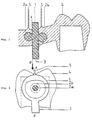
- FIG. 1 and 2 represent auxiliary parts made of a non-precious alloy which are made castable.
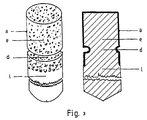
- FIG. 3 shows a castable root post according to the invention.
- cobalt, nickel, iron, chromium or niobium-based alloys are used as the non-precious alloy.
- Suitable deoxidizing agents are some metalloids, which can be partially diffusely diffused into the surface alloy grid and which have a sufficient deoxidizing effect in situ at sprue temperatures of around 1100 ° C to 1500 ° C (depending on the alloy). This ensures a perfect metallic fusion of the primary part and secondary part by means of sprue, so that the advantages of the sprue technique can also be used in the proposed method when using oxide-forming dental alloys, in particular when using non-precious alloys.
- a secondary part made of a non-precious alloy can be cast onto a primary part made of a non-precious alloy without difficulty. If desired, however, a secondary part made of a conventional gold alloy can also be cast onto the primary part according to the invention.
- the element boron is diffused into the primary part surface as a metalloid, even nickel-based alloys with up to about 2% aluminum content, which are characterized by particularly resistant passive and oxide layers, can be perfectly connected by sprue.
- Zintl phase e.g. B. chromium or other transition metals.
- the metalloid should only be physically incorporated into the surface lattice as an alloy component, without forming the following compounds of the type of the Zintl phases or hard materials according to stoichiometric or other chemical laws. Such phases or substances would lead to insulation layers and zones that thwart a gate.
- a halide can advantageously be used in the process according to the invention.
- Such as such. B. lithium fluoride forms with the metalloid a volatile and highly reactive metalloid-halide compound (z. B. boron or silicon fluoride), which is believed to be diffused into the metal surface under the process conditions after a place change mechanism.
- Halogen therefore apparently has a vehicle function in the process according to the invention. Due to the halogen attack, the reactants used can be induced particularly easily to the reaction desired according to the invention.
- the metalloid can be brought into the primary part surface by means of the halogen compounds, as well as the metalloid hydrogens.
- the poor manageability, as well as the toxicity of the metalloid halides, as well as metalloid hydrogens make the route of in-situ formation of the corresponding halogen compounds from the elements by use of a high-melting salt-like halide, preferably fluoride and a metal-metalloid phase, the easiest in the heat.
- the deoxidation of the primary part surface is effected via the elements boron, silicon or phosphorus itself, presumably in such a way that they diffuse into the surface metal lattice of the primary part as additional alloy components in the sense of a local microalloy.
- those compounds which are capable of releasing boron, phosphorus or silicon can also be used as the source of the three metalloids.
- the number and type of such usable connections is unmistakably large.
- the number of borides alone can hardly be overlooked, so that the person skilled in the art can use suitable table material to find suitable substances according to his special alloy requirements because of their less stable elementary crystal structure.
- the halogen addition mentioned can also bring about the desired reaction in those metalloid compounds which are regarded as "refractory" under other conditions; however, the reaction times can then be considerably longer than indicated above.
- Suitable metalloid phases are the silicides, borides and phosphides of all alkaline earth and subgroup metals, provided they are sufficiently heat and water resistant. Si-carbide and B-carbide are also suitable. For the doping of gold alloys, the heat resistance only needs to reach up to about 600 ° C, and should be at least 1000 ° C for non-precious and Pd alloys.
- the selection of the metalloid source is made so that a metal is chosen as the metallic partner of the metalloid phase, which occurs in the alloy to be doped anyway, or is very important for this.
- chromium borides and silicides are used in non-precious metal alloys, and copper phosphide is suitable for gold alloys.
- the metalloid boron, silicon and / or phosphorus only penetrates into the surface of the primary part made of non-precious alloy.
- the penetration depth is up to about 200 ⁇ m, in particular 0.1 to 50 ⁇ m, preferably 10 to 20 ⁇ m.
- the purification of the primary part after the reaction of residues and reaction products of the reactants is necessary because only structurally bound metalloid is desired on individual lattice sites in the surface, which in the theoretical ideal are lonely; because only this can Gate temperatures react. Residual residues of the reactants on the primary part surface interfere, since they react with one another as a result of chain and aggregate formation of the metalloid atoms. Most of them would therefore not be wettable for metals.
- the metalloid compounds can only be used as a source for the metalloid itself and therefore do not in any way remain on the surface of the primary part.
- micrographs of structures cast according to the invention show that the reaction products, insofar as they are soluble in the metal, are probably incorporated into the crystal structure as borides and are otherwise displaced from the sprue into the investment material in the form of insoluble slag.
- auxiliary parts made of non-precious alloys are made cast-on using the method according to the invention.
- the auxiliary part consists of an arbitrarily designed plate (1) of circular design, which carries at least one retention device 2a, 2b in the center on both sides and at least one anchoring arm 3, which in this case is arm-shaped as an example.
- the plate diameter is larger than that of the retention devices.
- the auxiliary part is worked in at the junction of the parts of the same denture to be cast in different alloys by means of sprue on both sides, where traditionally soldering, welding or gluing would have to be carried out.
- the auxiliary part is z. B.
- the retention devices 2a, 2b are completely and sufficiently dimensioned (at least 0.5 mm thick) from the modeling wax of the Scaffold as covered by connector 4.
- Scaffold and telescopic models have separate casting paths and risers 5. This creates a separate cavity system in the mold for each alloy. The spatial separation is brought about by the inserted auxiliary parts, which, by means of sprue on both sides, combine the dental prosthesis parts made in different alloys into a uniform whole as a modified one-piece casting without any special transfer or soldering process.
- a commercially available dental prosthesis component made of an oxide-forming alloy namely a root post for a crown core structure in the absence of a natural tooth crown
- the root portion 1 of the pin which can be sunk into the tooth root canal, only has to have a castable coating a in its portion close to the purchase surface. It can be offset from the crown part by a waist, so that the pin portion to be assigned to the waist becomes a connector d, which leads to the crown part of the pin e, which, as retention of the root pin, is cast onto a metallic crown structure of the replacement tooth (not shown).
- the connector d like the retention e, is constructed in two layers by applying a castable outer layer.
- the method according to the invention is described below by way of example for the castable finishing of the primary part surface with boron.
- the method is modified when using silicon or phosphorus, the latter expediently as a metal phosphide, for. B. copper or manganese phosphide can be handled.
- the boriding method is preferred because even aluminum-containing non-precious alloys, up to approx. 2% Al, become castable.
- amorphous boron is mixed with an aqueous, saturated lithium fluoride solution to form a paste of stain consistency and applied with a hair brush to the sprue surface of the primary part.
- the primary part thus prepared is heated in a technical vacuum of a rotor pump (residual pressure up to a maximum of 20 mbar is harmless) for 1 minute to about 900 to 950 ° C.
- the dental ceramic oven or a glass bulb which can be heated inductively with microwave energy can be used for this purpose.
- the boron remains and any trace of slag are removed until the metallic surface is exposed by blasting with corundum powder with a grain size of 25 ⁇ m and a jet pressure of 3 bar.
Landscapes
- Health & Medical Sciences (AREA)
- Oral & Maxillofacial Surgery (AREA)
- Dentistry (AREA)
- Epidemiology (AREA)
- Life Sciences & Earth Sciences (AREA)
- Animal Behavior & Ethology (AREA)
- General Health & Medical Sciences (AREA)
- Public Health (AREA)
- Veterinary Medicine (AREA)
- Dental Prosthetics (AREA)
Priority Applications (1)
| Application Number | Priority Date | Filing Date | Title |
|---|---|---|---|
| AT90906911T ATE97793T1 (de) | 1989-05-20 | 1990-05-17 | Zahntechnisch-prothetisches angussverfahren und primaerteil hierfuer. |
Applications Claiming Priority (2)
| Application Number | Priority Date | Filing Date | Title |
|---|---|---|---|
| DE3916562 | 1989-05-20 | ||
| DE3916562A DE3916562A1 (de) | 1989-05-20 | 1989-05-20 | Verfahren und hilfsteil zur herstellung einer zahntechnisch-prothetischen angussverbindung mit einer oxidbildenden legierung |
Publications (2)
| Publication Number | Publication Date |
|---|---|
| EP0472550A1 EP0472550A1 (de) | 1992-03-04 |
| EP0472550B1 true EP0472550B1 (de) | 1993-12-01 |
Family
ID=6381121
Family Applications (1)
| Application Number | Title | Priority Date | Filing Date |
|---|---|---|---|
| EP90906911A Expired - Lifetime EP0472550B1 (de) | 1989-05-20 | 1990-05-17 | Zahntechnisch-prothetisches angussverfahren und primärteil hierfür |
Country Status (7)
| Country | Link |
|---|---|
| US (1) | US5322110A (cs) |
| EP (1) | EP0472550B1 (cs) |
| CZ (1) | CZ281779B6 (cs) |
| DD (1) | DD294412A5 (cs) |
| DE (1) | DE3916562A1 (cs) |
| IL (1) | IL94441A (cs) |
| WO (1) | WO1990014053A1 (cs) |
Families Citing this family (8)
| Publication number | Priority date | Publication date | Assignee | Title |
|---|---|---|---|---|
| NO924697D0 (no) * | 1992-12-04 | 1992-12-04 | Jan Erik Ellingsen | Kirurgisk implantat og en fremgangsmaate for behandling avkirurgisk implantat |
| DE4431627A1 (de) * | 1994-09-06 | 1996-03-07 | Krupp Medizintechnik | Gegossener prothetischer Zahnersatz und Verfahren zu seiner Herstellung |
| US6503271B2 (en) * | 1998-01-09 | 2003-01-07 | Cordis Corporation | Intravascular device with improved radiopacity |
| FR2806336B1 (fr) * | 2000-03-20 | 2004-01-16 | Raymond Tarrisse | Procede de realisation d'assemblages separables par surcoulee directe d'un alliage metallique sur une piece egalement metallique, et produits tels que protheses dentaires composites ainsi obtenus |
| US20090068016A1 (en) * | 2007-04-20 | 2009-03-12 | Honeywell International, Inc. | Shrouded single crystal dual alloy turbine disk |
| DE102008037456B4 (de) * | 2008-10-16 | 2011-03-03 | Carsten Sobczik | Vorrichtungen und Verfahren zur Herstellung polylegierter Schmuckgegenstände |
| DE102009044282A1 (de) | 2009-10-18 | 2011-05-05 | Carsten Sobczik | Vorrichtung und Verfahren zur Herstellung polylegierter Schmuckgegenstände |
| RU2713968C2 (ru) * | 2016-02-11 | 2020-02-11 | Бредент Гмбх Унд Ко.Кг | Способ изготовления зубного протеза |
Family Cites Families (11)
| Publication number | Priority date | Publication date | Assignee | Title |
|---|---|---|---|---|
| FR1344711A (fr) * | 1963-01-18 | 1963-11-29 | Procédé et dispositif perfectionné pour montage de dents artificielles esthétiques et interchangeables en prothèse dentaire | |
| JPS54160520A (en) * | 1978-06-10 | 1979-12-19 | Nippon Tungsten | Metal enclosing casting by niip alloy paste |
| US4450886A (en) * | 1980-07-14 | 1984-05-29 | Nakamura Kinzoku Kogyosho, Inc. | Method of producing suction manifolds for automobile engines |
| JPS5844949A (ja) * | 1981-09-09 | 1983-03-16 | Sumitomo Metal Ind Ltd | 鋼片の製造方法 |
| SU1131594A1 (ru) * | 1983-02-01 | 1984-12-30 | Белорусский Ордена Трудового Красного Знамени Политехнический Институт | Способ получени биметаллических отливок из сплавов на основе железа |
| US4494287A (en) * | 1983-02-14 | 1985-01-22 | Williams International Corporation | Method of manufacturing a turbine rotor |
| JPS59174262A (ja) * | 1983-03-23 | 1984-10-02 | Chobe Taguchi | 銅合金と鋳鉄の溶着法 |
| JPH0647163B2 (ja) * | 1986-01-27 | 1994-06-22 | 株式会社豊田中央研究所 | 複合アルミニウム部材の製造方法 |
| DE3622511A1 (de) * | 1986-07-04 | 1988-01-07 | Paul Rosenhain | Verfahren zum aufgiessen eines metallkoerpers auf einen anderen metallkoerper |
| US4895516A (en) * | 1987-10-14 | 1990-01-23 | Hulten Johan O | Intermediate ceramic bonding layer for bonding of a resin to an alloy structure or substructure |
| DE8801574U1 (de) * | 1988-02-08 | 1988-07-14 | Tretschoks, Ursula, 8000 München | Gießform für Metall- oder Glasschmelzen |
-
1989
- 1989-05-20 DE DE3916562A patent/DE3916562A1/de active Granted
-
1990
- 1990-05-17 EP EP90906911A patent/EP0472550B1/de not_active Expired - Lifetime
- 1990-05-17 WO PCT/DE1990/000370 patent/WO1990014053A1/de not_active Ceased
- 1990-05-17 US US07/773,589 patent/US5322110A/en not_active Expired - Fee Related
- 1990-05-18 DD DD90340817A patent/DD294412A5/de not_active IP Right Cessation
- 1990-05-18 CZ CS902445A patent/CZ281779B6/cs not_active IP Right Cessation
- 1990-05-18 IL IL9444190A patent/IL94441A/en not_active IP Right Cessation
Also Published As
| Publication number | Publication date |
|---|---|
| DE3916562C2 (cs) | 1991-05-29 |
| DE3916562A1 (de) | 1990-11-22 |
| CZ281779B6 (cs) | 1997-01-15 |
| CS244590A3 (en) | 1992-03-18 |
| EP0472550A1 (de) | 1992-03-04 |
| DD294412A5 (de) | 1991-10-02 |
| IL94441A (en) | 1996-05-14 |
| WO1990014053A1 (de) | 1990-11-29 |
| US5322110A (en) | 1994-06-21 |
| IL94441A0 (en) | 1991-03-10 |
Similar Documents
| Publication | Publication Date | Title |
|---|---|---|
| DE2632871C3 (de) | Porzellanüberzogene Metallkrone und Verfahren zu ihrer Herstellung | |
| DE2531113C2 (de) | Verfahren zur Herstellung eines Metall-Keramik-Zahnersatzes | |
| EP0270084B1 (en) | Method and material for dental structures | |
| EP0168868B1 (de) | Verfahren zum Aufbringen einer schutzoxydbildende Elemente enthaltenden Korrosionsschutzschicht auf den Grundkörper einer Gasturbinenschaufel und Korrosionssschutzschicht auf dem Grundkörper einer Gasturbinenschaufel | |
| EP0214341B1 (de) | Verfahren zur Herstellung eines metallischen Zahnersatzes | |
| DE60118246T2 (de) | Diffusionslötlegierung auf nickelbasis und verfahren zur reparatur von superlegierungen | |
| EP0055383B1 (de) | Aufsinterbare Grundmasse zur Herstellung einer Zwischenschicht zwischen einer hochschmelzenden Dentalmetall-Legierung und Zahnporzellan | |
| DE602004010296T2 (de) | Pulver zur herstellung von edelmetallprodukten durch freiformherstellung und produkte | |
| EP0397117B1 (en) | Method and material for dental structures | |
| DE3237776A1 (de) | Verfahren zur ausfuellung von rissen in einem aus einer superlegierung bestehenden gegenstand | |
| DE2514672A1 (de) | Prothetische gegenstaende und hierfuer geeigneter werkstoff | |
| DE2729488A1 (de) | Herstellungsverfahren fuer kuenstliche zaehne oder zahnteile | |
| WO1990014053A1 (de) | Zahntechnisch-prothetisches angussverfahren und primärteil hierfür | |
| US4814008A (en) | Dental material | |
| DE69703947T2 (de) | Verbindung siliciumcarbidhaltiger keramischer Materialien durch Hartlötung | |
| DE3742134C2 (de) | Verbundschichtkronen zur Wiederherstellung von Zahnkronen | |
| DE3512118A1 (de) | Verfahren zur erzeugung einer verbesserten feinkoernigkeit des primaergefueges und/oder des eutektikums von gussteilen | |
| US6027012A (en) | Method for making metal frameworks for dental protheses | |
| DE4001057C2 (de) | Verfahren zur Trennschichtbildung in der Aufgußtechnik | |
| DE972452C (de) | Verfahren zum Herstellen einer vakuumdichten Verbindung von Keramik mit den Metallen Aluminium, Magnesium oder deren Legierungen | |
| DE2620056C2 (de) | Verfahren zur Herstellung von Zahnprothesen | |
| DEG0016958MA (cs) | ||
| DE3903427C2 (cs) | ||
| DE2603859A1 (de) | Dentallot | |
| CH191495A (de) | Verfahren zum Herstellen von Verbindungen keramischer Körper miteinander oder mit metallischen Körpern. |
Legal Events
| Date | Code | Title | Description |
|---|---|---|---|
| PUAI | Public reference made under article 153(3) epc to a published international application that has entered the european phase |
Free format text: ORIGINAL CODE: 0009012 |
|
| 17P | Request for examination filed |
Effective date: 19911115 |
|
| AK | Designated contracting states |
Kind code of ref document: A1 Designated state(s): AT CH IT LI SE |
|
| 17Q | First examination report despatched |
Effective date: 19921229 |
|
| GRAA | (expected) grant |
Free format text: ORIGINAL CODE: 0009210 |
|
| AK | Designated contracting states |
Kind code of ref document: B1 Designated state(s): AT CH IT LI SE |
|
| REF | Corresponds to: |
Ref document number: 97793 Country of ref document: AT Date of ref document: 19931215 Kind code of ref document: T |
|
| ITF | It: translation for a ep patent filed | ||
| PLBE | No opposition filed within time limit |
Free format text: ORIGINAL CODE: 0009261 |
|
| STAA | Information on the status of an ep patent application or granted ep patent |
Free format text: STATUS: NO OPPOSITION FILED WITHIN TIME LIMIT |
|
| 26N | No opposition filed | ||
| EAL | Se: european patent in force in sweden |
Ref document number: 90906911.4 |
|
| PGFP | Annual fee paid to national office [announced via postgrant information from national office to epo] |
Ref country code: SE Payment date: 19950522 Year of fee payment: 6 |
|
| PG25 | Lapsed in a contracting state [announced via postgrant information from national office to epo] |
Ref country code: SE Effective date: 19960518 |
|
| EUG | Se: european patent has lapsed |
Ref document number: 90906911.4 |
|
| PGFP | Annual fee paid to national office [announced via postgrant information from national office to epo] |
Ref country code: AT Payment date: 19970528 Year of fee payment: 8 |
|
| PGFP | Annual fee paid to national office [announced via postgrant information from national office to epo] |
Ref country code: CH Payment date: 19970530 Year of fee payment: 8 |
|
| PG25 | Lapsed in a contracting state [announced via postgrant information from national office to epo] |
Ref country code: AT Free format text: LAPSE BECAUSE OF NON-PAYMENT OF DUE FEES Effective date: 19980517 |
|
| PG25 | Lapsed in a contracting state [announced via postgrant information from national office to epo] |
Ref country code: LI Free format text: LAPSE BECAUSE OF NON-PAYMENT OF DUE FEES Effective date: 19980531 Ref country code: CH Free format text: LAPSE BECAUSE OF NON-PAYMENT OF DUE FEES Effective date: 19980531 |
|
| REG | Reference to a national code |
Ref country code: CH Ref legal event code: PL |
|
| PG25 | Lapsed in a contracting state [announced via postgrant information from national office to epo] |
Ref country code: IT Free format text: LAPSE BECAUSE OF NON-PAYMENT OF DUE FEES;WARNING: LAPSES OF ITALIAN PATENTS WITH EFFECTIVE DATE BEFORE 2007 MAY HAVE OCCURRED AT ANY TIME BEFORE 2007. THE CORRECT EFFECTIVE DATE MAY BE DIFFERENT FROM THE ONE RECORDED. Effective date: 20050517 |