EP0462725B1 - Electronic mail handling in a multi-user environment - Google Patents
Electronic mail handling in a multi-user environment Download PDFInfo
- Publication number
- EP0462725B1 EP0462725B1 EP91305076A EP91305076A EP0462725B1 EP 0462725 B1 EP0462725 B1 EP 0462725B1 EP 91305076 A EP91305076 A EP 91305076A EP 91305076 A EP91305076 A EP 91305076A EP 0462725 B1 EP0462725 B1 EP 0462725B1
- Authority
- EP
- European Patent Office
- Prior art keywords
- protocol
- message
- messages
- user
- Prior art date
- Legal status (The legal status is an assumption and is not a legal conclusion. Google has not performed a legal analysis and makes no representation as to the accuracy of the status listed.)
- Expired - Lifetime
Links
- 238000000034 method Methods 0.000 claims description 25
- 238000006243 chemical reaction Methods 0.000 claims description 16
- 238000012545 processing Methods 0.000 claims description 7
- 238000004891 communication Methods 0.000 description 37
- 238000010586 diagram Methods 0.000 description 16
- 230000008569 process Effects 0.000 description 13
- 238000012546 transfer Methods 0.000 description 13
- 230000008520 organization Effects 0.000 description 11
- 230000005540 biological transmission Effects 0.000 description 3
- 230000035945 sensitivity Effects 0.000 description 3
- 238000013519 translation Methods 0.000 description 3
- 238000010200 validation analysis Methods 0.000 description 3
- 230000008901 benefit Effects 0.000 description 1
- 230000008859 change Effects 0.000 description 1
- 238000005516 engineering process Methods 0.000 description 1
- 238000012012 milestone trend analyses Methods 0.000 description 1
- 238000012986 modification Methods 0.000 description 1
- 230000004048 modification Effects 0.000 description 1
- 230000000717 retained effect Effects 0.000 description 1
Images




Classifications
-
- H—ELECTRICITY
- H04—ELECTRIC COMMUNICATION TECHNIQUE
- H04L—TRANSMISSION OF DIGITAL INFORMATION, e.g. TELEGRAPHIC COMMUNICATION
- H04L51/00—User-to-user messaging in packet-switching networks, transmitted according to store-and-forward or real-time protocols, e.g. e-mail
- H04L51/06—Message adaptation to terminal or network requirements
- H04L51/066—Format adaptation, e.g. format conversion or compression
-
- H—ELECTRICITY
- H04—ELECTRIC COMMUNICATION TECHNIQUE
- H04L—TRANSMISSION OF DIGITAL INFORMATION, e.g. TELEGRAPHIC COMMUNICATION
- H04L51/00—User-to-user messaging in packet-switching networks, transmitted according to store-and-forward or real-time protocols, e.g. e-mail
- H04L51/48—Message addressing, e.g. address format or anonymous messages, aliases
Definitions
- This invention relates generally to the exchange of messages between workstations on interconnected computer systems, a process commonly termed electronic mail handling.
- a typical workstation is the RISC System/6000 (RISC System/6000 is a trademark of IBM Corp.) workstation running the AIX (AIX is a trademark of IBM Corp.) operating system as described in detail by "IBM RISC System/6000 Technology", published 1990 by IBM Corporation, and a preferred embodiment of the invention described herein is particularly suitable for such a workstation.
- RISC System/6000 is a trademark of IBM Corp.
- AIX is a trademark of IBM Corp.
- the present invention contemplates all multi-user systems interconnected into a network, e.g. Internet and is in no way limited to a specific hardware platform, or software operating system.
- the open systems interconnect (OSI) standard utilizes a mail handling protocol known as X.400, while other mail handling systems utilize protocols such as simple mail transfer protocol (SMTP), and UNIX to UNIX copy protocol (UUCP). It is currently known to utilize an RFC-987 gateway which will convert an interpersonal message (IPM, which by definition is in the OSI, or X.400 mail format) from X.400 to communications protocols, such as Transmission Control Protocol (TCP), or the like.
- IPM interpersonal message
- TCP Transmission Control Protocol
- TCP/IP Transmission Control Protocol/Internet Protocol
- SMTP Transmission Control Protocol/Internet Protocol
- RFC-987 gateway When a message is received by an SMTP user via the RFC-987 gateway certain message header fields present in the X.400 mail may not be displayed to the SMTP mail recipient.
- a method of exchanging messages between users of first and second mail handling systems having respectively a first and second mail handling protocol, the messages having a message header comprising header fields and a message body comprising body parts, and the second protocol supporting one or more body parts and/or header fields not supported by the first protocol
- said method comprising the step of providing a common interface within said first mail handling system for processing messages originating with any of said users, a first route through the common interface converting between the first and second protocols, the method being characterised by: addressing said messages such that an address corresponding to a user of said first protocol may be mixed with an address corresponding to a user of said second protocol; providing a second route through the common interface enabling messages to pass through the interface without conversion, with the second route said common interface tolerating body parts and/or header fields in said messages corresponding to said second protocol, said body parts and/or header fields not being supported by said first protocol; recognizing that portion of said address corresponding to users of said second protocol; and routing messages via one of said routes through the interface
- a system for exchanging messages between users of at least a first and second mail handling system having respectively a first and second mail handling protocol, the messages having a message header comprising header fields and a message body comprising body parts, and the second protocol supporting one or more body parts and/or header fields not supported by the first protocol
- the system comprising a common interface for processing messages originating with any of said users, a first route through the common interface being arranged to convert between the first and second protocols, the system being characterised by: means for addressing said messages such that an address corresponding to a user of said first protocol may be mixed with an address corresponding to a user of said second protocol; the interface being arranged to provide a second route through the common interface which enables messages to pass through the interface without conversion, the common interface, by said second route, tolerating body parts and/or header fields in said messages corresponding to said second protocol, said body parts and/or header fields not being supported by said first protocol; means for recognizing that portion of said address corresponding to users of said second protocol; and means for routing
- a preferred embodiment of the invention provides a method for utilizing an RFC-987 gateway (RFC-822/X.400) as a means to realize a full Interpersonal Messaging (IPM) capability within a mail handling system.
- An extended RFC-987 gateway supports not only the predefined RFC-822/X.400 translation function, but also is capable of emitting a fully conforming X.400 IPM.
- This gateway capability coupled with an enhanced mail handler provides the user of this system the ability to process either RFC-822 or IPMs from a common mail queue and a single user interface.
- the preferred method and system provides two separate paths through the RFC-987 gateway such that a true interpersonal message function is present.
- a straight conversion between a RFC-822 and X.400 mail user messages is provided, as well as a validation feature wherein X.400 messages to be output are validated in RFC-987 (AIX, or other operating system specific mail handling syntax) form and do not have to be converted, but merely submitted to the X.400 message transfer agent (MTA) for output to the X.400 system.
- MTA message transfer agent
- the preferred system does not attempt to convert the message to RFC-822 form, but merely passes it to the sendmail component for processing.
- RFC-822 syntax is recognizable to a user of a SMTP mail handling system, since it is a mail syntax component which separates TCP communication protocol commands into a standard format for text messages.
- the RFC-987 gateway of the present invention also provides a path which allows users of a SMTP mail system to communicate with users of an X.400 mail handling system.
- the RFC-822 message addressed to an X.400 user will be converted into the proper X.400 form.
- X.400 mail addressed to SMTP users is converted into RFC-822 form for receipt by the TCP communications service.
- a sendmail host component is capable of recognizing X.400 addresses and routing the associated messages to the X.400 network or directly to another sendmail host, that in turn will route the message to the X.400 network.
- the present invention also extends the capability of the mail handler in two primary areas.
- the mail handler header must be extended to provide for the additional header fields present in an interpersonal message (X.400).
- the mail handler must be extended such that non-ASCII body parts can be tolerated. That is, a viewer of the message is made aware of the existence of non-ASCII data.
- the mail handling interface of the present invention also provides for mixed mode addressing. That is, X.400, TCP and UUCP addresses can compose a single destination address.
- the mixed addresses are read from left to right. A slash is utilized to delimit X.400 addresses in mixed addresses.
- the characters @, !, and : are still retained from prior art to delimit TCP and UUCP addresses.
- reference numeral 1 represents a local mail handling system as contemplated by the present invention.
- a mail handler 10 and sendmail component 12 are included.
- a local mail component 14 is shown interconnected to a mail queue 16 which is accessible by a user of the present invention through the user interface provided with the operating system being utilized.
- Simple mail transfer protocol (SMTP) communication 18 is provided and in communication with sendmail 12.
- TCP communication protocol 22 is provided and also in communication with SMTP 18.
- TCP 22 represents a family of communication protocols which is described in greater detail in the RFC (Request For Comments) documents published by the Internet Architecture Board (IAB), hereby incorporated by reference.
- the RFC-987 gateway 20 is provided and also in communication with sendmail 12 as well as message transfer agent 24, which is considered part of the X.400 network. MTA 24 is further shown as being connected to the open system interconnect (OSI) network 26. Reference numerals 28, 30 and 32 represent the additional features to mail handler 10, sendmail 12 and RFC-987 gateway 20, respectively, which are provided by the present invention. It should be noted that the present invention will be described with reference to mail communications between a SMTP (TCP) and X.400 (OSI) network, although other configurations of mail handling systems are contemplated by the present invention.
- SMTP SMTP
- OSI X.400
- FIG. 2 is a block diagram further showing the components of the present invention and their interconnection with components of other mail handling systems.
- the functionality for a user of the present invention to send and receive mail via mail handler 10, sendmail 12 and mail queue 16 is shown.
- a mail handler interface 42 is provided such that mail handler 10 can communicate directly with user agent layer 41, which includes sendmail 12, RFC 987 gateway 20.
- Sendmail 12 is connected to a mail queue,or or message store component 16 such that mail can be received and/or sent by a user of the mail handler system 10.
- sendmail 12 interconnects with RFC-987 gateway 20 and SMTP application protocol 18.
- sendmail 12 is interconnected with UNIX to UNIX copy protocol (UUCP) 38 which provides sendmail 12 with the capability of communicating with other mail handling systems interconnected to asynchronous network 36.
- UUCP 38 UNIX copy protocol
- MTA 24 are all considered in Figure 2 to be part of a layer denoted as mailers 19.
- TCP 22, ASYNC 36 and OSI 26 communication protocol represent the lowest layer of Figure 2.
- FIG 3 illustrates the new functionality (reference numeral 30 of Figure 1) provided by the present invention to sendmail 12 and RFC-987 gateway 20 (reference numeral 32 of Figure 1).
- RFC-987 gateway 20 now provides two functions, or paths through RFC-987 gateway 20, for users of either the SMTP or X.400 mail handling systems. First, it provides a path for mail from IPM X.400 users to the X.400 message transfer agent (MTA 24). It should be noted that MTA 24 represents the X.400 network and is considered a component of a overall OSI system. Therefore, once the message has been sent to MTA 24, it is considered to be received by the X.400 network.
- MTA 24 represents the X.400 network and is considered a component of a overall OSI system. Therefore, once the message has been sent to MTA 24, it is considered to be received by the X.400 network.
- gateway 20 provides a path and message conversion facilities for TCP or UUCP network users interconnected to the X.400 message transfer network. That is, TCP or UUCP users interconnected to the X.400 system through a conventional RFC-987 conversion gateway will be able to send messages, via MTA 24, for receipt by X.400 users of the present invention.
- the RFC-987 gateway 20 has been extended to allow the additional capability of providing not only a standard conversion between RFC-822 and X.400 mail users, but also provides the capability of a true IPM function, which is accomplished by defining the two logical paths between the RFC-987 gateway 20 and sendmail 12.
- the first path, X.400 path 13 is enabled when sendmail 12 places a message on its output queue in X.400 form.
- RFC-987 gateway 20 does not convert the message but merely completes validation checks to insure that the message is capable of being submitted to MTA 24.
- MTA 24 places these incoming messages, which are the responsibility of gateway 20, on the input queue for RFC-987 gateway 20. These messages are then recognized by gateway 20, due to the X.400 destination address, and no attempt is made to convert the message to RFC-822 form. The message is merely transferred to sendmail 12 for processing. When sendmail 12 sees an X.400 address received from gateway 20, the message is placed in local message queue 16 for the recipient specified in the address. After the message is received, the recipient will process this message using IPM mail handler 50, via interface 52.
- the second path 15 between gateway 20 and sendmail 12 provides a user of other communications protocols (such as TCP and UUCP) access to X.400 mail handling systems.
- Gateway 20 will convert an outgoing RFC-822 message addressed to a X.400 IPM user into the proper X.400 form. This message is then transferred through path 15 and MTA application programming interface 46 onto MTA 24 for distribution to the X.400 mail user.
- Path 15 also provides for incoming mail such that X.400 mail addressed to a user of a SMTP mail handling system is in the proper form to allow receipt by the SMTP user.
- the X.400 message is transmitted from MTA 24 through interface 46 and path 15 through gateway 20.
- Gateway 20 converts the X.400 message into RFC-822 format before transmitting the message to sendmail 12 through path 15.
- Sendmail 12 then distributes the SMTP formatted message into relay 48 for delivery to the SMTP user.
- Sendmail 12 had its configuration file modified from its standard implementation to allow X.400 style addresses to be processed. This extension allows sendmail 12 to process both RFC-822 and X.400 style addresses. It should be noted that RFC-822 addresses are often denoted as RFC-822 messages which indicate address syntax which is utilized to communicate with a user of SMTP application protocol. The present invention allows sendmail 12 to recognize X.400 addresses and route them directly to the X.400 network (via MTA 24), or to another sendmail host 12 for routing to the X.400 network by another MTA.
- sendmail 12 is extended to allow for X.400 mail requests.
- These extensions include a parser which is capable of recognizing X.400 addresses.
- a second extension includes adding function which defines the relay 48 to other sendmail components which are capable of handling the X.400 protocol.
- the ability of sendmail 12 to define a X.400 relay in the sendmail configuration file 30 is used to transfer X.400 mail traffic from a X.400 user over a TCP/IP network to sendmail 12 and a RFC-987 Gateway.
- An IPM host which is not directly connected to the X.400 network may still take advantage of the present invention so long as the relay 48 ( Figure 3) is defined and communication to sendmail 12 is achieved.
- Sendmail 12 with an updated configuration file 30 determines if the path of the X.400 mail being transmitted through RFC-987 gateway 20 is local or remote. Should an IPM be relayed by sendmail via the TCP communication network in order to reach the X.400 network, then the X.400 address identifier (X400) will be appended to the end of the original X.400 message by sendmail 12.
- Relay 48 when sending a X.400 mail request encapsulated in a RFC-822 message to a specified X.400 gateway, strips off the RFC-822 address and passes, via sendmail 12, the X.400 message to the RFC-987 gateway 20 and onto the X.400 message transfer agent 24.
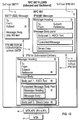
- FIG 4 illustrates in further detail mail handler 10 and its connection with sendmail 12, RFC-987 gateway 20 and MTA 24.
- the new features added by the present invention to mail handler 10 (reference numeral 28 Of Figure 1) which enables mail handler 10 to operate as an IPM-UA 40 requires extensions to its conventional capability in two primary areas.
- mail handler 10 must provide for the additional header fields that may be present in an interpersonal message.
- reference numeral 60 indicates a message heading block wherein the new header field of sensitivity, importance, obsolete, expiry date and reply to users are included and are not present in a conventional mail handler 10.
- Sensitivity refers to the nature of the message (urgent, normal, non-urgent), importance (low normal, high), obsoletes (IPM Message), expiry date, (a date in the future, mm/dd/yy, dd.mm.yy, or month day, year), and reply by (a date in the future, mm/dd/yy, dd.mm.yy, or month day, year).
- a display monitor such as a CRT, or the like
- a template may be used which will allow the user to generate addresses in the proper X.400 format.
- Reference numeral 60 is representative of a template which may be used by the present invention.
- a second extension to the mail handler 10 must be made such that a message body which is an other than ASCII text can be tolerated. That is a user viewing the message body is made aware of the existence of non- ASCII data such that the user can make provisions to process the non-ASCII data outside of the mail handling environment.
- Reference numeral 62 on Figure 4 represents message body parts wherein body part one shows the ASCII text which will be displayed, a forwarded message part and body part 3 which may include non-ASCII data, such as binary. In this manner, it can be seen how multi-body parts can be handled by the increased functionality of mail handler 10 in accordance with the sending of interpersonal messages (IPM).
- IPM interpersonal messages
- the two paths between the RFC-987 gateway 20 and sendmail 12 can be seen wherein the X.400 message can be input to MTA 24 and then passed through gateway 20, via path 13, to sendmail 12 for processing as an IPM X.400 message. Additionally, the X.400 message from the MTA 24 can be converted in RFC-987 gateway 20 and output through path 15 as an RFC-822 message to sendmail 12 and ultimately to users of SMTP mail handling systems, in a manner previously described.
- FIG. 5 is a schematic diagram representative of a multiple-user mail handling system using different communication protocols (specifically TCP and OSI) and the interconnection therebetween.
- user A represents a mail handling system of the present invention and is noted by reference numeral 70 as the gateway host interface which encompasses the present invention and includes a mail handling layer 10 with both a RFC-822 and an IPM-UA mail syntax component as well as sendmail component 12.
- Local mail box and associated mail queue 14 for X.400 and RFC-822 messages is provided along with relay 48, defined by the extensions to sendmail 12, as previously discussed.
- RFC-987 gateway 20, MTA 24 and OSI component 26 are also provided as well as TCP stack 22.
- Additional MTAs 24h and 24d are interconnected with communications links 25,27 and represent the X.400 communication network.
- User agent 54 is also provided and associated with a user H in Figure 5.
- the X.400 network is representative of an administrative domain (ADMD) this notation being a parameter utilized by a X.400 mail handling system for addressing messages.
- User B is representative of a X.400 mail system user, i.e. IPM user at mail handler 10B in conjunction with a conventional sendmail 12 and TCP stack 22.
- User B utilizes TCP communication protocol 22 for checking local mail 14 for any incoming X.400 messages.
- the X.400 messages can be received by a user with a configuration as shown in conjunction with user B when placed in local mail 14.
- TCP protocol is utilized.
- user C is a SMTP mail handling system user and includes in its associated configuration of components, mail handler 10 with RFC-822 syntax, sendmail 12 and TCP stack 22.
- Communications link 58 interconnects user A, B and C to a private domain network (PRMD) such as may be used internally by a university or corporation and is noted by reference numeral 56.
- PRMD private domain network
- country US
- a user must be familiar with X.400 addressing, even if connected to a SMTP system. Each address must contain enough information to ensure that only a single user in the X.400 domain is identified. Ambiguous addresses will result in non-delivery of messages. Proper originator/recipient addresses must be provided for the To:, cc:, bcc:, reply to:, from: identifiers and the like. The From: address will often be derived from the user's personal name (PN) and additional address components established by the local system.
- PN personal name
- Figure 6 represents a process whereby user A ( Figure 5) sends an IPM to X.400 user H.
- reference numeral 100 indicates the addresses which must be generated by user A.
- the originating address also notes US as the country, ptt as the administrative domain (ADMD), a private domain (PRMD) noted as co indicating a company (any company name could be substituted).
- the organization (O) is noted as a city (which often times may be designated as a plant or company location city).
- the organization unit (OU) is noted as department A (depta) which corresponds to user A (any organization unit such as user IDs, names and the like can be used in this portion of the address).
- personal name (PN) is noted as A, since user A is sending the message.
- sendmail 12 recognizes the address generated for user H as a X.400 address and routes the message to RFC-987 gateway 20 (reference numeral 101, Figure 6).
- Block 102 indicates the conversion from ASCII text to abstract syntax notation version 1 SN.1 protocol data units and further submits this data to message transfer agent 24.
- MTA 24 accepts the data from RFC-987 gateway 20 and notes the originator address, i.e. country, ADMD, PRMD, organization, organization unit and personal name.
- the recipients X.400 address is also noted by gateway 20, i.e. country, ADMD and personal name.
- This information is then relayed to MTA 24h on the X.400 network that is responsible for addresses corresponding to user H (reference numeral 104).
- Another message transfer agent 24d as shown in Figure 5 receives the address information as noted above for delivery of the mail to the IPM user H.
- the message is delivered to user H, the message including the recipient address, originator address, header and body parts, which make up the bulk of the communication.
- FIG. 1 An example of the transmission of a message generated by user A through the SMTP mail system (mail handler 10) to user H will now be described.
- the address for user H is generated by user A utilizing the components of host gateway 70 including mail handler 10 as noted in Figure 5.
- Reference numeral 110 of Figure 7 represents the address for user H which is identical to the address previously discussed with reference to Figure 6.
- the originating address for user A is generated RFC-822 syntax. It can be seen that the originating address differs from that of Figure 6 in that the RFC-822 address for user A is shown as A@depta.city.com.
- the originating address as shown in block 110 of Figure 7 is in RFC-822 syntax.
- the depta.city.com syntax represents tokens which are used to identify a specific user.
- Tokens are separated by periods, or "dots" and identify the user specified to the left of the "@" or (a) character. Tokens are issued from a centralized registration authority to an organization which represents a group of users operating within a domain or responsibility. It can be seen that registration authority is delegated to a lower level of detail as the address is read from right to left. For example, in block 110 the right token (com) indicates commercial organization; the middle token city, or location; and the left token a department. Left of the "@" character is the user being identified, in this case, user A.
- Sendmail 12 recognizes the address for user H as an X.400 address and routes the message to RFC-987 gateway 20 in the same manner as discussed with reference to Figure 6.
- RFC-987 gateway 20 then translates the RFC-822 message (which is generated by the RFC-822 mode of mail handler 10) into ASN.1 and encodes the delivery information, message header and body parts protocol data units for submission to MTA 24.
- the recipient address remains identical to that described in block 110 above.
- the message is then relayed from MTA 24 to MTA 24h via communications link 25 (block 114).
- the message is then further transferred via communication link 27 to message transfer agent 24d which will deliver the message to IPM user agent 54, for user H.
- the addresses utilized in blocks 114 and 115 are identical to those described above reference to block 113.
- the delivery of the message from the SMTP mail user A to IPM X.400 user H occurs with the addresses and the body parts being included as discussed above. It can be seen from the previous two examples, how two paths exist between RFC-987 gateway 20 and sendmail 12.
- user A can send a X.400 message through mail handler 10 (IPM mode), sendmail 12, RFC-987 gateway 20 and onto MTA 24.
- user A can send a RFC-822 message through mail handler 10 (in RFC-822 mode), sendmail 12, RFC-987 gateway 20 an onto message transfer agent 24.
- mail handler 10 (in IPM mode) for user B generates a message to be delivered to user H at user agent 54.
- the address for user H is shown and is identical to those previously shown in reference to Figures 6 and 7.
- the originating address for user B is shown in X.400 form with the country being the US, ADMD being ptt, the PRMD being co, for company, organization (O) as city, and organization unit (OU) as deptb (department B) with the personal name (PN) noted as B, for user B.
- This message is then transmitted to the sendmail 12B adjacent to mail handler 10.
- Block 121 of Figure 8 illustrates the functionality which occurs in sendmail 12B.
- the X.400 mail message is encapsulated in RFC-822 headers such that it may be sent via the SMTP connection, included in TCP stack 22b, to the gateway sendmail 12.
- the address of gateway sendmail 12 in RFC-822 syntax, is appended to the address for user H noted in block 120. That is, /@depta.city.com is attached to the original To: address (in block 120) which routes this message to the user A host gateway 70.
- the originating address now includes a RFC-822 header which shows that the message is from user B, ...B/@deptb.city.com.
- This RFC-822 address is then transferred via TCP stack 22b ( Figure 5) through communications link 58 and onto network 56 and on to sendmail 12 which recognizes the X.400 portion of the address and routes the message to RFC-987 gateway 20 for ASN.1 encoding, as previously noted.
- Block 123 indicates the conversion which occurs at RFC-987 gateway 20, wherein a conversion from ASCII text to the ASN.1 protocol data units is implemented and the message is then submitted to MTA 24, as noted by reference 124 on Figure 8.
- MTA 24 accepts the converted protocol data units from RFC-987 gateway 20 and puts the originating address and recipient address back into the X.400 form.
- MTA 24 relays the X.400 to next MTA 24h via communications link 25, which in turn transmits the message to MTA 24d via communication link 27, as noted by blocks 125 and 127, respectively.
- MTA 24d delivers the message to user H, the message including the recipient address, originator address, header and body parts.
- IPM X.400 user H desires to send a message to user C which is connected to a SMTP mail handling system.
- the message is addressed by user H with the X.400 format being utilized , i.e. country is US, ADMD is ptt, PRMD is company (co) and the domain defined (DD) is for a user of a SMTP system, i.e. user C(C(a) deptc.city.COM).
- the originating address is in the X.400 format as discussed previously with reference to Figures 6-8.
- MTA 24d for user H accepts the submitted message from UA 54 and creates the protocol data units and encodes the message into ASN.1 form, which is the abstract syntax notation that places binary headers around the message in order to transmit it through the X.400 network.
- the originator and recipient addresses remain the same in block 131, as previously discussed with reference to block 130.
- the message is then transmitted via communication link 27 to MTA 24h which is now responsible for the incoming mail for user C, as noted at block 132.
- MTA 24 accepts the transmitted message from the MTA 24h off of communication link 25 and delivers the X.400 message to the RFC-987 gateway 20 at block 134.
- the X.400 message is considered by the present invention to be delivered to User C at the time it is transferred from MTA 24 to RFC-987 gateway 20.
- RFC-987 gateway 20 translates the X.400 message into RFC-822 format and decodes the ASN.1 information before passing the message to sendmail 12.
- RFC-987 gateway 20 changes the recipient address into RFC-822 format and appends a RFC-822 address onto the X.400 originating address such that the SMTP user C can recognize the sender as being user H.
- Block 135 sends the newly translated RFC-822 message from sendmail 12 to the sendmail 12c located locally with user C.
- sendmail 12c then places the message from X.400 user H in the mailbox for SMTP user C.
- Figure 10 illustrates the reverse situation where SMTP user C desires to send a message to X.400 user H.
- user C addressed the message in X.400 format and uses RFC-822 format for the originating address.
- the message is then sent to sendmail 12c (see block 141) which encapsulates the message in RFC-822 syntax with headers that will allow the message to be sent via the TCP/SMTP network to the gateway host 70.
- the sendmail 12 recognizes the message as having an X.400 address and routes the message to the RFC-987 gateway 20 for encoding into the ASN.1 format.
- the MTA 24 associated with gateway host 70 accepts the encoded message from RFC-987 gateway 20 and relays the message, with addresses now being in the X.400 format (block 144), to the MTA 24h via communication link 25 (block 145).
- MTA 24d receives the X.400 message from communication link 27 and delivers the message to user H, as noted by blocks 146 and 147. It should be noted that the originating and recipient addresses did not change after translation occurred at block 143.
- User C addresses a message for recipient user A using RFC-822 format, as noted by block 150.
- User C also uses the RFC-822 format for the originating address, since user C is aware of the recipient and knows the message will be travelling only in the TCP/SMTP network.
- the message is delivered to the sendmail 12c for user C and then transmitted to sendmail 12 via the SMTP connection.
- Send mail 12 then places the message, without any need for translation, in the local mail queue 14 for user A (block 152).
- the present invention utilizes mixed mode addressing format, i.e. RFC-822 and X.400 addresses are used in conjunction with one another.
- This mixed mode addressing is accomplished in the same manner as is currently known in the art, with parsing done from right to left.
- one X.400 address cannot route a message to another X.400 address, i.e there cannot be consecutive X.400 addresses in the destination address.
- Message transfer agents are utilized by the present invention to accomplish source routing between X.400 locations.
- a slash is utilized in addressing messages in the system of the present invention as a separator, or delimiter for X.400 addresses.
- the only changes required to be made in order to achieve X.400 addressing capability in a mixed mode environment are to the re-write rules for the sendmail configuration file component and do not require changes to the code itself. Additional examples of mixed mode addresses will now be provided.
- Address (2) is a valid address containing two non-adjacent X.400 addresses, which is acceptable in the mixed mode addressing environment of the present invention.
- gateway host 70 acts to prepend address information for messages transmitted from the TCP/SMTP network to the OSI network with the proper X.400 information, as the messages travels downwardly through the layers of gateway host 70.
- the prepended messages are stripped off as they travel upwardly through the layers of gateway host 70. In this manner the present invention allows for communication between users of different systems by altering the addresses associated with the messages.
- RFC-987 gateway 20 is shown with an IPM message input from MTA API 46 and MTA 24.
- This message contains a heading 65 and three body parts consisting of ASCII text 66, forwarded message 67 and binary data 68. Since the message 64 is in X.400 form, it can he transferred as is without any conversion through the IPM path 13 and ultimately to an IPM mail handler such as IPM MH 50 ( Figure 5). It can he seen that heading 65 and body parts 66,67,68 of message 64 exactly correlate to the IPM message as shown in Figure 12 by reference numeral 69.
- the message 64 may not he sent to the SMTP mail handling system because it contains non-ASCII body parts (reference numerals 67 and 68) It can be seen that an SMTP message 79 does not provide for three types of body parts, i.e. only IA5 (including ASCII) text will be accepted. Thus, the message 64 as shown in Figure 12 has only one path 13 upon which it can be transferred. Although, message 64 can not be transferred to SMTP path 15, an IPM message containing only ASCII text will be processed into SMTP form (shown by SMTP message 79) and will be delivered to a SMTP mail handler, such as shown by reference numeral 10 of Figure 5. Conversely, an outbound message from SMTP mail handler 10 to RFC-987 gateway 20 will be sent, but only with the ASCII text message.
- FIG. 13 is a process diagram illustrating the processes implemented by the present invention to provide the two paths between RFC-987 gateway 20 and the SMTP and X.400 mail handlers.
- RFC-987 gateway 20 accepts the messages from sendmail 12.
- the RFC-987 gateway 20 converts these messages to or from the RFC-822 format and processes them (block 163).
- Messages received from the SMTP mail handler are converted to X.400 format and encoded at block 165.
- the messages are transferred directly to the encoding portion of the process (block 164), since no conversion between X.400 and SMTP format is required.
- the RFC-987 gateway 20 generates, at block 166, an ASN.1 encoded message for outbound mail.
- the ASN.1 encoded message is decoded (block 167).
- the message text is decoded and converted into RFC-822 format.
- FIG 14 is a block diagram illustrating the improvements by the present invention to the sendmail component of the mail handling system.
- the new functionality is shown by reference numeral 30, which is part of the sendmail configuration file.
- sendmail file 30 includes standard TCP/IP, UUCP and standard mixed mode addressing rules.
- the sendmail configuration file 30 also now includes the new X.400 addressing rules and extended mixed mode addressing rules such that X.400 addresses are usable in a mixed mode environment.
- the implementation of the new X.400 addressing rules have been previously described with reference to Figure 4. That is, the message heading 60 now includes headers for: sensitivity; importance; obsoletes; expiry date; and reply to users. Similarly, the implementation of the extensions to mixed mode addressing have been illustrated by the examples previously discussed.
- Paths 13, 15 between sendmail 12 and RFC-987 gateway 20 are shown and in communication with paths "a","b", respectively.
- path 13 in conjunction with path "a", through sendmail 12
- path "b” allows the conversion of an IPM message into RFC-822 format.
- path 15 and path "b" through sendmail 12 allow the IPM message (converted for receipt by a SMTP user) to be transferred to a SMTP mail handler.
- mail handler 10 of the present invention implements a send subroutine, such as "sendsbr()", which is a collection of routines used to help send messages, i.e. mail handling routines.
- the send subroutine then calls another subroutine "post()", or "spost()" (block 181).
- Figure 15 shows how the message is validated by the "post()", or "spost()" routines (block 181) and then passed to the X.400 field check routine (block 182) before being sent to the sendmail.
- the present invention is able to validate outgoing messages for both the X.400 and SMTP format.
Landscapes
- Engineering & Computer Science (AREA)
- Computer Networks & Wireless Communication (AREA)
- Signal Processing (AREA)
- Computer And Data Communications (AREA)
- Data Exchanges In Wide-Area Networks (AREA)
- Information Transfer Between Computers (AREA)
- Small-Scale Networks (AREA)
- Communication Control (AREA)
Applications Claiming Priority (2)
| Application Number | Priority Date | Filing Date | Title |
|---|---|---|---|
| US07/539,935 US5278955A (en) | 1990-06-18 | 1990-06-18 | Open systems mail handling capability in a multi-user environment |
| US539935 | 1990-06-18 |
Publications (3)
| Publication Number | Publication Date |
|---|---|
| EP0462725A2 EP0462725A2 (en) | 1991-12-27 |
| EP0462725A3 EP0462725A3 (enExample) | 1994-04-20 |
| EP0462725B1 true EP0462725B1 (en) | 1997-09-03 |
Family
ID=24153267
Family Applications (1)
| Application Number | Title | Priority Date | Filing Date |
|---|---|---|---|
| EP91305076A Expired - Lifetime EP0462725B1 (en) | 1990-06-18 | 1991-06-05 | Electronic mail handling in a multi-user environment |
Country Status (4)
| Country | Link |
|---|---|
| US (1) | US5278955A (enExample) |
| EP (1) | EP0462725B1 (enExample) |
| JP (1) | JPH07112196B2 (enExample) |
| DE (1) | DE69127514T2 (enExample) |
Families Citing this family (52)
| Publication number | Priority date | Publication date | Assignee | Title |
|---|---|---|---|---|
| US20020004812A1 (en) | 1997-06-26 | 2002-01-10 | Tetsuro Motoyama | Method and system for diagnosis and control of machines using connectionless modes having delivery monitoring and an alternate communication mode |
| JP2827521B2 (ja) * | 1991-02-06 | 1998-11-25 | 富士ゼロックス株式会社 | 電子メールシステム |
| US5579467A (en) * | 1992-05-27 | 1996-11-26 | Apple Computer, Inc. | Method and apparatus for formatting a communication |
| US5550976A (en) * | 1992-12-08 | 1996-08-27 | Sun Hydraulics Corporation | Decentralized distributed asynchronous object oriented system and method for electronic data management, storage, and communication |
| JPH06216935A (ja) * | 1993-01-18 | 1994-08-05 | Fujitsu Ltd | 電子メールシステム |
| DE4402856A1 (de) * | 1994-01-31 | 1995-08-10 | Sel Alcatel Ag | Verfahren zum Versenden von Briefen, sowie Teilnehmerstation, Konverterstation und Briefversendeeinrichtung |
| DE4403626A1 (de) * | 1994-02-05 | 1995-08-10 | Alcatel Network Services Deuts | Verfahren zum Versenden von Dokumenten, sowie Teilnehmerstationen und Konverterstation dafür |
| US5550984A (en) * | 1994-12-07 | 1996-08-27 | Matsushita Electric Corporation Of America | Security system for preventing unauthorized communications between networks by translating communications received in ip protocol to non-ip protocol to remove address and routing services information |
| US5850518A (en) * | 1994-12-12 | 1998-12-15 | Northrup; Charles J. | Access-method-independent exchange |
| US5710883A (en) * | 1995-03-10 | 1998-01-20 | Stanford University | Hypertext document transport mechanism for firewall-compatible distributed world-wide web publishing |
| JP3649769B2 (ja) * | 1995-03-17 | 2005-05-18 | 富士通株式会社 | 情報処理システムの切替え装置 |
| US5742845A (en) | 1995-06-22 | 1998-04-21 | Datascape, Inc. | System for extending present open network communication protocols to communicate with non-standard I/O devices directly coupled to an open network |
| US5896533A (en) * | 1995-07-06 | 1999-04-20 | Intel Corporation | Accessing internets world-wide web through object linking and embedding technology |
| JPH0954736A (ja) * | 1995-08-15 | 1997-02-25 | Kyushu Nippon Denki Software Kk | ファイルサーバシステム環境におけるosi実装方法 |
| US5926636A (en) * | 1996-02-21 | 1999-07-20 | Adaptec, Inc. | Remote procedural call component management method for a heterogeneous computer network |
| US6072862A (en) * | 1996-07-02 | 2000-06-06 | Srinivasan; Thiru | Adaptable method and system for message delivery |
| US5781902A (en) * | 1996-07-12 | 1998-07-14 | Microsoft Corporation | Method, computer program product, and system for extending the capabilities of an existing process to store and display foreign data |
| US6108689A (en) * | 1996-10-11 | 2000-08-22 | International Business Machines Corporation | Method and system for processing messages in a distributed computing environment |
| DE19717948C2 (de) * | 1997-04-29 | 2003-07-31 | Deutsche Telekom Ag | Verfahren zur Übertragung von Informationen |
| US6035326A (en) * | 1997-05-07 | 2000-03-07 | International Business Machines Corporation | Mapping table lookup optimization system |
| WO1998058321A1 (en) * | 1997-06-17 | 1998-12-23 | Purdue Pharma Lp | Self-destructing document and e-mail messaging system |
| US5864827A (en) * | 1997-06-27 | 1999-01-26 | Belzberg Financial Markets & News International Inc. | System and method for providing an information gateway |
| US6195686B1 (en) * | 1997-09-29 | 2001-02-27 | Ericsson Inc. | Messaging application having a plurality of interfacing capabilities |
| KR100285122B1 (ko) * | 1999-01-13 | 2001-03-15 | 이수복 | 인터넷 전자우편 부가 서비스 시스템 |
| GB2345828A (en) * | 1999-01-16 | 2000-07-19 | Ibm | Clustering message switches |
| US6718367B1 (en) * | 1999-06-01 | 2004-04-06 | General Interactive, Inc. | Filter for modeling system and method for handling and routing of text-based asynchronous communications |
| US6601088B1 (en) * | 1999-06-23 | 2003-07-29 | International Business Machines Corporation | User controlled e-mail deletion |
| US6549937B1 (en) * | 1999-07-21 | 2003-04-15 | Microsoft Corporation | System and method for multi-protocol communication in a computer network |
| US6609156B1 (en) | 1999-12-29 | 2003-08-19 | Unisys Corporation | Method and apparatus for reducing redundant multiple recipient message handling in a message handling system |
| EP1137236A1 (en) * | 2000-03-24 | 2001-09-26 | BRITISH TELECOMMUNICATIONS public limited company | Processing network address identifiers |
| EP1137235A1 (en) | 2000-03-24 | 2001-09-26 | BRITISH TELECOMMUNICATIONS public limited company | Processing network communication control messages |
| JP2002024394A (ja) * | 2000-07-11 | 2002-01-25 | Fuji Photo Film Co Ltd | 医用画像集中管理システムおよび方法並びに記録媒体 |
| US6993506B2 (en) | 2000-12-05 | 2006-01-31 | Jgr Acquisition, Inc. | Method and device utilizing polymorphic data in e-commerce |
| US7681032B2 (en) * | 2001-03-12 | 2010-03-16 | Portauthority Technologies Inc. | System and method for monitoring unauthorized transport of digital content |
| US8478824B2 (en) * | 2002-02-05 | 2013-07-02 | Portauthority Technologies Inc. | Apparatus and method for controlling unauthorized dissemination of electronic mail |
| US7298836B2 (en) * | 2002-09-24 | 2007-11-20 | At&T Bls Intellectual Property, Inc. | Network-based healthcare information systems |
| US7376704B2 (en) * | 2002-09-24 | 2008-05-20 | At&T Delaware Intellectual Property, Inc. | Methods, systems, and products for converting between legacy systems |
| US20040117450A1 (en) * | 2002-12-13 | 2004-06-17 | Campbell David T. | Gateway email concentrator |
| US7573999B2 (en) | 2002-12-31 | 2009-08-11 | At&T Intellectual Property I, L.P. | Computer telephony integration (CTI) complete healthcare contact center |
| US7620170B2 (en) | 2002-12-31 | 2009-11-17 | At&T Intellectual Property I, L.P. | Computer telephony integration (CTI) complete customer contact center |
| US8149823B2 (en) * | 2003-01-27 | 2012-04-03 | At&T Intellectual Property I, L.P. | Computer telephony integration (CTI) systems and methods for enhancing school safety |
| US7440567B2 (en) * | 2003-01-27 | 2008-10-21 | At&T Intellectual Property I, L.P. | Healthcare virtual private network methods and systems |
| US7248688B2 (en) | 2003-01-27 | 2007-07-24 | Bellsouth Intellectual Property Corporation | Virtual physician office systems and methods |
| US7949613B2 (en) * | 2003-05-02 | 2011-05-24 | Siemens Industry, Inc. | Apparatus for improved sortation and delivery point processing of military mail |
| US7363378B2 (en) * | 2003-07-01 | 2008-04-22 | Microsoft Corporation | Transport system for instant messaging |
| US7539727B2 (en) * | 2003-07-01 | 2009-05-26 | Microsoft Corporation | Instant messaging object store |
| US8171084B2 (en) * | 2004-01-20 | 2012-05-01 | Microsoft Corporation | Custom emoticons |
| US20060078126A1 (en) * | 2004-10-08 | 2006-04-13 | Philip Cacayorin | Floating vector scrambling methods and apparatus |
| US7433700B2 (en) * | 2004-11-12 | 2008-10-07 | Microsoft Corporation | Strategies for peer-to-peer instant messaging |
| US20060195532A1 (en) * | 2005-02-28 | 2006-08-31 | Microsoft Corporation | Client-side presence documentation |
| US7529255B2 (en) * | 2005-04-21 | 2009-05-05 | Microsoft Corporation | Peer-to-peer multicasting using multiple transport protocols |
| US9307288B2 (en) | 2010-06-23 | 2016-04-05 | Hillcrest Laboratories, Inc. | Television sign on for personalization in a multi-user environment |
Family Cites Families (13)
| Publication number | Priority date | Publication date | Assignee | Title |
|---|---|---|---|---|
| JPS5840965A (ja) * | 1981-09-04 | 1983-03-10 | Hitachi Ltd | 電話回線を利用した郵便システム |
| US4648061A (en) * | 1982-11-09 | 1987-03-03 | Machines Corporation, A Corporation Of New York | Electronic document distribution network with dynamic document interchange protocol generation |
| US4688170A (en) * | 1983-09-22 | 1987-08-18 | Tau Systems Corporation | Communications network for communicating with computers provided with disparate protocols |
| US4677588A (en) * | 1983-11-14 | 1987-06-30 | International Business Machines Corp. | Network interconnection without integration |
| EP0218113B1 (en) * | 1985-09-12 | 1991-02-20 | Sony Corporation | Protocol converting apparatus for videotex system |
| US4837798A (en) * | 1986-06-02 | 1989-06-06 | American Telephone And Telegraph Company | Communication system having unified messaging |
| US4790003A (en) * | 1987-04-27 | 1988-12-06 | American Telephone And Telegraph Company, At&T Information Systems | Message service system network |
| AU1760188A (en) * | 1987-06-18 | 1988-12-22 | Octel Communications Corporation | Voice mailbox address management system |
| US4951245A (en) * | 1988-05-20 | 1990-08-21 | Bull Hn Information Systems Inc. | Network terminal driver communications subsystem |
| JPH021659A (ja) * | 1988-06-10 | 1990-01-05 | Nec Corp | 異種電子メールシステム間通信方式 |
| JPH02112454A (ja) * | 1988-10-14 | 1990-04-25 | Osaka Gas Co Ltd | 炭素繊維製組紐の製造方法 |
| US5142622A (en) * | 1989-01-31 | 1992-08-25 | International Business Machines Corporation | System for interconnecting applications across different networks of data processing systems by mapping protocols across different network domains |
| JPH06269437A (ja) * | 1993-03-19 | 1994-09-27 | Hitachi Medical Corp | ディジタルx線撮影装置 |
-
1990
- 1990-06-18 US US07/539,935 patent/US5278955A/en not_active Expired - Lifetime
-
1991
- 1991-04-18 JP JP3112197A patent/JPH07112196B2/ja not_active Expired - Fee Related
- 1991-06-05 DE DE69127514T patent/DE69127514T2/de not_active Expired - Lifetime
- 1991-06-05 EP EP91305076A patent/EP0462725B1/en not_active Expired - Lifetime
Also Published As
| Publication number | Publication date |
|---|---|
| EP0462725A3 (enExample) | 1994-04-20 |
| US5278955A (en) | 1994-01-11 |
| JPH07112196B2 (ja) | 1995-11-29 |
| EP0462725A2 (en) | 1991-12-27 |
| DE69127514T2 (de) | 1998-02-26 |
| JPH0583263A (ja) | 1993-04-02 |
| DE69127514D1 (de) | 1997-10-09 |
Similar Documents
| Publication | Publication Date | Title |
|---|---|---|
| EP0462725B1 (en) | Electronic mail handling in a multi-user environment | |
| US5805810A (en) | Apparatus and methods for converting an electronic mail to a postal mail at the receiving station | |
| Postel | Simple mail transfer protocol | |
| EP0725523B1 (en) | Transaction message routing in digital communications networks | |
| US5758088A (en) | System for transmitting messages, between an installed network and wireless device | |
| US7949787B2 (en) | Open content model Web service messaging | |
| EP0845184B1 (en) | Improved message queuing distribution services for mail systems | |
| US7103635B2 (en) | Really simple mail transport protocol | |
| CN109379276A (zh) | 一种基于邮件协议进行即时通讯的方法及系统 | |
| Postel | Internet message protocol | |
| Horton | UUCP mail interchange format standard | |
| Postel | An internetwork message structure | |
| Rose et al. | Proposed Standard for Message Encapsulation | |
| Kille | Mapping between X. 400 and RFC 822 | |
| JP2864519B2 (ja) | 電子メール装置 | |
| Houttuin | A tutorial on gatewaying between x. 400 and internet mail | |
| Rotzal | X. 400 message handling system: the remote user agent | |
| Heagerty | Practical experience with high level gateways for mail transfer | |
| KR100321723B1 (ko) | 전자문서교환메시징시스템과개인간메시징시스템간의연동방법 | |
| Hagens et al. | Operational Requirements for X. 400 Management Domains in the GO-MHS Community | |
| Markovitz | Data^ Interchange in Message | |
| Horton | RFC0976: UUCP mail interchange format standard | |
| Pop | Comparative study of electronic mail systems | |
| Westine et al. | RFC1168: Intermail and Commercial Mail Relay services | |
| Houttuin | RFC1506: A Tutorial on Gatewaying between X. 400 and Internet Mail |
Legal Events
| Date | Code | Title | Description |
|---|---|---|---|
| PUAI | Public reference made under article 153(3) epc to a published international application that has entered the european phase |
Free format text: ORIGINAL CODE: 0009012 |
|
| AK | Designated contracting states |
Kind code of ref document: A2 Designated state(s): DE FR GB |
|
| 17P | Request for examination filed |
Effective date: 19911219 |
|
| PUAL | Search report despatched |
Free format text: ORIGINAL CODE: 0009013 |
|
| AK | Designated contracting states |
Kind code of ref document: A3 Designated state(s): DE FR GB |
|
| 17Q | First examination report despatched |
Effective date: 19940915 |
|
| GRAG | Despatch of communication of intention to grant |
Free format text: ORIGINAL CODE: EPIDOS AGRA |
|
| GRAH | Despatch of communication of intention to grant a patent |
Free format text: ORIGINAL CODE: EPIDOS IGRA |
|
| GRAH | Despatch of communication of intention to grant a patent |
Free format text: ORIGINAL CODE: EPIDOS IGRA |
|
| GRAA | (expected) grant |
Free format text: ORIGINAL CODE: 0009210 |
|
| AK | Designated contracting states |
Kind code of ref document: B1 Designated state(s): DE FR GB |
|
| REF | Corresponds to: |
Ref document number: 69127514 Country of ref document: DE Date of ref document: 19971009 |
|
| ET | Fr: translation filed | ||
| PLBE | No opposition filed within time limit |
Free format text: ORIGINAL CODE: 0009261 |
|
| STAA | Information on the status of an ep patent application or granted ep patent |
Free format text: STATUS: NO OPPOSITION FILED WITHIN TIME LIMIT |
|
| 26N | No opposition filed | ||
| REG | Reference to a national code |
Ref country code: GB Ref legal event code: IF02 |
|
| REG | Reference to a national code |
Ref country code: GB Ref legal event code: 746 Effective date: 20080529 |
|
| PGFP | Annual fee paid to national office [announced via postgrant information from national office to epo] |
Ref country code: FR Payment date: 20100701 Year of fee payment: 20 |
|
| PGFP | Annual fee paid to national office [announced via postgrant information from national office to epo] |
Ref country code: GB Payment date: 20100625 Year of fee payment: 20 Ref country code: DE Payment date: 20100625 Year of fee payment: 20 |
|
| REG | Reference to a national code |
Ref country code: DE Ref legal event code: R071 Ref document number: 69127514 Country of ref document: DE |
|
| REG | Reference to a national code |
Ref country code: DE Ref legal event code: R071 Ref document number: 69127514 Country of ref document: DE |
|
| REG | Reference to a national code |
Ref country code: GB Ref legal event code: PE20 Expiry date: 20110604 |
|
| PG25 | Lapsed in a contracting state [announced via postgrant information from national office to epo] |
Ref country code: GB Free format text: LAPSE BECAUSE OF EXPIRATION OF PROTECTION Effective date: 20110604 |
|
| PG25 | Lapsed in a contracting state [announced via postgrant information from national office to epo] |
Ref country code: DE Free format text: LAPSE BECAUSE OF EXPIRATION OF PROTECTION Effective date: 20110606 |