EP0462512B1 - Strahlenundurchlässige Kunststoffe - Google Patents
Strahlenundurchlässige Kunststoffe Download PDFInfo
- Publication number
- EP0462512B1 EP0462512B1 EP91109709A EP91109709A EP0462512B1 EP 0462512 B1 EP0462512 B1 EP 0462512B1 EP 91109709 A EP91109709 A EP 91109709A EP 91109709 A EP91109709 A EP 91109709A EP 0462512 B1 EP0462512 B1 EP 0462512B1
- Authority
- EP
- European Patent Office
- Prior art keywords
- tooth
- implant
- gutta
- percha
- tungsten
- Prior art date
- Legal status (The legal status is an assumption and is not a legal conclusion. Google has not performed a legal analysis and makes no representation as to the accuracy of the status listed.)
- Expired - Lifetime
Links
- 239000004033 plastic Substances 0.000 title claims abstract description 67
- 229920003023 plastic Polymers 0.000 title claims abstract description 67
- 239000007943 implant Substances 0.000 claims abstract description 85
- 239000000899 Gutta-Percha Substances 0.000 claims abstract description 53
- 240000000342 Palaquium gutta Species 0.000 claims abstract description 53
- 229920000588 gutta-percha Polymers 0.000 claims abstract description 53
- 239000000203 mixture Substances 0.000 claims abstract description 50
- 239000000945 filler Substances 0.000 claims abstract description 44
- WFKWXMTUELFFGS-UHFFFAOYSA-N tungsten Chemical compound [W] WFKWXMTUELFFGS-UHFFFAOYSA-N 0.000 claims abstract description 32
- 229910052721 tungsten Inorganic materials 0.000 claims abstract description 32
- 239000010937 tungsten Substances 0.000 claims abstract description 32
- 239000007787 solid Substances 0.000 claims abstract description 30
- 239000002245 particle Substances 0.000 claims abstract description 28
- 210000004262 dental pulp cavity Anatomy 0.000 claims abstract description 27
- 229910001385 heavy metal Inorganic materials 0.000 claims abstract description 25
- 239000002923 metal particle Substances 0.000 claims abstract description 21
- 229920000642 polymer Polymers 0.000 claims abstract description 18
- 229910052715 tantalum Inorganic materials 0.000 claims abstract description 14
- GUVRBAGPIYLISA-UHFFFAOYSA-N tantalum atom Chemical compound [Ta] GUVRBAGPIYLISA-UHFFFAOYSA-N 0.000 claims abstract description 14
- 230000009969 flowable effect Effects 0.000 claims abstract description 13
- 238000003780 insertion Methods 0.000 claims abstract description 8
- 230000037431 insertion Effects 0.000 claims abstract description 8
- 239000000463 material Substances 0.000 claims description 102
- 229920002492 poly(sulfone) Polymers 0.000 claims description 23
- 229920000106 Liquid crystal polymer Polymers 0.000 claims description 11
- 239000004977 Liquid-crystal polymers (LCPs) Substances 0.000 claims description 11
- 238000002156 mixing Methods 0.000 claims description 11
- 229920001169 thermoplastic Polymers 0.000 claims description 8
- 238000000034 method Methods 0.000 claims description 6
- 239000004677 Nylon Substances 0.000 claims description 5
- 239000004697 Polyetherimide Substances 0.000 claims description 5
- DHKHKXVYLBGOIT-UHFFFAOYSA-N acetaldehyde Diethyl Acetal Natural products CCOC(C)OCC DHKHKXVYLBGOIT-UHFFFAOYSA-N 0.000 claims description 5
- 229920001577 copolymer Polymers 0.000 claims description 5
- 238000001746 injection moulding Methods 0.000 claims description 5
- 229920001778 nylon Polymers 0.000 claims description 5
- 229920001601 polyetherimide Polymers 0.000 claims description 5
- 229920005989 resin Polymers 0.000 claims description 5
- 239000011347 resin Substances 0.000 claims description 5
- 239000004416 thermosoftening plastic Substances 0.000 claims description 4
- 238000010438 heat treatment Methods 0.000 claims description 3
- 238000002844 melting Methods 0.000 claims description 3
- 230000008018 melting Effects 0.000 claims description 3
- 239000007788 liquid Substances 0.000 claims 1
- 229910052751 metal Inorganic materials 0.000 abstract description 25
- 239000002184 metal Substances 0.000 abstract description 25
- 229920000426 Microplastic Polymers 0.000 abstract 1
- 229910052788 barium Inorganic materials 0.000 description 7
- DSAJWYNOEDNPEQ-UHFFFAOYSA-N barium atom Chemical compound [Ba] DSAJWYNOEDNPEQ-UHFFFAOYSA-N 0.000 description 7
- 239000011521 glass Substances 0.000 description 5
- 150000002739 metals Chemical class 0.000 description 5
- 238000000465 moulding Methods 0.000 description 5
- 239000011248 coating agent Substances 0.000 description 4
- 238000000576 coating method Methods 0.000 description 4
- 150000001875 compounds Chemical class 0.000 description 4
- 239000011800 void material Substances 0.000 description 4
- CERQOIWHTDAKMF-UHFFFAOYSA-M Methacrylate Chemical compound CC(=C)C([O-])=O CERQOIWHTDAKMF-UHFFFAOYSA-M 0.000 description 3
- 210000000988 bone and bone Anatomy 0.000 description 3
- 239000002991 molded plastic Substances 0.000 description 3
- 230000036961 partial effect Effects 0.000 description 3
- 239000008188 pellet Substances 0.000 description 3
- OYPRJOBELJOOCE-UHFFFAOYSA-N Calcium Chemical compound [Ca] OYPRJOBELJOOCE-UHFFFAOYSA-N 0.000 description 2
- 229910052791 calcium Inorganic materials 0.000 description 2
- 239000011575 calcium Substances 0.000 description 2
- 210000003298 dental enamel Anatomy 0.000 description 2
- 230000000694 effects Effects 0.000 description 2
- 229910052735 hafnium Inorganic materials 0.000 description 2
- VBJZVLUMGGDVMO-UHFFFAOYSA-N hafnium atom Chemical compound [Hf] VBJZVLUMGGDVMO-UHFFFAOYSA-N 0.000 description 2
- 229910052746 lanthanum Inorganic materials 0.000 description 2
- FZLIPJUXYLNCLC-UHFFFAOYSA-N lanthanum atom Chemical compound [La] FZLIPJUXYLNCLC-UHFFFAOYSA-N 0.000 description 2
- 239000011159 matrix material Substances 0.000 description 2
- 229910052712 strontium Inorganic materials 0.000 description 2
- CIOAGBVUUVVLOB-UHFFFAOYSA-N strontium atom Chemical compound [Sr] CIOAGBVUUVVLOB-UHFFFAOYSA-N 0.000 description 2
- CERQOIWHTDAKMF-UHFFFAOYSA-N Methacrylic acid Chemical compound CC(=C)C(O)=O CERQOIWHTDAKMF-UHFFFAOYSA-N 0.000 description 1
- BPQQTUXANYXVAA-UHFFFAOYSA-N Orthosilicate Chemical compound [O-][Si]([O-])([O-])[O-] BPQQTUXANYXVAA-UHFFFAOYSA-N 0.000 description 1
- 241001464016 Pedum Species 0.000 description 1
- VYPSYNLAJGMNEJ-UHFFFAOYSA-N Silicium dioxide Chemical compound O=[Si]=O VYPSYNLAJGMNEJ-UHFFFAOYSA-N 0.000 description 1
- ATJFFYVFTNAWJD-UHFFFAOYSA-N Tin Chemical compound [Sn] ATJFFYVFTNAWJD-UHFFFAOYSA-N 0.000 description 1
- 239000002253 acid Substances 0.000 description 1
- 239000000654 additive Substances 0.000 description 1
- 230000000996 additive effect Effects 0.000 description 1
- 230000002411 adverse Effects 0.000 description 1
- 229910000323 aluminium silicate Inorganic materials 0.000 description 1
- HJJVPARKXDDIQD-UHFFFAOYSA-N bromuconazole Chemical compound ClC1=CC(Cl)=CC=C1C1(CN2N=CN=C2)OCC(Br)C1 HJJVPARKXDDIQD-UHFFFAOYSA-N 0.000 description 1
- AXCZMVOFGPJBDE-UHFFFAOYSA-L calcium dihydroxide Chemical compound [OH-].[OH-].[Ca+2] AXCZMVOFGPJBDE-UHFFFAOYSA-L 0.000 description 1
- 239000000920 calcium hydroxide Substances 0.000 description 1
- 229910001861 calcium hydroxide Inorganic materials 0.000 description 1
- 150000004649 carbonic acid derivatives Chemical class 0.000 description 1
- 238000004040 coloring Methods 0.000 description 1
- 239000002131 composite material Substances 0.000 description 1
- 239000002872 contrast media Substances 0.000 description 1
- 230000006378 damage Effects 0.000 description 1
- 239000004053 dental implant Substances 0.000 description 1
- 230000008021 deposition Effects 0.000 description 1
- 150000005690 diesters Chemical class 0.000 description 1
- HNPSIPDUKPIQMN-UHFFFAOYSA-N dioxosilane;oxo(oxoalumanyloxy)alumane Chemical compound O=[Si]=O.O=[Al]O[Al]=O HNPSIPDUKPIQMN-UHFFFAOYSA-N 0.000 description 1
- 239000003822 epoxy resin Substances 0.000 description 1
- 238000011156 evaluation Methods 0.000 description 1
- 239000006112 glass ceramic composition Substances 0.000 description 1
- 239000002241 glass-ceramic Substances 0.000 description 1
- PCHJSUWPFVWCPO-UHFFFAOYSA-N gold Chemical compound [Au] PCHJSUWPFVWCPO-UHFFFAOYSA-N 0.000 description 1
- 239000010931 gold Substances 0.000 description 1
- 229910052737 gold Inorganic materials 0.000 description 1
- 239000005337 ground glass Substances 0.000 description 1
- 230000002209 hydrophobic effect Effects 0.000 description 1
- 238000002347 injection Methods 0.000 description 1
- 239000007924 injection Substances 0.000 description 1
- 230000002452 interceptive effect Effects 0.000 description 1
- 231100000053 low toxicity Toxicity 0.000 description 1
- 229910044991 metal oxide Inorganic materials 0.000 description 1
- 150000004706 metal oxides Chemical class 0.000 description 1
- 239000012778 molding material Substances 0.000 description 1
- 230000003647 oxidation Effects 0.000 description 1
- 238000007254 oxidation reaction Methods 0.000 description 1
- 239000011236 particulate material Substances 0.000 description 1
- 229920000647 polyepoxide Polymers 0.000 description 1
- 229910052761 rare earth metal Inorganic materials 0.000 description 1
- 150000002910 rare earth metals Chemical class 0.000 description 1
- 230000000717 retained effect Effects 0.000 description 1
- 125000006850 spacer group Chemical group 0.000 description 1
- 229910001220 stainless steel Inorganic materials 0.000 description 1
- 239000010935 stainless steel Substances 0.000 description 1
- 150000005691 triesters Chemical class 0.000 description 1
- 230000000007 visual effect Effects 0.000 description 1
- 230000003313 weakening effect Effects 0.000 description 1
Images
Classifications
-
- A—HUMAN NECESSITIES
- A61—MEDICAL OR VETERINARY SCIENCE; HYGIENE
- A61L—METHODS OR APPARATUS FOR STERILISING MATERIALS OR OBJECTS IN GENERAL; DISINFECTION, STERILISATION OR DEODORISATION OF AIR; CHEMICAL ASPECTS OF BANDAGES, DRESSINGS, ABSORBENT PADS OR SURGICAL ARTICLES; MATERIALS FOR BANDAGES, DRESSINGS, ABSORBENT PADS OR SURGICAL ARTICLES
- A61L27/00—Materials for grafts or prostheses or for coating grafts or prostheses
- A61L27/14—Macromolecular materials
- A61L27/18—Macromolecular materials obtained otherwise than by reactions only involving carbon-to-carbon unsaturated bonds
-
- A—HUMAN NECESSITIES
- A61—MEDICAL OR VETERINARY SCIENCE; HYGIENE
- A61C—DENTISTRY; APPARATUS OR METHODS FOR ORAL OR DENTAL HYGIENE
- A61C5/00—Filling or capping teeth
- A61C5/50—Implements for filling root canals; Methods or instruments for medication of tooth nerve channels
-
- A—HUMAN NECESSITIES
- A61—MEDICAL OR VETERINARY SCIENCE; HYGIENE
- A61K—PREPARATIONS FOR MEDICAL, DENTAL OR TOILETRY PURPOSES
- A61K6/00—Preparations for dentistry
- A61K6/50—Preparations specially adapted for dental root treatment
- A61K6/58—Preparations specially adapted for dental root treatment specially adapted for dental implants
-
- A—HUMAN NECESSITIES
- A61—MEDICAL OR VETERINARY SCIENCE; HYGIENE
- A61L—METHODS OR APPARATUS FOR STERILISING MATERIALS OR OBJECTS IN GENERAL; DISINFECTION, STERILISATION OR DEODORISATION OF AIR; CHEMICAL ASPECTS OF BANDAGES, DRESSINGS, ABSORBENT PADS OR SURGICAL ARTICLES; MATERIALS FOR BANDAGES, DRESSINGS, ABSORBENT PADS OR SURGICAL ARTICLES
- A61L27/00—Materials for grafts or prostheses or for coating grafts or prostheses
- A61L27/50—Materials characterised by their function or physical properties, e.g. injectable or lubricating compositions, shape-memory materials, surface modified materials
-
- C—CHEMISTRY; METALLURGY
- C08—ORGANIC MACROMOLECULAR COMPOUNDS; THEIR PREPARATION OR CHEMICAL WORKING-UP; COMPOSITIONS BASED THEREON
- C08K—Use of inorganic or non-macromolecular organic substances as compounding ingredients
- C08K3/00—Use of inorganic substances as compounding ingredients
- C08K3/02—Elements
- C08K3/08—Metals
-
- A—HUMAN NECESSITIES
- A61—MEDICAL OR VETERINARY SCIENCE; HYGIENE
- A61C—DENTISTRY; APPARATUS OR METHODS FOR ORAL OR DENTAL HYGIENE
- A61C2201/00—Material properties
- A61C2201/005—Material properties using radio-opaque means
Definitions
- This invention relates generally to radio opaque plastic compositions, methods of making the radio opaque plastic compositions, and articles made from the radio opaque plastic composition for use as an implant in a human.
- my radio opaque plastic composition together with a separate filler material can be used as a filling for a tooth.
- my radio opaque plastic composition can be used to replace metal pins as body implants.
- Polymer plastics because of there inherent characteristics are often preferred for use in medical applications such as tooth and bone implants.
- one of the problems with plastics is that when the implanted plastic article is subjected to x-rays the resulting image of most plastics is not detectable on the x-ray picture.
- One of the difficulties with mixing polymer plastics with metals or other radio opaque compounds is that it weakens the plastic. In some cases this can be tolerated but in other cases substantial weaken of the plastic is not acceptable.
- Another difficulty is to mix materiels into the plastic to improve the radio opacity of the plastics without having the added materials effect the mixing process. For example, heating a composition of a plastic and a radio opaque additive to the melting temperature of the plastic so that one can mold the composition into a homogeneous product may result in oxidation of the added materials. Consequently, when mixing radio opaque materials into the polymer plastics one must prevent the molding process of the plastic and the radio opaque materials from interfering and destroying each other.
- the present invention solves the problem of mixing radio opaque materials into certain polymer plastics to produce a molded plastic product is radio opaque so that when the x-rayed the presence of the molded plastic product appears on an x-ray picture of the molded plastic product.
- the resulting x-ray image of the tooth with the filling comprising the combination of gutta-percha and the metal tool appears as a single image in an x-ray image of the tooth.
- two materials are present it is desired to have the x-ray image of the two materials appear as a single image in such applications.
- the resulting x-ray image appears as two distinct materials.
- One of the problems the present invention solves is to make two distinct materials appear as one image when subjected to x-rays.
- radio opaque filler materials to the tooth implant from weakening the tooth implant. That is, if one mixes radio opaque materials into the filler material used to make the tooth implant the radio opaque material acts as a spacer and filler to the composition and may weaken the tool to the point where the tool is not sufficiently strong for use in the the intended manner.
- the user can insert both the tooth implant and a gutta-percha filler material into the bottom of the root canal without breaking the tool.
- metal pins such as stainless steel pins that are used as body implants
- they are not biocompatible. That is, the pins may react adversely with the body when the pin is embodied in the bone or the flesh for an extended period of time. Typically the nature of implants is that they may be in the body for decades.
- a further problem is that when plastic or even small amounts of metals or radio opaque materials are used as locaters the x-ray image is generally less distinct than of a metal pin. Consequently, the image of the plastic pin may be confusing to a person reading the x-ray image if radio opaque materials is used in a coating or in small amounts as a locater.
- One of the advantages of the present invention is that a pin or body implant made with my composition is biocompatible and also appears on an x-ray image as brightly as if the implanted pin were metal thus clearly avoiding problems in interpreting x-rays.
- the present invention involves a discovery that the combination of selected amounts of heavy metals with a thermoplastic polymer provides a radio opaque article that produces an x-ray image as bright as if it were a metal.
- combination of selected amounts of heavy metals with a thermoplastic polymer filler material mixture also can be used to mold a biocompatible body implant that is detectable by x-rays and has the advantages of the plastics.
- the use of my composition in tooth implants for insertion into a root canal as a permanent implant is sufficiently strong to us to force gutta-percha filler material or gutta-percha like material and the tooth implant into a root canal.
- x-ray post examination of a tooth filled with a severed portion of a dental tool made from the composition of the present invention and a different filler material reveals a single image. That is, it has been discovered that when a tooth is x-rayed that contains an insert made from my invention that contains a combination of selected amounts of a heavy metals with a thermoplastic polymer that is surrounded by a layer of gutta-percha one obtains a a single photoshadowgraph image. This single image occurs even though two distinct material having distinct interfaces are located in the root canal.
- the x-ray image of the severed end of the tooth implant surrounded by a cone of gutta-percha appears as a single uniform image on an x-ray picture of a filled tooth.
- the use of two different materials to create a false image of what is actually present in the tooth is preferred since it ensures that during a later x-ray examination of a filled tooth the practitioner will not be falsely deceived into believing that the tooth has a void or cavity.
- U.S. patent 4,758,156 discloses a tooth implant having an elongated severable shaft coated with a cone of gutta-percha. To insert the tooth implant and the gutta-percha into a root canal the gutta-percha is heated to make it flowable. Then the elongated severable stiff but resilient end of the tooth implant with the flowable gutta-percha is used to push both the gutta-percha and the end of the tooth implant into the root canal.
- the tooth implant is made of either a metal or a plastic so as to have sufficient strength and flexibility to permit a dentist to push both the elongated shaft of the tooth implant and the gutta-percha into the bottom of the root canal.
- x-rays x-rays
- x-ray image of a tooth with two different filler materials appears on an x-ray picture as two distinct images with a void between the two filler materials.
- the appearances of two distinct x-ray images may lead to false post x-ray examinations where the dentist is led to believe that the x-rayed tooth was not properly filled or that the tooth contains a cavity.
- the present invention solves the problem of making a plastic implant appear as the surrounding gutta-percha filler on an x-ray image of the plastic implant and the surrounding gutta-percha.
- the U.S. patent 3,715,331 discloses an x-ray opaque material comprising a combination of a plastic and a metal to produce an x-ray opaque material comprised of methacrylate particles and compounds containing heavy metals such as tungsten with the heavy metals selected to provide the desired color characteristics to the filler material as well as to enhance the radio-opacity of the material.
- the coloring materials including the heavy metal are hammered into the surface of the methacrylate particles.
- the U.S. patent 3,801,344 discloses an x-ray opaque filling composition using a finely divided glass-ceramic material and barium alumino silicate with a radio opaque oxide.
- the U.S. patent 3,971,754 discloses an x-ray opaque enamel matching dental filling material having low toxicity that matches the color of the tooth with a ground glass filler containing compounds selected from the class consisting of oxides and carbonates of lanthanum, hafnium, strontium and tantalum.
- the U.S. patent 3,808,170 discloses a translucent material that is opaque to x-rays.
- the material comprises an epoxy resin and a methacrylate acid compound cross-linked with a diester or triester of methacrylic acid as the matrix with a barium-containing glass filler.
- the U.S. patent 3,973,972 discloses an x-ray opaque transparent tooth filling composition that contains metal oxides.
- the U.S. patent 3,959,212 discloses a radio-opaque filler material that comprises a crystalline silicate containing barium in the crystalline composition.
- the U.S. patent 3,974,104 shows a radio opaque filler material comprising a tin containing polymer.
- the U.S. patent 4,017,454 discloses an x-ray opaque dental filling composition that uses glass ceramics in combination with any of a number of oxides.
- the U.S. patent 4,375,967 discloses an x-ray opaque dental composition comprising a polymerizable matrix and a metal selected from the group consisting of calcium, strontium, barium, lanthanum, rare earth metals having an atomic number of 58-71, tantalum and hafnium.
- the U.S. patent 4,326,889 discloses coating a dental prosthesis with gold.
- the U.S. patent 4,311,528 discloses an x-ray opaque root filler paste that uses calcium hydroxide, oleum pedum tauri and an x-ray contrast agent.
- the U.S. patent 4,297,266 discloses an x-ray opaque dental composition where the filler is a mixture of hydrophobic silica particles with an x-ray opaque glass material.
- the U.S. patent 4,220,582 discloses an x-ray opaque dental filling material that contains barium glass to enhance the x-ray opacity of the material.
- the U.S. patent 4,032,504 discloses an x-ray opaque filling material for teeth that uses barium glass and an x-ray transparent particulate material that has substantially the same refractive index as the barium glass.
- the U.S. patent 3,786,808 shows an intrauterine device that incorporates a thin coating of metal on the intrauterine device to inhibit the deposition of calcium on the intrauterine device.
- the EPC patent application shows a tooth implant that uses a metal ring around the tooth implant as an identifier of the location of the tooth implant.
- the U.S. patent 4,629,451 shows a biocompatible plug that can be left in the patient.
- the plug includes radio opaque top markings for X-ray identification of the plug on the person.
- the U.S. patent 4,106,506 shows a catheter needle that contains a radio opaque material as a locater to help a person locate the needle if the the needle should accidently break off while inserted in the body.
- the U.S. patent 4,516,970 shows a catheter or feeding tube that has a tip that has a radio opaque material in the tip of the device to help locate the location and orientation of the tip of the device once it is inserted in a persons body.
- the present invention comprises the discovery of radio opaque materials that can be easily molded with a thermoplastic such as polysulfone or liquid crystal polymers to produce a radio opaque plastic composition with the radio opaque material being a heavy metal selected from the group consisting of particles tungsten or tantalum. It has been found that the composition when molded into a tooth implant produces a solid dental filler material that when encapsulated with a gutta-percha filler material and inserted into a root canal to form a tooth filler and then subjected to x-rays produces a photoshadowgraph wherein the x-ray visual image of gutta-percha and the polymer plastic appear as an image of a single contiguous homogeneous material.
- a thermoplastic such as polysulfone or liquid crystal polymers
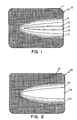
- reference numeral 10 generally identifies a prior art photoshadowgraph or an x-ray picture of the root end of a tooth 12 having a root canal filled with a portion of a severable solid tooth implant or carrier and a solidified gutta-percha.
- Reference numeral 11 indicates shading used to illustrate the black region that normally appears on x-ray pictures.
- the x-ray image illustrates that tooth 12 has an elongated root canal completely filled with the severed end 14 of a plastic tooth implant and an outer cone of gutta-percha 13.
- reference numeral 20 identifies an x-ray image of the root end of a tooth 12 having a root canal filled with a portion of a severable solid tooth implant made of the present invention and a gutta-percha filler material.
- Reference numeral 21 indicates shading used to illustrate the black region that normally appears on x-ray pictures.
- the x-ray image illustrates tooth 22 has an elongated root canal that appears to have a region 23 completely filled with a single material.
- the x-ray image in Fig. 2 is of two different filler materials, namely the severed end of a tooth implant made from the composition of the present invention and an outer cone of gutta-percha.
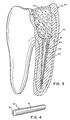
- reference numeral 40 generally identifies a partial cross sectional view of a filled tooth.
- Fig. 3 shows tooth 40 has an outer layer of enamel.
- Located in tooth 40 is a solid metal filling material 45, a solid tooth implant 44 and a solidified gutta-percha filler material filling the cavity 42 in root 41 of tooth 40.
- Located completely surrounding tooth implant 44 is an exterior cone of gutta-percha 35 that is used as one of the filler materials for filling a root canal.
- the combination of the rigid material of the tooth implant and the flowable gutta-percha allows one to use the combination of the solid tool and the flowable gutta-percha to completely fill the voids in a root canal. That is, in order to use the severable tooth implant as a carrier for insertion of the gutta-percha the tooth implant must be made of a material that is sufficiently rigid and flexible to permit one to insert and force both the flowable gutta-percha filler material and the solid filler material of the tooth implant into a root canal without breaking the tooth implant.
- the heavy metal particles retain there characteristics when mixed with the polysulfone since the temperatures that the tungsten is subjected is sufficiently low so as not to melt the tungsten particles. Consequently, the resulting plastic is in effect a thermoplastic plastic with heavy metal uniformly dispersed throughout the plastic so that when an x-ray is taken of the molded article it appears as a metal article.
- Example one The procedure of Example one was repeated except instead of using polysulfone I used a liquid crystal polymer sold under the name VECTRA ®.
- the mixing and the procedures of example one were followed to produce a plastic pin having substantially the same characteristics as Example one except the liquid crystal polymer has the advantage that smaller diameter pins can be molded with the liquid crystal polymer than with the polysulfone. That is since the liquid crystal polymers are more flowable one can injection mold smaller parts having dimensions on the order of a few thousands of an inch.
- Four different tapered pins were made using the liquid crystal polymer. Pin one had a diameter of.0098 inches at the end of the taper and a diameter of .02439 at a point approximately 2/3 of the distance from the end of the pin.
- Pin two had a diameter of .0118 inches at the end of the taper and a diameter of.02832 at a point approximately 2/3 of the distance from the end of the pin.
- Pin three had a diameter of .01377 inches at the end of the taper and a diameter of.03029 at a point approximately 2/3 of the distance from the end of the pin.
- Pin four had a diameter of .0154 inches at the end of the taper and a diameter of .02832 at a point approximately 2/3 of the distance from the end of the pin.
- the preferred range of heavy metal particles is 49.5 % to 51 % by weight of the mixture of the thermoplastic and the heavy metal particles in certain applications one can use as little as 35 % tungsten or tantalum to as much as 65 % tungsten or tantalum. Generally, the more heavy metal particles that are added the better the solidified mixture shows up on an x-ray picture and the more tungsten or tantalum added the weaker the solidified mixture becomes.
- FIG. 4 illustrates a plastic pin 50 that may be implanted in a bone.
- Plastic pin 50 has an outer cylindrical surface and an end surface 52.
- Pin 50 is molded from a composition consisting of about 50% by weight of polysulfone and about 50% by weight of tungsten. With the preferred range of tungsten and polysulfone there is virtually no loss in the inherent strength of pin 50. Consequently, pin 50 can be used as an implant and when subjected to x-rays produces and x-ray image like a metal article.
Landscapes
- Health & Medical Sciences (AREA)
- Oral & Maxillofacial Surgery (AREA)
- Chemical & Material Sciences (AREA)
- Epidemiology (AREA)
- Life Sciences & Earth Sciences (AREA)
- Animal Behavior & Ethology (AREA)
- General Health & Medical Sciences (AREA)
- Public Health (AREA)
- Veterinary Medicine (AREA)
- Medicinal Chemistry (AREA)
- Dermatology (AREA)
- Chemical Kinetics & Catalysis (AREA)
- Transplantation (AREA)
- Polymers & Plastics (AREA)
- Organic Chemistry (AREA)
- Dentistry (AREA)
- Dental Preparations (AREA)
- Mechanical Treatment Of Semiconductor (AREA)
- Reciprocating, Oscillating Or Vibrating Motors (AREA)
- Dry Shavers And Clippers (AREA)
- Materials For Medical Uses (AREA)
Claims (9)
- Ein Implantat für einen Körperteil, das ein festes, starres Material zur Einführung in eine Körperhöhlung umfaßt, wobei das feste, starre Material ein Polymerplastik umfaßt, das aus der Gruppe ausgewählt ist, die aus Polysulfon, flüssigen Kristallpolymeren, Nylon, Acetalcopolymeren und Polyetherimidharzen besteht, wobei das Polymerplastik Wolframteilchen aufweist, die einheitlich darin verteilt sind, so daß ein Röntgenstrahlenbild eines Körperteils, der das feste, starre Material enthält, die Gegenwart des festen, starren Materials in dem Körperteil zeigt.
- Das Implantat nach Anspruch 1, wobei das Polymerplastik Polysulfon ist.
- Das Implantat nach Anspruch 1 oder 2, wobei das Wolfram im festen, starren Material im Bereich eines Niedrigwertes von 35% Gewichtsanteil bis zu einem Höchstwert von 65% Gewichtsanteil des festen, starren Materials liegt.
- Das Implantat nach Anspruch 2, wobei das Polysulfon von 49% bis 50,5% Gewichtsanteil des festen, starren Materials umfaßt und das Wolfram von 49,5% bis 51% Gewichtsanteil des festen, starren Materials umfaßt.
- Das Implantat nach Anspruch 2, wobei die Wolframteilchen einen Durchmesser von vier bis fünf Mikrometern aufweisen.
- Ein Implantat für einen Körperteil, das ein festes, starres Material zur Einführung in eine Körperhöhlung umfaßt, wobei das feste, starre Material ein Polymerplastik umfaßt, das aus der Gruppe ausgewählt ist, die aus Polysulfon, flüssigen Kristallpolymeren, Nylon, Acetalcopolymeren und Polyetherimidharzen besteht, wobei das Polymerplastik Schwermetallteilchen aufweist, die aus einer Gruppe ausgewählt sind, die aus Wolfram- und Tantalteilchen besteht, die darin einheitlich verteilt sind, so daß das Röntgenstrahlenbild eines Körperteils, der das feste, starre Material enthält, die Gegenwart des festen, starren Materials im Körperteil zeigt.
- Ein Implantat zur Füllung eines endodontisch vorbereiteten Wurzelkanals eines Zahns, wobei sich der Kanal aus dem Zahnkranzbereich zur Zahnwurzelspitze erstreckt, wobei das Implantat einen verlängerten Schaft umfaßt, der als ein Träger zur Einführung des Schaftes und eines fließfähigen Guttaperchas oder Guttapercha-ähnlichen Füllmaterials in die Zahnwurzelspitze agiert, dadurch gekennzeichnet, daß der verlängerte Schaft aus einem Polymerplastik gemacht ist, das darin verstreute Schwermetallteilchen aufweist, wobei die Schwermetallteilchen aus der Gruppe ausgewählt sind, die aus Wolfram- und Tantalteilchen besteht, so daß das Röntgenstrahlbild des Schaftes und des Füllmaterials, das den Schaft umhüllt, als ein einziges fortwährendes Bild erscheint.
- Das Verfahren zur Herstellung eines strahlenundurchlässigen Gegenstands zur Verwendung als Implantat, das die folgenden Schritte umfaßt:Wählen der Schwermetallteilchen aus der Gruppe, die aus Wolframteilchen und Tantalteilchen besteht;Mischen der ausgewählten Schwermetallteilchen mit einem pelletisierten Thermoplast, der aus der Gruppe ausgewählt ist, die aus Polysulfon, flüssigen Kristallpolymeren, Nylon, Acetalcopolymeren und Polyetherimidharzen besteht, bis die Schwermetallteilchen einheitlich überall im Gemisch vermengt sind;Erhitzen des Gemischs auf die Spritzgußtemperatur des Polymerplastiks, um dadurch das Plastik zu verflüssigen, wobei die Spritzgußtemperatur genügend unterhalb der Schmelztemperatur der Schwermetallteilchen liegt, so daß die Schwermetallteilchen ein Festkörper bleiben; undSpritzgießen des Gemischs in eine Gußform, um einen strahlenundurchlässigen Plastikgegenstand mit darin verstreuten festen Metallteilchen herzustellen.
- Ein Zahnimplantat zum Füllen eines Hohlraums in einem Zahn, das mindestens zwei verschiedene Bestandteile umfaßt, worin eine Photo-Schattenaufnahme eines Zahnes mit der Füllung von zwei verschiedenen Bestandteilen als ein einziges Bild erscheint, umfassend:einen ersten Zahnfüllbestandteil, wobei der erste Zahnfüllbestandteil ein fließfähiges Guttapercha oder Guttaperchaähnliches Füllmaterial zur Einführung in den Hohlraum in einem Zahn umfaßt;einen zweiten Zahnfüllbestandteil, wobei der zweite Zahnfüllbestandteil einen gegossenen Träger umfaßt, um das fließfähige Füllmaterial zur Einführung sowohl des ersten Zahnfüllbestandteils als auch des zweiten Zahnfüllbestandteils im Hohlraum eines Zahnes zu halten, wobei der gegossene Träger ein darin einheitlich verteiltes strahlenundurchlässiges Material aufweist, das ungefähr 50% Gewichtsanteil des Gemisches des zweiten Zahnfüllbestandteils umfaßt, wobei das strahlenundurchlässige Material ein Schwermetall ist, das aus der Gruppe ausgewählt ist, die aus Wolfram und Tantal besteht.
Applications Claiming Priority (2)
| Application Number | Priority Date | Filing Date | Title |
|---|---|---|---|
| US539807 | 1990-06-18 | ||
| US07/539,807 US5088927A (en) | 1990-06-18 | 1990-06-18 | Radio opaque plastics and process of making |
Publications (2)
| Publication Number | Publication Date |
|---|---|
| EP0462512A1 EP0462512A1 (de) | 1991-12-27 |
| EP0462512B1 true EP0462512B1 (de) | 1996-05-08 |
Family
ID=24152734
Family Applications (1)
| Application Number | Title | Priority Date | Filing Date |
|---|---|---|---|
| EP91109709A Expired - Lifetime EP0462512B1 (de) | 1990-06-18 | 1991-06-13 | Strahlenundurchlässige Kunststoffe |
Country Status (5)
| Country | Link |
|---|---|
| US (1) | US5088927A (de) |
| EP (1) | EP0462512B1 (de) |
| AT (1) | ATE137781T1 (de) |
| DE (1) | DE69119302T2 (de) |
| DK (1) | DK0462512T3 (de) |
Families Citing this family (35)
| Publication number | Priority date | Publication date | Assignee | Title |
|---|---|---|---|---|
| US5275562A (en) * | 1990-06-04 | 1994-01-04 | Mcspadden John T | Method and material for obturating an extirpated root canal |
| US5326263A (en) * | 1992-06-12 | 1994-07-05 | Bernard Weissman | Light-curable tooth reinforcement |
| JP3563752B2 (ja) * | 1992-11-24 | 2004-09-08 | エイチエヌエイ・ホールディングス・インコーポレーテッド | 充填剤入り繊維 |
| US5415546A (en) * | 1993-03-23 | 1995-05-16 | Cox, Sr.; Ronald W. | Radiopaque dental composite and materials |
| AP9400632A0 (en) * | 1993-04-29 | 1995-10-07 | Zeneca Ltd | Ether derivatives. |
| US5300048A (en) * | 1993-05-12 | 1994-04-05 | Sabin Corporation | Flexible, highly radiopaque plastic material catheter |
| US5741139A (en) * | 1993-09-27 | 1998-04-21 | Tru-Flex Post Systems, Inc. | Flexible post in a dental post and core system |
| US6371763B1 (en) * | 1997-11-28 | 2002-04-16 | Robert J. Sicurelli, Jr. | Flexible post in a dental post and core system |
| US5948489A (en) * | 1994-03-03 | 1999-09-07 | Cordis Corporation | Catheter having extruded, flexible, pliable and compliant marker band |
| FR2727020B1 (fr) * | 1994-11-21 | 1997-01-24 | Marc Reynaud | Element prothetique, et notamment tenon dentaire en materiau composite |
| EP2312519A1 (de) | 1995-06-07 | 2011-04-20 | Citibank, N.A. | Verfahren und System zur Bereitstellung eines integrierten Maklergeschäfts und anderer Finanzdienstleistungen durch kundenaktivierte Endgeräte |
| US6024569A (en) * | 1998-11-06 | 2000-02-15 | Aytec Japan Corporation | Root canal filling point |
| BR0011208A (pt) | 1999-05-12 | 2002-02-26 | Jeneric Pentron Inc | PivÈ endodÈntico e método para restauração do canal radicular de um dente |
| US7163401B2 (en) * | 1999-05-12 | 2007-01-16 | Pentron Clinical Technologies, Llc | Endodontic post and obturating system |
| US7086864B2 (en) | 1999-05-12 | 2006-08-08 | Pentron Clinical Technologies, Llc | Endodontic post system |
| US7168952B2 (en) * | 1999-05-12 | 2007-01-30 | Pentron Clinical Technologies, Llc | Endodontic post and obturating system |
| US6641776B1 (en) * | 2000-11-15 | 2003-11-04 | Scimed Life Systems, Inc. | Method for preparing radiopaque surgical implement |
| US7605098B2 (en) * | 2001-03-02 | 2009-10-20 | Albacem, Llc | Low alkali, non-crystalline, vitreous silica fillers |
| US7750063B2 (en) | 2001-10-24 | 2010-07-06 | Pentron Clinical Technologies, Llc | Dental filling material |
| US7204874B2 (en) * | 2001-10-24 | 2007-04-17 | Pentron Clinical Technologies, Llc | Root canal filling material |
| US7204875B2 (en) * | 2001-10-24 | 2007-04-17 | Pentron Clinical Technologies, Llc | Dental filling material |
| US7303817B2 (en) * | 2001-10-24 | 2007-12-04 | Weitao Jia | Dental filling material |
| US7211136B2 (en) * | 2001-10-24 | 2007-05-01 | Pentron Clinical Technologies, Llc | Dental filling material |
| US20040054413A1 (en) | 2002-09-16 | 2004-03-18 | Howmedica Osteonics Corp. | Radiovisible hydrogel intervertebral disc nucleus |
| US7252508B2 (en) * | 2002-12-13 | 2007-08-07 | Pentron Clinical Technologies, Llc | Endodontic obturator |
| DE10338440A1 (de) * | 2003-08-19 | 2005-03-31 | Werner Mannschedel | Guttaperchaspitze und Herstellverfahren |
| EP1805251A1 (de) * | 2004-10-04 | 2007-07-11 | Solvay Advanced Polymers, L.L.C. | Mit kunststoff überformte gegenstände, verwendung davon und herstellungsverfahren dafür |
| US20070010815A1 (en) * | 2005-06-30 | 2007-01-11 | Sdgi Holdings, Inc. | Fixation systems with modulated stiffness |
| US20080108009A1 (en) * | 2006-11-03 | 2008-05-08 | Cms Dental Aps | Obturation device, material and methodolgy |
| FR2911494B1 (fr) * | 2007-01-19 | 2009-04-10 | Rech S Tech Dentaires R T D Sa | Element prothetique dentaire radio-opaque |
| WO2008102214A2 (en) * | 2007-02-22 | 2008-08-28 | Ghassemian Pour Bavandi, Madjid | Endodontic filling material |
| US8298664B2 (en) * | 2007-04-12 | 2012-10-30 | Pentron Clinical Technologies, Llc | Fiber-reinforced composite dental materials and method of manufacture |
| US20100167232A1 (en) * | 2007-11-01 | 2010-07-01 | Ajit Karmaker | Endodontic device |
| DE102019106034A1 (de) * | 2019-03-08 | 2020-09-10 | Marvis Interventional Gmbh | Wurzelstift |
| CN115484891A (zh) * | 2020-01-03 | 2022-12-16 | 约瑟夫·瑞恩·斯莫拉兹 | 使用骨骼传导的无线音频发射器和接收器骨骼设备 |
Family Cites Families (23)
| Publication number | Priority date | Publication date | Assignee | Title |
|---|---|---|---|---|
| US3715331A (en) * | 1970-05-01 | 1973-02-06 | Coe Labor | Monomer soluble x-ray opaque methacrylate particles |
| BE791737A (fr) * | 1971-06-23 | 1973-03-16 | Robins Co Inc A H | Dispositif a bords festonnes pour insertion |
| US3801344A (en) * | 1971-06-30 | 1974-04-02 | Owens Illinois Inc | Tooth filling and facing compositions comprising a radiopaque glass and method of making the same |
| US3808170A (en) * | 1971-10-12 | 1974-04-30 | S Rogers | Prosthetic material |
| GB1378212A (en) * | 1972-03-15 | 1974-12-27 | Amalgamated Dental Co Ltd | Denture bases |
| US3829903A (en) * | 1972-12-11 | 1974-08-20 | Dow Corning | Method of inhibiting blood clot on silicone rubber medical devices |
| US4017454A (en) * | 1973-09-21 | 1977-04-12 | Jenaer Glaswerk Schott & Gen. | Glass ceramic as filler in polymerizable dental filling compositions |
| AT339523B (de) * | 1973-09-21 | 1977-10-25 | Jenaer Glaswerk Schott & Gen | Glaskeramik fur zahnfullmassen |
| US4032504A (en) * | 1973-09-28 | 1977-06-28 | Lee Pharmaceuticals | X-ray opaque filler useful in dental and medical restorative compounds |
| US4106506A (en) * | 1973-12-03 | 1978-08-15 | Koehn Wilbur R | Catheter |
| US3971754A (en) * | 1973-12-10 | 1976-07-27 | Pennwalt Corporation | X-ray opaque, enamel-matching dental filling composition |
| US3959212A (en) * | 1974-06-03 | 1976-05-25 | American Hospital Supply Corporation | Radio-opaque dental restorative material |
| DE2851729C2 (de) * | 1978-11-30 | 1980-06-04 | W.C. Heraeus Gmbh, 6450 Hanau | Blendgold, Verfahren zum Verblenden gegossener oder gesinterter metallischer Zahnprothesen oder Zahnprothesenteile und Anwendung des Blendgoldes |
| US4220582A (en) * | 1979-01-03 | 1980-09-02 | Lee Pharmaceuticals | Dental restorative compositions of improved X-ray opacity |
| DE2932738C2 (de) * | 1979-08-13 | 1981-07-02 | Hans-Helmut Dr.Dr. 8000 München Barth | Zahnmedizinische Wurzelfüllpaste |
| US4297266A (en) * | 1980-02-08 | 1981-10-27 | Den-Mat, Inc. | Microfilled dental composite and method using the same |
| DE3039664C2 (de) * | 1980-10-21 | 1986-07-17 | Kulzer & Co Gmbh, 6380 Bad Homburg | Röntgenopakes Dentalmaterial mit Füllstoff auf Silicat-Basis |
| US4516970A (en) * | 1982-09-13 | 1985-05-14 | Kaufman Jack W | Medical device |
| JPS60135063A (ja) * | 1983-12-09 | 1985-07-18 | ジエイムス・アール・ヒユーレン | 腸供給管 |
| US4629451A (en) * | 1985-09-23 | 1986-12-16 | Victory Engineering Corp. | Stereotaxic array plug |
| DE3602721A1 (de) * | 1986-01-30 | 1987-08-20 | Feldmuehle Ag | Implantat |
| JPS63165302A (ja) * | 1986-12-26 | 1988-07-08 | G C Dental Ind Corp | 根管検査用造影性印象材 |
| US4758156A (en) * | 1987-04-02 | 1988-07-19 | Johnson William B | Tool for use in applying filler material to an endodontically prepared root canal |
-
1990
- 1990-06-18 US US07/539,807 patent/US5088927A/en not_active Expired - Lifetime
-
1991
- 1991-06-13 AT AT91109709T patent/ATE137781T1/de not_active IP Right Cessation
- 1991-06-13 EP EP91109709A patent/EP0462512B1/de not_active Expired - Lifetime
- 1991-06-13 DK DK91109709.5T patent/DK0462512T3/da active
- 1991-06-13 DE DE69119302T patent/DE69119302T2/de not_active Expired - Lifetime
Also Published As
| Publication number | Publication date |
|---|---|
| DK0462512T3 (da) | 1996-09-30 |
| DE69119302T2 (de) | 1997-01-16 |
| ATE137781T1 (de) | 1996-05-15 |
| US5088927A (en) | 1992-02-18 |
| DE69119302D1 (de) | 1996-06-13 |
| EP0462512A1 (de) | 1991-12-27 |
Similar Documents
| Publication | Publication Date | Title |
|---|---|---|
| EP0462512B1 (de) | Strahlenundurchlässige Kunststoffe | |
| US7204874B2 (en) | Root canal filling material | |
| US7204875B2 (en) | Dental filling material | |
| JP4954072B2 (ja) | 歯科用充填材 | |
| JP4657102B2 (ja) | 歯科充填材 | |
| Darcey et al. | Modern endodontic principles part 5: obturation | |
| Marlin et al. | Clinical use of injection-molded thermoplasticized gutta-percha for obturation of the root canal system: a preliminary report | |
| US20070031794A1 (en) | Apparatus and method for root canal obturation | |
| WO2003074009A1 (en) | Glass ionomers for enhancing mineralization of hard tissue | |
| JP2000102548A (ja) | X線不透過性の複合材から成る歯科用の合釘 | |
| Alghamdi et al. | A scanning electron microscopy study comparing 3 obturation techniques to seal dentin to root canal bioceramic sealer in 30 freshly extracted mandibular second premolars | |
| US6010335A (en) | Endodontic device for applying a filler material to a root canal of a tooth | |
| US20110129802A1 (en) | Dental material and methods of use | |
| US7750063B2 (en) | Dental filling material | |
| US20080108009A1 (en) | Obturation device, material and methodolgy | |
| Woo et al. | Evaluation of sealing properties of 70° C thermoplasticized gutta‐percha used as a retrograde root filling | |
| Swartz | Dental cements and restorative resins | |
| Kumar et al. | Utility of Obturation materials and Techniques amongst Endodontists: A Qualitative Research | |
| Maan | Recent Concept of Obturation | |
| Shenoy | Contemporary Techniques for Obturation of the Root Canal System | |
| JPH09143020A (ja) | 圧流度の大きい熱可塑性歯科用根管充填材 | |
| Parsa | Evaluation and Analysis of the Apically Extruded Gutta Percha Using Thermoplasticized Technique as Sole Obturation Method (Squirting) |
Legal Events
| Date | Code | Title | Description |
|---|---|---|---|
| PUAI | Public reference made under article 153(3) epc to a published international application that has entered the european phase |
Free format text: ORIGINAL CODE: 0009012 |
|
| AK | Designated contracting states |
Kind code of ref document: A1 Designated state(s): AT BE CH DE DK ES FR GB GR IT LI LU NL SE |
|
| 17P | Request for examination filed |
Effective date: 19920522 |
|
| 17Q | First examination report despatched |
Effective date: 19940921 |
|
| GRAH | Despatch of communication of intention to grant a patent |
Free format text: ORIGINAL CODE: EPIDOS IGRA |
|
| GRAA | (expected) grant |
Free format text: ORIGINAL CODE: 0009210 |
|
| AK | Designated contracting states |
Kind code of ref document: B1 Designated state(s): AT BE CH DE DK ES FR GB GR IT LI LU NL SE |
|
| PG25 | Lapsed in a contracting state [announced via postgrant information from national office to epo] |
Ref country code: GR Free format text: LAPSE BECAUSE OF FAILURE TO SUBMIT A TRANSLATION OF THE DESCRIPTION OR TO PAY THE FEE WITHIN THE PRESCRIBED TIME-LIMIT Effective date: 19960508 Ref country code: LI Free format text: LAPSE BECAUSE OF FAILURE TO SUBMIT A TRANSLATION OF THE DESCRIPTION OR TO PAY THE FEE WITHIN THE PRESCRIBED TIME-LIMIT Effective date: 19960508 Ref country code: AT Effective date: 19960508 Ref country code: BE Effective date: 19960508 Ref country code: CH Free format text: LAPSE BECAUSE OF FAILURE TO SUBMIT A TRANSLATION OF THE DESCRIPTION OR TO PAY THE FEE WITHIN THE PRESCRIBED TIME-LIMIT Effective date: 19960508 Ref country code: ES Free format text: THE PATENT HAS BEEN ANNULLED BY A DECISION OF A NATIONAL AUTHORITY Effective date: 19960508 |
|
| REF | Corresponds to: |
Ref document number: 137781 Country of ref document: AT Date of ref document: 19960515 Kind code of ref document: T |
|
| REF | Corresponds to: |
Ref document number: 69119302 Country of ref document: DE Date of ref document: 19960613 |
|
| PG25 | Lapsed in a contracting state [announced via postgrant information from national office to epo] |
Ref country code: LU Free format text: LAPSE BECAUSE OF NON-PAYMENT OF DUE FEES Effective date: 19960630 |
|
| ITF | It: translation for a ep patent filed | ||
| PG25 | Lapsed in a contracting state [announced via postgrant information from national office to epo] |
Ref country code: SE Effective date: 19960808 |
|
| ET | Fr: translation filed | ||
| REG | Reference to a national code |
Ref country code: DK Ref legal event code: T3 |
|
| REG | Reference to a national code |
Ref country code: CH Ref legal event code: PL |
|
| PLBE | No opposition filed within time limit |
Free format text: ORIGINAL CODE: 0009261 |
|
| STAA | Information on the status of an ep patent application or granted ep patent |
Free format text: STATUS: NO OPPOSITION FILED WITHIN TIME LIMIT |
|
| 26N | No opposition filed | ||
| REG | Reference to a national code |
Ref country code: GB Ref legal event code: IF02 |
|
| PGFP | Annual fee paid to national office [announced via postgrant information from national office to epo] |
Ref country code: DK Payment date: 20100625 Year of fee payment: 20 Ref country code: FR Payment date: 20100630 Year of fee payment: 20 |
|
| PGFP | Annual fee paid to national office [announced via postgrant information from national office to epo] |
Ref country code: NL Payment date: 20100624 Year of fee payment: 20 |
|
| PGFP | Annual fee paid to national office [announced via postgrant information from national office to epo] |
Ref country code: IT Payment date: 20100628 Year of fee payment: 20 Ref country code: GB Payment date: 20100625 Year of fee payment: 20 Ref country code: DE Payment date: 20100629 Year of fee payment: 20 |
|
| REG | Reference to a national code |
Ref country code: DE Ref legal event code: R071 Ref document number: 69119302 Country of ref document: DE |
|
| REG | Reference to a national code |
Ref country code: DE Ref legal event code: R071 Ref document number: 69119302 Country of ref document: DE |
|
| REG | Reference to a national code |
Ref country code: NL Ref legal event code: V4 Effective date: 20110613 |
|
| REG | Reference to a national code |
Ref country code: DK Ref legal event code: EUP |
|
| REG | Reference to a national code |
Ref country code: GB Ref legal event code: PE20 Expiry date: 20110612 |
|
| PG25 | Lapsed in a contracting state [announced via postgrant information from national office to epo] |
Ref country code: GB Free format text: LAPSE BECAUSE OF EXPIRATION OF PROTECTION Effective date: 20110612 Ref country code: NL Free format text: LAPSE BECAUSE OF EXPIRATION OF PROTECTION Effective date: 20110613 |
|
| PG25 | Lapsed in a contracting state [announced via postgrant information from national office to epo] |
Ref country code: DE Free format text: LAPSE BECAUSE OF EXPIRATION OF PROTECTION Effective date: 20110614 |