EP0457545A2 - Verfahren und Gerät zur Bildverarbeitung - Google Patents
Verfahren und Gerät zur Bildverarbeitung Download PDFInfo
- Publication number
- EP0457545A2 EP0457545A2 EP91304310A EP91304310A EP0457545A2 EP 0457545 A2 EP0457545 A2 EP 0457545A2 EP 91304310 A EP91304310 A EP 91304310A EP 91304310 A EP91304310 A EP 91304310A EP 0457545 A2 EP0457545 A2 EP 0457545A2
- Authority
- EP
- European Patent Office
- Prior art keywords
- character
- data
- image
- normalization
- feature
- Prior art date
- Legal status (The legal status is an assumption and is not a legal conclusion. Google has not performed a legal analysis and makes no representation as to the accuracy of the status listed.)
- Granted
Links
Images
Classifications
-
- G—PHYSICS
- G06—COMPUTING OR CALCULATING; COUNTING
- G06V—IMAGE OR VIDEO RECOGNITION OR UNDERSTANDING
- G06V30/00—Character recognition; Recognising digital ink; Document-oriented image-based pattern recognition
- G06V30/10—Character recognition
- G06V30/16—Image preprocessing
- G06V30/166—Normalisation of pattern dimensions
-
- G—PHYSICS
- G06—COMPUTING OR CALCULATING; COUNTING
- G06V—IMAGE OR VIDEO RECOGNITION OR UNDERSTANDING
- G06V30/00—Character recognition; Recognising digital ink; Document-oriented image-based pattern recognition
- G06V30/10—Character recognition
Definitions
- the present invention relates to image processing method and apparatus in which image data of characters of various type styles and output directions is input and can be converted into image data which has been normalized so as to be easily processed.
- a converting process from a character image into a character code is executed after completion of the steps such as character cutting-out process, character feature extracting process, and recognizing process.
- a character image format which is sent from the character cutting-out step to the character feature extracting step is constant.
- the feature extraction denotes a process such that a character image is normalized and the normalized image is divided into blocks and feature amounts of the character such as direction index, background density, and the like are generated as feature vectors on a block unit basis.
- the apparatus copes with such various directions by rearranging feature vectors.
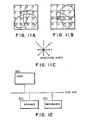
- Feature vectors are obtained by dividing a character image into a plurality of blocks as shown in Fig. 11A and by obtaining histograms about a direction index, densities of black and white pixels, and the like of each block.
- direction indices 1 to 4 shown in Fig. 11C are used as feature amounts.
- a character image having such feature amounts of Fig. 11A is rotated by an angle of 90°, so that an image as shown in Fig. 11 B is derived.
- Features of the images of Fig. 11A and 11 B are similarly extracted.
- the direction index 1 in Fig. 11A is extracted as a direction index 3 in Fig. 11 B.
- the feature of the block 2 in Fig. 11A corresponds to the feature of the block 9' in Fig. 11 B. Therefore, by executing the operations such that the direction indices (1 and 3) and (2 and 4) of the feature vectors of Fig.
- the character direction In the conventional method, however, even after the character direction was known, the character direction must be converted by rearranging the feature vectors, so that it is irrational and it takes a long processing time.
- an image to be recognized is divided on a character unit basis and is subjected to processes after a feature extraction.
- the recognizing process can be performed in any character direction in the same processing time as that by the ordinary method without changing the feature extractor.
- the discriminating process of the character direction and the recognizing process can be automatically executed at a high speed.
- an Italic style can be recognized in a manner similar to the ordinary method.
- a process to discriminate whether the width of character is standard or half and a process to discriminate a position can be performed in a lump.
- the invention by providing means for storing the character direction and feature extractor nor malization address shift adding means corresponding to the storage, it is possible to realize a character recognizing apparatus in which a table memory size is small, a size of character image memory which is connected is large, and a character in an arbitrary character direction can be recognized without a change in processing time.
- the invention can be realized by one apparatus or can be also realized by a system comprising a plurality of apparatuses.
- the invention can be also realized by supplying a software to a personal computer or the like.
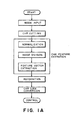
- Fig. 1A is a diagram showing a flow of recognizing processes.
- a character feature extractor comprises a normalization, a block division of an image, and a feature vector extraction.
- a feature extracting process after the normalization step denotes a process to divide an image into blocks and a process to extract feature vectors.
- the feature vector extracting process includes: a process to extract direction indices and pixel densities on a block unit basis; a process to dimensionally reduce the block by executing a filtering process to the block, for example, a process to compress the block of 7 x 7 to the block of 4 x 4; and the like.
- the feature extracting process denotes processes such that irrespective of a decision regarding whether an image normalized to a certain size is formed from a given character image or not, black and white pixel data of the normalized image is obtained from pixel data in bit addresses (nomalization bit addresses) on the character image which is derived from the normalization address table and feature amounts of the character are extracted and generated as feature vectors.
- Arbitrary amounts such as direction amount of character, density amount of black and white pixels, and the like can be used as feature amounts. Even if an original character image and light and dark data (multivalue image) have been provided, no problem occurs.
- the invention can be used in all of the algorithms to normalize the original character image to obtain feature amounts of the character.
- the normalization address table is formed by the computer and comprises two kinds of N tables (A and B) which are obtained by an arithmetic operation suitable for each character image in accordance with an instruction indicative of which type style or which state the character image as an object to be processed has.
- the data of one desired point in the normalization image data is obtained as follows. Namely, an x coordinate A(x) is extracted from x coordinates stored in the table A and a y coordinate B(y) is extracted from y coordinates stored in the table B in accordance with the coordinates of the desired one point. Both of the x and y coordinates are added like A(x) + B(y), thereby obtaining a nomalization bit address. Data of one point in the character memory indicated by the above address is obtained as such data.
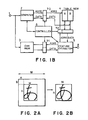
- Fig. 1B is a diagram showing most preferably a feature of the invention and is a detailed explanatory diagram of a characteristic feature extractor in Fig. 1A.
- reference numeral 1 denotes an input section from a character cutting-out section at the front stage. Character cut-out data such as a character position and the like which are necessary to the recognizing process in a character memory and a character image are sent from the input section.
- Reference numeral 2 denotes a computer having a program memory and a data memory; 3 a character image memory to store the character image; 4 two table memories A and B to store normalization addresses; 5 a feature extractor to execute a feature extracting process after the normalization to the character image in the character memory 3 with reference to the table memories 4; 6 a controller for switching external accesses to the memories and for executing a whole control of the feature extractor and the like; 7-1 to 7-3 buffers for receiving singals from the controller 6 and for controlling accesses to the memories; and 8 an output section to send the feature vectors from the feature extractor 6 to a recognizer at the next stage.
- a character image of Fig. 2A is normalized to an image of a size of N x N as shown in Fig. 2B. It is now assumed that a word unit in the character memory is set to one byte and that a bit order in one byte is set to MSB -+ LSB and that the bits 0 to 7 are ordered in a manner such that the bit 7 corresponds to 0 and the bit 0 corresponds to 7. Therefore, the bit 7 in the address 0 indicates the bit address 0 and the bit 7 in the adress 1 indicates the bit address 8.
- a point on the original character image of Fig. 2A in the case where a point (x, y) on the normalized image of Fig. 2B has been given is calculated as follows.
- bit address is a bit address in the character memory 3 in which the data to form the normalization image has been stored, it is hereinafter referred to as a normalization bit address.
- the address of the point on the character image corresponding to the point on the normalized image is expressed by the result of the addition of the terms (1) and (2) of the above equation.
- the two table memories A and B are prepared and the results of the terms (1) and (2) are respectively stored into the table memories A and B in order to calculate the normalization bit address.
- the feature extractor calculates the normalization bit address by the addition value of the contents in the table memories A and B.
- the feature extracting process after the normalizing process is executed by using the point on the character image corresponding to the normalization bit address as data corresponding to the point on the normalized image.
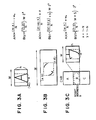
- Fig. 3A shows the format in which the character image is reduced as small as possible.
- Fig. 3B shows the format in which a character image is expressed by only two points of a circumscribed rectangle of a character.
- Fig. 3C shows the format in which a number of images whose character has been cut out are included in the character memory.
- Format data indicating which case in Figs. 3A to 3C the cut-out character relates to and character position data by the character cutting-out process are supplied from the input section 1 to the computer 2.
- the actual character image is supplied to the character memory 3.
- the computer 2 first discriminates to which one of the kinds of Figs.
- the character format belongs on the basis of the format data and calculates the x and y coordinates A(x) and B(y) in each of Figs. 3A to 3C and stores the calculated coordinates into the table memories 4 (A and B).
- the completion of the calculations is informed to the controller 6.
- the controller 6 transfers the access rights of the character memory 2 and the table memories 4 to the feature extractor 5 by controlling the buffers 7-1 to 7-3 and activates the feature extractor 5.
- the feature extractor 5 calculates the normalization bit address by the addition with reference to the contents in the table memories 4 (A and B) and reads the corresponding bit data from the character memory 3, thereby performing the feature extracting process after the nor malizing process.
- the feature extractor 5 informs the end of the process to the controller 6 and generates resultant feature vectors to the output section 8.
- the controller 6 returns the memory access right to the original section after completion of the above processes and informs the computer 2 of the fact that the next process can be executed.
- Figs. 1A and 1B are diagrams showing most preferably the invention.
- Reference numeral 6 denotes the controller having means for storing the resultant data from the computer 2 indicating which one of the binary values of 1 and 0 the character image indicates.
- Reference numeral 7-1 denotes the buffer for receiving the signal from the controller 6, for adjusting the access right of the feature extractor 5 to the character memory 3, and for inverting or non-inverting the data from the memory 3 to the feature extractor 5.
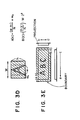
- Fig. 3D shows a character (blank character) which is obtained by inverting the character of Fig. 3A and their sizes and the like are almost equal.
- the character main body of Fig. 3A corresponds to the binary value of "1”
- the character style of Fig. 3D corresponds to the binary value of "0”. If the feature of the character of Fig. 3D is directly extracted, the feature which is quite opposite to that of the actual character "A" will be generated. Therefore, the feature data is temporarily stored into a momory in the controller 6 before the feature extractor 5 starts process.
- the controller 6 controls the buffer 7-1 so as to invert all of the data which are transmitted from the character memory 3 to the feature extractor 5.
- all of the binary values of "0" of the character main bodies are converted into “1” and the same features are extracted with respect to the character images of Figs. 3A and 3D.
- a blank character and the like can be recognized by the above method.
- Figs. 1A and 1B are diagrams most preferably showing the invention and an explanation is substantially the same as that of1.
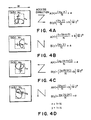
- Fig. 4A shows the case of the ordinary character direction in which it is assumed that the character image is accessed in the directions indicated by arrows and that the normalizing process is executed from the left upper position to the right lower position.
- Figs. 4B to 4D show the cases where the character of Fig. 4A has been rotated by an angle of 90° at a time.
- the character image has been normalized in the same manner as that of Fig. 4A, a feature which is quite different from that of the character of " " is extracted. Therefore, by accessing the character image from the left upper position to the right lower position of the character, the normalized images of Figs.
- FIG. 4B to 4D are the same as the image of Fig. 4A and the same feature vectors as those of Fig. 4A are extracted. That is, it is sufficient to rewrite the contents in the two table memories A and B in a manner such that the access is performed from the left lower position to the right upper position of the image in the case of Fig. 4B, from the right lower position to the left upper position in the case of Fig. 4C, and from the right upper position to the left lower position in the case of Fig. 4D.
- the equations on the left side are the normalization arithmetic equations.
- the character cutting-out section cuts out the characters on the basis of those direction data
- the character image and the character position data are sent to the above structure together with the data of the character direction
- contents in the table memories A and B are formed as shown in Figs. 4A to 4D in accordance with the character direction as described above.
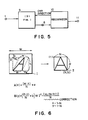
- Fig. 5 is a diagram showing most preferably the invention.
- Reference numeral 1 denotes the character input section to which the character position data and the character image are supplied.
- Reference numeral 9 denotes feature extractorwhich corresponds to3 mentioned above and can process the character direction; 8 indicates the output section of the feature extractor 9 for generating feature vectors; and 10 a recognizer which generates the nearest character code by a distance calculation of the basis of the feature vectors derived from the output section 8.
- Reference numeral 11 denotes a character code output section.
- the character direction is designated by the recognizer 10.
- Characteristics of the feature vectors include a direction amount and background density of each block unit which is obtained by dividing the character image into M equal blocks. An effect similar to the process in3 can be obtained by the rearrangement However, the processing time is delayed by only a time which is required for rearrangement.
- the character cutting-out section detects the lines in the vertical and lateral directions by an image projection or a histogram process, thereby obtaining the line direction. With respect to the lines obtained, characters are cut out from the lines in accordance with a predetermined order (order such that right -> left or upper ⁇ lower) and are sent to the recognizer. The resultant candidate character train and the determined character direction are received from the recognizer.
- the candidate character train are rearranged on the basis of the data of the line direction which has been decided by the character cutting-out section and the character direction obtained from the recognizer, thereby forming a correct document
- the character cutting-out section presumes the order of the character train so as to obtain a correct document on the basis of the line direction and the character direction corresponding thereto.
- the rearrangement is executed after the character cutting-out process was performed.
- a manager 12 executes the rearrangement by constructing as shown in Fig. 9.
- FIGs. 1A and 1B are diagrams most preferably showing the invention. Since the operations are similar to those of1, their detailed explanation is omitted here.
- a projection is obtained at an angle of Italic style (an angle of Italic style is substantially predetermined and such an angle can cover almost of the Italic style characters) and ⁇ 1 , is approximately obtained. Due to thi data indicating that the character style is the Italic style and the character position data including the degree of inclination ⁇ 1 , are sent to the above structure.
- the Italic style mode can be also designated by the user.
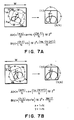
- Degrees ⁇ A and h A of inclination of the character and the inclination direction are detected by the character cutting-out section.
- characters are cut out of the line by the ordinary method and a circumscribed rectangle is obtained.
- an angle 9 of inclination is obtained by a method of least squares of the center point of the lower edge portion of the circumscribed rectangle of the character (by a well-known example).
- a projection is got at such an angle and the inclination degrees ⁇ A and h A are obtained.
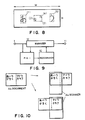
- Fig. 9 is a diagram most preferably showing the invention.
- Reference numeral 1 denotes the input section.
- the character image is sent to the character memory 2 in Fig. 1 from the character cutting-out section at the front stage of the input section 1.
- Each character data [for instance, positions of (1), (3), (4), and (5) in Fig. 8] is supplied to the manager 12.
- Reference numeral 10 denotes the recognizer for receiving the feature vectors from the construction of Fig. 1, for calculating a recognition distance, and for generating candidate characters and the distance value.
- Reference numeral 12 denotes the manager to manage Fig. 1 and the candidate characters and 11 indicates the output section for generating the recognition results.
- Fig. 1 there has been mentioned in Fig. 1 that the features are extracted by the addition of the contents in the two table memories A and B.
- the maximum image size which can be handled depends on the number of bits of the addition result. For example, in the case where each data of A(x) and B(y) consists of 16 bits, the image of up to 8 kBytes can be handled. In the case of 24 bits, the image of up to 2 MBytes can be handled. Since arbitrary image formats (Figs. 3A, 3B, and 3C) can be input to Fig. 1, a whole image as shown in Fig. 8 can be also recognized (an image of one page of a document can be also used as necessary).
- the entire character image to be recognized is first sent from the input section 1 to the character memory 2 in Fig. 1.
- the character position data is sent to the manager.
- the position data of (1), (3), (4) and (5) and data indicating that it is unknown whether the character images of (3) and (4) construct one character or two characters are sent
- the manager sends the character position data of (1), (2), (3), (4) and (5) to Fig. 1 on the basis of the above data.
- the construction of Fig. 1 extracts the features in accordance with the order of (1), (2), (3), (4) and (5) and transfers the feature vectors to the recognizer 10. During the above period of time, the content in the character memory is not changed.
- the recognizer sends the candidate characters and the distance value to the manager 12 in accordance with the order of (1) to (5). If the first candidate of (2) is a separate character like " " with response to the characters (2) to (4), the characters of (1), (2) and (3) are sent to the output section 11 from the manager. If the first candidate of each of (3) and (4) is a half-width character, the characters of (1), (3), (4) and (5) are supplied to the output section 11. In the other cases, the distance values are compared and the nearer value is generated.
- Figs. 1A and 1 B are diagrams most preferably showing the invention. As also mentioned in7, the image size which can be handled is limited to the number of bits of A(x) and B(y).
- Figs. 1A and 1B are diagrams most preferably showing the invention.
- the computer 2 forms the contents in the table memories A and B in accordance with the character format and subsequently executes the feature extracting process after the normalizing process with reference to the table memories A and B in accordance with the feature extracting program.
- the computer 2 can execute many kinds of processes by the same program irrespective of the character direction, inclination, and the like....(The case where the processing speed of the computer is high and the case where no problem occurs with respect to the processing time.)
- Fig. 1 it is also possible to construct in a manner such that the character position data and the character image are stored into the character memory and the computer 2 reads out the character position data from character memory 3 and processes. (Since a format in the character memory can be arbitrarily set, the resources can be effectively used.)
- Fig. 12 is a constructional block diagram of a whole apparatus.
- Reference numeral 100 denotes a host computer to execute processes such as image input, area designation, cutting-out of character, and document edition.
- Reference numeral 200 indicates a scanner which sends a document image to the host computer 100 and 300 denotes a recognizer for extracting features (Fig. 1) in accordance with the character image format sent from the host computer 100, for recognizing by using the feature vectors derived, and thereby for sending the character codes of the candidate characters from the character image to the host computer 100.
Landscapes
- Engineering & Computer Science (AREA)
- Computer Vision & Pattern Recognition (AREA)
- Physics & Mathematics (AREA)
- General Physics & Mathematics (AREA)
- Multimedia (AREA)
- Theoretical Computer Science (AREA)
- Character Input (AREA)
- Character Discrimination (AREA)
Applications Claiming Priority (2)
| Application Number | Priority Date | Filing Date | Title |
|---|---|---|---|
| JP125935/90 | 1990-05-15 | ||
| JP2125935A JPH0424781A (ja) | 1990-05-15 | 1990-05-15 | 文書処理装置 |
Publications (3)
| Publication Number | Publication Date |
|---|---|
| EP0457545A2 true EP0457545A2 (de) | 1991-11-21 |
| EP0457545A3 EP0457545A3 (en) | 1993-08-11 |
| EP0457545B1 EP0457545B1 (de) | 1998-12-23 |
Family
ID=14922607
Family Applications (1)
| Application Number | Title | Priority Date | Filing Date |
|---|---|---|---|
| EP91304310A Expired - Lifetime EP0457545B1 (de) | 1990-05-15 | 1991-05-14 | Verfahren und Gerät zur Bildverarbeitung |
Country Status (4)
| Country | Link |
|---|---|
| US (1) | US5784501A (de) |
| EP (1) | EP0457545B1 (de) |
| JP (1) | JPH0424781A (de) |
| DE (1) | DE69130655T2 (de) |
Families Citing this family (12)
| Publication number | Priority date | Publication date | Assignee | Title |
|---|---|---|---|---|
| JPH06251199A (ja) * | 1993-02-26 | 1994-09-09 | N T T Data Tsushin Kk | 文字認識前処理装置 |
| US6256412B1 (en) * | 1996-03-04 | 2001-07-03 | Ricoh Company, Ltd. | Image recognition method and apparatus using image rotation information |
| JPH09259219A (ja) * | 1996-03-26 | 1997-10-03 | Sharp Corp | 文字認識方法 |
| US6215901B1 (en) * | 1997-03-07 | 2001-04-10 | Mark H. Schwartz | Pen based computer handwriting instruction |
| EP0952554A3 (de) * | 1998-02-26 | 2003-01-08 | Canon Kabushiki Kaisha | Informationsverarbeitungsgerät und -vorrichtung |
| US6882746B1 (en) * | 1999-02-01 | 2005-04-19 | Thomson Licensing S.A. | Normalized bitmap representation of visual object's shape for search/query/filtering applications |
| JP4189506B2 (ja) * | 2000-06-09 | 2008-12-03 | コニカミノルタビジネステクノロジーズ株式会社 | 画像処理のための装置、方法及び記録媒体 |
| US20070139412A1 (en) * | 2005-12-19 | 2007-06-21 | Microsoft Corporation | Automatic font control value determination |
| JP4633683B2 (ja) | 2006-07-31 | 2011-02-16 | シャープ株式会社 | 現像装置およびこれを備えた画像形成装置 |
| JP4915855B2 (ja) * | 2007-02-05 | 2012-04-11 | 三甲株式会社 | Icタグホルダ |
| JP2008282327A (ja) * | 2007-05-14 | 2008-11-20 | Sharp Corp | 文字対称性判定方法及び文字対称性判定装置 |
| US8582889B2 (en) * | 2010-01-08 | 2013-11-12 | Qualcomm Incorporated | Scale space normalization technique for improved feature detection in uniform and non-uniform illumination changes |
Family Cites Families (18)
| Publication number | Priority date | Publication date | Assignee | Title |
|---|---|---|---|---|
| US3710323A (en) * | 1971-12-13 | 1973-01-09 | Ibm | Pattern-size normalizing for recognition apparatus |
| US4173015A (en) * | 1978-08-16 | 1979-10-30 | Recognition Equipment Incorporated | System and method for character presence detection |
| JPS5599680A (en) * | 1979-01-24 | 1980-07-29 | Toshiba Corp | Character reading control system |
| US4658424A (en) * | 1981-03-05 | 1987-04-14 | Texas Instruments Incorporated | Speech synthesis integrated circuit device having variable frame rate capability |
| JPS5856079A (ja) * | 1981-09-29 | 1983-04-02 | Ricoh Co Ltd | 光学文字読取装置における文字切出装置 |
| JPS5887652A (ja) * | 1981-11-19 | 1983-05-25 | Ricoh Co Ltd | 画像処理装置 |
| JPS58114176A (ja) * | 1981-12-26 | 1983-07-07 | Fujitsu Ltd | 図形認識装置 |
| JPS5978949A (ja) * | 1983-02-28 | 1984-05-08 | Toshiba Corp | 光フアイバ−用被覆ガラス |
| JPS60126779A (ja) * | 1983-12-13 | 1985-07-06 | Ricoh Co Ltd | 画像正規化装置 |
| JPS6220069A (ja) * | 1985-07-19 | 1987-01-28 | Canon Inc | 画像情報変換方式 |
| JPS62147584A (ja) * | 1985-12-23 | 1987-07-01 | Toshiba Corp | 文字読取装置 |
| JPS62166486A (ja) * | 1986-01-20 | 1987-07-22 | Matsushita Electric Ind Co Ltd | 文字図形読取装置 |
| JP2503208B2 (ja) * | 1986-01-20 | 1996-06-05 | 株式会社リコー | 名刺画像処理方法 |
| FR2608295B1 (fr) * | 1986-12-12 | 1989-03-31 | France Etat | Procede et dispositif de reconnaissance de caracteres |
| US5136659A (en) * | 1987-06-30 | 1992-08-04 | Kokusai Denshin Denwa Kabushiki Kaisha | Intelligent coding system for picture signal |
| JP3046027B2 (ja) * | 1987-08-05 | 2000-05-29 | キヤノン株式会社 | 文字処理方法 |
| US5062141A (en) * | 1988-06-02 | 1991-10-29 | Ricoh Company, Ltd. | Method of segmenting characters in lines which may be skewed, for allowing improved optical character recognition |
| US5077811A (en) * | 1990-10-10 | 1991-12-31 | Fuji Xerox Co., Ltd. | Character and picture image data processing system |
-
1990
- 1990-05-15 JP JP2125935A patent/JPH0424781A/ja active Pending
-
1991
- 1991-05-14 EP EP91304310A patent/EP0457545B1/de not_active Expired - Lifetime
- 1991-05-14 DE DE69130655T patent/DE69130655T2/de not_active Expired - Fee Related
-
1994
- 1994-04-28 US US08/235,133 patent/US5784501A/en not_active Expired - Fee Related
Also Published As
| Publication number | Publication date |
|---|---|
| EP0457545B1 (de) | 1998-12-23 |
| JPH0424781A (ja) | 1992-01-28 |
| US5784501A (en) | 1998-07-21 |
| EP0457545A3 (en) | 1993-08-11 |
| DE69130655T2 (de) | 1999-06-17 |
| DE69130655D1 (de) | 1999-02-04 |
Similar Documents
| Publication | Publication Date | Title |
|---|---|---|
| EP0457545A2 (de) | Verfahren und Gerät zur Bildverarbeitung | |
| US5075895A (en) | Method and apparatus for recognizing table area formed in binary image of document | |
| US5033104A (en) | Method for detecting character strings | |
| US7305619B2 (en) | Image processing method, device and storage medium therefor | |
| JPH08212298A (ja) | 文書方向自動判別装置、及び文書方向自動補正装置 | |
| EP0173098A2 (de) | Verfahren und Gerät zum Folgen einer Musterkontur | |
| JP2766053B2 (ja) | 画像データ処理方法 | |
| US5729630A (en) | Image processing method and apparatus having character recognition capabilities using size or position information | |
| EP0537030A2 (de) | Verarbeitungsverfahren für Zeichen oder graphische Daten | |
| US5291561A (en) | Graphics processing device | |
| US4852024A (en) | Picture processing apparatus | |
| US5283840A (en) | Method and apparatus for extracting image data | |
| US20010048438A1 (en) | Figure processing apparatus, figure processing method, and storing medium | |
| EP0457546B1 (de) | Verfahren und Gerät zur Bildverarbeitung | |
| US5134572A (en) | Partitioned image processing system for an image processing device | |
| JPH11150655A (ja) | 領域抽出方法及び情報処理装置 | |
| JPH096901A (ja) | 文書読取装置 | |
| US6330360B1 (en) | Image processing apparatus and method | |
| US5291308A (en) | Image processing apparatus using tonal degree conversion | |
| JPH0490083A (ja) | 文字認識装置 | |
| JP3135290B2 (ja) | 画像処理方法及び装置 | |
| JPH08147314A (ja) | 認識型文書ファイリング装置及びその制御方法 | |
| JP2721415B2 (ja) | 文字画像抽出方法 | |
| JPH1049687A (ja) | 画像処理装置及びその方法 | |
| JP2875446B2 (ja) | 輪郭検査装置 |
Legal Events
| Date | Code | Title | Description |
|---|---|---|---|
| PUAI | Public reference made under article 153(3) epc to a published international application that has entered the european phase |
Free format text: ORIGINAL CODE: 0009012 |
|
| AK | Designated contracting states |
Kind code of ref document: A2 Designated state(s): DE FR GB |
|
| PUAL | Search report despatched |
Free format text: ORIGINAL CODE: 0009013 |
|
| AK | Designated contracting states |
Kind code of ref document: A3 Designated state(s): DE FR GB |
|
| 17P | Request for examination filed |
Effective date: 19931223 |
|
| 17Q | First examination report despatched |
Effective date: 19960626 |
|
| GRAG | Despatch of communication of intention to grant |
Free format text: ORIGINAL CODE: EPIDOS AGRA |
|
| GRAG | Despatch of communication of intention to grant |
Free format text: ORIGINAL CODE: EPIDOS AGRA |
|
| GRAG | Despatch of communication of intention to grant |
Free format text: ORIGINAL CODE: EPIDOS AGRA |
|
| GRAH | Despatch of communication of intention to grant a patent |
Free format text: ORIGINAL CODE: EPIDOS IGRA |
|
| GRAH | Despatch of communication of intention to grant a patent |
Free format text: ORIGINAL CODE: EPIDOS IGRA |
|
| GRAA | (expected) grant |
Free format text: ORIGINAL CODE: 0009210 |
|
| AK | Designated contracting states |
Kind code of ref document: B1 Designated state(s): DE FR GB |
|
| REF | Corresponds to: |
Ref document number: 69130655 Country of ref document: DE Date of ref document: 19990204 |
|
| ET | Fr: translation filed | ||
| PLBE | No opposition filed within time limit |
Free format text: ORIGINAL CODE: 0009261 |
|
| STAA | Information on the status of an ep patent application or granted ep patent |
Free format text: STATUS: NO OPPOSITION FILED WITHIN TIME LIMIT |
|
| 26N | No opposition filed | ||
| REG | Reference to a national code |
Ref country code: GB Ref legal event code: IF02 |
|
| PGFP | Annual fee paid to national office [announced via postgrant information from national office to epo] |
Ref country code: GB Payment date: 20050503 Year of fee payment: 15 |
|
| PGFP | Annual fee paid to national office [announced via postgrant information from national office to epo] |
Ref country code: FR Payment date: 20050520 Year of fee payment: 15 |
|
| PGFP | Annual fee paid to national office [announced via postgrant information from national office to epo] |
Ref country code: DE Payment date: 20050720 Year of fee payment: 15 |
|
| PG25 | Lapsed in a contracting state [announced via postgrant information from national office to epo] |
Ref country code: GB Free format text: LAPSE BECAUSE OF NON-PAYMENT OF DUE FEES Effective date: 20060514 |
|
| PG25 | Lapsed in a contracting state [announced via postgrant information from national office to epo] |
Ref country code: DE Free format text: LAPSE BECAUSE OF NON-PAYMENT OF DUE FEES Effective date: 20061201 |
|
| GBPC | Gb: european patent ceased through non-payment of renewal fee |
Effective date: 20060514 |
|
| REG | Reference to a national code |
Ref country code: FR Ref legal event code: ST Effective date: 20070131 |
|
| PG25 | Lapsed in a contracting state [announced via postgrant information from national office to epo] |
Ref country code: FR Free format text: LAPSE BECAUSE OF NON-PAYMENT OF DUE FEES Effective date: 20060531 |