EP0457511A2 - Gerät zur Erzeugung einer gerasterten Reproduktion eines Bildes - Google Patents
Gerät zur Erzeugung einer gerasterten Reproduktion eines Bildes Download PDFInfo
- Publication number
- EP0457511A2 EP0457511A2 EP91304219A EP91304219A EP0457511A2 EP 0457511 A2 EP0457511 A2 EP 0457511A2 EP 91304219 A EP91304219 A EP 91304219A EP 91304219 A EP91304219 A EP 91304219A EP 0457511 A2 EP0457511 A2 EP 0457511A2
- Authority
- EP
- European Patent Office
- Prior art keywords
- original
- dot
- plotter
- contour
- multiplicity
- Prior art date
- Legal status (The legal status is an assumption and is not a legal conclusion. Google has not performed a legal analysis and makes no representation as to the accuracy of the status listed.)
- Granted
Links
Images



Classifications
-
- H—ELECTRICITY
- H04—ELECTRIC COMMUNICATION TECHNIQUE
- H04N—PICTORIAL COMMUNICATION, e.g. TELEVISION
- H04N1/00—Scanning, transmission or reproduction of documents or the like, e.g. facsimile transmission; Details thereof
- H04N1/40—Picture signal circuits
- H04N1/405—Halftoning, i.e. converting the picture signal of a continuous-tone original into a corresponding signal showing only two levels
- H04N1/4055—Halftoning, i.e. converting the picture signal of a continuous-tone original into a corresponding signal showing only two levels producing a clustered dots or a size modulated halftone pattern
- H04N1/4058—Halftoning, i.e. converting the picture signal of a continuous-tone original into a corresponding signal showing only two levels producing a clustered dots or a size modulated halftone pattern with details for producing a halftone screen at an oblique angle
Definitions
- the present invention relates to screened image reproduction and more particularly to a method and apparatus for electronically generating a screened reproduction of an image.
- U.S. Patent 4,825,298 to Ikuta and Murai describes a technique for generating a screened reproduction of an image in which the density distribution of a given screen dot is expressed in three dimensions, wherein the area of the screen dot is expressed along X and Y axes and the density is expressed along a Z axis perpendicular thereto.
- a film coordinate generator generates film coordinates (u,v), corresponding to the position of an exposure beam on a recording film which is detected by encoders, which is in turn supplied to a screen coordinate generator to be converted into virtual screen coordinates (x,y).
- a beam control signal generator receives the coordinates (x,y) and an image signal corresponding to the position of the exposure beam to output a beam control signal indicting lighting of the exposure beam when one of the coordinates (x,y) is between upper and lower limit values, corresponding to the same, which are previously decided for each combination of the other of the coordinates (x,y) and the density value of the image signal.
- the present invention seeks to provide an improved technique for generating a screened reproduction of an image.
- a technique for generating a screened reproduction of an image comprising the steps of: providing a representation of an original having input density values of the original, storing information representing a plurality of contours of desired dot configurations, corresponding to various possible density values for the multiplicity of screened dots, for each coordinate pair of a plotter, determining whether the coordinate pair lies inside or outside of the contour corresponding to the input density value of the original and operating the plotter to write only if the coordinate pair lies inside the contour, thereby to produce the multiplicity of screen dots of sizes representing the input density values of the original.
- apparatus for generating a screened reproduction of an image including: apparatus for providing a representation of an original having input density values of the original, apparatus for storing information representing a plurality of contours of desired dot configurations, corresponding to various possible density values for a multiplicity of screened dots, apparatus for determining, for each coordinate pair of a plotter, whether the coordinate pair lies inside or outside of the contour of a dot corresponding to the input density value of the original and apparatus for operating the plotter to write only if the coordinate pair lies inside the contour, thereby to produce the multiplicity of screen dots of sizes representing the input density values of the original.
- the stored information representing a plurality of contours stores only octants of the contour.
- the stored information representing a plurality of contours is represented by arcs centered on given locations.
- the representation of the original is produced by a laser scanner having a first pixel resolution.
- the multiplicity of screen dots are arranged in a screen grid having a second resolution, coarser than the first pixel resolution and the representation of the original is arranged in a scanner grid pattern and said screen grid is angled with respect to the scanner grid pattern.
- the stored information comprises information relating to a plurality of selectable different dot configurations.
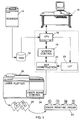
- Fig. 1 illustrates a system for generating a screened reproduction of an image constructed and operative in accordance with a preferred embodiment of the present invention.
- the system preferably comprises a color separation scanner 10, such as a Scitex Smart Scanner, manufactured and sold by Scitex Corporation Ltd. of Herzlia, Israel, which is adapted to provide a digital color separation output of a color original.
- a color separation scanner 10 such as a Scitex Smart Scanner, manufactured and sold by Scitex Corporation Ltd. of Herzlia, Israel, which is adapted to provide a digital color separation output of a color original.
- the digital output of scanner 10 is normally stored on an image data disc 12 or any other suitable storage medium, which is accessible by a CPU 14, such as an Intel 80386. Interfacing with the CPU is an interactive workstation 16, such as a Scitex Prisma, manufactured and sold by Scitex Corporation Ltd. of Herzlia, Israel.
- Dot construction circuitry 20 receives dot contour information from a look up table (LUT) 22, which may be loaded by CPU 14.
- Dot construction circuitry 20 provides a control output to laser beam control circuitry 24 in a laser plotter 26, such as a Raystar, manufactured and sold by Scitex Corporation Ltd. of Herzlia, Israel.
- Laser plotter 26 produces halftone film color separations 28 which are employed in a conventional process color printing press 30, to produce process color prints.
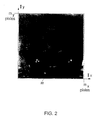
- Fig. 2 illustrates a typical halftone color separation which is stored on disc 12.
- Fig. 3 illustrates in enlarged detail, a small area 32 indicated on Fig. 2. It is noted that the gray level over area 32 varies thereacross.
- the halftone color separation in general and the small area 32 in particular are hereinafter termed the input image and are divided into a first multiplicity of pixels 34 which are arranged along coordinates I x and I y .
- Pixels 34 typically have a resolution of 100 - 400 pixels per inch along each of the coordinate axes of the input image.
- Each average gray level for a pixel 34 is represented digitally by an input density level. There are typically provided 256 different input density levels, 0 being the lightest and 255 being the blackest.
- Fig. 4 illustrates the input density values for the pixels 34 of Fig. 3.
- the apparatus of the present invention stores output dot contour information for each of 256 input density values.
- the output dot contours are preferably stored in LUT 22 (Fig. 1).
- the output dot contours are generally defined in accordance with an output dot density distribution corresponding to each given output dot configuration.
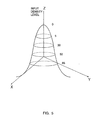
- Fig. 5 illustrates an output dot density distribution for a conventional C dot, which is used in process color printing.
- Fig. 5 shows the various cross sections of the output density dot distribution for various corresponding input density values, the cross section defining the dot contour corresponding to each input density value.
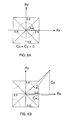
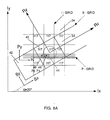
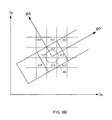
- Figs. 6A and 6B illustrate the construction of dot contours from octants, for two cases, those wherein the center of the arc of the octant is within the dot contour (Fig. 6A) and those wherein the center of the arc of the octant is outside the dot contour (Fig. 6B).
- the dot contour is fully defined by the following parameters for each octant: C x , C y , the x and y coordinates of the center of the arc; r, the radius of the arc; F, a flag indicating whether the center of the arc is within or without the dot and having the possible values of 0 and 1.
- the internal coordinates of each cell are given as R x , R y .
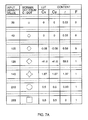
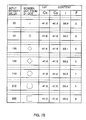
- Figs. 7A, 7B and 7C illustrate portions of the contents of LUT 22 (Fig. 1) for three different conventional output dot configurations, C dot, D dot and gravure dot respectively. It is seen that for each dot configuration, and for each input density value a given dot contour is defined by values C x , C y , r and F. It is appreciated that as the result of dot symmetry, the values for only one octant are given. In practice, however, values for all eight of the octants are normally stored, although this need not necessarily be the case.
- Fig. 8A illustrates the construction of an output dot employing a rotated screen having a mesh different from that of the scanner 10, for a portion 40 of the image illustrated in Figs. 3 and 4.
- the input density values for the pixels 34 are indicated within each pixel and it is seen that they are all uniform.
- the rotated screen defines a second multiplicity of cells 42, lying along coordinate axes S x , S y , which are rotated with respect to coordinate axes I x , I y by a given angle, typically 30 degrees.
- Each output dot 44 also referred to as a screen dot, is centered within a cell 42.
- the mesh of the rotated screen defines the size of cells 42 and of dots 44 and provides output dots having a typical resolution of 60 - 200 dots per inch in the output image.
- the internal coordinates of each cell are given as R x , R y .
- Each output dot 44 is made up of a third multiplicity of points 46 which are produced by laser plotter 26 (Fig. 1), which operates along coordinates P x , P y , which are normally parallel to coordinates I x , I y and normally have a significantly higher resolution than pixels 34.
- Typical resolution of points 46 is 800 - 5000 points per inch of the output image.
- the laser plotter is controlled to write for all locations within the dot contour defined by LUT 22, as indicated at P1 and not to write at all locations outside the dot contour, as indicated at P2.
- Fig. 8B illustrates a completed dot produced by the technique described in Fig. 8A for the same location on the input image.
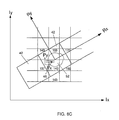
- Fig. 8C illustrates the construction of an output dot employing a rotated screen having a mesh different from that of the scanner 10, for a portion 50 of the image illustrated in Figs. 3 and 4.
- the input density values for the pixels 34 are indicated within each pixel and it is seen that they differ from each other.
- the rotated screen defines a second multiplicity of cells 42, lying along coordinate axes S x , S y , which are rotated with respect to coordinate axes I x , I y by a given screen rotation angle ⁇ , typically 30 degrees.
- Each output dot 52 also referred to as a screen dot, is centered within a cell 42.
- the mesh of the rotated screen defines the size of cells 42 and of dots 52 and provides output dots having a typical resolution of 60 - 200 dots per inch in the output image.
- the internal coordinates of each cell are given as R x , R y .
- the output dot contour along each portion of the circumference of the dot is a function of the input density value for the pixel 34 over which it lies.
- the dot contour corresponds to a relatively small dot area and where the input density value is high, such as 170, the dot contour corresponds to a relatively large dot area.
- An output dot which overlies pixels 34 having different input density values is thus asymmetric in a manner generally corresponding to the asymmetry of the input density values of the pixels 34 represented by the output dot.
- each output dot 52 is made up of a third multiplicity of points 46 which are produced by laser plotter 26 (Fig. 1), which operates along coordinates P x , P y , which are normally parallel to coordinates I x , I y and normally have a significantly higher resolution than pixels 34.
- Typical resolution of points 46 is 800 - 5000 points per inch of the output image.
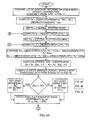
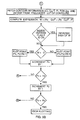
- FIG. 9 illustrates the computer instructions given to carry out the invention.
- the flow chart of Fig. 9 is self-explanatory and employs terms defined as follows:
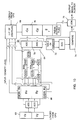
- Fig. 10 describes circuitry 18 and 20 (Fig. 1).
- a register 60 stores current screen-cell coordinates R x , R y obtained through addition of contents V x , V y of a preloaded step increment register 62 with the previous values stored in register 60.
- An octant 66 is composed of two most significant bits, namely the sign bits of R x and R y stored in register 60 and of a least significant bit computed by circuitry 64 which operates on the values of R x and R y as shown in Fig. 10.
- An LUT of contours 68 preloaded from CPU 14 (Fig. 1), receives the octant 66 and a current input density level for the current screen-cell coordinates R x , R y and produces the octant information C x , C y , r2 and F, the flag indicating whether or not the center of the arc is within or without the dot, for storage in a register 70.
- Adders 78 and 80 and a table of squares 72 serve to compute the expression (C x - R x )2 + (C y - R y )2 from the information in registers 60 and 70.
- a comparator 74 compares the result of adder 80 with the r2 value stored in register 70.
- the output of comparator 74 and the value of F stored in register 70 are used to drive an XOR gate 76 which, in turn, controls the laser beam 24 (Fig. 1).
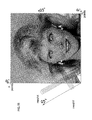
- Fig. 11 illustrates a screened halftone color separation produced in accordance with a preferred embodiment of the present invention. It is appreciated that the operator, using workstation 16, defines meshX and meshY and the screen rotation angle ⁇ of the output screen dots.
Landscapes
- Engineering & Computer Science (AREA)
- Multimedia (AREA)
- Signal Processing (AREA)
- Facsimile Image Signal Circuits (AREA)
- Ultra Sonic Daignosis Equipment (AREA)
- Closed-Circuit Television Systems (AREA)
- Image Analysis (AREA)
- Holo Graphy (AREA)
- Magnetic Resonance Imaging Apparatus (AREA)
- Image Processing (AREA)
- Image Generation (AREA)
Applications Claiming Priority (2)
| Application Number | Priority Date | Filing Date | Title |
|---|---|---|---|
| US524922 | 1990-05-18 | ||
| US07/524,922 US5150225A (en) | 1990-05-18 | 1990-05-18 | Apparatus for generating a screened reproduction of an image |
Publications (3)
| Publication Number | Publication Date |
|---|---|
| EP0457511A2 true EP0457511A2 (de) | 1991-11-21 |
| EP0457511A3 EP0457511A3 (en) | 1993-01-13 |
| EP0457511B1 EP0457511B1 (de) | 1996-06-26 |
Family
ID=24091196
Family Applications (1)
| Application Number | Title | Priority Date | Filing Date |
|---|---|---|---|
| EP91304219A Expired - Lifetime EP0457511B1 (de) | 1990-05-18 | 1991-05-10 | Gerät zur Erzeugung einer gerasterten Reproduktion eines Bildes |
Country Status (7)
| Country | Link |
|---|---|
| US (1) | US5150225A (de) |
| EP (1) | EP0457511B1 (de) |
| JP (1) | JPH05347702A (de) |
| AT (1) | ATE139879T1 (de) |
| CA (1) | CA2042761A1 (de) |
| DE (1) | DE69120471T2 (de) |
| IL (1) | IL98114A (de) |
Cited By (2)
| Publication number | Priority date | Publication date | Assignee | Title |
|---|---|---|---|---|
| DE4205085A1 (de) * | 1992-02-17 | 1993-08-26 | Mannesmann Ag | Verfahren und schaltung zum erzeugen von bild-informationen (pixmaps) |
| EP0863660A3 (de) * | 1997-03-07 | 2003-10-08 | Xerox Corporation | Ein Verfahren zum Produzieren von Halbtonpunkten mit Paaren von Holladay-Halbtonpunkten |
Families Citing this family (10)
| Publication number | Priority date | Publication date | Assignee | Title |
|---|---|---|---|---|
| US5227895A (en) * | 1990-08-03 | 1993-07-13 | Scitex Corporation Ltd. | Method and apparatus for image reproduction |
| JPH077624A (ja) * | 1991-09-09 | 1995-01-10 | Mitsubishi Paper Mills Ltd | 網点画像記録方法 |
| US5233441A (en) * | 1992-03-20 | 1993-08-03 | Eastman Kodak Company | Method for representing halftone dots with dot envelope parameters |
| US5239391A (en) * | 1992-03-20 | 1993-08-24 | Eastman Kodak Company | Apparatus for generating halftone dots from dot envelope parameters |
| US5446558A (en) * | 1992-10-05 | 1995-08-29 | Eastman Kodak Company | Apparatus and associated method for representing elliptical halftone dots |
| US5751594A (en) * | 1993-03-16 | 1998-05-12 | Emc Corporation | Aperture control system for printed circuit board fabrication |
| IL106514A (en) * | 1993-07-28 | 1997-08-14 | Scitex Corp Ltd | Apparatus and method for screening images for reproduction |
| US5440652A (en) * | 1993-09-10 | 1995-08-08 | Athena Design Systems, Inc. | Method and apparatus for preparing color separations based on n-way color relationships |
| US5689623A (en) * | 1995-03-27 | 1997-11-18 | Optronics International Corporation | Spread spectrum digital screening |
| DE29507302U1 (de) * | 1995-05-05 | 1995-06-22 | MAN Roland Druckmaschinen AG, 63075 Offenbach | Rotationsdruckmaschine |
Family Cites Families (10)
| Publication number | Priority date | Publication date | Assignee | Title |
|---|---|---|---|---|
| GB1448112A (en) * | 1973-02-13 | 1976-09-02 | Int Publishing Corp Ltd | Electronic screening |
| US4040094A (en) * | 1973-02-13 | 1977-08-02 | International Publishing Corporation Ltd. | Electronic screening |
| US4149183A (en) * | 1976-05-21 | 1979-04-10 | Xerox Corporation | Electronic halftone generator |
| US4456924A (en) * | 1980-04-14 | 1984-06-26 | Scitex Corporation Ltd. | Screened image reproduction |
| US4350996A (en) * | 1980-04-14 | 1982-09-21 | Scitex Corporation Ltd. | Screened image reproduction |
| US4419690A (en) * | 1980-09-01 | 1983-12-06 | Crosfield Electronics Limited | Method and apparatus for producing a half-tone reproduction |
| JPS60213170A (ja) * | 1984-04-06 | 1985-10-25 | Dainippon Screen Mfg Co Ltd | 画像走査記録装置における網点パタ−ン発生方法 |
| JPS6258779A (ja) * | 1985-09-06 | 1987-03-14 | Dainippon Screen Mfg Co Ltd | 網目版画像記録装置 |
| JPH0626440B2 (ja) * | 1987-05-26 | 1994-04-06 | 大日本スクリ−ン製造株式会社 | 網点作成装置 |
| AU605298B2 (en) * | 1987-05-29 | 1991-01-10 | Digital Equipment Corporation | System for producing dithered images on asymmetric grids |
-
1990
- 1990-05-18 US US07/524,922 patent/US5150225A/en not_active Expired - Fee Related
-
1991
- 1991-05-10 EP EP91304219A patent/EP0457511B1/de not_active Expired - Lifetime
- 1991-05-10 AT AT91304219T patent/ATE139879T1/de active
- 1991-05-10 DE DE69120471T patent/DE69120471T2/de not_active Expired - Fee Related
- 1991-05-12 IL IL9811491A patent/IL98114A/en unknown
- 1991-05-16 CA CA002042761A patent/CA2042761A1/en not_active Abandoned
- 1991-05-17 JP JP3141240A patent/JPH05347702A/ja active Pending
Cited By (2)
| Publication number | Priority date | Publication date | Assignee | Title |
|---|---|---|---|---|
| DE4205085A1 (de) * | 1992-02-17 | 1993-08-26 | Mannesmann Ag | Verfahren und schaltung zum erzeugen von bild-informationen (pixmaps) |
| EP0863660A3 (de) * | 1997-03-07 | 2003-10-08 | Xerox Corporation | Ein Verfahren zum Produzieren von Halbtonpunkten mit Paaren von Holladay-Halbtonpunkten |
Also Published As
| Publication number | Publication date |
|---|---|
| EP0457511A3 (en) | 1993-01-13 |
| IL98114A (en) | 1995-01-24 |
| US5150225A (en) | 1992-09-22 |
| DE69120471D1 (de) | 1996-08-01 |
| DE69120471T2 (de) | 1997-02-20 |
| JPH05347702A (ja) | 1993-12-27 |
| EP0457511B1 (de) | 1996-06-26 |
| ATE139879T1 (de) | 1996-07-15 |
| CA2042761A1 (en) | 1991-11-19 |
| IL98114A0 (en) | 1992-06-21 |
Similar Documents
| Publication | Publication Date | Title |
|---|---|---|
| EP0493445B1 (de) | Verfahren und vorrichtung zur erzeugung gerasterter halbtonbilder | |
| EP0457511B1 (de) | Gerät zur Erzeugung einer gerasterten Reproduktion eines Bildes | |
| JPH08227147A (ja) | 網点作成方法および装置 | |
| US5140431A (en) | Digital electronic system for halftone printing | |
| JPS63141445A (ja) | ハーフトーン表示発生方法及びその装置 | |
| US6853467B2 (en) | Multistage screening with screens of any desired screen resolutions and screen angles | |
| US6970273B1 (en) | Method of tone reproduction with halftone dots, apparatus for outputting halftone plate, halftone plate, and printed material | |
| US6325487B1 (en) | Systems and methods for generating high addressability images | |
| US5227895A (en) | Method and apparatus for image reproduction | |
| EP0457519B1 (de) | Gerät zur Erzeugung einer gerasterten Reproduktion eines Bildes | |
| US5299020A (en) | Method and apparatus for generating a screened reproduction of an image using stored dot portions | |
| EP1161082B1 (de) | Halbtongerasterte Bildwiedergabe | |
| US5473733A (en) | Technique for generating image reproduction | |
| US5526143A (en) | Apparatus and technique for generating a screened reproduction of an image | |
| US5508828A (en) | Apparatus and method for generating a screened reproduction of an image employing a non-periodic screen function | |
| US5530555A (en) | Method and apparatus for recording halftone dot image with different repeating units | |
| US5600448A (en) | Apparatus and method for generating a screened reproduction of an image | |
| US5608822A (en) | Apparatus and method for generating half-tone dot in image reproduction | |
| US5691823A (en) | Apparatus and method for random screening | |
| HK1005200B (en) | Apparatus for generating a screened reproduction of an image | |
| IL108643A (en) | Method and device for creating on-screen image reproduction |
Legal Events
| Date | Code | Title | Description |
|---|---|---|---|
| PUAI | Public reference made under article 153(3) epc to a published international application that has entered the european phase |
Free format text: ORIGINAL CODE: 0009012 |
|
| AK | Designated contracting states |
Kind code of ref document: A2 Designated state(s): AT BE CH DE DK ES FR GB GR IT LI LU NL SE |
|
| PUAL | Search report despatched |
Free format text: ORIGINAL CODE: 0009013 |
|
| 17P | Request for examination filed |
Effective date: 19921028 |
|
| AK | Designated contracting states |
Kind code of ref document: A3 Designated state(s): AT BE CH DE DK ES FR GB GR IT LI LU NL SE |
|
| 17Q | First examination report despatched |
Effective date: 19950320 |
|
| GRAH | Despatch of communication of intention to grant a patent |
Free format text: ORIGINAL CODE: EPIDOS IGRA |
|
| GRAA | (expected) grant |
Free format text: ORIGINAL CODE: 0009210 |
|
| AK | Designated contracting states |
Kind code of ref document: B1 Designated state(s): AT BE CH DE DK ES FR GB GR IT LI LU NL SE |
|
| PG25 | Lapsed in a contracting state [announced via postgrant information from national office to epo] |
Ref country code: IT Free format text: LAPSE BECAUSE OF FAILURE TO SUBMIT A TRANSLATION OF THE DESCRIPTION OR TO PAY THE FEE WITHIN THE PRE;WARNING: LAPSES OF ITALIAN PATENTS WITH EFFECTIVE DATE BEFORE 2007 MAY HAVE OCCURRED AT ANY TIME BEFORE 2007. THE CORRECT EFFECTIVE DATE MAY BE DIFFERENT FROM THE ONE RECORDED.SCRIBED TIME-LIMIT Effective date: 19960626 Ref country code: LI Effective date: 19960626 Ref country code: DK Effective date: 19960626 Ref country code: ES Free format text: THE PATENT HAS BEEN ANNULLED BY A DECISION OF A NATIONAL AUTHORITY Effective date: 19960626 Ref country code: FR Effective date: 19960626 Ref country code: BE Effective date: 19960626 Ref country code: NL Free format text: LAPSE BECAUSE OF FAILURE TO SUBMIT A TRANSLATION OF THE DESCRIPTION OR TO PAY THE FEE WITHIN THE PRESCRIBED TIME-LIMIT Effective date: 19960626 Ref country code: GR Free format text: LAPSE BECAUSE OF FAILURE TO SUBMIT A TRANSLATION OF THE DESCRIPTION OR TO PAY THE FEE WITHIN THE PRESCRIBED TIME-LIMIT Effective date: 19960626 Ref country code: CH Effective date: 19960626 Ref country code: AT Effective date: 19960626 |
|
| REF | Corresponds to: |
Ref document number: 139879 Country of ref document: AT Date of ref document: 19960715 Kind code of ref document: T |
|
| REF | Corresponds to: |
Ref document number: 69120471 Country of ref document: DE Date of ref document: 19960801 |
|
| PG25 | Lapsed in a contracting state [announced via postgrant information from national office to epo] |
Ref country code: SE Effective date: 19960926 |
|
| EN | Fr: translation not filed | ||
| NLV1 | Nl: lapsed or annulled due to failure to fulfill the requirements of art. 29p and 29m of the patents act | ||
| REG | Reference to a national code |
Ref country code: CH Ref legal event code: PL |
|
| PLBE | No opposition filed within time limit |
Free format text: ORIGINAL CODE: 0009261 |
|
| STAA | Information on the status of an ep patent application or granted ep patent |
Free format text: STATUS: NO OPPOSITION FILED WITHIN TIME LIMIT |
|
| PG25 | Lapsed in a contracting state [announced via postgrant information from national office to epo] |
Ref country code: LU Free format text: LAPSE BECAUSE OF NON-PAYMENT OF DUE FEES Effective date: 19970531 |
|
| 26N | No opposition filed | ||
| PGFP | Annual fee paid to national office [announced via postgrant information from national office to epo] |
Ref country code: GB Payment date: 19990413 Year of fee payment: 9 |
|
| PGFP | Annual fee paid to national office [announced via postgrant information from national office to epo] |
Ref country code: DE Payment date: 19990420 Year of fee payment: 9 |
|
| PG25 | Lapsed in a contracting state [announced via postgrant information from national office to epo] |
Ref country code: GB Free format text: LAPSE BECAUSE OF NON-PAYMENT OF DUE FEES Effective date: 20000510 |
|
| GBPC | Gb: european patent ceased through non-payment of renewal fee |
Effective date: 20000510 |
|
| PG25 | Lapsed in a contracting state [announced via postgrant information from national office to epo] |
Ref country code: DE Free format text: LAPSE BECAUSE OF NON-PAYMENT OF DUE FEES Effective date: 20010301 |