EP0456751B1 - Verfahren zum untersuchen von festen oberflächen auf das vorhandensein von substanzen mittels eines wattestäbchens - Google Patents
Verfahren zum untersuchen von festen oberflächen auf das vorhandensein von substanzen mittels eines wattestäbchens Download PDFInfo
- Publication number
- EP0456751B1 EP0456751B1 EP90903465A EP90903465A EP0456751B1 EP 0456751 B1 EP0456751 B1 EP 0456751B1 EP 90903465 A EP90903465 A EP 90903465A EP 90903465 A EP90903465 A EP 90903465A EP 0456751 B1 EP0456751 B1 EP 0456751B1
- Authority
- EP
- European Patent Office
- Prior art keywords
- reagent
- swab
- lead
- substance
- dye
- Prior art date
- Legal status (The legal status is an assumption and is not a legal conclusion. Google has not performed a legal analysis and makes no representation as to the accuracy of the status listed.)
- Expired - Lifetime
Links
- 239000000126 substance Substances 0.000 title claims abstract description 31
- 239000007787 solid Substances 0.000 title claims description 15
- 238000010998 test method Methods 0.000 title claims description 4
- 238000012360 testing method Methods 0.000 claims abstract description 65
- 239000003153 chemical reaction reagent Substances 0.000 claims abstract description 44
- 229910052751 metal Inorganic materials 0.000 claims abstract description 27
- 239000002184 metal Substances 0.000 claims abstract description 27
- 238000006243 chemical reaction Methods 0.000 claims abstract description 23
- 238000000034 method Methods 0.000 claims abstract description 20
- 239000002250 absorbent Substances 0.000 claims description 26
- 230000002745 absorbent Effects 0.000 claims description 26
- 239000000463 material Substances 0.000 claims description 26
- 239000000872 buffer Substances 0.000 claims description 23
- 229910052793 cadmium Inorganic materials 0.000 claims description 20
- BDOSMKKIYDKNTQ-UHFFFAOYSA-N cadmium atom Chemical compound [Cd] BDOSMKKIYDKNTQ-UHFFFAOYSA-N 0.000 claims description 20
- 239000000945 filler Substances 0.000 claims description 17
- 230000003213 activating effect Effects 0.000 claims description 15
- XEEYBQQBJWHFJM-UHFFFAOYSA-N Iron Chemical compound [Fe] XEEYBQQBJWHFJM-UHFFFAOYSA-N 0.000 claims description 10
- SMMIDVLUFMPWFN-UHFFFAOYSA-N 4-nitro-n-[(4-phenyldiazenylphenyl)diazenyl]aniline Chemical compound C1=CC([N+](=O)[O-])=CC=C1NN=NC1=CC=C(N=NC=2C=CC=CC=2)C=C1 SMMIDVLUFMPWFN-UHFFFAOYSA-N 0.000 claims description 6
- QSHDDOUJBYECFT-UHFFFAOYSA-N mercury Chemical compound [Hg] QSHDDOUJBYECFT-UHFFFAOYSA-N 0.000 claims description 6
- 229910052753 mercury Inorganic materials 0.000 claims description 6
- RYGMFSIKBFXOCR-UHFFFAOYSA-N Copper Chemical compound [Cu] RYGMFSIKBFXOCR-UHFFFAOYSA-N 0.000 claims description 5
- BUGBHKTXTAQXES-UHFFFAOYSA-N Selenium Chemical compound [Se] BUGBHKTXTAQXES-UHFFFAOYSA-N 0.000 claims description 5
- 229910052787 antimony Inorganic materials 0.000 claims description 5
- WATWJIUSRGPENY-UHFFFAOYSA-N antimony atom Chemical compound [Sb] WATWJIUSRGPENY-UHFFFAOYSA-N 0.000 claims description 5
- 229910052797 bismuth Inorganic materials 0.000 claims description 5
- JCXGWMGPZLAOME-UHFFFAOYSA-N bismuth atom Chemical compound [Bi] JCXGWMGPZLAOME-UHFFFAOYSA-N 0.000 claims description 5
- 229910052802 copper Inorganic materials 0.000 claims description 5
- 239000010949 copper Substances 0.000 claims description 5
- 229910052742 iron Inorganic materials 0.000 claims description 5
- 239000011669 selenium Substances 0.000 claims description 5
- 229910052711 selenium Inorganic materials 0.000 claims description 5
- NZOSULSUAMEDAR-UHFFFAOYSA-N C1=CC=C2C([N+](=O)[O-])=CC=CC2=C1.[N-]=[N+]=NC1=CC=CC=C1N=NC1=CC=CC=C1 Chemical compound C1=CC=C2C([N+](=O)[O-])=CC=CC2=C1.[N-]=[N+]=NC1=CC=CC=C1N=NC1=CC=CC=C1 NZOSULSUAMEDAR-UHFFFAOYSA-N 0.000 claims description 4
- 244000273618 Sphenoclea zeylanica Species 0.000 claims description 2
- UZVDZTNCWFODEO-UHFFFAOYSA-N N=[N+]=[N-].C1=CC=C2C([N+](=O)[O-])=CC=CC2=C1.C1=CC=CC=C1N=NC1=CC=CC=C1 Chemical compound N=[N+]=[N-].C1=CC=C2C([N+](=O)[O-])=CC=CC2=C1.C1=CC=CC=C1N=NC1=CC=CC=C1 UZVDZTNCWFODEO-UHFFFAOYSA-N 0.000 claims 1
- 230000004913 activation Effects 0.000 claims 1
- 238000009736 wetting Methods 0.000 claims 1
- 239000000975 dye Substances 0.000 description 66
- 239000000243 solution Substances 0.000 description 48
- 239000004033 plastic Substances 0.000 description 34
- 229920003023 plastic Polymers 0.000 description 34
- 239000003973 paint Substances 0.000 description 18
- 229920000297 Rayon Polymers 0.000 description 17
- 239000002964 rayon Substances 0.000 description 17
- 239000002023 wood Substances 0.000 description 17
- FEWJPZIEWOKRBE-JCYAYHJZSA-N Dextrotartaric acid Chemical compound OC(=O)[C@H](O)[C@@H](O)C(O)=O FEWJPZIEWOKRBE-JCYAYHJZSA-N 0.000 description 15
- PNEYBMLMFCGWSK-UHFFFAOYSA-N aluminium oxide Inorganic materials [O-2].[O-2].[O-2].[Al+3].[Al+3] PNEYBMLMFCGWSK-UHFFFAOYSA-N 0.000 description 15
- 239000000203 mixture Substances 0.000 description 15
- 229940095064 tartrate Drugs 0.000 description 15
- 229920000742 Cotton Polymers 0.000 description 14
- 239000012190 activator Substances 0.000 description 13
- 150000002739 metals Chemical class 0.000 description 13
- 229920004934 Dacron® Polymers 0.000 description 11
- 230000002378 acidificating effect Effects 0.000 description 11
- 239000005020 polyethylene terephthalate Substances 0.000 description 11
- 239000000835 fiber Substances 0.000 description 10
- 239000000725 suspension Substances 0.000 description 10
- KWYUFKZDYYNOTN-UHFFFAOYSA-M Potassium hydroxide Chemical compound [OH-].[K+] KWYUFKZDYYNOTN-UHFFFAOYSA-M 0.000 description 9
- 239000000843 powder Substances 0.000 description 9
- 239000002244 precipitate Substances 0.000 description 8
- 159000000000 sodium salts Chemical class 0.000 description 8
- QXNVGIXVLWOKEQ-UHFFFAOYSA-N Disodium Chemical class [Na][Na] QXNVGIXVLWOKEQ-UHFFFAOYSA-N 0.000 description 7
- CSCPPACGZOOCGX-UHFFFAOYSA-N Acetone Chemical compound CC(C)=O CSCPPACGZOOCGX-UHFFFAOYSA-N 0.000 description 6
- HEMHJVSKTPXQMS-UHFFFAOYSA-M Sodium hydroxide Chemical compound [OH-].[Na+] HEMHJVSKTPXQMS-UHFFFAOYSA-M 0.000 description 6
- 229910052788 barium Inorganic materials 0.000 description 6
- DSAJWYNOEDNPEQ-UHFFFAOYSA-N barium atom Chemical compound [Ba] DSAJWYNOEDNPEQ-UHFFFAOYSA-N 0.000 description 6
- 150000001768 cations Chemical class 0.000 description 6
- 229910052979 sodium sulfide Inorganic materials 0.000 description 6
- GRVFOGOEDUUMBP-UHFFFAOYSA-N sodium sulfide (anhydrous) Chemical compound [Na+].[Na+].[S-2] GRVFOGOEDUUMBP-UHFFFAOYSA-N 0.000 description 6
- 231100000331 toxic Toxicity 0.000 description 6
- 230000002588 toxic effect Effects 0.000 description 6
- 230000000694 effects Effects 0.000 description 5
- 239000011521 glass Substances 0.000 description 5
- WCJLIWFWHPOTAC-UHFFFAOYSA-N rhodizonic acid Chemical compound OC1=C(O)C(=O)C(=O)C(=O)C1=O WCJLIWFWHPOTAC-UHFFFAOYSA-N 0.000 description 5
- FBPFZTCFMRRESA-KVTDHHQDSA-N D-Mannitol Chemical compound OC[C@@H](O)[C@@H](O)[C@H](O)[C@H](O)CO FBPFZTCFMRRESA-KVTDHHQDSA-N 0.000 description 4
- 229930195725 Mannitol Natural products 0.000 description 4
- VMHLLURERBWHNL-UHFFFAOYSA-M Sodium acetate Chemical compound [Na+].CC([O-])=O VMHLLURERBWHNL-UHFFFAOYSA-M 0.000 description 4
- 239000000919 ceramic Substances 0.000 description 4
- 239000000594 mannitol Substances 0.000 description 4
- 235000010355 mannitol Nutrition 0.000 description 4
- 239000001632 sodium acetate Substances 0.000 description 4
- 235000017281 sodium acetate Nutrition 0.000 description 4
- KCXVZYZYPLLWCC-UHFFFAOYSA-N EDTA Chemical compound OC(=O)CN(CC(O)=O)CCN(CC(O)=O)CC(O)=O KCXVZYZYPLLWCC-UHFFFAOYSA-N 0.000 description 3
- LFQSCWFLJHTTHZ-UHFFFAOYSA-N Ethanol Chemical compound CCO LFQSCWFLJHTTHZ-UHFFFAOYSA-N 0.000 description 3
- OKKJLVBELUTLKV-UHFFFAOYSA-N Methanol Chemical compound OC OKKJLVBELUTLKV-UHFFFAOYSA-N 0.000 description 3
- SXWPCWBFJXDMAI-UHFFFAOYSA-L disodium;3,4,5,6-tetraoxocyclohexene-1,2-diolate Chemical compound [Na+].[Na+].[O-]C1=C([O-])C(=O)C(=O)C(=O)C1=O SXWPCWBFJXDMAI-UHFFFAOYSA-L 0.000 description 3
- 239000000428 dust Substances 0.000 description 3
- 229920000728 polyester Polymers 0.000 description 3
- 239000001267 polyvinylpyrrolidone Substances 0.000 description 3
- 235000013855 polyvinylpyrrolidone Nutrition 0.000 description 3
- 229920000036 polyvinylpyrrolidone Polymers 0.000 description 3
- 235000011118 potassium hydroxide Nutrition 0.000 description 3
- RMAQACBXLXPBSY-UHFFFAOYSA-N silicic acid Chemical compound O[Si](O)(O)O RMAQACBXLXPBSY-UHFFFAOYSA-N 0.000 description 3
- 235000012239 silicon dioxide Nutrition 0.000 description 3
- HELHAJAZNSDZJO-OLXYHTOASA-L sodium L-tartrate Chemical compound [Na+].[Na+].[O-]C(=O)[C@H](O)[C@@H](O)C([O-])=O HELHAJAZNSDZJO-OLXYHTOASA-L 0.000 description 3
- 239000001509 sodium citrate Substances 0.000 description 3
- NLJMYIDDQXHKNR-UHFFFAOYSA-K sodium citrate Chemical compound O.O.[Na+].[Na+].[Na+].[O-]C(=O)CC(O)(CC([O-])=O)C([O-])=O NLJMYIDDQXHKNR-UHFFFAOYSA-K 0.000 description 3
- 235000011083 sodium citrates Nutrition 0.000 description 3
- 239000001433 sodium tartrate Substances 0.000 description 3
- 229960002167 sodium tartrate Drugs 0.000 description 3
- 235000011004 sodium tartrates Nutrition 0.000 description 3
- 239000000454 talc Substances 0.000 description 3
- 229910052623 talc Inorganic materials 0.000 description 3
- 235000012222 talc Nutrition 0.000 description 3
- ZCYVEMRRCGMTRW-UHFFFAOYSA-N 7553-56-2 Chemical compound [I] ZCYVEMRRCGMTRW-UHFFFAOYSA-N 0.000 description 2
- 244000215068 Acacia senegal Species 0.000 description 2
- 235000006491 Acacia senegal Nutrition 0.000 description 2
- QGZKDVFQNNGYKY-UHFFFAOYSA-N Ammonia Chemical compound N QGZKDVFQNNGYKY-UHFFFAOYSA-N 0.000 description 2
- CIWBSHSKHKDKBQ-JLAZNSOCSA-N Ascorbic acid Chemical compound OC[C@H](O)[C@H]1OC(=O)C(O)=C1O CIWBSHSKHKDKBQ-JLAZNSOCSA-N 0.000 description 2
- IJGRMHOSHXDMSA-UHFFFAOYSA-N Atomic nitrogen Chemical compound N#N IJGRMHOSHXDMSA-UHFFFAOYSA-N 0.000 description 2
- 229920000084 Gum arabic Polymers 0.000 description 2
- 239000004677 Nylon Substances 0.000 description 2
- KAESVJOAVNADME-UHFFFAOYSA-N Pyrrole Chemical compound C=1C=CNC=1 KAESVJOAVNADME-UHFFFAOYSA-N 0.000 description 2
- VYPSYNLAJGMNEJ-UHFFFAOYSA-N Silicium dioxide Chemical compound O=[Si]=O VYPSYNLAJGMNEJ-UHFFFAOYSA-N 0.000 description 2
- 229910021536 Zeolite Inorganic materials 0.000 description 2
- 235000010489 acacia gum Nutrition 0.000 description 2
- 239000000654 additive Substances 0.000 description 2
- 239000011324 bead Substances 0.000 description 2
- 239000007853 buffer solution Substances 0.000 description 2
- 229920002678 cellulose Polymers 0.000 description 2
- 239000001913 cellulose Substances 0.000 description 2
- 239000003795 chemical substances by application Substances 0.000 description 2
- 230000000052 comparative effect Effects 0.000 description 2
- 238000011109 contamination Methods 0.000 description 2
- 238000001514 detection method Methods 0.000 description 2
- 239000003085 diluting agent Substances 0.000 description 2
- HNPSIPDUKPIQMN-UHFFFAOYSA-N dioxosilane;oxo(oxoalumanyloxy)alumane Chemical compound O=[Si]=O.O=[Al]O[Al]=O HNPSIPDUKPIQMN-UHFFFAOYSA-N 0.000 description 2
- OAEGRYMCJYIXQT-UHFFFAOYSA-N dithiooxamide Chemical compound NC(=S)C(N)=S OAEGRYMCJYIXQT-UHFFFAOYSA-N 0.000 description 2
- 239000006260 foam Substances 0.000 description 2
- 239000003292 glue Substances 0.000 description 2
- 229910001385 heavy metal Inorganic materials 0.000 description 2
- 239000003701 inert diluent Substances 0.000 description 2
- 239000011630 iodine Substances 0.000 description 2
- 229910052740 iodine Inorganic materials 0.000 description 2
- RBTARNINKXHZNM-UHFFFAOYSA-K iron trichloride Chemical compound Cl[Fe](Cl)Cl RBTARNINKXHZNM-UHFFFAOYSA-K 0.000 description 2
- 229940056932 lead sulfide Drugs 0.000 description 2
- 229910052981 lead sulfide Inorganic materials 0.000 description 2
- 239000007788 liquid Substances 0.000 description 2
- 238000004519 manufacturing process Methods 0.000 description 2
- 238000002156 mixing Methods 0.000 description 2
- 238000000465 moulding Methods 0.000 description 2
- 229920001778 nylon Polymers 0.000 description 2
- DHRLEVQXOMLTIM-UHFFFAOYSA-N phosphoric acid;trioxomolybdenum Chemical compound O=[Mo](=O)=O.O=[Mo](=O)=O.O=[Mo](=O)=O.O=[Mo](=O)=O.O=[Mo](=O)=O.O=[Mo](=O)=O.O=[Mo](=O)=O.O=[Mo](=O)=O.O=[Mo](=O)=O.O=[Mo](=O)=O.O=[Mo](=O)=O.O=[Mo](=O)=O.OP(O)(O)=O DHRLEVQXOMLTIM-UHFFFAOYSA-N 0.000 description 2
- 229920001592 potato starch Polymers 0.000 description 2
- 238000002360 preparation method Methods 0.000 description 2
- WPPDXAHGCGPUPK-UHFFFAOYSA-N red 2 Chemical compound C1=CC=CC=C1C(C1=CC=CC=C11)=C(C=2C=3C4=CC=C5C6=CC=C7C8=C(C=9C=CC=CC=9)C9=CC=CC=C9C(C=9C=CC=CC=9)=C8C8=CC=C(C6=C87)C(C=35)=CC=2)C4=C1C1=CC=CC=C1 WPPDXAHGCGPUPK-UHFFFAOYSA-N 0.000 description 2
- PYWVYCXTNDRMGF-UHFFFAOYSA-N rhodamine B Chemical compound [Cl-].C=12C=CC(=[N+](CC)CC)C=C2OC2=CC(N(CC)CC)=CC=C2C=1C1=CC=CC=C1C(O)=O PYWVYCXTNDRMGF-UHFFFAOYSA-N 0.000 description 2
- 150000003839 salts Chemical class 0.000 description 2
- 230000035945 sensitivity Effects 0.000 description 2
- 235000011121 sodium hydroxide Nutrition 0.000 description 2
- 239000002689 soil Substances 0.000 description 2
- CWERGRDVMFNCDR-UHFFFAOYSA-N thioglycolic acid Chemical compound OC(=O)CS CWERGRDVMFNCDR-UHFFFAOYSA-N 0.000 description 2
- 231100000419 toxicity Toxicity 0.000 description 2
- 230000001988 toxicity Effects 0.000 description 2
- XLYOFNOQVPJJNP-UHFFFAOYSA-N water Chemical compound O XLYOFNOQVPJJNP-UHFFFAOYSA-N 0.000 description 2
- 239000010457 zeolite Substances 0.000 description 2
- MCSXGCZMEPXKIW-UHFFFAOYSA-N 3-hydroxy-4-[(4-methyl-2-nitrophenyl)diazenyl]-N-(3-nitrophenyl)naphthalene-2-carboxamide Chemical compound Cc1ccc(N=Nc2c(O)c(cc3ccccc23)C(=O)Nc2cccc(c2)[N+]([O-])=O)c(c1)[N+]([O-])=O MCSXGCZMEPXKIW-UHFFFAOYSA-N 0.000 description 1
- QTBSBXVTEAMEQO-UHFFFAOYSA-M Acetate Chemical compound CC([O-])=O QTBSBXVTEAMEQO-UHFFFAOYSA-M 0.000 description 1
- ROFVEXUMMXZLPA-UHFFFAOYSA-N Bipyridyl Chemical compound N1=CC=CC=C1C1=CC=CC=N1 ROFVEXUMMXZLPA-UHFFFAOYSA-N 0.000 description 1
- OYPRJOBELJOOCE-UHFFFAOYSA-N Calcium Chemical compound [Ca] OYPRJOBELJOOCE-UHFFFAOYSA-N 0.000 description 1
- CURLTUGMZLYLDI-UHFFFAOYSA-N Carbon dioxide Chemical compound O=C=O CURLTUGMZLYLDI-UHFFFAOYSA-N 0.000 description 1
- BVKZGUZCCUSVTD-UHFFFAOYSA-L Carbonate Chemical compound [O-]C([O-])=O BVKZGUZCCUSVTD-UHFFFAOYSA-L 0.000 description 1
- VYZAMTAEIAYCRO-UHFFFAOYSA-N Chromium Chemical compound [Cr] VYZAMTAEIAYCRO-UHFFFAOYSA-N 0.000 description 1
- RWSOTUBLDIXVET-UHFFFAOYSA-N Dihydrogen sulfide Chemical compound S RWSOTUBLDIXVET-UHFFFAOYSA-N 0.000 description 1
- KSPIHGBHKVISFI-UHFFFAOYSA-N Diphenylcarbazide Chemical compound C=1C=CC=CC=1NNC(=O)NNC1=CC=CC=C1 KSPIHGBHKVISFI-UHFFFAOYSA-N 0.000 description 1
- 241000196324 Embryophyta Species 0.000 description 1
- 206010016952 Food poisoning Diseases 0.000 description 1
- 208000019331 Foodborne disease Diseases 0.000 description 1
- 208000005577 Gastroenteritis Diseases 0.000 description 1
- 229910021578 Iron(III) chloride Inorganic materials 0.000 description 1
- 229910002567 K2S2O8 Inorganic materials 0.000 description 1
- AMQJEAYHLZJPGS-UHFFFAOYSA-N N-Pentanol Chemical compound CCCCCO AMQJEAYHLZJPGS-UHFFFAOYSA-N 0.000 description 1
- GRYLNZFGIOXLOG-UHFFFAOYSA-N Nitric acid Chemical compound O[N+]([O-])=O GRYLNZFGIOXLOG-UHFFFAOYSA-N 0.000 description 1
- IOVCWXUNBOPUCH-UHFFFAOYSA-M Nitrite anion Chemical compound [O-]N=O IOVCWXUNBOPUCH-UHFFFAOYSA-M 0.000 description 1
- NBIIXXVUZAFLBC-UHFFFAOYSA-N Phosphoric acid Chemical compound OP(O)(O)=O NBIIXXVUZAFLBC-UHFFFAOYSA-N 0.000 description 1
- 229920005830 Polyurethane Foam Polymers 0.000 description 1
- 229920002472 Starch Polymers 0.000 description 1
- QAOWNCQODCNURD-UHFFFAOYSA-N Sulfuric acid Chemical compound OS(O)(=O)=O QAOWNCQODCNURD-UHFFFAOYSA-N 0.000 description 1
- DGEZNRSVGBDHLK-UHFFFAOYSA-N [1,10]phenanthroline Chemical compound C1=CN=C2C3=NC=CC=C3C=CC2=C1 DGEZNRSVGBDHLK-UHFFFAOYSA-N 0.000 description 1
- 239000002253 acid Substances 0.000 description 1
- CQPFMGBJSMSXLP-UHFFFAOYSA-M acid orange 7 Chemical compound [Na+].OC1=CC=C2C=CC=CC2=C1N=NC1=CC=C(S([O-])(=O)=O)C=C1 CQPFMGBJSMSXLP-UHFFFAOYSA-M 0.000 description 1
- 229910052782 aluminium Inorganic materials 0.000 description 1
- XAGFODPZIPBFFR-UHFFFAOYSA-N aluminium Chemical compound [Al] XAGFODPZIPBFFR-UHFFFAOYSA-N 0.000 description 1
- 229910021529 ammonia Inorganic materials 0.000 description 1
- 238000004458 analytical method Methods 0.000 description 1
- 239000012736 aqueous medium Substances 0.000 description 1
- 239000007864 aqueous solution Substances 0.000 description 1
- 229960005070 ascorbic acid Drugs 0.000 description 1
- 235000010323 ascorbic acid Nutrition 0.000 description 1
- 239000011668 ascorbic acid Substances 0.000 description 1
- GIXWDMTZECRIJT-UHFFFAOYSA-N aurintricarboxylic acid Chemical compound C1=CC(=O)C(C(=O)O)=CC1=C(C=1C=C(C(O)=CC=1)C(O)=O)C1=CC=C(O)C(C(O)=O)=C1 GIXWDMTZECRIJT-UHFFFAOYSA-N 0.000 description 1
- 230000001580 bacterial effect Effects 0.000 description 1
- 239000000440 bentonite Substances 0.000 description 1
- 229910000278 bentonite Inorganic materials 0.000 description 1
- SVPXDRXYRYOSEX-UHFFFAOYSA-N bentoquatam Chemical compound O.O=[Si]=O.O=[Al]O[Al]=O SVPXDRXYRYOSEX-UHFFFAOYSA-N 0.000 description 1
- 229910052790 beryllium Inorganic materials 0.000 description 1
- ATBAMAFKBVZNFJ-UHFFFAOYSA-N beryllium atom Chemical compound [Be] ATBAMAFKBVZNFJ-UHFFFAOYSA-N 0.000 description 1
- 235000013361 beverage Nutrition 0.000 description 1
- 230000015572 biosynthetic process Effects 0.000 description 1
- 239000004067 bulking agent Substances 0.000 description 1
- 150000001661 cadmium Chemical class 0.000 description 1
- 229910052791 calcium Inorganic materials 0.000 description 1
- 239000011575 calcium Substances 0.000 description 1
- 230000000711 cancerogenic effect Effects 0.000 description 1
- 235000011089 carbon dioxide Nutrition 0.000 description 1
- -1 carbonate Chemical class 0.000 description 1
- 231100000357 carcinogen Toxicity 0.000 description 1
- 239000003183 carcinogenic agent Substances 0.000 description 1
- 230000015556 catabolic process Effects 0.000 description 1
- 229910052729 chemical element Inorganic materials 0.000 description 1
- 229910052804 chromium Inorganic materials 0.000 description 1
- 239000011651 chromium Substances 0.000 description 1
- KMPWYEUPVWOPIM-UHFFFAOYSA-N cinchonidine Natural products C1=CC=C2C(C(C3N4CCC(C(C4)C=C)C3)O)=CC=NC2=C1 KMPWYEUPVWOPIM-UHFFFAOYSA-N 0.000 description 1
- KMPWYEUPVWOPIM-LSOMNZGLSA-N cinchonine Chemical compound C1=CC=C2C([C@@H]([C@H]3N4CC[C@H]([C@H](C4)C=C)C3)O)=CC=NC2=C1 KMPWYEUPVWOPIM-LSOMNZGLSA-N 0.000 description 1
- LOUPRKONTZGTKE-UHFFFAOYSA-N cinchonine Natural products C1C(C(C2)C=C)CCN2C1C(O)C1=CC=NC2=CC=C(OC)C=C21 LOUPRKONTZGTKE-UHFFFAOYSA-N 0.000 description 1
- INDBQWVYFLTCFF-UHFFFAOYSA-L cobalt(2+);dithiocyanate Chemical compound [Co+2].[S-]C#N.[S-]C#N INDBQWVYFLTCFF-UHFFFAOYSA-L 0.000 description 1
- QAHREYKOYSIQPH-UHFFFAOYSA-L cobalt(II) acetate Chemical compound [Co+2].CC([O-])=O.CC([O-])=O QAHREYKOYSIQPH-UHFFFAOYSA-L 0.000 description 1
- 239000008139 complexing agent Substances 0.000 description 1
- 150000001875 compounds Chemical class 0.000 description 1
- 238000006731 degradation reaction Methods 0.000 description 1
- 238000013461 design Methods 0.000 description 1
- 239000003599 detergent Substances 0.000 description 1
- 238000010586 diagram Methods 0.000 description 1
- FPAFDBFIGPHWGO-UHFFFAOYSA-N dioxosilane;oxomagnesium;hydrate Chemical compound O.[Mg]=O.[Mg]=O.[Mg]=O.O=[Si]=O.O=[Si]=O.O=[Si]=O.O=[Si]=O FPAFDBFIGPHWGO-UHFFFAOYSA-N 0.000 description 1
- VDQVEACBQKUUSU-UHFFFAOYSA-M disodium;sulfanide Chemical compound [Na+].[Na+].[SH-] VDQVEACBQKUUSU-UHFFFAOYSA-M 0.000 description 1
- 239000003651 drinking water Substances 0.000 description 1
- 235000020188 drinking water Nutrition 0.000 description 1
- SQNZJJAZBFDUTD-UHFFFAOYSA-N durene Chemical compound CC1=CC(C)=C(C)C=C1C SQNZJJAZBFDUTD-UHFFFAOYSA-N 0.000 description 1
- 239000003344 environmental pollutant Substances 0.000 description 1
- 238000003912 environmental pollution Methods 0.000 description 1
- ZGVNYCXXBQPDPQ-UHFFFAOYSA-M ferrozine monosodium salt Chemical compound [H+].[Na+].C1=CC(S(=O)(=O)[O-])=CC=C1C1=NN=C(C=2N=CC=CC=2)N=C1C1=CC=C(S([O-])(=O)=O)C=C1 ZGVNYCXXBQPDPQ-UHFFFAOYSA-M 0.000 description 1
- 239000006261 foam material Substances 0.000 description 1
- 235000013305 food Nutrition 0.000 description 1
- 238000004108 freeze drying Methods 0.000 description 1
- 239000003517 fume Substances 0.000 description 1
- 229910021485 fumed silica Inorganic materials 0.000 description 1
- XLYOFNOQVPJJNP-UHFFFAOYSA-M hydroxide Chemical compound [OH-] XLYOFNOQVPJJNP-UHFFFAOYSA-M 0.000 description 1
- RBLWMQWAHONKNC-UHFFFAOYSA-N hydroxyazanium Chemical compound O[NH3+] RBLWMQWAHONKNC-UHFFFAOYSA-N 0.000 description 1
- 230000002779 inactivation Effects 0.000 description 1
- 238000003780 insertion Methods 0.000 description 1
- 230000037431 insertion Effects 0.000 description 1
- 230000002452 interceptive effect Effects 0.000 description 1
- OTXBWGUYZNKPMG-UHFFFAOYSA-N isofulminic acid Chemical compound O[N+]#[C-] OTXBWGUYZNKPMG-UHFFFAOYSA-N 0.000 description 1
- 239000004816 latex Substances 0.000 description 1
- 229920000126 latex Polymers 0.000 description 1
- XCAUINMIESBTBL-UHFFFAOYSA-N lead(ii) sulfide Chemical compound [Pb]=S XCAUINMIESBTBL-UHFFFAOYSA-N 0.000 description 1
- 238000002844 melting Methods 0.000 description 1
- 230000008018 melting Effects 0.000 description 1
- 238000012986 modification Methods 0.000 description 1
- 230000004048 modification Effects 0.000 description 1
- 239000013518 molded foam Substances 0.000 description 1
- 230000007935 neutral effect Effects 0.000 description 1
- 229910017604 nitric acid Inorganic materials 0.000 description 1
- 229910052757 nitrogen Inorganic materials 0.000 description 1
- 230000001473 noxious effect Effects 0.000 description 1
- 239000003960 organic solvent Substances 0.000 description 1
- 230000003647 oxidation Effects 0.000 description 1
- 238000007254 oxidation reaction Methods 0.000 description 1
- 239000002245 particle Substances 0.000 description 1
- 239000000575 pesticide Substances 0.000 description 1
- 238000007747 plating Methods 0.000 description 1
- 231100000614 poison Toxicity 0.000 description 1
- 231100000719 pollutant Toxicity 0.000 description 1
- 229920002635 polyurethane Polymers 0.000 description 1
- 239000004814 polyurethane Substances 0.000 description 1
- 239000011496 polyurethane foam Substances 0.000 description 1
- XAEFZNCEHLXOMS-UHFFFAOYSA-M potassium benzoate Chemical compound [K+].[O-]C(=O)C1=CC=CC=C1 XAEFZNCEHLXOMS-UHFFFAOYSA-M 0.000 description 1
- LJCNRYVRMXRIQR-OLXYHTOASA-L potassium sodium L-tartrate Chemical compound [Na+].[K+].[O-]C(=O)[C@H](O)[C@@H](O)C([O-])=O LJCNRYVRMXRIQR-OLXYHTOASA-L 0.000 description 1
- 239000000047 product Substances 0.000 description 1
- 125000005493 quinolyl group Chemical group 0.000 description 1
- 239000000376 reactant Substances 0.000 description 1
- 230000009257 reactivity Effects 0.000 description 1
- 229940043267 rhodamine b Drugs 0.000 description 1
- 229920006395 saturated elastomer Polymers 0.000 description 1
- 229910002027 silica gel Inorganic materials 0.000 description 1
- 239000000741 silica gel Substances 0.000 description 1
- 238000002791 soaking Methods 0.000 description 1
- 239000011734 sodium Substances 0.000 description 1
- 239000011684 sodium molybdate Substances 0.000 description 1
- 235000015393 sodium molybdate Nutrition 0.000 description 1
- TVXXNOYZHKPKGW-UHFFFAOYSA-N sodium molybdate (anhydrous) Chemical compound [Na+].[Na+].[O-][Mo]([O-])(=O)=O TVXXNOYZHKPKGW-UHFFFAOYSA-N 0.000 description 1
- 239000001488 sodium phosphate Substances 0.000 description 1
- 239000001476 sodium potassium tartrate Substances 0.000 description 1
- 235000011006 sodium potassium tartrate Nutrition 0.000 description 1
- AXMCIYLNKNGNOT-UHFFFAOYSA-N sodium;3-[[4-[(4-dimethylazaniumylidenecyclohexa-2,5-dien-1-ylidene)-[4-[ethyl-[(3-sulfophenyl)methyl]amino]phenyl]methyl]-n-ethylanilino]methyl]benzenesulfonate Chemical compound [Na+].C=1C=C(C(=C2C=CC(C=C2)=[N+](C)C)C=2C=CC(=CC=2)N(CC)CC=2C=C(C=CC=2)S([O-])(=O)=O)C=CC=1N(CC)CC1=CC=CC(S(O)(=O)=O)=C1 AXMCIYLNKNGNOT-UHFFFAOYSA-N 0.000 description 1
- 229910000679 solder Inorganic materials 0.000 description 1
- 239000008107 starch Substances 0.000 description 1
- 235000019698 starch Nutrition 0.000 description 1
- FKHIFSZMMVMEQY-UHFFFAOYSA-N talc Chemical compound [Mg+2].[O-][Si]([O-])=O FKHIFSZMMVMEQY-UHFFFAOYSA-N 0.000 description 1
- 239000003440 toxic substance Substances 0.000 description 1
- AYNNSCRYTDRFCP-UHFFFAOYSA-N triazene Chemical compound NN=N AYNNSCRYTDRFCP-UHFFFAOYSA-N 0.000 description 1
- RYFMWSXOAZQYPI-UHFFFAOYSA-K trisodium phosphate Chemical compound [Na+].[Na+].[Na+].[O-]P([O-])([O-])=O RYFMWSXOAZQYPI-UHFFFAOYSA-K 0.000 description 1
- 229910000406 trisodium phosphate Inorganic materials 0.000 description 1
- 235000019801 trisodium phosphate Nutrition 0.000 description 1
- 210000002268 wool Anatomy 0.000 description 1
Images
Classifications
-
- G—PHYSICS
- G01—MEASURING; TESTING
- G01N—INVESTIGATING OR ANALYSING MATERIALS BY DETERMINING THEIR CHEMICAL OR PHYSICAL PROPERTIES
- G01N33/00—Investigating or analysing materials by specific methods not covered by groups G01N1/00 - G01N31/00
- G01N33/48—Biological material, e.g. blood, urine; Haemocytometers
- G01N33/50—Chemical analysis of biological material, e.g. blood, urine; Testing involving biospecific ligand binding methods; Immunological testing
- G01N33/84—Chemical analysis of biological material, e.g. blood, urine; Testing involving biospecific ligand binding methods; Immunological testing involving inorganic compounds or pH
-
- G—PHYSICS
- G01—MEASURING; TESTING
- G01N—INVESTIGATING OR ANALYSING MATERIALS BY DETERMINING THEIR CHEMICAL OR PHYSICAL PROPERTIES
- G01N21/00—Investigating or analysing materials by the use of optical means, i.e. using sub-millimetre waves, infrared, visible or ultraviolet light
- G01N21/75—Systems in which material is subjected to a chemical reaction, the progress or the result of the reaction being investigated
- G01N21/77—Systems in which material is subjected to a chemical reaction, the progress or the result of the reaction being investigated by observing the effect on a chemical indicator
- G01N21/78—Systems in which material is subjected to a chemical reaction, the progress or the result of the reaction being investigated by observing the effect on a chemical indicator producing a change of colour
-
- G—PHYSICS
- G01—MEASURING; TESTING
- G01N—INVESTIGATING OR ANALYSING MATERIALS BY DETERMINING THEIR CHEMICAL OR PHYSICAL PROPERTIES
- G01N21/00—Investigating or analysing materials by the use of optical means, i.e. using sub-millimetre waves, infrared, visible or ultraviolet light
- G01N21/17—Systems in which incident light is modified in accordance with the properties of the material investigated
- G01N21/25—Colour; Spectral properties, i.e. comparison of effect of material on the light at two or more different wavelengths or wavelength bands
- G01N21/29—Colour; Spectral properties, i.e. comparison of effect of material on the light at two or more different wavelengths or wavelength bands using visual detection
Definitions
- the present invention relates to a method of using a swab in a test for certain chemical elements, and more particularly, the present invention relates to a method of using the swab in a test for metals or other specific elements or compounds.
- Some of the more toxic metals include lead, cadmium, mercury, barium, chromium and beryllium.
- Lead in particular, has been subject to much attention due to its presence in articles or paints commonly found in the home. See, for example, "A Simple Direct Estimation of Ultramicroquantities of Lead in Drinking Water Using Sodium Rhodizonate” by E. Jungreis and M. Nechama, Microchemical Journal, vol. 34, pp. 219 - 221 (1986); GB 2 025 047 A; "A Simplified Method for Detection of Lead Contamination of Soil” by J. Preer and G. Murchison, Jr., Environmental Pollution (Series B), vol. 12, pp. 1 - 13; and "A Spot Test for Detection of Lead in Paint” by J. Sayre and D. Wilson, J. Pediatrics, vol. 46, pp. 783 - 785 (1970).
- rhodizonic acid Another common analytical reagent is a metal complexing agent, rhodizonic acid.
- rhodizonic acid and salts thereof have been used as analytical reagents to detect heavy metals, including lead, in both qualitative and quantitative analyses.
- the methodology for using rhodizonate dye is based on two types of tests:
- semi-quantitative information can be derived from the use of columns packed with silica gel impregnated with rhodizonate dye. See GB 2 025 047 A.
- Time Macherey-Nagel Company manufactures a test paper for the determination of lead under the trademark PLUMBTESMO.
- the PLUMBTESMO strips comprise a heavy filter paper with a reagent impregnated therein. To test for lead in a solution, a strip is dipped into the solution, and observed for a color change that indicates the presence of lead.
- the PLUMBTESO strips can also be used to detect lead deposits in motor vehicle tailpipes as discussed in GOV. REP. ANNOUNCE. INDEX (US), vol. 81, no. 6, 1981, page 3375, National Technical Information Service, U.S. Department of Commerce, Springfield, US; report no EPA-AA-IMS-80-6.
- the instruction sheet that is distributed with the PLUMBTESMO strips indicates that the PLUMBTESMO strips may be used to detect the presence of lead on a degreased surface.
- the instruction sheet impliedly recognizes that the PLUMBTESMO strips are not entirely satisfactory for testing for the presence of lead on a surface.
- the instruction sheet indicates that the PLUMBTESMO strip may have to be held firmly against a test surface for as long as fifteen minutes before an indication of lead develops.
- a test strip that must be held firmly for fifteen minutes is entirely unsatisfactory in that many users will become impatient after only a few minutes and will discontinue the application of the PLUMBTESMO strip against the test surface. That type of usage may, of course, result in dangerous false readings, leaving the user with the erroneous impression that lead is not present when in fact lead may be present.
- a further disadvantage of the PLUMBTESMO strips is that the test operator must directly handle the test strips, thus being unnecessarily exposed to chemicals. Yet another disadvantage of the PLUMBTESMO strips is that the strips are flat and comparatively stiff, and are thus not readily conformable to curved or otherwise unusually contoured surfaces, such as those that one is likely to encounter on moldings in older houses.
- U.S. Patent No. 4,707,450 discloses a biological specimen collection and test unit.
- the teachings of U.S. Patent No. 4,707,450 are quite different from the present invention.
- U.S. Patent No. 4,707,450 discloses a specimen collection device that utilizes a swab to collect biological specimens for testing after the swab has been removed from the specimen collection location. Since lead and other metals do not readily collect on a swab when rubbed on a metal-containing surface, the disclosed swab is not useful for testing for metals. This is especially true because the success of the disclosed swab depends upon the removal of a specimen from the collection site for subsequent testing. Because metals will not usually collect on the swab, the swab will not work well for metals testing.
- a method of testing for a metal selected from lead, cadmium, bismuth, mercury, antimony, iron, selenium and copper or organophosphate on a surface with a reagent that reacts with the substance comprising the steps of:
- a device in the testing for a substance selected from lead, cadmium, bismuth, mercury, antimony, iron, selenium, organophosphate and copper, on a solid surface, the device comprising:
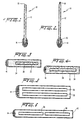
- Figure 1 is a view in cross section of a swab according to the present invention prior to the insertion of a reagent.
- Figure 2 is a view in cross section of a swab according to the present invention with a reagent inserted therein.
- Figure 3 is a view in cross section of a cartridge swab according to the present invention containing a breakable cartridge and loose powder.
- Figure 4 in a view in cross section of a cartridge swab according to the present invention containing buffer and a cartridge containing dye.
- Figure 5 is a view in cross section of a cartridge swab according to the present invention containing two cartridges side by side.
- FIG. 6 is a view in cross section of a cartridge swab according to the present invention containing two cartridges end to end.
- the test swabs of the present invention may be used to detect a variety of substances on a variety of surfaces depending on the reagent contained in the swab, including but not limited to, paint, ceramics, dust, soil, plant leaves, solder, bird cages, etc.
- the test swabs are used to determine the presence of lead, cadmium, bismuth, mercury, antimony, iron, aluminum, selenium, copper or organophosphates.
- the present invention preferably will be used to determine the presence of metals in such surfaces.
- the test swabs of the present invention are used to determine the presence of lead or cadmium on surfaces.
- the swabs can be made in a variety of formats as shown in the Figures, described below.
- a swab is indicated generally by reference numeral 10.
- the swab 10 includes a stem 12 that is preferably formed from a hollow tube.
- the stem 12 may be made from glass, plastic, or any other suitable material. If plastic is used, the composition of the plastic is not critical. However, because glass is breakable and because plastic is more easily crimped, plastic is preferable to glass.
- a solid stem may be used.
- the absorbent material may be comprised of any number of materials, including: cotton fibers, rayon fibers, dacron fibers, monofilament polyester, monofilament nylon, or an open cell structure such as polyurethane foam. Table I lists several connercially available swabs, together with the source or manufacturer of each swab.
- the preferred reagent dye is rhodizonic acid.
- Table II lists various dyes that are acceptable, together with the supplier or manufacturer of each. Table II DYE SUPPLIER Rhodizonic acid, potassium salt Sigma Chemical Company Rhodizonic acid, sodium salt Sigma Chemical Company Rhodizonic acid, disodium salt Sigma Chemical Company Rhodizonic acid, disodium salt Eastman Kodak Company No major differences in purity or other analytical criteria were reported for similar salts. The above materials all function well in testing for the presence of lead, as indicated below. An activator solution, described below, typically will be used with the reagent dyes in carrying out embodiments of the present invention.
- the preferred reagent dyes are 4-nitronaphthalene-diazoamino-azobenzene or l-(4-nitrophenyl)-3-(4-phenylazophenyl)triazene.
- the latter dye may be obtained from Aldrich as Cadion.
- fillers are not required, they are useful to provide bulk to the dye when the dye is a solid so the dye can be placed in the swabs more conveniently since the dye is used in a small amount.
- No filler is needed when the dye to be used is a liquid. All could be used as a filler for the dyes used in the test method of the present invention, but some exhibited more desirable properties than others.
- the more granular and less sticky solids are preferable to use with automatic filling equipment, such as a Kinematics Powder Filling Machine, model no. 1700 equipped with a model 3015 filling gun.
- Table IV identifies several fillers and their ease of use with automatic filling equipment.
- Table IV FILLER RECOMMENDATION Alumina acid Worked well with the machine and filling gun.
- Talc Worked well with the machine and filling gun.
- Silicic acid Formed a plug, but worked with the machine and filling gun.
- Glass beads Formed a plug, but worked with the machine and filling gun.
- Polyvinylpyrrolidone Not recommended for use with the filing equipment.
- the rhodizonate dye is unstable in an aqueous medium.
- hygroscopic fillers may retain moisture too avidly and will consequently contribute to inactivation of this dye.
- Table V identifies several materials capable of use as a filler for the dye, together with comments concerning the suitability of each material.
- Table V BULKING AGENT APPEARANCE COMMENTS Alumina -WB-2, basic Loose, sandy Mixes well; hygroscopic, fills tube easily.
- -WA-1 acidic Loose Mixes well; hygroscopic, fills tube easily.
- -WN-3 neutral Loose Mixes well; hygroscopic, fills tube easily. Bentonite Particulate Colored powder; unsuitable for use.
- Cellulose -SigmaCell 20 Loose Mixes well; fills tube easily.
- alumina all types
- talc gum acacia
- silicic acid and mannitol are all suitable materials for use as a diluent with the dye.
- other materials may be used.
- the swabs 10 are filled through the open end 16 of the stem 12, preferably with automatic filling equipment, such as that described above. Once the desired quantity of dye and filler 20 is inserted into the swab 10, the end 16 of the stem 12 may be crimped as shown at 18 in FIG. 2.
- the swabs are filled with a dye/filler mixture using a Kinematics dispensing machine to fill. Then, the solid filled swabs are shaken on a vibrating table to disperse the solid throughout the swab. A (four inch) 100mm wooden applicator is inserted into the swab to prevent loss of reagent through the open end and a drop of glue from a glue gun then is applied to the end of the unit.
- Automatic filling units can be designed by using a metal brace notched with the appropriate size holes to ensure that the swabs remain in a fixed position during an automatic filling operation.
- a conveyor belt can move these units under a fixed dispensing gun. After the dispensing of the solid reagent, the swabs can be sealed by a variety of automatic procedures including, melting to close, using pressure to close and flattening the plastic handle of the swab.
- swabs were filled with 20, 30, 40, and 80 mg. of the dye and filler. In such tests, the ratios of filler to dye were varied between 0 and 100:1.
- the absorbent ball 14 of the filled swab 10 is wetted with an activator solution.
- a pH level of between about 2.0 and about 3.0 is preferable for the lead-rhodizonate reaction.
- a buffer generally is used as the activator solution.
- a pH level of 2.8 for the buffer is optimal for the lead-rhodizonate reaction.
- the wetted absorbent ball 14 is then rubbed onto a surface suspected of containing lead. If lead is present on the surface, a reaction occurs with the rhodizonate dye, thus causing an easily detectable deep pink color to appear on the absorbent ball 14 of the swab 10.
- the test is even sensitive enough to detect lead dust on a surface caused by sanding lead-containing paint, even after the surface had been vacuumed and washed with trisodium phosphate detergent.
- the activator solution generally will comprise sodium tartrate, sodium acetate, sodium citrate, potassium hydroxide or a mixture thereof. Additional chelating materials such as EDTA may also be present.
- the pH preferably used for the cadmium reaction is above about 8, more preferably above 9.
- the potassium hydroxide may be used to adjust the pH. Bases other than hydroxide, which form insoluble cadmium complexes, such as carbonate, might be used.
- the solid fill method described above with the use of a Kinematics filling machine, is the manufacturing option that is best for preserving the stability of the dye reagent. However, alternative manufacturing protocols are also available.
- an aqueous solution of 0.01M rhodizonate (dye) is prepared.
- the rhodizonate solution may be prepared using a tartrate buffer at 2.8 pH. Although that pH level is the preferred level for the lead testing reaction, at that pH level, the rhodizonate dye is unstable and completely degrades in about thirty-six hours.
- the rhodizonate solution can be prepared using water at pH 5 or 6. At that pH level, complete degradation of the rhodizonate takes about ninety-six hours.
- organic solvents may enhance the stability of the aqueous rhodizonate solution.
- 10 to 20% methanol, ethanol, or acetone may be added.
- swabs are dipped in the solution for thirty seconds to one minute.
- the swabs are then rapidly frozen in acetone/dry ice, or liquid nitrogen, and dried by lyophilization.
- the swabs can then be used in the same manner as the swabs that are filled from the inside with a filling machine.
- the swabs can alternatively be dried under heat, although the temperature must be kept below 80°C.
- the swabs can be pretreated by soaking the absorbent material of the swabs in a tartrate buffer, pH 2.8, or any other buffer with a pH preferably between 2 and 3. The soaked swabs are then dried under heat.
- the swab can also be presoaked in a buffer containing EDTA for about one minute in order to clean other possible interfering cations from the swab prior to the test.
- the EDTA can be included in the buffer described in the preceding paragraph.
- the swab of the present invention is prepared as a cartridge swab.
- a device for testing for a substance or metal on a surface comprises a cartridge, two compartments within the cartridge wherein one compartment contains a reagent that reacts with the metal and the other compartment contains an activating solution, and an absorbent ball of material mounted at one end of the cartridge.
- the reagent and activating solution are combined and mixed within the cartridge before the device is used.
- This embodiment can take several forms, some of which are shown in Figures 3-6.
- the simplest design of the cartridge swab is a system wherein two compartments are used.
- One compartment contains an activator solution and the other contains a dye.
- the activator solution will be the buffer solution described above and the dye will be rhodizonate dye.
- the activator solution When testing for cadmium, the activator solution will be sodium tartrate, sodium acetate, sodium citrate, potassium hydroxide or mixtures thereof, and the dye will be 4-nitronaphthalene-diazoamino-azo-benzene or 1-(4-nitrophenyl)-3-(4-phenylazophenyl)triazene.
- the absorbent ball mounted at one end of the cartridge swab may be attached when the cartridge swab is prepared or it may be attached when the cartridge swab is to be used.
- FIG 3 shows an embodiment of a cartridge swab wherein a breakable cartridge 22 contains a small amount of activator solution.
- the breakable cartridge 22 is inserted into a plastic holder or cartridge 24 into which dry dye powder 26 plus any additives required for the test desired has been dispensed.
- the swab tip 14 generally will be placed on the cartridge 24 before the cartridge 24 is filled with dry dye powder 26 and the breakable cartridge 22.
- the breakable cartridge 22 is broken and the activator solution mixes with the dye powder and wets the swab tip. The swab tip then can be rubbed over the surface to be tested.
- Figure 4 shows an embodiment of a cartridge swab wherein a small breakable cartridge 28 is prepared containing dry dye powder plus any additives required for the desired test.
- the cartridge 28 is placed inside another breakable cartridge 32 large enough to hold cartridge 28 and sufficient activating solution 34 to execute the desired test.
- the breakable cartridge is broken when the test is to be performed and the activating solution mixes with the dye and wets the swab tip which can be rubbed over the surface to be tested.
- Figure 5 shows an embodiment of the cartridge swab wherein two breakable cartridges are used side by side in a larger cartridge.
- Breakable cartridges 36 and 38 will contain either activating solution or dye. The cartridges are broken together when the test is to be performed and the activating solution mixes with the dye and wets the swab tip which can be rubbed over the surface to be tested.
- Figure 6 shows an embodiment of the cartridge swab wherein two breakable cartridges 36 and 38 are used in an end to end format inside a larger cartridge 40 which has a swab tip 14.
- the cartridges are broken together when the test is to be performed and the activating solution mixes with the dye and wets the swab tip which can be rubbed over the surface to be tested.
- the swab tips on the cartridge swabs can be the same type of swabs described above for use on the stick type swabs.
- the cartridges which are used to hold the breakable cartridges containing the reactants for the desired test can be non breakable or squeezable containers.
- a squeezable cartridge similar to a tdothpaste tube may be used.
- the breakable cartridges are placed inside the squeezable cartridge and the end is closed with a fibrous or porous swab tip.
- the swab tip optionally may have a pointed tip which breaks the cartridges contained within tube.
- the squeezable cartridge is squeezed, breaking the cartridges within the squeezable cartridge and mixing the reagents.
- the reagents wet the swab tip which can then be rubbed over the surface to be tested.
- swabs were obtained from CitMed having an absorbent ball of 12mm (0.50 inches) diameter made from rayon fibers.
- the swab stem was a 5mm (3/16 inch) plastic tube.
- Alumina (WA-1, acidic) was used as an inert diluent, and rhodizonate dye, disodium salt (from the Sigma Chemical Company) was used as the dye.
- the inert diluent was mixed with the dye in the ratios set forth in Table VI. Table VI also lists the quantity of fill used in the swab, together with the test results.
- the swabs after being filled with the above-designated quantities of the above-designated ratios of filler and dye, were wetted with 1.5 ml. of 0.2M tartrate buffer, pH 2.8. The swabs were then rubbed on wood that had been previously painted with 0.5% lead-containing paint. In most instances, a positive reaction was clearly visible within seconds, almost always within less than one minute. A positive reaction is indicated by a deep pink color appearing on the absorbent ball of the swab.
- a mixture of alumina (acidic) and rhodizonate dye, sodium salt at a ratio of 40:1 was suspended in 0.2M tartrate buffer, pH 2.8.
- the suspension lost activity rapidly, losing its ability to detect lead within one minute. It is interesting to note that the suspension lost activity acre rapidly when soaked onto the swab, as in this example, than when the mixture was filled through the center of the swab and then wetted with the buffer.
- a mixture of alumina (acidic) and rhodizonate dye, sodium salt at a ratio of 20:1 was suspended in 0.2M tartrate buffer, pH 2.8.
- a mixture of mannitol and rhodizonate dye, sodium salt at a ratio of 20:1 was suspended in 0.2M tartrate buffer, pH 2.8.
- a contoured wood molding strip was divided into ten different sections. Each section was painted with latex paint that was mixed with a different quantity of lead, ranging from 0.1% to 1.0%.
- the following diagram illustrates the various ratios used: 0.1% 0.2% 0.3% 0.4% 0.5% 0.6% 0.7% 0.8% 0.9% 1.0%
- a swab with a 12mm (0.5 inch) diameter absorbent ball made from rayon fibers and a 8mm (5/16 inch hollow plastic stem was filled with 40 mg. of alumina (WA-1, acidic) and rhodizonate dye, disodium salt (from the Sigma Chemical Company) in a 40:1 ratio.
- a 1.5 ml. solution of 0.2M tartrate buffer, pH 2.8 was used as the developing agent.
- a swab with a 12mm (0.5 inch) diameter absorbent bal1 - made from rayon fibers and a 8mm (5/16 inch) hollow plastic stem was filled with 40 mg. of alumina (WA-1, acidic) and rhodizonate dye, disodium salt (from the Sigma Chemical Company) in a 40:1 ratio.
- a 1.5 ml. solution of 0.2M tartrate buffer, pH 2.8 was used as the developing agent, i.e., the swab was prepared exactly as set forth in example XVII, above. This time the swab was rubbed on lead-glazed ceramic dishes. Within less than thirty seconds, the tip of the swab was obviously pink.
- a solution was prepared using 40 mg. of alumina (WA-1, acidic) and rhodizonate dye, disodium salt (from the Sigma Chemical Company) in a 40:1 ratio and a 1.5 ml. solution of 0.2M tartrate buffer, pH 2.8.
- a piece of Whatman 3 mm. filter paper was dipped into the solution, allowing the solution to completely saturate the filter paper, i.e., the filter paper was prepared in accordance with the method set forth above in example XVIII.
- the treated filter paper was rubbed on the lead-glazed ceramic dishes used in example XIX. No detectable color was observed on the filter paper after several minutes of contact with the lead-glazed dishes.
- Plain untreated swabs having a rayon fiber absorbent ball of 12mm (0.5 inch) diameter on a 8mm (5/16 inch) hollow plastic stem were soaked in a solution of 40 mg. of alumina (WA-1, acidic) and rhodizonate dye, disodium salt (from the Sigma Chemical Company) in a 40:1 ratio and a 1.5 ml. solution of 0.2M tartrate buffer, pH 2.8, i.e., the same solution used in examples XVIII and XX.
- a clear positive result was easy to read.
- Plain untreated swabs having a rayon fiber absorbent ball of 12mm (0.5 inch) diameter on a 8mm (5/16 inch) hollow plastic stem were soaked in a solution of 40 mg. of alumina (WA-I, acidic) and rhodizonate dye, disodium salt (from the Sigma Chemical Company) in a 40:1 ratio and a 1.5 ml. solution of 0.2M tartrate buffer, pH 2.8, i.e., the same solution used in examples XVIII, XX, and XXI.
- a clear positive result was easy to read.
- a mixture of alumina (acidic) and rhodizonate dye, sodium salt at a ratio of 40:1 was filled into the following swabs: cotton, 150mm (6") plastic rod, from CitMed; rayon, 150mm (6") plastic rod, from CitMed; and dacron, 150mm (6") plastic rod, from CitMed. About 5-6mm (3/16" to 1/4") of material was filled in each swab. The swabs were then wetted with tartrate, sodium salt and rubbed on a wood board painted with a 0.5% lead-containing paint.
- a mixture of mannitol and rhodizonate dye, sodium salt at a ratio of 20:1 was suspende in 0.2M tartrate buffer, pH 2.8.
- the foam materials did not wet well, and little or no color formation was observed on the material or the wood.
- the cotton, rayon, and dacron swabs had intense color on the fibers. Under a microscope it appeared that the fibers had been dyed. It did not appear as though a precipitate had been formed and trapped by the fibers. However, at high concentrations of lead and dye, some precipitate may form. The precipitate is not necessary in order to detect a reaction.
- a swab with a hollow stem is filled with 30 mg of a mixture of 4-nitronaphthalene-diazoamino-azo-benzene and an inert filler, alumina in ratios as shown in Table VI.
- the swab tip is wetted with an activator solution containing sodium potassium tartrate, sodium acetate, sodium citrate at pH 8.5.
- the area to be tested is rubbed with the swab. If cadmium is present, the swab becomes pink.
- One crushable cartridge is filled with 30 mg Cadion, (1-(4-nitrophenyl)-3-(4-phenylazophenyl)triazene) and talc.
- Another breakable cartridge is filled with 0.5 ml activator solution which is a mixture of sodium tartrate, sodium acetate and sodium hydroxide. The pH of the activator solution is adjusted to be basic at a pH greater than 9.
- the two cartridges are placed inside a larger cartridge having a swab tip at one end.
- the breakable cartridges are broken and the unit is shaken to ensure good mixing.
- the swab tip is rubbed over the area to be tested and becomes pink if cadmium is present.
- the present invention is not limited to tests for the presence of lead or calcium.
Landscapes
- Chemical & Material Sciences (AREA)
- Health & Medical Sciences (AREA)
- Life Sciences & Earth Sciences (AREA)
- Engineering & Computer Science (AREA)
- Immunology (AREA)
- Physics & Mathematics (AREA)
- Biomedical Technology (AREA)
- General Physics & Mathematics (AREA)
- General Health & Medical Sciences (AREA)
- Hematology (AREA)
- Biochemistry (AREA)
- Molecular Biology (AREA)
- Urology & Nephrology (AREA)
- Analytical Chemistry (AREA)
- Pathology (AREA)
- Medicinal Chemistry (AREA)
- Plasma & Fusion (AREA)
- Microbiology (AREA)
- Cell Biology (AREA)
- Biotechnology (AREA)
- Inorganic Chemistry (AREA)
- Chemical Kinetics & Catalysis (AREA)
- Food Science & Technology (AREA)
- Investigating Or Analyzing Non-Biological Materials By The Use Of Chemical Means (AREA)
- Investigating Or Analysing Biological Materials (AREA)
- Investigating Or Analysing Materials By The Use Of Chemical Reactions (AREA)
- Investigating And Analyzing Materials By Characteristic Methods (AREA)
- Analysing Materials By The Use Of Radiation (AREA)
- Measurement Of The Respiration, Hearing Ability, Form, And Blood Characteristics Of Living Organisms (AREA)
Claims (12)
- Verfahren zum Untersuchen von festen Oberflächen auf das Vorhandensein von Substanzen der Gruppe Cadmium, Bismut, Quecksilber, Antimon, Eisen, Selen, Organophosphat und Kupfer bestehend aus den folgenden Schritten:i) ein Wattestäbchen mit einem Stiel und einem saugfähigen Materialball an einem Ende des mit Reagens imprägnierten Stiels, das mit der zu untersuchenden Substanz reagiert, wird vorbereitet,ii) das Reagens wird aktiviert,iii) der imprägnierte saugfähige Ball wird mit der festen Oberfläche in Kontakt gebracht undiv) das Vorhandensein der Substanz wird erfaßt durch das Untersuchen des imprägnierten Materialballs auf eine Reaktion zwischen der Substanz und dem Reagens.
- Verfahren nach Anspruch 1, dadurch gekennzeichnet, daß der Stiel des Wattestäbchens hohl ist, und der Schritt des Imprägnierens des saugfähigen Balls das Einspritzen des Reagens durch den hohlen Stiel ins Zentrum des saugfähigen Balls einschließt.
- Verfahren nach Anspruch 1, dadurch gekennzeichnet, daß die Aktivierung das Benetzen des saugfähigen Materialballs mit einem Puffer mit einem die Reaktion begünstigenden pH-Wert umfaßt.
- Verfahren nach Anspruch 1, dadurch gekennzeichnet, daß die zu untersuchende Substanz Blei ist.
- Verfahren nach Anspruch 4, dadurch gekennzeichnet, daß das Reagens aus einer Rhodizonatfarbe besteht.
- Verfahren nach Anspruch 5, dadurch gekennzeichnet, daß das Reagens auch einen Füller beinhaltet, und das Füller-Rhodizonat-Verhältnis im Bereich von etwa 20:1 bis 100:1 Gewichtsprozent liegt.
- Verfahren nach Anspruch 1, dadurch gekennzeichnet, daß das Metall Cadmium ist und das Reagens aus 4-Nitronaphtalen-Diazoamin-Azobenzen oder 1-(4-Nitrophenyl)-3-(4-Phenylazophenyl)-Triazin und wahlweise einem inaktiven Füller besteht.
- Verwendung eines Geräts zum Untersuchen von einer festen Oberfläche auf das Vorhandensein von Substanzen der Gruppe Blei, Cadmium, Bismut. Quecksilber, Antimon, Eisen, Selen, Organophosphat und Kupfer, wobei das Gerät ausi) einer Patrone,ii) zwei Abteilungen innerhalb der genannten Patrone, wobei ein Teil ein Reagens enthält, das mit der Substanz reagiert, und der andere Teil eine Wirkungslösung enthält, undiii) einem saugfähigen Materialball, wobei das Reagens und die Wirkungslösung zusammengeführt und gemischt werden, bevor das Gerät benutzt wird,besteht.
- Verwendung nach Anspruch 8, dadurch gekennzeichnet, daß wenigstens ein Teil eine brechbare Patrone ist.
- Verwendung nach Anspruch 8, dadurch gekennzeichnet, daß die untersuchte Substanz Blei ist.
- Verwendung nach Anspruch 10, dadurch gekennzeichnet, daß das Reagens eine Rhodizonatfarbe beinhaltet und die Wirkungslösung ein Puffer mit einem pH-Wert von ungefähr 2 bis 3 ist.
- Verwendung nach Anspruch 8, dadurch gekennzeichnet, daß die Substanz Cadmium ist, und das Reagens aus 4-Nitronaphtalen-Diazoamin-Azobenzen oder 1-(4-Nitrophenyl)-3-(4-Phenylazophenyl)-Triazin besteht.
Applications Claiming Priority (3)
| Application Number | Priority Date | Filing Date | Title |
|---|---|---|---|
| US30522189A | 1989-02-02 | 1989-02-02 | |
| US305221 | 1989-02-02 | ||
| PCT/US1990/000527 WO1990008954A1 (en) | 1989-02-02 | 1990-02-02 | Test swab and methods of making and using same |
Publications (3)
| Publication Number | Publication Date |
|---|---|
| EP0456751A1 EP0456751A1 (de) | 1991-11-21 |
| EP0456751A4 EP0456751A4 (en) | 1991-12-11 |
| EP0456751B1 true EP0456751B1 (de) | 1997-05-21 |
Family
ID=23179864
Family Applications (1)
| Application Number | Title | Priority Date | Filing Date |
|---|---|---|---|
| EP90903465A Expired - Lifetime EP0456751B1 (de) | 1989-02-02 | 1990-02-02 | Verfahren zum untersuchen von festen oberflächen auf das vorhandensein von substanzen mittels eines wattestäbchens |
Country Status (7)
| Country | Link |
|---|---|
| EP (1) | EP0456751B1 (de) |
| JP (1) | JPH04504616A (de) |
| AT (1) | ATE153449T1 (de) |
| AU (1) | AU5100190A (de) |
| CA (1) | CA2046657C (de) |
| DE (1) | DE69030763D1 (de) |
| WO (1) | WO1990008954A1 (de) |
Cited By (1)
| Publication number | Priority date | Publication date | Assignee | Title |
|---|---|---|---|---|
| CN102590122A (zh) * | 2012-01-17 | 2012-07-18 | 佛山市邦普循环科技有限公司 | 一种废旧镍镉电池中镉含量的测定方法 |
Families Citing this family (5)
| Publication number | Priority date | Publication date | Assignee | Title |
|---|---|---|---|---|
| FI126969B (en) * | 2014-09-16 | 2017-08-31 | Aboatox Oy | Toxicity testing of the sample |
| CN106290352A (zh) * | 2016-08-23 | 2017-01-04 | 内蒙古包钢钢联股份有限公司 | 一种用于电石渣中三氧化二铝含量的测定方法 |
| CN113008880A (zh) * | 2021-02-26 | 2021-06-22 | 必为(上海)医疗器械有限公司 | 一种医疗器械残留血检测套装及其使用方法 |
| CN117191878B (zh) * | 2023-09-08 | 2024-02-23 | 宁夏昊标检测服务研究院(有限公司) | 一种土壤酸碱度检测装置及检测方法 |
| WO2025234493A1 (ja) * | 2024-05-09 | 2025-11-13 | 株式会社キッツメタルワークス | 金属検出用の試薬、ビスマス検出用の試薬及び鉛検出用の試薬、これらを用いた金属検出方法並びに再生材の製造方法 |
Family Cites Families (4)
| Publication number | Priority date | Publication date | Assignee | Title |
|---|---|---|---|---|
| US4184483A (en) * | 1973-05-08 | 1980-01-22 | U.S. Medical Research & Development, Inc. | Method of and apparatus for collecting cultures |
| DE2829091A1 (de) * | 1978-07-03 | 1980-01-17 | Dynamit Nobel Ag | Insolubilisierte reagenzien enthaltene kieselgele |
| US4824789B1 (en) * | 1986-10-10 | 1996-08-13 | Minnesota Mining & Mfg | Gas sensor |
| US4770853A (en) * | 1986-12-03 | 1988-09-13 | New Horizons Diagnostics Corporation | Device for self contained solid phase immunodiffusion assay |
-
1990
- 1990-02-02 EP EP90903465A patent/EP0456751B1/de not_active Expired - Lifetime
- 1990-02-02 DE DE69030763T patent/DE69030763D1/de not_active Expired - Lifetime
- 1990-02-02 CA CA002046657A patent/CA2046657C/en not_active Expired - Lifetime
- 1990-02-02 WO PCT/US1990/000527 patent/WO1990008954A1/en not_active Ceased
- 1990-02-02 AU AU51001/90A patent/AU5100190A/en not_active Abandoned
- 1990-02-02 AT AT90903465T patent/ATE153449T1/de not_active IP Right Cessation
- 1990-02-02 JP JP2503526A patent/JPH04504616A/ja active Pending
Cited By (1)
| Publication number | Priority date | Publication date | Assignee | Title |
|---|---|---|---|---|
| CN102590122A (zh) * | 2012-01-17 | 2012-07-18 | 佛山市邦普循环科技有限公司 | 一种废旧镍镉电池中镉含量的测定方法 |
Also Published As
| Publication number | Publication date |
|---|---|
| DE69030763D1 (de) | 1997-06-26 |
| CA2046657A1 (en) | 1990-08-03 |
| WO1990008954A1 (en) | 1990-08-09 |
| AU5100190A (en) | 1990-08-24 |
| EP0456751A1 (de) | 1991-11-21 |
| JPH04504616A (ja) | 1992-08-13 |
| CA2046657C (en) | 2002-07-02 |
| EP0456751A4 (en) | 1991-12-11 |
| ATE153449T1 (de) | 1997-06-15 |
Similar Documents
| Publication | Publication Date | Title |
|---|---|---|
| US5039618A (en) | Test swab cartridge type device and method for detecting lead and cadmium | |
| US5330917A (en) | Test swab device and method of detecting lead, mercury, arsenic, and bismuth | |
| US5550061A (en) | Test swab and method of using same | |
| US5364792A (en) | Test swab and method of making and using same | |
| US4275031A (en) | Agent and process for carrying out colorimetric or photometric determinations | |
| US4092115A (en) | Method, device and test reagent for detecting free available chlorine in aqueous fluids | |
| US5416028A (en) | Process for testing for substances in liquids | |
| CA2410925A1 (en) | Self-contained devices for detecting biological contaminants | |
| JPS5849824B2 (ja) | アスコルビン酸及びその塩を測定するための組成物および用具 | |
| GB2070770A (en) | Biuret reagent composition and analytical elements | |
| AU2237600A (en) | Quick acting toxic ammonia test for aqueous samples | |
| CA2046657C (en) | Test swab and methods of making and using same | |
| US5620658A (en) | Colorimetric test strip | |
| US5140986A (en) | System, device and method for skin contamination detection | |
| Khan | 1-(2-Pyridylazo)-2-naphthol modified carbon paste electrode for trace cobalt (II) determination by differential pulse cathodic voltammetry | |
| US4769084A (en) | Synthetic chemical adsorbents | |
| JPS6321865B2 (de) | ||
| EP0580863B1 (de) | Zusammensetzung für die messung der ionenstärke oder des spezifischen gewichts einer flüssigen probe und testvorrichtung, die aus besagter zusammensetzung gefertigt wurde | |
| US4277368A (en) | Sulfur dioxide detector | |
| Cohen et al. | A field method for the determination of ozone in the presence of nitrogen dioxide | |
| Pathan et al. | A novel chromogenic spray reagent for thin-layer chromatographic analysis of paraquat and design of an ultra-low-cost sensor for on-the-field detection of viologens | |
| Katami et al. | Extraction and spectrophotometric determination of cobalt in coal fly ashes using 2-[2-(3, 5-dibromopyridyl) azo]-5-dimethylaminobenzoic acid | |
| JP3809484B2 (ja) | 体液中のマグネシウム測定用試験片 | |
| RU2103677C1 (ru) | Способ определения меди тест-методом | |
| RU2103678C1 (ru) | Способ определения железа (ii, iii) тест-методом |
Legal Events
| Date | Code | Title | Description |
|---|---|---|---|
| PUAI | Public reference made under article 153(3) epc to a published international application that has entered the european phase |
Free format text: ORIGINAL CODE: 0009012 |
|
| 17P | Request for examination filed |
Effective date: 19910808 |
|
| AK | Designated contracting states |
Kind code of ref document: A1 Designated state(s): AT BE CH DE DK ES FR GB IT LI LU NL SE |
|
| A4 | Supplementary search report drawn up and despatched |
Effective date: 19911018 |
|
| AK | Designated contracting states |
Kind code of ref document: A4 Designated state(s): AT BE CH DE DK ES FR GB IT LI LU NL SE |
|
| 17Q | First examination report despatched |
Effective date: 19940606 |
|
| GRAG | Despatch of communication of intention to grant |
Free format text: ORIGINAL CODE: EPIDOS AGRA |
|
| GRAH | Despatch of communication of intention to grant a patent |
Free format text: ORIGINAL CODE: EPIDOS IGRA |
|
| GRAH | Despatch of communication of intention to grant a patent |
Free format text: ORIGINAL CODE: EPIDOS IGRA |
|
| GRAA | (expected) grant |
Free format text: ORIGINAL CODE: 0009210 |
|
| AK | Designated contracting states |
Kind code of ref document: B1 Designated state(s): AT BE CH DE DK ES FR GB IT LI LU NL SE |
|
| PG25 | Lapsed in a contracting state [announced via postgrant information from national office to epo] |
Ref country code: IT Free format text: LAPSE BECAUSE OF FAILURE TO SUBMIT A TRANSLATION OF THE DESCRIPTION OR TO PAY THE FEE WITHIN THE PRE;WARNING: LAPSES OF ITALIAN PATENTS WITH EFFECTIVE DATE BEFORE 2007 MAY HAVE OCCURRED AT ANY TIME BEFORE 2007. THE CORRECT EFFECTIVE DATE MAY BE DIFFERENT FROM THE ONE RECORDED.SCRIBED TIME-LIMIT Effective date: 19970521 Ref country code: ES Free format text: THE PATENT HAS BEEN ANNULLED BY A DECISION OF A NATIONAL AUTHORITY Effective date: 19970521 Ref country code: LI Effective date: 19970521 Ref country code: BE Effective date: 19970521 Ref country code: FR Effective date: 19970521 Ref country code: DK Effective date: 19970521 Ref country code: NL Free format text: LAPSE BECAUSE OF FAILURE TO SUBMIT A TRANSLATION OF THE DESCRIPTION OR TO PAY THE FEE WITHIN THE PRESCRIBED TIME-LIMIT Effective date: 19970521 Ref country code: CH Effective date: 19970521 Ref country code: AT Effective date: 19970521 |
|
| REF | Corresponds to: |
Ref document number: 153449 Country of ref document: AT Date of ref document: 19970615 Kind code of ref document: T |
|
| REG | Reference to a national code |
Ref country code: CH Ref legal event code: EP |
|
| REF | Corresponds to: |
Ref document number: 69030763 Country of ref document: DE Date of ref document: 19970626 |
|
| PG25 | Lapsed in a contracting state [announced via postgrant information from national office to epo] |
Ref country code: SE Effective date: 19970821 |
|
| PG25 | Lapsed in a contracting state [announced via postgrant information from national office to epo] |
Ref country code: DE Effective date: 19970822 |
|
| EN | Fr: translation not filed | ||
| NLV1 | Nl: lapsed or annulled due to failure to fulfill the requirements of art. 29p and 29m of the patents act | ||
| REG | Reference to a national code |
Ref country code: CH Ref legal event code: PL |
|
| PG25 | Lapsed in a contracting state [announced via postgrant information from national office to epo] |
Ref country code: LU Free format text: LAPSE BECAUSE OF NON-PAYMENT OF DUE FEES Effective date: 19980202 |
|
| PLBE | No opposition filed within time limit |
Free format text: ORIGINAL CODE: 0009261 |
|
| STAA | Information on the status of an ep patent application or granted ep patent |
Free format text: STATUS: NO OPPOSITION FILED WITHIN TIME LIMIT |
|
| 26N | No opposition filed | ||
| REG | Reference to a national code |
Ref country code: GB Ref legal event code: IF02 |
|
| PGFP | Annual fee paid to national office [announced via postgrant information from national office to epo] |
Ref country code: GB Payment date: 20090128 Year of fee payment: 20 |
|
| REG | Reference to a national code |
Ref country code: GB Ref legal event code: PE20 Expiry date: 20100201 |
|
| PG25 | Lapsed in a contracting state [announced via postgrant information from national office to epo] |
Ref country code: GB Free format text: LAPSE BECAUSE OF EXPIRATION OF PROTECTION Effective date: 20100201 |