EP0454841B1 - Abschlussschaltung mit temperaturdriftkompensation für ein r-2r-kettennetzwerk - Google Patents
Abschlussschaltung mit temperaturdriftkompensation für ein r-2r-kettennetzwerk Download PDFInfo
- Publication number
- EP0454841B1 EP0454841B1 EP91901034A EP91901034A EP0454841B1 EP 0454841 B1 EP0454841 B1 EP 0454841B1 EP 91901034 A EP91901034 A EP 91901034A EP 91901034 A EP91901034 A EP 91901034A EP 0454841 B1 EP0454841 B1 EP 0454841B1
- Authority
- EP
- European Patent Office
- Prior art keywords
- emitter
- transistors
- transistor
- base
- voltage
- Prior art date
- Legal status (The legal status is an assumption and is not a legal conclusion. Google has not performed a legal analysis and makes no representation as to the accuracy of the status listed.)
- Expired - Lifetime
Links
- 230000005284 excitation Effects 0.000 claims abstract description 11
- 238000000034 method Methods 0.000 claims description 10
- 230000008878 coupling Effects 0.000 claims 1
- 238000010168 coupling process Methods 0.000 claims 1
- 238000005859 coupling reaction Methods 0.000 claims 1
- 230000000063 preceeding effect Effects 0.000 claims 1
- 239000003990 capacitor Substances 0.000 abstract description 3
- 230000001419 dependent effect Effects 0.000 description 4
- 238000010586 diagram Methods 0.000 description 4
- 230000006872 improvement Effects 0.000 description 3
- 230000004075 alteration Effects 0.000 description 2
- 230000000694 effects Effects 0.000 description 2
- 238000005516 engineering process Methods 0.000 description 2
- 238000004519 manufacturing process Methods 0.000 description 2
- 238000012986 modification Methods 0.000 description 2
- 230000004048 modification Effects 0.000 description 2
- 238000004458 analytical method Methods 0.000 description 1
- 238000006243 chemical reaction Methods 0.000 description 1
Images

Classifications
-
- H—ELECTRICITY
- H03—ELECTRONIC CIRCUITRY
- H03M—CODING; DECODING; CODE CONVERSION IN GENERAL
- H03M1/00—Analogue/digital conversion; Digital/analogue conversion
- H03M1/06—Continuously compensating for, or preventing, undesired influence of physical parameters
- H03M1/08—Continuously compensating for, or preventing, undesired influence of physical parameters of noise
- H03M1/089—Continuously compensating for, or preventing, undesired influence of physical parameters of noise of temperature variations
-
- H—ELECTRICITY
- H03—ELECTRONIC CIRCUITRY
- H03M—CODING; DECODING; CODE CONVERSION IN GENERAL
- H03M1/00—Analogue/digital conversion; Digital/analogue conversion
- H03M1/66—Digital/analogue converters
- H03M1/74—Simultaneous conversion
- H03M1/78—Simultaneous conversion using ladder network
- H03M1/785—Simultaneous conversion using ladder network using resistors, i.e. R-2R ladders
Definitions
- This invention relates to a digital-to-analog converter (DAC) of the current output type that has a number of transistor current sources connected to an R-2R resistive ladder network, which establishes the current weighting. More particularly, the invention relates to a circuit which is used to terminate the R-2R ladder in a way that equalizes the temperature drift of the base-to-emitter voltages of the current source transistors.
- DAC digital-to-analog converter
- each 2R resistor in the R-2R ladder is connected to the emitter of a bipolar transistor.
- the resistor-transistor combination forms a current source, when the transistor is turned on, contributing a portion of the output current.
- each transistor is identical to its counterparts in the other 2R legs. However, the current in each successive 2R leg is one-half the current of the previous leg.
- This voltage produces, through the series resistors of the ladder, a compensation current which develops corresponding voltage components matching the base-emitter voltage differences ( ⁇ V be ) between successive legs (or stages), so that the voltage across each of the 2R shunt resistors of the ladder remains unaffected by changes in offset voltage due to temperature.
- ⁇ V be base-emitter voltage differences
- Another object of this invention is to provide a compensation circuit which does not need an amplifier.
- Yet another object of the invention is to provide a compensation circuit which is compatible with DAC's that are fabricated using only NPN bipolar technology or only PNP technology.
- the present invention provides a termination circuit for an R-2R resistor ladder network used in a current weighted circuit, as defined in claim 1.
- the invention also provides a method of compensating for differences in the base-emitter voltages between current source transistors of an R-2R resistor ladder, as defined in claim 9.
- the present invention makes use of the theory of U.S.-A-4,349,811 and goes on to teach an improved method and apparatus for terminating an R-2R ladder in a current-switching DAC.
- U.S.-A-4,349,811 varied the usual arrangement of a DAC using an R-2R ladder by connecting the standard 2R terminating resistor of the ladder to an excitation voltage which is 2(kT/q)ln 2 closer to the supply voltage than the emitter of the current source in the last (i.e., least significant) stage.
- the present invention greatly enhances the usefulness of the prior theory by providing excitation source circuitry that is fabricated with just one type of bipolar transistor (e.g., all NPN's or all PNP's), and does not require an amplifier with its attendant frequency compensation capacitor(s).
- the invention improves the accuracy of each binary current source in the R-2R ladder in a way that greatly simplifies the architecture and the fabrication of the improved R-2R DAC.
- the excitation source is a simple circuit requiring only five transistors. At least one of the transistors has an emitter area which is a multiple of the emitter areas of the current source transistors.
- the transistors in the excitation source are connected so that their base-to-emitter voltages are continuously connected in a voltage loop that goes from a voltage V LSB at the emitter of the current source transistor connected to the least significant ladder network shunt resistor to a voltage, Vt, which would be equal to V LSB ' if all six transistors in the loop had the same emitter area, but which deviates thereform by the 2(kT/q)ln 2 compensation voltage due the differences in the emitter areas.
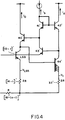
- Fig. 1 shows a portion of a digital-to-analog converter, based on a known type of DAC called a current-mode or current switching converter.
- a current-mode or current switching converter comprises a number of identical transistors 10-1 through 10-n connected as current sources, with their bases tied to a common bias line 12, and their emitters connected to respective shunt resistors 14-1 through 14-n, all of value 2R, along an R-2R ladder 16, having series resistors (18-1, 18-2 ..., 18-n), all of value R.
- the bias line (12) is held fixed at a voltage designated as -V b .
- the collector currents of the transistors 10-1, 10-2, 10-3, ..., 10-n are selectively summed by a summation circuit 24 to produce the desired analog output signal corresponding to an applied digital input signal, as is fully described in the general body of literature on DAC's.
- the output of an operational amplifier 20 applies an excitation voltage to the input terminal 22 of the ladder 16.
- the ladder excitation voltage is controlled by a feedback loop, comprising a reference transistor 26, with its emitter connected through a 2R resistor 28 to the output of the operational amplifier 20.
- the base of this transistor is tied to the common base bias line 12, and the collector is connected to one input terminal of the amplifier.
- a source of constant reference voltage, V REF is also connected to this input terminal.
- the amplifier 20 continuously compares the collector current of transistor 26 with the reference current (i REF ) established in resistor 30, and sets the voltage at node 22 at the lower end of resistor 28 to maintain the collector current equal to the reference current. Since the voltage at node 22 also is applied to the ladder input, the control of that voltage by the amplifier 20 serves also to stabilize the collector currents of the current source transistors 10-1, 10-2, 10-3, ..., 10-n.
- each of the identical source transistors 10-1, 10-2, 10-3, ..., 10-n operates at a different current (i.e., each successive transistor has one-half the current of the previous transistor). Therefore, no two transistors operate at the same current density; hence each has a slightly different base-to-emitter voltage (V be ). Moreover, the differences between these base-to-emitter voltages ( ⁇ V be ) are temperature-dependent, so that it is not possible simply to make a compensating adjustment in the resistor network values which would accommodate the temperature-varying component of the differences from stage to stage.
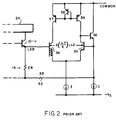
- Fig. 2 shows a schematic circuit diagram for developing a voltage of 2(kT/q)ln 2 for the 2R termination resistor 32, which supplies the current for the least significant bit's contribution, according to US-A-4 349 811.
- This circuit consists of both NPN transistors (34, 35 and 36) and PNP transistors (37, 38 and 39).
- U.S. Patent No. 4 349 811 (Brokaw) also describes other circuits for accomplishing the same compensation but typically they require either an amplifier or both NPN and PNP transistors.
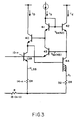
- FIG. 3 A simpler termination circuit, accomplishing the same temperature compensation is shown in Fig. 3. This circuit is simpler to manufacture than any previously shown circuit for achieving the compensation taught in U.S. Patent No. 4 349 811. It does not require an amplifier, and can be fabricated in either all NPN or all PNP type transistors.
- Fig. 3 shows the circuit as it connects to the LSB transistor 10-n in the R-2R ladder of the DAC.
- Transistors 40 through 44 terminate the ladder with a voltage which is (2kt/q)ln2 more positive than the emitter voltage of the LSB transistor 10-n. To see why this is so, consider the continuous path of base-to- emitter voltages (V be 's) from the emitter of transistor 10-n to the emitter of transistor 44.
- V t The voltage at the top of the resistor 32 (i.e., V t ) can be expressed as the sum of base-to-emitter voltages around the loop from V LSB (i.e., the voltage at the top of resistor 14-n) to V t (i.e., the voltage at the top of resistor 32).
- V be(43) , and V be(42) ascend in voltage (i.e., are positive), whereas V be(41) , V be(40) and V be(44) descend (i.e., are negative).
- V LSB + V be(10-n) + V be(43) + V be(42) - V be(41) - V be(40) - V be(44) V t
- V t - V LSB V be(10-n) + V be(43) + V be(42) - V be(41) - V be(40) - V be(44) .
- V t - V LSB (V be(10-n) - V be(40) ) + (V be(43) - V be(41) ) + (V be(42) - V be(44) )
- transistors 10-n and 40 operate at the LSB current so their base-emitter voltages match and the term (V be(10-n) - V be(40) ) drops out as well.
- transistors 42 and 44 operate at the same current (i o ), but since transistor 44 is larger than transistor 42, it operates at a different current density. Therefore, the term involving V be(42) and V be(44) is not zero.
- transistor 40 or 41 may be made with four times the emitter area of the other transistors in the loop, instead of transistor 44, to obtain the same overall result.
- two of the three transistors 40, 41 or 44 each may have twice the emitter area, which will also achieve the same result.
- all three of those transistors could have 4/3 the area of transistor 44 and the other transistors in the loop.
- Other emitter area combinations can be employed, as well, so long as the total base-emitter voltage difference developed around the loop is the required 2(kT/q)ln 2, required to provide the sought after compensation.
- additional junctions may be introduced into the loop, as well, without departing from this teaching, so long as the loop develops the aforementioned base-emitter voltage difference.
- a second error results from the modulation of V be by collector voltage.
- Transistors 41, 43, and 10-n operate at or near zero collector-to-base voltage.
- Transistor 44 has approximately a single base-emitter voltage reverse biasing its collector.
- the collector voltages of 40 and 42 are not constrained by the circuit, as shown. The effects of collector voltage on the two transistors have opposite results on the voltage V t .
Landscapes
- Engineering & Computer Science (AREA)
- Theoretical Computer Science (AREA)
- Analogue/Digital Conversion (AREA)
- Networks Using Active Elements (AREA)
- Amplifiers (AREA)
Claims (16)
- Ein R-2R-Widerstands-Kettennetzwerk, das in einer Stromgewichteten Schaltung verwendet ist, mit folgenden Merkmalen:(A) einer Mehrzahl von Transistoren (10-1 bis 10-n), die einen niederstwertigen Transistor (10-n) aufweisen und die als Stromquellen mit unterschiedlichen Stromdichten wirksam sind;(B) wobei das Kettennetzwerk (16) einen Nebenschlußwiderstand (14-1 bis 14-n) aufweist, der jeder Stromquelle zugeordnet ist;(C) wobei die Nebenschlußwiderstände (14-1 bis 14-n) des Kettennetzwerks (16) mit jeweiligen Stromquellen-Emittern der Transistoren (10-1 bis 10-n) verbunden sind, um gewichtete Transistorströme zu liefern; und(D) einer Anregungsquelle, die mit dem Kettennetzwerk (16) verbunden ist, um die gewichteten Ströme durch die Transistoren (10-1 bis 10-n) zu entwickeln;(E) wobei das Kettennetzwerk (16) an einem Ende desselben eine Abschlußschaltung, die einen Abschlußwiderstand (32) des Werts 2R aufweist, und eine Spannungsquelle mit einem Ausgang (Vt), der mit dem Abschlußwiderstand (32) verbunden ist, aufweist, um an denselben eine Spannung anzulegen, die 2(kT/q)ln2 näher an einer Versorgungsspannung ist, als die Spannung an dem Emitter des niederstwertigen Transistors (VLSB) des R-2R-Kettennetzwerks,dadurch gekennzeichnet, daß
(F) die Spannungsquelle aus einer Mehrzahl von Transistoren (40-44) gebildet ist, die alle von dem gleichen bipolaren Typ sind, wobei die Mehrzahl von Transistoren der Spannungsquelle wirksam zwischen den Emitter des niederstwertigen Transistors (10-n) und den Ausgang der Spannungsquelle (Vt) gekoppelt ist, und folgende Merkmale aufweisen:eine erste Gruppe von Transistoren (43, 42), deren Basis-Emitter-Übergänge seriell in einer ersten Richtung eines wechselnden Potentials von der Basis des niederstwertigen Transistors zu einem Referenzknoten gekoppelt sind; undeine zweite Gruppe von Transistoren (40, 41, 44), deren Basis-Emitter-Übergänge seriell in einer zweiten Richtung eines wechselnden Potentials, die entgegengesetzt zu der ersten Richtung ist, von dem Referenzknoten zu dem Ausgang der Spannungsquelle (Vt) gekoppelt sind. - Das Kettennetzwerk gemäß Anspruch 1, bei dem die Ausgangsspannung durch das Vorsehen eines Emitter-Oberflächenbereichs von zumindest einem der Mehrzahl von Transistoren, der sich von den anderen der Mehrzahl von Transistoren unterscheidet, wählbar ist.
- Das Kettennetzwerk gemäß Anspruch 2, bei dem:die erste Gruppe von Transistoren einen ersten Transistor (43) und einen zweiten Transistor (42) aufweist; unddie zweite Gruppe von Transistoren einen dritten Transistor (41), einen vierten Transistor (40) und einen fünften Transistor (44) aufweist.
- Das Kettennetzwerk gemäß Anspruch 3, bei dem die Fläche des Emitters des einen der ersten bis fünften Transistoren (40-44) das Vierfache der Emitter-Fläche des niederstwertigen Transistors (10-n) ist.
- Das Kettennetzwerk gemäß Anspruch 3, bei dem die Emitter-Flächen von jedem von zwei der ersten bis fünften Transistoren (40-44) jeweils das Zweifache der Emitter-Fläche des niederstwertigen Transistors (10-n) ist.
- Das Kettennetzwerk gemäß Anspruch 3, bei dem die Emitter-Flächen von jedem von drei der ersten bis fünften Transistoren (40-44) das Vierdrittelfache der Emitter-Fläche des niederstwertigen Transistors (10-n) ist.
- Das Kettennetzwerk gemäß Anspruch 3, bei dem:der Emitter des ersten Transistors (43) mit der Basis des niederstwertigen Transistors (10-n) verbunden ist;der Emitter des zweiten Transistors (42) mit der Basis des ersten Transistors (43) verbunden ist;die Basis des dritten Transistors (41) mit der Basis des zweiten Transistors (42) verbunden ist;die Basis des vierten Transistors (40) mit dem Emitter des dritten Transistors (41) und dem Kollektor des ersten Transistors (43) verbunden ist;die Basis des fünften Transistors (44) mit dem Emitter des vierten Transistors (40) und dem Kollektor des niederstwertigen Transistors (10-n) verbunden ist,so daß die Ausgangsspannung der Spannungsquelle an dem Emitter des fünften Transistors (44) 2(kT/q)ln2 näher an der Versorgungsspannung ist als die Emitterspannung des niederstwertigen Transistors (10-n).
- Das Kettennetzwerk gemäß einem beliebigen vorhergehenden Anspruch, bei dem alle Transistoren NPN-Bipolartransistoren sind.
- Ein Verfahren des Kompensierens von Unterschieden der Basis-Emitter-Spannungen zwischen Stromquellentransistoren eines R-2R-Widerstands-Kettennetzwerks (16) gemäß dem oberbegriff von Anspruch 1, wobei die Stromquellentransistoren (10-1 bis 10-n) alle von einem Typ sind und alle näherungsweise die gleiche Emitter-Fläche aufweisen, mit folgenden Schritten:(A) Erzeugen eines Kompensationsstroms durch Serienwiderstände (R) des Kettennetzwerks, der entsprechende Spannungskomponenten entwickelt, die die Basis-Emitter-Spannungsunterschiede zwischen aufeinanderfolgenden Beinen des Kettennetzwerks anpassen, wobei der Kompensationsstrom einen Wert aufweist, der die Unterschiede zwischen den Basis-Emitter-Spannungen der Stromquellentransistoren anzeigt; und(B) Zuführen des Kompensationsstroms zu dem niederstwertigen Stromquellentransistor in dem R-2R-Kettennetzwerk, derart, daß jeder Stromquellentransistor des R-2R-Kettennetzwerks einen Anteil der vorgesehenen Kompensation empfängt;dadurch gekennzeichnet, daß
(C) die Schritte des Erzeugens und Zuführens nur Transistoren des einen bipolaren Typs des R-2R-Kettennetzwerks verwenden, und folgende Merkmale verwendet werden:i) eine erste Gruppe von Transistoren, deren Basis-Emitter-Übergänge seriell in einer ersten Richtung eines wechselnden Potentials von der Basis des niederstwertigen Transistors zu einem Referenzknoten gekoppelt sind; undii) eine zweite Gruppe von Transistoren, deren Basis-Emitter-Übergänge seriell in einer zweiten Richtung eines wechselnden Potentials, die entgegengesetzt zu der ersten Richtung ist, von dem Referenzknoten zu dem Ausgang der Spannungsquelle (Vt) gekoppelt ist. - Das Verfahren gemäß Anspruch 9, bei dem Unterschiede zwischen den Basis-Emitter-Spannungen der Stromquellentransistoren eine Komponente aufweisen, die sich mit der Temperatur ändert, und bei dem der Kompensationsstrom eine Komponente aufweist, die sich auf eine gleichartige Weise mit der Temperatur ändert, so daß das Kompensationssignal im wesentlichen die Komponente der Unterschiede, die sich mit der Temperatur ändert, beseitigt.
- Das Verfahren gemäß Anspruch 10, bei dem der Schritt A folgende Schritte aufweist:A1) Zuführen eines Basisstroms zu den Transistoren des R-2R-Kettennetzwerks durch einen ersten Emitterfolger;A2) Zuführen des Basisstroms zu dem ersten Emitter-Folger durch einen zweiten Emitter-Folger;A3) Spiegeln der Emitterspannung des zweiten Emitter-Folgers mit einem dritten Emitter-Folger, dessen Basis mit der Basis des zweiten Emitter-Folgers gekoppelt ist;A4) Zuführen des Basisstroms zu einem vierten Emitter-Folger durch den Emitter des dritten Emitter-Folgers;A5) Zuführen des Basisstroms zu einem fünften Emitter-Folger durch den Emitter des vierten Emitter-Folgers;
- Das Verfahren gemäß Anspruch 11, bei dem der Schritt B den Schritt des Koppelns des Emitters des fünften Emitter-Folgers durch eine Impedanz mit der niederstwertigen Stromquelle aufweist.
- Das Verfahren gemäß Anspruch 12, das ferner den Schritt des Auswählens einer vorbestimmten Emitter-Fläche von zumindest einem der ersten bis fünften Emitter-Folger aufweist, um einen Kompensationsstrom mit einer exakten Kompensation zu erzeugen.
- Das Verfahren gemäß Anspruch 12, bei dem Schritt des Auswählens die Emitter-Fläche des einen des ersten bis fünften Emitter-Folger-Transistoren auswählt, um das Vierfache der Emitter-Fläche der Transistoren des R-2R-Kettennetzwerks zu sein.
- Das Verfahren gemäß Anspruch 13, bei dem der Schritt des Auswählens die Emitter-Flächen von zwei der ersten bis fünften Emitter-Folger-Transistoren auswählt, um das Zweifache der Emitter-Fläche der Transistoren des R-2R-Kettennetzwerks zu sein.
- Das Verfahren gemäß Anspruch 13, bei dem der Schritt des Auswählens die Emitter-Flächen von drei der ersten bis fünften Emitter-Folger-Transistoren auswählt, um das Vierdrittelfache der Emitter-Fläche der Transistoren des R-2R-Kettennetzwerks zu sein.
Applications Claiming Priority (3)
| Application Number | Priority Date | Filing Date | Title |
|---|---|---|---|
| US439821 | 1989-11-20 | ||
| US07/439,821 US5119094A (en) | 1989-11-20 | 1989-11-20 | Termination circuit for an r-2r, ladder that compensates for the temperature drift caused by different current densities along the ladder, using one type of biopolar transistor |
| PCT/US1990/006790 WO1991007825A2 (en) | 1989-11-20 | 1990-11-19 | Termination circuit for an r-2r ladder that compensates for temperature drift |
Publications (2)
| Publication Number | Publication Date |
|---|---|
| EP0454841A1 EP0454841A1 (de) | 1991-11-06 |
| EP0454841B1 true EP0454841B1 (de) | 1997-10-22 |
Family
ID=23746268
Family Applications (1)
| Application Number | Title | Priority Date | Filing Date |
|---|---|---|---|
| EP91901034A Expired - Lifetime EP0454841B1 (de) | 1989-11-20 | 1990-11-19 | Abschlussschaltung mit temperaturdriftkompensation für ein r-2r-kettennetzwerk |
Country Status (5)
| Country | Link |
|---|---|
| US (1) | US5119094A (de) |
| EP (1) | EP0454841B1 (de) |
| JP (1) | JPH04505240A (de) |
| DE (1) | DE69031620T2 (de) |
| WO (1) | WO1991007825A2 (de) |
Cited By (1)
| Publication number | Priority date | Publication date | Assignee | Title |
|---|---|---|---|---|
| US10615817B2 (en) | 2017-11-07 | 2020-04-07 | Analog Devices Global Unlimited Company | Current steering digital to analog converter |
Families Citing this family (3)
| Publication number | Priority date | Publication date | Assignee | Title |
|---|---|---|---|---|
| DE4130675A1 (de) * | 1991-09-14 | 1993-03-18 | Philips Patentverwaltung | Multiplizierender digital-analog-umsetzer |
| EP1145441A2 (de) * | 1999-08-13 | 2001-10-17 | Koninklijke Philips Electronics N.V. | Analog-digital-wandler |
| US7095351B2 (en) * | 2004-09-20 | 2006-08-22 | Analog Devices, Inc. | Digital-to-analog converter structures |
Family Cites Families (7)
| Publication number | Priority date | Publication date | Assignee | Title |
|---|---|---|---|---|
| US3893018A (en) * | 1973-12-20 | 1975-07-01 | Motorola Inc | Compensated electronic voltage source |
| US3940760A (en) * | 1975-03-21 | 1976-02-24 | Analog Devices, Inc. | Digital-to-analog converter with current source transistors operated accurately at different current densities |
| US4176344A (en) * | 1975-05-28 | 1979-11-27 | Bell Telephone Laboratories, Incorporated | Integrated circuit binary weighted digital-to-analog converter |
| US4349811A (en) * | 1980-07-30 | 1982-09-14 | Analog Devices, Incorporated | Digital-to-analog converter with improved compensation arrangement for offset voltage variations |
| JPS59107612A (ja) * | 1982-12-10 | 1984-06-21 | Hitachi Ltd | レシオメトリック定電流装置 |
| US4899152A (en) * | 1986-12-23 | 1990-02-06 | Analog Devices, Inc. | Method and apparatus for temperature compensating a digital to analog converter |
| US4882533A (en) * | 1987-08-28 | 1989-11-21 | Unitrode Corporation | Linear integrated circuit voltage drop generator having a base-10-emitter voltage independent current source therein |
-
1989
- 1989-11-20 US US07/439,821 patent/US5119094A/en not_active Expired - Lifetime
-
1990
- 1990-11-19 DE DE69031620T patent/DE69031620T2/de not_active Expired - Lifetime
- 1990-11-19 JP JP3501503A patent/JPH04505240A/ja active Pending
- 1990-11-19 EP EP91901034A patent/EP0454841B1/de not_active Expired - Lifetime
- 1990-11-19 WO PCT/US1990/006790 patent/WO1991007825A2/en not_active Ceased
Cited By (1)
| Publication number | Priority date | Publication date | Assignee | Title |
|---|---|---|---|---|
| US10615817B2 (en) | 2017-11-07 | 2020-04-07 | Analog Devices Global Unlimited Company | Current steering digital to analog converter |
Also Published As
| Publication number | Publication date |
|---|---|
| WO1991007825A2 (en) | 1991-05-30 |
| DE69031620D1 (de) | 1997-11-27 |
| DE69031620T2 (de) | 1998-02-12 |
| EP0454841A1 (de) | 1991-11-06 |
| US5119094A (en) | 1992-06-02 |
| JPH04505240A (ja) | 1992-09-10 |
| WO1991007825A3 (en) | 1991-06-27 |
Similar Documents
| Publication | Publication Date | Title |
|---|---|---|
| US5969658A (en) | R/2R ladder circuit and method for digital-to-analog converter | |
| US4029974A (en) | Apparatus for generating a current varying with temperature | |
| EP0343177B1 (de) | Digital-zu-zeit-umwandler | |
| JPS6238894B2 (de) | ||
| EP0260095B1 (de) | Digital wählbare Mehrfachstromquelle mit Proportionalität zu einem Referenzstrom | |
| GB1589439A (en) | Digital-toanalogue converter | |
| EP0438494B1 (de) | Digital-analogwandler mit auf der platte eingebautem invertierungsverstärker mit einheitsverstärkung | |
| GB2118336A (en) | Digitally controlled precision current source with open loop compensation circuit | |
| US4349811A (en) | Digital-to-analog converter with improved compensation arrangement for offset voltage variations | |
| EP0454841B1 (de) | Abschlussschaltung mit temperaturdriftkompensation für ein r-2r-kettennetzwerk | |
| US6323801B1 (en) | Bandgap reference circuit for charge balance circuits | |
| US4631522A (en) | Method and circuit for compensation of a multiplying digital-to-analog converter | |
| US4567463A (en) | Circuit for improving the performance of digital to analog converters | |
| US4523182A (en) | PROM trimmed digital-to-analog converter | |
| US5132559A (en) | Circuit for trimming input offset voltage utilizing variable resistors | |
| US4034366A (en) | Analog-to-digital converter with controlled ladder network | |
| US4358752A (en) | Analog-to-digital converter | |
| US5729231A (en) | Digital-to-analog converter having improved resistance to variations in DC current gain | |
| US3943431A (en) | Current-splitting network | |
| EP0061199B1 (de) | Digital-Analog-Umwandler | |
| JP2737907B2 (ja) | Da変換器 | |
| GB2068186A (en) | Programmable transconductance amplifier | |
| JP2985185B2 (ja) | Da変換回路 | |
| JP2906280B2 (ja) | D/a変換器 | |
| EP0603904B1 (de) | Digital-Analog-Wandlerschaltung |
Legal Events
| Date | Code | Title | Description |
|---|---|---|---|
| PUAI | Public reference made under article 153(3) epc to a published international application that has entered the european phase |
Free format text: ORIGINAL CODE: 0009012 |
|
| AK | Designated contracting states |
Kind code of ref document: A1 Designated state(s): DE FR GB |
|
| 17P | Request for examination filed |
Effective date: 19911107 |
|
| 17Q | First examination report despatched |
Effective date: 19940221 |
|
| GRAG | Despatch of communication of intention to grant |
Free format text: ORIGINAL CODE: EPIDOS AGRA |
|
| GRAH | Despatch of communication of intention to grant a patent |
Free format text: ORIGINAL CODE: EPIDOS IGRA |
|
| GRAH | Despatch of communication of intention to grant a patent |
Free format text: ORIGINAL CODE: EPIDOS IGRA |
|
| GRAA | (expected) grant |
Free format text: ORIGINAL CODE: 0009210 |
|
| AK | Designated contracting states |
Kind code of ref document: B1 Designated state(s): DE FR GB |
|
| REF | Corresponds to: |
Ref document number: 69031620 Country of ref document: DE Date of ref document: 19971127 |
|
| ET | Fr: translation filed | ||
| PLBE | No opposition filed within time limit |
Free format text: ORIGINAL CODE: 0009261 |
|
| STAA | Information on the status of an ep patent application or granted ep patent |
Free format text: STATUS: NO OPPOSITION FILED WITHIN TIME LIMIT |
|
| 26N | No opposition filed | ||
| REG | Reference to a national code |
Ref country code: GB Ref legal event code: IF02 |
|
| PGFP | Annual fee paid to national office [announced via postgrant information from national office to epo] |
Ref country code: DE Payment date: 20091127 Year of fee payment: 20 |
|
| PGFP | Annual fee paid to national office [announced via postgrant information from national office to epo] |
Ref country code: FR Payment date: 20091201 Year of fee payment: 20 Ref country code: GB Payment date: 20091125 Year of fee payment: 20 |
|
| REG | Reference to a national code |
Ref country code: GB Ref legal event code: PE20 Expiry date: 20101118 |
|
| PG25 | Lapsed in a contracting state [announced via postgrant information from national office to epo] |
Ref country code: GB Free format text: LAPSE BECAUSE OF EXPIRATION OF PROTECTION Effective date: 20101118 |
|
| PG25 | Lapsed in a contracting state [announced via postgrant information from national office to epo] |
Ref country code: DE Free format text: LAPSE BECAUSE OF EXPIRATION OF PROTECTION Effective date: 20101119 |