EP0454599B1 - Sehnenbandprothese und Verfahren zur Herstellung - Google Patents
Sehnenbandprothese und Verfahren zur Herstellung Download PDFInfo
- Publication number
- EP0454599B1 EP0454599B1 EP91420137A EP91420137A EP0454599B1 EP 0454599 B1 EP0454599 B1 EP 0454599B1 EP 91420137 A EP91420137 A EP 91420137A EP 91420137 A EP91420137 A EP 91420137A EP 0454599 B1 EP0454599 B1 EP 0454599B1
- Authority
- EP
- European Patent Office
- Prior art keywords
- sheath
- extracellular matrix
- extracellular
- prosthesis according
- matrix
- Prior art date
- Legal status (The legal status is an assumption and is not a legal conclusion. Google has not performed a legal analysis and makes no representation as to the accuracy of the status listed.)
- Expired - Lifetime
Links
- 210000003041 ligament Anatomy 0.000 title claims abstract description 27
- 238000004519 manufacturing process Methods 0.000 title claims description 11
- 238000000034 method Methods 0.000 title description 11
- 210000002744 extracellular matrix Anatomy 0.000 claims abstract description 79
- 102000010834 Extracellular Matrix Proteins Human genes 0.000 claims abstract description 59
- 108010037362 Extracellular Matrix Proteins Proteins 0.000 claims abstract description 59
- 239000007788 liquid Substances 0.000 claims abstract description 19
- 102000008186 Collagen Human genes 0.000 claims description 21
- 108010035532 Collagen Proteins 0.000 claims description 21
- 229920001436 collagen Polymers 0.000 claims description 21
- 229920001661 Chitosan Polymers 0.000 claims description 19
- 229920002683 Glycosaminoglycan Polymers 0.000 claims description 15
- 239000000203 mixture Substances 0.000 claims description 9
- 238000002360 preparation method Methods 0.000 claims description 9
- 239000011159 matrix material Substances 0.000 claims description 7
- -1 polyethylene terephthalate Polymers 0.000 claims description 5
- 238000004108 freeze drying Methods 0.000 claims description 4
- 238000005470 impregnation Methods 0.000 claims description 4
- 239000005020 polyethylene terephthalate Substances 0.000 claims description 4
- 229920002101 Chitin Polymers 0.000 claims description 3
- 238000003381 deacetylation reaction Methods 0.000 claims description 3
- 229910021653 sulphate ion Inorganic materials 0.000 claims description 3
- KIUKXJAPPMFGSW-DNGZLQJQSA-N (2S,3S,4S,5R,6R)-6-[(2S,3R,4R,5S,6R)-3-Acetamido-2-[(2S,3S,4R,5R,6R)-6-[(2R,3R,4R,5S,6R)-3-acetamido-2,5-dihydroxy-6-(hydroxymethyl)oxan-4-yl]oxy-2-carboxy-4,5-dihydroxyoxan-3-yl]oxy-5-hydroxy-6-(hydroxymethyl)oxan-4-yl]oxy-3,4,5-trihydroxyoxane-2-carboxylic acid Chemical compound CC(=O)N[C@H]1[C@H](O)O[C@H](CO)[C@@H](O)[C@@H]1O[C@H]1[C@H](O)[C@@H](O)[C@H](O[C@H]2[C@@H]([C@@H](O[C@H]3[C@@H]([C@@H](O)[C@H](O)[C@H](O3)C(O)=O)O)[C@H](O)[C@@H](CO)O2)NC(C)=O)[C@@H](C(O)=O)O1 KIUKXJAPPMFGSW-DNGZLQJQSA-N 0.000 claims description 2
- 229920000045 Dermatan sulfate Polymers 0.000 claims description 2
- 229920002971 Heparan sulfate Polymers 0.000 claims description 2
- HTTJABKRGRZYRN-UHFFFAOYSA-N Heparin Chemical compound OC1C(NC(=O)C)C(O)OC(COS(O)(=O)=O)C1OC1C(OS(O)(=O)=O)C(O)C(OC2C(C(OS(O)(=O)=O)C(OC3C(C(O)C(O)C(O3)C(O)=O)OS(O)(=O)=O)C(CO)O2)NS(O)(=O)=O)C(C(O)=O)O1 HTTJABKRGRZYRN-UHFFFAOYSA-N 0.000 claims description 2
- 229920000288 Keratan sulfate Polymers 0.000 claims description 2
- 241001465754 Metazoa Species 0.000 claims description 2
- 229920000669 heparin Polymers 0.000 claims description 2
- 229960002897 heparin Drugs 0.000 claims description 2
- 229920002674 hyaluronan Polymers 0.000 claims description 2
- 229960003160 hyaluronic acid Drugs 0.000 claims description 2
- KXCLCNHUUKTANI-RBIYJLQWSA-N keratan Chemical compound CC(=O)N[C@@H]1[C@@H](O)C[C@@H](COS(O)(=O)=O)O[C@H]1O[C@@H]1[C@@H](O)[C@H](O[C@@H]2[C@H](O[C@@H](O[C@H]3[C@H]([C@@H](COS(O)(=O)=O)O[C@@H](O)[C@@H]3O)O)[C@H](NC(C)=O)[C@H]2O)COS(O)(=O)=O)O[C@H](COS(O)(=O)=O)[C@@H]1O KXCLCNHUUKTANI-RBIYJLQWSA-N 0.000 claims description 2
- 239000000126 substance Substances 0.000 claims 4
- FPJHWYCPAOPVIV-VOZMEZHOSA-N (2R,3S,4R,5R,6R)-6-[(2R,3R,4R,5R,6R)-5-acetamido-2-(hydroxymethyl)-6-methoxy-3-sulfooxyoxan-4-yl]oxy-4,5-dihydroxy-3-methoxyoxane-2-carboxylic acid Chemical compound CO[C@@H]1O[C@H](CO)[C@H](OS(O)(=O)=O)[C@H](O[C@@H]2O[C@H]([C@@H](OC)[C@H](O)[C@H]2O)C(O)=O)[C@H]1NC(C)=O FPJHWYCPAOPVIV-VOZMEZHOSA-N 0.000 claims 1
- 229920000139 polyethylene terephthalate Polymers 0.000 claims 1
- LYCAIKOWRPUZTN-UHFFFAOYSA-N Ethylene glycol Chemical compound OCCO LYCAIKOWRPUZTN-UHFFFAOYSA-N 0.000 description 8
- 239000000463 material Substances 0.000 description 7
- 239000000835 fiber Substances 0.000 description 6
- 210000002950 fibroblast Anatomy 0.000 description 6
- 230000003013 cytotoxicity Effects 0.000 description 4
- 231100000135 cytotoxicity Toxicity 0.000 description 4
- 230000018044 dehydration Effects 0.000 description 4
- 238000006297 dehydration reaction Methods 0.000 description 4
- 238000007710 freezing Methods 0.000 description 4
- 230000008014 freezing Effects 0.000 description 4
- WGCNASOHLSPBMP-UHFFFAOYSA-N hydroxyacetaldehyde Natural products OCC=O WGCNASOHLSPBMP-UHFFFAOYSA-N 0.000 description 4
- 238000012360 testing method Methods 0.000 description 4
- QTBSBXVTEAMEQO-UHFFFAOYSA-N Acetic acid Chemical compound CC(O)=O QTBSBXVTEAMEQO-UHFFFAOYSA-N 0.000 description 3
- 229920004934 Dacron® Polymers 0.000 description 3
- 210000004027 cell Anatomy 0.000 description 3
- 239000000470 constituent Substances 0.000 description 3
- 238000013508 migration Methods 0.000 description 3
- 230000005012 migration Effects 0.000 description 3
- 239000000047 product Substances 0.000 description 3
- 229920001287 Chondroitin sulfate Polymers 0.000 description 2
- 239000004698 Polyethylene Substances 0.000 description 2
- 238000005299 abrasion Methods 0.000 description 2
- 239000000560 biocompatible material Substances 0.000 description 2
- 239000012620 biological material Substances 0.000 description 2
- 238000006243 chemical reaction Methods 0.000 description 2
- 210000002808 connective tissue Anatomy 0.000 description 2
- 230000000694 effects Effects 0.000 description 2
- 238000009940 knitting Methods 0.000 description 2
- 239000002609 medium Substances 0.000 description 2
- 229920000573 polyethylene Polymers 0.000 description 2
- 229920002994 synthetic fiber Polymers 0.000 description 2
- 210000001519 tissue Anatomy 0.000 description 2
- XLYOFNOQVPJJNP-UHFFFAOYSA-N water Substances O XLYOFNOQVPJJNP-UHFFFAOYSA-N 0.000 description 2
- 238000009941 weaving Methods 0.000 description 2
- 241000238557 Decapoda Species 0.000 description 1
- 206010013647 Drowning Diseases 0.000 description 1
- 239000006144 Dulbecco’s modified Eagle's medium Substances 0.000 description 1
- 239000004677 Nylon Substances 0.000 description 1
- 239000004952 Polyamide Substances 0.000 description 1
- 239000004743 Polypropylene Substances 0.000 description 1
- 102000019259 Succinate Dehydrogenase Human genes 0.000 description 1
- 108010012901 Succinate Dehydrogenase Proteins 0.000 description 1
- 239000004809 Teflon Substances 0.000 description 1
- 229920006362 Teflon® Polymers 0.000 description 1
- 230000015572 biosynthetic process Effects 0.000 description 1
- 210000000988 bone and bone Anatomy 0.000 description 1
- 244000309466 calf Species 0.000 description 1
- 229940094517 chondroitin 4-sulfate Drugs 0.000 description 1
- KXKPYJOVDUMHGS-OSRGNVMNSA-N chondroitin sulfate Chemical compound CC(=O)N[C@H]1[C@H](O)O[C@H](OS(O)(=O)=O)[C@H](O)[C@@H]1O[C@H]1[C@H](O)[C@@H](O)[C@H](O)[C@@H](C(O)=O)O1 KXKPYJOVDUMHGS-OSRGNVMNSA-N 0.000 description 1
- 239000013078 crystal Substances 0.000 description 1
- 230000001419 dependent effect Effects 0.000 description 1
- 238000000151 deposition Methods 0.000 description 1
- AVJBPWGFOQAPRH-FWMKGIEWSA-L dermatan sulfate Chemical compound CC(=O)N[C@H]1[C@H](O)O[C@H](CO)[C@H](OS([O-])(=O)=O)[C@@H]1O[C@H]1[C@H](O)[C@@H](O)[C@H](O)[C@H](C([O-])=O)O1 AVJBPWGFOQAPRH-FWMKGIEWSA-L 0.000 description 1
- 229940051593 dermatan sulfate Drugs 0.000 description 1
- 238000011161 development Methods 0.000 description 1
- 238000001035 drying Methods 0.000 description 1
- 238000011156 evaluation Methods 0.000 description 1
- 230000002344 fibroplastic effect Effects 0.000 description 1
- 239000012634 fragment Substances 0.000 description 1
- 238000000227 grinding Methods 0.000 description 1
- 239000001963 growth medium Substances 0.000 description 1
- 230000001900 immune effect Effects 0.000 description 1
- 238000002513 implantation Methods 0.000 description 1
- 238000001727 in vivo Methods 0.000 description 1
- 230000002757 inflammatory effect Effects 0.000 description 1
- 238000009434 installation Methods 0.000 description 1
- VMGAPWLDMVPYIA-HIDZBRGKSA-N n'-amino-n-iminomethanimidamide Chemical compound N\N=C\N=N VMGAPWLDMVPYIA-HIDZBRGKSA-N 0.000 description 1
- 231100001083 no cytotoxicity Toxicity 0.000 description 1
- 229920001778 nylon Polymers 0.000 description 1
- 239000004033 plastic Substances 0.000 description 1
- 229920003023 plastic Polymers 0.000 description 1
- 229920002647 polyamide Polymers 0.000 description 1
- 229920000728 polyester Polymers 0.000 description 1
- 229920001155 polypropylene Polymers 0.000 description 1
- 229920001296 polysiloxane Polymers 0.000 description 1
- 229920001343 polytetrafluoroethylene Polymers 0.000 description 1
- 239000004810 polytetrafluoroethylene Substances 0.000 description 1
- 239000011148 porous material Substances 0.000 description 1
- 239000000843 powder Substances 0.000 description 1
- 239000002244 precipitate Substances 0.000 description 1
- 230000001737 promoting effect Effects 0.000 description 1
- BOLDJAUMGUJJKM-LSDHHAIUSA-N renifolin D Natural products CC(=C)[C@@H]1Cc2c(O)c(O)ccc2[C@H]1CC(=O)c3ccc(O)cc3O BOLDJAUMGUJJKM-LSDHHAIUSA-N 0.000 description 1
- 210000002966 serum Anatomy 0.000 description 1
- 235000015170 shellfish Nutrition 0.000 description 1
- 239000007787 solid Substances 0.000 description 1
- 239000002904 solvent Substances 0.000 description 1
- 238000010186 staining Methods 0.000 description 1
- 238000003756 stirring Methods 0.000 description 1
- 239000000725 suspension Substances 0.000 description 1
- 201000004595 synovitis Diseases 0.000 description 1
- 238000009864 tensile test Methods 0.000 description 1
- BFKJFAAPBSQJPD-UHFFFAOYSA-N tetrafluoroethene Chemical compound FC(F)=C(F)F BFKJFAAPBSQJPD-UHFFFAOYSA-N 0.000 description 1
- 125000003831 tetrazolyl group Chemical group 0.000 description 1
- 238000002604 ultrasonography Methods 0.000 description 1
Images
Classifications
-
- A—HUMAN NECESSITIES
- A61—MEDICAL OR VETERINARY SCIENCE; HYGIENE
- A61L—METHODS OR APPARATUS FOR STERILISING MATERIALS OR OBJECTS IN GENERAL; DISINFECTION, STERILISATION OR DEODORISATION OF AIR; CHEMICAL ASPECTS OF BANDAGES, DRESSINGS, ABSORBENT PADS OR SURGICAL ARTICLES; MATERIALS FOR BANDAGES, DRESSINGS, ABSORBENT PADS OR SURGICAL ARTICLES
- A61L27/00—Materials for grafts or prostheses or for coating grafts or prostheses
- A61L27/50—Materials characterised by their function or physical properties, e.g. injectable or lubricating compositions, shape-memory materials, surface modified materials
- A61L27/58—Materials at least partially resorbable by the body
-
- A—HUMAN NECESSITIES
- A61—MEDICAL OR VETERINARY SCIENCE; HYGIENE
- A61F—FILTERS IMPLANTABLE INTO BLOOD VESSELS; PROSTHESES; DEVICES PROVIDING PATENCY TO, OR PREVENTING COLLAPSING OF, TUBULAR STRUCTURES OF THE BODY, e.g. STENTS; ORTHOPAEDIC, NURSING OR CONTRACEPTIVE DEVICES; FOMENTATION; TREATMENT OR PROTECTION OF EYES OR EARS; BANDAGES, DRESSINGS OR ABSORBENT PADS; FIRST-AID KITS
- A61F2/00—Filters implantable into blood vessels; Prostheses, i.e. artificial substitutes or replacements for parts of the body; Appliances for connecting them with the body; Devices providing patency to, or preventing collapsing of, tubular structures of the body, e.g. stents
- A61F2/02—Prostheses implantable into the body
- A61F2/08—Muscles; Tendons; Ligaments
-
- A—HUMAN NECESSITIES
- A61—MEDICAL OR VETERINARY SCIENCE; HYGIENE
- A61L—METHODS OR APPARATUS FOR STERILISING MATERIALS OR OBJECTS IN GENERAL; DISINFECTION, STERILISATION OR DEODORISATION OF AIR; CHEMICAL ASPECTS OF BANDAGES, DRESSINGS, ABSORBENT PADS OR SURGICAL ARTICLES; MATERIALS FOR BANDAGES, DRESSINGS, ABSORBENT PADS OR SURGICAL ARTICLES
- A61L27/00—Materials for grafts or prostheses or for coating grafts or prostheses
- A61L27/14—Macromolecular materials
- A61L27/26—Mixtures of macromolecular compounds
-
- A—HUMAN NECESSITIES
- A61—MEDICAL OR VETERINARY SCIENCE; HYGIENE
- A61L—METHODS OR APPARATUS FOR STERILISING MATERIALS OR OBJECTS IN GENERAL; DISINFECTION, STERILISATION OR DEODORISATION OF AIR; CHEMICAL ASPECTS OF BANDAGES, DRESSINGS, ABSORBENT PADS OR SURGICAL ARTICLES; MATERIALS FOR BANDAGES, DRESSINGS, ABSORBENT PADS OR SURGICAL ARTICLES
- A61L27/00—Materials for grafts or prostheses or for coating grafts or prostheses
- A61L27/28—Materials for coating prostheses
- A61L27/34—Macromolecular materials
-
- A—HUMAN NECESSITIES
- A61—MEDICAL OR VETERINARY SCIENCE; HYGIENE
- A61L—METHODS OR APPARATUS FOR STERILISING MATERIALS OR OBJECTS IN GENERAL; DISINFECTION, STERILISATION OR DEODORISATION OF AIR; CHEMICAL ASPECTS OF BANDAGES, DRESSINGS, ABSORBENT PADS OR SURGICAL ARTICLES; MATERIALS FOR BANDAGES, DRESSINGS, ABSORBENT PADS OR SURGICAL ARTICLES
- A61L2430/00—Materials or treatment for tissue regeneration
- A61L2430/10—Materials or treatment for tissue regeneration for reconstruction of tendons or ligaments
Definitions
- the invention relates to a ligament prosthesis for human or veterinary use, to replace a natural ligament.
- the prostheses currently described act as artificial ligaments intended to replace or strengthen the injured ligaments.
- a solution to the first problem is in particular provided by prostheses produced by the knitting of a polyethylene wire of great resistance, sold under the brand RASHEL for example, giving the mesh thus obtained, flexibility and solidity.
- the second problem is linked to a habitation or colonization of the ligament prosthesis consisting in obtaining collagenous, fibroplastic or connective tissue.
- ligament prosthesis consisting in obtaining collagenous, fibroplastic or connective tissue.
- existing habitable prostheses sometimes made of a biodegradable material, do not induce good quality colonization, which leads to immunological and / or mechanical complications.
- the interface between the prosthesis and the surrounding tissue consists of an extracellular matrix, collagen-chitosan-glycosaminoglycans, facilitating the development of fibroplasts and the reconstitution of connective tissue.
- this layer of extracellular matrix on the one hand is biodegradable at the risk of disappearing before the housing has substantially advanced, on the other hand only allows external colonization on the surface of the prosthesis.
- the present invention provides a ligament prosthesis which solves both the mechanical and biological problems encountered by known prostheses.
- the prosthesis according to the invention essentially consists of an elongated, flexible and resistant framework and an extracellular matrix covering said framework, the framework being a tubular sheath permeable to the extracellular matrix in the liquid state, said sheath being filled with a matrix dry internal extracellular and covered on the outside by a dry external extracellular matrix, the sheath being crossed by one and / or the other of the two extracellular matrices.
- extracellular matrix in the present invention is meant an artificial biological extracellular material, originally in the liquid state and in the solid, porous state, after dehydration.
- the mechanical resistance is provided by the framework
- the biological performances, for the reconstitution of a normal ligament are provided by the extracellular matrix which arranged on either side of the framework fills and crosses it completely, making colonization quantitatively and qualitatively viable.
- the sheath is permeable to the liquid extracellular matrix to facilitate the interpenetration of the two extracellular matrices thus drowning the sheath network and then promoting the migration of fibroplasts from one extracellular matrix to the other.
- the sheath is constituted by woven synthetic threads, such as polyterephtaethylene glycol, braided or knitted.
- the extracellular matrices whose nature is chosen to promote the migration, multiplication and growth of fibroplasts consist of an artificial biological extracellular material, which according to a preferred embodiment of the invention is based on the association of collagen-chitosan-glycosaminoglycans .
- the extracellular matrices comprise collagen for 60 to 80%, chosen from type I to XV collagens of human or animal origin, native or without telopeptide, with chitosan for 10 to 30%, the chitosan coming from the N-deacetylation of the chitin of invertebrates and in particular of crabs and by glycosaminoglycans for 6 to 10%, chosen from hyaluronic acid, chondroitin-4-sulfate, chondroitin -6-sulfate, dermatan-sulfate, heparan-sulfate, keratan-sulfate and heparin, these percentages representing a concentration by weight relative to the dry weight of the matrix.
- the extracellular matrices can be chosen from the following materials: crosslinked collagens and derivatives, reacetylated chitosans and derivatives, crosslinked chitosans and derivatives, crosslinked collagen and crosslinked chitosan combination, crosslinked collagen with a chitosan , combination of crosslinked collagen and crosslinked glycosaminoglycans.
- each of the internal and external extracellular matrices can be respectively the same in identical or different proportions or very different.
- the object of the present invention is also a method for producing such a prosthesis, that is to say obtaining a perfect impregnation of the tubular sheath by the two internal and external extracellular matrices and good cohesion of the prosthesis thus obtained.
- the present invention more particularly proposes two methods of manufacturing a prosthesis: a first more specifically adapted to produce prostheses of small diameter and the second preferably adapted to produce prostheses of larger diameter.
- One of the methods can for example be used for a sheath diameter in particular less than approximately 9 mm, while the other method can be used for a diameter greater than approximately 9 mm.
- Each of the two methods is discussed below, it being obvious that the numerical values relating to the diameter of the sheath evaluated experimentally, are given by way of non-limiting indication.
- the method described above has certain drawbacks related to the larger volume of liquid extracellular matrix to be handled. Indeed, on the one hand, after its introduction into the tube and the sheath, the liquid extracellular matrix can spread through the open ends of the tube, and on the other hand, during freezing there is a risk of not freezing any the extracellular matrix, and in particular the heart of the internal extracellular matrix.
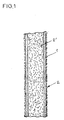
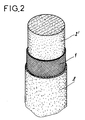
- the ligament prosthesis is constituted by the combination of at least two biocompatible materials shown in Figure 3 respectively in the form of a support or sheath 1 and two internal extracellular matrices 2 ′ and external 2, biodegradable and determined for allow in vivo the migration, growth and multiplication of cells necessary for the formation of a tissue capable of ensuring the functions of a natural ligament.
- the extracellular matrix is preferably composed of collagen, chitosan and glycosaminoglycans.
- this preparation is carried out as follows.
- a collagen solution is prepared to which a chitosan solution is added which can be obtained by N-deacetylation of chitin extracted from shellfish shells.
- a solution of chondroitin sulphate is then added.
- the viscous solution obtained is then poured into molds suitable for the intended uses, then dehydrated. Note that the dehydration of this mixture can be obtained in different ways depending on the applications envisaged and the desired appearance.
- a mixture is obtained in the form of a felt, the mean pore diameter of which can vary in a controlled manner as a function of the operating conditions, in particular the proportion of dry matter in the liquid extracellular matrix, freezing speed and temperature.
- a film is obtained.
- the mixture is precipitated with solvents, an extracellular matrix will be obtained in the form of a powder, after grinding the precipitate.
- the constituents thereof can be added in different proportions corresponding to the above ranges.
- the extracellular matrix can contain between 0.5 and 2% of dry matter constituted by the three types of molecules mentioned above.
- the liquid extracellular matrix can contain approximately 1.25% of dry matter constituted by 72% of collagen, 20% of chitosan and 8% of glycosaminoglycans.
- the mixture obtained is stirred for one hour at a temperature between 20 and 25 ° C, then optionally degassed by ultrasound in particular. Then just dehydrate the mixture.
- the support or sheath 1 intended to receive the extracellular matrices, as described above, is of the tubular type being shaped to be implanted in place of the natural ligament or ligaments to be replaced.
- this sheath 1 has any arrangement for its installation and its fixing at the level of the joint considered.
- the structure of the sheath 1 is not described in detail, since it is not part of the specific object of the invention.
- the extracellular matrices can be combined with any type of biocompatible sheath whose shapes, dimensions and arrangements make it possible to constitute an artificial ligament.
- the sheath 1 can be obtained by weaving or knitting fibers of biocompatible material.
- the sheath is obtained from a weaving of terephtaethylene glycol fibers, without excluding any other compatible polyester capable of being shaped by similar characteristics.
- the sheath is determined to have the mechanical characteristics, in particular of sufficient tensile strength during the time necessary for the reconstitution of the neoligament under the effect of the action of the extracellular matrix.
- the nature of the material constituting the sheath 1 is determined so as not to generate reactions inflammatory.
- the direct test consists in directly depositing a fragment of DACRON + extracellular matrix on a culture of fibroblasts.
- the culture medium in which the product to be tested has incubated for 48 hours is used.
- MTT staining transforms the tetrazolium salts into blue formazan crystals and is directly dependent on the activity of the succinate dehydrogenase enzyme.
- the extracellular matrix was seeded with fibroblasts at the rate of 500,000 cells per cm2 at T o .
- the culture is incubated at 37 ° C. in an atmosphere at 5% CO2 in DMEM medium containing 10% calf serum.
- the medium is changed twice a week. Histological sections are made at T o + 7 days, 15 days, 21 days and 28 days.
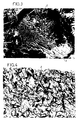
- the fibroblasts have recolonized the extracellular matrix homogeneously at T o + 28 days, as shown in Figure 4.
- the procedure is carried out in a single step.
- the sheath 1 is introduced into a tube open at its two ends and the diameter of which is approximately 20% greater than the diameter of said sheath.
- the extracellular matrix in the liquid state is introduced through one of the openings of the tube at a suitable flow rate to ensure a homogeneous impregnation of the fibers of the sheath.
- the whole is frozen as indicated above and then subjected to a dehydration operation in the tube or after demolding.
- this process can also be used in certain cases for the production of ligaments with a diameter greater than 9 mm, but does not make it possible to produce ligaments having differences in terms of composition and texture between the internal extracellular matrix and the external extracellular matrix.
- the outer diameter of the sheath can be 4 to 5 mm, the length of the prosthesis obtained from 10 to 20 cm, its breaking strength of the order of 120 daN and its elongation at break. around 24.4%.
- a first step after preparation of the internal liquid extracellular matrix, as indicated above, the latter is poured into a cylindrical plastic tube such as polyethylene, polypropylene, polytetrafluorocarbon, silicone, etc. Then the product is frozen. internal extracellular matrix poured into the tube for a time necessary to obtain a stable temperature within said extracellular matrix. The latter is then dehydrated directly in the freezing tube or after demolding.
- a cylindrical plastic tube such as polyethylene, polypropylene, polytetrafluorocarbon, silicone, etc.
- the dehydrated internal extracellular matrix 2 ′ is then introduced into the sheath 1 thus constituting a cylindrical body resulting from the introduction of said internal extracellular matrix 2 ′ in the dry state at the interior of said sheath 1.
- the assembly consisting of the sheath 1 and the internal extracellular matrix 2 ′ in the dry state is introduced into a tube containing a solution of external extracellular matrix in the liquid state and in sufficient quantity to surround said together in its entirety.
- the assembly contained in the tube and impregnated with the liquid external extracellular matrix is frozen under the same conditions as those described above. We then proceed to dehydration in the tube or after demolding to obtain the ligament prosthesis.
- the outside diameter of the support can be 9 to 10 mm, the length of the prosthesis obtained in the order of 25 to 30 cm, its breaking strength in the order of 238 daN and its elongation. around 28.4%.
- This preparation process makes it possible to use compositions different from the extracellular matrix for the internal matrix and the external matrix.
Landscapes
- Health & Medical Sciences (AREA)
- Public Health (AREA)
- Veterinary Medicine (AREA)
- Oral & Maxillofacial Surgery (AREA)
- Transplantation (AREA)
- Life Sciences & Earth Sciences (AREA)
- Animal Behavior & Ethology (AREA)
- General Health & Medical Sciences (AREA)
- Medicinal Chemistry (AREA)
- Epidemiology (AREA)
- Chemical & Material Sciences (AREA)
- Dermatology (AREA)
- Orthopedic Medicine & Surgery (AREA)
- Rehabilitation Therapy (AREA)
- Rheumatology (AREA)
- Cardiology (AREA)
- Engineering & Computer Science (AREA)
- Biomedical Technology (AREA)
- Heart & Thoracic Surgery (AREA)
- Vascular Medicine (AREA)
- Prostheses (AREA)
- Materials For Medical Uses (AREA)
Claims (11)
- Bandprothese, mit einem länglichen flexiblen und strapazierfähigen Stützwerk, und mit einer das Stützwerk bedeckenden extrazellulären Matrix, dadurch gekennzeichnet, daß das Stützwerk als rohrförmige Hülle (1) ausgebildet ist, die für die sich im flüssigen Zustand befindliche extrazelluläre Matrix durchlässig ist, wobei die Hülle mit einer inneren trockenen extrazellulären Matrix (2′) gefüllt ist und auf der Außenseite mit einer äußeren trockenen extrazellulären Matrix (2) bedeckt ist, wobei die Hülle von der einen und/oder der anderen der beiden extrazellulären Matrizes durchdrungen ist.
- Prothese nach Anspruch 1, dadurch gekennzeichnet, daß die Hülle aus gewebten synthetischen Fäden, wie geflochtenes oder gewirktes polyethylenglykolterephthalat gebildet ist.
- Prothese nach Anspruch 1, dadurch gekennzeichnet, daß die inneren und äußeren extrazellulären Matrizes aus einem künstlich dargestellten biologischen extrazellulären Material gebildet sind.
- Prothese nach Anspruch 3, dadurch gekennzeichnet, daß das künstlich dargestellte biologische extrazelluläre Material aus Kollagen, Chitosan und Glykosaminoglykanen zusammengesetzt ist.
- Prothese nach Anspruch 4, dadurch gekennzeichnet, daß das Kollagen ausgewählt aus den Kollagenen des Types I bis XV menschlichen oder tierischen Ursprungs, natürlicher Art oder ohne Telopeptid ist, und daß dessen Gewichtsanteil bezüglich des Trockengewichts der Matrix zwischen 60 und 80 % liegt.
- Prothese nach Anspruch 4, dadurch gekennzeichnet, daß das Chitosan aus der N-Desacetylierung des Chitins von Wirbellosen stammt, und daß dessen Gewichtsanteil bezüglich des Trockengewichts der Matrix zwischen 10 und 30 % liegt.
- Prothese nach Anspruch 4, dadurch gekennzeichnet, daß die Glykosaminoglykane ausgewählt sind aus Hyaluronsäure, Chondroitin-4-sulfat, Chondroitin-6-sulfat, Dermatansulfat, Heparansulfat, Keratansulfat und Heparin, und daß deren Gewichtsanteil bezüglich des Trockengewichts der Matrix zwischen 6 und 10 % liegt.
- Prothese nach Anspruch 3, dadurch gekennzeichnet, daß das künstlich dargestellte biologische extrazelluläre Material ausgewählt ist aus den vernetzten und derivativen Kollagenen, den reacetylisierten und derivativen Chitosanen, den vernetzten und derivativen Chitosanen, der Kombination von vernetztem Kollagen und vernetztem Chitosan, von vernetztem Kollagen mit Chitosan, und der Kombination von vernetztem Kollagen und vernetzten Glykosaminoglykanen.
- Prothese nach Anspruch 3, dadurch gekennzeichnet, daß die Zusammensetzungen der inneren und äußeren extrazellulären Matrizes gleich oder unterschiedlich sind.
- Verfahren zum Herstellen einer Bandprothese nach einem der Ansprüche 1 bis 8, die einen Durchmesser von zumindest gleich bzw. etwa 9 mm aufweist, dadurch gekennzeichnet, daß- nach Herstellen der flüssigen extrazellulären Matrizes die innere extrazelluläre Matrix (2′) in ein zylindrisches Rohr gegossen wird, und man diese während eines bestimmten Zeitraumes, der ausreichend ist, um das innere des Materials auf eine stabile Temperatur zu bringen, zum Erstarren bringt,- die innere extrazelluläre Matrix (2′), insbesondere durch Gefriertrocknen, dehydratisiert wird,- die dehydratisierte innere extrazelluläre Matrix (2′) in die Hülle eingeführt wird,- die Hülle (1), die die dehydratisierte innere extrazelluläre Matrix (2′) enthält, in ein Rohr getaucht wird, das eine Menge der flüssigen äußeren extrazellulären Matrix (2) enthält, um die Hülle (1) insgesamt zu imprägnieren, und das Gesamte nach einer bestimmten Kontaktzeit zum Erstarren gebracht wird,- und das Gesamte, insbesondere durch Gefriertrocknen, dehydratisiert wird.
- Verfahren zum Herstellen einer Bandprothese nach einem der Ansprüche 1 bis 8, die insbesondere einen Durchmesser unterhalb von 9 mm aufweist, dadurch gekennzeichnet, daß- die Hülle (1) in ein an seinen beiden äußeren Enden offenes Rohr eingeführt wird,- die flüssige innere extrazelluläre Matrix (2′) und die flüssige äußere extrazelluläre Matrix (2) durch eines der Enden des Rohres eingebracht wird, so daß ein Füllen und ein homogenes Imprägnieren der Hülle (1) sichergestellt ist,- das Gesamte zum Erstarren gebracht wird, und- das Gesamte, insbesondere durch Gefriertrocken, dehydratisiert wird.
Applications Claiming Priority (2)
| Application Number | Priority Date | Filing Date | Title |
|---|---|---|---|
| FR9005942A FR2661332B1 (fr) | 1990-04-25 | 1990-04-25 | Prothese ligamentaire et son procede de fabrication. |
| FR9005942 | 1990-04-25 |
Publications (2)
| Publication Number | Publication Date |
|---|---|
| EP0454599A1 EP0454599A1 (de) | 1991-10-30 |
| EP0454599B1 true EP0454599B1 (de) | 1994-07-27 |
Family
ID=9396549
Family Applications (1)
| Application Number | Title | Priority Date | Filing Date |
|---|---|---|---|
| EP91420137A Expired - Lifetime EP0454599B1 (de) | 1990-04-25 | 1991-04-25 | Sehnenbandprothese und Verfahren zur Herstellung |
Country Status (5)
| Country | Link |
|---|---|
| EP (1) | EP0454599B1 (de) |
| AT (1) | ATE109012T1 (de) |
| DE (1) | DE69103076T2 (de) |
| ES (1) | ES2072582T3 (de) |
| FR (1) | FR2661332B1 (de) |
Families Citing this family (10)
| Publication number | Priority date | Publication date | Assignee | Title |
|---|---|---|---|---|
| GB9407237D0 (en) * | 1994-04-12 | 1994-06-08 | Sec Dep For Health The | Cruciate ligament prosthesis |
| FI974321A0 (fi) | 1997-11-25 | 1997-11-25 | Jenny Ja Antti Wihurin Rahasto | Multipel heparinglykosaminoglykan och en proteoglykan innehaollande dessa |
| FR2791262B1 (fr) * | 1999-03-22 | 2001-09-28 | Virbac Sa | Compositions a base de chondroitine et de chitosan pour la protection, le traitement ou le remplacement des tissus conjonctifs |
| US7033603B2 (en) | 1999-08-06 | 2006-04-25 | Board Of Regents The University Of Texas | Drug releasing biodegradable fiber for delivery of therapeutics |
| WO2001010421A1 (en) * | 1999-08-06 | 2001-02-15 | Board Of Regents, The University Of Texas System | Drug releasing biodegradable fiber implant |
| US20050019488A1 (en) * | 2001-11-30 | 2005-01-27 | Cambridge Polymer Group, Inc., Boston, Ma | Layered aligned polymer structures and methods of making same |
| US7048963B2 (en) | 2001-11-30 | 2006-05-23 | Cambridge Polymers Group, Inc. | Layered aligned polymer structures and methods of making same |
| FR2850026B1 (fr) * | 2003-01-17 | 2007-08-31 | L A R S Laboratoire D Applic E | Ligament prothetique biomimetique et procede d'obtention |
| CN103315827B (zh) * | 2013-06-25 | 2016-01-20 | 周婕 | 一种人工韧带的制备方法 |
| FR3022765B1 (fr) | 2014-06-25 | 2016-07-08 | Assist Publique - Hopitaux De Paris | Implant amovible pour generer un tendon ou un ligament en remplacement d'un tendon ou d'un ligament rompu |
Family Cites Families (1)
| Publication number | Priority date | Publication date | Assignee | Title |
|---|---|---|---|---|
| FR2616318A1 (fr) * | 1987-06-15 | 1988-12-16 | Centre Nat Rech Scient | Peau artificielle et son procede de preparation |
-
1990
- 1990-04-25 FR FR9005942A patent/FR2661332B1/fr not_active Expired - Fee Related
-
1991
- 1991-04-25 DE DE69103076T patent/DE69103076T2/de not_active Expired - Fee Related
- 1991-04-25 AT AT91420137T patent/ATE109012T1/de not_active IP Right Cessation
- 1991-04-25 ES ES91420137T patent/ES2072582T3/es not_active Expired - Lifetime
- 1991-04-25 EP EP91420137A patent/EP0454599B1/de not_active Expired - Lifetime
Also Published As
| Publication number | Publication date |
|---|---|
| FR2661332B1 (fr) | 1995-06-16 |
| EP0454599A1 (de) | 1991-10-30 |
| DE69103076T2 (de) | 1996-01-11 |
| ATE109012T1 (de) | 1994-08-15 |
| FR2661332A1 (fr) | 1991-10-31 |
| DE69103076D1 (de) | 1994-09-01 |
| ES2072582T3 (es) | 1995-07-16 |
Similar Documents
| Publication | Publication Date | Title |
|---|---|---|
| US5171273A (en) | Synthetic collagen orthopaedic structures such as grafts, tendons and other structures | |
| CA2139864C (fr) | Utilisation d'un materiau poreux a base de carbonate de calcium comme support pour un facteur de croissance dans la preparation d'un implant bioresorbable | |
| DE3627316C2 (de) | Collagenimplantate, Verfahren zu ihrer Herstellung und Verwendung | |
| DE69525692T2 (de) | Implantierbare Rohrprothese aus Polytetrafluorethylen | |
| US5891558A (en) | Biopolymer foams for use in tissue repair and reconstruction | |
| Itoh et al. | Evaluation of cross-linking procedures of collagen tubes used in peripheral nerve repair | |
| Rocha et al. | Biocompatibility of anionic collagen matrix as scaffold for bone healing | |
| DE69030874T2 (de) | Nichtresorbierbares Zweiphasen-Hornhautimplantat und Verfahren zu seiner Herstellung | |
| EP0641225B1 (de) | Verwendung von vernetztem kollagen zur herstellung einer nähfähigen bioverträglichen langsam resorbierbaren membran | |
| CA1247819A (fr) | Procede de fabrication de tubes de collagene notamment de tubes de faibles diametres et application des tubes obtenus dans le domaine des protheses vasculaires et des sutures nerveuses | |
| CA2352984C (fr) | Preparation d'un materiau collagenique avec une degradation in vivo controlee | |
| EP0454599B1 (de) | Sehnenbandprothese und Verfahren zur Herstellung | |
| AU747442B2 (en) | Biopolymer matt for use in tissue repair and reconstruction | |
| EP2180906A1 (de) | Prothese zur förderung der in-vivo-rekonstruktion eines hohlorgans oder eines teils eines hohlorgans | |
| DE10196234B4 (de) | Verfahren zur Herstellung eines Verbundprodukts aus Kollagen für die Gewebebildung und seine Verwendung | |
| CA2204753A1 (en) | Synthetic collagen orthopaedic structures such as grafts, tendons and other structures | |
| EP2037975B1 (de) | Kollagenröhren | |
| WO2011151603A1 (fr) | Nouveaux substituts vasculaires biodegradables | |
| Watanabe et al. | Development of biotube vascular grafts incorporating cuffs for easy implantation | |
| EP1960011B1 (de) | Verwendung eines polysaccharids, das von der vibrio-dlabolicus-spezie ausgeschieden wird zur herstellung von nicht mineralisiertem verbindungsgewebe | |
| FR2966047A1 (fr) | Procede de preparation de collagene fibrille | |
| Nagata et al. | Morphological Structure of Allogeneic and Heterologous Collagen Matrix: Scanning Electron Microscopic Analysis | |
| FR3124394A1 (fr) | Procede de consolidation d’un hydrogel alginate / gelatine | |
| AU5607399A (en) | Synthetic collagen orthopaedic structures such as grafts, tendons and other structures |
Legal Events
| Date | Code | Title | Description |
|---|---|---|---|
| PUAI | Public reference made under article 153(3) epc to a published international application that has entered the european phase |
Free format text: ORIGINAL CODE: 0009012 |
|
| AK | Designated contracting states |
Kind code of ref document: A1 Designated state(s): AT BE CH DE DK ES FR GB GR IT LI LU NL SE |
|
| 17P | Request for examination filed |
Effective date: 19920116 |
|
| 17Q | First examination report despatched |
Effective date: 19931103 |
|
| GRAA | (expected) grant |
Free format text: ORIGINAL CODE: 0009210 |
|
| AK | Designated contracting states |
Kind code of ref document: B1 Designated state(s): AT BE CH DE DK ES FR GB GR IT LI LU NL SE |
|
| PG25 | Lapsed in a contracting state [announced via postgrant information from national office to epo] |
Ref country code: NL Effective date: 19940727 Ref country code: GR Free format text: LAPSE BECAUSE OF FAILURE TO SUBMIT A TRANSLATION OF THE DESCRIPTION OR TO PAY THE FEE WITHIN THE PRESCRIBED TIME-LIMIT Effective date: 19940727 Ref country code: GB Effective date: 19940727 Ref country code: DK Effective date: 19940727 Ref country code: AT Effective date: 19940727 |
|
| REF | Corresponds to: |
Ref document number: 109012 Country of ref document: AT Date of ref document: 19940815 Kind code of ref document: T |
|
| REF | Corresponds to: |
Ref document number: 69103076 Country of ref document: DE Date of ref document: 19940901 |
|
| ITF | It: translation for a ep patent filed | ||
| PG25 | Lapsed in a contracting state [announced via postgrant information from national office to epo] |
Ref country code: SE Effective date: 19941027 |
|
| RAP2 | Party data changed (patent owner data changed or rights of a patent transferred) |
Owner name: MICHEL, JEAN-PIERRE Owner name: AESCULAP-ICP |
|
| REG | Reference to a national code |
Ref country code: CH Ref legal event code: PFA Free format text: AESCULAP-ICP |
|
| NLV1 | Nl: lapsed or annulled due to failure to fulfill the requirements of art. 29p and 29m of the patents act | ||
| ITPR | It: changes in ownership of a european patent |
Owner name: CAMBIO RAGIONE SOCIALE;AESCULAP - ICP |
|
| GBV | Gb: ep patent (uk) treated as always having been void in accordance with gb section 77(7)/1977 [no translation filed] |
Effective date: 19940727 |
|
| REG | Reference to a national code |
Ref country code: FR Ref legal event code: RM Ref country code: FR Ref legal event code: CD |
|
| PGFP | Annual fee paid to national office [announced via postgrant information from national office to epo] |
Ref country code: FR Payment date: 19950329 Year of fee payment: 5 |
|
| PGFP | Annual fee paid to national office [announced via postgrant information from national office to epo] |
Ref country code: ES Payment date: 19950419 Year of fee payment: 5 |
|
| PGFP | Annual fee paid to national office [announced via postgrant information from national office to epo] |
Ref country code: CH Payment date: 19950425 Year of fee payment: 5 |
|
| PG25 | Lapsed in a contracting state [announced via postgrant information from national office to epo] |
Ref country code: LU Free format text: LAPSE BECAUSE OF NON-PAYMENT OF DUE FEES Effective date: 19950430 Ref country code: BE Effective date: 19950430 |
|
| PGFP | Annual fee paid to national office [announced via postgrant information from national office to epo] |
Ref country code: DE Payment date: 19950601 Year of fee payment: 5 |
|
| PLBE | No opposition filed within time limit |
Free format text: ORIGINAL CODE: 0009261 |
|
| STAA | Information on the status of an ep patent application or granted ep patent |
Free format text: STATUS: NO OPPOSITION FILED WITHIN TIME LIMIT |
|
| REG | Reference to a national code |
Ref country code: ES Ref legal event code: FG2A Ref document number: 2072582 Country of ref document: ES Kind code of ref document: T3 |
|
| 26N | No opposition filed | ||
| BERE | Be: lapsed |
Owner name: MICHEL JEAN-PIERRE Effective date: 19950430 Owner name: S.A. ICP FRANCE Effective date: 19950430 |
|
| PG25 | Lapsed in a contracting state [announced via postgrant information from national office to epo] |
Ref country code: ES Free format text: LAPSE BECAUSE OF NON-PAYMENT OF DUE FEES Effective date: 19960426 |
|
| PG25 | Lapsed in a contracting state [announced via postgrant information from national office to epo] |
Ref country code: LI Effective date: 19960430 Ref country code: CH Effective date: 19960430 |
|
| REG | Reference to a national code |
Ref country code: CH Ref legal event code: PL |
|
| PG25 | Lapsed in a contracting state [announced via postgrant information from national office to epo] |
Ref country code: FR Effective date: 19961227 |
|
| PG25 | Lapsed in a contracting state [announced via postgrant information from national office to epo] |
Ref country code: DE Effective date: 19970101 |
|
| REG | Reference to a national code |
Ref country code: FR Ref legal event code: ST |
|
| REG | Reference to a national code |
Ref country code: ES Ref legal event code: FD2A Effective date: 19990201 |
|
| PG25 | Lapsed in a contracting state [announced via postgrant information from national office to epo] |
Ref country code: IT Free format text: LAPSE BECAUSE OF NON-PAYMENT OF DUE FEES;WARNING: LAPSES OF ITALIAN PATENTS WITH EFFECTIVE DATE BEFORE 2007 MAY HAVE OCCURRED AT ANY TIME BEFORE 2007. THE CORRECT EFFECTIVE DATE MAY BE DIFFERENT FROM THE ONE RECORDED. Effective date: 20050425 |