EP0454075A2 - Procédé de fabrication de filtres de cigarettes - Google Patents
Procédé de fabrication de filtres de cigarettes Download PDFInfo
- Publication number
- EP0454075A2 EP0454075A2 EP91106566A EP91106566A EP0454075A2 EP 0454075 A2 EP0454075 A2 EP 0454075A2 EP 91106566 A EP91106566 A EP 91106566A EP 91106566 A EP91106566 A EP 91106566A EP 0454075 A2 EP0454075 A2 EP 0454075A2
- Authority
- EP
- European Patent Office
- Prior art keywords
- phb
- cigarette filter
- filter
- cigarette
- fibers
- Prior art date
- Legal status (The legal status is an assumption and is not a legal conclusion. Google has not performed a legal analysis and makes no representation as to the accuracy of the status listed.)
- Granted
Links
Images





Classifications
-
- A—HUMAN NECESSITIES
- A24—TOBACCO; CIGARS; CIGARETTES; SIMULATED SMOKING DEVICES; SMOKERS' REQUISITES
- A24D—CIGARS; CIGARETTES; TOBACCO SMOKE FILTERS; MOUTHPIECES OF CIGARS OR CIGARETTES; MANUFACTURE OF TOBACCO SMOKE FILTERS OR MOUTHPIECES
- A24D3/00—Tobacco smoke filters, e.g. filter tips or filtering inserts; Filters specially adapted for simulated smoking devices; Mouthpieces of cigars or cigarettes
- A24D3/06—Use of materials for tobacco smoke filters
- A24D3/08—Use of materials for tobacco smoke filters of organic materials as carrier or major constituent
-
- A—HUMAN NECESSITIES
- A24—TOBACCO; CIGARS; CIGARETTES; SIMULATED SMOKING DEVICES; SMOKERS' REQUISITES
- A24D—CIGARS; CIGARETTES; TOBACCO SMOKE FILTERS; MOUTHPIECES OF CIGARS OR CIGARETTES; MANUFACTURE OF TOBACCO SMOKE FILTERS OR MOUTHPIECES
- A24D3/00—Tobacco smoke filters, e.g. filter tips or filtering inserts; Filters specially adapted for simulated smoking devices; Mouthpieces of cigars or cigarettes
- A24D3/02—Manufacture of tobacco smoke filters
Definitions
- the invention relates to a method for producing cigarette filters according to the preamble of claim 1, a filter produced in this way according to the preamble of claim 8 and a special use of PHB according to claim 13.
- the fiber material is produced by a nozzle spinning process with a large number of spinnerets. After spinning, the individual continuous fibers are combined in a number of several thousand to form a fiber bundle and crimped in a crimping device. The bundle is then deposited as a curled band and pressed together, for example in block form.
- the crimped tape is pulled off the block and first opened by a stretching arrangement, which causes the individual fibers to be shifted in their position relative to one another, so that a 3-dimensional strand, which is as voluminous as possible, forms in a format device the desired diameter is compressed, wrapped with paper and further processed into cylindrical filter rods.
- a fiber material is already known from EP 0 177 207 A2, the individual fibers of which are made from PHB (polyhydroxybutyric acid) or copolymers PHB / PHV (polyhydroxyvaleric acid).
- This fiber material is produced microbiologically and is suitable for spinning out of a centrifugal spinning device.
- the fibers produced form cloths which can be suitably pressed or shaped for the intended purpose.
- the special property of the fiber materials namely their biodegradability, is particularly important since the products produced with these fibers, for example wound sutures, are broken down in the body itself, so that a later removal of the materials from the body is not necessary.
- This material is a polyester with 4 - 5 carbon atoms per basic building block.
- a microorganism is usually cultivated in an aqueous medium on a suitable substrate, such as, for example, carbohydrates or methanol, which provides energy and carbon.
- the substrate must be assimilable by the microorganism.
- at least part of the cultivation is carried out with limitation of the nutrient which is used for Growth of the microorganism is required, but is not necessary for polymer accumulation. Examples of suitable processes are described in EP PS 15 669 and 46 344.
- Copolymers can also be produced which contain other hydroxycarboxylic acids e.g. Hydroxyvaleric acid and / or units derived from a diol, e.g. Contain ethylene glycol and / or dicarboxylic acids, e.g. Isophthalic acid.
- An ester exchange takes place when the microbiologically produced polymer or copolymer with a hydroxycarboxylic acid, or its lactone, e.g. Pivalolactone, a diol, a dicarboxylic acid and / or a polyester produced therefrom.
- HB polymers used below means not only 3-hydroxybutyric acid homopolymers, but also copolymers, as described, provided the 3-hydroxybutyric acid units form at least part of the polymer chain.
- the invention is based on the object of specifying a method for producing cigarette filters and cigarette filters which can be decomposed relatively quickly under the influence of environmental influences, but nevertheless have good filter properties.
- the filter material according to the invention has the special property that it converts to completely harmless products, such as carbon dioxide and water, within a short period of time, in particular in months.
- the disposal that was previously necessary with cigarette filters, such as incineration or landfilling, is only required to a limited extent, since the material according to the invention decomposes itself under the influence of microorganisms.
- the new material for the use according to the invention has improved filter properties compared to conventional cellulose acetate filters, since the taste properties are improved in particular in the case of filter-ventilated cigarettes or an increased dilution of the cigarette smoke is possible with the same taste intensity.
- the filter material 19 consists of tangled layers of a fiber material, the individual fibers of which are generally longer than the filter section.
- the individual fibers of the material are generally at an angle of 30-40 ° to the longitudinal axis of the filter 17, the fibers being oriented in the axial direction of the filter as a whole.
- the filter materials are produced by spinning the polymer into fibers.
- the centrifuge spinning process described in EP 0 177 207 is basically applicable for the purposes of the invention, but the process parameters differ.
- the use of centrifuge spinning technology has led to the surprising finding that direct filter rod production is possible in this way.
- the centrifugal spinning process enables the immediate production of a 3-dimensional strand with an approximately round cross-sectional shape, which can be brought into the desired shape and size of a filter rod by radial compression.
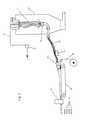
- Fig. 2 shows a device for producing a fiber strand according to the invention.
- a spinning solution with 10-20% weight concentration per volume of solution (W / V) consists of PHB or copolymer PHB-PHV with a molecular weight of greater than 300,000 in a solvent such as chloroform or methylene chloride.
- the solution is itself in a solution container 14.
- the solution is fed to the spinning head via a pump 15.
- This preferably contains a hollow shaft 1 which leads to a spinning cup 2 on which the cup bead 4 is located axially continuing.
- the spinning solution is pressed under pressure onto the top of the cup bead 4.
- the spinning head rotates at a speed of 8,000 rpm, for example. This rotation causes the spinning solution to fly to the outside of the bead and is broken up into individual filaments.
- a first air chamber 5 is provided around the hollow shaft, to which cold air is supplied via an air inlet 6.
- the cold air supplied blows onto the spinning head in the axial direction and combs and separates the fibers as they emerge from the spinning cup 2.
- the speed of the cold air counteracts the rotation or the swirl which the fibers have been impressed by the spinning cup 2.
- a change in the cold air speed influences the degree of crosslinking in the fiber stream.
- a further air chamber 7 is provided which is concentric with the air chamber 5 and to which hot air is supplied via the air inlet 8. The warm air blown out of the chamber 7 in the axial direction of the device downward from the air outlet 9 evaporates the solvent of the spinning solution and forms the network-connected polymer fibers.
- the spinning head rotates at around 4,000 - 15,000 rpm, in particular 8,000 - 12,000 rpm.
- the spinning head diameter is typically 10-15 cm.
- the warm air temperature at the entrance to the air chamber 7 is approximately 160-200 ° C.
- the individual filaments are deflected downwards by the air currents blowing in the axial direction and can form a strand there be summarized.
- an extractor operating with an air stream is provided, which detects the fiber bundle and extracts it to the outside.
- the excess air and solvent vapor are discharged to the outside through an opening 11 and a vent 12.
- the shape of the spun material can be influenced by varying the flows of cold air to warm air under otherwise identical conditions. If the volume ratio cold: warm is greater than 2: 1, an open fleece is obtained. If it is less than 0.1: 1, a compact, twisted thread is obtained. A fiber bundle or a fiber strand can be produced in the intermediate region. It has been found that a ratio of 0.5: 1 to 0.2: 1 is the most favorable strand formation ratio for further forming and processing into cigarette filter rods.
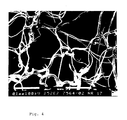
- FIG. 4 shows an electron micrograph of a cloth produced with a volume ratio of 2: 1 cold air to warm air
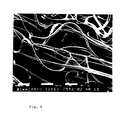
- FIG. 5 shows a corresponding image of a thread in which the volume ratio was 0.1: 1
- FIG. 6 shows an image of a Stranges, which was produced with a volume ratio of 0.33: 1 and which can be used for the purposes of the invention.
- the temperature at the exit of the evaporation section should be in the range 60 - 100 ° C.
- the absolute amounts of air depend on the mass flow of the spinning liquid, whereby amounts of heat per gram of fibers in the above-mentioned. Solvents for PHB in the range of 4,000 - 8,000 J are required.
- the air discharge summarizing the downward blown fiber bundle at the end of the evaporation path through an annular nozzle 16 exerts a minimal pulling force on the fiber bundle and still brings the bundle together well. Too great a pull-off force would rather cause an excessive fiber orientation in the axial direction, which negatively affects the filter properties.
- the ring nozzle used with a diameter of 50 mm, an air flow of 0.012 - 0.016 m3 / s and an air pressure of 0.21 - 0.28 bar acts practically as a fixed point for the twisting of the fibers, which results from the rotation of the spinning head.
- the strand diameter is set to approximately 30-50 mm.
- a container 10 Arranged around the spinning core and the surrounding air chambers is a container 10 which extends far downwards and has the opening 11 at the lower end, at the end of which an outlet 12 is provided, to which a suction device can be connected.
- the polymers produced according to the invention have thermoplastic properties. Many properties correspond to those of polyolefins. In contrast to conventional plastics, PHB and the copolymers are characterized by the fact that they are biodegradable.
- a hot spinning solution can also be used in order to avoid gelation of the HB polymer at high concentration.
- a spinning solution with 10-15% concentration (weight per volume) PHB in chloroform or methylene chloride is suitable.
- a spinner head with a diameter of 10 cm and a rotation speed of 10,000 rpm was used.
- the solution concentration was 13% weight PHB per unit volume Solution dissolved in chloroform.
- the molecular weight was approximately 600,000.
- Hot air of 190 ° C. was used, the volume ratio between cold and warm air being 1: 1 - 0.3: 1. 6.4 g per second of polymer material was spun out.
- the solution temperature was 20 ° C.
- Spun threads with a diameter of 2 to 20 micrometers (the majority of the fibers had a diameter of 5 to 7 micrometers) were produced, which were drawn off at a speed of 10 m per minute.
- the strand density was approximately 500 mg per decimeter of run length.
- the air vent should be arranged at least 1.2 m below the spinning head.
- Fig. 3 shows the device in connection with a format device.
- the fiber strand 20 emerging from the air vent 16 is transferred via a deflection 23 directly into the inlet 24 of the format device.
- the strand is radially compressed to the desired diameter and wrapped with filter wrapping paper 25, which is fed to the strand 20 via a format belt 27.
- the filter strand produced can be cut to length in a cutting device 26, so that the finished filter rods 22 then result.
- a finished filter has a pressure drop (tensile resistance at a standard flow of 17.5 cm3 / s) of about 20 - 50 mm water column per cm.
- the weight of the filter is 30 - 80 mg per cm for common diameters of 7.84 mm.
- the filter properties differ from those of conventional cellulose acetate filters. This difference is due to the different chemical structure of the polymer surfaces of cellulose acetate and PHB. This leads to changed adhesion properties of the particles to be filtered, so that the amount of the non-filtered out medium-volatile components of the cigarette smoke differs from conventional cigarettes. This can be seen in particular from the headspace analysis on the gas chromatograph which is customary in the cigarette industry.
- Filters made from PHB fiber material were compared with standard filters made from cellulose acetate. The focus of the investigations was to find out how the influence of filter ventilation in both systems can be compared in terms of sensors and smoke analysis.
- the two series were laser-perforated. By setting the laser power and the pulse frequency, the following degrees of ventilation were achieved achieved:
- the unventilated version served as a zero test.
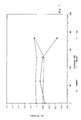
- FIG. 7 shows a comparison of the nicotine-free, dry smoke condensate (PMWNF), nicotine and CO for PHB as a function of the degree of ventilation, in relative units based on the CA filter.
- PMWNF dry smoke condensate
- Fig. 9 the chromatograms have been divided into three areas.
- the course shown in FIG. 10 is obtained if the headspace areas per TPM are nominated to the corresponding CA values.
- the main shift is in the central area of the chromatograms, where the medium-volatile, flavor-intensive substances are detected. If these areas are related to the condensate (TPM) and the PHB values are normalized to the CA values, the course shown in FIG. 10 is included.
- TPM condensate
- the proportion of medium-volatile substances is significantly higher than the comparatively large proportion of volatile and low-volatility substances.
Landscapes
- Chemical & Material Sciences (AREA)
- Engineering & Computer Science (AREA)
- Materials Engineering (AREA)
- Cigarettes, Filters, And Manufacturing Of Filters (AREA)
- Glass Compositions (AREA)
Applications Claiming Priority (2)
| Application Number | Priority Date | Filing Date | Title |
|---|---|---|---|
| DE4013304A DE4013304C2 (de) | 1990-04-26 | 1990-04-26 | Verfahren zur Herstellung von Cigarettenfiltern sowie Cigarettenfilter |
| DE4013304 | 1990-04-26 |
Publications (3)
| Publication Number | Publication Date |
|---|---|
| EP0454075A2 true EP0454075A2 (fr) | 1991-10-30 |
| EP0454075A3 EP0454075A3 (en) | 1992-04-22 |
| EP0454075B1 EP0454075B1 (fr) | 1994-10-26 |
Family
ID=6405130
Family Applications (1)
| Application Number | Title | Priority Date | Filing Date |
|---|---|---|---|
| EP91106566A Expired - Lifetime EP0454075B1 (fr) | 1990-04-26 | 1991-04-24 | Procédé de fabrication de filtres de cigarettes |
Country Status (5)
| Country | Link |
|---|---|
| EP (1) | EP0454075B1 (fr) |
| AT (1) | ATE113174T1 (fr) |
| DE (2) | DE4013304C2 (fr) |
| DK (1) | DK0454075T3 (fr) |
| ES (1) | ES2066256T3 (fr) |
Cited By (2)
| Publication number | Priority date | Publication date | Assignee | Title |
|---|---|---|---|---|
| CN100406632C (zh) * | 2006-01-18 | 2008-07-30 | 东华大学 | 一种纳米级直径的生物可降解纤维无纺布和制备方法 |
| EP2213184A1 (fr) * | 2003-11-25 | 2010-08-04 | Hauni Maschinenbau AG | Dispositif de préparation d'une mèche de filtre et dispositif de fabrication de filtres |
Families Citing this family (2)
| Publication number | Priority date | Publication date | Assignee | Title |
|---|---|---|---|---|
| DE4322966C2 (de) | 1993-07-09 | 1995-10-26 | Rhodia Ag Rhone Poulenc | Aus Celluloseacetat geformte Gebilde und ihre Verwendung als Filtertow und Tabakrauchfilterelement |
| DE19536505A1 (de) * | 1995-09-29 | 1997-04-10 | Biotec Biolog Naturverpack | Biologisch abbaubares Filtermaterial und Verfahren zu seiner Herstellung |
Family Cites Families (5)
| Publication number | Priority date | Publication date | Assignee | Title |
|---|---|---|---|---|
| NL186392B (nl) * | 1953-06-30 | Herberts & Co Gmbh | Carboxylgroepen bevattende polyesters, werkwijze voor de bereiding daarvan en deze esters bevattende waterige bekledingsmiddelen. | |
| DE1039904B (de) * | 1957-07-23 | 1958-09-25 | Zigarettenfabrik Kosmos G M B | Filterkoerper, insbesondere zum Entgiften von Tabakrauch, und Verfahren zu deren Herstellung |
| DE1275428B (de) * | 1960-06-17 | 1968-08-14 | Eastman Kodak Co | Verfahren zur Herstellung von Tabakrauchfilterelementen |
| GB941082A (en) * | 1961-05-11 | 1963-11-06 | Cigarette Components Ltd | Improvements in or relating to cigarette filters |
| GB8424950D0 (en) * | 1984-10-03 | 1984-11-07 | Ici Plc | Non-woven fibrous materials |
-
1990
- 1990-04-26 DE DE4013304A patent/DE4013304C2/de not_active Expired - Fee Related
-
1991
- 1991-04-24 AT AT91106566T patent/ATE113174T1/de not_active IP Right Cessation
- 1991-04-24 EP EP91106566A patent/EP0454075B1/fr not_active Expired - Lifetime
- 1991-04-24 DE DE59103314T patent/DE59103314D1/de not_active Expired - Fee Related
- 1991-04-24 DK DK91106566.2T patent/DK0454075T3/da active
- 1991-04-24 ES ES91106566T patent/ES2066256T3/es not_active Expired - Lifetime
Cited By (2)
| Publication number | Priority date | Publication date | Assignee | Title |
|---|---|---|---|---|
| EP2213184A1 (fr) * | 2003-11-25 | 2010-08-04 | Hauni Maschinenbau AG | Dispositif de préparation d'une mèche de filtre et dispositif de fabrication de filtres |
| CN100406632C (zh) * | 2006-01-18 | 2008-07-30 | 东华大学 | 一种纳米级直径的生物可降解纤维无纺布和制备方法 |
Also Published As
| Publication number | Publication date |
|---|---|
| ES2066256T3 (es) | 1995-03-01 |
| DE4013304C2 (de) | 1993-11-25 |
| DE4013304A1 (de) | 1991-10-31 |
| EP0454075B1 (fr) | 1994-10-26 |
| EP0454075A3 (en) | 1992-04-22 |
| DE59103314D1 (de) | 1994-12-01 |
| ATE113174T1 (de) | 1994-11-15 |
| DK0454075T3 (da) | 1995-04-03 |
Similar Documents
| Publication | Publication Date | Title |
|---|---|---|
| DE19609143C1 (de) | Melt-blown-Vlies, Verfahren zu dessen Herstellung und dessen Verwendungen | |
| US5225277A (en) | Acetate tow having high crimp modulus and manufacturing method thereof | |
| DE2558004C3 (de) | Celluloseacetatfäden enthaltende Zigarettenfilter, Verfahren und Vorrichtung zu deren Herstellung | |
| EP0632970B1 (fr) | Produits à base d'acétate de cellulose, leur utilisation pour la fabrication de cordons filtrants pour la fabrication de filtres à fumée de tabac ainsi que les cordons filtrants et filtres à cigarettes | |
| EP0632969B1 (fr) | Cordon filtrant et son procédé de fabrication ainsi qu'une filtre pour fumée de tabac et son procédé de fabrication | |
| DE1230702B (de) | Verfahren und Vorrichtung zum Herstellen von Filtern fuer Tabakrauch oder andere Gase | |
| DE1657244B1 (de) | Verfahren und Vorrichtung zur Herstellung von Faserstaebchen,insbesondere zur Verwendung als Zigarettenfilter | |
| EP1221869A1 (fr) | Filtre a cigarette hautes performances | |
| EP0632968B1 (fr) | Cordon filtrant et son procédé de fabrication ainsi qu'un filtre pour fumée de tabac et son procédé de fabrication | |
| EP1389922A2 (fr) | Cordon filtrant compose de filaments continus et crepes d'acetate de cellulose | |
| DE1188998C2 (de) | Verfahren und Vorrichtung zum Herstellen eines Filtermaterialstranges fuer Tabakrauchfilter od. dgl. | |
| DD244503A5 (de) | System zur oertlichen aufbringung von zusatzfluessigkeiten fuer ein kontinuierliches zylindrisches produkt | |
| EP0608744B1 (fr) | Filaments d'acétate de cellulose, solution de filage optiquement isotrope à cet effet et son utilisation pour la fabrication des filaments | |
| DE2440821A1 (de) | Zigarettenfilter | |
| DE3544523A1 (de) | Verfahren zur herstellung von bikomponentenfasern, daraus hergestellte fasern und deren verwendung | |
| DE4013293C2 (fr) | ||
| EP0454075B1 (fr) | Procédé de fabrication de filtres de cigarettes | |
| DE2641719A1 (de) | Tabakfilter | |
| DE1632236B2 (de) | Tabakfilter und verfahren zu seiner herstellung | |
| DE2556130A1 (de) | Verfahren zur herstellung von fibrillierten polytetrafluoraethylenprodukten | |
| DE19730485C2 (de) | Celluloseacetatfilamente mit trilobalem Querschnitt | |
| DE3925330C2 (de) | Verfahren zum Verbessern der Härte von Zigarettenfilterelementen | |
| WO2019053074A1 (fr) | Fibre polymère ayant une meilleure aptitude à la dispersion à long terme | |
| EP4240905B1 (fr) | Segment pour un article à fumer comprenant une bande fibreuse calandrée | |
| DE102010063564A1 (de) | Verfahren und Vorrichtung zum Herstellen eines Faservlieses |
Legal Events
| Date | Code | Title | Description |
|---|---|---|---|
| PUAI | Public reference made under article 153(3) epc to a published international application that has entered the european phase |
Free format text: ORIGINAL CODE: 0009012 |
|
| AK | Designated contracting states |
Kind code of ref document: A2 Designated state(s): AT BE CH DE DK ES FR GB GR IT LI LU NL SE |
|
| PUAL | Search report despatched |
Free format text: ORIGINAL CODE: 0009013 |
|
| AK | Designated contracting states |
Kind code of ref document: A3 Designated state(s): AT BE CH DE DK ES FR GB GR IT LI LU NL SE |
|
| 17P | Request for examination filed |
Effective date: 19920312 |
|
| 17Q | First examination report despatched |
Effective date: 19940302 |
|
| GRAA | (expected) grant |
Free format text: ORIGINAL CODE: 0009210 |
|
| AK | Designated contracting states |
Kind code of ref document: B1 Designated state(s): AT BE CH DE DK ES FR GB GR IT LI LU NL SE |
|
| REF | Corresponds to: |
Ref document number: 113174 Country of ref document: AT Date of ref document: 19941115 Kind code of ref document: T |
|
| RAP2 | Party data changed (patent owner data changed or rights of a patent transferred) |
Owner name: ZENECA LIMITED Owner name: B.A.T. CIGARETTENFABRIKEN GMBH |
|
| REF | Corresponds to: |
Ref document number: 59103314 Country of ref document: DE Date of ref document: 19941201 |
|
| GBT | Gb: translation of ep patent filed (gb section 77(6)(a)/1977) |
Effective date: 19941107 |
|
| ET | Fr: translation filed | ||
| ITF | It: translation for a ep patent filed | ||
| EAL | Se: european patent in force in sweden |
Ref document number: 91106566.2 |
|
| REG | Reference to a national code |
Ref country code: ES Ref legal event code: FG2A Ref document number: 2066256 Country of ref document: ES Kind code of ref document: T3 |
|
| REG | Reference to a national code |
Ref country code: GR Ref legal event code: FG4A Free format text: 3014813 |
|
| REG | Reference to a national code |
Ref country code: DK Ref legal event code: T3 |
|
| ITPR | It: changes in ownership of a european patent |
Owner name: CAMBIO RAGIONE SOCIALE;BRITISH - AMERICAN TOBACCO |
|
| REG | Reference to a national code |
Ref country code: CH Ref legal event code: PFA Free format text: BRITISH-AMERICAN TOBACCO (GERMANY) GMBH |
|
| PLBE | No opposition filed within time limit |
Free format text: ORIGINAL CODE: 0009261 |
|
| STAA | Information on the status of an ep patent application or granted ep patent |
Free format text: STATUS: NO OPPOSITION FILED WITHIN TIME LIMIT |
|
| NLT2 | Nl: modifications (of names), taken from the european patent patent bulletin |
Owner name: B.A.T. CIGARETTENFABRIKEN GMBH EN ZENECA LIMITED |
|
| REG | Reference to a national code |
Ref country code: FR Ref legal event code: CD |
|
| 26N | No opposition filed | ||
| NLT1 | Nl: modifications of names registered in virtue of documents presented to the patent office pursuant to art. 16 a, paragraph 1 |
Owner name: BRITISH-AMERICAN TOBACCO (GERMANY) GMBH;ZENECA LIM |
|
| NLXE | Nl: other communications concerning ep-patents (part 3 heading xe) |
Free format text: PAT.BUL.05/95 PAGE949 CORR.:B.A.T. CIGARETTENFABRIKEN GMBH AND ZENECA LIMITED |
|
| REG | Reference to a national code |
Ref country code: ES Ref legal event code: PC2A Owner name: BRITISH-AMERICAN TOBACCO(GERMANY)GMBH(TITULAR AL 5 |
|
| PGFP | Annual fee paid to national office [announced via postgrant information from national office to epo] |
Ref country code: DK Payment date: 19980313 Year of fee payment: 8 |
|
| PGFP | Annual fee paid to national office [announced via postgrant information from national office to epo] |
Ref country code: SE Payment date: 19980323 Year of fee payment: 8 |
|
| PGFP | Annual fee paid to national office [announced via postgrant information from national office to epo] |
Ref country code: ES Payment date: 19980406 Year of fee payment: 8 |
|
| PGFP | Annual fee paid to national office [announced via postgrant information from national office to epo] |
Ref country code: FR Payment date: 19980427 Year of fee payment: 8 |
|
| PGFP | Annual fee paid to national office [announced via postgrant information from national office to epo] |
Ref country code: GR Payment date: 19980429 Year of fee payment: 8 Ref country code: DE Payment date: 19980429 Year of fee payment: 8 Ref country code: BE Payment date: 19980429 Year of fee payment: 8 |
|
| PGFP | Annual fee paid to national office [announced via postgrant information from national office to epo] |
Ref country code: AT Payment date: 19980430 Year of fee payment: 8 |
|
| PGFP | Annual fee paid to national office [announced via postgrant information from national office to epo] |
Ref country code: GB Payment date: 19990219 Year of fee payment: 9 |
|
| PGFP | Annual fee paid to national office [announced via postgrant information from national office to epo] |
Ref country code: CH Payment date: 19990311 Year of fee payment: 9 |
|
| PGFP | Annual fee paid to national office [announced via postgrant information from national office to epo] |
Ref country code: LU Payment date: 19990406 Year of fee payment: 9 |
|
| PG25 | Lapsed in a contracting state [announced via postgrant information from national office to epo] |
Ref country code: AT Free format text: LAPSE BECAUSE OF NON-PAYMENT OF DUE FEES Effective date: 19990424 |
|
| PG25 | Lapsed in a contracting state [announced via postgrant information from national office to epo] |
Ref country code: SE Free format text: LAPSE BECAUSE OF NON-PAYMENT OF DUE FEES Effective date: 19990425 |
|
| PG25 | Lapsed in a contracting state [announced via postgrant information from national office to epo] |
Ref country code: ES Free format text: LAPSE BECAUSE OF NON-PAYMENT OF DUE FEES Effective date: 19990426 |
|
| PGFP | Annual fee paid to national office [announced via postgrant information from national office to epo] |
Ref country code: NL Payment date: 19990429 Year of fee payment: 9 |
|
| PG25 | Lapsed in a contracting state [announced via postgrant information from national office to epo] |
Ref country code: GR Free format text: LAPSE BECAUSE OF NON-PAYMENT OF DUE FEES Effective date: 19990430 Ref country code: DK Free format text: LAPSE BECAUSE OF NON-PAYMENT OF DUE FEES Effective date: 19990430 Ref country code: BE Free format text: LAPSE BECAUSE OF NON-PAYMENT OF DUE FEES Effective date: 19990430 |
|
| BERE | Be: lapsed |
Owner name: ZENECA LTD Effective date: 19990430 Owner name: BRITISH-AMERICAN TOBACCO (GERMANY) G.M.B.H. Effective date: 19990430 |
|
| PG25 | Lapsed in a contracting state [announced via postgrant information from national office to epo] |
Ref country code: FR Free format text: LAPSE BECAUSE OF NON-PAYMENT OF DUE FEES Effective date: 19991231 |
|
| EUG | Se: european patent has lapsed |
Ref document number: 91106566.2 |
|
| REG | Reference to a national code |
Ref country code: FR Ref legal event code: ST |
|
| PG25 | Lapsed in a contracting state [announced via postgrant information from national office to epo] |
Ref country code: DE Free format text: LAPSE BECAUSE OF NON-PAYMENT OF DUE FEES Effective date: 20000201 |
|
| REG | Reference to a national code |
Ref country code: DK Ref legal event code: EBP |
|
| PG25 | Lapsed in a contracting state [announced via postgrant information from national office to epo] |
Ref country code: LU Free format text: LAPSE BECAUSE OF NON-PAYMENT OF DUE FEES Effective date: 20000424 Ref country code: GB Free format text: LAPSE BECAUSE OF NON-PAYMENT OF DUE FEES Effective date: 20000424 |
|
| PG25 | Lapsed in a contracting state [announced via postgrant information from national office to epo] |
Ref country code: LI Free format text: LAPSE BECAUSE OF NON-PAYMENT OF DUE FEES Effective date: 20000430 Ref country code: CH Free format text: LAPSE BECAUSE OF NON-PAYMENT OF DUE FEES Effective date: 20000430 |
|
| PG25 | Lapsed in a contracting state [announced via postgrant information from national office to epo] |
Ref country code: NL Free format text: LAPSE BECAUSE OF NON-PAYMENT OF DUE FEES Effective date: 20001101 |
|
| GBPC | Gb: european patent ceased through non-payment of renewal fee |
Effective date: 20000424 |
|
| REG | Reference to a national code |
Ref country code: CH Ref legal event code: PL |
|
| NLV4 | Nl: lapsed or anulled due to non-payment of the annual fee |
Effective date: 20001101 |
|
| REG | Reference to a national code |
Ref country code: ES Ref legal event code: FD2A Effective date: 20010503 |
|
| PG25 | Lapsed in a contracting state [announced via postgrant information from national office to epo] |
Ref country code: IT Free format text: LAPSE BECAUSE OF NON-PAYMENT OF DUE FEES;WARNING: LAPSES OF ITALIAN PATENTS WITH EFFECTIVE DATE BEFORE 2007 MAY HAVE OCCURRED AT ANY TIME BEFORE 2007. THE CORRECT EFFECTIVE DATE MAY BE DIFFERENT FROM THE ONE RECORDED. Effective date: 20050424 |