EP0453270B1 - Rare-earth based magnetic materials, production process and use - Google Patents
Rare-earth based magnetic materials, production process and use Download PDFInfo
- Publication number
- EP0453270B1 EP0453270B1 EP91303442A EP91303442A EP0453270B1 EP 0453270 B1 EP0453270 B1 EP 0453270B1 EP 91303442 A EP91303442 A EP 91303442A EP 91303442 A EP91303442 A EP 91303442A EP 0453270 B1 EP0453270 B1 EP 0453270B1
- Authority
- EP
- European Patent Office
- Prior art keywords
- intermetallic compound
- value
- elements
- group
- nitrogen
- Prior art date
- Legal status (The legal status is an assumption and is not a legal conclusion. Google has not performed a legal analysis and makes no representation as to the accuracy of the status listed.)
- Expired - Lifetime
Links
- 229910052761 rare earth metal Inorganic materials 0.000 title claims abstract description 30
- 239000000696 magnetic material Substances 0.000 title claims abstract description 26
- 238000004519 manufacturing process Methods 0.000 title claims description 5
- 150000002910 rare earth metals Chemical class 0.000 title description 6
- 238000000034 method Methods 0.000 claims abstract description 41
- 230000008569 process Effects 0.000 claims abstract description 39
- 230000005291 magnetic effect Effects 0.000 claims abstract description 35
- 239000013078 crystal Substances 0.000 claims abstract description 31
- 239000000463 material Substances 0.000 claims abstract description 30
- 229910000765 intermetallic Inorganic materials 0.000 claims abstract description 29
- 230000000737 periodic effect Effects 0.000 claims abstract description 14
- ZOXJGFHDIHLPTG-UHFFFAOYSA-N Boron Chemical compound [B] ZOXJGFHDIHLPTG-UHFFFAOYSA-N 0.000 claims abstract description 8
- 229910052796 boron Inorganic materials 0.000 claims abstract description 8
- 229910052787 antimony Inorganic materials 0.000 claims abstract description 5
- 229910052797 bismuth Inorganic materials 0.000 claims abstract description 5
- WATWJIUSRGPENY-UHFFFAOYSA-N antimony atom Chemical compound [Sb] WATWJIUSRGPENY-UHFFFAOYSA-N 0.000 claims abstract description 4
- JCXGWMGPZLAOME-UHFFFAOYSA-N bismuth atom Chemical compound [Bi] JCXGWMGPZLAOME-UHFFFAOYSA-N 0.000 claims abstract description 4
- IJGRMHOSHXDMSA-UHFFFAOYSA-N Atomic nitrogen Chemical compound N#N IJGRMHOSHXDMSA-UHFFFAOYSA-N 0.000 claims description 70
- XEEYBQQBJWHFJM-UHFFFAOYSA-N Iron Chemical compound [Fe] XEEYBQQBJWHFJM-UHFFFAOYSA-N 0.000 claims description 51
- 229910052757 nitrogen Inorganic materials 0.000 claims description 35
- QGZKDVFQNNGYKY-UHFFFAOYSA-N Ammonia Chemical compound N QGZKDVFQNNGYKY-UHFFFAOYSA-N 0.000 claims description 27
- 239000000843 powder Substances 0.000 claims description 25
- 229910052742 iron Inorganic materials 0.000 claims description 21
- 238000010438 heat treatment Methods 0.000 claims description 20
- 150000001875 compounds Chemical class 0.000 claims description 18
- 150000003624 transition metals Chemical class 0.000 claims description 15
- 239000007789 gas Substances 0.000 claims description 14
- 229910052723 transition metal Inorganic materials 0.000 claims description 14
- 229910021529 ammonia Inorganic materials 0.000 claims description 13
- 229910052772 Samarium Inorganic materials 0.000 claims description 10
- KZUNJOHGWZRPMI-UHFFFAOYSA-N samarium atom Chemical group [Sm] KZUNJOHGWZRPMI-UHFFFAOYSA-N 0.000 claims description 10
- 229910052779 Neodymium Inorganic materials 0.000 claims description 9
- 229910052777 Praseodymium Inorganic materials 0.000 claims description 8
- RKTYLMNFRDHKIL-UHFFFAOYSA-N copper;5,10,15,20-tetraphenylporphyrin-22,24-diide Chemical compound [Cu+2].C1=CC(C(=C2C=CC([N-]2)=C(C=2C=CC=CC=2)C=2C=CC(N=2)=C(C=2C=CC=CC=2)C2=CC=C3[N-]2)C=2C=CC=CC=2)=NC1=C3C1=CC=CC=C1 RKTYLMNFRDHKIL-UHFFFAOYSA-N 0.000 claims description 8
- QEFYFXOXNSNQGX-UHFFFAOYSA-N neodymium atom Chemical compound [Nd] QEFYFXOXNSNQGX-UHFFFAOYSA-N 0.000 claims description 8
- GUTLYIVDDKVIGB-UHFFFAOYSA-N cobalt atom Chemical compound [Co] GUTLYIVDDKVIGB-UHFFFAOYSA-N 0.000 claims description 7
- PUDIUYLPXJFUGB-UHFFFAOYSA-N praseodymium atom Chemical group [Pr] PUDIUYLPXJFUGB-UHFFFAOYSA-N 0.000 claims description 7
- 229910052727 yttrium Inorganic materials 0.000 claims description 7
- 239000011701 zinc Substances 0.000 claims description 7
- 229910052684 Cerium Inorganic materials 0.000 claims description 6
- ZMIGMASIKSOYAM-UHFFFAOYSA-N cerium Chemical compound [Ce][Ce][Ce][Ce][Ce][Ce][Ce][Ce][Ce][Ce][Ce][Ce][Ce][Ce][Ce][Ce][Ce][Ce][Ce][Ce][Ce][Ce][Ce][Ce][Ce][Ce][Ce][Ce][Ce][Ce][Ce][Ce][Ce][Ce][Ce][Ce][Ce][Ce] ZMIGMASIKSOYAM-UHFFFAOYSA-N 0.000 claims description 6
- 238000006243 chemical reaction Methods 0.000 claims description 6
- 229910017052 cobalt Inorganic materials 0.000 claims description 6
- 239000010941 cobalt Substances 0.000 claims description 6
- 229910052751 metal Inorganic materials 0.000 claims description 6
- 239000002184 metal Substances 0.000 claims description 6
- 239000000203 mixture Substances 0.000 claims description 6
- VWQVUPCCIRVNHF-UHFFFAOYSA-N yttrium atom Chemical compound [Y] VWQVUPCCIRVNHF-UHFFFAOYSA-N 0.000 claims description 6
- 229910052691 Erbium Inorganic materials 0.000 claims description 5
- 229910052725 zinc Inorganic materials 0.000 claims description 5
- 229910052692 Dysprosium Inorganic materials 0.000 claims description 4
- OAKJQQAXSVQMHS-UHFFFAOYSA-N Hydrazine Chemical compound NN OAKJQQAXSVQMHS-UHFFFAOYSA-N 0.000 claims description 4
- 229910052771 Terbium Inorganic materials 0.000 claims description 4
- 229910052775 Thulium Inorganic materials 0.000 claims description 4
- HCHKCACWOHOZIP-UHFFFAOYSA-N Zinc Chemical compound [Zn] HCHKCACWOHOZIP-UHFFFAOYSA-N 0.000 claims description 4
- 239000004411 aluminium Substances 0.000 claims description 4
- 229910052782 aluminium Inorganic materials 0.000 claims description 4
- XAGFODPZIPBFFR-UHFFFAOYSA-N aluminium Chemical group [Al] XAGFODPZIPBFFR-UHFFFAOYSA-N 0.000 claims description 4
- QVGXLLKOCUKJST-UHFFFAOYSA-N atomic oxygen Chemical compound [O] QVGXLLKOCUKJST-UHFFFAOYSA-N 0.000 claims description 4
- KBQHZAAAGSGFKK-UHFFFAOYSA-N dysprosium atom Chemical group [Dy] KBQHZAAAGSGFKK-UHFFFAOYSA-N 0.000 claims description 4
- UYAHIZSMUZPPFV-UHFFFAOYSA-N erbium Chemical compound [Er] UYAHIZSMUZPPFV-UHFFFAOYSA-N 0.000 claims description 4
- 239000001301 oxygen Substances 0.000 claims description 4
- 229910052760 oxygen Inorganic materials 0.000 claims description 4
- 239000002245 particle Substances 0.000 claims description 4
- 229910052710 silicon Chemical group 0.000 claims description 4
- 239000010703 silicon Chemical group 0.000 claims description 4
- 239000007787 solid Substances 0.000 claims description 4
- 238000006467 substitution reaction Methods 0.000 claims description 4
- GZCRRIHWUXGPOV-UHFFFAOYSA-N terbium atom Chemical group [Tb] GZCRRIHWUXGPOV-UHFFFAOYSA-N 0.000 claims description 4
- 229910052689 Holmium Chemical group 0.000 claims description 3
- KJZYNXUDTRRSPN-UHFFFAOYSA-N holmium atom Chemical group [Ho] KJZYNXUDTRRSPN-UHFFFAOYSA-N 0.000 claims description 3
- 229910052746 lanthanum Inorganic materials 0.000 claims description 3
- FZLIPJUXYLNCLC-UHFFFAOYSA-N lanthanum atom Chemical compound [La] FZLIPJUXYLNCLC-UHFFFAOYSA-N 0.000 claims description 3
- ZSLUVFAKFWKJRC-IGMARMGPSA-N 232Th Chemical group [232Th] ZSLUVFAKFWKJRC-IGMARMGPSA-N 0.000 claims description 2
- OKTJSMMVPCPJKN-UHFFFAOYSA-N Carbon Chemical group [C] OKTJSMMVPCPJKN-UHFFFAOYSA-N 0.000 claims description 2
- VYZAMTAEIAYCRO-UHFFFAOYSA-N Chromium Chemical compound [Cr] VYZAMTAEIAYCRO-UHFFFAOYSA-N 0.000 claims description 2
- RYGMFSIKBFXOCR-UHFFFAOYSA-N Copper Chemical compound [Cu] RYGMFSIKBFXOCR-UHFFFAOYSA-N 0.000 claims description 2
- 229910052688 Gadolinium Inorganic materials 0.000 claims description 2
- 229910052765 Lutetium Inorganic materials 0.000 claims description 2
- 229910001122 Mischmetal Inorganic materials 0.000 claims description 2
- XUIMIQQOPSSXEZ-UHFFFAOYSA-N Silicon Chemical group [Si] XUIMIQQOPSSXEZ-UHFFFAOYSA-N 0.000 claims description 2
- 229910052776 Thorium Inorganic materials 0.000 claims description 2
- RTAQQCXQSZGOHL-UHFFFAOYSA-N Titanium Chemical group [Ti] RTAQQCXQSZGOHL-UHFFFAOYSA-N 0.000 claims description 2
- 229910052769 Ytterbium Inorganic materials 0.000 claims description 2
- QCWXUUIWCKQGHC-UHFFFAOYSA-N Zirconium Chemical group [Zr] QCWXUUIWCKQGHC-UHFFFAOYSA-N 0.000 claims description 2
- 229910052799 carbon Inorganic materials 0.000 claims description 2
- 229910052804 chromium Inorganic materials 0.000 claims description 2
- 239000011651 chromium Substances 0.000 claims description 2
- 229910052802 copper Inorganic materials 0.000 claims description 2
- 239000010949 copper Substances 0.000 claims description 2
- 238000000354 decomposition reaction Methods 0.000 claims description 2
- UIWYJDYFSGRHKR-UHFFFAOYSA-N gadolinium atom Chemical group [Gd] UIWYJDYFSGRHKR-UHFFFAOYSA-N 0.000 claims description 2
- 150000004678 hydrides Chemical class 0.000 claims description 2
- OHSVLFRHMCKCQY-UHFFFAOYSA-N lutetium atom Chemical compound [Lu] OHSVLFRHMCKCQY-UHFFFAOYSA-N 0.000 claims description 2
- 238000003801 milling Methods 0.000 claims description 2
- 239000010453 quartz Substances 0.000 claims description 2
- 230000005855 radiation Effects 0.000 claims description 2
- 229920005989 resin Polymers 0.000 claims description 2
- 239000011347 resin Substances 0.000 claims description 2
- VYPSYNLAJGMNEJ-UHFFFAOYSA-N silicon dioxide Inorganic materials O=[Si]=O VYPSYNLAJGMNEJ-UHFFFAOYSA-N 0.000 claims description 2
- 229910052719 titanium Inorganic materials 0.000 claims description 2
- 239000010936 titanium Substances 0.000 claims description 2
- 229910052720 vanadium Inorganic materials 0.000 claims description 2
- GPPXJZIENCGNKB-UHFFFAOYSA-N vanadium Chemical group [V]#[V] GPPXJZIENCGNKB-UHFFFAOYSA-N 0.000 claims description 2
- NAWDYIZEMPQZHO-UHFFFAOYSA-N ytterbium Chemical compound [Yb] NAWDYIZEMPQZHO-UHFFFAOYSA-N 0.000 claims description 2
- 229910052726 zirconium Chemical group 0.000 claims description 2
- 229910052785 arsenic Inorganic materials 0.000 claims 1
- 229910052698 phosphorus Inorganic materials 0.000 claims 1
- 239000000523 sample Substances 0.000 description 10
- 238000002441 X-ray diffraction Methods 0.000 description 8
- 230000005415 magnetization Effects 0.000 description 8
- 150000004767 nitrides Chemical class 0.000 description 7
- 238000010521 absorption reaction Methods 0.000 description 6
- 239000007858 starting material Substances 0.000 description 6
- 229910045601 alloy Inorganic materials 0.000 description 5
- 239000000956 alloy Substances 0.000 description 5
- 229910001873 dinitrogen Inorganic materials 0.000 description 5
- 238000001669 Mossbauer spectrum Methods 0.000 description 4
- 238000010348 incorporation Methods 0.000 description 4
- 125000004433 nitrogen atom Chemical group N* 0.000 description 4
- QJGQUHMNIGDVPM-UHFFFAOYSA-N nitrogen group Chemical group [N] QJGQUHMNIGDVPM-UHFFFAOYSA-N 0.000 description 4
- 230000003993 interaction Effects 0.000 description 3
- 230000002269 spontaneous effect Effects 0.000 description 3
- NJFMNPFATSYWHB-UHFFFAOYSA-N ac1l9hgr Chemical compound [Fe].[Fe] NJFMNPFATSYWHB-UHFFFAOYSA-N 0.000 description 2
- 229910000828 alnico Inorganic materials 0.000 description 2
- 125000004429 atom Chemical group 0.000 description 2
- 230000008859 change Effects 0.000 description 2
- 238000011161 development Methods 0.000 description 2
- 230000006872 improvement Effects 0.000 description 2
- 150000002739 metals Chemical class 0.000 description 2
- 229910001172 neodymium magnet Inorganic materials 0.000 description 2
- 239000010955 niobium Substances 0.000 description 2
- 238000005121 nitriding Methods 0.000 description 2
- 125000001424 substituent group Chemical group 0.000 description 2
- 229910000640 Fe alloy Inorganic materials 0.000 description 1
- 229910005438 FeTi Inorganic materials 0.000 description 1
- 229910017108 Fe—Fe Inorganic materials 0.000 description 1
- UFHFLCQGNIYNRP-UHFFFAOYSA-N Hydrogen Chemical compound [H][H] UFHFLCQGNIYNRP-UHFFFAOYSA-N 0.000 description 1
- CTNCAPKYOBYQCX-UHFFFAOYSA-N [P].[As] Chemical compound [P].[As] CTNCAPKYOBYQCX-UHFFFAOYSA-N 0.000 description 1
- 239000000654 additive Substances 0.000 description 1
- 238000004458 analytical method Methods 0.000 description 1
- 238000001816 cooling Methods 0.000 description 1
- 238000005090 crystal field Methods 0.000 description 1
- 230000003247 decreasing effect Effects 0.000 description 1
- 238000009792 diffusion process Methods 0.000 description 1
- 238000009826 distribution Methods 0.000 description 1
- 238000005315 distribution function Methods 0.000 description 1
- 230000000694 effects Effects 0.000 description 1
- 230000005684 electric field Effects 0.000 description 1
- 238000005516 engineering process Methods 0.000 description 1
- 239000003822 epoxy resin Substances 0.000 description 1
- 238000002474 experimental method Methods 0.000 description 1
- 230000002349 favourable effect Effects 0.000 description 1
- 239000001257 hydrogen Substances 0.000 description 1
- 229910052739 hydrogen Inorganic materials 0.000 description 1
- 238000005339 levitation Methods 0.000 description 1
- 230000005389 magnetism Effects 0.000 description 1
- 238000005551 mechanical alloying Methods 0.000 description 1
- 230000007246 mechanism Effects 0.000 description 1
- 238000002074 melt spinning Methods 0.000 description 1
- 238000002844 melting Methods 0.000 description 1
- 230000008018 melting Effects 0.000 description 1
- 239000007769 metal material Substances 0.000 description 1
- 229910052758 niobium Inorganic materials 0.000 description 1
- GUCVJGMIXFAOAE-UHFFFAOYSA-N niobium atom Chemical compound [Nb] GUCVJGMIXFAOAE-UHFFFAOYSA-N 0.000 description 1
- -1 nitride compounds Chemical class 0.000 description 1
- 229920000647 polyepoxide Polymers 0.000 description 1
- 239000002994 raw material Substances 0.000 description 1
- 238000011160 research Methods 0.000 description 1
- 238000005245 sintering Methods 0.000 description 1
- 229910000679 solder Inorganic materials 0.000 description 1
- 238000009718 spray deposition Methods 0.000 description 1
- 238000000547 structure data Methods 0.000 description 1
- 239000010409 thin film Substances 0.000 description 1
- 230000004584 weight gain Effects 0.000 description 1
- 235000019786 weight gain Nutrition 0.000 description 1
- 229910000859 α-Fe Inorganic materials 0.000 description 1
Images









Classifications
-
- H—ELECTRICITY
- H01—ELECTRIC ELEMENTS
- H01F—MAGNETS; INDUCTANCES; TRANSFORMERS; SELECTION OF MATERIALS FOR THEIR MAGNETIC PROPERTIES
- H01F1/00—Magnets or magnetic bodies characterised by the magnetic materials therefor; Selection of materials for their magnetic properties
- H01F1/01—Magnets or magnetic bodies characterised by the magnetic materials therefor; Selection of materials for their magnetic properties of inorganic materials
- H01F1/03—Magnets or magnetic bodies characterised by the magnetic materials therefor; Selection of materials for their magnetic properties of inorganic materials characterised by their coercivity
- H01F1/032—Magnets or magnetic bodies characterised by the magnetic materials therefor; Selection of materials for their magnetic properties of inorganic materials characterised by their coercivity of hard-magnetic materials
- H01F1/04—Magnets or magnetic bodies characterised by the magnetic materials therefor; Selection of materials for their magnetic properties of inorganic materials characterised by their coercivity of hard-magnetic materials metals or alloys
- H01F1/047—Alloys characterised by their composition
- H01F1/053—Alloys characterised by their composition containing rare earth metals
- H01F1/055—Alloys characterised by their composition containing rare earth metals and magnetic transition metals, e.g. SmCo5
-
- H—ELECTRICITY
- H01—ELECTRIC ELEMENTS
- H01F—MAGNETS; INDUCTANCES; TRANSFORMERS; SELECTION OF MATERIALS FOR THEIR MAGNETIC PROPERTIES
- H01F1/00—Magnets or magnetic bodies characterised by the magnetic materials therefor; Selection of materials for their magnetic properties
- H01F1/01—Magnets or magnetic bodies characterised by the magnetic materials therefor; Selection of materials for their magnetic properties of inorganic materials
- H01F1/03—Magnets or magnetic bodies characterised by the magnetic materials therefor; Selection of materials for their magnetic properties of inorganic materials characterised by their coercivity
- H01F1/032—Magnets or magnetic bodies characterised by the magnetic materials therefor; Selection of materials for their magnetic properties of inorganic materials characterised by their coercivity of hard-magnetic materials
- H01F1/04—Magnets or magnetic bodies characterised by the magnetic materials therefor; Selection of materials for their magnetic properties of inorganic materials characterised by their coercivity of hard-magnetic materials metals or alloys
- H01F1/047—Alloys characterised by their composition
- H01F1/053—Alloys characterised by their composition containing rare earth metals
- H01F1/055—Alloys characterised by their composition containing rare earth metals and magnetic transition metals, e.g. SmCo5
- H01F1/057—Alloys characterised by their composition containing rare earth metals and magnetic transition metals, e.g. SmCo5 and IIIa elements, e.g. Nd2Fe14B
-
- H—ELECTRICITY
- H01—ELECTRIC ELEMENTS
- H01F—MAGNETS; INDUCTANCES; TRANSFORMERS; SELECTION OF MATERIALS FOR THEIR MAGNETIC PROPERTIES
- H01F1/00—Magnets or magnetic bodies characterised by the magnetic materials therefor; Selection of materials for their magnetic properties
- H01F1/01—Magnets or magnetic bodies characterised by the magnetic materials therefor; Selection of materials for their magnetic properties of inorganic materials
- H01F1/03—Magnets or magnetic bodies characterised by the magnetic materials therefor; Selection of materials for their magnetic properties of inorganic materials characterised by their coercivity
- H01F1/032—Magnets or magnetic bodies characterised by the magnetic materials therefor; Selection of materials for their magnetic properties of inorganic materials characterised by their coercivity of hard-magnetic materials
- H01F1/04—Magnets or magnetic bodies characterised by the magnetic materials therefor; Selection of materials for their magnetic properties of inorganic materials characterised by their coercivity of hard-magnetic materials metals or alloys
- H01F1/047—Alloys characterised by their composition
- H01F1/053—Alloys characterised by their composition containing rare earth metals
- H01F1/055—Alloys characterised by their composition containing rare earth metals and magnetic transition metals, e.g. SmCo5
- H01F1/058—Alloys characterised by their composition containing rare earth metals and magnetic transition metals, e.g. SmCo5 and IVa elements, e.g. Gd2Fe14C
-
- H—ELECTRICITY
- H01—ELECTRIC ELEMENTS
- H01F—MAGNETS; INDUCTANCES; TRANSFORMERS; SELECTION OF MATERIALS FOR THEIR MAGNETIC PROPERTIES
- H01F1/00—Magnets or magnetic bodies characterised by the magnetic materials therefor; Selection of materials for their magnetic properties
- H01F1/01—Magnets or magnetic bodies characterised by the magnetic materials therefor; Selection of materials for their magnetic properties of inorganic materials
- H01F1/03—Magnets or magnetic bodies characterised by the magnetic materials therefor; Selection of materials for their magnetic properties of inorganic materials characterised by their coercivity
- H01F1/032—Magnets or magnetic bodies characterised by the magnetic materials therefor; Selection of materials for their magnetic properties of inorganic materials characterised by their coercivity of hard-magnetic materials
- H01F1/04—Magnets or magnetic bodies characterised by the magnetic materials therefor; Selection of materials for their magnetic properties of inorganic materials characterised by their coercivity of hard-magnetic materials metals or alloys
- H01F1/047—Alloys characterised by their composition
- H01F1/053—Alloys characterised by their composition containing rare earth metals
- H01F1/055—Alloys characterised by their composition containing rare earth metals and magnetic transition metals, e.g. SmCo5
- H01F1/059—Alloys characterised by their composition containing rare earth metals and magnetic transition metals, e.g. SmCo5 and Va elements, e.g. Sm2Fe17N2
Definitions
- the invention relates to new magnetic materials having improved magnetic properties, to processes for their production and to the use of the new materials to make permanent magnets.
- Magnets have many applications in engineering and science as components of apparatus such as electric motors, electric generators, focussing elements, lifting mechanisms, locks, levitation devices, anti-friction mounts and so on.
- three intrinsic properties are of critical importance. These are the Curie temperature (Tc) i.e. the temperature at which a permanent magnet loses its magnetism, the spontaneous magnetic moment per unit volume (M s ) and the easy uniaxial anisotropy conventionally represented by an anisotropy field B a .
- Tc Curie temperature
- M s spontaneous magnetic moment per unit volume
- B a easy uniaxial anisotropy
- the Curie temperature is of particular significance because it dictates the temperature below which apparatus containing the magnet must be operated.
- Nd-Fe-B magnetic materials can have a Curie temperature of up to 320 o C and are particularly described in three European applications, EP-A-0101552, EP-A-0106948 and EP-A-0108474. Derivatives of these boride materials represent the state of the art to date in magnet technology. However they are somewhat unstable in air and change chemically, gradually losing their magnetic properties so that despite Curie temperatures in excess of 300 o C in practice they are not suitable for operating at temperatures greater than 150 o C.
- Higano et al In 1987 Higano et al (IEEE Transactions on Magnetics, vol, Mag-23 , No. 5 Sept 1987) reported an attempt to carry out a nitriding reaction by exposure of powders of Sm2Fe17 alloy to gaseous nitrogen at temperatures of 500 and 1100°C. The experiment was intended to produce a compound of the formula Sm2Fe17-N which it was hoped would have improved magnetic properties. However Higano et al found no evidence that such a material was produced by this process but instead found that the nitriding process simply decomposed the rare-earth iron alloy starting material to produce iron and nitrides of the rare earth elements.
- the present inventors have now produced a new magnetic material of improved properties which includes at least a rare earth element, iron and a group VA element with optionally one or more other elements. These materials have Curie temperatures in excess of 400°C. The successful production of these materials is unexpected having regard to the teaching of Higano et al and JP-A-60-131949.
- a magnetic material of the general formula: R x Fe y X' a Z b which has a Curie temperature in excess of 400°C and which is an intermetallic compound of rhombohedral or hexagonal crystal structure analogous to Th2Zn17 and Th2Ni17 respectively wherein R is one or more rare earth elements, X' is an element of groups IIIA, IIIB, IVA or IVB of the periodic table of elements, Z is one or more elements of group VA of the periodic table of elements and is interstitially incorporated into the crystal lattice of said intermetallic compound, x is a value from 0.5 to 2, y is a value from 9 to 19, a is a value from 0 to 3, b is a value from 0.3 to 3 and Fe is unsubstituted or up to 33% substituted by a transition metal with the proviso that the element X' is not boron when the component Z is antimony or bismuth.
- the invention provides a magnetic material of the general formula R x Fe y Z b which has a Curie temperature in excess of 400°C and which is an intermetallic compound of tetragonal crystal structure analogous to ThMn12 wherein R is one or more rare earth elements, Z is one or more elements of group VA of the periodic table of elements and is interstititally incorporated into the crystal lattice of said intermetallic compound, x is a value from 0.5 to 2, y is a value from 9 to 19, b is a value from 0.3 to 3 and Fe is partially substituted by an element of group IIIA or IVA of the periodic table or a transition metal from another group wherein the level of substitution of Fe with any transition metal is up to 33%.
- rare earth element includes the elements yttrium and thorium, and that the groups IIIA, IIIB, IVA, IVB and V of the periodic table are those defined by the CAS version of that table.
- hexagonal, rhombohedral and tetragonal crystal structure is meant intermetallic compounds having a crystal structure analogous to Th2Ni 17' Th2Zn17 and ThMn12 respectively.
- the element R may be samarium alone or a combination of samarium with one or more other rare earth elements selected from lanthanum, cerium, neodymium, praseodymium, erbium, thulium, yttrium, and mischmetal.
- R may also be yttrium, cerium, neodymium, gadolinium, terbium, dysprosium, holmium, erbium, thulium, ytterbium, lutetium, or a mixture of two or more thereof.
- R may be any rare earth element but preferred elements for R are cerium, praseodymium, neodymium, terbium, dysprosium, holmium or a mixture of two or more thereof. Particularly preferred are neodymium or praseodymium alone or in combination with other elements.
- the iron may be substituted by up to 33% with another element or elements, in particular a transition metal, preferably a magnetic transition metal.
- a transition metal preferably a magnetic transition metal.
- a preferred transition metal is cobalt.
- the iron is substituted with any element of group IIIA or IVA of the periodic table or with a transition metal not already included in those groups.
- Preferred substituents are silicon or aluminium or any of the transition metals titanium, vandium, molydenum or chromium.
- an element X' is included in the hexagonal or rhombohedral materials it is preferably carbon, boron, silicon or zirconium and the value of "a" may be as low as 0.1 with a maximum of 3.
- the value of a+b is ⁇ 3.
- the component Z may be nitrogen, phosphorus arsenic, antimony or bismuth or mixtures thereof and of these the particularly preferred element is nitrogen.
- three materials in accordance with the invention which demonstrate the requisite improved magnetic properties are Sm2Fe17N 2.3 , Sm2Fe17C 1.1 N 1.1 and NdFe11TiN 0.8 .
- the magnetic materials of the invention display considerably improved magnetic properties over materials hitherto known. Firstly they have Curie temperatures in excess of 400°C. Secondly, they have improved easy uniaxial anisotropy as demonstrated by X-ray diffraction patterns of the material after a magnetic field has been applied. Thirdly, the magnetic moment is increased and finally the magnetic moment is subject to little variation with time or temperature around ambient temperature. These increased intrinsic magnetic properties are all very favourable for permanent magnet applications.
- a process for modifying the magnetic properties of an intermetallic compound comprising at least one or more rare earth elements and the element iron in which the iron is optionally substituted with another element to make the compounds hereinbefore defined, which process comprises heating said intermetallic compound with a gas containing at least one group VA element Z in the substantial absence of oxygen to incorporate the said at least one element Z interstitially into the crystal lattice of the intermetallic compound by a gas-solid reaction.
- the intermetallic compound is of tetragonal crystal structure the iron may be substituted by an element of group IIIA or group IVA of the periodic table or by a transition metal not already included in those groups.
- the sample material is preferably placed in a sealed container from which the oxygen can be pumped and the reactive gas added and heated from the outside. Its temperature is raised to a maximum not exceeding about 600°C.
- the intermetallic starting material is ground from, for example, an ingot to a particle size of from 0.5 to 50 ⁇ m diameter before heating in a suitable gas. The preferred range is 0.5 to 20 ⁇ m. Specific additives such as niobium or vanadium may be added to reduce or eliminate free iron present in the ingot faciliating the development of coercivity in the resulting modified metallic material.
- the starting material may be prepared into thin flakes or ribbons by melt spinning or into powder by mechanical alloying or spray casting. The heating may proceed for a period not exceeding 8 hours, but the exact time will depend upon the gas and the solid geometry of the starting material. The precise heating time for any starting material is therefore readily calculable.
- Suitable gases to be used in the process include those which produce radicals containing single atoms of a group VA element on contact with hot surfaces such as metal or quartz or by exposure to high frequency radiation, for example gaseous hydrides of the group VA elements.
- the preferred magnetic materials of the invention in which the group VA component Z interstitially inserted into the crystal lattice is nitrogen, may be made from the appropriate intermetallic starting material using gaseous nitrogen, ammonia or hydrazine.
- an intermetallic compound of the formula R2Fe17, or RFe11Ti for example is heated with nitrogen and the gas pressure monitored, a decrease in pressure occurs which begins at about 350°C and continues until the temperature reaches 650 o C.
- the initial decrease in pressure is attributed to the reaction of nitrogen with the exemplified intermetallic compound and its incorporation into the R2Fe17 or R(FeTi)12 crystal lattice.
- the process of producing the new preferred materials may also be carried out using ammonia instead of nitrogen.
- ammonia instead of nitrogen.
- the rise in pressure is explained by the fact that at 350 o C the ammonia decomposes to nitrogen and hydrogen.
- the nitrogen is taken up by the intermetallic sample as evidenced by a weight gain and increased crystal lattice parameters. It appears that once the temperature exceeds about 650°C the newly formed material decomposes to alpha-Fe and nitrides of the rare earth element or elements.
- the new magnetic material produced as described herein is used for fabricating permanent magnets.
- a preferred process by which this may be achieved comprises milling the magnetic material with a metal such as aluminium, copper or zinc or a solder or an organic powder or resin, magnetically aligning the material by applying a magnetic field and then heating to a temperature not sufficient to decompose the material.
- a metal such as aluminium, copper or zinc or a solder or an organic powder or resin
- magnetically aligning the material by applying a magnetic field and then heating to a temperature not sufficient to decompose the material.
- the magnetic material is milled with zinc.
- Table 3 The data presented in this table demonstrate the improved easy unfaxial anisotropy with, as an example, compounds where R is samarium.
- the value for easy uniaxial anisotropy represented by the anisotropy field B a in Tesla was obtained by aligning the rhombohedral c-axis in the direction of an applied magnetic field. From magnetization curves on oriented powders with the field applied parallel and perpendicular to the alignment direction the values for B a shown in this table were obtained.
- the figure shows the appearance of a phase with expanded lattice parameters which co-exists with the unexpanded phase after treatment up to 550 o C.
- the Y2Fe17N 2.6 phase forms clearly at 600 o C and on heating up to 700 o C or above the alloy decomposes to YN and ⁇ Fe;
- thin films of materials of the invention may be exploited for magnetic or magneto-optic recording.
Landscapes
- Chemical & Material Sciences (AREA)
- Crystallography & Structural Chemistry (AREA)
- Inorganic Chemistry (AREA)
- Engineering & Computer Science (AREA)
- Power Engineering (AREA)
- Hard Magnetic Materials (AREA)
- Powder Metallurgy (AREA)
Abstract
Description
- The invention relates to new magnetic materials having improved magnetic properties, to processes for their production and to the use of the new materials to make permanent magnets.
- Magnets have many applications in engineering and science as components of apparatus such as electric motors, electric generators, focussing elements, lifting mechanisms, locks, levitation devices, anti-friction mounts and so on. In order for a magnetic material to be useful for making a permanent magnet three intrinsic properties are of critical importance. These are the Curie temperature (Tc) i.e. the temperature at which a permanent magnet loses its magnetism, the spontaneous magnetic moment per unit volume (Ms) and the easy uniaxial anisotropy conventionally represented by an anisotropy field Ba. The Curie temperature is of particular significance because it dictates the temperature below which apparatus containing the magnet must be operated.
- During this century much research has been directed to developing magnetic materials which combine high Curie temperatures and improved magnetic moments with strong uniaxial anisotropy. For many years magnetic materials of the AlNiCo type were used in permanent magnets for practical applications. In the late 1960's it was discovered that alloys of the rare earth elements, particularly samarium when alloyed with cobalt, had magnetic properties which made them superior as permanent magnets to the AlNiCo type. Compounds of samarium and cobalt provided magnets which were particularly successful in many demanding practical applications requiring a magnet with a high energy product. However the high cost of cobalt as a raw material led investigators in the early 1980's to consider the possibility of combining the cheaper and more abundant iron with the magnetically superior rare earth elements to produce permanent magnets with improved magnetic properties. A major breakthrough came in 1983 when the Sumitomo Special Metals Company and General Motors of America independently developed a magnetic material which combined a rare earth element and iron and incorporated a third element, boron, into the crystal lattice to give an intermetallic compound, Nd₂Fe₁₄B which can be used to produce magnets with an excellent energy product, but a lower Curie temperature than the Sm-Co materials. These Nd-Fe-B magnetic materials can have a Curie temperature of up to 320oC and are particularly described in three European applications, EP-A-0101552, EP-A-0106948 and EP-A-0108474. Derivatives of these boride materials represent the state of the art to date in magnet technology. However they are somewhat unstable in air and change chemically, gradually losing their magnetic properties so that despite Curie temperatures in excess of 300oC in practice they are not suitable for operating at temperatures greater than 150oC.
- The fact that the incorporation of boron into the crystal lattice of intermetallic materials containing a rare earth element and iron serves to improve magnetic properties has encouraged investigators to search for new compounds of elements other than boron in combination with rare earth elements and iron.
- In 1987 Higano et al (IEEE Transactions on Magnetics, vol, Mag-23, No. 5 Sept 1987) reported an attempt to carry out a nitriding reaction by exposure of powders of Sm₂Fe₁₇ alloy to gaseous nitrogen at temperatures of 500 and 1100°C. The experiment was intended to produce a compound of the formula Sm₂Fe₁₇-N which it was hoped would have improved magnetic properties. However Higano et al found no evidence that such a material was produced by this process but instead found that the nitriding process simply decomposed the rare-earth iron alloy starting material to produce iron and nitrides of the rare earth elements.
- In Japanese Patent Application No 60-131949 of Hitachi Metals Corporation the production of a material containing iron, praseodymium and nitrogen is described in which an alloy containing Fe and Pr is first prepared by melting iron and praseodymium in the ratio 29.1% wt Pr and 70.9% wt Fe to produce a multiphase product. This multiphase alloy is then heated in ammonia at 500°C. Thereafter the product is sintered at 1100°C for two hours in nitrogen. As is shown herein such a high sintering temperature decomposes any earlier product.
- The present inventors have now produced a new magnetic material of improved properties which includes at least a rare earth element, iron and a group VA element with optionally one or more other elements. These materials have Curie temperatures in excess of 400°C. The successful production of these materials is unexpected having regard to the teaching of Higano et al and JP-A-60-131949.
- In accordance with one aspect of the invention there is provided a magnetic material of the general formula:
RxFeyX'aZb
which has a Curie temperature in excess of 400°C and which is an intermetallic compound of rhombohedral or hexagonal crystal structure analogous to Th₂Zn₁₇ and Th₂Ni₁₇ respectively wherein R is one or more rare earth elements, X' is an element of groups IIIA, IIIB, IVA or IVB of the periodic table of elements, Z is one or more elements of group VA of the periodic table of elements and is interstitially incorporated into the crystal lattice of said intermetallic compound, x is a value from 0.5 to 2, y is a value from 9 to 19, a is a value from 0 to 3, b is a value from 0.3 to 3 and Fe is unsubstituted or up to 33% substituted by a transition metal with the proviso that the element X' is not boron when the component Z is antimony or bismuth. - In accordance with a second aspect the invention provides a magnetic material of the general formula
RxFeyZb
which has a Curie temperature in excess of 400°C and which is an intermetallic compound of tetragonal crystal structure analogous to ThMn₁₂ wherein R is one or more rare earth elements, Z is one or more elements of group VA of the periodic table of elements and is interstititally incorporated into the crystal lattice of said intermetallic compound, x is a value from 0.5 to 2, y is a value from 9 to 19, b is a value from 0.3 to 3 and Fe is partially substituted by an element of group IIIA or IVA of the periodic table or a transition metal from another group wherein the level of substitution of Fe with any transition metal is up to 33%. - It is to be understood that herein the term rare earth element includes the elements yttrium and thorium, and that the groups IIIA, IIIB, IVA, IVB and V of the periodic table are those defined by the CAS version of that table. By hexagonal, rhombohedral and tetragonal crystal structure is meant intermetallic compounds having a crystal structure analogous to Th₂Ni17' Th₂Zn₁₇ and ThMn₁₂ respectively.
- In the case where the material is an intermetallic compound of hexagonal or rhombohedral crystal structure the element R may be samarium alone or a combination of samarium with one or more other rare earth elements selected from lanthanum, cerium, neodymium, praseodymium, erbium, thulium, yttrium, and mischmetal. R may also be yttrium, cerium, neodymium, gadolinium, terbium, dysprosium, holmium, erbium, thulium, ytterbium, lutetium, or a mixture of two or more thereof. In the case where the material is an intermetallic compound of tetragonal crystal structure, R may be any rare earth element but preferred elements for R are cerium, praseodymium, neodymium, terbium, dysprosium, holmium or a mixture of two or more thereof. Particularly preferred are neodymium or praseodymium alone or in combination with other elements.
- As aforementioned in the materials of the invention the iron may be substituted by up to 33% with another element or elements, in particular a transition metal, preferably a magnetic transition metal. For hexagonal or rhombohedral materials a preferred transition metal is cobalt.
- In the case of the tetragonal materials as aforementioned the iron is substituted with any element of group IIIA or IVA of the periodic table or with a transition metal not already included in those groups. Preferred substituents are silicon or aluminium or any of the transition metals titanium, vandium, molydenum or chromium.
- Where an element X' is included in the hexagonal or rhombohedral materials it is preferably carbon, boron, silicon or zirconium and the value of "a" may be as low as 0.1 with a maximum of 3. Preferably the value of a+b is ≦ 3.
- The component Z may be nitrogen, phosphorus arsenic, antimony or bismuth or mixtures thereof and of these the particularly preferred element is nitrogen. For example, three materials in accordance with the invention which demonstrate the requisite improved magnetic properties are Sm₂Fe₁₇N2.3, Sm₂Fe₁₇C1.1N1.1 and NdFe₁₁TiN0.8.
- The magnetic materials of the invention display considerably improved magnetic properties over materials hitherto known. Firstly they have Curie temperatures in excess of 400°C. Secondly, they have improved easy uniaxial anisotropy as demonstrated by X-ray diffraction patterns of the material after a magnetic field has been applied. Thirdly, the magnetic moment is increased and finally the magnetic moment is subject to little variation with time or temperature around ambient temperature. These increased intrinsic magnetic properties are all very favourable for permanent magnet applications.
- In accordance with a third aspect of the invention there is provided a process for modifying the magnetic properties of an intermetallic compound comprising at least one or more rare earth elements and the element iron in which the iron is optionally substituted with another element to make the compounds hereinbefore defined, which process comprises heating said intermetallic compound with a gas containing at least one group VA element Z in the substantial absence of oxygen to incorporate the said at least one element Z interstitially into the crystal lattice of the intermetallic compound by a gas-solid reaction. Where the intermetallic compound is of tetragonal crystal structure the iron may be substituted by an element of group IIIA or group IVA of the periodic table or by a transition metal not already included in those groups.
- The sample material is preferably placed in a sealed container from which the oxygen can be pumped and the reactive gas added and heated from the outside. Its temperature is raised to a maximum not exceeding about 600°C. Optionally the intermetallic starting material is ground from, for example, an ingot to a particle size of from 0.5 to 50 µm diameter before heating in a suitable gas. The preferred range is 0.5 to 20 µm. Specific additives such as niobium or vanadium may be added to reduce or eliminate free iron present in the ingot faciliating the development of coercivity in the resulting modified metallic material. Alternatively, the starting material may be prepared into thin flakes or ribbons by melt spinning or into powder by mechanical alloying or spray casting. The heating may proceed for a period not exceeding 8 hours, but the exact time will depend upon the gas and the solid geometry of the starting material. The precise heating time for any starting material is therefore readily calculable.
- Suitable gases to be used in the process include those which produce radicals containing single atoms of a group VA element on contact with hot surfaces such as metal or quartz or by exposure to high frequency radiation, for example gaseous hydrides of the group VA elements.
- The preferred magnetic materials of the invention, in which the group VA component Z interstitially inserted into the crystal lattice is nitrogen, may be made from the appropriate intermetallic starting material using gaseous nitrogen, ammonia or hydrazine. When an intermetallic compound of the formula R₂Fe₁₇, or RFe₁₁Ti for example, is heated with nitrogen and the gas pressure monitored, a decrease in pressure occurs which begins at about 350°C and continues until the temperature reaches 650oC. The initial decrease in pressure is attributed to the reaction of nitrogen with the exemplified intermetallic compound and its incorporation into the R₂Fe₁₇ or R(FeTi)₁₂ crystal lattice. That a new compound incorporating R, Fe and N has been formed is borne out by the fact that after the heating process the sample has increased weight and there is an increase in the crystal lattice parameters i.e. unit cell volume, as shown by X-ray diffraction.
- The process of producing the new preferred materials may also be carried out using ammonia instead of nitrogen. In this case there is a rise in pressure starting at approximately 350°C. The rise in pressure is explained by the fact that at 350oC the ammonia decomposes to nitrogen and hydrogen. The nitrogen is taken up by the intermetallic sample as evidenced by a weight gain and increased crystal lattice parameters. It appears that once the temperature exceeds about 650°C the newly formed material decomposes to alpha-Fe and nitrides of the rare earth element or elements.
- In accordance with a fourth aspect of the invention the new magnetic material produced as described herein is used for fabricating permanent magnets.
- A preferred process by which this may be achieved comprises milling the magnetic material with a metal such as aluminium, copper or zinc or a solder or an organic powder or resin, magnetically aligning the material by applying a magnetic field and then heating to a temperature not sufficient to decompose the material. Preferably the magnetic material is milled with zinc. This process of forming a magnet serves to increase the coercivity essential for forming magnets.
- The following figures and tables give data relating to the magnetic properties of certain preferred intermetallic compounds of the invention and by way of example demonstrate the improvement in magnetic properties over known magnetic materials.


- The data presented in Table 1 demonstrate that the interstitial nitride phase R₂Fe₁₇Nb, where b is about 2.6, exists across the entire rare-earth series from Ce to Lu. The unit cell volume of the crystal lattice increases by 5 to 9% on forming the nitride and the Curie temperature Tc and
spontaneous magnetization 6s are greatly increased. Data further indicate that substitutions exist between nitrides of different rare earths so that properties such as magnetization or anisotropy field may be optimised for particular applications having regard to the cost of the particular rare earth component.
- The data again demonstrate the improvement in magnetic properties, Tc, magnetization and unit cell volume, by interstitial incorporation of nitrogen into the crystal lattice of compounds of the general formula RXFeyX'a.
Table 3 The data presented in this table demonstrate the improved easy unfaxial anisotropy with, as an example, compounds where R is samarium. The value for easy uniaxial anisotropy represented by the anisotropy field Ba, in Tesla was obtained by aligning the rhombohedral c-axis in the direction of an applied magnetic field. From magnetization curves on oriented powders with the field applied parallel and perpendicular to the alignment direction the values for Ba shown in this table were obtained. Compound Ba(T) Sm₂Fe₁₇ < 1.0 Sm₂Fe₁₇N2.3 >12.0 Sm₂Fe₁₇C1.1 4.0 Sm₂Fe₁₇C1.1N1.0 >8.0 Table 4 The data in this table presented give deduced values for iron-iron and ion-rare earth exchange interactions based on the variation in Curie temperature for the different heavy rare earths. Compound nR-Fe(µo) nFe-Fe(µo) R₂Fe₁₇ 225 181 R₂Fe₁₇Ny 208 515 - It is deduced that the iron-iron interactions are enhanced by a factor of 2.5 in the new nitride compounds while iron-rare earth interactions are only slightly decreased.

- The interstitial incorporation of an element of group VA of the periodic table, for which the example is nitrogen, into selected intermetallic compounds of the formula R₂Fe₁₇ or R₂Fe₁₇X′a or R(FeM)₁₂ or R₂(FeM)₁₇ where M is a substituent element as hereinbefore defined and the improved magnetic properties achieved thereby is further demonstrated by data presented in the figures in which:
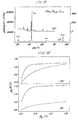
- Figure 1 is a thermopiezic curve for absorption of nitrogen gas by Y₂Fe₁₇ showing the drop in pressure of gas in the chamber as nitrogen is taken up by the sample. The pressure values on cooling demonstrate that the nitrogen remains absorbed by the Y₂Fe₁₇ sample;
- Figure 2 shows the isothermal reaction of nitrogen with Y₂Fe₁₇ powder, having an average grain size of approximately 2 microns diameter at 400oC, 450oC and 500oC, the value y being the number of moles of nitrogen atoms incorporated into a mole of the sample. The data indicate that the optimum temperature range for the operations of the process of the invention is between about 450oC and 600oC;
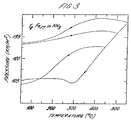
- Figure 3 is a thermopiezic curve for absorption of ammonia gas by Y₂Fe₁₇ at an atmosphere of approximately 1 bar. The curves of heating demonstrate an increase in pressure due to uptake of nitrogen from the ammonia. There is an increase in weight after heating the sample to 550oC which is attributed to nitrogen absorption.
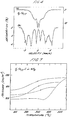
- Figure 4 shows ⁵⁷Fe Mössbauer spectra at room temperature of Y₂Fe₁₇ before (a) and after (b) heating to 500oC in 1 bar ammonia. The changes in Curie temperature and magnetic moment are reflected in the ⁵⁷Fe Mossbauer spectra in which the average hyperfine field at 20oC, <Bhf> increases from 10 Tesla for Y₂Fe₁₇ to 30 Tesla for Y₂Fe₁₇N2.6;
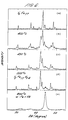
- Figure 5 shows the X-ray diffraction patterns of Y₂Fe₁₇ powder heated in a thermopiezic analyser in nitrogen at 10oC/minute up to the temperatures of 500oC, 550oC, 600oC, 700oC and 850oC. Powders of the formula R₂Fe₁₇ where R is another rare earth element behave similarly.
- The figure shows the appearance of a phase with expanded lattice parameters which co-exists with the unexpanded phase after treatment up to 550oC. The Y₂Fe₁₇N2.6 phase forms clearly at 600oC and on heating up to 700oC or above the alloy decomposes to YN and αFe;
- Figure 6 shows X-ray diffraction patterns of Y₂Fe₁₇ powder after heating in nitrogen gas isothermally at 500oC for two hours. The extended heat treatment produces the Y₂Fe₁₇N2.6 compound at a lower temperature than shown in the previous figure but further heat treatment to 850oC results in decomposition to YN and αFe.
- Figure 7 is a thermopiezic curve for Y₂Fe₁₇C1.0 heated from room temperature in an atmosphere of approximately 1 bar ammonia. Again an increase in pressure at about 370oC is observed;
- Figure 8 shows the dependence of the Curie temperature (a) Tc(oC) and the unit cell volume of the lattice (b) V(ų) on the maximum heating temperature Tm for Y₂Fe₁₇C. For the sample treated at 450oC and 500oC there co-exist two R₂Fe₁₇-type phases one with the larger unit cell volume and higher Curie temperature and the other with the smaller unit cell volume and lower Curie temperature. The more the crystal lattice is expanded the higher the Curie temperature. There is also a substantial increase in spontaneous magnetic moment (µoMs) to 1.46 Tesla (see Table 2);
- Figure 9 shows Mossbauer spectra at room temperature of Y₂Fe₁₇C1.0 before (a) and after (b) heating in 1 bar ammonia at 550oC. The average hyperfine field at 18oC <Bhf> increases from 25.3 Tesla to 30.8 Tesla after the ammonia treatment;
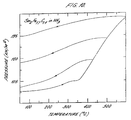
- Figure 10 is a thermopiezic curve for Sm₂Fe₁₇C1.1 heated from room temperature in an atmosphere of approximately 1 bar ammonia. Again an increase in pressure is shown at about 350oC. Analysis of the sample after heating to 600oC reveals that the material retains the rhombohedral (Th₂Zn₁₇-type) structure with increased lattice parameters. From the increase in mass the nitrogen content is estimated to be 1.1 nitrogen atoms per Sm₂Fe₁₇C1.1 formula unit;
- Figure 11 is an X-ray diffraction pattern of Sm₂Fe₁₇C1.1N1.1 powder before (a) and after (b) orientation in an applied field of 1.2 Tesla for one hour. The figure demonstrates the strong uniaxial anisotropy possessed in particular where R is samarium;
- Figure 12 shows magnetization curves at 18oC of oriented samples of Sm₂Fe₁₇C1.1 before (a) and after (b) treatment in 1 bar ammonia up to 600oC. Curves are shown for the field applied parallel (∥) and perpendicular (⊥) to the axis of orientation. From these magnetization curves the values for µoMs shown in Table 2 and Ba shown in Table 3 are obtained;
- Figure 13 shows the X-ray diffraction patterns of a) Sm₂Fe₁₇ powder with an average particle size of 1µm and b) the same powder heated at 500oC in nitrogen gas for two hours to form Sm₂Fe₁₇N2.4;
- Figures 14a and b show the radial distribution functions deduced from extended X-ray absorption fine structure data on the same samples as Figure 13. The peak appearing at 2.5 Å shows the presence of approximately three nitrogen atoms at a distance 2.5 A from a samarium atom in the nitride;
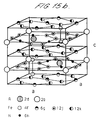
- Figures 15a and b show the crystal structure of the rhombohedral and hexagonal 2:17 structure, indicating the sites occupied by nitrogen; Figure 15a is the rhombohedral crystal structure and Figure 15b is the hexagonal crystal structure. Large circles represent rare earths, small shaded circles represent iron and small black circles represent
nitrogen sites - Figure 16 is a histogram of the particle size distribution of a typical Sm₂Fe₁₇ powder used for nitrogen absorption;
- Figure 17 shows the variation of the diffusion coefficient for nitrogen in the Sm₂Fe₁₇ powder as a function of inverse temperature.
- Figure 18 shows magnetization curves at 18°C for an oriented sample of Sm₂Fe₁₇N2.3 after treatment with ammonia. Again curves are shown for the field applied parallel (∥) and perpendicular (⊥) to the axis of orientation. From these the values of the anisotropy field Ba are obtained as shown in Table 3. The value of Ba for Sm₂Fe₁₇N2.3 is given as >12.0 Tesla but in fact the curves shown in the figure indicate it may be as high as 20 Tesla;
- Figure 19(a) is a thermopiezic curve for a powder made from a cast ingot of Sm₂Fe₁₇ heated in nitrogen. Figure 19(b) is a thermopiezic curve for a powder made from an ingot and annealed for 100 hours at 950oC and heated in nitrogen. The differences in the two sets of curves clearly demonstrate that the treatment temperature required to form the R₂Fe₁₇Nb phase varies depending on the metallurgical composition of the ingot used to make the powder;
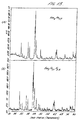
- Figure 20 shows X-ray diffraction patterns of the compounds Nd₂Fe₁₇N2.3, Sm₂Fe₁₇N2.3 and Er₂Fe₁₇N2.7 after an applied field of 1.2 Tesla. In the case of Sm₂Fe₁₇N2.3 the c-axis is aligned parallel to the applied field indicating strong uniaxial anisotropy. However in the case where R is Nd or Er there is a tendency for the c-axis to be aligned perpendicular to the direction of the applied magnetic field;
- Figure 21 shows the crystal structure of the tetragonal 1:12 compound showing sites occupied by nitrogen. The coding of the circles is as described for Figures 15a and 15b;
- Figure 22 shows a thermopiezic trace for absorption of nitrogen gas by Sm(Fe₁₁Ti). The material was heated at a rate of 10oC/minute at approximately 1 bar nitrogen. The figure demonstrates that the optimum temperature range for operation of the process is similar to that of the R₂Fe₁₇ compounds;
- Figure 23 shows room temperature ⁵⁷ Mössbauer spectra of Sm(Fe₁₁Ti) before (a) and after (b) heating in a nitrogen containing gas in accordance with the invention. The average hypefine field increases from 25.5 Tesla in (a) to 29.1 Tesla in (b), reflecting the changes in Curie temperature and iron magnetic moment.
- Figure 24 shows X-ray diffraction patterns of powders of Sm(Fe₁₁Ti) (a) and Sm(Fe₁₁Ti)N0.8 (b) oriented in a magnetic field of 1.2 Tesla. The strong uniaxial anisotropy of Sm(Fe₁₁Ti) is transformed to easy-plane anisotropy in the interstitial nitride SmFe₁₁TiN0.8 demonstrating a change in sign of the second-order crystal field coefficient A₂₀ from negative to positive. Hence the strong uniaxial anisotropy observed for interstitially-modified 1:12 structure compounds of rare-earths with a negative Stevens coefficient αJ(Nd,Er,Tm), neodymium in particular;
- Figure 25 is an illustration of interstitial nitrogen atoms around the rare earth in the rhombohedral or hexagonal 2.17 structure (a) and in the tetragonal 1.12 structure (b). The electric field gradient experienced by the rare-earth, quantified in the parameter A₂₀, is mainly produced by surrounding interstitial atoms in the materials of the invention. It is negative for the configuration of the 2.17 compounds and positive for configuration of the 1.12 compounds;
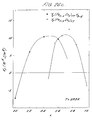
- Figure 26 illustrates some of the effects of cobalt substitution for iron in materials of the invention having the rhombohedral or hexagonal crystal structure.
- Figure 26(a) indicates the nitrogen content achieved by treating finely-ground powders of the R₂(Fe17-cCoc)Nb type formula where c is the number of cobalt atoms in nitrogen gas at temperatures ranging from 400-600oC.
- Figure 26(b) illustrates a broad maximum in magnetization with a transition metal substitute where R is Y and c=0.2.
- Figure 26(c) shows that the transition metal substituents make a positive contribution to the anisotropy when c is >0.1;
- Figure 27 is an illustration of the development of hysteresis in a powder of Sm₂Fe₁₇N2.3 comprising first and second quadrant demagnetizing curves of samples aligned and magnetized in a pulsed field of 8 Tesla. The data represented are as follows:
- a) Powder of Sm₂Fe₁₇N2.3 dispersed in epoxy resin
- b) Powder of Sm₂Fe₁₇N2.3 milled with Zn powder (25 wt %)
- c) Powder of Sm₂Fe₁₇N2.3 milled with Zn powder (15 wt %) and heat treated at 400oC for two hours.
- Figure 27 indicates the magnetic properties of permanent magnets produced from the magnetic materials of the invention and methods by which the coercivity and hysteresis may be developed. For example in 21(c) the material is milled with 15 wt % Zn and heated to 400oC to produce a magnet having a coercivity of 0.5 Tesla and a maximum energy product of
86KJm⁻ ³. - The data shown in Figure 27 establishes conclusively that Sm₂Fe₁₇N2.3 and the related compounds of the invention can be effectively processed to make magnets.
- Further, thin films of materials of the invention may be exploited for magnetic or magneto-optic recording.
Claims (28)
- A process for modifying the magnetic properties of an intermetallic compound comprising at least one or more rare earth elements and the element iron to produce a magnetic material of the general formula:-
RxFeyX'aZb
which has a Curie temperature in excess of 400°C and which is an intermetallic compound of rhombohedral or hexagonal crystal structure analogous to Th₂Zn₁₇ and Th₂Ni₁₇ respectively wherein R is one or more rare earth elements, X' is an element of groups IIIA, IIIB, IVA or IVB of the periodic table of elements, Z is one or more elements of group VA of the periodic table of elements and is interstitially incorporated into the crystal lattice of said intermetallic compound, x is a value from 0.5 to 2, y is a value from 9 to 19, a is a value from 0 to 3, b is a value from 0.3 to 3 and Fe is unsubstituted or up to 33% substituted by a transition metal with the proviso that the element X' is not boron when the component Z is antimony or bismuth; which process comprises heating said intermetallic compound in a gas containing Z in the substantial absence of oxygen to incorporate Z interstitially into the crystal lattice of the intermetallic compound by a gas-solid reaction. - A process for modifying the magnetic properties of an intermetallic compound comprising at least one or more rare earth elements and the element iron to produce a magnetic material of the general formula:-
RxFeyZb
which has a Curie temperature in excess of 400°C and which is an intermetallic compound of tetragonal crystal structure analogous to ThMn₁₂ wherein R is one or more rare earth elements, Z is one or more elements of group VA of the periodic table of elements and is interstititally incorporated into the crystal lattice of said intermetallic compound, x is a value from 0.5 to 2, y is a value from 9 to 19, b is a value from 0.3 to 3 and Fe is partially substituted by an element of group IIIA or IVA of the periodic table or a transition metal from another group wherein the level of substitution of Fe with any transition metal is up to 33%; which process comprises heating, said intermetallic compound in a gas containing Z in the substantial absence of oxygen to incorporate Z interstitially into the crystal lattice of the intermetallic compound by a gas solid reaction. - A process as claimed in claim 1 or claim 2 wherein the gas is one which produces radicals containing single atoms of the group VA element Z on contact with hot surfaces such as metal or quartz or by exposure to high frequency radiation.
- A process as claimed in claim 3 wherein the gas is a gaseous hydride of the group VA element Z.
- A process as claimed in claim 3 wherein the group VA element Z is nitrogen and the gas is nitrogen, ammonia or hydrazine.
- A process as claimed in any one of claims 1 to 5 wherein said intermetallic compound is heated to a temperature not exceeding 650°C.
- A process as claimed in any one of claims 1 to 6 wherein said intermetallic compound is ground to a particle size of 1 to 50 µm diameter.
- A process as claimed in claim 7 wherein the said ground compound is heated for up to 8 hours.
- A process as claimed in any preceding claim wherein R is samarium or neodynium.
- A process as claimed in any one of claims 1 and 3 to 8 wherein R is samarium.
- A process as claimed in any one of claims 1 and 3 to 8 wherein R is samarium in combination with one or more rare earth elements selected from yttrium, lanthanum, cerium, neodymium, erbium, thulium and mischmetal.
- A process as claimed in any one of claims 1 and 3 to 8 wherein R is yttrium, lanthanum, cerium, praseodymium, neodymium, gadolinium, terbium, dysprosium, erbium, thulium, ytterbium or lutetium or a mixture of two or more thereof.
- A process as claimed in any one of claims 2 to 8 wherein R is yttrium, thorium, cerium, praseodymium, neodymium, terbium, dysprosium or holmium or a mixture of two or more thereof.
- A process as claimed in claim 1 or any of claims 3 to 12 wherein the transition metal is cobalt.
- A process as claimed in any one of claims 2 to 8 and 13 wherein the element Fe is partially substituted by titanium, vanadium, molydenum or chromium.
- A process as claimed in any one of claims 2 to 8 and 13 wherein the element Fe is partially substituted by aluminium or silicon.
- A process as claimed in any of claims 1 and 3 to 12 wherein X' is carbon, boron, silicon or zirconium and a is a value from 0.1 to 3.
- A process as claimed in claim 16 wherein a+b ≦ 3.
- A process as claimed in any preceding claim wherein Z is nitrogen.
- A process as claimed in any one of claims 1 to 18 wherein Z is a combination of nitrogen with one or more other group VA elements.
- A process as claimed in any one of claims 1 to 18 wherein Z is one or more of P, As, Sb and Bi.
- Use of the magnetic material made by the process as claimed in any preceding claim for fabricating a permanent magnet.
- A method of fabricating a permanent magnet from a magnetic material made by the process of any of claims 1 to 21 comprising the steps of:a) milling said magnetic material with a metal such as aluminium, copper or zinc or an organic powder or resinb) generating magnetic alignment in the said material by applying a magnetic field andc) heating the milled product to a temperature sufficiently low to prevent decomposition of the magnetic material.
- A method as claimed in claim 23 wherein in the magnet fabricating process the magnetic material is milled with from 5 to 20 wt % zinc.
- A permanent magnet comprising a magnetic material which is produced by the process as claimed in any one of claims 1 to 21.
Applications Claiming Priority (6)
| Application Number | Priority Date | Filing Date | Title |
|---|---|---|---|
| IE135990 | 1990-04-18 | ||
| IE320190 | 1990-09-04 | ||
| IE320190 | 1990-09-04 | ||
| IE67191 | 1991-02-28 | ||
| IE67191 | 1991-02-28 | ||
| IE135990A IE76721B1 (en) | 1990-09-04 | 1991-04-18 | Rare-earth based magnetic materials production process and use |
Publications (3)
| Publication Number | Publication Date |
|---|---|
| EP0453270A2 EP0453270A2 (en) | 1991-10-23 |
| EP0453270A3 EP0453270A3 (en) | 1991-11-27 |
| EP0453270B1 true EP0453270B1 (en) | 1996-04-10 |
Family
ID=27270319
Family Applications (1)
| Application Number | Title | Priority Date | Filing Date |
|---|---|---|---|
| EP91303442A Expired - Lifetime EP0453270B1 (en) | 1990-04-18 | 1991-04-17 | Rare-earth based magnetic materials, production process and use |
Country Status (7)
| Country | Link |
|---|---|
| EP (1) | EP0453270B1 (en) |
| JP (1) | JPH06349612A (en) |
| AT (1) | ATE136680T1 (en) |
| CA (1) | CA2040686A1 (en) |
| DE (1) | DE69118577T2 (en) |
| IE (1) | IE76721B1 (en) |
| PT (1) | PT97411A (en) |
Families Citing this family (14)
| Publication number | Priority date | Publication date | Assignee | Title |
|---|---|---|---|---|
| EP0532701A4 (en) * | 1990-06-08 | 1993-07-14 | Sps Technologies, Inc. | Improved magnetic materials and process for producing the same |
| US5288339A (en) * | 1990-07-25 | 1994-02-22 | Siemens Aktiengesellschaft | Process for the production of magnetic material based on the Sm-Fe-N system of elements |
| DE4023575A1 (en) * | 1990-07-25 | 1992-01-30 | Siemens Ag | METHOD FOR PRODUCING MAGNETIC MATERIAL BASED ON THE SM-FE-N POWER SYSTEM |
| DE4116857A1 (en) * | 1991-05-23 | 1992-11-26 | Siemens Ag | MAGNETIC MATERIAL WITH THMN (DOWN ARROW) 1 (DOWN ARROW) (DOWN ARROW) 2 (DOWN ARROW) CRYSTAL STRUCTURE AND METHOD FOR PRODUCING THE SAME |
| DE4135122A1 (en) * | 1991-10-24 | 1993-04-29 | Vacuumschmelze Gmbh | METHOD FOR PRODUCING A N-CONTAINING PERMANENT MAGNET, LIKE SM2FE17N BY ADDING A SOLID, N-CONTAINING COMPOUND |
| GB9217760D0 (en) * | 1992-08-21 | 1992-10-07 | Martinex R & D Inc | Permanent manget material containing a rare-earth element,iron,nitrogen & carbon |
| DE4237346C1 (en) * | 1992-11-05 | 1993-12-02 | Goldschmidt Ag Th | Method for the production of rare earth alloys of the type SE¶2¶Fe¶1¶¶¶¶¶¶¶¶¶¶¶¶¶¶¶¶¶¶¶¶¶¶¶¶ |
| US5403407A (en) * | 1993-04-08 | 1995-04-04 | University Of Delaware | Permanent magnets made from iron alloys |
| JP3304726B2 (en) * | 1995-11-28 | 2002-07-22 | 住友金属鉱山株式会社 | Rare earth-iron-nitrogen magnet alloy |
| CN100437841C (en) | 2006-09-19 | 2008-11-26 | 北京大学 | Anisotropic rare earth permanent magnet material, its magnetic powder and its manufacturing method |
| US8145766B2 (en) | 2007-08-08 | 2012-03-27 | Research In Motion Limited | Method for pre-fetching data chunks of an email attachment on a portable electronic device |
| JP5055345B2 (en) * | 2009-11-30 | 2012-10-24 | 株式会社日立製作所 | Ferromagnetic compound magnet |
| JP6248689B2 (en) * | 2014-02-20 | 2017-12-20 | 日立金属株式会社 | Ferromagnetic alloy and method for producing the same |
| US10062482B2 (en) | 2015-08-25 | 2018-08-28 | GM Global Technology Operations LLC | Rapid consolidation method for preparing bulk metastable iron-rich materials |
Citations (2)
| Publication number | Priority date | Publication date | Assignee | Title |
|---|---|---|---|---|
| JPS60131949A (en) * | 1983-12-19 | 1985-07-13 | Hitachi Metals Ltd | Iron-rare earth-nitrogen permanent magnet |
| EP0470476A2 (en) * | 1990-08-09 | 1992-02-12 | Siemens Aktiengesellschaft | Method for the preparation of anisotropic magnetic material based on the Sm-Fe-N substance system |
Family Cites Families (1)
| Publication number | Priority date | Publication date | Assignee | Title |
|---|---|---|---|---|
| US4402770A (en) * | 1981-10-23 | 1983-09-06 | The United States Of America As Represented By The Secretary Of The Navy | Hard magnetic alloys of a transition metal and lanthanide |
-
1991
- 1991-04-17 DE DE69118577T patent/DE69118577T2/en not_active Expired - Fee Related
- 1991-04-17 AT AT91303442T patent/ATE136680T1/en active
- 1991-04-17 EP EP91303442A patent/EP0453270B1/en not_active Expired - Lifetime
- 1991-04-17 CA CA002040686A patent/CA2040686A1/en not_active Abandoned
- 1991-04-18 JP JP3086632A patent/JPH06349612A/en active Pending
- 1991-04-18 IE IE135990A patent/IE76721B1/en not_active IP Right Cessation
- 1991-04-18 PT PT97411A patent/PT97411A/en not_active Application Discontinuation
Patent Citations (2)
| Publication number | Priority date | Publication date | Assignee | Title |
|---|---|---|---|---|
| JPS60131949A (en) * | 1983-12-19 | 1985-07-13 | Hitachi Metals Ltd | Iron-rare earth-nitrogen permanent magnet |
| EP0470476A2 (en) * | 1990-08-09 | 1992-02-12 | Siemens Aktiengesellschaft | Method for the preparation of anisotropic magnetic material based on the Sm-Fe-N substance system |
Non-Patent Citations (3)
| Title |
|---|
| & JP-A-1 274 401 (TDK CORP.) 02-11-1989 * |
| A.F.Wells, Structural Inorganic Chemistry, 3rd. edition, page 176; * |
| Handbook of Magnetic Materials, Coey et. al., Elsevier Science Publishers B.V., 1991, pages 2-4; * |
Also Published As
| Publication number | Publication date |
|---|---|
| DE69118577D1 (en) | 1996-05-15 |
| EP0453270A2 (en) | 1991-10-23 |
| PT97411A (en) | 1992-01-31 |
| EP0453270A3 (en) | 1991-11-27 |
| CA2040686A1 (en) | 1991-10-19 |
| IE76721B1 (en) | 1997-11-05 |
| ATE136680T1 (en) | 1996-04-15 |
| IE901359A1 (en) | 1991-11-06 |
| DE69118577T2 (en) | 1996-11-14 |
| JPH06349612A (en) | 1994-12-22 |
Similar Documents
| Publication | Publication Date | Title |
|---|---|---|
| Kumar | RETM5 and RE2TM17 permanent magnets development | |
| EP0369097B1 (en) | Magnetic materials containing rare earth element iron nitrogen and hydrogen | |
| EP0453270A2 (en) | Rare-earth based magnetic materials, production process and use | |
| US5720828A (en) | Permanent magnet material containing a rare-earth element, iron, nitrogen and carbon | |
| US5800728A (en) | Permanent magnetic material made of iron-rare earth metal alloy | |
| JP2703281B2 (en) | Magnetic anisotropic material and method of manufacturing the same | |
| EP0493019B1 (en) | Process for modifying magnetic materials and magnetic materials therefrom | |
| US5478411A (en) | Magnetic materials and processes for their production | |
| US4854979A (en) | Method for the manufacture of an anisotropic magnet material on the basis of Fe, B and a rare-earth metal | |
| EP0386286A1 (en) | Rare earth iron-based permanent magnet | |
| JPH06207203A (en) | Rare earth permanent magnet manufacturing method | |
| KR102712342B1 (en) | MAGNETIC SUBSTANCES BASED ON Mn-Bi-Sb AND FABRICATION METHOD THEREOF | |
| US4954186A (en) | Rear earth-iron-boron permanent magnets containing aluminum | |
| JPH06207204A (en) | Production of rare earth permanent magnet | |
| EP1072044A1 (en) | Praseodymium-rich iron-boron-rare earth composition, permanent magnet produced therefrom, and method of making | |
| Croat et al. | Rapidly Solidified Neodymium-Iron-Boron Magnets | |
| JP2966169B2 (en) | Rare earth magnet, alloy powder for rare earth magnet and method for producing the same | |
| JP2999648B2 (en) | Rare earth magnet, rare earth magnet alloy powder and method for producing the same | |
| JPH0644526B2 (en) | Rare earth magnet manufacturing method | |
| JP3202830B2 (en) | Rare earth sintered magnet and manufacturing method thereof | |
| JPH0521219A (en) | Rare earth permanent magnet manufacturing method | |
| JP3713326B2 (en) | Permanent magnet material | |
| JPH0142338B2 (en) | ||
| JPH04346607A (en) | Production of permanent magnet powder | |
| JPH04318152A (en) | Rare earth magnetic material and its manufacture |
Legal Events
| Date | Code | Title | Description |
|---|---|---|---|
| PUAI | Public reference made under article 153(3) epc to a published international application that has entered the european phase |
Free format text: ORIGINAL CODE: 0009012 |
|
| PUAL | Search report despatched |
Free format text: ORIGINAL CODE: 0009013 |
|
| AK | Designated contracting states |
Kind code of ref document: A2 Designated state(s): AT BE CH DE DK ES FR GB GR IT LI LU NL SE |
|
| AK | Designated contracting states |
Kind code of ref document: A3 Designated state(s): AT BE CH DE DK ES FR GB GR IT LI LU NL SE |
|
| 17P | Request for examination filed |
Effective date: 19920311 |
|
| 17Q | First examination report despatched |
Effective date: 19920619 |
|
| GRAH | Despatch of communication of intention to grant a patent |
Free format text: ORIGINAL CODE: EPIDOS IGRA |
|
| GRAA | (expected) grant |
Free format text: ORIGINAL CODE: 0009210 |
|
| AK | Designated contracting states |
Kind code of ref document: B1 Designated state(s): AT BE CH DE DK ES FR GB GR IT LI LU NL SE |
|
| PG25 | Lapsed in a contracting state [announced via postgrant information from national office to epo] |
Ref country code: IT Free format text: LAPSE BECAUSE OF FAILURE TO SUBMIT A TRANSLATION OF THE DESCRIPTION OR TO PAY THE FEE WITHIN THE PRESCRIBED TIME-LIMIT;WARNING: LAPSES OF ITALIAN PATENTS WITH EFFECTIVE DATE BEFORE 2007 MAY HAVE OCCURRED AT ANY TIME BEFORE 2007. THE CORRECT EFFECTIVE DATE MAY BE DIFFERENT FROM THE ONE RECORDED. Effective date: 19960410 Ref country code: BE Effective date: 19960410 Ref country code: DK Effective date: 19960410 Ref country code: CH Free format text: LAPSE BECAUSE OF FAILURE TO SUBMIT A TRANSLATION OF THE DESCRIPTION OR TO PAY THE FEE WITHIN THE PRESCRIBED TIME-LIMIT Effective date: 19960410 Ref country code: ES Free format text: THE PATENT HAS BEEN ANNULLED BY A DECISION OF A NATIONAL AUTHORITY Effective date: 19960410 Ref country code: NL Free format text: LAPSE BECAUSE OF FAILURE TO SUBMIT A TRANSLATION OF THE DESCRIPTION OR TO PAY THE FEE WITHIN THE PRESCRIBED TIME-LIMIT Effective date: 19960410 Ref country code: AT Effective date: 19960410 Ref country code: LI Free format text: LAPSE BECAUSE OF FAILURE TO SUBMIT A TRANSLATION OF THE DESCRIPTION OR TO PAY THE FEE WITHIN THE PRESCRIBED TIME-LIMIT Effective date: 19960410 Ref country code: GR Free format text: LAPSE BECAUSE OF FAILURE TO SUBMIT A TRANSLATION OF THE DESCRIPTION OR TO PAY THE FEE WITHIN THE PRESCRIBED TIME-LIMIT Effective date: 19960410 |
|
| REF | Corresponds to: |
Ref document number: 136680 Country of ref document: AT Date of ref document: 19960415 Kind code of ref document: T |
|
| PG25 | Lapsed in a contracting state [announced via postgrant information from national office to epo] |
Ref country code: LU Free format text: LAPSE BECAUSE OF NON-PAYMENT OF DUE FEES Effective date: 19960430 |
|
| ET | Fr: translation filed | ||
| REF | Corresponds to: |
Ref document number: 69118577 Country of ref document: DE Date of ref document: 19960515 |
|
| PG25 | Lapsed in a contracting state [announced via postgrant information from national office to epo] |
Ref country code: SE Effective date: 19960710 |
|
| NLV1 | Nl: lapsed or annulled due to failure to fulfill the requirements of art. 29p and 29m of the patents act | ||
| REG | Reference to a national code |
Ref country code: CH Ref legal event code: PL |
|
| PLBE | No opposition filed within time limit |
Free format text: ORIGINAL CODE: 0009261 |
|
| STAA | Information on the status of an ep patent application or granted ep patent |
Free format text: STATUS: NO OPPOSITION FILED WITHIN TIME LIMIT |
|
| 26N | No opposition filed | ||
| PGFP | Annual fee paid to national office [announced via postgrant information from national office to epo] |
Ref country code: GB Payment date: 19980130 Year of fee payment: 8 |
|
| PGFP | Annual fee paid to national office [announced via postgrant information from national office to epo] |
Ref country code: FR Payment date: 19980210 Year of fee payment: 8 |
|
| PGFP | Annual fee paid to national office [announced via postgrant information from national office to epo] |
Ref country code: DE Payment date: 19980430 Year of fee payment: 8 |
|
| PG25 | Lapsed in a contracting state [announced via postgrant information from national office to epo] |
Ref country code: GB Free format text: LAPSE BECAUSE OF NON-PAYMENT OF DUE FEES Effective date: 19990417 |
|
| GBPC | Gb: european patent ceased through non-payment of renewal fee |
Effective date: 19990417 |
|
| PG25 | Lapsed in a contracting state [announced via postgrant information from national office to epo] |
Ref country code: FR Free format text: LAPSE BECAUSE OF NON-PAYMENT OF DUE FEES Effective date: 19991231 |
|
| REG | Reference to a national code |
Ref country code: FR Ref legal event code: ST |
|
| PG25 | Lapsed in a contracting state [announced via postgrant information from national office to epo] |
Ref country code: DE Free format text: LAPSE BECAUSE OF NON-PAYMENT OF DUE FEES Effective date: 20000201 |