EP0451001B1 - Oxydes mixtes de strontium et de lanthanide et laser utilisant des monocristaux de ces oxydes - Google Patents
Oxydes mixtes de strontium et de lanthanide et laser utilisant des monocristaux de ces oxydes Download PDFInfo
- Publication number
- EP0451001B1 EP0451001B1 EP91400665A EP91400665A EP0451001B1 EP 0451001 B1 EP0451001 B1 EP 0451001B1 EP 91400665 A EP91400665 A EP 91400665A EP 91400665 A EP91400665 A EP 91400665A EP 0451001 B1 EP0451001 B1 EP 0451001B1
- Authority
- EP
- European Patent Office
- Prior art keywords
- laser
- mixed oxide
- oxide according
- neodymium
- trivalent
- Prior art date
- Legal status (The legal status is an assumption and is not a legal conclusion. Google has not performed a legal analysis and makes no representation as to the accuracy of the status listed.)
- Expired - Lifetime
Links
- 0 CCC(C)C(C)*C(C)CN Chemical compound CCC(C)C(C)*C(C)CN 0.000 description 1
Images



Classifications
-
- C—CHEMISTRY; METALLURGY
- C30—CRYSTAL GROWTH
- C30B—SINGLE-CRYSTAL GROWTH; UNIDIRECTIONAL SOLIDIFICATION OF EUTECTIC MATERIAL OR UNIDIRECTIONAL DEMIXING OF EUTECTOID MATERIAL; REFINING BY ZONE-MELTING OF MATERIAL; PRODUCTION OF A HOMOGENEOUS POLYCRYSTALLINE MATERIAL WITH DEFINED STRUCTURE; SINGLE CRYSTALS OR HOMOGENEOUS POLYCRYSTALLINE MATERIAL WITH DEFINED STRUCTURE; AFTER-TREATMENT OF SINGLE CRYSTALS OR A HOMOGENEOUS POLYCRYSTALLINE MATERIAL WITH DEFINED STRUCTURE; APPARATUS THEREFOR
- C30B29/00—Single crystals or homogeneous polycrystalline material with defined structure characterised by the material or by their shape
- C30B29/10—Inorganic compounds or compositions
- C30B29/16—Oxides
- C30B29/22—Complex oxides
-
- C—CHEMISTRY; METALLURGY
- C30—CRYSTAL GROWTH
- C30B—SINGLE-CRYSTAL GROWTH; UNIDIRECTIONAL SOLIDIFICATION OF EUTECTIC MATERIAL OR UNIDIRECTIONAL DEMIXING OF EUTECTOID MATERIAL; REFINING BY ZONE-MELTING OF MATERIAL; PRODUCTION OF A HOMOGENEOUS POLYCRYSTALLINE MATERIAL WITH DEFINED STRUCTURE; SINGLE CRYSTALS OR HOMOGENEOUS POLYCRYSTALLINE MATERIAL WITH DEFINED STRUCTURE; AFTER-TREATMENT OF SINGLE CRYSTALS OR A HOMOGENEOUS POLYCRYSTALLINE MATERIAL WITH DEFINED STRUCTURE; APPARATUS THEREFOR
- C30B11/00—Single-crystal growth by normal freezing or freezing under temperature gradient, e.g. Bridgman-Stockbarger method
-
- C—CHEMISTRY; METALLURGY
- C30—CRYSTAL GROWTH
- C30B—SINGLE-CRYSTAL GROWTH; UNIDIRECTIONAL SOLIDIFICATION OF EUTECTIC MATERIAL OR UNIDIRECTIONAL DEMIXING OF EUTECTOID MATERIAL; REFINING BY ZONE-MELTING OF MATERIAL; PRODUCTION OF A HOMOGENEOUS POLYCRYSTALLINE MATERIAL WITH DEFINED STRUCTURE; SINGLE CRYSTALS OR HOMOGENEOUS POLYCRYSTALLINE MATERIAL WITH DEFINED STRUCTURE; AFTER-TREATMENT OF SINGLE CRYSTALS OR A HOMOGENEOUS POLYCRYSTALLINE MATERIAL WITH DEFINED STRUCTURE; APPARATUS THEREFOR
- C30B15/00—Single-crystal growth by pulling from a melt, e.g. Czochralski method
-
- C—CHEMISTRY; METALLURGY
- C30—CRYSTAL GROWTH
- C30B—SINGLE-CRYSTAL GROWTH; UNIDIRECTIONAL SOLIDIFICATION OF EUTECTIC MATERIAL OR UNIDIRECTIONAL DEMIXING OF EUTECTOID MATERIAL; REFINING BY ZONE-MELTING OF MATERIAL; PRODUCTION OF A HOMOGENEOUS POLYCRYSTALLINE MATERIAL WITH DEFINED STRUCTURE; SINGLE CRYSTALS OR HOMOGENEOUS POLYCRYSTALLINE MATERIAL WITH DEFINED STRUCTURE; AFTER-TREATMENT OF SINGLE CRYSTALS OR A HOMOGENEOUS POLYCRYSTALLINE MATERIAL WITH DEFINED STRUCTURE; APPARATUS THEREFOR
- C30B17/00—Single-crystal growth onto a seed which remains in the melt during growth, e.g. Nacken-Kyropoulos method
-
- H—ELECTRICITY
- H01—ELECTRIC ELEMENTS
- H01S—DEVICES USING THE PROCESS OF LIGHT AMPLIFICATION BY STIMULATED EMISSION OF RADIATION [LASER] TO AMPLIFY OR GENERATE LIGHT; DEVICES USING STIMULATED EMISSION OF ELECTROMAGNETIC RADIATION IN WAVE RANGES OTHER THAN OPTICAL
- H01S3/00—Lasers, i.e. devices using stimulated emission of electromagnetic radiation in the infrared, visible or ultraviolet wave range
- H01S3/14—Lasers, i.e. devices using stimulated emission of electromagnetic radiation in the infrared, visible or ultraviolet wave range characterised by the material used as the active medium
- H01S3/16—Solid materials
- H01S3/1688—Stoichiometric laser compounds, i.e. in which the active element forms one component of a stoichiometric formula rather than being merely a dopant
Definitions
- the present invention relates to mixed oxides of strontium and lanthanide single-phase having the crystal structure of magnetoplombite, obtained in particular in the form of single crystals.
- microlasers for integrated optics, telecommunications by optical fibers, medicine (microsurgery, skin treatment) and for the study of semiconductors as well as in the field of emitting power lasers in the infrared (1000 to 3000nm) or the visible allowing in particular to carry out treatments of materials (welds, drillings, markings, surface treatments), photochemical reactions, controlled thermonuclear fusion or the polarization of the atoms of a gas such as helium.
- These lasers emit at one or more discrete wavelengths with a certain degree of tunability.
- the mixed oxides of the invention are aluminates or gallates.
- LNA lanthanum-neodymium-magnesium aluminates
- LNA lanthanum-neodymium-magnesium aluminates
- These aluminates have been the subject of patents FR-A-2 448 134 and EP-A-0 043 776, and of the publication of D. Schearer et al., IEEE Journal of Quantum Electronics, vol. QE-22, n ° 5, 1986, p. 713-717, "LNA: a neu CW Nd laser tunable around 1.05 and 1.08" m ".
- These mixed aluminates obtained in monocrystalline form have optical properties comparable to those possessed by yttrium and aluminum garnet doped with neodymium, known under the abbreviation YAG: Nd3+, and neodymium ultraphosphate (NdP5O14); these lasers also emit in the infrared.
- YAG yttrium and aluminum garnet doped with neodymium, known under the abbreviation YAG: Nd3+, and neodymium ultraphosphate (NdP5O14); these lasers also emit in the infrared.
- the LNA has laser emission wavelengths at 1054 and 1082nm, framing that of the YAG at 1064nm.
- it has another range of emission wavelength around 1320nm, a range corresponding to the lowest attenuation by optical fibers made of silica, thus allowing the transmission by optical fibers of maximum information with a minimum loss.
- the growth of these crystals occurs naturally in the crystallographic direction a .
- the crystallographic direction c corresponding to the optical axis of the crystal is much more advantageous for the laser properties and leads to higher yields.
- the use of a crystal whose crystallographic axis c coincides with the optical axis of the laser allows better heat dissipation and therefore better cooling of the emitting bar than when using a crystal.
- the low efficiency of the laser emission of the LNA is mainly due to the self-extinction phenomenon thus limiting the amount of neodymium responsible for the laser effect, which can be introduced into the crystal without harming fluorescence.
- the neodymium can occupy 3 crystalline sites of the structure (see the article by D. Shearer above), which means that the latter has faults, interfering in particular with the propagation of heat and therefore the rise in laser power.
- the presence of several sites for neodymium promotes self-extinction.
- neodymium-doped strontium aluminate of formula SrAl12O19: Nd3+ This oxide was the subject of a publication by Kh. S. Bagdasarov et al. "Stimulated emission of Nd3+ ions in an SrAl12O19 crystal at the transitions 4F 3/2 ---> 4I 11/2 and 4F 3/2 ---> 4I 13/2 " Sov. Phys. Dokl; flight. 19; N ° 6, from December 1974, pp. 350.
- the neodymium ions in this strontium oxide can occupy several sites, thus limiting the power of laser emission.
- the crystals obtained have insufficient qualities for their use in the laser industry and in particular power lasers.
- the amount of neodymium that can be introduced into this strontium oxide is very small, which further contributes to the limitation of the laser power.
- Gadolinium-magnesium-strontium aluminates, doped with cerium, obtained in powder form and also having luminescent properties but no laser effect are disclosed in document FR-A-2 442 264.
- the subject of the invention is new mixed oxides of strontium and of lanthanide which can be used as laser emitters making it possible in particular to remedy the various drawbacks given above.
- these new oxides can be produced in the form of large single crystals, free of bubbles and defects, by the Czochralski method, having a laser emission whose yield is higher than that of the mixed neodymium aluminates mentioned above.
- these oxides can be used in the power laser industry.
- these oxides admit a greater amount of activating ions, unlike LNA or strontium oxide doped with neodymium, mentioned above, without harming the laser effect, still going in the direction of the increase in the light power emitted.
- the subject of the invention is mixed oxides of strontium and of neodymium, single-phase having a structure of the magnetoplombite type, having the formula (I): (I) Sr x Ln1 y1 Ln2 y2 Ln3 y3 M z A a B b O 19-k wherein Ln1 represents at least one trivalent element chosen from lanthanum, gadolinium and yttrium; Ln2 represents at least one trivalent element chosen from neodymium, praseodymium, erbium, holmium and thulium; Ln3 represents at least one element chosen from bivalent europium and trivalent cerium with conservation of electrical neutrality thanks to oxygen vacancies; M represents at least one bivalent metal chosen from magnesium, manganese and zinc; A represents at least one metal trivalent chosen from aluminum and gallium; B represents at least one trivalent transition metal chosen from chromium and titanium; x, y1, y2, y3, z
- the compounds of the invention can be manufactured in the form of single crystals.
- x + y1 + y2 + y3 satisfies the equation 0.5 ⁇ x + y1 + y2 + y3 ⁇ 1 .
- These mixed oxides have mechanical properties close to those of alumina.
- their crystal structure is much closer to that of magnetoplombite, thus improving their thermal properties compared to the above-mentioned known mixed lanthanide aluminates.
- x satisfies the relation 0.05 ⁇ x ⁇ 0.95 or better still the relation 0.2 ⁇ x ⁇ 0.95 and z satisfies the relation 0.05 ⁇ z ⁇ 0.8.
- These oxides have a hexagonal structure which consists of spinel blocks separated by mirror planes containing strontium and lanthanides.
- Ln1 is a lanthanide ion playing the role of diluent
- Ln2 is the lanthanide ion responsible for the laser effect, called a laser activator
- Ln3 is the lanthanide ion serving as a laser sensitizer.
- the ion B serves as a laser sensitizer.
- the laser activator ion can be introduced at very high rates into the structure, thereby increasing the laser emission power.
- y1, y2 and y3 satisfy the relations 0 ⁇ y1 ⁇ 0.9; 0.02 ⁇ y2 ⁇ 0.6 and 0 ⁇ y3 ⁇ 0.6.
- 0.05 ⁇ y2 ⁇ 0.45 is chosen or better still 0.15 ⁇ y2 ⁇ 0.25 for good laser efficiency.
- the oxides of the invention can be used as laser emitters in a wide range of wavelengths, the latter depending on the nature of the activating ion. Also, the invention also relates to a laser comprising as laser emitter an oxide as described above.
- Ln2 represents neodymium
- the corresponding mixed oxides produced in the form of single crystals, can be used as laser emitters, in particular in power lasers, emitting at 1049.8nm, 1061.8nm with a relatively narrow tunability range, around 2nm.
- these neodymium oxides have a much wider type of emission around 1074nm which extends from 1066nm to 1078nm, or over 12 nanometers, which is considerable for a solid neodymium laser.
- the emission wavelengths of a mixed neodymium oxide of the invention are different from those of LNA as well as those described in the article by Bagdasarov cited above.
- the neodymium oxides of the invention can be tuned in wave length.
- Ln2 represents holmium
- the corresponding mixed oxides in monocrystalline form, can be used as laser emitters in particular in tunable power lasers, emitting in the infrared and more particularly at lengths d wave from 1500 to 3000nm.
- the tunability allows in particular in the field of telecommunications, to convey a greater number of information simultaneously.
- Wavelengths near 3000nm have the advantage of being absorbed by water.
- the eye is no longer sensitive to the laser emission and this results in safety for the latter.
- the corresponding mixed oxides in monocrystalline form, can be used as laser emitters emitting in the visible and mainly in yellow and red, with still a certain tunability.
- the lasers using the monocrystalline oxides of the invention can be both pulsed lasers and lasers emitting continuously.
- these lasers are power lasers
- the emitted light beam has an emitted power ranging from several watts to a few hundred watts.
- the latter After having brought to the excited state, by absorption of light, one or the other of the spectral bands of the sensitizing ions, the latter transfer their energy to the activating ions thus ensuring the populating of the energy level E1.
- This energy transmission is possible because the energy difference between the ground state and the excited state of the chromium, titanium, cerium or europium ions is close to the energy difference between the ground state and the overexcited state.
- E2 neodymium or praseodymium ions, but also erbium, thulium and holmium ions.
- the laser sensitizers and activators are chosen according to the wavelength used for optical pumping and the desired emission wavelength.
- a cerium-chromium coding can be favorably considered.
- the single crystals for which y2 is weak are more particularly suitable for the production of power lasers operating continuously while the single crystals for which y2 is greater are better suited to the manufacture of power lasers operating in pulses.
- the optimum quantity of activating ions in a given crystal is equal to that which gives the maximum light intensity, while for a pulsed laser, the quantity of activating ions can be greater at this optimum amount.
- the energy transfer time from the sensitizer to the activating ions must be compatible with that of the emission of the activator. In pulsed mode, too long a transfer time can be annoying, while in continuous mode this transfer time does not matter since pumping is ensured continuously.
- chromium having a fairly long transfer time is preferably used as a sensitizer for a laser operating continuously; on the other hand, cerium or europium can be used in a laser operating in pulsed regime.
- a bivalent metal such as magnesium, manganese or zinc considerably promotes the crystallogenesis of strontium oxides and in particular allows, for the same quantity of activating ions, obtaining crystals of better quality than that obtained with oxides of strontium without divalent metal (SrAl12O19: Nd in particular). The growth of these crystals is congruent.
- this bivalent metal allows the introduction of a greater rate of activator than that of the same crystal free of this divalent metal.
- the amount of divalent metal is close to, or even equal to the amount of lanthanide.
- the presence of strontium in the oxides of the invention ensures, for the Czochralski method, crystal growth along the crystallographic axis c even in the absence of monocrystalline germ. This makes it possible to increase power and to cool the emitting bar laterally, in the crystallographic direction a , necessary to prevent the bar from becoming a thermal lens, focusing the light and thus preventing the laser effect.
- strontium and gallium of the oxides of the invention make it possible, compared to LNA, to lower the strength of the crystal field at the site of the activator and in particular of the neodymium, to increase the activator-oxygen distance and therefore to reduce the phenomenon of self-extinction. They also increase the amount of activating ions in the crystal, compared to LNA.
- composition of the oxides of the invention varies from pure aluminate to pure gallate, all the intermediate aluminum-gallate compositions being able to be envisaged.
- the mixed oxides of the invention have in particular the formula (I) in which M represents magnesium and A represents aluminum.
- the corresponding oxides then have the formula: Sr x Ln1 y1 Ln2 y2 Ln3 y3 Mg z Al a O 19-k .
- the oxides of the invention have the formula: Sr x Ln1 y1 Ln2 y2 Mg z A a O 19-k .
- the commercial powders, of high purity, of the oxides of Ln1, Ln2, Ln3, M, A, B as well as strontium carbonate are weighed in the desired proportions, mixed for several hours using a mechanical agitator then comfortable in the form of pellets which are heated at 1100 ° C for 15 hours to remove carbonates and perform a preaction.
- the pellets are then ground and then remixed and parallelepiped bars 5cm long and 1cm side are formed by compression. These are then sintered for 50 hours between 1400 and 1600 ° C until a solid solution is formed, then cut into the shape of cylinders for use in the radiation concentration oven.
- the sintering temperature is a function of the exact composition of the crystal and its choice is within the reach of those skilled in the art.
- compositions were tested for translation speeds of the bars of between 0.4 and 3.5 cm / h.
- the so-called second pass technique has also been practiced: a sintered bar is melted for the first time in a radiation concentration oven quickly (1.5 to 3.5 cm / h) to melt the powder and approach the density theoretical. The bar obtained is then melted a second time slowly at a speed of 0.4 to 1 cm / h.
- This growth method has the advantage of being clean (the crystal cannot be polluted since the molten area is not in contact with a crucible), and of being fast since a few hours, depending on the translation speed used, enough to get a crystal.
- Monocrystals of oxides in accordance with the invention were also obtained by the Czochralski growth technique.
- commercial powders of high purity, oxides Ln1, Ln2, Ln3, M, A, B and strontium carbonate weighed in the desired proportions are mixed for several hours using a mechanical stirrer and then compressed under shape of cylinders. Sintering for 15 hours at 1100 ° C and then 50 hours between 1400 ° C and 1600 ° C is carried out.
- the sintered mixture is placed in an iridium crucible and brought to the melting temperature.
- the draw is carried out under a nitrogen atmosphere from an iridium rod or a germ having the desired orientation.
- the drawing speed varies from 0.5 to 1mm per hour.
- the rotation speed varies around 30 revolutions per minute.
- the starting oxides and carbonates used are in the form of a powder having a particle size ranging from 1 to 10 micrometers and a purity greater than 99.99% in order to obtain a yield as high as possible for the laser emission.
- starting materials such as, for example, nitrates, as described in document FR-A-2 599 733, or even chlorides.
- the single crystals produced contain titanium, it is possible to carry out a final annealing in an oven at 1100 ° C. under a reducing atmosphere so that the titanium contained in the structure is in the oxidation state (III), this element commercially available in the oxidation state IV in the form of TiO2.
- any other method of crystallogenesis using a molten bath such as the Bridgmann, Kyropoulos, auto-crucible or Verneuil method can be used.
- compositions with different Sr / Ln2 ratios with Ln2 representing neodymium or praseodymium, have been developed in the form monocrystalline in a radiation concentration oven and their optical properties such as absorption and fluorescence were studied.
- Table I appended gives examples of monocrystals of aluminates and / or gallates of strontium-lanthanide-magnesium obtained in a radiation concentration oven.
- the left part of this table gives the initial mole% composition from which the sintered bars were made, the central part of the table gives the formula of the crystal obtained by zone fusion and the right part of the table gives the crystal parameters of this crystal.
- Tables II and III annexed give examples of monocrystals of strontium-lanthanide-magnesium aluminates obtained respectively by Czochralski drawing and according to the Verneuil method.
- the left part gives the composition in mole% of the starting powder from which the single crystal is obtained
- the central part gives the formula of the single crystal obtained
- the right part gives the crystalline parameters of the single crystal.
- compositions of the crystals obtained were determined by electron microprobe, with the exception of the compositions preceded by an asterisk which could not yet be determined precisely, and the crystal parameters were determined by X-ray diffraction.
- This composition is that of Example 23 and has been the subject of an in-depth study of its laser properties.
- a perfectly monocrystalline sample was isolated from crystal 23 - according to Czochralski -, by cleavage, so as to obtain two strictly parallel faces. It is in the form of a cylindrical blade 20mm in diameter and 7mm thick.
- the cylinder axis is the c axis of the hexagonal structure and corresponds to the direction known to be optimal in the case of LNA with regard to the laser effect.
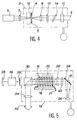
- the sample placed in a laser cavity as shown in Figure 4 is pumped longitudinally by the green line of an ionized argon laser. At the wavelength used, 514.5nm, the sample absorbs 60% of the pump radiation.
- the laser effect corresponding to the 4F 3/2 ---> 4I 11/2 transition of neodymium is easily obtained and occurs spontaneously for a wavelength of 1049.8nm.
- Figure 1 gives two curves A and B of efficiency of the laser power (P ′) emitted by the crystal of composition 23 as a function of the power of the ionized argon pump laser (P) for two transmission values of the output mirror of the laser cavity, respectively 10% and 1%. If we take into account the fraction 60% of pump radiation actually absorbed by the sample, we deduce that the efficiency of the laser emission is around 21% for a mirror transmission rate of 10 %, which is relatively high.
- the fluorescence spectrum of Figure 3 was set at 300K; it was obtained using an excitation wavelength of 577nm corresponding to the transition 4I 9/2 ---> 4G 7/2 , 4G 7/2 in absorption of the crystal.
- compound No. 23 as well as compounds 1 to 14, 17 to 22 and 24 to 27 activated with neodymium have emission wavelengths around 1.32 micrometer which can also give the laser effect.
- the fluorescence and tunability spectra of the strontium-neodymium-magnesium aluminates of the invention are very different from those of LNA and of the Bagdasarov compound.
- Figure 4 there is shown schematically a continuous power laser using a single crystal of an oxide according to the invention.
- This laser comprises a laser cavity 2 containing a bar 4 of the compound 23, arranged perpendicular to the longitudinal axis 3 of the laser, the axis c of the bar being coincident with the axis 3 of the laser.
- the corresponding laser emission is located in the infrared (see Figure 3).
- the use of compounds 1 to 14, 17 to 22 and 24 to 27 allows the same type of emission.
- a device 5 for circulating distilled water around the bar 4 ensures its cooling.
- the laser cavity 2 also consists of a converging lens 8 transforming the light emitted by the aluminate bar 4 into a parallel beam of light which is sent to an exit mirror 10.
- the light beam again crosses the converging lens 8 and the amplifying medium or bar 4.
- the amplified laser beam is then reflected by a dichroic input mirror 12 near which the bar 4 is placed; this mirror 12 is transparent to the light emitted by the monochromatic source 6 and opaque to that emitted by the aluminate single crystal 4.
- the sufficiently amplified laser beam in the cavity 2 is then sent to the outside of the laser cavity, via the mirror 10, which is partially transparent to the light emitted by the aluminate single crystal 4.
- strontium-neodymium-magnesium aluminate bar 4 by an aluminate according to the invention of strontium-praseodymium-magnesium such as compound 15 or 16, leads to a continuous power laser emitting in the visible range and in particular in yellow and red.
- an aluminate bar 4 of the invention with neodymium or praseodymium combined with cerium, europium, chromium or titanium.
- an oxide containing holmium allows the emission of a laser beam whose wavelength varies from 1.5 to 3 micrometers depending on the chosen transition.
- Wavelength tunability can be obtained using a wavelength selection system 14 interposed between the converging lens 8 and the output mirror 10 of the laser cavity 2, of the angle prism type Brewster filter or Lyot filter formed by several blades of birefringent material.
- a solid standard 13 of the blade type with parallel faces can be interposed between the converging lens 8 and the Lyot filter 14 to fix the emission wavelength.
- the oxides of the invention can also be used in monocrystalline form in a power laser operating in pulses. Such a laser is shown in FIG. 5.
- This pulsed laser comprises a cavity 15 containing a monocrystalline bar 16 of an oxide according to the invention, arranged parallel to the longitudinal axis 17 of the laser, the axis c of the crystal being coincident with the axis 17.
- This oxide is in particularly compound 3 or 1 with a high neodymium content.
- a device 21 for circulating distilled water around the bar 16 ensures its cooling.
- the laser cavity 15 also consists of a quarter-wave plate 22 transforming the linearly polarized incident light, coming from the bar 16, into circularly polarized light.
- This blade 22 is followed by a plane mirror 24 and a convex mirror 26 diverge.
- the widened, adapted and circularly polarized light beam again crosses the quarter-wave plate 22, thereby producing a vertically polarized beam which completely scans the amplifying medium or bar 16, extracting the maximum of it. luminous energy.
- the amplified laser beam propagating in the direction of another highly reflective concave mirror 28 outside the cavity 15 is interrupted by a polarizing prism 30 ejecting the vertically polarized beam 32 out of the laser cavity.
- a converging lens 34 makes it possible to obtain a parallel beam of light.
- This pulsed laser is also equipped with an electro-optical switch 36, more generally designated by the English term "Q switch", placed between the concave mirror 28 and the output polarizer 30.
- the laser cannot function.
- the polarizer 30 is transparent to the horizontally polarized photons and lets light pass to the switch 36. The latter causing the direction of 90 ° polarization prevents polarizer 30 from transmitting this light.
- a diaphragm 38 can be interposed between the switch and the polarizer to channel the laser light.
- the bar 16 based on neodymium can be replaced by a bar based on praseodymium, holmium, erbium, thulium, combined or not with cerium, europium, chromium or titanium or a neodymium-based bar combined with cerium, europium, chromium or titanium, corresponding to formula (I) above, with a view to obtaining other pulsed power lasers. It is simply necessary to adapt the coating of the mirrors 26 and 28 to the desired laser emission wavelength.
- a wavelength selection device 40 as described above must be inserted between the blade 22 and the mirror 24.
- the laser diode array 6 by an ionized gas laser (argon or krypton) or the flash lamps 18 and 20 by a laser diode or diode arrays.
- argon or krypton ionized gas laser
- the flash lamps 18 and 20 by a laser diode or diode arrays.
- this absorption spectrum is valid for all the oxides of the invention containing neodymium; only the intensity and the wavelengths of absorption can be slightly different. Also, the neodymium oxides of the invention prove to be well suited for pumping by laser diodes, especially as the wavelength of the latter can be tuned in order to be in a maximum absorption peak of the crystal.
- the absorption intensity around 800 nm of the oxides of the invention is two to three times higher than that obtained at 514 nm with an ionized argon laser or at 752 nm with an ionized krypton laser.
- the laser diodes have an excellent efficiency of around 50% and the laser conversion is around 30% to 40%, which corresponds to a laser effect efficiency of at least 20% at from the electric current.
- the laser efficiency from the electric current is only 1%.
- the laser effect was observed (for the transition 4F 3/2 -> 4J 11/2 ) along the c axis of the crystal.
- the maximum power of the laser effect obtained was 190 mW for 1 watt emitted by the diode. This results in a laser effect efficiency ⁇ of 33% and an absorbed power threshold of 200 mW for an output mirror with 2% transmission and a pump wavelength of 799 nm (at 0 ° C) .
- the monocrystals of the strontium-neodymium-magnesium oxides of the invention can be used in all applications currently using a laser emitter of the YAG type.
- these single crystals can be used for lasers intended for cutting or marking materials as well as for making welds.
- these oxides have their own applications. They are particularly suitable for pumping by laser diodes and therefore for making miniaturized devices (military applications, scientific research, medical applications). In addition, their particular emission wavelengths and the tunability of the latter can be used to advantage in optical telecommunications or for the polarization of certain atoms by optical pumping.
Landscapes
- Chemical & Material Sciences (AREA)
- Engineering & Computer Science (AREA)
- Organic Chemistry (AREA)
- Crystallography & Structural Chemistry (AREA)
- Materials Engineering (AREA)
- Metallurgy (AREA)
- Electromagnetism (AREA)
- Physics & Mathematics (AREA)
- Inorganic Chemistry (AREA)
- Plasma & Fusion (AREA)
- Optics & Photonics (AREA)
- Lasers (AREA)
- Crystals, And After-Treatments Of Crystals (AREA)
- Inorganic Compounds Of Heavy Metals (AREA)
- Compositions Of Oxide Ceramics (AREA)
- Compounds Of Iron (AREA)
Applications Claiming Priority (2)
| Application Number | Priority Date | Filing Date | Title |
|---|---|---|---|
| FR9003180 | 1990-03-13 | ||
| FR9003180A FR2659639B1 (fr) | 1990-03-13 | 1990-03-13 | Oxydes mixtes de strontium et de lanthanide et laser utilisant des monocristaux de ces oxydes. |
Publications (2)
| Publication Number | Publication Date |
|---|---|
| EP0451001A1 EP0451001A1 (fr) | 1991-10-09 |
| EP0451001B1 true EP0451001B1 (fr) | 1994-09-21 |
Family
ID=9394664
Family Applications (1)
| Application Number | Title | Priority Date | Filing Date |
|---|---|---|---|
| EP91400665A Expired - Lifetime EP0451001B1 (fr) | 1990-03-13 | 1991-03-11 | Oxydes mixtes de strontium et de lanthanide et laser utilisant des monocristaux de ces oxydes |
Country Status (7)
| Country | Link |
|---|---|
| US (1) | US5140604A (es) |
| EP (1) | EP0451001B1 (es) |
| JP (1) | JPH04219316A (es) |
| AT (1) | ATE111976T1 (es) |
| DE (1) | DE69104100T2 (es) |
| ES (1) | ES2064930T3 (es) |
| FR (1) | FR2659639B1 (es) |
Families Citing this family (38)
| Publication number | Priority date | Publication date | Assignee | Title |
|---|---|---|---|---|
| US5295146A (en) * | 1992-04-10 | 1994-03-15 | Polaroid Corporation | Solid state gain mediums for optically pumped monolithic laser |
| US5488619A (en) * | 1994-10-06 | 1996-01-30 | Trw Inc. | Ultracompact Q-switched microlasers and related method |
| US5541948A (en) * | 1994-11-28 | 1996-07-30 | The Regents Of The University Of California | Transition-metal doped sulfide, selenide, and telluride laser crystal and lasers |
| US5571451A (en) * | 1995-01-03 | 1996-11-05 | General Electric Company | Quantum splitting oxide phosphor and method of making |
| DE69517496T2 (de) * | 1995-01-03 | 2001-03-01 | General Electric Co., Schenectady | Quantum-Teilungs-Oxidphosphoren und Verfahren zur Herstellung desselben |
| US5788883A (en) * | 1996-03-29 | 1998-08-04 | General Electric Company | Determination process for determining if quantum splitting phosphors are obtained and novel compositions |
| US5977162A (en) * | 1996-09-16 | 1999-11-02 | Seidman; Michael D. | Therapeutic treatment for auditory function |
| EP1333548A3 (en) * | 2002-02-01 | 2005-03-16 | Nec Tokin Corporation | Laser oscillation method and laser device |
| US6982045B2 (en) * | 2003-05-17 | 2006-01-03 | Phosphortech Corporation | Light emitting device having silicate fluorescent phosphor |
| US7112921B2 (en) * | 2003-08-02 | 2006-09-26 | Phosphortech Inc. | Light emitting device having selenium-based fluorescent phosphor |
| US6987353B2 (en) * | 2003-08-02 | 2006-01-17 | Phosphortech Corporation | Light emitting device having sulfoselenide fluorescent phosphor |
| US7109648B2 (en) * | 2003-08-02 | 2006-09-19 | Phosphortech Inc. | Light emitting device having thio-selenide fluorescent phosphor |
| US20060133826A1 (en) * | 2004-12-22 | 2006-06-22 | Cisco Technology, Inc. | Adaptive receiver for APD based modules |
| US20060221022A1 (en) * | 2005-04-01 | 2006-10-05 | Roger Hajjar | Laser vector scanner systems with display screens having optical fluorescent materials |
| US7733310B2 (en) | 2005-04-01 | 2010-06-08 | Prysm, Inc. | Display screens having optical fluorescent materials |
| US7474286B2 (en) | 2005-04-01 | 2009-01-06 | Spudnik, Inc. | Laser displays using UV-excitable phosphors emitting visible colored light |
| US7791561B2 (en) * | 2005-04-01 | 2010-09-07 | Prysm, Inc. | Display systems having screens with optical fluorescent materials |
| US7994702B2 (en) | 2005-04-27 | 2011-08-09 | Prysm, Inc. | Scanning beams displays based on light-emitting screens having phosphors |
| US8000005B2 (en) | 2006-03-31 | 2011-08-16 | Prysm, Inc. | Multilayered fluorescent screens for scanning beam display systems |
| US8089425B2 (en) | 2006-03-03 | 2012-01-03 | Prysm, Inc. | Optical designs for scanning beam display systems using fluorescent screens |
| US7435358B2 (en) * | 2005-06-07 | 2008-10-14 | Osram Sylvania Inc. | UVC-emitting Sr(Al,Mg)12O19:Pr phosphor and lamp containing same |
| US8451195B2 (en) | 2006-02-15 | 2013-05-28 | Prysm, Inc. | Servo-assisted scanning beam display systems using fluorescent screens |
| US7884816B2 (en) | 2006-02-15 | 2011-02-08 | Prysm, Inc. | Correcting pyramidal error of polygon scanner in scanning beam display systems |
| US7449129B2 (en) * | 2006-03-07 | 2008-11-11 | Osram Sylvania Inc. | Ce,Pr-coactivated strontium magnesium aluminate phosphor and lamp containing same |
| US7419621B2 (en) * | 2006-03-07 | 2008-09-02 | Osram Sylvania Inc. | UV-emitting phosphor and lamp containing same |
| CN101460880B (zh) | 2006-05-05 | 2012-05-23 | Prysm公司 | 用于显示系统和装置的磷光体组合物和其它荧光材料 |
| US20080068295A1 (en) * | 2006-09-19 | 2008-03-20 | Hajjar Roger A | Compensation for Spatial Variation in Displayed Image in Scanning Beam Display Systems Using Light-Emitting Screens |
| US8013506B2 (en) | 2006-12-12 | 2011-09-06 | Prysm, Inc. | Organic compounds for adjusting phosphor chromaticity |
| US9525850B2 (en) * | 2007-03-20 | 2016-12-20 | Prysm, Inc. | Delivering and displaying advertisement or other application data to display systems |
| US8169454B1 (en) | 2007-04-06 | 2012-05-01 | Prysm, Inc. | Patterning a surface using pre-objective and post-objective raster scanning systems |
| US7697183B2 (en) | 2007-04-06 | 2010-04-13 | Prysm, Inc. | Post-objective scanning beam systems |
| CN101688979B (zh) | 2007-05-17 | 2011-02-09 | Prysm公司 | 用于扫描光束显示系统的具有发光带的多层屏幕 |
| US7878657B2 (en) | 2007-06-27 | 2011-02-01 | Prysm, Inc. | Servo feedback control based on invisible scanning servo beam in scanning beam display systems with light-emitting screens |
| US8556430B2 (en) | 2007-06-27 | 2013-10-15 | Prysm, Inc. | Servo feedback control based on designated scanning servo beam in scanning beam display systems with light-emitting screens |
| US7869112B2 (en) * | 2008-07-25 | 2011-01-11 | Prysm, Inc. | Beam scanning based on two-dimensional polygon scanner for display and other applications |
| RU2749153C1 (ru) * | 2020-11-02 | 2021-06-07 | Акционерное общество "Научно-исследовательский институт "Полюс" им. М.Ф. Стельмаха" | Способ создания композитного лазерного элемента на основе оксидных кристаллов |
| CN115746842B (zh) * | 2022-11-01 | 2023-10-03 | 五邑大学 | 一种荧光粉及其制备方法和应用 |
| CN118326512A (zh) * | 2024-04-15 | 2024-07-12 | 江苏师范大学 | 一种掺稀土离子的铝酸镁镧锶激光单晶光纤及其制备方法 |
Family Cites Families (4)
| Publication number | Priority date | Publication date | Assignee | Title |
|---|---|---|---|---|
| FR2486519A1 (fr) * | 1980-07-08 | 1982-01-15 | Centre Nat Rech Scient | Oxydes mixtes d'aluminium, leur procede de fabrication et leur application |
| FR2588848B1 (fr) * | 1985-10-21 | 1987-11-20 | Commissariat Energie Atomique | Aluminates mixtes de lanthane-magnesium, leur procede de fabrication et lasers utilisant ces aluminates |
| FR2599733B1 (fr) * | 1986-06-10 | 1988-08-26 | Centre Nat Rech Scient | Gallates mixtes de lanthanide-magnesium, laser utilisant des monocristaux de ces gallates |
| FR2600055B1 (fr) * | 1986-06-16 | 1988-08-26 | Commissariat Energie Atomique | Aluminates mixtes de lanthanide-magnesium, lasers utilisant des monocristaux de ces aluminates |
-
1990
- 1990-03-13 FR FR9003180A patent/FR2659639B1/fr not_active Expired - Lifetime
-
1991
- 1991-03-11 DE DE69104100T patent/DE69104100T2/de not_active Expired - Fee Related
- 1991-03-11 EP EP91400665A patent/EP0451001B1/fr not_active Expired - Lifetime
- 1991-03-11 AT AT91400665T patent/ATE111976T1/de active
- 1991-03-11 ES ES91400665T patent/ES2064930T3/es not_active Expired - Lifetime
- 1991-03-13 JP JP3072113A patent/JPH04219316A/ja active Pending
- 1991-03-13 US US07/668,874 patent/US5140604A/en not_active Expired - Fee Related
Also Published As
| Publication number | Publication date |
|---|---|
| ES2064930T3 (es) | 1995-02-01 |
| FR2659639A1 (fr) | 1991-09-20 |
| EP0451001A1 (fr) | 1991-10-09 |
| JPH04219316A (ja) | 1992-08-10 |
| DE69104100T2 (de) | 1995-05-11 |
| US5140604A (en) | 1992-08-18 |
| DE69104100D1 (de) | 1994-10-27 |
| ATE111976T1 (de) | 1994-10-15 |
| FR2659639B1 (fr) | 1992-06-12 |
Similar Documents
| Publication | Publication Date | Title |
|---|---|---|
| EP0451001B1 (fr) | Oxydes mixtes de strontium et de lanthanide et laser utilisant des monocristaux de ces oxydes | |
| EP0250305B1 (fr) | Aluminates mixtes de lanthanide-magnésium, lasers utilisant des monocristaux de ces aluminates | |
| Rameix et al. | An efficient, diode-pumped, 2 μm Tm: YAG waveguide laser | |
| CN1589513A (zh) | 中红外微芯片激光器:带有可饱和吸收材料的ZnS:Cr2+激光器 | |
| EP0483003B1 (fr) | Emetteur laser constitué d'un silicate mixte d'yttrium et de lanthanide | |
| EP0252784B1 (fr) | Gallates mixtes de lanthanide-magnésium, laser utilisant des monocristaux de ces gallates | |
| FR2826519A1 (fr) | Commutateur de facteur de qualite a absorbeur saturable dope au cobalt et systeme laser | |
| EP0756719A1 (fr) | Cristaux non lineaires et leurs applications | |
| FR2773000A1 (fr) | Cavite laser a declenchement passif a polarisation controlee, microlaser comprenant cette cavite, et procede de fabrication de ce microlaser | |
| EP0227499B1 (fr) | Aluminates mixtes de lanthane-magnesium, leur procédé de fabrication et lasers utilisant ces aluminates | |
| Jaque et al. | Influence of neodymium concentration on the cw laser properties of Nd doped Ca 3 Ga 2 Ge 3 O 12 laser garnet crystal | |
| FR2771107A1 (fr) | Procede de preparation par croissance par epitaxie en phase liquide de couches monocristallines d'aluminate de lanthane et de magnesium (lma) et composants optiques comprenant ces couches | |
| EP3850715B1 (fr) | Cristal laser avec au moins deux co-dopants | |
| Zhao et al. | The passive Q-switching Tm, Ho co-doped GAGG state laser operating near 2.1 μm | |
| EP0274298B1 (fr) | Aluminates mixtes de lanthane-magnésium, lasers utilisant des monocristaux de ces aluminates | |
| EP0898800A1 (en) | ROOM TEMPERATURE STABLE COLOR CENTER LASER, LiF:F 2??+ ** MATERIAL, AND METHOD OF LASING | |
| Higuchi et al. | Float zone growth of Nd: GdVO4 single crystals along [1 1 0] direction and their laser performance | |
| EP0547212A1 (fr) | Cristal de gehlenite dopee au neodyme et laser utilisant ce cristal | |
| US20070045597A1 (en) | Cr3+-doped laser materials and lasers and methods of making and using | |
| JP2882351B2 (ja) | 固体レーザ用結晶とその製造方法およびレーザ装置 | |
| Zavartsev et al. | Lasing in a Tm: Ho: Yb3Al5O12 crystal pumped into the 3H6–3F4 transition | |
| Baillard et al. | Deep-red Eu: KY (WO $ _4 $) $ _2 $ planar waveguide laser at 705 nm | |
| RU2106050C1 (ru) | Лазерное вещество | |
| RU2231187C2 (ru) | Лазерный материал | |
| Alpat'ev et al. | Influence of the spectral composition of the exciting radiation on the lasing and spectral luminescence properties of YSGG: Cr3+: Tm3+: Ho3+ and GSAG: Cr3+: Tm3+: Ho3+ crystals |
Legal Events
| Date | Code | Title | Description |
|---|---|---|---|
| PUAI | Public reference made under article 153(3) epc to a published international application that has entered the european phase |
Free format text: ORIGINAL CODE: 0009012 |
|
| AK | Designated contracting states |
Kind code of ref document: A1 Designated state(s): AT BE CH DE DK ES FR GB GR IT LI LU NL SE |
|
| 17P | Request for examination filed |
Effective date: 19920311 |
|
| 17Q | First examination report despatched |
Effective date: 19931203 |
|
| GRAA | (expected) grant |
Free format text: ORIGINAL CODE: 0009210 |
|
| AK | Designated contracting states |
Kind code of ref document: B1 Designated state(s): AT BE CH DE DK ES FR GB GR IT LI LU NL SE |
|
| PG25 | Lapsed in a contracting state [announced via postgrant information from national office to epo] |
Ref country code: GR Free format text: LAPSE BECAUSE OF FAILURE TO SUBMIT A TRANSLATION OF THE DESCRIPTION OR TO PAY THE FEE WITHIN THE PRESCRIBED TIME-LIMIT Effective date: 19940921 Ref country code: DK Effective date: 19940921 |
|
| REF | Corresponds to: |
Ref document number: 111976 Country of ref document: AT Date of ref document: 19941015 Kind code of ref document: T |
|
| REF | Corresponds to: |
Ref document number: 69104100 Country of ref document: DE Date of ref document: 19941027 |
|
| RAP2 | Party data changed (patent owner data changed or rights of a patent transferred) |
Owner name: CRISMATEC |
|
| ITF | It: translation for a ep patent filed | ||
| PG25 | Lapsed in a contracting state [announced via postgrant information from national office to epo] |
Ref country code: SE Effective date: 19941221 |
|
| GBT | Gb: translation of ep patent filed (gb section 77(6)(a)/1977) |
Effective date: 19941208 |
|
| REG | Reference to a national code |
Ref country code: ES Ref legal event code: FG2A Ref document number: 2064930 Country of ref document: ES Kind code of ref document: T3 |
|
| PG25 | Lapsed in a contracting state [announced via postgrant information from national office to epo] |
Ref country code: LU Free format text: LAPSE BECAUSE OF NON-PAYMENT OF DUE FEES Effective date: 19950331 Ref country code: BE Effective date: 19950331 |
|
| PLBE | No opposition filed within time limit |
Free format text: ORIGINAL CODE: 0009261 |
|
| STAA | Information on the status of an ep patent application or granted ep patent |
Free format text: STATUS: NO OPPOSITION FILED WITHIN TIME LIMIT |
|
| 26N | No opposition filed | ||
| BERE | Be: lapsed |
Owner name: QUARTZ ET SILICE Effective date: 19950331 |
|
| PGFP | Annual fee paid to national office [announced via postgrant information from national office to epo] |
Ref country code: GB Payment date: 20000309 Year of fee payment: 10 |
|
| PGFP | Annual fee paid to national office [announced via postgrant information from national office to epo] |
Ref country code: AT Payment date: 20000310 Year of fee payment: 10 |
|
| PGFP | Annual fee paid to national office [announced via postgrant information from national office to epo] |
Ref country code: ES Payment date: 20000316 Year of fee payment: 10 |
|
| PGFP | Annual fee paid to national office [announced via postgrant information from national office to epo] |
Ref country code: FR Payment date: 20000321 Year of fee payment: 10 |
|
| PGFP | Annual fee paid to national office [announced via postgrant information from national office to epo] |
Ref country code: NL Payment date: 20000331 Year of fee payment: 10 |
|
| PGFP | Annual fee paid to national office [announced via postgrant information from national office to epo] |
Ref country code: DE Payment date: 20000406 Year of fee payment: 10 |
|
| PGFP | Annual fee paid to national office [announced via postgrant information from national office to epo] |
Ref country code: CH Payment date: 20000608 Year of fee payment: 10 |
|
| PG25 | Lapsed in a contracting state [announced via postgrant information from national office to epo] |
Ref country code: GB Free format text: LAPSE BECAUSE OF NON-PAYMENT OF DUE FEES Effective date: 20010311 Ref country code: AT Free format text: LAPSE BECAUSE OF NON-PAYMENT OF DUE FEES Effective date: 20010311 |
|
| PG25 | Lapsed in a contracting state [announced via postgrant information from national office to epo] |
Ref country code: ES Free format text: LAPSE BECAUSE OF NON-PAYMENT OF DUE FEES Effective date: 20010312 |
|
| PG25 | Lapsed in a contracting state [announced via postgrant information from national office to epo] |
Ref country code: LI Free format text: LAPSE BECAUSE OF NON-PAYMENT OF DUE FEES Effective date: 20010331 Ref country code: CH Free format text: LAPSE BECAUSE OF NON-PAYMENT OF DUE FEES Effective date: 20010331 |
|
| PG25 | Lapsed in a contracting state [announced via postgrant information from national office to epo] |
Ref country code: NL Free format text: LAPSE BECAUSE OF NON-PAYMENT OF DUE FEES Effective date: 20011001 |
|
| GBPC | Gb: european patent ceased through non-payment of renewal fee |
Effective date: 20010311 |
|
| REG | Reference to a national code |
Ref country code: CH Ref legal event code: PL |
|
| PG25 | Lapsed in a contracting state [announced via postgrant information from national office to epo] |
Ref country code: FR Free format text: LAPSE BECAUSE OF NON-PAYMENT OF DUE FEES Effective date: 20011130 |
|
| NLV4 | Nl: lapsed or anulled due to non-payment of the annual fee |
Effective date: 20011001 |
|
| REG | Reference to a national code |
Ref country code: FR Ref legal event code: ST |
|
| PG25 | Lapsed in a contracting state [announced via postgrant information from national office to epo] |
Ref country code: DE Free format text: LAPSE BECAUSE OF NON-PAYMENT OF DUE FEES Effective date: 20020101 |
|
| REG | Reference to a national code |
Ref country code: ES Ref legal event code: FD2A Effective date: 20030303 |
|
| PG25 | Lapsed in a contracting state [announced via postgrant information from national office to epo] |
Ref country code: IT Free format text: LAPSE BECAUSE OF NON-PAYMENT OF DUE FEES;WARNING: LAPSES OF ITALIAN PATENTS WITH EFFECTIVE DATE BEFORE 2007 MAY HAVE OCCURRED AT ANY TIME BEFORE 2007. THE CORRECT EFFECTIVE DATE MAY BE DIFFERENT FROM THE ONE RECORDED. Effective date: 20050311 |