EP0448628B1 - Matratze mit federn, versehen mit stützstäben - Google Patents
Matratze mit federn, versehen mit stützstäben Download PDFInfo
- Publication number
- EP0448628B1 EP0448628B1 EP90901244A EP90901244A EP0448628B1 EP 0448628 B1 EP0448628 B1 EP 0448628B1 EP 90901244 A EP90901244 A EP 90901244A EP 90901244 A EP90901244 A EP 90901244A EP 0448628 B1 EP0448628 B1 EP 0448628B1
- Authority
- EP
- European Patent Office
- Prior art keywords
- spring interior
- bands
- spring
- interlaced
- springs
- Prior art date
- Legal status (The legal status is an assumption and is not a legal conclusion. Google has not performed a legal analysis and makes no representation as to the accuracy of the status listed.)
- Expired - Lifetime
Links
Images


Classifications
-
- A—HUMAN NECESSITIES
- A47—FURNITURE; DOMESTIC ARTICLES OR APPLIANCES; COFFEE MILLS; SPICE MILLS; SUCTION CLEANERS IN GENERAL
- A47C—CHAIRS; SOFAS; BEDS
- A47C27/00—Spring, stuffed or fluid mattresses or cushions specially adapted for chairs, beds or sofas
- A47C27/04—Spring, stuffed or fluid mattresses or cushions specially adapted for chairs, beds or sofas with spring inlays
- A47C27/06—Spring inlays or spring units therefor
- A47C27/065—Spring inlays or spring units therefor of special shape
Definitions
- This invention relates to spring interiors, and specifically to spring interiors for bedding products, such as mattresses and the like.
- each interconnecting segment comprises a bridging portion between adjacent coils, which bridging portion extends lengthwise of the row.
- the top face of a spring interior assembled in this way has the general appearance of a rectangular grid.
- Each of the transverse elements of the grid comprises a helical wire, and each of the longitudinal elements of the grid comprises a row of mutually aligned bridging portions.
- Within the confines of each rectangle of the grid and disposed a little lower than the grid are the upper end portions of two adjacent coil springs, those two springs constituting parts of the same band of springs.
- the bottom face of the spring interior is, of course, similar to the top face, though inverted.
- Pressure is applied unevenly to the top surface of a mattress when a person reclines atop the mattress.
- This uneven pressure or uneven loading of the mattress is a consequence of the uneven weight distribution of a person along the length of the body.
- the heaviest portion of the body is located approximately midway along the length of the body, and consequently, a person reclining atop a mattress tends to cause the mattress to deflect or sag to a greater extent in the lengthwise center of the mattress than at the ends.
- This uneven deflection in turn results in a person reclining atop the mattress having an unnatural and uncomfortable misalignment imparted to his or her spine.
- center section reinforcement or rigidification has taken the form of increasing the number or density of springs in the center section of the mattress, using different or firmer springs in the center section of the mattress, or adding additional structure to the center section to reinforce that section to a greater extent than the end sections. All of these center section reinforcement techniques, though, are relatively expensive and difficult to automate.
- Still another objective of this invention has been to provide an improved method and apparatus for increasing the firmness of selected lengthwise sections of a bedding spring interior of the interlocked spring type described hereinabove.
- a method of increasing the firmness of at least one selected section of a spring interior comprises a plurality of longitudinally extending bands of springs disposed side by side and connected together in the top and bottom faces of the bands, each of the bands of springs comprising a single length of wire formed into a plurality of substantially vertical coil springs arranged in a row and interconnected by interconnecting segments of wire located alternately in the top and bottom faces of the bands, each of the interconnecting segments comprising a longitudinally extending bridging portion, each of the coil springs being interlaced with the adjacent coil springs of the same row, which method comprises inserting posture rods through interlaced portions of a plurality of pairs of interlaced coils of the spring interior, each of the posture rods being inserted through interlaced portions of the pairs of interlaced coils at locations between the top and bottom faces of the bands.
- a spring interior comprises a plurality of longitudinally extending bands of springs disposed side by side and connected together in the top and bottom faces of the bands, each of the bands of springs comprising a single length of wire formed into a plurality of substantially vertical coil springs arranged in a row and interconnected by interconnecting segments of wire located alternately in the top and bottom faces of the bands, each of the interconnecting segments comprising a longitudinally extending bridging portion, each of the coil springs being interlaced with the adjacent coil springs of the same row, and the spring interior exhibiting differing firmness of the coil springs throughout the length of the spring interior, the differing firmness being the result of posture rods extending through interlaced portions of a plurality of pairs of interlaced coils of the spring interior, each posture rod being located between the top and bottom faces of the bands.
- the spring interior which achieves the above described objectives, has a plurality of longitudinally extending bands of interlocked or interlaced coil springs wherein the bands are disposed side by side so that their top faces lie in a top main face of the spring interior and their bottom faces lie in a bottom main face of the spring interior.
- the bands of springs are interconnected by helical wires lying in the top and bottom faces of the bands and extending across the bands with each helical wire embracing portions of wires of the bands that extend transversely of the bands.
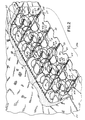
- Figure 2 is an enlarged perspective view, partially broken away, of a portion of two bands or rows of springs embodied in the mattress of Figure 1.
- Figure 3 is a cross-sectional view taken on line 3-3 of Figure 1.
- Figure 4 is a perspective view of a portion of a spring interior incorporating a modified version of the posture rods of the spring interior of Figure 1.
- the spring interior 21 is formed from a plurality of bands of springs 22 which extend longitudinally of the mattress. These bands of springs 22 are laced together by helical lacing wires 23 which extend transversely of the spring interior and secure the bands of springs in an assembled relation.
- a border wire 24 extends completely around the periphery of the spring interior in the top and bottom planes 25, 26, respectively, of the interior and is secured to the outermost edge of the spring interior in these planes by conventional sheet metal clips 27.
- Each band of springs 22, a portion of one of which is illustrated in Figure 3, is made from a single length of spring wire shaped to form a plurality of individual coil springs 31 arranged in a row.
- Each coil spring 31 comprises about two and one-half turns of wire.
- the axis of each coil spring is not upright but is inclined slightly lengthwise of the band, each spring being inclined in a direction opposite to that in which its two adjacent springs in the row are inclined.
- the end turns of the coil springs 31 lie adjacent to the top and bottom faces 25, 26 of the band.
- Each coil spring, such as that numbered 31b ( Figure 3) is so coiled as to have a hand opposite to the hand of the adjacent coil springs, such as 31a and 31c, immediately before and after it in the row.
- Each coil spring is joined to the next adjacent coil spring by two interconnecting segments 35, 36 ( Figure 2) of the wire integral with the coil springs.
- One of the two interconnecting segments 35, 36 is in the top face 25 of the band 22, and the other is in the bottom face 26 thereof.
- coil spring 31a ( Figure 3) is connected to coil spring 31b by interconnecting segment 35, which is in the bottom face of the band
- the coil spring 31b is connected to coil spring 31c by interconnecting segment 36, which is in the top face of the band.
- Each interconnecting segment 35, 36 comprises a bridging portion 37, which extends longitudinally of the row of coil springs and end portions 38 which extend in a direction normal to the longitudinal axis of the band 22.
- Those end portions 38 of the interconnecting segments 35, 36 also lie in the top and bottom faces 25, 26 of the band 22.
- each end 38 of each coil spring 31a, 31b, 31c or 31d is well defined, for the coil springs are curved and the end portions 38 of the interconnecting segments are straight. In other constructions, however, the intersections may be less well defined because the end portions 38 of the interconnecting segments 35, 36 may be replaced by arcuate extensions of the coil springs 31a, 31b, 31c; in those last cases the interconnecting segments must be considered as consisting solely of the bridging portions 37.
- Each bridging portion 37 in addition to extending longitudinally of the band, also extends laterally thereof to form a supporting structure 40.
- the supporting structure 40 is in the form of a V-shaped indentation 41 of wire lying in the top 25 or bottom face 26 of the band 22, as the case may be, and extending to one side of the remainder of the bridging portion 37 of which it forms a part.
- Each V-shaped indentation 41 lies halfway between the end portions 38 of the interconnecting segment of which it forms a part, and it extends from one side face of the band toward the other side face thereof.
- a plurality of bands of springs 22 are assembled to form a spring interior 21.
- Bands of springs 22, each similar to that shown in Figures 1-4, are disposed side by side, and preformed helical wires 23 are attached to them.
- the helical wires 23 lie in the top and bottom faces 25, 26 of the bands and extend at right angles to the longitudinal axes of the bands.
- Each helical wire 23 embraces one pair of closely adjacent end portions 38 of each band.
- each of the transverse elements of the grid comprises a helical wire 23, with the end portions 38 embraced by it, and each of the longitudinal elements of the grid comprises a row of mutually aligned bridging portions 37.
- each rectangle of the grid and disposed a little lower than the grid are the upper end portions of two adjacent coil springs 31.
- the top face 25 and bottom face 26 of the spring interior 21 would present relatively large rectangular apertures into which upholstery material, such as filling or padding 60, placed on top of the top face could readily enter, thereby giving rise to "cupping.”
- the presence of the supporting structures 40 reduces any tendency to "cupping,” as the supporting structures occupy central parts of the rectangular apertures and can serve to support the upholstery material.
- the lengthwise center one-third section 20a of the mattress 20 and spring interior 21 is posturized or increased in firmness relative to the endmost sections 20b and 20c.
- Posturization is a term of art used to describe the increasing of the firmness of one section of a mattress or spring product relative to another section. In this instance, the posturization is the practice of increasing the firmness of the lengthwise, centermost one-third section of the mattress. This is the section which supports the greatest concentration of weight of a person reclining atop the mattress and is therefore the section most subject to sagging or drooping relative to the other endmost sections.
- the spring interior 21 includes nine posturizing rods 62a-62i which extend transversely between opposite sides of the spring interior and pass through or between overlapped portions 64 of overlapped intermediate turns of coil springs 31.
- These rods 62a-62i are straight rods, except for the endmost portions which, as explained more fully hereinafter, have end treatments to prevent the rods from pulling out of or being withdrawn from between the overlapped portions 64 of the coils 31.
- each posture rod 62 which are located in the lower plane 66 are formed into a downwardly extending end section 70 and a longitudinally extending endmost section 71.
- the ends of those posture rods 62 located in the upper plane 68 have an upwardly extending end section 74 and an endmost longitudinally extending section 75.
- the endmost sections 71 and 75 of the posture rods are secured by conventional metal clips 76 to the bottom and top border wires 77 and 78, respectively.
Landscapes
- Mattresses And Other Support Structures For Chairs And Beds (AREA)
- Springs (AREA)
- Professional, Industrial, Or Sporting Protective Garments (AREA)
- Seats For Vehicles (AREA)
- Wire Processing (AREA)
Claims (16)
- Ein Verfahren zum Erhöhen der Festigkeit von mindestens einem ausgewählten Abschnitt eines Federkerns, der eine Mehrzahl von sich der Länge nach erstreckenden Federbändern umfaßt, die nebeneinander angeordnet und in den oberen und unteren Flächen der Bänder miteinander verbunden sind, wobei jedes der Federbänder ein einziges Drahtstück umfaßt, das zu einer Mehrzahl von im wesentlichen senkrechten Spiralfedern geformt ist, die in einer Reihe angeordnet und durch wechselweise in den oberen und unteren Flächen der Bänder angeordnete verbindende Drahtsegmente miteinander verbunden sind, jedes der verbindenden Segmente einen sich der Länge nach erstreckenden Überbrückungsteil umfaßt und jede der Spiralfedern mit den anschließenden Spiralfedern der gleichen Reihe verschränkt ist, und zwar erstreckt sich das besagte Verfahren auf das Einsetzen von Abstützstangen durch verschränkte Teile einer Mehrzahl von Paaren verschränkter Spiralen des Federkerns hindurch, wobei jede der Abstützstangen in Bereichen zwischen den oberen und unteren Flächen der Bänder durch verschränkte Teile der Paare verschränkter Spiralen hindurch eingesetzt wird.
- Ein Verfahren nach Anspruch 1, bei dem die Wickelrichtung jeder Spiralfeder jeder Reihe von Federn zu der Wickelrichtung der anschließenden Spiralfedern unmittelbar davor und danach in der Reihe entgegengesetzt ist, bei dem die Federbänder nebeneinander angeordnet sind, so daß ihre oberen Flächen in einer oberen Hauptfläche des Federkerns liegen und ihre unteren Flächen in einer unteren Hauptfläche des Federkerns liegen, und bei der die Bänder durch spiralförmige Drähte miteinander verbunden sind, die in den oberen und unteren Flächen der Bänder liegen und sich quer zu den Bändern erstrecken.
- Ein Verfahren nach Anspruch 1 oder Anspruch 2, bei dem jede Abstützstange im wesentlichen geradlinig ist und sich quer durch verschränkte Teile einer Mehrzahl von Paaren verschränkter Spiralen hindurch erstreckt.
- Ein Verfahren nach einem der vorstehenden Ansprüche, bei dem jede Abstützstange durch ein Paar verschränkter Spiralen an einer quer verlaufenden Seite des Federkerns sowie durch ein zweites Paar verschränkter Spiralen an der gegenüberliegenden quer verlaufenden Seite des Federkerns hindurch eingesetzt wird.
- Ein Verfahren nach einem der vorstehenden Ansprüche, bei dem jede Abstützstange einer Endbehandlung an den gegenüber befindlichen Enden der Stange unterzogen wird, wobei die besagte Endbehandlung so durchgeführt werden kann, daß unbeabsichtigtes Herausziehen der Abstützstangen aus dem Raum zwischen den verschränkten Spiralen verhütet wird.
- Ein Verfahren nach Anspruch 5, bei dem eine solche Endbehandlung sich auf das Formen eines Endhakens an jedem Ende jeder der besagten Abstützstangen erstreckt.
- Ein Verfahren nach einem dervorstehenden Ansprüche, bei dem der Federkern eine erste Randstange umfaßt, die sich rings um den Umfang des Federkerns in der oberen Hauptfläche erstreckt, sowie eine zweite Randstange, die sich rings um die untere Hauptfläche des Federkerns erstreckt, wobei sich das Verfahren des weiteren auf die Befestigung der gegenüber befindlichen Enden jeder Abstützstange an die Randstangen erstreckt.
- Ein Federkern (21), der eine Mehrzahl von sich der Länge nach erstreckenden Federbändern (22) umfaßt, die nebeneinander angeordnet und in den oberen und unteren Flächen (25, 26) der Bänder (22) miteinander verbunden sind, wobei jedes der Federbänder (22) ein einziges Drahtstück umfaßt, das zu einer Mehrzahl von im wesentlichen senkrechten Spiralfedern (31) geformt ist, welche in einer Reihe angeordnet und durch wechselweise in den oberen und unteren Flächen (25, 26) der Bänder (22) angeordnete verbindende Drahtsegmente (35, 36) miteinander verbunden sind, wobei jedes der verbindenden Segmente (35, 36) einen sich der Länge nach erstreckenden Überbrückungsteil (37) umfaßt, jede des Spiralfedern (31) mit den anschließenden Spiralfedern der gleichen Reihe verschränkt ist und der Federkern (21) innerhalb der gesamten Länge des Federkerns unterschiedliche Festigkeit der Spiralfedern aufweist, und zwar ist die unterschiedliche Festigkeit auf Abstützstangen (62) zurückzuführen, die sich durch verschränkte Teile (64) einer Mehrzahl von Paaren verschränkter Spiralen (31) des Federkerns hindurch erstrecken, wobei jede Abstützstange (62) zwischen den oberen und unteren Flächen der Bänder angeordnet ist.
- Ein Federkern nach Anspruch 8, bei dem die Wickelrichtung jeder Spiralfeder (31b) zu der Wickelrichtung der anschließenden Spiralfedern (31a, 31c) unmittelbar davor und unmittelbar danach in der Reihe entgegengesetzt ist, bei dem die Bänder (22) nebeneinander angeordnet sind, so daß ihre oberen Flächen (25) in einer oberen Hauptfläche des Federkerns liegen und ihre unteren Flächen (26) in einer unteren Hauptfläche des Federkerns liegen, und bei dem die Bänder (22) durch spiralförmige Drähte (23) miteinander verbunden sind, die in den oberen und unteren Flächen (25, 26) der Bänder liegen und sich quer über die Bänder (22) erstrecken.
- Ein Federkern nach Anspruch 9, bei dem jeder spiralförmige Draht (23) Teile von Drähten der Bänder (22) umfaßt, die sich von den Enden der Überbrückungsteile (37) der besagten Bänder quer zu den Bändern (22) erstrecken, wobei sich in jeder Fläche des Federkerns in der Lücke zwischen jedem spiralförmigen Draht (23) und dem nächsten spiralförmigen Draht zwei Federn (31) befinden.
- Ein Federkern nach einem der Ansprüche 8 bis 10, dadurch gekennzeichnet, daß jede Abstützstange (62) im wesentlichen geradlinig ist und sich quer durch verschränkte Teile einer Mehrzahl von Paaren verschränkter Spiralen (31) hindurch erstreckt.
- Ein Federkern nach einem der Ansprüche 8 bis 11, dadurch gekennzeichnet, daß sich jede Abstützstange (62) von einem Paar verschränkter Spiralen an einer quer verlaufenden Seite des Federkerns zu einem zweiten Paar verschränkter Spiralen an der gegenüberliegenden quer verlaufenden Seite des Federkerns erstreckt.
- Ein Federkern nach einem der Ansprüche 8 bis 12, dadurch gekennzeichnet, daß jede Abstützstange (62) an deren gegenüberliegenden Enden mit einem Haken (63) geformt ist, um unbeabsichtigtes Herausziehen der Abstützstange aus dem Raum zwischen den verschränkten Spiralen zu verhüten.
- Ein Federkern nach einem der Ansprüche 8 bis 13, dadurch gekennzeichnet, daß sich eine erste Randstange (24, 78) rings um den Umfang des Federkerns in der oberen Hauptfläche (25) erstreckt und daß sich eine zweite Randstange (24, 77) rings um die untere Hauptfläche (26) des Ferderkerns erstreckt, wobei jede Abstützstange (62) an deren gegenüberliegenden Enden an den Randstangen (24, 77, 78) befestigt ist.
- Ein Federkern nach Anspruch 14, bei dem die gegenüberliegenden Enden jeder Abstützstange (62) an der gleichen Randstange (24, 77, 78) befestigt sind.
- Eine Bettmatratze (20), umfassend einen Federkern (21) nach einem der Ansprüche 8 bis 15, eine mindestens eine der Hauptflächen des Federkerns (21) überlagernde Füllung (19) sowie einen gepolsterten Bezugsstoff (18), der den Federkern (21) und die Füllung (19) umhüllt.
Applications Claiming Priority (3)
| Application Number | Priority Date | Filing Date | Title |
|---|---|---|---|
| US285778 | 1988-12-16 | ||
| US07/285,778 US4918773A (en) | 1988-12-16 | 1988-12-16 | Posturized spring bedding product |
| PCT/US1989/005377 WO1990006705A1 (en) | 1988-12-16 | 1989-11-27 | Posturized spring bedding product |
Publications (3)
| Publication Number | Publication Date |
|---|---|
| EP0448628A1 EP0448628A1 (de) | 1991-10-02 |
| EP0448628A4 EP0448628A4 (en) | 1992-07-01 |
| EP0448628B1 true EP0448628B1 (de) | 1995-06-14 |
Family
ID=23095648
Family Applications (1)
| Application Number | Title | Priority Date | Filing Date |
|---|---|---|---|
| EP90901244A Expired - Lifetime EP0448628B1 (de) | 1988-12-16 | 1989-11-27 | Matratze mit federn, versehen mit stützstäben |
Country Status (9)
| Country | Link |
|---|---|
| US (2) | US4918773A (de) |
| EP (1) | EP0448628B1 (de) |
| JP (1) | JP2749196B2 (de) |
| AU (1) | AU619643B2 (de) |
| CA (1) | CA2005041C (de) |
| DE (1) | DE68923092D1 (de) |
| ES (2) | ES2017049A6 (de) |
| WO (1) | WO1990006705A1 (de) |
| ZA (1) | ZA899534B (de) |
Families Citing this family (18)
| Publication number | Priority date | Publication date | Assignee | Title |
|---|---|---|---|---|
| US5104099A (en) * | 1990-04-27 | 1992-04-14 | Leggett & Platt, Incorporated | Spring bedding product |
| AU8664891A (en) * | 1990-11-13 | 1992-06-11 | Leggett & Platt, Incorporated | Bedding system |
| US5325553A (en) * | 1992-08-21 | 1994-07-05 | Namaco Enterprises | Mattress spring structure with reinforcing frame in the lumbar area |
| DE69504788D1 (de) * | 1994-08-16 | 1998-10-22 | Jae Ho Oh | Sprungfedermatratze mit Doppelfunktion |
| US5649332A (en) * | 1996-03-15 | 1997-07-22 | L&P Property Management Company | Posturized continuous mattress spring core |
| US5669087A (en) * | 1996-04-10 | 1997-09-23 | L&P Property Management Company | Lacing wire zoned mattress |
| US5868383A (en) * | 1997-03-27 | 1999-02-09 | L&P Property Management Company | Multiple rate coil spring assembly |
| EP1161165A1 (de) | 1999-02-05 | 2001-12-12 | L & P Property Management Company | Taschenfederanordnung für betten oder sitze |
| US6173464B1 (en) * | 1999-05-07 | 2001-01-16 | L&P Property Management Company | Pocketed bedding or seating product |
| US6398199B1 (en) | 1999-09-03 | 2002-06-04 | Barber Manufacturing Company, Inc. | Coil spring assembly |
| US6807698B2 (en) | 2002-06-01 | 2004-10-26 | Sleepadvantage, Llc | Bed having low body pressure and alignment |
| US7036172B2 (en) * | 2002-06-01 | 2006-05-02 | Sleepadvantage, Lc | Bed having low body pressure and alignment |
| US6966091B2 (en) * | 2002-11-27 | 2005-11-22 | Barber Manufacturing Company, Inc. | Coil innerspring assembly having varying degrees of firmness |
| US6883196B2 (en) * | 2002-11-27 | 2005-04-26 | Barber Manufacturing Company, Inc. | Encased coil innerspring assembly |
| US20070023154A1 (en) * | 2005-06-30 | 2007-02-01 | Shearer Dwayne M | Insulating paperboard |
| US7251847B2 (en) * | 2005-10-13 | 2007-08-07 | L&P Property Management Company | Continuous wire spring mattress or seating product and method of manufacture |
| US8769748B2 (en) | 2010-06-23 | 2014-07-08 | L&P Property Management Company | Spring core having border wire with generally rectangular cross-section |
| JP6614613B2 (ja) * | 2016-04-28 | 2019-12-04 | 株式会社弘樹 | 敷きパッド |
Family Cites Families (17)
| Publication number | Priority date | Publication date | Assignee | Title |
|---|---|---|---|---|
| US1400505A (en) * | 1920-06-21 | 1921-12-13 | Shott Mfg Company | Bed-spring |
| US1594276A (en) * | 1925-05-18 | 1926-07-27 | L A Young Ind Inc | Bedspring |
| DE809235C (de) * | 1948-11-03 | 1951-07-26 | Alfred Beckmann | Polstermoebel-Federeinlage |
| GB733490A (en) * | 1951-07-24 | 1955-07-13 | Geza Hollo | Spring assembly and inner spring construction |
| GB839835A (en) * | 1957-11-14 | 1960-06-29 | Ewald Hemmers | Improvements in and relating to interior spring mattresses |
| DE1155218B (de) * | 1958-03-14 | 1963-10-03 | Willi Gerstorfer | Federeinlage fuer Polsterungen od. dgl. |
| GB1104884A (en) * | 1964-12-10 | 1968-03-06 | Multilastic Ltd | Method of and apparatus for dividing lengths of spring unit for use in mattresses and the like |
| GB1098892A (en) * | 1965-04-08 | 1968-01-10 | Agfa Gevaert Ag | Photosensitive materials prepared from homopolymers and copolymers of salts of n-vinylbenzyl-4-vinylpyridine |
| GB1113772A (en) * | 1966-01-08 | 1968-05-15 | Slumberland Group Ltd | Improvements relating to mattresses,seats and the like |
| GB1183315A (en) * | 1966-06-03 | 1970-03-04 | Multilastic Ltd | Apparatus for Dividing Lengths of Spring Unit for use in Mattresses and the like |
| GB1245033A (en) * | 1969-05-13 | 1971-09-02 | Slumberland Group Ltd | Spring interiors for mattresses, seats and the like |
| US4052760A (en) * | 1976-02-23 | 1977-10-11 | The United States Bedding Company | Coil spring assembly |
| US4156442A (en) * | 1977-12-02 | 1979-05-29 | Multilastic Limited | Locating means for co-operating with helical wires |
| US4488712A (en) * | 1981-12-21 | 1984-12-18 | Leggett & Platt, Incorporated | Longitudinally laced continuous coil spring assembly |
| GB8319841D0 (en) * | 1983-07-22 | 1983-08-24 | Multilastic Ltd | Spring interiors for mattresses |
| US4679266A (en) * | 1986-02-18 | 1987-07-14 | Eugene Kraft | Varying firmness mattress |
| GB2198938B (en) * | 1986-12-22 | 1990-02-14 | Slumberland Limited | A spring interior for a double mattress |
-
1988
- 1988-12-16 US US07/285,778 patent/US4918773A/en not_active Expired - Fee Related
-
1989
- 1989-09-22 US US07/411,059 patent/US4972536A/en not_active Expired - Fee Related
- 1989-10-24 ES ES8903582A patent/ES2017049A6/es not_active Expired - Lifetime
- 1989-11-27 ES ES90901244T patent/ES2073563T3/es not_active Expired - Lifetime
- 1989-11-27 EP EP90901244A patent/EP0448628B1/de not_active Expired - Lifetime
- 1989-11-27 WO PCT/US1989/005377 patent/WO1990006705A1/en not_active Ceased
- 1989-11-27 JP JP2501850A patent/JP2749196B2/ja not_active Expired - Lifetime
- 1989-11-27 DE DE68923092T patent/DE68923092D1/de not_active Expired - Lifetime
- 1989-11-27 AU AU48299/90A patent/AU619643B2/en not_active Ceased
- 1989-12-11 CA CA002005041A patent/CA2005041C/en not_active Expired - Fee Related
- 1989-12-13 ZA ZA899534A patent/ZA899534B/xx unknown
Also Published As
| Publication number | Publication date |
|---|---|
| AU619643B2 (en) | 1992-01-30 |
| EP0448628A1 (de) | 1991-10-02 |
| CA2005041C (en) | 1994-09-06 |
| AU4829990A (en) | 1990-07-10 |
| ES2017049A6 (es) | 1990-12-16 |
| JPH04502265A (ja) | 1992-04-23 |
| ZA899534B (en) | 1990-09-26 |
| DE68923092D1 (de) | 1995-07-20 |
| WO1990006705A1 (en) | 1990-06-28 |
| EP0448628A4 (en) | 1992-07-01 |
| ES2073563T3 (es) | 1995-08-16 |
| US4972536A (en) | 1990-11-27 |
| JP2749196B2 (ja) | 1998-05-13 |
| CA2005041A1 (en) | 1990-06-16 |
| US4918773A (en) | 1990-04-24 |
Similar Documents
| Publication | Publication Date | Title |
|---|---|---|
| EP0448628B1 (de) | Matratze mit federn, versehen mit stützstäben | |
| US4960267A (en) | Edge-reinforced spring bedding product | |
| EP0132362A2 (de) | Federeinlage für Matratzen und dergleichen | |
| US6202238B1 (en) | Bedding or seating product with edge support | |
| US5469590A (en) | Mattress with compressible support members | |
| US8490232B2 (en) | Spring core having border wire with generally rectangular cross-section | |
| US3911511A (en) | Spring assembly | |
| EP0053739B1 (de) | Federgefüge | |
| US4180877A (en) | Mattress | |
| WO2007053459A2 (en) | Posterized bedding or seating product | |
| US4790038A (en) | Bedding spring assembly | |
| US4905333A (en) | Spring bedding product | |
| US4369534A (en) | Center reinforced mattress | |
| KR0169951B1 (ko) | 스프링 침대 매트리스 | |
| US9044102B2 (en) | Spring core having border wire with generally rectangular cross-section | |
| US5649332A (en) | Posturized continuous mattress spring core | |
| GB2215199A (en) | Mattress | |
| US3426371A (en) | Spring assembly | |
| CA2024962C (en) | Longitudinally laced posturized and/or contoured spring bedding product | |
| US5669087A (en) | Lacing wire zoned mattress | |
| US5104099A (en) | Spring bedding product | |
| US20120047657A1 (en) | Spring Assembly Having Continuous Bands of Springs | |
| US4853991A (en) | Bedding foundation having multiple-span sinuous wire springs | |
| WO1988005640A1 (en) | Bedding spring assembly | |
| CA1261077A (en) | Spring interiors for mattresses and other articles |
Legal Events
| Date | Code | Title | Description |
|---|---|---|---|
| PUAI | Public reference made under article 153(3) epc to a published international application that has entered the european phase |
Free format text: ORIGINAL CODE: 0009012 |
|
| 17P | Request for examination filed |
Effective date: 19910607 |
|
| AK | Designated contracting states |
Kind code of ref document: A1 Designated state(s): BE DE ES FR GB LU NL SE |
|
| A4 | Supplementary search report drawn up and despatched |
Effective date: 19920508 |
|
| AK | Designated contracting states |
Kind code of ref document: A4 Designated state(s): BE DE ES FR GB LU NL SE |
|
| 17Q | First examination report despatched |
Effective date: 19931221 |
|
| GRAA | (expected) grant |
Free format text: ORIGINAL CODE: 0009210 |
|
| AK | Designated contracting states |
Kind code of ref document: B1 Designated state(s): BE DE ES FR GB LU NL SE |
|
| PG25 | Lapsed in a contracting state [announced via postgrant information from national office to epo] |
Ref country code: NL Free format text: LAPSE BECAUSE OF NON-PAYMENT OF DUE FEES Effective date: 19950614 Ref country code: FR Effective date: 19950614 Ref country code: BE Effective date: 19950614 |
|
| REF | Corresponds to: |
Ref document number: 68923092 Country of ref document: DE Date of ref document: 19950720 |
|
| REG | Reference to a national code |
Ref country code: ES Ref legal event code: FG2A Ref document number: 2073563 Country of ref document: ES Kind code of ref document: T3 |
|
| PG25 | Lapsed in a contracting state [announced via postgrant information from national office to epo] |
Ref country code: SE Effective date: 19950914 |
|
| PG25 | Lapsed in a contracting state [announced via postgrant information from national office to epo] |
Ref country code: DE Effective date: 19950915 |
|
| EN | Fr: translation not filed | ||
| PG25 | Lapsed in a contracting state [announced via postgrant information from national office to epo] |
Ref country code: GB Effective date: 19951127 |
|
| PG25 | Lapsed in a contracting state [announced via postgrant information from national office to epo] |
Ref country code: LU Free format text: LAPSE BECAUSE OF NON-PAYMENT OF DUE FEES Effective date: 19951130 |
|
| NLV1 | Nl: lapsed or annulled due to failure to fulfill the requirements of art. 29p and 29m of the patents act | ||
| PLBE | No opposition filed within time limit |
Free format text: ORIGINAL CODE: 0009261 |
|
| STAA | Information on the status of an ep patent application or granted ep patent |
Free format text: STATUS: NO OPPOSITION FILED WITHIN TIME LIMIT |
|
| 26N | No opposition filed | ||
| GBPC | Gb: european patent ceased through non-payment of renewal fee |
Effective date: 19951127 |
|
| PGFP | Annual fee paid to national office [announced via postgrant information from national office to epo] |
Ref country code: ES Payment date: 20001121 Year of fee payment: 12 |
|
| PG25 | Lapsed in a contracting state [announced via postgrant information from national office to epo] |
Ref country code: ES Free format text: LAPSE BECAUSE OF NON-PAYMENT OF DUE FEES Effective date: 20011128 |
|
| REG | Reference to a national code |
Ref country code: ES Ref legal event code: FD2A Effective date: 20021213 |