EP0447906A2 - Schloss, welches mittels einer Karte mit verschiedenen Löchern betätigbar ist - Google Patents
Schloss, welches mittels einer Karte mit verschiedenen Löchern betätigbar ist Download PDFInfo
- Publication number
- EP0447906A2 EP0447906A2 EP91103649A EP91103649A EP0447906A2 EP 0447906 A2 EP0447906 A2 EP 0447906A2 EP 91103649 A EP91103649 A EP 91103649A EP 91103649 A EP91103649 A EP 91103649A EP 0447906 A2 EP0447906 A2 EP 0447906A2
- Authority
- EP
- European Patent Office
- Prior art keywords
- tumblers
- slider
- lock card
- locking device
- indentations
- Prior art date
- Legal status (The legal status is an assumption and is not a legal conclusion. Google has not performed a legal analysis and makes no representation as to the accuracy of the status listed.)
- Granted
Links
Images






Classifications
-
- E—FIXED CONSTRUCTIONS
- E05—LOCKS; KEYS; WINDOW OR DOOR FITTINGS; SAFES
- E05B—LOCKS; ACCESSORIES THEREFOR; HANDCUFFS
- E05B27/00—Cylinder locks or other locks with tumbler pins or balls that are set by pushing the key in
- E05B27/0028—Other locks than cylinder locks with tumbler pins or balls
-
- E—FIXED CONSTRUCTIONS
- E05—LOCKS; KEYS; WINDOW OR DOOR FITTINGS; SAFES
- E05B—LOCKS; ACCESSORIES THEREFOR; HANDCUFFS
- E05B35/00—Locks for use with special keys or a plurality of keys ; keys therefor
- E05B35/007—Locks for use with special keys or a plurality of keys ; keys therefor the key being a card, e.g. perforated, or the like
-
- E—FIXED CONSTRUCTIONS
- E05—LOCKS; KEYS; WINDOW OR DOOR FITTINGS; SAFES
- E05B—LOCKS; ACCESSORIES THEREFOR; HANDCUFFS
- E05B65/00—Locks or fastenings for special use
- E05B65/52—Other locks for chests, boxes, trunks, baskets, travelling bags, or the like
Definitions
- This invention relates to a locking device for unlocking or locking by the insertion therein of a card key provided with a plurality of holes.
- Such a locking device comprises a slider having a plurality of tumblers, a card key provided with several holes through which pre-determined portions of the tumblers project out, a groove to guide the card key to the tips of the tumblers, a mechanism to slide the slider when the pre-determined portions of each tumbler project out, and a mechanism for unlocking or locking by sliding the slider.
- the slider comprises a step portion which the card key pushes to move the slider.
- the object of this invention is to provide a locking device for unlocking or locking which requires only sliding of a card key without stops by a step portion.
- a locking device of this invention comprises a slider provided with a plurality of tumblers that can freely advance and retreat and are activated upon advancing, and effects unlocking or locking by insertion of a card key which moves the slider when pre-determined portions of the tumblers project through a plurality of holes of the card key, wherein at least one of the tumblers is enabled to move the slider by engaging with the hole of the card key.
- the card key moves the slider by means of the tumblers.
- the tumblers are mounted on the slider and can freely advance and retreat.
- each tumbler retreats and disengages from the holes of the card key. Namely, when the card key continuously moves along the points of the tumblers, the tumblers engage with the holes of the card key for unlocking or locking, and then the tumblers once inserted into the holes of the card key disengage from the holes. Therefore, the card key effects unlocking or locking without stopping of the sliding by a step portion.
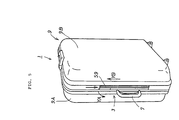
- a suitcase 1 comprises a grip 7 and a case member 9 as shown in Fig. 5.
- the case member 9 consists of a first case 9A and a second case 9B.
- the grip 7 is positioned on the suitcase 9 at the point the first case 9A and the second case 9B are combined.
- a locking device 3 is constructed between the first case 9A and the second case 9B adjacent to the grip 7.
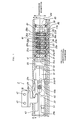
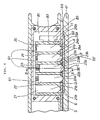
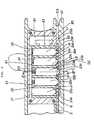
- the locking device 3 comprises a slider II, five tumblers 21 through 25, a first engaging projection 31, a first receiving portion 33, a second engaging projection 35, a second receiving portion 37, a first main body 41 and a second main body 43.
- the second main body 43 is fixed to the second case 9B by means of a plurality of fixing machine screws 45.
- An aperture 43a is formed on the second main body 43 in the direction where the first case 9A is moved to close the two cases 9A and 9B.
- the second main body 43 further comprises an aperture 43b in the first main body 41 side.
- the second receiving portion 37 is a cast made of light alloy, and has a pre-determined thickness of da as illustrated in Fig. 2.
- One end 37a of the second receiving portion 37 is T-shaped, while the other end 37b which projects out of the second main body 43 through the aperture 43b is U-shaped.
- This projecting portion of the end 37b is rotatably fixed to an axis member 46. Both ends of the axis member 46 are fixed to the first main body 41.
- a hook 37c is formed in the middle of the second receiving portion 37.
- the second receiving portion 37 is prevented from moving in the transverse and the height directions by the second main body 43.
- the second receiving portion 37 is
- the second engaging projection 35 is fixed to the first case 9A by means of two fixing machine screws 47.
- This second engaging projection 35 is constructed such that the hook 35a of the projection 35 is inserted into the second main body 43 through the aperture 43a of the second main body 43 when the first case 9A and the second case 9B are combined.
- the hook 35a of the second engaging projection 35 meshes with the hook 37c of the second receiving portion 37 as shown in Fig. 1 in order to keep the two cases 9A and 9B combined.
- An iron framework member 51 is fixed to the second main body 43 between the second receiving portion 37 and the second case 9B by means of a plurality of fixing machine screws 45.
- One end 51 a of the framework member 51 is formed between the first main body 41 and the second case 9B, and stretches to the middle of the first main body 41. This end 51a thus supports a first axis member 53 such that the first axis member 53 is fixed to a pre-determined point of the second case 9B in the first main body 41.
- One end of a linking member 55 is rotatably fixed to the first axis member 53, and a second axis member 57 is supported on the other end of the linking member 55.
- the second axis member 57 rotates along a circumference EK shown with an alternate long and two short dashes line in Fig. 2 with the center being the first axis member 53.
- Both ends of the second axis member 57 are rotatably fixed to the first main body 41 as shown in Figs. 1 and 2.
- the components of the instant invention act in cooperation with each other as follows.
- the first main body 41 fluctuates along an alternate long and two short dashes line with the first and second axis members 53 and 57 being its axes.
- the first main body 41 then moves in the directions of the arrow YA and an arrow YB.
- the second receiving portion 37 linked to the first main body 41 slides in the direction of the arrow YB in accordance with the movement of the body 41. Consequently, as illustrated in Fig. 1, the hook 35a of the second engaging projection 35 engages with the hook 37c of the second receiving portion 37 until the second receiving portion 37 moves in the direction of the arrow YB such that the suitcase 1 is locked.
- the hooks 35a and 37c are disengaged. The suitcase 1 is thus unlocked, enabling the first case 9A and the second case 9B to be separated.
- the slider 11 is mounted inside the first main body 41, and can slide in the longitudinal direction of the first main body 41. The movement of the slider 11 in the transverse and the height directions is controlled.
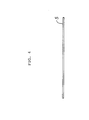
- a slit 59 is formed in the first main body 41 along one side 11b of the slider 11 as illustrated in Fig. 1, Fig. 6 describing the details of the slider 11 and Fig. 7 showing a sectional view taken along B-B of Fig. 6.
- a concave member 60 is formed adjacent to the slit 59 in opposition to the side 11 b of the slider 11.
- the slit 59 guides the card key 5 along the side 11 b of the slider 11.
- the concave member 60 determines the maximum amount of projections of the tumblers 21 through 25.
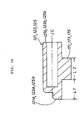
- the first engaging projection 31 is connected with the slider 11 a in the second case 9B side of the slider 11. As shown in Fig. 2 and Fig. 8 illustrating the details of Fig. 2, the first engaging projection 31 is L-shaped, and is inserted into the second case 9B through an opening 9Ba formed in the second case 9B. Adjacent to the opening 9Ba is the first receiving portion 33 which is a part of the second case 9B.
- the first engaging projection 31 is positioned such that a projecting portion 31 a of the engaging projection 31 is opposite to the first receiving portion 33 when the slider 11 is located as illustrated in Fig. 2. Since the projecting portion 31 a engages with the first receiving portion 33, the first main body 41 cannot be pulled up in the direction of the arrow YA.
- the tumblers 21 through 25 are provided on the slider 11 at the same intervals in the longitudinal direction of the slider 11.
- the tumblers 21 through 25 are slidingly inserted into the slider 11 in the transverse direction of the slider 11. Openings 11a1 through 11a5 are formed along the tumblers 21 through 25 in the side of case 9B as shown in Figs. 2, 7 and 8.
- the tumblers 21 through 25 are equipped with acuminate members 21a through 25a and cylindrical members 21b through 25b as shown in Fig. 6.
- Coil springs 61 are provided inside the cylindrical members 21 b through 25b in the slider 11. The coil springs 61 actuate the tumblers 21 through 25 in the direction from the slider 11 to the slit 59.
- rectangular engaging projections 71 through 75 are located on pre-determined points of the tumblers 25 in the side of the second case 9B.
- the engaging projections 71 through 75 protrude outside the slider 11 in the side of the second case 9B via the openings 11 a1 through 11a5 of the slider 11.
- a groove-forming member 81 is provided adjacent to the openings 11 ai through 11 a5 of the slider 11 in the side of the second case 9B of the first main body 41.
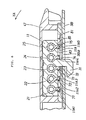
- the groove-forming member 81 is equipped with a groove 83 and engaging concave member 85 as shown in Fig. 9 which shows a sectional view of Fig. 2 taken on the line C-C.
- Fig. 9 illustrates, the slider 11 freely slides in the longitudinal direction when all of the engaging projections 71 through 75 are positioned inside the groove 83.
- the engaging projections 71 through 75 are inserted into the engaging concave member 85, the slider 11 cannot slide in the longitudinal direction.
- Relative positions of the engaging projections 71 through 75 and the groove 83 are determined in accordance with the projections of the tumblers 21 through 25 from the slider 11 into the slit 59.
- the projections into the slit 59 change according to the sliding of the card key 5 shown in Figs. 3 and 4.
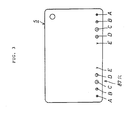
- the card key has a plurality of holes 87 at the same intervals as the tumblers 21 through 25.
- the holes 87 receive the acuminate members 21 a through 25a.
- the holes 87 are formed at the pre-determined points A through E.
- a pre-determined size e.g. full, large, medium, small or none, is selected for each of the points A through E.
- the holes 87 are formed at pre-determined points of the card key 5.
- the points A, B, C, D and E are bilaterally symmetrical with their center being the center line in the longitudinal direction of the card key 5. The card key 5 is thus able to be inserted into the slit 59 from both directions.
- the diameters of the holes 87 of the card key 5 and the positions of the engaging projections 71 through 75 of the tumblers 21 through 25 are orderly determined. As shown in Fig. 6, all of the engaging projections 71 through 75 are located inside the groove 83 as illustrated in Fig. 9 only when the tumblers 21 through 25 engage with the card key 5, and thus the slider 11 can slide in the longitudinal direction.
- At least one of the points A through E of the holes 87 is a full hole.
- This hole indicates, for instance, a hole through which the tumbler 23 protrudes till the acuminate member 23a reaches the concave member 60 as shown in Fig. 6.
- the tumblers 21 through 25 are constructed, in the case of the tumbler 23, such that a boundary member 23c separating the acuminate member 23a and the cylindrical member 23b abuts an inside edge 5E of the full hole at point C.
- the boundary member 23C is formed between the acuminate member 23a and the cylindrical member 23b.
- the boundary member 23c abuts the card key 5 more vertically than the acuminate member 23a.
- the tumblers 21 through 25 engage with the smaller holes (large, medium and small), the inside edge 5E abuts the acuminate members 21 a through 25a. In this case, the tumblers 21 through 25 do not receive great pushing force in the sliding direction of the card key 5 even when the card key 5 slides. The tumblers 21 through 25 receive great pushing force in the direction where the tumblers 21 through 25 are pushed.
- the card 5 key slides in the slit 59 till the key 5 engages with the tumblers 21 through 25 as shown in Fig. 6.
- the tumblers 21 through 25 are successively pushed into the slider 11 in accordance with the sliding of the card key 5 and the card key 5 slides in the slit 59.
- at least one of the engaging projections 71 through 75 is positioned inside the engaging concave member 85, and thus the slide 11 cannot slide.
- the first engaging projection 31 moves in the direction of the arrow YB when the card key slides in the direction of the arrow YB in Fig. 2. Accordingly, the first main body 41 can be pulled up in the direction of the arrow YA, so that the locking device 3 is unlocked without stopping of the card key 5 by steps or the like.
- the first engaging projection 31 moves in the reverse direction of the arrow YB when the card key 5 slides in the slit 59 in the reverse direction of the arrow YB. Therefore, the first main body 41 cannot be pulled up in the direction of the arrow YA, so that the locking device 3 is also locked without stopping of the card key 5 by steps or the like.
- the suitcase 1 in the aforementioned embodiment can be unlocked or locked by sliding the card key 5 in the slit 59 mounted adjacent to the grip 7 without stopping of the card key by steps or the like. Therefore, the card key 6 can effect unlocking or locking more smoothly than a conventional card key.
- a slider 111, tumblers 121 through 125, and a card key 105 are employed in this embodiment instead of the slider 11, the tumblers 21 through 25, and the card key 5 of the first embodiment, respectively.
- the slider 111 comprises a first engaging projection 131, openings 111 a1 through 111 a5 and receiving chambers 111 b1 through 111 b5.
- the first engaging projection 131 and the openings 111 a1 through 111 a5 have almost the same structures as the first engaging projection 31 and the openings 11a1 through 11a5 of the first embodiment.
- the receiving chambers 111b1 through 111 b5 have quadrilateral sections.
- the tumblers 121 through 125 are slidingly inserted into the receiving chambers 111b1 through 111 b5.
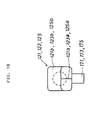
- the tumblers 121, 123 and 125 comprise acuminate members 121a, 123a and 125a, quadrilateral tube-like members 121b, 123b and 125b, and engaging projections 171, 173 and 175, respectively.
- the acuminate members 121 a, 123a and 125a are formed below an axis JC of the quadrilateral members 121 b, 123b and 125b as shown in Fig. 16.
- Dimensions L1 and L2 of the engaging projections 171, 173 and 175 in Fig. 16 are selected from Table 1, No. 1 through No. 3.
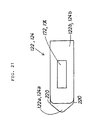
- the tumblers 122 and 124 comprise acuminate members 122a and 124a, quadrilateral tube-like members 122b and 124b, and engaging projections 172 and 174, respectively, as shown in Figs. 19 and 20.
- the acuminate members 122a and 124a are formed above the axis JC of the quadrilateral members 122b and 124b as illustrated in Fig. 20.
- Dimensions L1 and L2 of the engaging projections 172 and 174 in Fig 20 are selected from Table 1, No. 1 through No. 3 shown above.
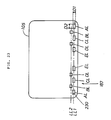
- the card key 105 shown in Fig. 23 changes the projecting portions of the tumblers 121 through 125 inserted into the slider 111.
- the card key 105 is provided with a plurality of holes 187.
- the holes 187 are positioned at points AL, BL, CL, DL and EL in Fig. 23 in accordance with the positions of the tumblers 121 through 125.
- the points AL, CL and EL are provided along a line LL1, and the points BL and DL are along a line LL2.
- the centers of the acuminate members 121a, 123a and 125s are on the line LL1 during engagement with the holes 187.
- the centers of the acuminate members 122a and 124a are on the line LL2 during engagement with the holes 187.
- Dimensions D1 and D2 of the holes 187 are selected from Table 2, No. 1 through No. 3.
- Table 1 and Table 2 are selected for each tumbler, the pre-determined portions of the tumblers project out and the slider 111 can slide in the longitudinal direction.
- At least one of the points AL through EL for the holes 187 is a full hole.
- the acuminate members 121a a through 125a reach the concave member 60 through the full hole, wherein boundary members 220 of the tumblers 121 through 125 in Figs. 15 and 19 abut an inner edge 230 of the full hole in Fig. 23, as in the first embodiment.
- the boundary members 220 are formed between the acuminate members 121 a through 125a and the quadrilateral members 121 and 125b.
- the boundary members 220 abut the card key 105 more vertically in the sliding direction than the acuminate members 121 a through 125a.
- the tumblers 121 through 125 engage with the smaller hole (No. 2 in Table 2), the inner edge 230 of the smaller hole abuts the acuminate members 121 a through 125a. If No.3 in Table 2 is selected for the holes which does not form a hole, the acuminate members 121 a through 125a are not inserted into the card key 105. If No. 2 or No. 3 in Table 2 is selected, the tumblers 121 through 125 does not receive great pushing force in the sliding direction from the card key 105 during sliding of the card key. When No. 2 in Table 2 is selected, the tumblers 121 through 125 receive great pushing force in the direction where the tumblers are pushed into the slider 111.
- the locking device 3 can attain locking or unlocking operation by sliding the card key without stops by a step portion.
- the acuminate members 121a, 123a and 125a are formed in the upper position, and the acuminate members 122a and 124a are in the lower position.
- the tumblers 121 through 125 are placed in a line, but the holes 187 and the acuminate members 121a a through 125a are positioned in two lines. Accordingly, a wider variety of alternatives for unlocking or locking operation can be made in this embodiment than simply selecting from three types of dimensions for five tumblers placed in a line. A locking device difficult to break with simple structure can be thus provided.
- This invention is not limited to the embodiment illustrated and described as above, but can be applied to a wide variety of locking devices.
- the configuration of the card key and the holes, the number of the holes and the tumblers and the like do not have to be the same as in this embodiment.
- pushing force can be adjusted by changing the quality or configuration of the acuminate members of the tumblers, though the pressure is controlled by changing the angle at which the tumblers abuts the edges of the holes of the card key in the instant invention.
- the acuminate members of the tumblers can be positioned in the left or right of the axis of the tumblers instead of the acuminate members the centers of which are positioned along the axis or above or below the axis as in the aforementioned embodiments.
- the acuminate members can be also located on pre-determined area of the front of the tumblers with the front being divided lengthwise and crosswise into a pre-determined number of the pre-determined area.
Landscapes
- Lock And Its Accessories (AREA)
- Purses, Travelling Bags, Baskets, Or Suitcases (AREA)
- Bag Frames (AREA)
- Closures For Containers (AREA)
Applications Claiming Priority (4)
| Application Number | Priority Date | Filing Date | Title |
|---|---|---|---|
| JP67597/90 | 1990-03-16 | ||
| JP6759790 | 1990-03-16 | ||
| JP30991/91 | 1991-02-26 | ||
| JP3030991A JPH04213674A (ja) | 1990-03-16 | 1991-02-26 | 施錠装置 |
Publications (3)
| Publication Number | Publication Date |
|---|---|
| EP0447906A2 true EP0447906A2 (de) | 1991-09-25 |
| EP0447906A3 EP0447906A3 (de) | 1991-10-16 |
| EP0447906B1 EP0447906B1 (de) | 1994-08-03 |
Family
ID=26369451
Family Applications (1)
| Application Number | Title | Priority Date | Filing Date |
|---|---|---|---|
| EP91103649A Expired - Lifetime EP0447906B1 (de) | 1990-03-16 | 1991-03-09 | Schloss, welches mittels einer Karte mit verschiedenen Löchern betätigbar ist |
Country Status (5)
| Country | Link |
|---|---|
| EP (1) | EP0447906B1 (de) |
| AT (1) | ATE109540T1 (de) |
| CA (1) | CA2037759A1 (de) |
| DE (1) | DE69103182T2 (de) |
| MX (1) | MX173355B (de) |
Cited By (4)
| Publication number | Priority date | Publication date | Assignee | Title |
|---|---|---|---|---|
| WO1993008354A1 (en) * | 1991-10-24 | 1993-04-29 | Cardlok Pty. Ltd. | Mechanical card lock |
| WO1998011316A1 (en) * | 1996-09-16 | 1998-03-19 | Assa Ab | A locking device |
| FR2779561A1 (fr) * | 1998-06-09 | 1999-12-10 | Valeo Securite Habitacle | Agencement pour le blocage longitudinal d'un support de donnees rigide dans un dispositif d'echange de donnees |
| CN112012587A (zh) * | 2020-09-15 | 2020-12-01 | 杭州小安物联科技有限公司 | 机柜双控锁 |
Families Citing this family (1)
| Publication number | Priority date | Publication date | Assignee | Title |
|---|---|---|---|---|
| JPH0711208B2 (ja) * | 1991-11-29 | 1995-02-08 | 田村プラスチック製品株式会社 | 施錠装置 |
Family Cites Families (2)
| Publication number | Priority date | Publication date | Assignee | Title |
|---|---|---|---|---|
| FR1010520A (fr) * | 1948-09-04 | 1952-06-12 | Serrure de sûreté | |
| US4754630A (en) * | 1985-12-18 | 1988-07-05 | Kabushiki Kaisha Saikousha | Locking device |
-
1991
- 1991-03-07 CA CA002037759A patent/CA2037759A1/en not_active Abandoned
- 1991-03-09 AT AT91103649T patent/ATE109540T1/de not_active IP Right Cessation
- 1991-03-09 EP EP91103649A patent/EP0447906B1/de not_active Expired - Lifetime
- 1991-03-09 DE DE69103182T patent/DE69103182T2/de not_active Expired - Fee Related
- 1991-03-11 MX MX024850A patent/MX173355B/es unknown
Cited By (6)
| Publication number | Priority date | Publication date | Assignee | Title |
|---|---|---|---|---|
| WO1993008354A1 (en) * | 1991-10-24 | 1993-04-29 | Cardlok Pty. Ltd. | Mechanical card lock |
| WO1998011316A1 (en) * | 1996-09-16 | 1998-03-19 | Assa Ab | A locking device |
| US6220066B1 (en) | 1996-09-16 | 2001-04-24 | Assa Ab | Locking device |
| FR2779561A1 (fr) * | 1998-06-09 | 1999-12-10 | Valeo Securite Habitacle | Agencement pour le blocage longitudinal d'un support de donnees rigide dans un dispositif d'echange de donnees |
| EP0964356A1 (de) * | 1998-06-09 | 1999-12-15 | Valeo Sécurité Habitacle | Anordnung zum longitudinalen Blockieren eines starren Datenträgers in einer Datenaustausch-Vorrichtung |
| CN112012587A (zh) * | 2020-09-15 | 2020-12-01 | 杭州小安物联科技有限公司 | 机柜双控锁 |
Also Published As
| Publication number | Publication date |
|---|---|
| CA2037759A1 (en) | 1991-09-17 |
| EP0447906A3 (de) | 1991-10-16 |
| DE69103182T2 (de) | 1995-03-23 |
| MX173355B (es) | 1994-02-22 |
| DE69103182D1 (de) | 1994-09-08 |
| ATE109540T1 (de) | 1994-08-15 |
| EP0447906B1 (de) | 1994-08-03 |
Similar Documents
| Publication | Publication Date | Title |
|---|---|---|
| US4518212A (en) | Multiple pin electrical plug | |
| US5375444A (en) | Multi-key core lock assembly | |
| CA1161656A (en) | Resettable lock assembly | |
| US3910083A (en) | Combination changing cylinder lock | |
| US7584635B2 (en) | Multifunctional lock | |
| US6932445B2 (en) | Drawer interlocking mechanism | |
| EP0616103A1 (de) | Diebstahlsicherungs-Vorrichtung | |
| EP0447906B1 (de) | Schloss, welches mittels einer Karte mit verschiedenen Löchern betätigbar ist | |
| DE4134812A1 (de) | Behaelter fuer magnetbandkassetten | |
| JPH0833084B2 (ja) | 錠と複数の鍵から成る閉鎖装置 | |
| US3230749A (en) | Key-operated lock | |
| SI9200156A (en) | Locking system consisting of a key and its associated locking cylinder | |
| US3068682A (en) | Padlock with dual blockers | |
| US3978700A (en) | Safe deposit lock construction with changeable tumbler mechanism | |
| JP2022529143A (ja) | スーツケース用ジッパー錠及びスーツケース | |
| US3514981A (en) | Lock box | |
| US3357216A (en) | Combination lock | |
| US3884058A (en) | Key-actuated locks | |
| US4956985A (en) | Combination lock mechanism and method | |
| US4069693A (en) | Cylinder lock assembly | |
| US4043159A (en) | Padlock construction | |
| US3823587A (en) | Key holder | |
| US4526022A (en) | Keylock with resettable, bendable lever tumblers | |
| DE3337829C2 (de) | Banknotenkassette | |
| US3776008A (en) | Removable cylinder for a lockset |
Legal Events
| Date | Code | Title | Description |
|---|---|---|---|
| PUAI | Public reference made under article 153(3) epc to a published international application that has entered the european phase |
Free format text: ORIGINAL CODE: 0009012 |
|
| PUAL | Search report despatched |
Free format text: ORIGINAL CODE: 0009013 |
|
| AK | Designated contracting states |
Kind code of ref document: A2 Designated state(s): AT BE CH DE DK ES FR GB GR IT LI LU NL SE |
|
| AK | Designated contracting states |
Kind code of ref document: A3 Designated state(s): AT BE CH DE DK ES FR GB GR IT LI LU NL SE |
|
| 17P | Request for examination filed |
Effective date: 19920302 |
|
| 17Q | First examination report despatched |
Effective date: 19920717 |
|
| GRAA | (expected) grant |
Free format text: ORIGINAL CODE: 0009210 |
|
| AK | Designated contracting states |
Kind code of ref document: B1 Designated state(s): AT BE CH DE DK ES FR GB GR IT LI LU NL SE |
|
| PG25 | Lapsed in a contracting state [announced via postgrant information from national office to epo] |
Ref country code: NL Effective date: 19940803 Ref country code: LI Effective date: 19940803 Ref country code: GR Free format text: LAPSE BECAUSE OF FAILURE TO SUBMIT A TRANSLATION OF THE DESCRIPTION OR TO PAY THE FEE WITHIN THE PRESCRIBED TIME-LIMIT Effective date: 19940803 Ref country code: ES Free format text: THE PATENT HAS BEEN ANNULLED BY A DECISION OF A NATIONAL AUTHORITY Effective date: 19940803 Ref country code: DK Effective date: 19940803 Ref country code: CH Effective date: 19940803 Ref country code: BE Effective date: 19940803 Ref country code: AT Effective date: 19940803 |
|
| REF | Corresponds to: |
Ref document number: 109540 Country of ref document: AT Date of ref document: 19940815 Kind code of ref document: T |
|
| REF | Corresponds to: |
Ref document number: 69103182 Country of ref document: DE Date of ref document: 19940908 |
|
| ITF | It: translation for a ep patent filed | ||
| PG25 | Lapsed in a contracting state [announced via postgrant information from national office to epo] |
Ref country code: SE Effective date: 19941103 |
|
| REG | Reference to a national code |
Ref country code: CH Ref legal event code: PL |
|
| ET | Fr: translation filed | ||
| NLV1 | Nl: lapsed or annulled due to failure to fulfill the requirements of art. 29p and 29m of the patents act | ||
| PG25 | Lapsed in a contracting state [announced via postgrant information from national office to epo] |
Ref country code: LU Free format text: LAPSE BECAUSE OF NON-PAYMENT OF DUE FEES Effective date: 19950331 |
|
| PLBE | No opposition filed within time limit |
Free format text: ORIGINAL CODE: 0009261 |
|
| STAA | Information on the status of an ep patent application or granted ep patent |
Free format text: STATUS: NO OPPOSITION FILED WITHIN TIME LIMIT |
|
| 26N | No opposition filed | ||
| PGFP | Annual fee paid to national office [announced via postgrant information from national office to epo] |
Ref country code: DE Payment date: 19970122 Year of fee payment: 7 |
|
| PGFP | Annual fee paid to national office [announced via postgrant information from national office to epo] |
Ref country code: GB Payment date: 19970226 Year of fee payment: 7 |
|
| PGFP | Annual fee paid to national office [announced via postgrant information from national office to epo] |
Ref country code: FR Payment date: 19970228 Year of fee payment: 7 |
|
| PG25 | Lapsed in a contracting state [announced via postgrant information from national office to epo] |
Ref country code: GB Free format text: LAPSE BECAUSE OF NON-PAYMENT OF DUE FEES Effective date: 19980309 |
|
| PG25 | Lapsed in a contracting state [announced via postgrant information from national office to epo] |
Ref country code: FR Free format text: THE PATENT HAS BEEN ANNULLED BY A DECISION OF A NATIONAL AUTHORITY Effective date: 19980331 |
|
| GBPC | Gb: european patent ceased through non-payment of renewal fee |
Effective date: 19980309 |
|
| PG25 | Lapsed in a contracting state [announced via postgrant information from national office to epo] |
Ref country code: DE Free format text: LAPSE BECAUSE OF NON-PAYMENT OF DUE FEES Effective date: 19981201 |
|
| REG | Reference to a national code |
Ref country code: FR Ref legal event code: ST |
|
| PG25 | Lapsed in a contracting state [announced via postgrant information from national office to epo] |
Ref country code: IT Free format text: LAPSE BECAUSE OF NON-PAYMENT OF DUE FEES;WARNING: LAPSES OF ITALIAN PATENTS WITH EFFECTIVE DATE BEFORE 2007 MAY HAVE OCCURRED AT ANY TIME BEFORE 2007. THE CORRECT EFFECTIVE DATE MAY BE DIFFERENT FROM THE ONE RECORDED. Effective date: 20050309 |