EP0447200B1 - Hohe Geschwindigkeitsluftreifen für LKW - Google Patents
Hohe Geschwindigkeitsluftreifen für LKW Download PDFInfo
- Publication number
- EP0447200B1 EP0447200B1 EP91302098A EP91302098A EP0447200B1 EP 0447200 B1 EP0447200 B1 EP 0447200B1 EP 91302098 A EP91302098 A EP 91302098A EP 91302098 A EP91302098 A EP 91302098A EP 0447200 B1 EP0447200 B1 EP 0447200B1
- Authority
- EP
- European Patent Office
- Prior art keywords
- tyre
- carcass
- bead
- cords
- less
- Prior art date
- Legal status (The legal status is an assumption and is not a legal conclusion. Google has not performed a legal analysis and makes no representation as to the accuracy of the status listed.)
- Expired - Lifetime
Links
Images

Classifications
-
- B—PERFORMING OPERATIONS; TRANSPORTING
- B60—VEHICLES IN GENERAL
- B60C—VEHICLE TYRES; TYRE INFLATION; TYRE CHANGING; CONNECTING VALVES TO INFLATABLE ELASTIC BODIES IN GENERAL; DEVICES OR ARRANGEMENTS RELATED TO TYRES
- B60C9/00—Reinforcements or ply arrangement of pneumatic tyres
- B60C9/02—Carcasses
- B60C9/04—Carcasses the reinforcing cords of each carcass ply arranged in a substantially parallel relationship
- B60C9/08—Carcasses the reinforcing cords of each carcass ply arranged in a substantially parallel relationship the cords extend transversely from bead to bead, i.e. radial ply
-
- B—PERFORMING OPERATIONS; TRANSPORTING
- B60—VEHICLES IN GENERAL
- B60C—VEHICLE TYRES; TYRE INFLATION; TYRE CHANGING; CONNECTING VALVES TO INFLATABLE ELASTIC BODIES IN GENERAL; DEVICES OR ARRANGEMENTS RELATED TO TYRES
- B60C15/00—Tyre beads, e.g. ply turn-up or overlap
- B60C15/0009—Tyre beads, e.g. ply turn-up or overlap features of the carcass terminal portion
- B60C15/0018—Tyre beads, e.g. ply turn-up or overlap features of the carcass terminal portion not folded around the bead core, e.g. floating or down ply
-
- B—PERFORMING OPERATIONS; TRANSPORTING
- B60—VEHICLES IN GENERAL
- B60C—VEHICLE TYRES; TYRE INFLATION; TYRE CHANGING; CONNECTING VALVES TO INFLATABLE ELASTIC BODIES IN GENERAL; DEVICES OR ARRANGEMENTS RELATED TO TYRES
- B60C15/00—Tyre beads, e.g. ply turn-up or overlap
- B60C15/0009—Tyre beads, e.g. ply turn-up or overlap features of the carcass terminal portion
- B60C15/0072—Tyre beads, e.g. ply turn-up or overlap features of the carcass terminal portion with ply reverse folding, i.e. carcass layer folded around the bead core from the outside to the inside
-
- B—PERFORMING OPERATIONS; TRANSPORTING
- B60—VEHICLES IN GENERAL
- B60C—VEHICLE TYRES; TYRE INFLATION; TYRE CHANGING; CONNECTING VALVES TO INFLATABLE ELASTIC BODIES IN GENERAL; DEVICES OR ARRANGEMENTS RELATED TO TYRES
- B60C15/00—Tyre beads, e.g. ply turn-up or overlap
- B60C15/06—Flipper strips, fillers, or chafing strips and reinforcing layers for the construction of the bead
-
- B—PERFORMING OPERATIONS; TRANSPORTING
- B60—VEHICLES IN GENERAL
- B60C—VEHICLE TYRES; TYRE INFLATION; TYRE CHANGING; CONNECTING VALVES TO INFLATABLE ELASTIC BODIES IN GENERAL; DEVICES OR ARRANGEMENTS RELATED TO TYRES
- B60C2200/00—Tyres specially adapted for particular applications
- B60C2200/02—Tyres specially adapted for particular applications for aircrafts
Definitions
- the present invention relates to a high speed heavy duty tyre.
- the bead portions are subjected to a large bending deformation under heavy load conditions, and the internal temperature of the bead portion is greatly increased by high speed running during take-off and landing. These cause bead damage, e.g. separation failure between the adjacent plies and between reinforcement cords and the surrounding rubber.
- a known tyre comprising the features of the preamble of claim 1 is shown, e.g. in EP-A-0 323 208.
- the inventors discovered that the distances between the adjacent carcass cords located in the bead portion and the lower sidewall portion have an unexpected influence on bead damage.
- a tyre for high speed and heavy duty use comprises a pair of bead portions, a tread portion, a pair of sidewall portions extending between the tread edges and the bead portions, a pair of bead cores disposed one in each portion, a radial carcass having at least one ply of rubberised cords extending between the bead portions and turned up around the bead cores, a tread disposed radially outside the carcass and a belt layer disposed radially outside the carcass and inside said tread, characterised in that when the tyre is mounted on its regular rim and inflated to its regular inner pressure, at least 60% of the spacings in number between the adjacent carcass cords located in a tyre side portion defined between two points P1 and P2 are not less than 1/4 times and not more than 2 times the thickness D of the carcass cords, wherein the point P1 is located on the outer surface of the tyre at a height corresponding to the height of a rim f
- the tyre 1 is shown mounted on its regular rim R and inflated to its regular inner pressure. This condition is hereinafter referred to as the "normal pressure condition”.
- the tyre 1 has a pair of axially spaced bead portions 3, a tread portion 5, and a pair of sidewall portions 4 extending between the tread edges and the bead portions 3.
- the tyre further comprises a pair of bead cores 2 disposed one in each bead portion 3, a carcass 7 extending between the bead portions through the sidewall portions 4 and the tread portion 5.
- the rim R comprises a pair of tapered bead sets Ra and a pair of flanges Rb extending radially outwardly from the axially outer edges of the bead seats Ra.
- the bottom face 3a and side face 3b of each bead portion 3 contact the bead seat Ra and the flange Rb of the rim, respectively.
- the carcass 7 comprises a plurality of plies of rubberised cords extending between the bead portions and turned up around the bead cores.
- the carcass is composed of two layers 7A and 7B, wherein the inner layer 7A is composed of plural plies 7a (in this example 4 plies) turned up around the bead cores 2 from the inside to the outside of the tyre, and the outer layer 7B is composed of plural plies 7b (in this example 2 plies) turned up in the reverse direction around the bead cores from the outside to the inside of the tyre to wrap around the turned up portion of the inner layer 7A.
- the inner layer 7A is composed of plural plies 7a (in this example 4 plies) turned up around the bead cores 2 from the inside to the outside of the tyre
- the outer layer 7B is composed of plural plies 7b (in this example 2 plies) turned up in the reverse direction around the bead cores from the outside to the inside of the tyre to wrap around the turned up portion of the inner layer 7A.
- Each carcass ply 7a of the inner layer has a toroidal main portion 70 extending between the bead portions 3 through the sidewall portions 4 and the tread portion 5, and turned up around the bead cores 2 from the axially inside to the outside thereof to form turned up portions 71.
- Each carcass ply 7b of the outer layer has a toroidal main portion 73 extending between the bead portions 3 through the sidewall portions 4 and the tread portion 5, and turned up around the bead cores 2 from the axially outside to the inside thereof to form turned up portions 74.
- the carcass cords 6 are arranged radially at an angle of 70 to 90 degrees with respect to the tyre equator and embedded in a tapping rubber compound 8.
- the cords of one carcass ply are inclined towards one side of the tyre equator, and the cords of the other carcass ply are inclined towards the other side of the tyre equator, so that the carcass cords in each ply cross the cords of the adjacent carcass ply.
- organic fibre cords e.g. rayon, polyester, VINYLON (Trade Mark), nylon, aromatic polyamide or the like can be used.
- Each bead portion 3 is provided with a bead apex 9 between the above-mentioned main portion 70 and the turned up portion 71.
- the bead apex 9 extends taperingly radially outwardly from the bead core 2 to a position over the radially outer edge of the rim flange Rb.
- a belt layer 10 is disposed radially outside the carcass 7 and radially inside the rubber tread 5.
- the belt layer 10 is composed of a plurality of plies 10a (in this example eight plies).
- the axially outer edges of the belt plies are aligned so that each edge of the belt layer 10 is substantially parallel with the outer surface of the tyre.
- the belt layer 10 has a width of 70 to 85% of the tyre section width so as to tightly bind the carcass to increase the rigidity of the tyre and thereby to improve the running performance.
- the cords of each belt ply 10a are laid at an angle of 0 to 20 degrees with respect to the tyre equator and in parallel with each other.
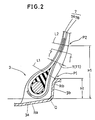
- the distances between the adjacent cords 6 are specifically defined in a specific portion 12 defined by a point P1 and a point P2.
- This portion 12 is a portion in which a large bending deformation occurs when in the ground contacting patch of the tyre and thus this portion is where damage is most liable to occur.
- the above-mentioned point P1 is located on the outer surface of the tyre at a height h1 corresponding to the height of the rim flange Rb, and the point P2 is located on the outer surface of the tyre at a height H1 of 1/3 times the tyre section height H.
- Both the above-mentioned heights are measured radially from a heel point Q which is defined as the intersection between an extension line of the bead bottom face 3a and an extension line of the bead side face 3b.
- the above-mentioned portion 12 is defined as being between a straight line L1 drawn perpendicularly to the outer surface of the tyre from the point P1 and a straight line L2 drawn perpendicularly to the outer surface of the tyre from the point P2.
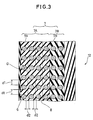
- the distances between the adjacent carcass cords are set to be not less than 1/4 times and not more than 2 times the thickness D of the carcass cords, whereby the shear strain caused between the carcass cords and between the carcass plies by bent deformation is mitigated by the rubber existing between the carcass cords, that is, the carcass rubber 8, and as a result rubber breakage and cord separation failure are prevented, and durability is improved.
- the above-mentioned regulation of the distances d1 and d2 must be met by at least 60% or more of the number of the distances d1 and d2, preferably not less than 80%, and more preferably not less than 90% of the number of the distances.
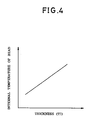
- the thickness T of the portion 12 is excessively increased, and as a result the internal temperature thereof is increased by the bending deformation which decreases bead durability.
- Figure 4 shows a relationship between the thickness T1 of the lower sidewall portion 12 measured at a height of 1/5 times the tyre section height H from the above-mentioned heel point Q and the internal temperature during high speed running. As apparent from the Figure, the internal temperature is increased roughly in direct proportion to an increase in the thickness T.
- those adjacent plies include all possible combinations, for example the main portions 70 and 70, the main portions 70 and 73, the main portions 73 and 73, the turned up portions 71 and 71, the main portions 70 and the turned up portion 71, and the main portions 73 and the turned up portion 71.
- the 100% modulus is not less than 40 kg/cm2 and not more than 70 kg/cm2; the elongation at rupture is not less than 200% and not more than 350%; and the stress at rupture is not less than 150 kg/cm2 and not more than 300 kg/cm2.
- the carcass rubber has a higher strength in comparison with a known low heat generation rubber compound, and the durability is improved.
- 100% modulus is made less than 40 kg/cm2, when the elongation at rupture is more than 350%, or when the stress at rupture is more than 300 kg/cm2, heat generation increases, and high speed durability of the bead portion is apt to be decreased.
- the 100% modulus is more than 70 kg/cm2, when the elongation at rupture is less than 200%, or when the stress at rupture is less than 150 kg/cm2, the strength of the rubber becomes insufficient, and a decrease in the bead durability by rubber breakage is liable to occur.
- the 100% modulus is 45 to 55 kg/cm2
- the elongation at rupture is 280 to 340%
- the stress at rupture is 200 to 250 kg/cm2.
- Test tyres of size 46x17R20 for aircraft having the tyre construction shown in Figure 1 were made and tested for bead durability.
- Table 2 shows the components and properties of the carcass rubbers A, B and C shown in Table 1.
- the high speed durability test was the overload take-off 100 cycle test, with a 150% load of the normal tyre load, in accordance with Technical Standard Order TSO-C62c of the Federal Aviation Administration in USA.
- the heat generation index in Table 1 is the above-mentioned difference, that is the increase in temperature during the test divided by the temperature before the test.
- the test was run at a speed of 11 Km/h under a 120% load of the normal tyre load, and the running distance to bead damage was measured. Alternatively, when the total running distance reached 3000 km, the test was finished.
- carbon having a mean particle diameter of HAF or ISAF grade and a surface coverage to iodine of 70 to 130 mg/g was used.
- accelerator For the accelerator, one of the following accelerators or a combination of at least two of the following accelerators can be used:
- the carcass in the specific portion is specifically defined in respect of the cord spacings and the rubber properties whereby the carcass rubber is prevented from being broken, and both high speed durability and low speed durability of the bead are greatly improved.
Landscapes
- Engineering & Computer Science (AREA)
- Mechanical Engineering (AREA)
- Tires In General (AREA)
Claims (5)
- Ein Reifen für Hochgeschwindigkeits- und Schwerlastverwendung mit einem Paar von Wulstteilen (3), einem Laufflächenteil (5), einem Paar von sich zwischen den Laufflächenrändern und den Wulstteilen (3) erstreckenden Seitenwandteilen (4), einem Paar von Wulstkernen (2), wovon einer in jedem Teil (3) angeordnet ist, einer radialen Karkasse (7) mit zumindest einer Lage von gummierten Corden, die sich zwischen den Wulstteilen (3) erstrecken und um die Wulstkerne (2) geschlagen sind, einer Lauffläche (5), die radial außerhalb der Karkasse (7) angeordnet ist, und einer Gürtellage (10), die radial außerhalb der Karkasse (7) und innerhalb der Lauffläche (8) angeordnet ist,
dadurch gekennzeichnet,
daß, wenn der Reifen auf seiner regulären Felge aufgezogen und zu seinem regulären inneren Druck aufgepumpt ist, zumindest 60 % der Beabstandungen (d1, d2) an der Zahl zwischen den benachbarten Karkassencorden (6), die in einem Reifenseitenteil (3) angeordnet sind, das zwischen zwei Punkten P1 und P2 festgelegt ist, nicht weniger als ein 1/4 mal und nicht mehr als 2 mal die Dicke D der Karkassencorde betragen, worin der Punkt P1 auf der äußeren Oberfläche des Reifens bei einer Höhe entsprechend der Höhe eines Felgenflansches Rb angeordnet ist und der Punkt P2 auf der äußeren Oberfläche des Reifens bei einer Höhe von 1/3 mal der Reifenquerschnittshöhe H angeordnet ist, und das Karkassencord überziehende Gummi die folgenden Eigenschaften aufweist: ein 100 % Modul von nicht weniger als 40 kg/cm² und nicht mehr als 70 kg/cm², eine Bruchdehnung von nicht weniger als 200 % und nicht mehr als 350 %, und eine Bruchspannung von nicht weniger als 150 kg/cm² und nicht mehr als 300 kg/cm². - Ein Reifen nach Anspruch 1,
dadurch gekennzeichnet,
daß der 100 % Modul des Karkassencord überziehenden Gummis 45 bis 55 kg/cm² beträgt, die Bruchdehnung davon 280 bis 340 % beträgt, und weiter die Bruchspannung davon bei 200 bis 250 kg/cm² liegt. - Ein Reifen nach Anspruch 1 oder 2,
dadurch gekennzeichnet,
daß in der oder jeder Karkassenlage (7) die Dicke des Überzugsgummis gemessen von der Oberfläche der Karkassencorde in dem Bereich von 1/8 bis 1 mal die Dicke der Karkassencorden liegt. - Ein Reifen nach Anspruch 1, 2 oder 3,
dadurch gekennzeichnet,
daß zumindest 80 % der Beabstandungen an der Zahl aller der Beabstandungen (d1, d2), die in dem Reifenseitenteil vorliegen, das zwischen den zwei Punkten (P1 und P2) festgelegt ist, nicht weniger als 1/4 mal und nicht mehr als 2 mal die Dicke (D) der Karkassencorde betragen. - Ein Reifen nach Anspruch 1, 2 oder 3,
dadurch gekennzeichnet,
daß alle der Beabstandungen (d1, d2) zwischen den benachbarten Karkassencorden (6) in dem Reifenseitenteil, das zwischen den zwei Punkten (P1 und P2) festgelegt ist, nicht weniger als 1/4 mal und nicht mehr als 2 mal die Dicke (D) der Karkassencorden betragen.
Applications Claiming Priority (2)
| Application Number | Priority Date | Filing Date | Title |
|---|---|---|---|
| JP2067452A JPH0481301A (ja) | 1990-03-16 | 1990-03-16 | 高速重荷重用タイヤ |
| JP67452/90 | 1990-03-16 |
Publications (3)
| Publication Number | Publication Date |
|---|---|
| EP0447200A2 EP0447200A2 (de) | 1991-09-18 |
| EP0447200A3 EP0447200A3 (en) | 1992-01-22 |
| EP0447200B1 true EP0447200B1 (de) | 1994-10-12 |
Family
ID=13345335
Family Applications (1)
| Application Number | Title | Priority Date | Filing Date |
|---|---|---|---|
| EP91302098A Expired - Lifetime EP0447200B1 (de) | 1990-03-16 | 1991-03-13 | Hohe Geschwindigkeitsluftreifen für LKW |
Country Status (3)
| Country | Link |
|---|---|
| EP (1) | EP0447200B1 (de) |
| JP (1) | JPH0481301A (de) |
| DE (1) | DE69104521T2 (de) |
Families Citing this family (5)
| Publication number | Priority date | Publication date | Assignee | Title |
|---|---|---|---|---|
| US5547005A (en) * | 1991-11-05 | 1996-08-20 | Sumitomo Rubber Industries, Ltd. | Radial tire with enhanced bead durability |
| JPH06156028A (ja) * | 1992-11-24 | 1994-06-03 | Bridgestone Corp | 航空機用ラジアルタイヤ |
| US6648041B2 (en) * | 2001-08-31 | 2003-11-18 | The Goodyear Tire & Rubber Company | Aircraft tire with improved bead structure |
| WO2010122803A1 (ja) * | 2009-04-22 | 2010-10-28 | 株式会社ブリヂストン | 航空機用タイヤ |
| CN103009932B (zh) * | 2012-12-18 | 2015-11-18 | 中橡集团曙光橡胶工业研究设计院 | 能够降低界面剪切应力提高胎圈耐久性的子午线航空轮胎 |
Family Cites Families (8)
| Publication number | Priority date | Publication date | Assignee | Title |
|---|---|---|---|---|
| JPS5222202A (en) * | 1975-08-12 | 1977-02-19 | Bridgestone Corp | Radial tire for high load |
| JPS562203A (en) * | 1979-06-21 | 1981-01-10 | Unitika Ltd | Tire cord reed woven material |
| JPS5639901A (en) * | 1979-09-04 | 1981-04-15 | Bridgestone Corp | Lightweight tire body of coarse thread with improved life against fatigue |
| JPS5711240A (en) * | 1980-06-16 | 1982-01-20 | Toyo Tire & Rubber Co | Tire fabric and radial tire using same |
| JPS6056642A (ja) * | 1983-09-06 | 1985-04-02 | Tachikawa Spring Co Ltd | シ−トリフタ |
| JPS63284005A (ja) * | 1987-05-15 | 1988-11-21 | Bridgestone Corp | 重荷重用空気入りラジアルタイヤ |
| JP2678023B2 (ja) * | 1988-08-16 | 1997-11-17 | 住友ゴム工業 株式会社 | 航空機用ラジアルタイヤ |
| EP0323208B1 (de) * | 1987-12-29 | 1992-02-26 | Sumitomo Rubber Industries Limited | Gürtelreifen für LKW |
-
1990
- 1990-03-16 JP JP2067452A patent/JPH0481301A/ja active Pending
-
1991
- 1991-03-13 DE DE69104521T patent/DE69104521T2/de not_active Expired - Lifetime
- 1991-03-13 EP EP91302098A patent/EP0447200B1/de not_active Expired - Lifetime
Also Published As
| Publication number | Publication date |
|---|---|
| DE69104521T2 (de) | 1995-03-02 |
| JPH0481301A (ja) | 1992-03-16 |
| DE69104521D1 (de) | 1994-11-17 |
| EP0447200A2 (de) | 1991-09-18 |
| EP0447200A3 (en) | 1992-01-22 |
Similar Documents
| Publication | Publication Date | Title |
|---|---|---|
| EP0206679B1 (de) | Wulstverstärkung für LKW-Reifen | |
| US6427743B1 (en) | Pneumatic tire | |
| US7950430B2 (en) | Pneumatic aviation tire | |
| EP2133218B1 (de) | Flugzeugradialreifen | |
| EP0798139B1 (de) | Luftreifen | |
| US6648041B2 (en) | Aircraft tire with improved bead structure | |
| US5538063A (en) | Aircraft tire with reinforcement insert | |
| EP2055508B1 (de) | Pneumatischer Reifen mit erhöhter Haltbarkeit im unterem Bereich der Seitenwand | |
| US8695666B2 (en) | Pneumatic tire | |
| EP0884200B1 (de) | Radiale LKW-Reifen | |
| US5522443A (en) | High speed heavy duty tire and rim assembly whose tire includes a buffer layer in each bead portion | |
| EP0844109B1 (de) | LKW-Radialreifen | |
| CN102421610A (zh) | 包括两种增强材料的增强件和包括该增强件的轮胎 | |
| EP0447200B1 (de) | Hohe Geschwindigkeitsluftreifen für LKW | |
| EP0698513B1 (de) | Radialer Luftreifen | |
| US5205882A (en) | Heavy duty high speed radial tire with aromatic polyamide belt cords | |
| EP0435621B1 (de) | Hochgeschwindigkeitsreifen für Schwerlastfahrzeuge | |
| EP0470835A2 (de) | Radialer Luftreifen | |
| EP0423997B1 (de) | Luftreifen | |
| JP3081732B2 (ja) | 高速重荷重用ラジアルタイヤ | |
| EP4249289B1 (de) | Luftreifen für flugzeuge | |
| US20230064368A1 (en) | Pneumatic aviation tire | |
| US20230406042A1 (en) | Pneumatic Tire for Aircraft | |
| WO1998056605A1 (en) | Aircraft tire with embedded breaker plies |
Legal Events
| Date | Code | Title | Description |
|---|---|---|---|
| PUAI | Public reference made under article 153(3) epc to a published international application that has entered the european phase |
Free format text: ORIGINAL CODE: 0009012 |
|
| AK | Designated contracting states |
Kind code of ref document: A2 Designated state(s): DE FR GB |
|
| PUAL | Search report despatched |
Free format text: ORIGINAL CODE: 0009013 |
|
| AK | Designated contracting states |
Kind code of ref document: A3 Designated state(s): DE FR GB |
|
| 17P | Request for examination filed |
Effective date: 19920504 |
|
| 17Q | First examination report despatched |
Effective date: 19940301 |
|
| GRAA | (expected) grant |
Free format text: ORIGINAL CODE: 0009210 |
|
| AK | Designated contracting states |
Kind code of ref document: B1 Designated state(s): DE FR GB |
|
| REF | Corresponds to: |
Ref document number: 69104521 Country of ref document: DE Date of ref document: 19941117 |
|
| ET | Fr: translation filed | ||
| PLBE | No opposition filed within time limit |
Free format text: ORIGINAL CODE: 0009261 |
|
| STAA | Information on the status of an ep patent application or granted ep patent |
Free format text: STATUS: NO OPPOSITION FILED WITHIN TIME LIMIT |
|
| 26N | No opposition filed | ||
| REG | Reference to a national code |
Ref country code: GB Ref legal event code: IF02 |
|
| PGFP | Annual fee paid to national office [announced via postgrant information from national office to epo] |
Ref country code: FR Payment date: 20100324 Year of fee payment: 20 |
|
| PGFP | Annual fee paid to national office [announced via postgrant information from national office to epo] |
Ref country code: GB Payment date: 20100310 Year of fee payment: 20 |
|
| PGFP | Annual fee paid to national office [announced via postgrant information from national office to epo] |
Ref country code: DE Payment date: 20100415 Year of fee payment: 20 |
|
| REG | Reference to a national code |
Ref country code: DE Ref legal event code: R071 Ref document number: 69104521 Country of ref document: DE |
|
| REG | Reference to a national code |
Ref country code: GB Ref legal event code: PE20 Expiry date: 20110312 |
|
| PG25 | Lapsed in a contracting state [announced via postgrant information from national office to epo] |
Ref country code: GB Free format text: LAPSE BECAUSE OF EXPIRATION OF PROTECTION Effective date: 20110312 |
|
| PG25 | Lapsed in a contracting state [announced via postgrant information from national office to epo] |
Ref country code: DE Free format text: LAPSE BECAUSE OF EXPIRATION OF PROTECTION Effective date: 20110313 |