EP0444724A2 - Kunststoffgranulat mit nichtdispergierten Verstärkungsfaserbündeln - Google Patents
Kunststoffgranulat mit nichtdispergierten Verstärkungsfaserbündeln Download PDFInfo
- Publication number
- EP0444724A2 EP0444724A2 EP91200143A EP91200143A EP0444724A2 EP 0444724 A2 EP0444724 A2 EP 0444724A2 EP 91200143 A EP91200143 A EP 91200143A EP 91200143 A EP91200143 A EP 91200143A EP 0444724 A2 EP0444724 A2 EP 0444724A2
- Authority
- EP
- European Patent Office
- Prior art keywords
- fibre bundles
- plastic
- plastic granulate
- fibres
- granulate
- Prior art date
- Legal status (The legal status is an assumption and is not a legal conclusion. Google has not performed a legal analysis and makes no representation as to the accuracy of the status listed.)
- Granted
Links
Images
Classifications
-
- B—PERFORMING OPERATIONS; TRANSPORTING
- B29—WORKING OF PLASTICS; WORKING OF SUBSTANCES IN A PLASTIC STATE IN GENERAL
- B29B—PREPARATION OR PRETREATMENT OF THE MATERIAL TO BE SHAPED; MAKING GRANULES OR PREFORMS; RECOVERY OF PLASTICS OR OTHER CONSTITUENTS OF WASTE MATERIAL CONTAINING PLASTICS
- B29B9/00—Making granules
- B29B9/12—Making granules characterised by structure or composition
- B29B9/14—Making granules characterised by structure or composition fibre-reinforced
-
- Y—GENERAL TAGGING OF NEW TECHNOLOGICAL DEVELOPMENTS; GENERAL TAGGING OF CROSS-SECTIONAL TECHNOLOGIES SPANNING OVER SEVERAL SECTIONS OF THE IPC; TECHNICAL SUBJECTS COVERED BY FORMER USPC CROSS-REFERENCE ART COLLECTIONS [XRACs] AND DIGESTS
- Y10—TECHNICAL SUBJECTS COVERED BY FORMER USPC
- Y10T—TECHNICAL SUBJECTS COVERED BY FORMER US CLASSIFICATION
- Y10T428/00—Stock material or miscellaneous articles
- Y10T428/26—Web or sheet containing structurally defined element or component, the element or component having a specified physical dimension
- Y10T428/269—Web or sheet containing structurally defined element or component, the element or component having a specified physical dimension including synthetic resin or polymer layer or component
-
- Y—GENERAL TAGGING OF NEW TECHNOLOGICAL DEVELOPMENTS; GENERAL TAGGING OF CROSS-SECTIONAL TECHNOLOGIES SPANNING OVER SEVERAL SECTIONS OF THE IPC; TECHNICAL SUBJECTS COVERED BY FORMER USPC CROSS-REFERENCE ART COLLECTIONS [XRACs] AND DIGESTS
- Y10—TECHNICAL SUBJECTS COVERED BY FORMER USPC
- Y10T—TECHNICAL SUBJECTS COVERED BY FORMER US CLASSIFICATION
- Y10T428/00—Stock material or miscellaneous articles
- Y10T428/29—Coated or structually defined flake, particle, cell, strand, strand portion, rod, filament, macroscopic fiber or mass thereof
- Y10T428/2913—Rod, strand, filament or fiber
-
- Y—GENERAL TAGGING OF NEW TECHNOLOGICAL DEVELOPMENTS; GENERAL TAGGING OF CROSS-SECTIONAL TECHNOLOGIES SPANNING OVER SEVERAL SECTIONS OF THE IPC; TECHNICAL SUBJECTS COVERED BY FORMER USPC CROSS-REFERENCE ART COLLECTIONS [XRACs] AND DIGESTS
- Y10—TECHNICAL SUBJECTS COVERED BY FORMER USPC
- Y10T—TECHNICAL SUBJECTS COVERED BY FORMER US CLASSIFICATION
- Y10T428/00—Stock material or miscellaneous articles
- Y10T428/29—Coated or structually defined flake, particle, cell, strand, strand portion, rod, filament, macroscopic fiber or mass thereof
- Y10T428/2982—Particulate matter [e.g., sphere, flake, etc.]
Definitions
- the invention relates to a plastic granulate containing non-dispersed reinforcing fibre bundles.
- Such a plastic granulate is known from US-A-4169186.
- a plastic granulate is described in which non-dispersed glass fibre bundles are present.
- the glass fibre bundles in the granulate are all of them oriented parallel to the longitudinal axis of the granulate. Round the glass fibre bundle an extra coating of oriented material has been applied to improve the compatibility with the plastic with which the glass fibre bundles are mixed.
- the glass fibre bundles are put in the extruder by means of a long strand, with the plastic melting all around, at a temperature which at least equals the processing temperature of the plastic.
- the strand of glass fibre bundles and plastic is subsequently pulled from the extruder via pultrusion, cooled and granulated.
- the plastic In order to be able to apply this production technique, the plastic must have a low melt viscosity.
- a disadvantage of such a granulate is that the glass fibre in a bundle must also be coated itself to allow it to be dispersed properly in its incorporation in an endproduct.
- Another disadvantage is the strict parallel orientation in respect of the longitudinal axis of the granulate, which requires a complex technique for the production of the plastic granulate.
- the object of the invention is to provide a plastic granulate, and a process for this purpose, that does not have said disadvantages.
- the plastic granulate according to the invention is characterized in that the granulate consists of granules incorporating 0.1-50% (vol) fibre bundles, with random three-dimensional orientation of the fibre bundles in a granule.
- the glass fibre bundles preferably have an amount of glass fibres of at least 100 fibres to the bundle. Preferably 200-5000, more specifically 400-1000.
- a random three-dimensional orientation of fibre bundles in a granule provides granules with fibre bundles substantially not parallel to the longitudinal axis of the granule.
- the plastic granulate according to the invention is further characterized in that the granulate has a maximum degree of dispersion of 0.10. In case the degree of dispersion exceeds 0.10, the degree of dispersion is considered to be very poor. Preferably, the degree of dispersion is 0.04 at most, more specifically 0.02 at most.
- the degree of dispersion is defined as the reciprocal value of the volume fraction (V v ) occupied by fibre bundles in a granule.
- This volume fraction (V v ) is expressed as a percentage of a granule, measured via the threshold value method. Since the volume fraction occupied by fibre bundles, measured via the threshold value method, is 100% at most, the minimal degree of dispersion is 0.01.
- the threshold value method consists in the determination of V v by means of digital picture processing and picture analysis. In order to obtain a reliable indication of V v . the granules are moulded to form a plate.
- a picture of a moulded plate is converted into a matrix with a great many dots, using a video camera and a digital converter.
- a picture is converted into a (256 x 256) matrix of dots. Every dot is given a discrete value corresponding with the intensity of light in the starting picture; for instance, black will be 0, white will be 255, and intermediate intensities are divided pro rata.
- the principle of this method is described in A. Rosenfeld, A.C. Kak, 'Digital Picture Processing', vols 1 (chapter 4) and 2 (chapter 10) (1982).
- the chosen threshold value is in between 50 and 200, more specifically in between 80 and 160.
- the chosen threshold value is determined by the amount of fibres present per mm 2 of surface. This threshold value must be such that the surface occupied by fibres is at least 5% of the total surface. Preferably at least 10%.
- the number of fibres may range in this connection from 100-25000 fibres per mm 2 cross section, with a fibre diameter of 2-24 ⁇ m. If the amount of fibres per mm 2 cross section is lower than 100, the difference in light intensity between the starting picture and areas in which no or hardly any fibres are present will be too small to make a proper distinction.
- any reinforcing fibre can be used as long as the fibre is available in a fibre bundle.
- Such fibres are carbon fibres, aramide fibres, wollastonite fibres and glass fibres.
- the invention is particularly suited for the use of glass fibres as reinforcing material in plastic.
- the glass fibre bundle used may be any commercially available glass fibre bundle.
- the plastic granulate according to the invention is particularly suited if glass fibres are used having a length of between 2-15 mm. More particularly 4.5-10 mm.
- the glass fibre bundles may be provided with an extra coating to improve the adhesion to the plastic to be mixed with it, but this is not strictly necessary.
- the plastic in the granulate according to the invention is a thermoplastic polymer composition. It includes polyolefins, particularly homopolymers and copolymers of propylene and ethylene; copolymers, particularly styrene acrylonitrile and styrene maleic anhydride copolymers; nylon; polyphenylene oxides; polyphenylene oxide polystyrene mixtures; polyphenylene sulphides; polyacetals; polysulphones; polycarbonates; polyurethanes; cellulose esters; amorphous and/or crystalline polyesters, for instance polyethylene terephthalate, polyoxybenzoyl polyesters; polymonochlorostyrene; acryl polymers; polyvinyl chlorides; polyvinylidene chlorides; copolymers of vinyl chloride and vinylidene chloride; various elastomers, for instance (graft)copolymers based on styrene and butadiene or ethylene and propylene
- the invention also comprises the process by which the plastic granulate according to the invention is obtained.
- the process is characterized in that the fibre bundles and the plastic are mixed with each other at a relatively low shearing stress, the temperature at the place where the fibre bundles are dosed to the mixing device being below the processing temperature of the plastic.
- the processing temperature is dependent on the plastic that is used, and is obvious for a person skilled in the art.
- a granule is obtained with a degree of dispersion lower than 0.10 in which fibre bundles do not fall apart, but are ultimately to be found showing random orientation.
- melt viscosity of the plastic used is an important parameter. It has been found that in the process according to the invention this parameter is not so important.
- EP-A-170245 plastic granulates are described obtained from pultruded plastic-coated glass fibre strands.
- Example 4 of EP-A-170245 describes a glass-filled polypropylene granulate in the preparation of which it is necessary to substantially reduce the melt viscosity of the polypropylene to be used before it can be processed. The process according to the invention does not have this disadvantage.
- pultrusion processes are very expensive techniques, which may inhibit their commercialization.
- the mixing device used is preferably a single or contra-rotating twin-screw extruder, optionally provided with a progressive core screw.
- Moulding compounds wholly or partly produced from the plastic granulate according to the invention have excellent properties both in the processing direction and perpendicular thereto. This makes the plastic granulate according to the invention perfectly suited for being converted into fibre-reinforced end-products.
- the moulding compounds can be obtained from the granules according to the invention using the known processing techniques, for instance injection moulding.
- injection moulding the bundles will fall apart into fibres that will disperse in the plastic matrix.
- good properties are obtained in a final moulding compound.
- the usual additives can be added, for instance stabilizers, pigments, lubricants and organic and/or inorganic fillers.
- compositions were extruded of polypropylene, having a melt index of 3.5 or 18 (being Stamylan P, PHC 22 resp. Stamylan P, 19 MN 10), together with glass fibre bundles.
- the glass fibre bundles (Silenka 8045 and 8394) are 4.5 mm long and have about 600 fibres in one bundle.
- T1 is the inlet temperature
- T2 the temperature just before the devolatilizing opening. After this opening there are two temperature zones, having temperatures T3 and T4; the temperature at the extruder head is T5.
- the processing temperature of polypropylene is 240°C.
- the softening temperature is 168°C.
- the strand coming from the extruder was cooled in a water vessel and cut to granules having a length of 6 mm.
- Granules obtained by applying the processes mentioned in table 1 were processed to form plates (65 x 65 x 3.2 cm3) using an Arburg injection moulding machine.
- the plates were characterized for impact strength (Izod ISO 180) and modulus of elasticity (ASTM D 790).
- test plates were moulded and analyzed by means of digital picture processing.
- the surface fraction occupied by fibre bundles was determined. This surface fraction is the same on average as the volume fraction (V v ) sought.
- the test was carried out five times. The same test was carried out with granules obtained with Verton R granules (as also was used in comparative experiment A).
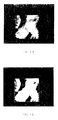
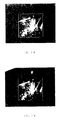
- the photos 1 show pictures of a plate according to example IX; the photos 2 show pictures of a plate according to comparative experiment B.
- the photos A show the pictures without the threshold value having been set; the photos B show the same picture, but this time with a threshold value set at 150.
- compositions were extruded of acrylonitrile-butadiene-styrene copolymer (ABS, type TZ220 provided by DSM) together with glass fibre bundles (Silenka 8045, 4.5 mm long). The following temperatures and speeds were set (table 4).
- T1 is the inlet temperature
- T2 the temperature just before the devolatilizing opening. After this opening there are two temperature zones, having temperatures T3 and T4; the temperature at the extruder head is T5. All glass fibres were added in the devolatilizing opening of the extruder (at a temperature T2).
- the strand coming from the extruder was cooled in a water vessel and cut to granules having a length of 6 mm.
- Granules obtained by applying the processes mentioned in table 1 were processed to form plates (65 x 65 x 3.2 cm3) using an Arburg injection moulding machine.
- the plates were characterized for impact strength (Izod ISO 180) and modulus of elasticity (ASTM D 790).
- T1 is the inlet temperature
- T2 the temperature just before the devolatilizing opening. After this opening there are two temperature zones, having temperatures T3 and T4; the temperature at the extruder head is T5. All glass fibres were added in the devolatilizing opening of the extruder (at a temperature T2).
- the strand coming from the extruder was cooled in a water vessel and cut to granules having a length of 6 mm.
- Granules obtained by applying the process mentioned in table 6 were processed to form plates (65 x 65 x 3.2 cm3) using an Arburg injection moulding machine.
- the plates were characterized for impact strength (Izod ISO 180) and modulus of elasticity (ASTM D 790).
- the experiments show, that using the granulate according to the invention results in obtaining a glossy surface of the moulding compounds, unlike the mat surface of the moulding compound of comparative experiment A.
Landscapes
- Engineering & Computer Science (AREA)
- Mechanical Engineering (AREA)
- Processing And Handling Of Plastics And Other Materials For Molding In General (AREA)
- Compositions Of Macromolecular Compounds (AREA)
- Reinforced Plastic Materials (AREA)
Applications Claiming Priority (2)
| Application Number | Priority Date | Filing Date | Title |
|---|---|---|---|
| NL9000235A NL9000235A (nl) | 1990-01-31 | 1990-01-31 | Kunststofgranulaat bevattend niet-gedispergeerde versterkende vezelbundels. |
| NL9000235 | 1990-01-31 |
Publications (3)
| Publication Number | Publication Date |
|---|---|
| EP0444724A2 true EP0444724A2 (de) | 1991-09-04 |
| EP0444724A3 EP0444724A3 (en) | 1991-09-11 |
| EP0444724B1 EP0444724B1 (de) | 1995-05-31 |
Family
ID=19856514
Family Applications (1)
| Application Number | Title | Priority Date | Filing Date |
|---|---|---|---|
| EP91200143A Expired - Lifetime EP0444724B1 (de) | 1990-01-31 | 1991-01-25 | Kunststoffgranulat mit nichtdispergierten Verstärkungsfaserbündeln |
Country Status (6)
| Country | Link |
|---|---|
| US (1) | US5236781A (de) |
| EP (1) | EP0444724B1 (de) |
| JP (1) | JPH07299818A (de) |
| AT (1) | ATE123248T1 (de) |
| DE (1) | DE69110066T2 (de) |
| NL (1) | NL9000235A (de) |
Families Citing this family (1)
| Publication number | Priority date | Publication date | Assignee | Title |
|---|---|---|---|---|
| DE9302401U1 (de) * | 1993-02-19 | 1993-06-17 | Hoechst Ag, 65929 Frankfurt | Granulat aus faserverstärktem Thermoplast |
Family Cites Families (9)
| Publication number | Priority date | Publication date | Assignee | Title |
|---|---|---|---|---|
| US3586560A (en) * | 1968-06-17 | 1971-06-22 | Eastman Kodak Co | Method of making a fiber-filled thermoplastic article |
| US3684645A (en) * | 1969-03-25 | 1972-08-15 | Ppg Industries Inc | Glass fiber reinforced thermoplastic article |
| US4037011A (en) * | 1972-02-15 | 1977-07-19 | Dart Industries Inc. | Glass fiber reinforced thermoplastic composition and process for its preparation |
| US3984603A (en) * | 1974-05-06 | 1976-10-05 | Standard Oil Company (Indiana) | Fiber-reinforced thermoplastic pellets for preparing manufactured articles |
| US4250221A (en) * | 1976-04-29 | 1981-02-10 | Consolidated Fiberglass Products Co. | Fiberglass mat |
| IT1193532B (it) * | 1980-05-06 | 1988-07-08 | Montedison Spa | Manufatti di polimeri termoplastici rinforzati con fibre di vetro |
| US4559262A (en) * | 1981-01-21 | 1985-12-17 | Imperial Chemical Industries, Plc | Fibre reinforced compositions and methods for producing such compositions |
| US4944965A (en) * | 1985-06-13 | 1990-07-31 | American Cyanamid | Elongated molding granules and injection-molding process employing them |
| ATE131846T1 (de) * | 1988-10-20 | 1996-01-15 | Dsm Nv | Granuliertes kunststoffmaterial mit nichtdispergierten elektrisch leitfähigen faserbündeln |
-
1990
- 1990-01-31 NL NL9000235A patent/NL9000235A/nl not_active Application Discontinuation
-
1991
- 1991-01-25 DE DE69110066T patent/DE69110066T2/de not_active Expired - Fee Related
- 1991-01-25 EP EP91200143A patent/EP0444724B1/de not_active Expired - Lifetime
- 1991-01-25 AT AT91200143T patent/ATE123248T1/de not_active IP Right Cessation
- 1991-01-31 US US07/648,643 patent/US5236781A/en not_active Expired - Fee Related
- 1991-01-31 JP JP3031526A patent/JPH07299818A/ja active Pending
Also Published As
| Publication number | Publication date |
|---|---|
| US5236781A (en) | 1993-08-17 |
| NL9000235A (nl) | 1991-08-16 |
| EP0444724A3 (en) | 1991-09-11 |
| DE69110066T2 (de) | 1996-02-01 |
| JPH07299818A (ja) | 1995-11-14 |
| EP0444724B1 (de) | 1995-05-31 |
| DE69110066D1 (de) | 1995-07-06 |
| ATE123248T1 (de) | 1995-06-15 |
Similar Documents
| Publication | Publication Date | Title |
|---|---|---|
| KR930003378B1 (ko) | 섬유강화 열가소성 수지 조성물 | |
| EP0232522B1 (de) | Polypropylen-Zusammensetzung | |
| SE460851B (sv) | Utstraeckt termoplastgranulat innehaallande fibrer av rostfritt staal samt av granulatet framstaellda formade produkter | |
| CA1305263C (en) | Filled thermoplastic polymer compositions | |
| KR0141103B1 (ko) | 고용융유동성 섬유강화 폴리프로필렌 조성물 | |
| WO1998016359A1 (en) | Rod-shaped pellets | |
| CA1334710C (en) | Thermoplastic resin composition and process for producing the same | |
| EP0002514A1 (de) | Verfahren zum Flammfest- Ausrüsten von thermoplastischen Kunststoffen | |
| EP0566149B1 (de) | Verbundmaterial und Verfahren zu dessen Herstellung | |
| EP0444724B1 (de) | Kunststoffgranulat mit nichtdispergierten Verstärkungsfaserbündeln | |
| KR910008996B1 (ko) | 플라스틱 입자물질, 그 제조방법 및 이로부터 제조되는 성형용 컴파운드 | |
| US4948823A (en) | Nucleating systems | |
| JP3579770B2 (ja) | 長繊維及び板状の無機フィラーで強化された結晶性熱可塑性樹脂柱状体 | |
| US3932573A (en) | Process for producing glass fiber reinforced injection molding compounds | |
| US4340516A (en) | Compounding mica and resin with heat sensitive additives | |
| JP2755988B2 (ja) | 長繊維を含有する熱可塑性樹脂組成物の射出成形法及び成形品 | |
| US4304699A (en) | Compounding mica and resin with particulate heat sensitive additives | |
| JPH0730211B2 (ja) | 熱可塑性樹脂組成物の製造方法 | |
| JPS61254629A (ja) | 集束炭素繊維及びそれから形成された短繊維チツプ | |
| JPH0711049A (ja) | 熱可塑性樹脂組成物 | |
| JPH10139927A (ja) | リサイクル樹脂組成物 | |
| JPH0692508B2 (ja) | 長繊維強化ポリオレフィン樹脂組成物 | |
| JP2766307B2 (ja) | 長繊維を含有する熱可塑性樹脂組成物の射出成形法及び成形品 | |
| EP0014292A1 (de) | Verfahren zum Verbinden von schmelzbaren Harzen mit Glimmerteilchen | |
| CA1145915A (en) | Compounding mica and resin with heat sensitive additives |
Legal Events
| Date | Code | Title | Description |
|---|---|---|---|
| PUAI | Public reference made under article 153(3) epc to a published international application that has entered the european phase |
Free format text: ORIGINAL CODE: 0009012 |
|
| PUAL | Search report despatched |
Free format text: ORIGINAL CODE: 0009013 |
|
| AK | Designated contracting states |
Kind code of ref document: A2 Designated state(s): AT BE CH DE DK ES FR GB GR IT LI NL SE |
|
| AK | Designated contracting states |
Kind code of ref document: A3 Designated state(s): AT BE CH DE DK ES FR GB GR IT LI NL SE |
|
| RAP1 | Party data changed (applicant data changed or rights of an application transferred) |
Owner name: DSM N.V. |
|
| 17P | Request for examination filed |
Effective date: 19920212 |
|
| 17Q | First examination report despatched |
Effective date: 19940204 |
|
| GRAA | (expected) grant |
Free format text: ORIGINAL CODE: 0009210 |
|
| AK | Designated contracting states |
Kind code of ref document: B1 Designated state(s): AT BE CH DE DK ES FR GB GR IT LI NL SE |
|
| PG25 | Lapsed in a contracting state [announced via postgrant information from national office to epo] |
Ref country code: LI Effective date: 19950531 Ref country code: GR Free format text: LAPSE BECAUSE OF FAILURE TO SUBMIT A TRANSLATION OF THE DESCRIPTION OR TO PAY THE FEE WITHIN THE PRESCRIBED TIME-LIMIT Effective date: 19950531 Ref country code: ES Free format text: THE PATENT HAS BEEN ANNULLED BY A DECISION OF A NATIONAL AUTHORITY Effective date: 19950531 Ref country code: DK Effective date: 19950531 Ref country code: CH Effective date: 19950531 Ref country code: BE Effective date: 19950531 Ref country code: AT Effective date: 19950531 |
|
| REF | Corresponds to: |
Ref document number: 123248 Country of ref document: AT Date of ref document: 19950615 Kind code of ref document: T |
|
| REF | Corresponds to: |
Ref document number: 69110066 Country of ref document: DE Date of ref document: 19950706 |
|
| ITF | It: translation for a ep patent filed | ||
| PG25 | Lapsed in a contracting state [announced via postgrant information from national office to epo] |
Ref country code: SE Effective date: 19950831 |
|
| ET | Fr: translation filed | ||
| REG | Reference to a national code |
Ref country code: CH Ref legal event code: PL |
|
| PLBE | No opposition filed within time limit |
Free format text: ORIGINAL CODE: 0009261 |
|
| STAA | Information on the status of an ep patent application or granted ep patent |
Free format text: STATUS: NO OPPOSITION FILED WITHIN TIME LIMIT |
|
| 26N | No opposition filed | ||
| PGFP | Annual fee paid to national office [announced via postgrant information from national office to epo] |
Ref country code: FR Payment date: 19991231 Year of fee payment: 10 |
|
| PGFP | Annual fee paid to national office [announced via postgrant information from national office to epo] |
Ref country code: DE Payment date: 20000103 Year of fee payment: 10 |
|
| PGFP | Annual fee paid to national office [announced via postgrant information from national office to epo] |
Ref country code: GB Payment date: 20000105 Year of fee payment: 10 |
|
| PGFP | Annual fee paid to national office [announced via postgrant information from national office to epo] |
Ref country code: NL Payment date: 20000110 Year of fee payment: 10 |
|
| PG25 | Lapsed in a contracting state [announced via postgrant information from national office to epo] |
Ref country code: GB Free format text: LAPSE BECAUSE OF NON-PAYMENT OF DUE FEES Effective date: 20010125 |
|
| PG25 | Lapsed in a contracting state [announced via postgrant information from national office to epo] |
Ref country code: NL Free format text: LAPSE BECAUSE OF NON-PAYMENT OF DUE FEES Effective date: 20010801 |
|
| GBPC | Gb: european patent ceased through non-payment of renewal fee |
Effective date: 20010125 |
|
| PG25 | Lapsed in a contracting state [announced via postgrant information from national office to epo] |
Ref country code: FR Free format text: LAPSE BECAUSE OF NON-PAYMENT OF DUE FEES Effective date: 20010928 |
|
| NLV4 | Nl: lapsed or anulled due to non-payment of the annual fee |
Effective date: 20010801 |
|
| PG25 | Lapsed in a contracting state [announced via postgrant information from national office to epo] |
Ref country code: DE Free format text: LAPSE BECAUSE OF NON-PAYMENT OF DUE FEES Effective date: 20011101 |
|
| REG | Reference to a national code |
Ref country code: FR Ref legal event code: ST |
|
| PG25 | Lapsed in a contracting state [announced via postgrant information from national office to epo] |
Ref country code: IT Free format text: LAPSE BECAUSE OF NON-PAYMENT OF DUE FEES;WARNING: LAPSES OF ITALIAN PATENTS WITH EFFECTIVE DATE BEFORE 2007 MAY HAVE OCCURRED AT ANY TIME BEFORE 2007. THE CORRECT EFFECTIVE DATE MAY BE DIFFERENT FROM THE ONE RECORDED. Effective date: 20050125 |