EP0443688B1 - Spirodilactam-Arylsulfon-Oligomere - Google Patents
Spirodilactam-Arylsulfon-Oligomere Download PDFInfo
- Publication number
- EP0443688B1 EP0443688B1 EP91200370A EP91200370A EP0443688B1 EP 0443688 B1 EP0443688 B1 EP 0443688B1 EP 91200370 A EP91200370 A EP 91200370A EP 91200370 A EP91200370 A EP 91200370A EP 0443688 B1 EP0443688 B1 EP 0443688B1
- Authority
- EP
- European Patent Office
- Prior art keywords
- oligomer
- spirodilactam
- producing
- reaction
- hydroxyaryl
- Prior art date
- Legal status (The legal status is an assumption and is not a legal conclusion. Google has not performed a legal analysis and makes no representation as to the accuracy of the status listed.)
- Expired - Lifetime
Links
- 150000001875 compounds Chemical class 0.000 claims description 15
- 238000000034 method Methods 0.000 claims description 15
- 239000004695 Polyether sulfone Substances 0.000 claims description 14
- 229920006393 polyether sulfone Polymers 0.000 claims description 14
- 229910052799 carbon Inorganic materials 0.000 claims description 11
- OKTJSMMVPCPJKN-UHFFFAOYSA-N Carbon Chemical group [C] OKTJSMMVPCPJKN-UHFFFAOYSA-N 0.000 claims description 10
- 239000003795 chemical substances by application Substances 0.000 claims description 9
- 125000004432 carbon atom Chemical group C* 0.000 claims description 8
- 239000007791 liquid phase Substances 0.000 claims description 7
- 125000003118 aryl group Chemical group 0.000 claims description 5
- 125000003903 2-propenyl group Chemical group [H]C([*])([H])C([H])=C([H])[H] 0.000 claims description 4
- 125000003342 alkenyl group Chemical group 0.000 claims description 4
- 125000003545 alkoxy group Chemical group 0.000 claims description 4
- 125000004433 nitrogen atom Chemical group N* 0.000 claims description 4
- UFHFLCQGNIYNRP-UHFFFAOYSA-N Hydrogen Chemical compound [H][H] UFHFLCQGNIYNRP-UHFFFAOYSA-N 0.000 claims description 3
- 125000005843 halogen group Chemical group 0.000 claims description 3
- 239000001257 hydrogen Substances 0.000 claims description 3
- 229910052739 hydrogen Inorganic materials 0.000 claims description 3
- 229910052757 nitrogen Inorganic materials 0.000 claims description 3
- 125000000217 alkyl group Chemical group 0.000 claims description 2
- 125000003003 spiro group Chemical group 0.000 claims description 2
- 229920001187 thermosetting polymer Polymers 0.000 claims description 2
- 239000011342 resin composition Substances 0.000 claims 1
- -1 1-(4-chloro-naphthyl) 4-fluorophenyl Chemical group 0.000 description 23
- 238000006243 chemical reaction Methods 0.000 description 23
- 239000000047 product Substances 0.000 description 19
- SECXISVLQFMRJM-UHFFFAOYSA-N N-Methylpyrrolidone Chemical compound CN1CCCC1=O SECXISVLQFMRJM-UHFFFAOYSA-N 0.000 description 18
- 229910052783 alkali metal Inorganic materials 0.000 description 17
- 239000003085 diluting agent Substances 0.000 description 15
- 239000000203 mixture Substances 0.000 description 13
- YXFVVABEGXRONW-UHFFFAOYSA-N Toluene Chemical compound CC1=CC=CC=C1 YXFVVABEGXRONW-UHFFFAOYSA-N 0.000 description 12
- 150000002170 ethers Chemical class 0.000 description 11
- XLYOFNOQVPJJNP-UHFFFAOYSA-N water Substances O XLYOFNOQVPJJNP-UHFFFAOYSA-N 0.000 description 10
- ZMXDDKWLCZADIW-UHFFFAOYSA-N N,N-Dimethylformamide Chemical compound CN(C)C=O ZMXDDKWLCZADIW-UHFFFAOYSA-N 0.000 description 9
- 238000001723 curing Methods 0.000 description 9
- 239000000376 reactant Substances 0.000 description 9
- 238000007796 conventional method Methods 0.000 description 6
- 238000004519 manufacturing process Methods 0.000 description 6
- 239000002904 solvent Substances 0.000 description 6
- 230000009477 glass transition Effects 0.000 description 5
- 238000006384 oligomerization reaction Methods 0.000 description 5
- XQUPVDVFXZDTLT-UHFFFAOYSA-N 1-[4-[[4-(2,5-dioxopyrrol-1-yl)phenyl]methyl]phenyl]pyrrole-2,5-dione Chemical compound O=C1C=CC(=O)N1C(C=C1)=CC=C1CC1=CC=C(N2C(C=CC2=O)=O)C=C1 XQUPVDVFXZDTLT-UHFFFAOYSA-N 0.000 description 4
- IAZDPXIOMUYVGZ-UHFFFAOYSA-N Dimethylsulphoxide Chemical compound CS(C)=O IAZDPXIOMUYVGZ-UHFFFAOYSA-N 0.000 description 4
- YNQLUTRBYVCPMQ-UHFFFAOYSA-N Ethylbenzene Chemical compound CCC1=CC=CC=C1 YNQLUTRBYVCPMQ-UHFFFAOYSA-N 0.000 description 4
- 238000010533 azeotropic distillation Methods 0.000 description 4
- BWHMMNNQKKPAPP-UHFFFAOYSA-L potassium carbonate Chemical compound [K+].[K+].[O-]C([O-])=O BWHMMNNQKKPAPP-UHFFFAOYSA-L 0.000 description 4
- 239000011541 reaction mixture Substances 0.000 description 4
- 150000003457 sulfones Chemical class 0.000 description 4
- QJBSWHJZBJOOPH-UHFFFAOYSA-N 1,6-bis(4-hydroxyphenyl)-1,6-diazaspiro[4.4]nonane-2,7-dione Chemical compound C1=CC(O)=CC=C1N1C2(N(C(=O)CC2)C=2C=CC(O)=CC=2)CCC1=O QJBSWHJZBJOOPH-UHFFFAOYSA-N 0.000 description 3
- XMIMDKVTQAEPTE-UHFFFAOYSA-N 7-(chloromethyl)bicyclo[4.2.0]octa-1,3,5-triene Chemical compound C1=CC=C2C(CCl)CC2=C1 XMIMDKVTQAEPTE-UHFFFAOYSA-N 0.000 description 3
- DGAQECJNVWCQMB-PUAWFVPOSA-M Ilexoside XXIX Chemical compound C[C@@H]1CC[C@@]2(CC[C@@]3(C(=CC[C@H]4[C@]3(CC[C@@H]5[C@@]4(CC[C@@H](C5(C)C)OS(=O)(=O)[O-])C)C)[C@@H]2[C@]1(C)O)C)C(=O)O[C@H]6[C@@H]([C@H]([C@@H]([C@H](O6)CO)O)O)O.[Na+] DGAQECJNVWCQMB-PUAWFVPOSA-M 0.000 description 3
- FXHOOIRPVKKKFG-UHFFFAOYSA-N N,N-Dimethylacetamide Chemical compound CN(C)C(C)=O FXHOOIRPVKKKFG-UHFFFAOYSA-N 0.000 description 3
- KWYUFKZDYYNOTN-UHFFFAOYSA-M Potassium hydroxide Chemical compound [OH-].[K+] KWYUFKZDYYNOTN-UHFFFAOYSA-M 0.000 description 3
- 150000008044 alkali metal hydroxides Chemical class 0.000 description 3
- BHELZAPQIKSEDF-UHFFFAOYSA-N allyl bromide Chemical compound BrCC=C BHELZAPQIKSEDF-UHFFFAOYSA-N 0.000 description 3
- 150000002148 esters Chemical class 0.000 description 3
- 238000010438 heat treatment Methods 0.000 description 3
- 238000000465 moulding Methods 0.000 description 3
- IJGRMHOSHXDMSA-UHFFFAOYSA-N Atomic nitrogen Chemical compound N#N IJGRMHOSHXDMSA-UHFFFAOYSA-N 0.000 description 2
- BVKZGUZCCUSVTD-UHFFFAOYSA-M Bicarbonate Chemical compound OC([O-])=O BVKZGUZCCUSVTD-UHFFFAOYSA-M 0.000 description 2
- WKBOTKDWSSQWDR-UHFFFAOYSA-N Bromine atom Chemical compound [Br] WKBOTKDWSSQWDR-UHFFFAOYSA-N 0.000 description 2
- ZAMOUSCENKQFHK-UHFFFAOYSA-N Chlorine atom Chemical compound [Cl] ZAMOUSCENKQFHK-UHFFFAOYSA-N 0.000 description 2
- WHXSMMKQMYFTQS-UHFFFAOYSA-N Lithium Chemical compound [Li] WHXSMMKQMYFTQS-UHFFFAOYSA-N 0.000 description 2
- ZLMJMSJWJFRBEC-UHFFFAOYSA-N Potassium Chemical compound [K] ZLMJMSJWJFRBEC-UHFFFAOYSA-N 0.000 description 2
- QAOWNCQODCNURD-UHFFFAOYSA-N Sulfuric acid Chemical compound OS(O)(=O)=O QAOWNCQODCNURD-UHFFFAOYSA-N 0.000 description 2
- 239000000853 adhesive Substances 0.000 description 2
- 230000001070 adhesive effect Effects 0.000 description 2
- 150000001340 alkali metals Chemical class 0.000 description 2
- 125000004429 atom Chemical group 0.000 description 2
- 239000002585 base Substances 0.000 description 2
- WTEOIRVLGSZEPR-UHFFFAOYSA-N boron trifluoride Chemical compound FB(F)F WTEOIRVLGSZEPR-UHFFFAOYSA-N 0.000 description 2
- GDTBXPJZTBHREO-UHFFFAOYSA-N bromine Substances BrBr GDTBXPJZTBHREO-UHFFFAOYSA-N 0.000 description 2
- 229910052794 bromium Inorganic materials 0.000 description 2
- 239000003054 catalyst Substances 0.000 description 2
- 239000011951 cationic catalyst Substances 0.000 description 2
- 239000000460 chlorine Substances 0.000 description 2
- 229910052801 chlorine Inorganic materials 0.000 description 2
- 238000004821 distillation Methods 0.000 description 2
- 238000000605 extraction Methods 0.000 description 2
- 239000000706 filtrate Substances 0.000 description 2
- 238000001914 filtration Methods 0.000 description 2
- 238000009472 formulation Methods 0.000 description 2
- 125000003106 haloaryl group Chemical group 0.000 description 2
- 125000001183 hydrocarbyl group Chemical group 0.000 description 2
- 229910052744 lithium Inorganic materials 0.000 description 2
- RLSSMJSEOOYNOY-UHFFFAOYSA-N m-cresol Chemical compound CC1=CC=CC(O)=C1 RLSSMJSEOOYNOY-UHFFFAOYSA-N 0.000 description 2
- 239000000463 material Substances 0.000 description 2
- 229910052700 potassium Inorganic materials 0.000 description 2
- 239000011591 potassium Substances 0.000 description 2
- 229910000027 potassium carbonate Inorganic materials 0.000 description 2
- 238000001556 precipitation Methods 0.000 description 2
- 229920005989 resin Polymers 0.000 description 2
- 239000011347 resin Substances 0.000 description 2
- 229910052708 sodium Inorganic materials 0.000 description 2
- 239000011734 sodium Substances 0.000 description 2
- HEMHJVSKTPXQMS-UHFFFAOYSA-M sodium hydroxide Inorganic materials [OH-].[Na+] HEMHJVSKTPXQMS-UHFFFAOYSA-M 0.000 description 2
- 125000001424 substituent group Chemical group 0.000 description 2
- JOXIMZWYDAKGHI-UHFFFAOYSA-N toluene-4-sulfonic acid Chemical compound CC1=CC=C(S(O)(=O)=O)C=C1 JOXIMZWYDAKGHI-UHFFFAOYSA-N 0.000 description 2
- KOMNUTZXSVSERR-UHFFFAOYSA-N 1,3,5-tris(prop-2-enyl)-1,3,5-triazinane-2,4,6-trione Chemical compound C=CCN1C(=O)N(CC=C)C(=O)N(CC=C)C1=O KOMNUTZXSVSERR-UHFFFAOYSA-N 0.000 description 1
- HKAYLDAAMVSPQX-UHFFFAOYSA-N 1,6-bis(4-hydroxyphenyl)-3,3,4,4,8,8,9,9-octamethyl-1,6-diazaspiro[4.4]nonane-2,7-dione Chemical compound C=1C=C(O)C=CC=1N1C(=O)C(C)(C)C(C)(C)C21C(C)(C)C(C)(C)C(=O)N2C1=CC=C(O)C=C1 HKAYLDAAMVSPQX-UHFFFAOYSA-N 0.000 description 1
- OGQRUQFWZZHIII-UHFFFAOYSA-N 1,6-bis[2-(4-hydroxyphenyl)propyl]-1,6-diazaspiro[4.4]nonane-2,7-dione Chemical compound C=1C=C(O)C=CC=1C(C)CN1C(=O)CCC11CCC(=O)N1CC(C)C1=CC=C(O)C=C1 OGQRUQFWZZHIII-UHFFFAOYSA-N 0.000 description 1
- PKEAWVNIECMWAX-UHFFFAOYSA-N 1,6-bis[4-[(4-hydroxyphenyl)methyl]phenyl]-1,6-diazaspiro[4.4]nonane-2,7-dione Chemical compound C1=CC(O)=CC=C1CC1=CC=C(N2C3(N(C(=O)CC3)C=3C=CC(CC=4C=CC(O)=CC=4)=CC=3)CCC2=O)C=C1 PKEAWVNIECMWAX-UHFFFAOYSA-N 0.000 description 1
- CJIABXOJSHKHDN-UHFFFAOYSA-N 1,6-bis[4-[2-(4-hydroxyphenyl)propan-2-yl]phenyl]-1,6-diazaspiro[4.4]nonane-2,7-dione Chemical compound C=1C=C(N2C3(N(C(=O)CC3)C=3C=CC(=CC=3)C(C)(C)C=3C=CC(O)=CC=3)CCC2=O)C=CC=1C(C)(C)C1=CC=C(O)C=C1 CJIABXOJSHKHDN-UHFFFAOYSA-N 0.000 description 1
- UGMPHUWLSLSAHB-UHFFFAOYSA-N 1-(4-bromophenyl)sulfonyl-4-chlorobenzene Chemical compound C1=CC(Cl)=CC=C1S(=O)(=O)C1=CC=C(Br)C=C1 UGMPHUWLSLSAHB-UHFFFAOYSA-N 0.000 description 1
- ZRZHXNCATOYMJH-UHFFFAOYSA-N 1-(chloromethyl)-4-ethenylbenzene Chemical compound ClCC1=CC=C(C=C)C=C1 ZRZHXNCATOYMJH-UHFFFAOYSA-N 0.000 description 1
- VEZJPRMEUDKIIN-UHFFFAOYSA-N 1-chloro-4-(4-chloro-3-methylphenyl)sulfonyl-2-methylbenzene Chemical compound C1=C(Cl)C(C)=CC(S(=O)(=O)C=2C=C(C)C(Cl)=CC=2)=C1 VEZJPRMEUDKIIN-UHFFFAOYSA-N 0.000 description 1
- IWTYTFSSTWXZFU-UHFFFAOYSA-N 3-chloroprop-1-enylbenzene Chemical compound ClCC=CC1=CC=CC=C1 IWTYTFSSTWXZFU-UHFFFAOYSA-N 0.000 description 1
- GPAPPPVRLPGFEQ-UHFFFAOYSA-N 4,4'-dichlorodiphenyl sulfone Chemical compound C1=CC(Cl)=CC=C1S(=O)(=O)C1=CC=C(Cl)C=C1 GPAPPPVRLPGFEQ-UHFFFAOYSA-N 0.000 description 1
- OSDWBNJEKMUWAV-UHFFFAOYSA-N Allyl chloride Chemical compound ClCC=C OSDWBNJEKMUWAV-UHFFFAOYSA-N 0.000 description 1
- 229910015900 BF3 Inorganic materials 0.000 description 1
- BVKZGUZCCUSVTD-UHFFFAOYSA-L Carbonate Chemical compound [O-]C([O-])=O BVKZGUZCCUSVTD-UHFFFAOYSA-L 0.000 description 1
- 239000002841 Lewis acid Substances 0.000 description 1
- ISWSIDIOOBJBQZ-UHFFFAOYSA-N Phenol Chemical compound OC1=CC=CC=C1 ISWSIDIOOBJBQZ-UHFFFAOYSA-N 0.000 description 1
- ABLZXFCXXLZCGV-UHFFFAOYSA-N Phosphorous acid Chemical compound OP(O)=O ABLZXFCXXLZCGV-UHFFFAOYSA-N 0.000 description 1
- NINIDFKCEFEMDL-UHFFFAOYSA-N Sulfur Chemical compound [S] NINIDFKCEFEMDL-UHFFFAOYSA-N 0.000 description 1
- 229910021627 Tin(IV) chloride Inorganic materials 0.000 description 1
- AUYQDAWLRQFANO-UHFFFAOYSA-N [4-[(4-cyanatophenyl)methyl]phenyl] cyanate Chemical compound C1=CC(OC#N)=CC=C1CC1=CC=C(OC#N)C=C1 AUYQDAWLRQFANO-UHFFFAOYSA-N 0.000 description 1
- AHZMUXQJTGRNHT-UHFFFAOYSA-N [4-[2-(4-cyanatophenyl)propan-2-yl]phenyl] cyanate Chemical compound C=1C=C(OC#N)C=CC=1C(C)(C)C1=CC=C(OC#N)C=C1 AHZMUXQJTGRNHT-UHFFFAOYSA-N 0.000 description 1
- 239000002253 acid Substances 0.000 description 1
- 229910000288 alkali metal carbonate Inorganic materials 0.000 description 1
- 150000008041 alkali metal carbonates Chemical class 0.000 description 1
- 125000000304 alkynyl group Chemical group 0.000 description 1
- 150000001408 amides Chemical class 0.000 description 1
- 238000010539 anionic addition polymerization reaction Methods 0.000 description 1
- 239000011952 anionic catalyst Substances 0.000 description 1
- 125000005362 aryl sulfone group Chemical group 0.000 description 1
- 239000012298 atmosphere Substances 0.000 description 1
- QVGXLLKOCUKJST-UHFFFAOYSA-N atomic oxygen Chemical compound [O] QVGXLLKOCUKJST-UHFFFAOYSA-N 0.000 description 1
- 150000001555 benzenes Chemical class 0.000 description 1
- 125000001246 bromo group Chemical group Br* 0.000 description 1
- 150000001721 carbon Chemical group 0.000 description 1
- 238000005266 casting Methods 0.000 description 1
- 125000002091 cationic group Chemical group 0.000 description 1
- 238000010538 cationic polymerization reaction Methods 0.000 description 1
- 159000000006 cesium salts Chemical class 0.000 description 1
- 239000007810 chemical reaction solvent Substances 0.000 description 1
- 125000001309 chloro group Chemical group Cl* 0.000 description 1
- 238000000576 coating method Methods 0.000 description 1
- 125000001651 cyanato group Chemical group [*]OC#N 0.000 description 1
- 125000001033 ether group Chemical group 0.000 description 1
- 230000005284 excitation Effects 0.000 description 1
- 239000000835 fiber Substances 0.000 description 1
- 239000003733 fiber-reinforced composite Substances 0.000 description 1
- 239000011152 fibreglass Substances 0.000 description 1
- 238000009730 filament winding Methods 0.000 description 1
- 125000001153 fluoro group Chemical group F* 0.000 description 1
- 125000000524 functional group Chemical group 0.000 description 1
- 239000011521 glass Substances 0.000 description 1
- 150000004820 halides Chemical class 0.000 description 1
- 150000002367 halogens Chemical group 0.000 description 1
- XLYOFNOQVPJJNP-UHFFFAOYSA-M hydroxide Chemical compound [OH-] XLYOFNOQVPJJNP-UHFFFAOYSA-M 0.000 description 1
- 150000004679 hydroxides Chemical class 0.000 description 1
- 125000004356 hydroxy functional group Chemical group O* 0.000 description 1
- 125000005027 hydroxyaryl group Chemical group 0.000 description 1
- 238000011065 in-situ storage Methods 0.000 description 1
- 125000002346 iodo group Chemical group I* 0.000 description 1
- 150000007517 lewis acids Chemical class 0.000 description 1
- 125000005394 methallyl group Chemical group 0.000 description 1
- 150000007522 mineralic acids Chemical class 0.000 description 1
- 238000012986 modification Methods 0.000 description 1
- 230000004048 modification Effects 0.000 description 1
- DSRCHKVMXLKZTM-UHFFFAOYSA-N nonane-2,7-dione Chemical compound CCC(=O)CCCCC(C)=O DSRCHKVMXLKZTM-UHFFFAOYSA-N 0.000 description 1
- 150000007524 organic acids Chemical class 0.000 description 1
- 150000002894 organic compounds Chemical class 0.000 description 1
- 229910052760 oxygen Inorganic materials 0.000 description 1
- 239000001301 oxygen Substances 0.000 description 1
- 150000008379 phenol ethers Chemical class 0.000 description 1
- 150000002989 phenols Chemical class 0.000 description 1
- 229920003192 poly(bis maleimide) Polymers 0.000 description 1
- 239000002685 polymerization catalyst Substances 0.000 description 1
- 238000006116 polymerization reaction Methods 0.000 description 1
- XAEFZNCEHLXOMS-UHFFFAOYSA-M potassium benzoate Chemical compound [K+].[O-]C(=O)C1=CC=CC=C1 XAEFZNCEHLXOMS-UHFFFAOYSA-M 0.000 description 1
- 238000002360 preparation method Methods 0.000 description 1
- 230000005855 radiation Effects 0.000 description 1
- 230000002787 reinforcement Effects 0.000 description 1
- 229910052701 rubidium Inorganic materials 0.000 description 1
- IGLNJRXAVVLDKE-UHFFFAOYSA-N rubidium atom Chemical compound [Rb] IGLNJRXAVVLDKE-UHFFFAOYSA-N 0.000 description 1
- 150000003839 salts Chemical class 0.000 description 1
- 159000000000 sodium salts Chemical class 0.000 description 1
- 238000003756 stirring Methods 0.000 description 1
- HXJUTPCZVOIRIF-UHFFFAOYSA-N sulfolane Chemical compound O=S1(=O)CCCC1 HXJUTPCZVOIRIF-UHFFFAOYSA-N 0.000 description 1
- 229910052717 sulfur Inorganic materials 0.000 description 1
- 239000011593 sulfur Substances 0.000 description 1
- 238000001029 thermal curing Methods 0.000 description 1
- HPGGPRDJHPYFRM-UHFFFAOYSA-J tin(iv) chloride Chemical compound Cl[Sn](Cl)(Cl)Cl HPGGPRDJHPYFRM-UHFFFAOYSA-J 0.000 description 1
Classifications
-
- C—CHEMISTRY; METALLURGY
- C07—ORGANIC CHEMISTRY
- C07D—HETEROCYCLIC COMPOUNDS
- C07D519/00—Heterocyclic compounds containing more than one system of two or more relevant hetero rings condensed among themselves or condensed with a common carbocyclic ring system not provided for in groups C07D453/00 or C07D455/00
-
- C—CHEMISTRY; METALLURGY
- C08—ORGANIC MACROMOLECULAR COMPOUNDS; THEIR PREPARATION OR CHEMICAL WORKING-UP; COMPOSITIONS BASED THEREON
- C08F—MACROMOLECULAR COMPOUNDS OBTAINED BY REACTIONS ONLY INVOLVING CARBON-TO-CARBON UNSATURATED BONDS
- C08F16/00—Homopolymers and copolymers of compounds having one or more unsaturated aliphatic radicals, each having only one carbon-to-carbon double bond, and at least one being terminated by an alcohol, ether, aldehydo, ketonic, acetal or ketal radical
-
- C—CHEMISTRY; METALLURGY
- C08—ORGANIC MACROMOLECULAR COMPOUNDS; THEIR PREPARATION OR CHEMICAL WORKING-UP; COMPOSITIONS BASED THEREON
- C08G—MACROMOLECULAR COMPOUNDS OBTAINED OTHERWISE THAN BY REACTIONS ONLY INVOLVING UNSATURATED CARBON-TO-CARBON BONDS
- C08G73/00—Macromolecular compounds obtained by reactions forming a linkage containing nitrogen with or without oxygen or carbon in the main chain of the macromolecule, not provided for in groups C08G12/00 - C08G71/00
- C08G73/06—Polycondensates having nitrogen-containing heterocyclic rings in the main chain of the macromolecule
- C08G73/0666—Polycondensates containing five-membered rings, condensed with other rings, with nitrogen atoms as the only ring hetero atoms
- C08G73/0672—Polycondensates containing five-membered rings, condensed with other rings, with nitrogen atoms as the only ring hetero atoms with only one nitrogen atom in the ring
-
- C—CHEMISTRY; METALLURGY
- C08—ORGANIC MACROMOLECULAR COMPOUNDS; THEIR PREPARATION OR CHEMICAL WORKING-UP; COMPOSITIONS BASED THEREON
- C08K—Use of inorganic or non-macromolecular organic substances as compounding ingredients
- C08K5/00—Use of organic ingredients
- C08K5/16—Nitrogen-containing compounds
- C08K5/34—Heterocyclic compounds having nitrogen in the ring
- C08K5/3412—Heterocyclic compounds having nitrogen in the ring having one nitrogen atom in the ring
- C08K5/3415—Five-membered rings
Definitions
- This invention relates to a novel class of spirodilactam-arylsulfone oligomers having chain terminating groups comprising carbon to carbon or carbon to nitrogen unsaturation.
- Unsaturated ether or ester derivatives of oligomers of polyhydric phenol ethers are well known as a class of compounds that can be cured or crosslinked to produce insoluble products which exhibit good solvent resistance and mechanical properties as well as high heat distortion temperatures.
- Such unsaturated ethers and esters are crosslinked to produce tough, heat resistant products for example in U.S. patent 4,701,514, which are processed by conventional methods into sheets, laminates with fiber glass or other reinforcements, or shaped articles and the crosslinked products are also useful in adhesive formulations.
- novel products of the invention are oligomers of the formula E ⁇ O-[ ⁇ (SL)-O ⁇ R ⁇ SO 2 ⁇ R ⁇ O] n ⁇ (SL) ⁇ O ⁇ E wherein n is a number of from 3 to 8, inclusive; E is an alkenyl, vinylarylmethyl or benzocyclobutenealkyl group having up to 10 carbon atoms and terminal carbon to carbon unsaturation; R is aryl with one or two aromatic rings and up to 15 carbon atoms; and SL is a moiety of the formula wherein each Z independently represents >C(Z') 2 in which each Z' independently represents hydrogen or lower alkyl; and R' has the same meanings as R.
- the spirodilactam moieties of formula II can be derived from compounds such as 1,6-di(4-hydroxyphenyl)-1,6-diazaspiro[4.4]-nonane-2,7-dione, 1,6-di(3-hydroxy-4-chlorophenyl)-3,8-dimethyl-1,6-diazapiro[4.4]nonane-2,7-dione, 1,6-di[4-(4-hydroxybenzyl)-phenyl]-1,6-diazaspiro[4.4]-nonane-2,7-dione, 1,6-di(4-hydroxyphenyl)-3,3,4,4,8,8,9,9-octamethyl-1,6-diazaspiro[4.4]nonane-2,7-dione, 1,6-di [4-(4'-hydroxybiphenyl)]-3,3-dimethyl-1, 6-diazaspiro[
- the oligomers of this invention are obtained in a two-step process, the first step of which is concerned with producing oligomers comprising arylsulfone and spirodilactam moieties only and then, in the second step, reacting the latter oligomers with appropriate compounds to introduce the defined terminating groups into the oligomer molecules.
- a dihydroxyterminated spirodilactam compound is reacted with a di(halo-aryl)sulfone in the presence of an alkaline compound to remove hydrohalogen acid, e.g. HCl or HBr.
- Suitable di(halo-aryl)sulfone reactants used in the first reaction step are those comprising fluoro, chloro, bromo or iodo atoms, but preferably comprise chlorine or bromine.
- the halogen substituents on each aromatic ring are preferably ortho or para, or mixtures thereof.
- Illustrative of the halo-aryl sulfone reactants are di(4-chlorophenyl) sulfone, 4-chlorophenyl 4-bromophenyl sulfone, 1-(4-chloro-naphthyl) 4-fluorophenyl sulfone, and di(4-chloro-3-methylphenyl) sulfone.
- Suitable alkaline compounds are alkali metal bases, e.g., the hydroxide, carbonate or bicarbonate of lithium, potassium or sodium. These are reacted with the hydroxy terminate spirodilactam compounds to produce the alkali metal salt thereof whilst removing water from the reaction mixture, e.g. by conventional methods such as extraction or distillation. A preferred method of water removal is by azeotropic distillation with a portion of the reaction diluent.
- Dimethyl sulfoxide is a preferred diluent for this purpose although other diluents such as N-alkylamides, e.g., N,N-dimethylformamide, N,N-dimethylacetamide, N-methyl-2-pyrrolidone or the like, also in mixtures with alkylated benzenes, such as toluene or ethylbenzene, are also satisfactory.
- the alkali metal salt(s) may be recovered by conventional methods such as solvent removal or precipitation.
- the halo-aryl sulfone reactant is present in a molar ratio of from 3:1 to 1:3 with the total molar quantity of alkali metal salt reactants.
- the sulfone reactant is preferably present in a substantially stoichiometric quantity, i.e., a molar ratio of sulfone reactant to total alkali metal salt reactant of substantially 1:1.
- Oligomerization takes place at an elevated temperature, typically from 80°C to 225°C but more often from 100°C to 220°C.
- the pressure is sufficient to maintain the reaction mixture in a liquid phase.
- Such pressures are up to 2MPa. (20 atmospheres), preferably up to lMPa. (10 atmospheres).
- the reactant contact is maintained by conventional methods such as stirring or shaking and subsequent to reaction the oligomer product is recovered by well-known techniques, such as solvent removal, precipitation or extraction and the like.
- the process to produce the spirodilactam-terminated polyether sulfone oligomer is conducted under oligomerization conditions in the liquid phase in an inert reaction diluent.
- Preferred diluents are polar diluents capable of dissolving at least a portion of each reactant at oligomerization temperature.
- the oligomerization diluent is the same as the diluent employed in alkali metal salt production, but such is not required.
- the resulting oligomers have an average formula weight of from 1,000 to 40,000, preferably from 5,000 to 30,000 and, more preferably from 10,000 to 20,000.
- the unsaturated derivatives produced in the last reaction step are ether derivatives of the hydroxyaryl substituents in the terminal spirodilactam units of the oligomer.
- the unsaturated moiety, which becomes bound to the oxygen of the oxyaryl moiety (derived by loss of hydrogen from the terminal hydroxyaryl moiety of the spirodilactam end units of the oligomer), is an alkenyl, vinylarylmethyl or benzocyclobutenealkyl group having up 10 carbon atoms and terminal carbon to carbon unsaturation.
- unsaturated moieties of conventional types are useful in the ether derivatives of the invention
- the preferred unsaturated ether moieties are selected from 2-alkenyl, such as allyl, methallyl, and crotyl; vinylarylmethyl, such as 4-styrylmethyl and 4-vinyl-2-methylbenzyl; and benzocyclobutenealkyl.
- Preferred unsaturated moieties are allyl, 4-vinylbenzyl and benzocyclobutenemethyl.
- These derivatives are tvpically produced by reacting a compound containing the desired unsaturated moiety with an alkali metal salt of the hydroxyaryl-substituted spirodilactam-terminated polyether sulfone oligomer.
- an alkali metal salt of the hydroxyaryl-substituted spirodilactam-terminated polyether sulfone oligomer lithium, sodium, potassium, rubidium and cesium salts of the hydroxyaryl-substituted spirodilactam-terminated polyether sulfone oligomers are usefully employed in the production of the unsaturated ether derivatives of the invention, the use of a sodium salt or a potassium salt is preferred.
- the alkali metal salt of the hydroxyaryl-substituted spirodilactam-terminated polyether sulfone oligomer is produced by contacting the spirodilactam-terminated polyether sulfone oligomer with a substantially stoichiometric quantity of alkali metal hydroxide, i.e., substantially 2 moles of alkali metal hydroxide for each mole of the spirodilactam-terminated polyether sulfone oligomer.
- Sodium or potassium hydroxide is preferred.
- Reaction is conducted in the liquid phase in a suitable reaction solvent such as N-methyl-2-pyrrolidinone, N,N-dimethylacetamide, N,N-dimethylformamide or the like while removing the water present or formed by distillation, preferably azeotropic distillation employing a second solvent, such as toluene or ethylbenzene, with which water forms an azeotrope.
- a suitable reaction solvent such as N-methyl-2-pyrrolidinone, N,N-dimethylacetamide, N,N-dimethylformamide or the like
- a second solvent such as toluene or ethylbenzene
- the alkali metal salt of the hydroxyaryl-substituted spirodilactam-terminated polyether sulfone oligomer is isolated if desired by conventional procedures, such as solvent removal, but the salt is typically used in situ in the media of its production for reaction with the compound containing the unsaturated moiety.
- the second step of the process of this invention can be defined as a process for producing an oligomer as defined in this invention which comprises reacting in the liquid phase (a) an unsaturated compound of the formula E-G wherein E is as defined above and G is halo or alkoxy, and (b) a hydroxyaryl-substituted [4.4] spirodilactam-terminated polyether sulfone oligomer having nitrogen atoms in the 1- and 6-positions of the spiro ring system and having a hydroxyaryl substituent on each terminal spiro ring nitrogen atom.
- G is halo, preferably chlorine or bromine, or alkoxy, preferably alkoxy of up to 4 carbon atoms.
- E moiety is preferably allyl, 4-styrylmethyl, or benzocyclobutenemethyl and is generally provided as the halide. Allyl chloride, allyl bromide, p-vinylbenzyl chloride, or chloromethylbenzocyclobutene are illustrative.
- reaction of the alkali metal salt of the hydroxyaryl-substituted spirodilactam-terminated polyether sulfone oligomer and the E-G compound is conducted in liquid phase solution in the presence of a reaction diluent.
- Preferred diluents are polar diluents in which the compounds undergoing are soluble, at least at reaction conditions.
- Suitable reaction diluents include N-alkylamides such as N,N-dimethylacetamide, N,N-dimethylformamide and N-methyl-2-pyrrolidone, phenols such as phenol and m-cresol and sulfur containing diluents such as sulfolane and dimethylsulfoxide or the like.
- the compound which provides the unsaturated moiety i.e., the compound E-G
- E-G is utilized in a molar amount equal to or in excess over the alkali metal salt.
- Molar ratios from 5:1 to 1:1 are suitable.
- the stoichiometry of the reaction would suggest reaction of the E-G compound and the alkali metal salt in a 2:1 ratio.
- Molar ratios of from 3:1 to 1.5:1 are preferred.
- Reaction is effected by charging the unsaturated moiety compound, the alkali metal salt of the hydroxyaryl-substituted spirodilactam-terminated polyether sulfone oligomer and the reaction diluent to a suitable reactor and maintaining the reaction mixture under reaction conditions.
- the alkali metal salt is employed as produced in the media of its production and the E-G compound is added to the solution of the alkali metal salt if produced in a suitable reaction diluent.
- Reaction to produce the unsaturated ether derivatives of the hydroxyaryl-substituted spirodilactam-terminated polyether sulfone oligomer is conducted over a range of reaction conditions, typically including a reaction temperature of from -30°C to 200°C, preferably from -10°C to 175°C, the higher portion of the temperature range being preferred.
- a suitable reaction pressure is one which will maintain the reaction mixture in the liquid phase. Such pressures are typically up to 2MPa. (20 atmospheres) but more often are from 80 to 500 kPa (0.8 atmosphere to 5 atmospheres).
- the ether derivatives of the hydroxy-substituted spirodilactams-terminated polyether sulfone oligomers find utility as thermosetting resins which are employed in the production of the cured or crosslinked products of the invention. These products are useful as surface coatings, in adhesive formulations and in fiber-reinforced composites wherein, for example, the fiber is glass or carbon.
- the cured products are also useful in the production of hollow objects as by filament winding and are employed as impregnating and casting resins. The processing of the cured products for these applications is by conventional methods.
- the curing of the unsaturated ether derivatives is accomplished by conventional methods such as thermal curing, e.g., heating to a temperature above 200°C, by photochemical excitation, e.g., as by exposure to high energy radiation, by catalyzed polymerization employing cationic or anionic catalysts or by reaction with a polyfunctional curing agent.
- Anionic polymerization uses alkali metal alkoxides, hydroxides or amides as the catalyst typical cationic polymerization catalysts are organic or inorganic acids or are Lewis acids.
- Such cationic catalysts include sulfuric acid, phosphonic acid, p-toluenesulfonic acid, boron trifluoride, tin tetrachloride and the like.
- Catalysts are generally employed in a quantity of from 0.05 to 5% by weight, based on total composition.
- the unsaturated ether or ester derivatives are cured by heating with a substantial amount, e.g., from 20 to 50% by weight, based on total composition, of a polyfunctional curing agent.
- the preferred cured products are obtained by reacting the unsaturated ether derivatives with a polyfunctional curing agent.
- a polyfunctional curing agent are organic compounds having at least two substituents with multiple bonds between adjacent atoms.
- substituents are hydrocarbyl with multiple bonds between adjacent carbon atoms or are non-hydrocarbyl with multiple bonds between atoms at least one of which is not a carbon atom.
- Preferred polyfunctional curing agents have up to 30 carbon atoms inclusive and contain functional groups selected from alkenyl, alkynyl, styrylmethyl, cyanato or maleimido. Particularly preferred are the maleimido-substituted polyfunctional curing agents, especially di(4-maleimidophenyl)methane.
- polyfunctional curing agents are also well known in the art, and include such preferred curing agents as triallyl isocyanurate, di(4-cyanatophenyl)methane, 2,2-di(4-cyanatophenyl)propane and the like.
- Illustrative Embodiment I was mixed 17 parts by weight with 83 parts by weight of bismaleimide, i.e., di(4-maleimidophenyl)methane.
- the resulting mixture was melted at 175°C and then heated to 200°C for 3 hours and finally at 250°C for 5 hours.
- the resulting cured product was insoluble in common solvents and had a glass transition temperature in excess 350°C.
- a mixture of 17 parts by weight of the oligomer of example 3 and 83 parts by weight of di(4-maleimidophenyl)methane was melted at 190°-200°C and then heated in an oven in a first stage to 200°C for 3 hours and in a second stage at 265°C for an additional 5 hours.
- the resulting cured product had a glass transition temperature in excess of 350°C.
Landscapes
- Chemical & Material Sciences (AREA)
- Organic Chemistry (AREA)
- Health & Medical Sciences (AREA)
- Chemical Kinetics & Catalysis (AREA)
- Medicinal Chemistry (AREA)
- Polymers & Plastics (AREA)
- Macromonomer-Based Addition Polymer (AREA)
- Polyethers (AREA)
- Macromolecular Compounds Obtained By Forming Nitrogen-Containing Linkages In General (AREA)
- Nitrogen Condensed Heterocyclic Rings (AREA)
- Organic Low-Molecular-Weight Compounds And Preparation Thereof (AREA)
Claims (5)
- Verfahren zur Herstellung eines Oligomers mit der Formelbedeutet, worin jedes Z unabhängig voneinander für >C(Z')2 steht, worin jedes Z' unabhängig voneinander Wasserstoff oder Niederalkyl bedeutet; und R' die gleichen Bedeutungen wie R aufweist, welches ein in flüssiger Phase erfolgendes Umsetzen von (a) einer ungesättigten Verbindung der Formel E-G, worin E wie oben definiert ist und G für Halogen oder Alkoxy steht, mit (b) einem Hydroxyaryl-substituierten, [4.4] Spirodilactam-terminierten Polyethersulfonoligomer mit Stickstoffatomen in den 1- und 6-Stellungen des Spiroringsystems und mit einem Hydroxyarylsubstituenten an jedem endständigen Spiroring-Stickstoffatom umfaßt.
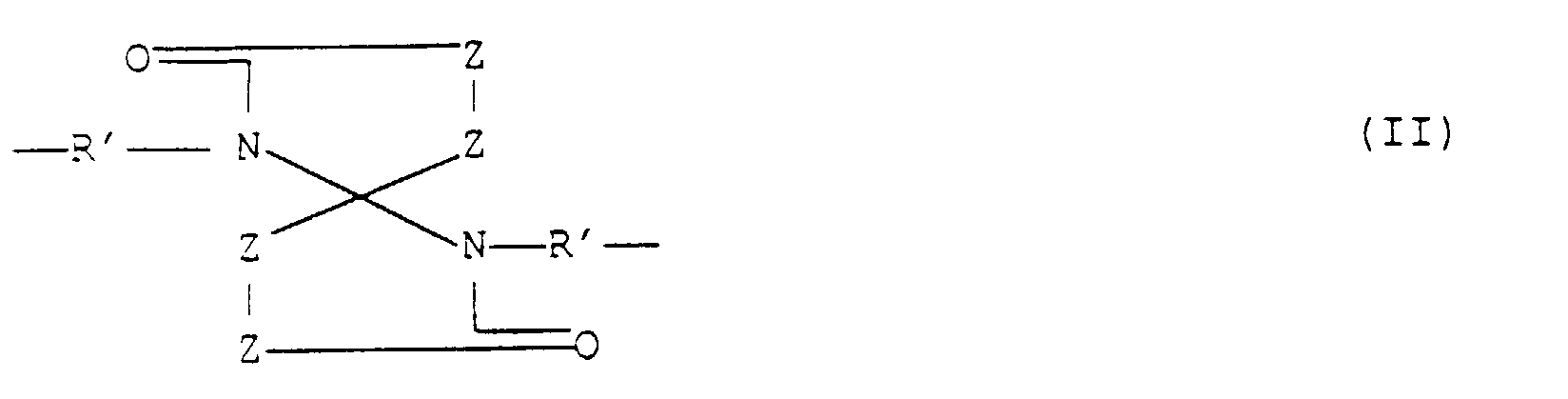
- Verfahren zur Herstellung des Oligomers nach Anspruch 1, worin jedes E unabhängig voneinander für Allyl, 4-Styrylmethyl oder Benzocyclobutenmethyl steht.
- Verfahren zur Herstellung des Derivats nach Anspruch 1 oder 2, worin jedes Z für >C(H)2 steht.
- Verfahren zur Herstellung einer warmhärtenden Harzzusammensetzung durch Vereinigen eines Oligomers, wie nach einem Verfahren der Ansprüche 1 bis 3 gebildet, mit einem Maleimido-Härtungsmittel.
Applications Claiming Priority (2)
| Application Number | Priority Date | Filing Date | Title |
|---|---|---|---|
| US48209990A | 1990-02-20 | 1990-02-20 | |
| US482099 | 1990-02-20 |
Publications (3)
| Publication Number | Publication Date |
|---|---|
| EP0443688A2 EP0443688A2 (de) | 1991-08-28 |
| EP0443688A3 EP0443688A3 (en) | 1992-03-18 |
| EP0443688B1 true EP0443688B1 (de) | 1998-05-06 |
Family
ID=23914652
Family Applications (1)
| Application Number | Title | Priority Date | Filing Date |
|---|---|---|---|
| EP91200370A Expired - Lifetime EP0443688B1 (de) | 1990-02-20 | 1991-02-20 | Spirodilactam-Arylsulfon-Oligomere |
Country Status (5)
| Country | Link |
|---|---|
| EP (1) | EP0443688B1 (de) |
| JP (1) | JPH04216811A (de) |
| KR (1) | KR910021417A (de) |
| CA (1) | CA2036500A1 (de) |
| DE (1) | DE69129343D1 (de) |
Family Cites Families (6)
| Publication number | Priority date | Publication date | Assignee | Title |
|---|---|---|---|---|
| US4562243A (en) * | 1984-03-06 | 1985-12-31 | The B. F. Goodrich Company | Crosslinkable difunctionalized polyarylene polyethers |
| CA1334099C (en) * | 1988-03-23 | 1995-01-24 | Pen Chung Wang | 1,6-diazaspiro(4,4)nonane-2,7-dione derivatives |
| US4847388A (en) * | 1988-09-16 | 1989-07-11 | Shell Oil Company | Polycyclic unsaturated ethers and esters |
| CA1335596C (en) * | 1988-09-16 | 1995-05-16 | Pen Chung Wang | 1,6-diazaspiro (4,4) nonane-2, 7-dione derivatives |
| DE69011705T2 (de) * | 1989-02-23 | 1995-01-12 | Shell Int Research | Alkenylphenolderivate. |
| US4968810A (en) * | 1989-03-17 | 1990-11-06 | Shell Oil Company | Arylcyclobutene ethers |
-
1991
- 1991-02-18 KR KR1019910002567A patent/KR910021417A/ko not_active Withdrawn
- 1991-02-18 JP JP3044014A patent/JPH04216811A/ja active Pending
- 1991-02-18 CA CA002036500A patent/CA2036500A1/en not_active Abandoned
- 1991-02-20 EP EP91200370A patent/EP0443688B1/de not_active Expired - Lifetime
- 1991-02-20 DE DE69129343T patent/DE69129343D1/de not_active Expired - Lifetime
Also Published As
| Publication number | Publication date |
|---|---|
| EP0443688A2 (de) | 1991-08-28 |
| EP0443688A3 (en) | 1992-03-18 |
| CA2036500A1 (en) | 1991-08-21 |
| KR910021417A (ko) | 1991-12-20 |
| JPH04216811A (ja) | 1992-08-06 |
| DE69129343D1 (de) | 1998-06-10 |
Similar Documents
| Publication | Publication Date | Title |
|---|---|---|
| KR101995727B1 (ko) | 프탈로니트릴 수지 | |
| US4670536A (en) | Addition-curable quinoxaline resin oligomer and intermediate material for fiber-reinforced composite | |
| GB1591325A (en) | High temperature polyurea resin | |
| US4847388A (en) | Polycyclic unsaturated ethers and esters | |
| US4988785A (en) | Bismaleimide resin based on indane bisphenol | |
| EP0443688B1 (de) | Spirodilactam-Arylsulfon-Oligomere | |
| US3642720A (en) | Triazine based polybenzimidazole | |
| US7348395B2 (en) | Synthesis of oligomeric cyanate esters | |
| EP0451405B1 (de) | Härtbare Harzzusammensetzung | |
| US4959443A (en) | Thermosetting resin composition from bis maleimide and aromatic amine resin | |
| JP3874089B2 (ja) | 熱硬化性ppeのオリゴマー体 | |
| US4885351A (en) | Spirodilactam derivatives | |
| KR20180074043A (ko) | 프탈로니트릴 수지 | |
| US4197393A (en) | Biphenylene polymers and resins and the production thereof | |
| US5061780A (en) | Poly(ether-bis-imide-spiro dilactam) polymer | |
| US4886863A (en) | Novel alkenylphenol derivatives | |
| US4921931A (en) | Thermosetting resin compositions | |
| US5013805A (en) | Cured resin products | |
| JPH032149A (ja) | Pbzポリマー用のモノマーのホスフェート塩 | |
| US4981919A (en) | End capped thermally stable polyphenylene oxide (PPO) | |
| JP2533606B2 (ja) | 新規な芳香族アミン樹脂およびその製造方法 | |
| US4968810A (en) | Arylcyclobutene ethers | |
| US4968769A (en) | Novel polyaryl ethers | |
| US5444147A (en) | Cyclopropane monomers and polymers derived therefrom | |
| JP2545604B2 (ja) | 熱硬化性樹脂組成物 |
Legal Events
| Date | Code | Title | Description |
|---|---|---|---|
| PUAI | Public reference made under article 153(3) epc to a published international application that has entered the european phase |
Free format text: ORIGINAL CODE: 0009012 |
|
| AK | Designated contracting states |
Kind code of ref document: A2 Designated state(s): BE CH DE ES FR GB IT LI NL |
|
| PUAL | Search report despatched |
Free format text: ORIGINAL CODE: 0009013 |
|
| AK | Designated contracting states |
Kind code of ref document: A3 Designated state(s): BE CH DE ES FR GB IT LI NL |
|
| 17P | Request for examination filed |
Effective date: 19920714 |
|
| 17Q | First examination report despatched |
Effective date: 19950410 |
|
| GRAG | Despatch of communication of intention to grant |
Free format text: ORIGINAL CODE: EPIDOS AGRA |
|
| GRAG | Despatch of communication of intention to grant |
Free format text: ORIGINAL CODE: EPIDOS AGRA |
|
| GRAG | Despatch of communication of intention to grant |
Free format text: ORIGINAL CODE: EPIDOS AGRA |
|
| GRAH | Despatch of communication of intention to grant a patent |
Free format text: ORIGINAL CODE: EPIDOS IGRA |
|
| GRAH | Despatch of communication of intention to grant a patent |
Free format text: ORIGINAL CODE: EPIDOS IGRA |
|
| GRAA | (expected) grant |
Free format text: ORIGINAL CODE: 0009210 |
|
| AK | Designated contracting states |
Kind code of ref document: B1 Designated state(s): BE CH DE ES FR GB IT LI NL |
|
| PG25 | Lapsed in a contracting state [announced via postgrant information from national office to epo] |
Ref country code: IT Free format text: LAPSE BECAUSE OF FAILURE TO SUBMIT A TRANSLATION OF THE DESCRIPTION OR TO PAY THE FEE WITHIN THE PRE;WARNING: LAPSES OF ITALIAN PATENTS WITH EFFECTIVE DATE BEFORE 2007 MAY HAVE OCCURRED AT ANY TIME BEFORE 2007. THE CORRECT EFFECTIVE DATE MAY BE DIFFERENT FROM THE ONE RECORDED.SCRIBED TIME-LIMIT Effective date: 19980506 Ref country code: ES Free format text: THE PATENT HAS BEEN ANNULLED BY A DECISION OF A NATIONAL AUTHORITY Effective date: 19980506 Ref country code: NL Free format text: LAPSE BECAUSE OF FAILURE TO SUBMIT A TRANSLATION OF THE DESCRIPTION OR TO PAY THE FEE WITHIN THE PRESCRIBED TIME-LIMIT Effective date: 19980506 Ref country code: BE Free format text: LAPSE BECAUSE OF FAILURE TO SUBMIT A TRANSLATION OF THE DESCRIPTION OR TO PAY THE FEE WITHIN THE PRESCRIBED TIME-LIMIT Effective date: 19980506 Ref country code: FR Free format text: LAPSE BECAUSE OF FAILURE TO SUBMIT A TRANSLATION OF THE DESCRIPTION OR TO PAY THE FEE WITHIN THE PRESCRIBED TIME-LIMIT Effective date: 19980506 |
|
| REG | Reference to a national code |
Ref country code: CH Ref legal event code: EP |
|
| REF | Corresponds to: |
Ref document number: 69129343 Country of ref document: DE Date of ref document: 19980610 |
|
| PG25 | Lapsed in a contracting state [announced via postgrant information from national office to epo] |
Ref country code: DE Free format text: LAPSE BECAUSE OF FAILURE TO SUBMIT A TRANSLATION OF THE DESCRIPTION OR TO PAY THE FEE WITHIN THE PRESCRIBED TIME-LIMIT Effective date: 19980807 |
|
| NLV1 | Nl: lapsed or annulled due to failure to fulfill the requirements of art. 29p and 29m of the patents act | ||
| EN | Fr: translation not filed | ||
| PG25 | Lapsed in a contracting state [announced via postgrant information from national office to epo] |
Ref country code: GB Free format text: LAPSE BECAUSE OF NON-PAYMENT OF DUE FEES Effective date: 19990220 |
|
| PG25 | Lapsed in a contracting state [announced via postgrant information from national office to epo] |
Ref country code: CH Free format text: LAPSE BECAUSE OF NON-PAYMENT OF DUE FEES Effective date: 19990228 Ref country code: LI Free format text: LAPSE BECAUSE OF NON-PAYMENT OF DUE FEES Effective date: 19990228 |
|
| PLBE | No opposition filed within time limit |
Free format text: ORIGINAL CODE: 0009261 |
|
| STAA | Information on the status of an ep patent application or granted ep patent |
Free format text: STATUS: NO OPPOSITION FILED WITHIN TIME LIMIT |
|
| 26N | No opposition filed | ||
| GBPC | Gb: european patent ceased through non-payment of renewal fee |
Effective date: 19990220 |
|
| REG | Reference to a national code |
Ref country code: CH Ref legal event code: PL |