EP0443059B1 - 3-(Substituierte Phenyl)pyrazolderivate, deren Salze, deren Herbizide und Verfahren zur Herstellung dieser Derivate oder Salze - Google Patents
3-(Substituierte Phenyl)pyrazolderivate, deren Salze, deren Herbizide und Verfahren zur Herstellung dieser Derivate oder Salze Download PDFInfo
- Publication number
- EP0443059B1 EP0443059B1 EP90103338A EP90103338A EP0443059B1 EP 0443059 B1 EP0443059 B1 EP 0443059B1 EP 90103338 A EP90103338 A EP 90103338A EP 90103338 A EP90103338 A EP 90103338A EP 0443059 B1 EP0443059 B1 EP 0443059B1
- Authority
- EP
- European Patent Office
- Prior art keywords
- coch
- oocch
- chch
- cch
- nhcoch
- Prior art date
- Legal status (The legal status is an assumption and is not a legal conclusion. Google has not performed a legal analysis and makes no representation as to the accuracy of the status listed.)
- Expired - Lifetime
Links
- 0 C*[n]1nc(C*)c(C(CC2*S)C(*)CC2Cl)c1* Chemical compound C*[n]1nc(C*)c(C(CC2*S)C(*)CC2Cl)c1* 0.000 description 7
- CFHZNVVACSBFHR-UHFFFAOYSA-N CC1N(C)N=CC1(c(c(F)c1)cc(C)c1Cl)Cl Chemical compound CC1N(C)N=CC1(c(c(F)c1)cc(C)c1Cl)Cl CFHZNVVACSBFHR-UHFFFAOYSA-N 0.000 description 1
Classifications
-
- C—CHEMISTRY; METALLURGY
- C07—ORGANIC CHEMISTRY
- C07D—HETEROCYCLIC COMPOUNDS
- C07D231/00—Heterocyclic compounds containing 1,2-diazole or hydrogenated 1,2-diazole rings
- C07D231/02—Heterocyclic compounds containing 1,2-diazole or hydrogenated 1,2-diazole rings not condensed with other rings
- C07D231/10—Heterocyclic compounds containing 1,2-diazole or hydrogenated 1,2-diazole rings not condensed with other rings having two or three double bonds between ring members or between ring members and non-ring members
- C07D231/14—Heterocyclic compounds containing 1,2-diazole or hydrogenated 1,2-diazole rings not condensed with other rings having two or three double bonds between ring members or between ring members and non-ring members with hetero atoms or with carbon atoms having three bonds to hetero atoms with at the most one bond to halogen, e.g. ester or nitrile radicals, directly attached to ring carbon atoms
- C07D231/18—One oxygen or sulfur atom
-
- C—CHEMISTRY; METALLURGY
- C07—ORGANIC CHEMISTRY
- C07D—HETEROCYCLIC COMPOUNDS
- C07D231/00—Heterocyclic compounds containing 1,2-diazole or hydrogenated 1,2-diazole rings
- C07D231/02—Heterocyclic compounds containing 1,2-diazole or hydrogenated 1,2-diazole rings not condensed with other rings
- C07D231/10—Heterocyclic compounds containing 1,2-diazole or hydrogenated 1,2-diazole rings not condensed with other rings having two or three double bonds between ring members or between ring members and non-ring members
- C07D231/14—Heterocyclic compounds containing 1,2-diazole or hydrogenated 1,2-diazole rings not condensed with other rings having two or three double bonds between ring members or between ring members and non-ring members with hetero atoms or with carbon atoms having three bonds to hetero atoms with at the most one bond to halogen, e.g. ester or nitrile radicals, directly attached to ring carbon atoms
- C07D231/18—One oxygen or sulfur atom
- C07D231/20—One oxygen atom attached in position 3 or 5
- C07D231/22—One oxygen atom attached in position 3 or 5 with aryl radicals attached to ring nitrogen atoms
-
- C—CHEMISTRY; METALLURGY
- C07—ORGANIC CHEMISTRY
- C07F—ACYCLIC, CARBOCYCLIC OR HETEROCYCLIC COMPOUNDS CONTAINING ELEMENTS OTHER THAN CARBON, HYDROGEN, HALOGEN, OXYGEN, NITROGEN, SULFUR, SELENIUM OR TELLURIUM
- C07F7/00—Compounds containing elements of Groups 4 or 14 of the Periodic Table
- C07F7/02—Silicon compounds
- C07F7/08—Compounds having one or more C—Si linkages
- C07F7/0803—Compounds with Si-C or Si-Si linkages
- C07F7/081—Compounds with Si-C or Si-Si linkages comprising at least one atom selected from the elements N, O, halogen, S, Se or Te
- C07F7/0812—Compounds with Si-C or Si-Si linkages comprising at least one atom selected from the elements N, O, halogen, S, Se or Te comprising a heterocyclic ring
-
- C—CHEMISTRY; METALLURGY
- C07—ORGANIC CHEMISTRY
- C07F—ACYCLIC, CARBOCYCLIC OR HETEROCYCLIC COMPOUNDS CONTAINING ELEMENTS OTHER THAN CARBON, HYDROGEN, HALOGEN, OXYGEN, NITROGEN, SULFUR, SELENIUM OR TELLURIUM
- C07F9/00—Compounds containing elements of Groups 5 or 15 of the Periodic Table
- C07F9/02—Phosphorus compounds
- C07F9/547—Heterocyclic compounds, e.g. containing phosphorus as a ring hetero atom
- C07F9/645—Heterocyclic compounds, e.g. containing phosphorus as a ring hetero atom having two nitrogen atoms as the only ring hetero atoms
- C07F9/6503—Five-membered rings
- C07F9/65031—Five-membered rings having the nitrogen atoms in the positions 1 and 2
Definitions
- the present invention relates to 3-(substituted phenyl)pyrazole derivatives or salts thereof, a process for producing said derivatives or salts, and to herbicidal compositions comprising said derivatives or salts and methods for applying said herbicidal compositions.
- the 3-(substituted phenyl)pyrazole derivatives are represented by the general formula wherein
- the present invention provides a 3-(substituted phenyl)-pyrazole derivative or a salt thereof, the derivative being represented by the general formula wherein
- the present inventive 3-(substituted phenyl)-pyrazole derivatives represented by formula (I) and salts thereof include structural isomers as shown below. These structural isomers form simultaneously in the production of 3-(substituted phenyl)pyrazole derivatives and each isomer can be isolated by a suitable separating method, e.g. recrystallization or column chromatography. The scope of the present invention also includes these structural isomers. In this formula, R 1 , R 2 , R 3 , R 4 , and X are as defined above.
- the substituent R 1 in 3-(substituted phenyl)-pyrazole derivatives represented by formula (I) and salts thereof is methyl.
- the substituent R 2 can be exemplified by hydroxy, mercapto alkylthio, haloalkoxy, and haloalkylthio groups, of which preferred are haloalkoxy groups and particularly preferred is a difluoromethoxy group.
- the substituent R 3 can be exemplified by hydrogen and halogen atoms, of which preferred are halogen atoms, particularly a chlorine atom.
- the substituent R 4 can be exemplified by formyl, nitro, -CO-B-R 6 (wherein, B and R 6 are as defined above) and -D-R 8 (wherein, D and R 8 are as defined above).
- Preferred examples of -CO-B-R 6 are methoxycarbonyl, ethoxycarbonyl, propoxycarbonyl, butoxycarbonyl, methoxycarbonylmethoxycarbonyl, ethoxycarbonylmethoxycarbonyl, propoxycarbonylmethoxycarbonyl, methoxycarbonylethoxycarbonyl, ethoxycarbonylethoxycarbonyl, or propoxycarbonylethoxycarbonyl.
- Preferred examples of -D-R 8 are alkoxy and alkylthio groups containing each methyl, ethyl, propyl, or butyl; alkenyloxy groups containing each propenyl, butenyl, or pentenyl; alkynyloxy groups containing each propynyl, butynyl, or pentynyl; alkenylamino groups containing each propenyl, butenyl, or pentenyl; and alkoxy-carbonylalkoxy and alkylthiocarbonylalkoxy groups containing each methyl, ethyl, propyl, or butyl.
- the substituent X is a halogen atom which can be exemplified by chlorine, bromine, fluorine, and iodine, of which preferred are chlorine and fluorine.
- Salts of 3-(substituted phenyl)pyrazole derivatives represented by formula (I) are of mineral acids including, e.g. sulfuric acid and hydrochloric acid and of organic acids including, e.g. p-toluenesulfonic acid.
- Salts of 3-(substituted phenyl)pyrazole derivatives represented by formula (I) can be produced by treating these derivatives with a suitable mineral acid or organic acid.
- X, R 1 , R 2 , R 3 , and -CO-B-R 6 are as defined above, Y 1 and Z denote halogen, and p and q denote each an integer of 1 or 2 with the proviso that the sum of p and q is 3.
- the 3-(substituted phenyl)pyrazole derivative represented by formula (I-4) can be produced as follows: A pyrazole derivative represented by formula (II-2) is reacted with a halogenating agent in an inert solvent to give a pyrazole derivative represented by formula (II-3), which in turn is subjected to Sommelet reaction with hexamethylenetetramine in an inert solvent and further hydrolyzed with acid to give a 3-(substituted phenyl)-pyrazole derivative represented by formula (I-5), which in turn is oxidized in an inert solvent to give (I-6), which in turn is halogenated in an inert solvent to give an acid halide represented by formula (II-4).
- Y denotes halogen or OH, which consist of a derivative of formula (I-6) (corresponding to the case when Y is OH and a derivative of formula (II-4) (corresponding to the case when Y is halogen) are reacted with a compound represented by formula (II-1) or with a halide represented by formula (II-1-1) in an inert solvent in the presence or absence of a base to produce the 3-(substituted phenyl)pyrazole derivative represented by formula (I-4).
- any inert solvent may be used in this reaction that does not markedly hinder the reaction from proceeding.
- solvents include, though not limited to; halogenated hydrocarbons, e.g. methylene chloride, chloroform, and carbon tetrachloride; aromatic hydrocarbons, e.g. benzene, toluene, and xylene; nitriles, e.g. acetonitrile and benzonitrile; linear ethers, e.g. methyl Cellosolve and diethyl ether; cyclic ethers, e.g. dioxane and tetrahydrofuran; and sulforane, dimethyl sulfone and dimethylsulfoxide. These solvents may be used alone or in combination.
- Halogenating agents suitable for use in the above reaction include, for example, N-bromosuccinimide (NBS), N-chlorosuccinimide (NCS), bromine, chlorine, t-butyl hypohalogenite, and trichloromethanesulfonyl halide.
- NBS or NCS N-bromosuccinimide
- an organic peroxide such as benzoyl peroxide or light as a catalyst or exciter.
- the amount of halogenating agent used may be chosen from the range of 1 mole to an excess of 1 mole per mole of the pyrazole derivative of formula (II-2).
- the reaction temperature ranges from 0°C to the boiling point of the inert solvent used.
- the reaction period is chosen from the range of several minutes to 48 hours so as to complete the reaction.
- the 3-(substituted phenyl)pyrazole derivative of formula (II-3) can be obtained from the reaction product solution by an ordinary method, e.g. solvent extraction, and if necessary, by purification procedure such as recrystallization or column chromatography.
- This reaction process consists of the first step of carrying out Sommelet reaction and the second step of carrying out acid hydrolysis.
- Inert solvents suitable for use in the first step include organic acids, e.g. glacial acetic acid, mineral acids, e.g. hydrochloric acid and sulfuric acid, water, and mixtures of these solvents.
- Hexamethylenetetramine is used in an amount equimolar to the pyrazole derivative of formula (II-3). An excess of hexamethylenetetramine can also be used.
- the reaction temperature ranges from 10°C to the boiling point of inert solvent used, preferably from 30 to 180°C.
- the resultant solution containing the objective compound is subjected to the acid hydrolysis in the second step.
- reaction product solution from the first step is subjected as such or with a large excess of mineral acid such as hydrochloric acid or sulfuric acid added as occasion demands, the latter procedure being preferable.
- the reaction temperature is in the range of 80 to 180°C and the reaction period is chosen from the range of several minutes to 48 hours so as to complete the reaction.
- the 3-(substituted phenyl)pyrazole derivative of formula (I-5) can be obtained from the reaction product solution by an ordinary method, e.g. solvent extraction, and if necessary, by purification procedure such as recrystallization or column chromatography.
- Inert solvents suitable for use in this reaction include aromatic hydrocarbons such as benzene, toluene, and xylene, and further pyridine and its derivatives and water. These solvents may be used alone or in combination.
- Oxidants e.g. potassium permanganate and potasium dichromate
- Oxidants can be used as oxidizing agents in amounts of 1 to 5 moles, preferably 1 to 2 moles, per mole of the 3-(substituted phenyl)pyrazole derivative of formula (I-5).
- the reaction temperature is from 0°C to the boiling point of inert solvent used, preferably in the range of 30 to 180°C.
- the reaction period is chosen from the range of several minutes to 48 hours so as to complete the reaction.
- the 3-(substituted phenyl)pyrazole derivative of formula (I-6) can be obtained from the reaction product solution by an ordinary method e.g. solvent extraction, and if necessary, by purification procedure such as recrystallization or column chromatography.
- Inert solvents suitable for use in this acid halide-forming reaction include; halogenated hydrocarbons, e.g. methylene chloride, chloroform, and carbon tetrachloride; aromatic hydrocarbons, e.g. benzene, toluene, and xylene; linear ethers, e.g. methyl Cellosolve, diethyl ether, and diisopropyl ether; and cyclic ethers, e.g. dioxane and tetrahydrofuran.
- halogenated hydrocarbons e.g. methylene chloride, chloroform, and carbon tetrachloride
- aromatic hydrocarbons e.g. benzene, toluene, and xylene
- linear ethers e.g. methyl Cellosolve, diethyl ether, and diisopropyl ether
- cyclic ethers e.g. dioxane and
- Halogenating agents suitable for this reaction include, for example, thionyl chloride, phosphorus pentachloride, and phosphorus trichloride.
- the halogenating agent may be used in amounts of 1 mole to an excess of 1 mole, preferably in such an excess, per mole of the 3-(substituted phenyl)pyrazole derivative of formula (I-6).
- a catalytic amount of triethylamine, pyridine, dimethylformamide, or the like may be added for the purpose of promoting this reaction.
- the reaction temperature is in the range of room temperature to the boiling point of solvent used.
- the reaction period ranges from several minutes to 48 hours depending upon the amounts of reactants used and the reaction temperature.
- the excess halogenating agent and the solvent are removed from the reaction product solution by evaporation to isolate the objective compound, which may be subjected to the next reaction after purification, if necessary, by recrystallization, distillation, or some other method.
- This reaction is esterification or amide-forming reaction.
- the esterification can be carried out by using an excess of the alcohol corresponding to the objective ester in the presence of a mineral acid, e.g. concentrated sulfuric acid, which acts as a reactant and a solvent.
- a mineral acid e.g. concentrated sulfuric acid
- the 3-(substituted phenyl)pyrazole derivative of formula (I-6) can also be used in the form of alkali metal salt.
- the esterification or the amide-forming reaction can also be carried out in the presence of an inert solvent and a dehalogenating agent.
- Inert solvents suitable for use in the acid halide-forming reaction can also be used in this case.
- the alcohol or amine or the halide of formula (II-1-1) may be used in an equimolar amount or more.
- Dehalogenating agents suitable for use in this reaction are inorganic bases and organic bases.
- the inorganic bases include alkali metal salts, e.g. sodium hydroxide and potassium hydroxide and the organic bases include tertiary amines, e.g. triethylamine, and 4-dimethylaminopyridine, and 1,8-diazabicyclo-[5,4,0]-7-undecene (DBU).
- alkali metal salts e.g. sodium hydroxide and potassium hydroxide
- the organic bases include tertiary amines, e.g. triethylamine, and 4-dimethylaminopyridine, and 1,8-diazabicyclo-[5,4,0]-7-undecene (DBU).
- DBU 1,8-diazabicyclo-[5,4,0]-7-undecene
- the reaction temperature is in the range of 0°C to the boiling point of the solvent used, preferably in the range of 0 to 150°C.
- the reaction period ranges from several minutes to 48 hours depending upon the amounts of reactants used, the reaction temperature, etc.
- the 3-(substituted phenyl)pyrazole derivative of formula (I-4) can be obtained from the reaction product solution by an ordinary method, e.g. solvent extraction, and if necessary, by purification procedure such as recrystallization or column chromatography.
- R 1 , R 2 , R 3 , R 8-1 , D, X, and Z are as defined above.
- a pyrazole derivative of formula (II-5) is subjected to nitration with a nitrating agent in an inert solvent to give a 3-(substituted phenyl)-pyrazole derivative of formula (I-7).
- This derivative is then reduced in an inert solvent to give a 3-(substituted phenyl)pyrazole derivative of formula (I-8), which is further diazotized in an inert solvent and then decomposed, whereby a 3-(substituted phenyl)-pyrazole derivative of formula (I-9) can be obtained.
- a pyrazole derivative of formula (II-5) is subjected to chlorosulfonyl substitution in an inert solvent to give a pyrazole derivative of formula (II-6), which in turn is reduced, whereby a 3-(substituted phenyl)pyrazole derivative of formula (I-10) can be obtained.
- a 3- (substituted phenyl)pyrazole derivative of formula (I-2) can be produced from a 3- (substituted phenyl)pyrozole derivative represented by the general formula wherein X, R 1 , R 2 , R 3 , and D are as defined above, especially of formula (I-8), (I-9), or (I-10) by reacting with a halide of formula (II) in an inert solvent in the presence of a base.
- this 3-(substituted phenyl)pyrazole derivative can be produced by converting an acid represented by -CHR 10 -CO-E-H to an acid halide in the same manner as in the above reaction process 1 ⁇ , and subjecting the acid halide to esterification, thiol esterification, or amide-forming reaction.
- Nitrating agents suitable for use in this reaction include concentrated nitric acid, a mixture of fuming nitric acid with concentrated sulfuric acid, and acetyl nitrate that is formed by mixing concentrated nitric acid with acetic anhydride.
- Mineral acids such as sulfuric acid and hydrochloric acid can be used as solvents in this process.
- the reaction temperature is in the range of -10 to 140°C, preferably -10 to 20°C.
- the reaction period is chosen from the range of several minutes to 48 hours depending upon the amounts of reactants charged, the reaction temperature, etc.
- the intended 3-(substituted-phenyl)pyrazole derivative of formula (I-7) can be obtained from the reaction product solution by either pouring it into ice-cold water and collecting the precipitated crystals or subjecting the solution to solvent extraction or other separating procedure to isolate the intended product, and if necessary, by further purification procedure such as recrystallization.
- any inert solvent that does not markedly hinder the reaction from proceeding may be used in this reaction.
- inert solvents include; alcohols, e.g. methanol, ethanol, and propanol; linear ethers, e.g. diethyl ether and methyl Cellosolve; cyclic ethers, e.g. dioxane and tetrahydrofuran; organic acids, e.g. acetic acid; mineral acids, e.g. hydrochloric acid; and water.
- Reducing agents suitable for this reaction in an acidic medium include, for example, zinc, iorn, tin, and tin chloride.
- Zinc dust can be used in a neutral or basic medium.
- suitable catalysts include, for example, Raney nickel, palladium-carbon, palladium oxide, platinum, platinum black, platinum sulfide-carbon, and rhodium-alumina.
- the reducing agent may be used in an equimolar amount though generally in excess.
- the amount of Raney nickel or the like when it is used is from 5 to 20% by weight based on the weight of the 3-(substituted)pyrazole derivative of formula (I-7) and the amount of noble metal such as platinum or palladium when it is used is from 0.02 to 5% by weight on the same basis.
- the reaction temperature is in the range of 0 to 150°C, preferably 10 to 100°C.
- the reaction period may be chosen from the range of several minutes to 48 hours depending upon the amounts of reactants charged, the reaction temperature, etc.
- the intended 3-(substituted phenyl)pyrazole derivative of formula (I-8) can be obtained in the following manner:
- the reaction product solution is poured into ice-cold water, this mixture is turned basic, and the objective product is isolated by a method such as solvent extraction.
- the catalyst is removed from the reaction product fluid by filtration and the objective product is recovered by concentrating the filtrate. If necessary, the objective product is further purified by recrystallization, column chromatography, or some other method.
- This process consists of the step of diazotization and the step of decomposition.
- a mineral acid such as sulfuric acid or hydrochloric acid can be used as an inert solvent.
- sodium nitrite in the form of powder or aqueous solution of suitable concentration is used in an equimolar amount or in excess.
- the reaction temperature is in the range of -5 to 5°C.
- the resulting diazonium salt is subjected to decomposition without isolation.
- sulfuric acid may be used as an inert solvent.
- the decomposition is carried out in the presence of a catalyst at a temperature of 10 to 180°C.
- a catalyst at a temperature of 10 to 180°C.
- the reaction is conducted at a temperature of 50 to 180°C.
- cuprous oxide is used, as a catalyst, the reaction temperature is in the range of 10 to 50°C.
- Copper nitrate and cuprous oxide can be used as catalysts. To the reaction system is added copper nitrate and then cuprous oxide is added in limited amounts.
- Copper nitrate is used in an amount of 1 to 60 moles, preferably 30 to 60 moles, and cuprous oxide is used in an amount of catalytic to 2 moles, preferably about 1 mole, per mole of the diazonium salt.
- the total reaction period of diazotization and decomposition may be chosen from the range of several minutes to 48 hours depending upon the amounts of reactants charged and the reaction temperature.
- the 3-(substituted phenyl)pyrazole derivative of formula (I-9) can be obtained by pouring the reaction product solution into ice-cold water, isolating the objective product from the mixture by a method such as solvent extraction, and if necessary, purifying the isolated product by recrystallization, column chromatography, or some other method.
- Any solvent may be used for this reaction that does not markedly hinder the reaction.
- solvents include; halogenated hydrocarbons, e.g. methylene chloride, chloroform, and carbon tetrachloride, aliphatic nitriles, e.g. acetonitrile; linear ethers, e.g. methyl Cellosolve; cyclic ethers, e.g. dioxane and tetrahydrofuran; and mineral acids, e.g. concentrated sulfuric acid.
- halogenated hydrocarbons e.g. methylene chloride, chloroform, and carbon tetrachloride
- aliphatic nitriles e.g. acetonitrile
- linear ethers e.g. methyl Cellosolve
- cyclic ethers e.g. dioxane and tetrahydrofuran
- mineral acids e.g. concentrated sulfuric acid.
- chlorosulfonic acid or the like may be used.
- Another available method comprises sulfonating the starting compound of formula (II-5) with fuming sulfuric acid, converting the resulting sulfonic acid to an alkali metal salt, and chlorinating it with phosphorus pentachloride to give the objective product.
- a further method comprises reacting the starting compound with fuming sulfuric acid, followed by the reaction with carbon tetrachloride to give the objective product.
- Chlorosulfonic acid is used in an equimolar amount or in excess, preferably in excess.
- Fuming sulfuric acid is used also in an equimolar amount or in excess, preferably in excess.
- Carbon tetrachloride is used in an amount chosen properly from the range of an equimolar amount to an excess.
- the reaction temperature is in the range of 0 to 180°C, preferably 15 to 100°C.
- the reaction period may be chosen from the range of several minutes to 48 hours depending upon the amounts of reactants charged and the reaction temperature.
- the 3-(substituted phenyl)pyrazole derivative of formula (II-6) can be obtained by pouring the reaction product solution into water, isolating the objective product from the resulting mixture by solvent extraction, and if necessary, purifying the isolated product by recrystallization, column chromatography, or some other procedure.
- Reducing agents suitable for this reaction include, for example, zinc, tin, and tin chloride, which may be used in an amount of 1 mole or more, preferably 5 moles or more, per mole of the compound of formula (II-6).
- the reaction temperature is in the range of 0 to 180°C, preferably 15 to 120°C.
- the reaction period is chosen from the range of several minutes to 48 hours depending upon the amounts of reactants charged and the reaction temperature.
- the 3-(substituted phenyl)pyrazole derivative of formula (I-10) can be obtained by pouring the reaction product solution into water, isolating the objective product from the mixture by solvent extraction, and if necessary, purifying the isolated product by recrystallization, column chromatography, or some other procedure.
- This reaction can be carried out according to the procedure of the above reaction process 1 ⁇ - 5 , whereby the 3-(substituted phenyl)pyrazole derivative of formula (I-2) can be produced.
- These salts are formed from acids including mineral acids, e.g. hydrochloric acid and sulfuric acid, and organic acids, e.g. p-toluenesulfonic acid.
- the production of these salts can be carried out by treating 3-(substituted phenyl)pyrazole derivatives of formula (I), obtained according to the above stated process, with the above-cited mineral acid or organic acid.
- Table 2 shows NMR data on viscous or crystalline substances shown in Table 1.
- Comp'd No. NMR ( ⁇ value, CDCl 3 /TMS, ppm 19 2.38 (3H, s), 3.50 (2H, br), 3.96 (3H, s), 4.93 - 5.33 (2H, m), 5.46 - 6.23 (1H, m), 7.25 (1H, s), 7.43 (1H, s).
- Pyrazole derivatives of formula (II-2) that are starting materials for 3-(substituted phenyl)-pyrozole derivatives of formula (I) or salts thereof can be produced, for instance, according to the following reaction schemes.
- Pyrazole derivatives of formula (II-2) in connection with their raw materials, are classified into groups of formulae (II-7), (II-8), (II-9), and (II-10).
- R 1 , R 2 , R 5 , X, and Z are as defined above, R 3-1 denotes halogen, and R 5-1 denotes alkyl or haloalkyl.
- a pyrazole derivative of formula (II-8') can be prepared by reacting a compound of formula (V-1) with diethyl carbonate, reacting the resulting compound of formula (V-2) with a hydrazine of formula (IV), and reacting the resulting pyrazole derivative of formula (II-7') with Lawsson's reagent.
- the pyrazole derivative of formula (II-10) can be produced from a pyrazole derivative of formula (II-7) that is the tautomer of pyrazole derivative of formula (II-7') or from a pyrazole derivative of formula (II-8) that is the tautomer of pyrazole derivative of formula (II-8') by reacting a halide of formula (III-1), followed by halogenating the resulting pyrazole derivative of formula (II-9).
- the pyrazole derivatives of formula (II-2) can be produced that are raw materials used in the above production process 1 ⁇ .
- Pyrazole derivatives of formula (II-5) that are raw materials in the process 2 ⁇ A can be produced from compounds of the following formula (V-3) in the same manner as stated above.
- Table III shows typical examples of the compounds of formula (II-2) which have been prepared according to the above process Comp'd No. R 1 R 2 R 3 X Property II.1 CH 3 OCH 3 Cl F nD 1.5633(26.5°C) II.2 CH 3 OCHF 2 H Cl nD 1.5467(24.4°C) II.3 CH 3 OCHF 2 H F Oily matter II.4 CH 3 OCHF 2 Cl Cl nD 1.5511(24.5°C) II.5 CH 3 OCHF 2 Cl F mp. 93.7°C II.6 CH 3 OCHF 2 Br Cl nD 1.5627(24.8°C) II.7 CH 3 OCHF 2 Br F mp.
- Table 4 shows typical examples of the pyrazole derivatives of formula (II-5) Comp'd No. R 1 R 2 R 3 X Property II.12 CH 3 OCH 3 H Cl mp. 79.4°C II.13 CH 3 SCH 3 H Cl mp. 59.5 - 60.0°C II.14 CH 3 SCH 3 H F mp. 40.8°C II.15 CH 3 OCH 3 Cl Cl mp. 71 - 73°C II.16 CH 3 SCH 3 Cl Cl mp. 62.5 - 63.5°C II.17 CH 3 SCH 3 Cl F nD 1.6066(21.5°C) II.18 CH 3 OCH 3 Br Cl mp. 83 - 85°C II.19 CH 3 SCH 3 Br Cl mp.
- the present invention is illustrated with reference to typycal examples thereof.
- a solution of sodium nitrile (1.33 g) in 4.5 ml water was added dropwised to a 5°C or lower temperature solution of 4-chloro-3-(5-amino-2,4-dichlorophenyl)-1-methyl-5-methylthio-1H-pyrazole (5.67 g, 17 mmoles) in 20 ml 50% sulfuric acid while maintaining the reaction temperature between -5 and +5°C. After the addition was finished, the reaction mixture was further stirred for 20 minutes at 0 - 5°C.
- the objective product was extracted from the aqueous layer with ethyl acetate.
- the extract solution was washed with water, dehydrated, and evaporated to dryness, giving crystals (1.74 g) of the title compound, m.p. 180.0°C, yield 81.6%.
- N-Methylaminosulfonyl chloride (0.22 g, 1.67 mmoles) was added dropwise to a solution of 3-(5-amino-2,4-dichlorophenyl)-4-chloro-5-difluoromethoxy-1-methyl-1H-pyrazole (0.44 g, 1.28 mmoles) and triethylamine (0.17 g, 1.67 mmoles) in 20 ml anhydrous tetrahydrofuran under cooling with ice to react with the pyrazole derivative. After the addition was finished, the reaction was continued further for 2 hours. Then ethyl acetate was added to the reaction product solution, and the mixture was washed with water. The separated organic layer was dehydrated, concentrated, and purified by recrystallization from a n-hexane-ether mixture, giving the title compound (0.40 g), m.p. 133.0°C, yield 71.7%.
- the present inventive 3-(substituted phenyl)-pyrazole derivatives represented by formula (I) and salts thereof are capable of controlling annual and perennial weeds grown in paddy fields, upland fields, orchards, and swamps, such as barnyardgrass (Echinochloa Crus-galli Beauv., an annual gramineous grass which is a typical weed strongly injurious, grown in paddy fields), Mizugayatsuri (Cyperus serotinus Rottb., a perennial weed of Cyperaceae family, grown in swamps, ditches and paddy fields), Urikawa (Sagittaria pygmaea Miq., an injurious perennial weed of Alismataceae family, grown in swamps, ditches, and paddy fields), Hotarui (Scirpus juncoides Roxb.
- barnyardgrass Echinochloa Crus-galli Beauv., an annual gramineous grass which is a typical
- the 3-(substituted phenyl)pyrazole derivatives of formula (I) and salts thereof exhibit excellent controlling effect on weeds before or immediately after germination, characteristic physiological activities of these compounds can be manifested by treating fields with the derivative or the salt before or after planting of useful plants therein (including fields where useful plants are already planted) in the stage prior to weed emergence or in the period from the initial stage to the middle stage of weed growth.
- the applications of the present inventive herbicides are not limited such forms as stated above.
- the present herbicides can be applied to control not only weeds in paddy fields or upland fields but also general weeds grown in other places, for example, reaped fields, temporarily non-cultivated paddy fields and upland fields, ridges between paddy fields, agricultural pathways, waterways, lands constructed for pasture, graveyards, parks, roads, playgrounds, unoccupied areas around buildings, reclaimed lands, railways, and forests. It is most desirable in economy as well to treat these areas with the present herbicides, before the end of the initial stage of weed growth, but the treatment is not limited to this but can be carried out in the middle stage of weed growth.
- the 3-(substituted phenyl)pyrazole derivative of formula (I) or salt thereof, when applied as a herbicide, is generally made up, according to the customary procedure for preparing agricultural chemicals, into a form convenient to use. That is, the pyrazole derivative or salt thereof is blended with a suitable inert carrier and if necessary, further with an adjuvant, in proper ratios, and the mixture is made up into a suitable form of preparation, e.g. a suspension, emulsifiable concentrate, solution, wettable powder, granules, dust, or tablets, through dissolution, disersion, suspension, mixing, impregnation, adsorption, or sticking.
- a suitable inert carrier e.g. a suspension, emulsifiable concentrate, solution, wettable powder, granules, dust, or tablets, through dissolution, disersion, suspension, mixing, impregnation, adsorption, or sticking.
- Suitable materials as solid carriers include soybean flour, cereal flour, wood flour, bark flour, saw dust, powdered tobacco stalks, powdered walnut shells, bran, powdered cellulose, extraction residues of vegetables, powdered synthetic polymers or resins; clays (e.g. kaolin, bentonite, and acid clay), talcs (e.g. talc and pyrophyllite), silica powders or flakes (e.g. diatomaceous earth, silica sand, mica and white carbon, i.e.
- clays e.g. kaolin, bentonite, and acid clay
- talcs e.g. talc and pyrophyllite
- silica powders or flakes e.g. diatomaceous earth, silica sand, mica and white carbon, i.e.
- highly dispersed silicic acid also called finely divided hydrated silica or hydrated silicic acid
- activated carbon powdered sulfur, powdered pumice, calcined diatomaceous earth, ground brick, fly ash, sand, calcium carbonate powder, calcium phosphate powder, and other inorganic or mineral powders
- chemical fertilizers e.g. ammonium sulfate, ammonium nitrate, urea, and ammonium chloride
- Suitable materials as liquid carriers include liquids which themselves have solvent power as well as liquids which do not have solvent power but can disperse active ingredients with the aid of adjuvants.
- Typical examples of such liquids which may be used alone or in combination, are water, alcohols (including methanol, ethanol, isopropanol, butanol, and ethylene glycol), ketones (including acetone, methyl ethyl ketone, methyl isobutyl ketone, di-isobutyl ketone, and cyclohexanone), ethers (including ethyl ether, dioxane, Cellosolve, dipropyl ether, and tetrahydrofuran), aliphatic hydrocarbons (including gasoline, and mineral oils), aromatic hydrocarbons (including benzene, toluene, xylene, solvent naphtha, and alkylnaphthalenes), halogenated hydrocarbons (including dichloroethane, chloro
- surface active agents such as polyoxyethylene alkyl ethers, polyoxyethylene alkylaryl ethers, polyoxyethylene higher fatty acid esters, polyoxyethylene resinates, polyoxyethylene sorbitan monolaurate, polyoxyethylene sorbitan monooleate, alkylarylsulfonates, naphthalenesulfonic acid condensation products, ligninsulfonates, and higher alcohol sulfate esters.
- adjuvants for example, casein, gelatin, starch, methylcellulose, carboxymethylcellulose, gum arabic, polyvinyl alcohol, turpentine, bran oil, bentonite, and ligninsulfonates.
- adjuvants for example, waxes, stearates, and alkyl phosphates.
- Adjuvants e.g. naphthalenesulfonic acid condensation products and polyphates, can be used as peptizers in dispersible herbicidal products.
- Adjuvants e.g. silicone oils, can also the used as defoaming agents.
- the content of active ingredients may be varied as occasion demands; the suitable contents are from 0.01 to 50% by weight for preparing, for example, dusts or granules as well as emulsifiable concentrates or wettable powders.
- the herbicidal composition containing the 3-(substituted phenyl)pyrazole derivative of formula (I) or salt thereof as an active ingredient is applied as such or after being properly diluted with or suspended in water or other media, in amounts effective for destroying weeds or inhibiting their growth, to the foliage and stalks of the weeds or to soil in the area where the emergence or growth of weeds is undesirable.
- the amount of the present herbicidal composition to be used is chosen properly according to the purpose from the range of 1.0 g to 10 Kg, in terms of the amount of active ingredient, per hectare.
- the present herbicidal composition When the present herbicidal composition is applied to paddy fields or upland fields, it is desirable to choose such low doses as not to injure crops but to destroy weeds or control their growth.
- suitable doses of active ingredient for destroying the weeds are chosen from amounts of 100 g/hectare and more.
- the present herbicidal composition can be applied jointly with other herbicides for the purpose of expanding both the range of controllable weed species and the period of time when effective applications are possible or for the purpose of reducing the dosage.
- Pots (1/10,000-are) were filled with soil to simulate a paddy field, then plated separately with seeds of barnyardgrass, konagi (Monochoria vaginalis (Burm.f.) Presl var plantaginae), and hotarui which are all injurious weeds grown in paddy fields, and were conditioned so that the seeds might become in pre-emergence stage.
- Soil in each pot was sprayed with each of solutions containing compounds (listed in Table 1) of the present invention as active ingredients at a predetermined concentration. 21 Days later, the herbicidal effect was examined, the percentages of killed weeds were calculated in comparison with those on the untreated soil, and the herbicidal activity was judged and the chemical injury of a rice plant was examined at the same time and judged according to the following criterion:
- Pots (1/10,000-are) were filled with soil to simulate a paddy field, then planted separately with seeds of barnyardgrass and hotarui and with tubers of mizugayatsuri and urikawa, which are all injurious weeds grown in paddy fields, and were conditioned so that these weeds might grow to 1-leaf stage.
- Soil in each pot was sprayed with each of solutions containing compounds (listed in Table 1) of the present invention as active ingredient at a predetermined concentration. 21 Days later, the herbicidal effect was examined, the percentages of killed weeds were calculated in the same manner as in Test Example 1, and the phytotoxicity of a rice plant also examined and judged according the criterior shown in Test Example 1.
- Polyethylene vats of 10 cm W x 20 cm L x 5 cm depth were filled with soil, and planted separately with seeds of barnyardgrass, velvetleaf, cocklebur, jimsonweed, birdseye speedwell, cleavers, which are upland field weeds, and separately with seeds of soybean and wheat as upland field crops.
- Soil in each pot was sprayed with each of solutions containing compounds (listed in Table 1) of the present invention as active ingredient at a predetermined concentration. 14 Days later, the herbicidal effect was examined, the percentages of killed weeds were calculated in the same manner as in Test Example 1, and the phytotoxicity of soybean and wheat plants were also examined and judged according the criterion shown in Test Example 1.
- a wettable powder composition was prepared by uniform mixing and grinding of the following ingredients: Compound No. 1 50 parts Clay-white carbon mixture (clay is the major component) 45 " Polyoxyethylene nonyphenyl ether 5 "
- a granular composition was prepared by uniform mixing and grinding of the following ingredients, kneading the mixture with a suitable amount of water, and granulating the kneaded mxture.
- Compound No. 7 5 parts Bentonite-clay mixture 90 " Calcium ligninsulfonate 5 "
- An emulsifiable concentrate was prepared by uniform mixing of the following ingredients: Compound No. 12 50 parts Xylene 40 " Mixture of polyoxyethylene nonylphenyl ether and calcium alkylbenzenesulfonate 10 "
- a wettable powder composition was prepared by uniform mixing and grinding of the following ingredients: Compound No. 33 50 parts Clay-white carbon mixture (clay is the major component) 45 " Polyoxyethylene nonylphenyl ether 5 "
- a granular composition was prepared by uniform mixing and grinding of the following ingredients, kneading the mixture with a suitable amount of water, and granulating the kneaded mixture.
- An emulsifiable concentrate was prepared by uniform mixing the following ingregients: Compound No. 381 50 parts Xylene 40 " Mixture of polyoxyethylene nonylphenyl ether and calcium alkylbenzenesulfonate 10 "
Landscapes
- Chemical & Material Sciences (AREA)
- Organic Chemistry (AREA)
- Health & Medical Sciences (AREA)
- Life Sciences & Earth Sciences (AREA)
- Biochemistry (AREA)
- General Health & Medical Sciences (AREA)
- Molecular Biology (AREA)
- Agricultural Chemicals And Associated Chemicals (AREA)
- Plural Heterocyclic Compounds (AREA)
Claims (7)
- 3-(substituiertes Phenyl)pyrazol-Derivat oder ein Salz davon, wobei das Derivat dargestellt wird durch die allgemeine Formel (I)worin
 X Halogen bedeutet,R1 CH3 bedeutet,R2 Hydroxy, Mercapto, Alkylthio, Haloalkoxy oder Haloalkylthio bedeutet,R3 Wasserstoff oder Halogen bedeutet, undR4m eine ganze Zahl von 0 bis 3 bedeutet.(i) Formyl bedeutet, (ii) Nitro bedeutet,(iii) -CO-B-R6 bedeutet, worin B -O-, -S- oder -NR7- bedeutet, wobei R6 und R7 gleich oder verschieden sind und jeweils Wasserstoff oder Cycloalkyl bedeuten, und wenn B -O- ist, R6 ein Alkalimetallatom sein kann oder -CO-B-R6 Methoxycarbonyl, Ethoxycarbonyl, Propoxycarbonyl, Butoxycarbonyl, Methoxycarbonylmethoxycarbonyl, Ethoxycarbonylmethoxycarbonyl, Propoxycarbonylmethoxycarbonyl, Methoxycarbonylethoxycarbonyl, Ethoxycarbonylethoxycarbonyl oder Propoxycarbonylethoxycarbonyl bedeutet,(iv) -D-R8 bedeutet, worin D -O-, -S(O)n-, worin n eine ganze Zahl von 0 bis 2 ist, oder -NR9- bedeutet, worin R8 und R9, die gleich oder verschieden sind, jeweils Wasserstoff; Alkyl; Haloalkyl; Aminosulfonyl; Phenylalkyl oder Phenoxyalkyl bedeuten, worin der Phenylring gegebenenfalls einen oder mehrere Halogensubstituenten haben kann, die gleich oder verschieden sein können; oder -D-R8 eine Alkenyloxygruppe, enthaltend Propenyl, Butenyl oder Pentenyl; eine Alkinyloxygruppe, enthaltend Propinyl, Butinyl oder Pentinyl; eine Alkenylaminogruppe, enthaltend Propenyl, Butenyl oder Pentenyl; eine Alkoxycarbonylalkoxy- oder eine Alkylthiocarbonylalkoxygruppe, enthaltend jeweils Methyl, Ethyl, Propyl oder Butyl bedeutet; oder(v) -(CHR10)m-CO-E-R12 bedeutet, worin E -O-, -S- oder -NR11 bedeutet; R10 Wasserstoff bedeutet und R11 und R12, die gleich oder verschieden sein können, jeweils Wasserstoff; Alkyl; Haloalkyl; Phenyl, gegebenenfalls mit einem oder mehreren Halogensubstituenten an dem Phenylring; Phenylalkyl, gegebenenfalls mit einem oder mehreren Halogensubstituenten am Phenylring, bedeutet; oder R11, verbunden mit R12, eine Piperidin- oder Morpholinylgruppe bedeutet; und wenn E -O- ist, R12 ein Alkalimetallatom sein kann; und
 - 3-(substituiertes Phenyl)pyrazol-Derivat oder ein Salz davon, wobei das Derivat dargestellt wird durch die allgemeine Formel (I)worin
 a) X Cl ist, R1 CH3 ist, R2 CH3S ist, R3 Cl ist und R4 gewählt wird ausHOOCCH(CH3)O, CH3OOCCH(CH3)O, C2H5OOCCH(CH3)O, i-C3H7OOCCH(CH3)O, CH2=CHCH2OOCCH(CH3)O, CH≡CCH2OOCCH(CH3)O, CH2= CHCH2S, CH2=C(Cl)CH2S, CH≡CCH2S, HO2CCH(CH3)S,
 Cl(CH2)3OOCCH(CH3)S, CH2=CHCH2OOCCH(CH3)S, CH≡CCH2OOCCH(CH3)S, C2H5CH(CH - / 3)CH2OOCCH(CH3)S, (C2H5)2NCOCH(CH3)S, CH3NHSO2, (CH3)2NSO2, n-C3H7NHSO2, CH3SO2NHSO2, Cl⊖H3N⊕, CH≡CCH2NH, CH3OOCNH, CH3SO2NH, CH3NHSO2NH, CH3NHSO2N(CH3), (CH3)2NSO2N(CH3), i-C3H7NHSO2NH, CH≡CCH2N(CH3)SO2N(CH≡CCH2), CH3OCH2CH2OOCNH, BrCH2CH2OOCNH, NCCH2CH2OOCNH, CH2=C(CH3)CH2OOCNH,
 CH2=CHCH2OOCCH2NH, CH≡CCH2OOCCH2NH, C2H5OOCCH(CH3)NH, HOOCCH2NH, CH3OOCCH2NH, HOOCCH(CH3)NH und CH3OOCCH(CH3)NH;
 b) X Cl ist, R1 CH3 ist, R2 CH3SO ist, R3 Cl ist und R4 gewählt wird aus NO2, CH3SO2NH, CH3NHSO2NH, i-C3H7NHSO2NH und CH3NHSO2(CH≡CCH2);c) X Cl ist, R1 CHF2 ist, R2 CH3S ist, R3 Cl ist und R4 gewählt wird aus NH2, CH3NHSO2NH, CH3NHSO2N(CH≡CCH2) und CH3N(CH≡CCH2)SO2N(CH≡CCH2);d) X Cl ist, R1 CHF2 ist, R2 CH3SO ist, R3 Cl ist und R4 gewählt wird aus NH2 und NO2;e) X Cl ist, R1 CH3 ist, R2 CHF2O ist, R3 Cl ist und R4 gewählt wird ausC2H5OCH2CH2O, NCCH2O, CH3OOCO, n-C6H13OOCCH2O, CH2=CHCH2OOCCH2O, CH≡CCH2OOCCH2O,
 C2H5O(CH2)2OOCCH2O, C2H5O(CH2)2O(CH2)2OOCCH2O,
 CH2=CHCH2OOCCH(CH3)O, CH≡CCH2OOCCH(CH3)O, CH3NHCOCH(CH3)O, (CH3)2NCOCH(CH3)O, CH2=CHCH2S, CH2=CHCH2SO, CH≡CCH2S, (C2H5O)2P(O)CH2S, CH3OOCS, CH3OOCCH2S, C2H5OOCCH2S, CH2=CHCH2OOCCH2S, HOOCCH(CH3)S,
 CH3OOCCH(CH3)S, C2H5OOCCH(CH3)S, C2H5OOCCH(CH3)S(O), C2H5OOCCH(CH3)SO2, i-C3H7OOCCH(CH3)S, n-C4H9OOCCH(CH3)S, (CH3)2CH(CH2)2OOCCH(CH3)S, CH2=CHCH2OOCCH(CH3)S, CH≡CCH2OOCCH(CH3)S, CH3O(CH2)2O(CH2)2OOCCH(CH3)S, (C2H5O)2P(O)CH2OOCCH(CH3)S, CH3NHCOCH(CH3)S, (CH3)2NCOCH(CH3)S, (C2H5)2NCOCH(CH3)S, i-C3H7NHCOCH(CH3)S,
 CH3SO2NH, CH3NHSO2NH, CH2=CHCH2NH, CH≡CCH2NH, CH3OOCNH, Cl⊖H3N⊕,
 CH3OOCCH2NH, HOOCCH(CH3)NH,
 C2H5OOCCH(CH3)NH, CH3NHOCCH(CH3)NH, (CH3)2NOCCH(CH3)NH, CH3NHSO2, (CH3)2NSO2, (C2H5)2NCOS, (CH3)3SiCH2S, (CH3)3SiCH2O, HO-COCH2O,
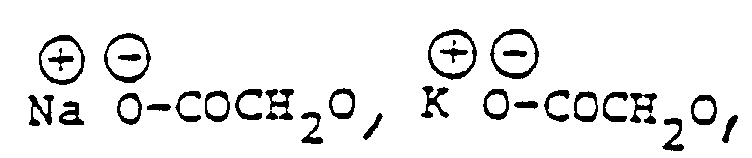 CH2=CHC(CH3)2O-COCH2O, CH3C≡CCH2O-COCH2O, CH3NHCOCH2O, (CH3)2NCOCH2O, n-C4H9NHCOCH2O, H2C=CHCH2NHCOCH2O, (H2C=CHCH2)2NCOCH2O,
 CH3SO2NHCOCH2O, CH3SO2NHCOCH(CH3)O, (CH3)3SiCH2O-COCH2O, CH3OC2H4OC2H4O-COCH(CH3)O, CH2=C(CH3)CH2S, CH2=C(Cl)CH2S, ClCH=CHCH2S, ClCH=C(Cl)CH2S, NCCH2S,
 HO-COCH2S, i-C3H7O-COCH2S, n-C4H9O-COCH2S, C12H25O-COCH2S, CH3S-COCH2S, C2H5S-COCH2S, i-C3H7S-COCH2S, CH≡CCH2O-COCH2S, C2H5OC2H4OC2H4O-COCH2S,
 (CH3)3SiCH2O-COCH2S, CH3NHCOCH2S, (CH3)2NCOCH2S, H2C=CHCH2NHCOCH2S, (H2C=CHCH2)2NCOCH2S, HC≡CCH2NHCOCH2S,
 i-C4H9O-COCH(CH3)S, t-C4H9CH2O-COCH(CH3)S, n-C6H13O-COCH(CH3)S,
 C2H5S-COCH(CH3)S, i-C3H7S-COCH(CH3)S, NCCH(CH3)O-COCH(CH3)S, CH3SC2H4O-COCH(CH3)S,
 (CH3)3SiCH2O-COCH(CH3)S, CH2=CHCH2NHCOCH(CH3)S, (H2C=CHCH2)2NCOCH(CH3)S, HC≡CCH2NHCOCH(CH3)S, CH3CO-O-(CH2)2S, C2H5O-COC(CH3)2S, CH3O-COCH(i-C3H7)S, C2H5O-COCH(CH3)N(CH3), CH2=CHCH2O-CO, CH3O-COCH(CH3)O-CO, C2H5O-COCH(CH3)O-CO, CH≡CCH2O-CO,
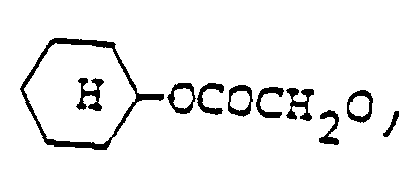 und CH3O-CO-OCH2S-CO;
 f) X Cl ist, R1 CH3 ist, R2 CHF2S ist, R3 Cl ist und R4 gewählt wird aus CH2=CHCH2S, CH≡CCH2S, C2H5OCH2CH2S, CH3SCH2S, NCCH2S, C2H5OOCS, CH3OOCCH2S, C2H5OOCCH2S,CH3NHOCCH2S, (CH3)2NOCCH2S, HOOCCH(CH3)S,
 C2H5OOCCH(CH3)S, n-C3H7OOCCH(CH3)S, i-C3H7OOCCH2S, (CH3)2CHCH2OOCCH2S, CH2=CHCH2OOCCH(CH3)S, C2H5OOC(CH2)3S, CH3NHOCCH(CH3)S, (CH3)2NOCCH(CH3)S, CH≡CCH2NH, CH3SO2NH, CH3NHSO2NH, CH3OOCNH, (C2H5)2NCOS, NCCH2O), ClCH=CHCH2O, CH3OCH2O, C2H5OC2H4O, CH3OCH2S, ClCH=CHCH2S, CH2=C(Cl)CH2S,
 CF3CH2O-COCH2O, CH2=CHCH2O-COCH2O,
 CH3NHCOCH2O, CH2=CHCH2O-COCH(CH3)O, CH3NHCOCH(CH3)O, NCCH2O-COCH2O, CH3O-COCH(CH3)S, NCCH2O-COCH(CH3)S, C2H5O-CO(CH2)3S,
 HO-COCH2NH, C2H5O-COCH2NH und C2H5O-COCH(CH3)NH;
 g) X F ist, R1 CH3 ist, R2 CH3SO ist, R3 Cl ist und R4 5-NO2 ist;h) X F ist, R1 CH3 ist, R2 CH3S ist, R3 Cl ist und R4 gewählt wird aus 5-NH2, 5-SH, 5-CH≡CCH2O, 5-CH≡CCH2S und 5-C2H5OOCCH(CH3)S;i) X F ist, R1 CH3 ist, R2 CHF2O ist, R3 Cl ist und R4 gewählt wird aus HO-COCH2O, CH3O-COCH2O, CH2-CHCH2O-COCH2O, CH≡CCH2O-COCH2O, HO-COCH(CH3)O, CH2=CHCH2O-COCH(CH3)O, CH≡CCH2O-COCH(CH3)O, CH2=CHCH2S, CH2=C(CH3)CH2S, CH≡CCH2S, C2H5OC2H4S, HO-COCH2S, CH3O-COCH2S, C2H5O-COCH2S, C2H5O-COCH2S(O), n-C4H9O-COCH2S, CH2=CHCH2O-COCH2S, CH3SCH2O-COCH2S,CH3NHCOCH2S, (CH3)2NCOCH2S, HO-COCH(CH3)S, CH3O-COCH(CH3)S, C2H5O-COCH(CH3)S, n-C4H9O-COCH(CH3)S, CH2=CHCH2O-COCH(CH3)S, CH≡CH2O-COCH(CH3)S, CH3OC2H4OC2H4O-COCH(CH3)S, CH3SO2NH, CH3NHSO2NH, C2H5O-COCH2NH, C2H5O-COCH(CH3)NH, CH2=CHCH2O-CO, CH≡CCH2O-CO, CH3O-COCH(CH3)O-CO, C2H5O-COCH(CH3)O-CO, (CH3)2NCO und
 j) X Cl ist, R1 CH3 ist, R2 CHF2O ist, R3 Br ist und R4 BrCH2CH(Br)CH2O oder BrC≡CCH2O ist.
 - Verfahren zur Herstellung von 3-(substituiertes Phenyl)prazol-Derivaten der allgemeinen Formel (I-2)worin X, R1, R2 und R3 definiert sind wie in Anspruch 1, und D-R8-1 definiert ist wie D-R8 in Anspruch 1 mit dem Unterschied, daß R8-1 kein Wasserstoff ist,

wobei das Verfahren das Umsetzen eines Pyrazol-Derivats der allgemeinen Formel (I-1)worin X, R1, R2, R3 und D wie oben definiert sind, mit einem Halogenid der allgemeinen Formel (II)
- Verfahren zur Herstellung von 3-(substituiertes Phenyl)pyrazol-Derivaten der allgemeinen Formel (I-4)worin X, R1, R2, R3 und -CO-B-R6 definiert sind wie in Anspruch 1,

wobei das Verfahren das Umsetzen eines Pyrazol-Derivats der allgemeinen Formel (I-3)worin X, R1, R2 und R3 wie oben definiert sind und Y Halogen oder OH bedeutet, mit einer Verbindung der allgemeinen Formel (II-1)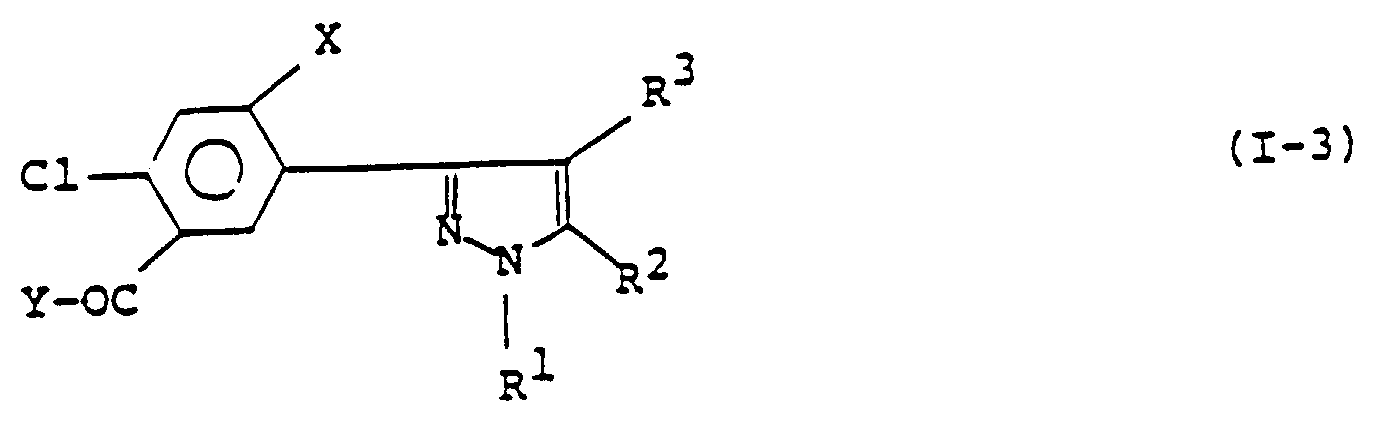
- Herbizide Zusammensetzung, die ein 3-(substituiertes Phenyl)pyrazol-Derivat oder ein Salz davon nach Anspruch 1 oder 2 als aktiven Inhaltsstoff enthält.
- Verwendung der herbiziden Zusammensetzung nach Anspruch 5 für Reisfelder, Hochlandfelder oder für Zwecke in nicht-landwirtschaftlichen Gebieten.
- Verfahren zur Kontrolle von unerwünschten Pflanzen, welches das Aufbringen einer herbiziden Zusammensetzung, welche ein 3-(substituiertes Phenyl)pyrazol-Derivat oder ein Salz davon nach Anspruch 1 oder 2 als aktiven Inhaltsstoff enthält, in einer Dosis von 1,0 g bis 10 kg, bezogen auf die Menge des aktiven Inhaltsstoffs, pro Hektar umfaßt.
Priority Applications (3)
| Application Number | Priority Date | Filing Date | Title |
|---|---|---|---|
| EP90103338A EP0443059B1 (de) | 1990-02-21 | 1990-02-21 | 3-(Substituierte Phenyl)pyrazolderivate, deren Salze, deren Herbizide und Verfahren zur Herstellung dieser Derivate oder Salze |
| ES90103338T ES2118060T3 (es) | 1990-02-21 | 1990-02-21 | Derivados de 3-(fenil sustituido)pirazol, sus sales, sus herbicidas; y los procedimientos de preparacion de estos derivados o de sus sales. |
| CN92112853A CN1026698C (zh) | 1990-02-21 | 1992-11-07 | 3-(取代苯基)吡唑衍生物及其盐的制备方法 |
Applications Claiming Priority (2)
| Application Number | Priority Date | Filing Date | Title |
|---|---|---|---|
| EP90103338A EP0443059B1 (de) | 1990-02-21 | 1990-02-21 | 3-(Substituierte Phenyl)pyrazolderivate, deren Salze, deren Herbizide und Verfahren zur Herstellung dieser Derivate oder Salze |
| CN92112853A CN1026698C (zh) | 1990-02-21 | 1992-11-07 | 3-(取代苯基)吡唑衍生物及其盐的制备方法 |
Publications (2)
| Publication Number | Publication Date |
|---|---|
| EP0443059A1 EP0443059A1 (de) | 1991-08-28 |
| EP0443059B1 true EP0443059B1 (de) | 1998-06-17 |
Family
ID=25742827
Family Applications (1)
| Application Number | Title | Priority Date | Filing Date |
|---|---|---|---|
| EP90103338A Expired - Lifetime EP0443059B1 (de) | 1990-02-21 | 1990-02-21 | 3-(Substituierte Phenyl)pyrazolderivate, deren Salze, deren Herbizide und Verfahren zur Herstellung dieser Derivate oder Salze |
Country Status (3)
| Country | Link |
|---|---|
| EP (1) | EP0443059B1 (de) |
| CN (1) | CN1026698C (de) |
| ES (1) | ES2118060T3 (de) |
Cited By (3)
| Publication number | Priority date | Publication date | Assignee | Title |
|---|---|---|---|---|
| RU2120753C1 (ru) * | 1993-10-12 | 1998-10-27 | Нихон Нохияку Ко., Лтд. | Способ получения пестицидного водного суспензионного концентрата и пестицидный водный суспензионный концентрат |
| JP5113531B2 (ja) * | 2006-01-16 | 2013-01-09 | 三井化学アグロ株式会社 | (3−硫黄原子置換フェニル)ピラゾール誘導体 |
| US8362017B2 (en) | 2003-08-29 | 2013-01-29 | Exelixis, Inc. | C-kit modulators and methods of use |
Families Citing this family (20)
| Publication number | Priority date | Publication date | Assignee | Title |
|---|---|---|---|---|
| US5281571A (en) * | 1990-10-18 | 1994-01-25 | Monsanto Company | Herbicidal benzoxazinone- and benzothiazinone-substituted pyrazoles |
| US5532416A (en) * | 1994-07-20 | 1996-07-02 | Monsanto Company | Benzoyl derivatives and synthesis thereof |
| AU653299B2 (en) * | 1993-02-06 | 1994-09-22 | Nihon Nohyaku Co., Ltd. | A herbicidal composition having a reduced phytotoxicity |
| GB9309542D0 (en) * | 1993-05-10 | 1993-06-23 | Zeneca Ltd | Herbicidal treatment |
| FR2705201B1 (fr) * | 1993-05-19 | 1995-07-07 | Rhone Poulenc Agrochimie | Mélanges herbicides à base de diflufenican et d'un composé 3-phénylpyrazole. |
| DE4417837A1 (de) | 1994-05-20 | 1995-11-23 | Basf Ag | Substituierte 3-Phenylpyrazole |
| DE4419517A1 (de) * | 1994-06-03 | 1995-12-07 | Basf Ag | Substituierte 3-Phenylpyrazole |
| HRP950330A2 (en) * | 1994-07-05 | 1997-10-31 | Ciba Geigy Ag | New herbicides |
| US5869688A (en) * | 1994-07-20 | 1999-02-09 | Monsanto Company | Preparation of substituted 3-aryl-5-haloalkyl-pyrazoles having herbicidal activity |
| GB2293766A (en) * | 1994-10-07 | 1996-04-10 | Zeneca Ltd | Herbicidal compositions based on synergistic combination of glyphosate and 1,3,4,5-tetrasubstituted pyrazoles |
| DE19524623A1 (de) * | 1995-07-06 | 1997-01-09 | Basf Ag | 5-Pyrazolylbenzoesäure-Derivate |
| US5698708A (en) * | 1996-06-20 | 1997-12-16 | Monsanto Company | Preparation of substituted 3-aryl-5-haloalkyl-pyrazoles having herbicidal activity |
| WO1998005649A1 (de) | 1996-08-01 | 1998-02-12 | Basf Aktiengesellschaft | Substituierte 3-phenylpyrazole |
| AU6719498A (en) * | 1997-02-27 | 1998-09-18 | Basf Aktiengesellschaft | Substituted 3-phenyl pyrazoles |
| IL156932A0 (en) | 2001-01-16 | 2004-02-08 | Basf Ag | Method of producing 1-alkyl-3-aryl-5-difluoromethoxy-1h-pyrazoles |
| WO2003029226A1 (en) * | 2001-09-26 | 2003-04-10 | Basf Aktiengesellschaft | Heterocyclyl substituted phenoxyalkyl-, phenylthioalkyl-, phenylaminoalkyl- and phenylalkyl-sulfamoylcarboxamides |
| CN100409748C (zh) * | 2002-09-28 | 2008-08-13 | 王正权 | 取代苯基异噁唑类除草剂 |
| AU2008236679B2 (en) | 2007-04-03 | 2013-11-28 | Fmc Corporation | Substituted benzene fungicides |
| CN102258028B (zh) * | 2011-07-06 | 2014-08-13 | 陕西美邦农药有限公司 | 一种含氟丁酰草胺与吡草醚的除草组合物 |
| CN102396464A (zh) * | 2011-11-24 | 2012-04-04 | 陕西美邦农药有限公司 | 一种含吡草醚的新型农药组合物 |
Family Cites Families (4)
| Publication number | Priority date | Publication date | Assignee | Title |
|---|---|---|---|---|
| DE2409753A1 (de) * | 1974-03-01 | 1975-09-11 | Basf Ag | Substituierte pyrazole |
| GB2073172A (en) * | 1980-04-03 | 1981-10-14 | Shell Int Research | Pesticidal Pyrazole Derivatives |
| JPS5785371A (en) * | 1980-11-13 | 1982-05-28 | Ihara Chem Ind Co Ltd | 4-fluoro-5-oxypyrazole derivative |
| KR930004672B1 (ko) * | 1988-08-31 | 1993-06-03 | 니혼 노야꾸 가부시끼가이샤 | 3-치환 페닐피라졸 유도체 또는 이의 염 및 이의 제조방법, 이의 용도 및 이의 사용 방법 |
-
1990
- 1990-02-21 EP EP90103338A patent/EP0443059B1/de not_active Expired - Lifetime
- 1990-02-21 ES ES90103338T patent/ES2118060T3/es not_active Expired - Lifetime
-
1992
- 1992-11-07 CN CN92112853A patent/CN1026698C/zh not_active Expired - Lifetime
Cited By (3)
| Publication number | Priority date | Publication date | Assignee | Title |
|---|---|---|---|---|
| RU2120753C1 (ru) * | 1993-10-12 | 1998-10-27 | Нихон Нохияку Ко., Лтд. | Способ получения пестицидного водного суспензионного концентрата и пестицидный водный суспензионный концентрат |
| US8362017B2 (en) | 2003-08-29 | 2013-01-29 | Exelixis, Inc. | C-kit modulators and methods of use |
| JP5113531B2 (ja) * | 2006-01-16 | 2013-01-09 | 三井化学アグロ株式会社 | (3−硫黄原子置換フェニル)ピラゾール誘導体 |
Also Published As
| Publication number | Publication date |
|---|---|
| CN1026698C (zh) | 1994-11-23 |
| ES2118060T3 (es) | 1998-09-16 |
| EP0443059A1 (de) | 1991-08-28 |
| CN1073432A (zh) | 1993-06-23 |
Similar Documents
| Publication | Publication Date | Title |
|---|---|---|
| EP0361114B1 (de) | 3-(Substituierte Phenyl)-pyrazol-Derivate, deren Salze, deren Herbizide und Verfahren zur Herstellung dieser Derivate oder Salze | |
| EP0443059A1 (de) | 3-(Substituierte Phenyl)pyrazolderivate, deren Salze, deren Herbizide und Verfahren zur Herstellung dieser Derivate oder Salze | |
| AU622585B2 (en) | 3-(substituted phenyl) pyrazole derivatives, a process for producing the same, herbicidal composition containing the same and method of controlling weeds using said composition | |
| KR880001717B1 (ko) | 2-치환페닐 하이단토인유도체의 제조방법 | |
| US4816064A (en) | Triazine derivatives, herbicidal composition containing them, and method of controlling growth of undesired vegetation by using same | |
| JPS60174756A (ja) | ピラゾール誘導体による除草剤 | |
| EP0203428A1 (de) | 4-Benzoyl-1-alkyl(alkenyl)-pyrazole als Herbizide | |
| US5094685A (en) | Substituted benzoyl derivatives and selective herbicides | |
| EP0202169A1 (de) | Pyrazolderivate, deren Herstellung und Verwendung | |
| EP0332133B1 (de) | Triazolverbindungen, Verfahren zu ihrer Herstellung und diese enthaltende herbizide Zusammensetzungen | |
| HK1005028B (en) | Novel triazole compounds, process for producing the same, and herbicidal compositions containing the same | |
| US4406688A (en) | Herbicidal 4-benzoyl-5-phenacyloxy-pyrazole derivatives, composition and method | |
| JPH0421672B2 (de) | ||
| EP0990649B1 (de) | Benzoylpyrazolderivate mit bestimmten substituenten und herbizide | |
| EP0799825A1 (de) | Pyridin-2,3-dicarbonsäurediamidderivate und diese Derivate als wirksame Bestandteile enthaltende Herbizide | |
| US5620944A (en) | Phenylimidazole derivatives, herbicides comprising said derivatives, and usages of said herbicides | |
| 山本進 et al. | Selective herbicidal activities of ethyl 5-(4, 6-dimethoxypyrimidin-2-ylcarbamoylsulfamoyl)-1-methylpyrazole-4-carboxylate and its related compounds | |
| EP0234352B1 (de) | Sulfonamidverbindungen und deren Salze, diese enthaltende herbizide Zusammensetzungen und Verfahren zu ihrer Herstellung | |
| JPS6314713B2 (de) | ||
| EP0073409B1 (de) | N-substituierte Derivate des Tetrahydroisophthalimids | |
| DE2842315A1 (de) | N-(1,2-azolyl)alkyl-halogenacetanilide, verfahren zu ihrer herstellung sowie ihre verwendung als herbizide | |
| JP2730022B2 (ja) | 3−アルコキシブチリルイミダゾール誘導体、その製造法及び除草剤 | |
| EP0299382A1 (de) | 2-Nitro-5-(substituiertes Pyridiloxy)-benzohydroximinsäure-Derivate | |
| US4222765A (en) | Thiolcarbamic acid esters | |
| AU3459600A (en) | Azole compounds and herbicide compositions |
Legal Events
| Date | Code | Title | Description |
|---|---|---|---|
| PUAI | Public reference made under article 153(3) epc to a published international application that has entered the european phase |
Free format text: ORIGINAL CODE: 0009012 |
|
| AK | Designated contracting states |
Kind code of ref document: A1 Designated state(s): BE ES NL |
|
| 17P | Request for examination filed |
Effective date: 19911105 |
|
| 17Q | First examination report despatched |
Effective date: 19920817 |
|
| APAB | Appeal dossier modified |
Free format text: ORIGINAL CODE: EPIDOS NOAPE |
|
| GRAG | Despatch of communication of intention to grant |
Free format text: ORIGINAL CODE: EPIDOS AGRA |
|
| GRAG | Despatch of communication of intention to grant |
Free format text: ORIGINAL CODE: EPIDOS AGRA |
|
| GRAH | Despatch of communication of intention to grant a patent |
Free format text: ORIGINAL CODE: EPIDOS IGRA |
|
| GRAH | Despatch of communication of intention to grant a patent |
Free format text: ORIGINAL CODE: EPIDOS IGRA |
|
| GRAA | (expected) grant |
Free format text: ORIGINAL CODE: 0009210 |
|
| AK | Designated contracting states |
Kind code of ref document: B1 Designated state(s): BE ES NL |
|
| REG | Reference to a national code |
Ref country code: ES Ref legal event code: FG2A Ref document number: 2118060 Country of ref document: ES Kind code of ref document: T3 |
|
| PLBE | No opposition filed within time limit |
Free format text: ORIGINAL CODE: 0009261 |
|
| STAA | Information on the status of an ep patent application or granted ep patent |
Free format text: STATUS: NO OPPOSITION FILED WITHIN TIME LIMIT |
|
| 26N | No opposition filed | ||
| APAH | Appeal reference modified |
Free format text: ORIGINAL CODE: EPIDOSCREFNO |
|
| PGFP | Annual fee paid to national office [announced via postgrant information from national office to epo] |
Ref country code: ES Payment date: 20090227 Year of fee payment: 20 |
|
| PGFP | Annual fee paid to national office [announced via postgrant information from national office to epo] |
Ref country code: NL Payment date: 20081125 Year of fee payment: 20 |
|
| PGFP | Annual fee paid to national office [announced via postgrant information from national office to epo] |
Ref country code: BE Payment date: 20090427 Year of fee payment: 20 |
|
| BE20 | Be: patent expired |
Owner name: *NIHON NOHYAKU CO. LTD Effective date: 20100221 |
|
| REG | Reference to a national code |
Ref country code: NL Ref legal event code: V4 Effective date: 20100221 |
|
| REG | Reference to a national code |
Ref country code: ES Ref legal event code: FD2A Effective date: 20100222 |
|
| PG25 | Lapsed in a contracting state [announced via postgrant information from national office to epo] |
Ref country code: ES Free format text: LAPSE BECAUSE OF EXPIRATION OF PROTECTION Effective date: 20100222 Ref country code: NL Free format text: LAPSE BECAUSE OF EXPIRATION OF PROTECTION Effective date: 20100221 |