EP0441535B1 - Verfahren und Vorrichtung zur Lokalisierung der Referenzierungsecke eines Dokuments in einem Dokumentabtaster - Google Patents
Verfahren und Vorrichtung zur Lokalisierung der Referenzierungsecke eines Dokuments in einem Dokumentabtaster Download PDFInfo
- Publication number
- EP0441535B1 EP0441535B1 EP91300778A EP91300778A EP0441535B1 EP 0441535 B1 EP0441535 B1 EP 0441535B1 EP 91300778 A EP91300778 A EP 91300778A EP 91300778 A EP91300778 A EP 91300778A EP 0441535 B1 EP0441535 B1 EP 0441535B1
- Authority
- EP
- European Patent Office
- Prior art keywords
- document
- platen
- footprint
- corner
- sensor array
- Prior art date
- Legal status (The legal status is an assumption and is not a legal conclusion. Google has not performed a legal analysis and makes no representation as to the accuracy of the status listed.)
- Expired - Lifetime
Links
- 238000000034 method Methods 0.000 title claims description 19
- 230000033001 locomotion Effects 0.000 claims description 30
- 230000003287 optical effect Effects 0.000 claims description 4
- 238000005286 illumination Methods 0.000 claims 1
- 230000006870 function Effects 0.000 description 19
- 239000004020 conductor Substances 0.000 description 6
- 238000010276 construction Methods 0.000 description 6
- 238000011144 upstream manufacturing Methods 0.000 description 6
- 238000003491 array Methods 0.000 description 5
- 238000004891 communication Methods 0.000 description 4
- 230000005540 biological transmission Effects 0.000 description 3
- 238000001514 detection method Methods 0.000 description 3
- 238000004519 manufacturing process Methods 0.000 description 3
- 238000012545 processing Methods 0.000 description 3
- 230000004913 activation Effects 0.000 description 2
- 230000008901 benefit Effects 0.000 description 2
- 230000008859 change Effects 0.000 description 2
- 238000006243 chemical reaction Methods 0.000 description 2
- 238000013500 data storage Methods 0.000 description 2
- 230000008520 organization Effects 0.000 description 2
- 238000012935 Averaging Methods 0.000 description 1
- 101100464472 Pectobacterium carotovorum PEL X gene Proteins 0.000 description 1
- 230000003213 activating effect Effects 0.000 description 1
- 238000013459 approach Methods 0.000 description 1
- 238000004364 calculation method Methods 0.000 description 1
- 238000010586 diagram Methods 0.000 description 1
- 239000000835 fiber Substances 0.000 description 1
- 239000011521 glass Substances 0.000 description 1
- 230000000977 initiatory effect Effects 0.000 description 1
- 239000011159 matrix material Substances 0.000 description 1
- 238000005259 measurement Methods 0.000 description 1
- 230000008569 process Effects 0.000 description 1
- 238000004064 recycling Methods 0.000 description 1
- 230000004044 response Effects 0.000 description 1
- 238000005070 sampling Methods 0.000 description 1
- 238000012546 transfer Methods 0.000 description 1
- 230000000007 visual effect Effects 0.000 description 1
Images


Classifications
-
- H—ELECTRICITY
- H04—ELECTRIC COMMUNICATION TECHNIQUE
- H04N—PICTORIAL COMMUNICATION, e.g. TELEVISION
- H04N1/00—Scanning, transmission or reproduction of documents or the like, e.g. facsimile transmission; Details thereof
- H04N1/04—Scanning arrangements, i.e. arrangements for the displacement of active reading or reproducing elements relative to the original or reproducing medium, or vice versa
- H04N1/047—Detection, control or error compensation of scanning velocity or position
-
- H—ELECTRICITY
- H04—ELECTRIC COMMUNICATION TECHNIQUE
- H04N—PICTORIAL COMMUNICATION, e.g. TELEVISION
- H04N1/00—Scanning, transmission or reproduction of documents or the like, e.g. facsimile transmission; Details thereof
- H04N1/04—Scanning arrangements, i.e. arrangements for the displacement of active reading or reproducing elements relative to the original or reproducing medium, or vice versa
- H04N1/10—Scanning arrangements, i.e. arrangements for the displacement of active reading or reproducing elements relative to the original or reproducing medium, or vice versa using flat picture-bearing surfaces
- H04N1/1013—Scanning arrangements, i.e. arrangements for the displacement of active reading or reproducing elements relative to the original or reproducing medium, or vice versa using flat picture-bearing surfaces with sub-scanning by translatory movement of at least a part of the main-scanning components
- H04N1/1017—Scanning arrangements, i.e. arrangements for the displacement of active reading or reproducing elements relative to the original or reproducing medium, or vice versa using flat picture-bearing surfaces with sub-scanning by translatory movement of at least a part of the main-scanning components the main-scanning components remaining positionally invariant with respect to one another in the sub-scanning direction
-
- H—ELECTRICITY
- H04—ELECTRIC COMMUNICATION TECHNIQUE
- H04N—PICTORIAL COMMUNICATION, e.g. TELEVISION
- H04N1/00—Scanning, transmission or reproduction of documents or the like, e.g. facsimile transmission; Details thereof
- H04N1/04—Scanning arrangements, i.e. arrangements for the displacement of active reading or reproducing elements relative to the original or reproducing medium, or vice versa
- H04N1/19—Scanning arrangements, i.e. arrangements for the displacement of active reading or reproducing elements relative to the original or reproducing medium, or vice versa using multi-element arrays
- H04N1/191—Scanning arrangements, i.e. arrangements for the displacement of active reading or reproducing elements relative to the original or reproducing medium, or vice versa using multi-element arrays the array comprising a one-dimensional array, or a combination of one-dimensional arrays, or a substantially one-dimensional array, e.g. an array of staggered elements
- H04N1/192—Simultaneously or substantially simultaneously scanning picture elements on one main scanning line
- H04N1/193—Simultaneously or substantially simultaneously scanning picture elements on one main scanning line using electrically scanned linear arrays, e.g. linear CCD arrays
-
- H—ELECTRICITY
- H04—ELECTRIC COMMUNICATION TECHNIQUE
- H04N—PICTORIAL COMMUNICATION, e.g. TELEVISION
- H04N2201/00—Indexing scheme relating to scanning, transmission or reproduction of documents or the like, and to details thereof
- H04N2201/024—Indexing scheme relating to scanning, transmission or reproduction of documents or the like, and to details thereof deleted
- H04N2201/02406—Arrangements for positioning elements within a head
- H04N2201/02416—Rotational positioning, i.e. with respect to an axis
-
- H—ELECTRICITY
- H04—ELECTRIC COMMUNICATION TECHNIQUE
- H04N—PICTORIAL COMMUNICATION, e.g. TELEVISION
- H04N2201/00—Indexing scheme relating to scanning, transmission or reproduction of documents or the like, and to details thereof
- H04N2201/024—Indexing scheme relating to scanning, transmission or reproduction of documents or the like, and to details thereof deleted
- H04N2201/02406—Arrangements for positioning elements within a head
- H04N2201/02439—Positioning method
-
- H—ELECTRICITY
- H04—ELECTRIC COMMUNICATION TECHNIQUE
- H04N—PICTORIAL COMMUNICATION, e.g. TELEVISION
- H04N2201/00—Indexing scheme relating to scanning, transmission or reproduction of documents or the like, and to details thereof
- H04N2201/024—Indexing scheme relating to scanning, transmission or reproduction of documents or the like, and to details thereof deleted
- H04N2201/028—Indexing scheme relating to scanning, transmission or reproduction of documents or the like, and to details thereof deleted for picture information pick-up
- H04N2201/03—Indexing scheme relating to scanning, transmission or reproduction of documents or the like, and to details thereof deleted for picture information pick-up deleted
- H04N2201/031—Indexing scheme relating to scanning, transmission or reproduction of documents or the like, and to details thereof deleted for picture information pick-up deleted deleted
- H04N2201/03104—Integral pick-up heads, i.e. self-contained heads whose basic elements are a light source, a lens and a photodetector supported by a single-piece frame
- H04N2201/0315—Details of integral heads not otherwise provided for
- H04N2201/03162—Original guide plate
-
- H—ELECTRICITY
- H04—ELECTRIC COMMUNICATION TECHNIQUE
- H04N—PICTORIAL COMMUNICATION, e.g. TELEVISION
- H04N2201/00—Indexing scheme relating to scanning, transmission or reproduction of documents or the like, and to details thereof
- H04N2201/04—Scanning arrangements
- H04N2201/047—Detection, control or error compensation of scanning velocity or position
- H04N2201/04701—Detection of scanning velocity or position
- H04N2201/04703—Detection of scanning velocity or position using the scanning elements as detectors, e.g. by performing a prescan
-
- H—ELECTRICITY
- H04—ELECTRIC COMMUNICATION TECHNIQUE
- H04N—PICTORIAL COMMUNICATION, e.g. TELEVISION
- H04N2201/00—Indexing scheme relating to scanning, transmission or reproduction of documents or the like, and to details thereof
- H04N2201/04—Scanning arrangements
- H04N2201/047—Detection, control or error compensation of scanning velocity or position
- H04N2201/04701—Detection of scanning velocity or position
- H04N2201/0471—Detection of scanning velocity or position using dedicated detectors
-
- H—ELECTRICITY
- H04—ELECTRIC COMMUNICATION TECHNIQUE
- H04N—PICTORIAL COMMUNICATION, e.g. TELEVISION
- H04N2201/00—Indexing scheme relating to scanning, transmission or reproduction of documents or the like, and to details thereof
- H04N2201/04—Scanning arrangements
- H04N2201/047—Detection, control or error compensation of scanning velocity or position
- H04N2201/04701—Detection of scanning velocity or position
- H04N2201/04715—Detection of scanning velocity or position by detecting marks or the like, e.g. slits
- H04N2201/0472—Detection of scanning velocity or position by detecting marks or the like, e.g. slits on or adjacent the sheet support
-
- H—ELECTRICITY
- H04—ELECTRIC COMMUNICATION TECHNIQUE
- H04N—PICTORIAL COMMUNICATION, e.g. TELEVISION
- H04N2201/00—Indexing scheme relating to scanning, transmission or reproduction of documents or the like, and to details thereof
- H04N2201/04—Scanning arrangements
- H04N2201/047—Detection, control or error compensation of scanning velocity or position
- H04N2201/04701—Detection of scanning velocity or position
- H04N2201/04715—Detection of scanning velocity or position by detecting marks or the like, e.g. slits
- H04N2201/04724—Detection of scanning velocity or position by detecting marks or the like, e.g. slits on a separate encoder wheel
-
- H—ELECTRICITY
- H04—ELECTRIC COMMUNICATION TECHNIQUE
- H04N—PICTORIAL COMMUNICATION, e.g. TELEVISION
- H04N2201/00—Indexing scheme relating to scanning, transmission or reproduction of documents or the like, and to details thereof
- H04N2201/04—Scanning arrangements
- H04N2201/047—Detection, control or error compensation of scanning velocity or position
- H04N2201/04701—Detection of scanning velocity or position
- H04N2201/04729—Detection of scanning velocity or position in the main-scan direction
-
- H—ELECTRICITY
- H04—ELECTRIC COMMUNICATION TECHNIQUE
- H04N—PICTORIAL COMMUNICATION, e.g. TELEVISION
- H04N2201/00—Indexing scheme relating to scanning, transmission or reproduction of documents or the like, and to details thereof
- H04N2201/04—Scanning arrangements
- H04N2201/047—Detection, control or error compensation of scanning velocity or position
- H04N2201/04701—Detection of scanning velocity or position
- H04N2201/04731—Detection of scanning velocity or position in the sub-scan direction
-
- H—ELECTRICITY
- H04—ELECTRIC COMMUNICATION TECHNIQUE
- H04N—PICTORIAL COMMUNICATION, e.g. TELEVISION
- H04N2201/00—Indexing scheme relating to scanning, transmission or reproduction of documents or the like, and to details thereof
- H04N2201/04—Scanning arrangements
- H04N2201/047—Detection, control or error compensation of scanning velocity or position
- H04N2201/04701—Detection of scanning velocity or position
- H04N2201/04732—Detecting at infrequent intervals, e.g. once or twice per line for main-scan control
-
- H—ELECTRICITY
- H04—ELECTRIC COMMUNICATION TECHNIQUE
- H04N—PICTORIAL COMMUNICATION, e.g. TELEVISION
- H04N2201/00—Indexing scheme relating to scanning, transmission or reproduction of documents or the like, and to details thereof
- H04N2201/04—Scanning arrangements
- H04N2201/047—Detection, control or error compensation of scanning velocity or position
- H04N2201/04701—Detection of scanning velocity or position
- H04N2201/04734—Detecting at frequent intervals, e.g. once per line for sub-scan control
-
- H—ELECTRICITY
- H04—ELECTRIC COMMUNICATION TECHNIQUE
- H04N—PICTORIAL COMMUNICATION, e.g. TELEVISION
- H04N2201/00—Indexing scheme relating to scanning, transmission or reproduction of documents or the like, and to details thereof
- H04N2201/04—Scanning arrangements
- H04N2201/047—Detection, control or error compensation of scanning velocity or position
- H04N2201/04701—Detection of scanning velocity or position
- H04N2201/04739—Detection of scanning velocity or position by detecting the scanning head or scanning carriage
-
- H—ELECTRICITY
- H04—ELECTRIC COMMUNICATION TECHNIQUE
- H04N—PICTORIAL COMMUNICATION, e.g. TELEVISION
- H04N2201/00—Indexing scheme relating to scanning, transmission or reproduction of documents or the like, and to details thereof
- H04N2201/04—Scanning arrangements
- H04N2201/047—Detection, control or error compensation of scanning velocity or position
- H04N2201/04753—Control or error compensation of scanning position or velocity
- H04N2201/04755—Control or error compensation of scanning position or velocity by controlling the position or movement of a scanning element or carriage, e.g. of a polygonal mirror, of a drive motor
-
- H—ELECTRICITY
- H04—ELECTRIC COMMUNICATION TECHNIQUE
- H04N—PICTORIAL COMMUNICATION, e.g. TELEVISION
- H04N2201/00—Indexing scheme relating to scanning, transmission or reproduction of documents or the like, and to details thereof
- H04N2201/04—Scanning arrangements
- H04N2201/047—Detection, control or error compensation of scanning velocity or position
- H04N2201/04753—Control or error compensation of scanning position or velocity
- H04N2201/04758—Control or error compensation of scanning position or velocity by controlling the position of the scanned image area
- H04N2201/04787—Control or error compensation of scanning position or velocity by controlling the position of the scanned image area by changing or controlling the addresses or values of pixels, e.g. in an array, in a memory, by interpolation
-
- H—ELECTRICITY
- H04—ELECTRIC COMMUNICATION TECHNIQUE
- H04N—PICTORIAL COMMUNICATION, e.g. TELEVISION
- H04N2201/00—Indexing scheme relating to scanning, transmission or reproduction of documents or the like, and to details thereof
- H04N2201/04—Scanning arrangements
- H04N2201/047—Detection, control or error compensation of scanning velocity or position
- H04N2201/04753—Control or error compensation of scanning position or velocity
- H04N2201/04789—Control or error compensation of scanning position or velocity in the main-scan direction
-
- H—ELECTRICITY
- H04—ELECTRIC COMMUNICATION TECHNIQUE
- H04N—PICTORIAL COMMUNICATION, e.g. TELEVISION
- H04N2201/00—Indexing scheme relating to scanning, transmission or reproduction of documents or the like, and to details thereof
- H04N2201/04—Scanning arrangements
- H04N2201/047—Detection, control or error compensation of scanning velocity or position
- H04N2201/04753—Control or error compensation of scanning position or velocity
- H04N2201/04791—Control or error compensation of scanning position or velocity in the sub-scan direction
-
- H—ELECTRICITY
- H04—ELECTRIC COMMUNICATION TECHNIQUE
- H04N—PICTORIAL COMMUNICATION, e.g. TELEVISION
- H04N2201/00—Indexing scheme relating to scanning, transmission or reproduction of documents or the like, and to details thereof
- H04N2201/04—Scanning arrangements
- H04N2201/047—Detection, control or error compensation of scanning velocity or position
- H04N2201/04753—Control or error compensation of scanning position or velocity
- H04N2201/04793—Control or error compensation of scanning position or velocity using stored control or compensation data, e.g. previously measured data
-
- H—ELECTRICITY
- H04—ELECTRIC COMMUNICATION TECHNIQUE
- H04N—PICTORIAL COMMUNICATION, e.g. TELEVISION
- H04N2201/00—Indexing scheme relating to scanning, transmission or reproduction of documents or the like, and to details thereof
- H04N2201/04—Scanning arrangements
- H04N2201/047—Detection, control or error compensation of scanning velocity or position
- H04N2201/04753—Control or error compensation of scanning position or velocity
- H04N2201/04794—Varying the control or compensation during the scan, e.g. using continuous feedback or from line to line
Definitions
- the present invention relates to document scanners, and more specifically to a method and an apparatus for electronically determining the physical position of critical scanner elements relative to a document referencing corner prior to the scanning of a document.
- the scanner is conventionally provided with a platen whereat a document is corner referenced for scanning.
- the platen's referencing corner defines the X axis and the Y axis of an orthogonal coordinate system or matrix to which the picture element image content (PEL content) of the document is referenced during scanning.
- PEL content picture element image content
- the document is illuminated during scanning by a line or footprint of light that extends in the X direction and moves in the Y direction. Light is thus reflected from the document in a line by line or row by row fashion.
- a document comprising a black image on white paper
- high intensity light is reflected from the document's white background PEL areas
- lower intensities of light are reflected from the document's black image PEL areas.
- the platen may contain a horizontal, rectangular, transparent glass or glass-like member on which the document is corner referenced.
- the line or footprint of reflected light is optically directed onto a linear array of light sensitive cells or elements that effectively extend in the X direction.
- An example of such an array is a CCD array whose individual cells define one pixel or PEL of the light footprint.
- the convention that will be used in the following description defines the direction in which the light footprint extends, the direction in which the sensor array extends, and the direction in which the leading edge of the platen extends, as the X direction.
- the direction of relative movement between the document and the light footprint is defined as the Y direction.
- the sides of the platen extend in the Y direction.
- a rectangular document includes two side edges that extend in the Y direction, and that terminate at the document's trailing edge. While this is the usual configuration for a document scanner, the present invention also finds utility in scanners that are also capable of the so called backward scanning.
- a scan request may be for what is defined as a window scan.
- a window scan requests that a rectangular area within the body of the document be scanned.
- the leading edge of such a window is parallel to the document's leading edge, and may or may not be coincident with the document's leading edge.
- the scanner apparatus can be used to either scan the entire document, or to scan an internal portion or window thereof.
- this window area is defined by giving the X and Y coordinates of the window area referenced to the X-Y coordinate system that is defined by the platen.
- the effective (i.e. magnified) X direction length of the sensor array is somewhat greater than the X direction width of the document being scanned (for example 216 mm (8 1/2 inch)).
- the signal content of the sensor array cells is not used (i.e is not read out into memory) until the Y direction position of the light footprint has reached the leading edge of the document (or portion of the document) that is to be scanned. Also, only the length of sensor cells that actually view the document or a document window (i.e. less than all of the cells), are read out into memory.
- US-A-4 249 217 describes a scanner in which the total number of pixels horizontally across an image is greater than the number of sensors in a single linear sensor array. To obtain the desired number of pixels across the image, multiple sensor arrays are used with overlapping ends. To calibrate the horizontal position of the arrays, vertical lines are scanned. By scanning a vertical line that is covered by the overlapping portion of two sensors arrays, the relative position of the two overlapping arrays can be determined.
- the present inventio provides a method and an apparatus for periodically recalibrating the electronic and/or logic means of a scanner apparatus so as to ensure accurate scanning of a document, or a window within a document, without the need to rely upon a fixed and non-varying physical relationship between the sensor array, the moving footprint of light, the platen, and other portions of the scanner apparatus.
- An advantage of the invention is to provide a scanner apparatus wherein the mechanical construction and alignment of various scanner members and parameters, such as the optical magnification of the scanning light footprint and the position of the light path, can be constructed more easily, more economically, and to less stringent engineering specifications than was possible in the prior art.
- the present invention provides a construction and arrangement whereby operation of the invention accurately locates or finds the scanning area of the scanner apparatus, for example the document referencing corner of the platen. For example, the location of the referencing corner is stored in memory each time the scanner apparatus is turned on.
- the present invention provides a target area that is accurately positioned adjacent to the leading edge of the platen. This target area is scanned prior to the light footprint reaching the leading edge of the platen. Sensing the position of this target area relative to (1) the individual sensor cells of the array, and (2) the position of the light footprint as the footprint approaches the document's leading edge, allows the scanner's electronics and/or logic to be initialized so as to thereafter accurately utilize the output of certain sensor cells only when these cells are in fact reading the image data content of the document, or in the case of a windowing request, are reading the image data content of a window area that is internal to the document.
- the invention provides a document scanner apparatus of the stationary document, moving light footprint type, wherein document scanning is accomplished by way of a movable carriage which contains a linear light source and an array of light sensitive cells that are operable to detect light that is reflected from the document.
- Each sensor cell defines a document picture element or pixel (PEL) within the linear scan line that is reflected from the document.
- the signal content of the sensor cells are periodically read out, document line by document line, as the carriage moves along the Y direction length of platen.
- the platen is provided with an opaque leading edge portion and an orthogonal opaque side edge portion, which two platen portions define a transparent leading edge corner of the platen at which a document is corner referenced for scanning.
- Movement of the scan carriage is servo controlled in an open loop manner.
- the scan carriage may be close loop controlled, but at an added cost.
- a home sensor is provided to detect the scan carriage as it moves in a homing direction, back toward the carriage's start of scan position.
- the home sensor is positioned within the body of the scanner apparatus, and at location that is generally related to the platen's leading edge portion.
- the home sensor senses the presence of the carriage when the light footprint arrives at the general location of the platen's leading edge.
- the inactive home position of the scan carriage is such that the light footprint illuminates the platen's leading edge portion.
- the moving light footprint operates, for example on initial power-up of the scanner apparatus, to scan-illuminate the platen's opaque leading edge portion during the initial part of a scan operation, and before the light footprint has moved to the leading edge of the platen/document.
- a reflection target is positioned within the opaque leading edge portion of platen, at a known position or distance relative to the above mentioned platen referencing corner.
- the output of the sensor array is analyzed or interrogated in order to physically locate (1) the position of this reflection target relative to the individual cells of the sensor array, and (2) the position of this reflection target relative to the position of the light footprint (i.e. the position of the scan carriage, the motor that drives the carriage, the home sensor, and the footprint of light that is generated by the scan carriage, and if a closed loop servomechanism is provided, the output of the feedback transducer within the carriage motion control servomechanism).
- the reflection target is scanned, scanning motion thereafter stops, and the signals derived from the reflection target are analyzed.
- the location of the reflection target i.e. the location of the platen's referencing corner, is thereby stored in memory. This position parameter is thereafter used as documents are periodically scanned during the work day.
- the scanner's control logic operates to process the output signal from only certain sensor cells as these cells view the platen, or a window within the platen.
- the scanner apparatus is operated to utilize only the sensor cells that are within the above mentioned second group of cells, as a document that is corner referenced at the platen is scanned, or window scanned.
- operation of the present invention uses the reflection target to locate the platen's X-Y coordinate system, and thus allows the scanner apparatus to accurate locate or find the leading edge of a document portion that is to be scanned.
- operation of the document scanner is initialized, as above described, each and every time the scanner apparatus is turned on, for example at the beginning of each working day.
- host controlled program means may be also provided to initialize the sensor cell operation upon command, and perhaps others will find it useful to initialize scanner operation upon the occasion of each and every document scan request.
- FIG. 1 A document scanning apparatus 10 embodying the present invention is shown in FIG. 1. While this scanner apparatus is of the general type in which the present invention finds utility, the invention is not limited to the specific arrangement of the apparatus as disclosed.
- scanner apparatus 10 In this scanner apparatus, a document 11 is shown positioned on transparent platen 12 with an image side facing down. The downward facing side of document 11 is scanned so as to convert the visual images contained thereon into an electronic image form that is useable by data processing machines and the like, for example host 45 of FIG. 4.
- scanner apparatus 10 is of the stationary document, moving light source type. However, within the scope of the invention the scanner apparatus may provide a moving document/platen and a stationary light footprint.
- Document scanning is accomplished in FIG. 1 by movable carriage 15 which contains a linear light source 16 and an array 17 of reflecting mirrors.
- Motor 18, which preferably is a stepping motor, is mechanically coupled to carriage 15 as by gears, cables or the like. Motor 18 operates to move carriage 15 bidirectionally along the length of platen 12. Movement to the left in FIG. 1 is defined as scan movement, whereas movement to the right is defined as homing movement. The direction of this movement is defined herein as the Y direction, as is shown in FIG. 1 by an appropriately labeled arrow.
- the light footprint 24 that is reflected from platen 12 is redirected into lens 20, and then into light sensor means 21, best seen in FIGS. 2 and 3.
- Light source 16 operates to provide a relatively thin light footprint 24 that spans the X direction or width of platen 12, so as to illuminate both the transparent portion of the platen and the opaque side edge portions of the platen, which side edge portions are defined by the scanner housing and extend in the Y direction, as is best seen in FIG. 5.
- the home position of carriage 15 and light footprint 24 is such that the line of light illuminates the opaque leading edge portion 13 of platen 12.
- CCD array 27 is of an amplified X direction length that is substantially coincident with the length of light footprint 24, see FIG. 2.
- the end cells of array 27 receive light that is reflected from the opaque underside of the scanner housing adjacent to the Y direction sides of transparent platen 12, see FIG. 5.
- light sensor means 21 is preferably a charge coupled device (CCD) assembly or array 27 that is configured as a linear array of individual light detector cells 28.
- CCD charge coupled device
- Each detector cell 28 of sensor array 27 defines a picture element or pixel (PEL) within the linear scan line that is defined by light footprint 24.
- PEL picture element or pixel
- CCD arrays that can distinguish a variety of PEL densities on the document (for example 16 PELS per document mm (400 PELS per document inch)) are readily available from contemporary commercial sources and provide high quality resolution.
- a typical image scan line 24 (also see FIG. 1), comprising an exemplary 3,684 X direction PEL length (the individual cells are numbered from 0 to 3,683 hereafter), is optically reduced in length as it passes through lens 20 in a predetermined ratio (eg: 7.5:1) before reaching CCD array 27.
- the analog signal content of light sensor means 21 is periodically read out, document line by document line, as carriage 15 moves in the Y direction along the length of platen 12.
- carriage 15 When a document scan has been completed, carriage 15 returns to a home position (defined as homing movement movement to the right as viewed in FIG. 1) and then stops with light footprint 24 positioned upstream of the leading edge 57 (FIG. 5) of platen 12 (i.e. to the right of the position of footprint 24 as shown in FIG. 1).
- a home position defined as homing movement movement to the right as viewed in FIG. 1
- light footprint 24 positioned upstream of the leading edge 57 (FIG. 5) of platen 12 (i.e. to the right of the position of footprint 24 as shown in FIG. 1).
- Controller 22 provides drive signals to carriage motor 18. Controller 22 operates to move carriage 15 in an open loop fashion, and receives carriage position feedback from home sensor 59 as the carriage returns to its beginning of scan position. However, within the spirit and scope of the invention, controller 22 may operate in a closed loop manner, as it receives position or movement feedback information relative to carriage 15, such as from the output of a tachometer position detector arrangement 23.
- Controller 22 incorporates data processing and handling elements for exchanging data and signals with a remote host or processor 45 (see FIG. 4) by way of cable 14 (see 43,44 of FIG. 4). The operation of controller unit 22 is described in greater detail in conjunction with FIG. 4.
- FIG. 3 illustrates an embodiment for reading out the data content of light sensor means 21.
- the analog signal content of every other detector cell 28 of CCD array 27 is coupled in parallel into analog shift register 25 while the signals present in the other, intervening cells 28 are coupled in parallel into analog shift register 26.
- the analog signals loaded into registers 25 and 26 are representative of the various reflected light levels that are received from the individual PELS of light footprint 24, as these light levels are received by the like number of individual cells 28 of CCD array 27.
- the individual analog magnitudes correspond to the average of the light that is reflected from a small incremental pixel or PEL of light footprint 24 over a predetermined period of time.
- A/D analog to digital converter
- Output 31 of A/D 30 comprises a sequence of bytes of data, for example, one byte of grey scale data for each PEL. Each of those bytes corresponds digitally to the magnitude of a discrete one of the analog signals retrieved from shift registers 25 and 26, and thus each byte corresponds to the magnitude of reflected light present at one of the cells 28 of CCD array 27. If array 27 images 16 cells or PELS per mm, (400 per inch) output 31 of A/D 30 comprises a similar 16 bytes per mm (400 bytes per inch).
- the magnified length of array 27 (as shown in FIG. 2, the actual length of array 21 is magnified to be substantially equal to the length of light footprint 24) spans a distance that is greater than the corresponding transparent width of platen 12, as shown in FIG. 5.
- the logic and control of the scanner apparatus it is desirable for the logic and control of the scanner apparatus to be able to disregard the output of certain end cells 28 of array 27 that are not positioned so as to view light that is reflected from the transparent portion of platen 12, or from a smaller predefined internal window area within a document 11 that is positioned on platen 12.
- a document scanner apparatus 10 in accordance with the invention provides a platen 12 having an opaque leading edge portion 13 and an orthogonal opaque side edge portion, which two edge portions define a transparent leading edge corner of the platen (58 of FIG. 5) at which document 11 is corner referenced for scanning.
- Moving light footprint 24 operates to first scan-illuminate the opaque leading edge portion 13 of platen 12, and to thereafter concomitantly scan-illuminate the above mentioned opaque side edge and transparent portion thereof.
- a reflected light footprint is provided to array 27 that comprises light reflected from leading edge portion 13 of platen 12.
- a reflection target (54 of FIG. 5) is positioned within this opaque leading edge portion 13, and at an exactly known position relative to the above mentioned referencing corner (58 of FIG. 5) of platen 12.
- the output of cells 28 is interrogated in order to logically locate the position of this reflection target relative to the individual cells 28 of array 27, and relative to light footprint 24 and the servomechanism elements that are operating to move footprint 24.
- the scanner's control logic is initialized to operate, as will be described, to (1) receive the output of only those cells 28 that view the transparent portion of platen 12, or that view a predefined window within platen 12, and to (2) activate these cells to scan the document, or to scan a window within the document, only when light footprint 24 has in fact reached the leading edge of document 11, or has reached the leading edge of a window within the document.
- this reflection target (54 of FIG. 5) is accurately known relative to the above mentioned document referencing corner (58 of FIG. 5)
- a determination of a first group of individual cells 28 that operate to sense this target area prior to actually beginning a document scan enables a determination to thereafter be made as to a second group of individual cells 28 that in fact will operate to sense a document that is corner referenced on platen 12, or will operate to sense a window within the document.
- scanner apparatus 10 is initialized to operate accurately, utilizing only the cells 28 that are within the above mentioned second group of cells as a document that is corner referenced at platen 12 is scanned.
- FIGS. 5-8 Prior to describing FIGS. 5-8 in detail, the general organization of the major electrical and electronic elements associated with the scanning of a full document or a document window will be described with reference to FIG. 4.
- master central processing unit (CPU) 35 controls movement of carriage 15 (FIG. 1) by way of appropriate activation signals on line 33 to motor 18 in conjunction with the output of a carriage home position sensor 59.
- Home sensor 59 may, for example, comprise a stationary light beam that is momentarily broken by a flag mounted on carriage 15, as the carriage moves in the homing direction toward the stop or rest position 64 shown in FIG. 5.
- closed loop control of carriage motion may be provided in conjunction with a carriage position feedback signal that is provided by carriage position tachometer 23 on line 34.
- master CPU 35 turns on and off the CCD cell sampling, and the analog-to-digital conversion of the cell contents of light sensor means 21, via a two-way control signal dialog that is conducted on lines 36 and 37.
- the digital byte data that is provided by the output of light sensor means 21 (i.e. the output of A/D 30 of FIG. 3) is presented in parallel to slave processor 32 by way of bus 31.
- Processor 32 inserts the bytes of data into storage locations in buffer memory 40 by way of cable 41.
- Slave processor 32 receives and stores the data in response to initiating commands that are received from master CPU 35 via line 38, and continuously informs CPU 35 of its status and operation by way of line 39.
- Slave processor 32 is also in two-way communication with an exemplary remotely located host data handling unit 45 via communication links 43 and 44 (14 of FIG. 1). While parallel bit, multiple line cables provide interface 43,44 between host 45 and slave processor 36, a variety of alternate data transmission disciplines are also available for this purpose, including means such as modems, fiber optic communications, etc.
- Buffer memory 40 may comprise a table having a sequence of data storage locations. Typically, but without limitation thereto, memory 40 does not provide enough data storage to hold all of the data that is derived from scanning all of document 11, or of a relatively large window within the document.
- processor 32 begins transmitting the data then resident in memory 40 to host 45 over link 44.
- Processor 32 concurrently handles the entry of data into memory 40 from cable 31 and the transmission of data from memory 40 to host 45.
- the transmission of data to and from memory 40 is such that memory 40 is loaded and unloaded on a recycling first in, first out (FIFO) basis.
- processor 32 is loading data in an upstream storage location of memory 40 at the same time that data is being extracted from a downstream memory location for transfer to host 45.
- Processor 32 notifies CPU 35 whenever host 45 fails to request data from memory 40 fast enough to prevent the last available storage location of memory 40 from becoming loaded with data, i.e. a memory-full condition.
- CPU 35 notes the location of carriage 15 and line of light 24 at which the memory-full event occurred, and CPU 35 operates to stop drive motor 18.
- CPU 35 now reverses drive motor 18, and returns carriage 15 to a position that is upstream of the noted memory-full location. Carriage 15 remains at this upstream position until host 45 again begins to request data from memory 40.
- stop/start scan sequence repeats each time that a memory-full condition is detected for memory 40.
- the complete data content of document 11, or of a window within the document will be loaded into memory 40, and will be transferred over communication link 44 to host 45.
- carriage 15 is parked at a stop position that is defined by reference numeral 64.
- motor 18 is driven in the Y direction (to the left as seen in FIG. 1) at a low velocity.
- the first event to occur is that home sensor 59 (FIG. 1) detects that carriage 15 has arrived at a position that is defined by reference numeral 63 in FIG. 5.
- motor 18 is controlled to momentarily stop carriage 15 at a position corresponding to 63.
- Stop position 63 is not well defined relative to the physical position of target 54. This is due to the inexact and variable physical relationship that exists between sensor 59 and target 54, as is evident from viewing FIG. 1 and as will be appreciated by those skilled in the art. The Y direction distance between home position 63 and the location of target 54 is quite small.
- Motor 18 now begins a document scan operation. Early in this scan movement, target 54 is encountered. As a result of scanning target area 54, a PEL map such as is shown in FIG. 7 is loaded into memory 40.
- FIG. 5 is a bottom view of document platen 12 shown in FIG. 1.
- transparent platen 12 is rectangular in shape, and is edge-supported or mounted by an encircling opaque scanner housing 50.
- the support portions of this housing comprise the above mentioned leading edge portion 13, two orthogonal side edge portions 51 and 52, and a trailing edge portion 53.
- leading edge portion 13 is colored white (i.e. highly reflective) and supports or mounts a 20 PEL by 20 PEL black target means 54 having an X direction edge 55 and a Y direction edge 56.
- target area 54 may comprise a hole or a recess that is formed in housing/platen leading edge portion 13 so as to appear black to the scanner's optical system.
- Target means 54 is located on housing portion 13 closely adjacent to the leading edge 57 of platen 12 (the exact distance is not critical), this leading edge 57 being coincident with the leading edge of a document 11, shown in broken lines.
- target edges 55 and 56 are accurately located or positioned relative to the X-Y coordinate system that is defined by the platen's document referencing corner 58.
- the rows of this coordinate system extend in the X direction, each row being coincident with a document scan line.
- the columns of this coordinate system extend in the Y direction and each column is coincident with sensor one cell 28 of CCD array 27.
- An exemplary scan resolution is 16 rows per Y direction mm and 16 columns per X direction mm (400 per inch).
- the X direction width of platen 12 was about 283.5 centimeters (cm) (about 8 5/8 inch), and the Y direction length of platen 12 was about 392.8 cm (about 14 1/8 inch).
- CCD array 27 is defined as having 3,684 individual sensor cells, designated from cell 0 to cell 3,683.
- CCD array 27 and light footprint 24 are synonymous, and are shown positioned at stop position 64 that is upstream of the home position 63 of these two scanner elements (remember that light footprint 24 moves and is optically imaged upon stationary CCD array 27).
- CCD array 27 is of an exemplary 16 PELS or cells (i.e. cells 28 of FIG. 3) per mm (400 per inch).
- PELS or cells i.e. cells 28 of FIG. 3
- the row by row scanning of an entire 216 mm (8 1/2 inch) wide document 11 will utilize only 3,400 of the 3,634 array cells.
- FIG. 5 shows two Y direction beginning of scan positions defined as 60 and 61, position 60 of which is used for the scanning of an entire document 11, or for the scanning of a window (not shown) within document 11 whose leading edge is coincident with the document's leading edge, and position 61 which is used for the scanning of a predefined window 62 within document 11.
- the position of the PEL areas of document 11 to be scanned, or of a window 62 within document 11, are all referenced to the X-Y coordinate system that is established by platen referencing corner 58.
- the concept of the present invention utilizes the unitary construction of platen leading edge portion 13 of the scanner housing to form both corner reference 58 for document 11 and to form the target means 54 whereby the physical location of corner 58 may be accurately determined or initialized relative to other more remotely located operative elements of the scanner 10, such as sensor array 21 and home sensor 59.
- target means 54 Since the position of target means 54 is accurately known relative to referencing corner 58, the sensing of target means 54 during the initial portion of a document scan is utilized to provide for activation of CCD array 27, both in the X and the Y direction, so as to accurately scan document 11, or to accurately scan a window area 62 within document 11.
- the output of sensor cells 28 are interrogated in order to (1) locate the physical position of reflection target 54 relative to the individual cells 28 of array 27, and (2) locate the physical position of reflection target 54 relative to the movement of motor 18 beyond home sensor 59 and home position 63.
- the scanner's control logic operates to (1) receive the output of only those sensor cells 28 that view the transparent portion of platen 12, or of a smaller window within the platen, and to (2) activate these cells to scan document 11, or a window within document 11, only when light footprint 24 has in fact reached the leading edge of document 11, or the window within the document.
- reflection target 54 Since the physical location of reflection target 54 is accurately known relative to document referencing corner 58, a determination of a first small group of individual cells 28 that operate to sense target area 54 prior to actually beginning a document or window scan, enables a determination to thereafter be made as to a second group of individual cells 28 that in fact will operate to sense document 11 that is corner referenced on platen 12, or to sense a window 62 within document 11.
- scanner apparatus 10 is operated to (1) accurately utilize only the cells 28 that are within the above mentioned second group of cells as a document that is corner referenced at platen 12 is scanned, and to (2) begin using these cells when light footprint 24 is coincident with the leading edge of the document area that is to be scanned.
- FIG. 6 is an enlarged view that is similar to FIG. 5, showing target means 54, showing the platen's document referencing corner 58, showing CCD array momentarily stopped at the home position defined as 63 in FIG. 5, and showing two different and exemplary X direction positions of CCD array 27 relative to corner 58.
- Square dotted outline 64 is an exemplary 100x100 PEL area of the platen's leading edge portion 13 that includes the 20x20 PEL area occupied by target 54.
- the image content of PEL area 64 will be stored in memory 40 of FIG. 4 as leading edge area 13 is scanned.
- FIG. 7 shows the stored PEL map content of memory 40 which results from scanning area 64.
- any PEL size area 64 of the platen's leading edge portion 13 can be scanned and stored, just so long as the scanned area includes target 54.
- Y direction target edge 55 of FIG. 6 is positioned in exact mechanical alignment with the left hand edge of the transparent portion of platen 12 (the right hand and left hand directions are referenced to viewing platen 12, FIG. 1, from below).
- the first X direction position of CCD array 27 to be considered is shown in solid line in FIG. 6.
- a sensor cell identified as PEL 60 scans the left hand edge 65 of area 64, as sensor PEL 160 senses the right hand edge 66 of area 64.
- the scanning of target 54 results in data being stored in memory 40 as is shown in FIG. 7. This stored data is used to make a determination that sensor PEL A is the sensor cell that is positioned to be substantially coincident with Y direction target edge 55.
- the cells of array 27 that are used to perform a full document scan begin at cell A and end at cell A+3400.
- the array cells to be used are determined with reference to the fact that cell A views the left hand edge of the platen.
- the dotted line position 67 of sensor array 27 assumes that a shift to the left has occurred in scanner components, as may have been caused by a temperature change or perhaps by a mechanical blow to the scanner. Or perhaps the scanner was originally manufactured without optimum alignment being achieved due to the fact that the tolerances for optimum alignment were too difficult to achieve.
- the effective position of array 27 has now shifted to the left by an assumed distance equal to 20 PELS. For this assumed condition, the sensor cell that is identified as PEL A+20 will be in substantial alignment with the left hand edge 55 of target 54 and with the left hand edge of platen 12. This determination results in the identification of the sensor cells to be used for a full document scan as the cells beginning with cell A+20, and ending with the cell A+20+3400.
- FIG. 7 PEL map content of memory 40 is used to accurately determine when light footprint 24 reaches the leading edge of the document area to be scanned, be it a full page document scan, or be it the scan of a small window within the body of the document.
- the content of buffer memory 40 is transmitted to host 45.
- the FIG. 7 content of buffer memory 40 is preferable maintained within the electronics of the scanner apparatus itself.
- the output 31 (FIG. 4) of sensor/converter 21 may comprise many binary magnitude levels of byte data spanning a range from byte 00000000 to byte 11111111, as is provided for example by scanning a document area having a white background and various levels of grey scale image.
- the output of sensor/convertor 21 is subjected to a threshold detection procedure by slave processor 32 of FIG. 4 to insure that only two levels of binary output are provided to memory 40.
- the only two outputs that are provided to buffer memory 40 during initialization are a large magnitude byte such as 01010111 for all PELS within the generally white area surrounding target 54, and a lower magnitude byte such as 00011111 for all areas within target 54.
- target means 54 can be located at virtually any known position prior to the platen's leading edge 57 that is within the viewing area of CCD array 27. It is however advantageous that the Y direction edge 55 of the target means be positioned in exact mechanical alignment with the left hand edge of the transparent portion of platen 12. For example, target means 54 may be located generally to the left of this platen edge, rather than to the right thereof as is shown in FIG. 6.
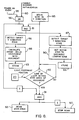
- FIG. 8 will now be referenced in order to describe further embodiments of the invention.
- the scanner apparatus of the invention is periodically initialized, for example at initial power-on at the beginning of a work day as a result of an active signal being present on conductor 95, or periodically at later times and on command as a result of an active signal being present on conductor 80.
- Reading function 93 is accomplished by activating the individual sensor cells 28 as are indicated by (1) the operation of memory store block 83 (to be described) and (2) the location of the document scan area relative to referencing corner 58 (FIG. 5). Whatever sensor cells as are activated, the cells remain active during the time interval that light footprint 24 remains within the document's scan area, as is indicated by the operation of memory store block 84 (to be described).
- the distance from the position of home sensor 63 of FIGS. 5 and 6 (i.e. the position at which motor 18 stops and then restarts to begin the scan toward document/platen leading edge 57) is stored in memory by operation of function block 84. If the above assumed scan operation is a full document scan, function block 93 is activated after this distance of movement by motor 18. If the above assumed scan operation is a window scan, the distance of movement by motor 18 is related to this memory content distance plus the distance from document/platen leading edge 57 to the leading edge of the document's window, this later parameter being defined by the user, by an application program that is currently being executed, by host 45, or by the like.
- an active signal is present on either of the conductors 80 or 95, indicating the occurrence of an initial power-on event 95 such as may occur at the beginning of a work day, or indicating that a request 80 has been received to re-initialize the scanner at a later time during the work day.
- Either of the events 80,95 causes function block 85 to become active.
- function block 85 becomes active not for the purpose of scanning a document, but rather for the purpose of scanning target 54 (FIGS. 5 and 6) in accordance with of the invention.
- OR gate 96 issues an active signal to AND gate 81.
- AND gate 81 also receives an active signal at this time from function block 85. The resulting active output from AND gate 81 indicates (1) that the scanner is to be initialized, and (2) that a scan operation is beginning during which the initialization is to occur.
- An active output from AND gate 81 operates to enable function blocks 86 and 87 to perform the sensing of target area 54 (i.e. sensing the position of target edges 56 and 55, respectively) as above described.
- function block 86 a calculation is performed to determine exactly which of the 3,634 sensor cells within linear sensor array 27 are positioned to be coincident with the 3,400 PEL X direction width of platen 12, see function block 88.
- This sensor cell parameter is then stored in memory (see function block 83) for use in future document scan operations. This stored sensor cell parameter will continue to be used until such time as a reinitialize request is received on conductor 80, as is evidenced by an active signal on this conductor.
- function block 87 operates to set the distance that motor 18 must move carriage 15 from home position 63 of FIGS. 5 and 6 in order to bring light footprint 24 into coincidence with the leading edge 57 of the platen/document. This distance parameter is also stored in memory, see block 84.
- the distance from target edge 56 to the leading edge 57 of platen 12 is a known distance.
- the location of edge 57 using the various mechanical and electrical components of scanner 10, cannot be accurately determined based upon the physical position of home sensor 59 (FIG. 1) which corresponds to the stop position labeled home sensor 63 in FIGS. 5 and 6, since, as will be appreciated by those of skill in the art, the mechanical position of home sensor 59 relative to leading edge 57 is clearly subject to variation, as with temperature change, jarring of the scanner, manufacturing tolerances, and the like.
- detection of the target's Y direction edge 55 enables accurate location of light footprint 24 relative to array 27, and detection of the target's X direction edge 56 enables accurate measurement of the position and movement of footprint 24, in order to accurately begin the sensing of document PELS when light footprint 24 is at the leading edge of the scan area, be it a full document scan or be it a document window scan.
- the distance that light footprint 24 must move before an active output is received from decision block 82 is determined by the known distance from target edge 56 to platen/document leading edge 57 in the case of a full document scan request, and is based upon this distance plus the location of the window within the document in the case of a window scan request.
- function block 97 operates to stop scan movement 85 after the operation of store functions 83 and 84, and to return the scan carriage to its home position, where the scan carriage awaits a later request to scan a document. This later request to scan a document will be indicated by function block 85 being active in the absence of an active output from OR gate 96.
- the scanner apparatus may be periodically initialized, for example on power-on or at a later time on command, and the initialization may occur as the beginning portion of a document scan request.
- decision block 82 operates to monitor the position of motor 18 (i.e. the position of light footprint 24) in order to determine when the light footprint is within a requested document scan area.
- function block 93 operates to activate the sensor cells 28, as is stored in memory by operation of store block 83, when the leading edge of the platen is encountered by the light footprint, as is indicated by distance memory store 84.
- the sensor cells 28 to be activated by function block 93 are based upon the position of the scan window within the document and upon the content of distance memory store 84.
Landscapes
- Engineering & Computer Science (AREA)
- Multimedia (AREA)
- Signal Processing (AREA)
- Facsimile Scanning Arrangements (AREA)
- Image Input (AREA)
Claims (10)
- Ein Verfahren zum Bestimmen einer beliebigen Abweichung in einer X-Richtung eines relativen physikalischen Orts einer Bezugsecke (58) und eines linearen Sensorarrays (27) in einer Dokumentenabtastvorrichtung (10) mit einer Auflageplatteneinrichtung (12), die die Dokumentenbezugsecke (58) aufweist, die durch zwei orthogonale Achsen, die ein X-Y-Koordinatensystem definieren, eingerichtet ist, und mit einer optischen Einrichtung (20) zum Erzeugen einer linearen Lichtausleuchtzone (24), die wirksam ist, um ein Dokument (11) abzutasten, das mit einer seiner Ecken an der Bezugsecke (58) der Auflageplatteneinrichtung positioniert ist, wenn sich die Ausleuchtzone in eine Y-Richtung des Koordinatensystems bewegt, wobei das Sensorarray (27) eine Mehrzahl einzelner Sensorzellen (28) aufweist, die in einer Linie, die sich wirksam in die X-Richtung erstreckt und mit einer Reflexion der Ausleuchtzone zusammenfällt, angeordnet sind, wobei jede Zelle des Arrays ein Bildelement (PEL) der reflektierten Ausleuchtzone definiert, wobei das Verfahren folgende Schritte aufweist:(A) Vorsehen eines Reflexions-Zielbereichs (54) an einer bekannten Position beabstandet von der Bezugsecke und an einem Ort, um abgetastet zu werden, bevor das Dokument abgetastet wird, und(B) Bestimmen (88) der einzelnen Sensorzellen des Sensorarrays, die wirksam sind, um den Zielbereich vor dem Abtasten des Dokuments zu erfassen, und aus dieser Bestimmung Bestimmen des relativen physikalischen Orts in der X-Richtung der Referenzecke und des Sensorarrays.
- Das Verfahren gemäß Anspruch 1, das folgende Schritte aufweist:(D) Vorsehen einer Logikeinrichtung (32) mit einem Eingang, der auf die Ausgabe des Sensorarrays anspricht, und mit einer Ausgabe (40), die eine elektrische Darstellung eines Bilds, das durch das Dokument getragen wird, aufweist, und(E) Verwenden nur der einzelnen Zellen des Sensorarrays, wie sie im Schritt (C) bestimmt wurden, um ein Dokument abzutasten, das eckenmäßig auf die Bezugsecke bezogen ist, als eine Eingabe zu der Logikeinrichtung.
- Das Verfahren gemäß Anspruch 2, das den Schritt (F) des Verwendens der Bestimmung aus Schritt (B), um die einzelnen Zellen des Sensorarrays zu bestimmen, die wirksam sind, um einen definierten Fensterbereich (62) in einem Dokument zu erfassen, das eckenmäßig auf die Bezugsecke bezogen ist, aufweist.
- Das Verfahren gemäß Anspruch 2, bei dem der Reflexions-Zielbereich einen optisch dunklen Bereich auf einem optisch hellen Hintergrund aufweist, und bei dem der Zielbereich eine Kante (55) desselben aufweist, die parallel zu der Y-Achse des Koordinatensystems ist, und
bei dem der Schritt (B) wirksam ist, um die einzelnen Sensorzellen des Sensorarrays zu bestimmen, die positioniert sind, um die Zielkante vor dem Abtasten des Dokuments zu erfassen. - Das Verfahren gemäß Anspruch 4, das den Schritt (80, 95) (G) des periodischen Neukalibrierens der Abtastvorrichtung durch das Wiederholen der Schritte des Verfahrens aufweist.
- Dokumentenabtastvorrichtung (10) mit folgenden Merkmalen:einer Auflageplatteneinrichtung (12) mit einem vorderen Kantenabschnitt (13) und einem sich orthogonal erstreckenden Seitenkantenabschnitt (52), die zusammen ein X-Y-Koordinatensystem definieren, wobei die Auflageplatteneinrichtung einen Dokumententrägerabschnitt aufweist, der eine Ecke (58) derselben aufweist, die an der Koordinate 0,0 des Koordinatensystems positioniert ist, und die wirksam ist, um ein Dokument (11) zum Abtasten eckenmäßig auszurichten,einer Beleuchtungseinrichtung (16), die eine Lichtausleuchtzone (24) liefert, die sich in der X-Richtung des Koordinatensystems erstreckt, wobei die Ausleuchtzone wirksam ist, um die Auflageplatteneinrichtung abtastmäßig zu beleuchten, während eine Relativbewegung in der Y-Richtung zwischen der Ausleuchtzone und der Auflageplatteneinrichtung geliefert wird, wobei die Ausleuchtzone folglich eine reflektierte Lichtausleuchtzone liefert, die sich in der X-Richtung des Koordinatensystems erstreckt,einer Einrichtung (59), die eine Stopp-Position der Ausleuchtzone relativ zu der Auflageplatteneinrichtung liefert, von der aus eine Dokumentenabtastung initialisiert wird, wobei die Ausleuchtzone wirksam ist, um den vorderen Kantenabschnitt der Auflageplatteneinrichtung zu beleuchten, wenn sie in der Stopp-Position ist,einer Einrichtung (27) mit linearem Sensorarray mit einer Mehrzahl von einzelnen Sensorzellen (28), die in einer Linie angeordnet sind, die sich wirksam in die X-Richtung des Koordinatensystems erstreckt und die mit der reflektierten Ausleuchtzone zusammenfällt, wobei folglich jede einzelne Zelle der Arrayeinrichtung ein Bildelement (PEL) der reflektierten Ausleuchtzone definiert, wobei die Einrichtung mit linearem Sensorarray an einer variablen Position in der X-Richtung relativ zu der Koordinate 0,0 des Koordinatensystems angeordnet ist,einer Reflexions-Zieleinrichtung (54), die in dem vorderen Kantenabschnitt der Auflageplatteneinrichtung und an einem Ort zwischen der Stopp-Position der Ausleuchtzone und dem Trägerabschnitt der Auflageplatteneinrichtung, sowie an einer bekannten Position relativ zu der Koordinate 0,0 des Koordinatensystems positioniert ist, um vor der Abtastung eines Dokuments durch die Ausleuchtzone abgetastet zu werden, undeiner Einrichtung (86, 87) zum Bestimmen der Relativposition der Einrichtung mit linearem Sensorarray und der Koordinate 0,0 des Koordinatensystems in der X-Richtung durch das Bestimmen der einzelnen Zellen der sensorarrayeinrichtung, die wirksam sind, um die Zieleinrichtung zu erfassen.
- Die Vorrichtung gemäß Anspruch 6, bei der die letztgenannte Einrichtung wirksam ist, um eine erste Gruppe von einzelnen Zellen der Sensorarrayeinrichtung zu bestimmen, die wirksam sind, um den Zieleinrichtungsbereich vor dem Abtasten des Dokuments zu erfassen, und um dadurch eine zweite Gruppe von einzelnen Zellen der Sensorarrayeinrichtung zu bestimmen, die wirksam sind, um einen Abschnitt eines Dokuments (11), das mit einer seiner Ecken an der Bezugsecke (58) auf dem Trägerabschnitt der Auflageplatteneinrichtung positioniert ist, zu erfassen.
- Die Vorrichtung gemäß Anspruch 7, die folgende Merkmale aufweist:eine Logikeinrichtung (32) mit einem Eingang, der auf die Ausgabe der Sensorarrayeinrichtung anspricht, und mit einem Ausgang (40), der eine elektrische Darstellung eines Bilds, das durch das Dokument getragen wird, aufweist, undeine Einrichtung, die wirksam ist, um nur die zweite Gruppe von einzelnen Zellen der Sensorarrayeinrichtung, wie sie bestimmt wurden, als eine Eingabe zu der Logikeinrichtung zu verwenden, um einen Abschnitt eines Dokuments, das eckenmäßig auf den Trägerabschnitt der Auflageplatteneinrichtung bezogen ist, zu erfassen.
- Die Vorrichtung gemäß Anspruch 8 mit folgenden Merkmalen:einer Servomechanismus-Einrichtung (35) mit einer Positionsrückkopplungs-Wandlereinrichtung (23, 59) zum Steuern und Erfassen der Abtastbewegung der Ausleuchtzone in der Y-Richtung des Koordinatensystems,wobei die Reflexions-Zieleinrichtung einen hellen Reflexionsbereich aufweist, der einen Kontrast zu der Reflexion des vorderen Kantenabschnitts der Auflageplatteneinrichtung liefert und eine erste Kante (55) der Zieleinrichtung aufweist, die parallel zu der Y-Achse des Koordinatensystems ist, und eine zweite Kante (56) der Zieleinrichtung, die parallel zu der X-Achse des Koordinatensystems ist, undwobei die Einrichtung zum Bestimmen wirksam ist, um die einzelnen Zellen der Sensorarrayeinrichtung zu bestimmen, die wirksam sind, um die erste Kante der Zieleinrichtung zu erfassen.
- Die Vorrichtung gemäß Anspruch 9, bei der die Einrichtung zum Bestimmen ferner wirksam ist, um die Position während der Abtastbewegung der Ausleuchtzone in der Y-Richtung des Koordinatensystems, an der die Sensorarrayeinrichtung wirksam ist, um die zweite Kante der Zieleinrichtung zu erfassen, zu bestimmen (87).
Applications Claiming Priority (2)
| Application Number | Priority Date | Filing Date | Title |
|---|---|---|---|
| US47497590A | 1990-02-05 | 1990-02-05 | |
| US474975 | 1990-02-05 |
Publications (3)
| Publication Number | Publication Date |
|---|---|
| EP0441535A2 EP0441535A2 (de) | 1991-08-14 |
| EP0441535A3 EP0441535A3 (en) | 1992-12-16 |
| EP0441535B1 true EP0441535B1 (de) | 1996-09-18 |
Family
ID=23885738
Family Applications (1)
| Application Number | Title | Priority Date | Filing Date |
|---|---|---|---|
| EP91300778A Expired - Lifetime EP0441535B1 (de) | 1990-02-05 | 1991-01-31 | Verfahren und Vorrichtung zur Lokalisierung der Referenzierungsecke eines Dokuments in einem Dokumentabtaster |
Country Status (3)
| Country | Link |
|---|---|
| EP (1) | EP0441535B1 (de) |
| JP (1) | JPH04213960A (de) |
| DE (1) | DE69122137T2 (de) |
Families Citing this family (5)
| Publication number | Priority date | Publication date | Assignee | Title |
|---|---|---|---|---|
| KR0158123B1 (ko) * | 1995-09-26 | 1998-12-15 | 김광호 | 팩시밀리장치의 화상테이타 자동정렬방법 |
| US5719404A (en) * | 1996-04-09 | 1998-02-17 | Must Systems, Inc. | Method and apparatus for calibrating the horizontal starting point of a document on a flatbed scanner |
| US5895913A (en) * | 1997-01-09 | 1999-04-20 | Hewlett-Packard Company | Method and apparatus for moving a carriage to a home position |
| DE19703382C2 (de) * | 1997-01-30 | 2000-10-05 | Fraunhofer Ges Forschung | Scanner zum Erfassen eines Objekts |
| JP4326166B2 (ja) | 2000-07-31 | 2009-09-02 | 株式会社リコー | 画像処理装置、スキャナの初期化処理方法及び該方法を実施するためのプログラムを記録した記録媒体 |
Family Cites Families (3)
| Publication number | Priority date | Publication date | Assignee | Title |
|---|---|---|---|---|
| GB1525218A (en) * | 1976-09-07 | 1978-09-20 | Ibm | Electrophotographic copying machine |
| US4249217A (en) * | 1979-05-29 | 1981-02-03 | International Business Machines Corporation | Separated sensor array abutment |
| US5023923A (en) * | 1987-02-11 | 1991-06-11 | Light Signatures, Inc. | Programmable sensor aperture |
-
1991
- 1991-01-31 EP EP91300778A patent/EP0441535B1/de not_active Expired - Lifetime
- 1991-01-31 DE DE69122137T patent/DE69122137T2/de not_active Expired - Fee Related
- 1991-02-05 JP JP3014338A patent/JPH04213960A/ja active Pending
Also Published As
| Publication number | Publication date |
|---|---|
| DE69122137D1 (de) | 1996-10-24 |
| EP0441535A3 (en) | 1992-12-16 |
| JPH04213960A (ja) | 1992-08-05 |
| DE69122137T2 (de) | 1997-02-06 |
| EP0441535A2 (de) | 1991-08-14 |
Similar Documents
| Publication | Publication Date | Title |
|---|---|---|
| US5144455A (en) | Method and apparatus for locating the document referencing corner in a document scanner | |
| US6470099B1 (en) | Scanner with multiple reference marks | |
| EP0944237B1 (de) | Tragbarer Bildabtaster mit optischen Positionssensoren | |
| US5047871A (en) | Direction scaling method and apparatus for image scanning resolution control | |
| US4581761A (en) | Manual image scanning system | |
| EP0439357A2 (de) | Verfahren und Vorrichtung zur Ausstattung eines Dokumentenlesers mit Sensorkompensation | |
| US6527182B1 (en) | Image reading apparatus and image processing apparatus | |
| US6417936B1 (en) | Self calibrating scanner for scanning an image via multiple swaths | |
| US4553035A (en) | Data acquisition control method and system for a hand held reader | |
| EP0391532A2 (de) | Apparat für das Messen dreidimensionaler gekrümmter Formen | |
| US7221485B2 (en) | Method for detecting and controlling home position of image reader | |
| US4648048A (en) | Apparatus for determining and evaluating color measurement strips on a printed sheet | |
| JP3437586B2 (ja) | スキャナのy位置決めを正確に行う方法 | |
| EP0441535B1 (de) | Verfahren und Vorrichtung zur Lokalisierung der Referenzierungsecke eines Dokuments in einem Dokumentabtaster | |
| US4866535A (en) | Method and device for interfacing an image scanner with an image processing device | |
| US20020114022A1 (en) | Image input apparatus, recording medium and image synthesis method | |
| US5084773A (en) | Image reading processing apparatus | |
| US5153645A (en) | Position indexing indicators for editing an image forming apparatus | |
| JP2578175B2 (ja) | 画像入力装置 | |
| KR920010547B1 (ko) | 3차원 곡면 형상의 측정방법 및 장치 | |
| JPH0669204B2 (ja) | 画像読取装置 | |
| EP0430452B1 (de) | Puffersteuerung zur Anpassung von variablen Datenübertragungsgeschwindigkeiten | |
| US6891644B1 (en) | Image processing device and image processing method | |
| JP3350244B2 (ja) | 透過歪の測定方法及びその装置 | |
| EP0441614B1 (de) | Verfahren und Vorrichtung zur Feststellung eines Schwellpegels in einem Binärmodus-Dokumentenleser |
Legal Events
| Date | Code | Title | Description |
|---|---|---|---|
| PUAI | Public reference made under article 153(3) epc to a published international application that has entered the european phase |
Free format text: ORIGINAL CODE: 0009012 |
|
| AK | Designated contracting states |
Kind code of ref document: A2 Designated state(s): DE GB |
|
| PUAL | Search report despatched |
Free format text: ORIGINAL CODE: 0009013 |
|
| AK | Designated contracting states |
Kind code of ref document: A3 Designated state(s): DE GB |
|
| 17P | Request for examination filed |
Effective date: 19930525 |
|
| 17Q | First examination report despatched |
Effective date: 19950315 |
|
| GRAH | Despatch of communication of intention to grant a patent |
Free format text: ORIGINAL CODE: EPIDOS IGRA |
|
| GRAH | Despatch of communication of intention to grant a patent |
Free format text: ORIGINAL CODE: EPIDOS IGRA |
|
| GRAA | (expected) grant |
Free format text: ORIGINAL CODE: 0009210 |
|
| AK | Designated contracting states |
Kind code of ref document: B1 Designated state(s): DE GB |
|
| REF | Corresponds to: |
Ref document number: 69122137 Country of ref document: DE Date of ref document: 19961024 |
|
| PLBE | No opposition filed within time limit |
Free format text: ORIGINAL CODE: 0009261 |
|
| STAA | Information on the status of an ep patent application or granted ep patent |
Free format text: STATUS: NO OPPOSITION FILED WITHIN TIME LIMIT |
|
| 26N | No opposition filed | ||
| REG | Reference to a national code |
Ref country code: GB Ref legal event code: 732E |
|
| REG | Reference to a national code |
Ref country code: GB Ref legal event code: IF02 |
|
| PGFP | Annual fee paid to national office [announced via postgrant information from national office to epo] |
Ref country code: GB Payment date: 20070125 Year of fee payment: 17 |
|
| PGFP | Annual fee paid to national office [announced via postgrant information from national office to epo] |
Ref country code: DE Payment date: 20070228 Year of fee payment: 17 |
|
| GBPC | Gb: european patent ceased through non-payment of renewal fee |
Effective date: 20080131 |
|
| PG25 | Lapsed in a contracting state [announced via postgrant information from national office to epo] |
Ref country code: DE Free format text: LAPSE BECAUSE OF NON-PAYMENT OF DUE FEES Effective date: 20080801 |
|
| PG25 | Lapsed in a contracting state [announced via postgrant information from national office to epo] |
Ref country code: GB Free format text: LAPSE BECAUSE OF NON-PAYMENT OF DUE FEES Effective date: 20080131 |