EP0440005A2 - Belichtungsrahmen mit UV-Absorption - Google Patents
Belichtungsrahmen mit UV-Absorption Download PDFInfo
- Publication number
- EP0440005A2 EP0440005A2 EP90850357A EP90850357A EP0440005A2 EP 0440005 A2 EP0440005 A2 EP 0440005A2 EP 90850357 A EP90850357 A EP 90850357A EP 90850357 A EP90850357 A EP 90850357A EP 0440005 A2 EP0440005 A2 EP 0440005A2
- Authority
- EP
- European Patent Office
- Prior art keywords
- printing
- glass
- light
- burnout
- film
- Prior art date
- Legal status (The legal status is an assumption and is not a legal conclusion. Google has not performed a legal analysis and makes no representation as to the accuracy of the status listed.)
- Granted
Links
Images
Classifications
-
- G—PHYSICS
- G03—PHOTOGRAPHY; CINEMATOGRAPHY; ANALOGOUS TECHNIQUES USING WAVES OTHER THAN OPTICAL WAVES; ELECTROGRAPHY; HOLOGRAPHY
- G03B—APPARATUS OR ARRANGEMENTS FOR TAKING PHOTOGRAPHS OR FOR PROJECTING OR VIEWING THEM; APPARATUS OR ARRANGEMENTS EMPLOYING ANALOGOUS TECHNIQUES USING WAVES OTHER THAN OPTICAL WAVES; ACCESSORIES THEREFOR
- G03B27/00—Photographic printing apparatus
- G03B27/02—Exposure apparatus for contact printing
- G03B27/04—Copying apparatus without a relative movement between the original and the light source during exposure, e.g. printing frame or printing box
Definitions
- the present invention generally relates to a printing frame of the type which is used when producing films, photosensitive printing plates etc. by printing with a shortwave light
- the invention relates more particularly to such a printing frame, which is called a burnout frame and which is used to produce films and printing plates etc., particularly through a so called positive printing, i.e. such a light printing, in which the printing is done through a positive master, usually a transparent original film and down to a positive film or plate, the shortwave light causing a "burnout" of non-image-carrying areas in and often also outside the original film.
- a burnout frame of this type is known through the Swedish patent no. 8704562-1 with laid out-number 458 482.
- This known burnout frame has a transparent printing glass, which is larger than the largest original film considered to be printed.
- a few grooves are provided on the underside of the printing glass, which via ducts in the glass lead to a source of negative pressure.
- That part of the printing glass, which corresponds to the largest image surface on the original film is clear, whereas that part of the printing glass, which is located outside said largest image surface, has been diffused in such a way, that it allows an exposure through the printing glass to a film or a plate outside the image-surface of the original film and in some cases also through the duct-equipped, diffused part of the printing glass, without the result, that the vacuum ducts, which extend through this part of the glass, provide shadows, which form image-carrying areas in the finished film or plate.
- the printing glass preferably is made of a transparent plastic material, e.g. an acrylate material, e.g. Plexi.
- a printing frame of this known type provides in many instances an excellent result, allowing a printing with an optimal exposure time of the image-carrying areas during a simultataneous burnout, partly of non-image-carrying areas of the printing picture and partly also of at least some areas, located outside the image surface, through the diffused areas of the printing frame.
- the exposure latitude in many instances can be regarded as markedly small, i.e. that the exposure must be done with a duration and a light intensity, which only is allowed to vary within very close limits.
- the exposure ought to be done with such an intensity and duration, that the image-carrying areas will be illuminated in the exactly right way, and partly the light intensity and the duration must be sufficient to burn out the non-image-carrying areas and at least some areas located outside the picture through the diffused areas of the printing glass and to prevent the formation of shadows from the vacuum ducts in the glass.
- the suitable exposure time for the printing film or the printing plate may provide a too small amount of light to avoid the formation of shadows from the vacuum ducts in the glass; in other instances the suitable exposure time for the printing film or the printing plate maybe is so long, that a light diffusion may take place into the often demasked, diffused parts of the printing glass, also corresponding parts of the printing film or printing plate being "burned out” and rendering impossible a subsequent printing of an image within this part of the printing film or plate.
- a too brief printing time results in an inferior burning out of non-image-carrying areas and a risk of a shadow formation from the vacuum ducts
- a too extended printing time results in a risk of a light diffusion into an area of the diffused part of the printing glass, which is placed outside and sometimes is demasked, and consequently a destruction of the image-receiving layer in this part of the printing film or the printing plate.
- the printing glass in the known device comprised a plate, including two interacting plastic plates, e.g. a lower plate of an acrylic plastic, e.g. Plexiglass, and an upper plate of a polyester plastic, e.g. Makrolon, and the vacuum ducts were formed in the intermediate layer between these two plastic plates.
- a plastic plate including two interacting plastic plates, e.g. a lower plate of an acrylic plastic, e.g. Plexiglass, and an upper plate of a polyester plastic, e.g. Makrolon, and the vacuum ducts were formed in the intermediate layer between these two plastic plates.
- the light is led in such a way in the plastic layers, that it from the clear, central part often creeps into the diffused part and partly burns out the image-receiving layer in the printing film or the printing plate in such a device.
- so called Newton-rings between the plastic layers may be formed, which injuriously influence the exposure.
- the plastic layers are susceptible to scratches and easily become staticly charged and
- the glass plate is made of a type of glass, which absorbs a certain amount of the ultraviolet light.
- a so called bronze glass which is a homogenous, slightly bronze-brown-colored glass, but many other types of glasses can profitably be used.
- the color of the glass has no particular importance, since it is the ultraviolet radiation, which provides the burnout of the non-image-carrying areas.
- the exposure can be increased across all the printing glass without a risk of an overexposure of the image-carrying areas in the printing film or the printing plate, and simultaneously such a strong light radiation in the diffused areas, located outside the glass plate, is obtained, that it has been possible to eliminate the risk of a shadow-formation from the vacuum ducts completely.
- partly an improved burnout of non-image-carrying areas in the printing film or the printing plate is attained and partly also a sharply increased exposure latitude, which makes it possible, in an advantageous way, to adjust the exposure of the original film to various requirements. For some purposes a certain underexposure perhaps is desirable, for other purposes a certain overexposure.
- the UV-light-suppressing glass preferably absorbs light within the wavelength range 350-450 nm.
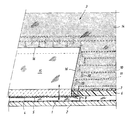
- the accompanying drawing shows schematicly a cross-section of a printing frame according to the invention.
- the printing frame shown in the drawing is designed for printing according to the so called positive method, in which light rays expose or burn out those areas, which are non-image-carrying during the printing, from a film or a printing plate 1, which in a known way is placed on a printing table 2, and against which all the printing frame 3 with the original film 4, which is sucked into contact with the underside of the printing frame, and a possibly used masking film 5 can be lowered to a precise contact.
- the burned out areas of the printing plate are made non-color-carrying, when the exposed printing plate is developed.
- the printing frame comprises a base plate 6, made of a transparent material, e.g. an acrylate material, e.g. Plexiglass, which suitably is of a type, which lacks UV-light-protection, and a covering plate 7, which is placed on top of this base plate 6 and is fastened to it with an intimate contact, e.g. by means of a transparent glue, a transparent double-faced adhesive tape or in another way, which does not interfere with the light transmission through the composite plate 6-7.
- the covering plate 7 on top of plate 6 can be made of some clear, transparent material, e.g. a polyester material, e.g. Makrolon.
- Base plate 6 is on its underside provided with at least two different arrays of vacuum grooves, namely an exterior groove 8 for holding by sucking an original film 4 and an interior groove 9 for holding by suction a masking film 5.
- the two arrays of vacuum grooves 8 and 9 are via ducts 10 and 11 connected to a source of negative pressure (not shown).
- Vacuum grooves 8 for original film 4 are placed outside the limiting surface of masking film 5.
- Ducts 10 and 11 are suitably obtained by cutting grooves in the top face of base plate 6, which grooves are connected to vertical through holes 12 and 13, which are connected to lower placed vacuum grooves 8 and 9.
- the cut grooves on the top face of base plate 6 are sealed by means of covering plate 7, placed on top of plate 6.
- the top face of covering plate 7 is made light diffusing, e.g. dulled or obscured (blasted) on a surface 14 outside the clear glass surface above the original film.
- the object of the dulling of surface 14 is to provide a diffused through beam of light in order to decrease or eliminate the risk of an emergence of shadows and non-burned-out lines caused thereby on the collecting film or printing plate 1, due to refraction phenomena from vacuum grooves 8 and 9 and connection ducts 10 and 11.
- Some types of glue lead the light out of the glass plate and into the diffusing part of the printing glass and other types of glue darken, when they dry or later on and result, when illuminated, in an non-illuminated line on all sides, which will be image-carrying on printing plate 1.
- one satisfactory glue has been found, namely an optical pure epoxy glue, which is unfadeable and which forms a type of light barrier along the edges of glass plate 15, but which still does not absorb such a large amount of light, that it forms an image-carrying line on the printing plate, and this is possible despite the fact that this glue is slightly rose-colored.
- the flux through the printing frame can be increased, due to the fact that the risk of light rays outwards from the edges of the glass plate has been eliminated, and having this stronger flux it has also been possible to eliminate the risk of shadow-formation on printing plate 1 from vacuum ducts 10 and 11.
- the glass plate suitably is made of a glass material, which absorbs a certain part of the ultraviolet light from the lighting of the printing machine, particularly UV-light within wavelength range 350-450 nm.
- a suitable glass is a homogenous bronze glass, which absorbs a certain part of the UV-light within the spectrum 350-450 nm and which has a slight auburn color with an insignificant light reduction, normally a 5-10 % light reduction.
- the flux against the diffused surface 14 in the printing frame can be increased without any risk of obtaining any overexposed image-carrying portions in the printing plate. It will simultaneously be possible to intentionally underexpose the printing plate without any risk of obtaining shadows from vacuum ducts 10 and 11 on printing plate 1. It is of course also possible to intentionally overexpose the printing plate, and the device consequently offers a considerably increased exposure latitude as compared to what has been possible so far. This in its turn results in a possibility to adjust the exposure to various types of printing methods and printing machines and to various desirable printing effects.
Landscapes
- Physics & Mathematics (AREA)
- General Physics & Mathematics (AREA)
- Exposure And Positioning Against Photoresist Photosensitive Materials (AREA)
- Cosmetics (AREA)
- Agricultural Chemicals And Associated Chemicals (AREA)
- Solid-Sorbent Or Filter-Aiding Compositions (AREA)
- Road Signs Or Road Markings (AREA)
Applications Claiming Priority (2)
| Application Number | Priority Date | Filing Date | Title |
|---|---|---|---|
| SE9000297 | 1990-01-29 | ||
| SE9000297A SE465899B (sv) | 1990-01-29 | 1990-01-29 | Utbraenningsram foer kopiering av en genomlyslig originalfilm |
Publications (3)
| Publication Number | Publication Date |
|---|---|
| EP0440005A2 true EP0440005A2 (de) | 1991-08-07 |
| EP0440005A3 EP0440005A3 (en) | 1992-08-26 |
| EP0440005B1 EP0440005B1 (de) | 1996-01-31 |
Family
ID=20378378
Family Applications (1)
| Application Number | Title | Priority Date | Filing Date |
|---|---|---|---|
| EP90850357A Expired - Lifetime EP0440005B1 (de) | 1990-01-29 | 1990-10-26 | Belichtungsrahmen mit UV-Absorption |
Country Status (7)
| Country | Link |
|---|---|
| US (1) | US5057865A (de) |
| EP (1) | EP0440005B1 (de) |
| JP (1) | JPH03231237A (de) |
| AT (1) | ATE133798T1 (de) |
| AU (1) | AU625010B2 (de) |
| DE (1) | DE69025161T2 (de) |
| SE (1) | SE465899B (de) |
Families Citing this family (3)
| Publication number | Priority date | Publication date | Assignee | Title |
|---|---|---|---|---|
| SE9302595L (sv) * | 1993-08-10 | 1994-12-12 | Misomex Ab | Förfarande och anordning vid kopiering av flera olika filmformat |
| US6142612A (en) * | 1998-11-06 | 2000-11-07 | Lexmark International, Inc. | Controlled layer of tantalum for thermal ink jet printer |
| JP5022241B2 (ja) * | 2008-01-11 | 2012-09-12 | サンエー技研株式会社 | 露光に用いられるフォトマスク |
Family Cites Families (9)
| Publication number | Priority date | Publication date | Assignee | Title |
|---|---|---|---|---|
| US4171903A (en) * | 1978-08-10 | 1979-10-23 | Robb Maurice R | Variable punch press system for four color work |
| EP0119326B1 (de) * | 1983-03-18 | 1987-05-13 | Agfa-Gevaert N.V. | Photokamera und ihre Verwendung zusammen mit photographischen Silberhalogenidmaterialien |
| FI80348C (fi) * | 1986-01-21 | 1990-05-10 | Veikko Johannes Saarilahti | Med undertryck fungerande faestunderlag. |
| US4835576A (en) * | 1986-10-17 | 1989-05-30 | Toyo Ink Mfg. Co., Ltd. | Opaquing method and apparatus thereof |
| FR2608795A1 (fr) * | 1986-12-18 | 1988-06-24 | Photomeca Sa | Dispositif de maintien pour leur insolation par ultraviolet des plaques de resine photosensible et machine d'insolation equipee de ce dispositif |
| US4791459A (en) * | 1987-01-02 | 1988-12-13 | Morris Hoffman | Pin register vacuum system |
| US4902899A (en) * | 1987-06-01 | 1990-02-20 | International Business Machines Corporation | Lithographic process having improved image quality |
| DE3723462A1 (de) * | 1987-07-16 | 1989-01-26 | Guenter J Flumm | Belichtungsgeraet fuer kontaktverfahren |
| SE458482B (sv) * | 1987-11-19 | 1989-04-03 | Misomex Ab | Utbraenningsram vid kopieringsmaskin |
-
1990
- 1990-01-29 SE SE9000297A patent/SE465899B/sv not_active IP Right Cessation
- 1990-10-26 AT AT90850357T patent/ATE133798T1/de active
- 1990-10-26 DE DE69025161T patent/DE69025161T2/de not_active Expired - Fee Related
- 1990-10-26 EP EP90850357A patent/EP0440005B1/de not_active Expired - Lifetime
- 1990-10-30 US US07/605,967 patent/US5057865A/en not_active Expired - Fee Related
- 1990-11-02 AU AU65801/90A patent/AU625010B2/en not_active Ceased
- 1990-11-20 JP JP2312969A patent/JPH03231237A/ja active Pending
Also Published As
| Publication number | Publication date |
|---|---|
| AU6580190A (en) | 1991-08-01 |
| DE69025161D1 (de) | 1996-03-14 |
| EP0440005A3 (en) | 1992-08-26 |
| US5057865A (en) | 1991-10-15 |
| JPH03231237A (ja) | 1991-10-15 |
| EP0440005B1 (de) | 1996-01-31 |
| DE69025161T2 (de) | 1996-07-04 |
| AU625010B2 (en) | 1992-06-25 |
| SE465899B (sv) | 1991-11-11 |
| SE9000297D0 (sv) | 1990-01-29 |
| SE9000297L (sv) | 1991-07-30 |
| ATE133798T1 (de) | 1996-02-15 |
Similar Documents
| Publication | Publication Date | Title |
|---|---|---|
| US4655570A (en) | Camera with a border image producing device | |
| US4018519A (en) | Composite photography apparatus and method utilizing a polarizing beam splitting unit | |
| US3985425A (en) | Polarizing beam splitting unit | |
| US5057865A (en) | Burnout frame with uv-absorption | |
| CN1070746A (zh) | 带预曝光胶片的胶片装置及其制造方法 | |
| US3119301A (en) | Lighting system for photographic cameras | |
| EP0106538A1 (de) | Filter für Fhotoapparat | |
| US4847663A (en) | Appartus and method for reflection free photography | |
| EP0317529B1 (de) | Abdeckrahmen für ein Kopiergerät | |
| US1841274A (en) | Preparation of photogravure copy and the like | |
| AU688999B2 (en) | Apparatus and method for reading motion picture film photographic dye soundtracks | |
| US4493541A (en) | Apparatus for photographically producing characters or other representations | |
| US4099865A (en) | Method and apparatus for making color separations from a color transparency | |
| US1858603A (en) | Apparatus for printing from alpha negative sound record to alpha positive | |
| JP2892377B2 (ja) | 照明装置 | |
| JPS5646263A (en) | Original lighting device of electronic copying machine | |
| US4396278A (en) | Photographic enlarger | |
| DK563089A (da) | Lystaet maskeringsfolie og fremgangsmaade til eksponering under anvendelse af samme | |
| JP4634643B2 (ja) | 植物の陰影付き画像を感光材に感光させる方法 | |
| JPS62163043A (ja) | フラツシユ照明装置 | |
| CA2105611A1 (en) | Exposure system for photographic copying machines | |
| JPS58203429A (ja) | 自動調光装置 | |
| JPS59176032U (ja) | 引伸機 | |
| JPH01302340A (ja) | 複写撮影装置 | |
| NO127475B (de) |
Legal Events
| Date | Code | Title | Description |
|---|---|---|---|
| PUAI | Public reference made under article 153(3) epc to a published international application that has entered the european phase |
Free format text: ORIGINAL CODE: 0009012 |
|
| AK | Designated contracting states |
Kind code of ref document: A2 Designated state(s): AT BE CH DE ES FR GB IT LI NL |
|
| 17P | Request for examination filed |
Effective date: 19920121 |
|
| PUAL | Search report despatched |
Free format text: ORIGINAL CODE: 0009013 |
|
| AK | Designated contracting states |
Kind code of ref document: A3 Designated state(s): AT BE CH DE ES FR GB IT LI NL |
|
| 17Q | First examination report despatched |
Effective date: 19941207 |
|
| GRAA | (expected) grant |
Free format text: ORIGINAL CODE: 0009210 |
|
| AK | Designated contracting states |
Kind code of ref document: B1 Designated state(s): AT BE CH DE ES FR GB IT LI NL |
|
| PG25 | Lapsed in a contracting state [announced via postgrant information from national office to epo] |
Ref country code: IT Free format text: LAPSE BECAUSE OF FAILURE TO SUBMIT A TRANSLATION OF THE DESCRIPTION OR TO PAY THE FEE WITHIN THE PRE;WARNING: LAPSES OF ITALIAN PATENTS WITH EFFECTIVE DATE BEFORE 2007 MAY HAVE OCCURRED AT ANY TIME BEFORE 2007. THE CORRECT EFFECTIVE DATE MAY BE DIFFERENT FROM THE ONE RECORDED.SCRIBED TIME-LIMIT Effective date: 19960131 Ref country code: NL Free format text: LAPSE BECAUSE OF FAILURE TO SUBMIT A TRANSLATION OF THE DESCRIPTION OR TO PAY THE FEE WITHIN THE PRESCRIBED TIME-LIMIT Effective date: 19960131 Ref country code: AT Effective date: 19960131 Ref country code: ES Free format text: THE PATENT HAS BEEN ANNULLED BY A DECISION OF A NATIONAL AUTHORITY Effective date: 19960131 Ref country code: LI Effective date: 19960131 Ref country code: BE Effective date: 19960131 Ref country code: FR Effective date: 19960131 Ref country code: CH Effective date: 19960131 |
|
| REF | Corresponds to: |
Ref document number: 133798 Country of ref document: AT Date of ref document: 19960215 Kind code of ref document: T |
|
| REF | Corresponds to: |
Ref document number: 69025161 Country of ref document: DE Date of ref document: 19960314 |
|
| EN | Fr: translation not filed | ||
| NLV1 | Nl: lapsed or annulled due to failure to fulfill the requirements of art. 29p and 29m of the patents act | ||
| REG | Reference to a national code |
Ref country code: CH Ref legal event code: PL |
|
| PLBE | No opposition filed within time limit |
Free format text: ORIGINAL CODE: 0009261 |
|
| STAA | Information on the status of an ep patent application or granted ep patent |
Free format text: STATUS: NO OPPOSITION FILED WITHIN TIME LIMIT |
|
| 26N | No opposition filed | ||
| PGFP | Annual fee paid to national office [announced via postgrant information from national office to epo] |
Ref country code: DE Payment date: 19991119 Year of fee payment: 10 |
|
| PGFP | Annual fee paid to national office [announced via postgrant information from national office to epo] |
Ref country code: GB Payment date: 19991123 Year of fee payment: 10 |
|
| PG25 | Lapsed in a contracting state [announced via postgrant information from national office to epo] |
Ref country code: GB Free format text: LAPSE BECAUSE OF NON-PAYMENT OF DUE FEES Effective date: 20001026 |
|
| GBPC | Gb: european patent ceased through non-payment of renewal fee |
Effective date: 20001026 |
|
| PG25 | Lapsed in a contracting state [announced via postgrant information from national office to epo] |
Ref country code: DE Free format text: LAPSE BECAUSE OF NON-PAYMENT OF DUE FEES Effective date: 20010703 |