EP0435807A2 - Verfahren zur kulturellen vorhersagbaren Tastensortierung in einem Landesspracheunterstützungssystem - Google Patents
Verfahren zur kulturellen vorhersagbaren Tastensortierung in einem Landesspracheunterstützungssystem Download PDFInfo
- Publication number
- EP0435807A2 EP0435807A2 EP90480195A EP90480195A EP0435807A2 EP 0435807 A2 EP0435807 A2 EP 0435807A2 EP 90480195 A EP90480195 A EP 90480195A EP 90480195 A EP90480195 A EP 90480195A EP 0435807 A2 EP0435807 A2 EP 0435807A2
- Authority
- EP
- European Patent Office
- Prior art keywords
- keys
- national language
- key
- key value
- culturally
- Prior art date
- Legal status (The legal status is an assumption and is not a legal conclusion. Google has not performed a legal analysis and makes no representation as to the accuracy of the status listed.)
- Ceased
Links
Images


Classifications
-
- G—PHYSICS
- G06—COMPUTING OR CALCULATING; COUNTING
- G06F—ELECTRIC DIGITAL DATA PROCESSING
- G06F7/00—Methods or arrangements for processing data by operating upon the order or content of the data handled
- G06F7/22—Arrangements for sorting or merging computer data on continuous record carriers, e.g. tape, drum, disc
- G06F7/24—Sorting, i.e. extracting data from one or more carriers, rearranging the data in numerical or other ordered sequence, and rerecording the sorted data on the original carrier or on a different carrier or set of carriers sorting methods in general
Definitions
- the present invention relates in general to the field of data processing systems and in particular to data processing systems designed to be utilized with multiple sets of keys and characters. Still more particularly, the present invention relates to data processing systems which permit the rapid and efficient sorting of keys and characters from different national languages in a culturally predictable manner.
- NLS National Language Support
- NLS National Language Support
- NLS National Language Support
- each sortable key within National Language Support (NLS) data processing system is assigned an alphabetic key value, a diacritic key value, a case key value and a special character key value.
- the various values assigned for the alphabetic key, the diacritic key, the case key and the special character key are ordered in a culturally predictable manner such that subsequent sorts of the keys within the data processing system based upon the alphabetic key value, the diacritic key value, the case key value, and the special character key values for these characters will result in a culturally predictable order. For example, if a particular national language implementation requires the character " " to follow "Z,” an appropriate selection of an alphabetic key value will result in this ordering.
- Figure 1 is a pictorial representation of a data processing system which may be utilized to implement the method of the present invention
- Figure 2 is a logic flow chart illustrating the assignment of place values for national language characters utilizing the method of the present invention.
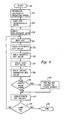
- Figure 3 is a logic flow chart illustrating the manner in which a sort through the national language characters of a data processing system may be implemented in a culturally predictable manner utilizing the method of the present invention.
- computer system 10 includes a processor 12 which preferably includes a graphics processor, memory device, and a central processor (not shown). Coupled to processor 12 is a video display 14 which may be implemented utilizing either a color or monochromatic monitor, in a manner well known in the computer art. Also coupled to processor 12 is keyboard 16. Keyboard 16 preferably comprises a standard computer keyboard which is coupled to processor 12 by means of cable 18 and which preferably includes various national language characters or keys which are unique to a particular language.
- computer 10 may be implemented utilizing a so-called personal computer, such as the Model 50 PS/2 computer manufactured by International Business Machines Corporation of Armonk, New York.
- a so-called personal computer such as the Model 50 PS/2 computer manufactured by International Business Machines Corporation of Armonk, New York.
- Office Vision/2, Release 2 may be utilized in a National Language Support system wherein multiple foreign language may be accommodated.
- Office Vision/2, Release 2 will support English, German, French, Italian, Dutch, Portuguese, Belgian Dutch, Belgian French, Spanish, Danish, Icelandic, Finnish, Norwegian, Swedish, and Japanese. Additionally, other languages may be accommodated in future releases of such products.
- the binary sort technique will not accommodate the special characters, such as hyphen, or the accent marks which many foreign languages utilize.
- each graphic character is grouped into a family of graphic characters wherein each group has a unique weight, whether or not a diacritical mark is also utilized and without distinction between upper case and lower case.
- Table II contains an example of a sort which has been implemented utilizing this technique.
- FIG. 2 there is illustrated a logic flow chart which depicts the assignment of place values for National Language characters which utilizes the method of the present invention. As is illustrated, the process begins at block 20, and thereafter block 22 depicts a determination of the culturally predicted order for the characters or keys in a particular national language. For example, whether or not numbers precede letters or lower case precedes upper case.
- block 24 illustrates a sort through the national language keys to locate any idiosyncratic keys or groups of keys.
- ligatures such as are specialized multiple character sequences such as “ch” or “ll” in Spanish, which should be ordered after “CX” but before “d” and after “lx” but before “m.”
- these idiosyncratic keys are located and then temporarily supplemented or substituted for by a selected replacement key, as depicted in block 26.
- an appropriate set of key values may be assigned to each such replacement key in order to achieve a culturally predicted sort.
- Block 28 then illustrates the selection of the next key or character within an alphabetic string.
- Block 30 next depicts the building of an alphabetic key value for that key character or replacement key.
- the various key values assigned for each key or character may be implicitly weighted by selecting all values for a particular key value to be greater than the maximum value for a second or subsequent key value.
- the alphabetic key values selected within block 30 may be properly ordered and selected such that minimum alphabetic key value contained therein is greater than any other key value which will be built. In this manner, the alphabetic key value will be entitled to the greatest weight during any type of sort procedure.
- block 32 depicts the building of a diacritic key value.
- the diacritic key value will, in the disclosed embodiment of the present invention, represent a value which is less than the smallest alphabetic key value which as been assigned and which will represent the various diacritic marks which may be utilized in the selected National Language. Of course, those skilled in the art will appreciate that for alphanumeric characters which do not include a diacritic mark, the diacritic key value may be set to zero.
- block 34 illustrates the building of a case key value. In the English language, this is a relatively simple evolution and only two possible case key values are required.
- the special character key value is built.
- Special character key values represent the rank value of the special characters which may be utilized in the selected language. For example, punctuation marks, parentheses, and various other non-alphanumeric characters. As discussed above, the special character key value of an alphanumeric character will preferably be set equal to zero.
- block 38 illustrates a determination of whether or not the alphabetic character under analysis will include a fixed length value frame under associated therewith.
- each alphabetic character within the system will have associated therewith a fixed length value frame which will include within fixed subsets thereof each of the values previously determined for the various key values. That is, the alphabetic key value will be contained within a fixed number of columns within such a fixed length value frame.
- the diacritic key value, case key value and special character key value will always include the same number of bits and will be contained within predetermined fixed subsets of the fixed length value frame.
- the four key values herein constructed are concatenated to form a composite place value for a particular character or key within the system.
- each alphabetic character does not include a fixed length value frame
- all key values previously established are merely concatenated to form a composite place value indicator.
- it will be necessary to constrain the values of each separate key to a particular range such that it will be possible to identify individual key values within a composite place value for a particular character.
- the maximum value for any diacritic key value can be selected to be less than the minimum value for the least alphabetic key value.
- alphabetic key values will be entitled to greater weight during any type of sort procedure.
- this weighting technique may be altered to conform to any desired sort rules
- block 44 illustrates a determination of whether or not the last key within a particular string has been considered and if so, the process terminates, as depicted in block 46. If not, the process returns to block 28 and the next key is selected. Thereafter, the process iterates and continues to build alphabetic key values, diacritic key values, case key values and special character key values for each key within the system.
- FIG. 3 there is depicted a logic flow chart which illustrates the manner in which a sort through the national language characters of a data processing system may be implemented in a culturally predictable manner utilizing the method of the present invention.
- the process beings at block 48 and thereafter proceeds to block 50 in which the alphabetic key values of two separate national language characters are compared.
- the alphabetic key values which are compared are the actual alphabetic key values for each character or the replacement character which has been temporarily substituted therefore in block 26 of Figure 2.
- block 52 illustrates the returning of the difference between the two key values. This difference may be utilized to sort the two characters under consideration, in an ascending or descending sort, as those skilled in the art will appreciate.
- block 54 illustrates a determination of whether or not the diacritic key values of the two characters are equal. In a manner identical to that described above, it the diacritic key values are not equal, the difference is returned, as depicted in block 56, in order that the two identical alphabetic characters may be sorted by means of the differences which exist in the diacritic key values for those characters.
- blocks 58 and 62 illustrates comparisons between the case key values and special character key values of the national language characters or replacement characters under consideration. Only after all four key values have been compared and found equal, does block 66 depict the returning of an indication that two characters are equal in value.
- place values within a sort scheme in such a circumstance may be assigned based upon a "first in, first out" or any other similar sorting technique.
- NLS National Language Support
Landscapes
- Engineering & Computer Science (AREA)
- General Engineering & Computer Science (AREA)
- Theoretical Computer Science (AREA)
- Computer Hardware Design (AREA)
- Physics & Mathematics (AREA)
- General Physics & Mathematics (AREA)
- Machine Translation (AREA)
- Document Processing Apparatus (AREA)
- Input From Keyboards Or The Like (AREA)
Applications Claiming Priority (2)
| Application Number | Priority Date | Filing Date | Title |
|---|---|---|---|
| US458047 | 1983-01-14 | ||
| US07/458,047 US5072386A (en) | 1989-12-27 | 1989-12-27 | Method for culturally predictable keysort within a national language support (nls) data processing system |
Publications (2)
| Publication Number | Publication Date |
|---|---|
| EP0435807A2 true EP0435807A2 (de) | 1991-07-03 |
| EP0435807A3 EP0435807A3 (en) | 1992-05-20 |
Family
ID=23819143
Family Applications (1)
| Application Number | Title | Priority Date | Filing Date |
|---|---|---|---|
| EP19900480195 Ceased EP0435807A3 (en) | 1989-12-27 | 1990-11-27 | Method for culturally predictable key sort within a national language support (nls) data processing system |
Country Status (3)
| Country | Link |
|---|---|
| US (2) | US5072386A (de) |
| EP (1) | EP0435807A3 (de) |
| JP (1) | JPH03201127A (de) |
Families Citing this family (14)
| Publication number | Priority date | Publication date | Assignee | Title |
|---|---|---|---|---|
| JP3005031B2 (ja) * | 1990-10-17 | 2000-01-31 | キヤノン株式会社 | 通信装置 |
| US5551018A (en) * | 1993-02-02 | 1996-08-27 | Borland International, Inc. | Method of storing national language support text by presorting followed by insertion sorting |
| JP3461572B2 (ja) * | 1994-06-09 | 2003-10-27 | 株式会社日立ユニシアオートモティブ | 車両の制御装置 |
| US5678039A (en) * | 1994-09-30 | 1997-10-14 | Borland International, Inc. | System and methods for translating software into localized versions |
| US5572668A (en) * | 1995-02-07 | 1996-11-05 | Oracle Corporation | Method and apparatus for universal national language support program testing |
| US5675818A (en) * | 1995-06-12 | 1997-10-07 | Borland International, Inc. | System and methods for improved sorting with national language support |
| US5787452A (en) * | 1996-05-21 | 1998-07-28 | Sybase, Inc. | Client/server database system with methods for multi-threaded data processing in a heterogeneous language environment |
| US6920247B1 (en) * | 2000-06-27 | 2005-07-19 | Cardiff Software, Inc. | Method for optical recognition of a multi-language set of letters with diacritics |
| CA2348239C (en) | 2001-05-18 | 2005-04-19 | Ibm Canada Limited-Ibm Canada Limitee | Culturally correct ordering of keyed records |
| CA2390849A1 (en) * | 2002-06-18 | 2003-12-18 | Ibm Canada Limited-Ibm Canada Limitee | System and method for sorting data |
| US7088341B2 (en) * | 2002-10-21 | 2006-08-08 | Microsoft Corporation | System and method for inputting special characters |
| US20070239738A1 (en) * | 2006-03-29 | 2007-10-11 | Harman Robert M | Method and apparatus for sorting character strings having complex characters |
| US8234287B2 (en) * | 2008-09-24 | 2012-07-31 | International Business Machines Corporation | Sorting records based on free text field content |
| EP2535802B1 (de) | 2011-06-16 | 2016-08-10 | GN Netcom A/S | Computerimplementiertes verfahren zur Anordnung von Textelementen in einer vordefinierten Reihenfolge |
Family Cites Families (10)
| Publication number | Priority date | Publication date | Assignee | Title |
|---|---|---|---|---|
| US4499555A (en) * | 1982-05-06 | 1985-02-12 | At&T Bell Laboratories | Sorting technique |
| US4891786A (en) * | 1983-02-22 | 1990-01-02 | Goldwasser Eric P | Stroke typing system |
| US4615002A (en) * | 1983-03-30 | 1986-09-30 | International Business Machines Corp. | Concurrent multi-lingual use in data processing system |
| JPS61267824A (ja) * | 1985-05-20 | 1986-11-27 | Fujitsu Ltd | 日本語デ−タ整列化処理方式 |
| US4758979A (en) * | 1985-06-03 | 1988-07-19 | Chiao Yueh Lin | Method and means for automatically coding and inputting Chinese characters in digital computers |
| US4809158A (en) * | 1985-10-23 | 1989-02-28 | Mccauley Peter B | Sorting method and apparatus |
| CA1265623A (en) * | 1987-06-11 | 1990-02-06 | Eddy Lee | Method of facilitating computer sorting |
| CA1280215C (en) * | 1987-09-28 | 1991-02-12 | Eddy Lee | Multilingual ordered data retrieval system |
| US4873625A (en) * | 1987-11-17 | 1989-10-10 | International Business Machines Corporation | Method and apparatus for extending collation functions of a sorting program |
| US5060146A (en) * | 1988-04-08 | 1991-10-22 | International Business Machines Corporation | Multilingual indexing system for alphabetical lysorting by comparing character weights and ascii codes |
-
1989
- 1989-12-27 US US07/458,047 patent/US5072386A/en not_active Expired - Fee Related
-
1990
- 1990-11-19 JP JP2313812A patent/JPH03201127A/ja active Pending
- 1990-11-27 EP EP19900480195 patent/EP0435807A3/en not_active Ceased
-
1991
- 1991-10-21 US US07/779,691 patent/US5231581A/en not_active Expired - Fee Related
Also Published As
| Publication number | Publication date |
|---|---|
| US5072386A (en) | 1991-12-10 |
| US5231581A (en) | 1993-07-27 |
| EP0435807A3 (en) | 1992-05-20 |
| JPH03201127A (ja) | 1991-09-03 |
Similar Documents
| Publication | Publication Date | Title |
|---|---|---|
| US5077669A (en) | Method for quasi-key search within a national language support (nls) data processing system | |
| US5231581A (en) | Method for culturally predictable key sort within a national language support (nls) data processing system | |
| EP0294950B1 (de) | Verfahren zur Vereinfachung des Sortierens mit dem Rechner | |
| US5218536A (en) | Electronic spelling machine having ordered candidate words | |
| JP2763089B2 (ja) | データ入力ワークステーション | |
| EP0394633A2 (de) | Von der Sprache unabhängiges Verfahren zur Isolierung von Wörtern eines Textes unter Verwendung von in Kategorien klassifizierten Zeichen | |
| EP0336582A2 (de) | Zeichenreihenverarbeitung | |
| WO1999056223A1 (en) | Associating files of data | |
| US4677585A (en) | Method for obtaining common mode information and common field attribute information for a plurality of card images | |
| US5096423A (en) | Computer system for teaching abbreviations for text and data processing functions | |
| CA2348239C (en) | Culturally correct ordering of keyed records | |
| EP0450049B1 (de) | Zeichenkodierung | |
| US5070456A (en) | Method for facilitating the sorting of national language keys in a data processing system | |
| US5682538A (en) | Automatic adaptive computer screen generation | |
| US5198978A (en) | System for facilitating the sorting of national language keys in a data processing system | |
| GB2158626A (en) | Encoding Chinese and like characters and keyboard therefor | |
| EP0271619A1 (de) | Phonetisches Kodierverfahren für chinesische Ideogramme und Vorrichtung zur Durchführung des Verfahrens | |
| JPH06337857A (ja) | 漢字入力方式 | |
| JPS61267824A (ja) | 日本語デ−タ整列化処理方式 | |
| JPS58163072A (ja) | 文字修正方式 | |
| JPH0944496A (ja) | 自然語解析方法及び装置 | |
| KR870001258Y1 (ko) | 한글 데이타 변환장치 | |
| GB2208732A (en) | Keyboards | |
| JPH05158937A (ja) | 情報処理装置 | |
| JPH0462659A (ja) | 一字変換学習方式 |
Legal Events
| Date | Code | Title | Description |
|---|---|---|---|
| PUAI | Public reference made under article 153(3) epc to a published international application that has entered the european phase |
Free format text: ORIGINAL CODE: 0009012 |
|
| AK | Designated contracting states |
Kind code of ref document: A2 Designated state(s): DE FR GB |
|
| 17P | Request for examination filed |
Effective date: 19911018 |
|
| PUAL | Search report despatched |
Free format text: ORIGINAL CODE: 0009013 |
|
| AK | Designated contracting states |
Kind code of ref document: A3 Designated state(s): DE FR GB |
|
| 17Q | First examination report despatched |
Effective date: 19950505 |
|
| GRAG | Despatch of communication of intention to grant |
Free format text: ORIGINAL CODE: EPIDOS AGRA |
|
| 17Q | First examination report despatched |
Effective date: 19960610 |
|
| STAA | Information on the status of an ep patent application or granted ep patent |
Free format text: STATUS: THE APPLICATION HAS BEEN REFUSED |
|
| 18R | Application refused |
Effective date: 19961208 |