EP0432941A2 - Polyolefin-substituierte Amine mit gepfropften Polymeren aus aromatischen Aminmonomeren für Ölzusammensetzungen - Google Patents
Polyolefin-substituierte Amine mit gepfropften Polymeren aus aromatischen Aminmonomeren für Ölzusammensetzungen Download PDFInfo
- Publication number
- EP0432941A2 EP0432941A2 EP90312986A EP90312986A EP0432941A2 EP 0432941 A2 EP0432941 A2 EP 0432941A2 EP 90312986 A EP90312986 A EP 90312986A EP 90312986 A EP90312986 A EP 90312986A EP 0432941 A2 EP0432941 A2 EP 0432941A2
- Authority
- EP
- European Patent Office
- Prior art keywords
- substituted
- aromatic
- long chain
- polymer
- acid
- Prior art date
- Legal status (The legal status is an assumption and is not a legal conclusion. Google has not performed a legal analysis and makes no representation as to the accuracy of the status listed.)
- Granted
Links
- 0 C*1(CC1)N=* Chemical compound C*1(CC1)N=* 0.000 description 1
Images
Classifications
-
- C—CHEMISTRY; METALLURGY
- C08—ORGANIC MACROMOLECULAR COMPOUNDS; THEIR PREPARATION OR CHEMICAL WORKING-UP; COMPOSITIONS BASED THEREON
- C08F—MACROMOLECULAR COMPOUNDS OBTAINED BY REACTIONS ONLY INVOLVING CARBON-TO-CARBON UNSATURATED BONDS
- C08F271/00—Macromolecular compounds obtained by polymerising monomers on to polymers of nitrogen-containing monomers as defined in group C08F26/00
-
- C—CHEMISTRY; METALLURGY
- C08—ORGANIC MACROMOLECULAR COMPOUNDS; THEIR PREPARATION OR CHEMICAL WORKING-UP; COMPOSITIONS BASED THEREON
- C08F—MACROMOLECULAR COMPOUNDS OBTAINED BY REACTIONS ONLY INVOLVING CARBON-TO-CARBON UNSATURATED BONDS
- C08F8/00—Chemical modification by after-treatment
- C08F8/30—Introducing nitrogen atoms or nitrogen-containing groups
- C08F8/32—Introducing nitrogen atoms or nitrogen-containing groups by reaction with amines
-
- C—CHEMISTRY; METALLURGY
- C08—ORGANIC MACROMOLECULAR COMPOUNDS; THEIR PREPARATION OR CHEMICAL WORKING-UP; COMPOSITIONS BASED THEREON
- C08F—MACROMOLECULAR COMPOUNDS OBTAINED BY REACTIONS ONLY INVOLVING CARBON-TO-CARBON UNSATURATED BONDS
- C08F8/00—Chemical modification by after-treatment
- C08F8/42—Introducing metal atoms or metal-containing groups
-
- C—CHEMISTRY; METALLURGY
- C10—PETROLEUM, GAS OR COKE INDUSTRIES; TECHNICAL GASES CONTAINING CARBON MONOXIDE; FUELS; LUBRICANTS; PEAT
- C10L—FUELS NOT OTHERWISE PROVIDED FOR; NATURAL GAS; SYNTHETIC NATURAL GAS OBTAINED BY PROCESSES NOT COVERED BY SUBCLASSES C10G OR C10K; LIQUIFIED PETROLEUM GAS; USE OF ADDITIVES TO FUELS OR FIRES; FIRE-LIGHTERS
- C10L1/00—Liquid carbonaceous fuels
- C10L1/10—Liquid carbonaceous fuels containing additives
- C10L1/14—Organic compounds
- C10L1/22—Organic compounds containing nitrogen
- C10L1/221—Organic compounds containing nitrogen compounds of uncertain formula; reaction products where mixtures of compounds are obtained
-
- C—CHEMISTRY; METALLURGY
- C10—PETROLEUM, GAS OR COKE INDUSTRIES; TECHNICAL GASES CONTAINING CARBON MONOXIDE; FUELS; LUBRICANTS; PEAT
- C10L—FUELS NOT OTHERWISE PROVIDED FOR; NATURAL GAS; SYNTHETIC NATURAL GAS OBTAINED BY PROCESSES NOT COVERED BY SUBCLASSES C10G OR C10K; LIQUIFIED PETROLEUM GAS; USE OF ADDITIVES TO FUELS OR FIRES; FIRE-LIGHTERS
- C10L1/00—Liquid carbonaceous fuels
- C10L1/10—Liquid carbonaceous fuels containing additives
- C10L1/14—Organic compounds
- C10L1/22—Organic compounds containing nitrogen
- C10L1/234—Macromolecular compounds
- C10L1/238—Macromolecular compounds obtained otherwise than by reactions involving only carbon-to-carbon unsaturated bonds
-
- C—CHEMISTRY; METALLURGY
- C10—PETROLEUM, GAS OR COKE INDUSTRIES; TECHNICAL GASES CONTAINING CARBON MONOXIDE; FUELS; LUBRICANTS; PEAT
- C10L—FUELS NOT OTHERWISE PROVIDED FOR; NATURAL GAS; SYNTHETIC NATURAL GAS OBTAINED BY PROCESSES NOT COVERED BY SUBCLASSES C10G OR C10K; LIQUIFIED PETROLEUM GAS; USE OF ADDITIVES TO FUELS OR FIRES; FIRE-LIGHTERS
- C10L1/00—Liquid carbonaceous fuels
- C10L1/10—Liquid carbonaceous fuels containing additives
- C10L1/14—Organic compounds
- C10L1/24—Organic compounds containing sulfur, selenium and/or tellurium
- C10L1/2462—Organic compounds containing sulfur, selenium and/or tellurium macromolecular compounds
- C10L1/2475—Organic compounds containing sulfur, selenium and/or tellurium macromolecular compounds obtained otherwise than by reactions only involving unsaturated carbon to carbon bonds
-
- C—CHEMISTRY; METALLURGY
- C10—PETROLEUM, GAS OR COKE INDUSTRIES; TECHNICAL GASES CONTAINING CARBON MONOXIDE; FUELS; LUBRICANTS; PEAT
- C10L—FUELS NOT OTHERWISE PROVIDED FOR; NATURAL GAS; SYNTHETIC NATURAL GAS OBTAINED BY PROCESSES NOT COVERED BY SUBCLASSES C10G OR C10K; LIQUIFIED PETROLEUM GAS; USE OF ADDITIVES TO FUELS OR FIRES; FIRE-LIGHTERS
- C10L1/00—Liquid carbonaceous fuels
- C10L1/10—Liquid carbonaceous fuels containing additives
- C10L1/14—Organic compounds
- C10L1/30—Organic compounds compounds not mentioned before (complexes)
- C10L1/301—Organic compounds compounds not mentioned before (complexes) derived from metals
- C10L1/303—Organic compounds compounds not mentioned before (complexes) derived from metals boron compounds
-
- C—CHEMISTRY; METALLURGY
- C10—PETROLEUM, GAS OR COKE INDUSTRIES; TECHNICAL GASES CONTAINING CARBON MONOXIDE; FUELS; LUBRICANTS; PEAT
- C10L—FUELS NOT OTHERWISE PROVIDED FOR; NATURAL GAS; SYNTHETIC NATURAL GAS OBTAINED BY PROCESSES NOT COVERED BY SUBCLASSES C10G OR C10K; LIQUIFIED PETROLEUM GAS; USE OF ADDITIVES TO FUELS OR FIRES; FIRE-LIGHTERS
- C10L10/00—Use of additives to fuels or fires for particular purposes
- C10L10/04—Use of additives to fuels or fires for particular purposes for minimising corrosion or incrustation
-
- C—CHEMISTRY; METALLURGY
- C10—PETROLEUM, GAS OR COKE INDUSTRIES; TECHNICAL GASES CONTAINING CARBON MONOXIDE; FUELS; LUBRICANTS; PEAT
- C10M—LUBRICATING COMPOSITIONS; USE OF CHEMICAL SUBSTANCES EITHER ALONE OR AS LUBRICATING INGREDIENTS IN A LUBRICATING COMPOSITION
- C10M133/00—Lubricating compositions characterised by the additive being an organic non-macromolecular compound containing nitrogen
- C10M133/52—Lubricating compositions characterised by the additive being an organic non-macromolecular compound containing nitrogen having a carbon chain of 30 or more atoms
- C10M133/54—Amines
-
- C—CHEMISTRY; METALLURGY
- C10—PETROLEUM, GAS OR COKE INDUSTRIES; TECHNICAL GASES CONTAINING CARBON MONOXIDE; FUELS; LUBRICANTS; PEAT
- C10M—LUBRICATING COMPOSITIONS; USE OF CHEMICAL SUBSTANCES EITHER ALONE OR AS LUBRICATING INGREDIENTS IN A LUBRICATING COMPOSITION
- C10M143/00—Lubricating compositions characterised by the additive being a macromolecular hydrocarbon or such hydrocarbon modified by oxidation
-
- C—CHEMISTRY; METALLURGY
- C10—PETROLEUM, GAS OR COKE INDUSTRIES; TECHNICAL GASES CONTAINING CARBON MONOXIDE; FUELS; LUBRICANTS; PEAT
- C10M—LUBRICATING COMPOSITIONS; USE OF CHEMICAL SUBSTANCES EITHER ALONE OR AS LUBRICATING INGREDIENTS IN A LUBRICATING COMPOSITION
- C10M143/00—Lubricating compositions characterised by the additive being a macromolecular hydrocarbon or such hydrocarbon modified by oxidation
- C10M143/12—Lubricating compositions characterised by the additive being a macromolecular hydrocarbon or such hydrocarbon modified by oxidation containing conjugated diene
-
- C—CHEMISTRY; METALLURGY
- C10—PETROLEUM, GAS OR COKE INDUSTRIES; TECHNICAL GASES CONTAINING CARBON MONOXIDE; FUELS; LUBRICANTS; PEAT
- C10M—LUBRICATING COMPOSITIONS; USE OF CHEMICAL SUBSTANCES EITHER ALONE OR AS LUBRICATING INGREDIENTS IN A LUBRICATING COMPOSITION
- C10M149/00—Lubricating compositions characterised by the additive being a macromolecular compound containing nitrogen
-
- C—CHEMISTRY; METALLURGY
- C10—PETROLEUM, GAS OR COKE INDUSTRIES; TECHNICAL GASES CONTAINING CARBON MONOXIDE; FUELS; LUBRICANTS; PEAT
- C10M—LUBRICATING COMPOSITIONS; USE OF CHEMICAL SUBSTANCES EITHER ALONE OR AS LUBRICATING INGREDIENTS IN A LUBRICATING COMPOSITION
- C10M159/00—Lubricating compositions characterised by the additive being of unknown or incompletely defined constitution
- C10M159/12—Reaction products
-
- C—CHEMISTRY; METALLURGY
- C10—PETROLEUM, GAS OR COKE INDUSTRIES; TECHNICAL GASES CONTAINING CARBON MONOXIDE; FUELS; LUBRICANTS; PEAT
- C10M—LUBRICATING COMPOSITIONS; USE OF CHEMICAL SUBSTANCES EITHER ALONE OR AS LUBRICATING INGREDIENTS IN A LUBRICATING COMPOSITION
- C10M159/00—Lubricating compositions characterised by the additive being of unknown or incompletely defined constitution
- C10M159/12—Reaction products
- C10M159/16—Reaction products obtained by Mannich reactions
-
- C—CHEMISTRY; METALLURGY
- C08—ORGANIC MACROMOLECULAR COMPOUNDS; THEIR PREPARATION OR CHEMICAL WORKING-UP; COMPOSITIONS BASED THEREON
- C08F—MACROMOLECULAR COMPOUNDS OBTAINED BY REACTIONS ONLY INVOLVING CARBON-TO-CARBON UNSATURATED BONDS
- C08F2800/00—Copolymer characterised by the proportions of the comonomers expressed
- C08F2800/10—Copolymer characterised by the proportions of the comonomers expressed as molar percentages
-
- C—CHEMISTRY; METALLURGY
- C10—PETROLEUM, GAS OR COKE INDUSTRIES; TECHNICAL GASES CONTAINING CARBON MONOXIDE; FUELS; LUBRICANTS; PEAT
- C10M—LUBRICATING COMPOSITIONS; USE OF CHEMICAL SUBSTANCES EITHER ALONE OR AS LUBRICATING INGREDIENTS IN A LUBRICATING COMPOSITION
- C10M2205/00—Organic macromolecular hydrocarbon compounds or fractions, whether or not modified by oxidation as ingredients in lubricant compositions
-
- C—CHEMISTRY; METALLURGY
- C10—PETROLEUM, GAS OR COKE INDUSTRIES; TECHNICAL GASES CONTAINING CARBON MONOXIDE; FUELS; LUBRICANTS; PEAT
- C10M—LUBRICATING COMPOSITIONS; USE OF CHEMICAL SUBSTANCES EITHER ALONE OR AS LUBRICATING INGREDIENTS IN A LUBRICATING COMPOSITION
- C10M2205/00—Organic macromolecular hydrocarbon compounds or fractions, whether or not modified by oxidation as ingredients in lubricant compositions
- C10M2205/02—Organic macromolecular hydrocarbon compounds or fractions, whether or not modified by oxidation as ingredients in lubricant compositions containing acyclic monomers
-
- C—CHEMISTRY; METALLURGY
- C10—PETROLEUM, GAS OR COKE INDUSTRIES; TECHNICAL GASES CONTAINING CARBON MONOXIDE; FUELS; LUBRICANTS; PEAT
- C10M—LUBRICATING COMPOSITIONS; USE OF CHEMICAL SUBSTANCES EITHER ALONE OR AS LUBRICATING INGREDIENTS IN A LUBRICATING COMPOSITION
- C10M2215/00—Organic non-macromolecular compounds containing nitrogen as ingredients in lubricant Compositions
- C10M2215/02—Amines, e.g. polyalkylene polyamines; Quaternary amines
- C10M2215/04—Amines, e.g. polyalkylene polyamines; Quaternary amines having amino groups bound to acyclic or cycloaliphatic carbon atoms
-
- C—CHEMISTRY; METALLURGY
- C10—PETROLEUM, GAS OR COKE INDUSTRIES; TECHNICAL GASES CONTAINING CARBON MONOXIDE; FUELS; LUBRICANTS; PEAT
- C10M—LUBRICATING COMPOSITIONS; USE OF CHEMICAL SUBSTANCES EITHER ALONE OR AS LUBRICATING INGREDIENTS IN A LUBRICATING COMPOSITION
- C10M2215/00—Organic non-macromolecular compounds containing nitrogen as ingredients in lubricant Compositions
- C10M2215/02—Amines, e.g. polyalkylene polyamines; Quaternary amines
- C10M2215/04—Amines, e.g. polyalkylene polyamines; Quaternary amines having amino groups bound to acyclic or cycloaliphatic carbon atoms
- C10M2215/042—Amines, e.g. polyalkylene polyamines; Quaternary amines having amino groups bound to acyclic or cycloaliphatic carbon atoms containing hydroxy groups; Alkoxylated derivatives thereof
-
- C—CHEMISTRY; METALLURGY
- C10—PETROLEUM, GAS OR COKE INDUSTRIES; TECHNICAL GASES CONTAINING CARBON MONOXIDE; FUELS; LUBRICANTS; PEAT
- C10M—LUBRICATING COMPOSITIONS; USE OF CHEMICAL SUBSTANCES EITHER ALONE OR AS LUBRICATING INGREDIENTS IN A LUBRICATING COMPOSITION
- C10M2215/00—Organic non-macromolecular compounds containing nitrogen as ingredients in lubricant Compositions
- C10M2215/24—Organic non-macromolecular compounds containing nitrogen as ingredients in lubricant Compositions having hydrocarbon substituents containing thirty or more carbon atoms, e.g. nitrogen derivatives of substituted succinic acid
- C10M2215/26—Amines
-
- C—CHEMISTRY; METALLURGY
- C10—PETROLEUM, GAS OR COKE INDUSTRIES; TECHNICAL GASES CONTAINING CARBON MONOXIDE; FUELS; LUBRICANTS; PEAT
- C10M—LUBRICATING COMPOSITIONS; USE OF CHEMICAL SUBSTANCES EITHER ALONE OR AS LUBRICATING INGREDIENTS IN A LUBRICATING COMPOSITION
- C10M2217/00—Organic macromolecular compounds containing nitrogen as ingredients in lubricant compositions
-
- C—CHEMISTRY; METALLURGY
- C10—PETROLEUM, GAS OR COKE INDUSTRIES; TECHNICAL GASES CONTAINING CARBON MONOXIDE; FUELS; LUBRICANTS; PEAT
- C10M—LUBRICATING COMPOSITIONS; USE OF CHEMICAL SUBSTANCES EITHER ALONE OR AS LUBRICATING INGREDIENTS IN A LUBRICATING COMPOSITION
- C10M2217/00—Organic macromolecular compounds containing nitrogen as ingredients in lubricant compositions
- C10M2217/02—Macromolecular compounds obtained from nitrogen containing monomers by reactions only involving carbon-to-carbon unsaturated bonds
-
- C—CHEMISTRY; METALLURGY
- C10—PETROLEUM, GAS OR COKE INDUSTRIES; TECHNICAL GASES CONTAINING CARBON MONOXIDE; FUELS; LUBRICANTS; PEAT
- C10M—LUBRICATING COMPOSITIONS; USE OF CHEMICAL SUBSTANCES EITHER ALONE OR AS LUBRICATING INGREDIENTS IN A LUBRICATING COMPOSITION
- C10M2217/00—Organic macromolecular compounds containing nitrogen as ingredients in lubricant compositions
- C10M2217/04—Macromolecular compounds from nitrogen-containing monomers obtained otherwise than by reactions only involving carbon-to-carbon unsaturated bonds
-
- C—CHEMISTRY; METALLURGY
- C10—PETROLEUM, GAS OR COKE INDUSTRIES; TECHNICAL GASES CONTAINING CARBON MONOXIDE; FUELS; LUBRICANTS; PEAT
- C10M—LUBRICATING COMPOSITIONS; USE OF CHEMICAL SUBSTANCES EITHER ALONE OR AS LUBRICATING INGREDIENTS IN A LUBRICATING COMPOSITION
- C10M2217/00—Organic macromolecular compounds containing nitrogen as ingredients in lubricant compositions
- C10M2217/04—Macromolecular compounds from nitrogen-containing monomers obtained otherwise than by reactions only involving carbon-to-carbon unsaturated bonds
- C10M2217/042—Macromolecular compounds from nitrogen-containing monomers obtained otherwise than by reactions only involving carbon-to-carbon unsaturated bonds between the nitrogen-containing monomer and an aldehyde or ketone
-
- C—CHEMISTRY; METALLURGY
- C10—PETROLEUM, GAS OR COKE INDUSTRIES; TECHNICAL GASES CONTAINING CARBON MONOXIDE; FUELS; LUBRICANTS; PEAT
- C10M—LUBRICATING COMPOSITIONS; USE OF CHEMICAL SUBSTANCES EITHER ALONE OR AS LUBRICATING INGREDIENTS IN A LUBRICATING COMPOSITION
- C10M2217/00—Organic macromolecular compounds containing nitrogen as ingredients in lubricant compositions
- C10M2217/04—Macromolecular compounds from nitrogen-containing monomers obtained otherwise than by reactions only involving carbon-to-carbon unsaturated bonds
- C10M2217/043—Mannich bases
-
- C—CHEMISTRY; METALLURGY
- C10—PETROLEUM, GAS OR COKE INDUSTRIES; TECHNICAL GASES CONTAINING CARBON MONOXIDE; FUELS; LUBRICANTS; PEAT
- C10M—LUBRICATING COMPOSITIONS; USE OF CHEMICAL SUBSTANCES EITHER ALONE OR AS LUBRICATING INGREDIENTS IN A LUBRICATING COMPOSITION
- C10M2217/00—Organic macromolecular compounds containing nitrogen as ingredients in lubricant compositions
- C10M2217/04—Macromolecular compounds from nitrogen-containing monomers obtained otherwise than by reactions only involving carbon-to-carbon unsaturated bonds
- C10M2217/046—Polyamines, i.e. macromoleculars obtained by condensation of more than eleven amine monomers
-
- C—CHEMISTRY; METALLURGY
- C10—PETROLEUM, GAS OR COKE INDUSTRIES; TECHNICAL GASES CONTAINING CARBON MONOXIDE; FUELS; LUBRICANTS; PEAT
- C10M—LUBRICATING COMPOSITIONS; USE OF CHEMICAL SUBSTANCES EITHER ALONE OR AS LUBRICATING INGREDIENTS IN A LUBRICATING COMPOSITION
- C10M2217/00—Organic macromolecular compounds containing nitrogen as ingredients in lubricant compositions
- C10M2217/06—Macromolecular compounds obtained by functionalisation op polymers with a nitrogen containing compound
-
- C—CHEMISTRY; METALLURGY
- C10—PETROLEUM, GAS OR COKE INDUSTRIES; TECHNICAL GASES CONTAINING CARBON MONOXIDE; FUELS; LUBRICANTS; PEAT
- C10M—LUBRICATING COMPOSITIONS; USE OF CHEMICAL SUBSTANCES EITHER ALONE OR AS LUBRICATING INGREDIENTS IN A LUBRICATING COMPOSITION
- C10M2227/00—Organic non-macromolecular compounds containing atoms of elements not provided for in groups C10M2203/00, C10M2207/00, C10M2211/00, C10M2215/00, C10M2219/00 or C10M2223/00 as ingredients in lubricant compositions
Definitions
- the present invention relates to a process for forming an oil-soluble polyaniline-grafted polyolefin polymers useful as dispersant and antioxidant additives for oleaginous compositions and also useful as electrically conducting polymers in electrical applications.
- Polyaniline is one of the oldest polymers known, and has been prepared in the form of emeraldine hydrochloride by oxidizing an aqueous hydrochloric acid solution of aniline with ammonium peroxy disulfate at ambient temperature. Polyaniline is a cheap, highly electrically conducted polymer, but is processable with difficulty in its powder form. Conventionally, making such conjugated conducting polymers oil-soluble and processible has been a very difficult problem.
- U.S. Patent 4,604,427 relates to forming electrically conducting polymer blends by impregnating a preformed host polymer with a cyclic monomer such as aniline and then exposing the mixture with a chemical oxidant to form the conductive polymer reaction product within the surface layer of the host polymer.
- a cyclic monomer such as aniline
- Canadian Patent 806,736 relates to an antioxidant for hydrocarbon-type rubber which is in the form of an aromatic polymer having repeating units which consist of an NH-group attached to a difunctional aromatic group prepared by reacting either hydroquinone or para-benzoquinone with various aromatic diamines, such as para-phenylene diamine and 2,7-diamino naphthylene (page 4).
- the antioxidant activity of exemplary polymers were demonstrated in ethylene-propylene copolymer rubber vulcanisate (pages 7-8).
- European Patent Publication 314,311 relates to the preparation of conducting articles by (a) forming a gel of a carrier polymer in a compatible solvent, (b) polymerizing, within the gel, a selected monomer, and (c) doping the article so provided.
- Disclosed carrier polymers include high molecular weight (M.W. > 100,000) flexible chain polymers, such as polyethylene, isostatic polypropylene, poly(ethylene oxide) and polystyrene, and lower molecular weight polymers (10,000-100,000) having "rigid-rod" molecules, such as aramid polymers, aromatic polyesters, PBT and PBI.
- the polymerization step (b) can include oxidative- coupling polymerization employing aniline.
- the polymeriztion step results in the formation, within the carrier polymer, of a normally intractable polymeric material derived from the selected monomer.
- European Patent Publication 314,845 discloses graft copolymers characterized by oil-soluble substantially linear, carbon-carbon backbone polymer having graft polymerized thereon units derived from RNH 2 monomer, wherein R is a hydrocarbon containing a polymerizable ethylenically unsaturated double bond.
- Illustrated amine monomers include p-aminostyrene and p(aminomethyl) styrene.
- U.S. Patent 3,219,666 discloses lubricating oil dispersants comprising oil-soluble, acylated nitrogen compositions, having within its structure (A) a substantially hydrocarbon-substituted polar group wherein the substantially hydrocarbon substituent contains at least about 50 carbon atoms, and (B) a nitrogen-containing group characterized by a nitrogen atom attached directly to the polar group and which are prepared, e.g., by reacting a polyalkenyl-substituted succinic anhydride with an amine.
- Aniline and N-cyclohexyl-aniline are disclosed as amine reactants.
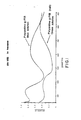
- Figure 1 is a graphical plot of the solution electronic absorption spectra obtained using ultraviolet-visible spectroscopy as described in Example 3.
- novel polymers of the present invention comprise nitrogen-containing polymers, such as ashless nitrogen-containing dispersant (e.g., polyisobutylene succinimides) and polyolefin-substituted amines, grafted with aromatic N-containing monomers, such as aniline, to provide oil soluble polymers having dispersant and antioxidant properties in oleaginous compositions, including fuel and lubricating oils.
- nitrogen-containing polymers such as ashless nitrogen-containing dispersant (e.g., polyisobutylene succinimides) and polyolefin-substituted amines, grafted with aromatic N-containing monomers, such as aniline, to provide oil soluble polymers having dispersant and antioxidant properties in oleaginous compositions, including fuel and lubricating oils.
- the additives serve to minimize the degree of carburetor and fuel injector fouling from deposits.
- the novel polymers are also useful in electrically conductive devices.
- novel polymers are formed by (a) providing a N-containing polymer adduct containing reactive amino groups formed by contacting an amine compound having at least two reactive nitrogen moieties with at least one long chain hydrocarbon-substituted reactant in an amount and under conditions sufficient to form a nitrogen-containing polymer adduct, said long chain hydrocarbon-substituted reactant comprising at least one member selected from the group consisting of: (i) long chain hydrocarbons substituted with mono- or dicarboxylic acid, anhydride or ester groups; (ii) halogenated long chain hydrocarbons; (iii) mixtures of formaldehyde and a long chain hydrocarbyl substituted phenol; and (iv) mixtures of formaldehyde and a reaction product formed by reaction of long chain hydrocarbons substituted with mono- or dicarboxylic acid, anhydride or ester groups and an amino-substituted, optionally hydrocarbyl-substituted phenol
- the present invention is directed to a polyolefin-substituted dispersant and antioxidant additive useful in oleaginous compositions formed by (a) reacting in a liquid reaction mixture an amine compound having at least two reactive nitrogen moieties (e.g., ammonia or a polyamine such as a polyalkylene polyamine) with a long chain hydrocarbyl substituted mono- or dicarboxylic acid material comprising a polyolefin, derived from a C 2 to C 10 o monoolefin and having a 300 to 10,000 number average molecular weight, substituted with at least 0.5 (e.g., from about 1 to 4) mono- or dicarboxylic acid producing moieties (preferably acid or anhydride moieties) per polyolefin molecule to form an N-acylated polymer substituted adduct having reactive amine groups, and (b) contacting said N-acylated polymer adduct with at least one aromatic N-containing monomer under poly
- the N-containing polymer adduct employed in the present invention is prepared by contacting a long chain hydrocarbon substituted reactant with an amine compound containing at least two (e.g., from 2 to 20), preferably at least 3 (e.g., from 3 to 15), and most preferably from 3 to 8, reactive nitrogen moieties (that is, the total of the nitrogen-bonded H atoms) per molecule of the amine compound.
- the amine compound will generally comprise at least one member selected from the group consisting of ammonia, organic primary monoamines and organic polyamines containing at least one primary amine group or at least two secondary amine groups per molecule.
- the organic amines will contain from about 2 to 60, preferably 2 to 40 (e.g.
- amines may be hydrocarbyl amines or may be hydrocarbyl amines including other groups, e.g, hydroxy groups, alkoxy groups, amide groups, nitriles, imidazoline groups, and the like. Hydroxy amines with 1 to 6 hydroxy groups, preferably 1 to 3 hydroxy groups are particularly useful.
- Preferred amines are aliphatic saturated amines, including those of the general formulas: wherein R, R', R" and R'" are independently selected from the group consisting of hydrogen; C 1 to C 25 straight or branched chain alkyl radicals; C, to C 12 alkoxy C 2 to C 6 alkylene radicals; C 2 to C 12 hydroxy amino alkylene radicals; and C 1 to C 12 alkylamino C 2 to C 6 alkylene radicals; and wherein R"' can additionally comprise a moiety of the formula: wherein R' is as defined above, and wherein s and s' can be the same or a different number of from 2 to 6, preferably 2 to 4; and t and t' can be the same or different and are numbers of from 0 to 10, preferably 2 to 7, and most preferably about 3 to 7, with the proviso that the sum of t and t' is not greater than 15.
- R, R', R", R"', s, s', t and t' be selected in a manner sufficient to provide the compounds of Formulas I and II with typically at least one primary or secondary amine group, preferably at least two primary or secondary amine groups. This can be achieved by selecting at least one of said R, R', R" or R''' groups to be hydrogen or by letting t in Formula II be at least one when R"' is H or when the III moiety possesses a secondary amino group.
- Non-limiting examples of suitable organic amine compounds include: 1,2-diaminoethane; 1,3-diaminopropane; 1,4-diaminobutane; 1,6-diaminohexane; polyethylene amines such as diethylene triamine; triethylene tetra; tetraethylene pentamine; polypropylene amines such as 1,2-propylene diamine; di-(1,2-propylene)triamine; di-(1,3-propylene) triamine; N,N-dimethyl-1,3-diaminopropane; N,N-di-(2-aminoethyl) ethylene diamine; N,N-di(2-hydroxyethyl)-1,3-propylene diamine; 3-dodecyloxypropylamine; N-dodecyl-1,3-propane diamine; tris hydroxymethylaminomethane (THAM); diisopropanol amine; diethanol
- amine compounds include: alicyclic diamines such as 1,4-di(aminomethyl) cyclohexane, and heterocyclic nitrogen compounds such as imidazolines, and N-aminoalkyl piperazines of the general formula (IV): wherein p i and p 2 are the same or different and are each integers of from 1 to 4, and n 1 , n 2 and n 3 are the same or different and are each integers of from 1 to 3.
- Non-limiting examples of such amines include 2-pentadecyl imidazoline: N-(2-aminoethyl) piperazine; etc.
- one process for preparing alkylene amines involves the reaction of an involves the reaction of an alkylene dihalide (such as ethylene dichloride or propylene dichloride) with ammonia, which results in a complex mixture of alkylene amines wherein pairs of nitrogens are joined by alkylene groups, forming such compounds as diethylene triamine, triethylenetetra, tetraethylene pentamine and isomeric piperazines.
- alkylene dihalide such as ethylene dichloride or propylene dichloride
- ammonia such as ethylene triamine, triethylenetetra, tetraethylene pentamine and isomeric piperazines.
- Low cost poly(ethyleneamines) compounds averaging about 5 to 7 nitrogen atoms per molecule are available commercially under trade names such as "Polyamine H", “Polyamine 400", “Dow Polyamine E-100", etc.
- Useful amines also include polyoxyalkylene polyamines such as those of the formulae: where m has a value of about 3 to 70 and preferably 10 to 35; and where "n 4 " has a value of about 1 to 40 with the provision that the sum of all the n 4 .,s is from about 3 to about 70 and preferably from about 6 to about 35, and R4 is a polyvalent saturated hydrocarbon radical of up to ten carbon atoms wherein the number of substituents on the R 4 group is represented by the value of "p", which is a number of from 3 to 6.
- the alkylene groups in either formula (V) or (VI) may be straight or branched chains containing about 2 to 7, and preferably about 2 to 4 carbon atoms.
- the polyoxyalkylene polyamines of formulas (V) or (VI) above may have average molecular weights ranging from about 200 to about 4000 and preferably from about 400 to about 2000.
- the preferred polyoxyalkylene polyoxyalkylene polyamines include the polyoxyethylene and polyoxypropylene diamines and the polyoxypropylene triamines having average molecular weights ranging from about 200 to 2000.
- the polyoxyalkylene polyamines are commercially available and may be obtained, for example, from the Jefferson Chemical Company, Inc. under the trade name "Jeffamines D-230, D-400, D-1000, D-2000, T-403", etc.
- the amine compound can comprise an amido-amine formed by reacting a polyamine with an alpha, beta-ethylenically unsaturated compound (e.g., of formula XXII), e.g. by reacting polyethylene amines (e.g., tetraethylene pentaamine,.
- an alpha, beta-ethylenically unsaturated compound e.g., of formula XXII
- polyethylene amines e.g., tetraethylene pentaamine
- polyoxyethylene and polyoxypropylene amines e.g., polyoxypropylene diamine, trismethylolaminomethane and pentaerythritol, and combinations thereof, with with an acrylate-type compound, and most preferably with an acrylate-type reactant selected from the group consisting of lower alkyl alky-acrylates (e.g., methyl, ethyl, iso-propyl, propyl, iso-butyl, n-butyl, tert-butyl, etc., esters of methacrylic acid, acrylic acid, and the like).
- lower alkyl alky-acrylates e.g., methyl, ethyl, iso-propyl, propyl, iso-butyl, n-butyl, tert-butyl, etc.
- amido-amines are compounds of the formula:
- amine compound members selected from the group consisting of ammonia and organic diprimary amines having from 2 to 12 carbon atoms and from 2 to 8 nitrogen atoms per molecule.
- organic diprimary amines are ethylene diamine, propylene diamine, diethylene triamine, dipropylene triamine, triethylene tetraamine, tripropylene tetraamine, tetraethylene pentaamine, tetrapropylene pentaamine, polyhexamethylene diamine, phenyl diamine.
- the long chain hydrocarbyl polymer-substituted mono- or dicarboxylic acid material i.e., acid, anhydride or acid ester used in this invention, includes the reaction product of a long chain hydrocarbon polymer, generally a polyolefin, with a monounsaturated carboxylic reactant comprising at least one member selected from the group consisting of (i) monounsaturated C 4 to C 10 dicarboxylic acid (preferably wherein (a) the carboxyl groups are vicinyl, (i.e.
- the reaction mixture will contain non-acid substituted polymer.
- the polymer-substituted mono- or dicarboxylic acid material also referred to herein as "functionalized” polymer or polyolefin
- non-acid substituted polyolefin and any other polymeric by-products, e.g. chlorinated polyolefin, (also referred to herein as “unfunctionalized” polymer) are collectively referred to herein as "product residue" or "product mixture”.
- the non-acid substituted polymer is typically not removed from the reaction mixture (because such removal is difficult and would be commercially infeasible) and the product mixture, stripped of any monounsaturated carboxylic reactant is employed for further reaction with the amine or alcohol as described hereinafter to make the dispersant.
- Characterization of the average number of moles of monounsaturated carboxylic reactant which have reacted per mole of polymer charged to the reaction (whether it has undergone reaction or not) is defined herein as functionality. Said functionality is based upon (i) determination of the saponification number of the resulting product mixture using potassium hydroxide; and (ii) the number average molecular weight of the polymer charged, using techniques well known in the art. Functionality is defined solely with reference to the resulting product mixture. Although the amount of said reacted polymer contained in the resulting product mixture can be subsequently modified, i.e. increased or decreased by techniques known in the art, such modifications do not alter functionality as defined above.
- the terms "polymer substituted monocarboxylic acid material” and “polymer substituted dicarboxylic acid material” as used herein are intended to refer to the product mixture whether it has undergone such modification or not.
- the functionality of the polymer substituted mono- and dicarboxylic acid material will be typically at least about 0.5, preferably at least about 0.8, and most preferably at least about 0.9 and will vary typically from about 0.5 to about 2.8 (e.g., 0.6 to 2), preferably from about 0.8 to about 1.4, and most preferably from about 0.9 to about 1.3.
- Such monounsaturated carboxylic reactants are fumaric acid, itaconic acid, maleic acid, maleic anhydride, chloromaleic acid, chloromaleic anhydride, acrylic acid, methacrylic acid, crotonic acid, cinnamic acid, and lower alkyl (e.g., C 1 to C 4 alkyl) acid esters of the foregoing, e.g., methyl maleate, ethyl fumarate, methyl fumarate, etc.
- lower alkyl e.g., C 1 to C 4 alkyl
- Preferred olefin polymers for reaction with the monounsaturated carboxylic reactants to form reactant A are polymers comprising a major molar amount of C 2 to Cio, e.g., C 2 to C 5 monoolefin.
- Such olefins include ethylene, propylene, butylene, isobutylene, pentene, octene-1, styrene, etc.
- the polymers can be homopolymers such as polyisobutylene, as well as copolymers of two or more of such olefins such as copolymers of: ethylene and propylene; butylene and isobutylene; propylene and isobutylene; etc.
- Copolymers prepared by polymerization of mixtures of isobutylene, butene-1 and butene-2, e.g., polyisobutylene wherein up to about 40% of the monomer units are derived from butene-1 and butene-2 is an exemplary, and preferred, olefin polymer.
- Other copolymers include those in which a minor molar amount of the copolymer monomers, e.g., 1 to 10 mole %, is a C 4 to C 18 non-conjugated diolefin, e.g., a copolymer of isobutylene and butadiene; or a copolymer of ethylene, propylene and 1,4-hexadiene; etc.
- the olefin polymer may be completely saturated, for example an ethylene-propylene copolymer made by a Ziegler-Natta synthesis using hydrogen as a moderator to control molecular weight.
- the olefin polymers used in the formation of reactant A will have number average molecular weights within the range of about 300 to 10,000, generally from about 700 and about 5,000, preferably from about 1000 to 4,000, more preferably between about 1300 and about 3,000.
- Particularly useful olefin polymers have number average molecular weights within the range of about 1500 and about 3000 with approximately one terminal double bond per polymer chain.
- An especially useful starting material for highly potent dispersant additives useful in accordance with this invention is polyisobutylene, wherein up to about 40% of the monomer units are derived from butene-1 and/or butene-2. The number average molecular weight for such polymers can be determined by several known techniques.
- GPC gel permeation chromatography
- the olefin polymers will generally have a molecular weight distribution (the ratio of the weight average molecular weight to number average molecular weight, i.e. M w /M n ) of from about 1.0 to 4.5, and more typically from about 1.5 to 3.0.
- the polymer can be reacted with the monounsaturated carboxylic reactant by a variety of methods.
- the polymer can be first halogenated, chlorinated or brominated to about 1 to 8 wt.%, preferably 3 to 7 wt. % chlorine, or bromine, based on the weight of polymer, by passing the chlorine or bromine through the polymer at a temperature of 60 to 250 C, preferably 110 to 160°C, e.g. 120 to 140°C, for about 0.5 to 10, preferably 1 to 7 hours.
- the halogenated polymer may then be reacted with sufficient monounsaturated carboxylic reactant at 100 to 250 C, usually about 180 to 235 C, for about 0.5 to 10, e.g.
- the polymer and the monounsaturated carboxylic reactant can be contacted at elevated temperature to cause a thermal "ene” reaction to take place.
- Thermal "ene” reactions have been heretofore described in U.S. Patents 3,361,673 and 3,401,118, the disclosures of which are hereby incorporated by reference in their entirety.
- the polymers used in this invention contain less than 5 wt%, more preferably less than 2 wt%, and most preferably less than 1 wt% of a polymer fraction comprising polymer molecules having a molecular weight of less than about 300, as determined by high temperature gel premeation chromatography employing the corresponding polymer calibration curve.
- Such preferred polymers have been found to permit the preparation of reaction products, particularly when employing maleic anhydride as the unsaturated acid reactant, with decreased sediment.
- the polymer produced as described above contains greater than about 5 wt% of such a low molecular weight polymer fraction
- the polymer can be first treated by conventional means to remove the low molecular weight fraction to the desired level prior to initiating the ene reaction, and preferably prior to contacing the polymer with the selected unsaturated carboxylic reactant(s).
- the polymer can be heated, preferably with inert gas (e.g., nitrogen) stripping, at elevated temperature under a reduced pressure to volatilize the low molecular weight polymer components which can then be removed from the heat treatment vessel.
- inert gas e.g., nitrogen
- the precise temperature, pressure and time for such heat treatment can vary widely depending on such factors as as the polymer number average molecular weight, the amount of the low molecular weight fraction to be removed, the particular monomers employed and other factors. Generally, a temperature of from about 60 to 1000 C and a pressure of from about 0.1 to 0.9 atmospheres and a time of from about 0.5 to 20 hours (e.g., 2 to 8 hours) will be sufficient.
- the selected polymer and monounsaturated carboxylic reactant and halogen e.g., chlorine gas
- the polymer and monounsaturated carboxylic reactant will be contacted in a unsaturated carboxylic reactant to polymer mole ratio usually from about 0.7:1 to 4:1, and preferably from about 1:1 to 2:1, at an elevated temperature, generally from about 120 to 260 ° C, preferably from about 160 to 240 ° C.
- the mole ratio of halogen to monounsaturated carboxylic reactant charged will also vary and will generally range from about 0.5:1 to 4:1, and more typically from about 0.7:1 to 2:1 (e.g., from about 0.9 to 1.4:1).
- the reaction will be generally carried out, with stirring for a time of from about 1 to 20 hours, preferably from about 2 to 6 hours.
- halogen about 65 to 95 wt. % of the polyolefin, e.g. polyisobutylene will normally react with the monounsaturated carboxylic acid reactant. Upon carrying out a thermal reaction without the use of halogen or a catalyst, then usually only about 50 to 75 wt. % of the polyisobutylene will react. Chlorination helps increase the reactivity.
- the aforesaid functionality ratios of mono- or dicarboxylic acid producing units to polyolefin e.g., 1.1 to 1.8, etc. are based upon the total amount of polyolefin, that is, the total of both the reacted and unreacted polyolefin, used to make the product.
- the reaction is preferably conducted in the substantial absence of 0 2 and water (to avoid competing side reactions), and to this end can be conducted in an atmosphere of dry N 2 gas or other gas inert under the reaction conditions.
- the reactants can be charged separately or together as a mixture to the reaction zone, and the reaction can be carried out continuously, semi-continuously or batchwise.
- the reaction can be carried out in the presence of a liquid diluent or solvent, e.g., a hydrocarbon diluent such as mineral lubricating oil, toluene, xylene, dichlorobenzene and the like.
- the polymer substituted mono- or dicarboxylic acid material thus formed can be recovered from the liquid reaction mixture, e.g., after stripping the reaction mixture, if desired, with an inert gas such as N 2 to remove unreacted unsaturated carboxylic reactant.
- a catalyst or promoter for reaction of the olefin polymer and monounsaturated carboxylic reactant can be employed in the reaction zone.
- halogen e.g., chlorine
- Such catalyst of promoters include alkoxides of Ti, Zr, V and Al, and nickel salts (e.g., Ni acetoacetonate and Ni iodide) which catalysts or promoters will be generally employed in an amount of from about 1 to 5,000 ppm by weight, based on the mass of the reaction medium.
- the selected amine compound(s) are readily reacted with the selected polymer substituted mono- or dicarboxylic acid material, e.g. alkenyl succinic anhydride, by heating an oil solution containing 5 to 95 wt. % of the polymer substituted dicarboxylic acid material to about 100 to 250° C., preferably 125 to 175° C., generally for 1 to 10, e.g. 2 to 6 hours until the desired amount of water is removed.
- the heating is preferably carried out to favor formation of imides and/or amides, rather than salts.
- amine compound Generally from 1 to 5, preferably from about 1.5 to 3 moles of mono- or dicarboxylic acid moiety content (e.g., grafted maleic anhydride or grafted acrylic acid content) is used per reactive nitrogen equivalent (preferably per equivalent of primary nitrogen) of the amine compound.
- mono- or dicarboxylic acid moiety content e.g., grafted maleic anhydride or grafted acrylic acid content
- reactive nitrogen equivalent preferably per equivalent of primary nitrogen
- the polymer substituted mono- or dicarboxylic acid producing material and amine compound will be contacted for a time and under conditions sufficient to form an adduct having within its structure, on average, at least 0.5 (e.g., from 0.5 to 20), and preferably at least 1 (e.g., from 1 to 15) reactive amine groups (i.e., primary and/or secondary amino groups) per molecule.
- the progress of this reaction can be followed by infra-red analysis.
- the dispersant-forming reaction can be conducted in a polar or non-polar solvent (e.g., xylene, toluene, benzene and the like), and is preferably conducted in the presence of a mineral or synthetic lubricating oil.
- a polar or non-polar solvent e.g., xylene, toluene, benzene and the like
- halogenated long chain aliphatic hydrocarbons are also useful as long chain hydrocarbyl reactants to form the improved dispersants of this invention.
- halogenated long chain aliphatic hydrocarbons as shown in U.S. Patents 3,275,554, 3,438,757, 3,565,804, and 4,000,353, the disclosures of which are hereby incorporated by reference in their entirety
- the halogen group on the halogenated hydrocarbon is displaced with the nitrogen-containing compound in the subsequent reaction therewith.
- a polymer of a C 2 to C 5 monoolefin e.g., polyethylene, polypropylene or polyisobutylene, wherein the polymer has an average molecular weight within the range of from 600 to about 3,000, preferably from about 800 to about 2,500, is halogenated with either bromine or chlorine; preferably the latter.
- the halogen may be conveniently added as gaseous chloride, liquid bromine, or a hydrohalogen, e.g., HCI or HBr gas.
- the amount of halogen introduced will depend on the particular hydrocarbon used, the desired amount of amine to be introduced into the molecule, the particular alkylene amine used, and the halogen used.
- the amount of halogen introduced will generally be in the range from about 1 to 5 halogen atoms per molecule, depending on the reactivity of the resulting halide. On a weight percent basis, the amount of halide will generally range from about 1 to 25, more usually from about 1 to 10.
- the halogenation step may be conducted in the temperature range of from about ordinary ambient temperatures to about 120° C.
- the polymer may be dissolved in a suitable solvent, such as carbon tetrachloride, in order to lower the viscosity of the polymer, although the use of such a solvent is not necessary.
- the time required for halogenation may be varied to some extent by the rate at which the halogen is introduced. Ordinarily from-about 2 to about 5 hours is a satisfactory halogenation period.
- a 100-pound batch will be chlorinated with 10 pounds of chlorine introduced into the reactor over a period of 3 1/2 hours with a chlorination temperature of about 120° C.
- the halohydrocarbon and amine compound may be brought together neat or in the presence of an inert solvent, particularly a hydrocarbon solvent.
- the inert hydrocarbon solvent may be aliphatic or aromatic.
- aliphatic alcohols may be used by themselves or in combination with another solvent, when capable of dissolving the reactants.
- the reaction may be carried out at room temperature (20 C), but elevated temperatures are preferred. Usually, the temperature will be in the range of from about 100° to 225 C. Depending on the temperature of the reaction, the particular halogen used, the mole ratios and the particular amine, as well as the reactant concentrations, the time may vary from 1 to 24 hours, more usually from about 3 to 20 hours. Times greatly in excess of 24 hours do not particularly enhance the yield and may lead to undesirable degradation. It is therefore preferred to limit the reaction time to fewer than 24 hours.
- the mole ratio of halohydrocarbon to amine compound will generally be in the range from about 0.2 to 10 moles of amine compound per mole of halohydrocarbon, more usually 0.5 to 5 moles of amine compound per mole of halohydrocarbon.
- the mole ratio will depend upon the amount of halogen present in the halohydrocarbon, the particular halogen and the desired ratio of hydrocarbon to amine compound.
- the residual halogen in the final composition are not deleterious. Generally, the residual halogen, as bound halogen, will be in the range of 0 to 10 weight percent of the composition. Small amounts of halogen may be present as the hydrohalide salt of the hydrocarbon substituted alkylene polyamines.
- the hydrocarbons used will have aliphatic unsaturation.
- the amines may react in a way resulting in the elimination of hydrogen halide, introducing further aliphatic unsaturation into the hydrocarbon radical. Therefore, the hydrocarbon radicals usually will be olefinically unsaturated.
- the olefinic unsaturation does not significantly affect the utility of the product, and when available, saturated aliphatic halide may be used.
- reaction mixture may be extracted with a hydrocarbon medium to free the product from any low molecular weight amine salt which has formed.
- the product may then be isolated by evaporation of the solvent. Further separation from unreacted hydrocarbon or purification may be carried out as desired, e.g., chromatography.
- (C) Another class of long chain hydrocarbyl reactants to form the improved dispersants of this invention are any of the long chain hydrocarbyl-substituted hydroxy aromatic compounds which are known in the art as useful for forming Mannich condensation products.
- Such Mannich condensation products generally are prepared by condensing about 1 mole of a high molecular weight hydrocarbyl substituted hydroxy aromatic compound (e.g., having a number average molecular weight of 700 or greater) with about 1 to 2.5 moles of an aldehyde such as formaldehyde or paraformaldehyde and about 0.5 to 2 moles of the second adduct, using the condensation conditions as disclosed, e.g., in U.S.
- Mannich condensation products may include a long chain, high molecular weight hydrocarbon on the phenol group or may be reacted with a compound containing such a hydrocarbon, e.g., polyalkenyl succinic anhydride as shown in said aforementioned U.S. Patent 3,442,808.
- the optionally substituted hydroxy aromatic compounds used in the preparation of the Mannich base products include those compounds having the formula wherein Ar represents wherein q is 1 or 2, R 1 is a long chain hydrocarbon, R 2 is a hydrocarbon or substituted hydrocarbon radical having from 1 to about 3 carbon atoms or a halogen radical such as the bromide or chloride radical, Y1 is an integer from 1 to 2, X1 is an integer from 0 to 2, and Z1 is an integer from 1 to 2.
- Ar groups are phenylene, biphenylene, naphthylene and the like.
- the long chain hydrocarbon R 1 substituents are olefin polymers as described above for those olefin polymers useful informing reactants.
- hydrocarbyl substituted hydroxy aromatic compounds contemplated for use in the present invention include, but are not limited to, 2-polypropylene phenol, 3-polypropylene phenol, 4- polypropylene phenol, 2-polybutylene phenol, 3-polyisobutylene phenol, 4-polyisobutylene phenol, 4- polyisobutylene-2-chlorophenol, 4-polyisobutylene-2-methylphenol, and the like.
- Suitable hydrocarbyl-substitued polyhydroxy aromatic compounds include the polyolefin catechols, the polyolefin resorcinols, and the polyolefin hydroquinones, e.g., 4-polyisobutylene-1,2-dihydroxybenzene, 3- polypropylene-1,2-dihydroxybenzene, 5 - polyisobutylene-1,3-dihydroxybenzene, 4-polyamylene-I,3-dihydroxybenzene, and the like.
- Suitable hydrocarbyl-substituted naphthols include 1-polyisobutylene-5-hydroxynaphthalene, 1- polypropylene-3-hydroxynaphthalene and the like.
- Mannich base aminophenol-type condensation products as they are known in the art.
- Such Mannich condensation products generally are prepared by reacting about 1 mole of long chain hydrocarbon substituted mono and dicarboxylic acids or their anhydrides (e.g., polyisobutylene-substituted succinic anhydride) with an about 1 mole of amine-substituted hydroxy aromatic compound (e.g., aminophenol), which aromatic compound can also be halogen- or hydrocarbyl-substituted, to form a long chain hydrocarbon substituted amide or imide-containing phenol intermediate adduct (generally having a number average molecular weight of 700 or greater), and condensing about a molar proportion of the long chain hydrocarbon substituted amide- or imide-containing phenol intermediate adduct with about 1 to 2.5 moles of formaldehyde and about 0.5 to 2 moles of the second
- Suitable aminophenols include 2-aminophenol, 3-aminophenol, 4-aminophenol, 4-amino-3-methylphenol, 4-amino-3-chlorophenol, 4-amino-2-bromophenol and 4-amino-3-ethylphenol.
- the adducts formed by reaction of amines and long chain hydrocarbyl reactants B, C and D will preferably have within their structure, on average, at least about 0.5 (e.g., from about 0.5 to 20), and preferably at about 1 (e.g., from about 1 to 15) reactive amine groups per molecule.
- N-containing polymer adducts useful in the present invention can be illustrated as follows:
- the reaction mixture is transferred to a separatory funnel with the aid of one liter of benzene, and the mixture is washed repeatedly first with a dilute aqueous solution of isopropyl alcohol, then with a dilute aqueous solution of a combination of isopropyl alcohol and butanol and finally with water.
- the volatile materials are then removed from a sample of the washed product by sparging with nitrogen to constant weight on a steam plate. Analysis: titrimetric equivalent wt., 806, equal to 1.74% N; wt. percent chlorine, 0.62.
- 1,434 g. or about half of the volatile solvents is removed from the main portion of the washed product.
- This solution containing about 25% volatile solvent (titrimetric equivalent weight 1,051) combined with 240 g. of a mixture of other materials prepared similarly to provide a final product having a titrimetric equivalent weight of 985, the product being polyisobutenyl ethylene diamine.
- Example D 1,000 g. of chloropolypropylene (polypropylene of about number average 800 molecular weight chlorinated to about 6 weight percent chlorine) is reacted with 270 g. of ethylene diamine.
- the product as finished contains about 15% volatile solvents.
- chloropolyisobutylene polyisobutylene of approximately 950 molecular weight chlorinated to 5.6 weight percent chlorine
- alkylene polyamine having an average composition of tetraethylene pentamine and 1,200 ml. of benzene
- the mixture is then allowed to cool, diluted with equal volumes of mixed hexanes and absolute ethanol, heated to reflux and 1/3 volume of 10 weight percent aqueous sodium carbonate added.
- the phases are Separated, and the organic phase is washed with water, followed by removing the volatile materials in vacuo. Analysis: wt. percent N, 4.15; molecular weight (ThermoNam), 1,539.
- a portion of the dispersant of Example I is reacted with boric acid to provide a S150N solution containing a borated polyisobutenyl succinimide having a nitrogen content of about 1.28 wt. %, a boron content of 0.23 wt.% (50% a.i.) and 50 wt. % of unreacted PIB and mineral oil (S150N).
- a borated polyisobutenyl succinimide having a nitrogen content of about 1.28 wt. %, a boron content of 0.23 wt.% (50% a.i.) and 50 wt. % of unreacted PIB and mineral oil (S150N).
- a mixture of 200 parts by weight of the PIBSA product formed as in Example K(a) and 42 parts of S150 mineral oil is heated to 150°C under N 2 . Then 11.6 parts of tetraethylenepentaamine are added dropwise while stirring and light nitrogen sparging. The mixture is nitrogen stripped at 150°C for 3 hours and then filtered. The oil solution is found to have the nitrogen content of 1.65 wt. % and a kinematic viscosity of 213.0 cSt at 100°C.
- a mixture of 200 parts by weight of the PIBSA product formed in Example I(a) and 119 parts of S150 mineral oil is heated to 150°C under N 2 . Then 8.8 parts of tetraethylenepentaamine are added dropwise while stirring and light nitrogen sparging. The mixture is nitrogen stripped at 150°C for 3 hours and then filtered. The oil solution is found to have the nitrogen content of 1.05 wt. % and a kinematic viscosity of 487.8 cSt at 100°C.
- Example P(b) Using the procedure of Example P(b), a mixture of 107 parts by weight of the PIBA product formed in Example P(a) and 47.3 parts of S150 mineral oil is heated to 160°C under N 2 . Then 4.8 parts of a commercial polyethylene-polyamine (PAM containing an average of 12 carbon atoms and 6 nitrogen atoms per molecule), are added dropwise while stirring and light nitrogen sparging. The mixture is nitrogen stripped at 160°C for 3 hours and then filtered. The oil solution is found to have the nitrogen content of 0.98 wt%.
- PAM polyethylene-polyamine
- polyisobutylene succinic anhydride (Sap. No. 48, 86 wt.% active ingredient) is prepared from 2225 M n PIB via a simultaneous process with chlorine gas and maleic anhydride was charged into a reaction vessel with 2897 g. of mineral oil S150N and heated to 150°C under nitrogen blanket. Thereafter, one mole of polyalkylene polyamine (as used in Example Q) is added to the reaction solution while nitrogen sparging for a period of one hour. After the addition is completed, the reaction mixture is nitrogen stripped at 150°C for two hours and filtered. The product, a 52 wt.% oil solution of polyisobutenyl succinimide, analyzes for 0.88 wt.% nitrogen (of which 47 wt.% is secondary amino groups).
- aromatic nitrogen-containing monomers employed in the present invention contain one or more aromatic ring, wherein at least one aromatic ring is substituted by a -NH(R a ) group, wherein R a is hydrogen or hydrocarbyl (e.g., C 1 to C 25 hydrocarbyl, and preferably H or C 1 to C 3 alkyl).
- aromatic N-monomers include compounds of the formula: wherein Ar is a substituted or unsubstituted aromatic radical, R a is as defined above and y is an integer of at least 1 (e.g., 1 to 4, preferably 1-2).
- the Ar radical will generally contain from 6 to 20 ring carbon atoms and can comprise a single aromatic ring, fused aromatic rings, or linked aromatic rings, and can be substituted or unsubstituted. preferably, the substituents on the Ar radical are positioned ortho- and/or meta- to the N substituent.
- the Ar radical's substituents can be the same or different and can comprise -Z 2 or -Z 1 Z 2 wherein Z 1 is a member selected from the group consisting of (a) a branched or straight chain alkylene group (e.g., -C n H 2n -, wherein n is an integer of from 1 to 20, preferably from 1 to 6) which can contain one or more -O-or -S- chain atoms (e.g., -(C n ⁇ H 2n ⁇ X) n" - wherein n' is an integer of from 1 to 6, preferably from 1 to 4, and n" is an integer of from 1 to 20, preferably from 1 to 6 and X is 0 or S), and (b) groups of the formula: wherein n 3 is from 1 to 4 (and preferably 1 to 2), R° in each instance in which it appears is independently C 1 to C 12 alkyl (preferably C 1 to C 4 alkyl), D in each instance in which it appears is independently Cl,
- the Ar group if substituted, will preferably be substituted by 1 to 3, more preferably 1 to 2, C 1 to C 20 hydrocarbyl (e.g., alkyl) groups, or with 1 to 3 halogen radicals (e. g. , Cl-, Br-, or I-) .
- suitable unsubstituted Ar groups are phenyl, naphthyl, bi-phenyl, terphenyl, quarterphenyl, quinquiphenyl, sexiphenyl, naphthyl- phenyl, phenylnaphthyl and the like.
- fused aromatic ring Ar systems are anthracene, phenanthrene, tetracene, acenaphthene and phenalene.
- Preferred polyaromatics are the polyphenylenes.
- R a and R c are preferably substantially free of polymerizable ethylenically unsaturated double bonds.
- Preferred aromatic N-monomers for use in the present invention comprise compounds of the formula: wherein Ar' is wherein Z 1 is as defined above, R° in each instance in which it appears is independently C 1 to C 12 alkyl (preferably C 1 to C 4 alkyl), D in each instance in which it appears is independently Cl, Br or I, y" is an integer of from 0 to 4 (preferably from 0 to 3), y'" is an integer of from 0 to 4 (preferably from 0 to 3), and wherein R b is H or C 1 to C 20 alkyl and y' is an integer of from 1 to 4 (preferably 1 or 2), with the proviso that the sum of y' + y" + y"' is from 1 to 5 (preferably from 1 to 4, more preferably from 1 to 3).
- aromatic N-monomers useful in this invention are aniline, N-methyl aniline, N-ethyl aniline, N-propyl aniline, N-isopropyl aniline, N-(tert-butyl) aniline, 2-aminophenol, 3-aminophenol, 2-amino-4-chloro-6-nitrophenol, 2-amino-4,6-dichlorophenol, 2-amino-4,6-dinitrophenol, 2-amino-4-chlorophenol, 2-amino-4-nitrophenol, 2-amino-1-phenol-4-sulfonamide; 3-amino-2-hydroxybenzoic acid, 2-amino-6-nitro-4-methylyphenol, 6-amino-4-nitro-2-methylphenol, 2-amino-3-nitro-4-methylphenol, 2-amino-4-methylphenol, 2-amino-4-(methylsulfonyl)phenol, 3'-amino-2'-hydroxy-5'-nitroacetanilide, 3'amino-4'
- Preferred aromatic N-monomers are o-methylaniline, o-ethylaniline, o-methoxyaniline, o-phenylaniline, o-aminoaniline, o-fluroaniline, o-chloroaniline, o-nitroaniline, o-methylaniline, m-ethylaniline, m-methoxyaniline, m-chloroaniline, m-nitroaniline, p-phenylaniline, N-methylaniline, N-ethylaniline, N-benzylaniline, N-methylaniline, N-phenylaniline, and N-naphthylaniline, and mixtures thereof.
- aromatic N-monomers on the present invention are aniline, o-toluidine, m-toluidine, m- ethylaniline, and o-ethylaniline.
- the amino-substifuted polymer is grafted with aromatic N-monomer in accordance with this invention by contacting the aromatic N-monomer and amino-substituted polymer under polymerizing conditions in a polymerization zone in the presence of an effective amount of an oxidizing agent.
- Oxidizing agents which can be employed have a reducing single electron potential (E ⁇ red ) greater than 1.00 volt, preferably grater than 1.5 volts and more preferably greater than 1.7 volts (e.g., from 1.5 to 2.5). E'red values for standard half reactions are obtained from Lange's Handbook of Chemistry, 13th ed., page 6-2 to 6-5, (J. A. Dean, Ed., McGraw Hill Book Company (1985), which is incorporated herein by reference.
- E ⁇ red reducing single electron potential
- Suitable oxidizing agents include chemical compounds which contain a metal ion which can change its valence, and also include non-metallic compounds. Examples are ammonium peroxydisulfate [(NH 4 ) 2 S 2 O 8 ], potassium iodate (KIOs), iron (III) chloride (FeCIs), sodium persulfate [Na 2 S 2 O 8 ], potassium persulfate [K 2 S 2 O 8 ], potassium dichromate (K 2 Cr 2 0 7 ), hydrogen peroxide (H 2 0 2 ) (e.g., 30% solution in water), chromium trioxide [CrO s] , sodium chlorate [Na 2 ClO 3 ], ammonium dichromate [(NH 4 ) 2 Cr 2 O 7 ], (NH4)- 2 Ce(NO 3 ) 6 , Ce(SO 4 ) 2 , and the like.
- ammonium peroxydisulfate (NH 4 ) 2 S 2 O 8 ]
- KIOs potassium
- the oxidizing agents can be dissolved in polar organic or inorganic solvents which are inert towards the particular oxidants used.
- Typical solvents are water, alcohols, acetonitrile, acetic acid, acetone, amides, ethers and the like.
- Typical concentrations for the oxidant are within the range 0.1-1.0 molar.
- auxiliary acids including, but not limited to, mineral, carboxylic and sulfonic may be used in conjunction with the aforementioned inorganic or organic oxidants.
- acids such as sulfuric, hydrochloric, acetic, trifluoroacetic, methanesulfonic or trifluoromethanesulfonic can be employed.
- Such acid may be co-dissolved with the oxidant in a suitable solvent used as a solvent for the oxidant.
- Such added acids may be preferred but are not necessary in conjunction with the preferred oxidants.
- auxiliary acids are added to the system, they are added in amounts in the range 0.01 to 100 moles acid/mole oxidant.
- the oxidizing agent is generally employed in an amount of from 0.01 to 3 mole (and preferably from 0.2 to 1 mole) per mole of the aromatic N-monomer.
- the conditions of temperature and pressure under which the polymerization is performed can vary widely, and generally temperatures of from about -20 to 100°C, preferably from about 0 to 30 C, will be employed. Temperatures of greater than 100°C can be employed but can cause excessive thermal decomposition of the product and increased by-products (including homopolymer of the aromatic N-monomer, e.g., polyaniline homopolymer from aniline). Similarly, temperatures of less then -20 C can be used, but uneconomically slow reaction rates can result.
- the pressure is preferably selected to maintain the polymer and monomer feed in substantially liquid form in the polymerization zone, and generally pressures from about 0.1 to 1000 kPa, and preferably from about 1 to 100 kPa, will be employed.
- the polymerization zone will be generally provided with a cooling means, which can comprise any of the conventionally used devices for cooling liquid media (e.g., external or internal reactor cooling coils, feedstream indirect heat exchanger (s), reaction liquid recycle through a pump around heat exchanger, introduction of a quench fluid (e.g., a cooled solvent or gas), and the like).
- Cooling of the polymerization reaction liquid can also be effected by evaporative cooling, as by continuously, or intermittently, introducing a low-boiling solvent which is evaporated from the surface of the reaction liquid.
- the polymerization reaction time can vary widely, depending on such factors as the size of the reactor, the type, amounts and notes of the feedstreams charged, the temperatures employed, and other factors. Generally, however, the polymerization will be conducted for a time of from about 0.1 to 24 hours, preferably from about 1 to 15 hours and more preferably from about 2 to 6 hours.
- the grafting polymerization reaction is believed to be an oxidation reaction, and therefore, the reactants are preferably charged in the substantial absence of reducing agents such as hydroquinone, NH 4 0H, hydrazine, and the like, as these materials may impede the desired grafting reaction.
- the polymerization can be effected in the presence or absence of a solvent.
- suitable solvents include hydrocarbon solvents such as aliphatics, cycloaliphatics, and aromatic hydrocarbon solvents, or halogenated versions of such solvents.
- hydrocarbon solvents such as aliphatics, cycloaliphatics, and aromatic hydrocarbon solvents, or halogenated versions of such solvents.
- Preferred are C 12 or lower straight-chain or branched- chain, saturated hydrocarbons, and C 5 to C ⁇ saturated alicyclic or aromatic hydrocarbons, or C 2 to C 6 halogenated hydrocarbons.
- solvents examples include hexane, butane, pentane, heptane, cyclopentane, cyclohexane, cycloheptane, methyl cyclopentane, methyl cyclohexane, isooctane, benzene, toluene, xylene, chloroform, chlorobenzene, tetrachloroethylene, dichloroethane and trichloroethane.
- one mole of the long chain hydrocarbon-substituted reactant contains 0.8 molar equivalents of reactive amino groups.
- the concentration of aromatic-N-monomer units produced in the product polymer can vary widely.
- the grafted polymer will preferably contain from about 0.5 to 30 wt.%, and more preferably from about 1 to 10 wt.% monomer units derived from the aromatic N-monomer (e.g., aniline), and for electronic applications, the grafted polymer will preferably contain from about 20 to 80 wt.%, preferably 30 to 50 wt.% of monomer units derived from the aromatic-N-monomer (e.g., aniline).
- the polymerization grafting reaction can be effected in a continuous, semi-continuous or batchwise manner, and can be carried out in any conventional reactor, such as in one or more stirred tank reactor, tubular reactor, and the like.
- the long chain hydrocarbon-substituted reactant and aromatic N-monomer are contacted with the acidic oxidizing solution. Under these conditions, the long chain hydrocarbon-substituted reactant is unable to homopolymerize as it lacks the polymerizable group. The aromatic N-monomer, however, readily polymerizes under these reaction conditions.
- the slow addition of the long chain hydrocarbon-substituted reactant already mixed with acidic oxiding solution or the slow addition of the aromatic N-monomer mixed with long chain hydrocarbon-substituted reactant to the acidic oxiding solution is essential for the prevention of significant homopolymerization of aromatic N-monomer.
- the grafting reaction of long chain hydrocarbon-substituted reactants with aromatic N-monomers in accordance with this invention can be illustrated by the grafting of aniline onto a polyisobutylene-substituted amine (PIB-NH 2 ). Attempts to establish the exact structure of polyaniline have been difficult.
- the redox chemistry of polyaniline is complicated by the large number of possible chemical structures for the polyaniline in an idealized structure, the polymer's graft segment units formed in this invention can be written as follows: where x is a number of from 1 to 100,000, preferably from 2 to 1,000, and wherein PIB represents the balance of the polymer, which can contain an average of one or more such graft segments per polymer chain.
- the structure of the grafted polyaniline polymer units can also be represented as follows:
- the above structure can also be seen as the polysemiquinone radical cation form: wherein A is an anion (e.g., chloride anion), x is as defined above, and y is 0.5 which polymer form will be herein called an emeraldine salt.
- A is an anion (e.g., chloride anion)
- x is as defined above
- y is 0.5 which polymer form will be herein called an emeraldine salt.
- the polymer can be reacted with 0.1 M ammonium hydroxide to get polyaniline in the emeraldine base form.
- the emeraldine base form of the grafted polymer of the present invention alternating reduced and oxidized repeat units can be presented as follows: where again x and y are as defined above.
- repeating units can be protonated by Bronsted acid such as aqueous HCI to produce or regenerate the corresponding salt as shown above.
- the grafted polymers prepared by the process of this invention are soluble in common organic solvents (including non-polar organic solvents) and in mineral oils, and possess electrically conducting properties.
- the novel polymers of this invention are useful in oleaginous compositions as dispersant-viscosity index improver additives, as dispersant additives, and possess antioxidant properties.
- the polymers of this invention are characterized by improved thermooxidative and thermal stability properties compared to the amino-substituted polymers from which they are prepared.
- the polymers of this invention also find utility in other applications such as thermoplastic conductivity systems, soluble conductive systems capable of being cast into coherent films, additives for conventional thermoplastics, and the like.
- the novel polymers have high electrical conductivities, in general from 10 to 10- 6 > ohm- 1 cm- 1 , and good mechanical properties.
- the electrical conductivity (in ohms -1 cm -1 ) is determined by applying ⁇ conductive copper contacts to the film and carrying out the measurement by the two-point method.
- the polymers of this invention find utility in the construction of light-weight rechargable storage batteries, electrochromic display devices, electo-optical switching and memory devices, neutron detectors, solar energy cells, ion exchangers, non-linear optic devices, molecule-based electronics, anti-static treatment of plastics and textiles and semiconductor components. They constitute an advance in the art, especially where good mechanical properties of the components, coupled with low specific gravity and well- balanced properties, are important.
- homopolymer (if any is formed) could be removed by blending the grafted product with mineral oil (e.g. at temperatures of from about 80 C to 100°C for from about 4 to 8 hours) and then filtering this mixture to remove the homopolymer which is insoluble in mineral oil.
- mineral oil e.g. at temperatures of from about 80 C to 100°C for from about 4 to 8 hours
- the dispersants of the present invention can be incorporated into a lubricating oil (or a fuel in any convenient way.
- these mixtures can be added directly to the lubricating oil (or fuel) by dispersing or dissolving the same in the lubricating oil (or fuel) at the desired level of concentration of the dispersant.
- Such blending into the additional lubricating oil (or fuel) can occur at room temperature or elevated temperatures.
- the dispersants can be blended with a suitable oil-soluble solvent/diluent (such as benzene, xylene, toluene, lubricating base oils and petroleum distillates, including the various normally liquid fuels described in detail below) to form a concentrate, and then blending the concentrate with a lubricating oil (or fuel) to obtain the final formulation.
- a suitable oil-soluble solvent/diluent such as benzene, xylene, toluene, lubricating base oils and petroleum distillates, including the various normally liquid fuels described in detail below
- a suitable oil-soluble solvent/diluent such as benzene, xylene, toluene, lubricating base oils and petroleum distillates, including the various normally liquid fuels described in detail below
- a suitable oil-soluble solvent/diluent such as benzene, xylene, toluene, lubricating base oils and petroleum distillates, including the various normally liquid fuels described in detail below
- the oil-soluble additives of the present invention possess very good dispersant and antioxidant properties as measured herein in a wide variety of environments. Accordingly, the additives are used by incorporation and dissolution into an oleaginous material such as fuels and lubricating oils.
- an oleaginous material such as fuels and lubricating oils.
- a concentration of the additives in the fuel in the range of typically from about 0.001 to about 0.5, and preferably 0.005 to about 0.15 weight percent, based on the total weight of the composition, will usually be employed.
- alcohols such as methanol, ethanol, propanol and butanol, and mixtures of such alcohols are included in commercial fuels in amounts of up to about 10%.
- materials which can be mixed with the fuels include diethyl ether, methyl ethyl ether, methyl tertiary butyl ether, and nitromethane.
- liquid fuels derived from vegetable or mineral sources such as corn, alfalfa, shale and coal. Normally liquid fuels which are mixtures of one or more hydrocarbonaceous fuels and one or more non-hydrocarbonaceous materials are also contemplated.
- the fuel compositions of this invention can contain, in addition to the products of this invention, other additives which are well known to those of skill in the art.
- additives which are well known to those of skill in the art.
- anti-knock agents such as tetraalkyl lead compounds, lead scavengers such as haloalkanes, deposit preventers or modifiers such as triaryl phosphates, dyes, cetane improvers, antioxidants such as 2,6-ditertiary-butyl-4-methylphenol, rust inhibitors, bacteriostatic agents, gum inhibitors, metal deactivators, upper cylinder lubricants and the like.
- the additives of the present invention find their primary utility in lubricating oil compositions which employ a base oil in which the additives are dissolved or dispersed.
- base oils may be natural or synthetic.
- Base oils suitable for use in preparing the lubricating oil compositions of the present invention include those conventionally employed as crankcase lubricating oils for spark-ignited and compression- ignited internal combustion engines, such as automobile and truck engines, marine and railroad diesel engines, and the like.
- Advantageous results are also achieved by employing the additives of the present invention in base oils conventionally employed in and/or adapted for use as power transmitting fluids, universal tractor fluids and hydraulic fluids, heavy duty hydraulic fluids, power steering fluids and the like.
- Gear lubricants, industrial oils, pump oils and other lubricating oil compositions can also benefit from the incorporation therein of the additives of the present invention.
- lubricating oil formulations conventionally contain several different types of additives that will . supply the characteristics that are required in the formulations.
- these types of additives are included viscosity index improvers, antioxidants, corrosion inhibitors, detergents, dispersants (especially ashless dispersants such as polyisobutylene succinimides and borated dreivatives thereof), pour point depressants, antiwear agents, friction modifiers, etc. as described in U. S. Patent 4,797,219, the disclosure of which is hereby incorporated by reference in its entirety.
- Some of these numerous additives can provide a multiplicity of effects, e.g. a dispersant-oxidation inhibitor. This approach is well known and need not be further elaborated herein.
- the additives in the form of 10 to 80 wt. %, e.g., 20 to 80 wt. % active ingredient concentrates in hydrocarbon oil, e.g. mineral lubricating oil, or other suitable solvent.
- hydrocarbon oil e.g. mineral lubricating oil, or other suitable solvent.
- these concentrates may be diluted with 3 to 100, e.g., 5 to 40 parts by weight of lubricating oil, per part by weight of the additive package, in forming finished lubricants, e.g. crankcase motor oils.
- the purpose of concentrates is to make the handling of the various materials less difficult and awkward as well as to facilitate solution or dispersion in the final blend.
- a dispersant would be usually employed in the form of a 40 to 50 wt. % concentrate, for example, in a lubricating oil fraction.
- the additives of the present invention will be generally used in admixture with a lube oil basestock, comprising an oil of lubricating viscosity, including natural and synthetic lubricating oils and mixtures thereof.
- Natural oils include animal oils and vegetable oils (e.g., castor, lard oil) liquid petroleum oils and hydrorefined, solvent-treated or acid-treated mineral lubricating oils of the paraffinic, naphthenic and mixed paraffinic-naphthenic types. Oils of lubricating viscosity derived from coal or shale are also useful base oils.
- animal oils and vegetable oils e.g., castor, lard oil
- mineral lubricating oils of the paraffinic, naphthenic and mixed paraffinic-naphthenic types.
- Oils of lubricating viscosity derived from coal or shale are also useful base oils.
- Alkylene oxide polymers and interpolymers and derivatives thereof where the terminal hydroxyl groups have been modified by esterification, etherification, etc. constitute another class of known synthetic lubricating oils. These are exemplified by polyoxyalkylene polymers prepared by polymerization of ethylene oxide or propylene oxide, the alkyl and aryl ethers of these polyoxyalkylene polymers (e.g., methyl-poly isopropylene glycol ether having an average molecular weight of 1000, diphenyl ether of poly-ethylene glycol having a molecular weight of 500-1000, diethyl ether of polypropylene glycol having a molecular weight of 1000-1500); and mono- and polycarboxylic esters thereof, for example, the acetic acid esters, mixed Cs-Cs fatty acid esters and C 1 ⁇ Oxo acid diester of tetraethylene glycol.
- polyoxyalkylene polymers prepared by polymerization of ethylene oxide or propylene oxide
- Another suitable class of synthetic lubricating oils comprises the esters of dicarboxylic acids (e.g., phthalic acid, succinic acid, alkyl succinic acids and alkenyl succinic acids, maleic acid, azelaic acid, suberic acid, sebasic acid, fumaric acid, adipic acid, linoleic acid dimer, malonic acid, alkylmalonic acids, alkenyl malonic acids) with a variety of alcohols (e.g., butyl alcohol, hexyl alcohol, dodecyl alcohol, 2-ethylhexyl alcohol, ethylene glycol, diethylene glycol monoether, propylene glycol).
- dicarboxylic acids e.g., phthalic acid, succinic acid, alkyl succinic acids and alkenyl succinic acids, maleic acid, azelaic acid, suberic acid, sebasic acid, fumaric acid, adipic acid, linole
- esters include dibutyl adipate, di(2-ethylhexyl)sebacate, di-n-hexyl fumarate, dioctyl sebacate, diisooctyl azelate, diisodecyl azelate, dioctyl phthalate, didecyl phthalate, dieicosyl sebacate, the 2-ethylhexyl diester of linoleic acid dimer, and the complex ester formed by reacting one mole of sebacic acid with two moles of tetraethylene glycol and two moles of 2-ethylhexanoic acid.
- Esters useful as synthetic oils also include those made from C 5 to C 12 monocarboxylic acids and polyols and polyol ethers such as neopentyl glycol, trimethylolpropane, pentaerythritol, dipentaerythritol and tripentaerythritol.
- Silicon-based oils such as the polyalkyl-, polyaryl-, polyalkoxy-, or polyaryloxysiloxane oils and silicate oils comprise another useful class of synthetic lubricants; they include tetraethyl silicate, tetraisopropyl silicate, tetra-(2-ethylhexyl)silicate, tetra-(4-methyl-2-ethylhexyl)silicate, tetra-(p-tertbutylphenyl)silicate, hexa-(4-methyl-2-pentoxy)disiloxane, poly(methyl)siloxanes and poly(methylphenyl)siloxanes.
- Other synthetic lubricating oils include liquid esters of phosphorus-containing acids (e.g., tricresyl phosphate, trioctyl phosphate, diethyl ester of decylphosphonic acid) and polymeric tetrahydrofurans.
- Unrefined, refined and rerefined oils can be used in the lubricants of the present invention.
- Unrefined oils are those obtained directly from a natural or synthetic source without further purification treatment.
- a shale oil obtained directly from retorting operations a petroleum oil obtained directly from distillation or ester oil obtained directly from an esterification process and used without further treatment would be an unrefined oil.
- Refined oils are similar to the unrefined oils except they have been further treated in one or more purification steps to improve one or more properties. Many such purification techniques, such as distillation, solvent extraction, acid or base extraction, filtration and percolation are known to those skilled in the art.
- Rerefined oils are obtained by processes similar to those used to obtain refined oils applied to refined oils which have been already used in service. Such rerefined oils are also known as reclaimed or reprocessed oils and often are additionally processed by techniques for removal of spent additives and oil breakdown products.
- compositions when containing these conventional additives are typically blended into the base oil in amounts effective to provide their normal attendant function.
- Representative effective amounts of such additives (as the respective active ingredients) in the fully formulated oil are illustrated as follows:
- additive concentrates comprising concentrated solutions or dispersions of the novel dispersants of this invention (in concentrate amounts hereinabove described), together with one or more of said other additives (said concentrate when constituting an additive mixture being referred to herein as an additive-package) whereby several additives can be added simultaneously to the base oil to form the lubricating oil composition. Dissolution of the additive concentrate into the lubricating oil may be facilitated by solvents and by mixing accompanied with mild heating, but this is not essential.
- the concentrate or additive-package will typically be formulated to contain the additives in proper amounts to provide the desired concentration in the final formulation when the additive-package is combined with a predetermined amount of base lubricant.
- the dispersants of the present invention can be added to small amounts of base oil or other compatible solvents along with other desirable additives to form additive-packages containing active ingredients in collective amounts of typically from about 2.5 to about 90%, and preferably from about 15 to about 75%, and most preferably from about 25 to about 60% by weight additives in the appropriate proportions with the remainder being base oil.
- the final formulations may employ typically about 10 wt. % of the additive-package with the remainder being base oil.
- Example 1 (a) Using the procedure of Example 1 (a), a solution of 4 . 6 g (0. 02 mol) ammonium peroxydisulfate [-(NH 4 ) 2 S 2 O 8 ] in 200 ml 1 M HCI was stirred at room temperature. 7.5 grams of PIB-NH 2 was dissolved in 100 ml THF and was mixed with 9.3 g (0.1 mol) of aniline, to provide an aniline:reactive amine equivalent molar charge ratio of about 25:1. This amine solution was added to the acidic oxidizing solution and was allowed to stir. The reaction was exothermic and temperature of the reaction went up to the 50°C. The solution was allowed to stir for 6 hours. After ca.
- Ultraviolet-Visible Spectroscopy is a useful technique to characterize conjugated polymers such as the polyaniline grafted polymers of this invention.
- Figure 1 shows the solution electronic absorption spectra of polyaniline grafted PIB-NH 2 of Example 1 recorded in hexane solution, in the neutral state (product of Example 1(b)) and in the doped state (product of Example 1(a)). These spectra were spectra of true solutions as evidenced by the fact that there was no evidence of deposition or precipitation of solid, when solutions were kept undisturbed over a period of two weeks.
- the homopolymer of polyaniline is not soluble in hexane or other typical organic solvents.
Landscapes
- Chemical & Material Sciences (AREA)
- Oil, Petroleum & Natural Gas (AREA)
- Organic Chemistry (AREA)
- Chemical Kinetics & Catalysis (AREA)
- General Chemical & Material Sciences (AREA)
- Engineering & Computer Science (AREA)
- Health & Medical Sciences (AREA)
- Medicinal Chemistry (AREA)
- Polymers & Plastics (AREA)
- Combustion & Propulsion (AREA)
- Addition Polymer Or Copolymer, Post-Treatments, Or Chemical Modifications (AREA)
- Lubricants (AREA)
Applications Claiming Priority (2)
| Application Number | Priority Date | Filing Date | Title |
|---|---|---|---|
| US45003689A | 1989-12-13 | 1989-12-13 | |
| US450036 | 1989-12-13 |
Publications (3)
| Publication Number | Publication Date |
|---|---|
| EP0432941A2 true EP0432941A2 (de) | 1991-06-19 |
| EP0432941A3 EP0432941A3 (en) | 1991-11-27 |
| EP0432941B1 EP0432941B1 (de) | 1996-04-17 |
Family
ID=23786503
Family Applications (1)
| Application Number | Title | Priority Date | Filing Date |
|---|---|---|---|
| EP90312986A Expired - Lifetime EP0432941B1 (de) | 1989-12-13 | 1990-11-29 | Polyolefin-substituierte Amine mit gepfropften Polymeren aus aromatischen Aminmonomeren für Ölzusammensetzungen |
Country Status (3)
| Country | Link |
|---|---|
| US (3) | US5633326A (de) |
| EP (1) | EP0432941B1 (de) |
| DE (1) | DE69026581T2 (de) |
Cited By (4)
| Publication number | Priority date | Publication date | Assignee | Title |
|---|---|---|---|---|
| EP1985686A1 (de) | 2007-04-19 | 2008-10-29 | Afton Chemical Corporation | Verbesserung der Leitfähigkeit von Mitteldestillatbrennstoffen durch eine Kombination aus einem Detergens und einem Fließverbesserer |
| EP1985685A1 (de) | 2007-04-19 | 2008-10-29 | Afton Chemical Corporation | Mitteldestillatbrennstoffe mit anhaltendem Leitfähigkeitsgewinn |
| EP2075264A1 (de) * | 2007-12-26 | 2009-07-01 | Infineum International Limited | Verfahren zum Bilden von polyalken-substituierten Carboxylsäure-Zusammensetzungen |
| US8138130B2 (en) | 2005-03-31 | 2012-03-20 | Chevron Oronite Company Llc | Fused-ring aromatic amine based wear and oxidation inhibitors for lubricants |
Families Citing this family (94)
| Publication number | Priority date | Publication date | Assignee | Title |
|---|---|---|---|---|
| EP0432941B1 (de) * | 1989-12-13 | 1996-04-17 | Exxon Chemical Patents Inc. | Polyolefin-substituierte Amine mit gepfropften Polymeren aus aromatischen Aminmonomeren für Ölzusammensetzungen |
| US6241913B1 (en) * | 1996-09-27 | 2001-06-05 | International Business Machines Corporation | Branched electrically conductive polymers and precursors and applications thereof |
| US5958301A (en) * | 1996-09-27 | 1999-09-28 | International Business Machines Corporation | Methods of fabricating branched electrially conductive polymers and precursors thereof |
| JP4683928B2 (ja) * | 2002-12-18 | 2011-05-18 | 株式会社ブリヂストン | クレイの剥離方法、該方法から得られた組成物、及び該組成物を含む変性ゴム |
| WO2005021606A1 (en) * | 2003-08-21 | 2005-03-10 | Honeywell International Inc. | Methods of producing nucleophilic polyolefins and uses thereof |
| US8530569B2 (en) * | 2003-12-05 | 2013-09-10 | Sun Chemical Corporation | Polymeric dispersants and dispersions containing same |
| US20050215693A1 (en) * | 2004-03-29 | 2005-09-29 | Xiaorong Wang | Clay modified rubber composition and a method for manufacturing same |
| US7060787B2 (en) * | 2004-05-14 | 2006-06-13 | Lyondell Chemical Technology, L.P. | Extraction of impurities from grafted polyolefins |
| US7615520B2 (en) * | 2005-03-14 | 2009-11-10 | Afton Chemical Corporation | Additives and lubricant formulations for improved antioxidant properties |
| US7879774B2 (en) * | 2004-07-19 | 2011-02-01 | Afton Chemical Corporation | Titanium-containing lubricating oil composition |
| US7615519B2 (en) | 2004-07-19 | 2009-11-10 | Afton Chemical Corporation | Additives and lubricant formulations for improved antiwear properties |
| EP1778822B1 (de) * | 2004-07-30 | 2018-01-10 | The Lubrizol Corporation | Dispergierend wirkende viskositätsmodifikatoren mit aromatischen aminen |
| US7745541B2 (en) * | 2005-04-29 | 2010-06-29 | Chevron Oronite Company Llc | Lubricating oil additive composition and method of making the same |
| US7745542B2 (en) * | 2005-04-29 | 2010-06-29 | Chevron Oronite Company Llc | Lubricating oil additive composition and method of making the same |
| US7709423B2 (en) * | 2005-11-16 | 2010-05-04 | Afton Chemical Corporation | Additives and lubricant formulations for providing friction modification |
| US7776800B2 (en) * | 2005-12-09 | 2010-08-17 | Afton Chemical Corporation | Titanium-containing lubricating oil composition |
| US7772167B2 (en) * | 2006-12-06 | 2010-08-10 | Afton Chemical Corporation | Titanium-containing lubricating oil composition |
| US7632788B2 (en) | 2005-12-12 | 2009-12-15 | Afton Chemical Corporation | Nanosphere additives and lubricant formulations containing the nanosphere additives |
| US7601772B2 (en) * | 2005-12-20 | 2009-10-13 | Bridgestone Corporation | Nano-composite and method thereof |
| US7682526B2 (en) | 2005-12-22 | 2010-03-23 | Afton Chemical Corporation | Stable imidazoline solutions |
| US7767632B2 (en) * | 2005-12-22 | 2010-08-03 | Afton Chemical Corporation | Additives and lubricant formulations having improved antiwear properties |
| US8834912B2 (en) * | 2005-12-30 | 2014-09-16 | Boston Scientific Scimed, Inc. | Medical devices having multiple charged layers |
| US7867958B2 (en) * | 2006-04-28 | 2011-01-11 | Afton Chemical Corporation | Diblock monopolymers as lubricant additives and lubricant formulations containing same |
| US20070299775A1 (en) * | 2006-06-02 | 2007-12-27 | Kenneth Algiene | Systems and methods for associating a second source of funds with an electronic check transaction |
| US7935184B2 (en) | 2006-06-19 | 2011-05-03 | Bridgestone Corporation | Method of preparing imidazolium surfactants |
| US20080132432A1 (en) * | 2006-12-01 | 2008-06-05 | Mathur Naresh C | Additives and lubricant formulations for providing friction modification |
| US20080139430A1 (en) | 2006-12-08 | 2008-06-12 | Lam William Y | Additives and lubricant formulations for improved antiwear properties |
| US8741821B2 (en) | 2007-01-03 | 2014-06-03 | Afton Chemical Corporation | Nanoparticle additives and lubricant formulations containing the nanoparticle additives |
| US7897548B2 (en) | 2007-03-15 | 2011-03-01 | Afton Chemical Corporation | Additives and lubricant formulations for improved antiwear properties |
| US20080236538A1 (en) | 2007-03-26 | 2008-10-02 | Lam William Y | Lubricating oil composition for improved oxidation, viscosity increase, oil consumption, and piston deposit control |
| US20080277203A1 (en) | 2007-05-08 | 2008-11-13 | Guinther Gregory H | Additives and lubricant formulations for improved phosphorus retention properties |
| US8048834B2 (en) | 2007-05-08 | 2011-11-01 | Afton Chemical Corporation | Additives and lubricant formulations for improved catalyst performance |
| US8278254B2 (en) | 2007-09-10 | 2012-10-02 | Afton Chemical Corporation | Additives and lubricant formulations having improved antiwear properties |
| US7737094B2 (en) * | 2007-10-25 | 2010-06-15 | Afton Chemical Corporation | Engine wear protection in engines operated using ethanol-based fuel |
| US7897552B2 (en) * | 2007-11-30 | 2011-03-01 | Afton Chemical Corporation | Additives and lubricant formulations for improved antioxidant properties |
| US8008237B2 (en) * | 2008-06-18 | 2011-08-30 | Afton Chemical Corporation | Method for making a titanium-containing lubricant additive |
| US20090318319A1 (en) * | 2008-06-23 | 2009-12-24 | Afton Chemical Corporation | Friction modifiers for slideway applications |
| EP2154230A1 (de) | 2008-08-08 | 2010-02-17 | Afton Chemical Corporation | Schmiermittelzusatzzusammensetzungen mit verbesserten Eigenschaften zur Steigerung des Viskositätsindex |
| UA102112C2 (ru) * | 2008-08-29 | 2013-06-10 | Тропикана Продактс, Инк. | Натурально подслащенный соковый продукт с бета-глюканом |
| US8211840B2 (en) | 2008-12-09 | 2012-07-03 | Afton Chemical Corporation | Additives and lubricant formulations for improved antiwear properties |
| US8377856B2 (en) | 2009-05-14 | 2013-02-19 | Afton Chemical Corporation | Extended drain diesel lubricant formulations |
| US20100292112A1 (en) * | 2009-05-14 | 2010-11-18 | Afton Chemical Corporation | Extended drain diesel lubricant formulations |
| US20100292113A1 (en) * | 2009-05-15 | 2010-11-18 | Afton Chemical Corporation | Lubricant formulations and methods |
| US9663743B2 (en) | 2009-06-10 | 2017-05-30 | Afton Chemical Corporation | Lubricating method and composition for reducing engine deposits |
| US8207099B2 (en) * | 2009-09-22 | 2012-06-26 | Afton Chemical Corporation | Lubricating oil composition for crankcase applications |
| US9725673B2 (en) | 2010-03-25 | 2017-08-08 | Afton Chemical Corporation | Lubricant compositions for improved engine performance |
| US8333945B2 (en) | 2011-02-17 | 2012-12-18 | Afton Chemical Corporation | Nanoparticle additives and lubricant formulations containing the nanoparticle additives |
| US9090847B2 (en) | 2011-05-20 | 2015-07-28 | Afton Chemical Corporation | Lubricant compositions containing a heteroaromatic compound |
| US8927469B2 (en) | 2011-08-11 | 2015-01-06 | Afton Chemical Corporation | Lubricant compositions containing a functionalized dispersant |
| KR20150018581A (ko) | 2012-06-06 | 2015-02-23 | 반더빌트 케미칼스, 엘엘씨 | 연료 효율성 윤활유 |
| US20140020645A1 (en) | 2012-07-18 | 2014-01-23 | Afton Chemical Corporation | Lubricant compositions for direct injection engines |
| WO2015088893A1 (en) | 2013-12-10 | 2015-06-18 | The Lubrizol Corporation | Organic salts of glyceride-cyclic carboxylic acid anhydride adducts as corrosion inhibitors |
| CN104927972B (zh) * | 2014-03-20 | 2017-11-03 | 中国石油化工股份有限公司 | 防锈油组合物 |
| CN104927982B (zh) * | 2014-03-20 | 2017-11-28 | 中国石油化工股份有限公司 | 乳化切削液组合物 |
| EP3218455B1 (de) | 2014-11-12 | 2021-05-05 | The Lubrizol Corporation | Gemischte phosphorester für schmiermittelanwendungen |
| ES2951546T3 (es) | 2015-11-09 | 2023-10-23 | Lubrizol Corp | Composición de revestimiento que comprende aditivos de amina cuaternaria y su uso |
| US10179886B2 (en) | 2016-05-17 | 2019-01-15 | Afton Chemical Corporation | Synergistic dispersants |
| SG11201810153YA (en) | 2016-05-18 | 2018-12-28 | Lubrizol Corp | Hydraulic fluid composition |
| SG11201810337PA (en) | 2016-06-17 | 2018-12-28 | Lubrizol Corp | Lubricating compositions |
| US10260019B2 (en) * | 2016-06-30 | 2019-04-16 | The Lubrizol Corporation | Hydroxyaromatic succinimide detergents for lubricating compositions |
| US20180016515A1 (en) | 2016-07-14 | 2018-01-18 | Afton Chemical Corporation | Dispersant Viscosity Index Improver-Containing Lubricant Compositions and Methods of Use Thereof |
| CN109715766B (zh) | 2016-07-20 | 2022-06-28 | 路博润公司 | 用于润滑剂中的烷基磷酸酯胺盐 |
| ES2931209T3 (es) | 2016-07-20 | 2022-12-27 | Lubrizol Corp | Sales de amina de fosfato de alquilo para su uso en lubricantes |
| EP3516024A1 (de) | 2016-09-21 | 2019-07-31 | The Lubrizol Corporation | Fluorierte polyacrylatantischaumkomponenten für schmiermittelzusammensetzungen |
| WO2018057675A1 (en) | 2016-09-21 | 2018-03-29 | The Lubrizol Corporation | Polyacrylate antifoam components with improved thermal stability |
| US10584297B2 (en) | 2016-12-13 | 2020-03-10 | Afton Chemical Corporation | Polyolefin-derived dispersants |
| US11643612B2 (en) | 2016-12-22 | 2023-05-09 | The Lubrizol Corporation | Fluorinated polyacrylate antifoam components for lubricating compositions |
| US11254893B2 (en) | 2017-06-20 | 2022-02-22 | The Lubrizol Corporation | Lubricating composition |
| EP3768810A1 (de) | 2018-03-21 | 2021-01-27 | The Lubrizol Corporation | Neuartige antischaummittel aus fluorierten polyacrylaten in fertigflüssigkeiten mit ultraniedriger viskosität (<5 cst) |
| US11046908B2 (en) | 2019-01-11 | 2021-06-29 | Afton Chemical Corporation | Oxazoline modified dispersants |
| US11008527B2 (en) | 2019-01-18 | 2021-05-18 | Afton Chemical Corporation | Engine oils for soot handling and friction reduction |
| SG10202004194TA (en) | 2019-05-13 | 2020-12-30 | Afton Chemical Corp | Additive and lubricant for industrial lubrication |
| US11214753B2 (en) | 2020-01-03 | 2022-01-04 | Afton Chemical Corporation | Silicone functionalized viscosity index improver |
| CN115335495B (zh) | 2020-03-12 | 2024-05-31 | 路博润公司 | 油基腐蚀抑制剂 |
| CN114057917B (zh) * | 2020-08-04 | 2024-03-26 | 中国石油天然气股份有限公司 | 一种后处理无灰分散剂及其制备方法 |
| US11639480B1 (en) | 2022-06-20 | 2023-05-02 | Afton Chemical Corporation | Phosphorus antiwear system for improved gear protection |
| US20250354083A1 (en) | 2022-06-27 | 2025-11-20 | The Lubrizol Corporation | Lubricating composition |
| US11873461B1 (en) | 2022-09-22 | 2024-01-16 | Afton Chemical Corporation | Extreme pressure additives with improved copper corrosion |
| EP4605503A1 (de) | 2022-10-18 | 2025-08-27 | The Lubrizol Corporation | Hydraulische flüssigkeitszusammensetzung |
| EP4368687B1 (de) | 2022-11-10 | 2025-06-25 | Afton Chemical Corporation | Korrosionsinhibitor und industrielles schmiermittel damit |
| US12157866B2 (en) | 2022-12-09 | 2024-12-03 | Afton Chemical Corporation | Driveline and transmission fluids for low speed wear and scuffing |
| US11795412B1 (en) | 2023-03-03 | 2023-10-24 | Afton Chemical Corporation | Lubricating composition for industrial gear fluids |
| US11884893B1 (en) | 2023-03-31 | 2024-01-30 | Afton Chemical Corporation | Antiwear system for improved copper corrosion |
| US11958875B1 (en) | 2023-03-31 | 2024-04-16 | Afton Chemical Corporation | Thiophosphoric acid products for antiwear additives |
| US11884892B1 (en) | 2023-03-31 | 2024-01-30 | Afton Chemical Corporation | Antiwear system for improved copper corrosion |
| US12054688B1 (en) | 2023-03-31 | 2024-08-06 | Afton Chemical Corporation | Antiwear system for improved copper corrosion |
| CN116622423B (zh) * | 2023-04-20 | 2024-03-15 | 青岛威仕普环保节能科技有限公司 | 一种降低油耗与排放的多效燃油清净剂及其制备方法 |
| WO2024220975A1 (en) * | 2023-04-20 | 2024-10-24 | Ultimate Eor Services Llc | Surface active organic alkali agents |
| US12291688B1 (en) | 2023-12-12 | 2025-05-06 | Afton Chemical Corporation | Silicon-containing compounds for lubricants |
| US12565625B2 (en) | 2023-12-18 | 2026-03-03 | Afton Chemical Corporation | Thiophosphate esters as antiwear additives for lubricants |
| US12305142B1 (en) | 2024-02-20 | 2025-05-20 | Afton Chemical Corporation | Industrial lubricant |
| US12378493B1 (en) | 2024-03-27 | 2025-08-05 | Afton Chemical Corporation | Lubricating composition for enhanced fuel economy |
| JP7825668B2 (ja) | 2024-04-24 | 2026-03-06 | アフトン・ケミカル・コーポレーション | ギア流体及び湿式ブレーキ用潤滑組成物 |
| US12460150B1 (en) | 2024-09-27 | 2025-11-04 | Afton Chemical Corporation | Low-ash lubricating compositions |
Family Cites Families (9)
| Publication number | Priority date | Publication date | Assignee | Title |
|---|---|---|---|---|
| CA806736A (en) * | 1969-02-18 | N. Phillips Leslie | Polymeric antioxidants for rubbers | |
| DE1248643B (de) * | 1959-03-30 | 1967-08-31 | The Lubrizol Corporation, Cleveland, Ohio (V. St. A.) | Verfahren zur Herstellung von öllöslichen aeylierten Aminen |
| US4715975A (en) * | 1984-08-20 | 1987-12-29 | Texaco Inc. | Oil containing dispersant VII olefin copolymer |
| US4604427A (en) * | 1984-12-24 | 1986-08-05 | W. R. Grace & Co. | Method of forming electrically conductive polymer blends |
| US4717492A (en) * | 1985-12-27 | 1988-01-05 | Mobil Oil Corporation | Phenolic-containing Mannich base reaction products and lubricant compositions containing same |
| US4698169A (en) * | 1986-05-01 | 1987-10-06 | Mobil Oil Corporation | Reaction products of alkenylsuccinic compounds with aromatic amines and lubricant compositions thereof |
| US5028354A (en) * | 1987-10-05 | 1991-07-02 | Regents Of The University Of California | Conductive articles of intractable polymers method for making |
| EP0432941B1 (de) * | 1989-12-13 | 1996-04-17 | Exxon Chemical Patents Inc. | Polyolefin-substituierte Amine mit gepfropften Polymeren aus aromatischen Aminmonomeren für Ölzusammensetzungen |
| DE4439421A1 (de) * | 1994-11-04 | 1996-05-09 | Huels Chemische Werke Ag | Neue harnstoffgruppenhaltige Polyamine und Verfahren zu ihrer Herstellung |
-
1990
- 1990-11-29 EP EP90312986A patent/EP0432941B1/de not_active Expired - Lifetime
- 1990-11-29 DE DE69026581T patent/DE69026581T2/de not_active Expired - Fee Related
-
1996
- 1996-06-26 US US08/668,313 patent/US5633326A/en not_active Expired - Fee Related
-
1997
- 1997-03-24 US US08/823,259 patent/US5756434A/en not_active Expired - Fee Related
-
1998
- 1998-01-20 US US09/009,615 patent/US5871554A/en not_active Expired - Fee Related
Cited By (4)
| Publication number | Priority date | Publication date | Assignee | Title |
|---|---|---|---|---|
| US8138130B2 (en) | 2005-03-31 | 2012-03-20 | Chevron Oronite Company Llc | Fused-ring aromatic amine based wear and oxidation inhibitors for lubricants |
| EP1985686A1 (de) | 2007-04-19 | 2008-10-29 | Afton Chemical Corporation | Verbesserung der Leitfähigkeit von Mitteldestillatbrennstoffen durch eine Kombination aus einem Detergens und einem Fließverbesserer |
| EP1985685A1 (de) | 2007-04-19 | 2008-10-29 | Afton Chemical Corporation | Mitteldestillatbrennstoffe mit anhaltendem Leitfähigkeitsgewinn |
| EP2075264A1 (de) * | 2007-12-26 | 2009-07-01 | Infineum International Limited | Verfahren zum Bilden von polyalken-substituierten Carboxylsäure-Zusammensetzungen |
Also Published As
| Publication number | Publication date |
|---|---|
| US5756434A (en) | 1998-05-26 |
| EP0432941A3 (en) | 1991-11-27 |
| DE69026581T2 (de) | 1996-11-14 |
| US5633326A (en) | 1997-05-27 |
| DE69026581D1 (de) | 1996-05-23 |
| EP0432941B1 (de) | 1996-04-17 |
| US5871554A (en) | 1999-02-16 |
Similar Documents
| Publication | Publication Date | Title |
|---|---|---|
| US5756434A (en) | Polyolefin-substituted amines grafted with poly (aromatic-N-monomers) for oleaginous compositions | |
| CA2034759C (en) | Novel ethylene alpha-olefin polymer substituted mono- and dicarboxylic acid dispersant additives | |
| US4617137A (en) | Glycidol modified succinimides | |
| DE69434613T2 (de) | Chlorfreie Schmieröle mit modifizierten hochmolekularen Succinimiden | |
| DE68923076T2 (de) | Polymer-dispergiermittel mit alternativ-polyalkylen- und bernsteingruppen. | |
| US5670462A (en) | Lubricating oil additives | |
| US5476521A (en) | Branched amido-amine dispersant additives (PT-739) | |
| DE3685685T2 (de) | Zusatz fuer schmieroele und kohlenwasserstoffbrennstoffe. | |
| US4169836A (en) | Oxazoline containing additive | |
| US5034018A (en) | Fuel additives derived from amido-amines (PT-731) | |
| US4975096A (en) | Long chain aliphatic hydrocarbyl amine additives having an oxyalkylene hydroxy connecting group | |
| US5069684A (en) | Fuel and lube additives from polyether derivatives of polyamine alkenyl succinimides | |
| US5043084A (en) | Novel polymer substituted amino phenol mannich base amido-amine dispersant additives (PT-742) | |
| EP0392005B1 (de) | Schmierölzusatzmittel | |
| US4631070A (en) | Glycidol modified succinimides and fuel compositions containing the same | |
| EP0451397A1 (de) | Elastomerverträgliche mit Oxalsäure acylierte Alkenylbernsteinsäureimide | |
| US4994197A (en) | Triazole compositions as fuel and lube additives | |
| US5238466A (en) | Fuel additives derived from amido-amines | |
| EP0149486A2 (de) | Reinigungszusammensetzungen und Kraftstoffzusammensetzung die diese enthalten | |
| US5232615A (en) | Heterocyclic nitrogen compound Mannich base derivatives of polyolefin-substituted amines for oleaginous compositions | |
| US5278240A (en) | Oil soluble amino-substituted polymers containing graft polymer segments derived from aromatic nitrogen-containing monomers | |
| US5665126A (en) | Adducts of quinone compounds and amine-containing polymers for use in lubricating oils and in fuels | |
| EP0419270B1 (de) | Succinimidderivate, und Verfahren zu ihrer Herstellung | |
| EP0400864A2 (de) | Verzweigte Amidoamin-Dispersionsadditive | |
| US5169409A (en) | Polymer modified hydroxyalkylene substituted polyamines as lubricant and fuel additives |
Legal Events
| Date | Code | Title | Description |
|---|---|---|---|
| PUAI | Public reference made under article 153(3) epc to a published international application that has entered the european phase |
Free format text: ORIGINAL CODE: 0009012 |
|
| 17P | Request for examination filed |
Effective date: 19901222 |
|
| AK | Designated contracting states |
Kind code of ref document: A2 Designated state(s): BE DE FR GB IT NL |
|
| PUAL | Search report despatched |
Free format text: ORIGINAL CODE: 0009013 |
|
| AK | Designated contracting states |
Kind code of ref document: A3 Designated state(s): BE DE FR GB IT NL |
|
| 17Q | First examination report despatched |
Effective date: 19930709 |
|
| GRAH | Despatch of communication of intention to grant a patent |
Free format text: ORIGINAL CODE: EPIDOS IGRA |
|
| GRAA | (expected) grant |
Free format text: ORIGINAL CODE: 0009210 |
|
| AK | Designated contracting states |
Kind code of ref document: B1 Designated state(s): BE DE FR GB IT NL |
|
| REF | Corresponds to: |
Ref document number: 69026581 Country of ref document: DE Date of ref document: 19960523 |
|
| ET | Fr: translation filed | ||
| ITF | It: translation for a ep patent filed | ||
| PLBE | No opposition filed within time limit |
Free format text: ORIGINAL CODE: 0009261 |
|
| STAA | Information on the status of an ep patent application or granted ep patent |
Free format text: STATUS: NO OPPOSITION FILED WITHIN TIME LIMIT |
|
| 26N | No opposition filed | ||
| REG | Reference to a national code |
Ref country code: GB Ref legal event code: IF02 |
|
| PGFP | Annual fee paid to national office [announced via postgrant information from national office to epo] |
Ref country code: GB Payment date: 20021002 Year of fee payment: 13 |
|
| PGFP | Annual fee paid to national office [announced via postgrant information from national office to epo] |
Ref country code: NL Payment date: 20021011 Year of fee payment: 13 |
|
| PGFP | Annual fee paid to national office [announced via postgrant information from national office to epo] |
Ref country code: FR Payment date: 20021105 Year of fee payment: 13 |
|
| PGFP | Annual fee paid to national office [announced via postgrant information from national office to epo] |
Ref country code: DE Payment date: 20021127 Year of fee payment: 13 |
|
| PGFP | Annual fee paid to national office [announced via postgrant information from national office to epo] |
Ref country code: BE Payment date: 20021213 Year of fee payment: 13 |
|
| PG25 | Lapsed in a contracting state [announced via postgrant information from national office to epo] |
Ref country code: GB Free format text: LAPSE BECAUSE OF NON-PAYMENT OF DUE FEES Effective date: 20031129 |
|
| PG25 | Lapsed in a contracting state [announced via postgrant information from national office to epo] |
Ref country code: BE Free format text: LAPSE BECAUSE OF NON-PAYMENT OF DUE FEES Effective date: 20031130 |
|
| BERE | Be: lapsed |
Owner name: *EXXON CHEMICAL PATENTS INC. Effective date: 20031130 |
|
| PG25 | Lapsed in a contracting state [announced via postgrant information from national office to epo] |
Ref country code: NL Free format text: LAPSE BECAUSE OF NON-PAYMENT OF DUE FEES Effective date: 20040601 |
|
| PG25 | Lapsed in a contracting state [announced via postgrant information from national office to epo] |
Ref country code: DE Free format text: LAPSE BECAUSE OF NON-PAYMENT OF DUE FEES Effective date: 20040602 |
|
| GBPC | Gb: european patent ceased through non-payment of renewal fee |
Effective date: 20031129 |
|
| PG25 | Lapsed in a contracting state [announced via postgrant information from national office to epo] |
Ref country code: FR Free format text: LAPSE BECAUSE OF NON-PAYMENT OF DUE FEES Effective date: 20040730 |
|
| NLV4 | Nl: lapsed or anulled due to non-payment of the annual fee |
Effective date: 20040601 |
|
| REG | Reference to a national code |
Ref country code: FR Ref legal event code: ST |
|
| PG25 | Lapsed in a contracting state [announced via postgrant information from national office to epo] |
Ref country code: IT Free format text: LAPSE BECAUSE OF NON-PAYMENT OF DUE FEES Effective date: 20051129 |