EP0416632B1 - Matériau optique organique non linéaire - Google Patents
Matériau optique organique non linéaire Download PDFInfo
- Publication number
- EP0416632B1 EP0416632B1 EP19900117208 EP90117208A EP0416632B1 EP 0416632 B1 EP0416632 B1 EP 0416632B1 EP 19900117208 EP19900117208 EP 19900117208 EP 90117208 A EP90117208 A EP 90117208A EP 0416632 B1 EP0416632 B1 EP 0416632B1
- Authority
- EP
- European Patent Office
- Prior art keywords
- waveguide element
- element according
- nonlinear optical
- nonlinear
- alkyl group
- Prior art date
- Legal status (The legal status is an assumption and is not a legal conclusion. Google has not performed a legal analysis and makes no representation as to the accuracy of the status listed.)
- Expired - Lifetime
Links
Images



Classifications
-
- G—PHYSICS
- G02—OPTICS
- G02F—OPTICAL DEVICES OR ARRANGEMENTS FOR THE CONTROL OF LIGHT BY MODIFICATION OF THE OPTICAL PROPERTIES OF THE MEDIA OF THE ELEMENTS INVOLVED THEREIN; NON-LINEAR OPTICS; FREQUENCY-CHANGING OF LIGHT; OPTICAL LOGIC ELEMENTS; OPTICAL ANALOGUE/DIGITAL CONVERTERS
- G02F1/00—Devices or arrangements for the control of the intensity, colour, phase, polarisation or direction of light arriving from an independent light source, e.g. switching, gating or modulating; Non-linear optics
- G02F1/35—Non-linear optics
- G02F1/355—Non-linear optics characterised by the materials used
- G02F1/361—Organic materials
- G02F1/3619—Organometallic compounds
-
- C—CHEMISTRY; METALLURGY
- C09—DYES; PAINTS; POLISHES; NATURAL RESINS; ADHESIVES; COMPOSITIONS NOT OTHERWISE PROVIDED FOR; APPLICATIONS OF MATERIALS NOT OTHERWISE PROVIDED FOR
- C09B—ORGANIC DYES OR CLOSELY-RELATED COMPOUNDS FOR PRODUCING DYES, e.g. PIGMENTS; MORDANTS; LAKES
- C09B47/00—Porphines; Azaporphines
- C09B47/04—Phthalocyanines abbreviation: Pc
- C09B47/045—Special non-pigmentary uses, e.g. catalyst, photosensitisers of phthalocyanine dyes or pigments
-
- C—CHEMISTRY; METALLURGY
- C09—DYES; PAINTS; POLISHES; NATURAL RESINS; ADHESIVES; COMPOSITIONS NOT OTHERWISE PROVIDED FOR; APPLICATIONS OF MATERIALS NOT OTHERWISE PROVIDED FOR
- C09B—ORGANIC DYES OR CLOSELY-RELATED COMPOUNDS FOR PRODUCING DYES, e.g. PIGMENTS; MORDANTS; LAKES
- C09B47/00—Porphines; Azaporphines
- C09B47/04—Phthalocyanines abbreviation: Pc
- C09B47/06—Preparation from carboxylic acids or derivatives thereof, e.g. anhydrides, amides, mononitriles, phthalimide, o-cyanobenzamide
- C09B47/067—Preparation from carboxylic acids or derivatives thereof, e.g. anhydrides, amides, mononitriles, phthalimide, o-cyanobenzamide from phthalodinitriles naphthalenedinitriles, aromatic dinitriles prepared in situ, hydrogenated phthalodinitrile
Definitions
- the present invention relates to a nonlinear optical waveguide element useful for frequency up-conversion devices, optical shutters and electro-optic modulators and comprising a phthalocyanine derivative.
- an inorganic ferroelectric material such as potassium dihydrogenphosphate (KDP) or lithium niobate (LiNbO 3 ) has been developed to a practical level as a frequency up-conversion device.
- KDP potassium dihydrogenphosphate
- LiNbO 3 lithium niobate
- the organic material has such features as a large nonlinear optical constant, an ultrafast nonlinear optical response and a high breakdown threshold value.
- the organic nonlinear optical material is expected to be a prospective basic material in the optoelectronics field in the future. Further, the organic material has additional merits that various methods are available for the preparation of the material, and the molecular modification is possible.
- the nonlinear optical effect is a phenomenon which occurs when a laser light having a large field intensity is radiated to a material, and the relation between the polarization thereby induced in the material and the photoelectric field becomes nonlinear.
- the nonlinear properties corresponding to the 2nd power, 3rd power or higher power of the electric field appear, and they are called the second order nonlinear optical effect, the third order nonlinear optical effect or the like, respectively.
- a material showing the second order nonlinear optical effect is applicable to a device utilizing a refractive index change proportional to the field intensity (an electro-optic effect), and it is thus expected to be applied to an electro-optic modulator (EO modulator) for optical communication.
- a material showing the third order nonlinear optical effect is expected to be developed for an optical memory or an optical logic device utilizing intensity dependent refractive index.
- the applicability to an optical waveguide structure becomes important for the organic material having a nonlinear optical effect.
- polyacetylene and polydiacetylene having ⁇ -electron conjugation have been well known as organic materials showing large third order nonlinear optical effets.
- these materials are not only hardly fusible but also hardly soluble in usual organic solvents or organic polymers. Therefore, they are hardly applicable to an optical waveguide structure, and they are poor in processability. Accordingly, it is not only difficult to control the film thickness, which is essential for constructing an optical waveguide, but also difficult to form a thin-film having excellent mechanical strength. With such difficulties, development of these materials for optical devices is practically limited.
- US-A-4,854,676 teaches a bi-stable optical device with naphthocyanine compounds having non-linear properties.
- EP-A-0 232 964 teaches optical information media requiring aluminum phthalocyanine-polymer compositions with linear optical properties.
- the present inventors have conducted extensive researches to overcome the above problems and as a result, have found it possible to obtain a material which is soluble in an organic polymer and has a high nonlinear optical effect, by introducing an alkyl group to a metal phthalocyanine compound.
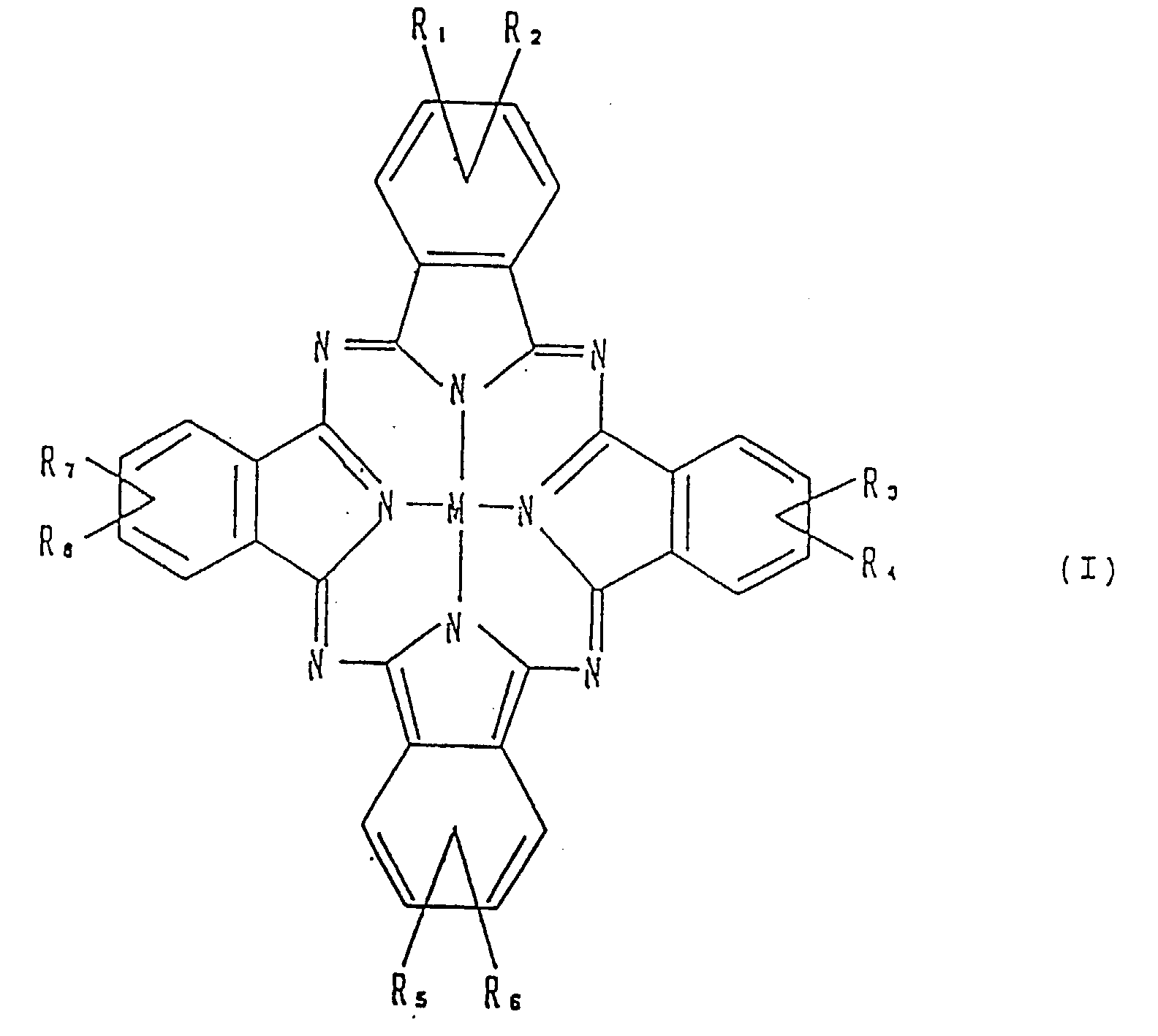
- the present invention provides a nonlinear optical waveguide element which comprises a thin film of an organic non-linear optical material comprising a phthalocyanine derivative of the formula: wherein M is hydrogen, a metal, a metal oxide or a metal halide, each of R 1 to R 8 is hydrogen or an alkyl group, provided that at least one of R 1 to R 8 is an alkyl group.
- the present invention also provides an organic non-linear optical material, which is a mixture of the phthalocyanine derivative of the formula I and an organic polymer.
- Figure 1 is a graph showing the absorption spectra of thin-films formed by spin coating of TBH2Pc ( ⁇ ) and TBVOPc (------).
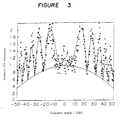
- Figures 2 and 3 are graphs showing the results of measurement of the THG maker fringes of a fused silica substrate and a TBH2Pc thin-film/fused silica substrate, respectively.
- Figure 4 is a graph showing the relation between the contents of the phthalocyanine derivatives [(TBH2Pc( ⁇ ), TBVOPc( ⁇ )] of the present invention in PMMA and the absorption coefficients at a wavelength of the maximum absorbance.
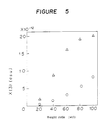
- Figure 5 is a graph showing the relation between the contents of the phthalocyanine derivatives [TBH2Pc( ⁇ ), TBVOPc( ⁇ )] of the present invention in PMMA and the third order nonlinear susceptibility ( ⁇ (3) ).
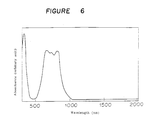
- Figure 6 is a graph showing the absorption spectrum of the polystyrene thin-film containing 10% by weight of (t-Bu) 1 VOPc after the ethyl acetate vapor treatment.
- M representing a metal, a metal oxide or a metal halide
- M include VO, Sn, Pb, GaCl and AlF.
- Each of R 1 to R 8 is hydrogen or an alkyl group, and at least one of R 1 to R 8 is an alkyl group.
- the chain length of the alkyl group for R 1 to R 8 is from 1 to 30 carbon atoms, preferably from 3 to 6 carbon atoms.
- Specific examples of the alkyl group include iso-propyl, iso-butyl, sec-butyl, tert-butyl, iso-amyl, sec-amyl and tert-amyl.
- a phthalocyanine derivative having tert-butyl groups introduced thereinto exhibits the most excellent properties.
- the larger the number of alkyl groups the better the solubility.
- the number of alkyl groups is preferably one or two.
- the phthalocyanine derivative of the present invention can be formed by itself into a cast film from its solution in a usual organic solvent such as chloroform, methylene chloride, acetone or dimethylformamide (DMF). Further, a phthalocyanine derivative having tert-butyl groups introduced thereinto exhibits excellent solubility and dissolves in an organic polymer even at a high content.
- the state in which the phthalocyanine derivative is dissolved in an organic polymer is meant for a state having excellent optical uniformity without light scattering due to aggregation of molecules, which is referred to as "a molecularly doped polymer”.
- the material of the formula I can usually be synthesized by a method disclosed in Inorg. Chem. 20, 3766 (1981). Namely, it can be prepared by mixing an alkylphthalonitrile and/or a dialkylphthalonitrile and phthalonitrile at desired proportions and reacting them with various metal salts at a high temperature of 250°C in a nitrogen stream for a few hours. The product thereby obtained can be dissolved in chloroform or methylene chloride and purified by column chromatography on silica gel. The alkyl phthalonitrile and the dialkylphthalonitrile as the reaction precursors can be obtained by reacting brominated alkyl benzene and dialkyl benzene with CuCN.
- the organic polymer which can be used in combination with the phthalocyanine derivative of the present invention includes, for example, an acrylate polymer such as polymethyl methacrylate, a styrene polymer such as polystyrene, a polyester polymer such as polycarbonate, a polyether polymer such as polyethylene oxide, an amide polymer such as nylon 6, an olefin polymer such as polyethylene, a cellulose polymer such as ethyl cellulose, polyvinyl alcohol, polyvinyl butyral, polyvinyl acetate, polyvinyl chloride, polyvinylidene chloride, polyglycidyl methacrylate, polyvinyl carbazole, and copolymers and mixtures thereof.
- an acrylate polymer such as polymethyl methacrylate
- a styrene polymer such as polystyrene
- a polyester polymer such as polycarbonate
- a polyether polymer such as polyethylene oxide
- polymethyl methacrylate and polycarbonate having excellent transparency may be mentioned.
- the phthalocyanine derivative of the present invention can be formed by itself into a cast film from its solution in a usual organic solvent. However, taking the machanical strength of the resulting film into consideration, it is preferred to incorporate the phthalocyanine derivative in an organic polymer in an amount of from 0.2 to 50% by weight, particularly preferably from 5 to 40% by weight.
- the film may be prepared by a casting method or a spin coating method. Particularly by the spin coating method, it is possible to obtain a thin-film having uniform thickness, since the film-forming is thereby conducted by high speed rotation.
- the present invention may be applied not only to an optical switch device comprising a Fabry-Perot resonator-type modulator, a Mach Zehnder-type interference modulator, a refractive index distribution-type diffraction grating modulator or a directional coupler type modulator, an optical bistable device, or an optical logic device, but also to a frequency up-conversion device.
- the derivative of the present invention also shows an electro-optic effect and can be used for an optical communication device comprising a phase control modulator or an electro-optic grating modulator (Bragg switch and TM-TE converter) using such a function.
- the derivative of the present invention may be incorporated in a photosensitive resin or a photoresist, and by employing a patterning technique by means of lithography, a nonlinear waveguide device or an optical device can be prepared.
- the third order nonlinear optical effect was evaluated by the measurement of the optical third harmonic generation (THG). Namely, the THG Maker fringe method was conducted at a wavelength of 1,907nm.
- the fundamental wavelength (1,064nm) of a Q-switched Nd:YAG laser was converted to 1,907nm by Raman shifting through a high pressure hydrogen cell. The measurement was performed under reduced pressure to avoid the effect of air.
- TBVOPc tetra-tert-buthylvanadylphthalocyanine
- the compound thus obtained was dissolved in chloroform and spin-coated to form a thin film.
- the absorption spectrum of the thin film thus obtained is shown by a dotted line in Figure 1.
- the measurement of the nonlinear optical effect was conducted in the same manner as in EXAMPLE 1, whereby a ⁇ (3) value of 2.0 x 10 -11 (esu) was obtained for TBVOPc.
- Polymethyl methacrylate (PMMA, Mn: 3.1 x 10 4 ) having excellent optical transparency and TBH2Pc or TBVOPc were dissolved in chloroform in various weight ratios, and the solution was spin-coated on a fused silica plate to form a thin film.
- the sample thereby obtained was subjected to the measurement of the absorption spectrum.
- the relation between the absorption coefficient at the maximum absorption wavelength in the visible region and the content exhibits an excellent proportional relation as shown in Figure 4 [TBH2Pc( ⁇ ), TBVOPc( ⁇ )]. Further, since no peak shift was observed due to the difference in the content, it is evident that a thin film having excellent uniformity without aggregation was obtained.
- test sample obtained was subjected to the measurement of the nonlinear optical effect in the same manner as in EXAMPLE 1, whereby the relation between the content of the phthalocyanine derivative and the ⁇ (3) value was a proportional relation as shown in Figure 5 [TBH2Pc( ⁇ ), TBVOPc( ⁇ )].
- phthalocyanine derivative of the present invention it is possible to obtain a desired level of the ⁇ (3) value by changing its content in the organic polymer.
- TBVOPc was dissolved in PMMA so that its content would be 38.8% by weight, and the solution was spin-coated on a fused silica plate to form a thin film.
- the thin film With the thin film, light propagation was conducted with an incident light of 1064nm.
- the guided wave was conducted by a TE mode in accordance with a prism (FD-11) coupling method, and propagation of light was conducted, whereby a mode line was observed. This indicates that this thin-film is useful as a nonlinear waveguide.
- the compound thus obtained was dissolved in polystyrene (manufactured by Aldrich Company, Mw: 2.5 x 10 5 ) to a concentration of 10% by weight, and the solution was spin-coated on a fused silica plate to form a thin film thereon.
- the test sample thus obtained was contacted with a vapor of ethyl acetate in a desiccator at room temperature for 24 hours. This test sample was subjected to measurement of the absorption spectrum, and the results are shown in Figure 6.
- the nonlinear optical effect was measured in the same manner as in EXAMPLE 1, whereby ⁇ (3) of this film was found to be 1.5 x 10 -11 (esu).
Landscapes
- Chemical & Material Sciences (AREA)
- Physics & Mathematics (AREA)
- Organic Chemistry (AREA)
- Nonlinear Science (AREA)
- Chemical Kinetics & Catalysis (AREA)
- Inorganic Chemistry (AREA)
- General Physics & Mathematics (AREA)
- Optics & Photonics (AREA)
- Nitrogen Condensed Heterocyclic Rings (AREA)
- Organic Low-Molecular-Weight Compounds And Preparation Thereof (AREA)
- Compositions Of Macromolecular Compounds (AREA)
Claims (10)
- Elément formant guide d'onde optique non-linéaire qui comprend un film mince en un matériau organique optique non-linéaire comprenant un dérivé de phtalocyanine de formule :dans laquelle M est l'hydrogène, un métal, un oxyde de métal ou un halogénure de métal et R1 à R8 représentent chacun l'hydrogène ou un groupe alkyle, l'un au moins de R1 à R8 étant un groupe alkyle.
- Elément formant guide d'onde non linéaire selon la revendication 1, dans lequel le métal est le Sn ou le Pb.
- Elément formant guide d'onde non linéaire selon la revendication 1, dans lequel l'oxyde de métal est le VO.
- Elément formant guide d'onde non linéaire selon la revendication 1, dans lequel l'halogénure de métal est le GaCl ou l'AlF.
- Elément formant guide d'onde non linéaire selon la revendication 1, dans lequel le groupe alkyle comporte de 1 à 30 atomes de carbone.
- Elément formant guide d'onde non linéaire selon la revendication 5, dans lequel le groupe alkyle comporte de 3 à 6 atomes de carbone.
- Elément formant guide d'onde non linéaire selon la revendication 1, dans lequel le groupe alkyle est au moins un élément sélectionné dans le groupe composé de l'isopropyle, l'isobutyle, le sec.-butyle, le tert.-butyle, l'isoamyle, le sec.-amyle et le tert.-amyle.
- Elément formant guide d'onde non linéaire selon la revendication 1, qui est un mélange d'un dérivé de phtalocyanine de formule I, telle que définie dans la revendication 1, et d'un polymère organique.
- Elément formant guide d'onde non linéaire selon la revendication 8, dans lequel la proportion du dérivé de phtalocyanine est de 0,2% à 50% en poids.
- Elément formant guide d'onde non linéaire selon la revendication 8, dans lequel la proportion du dérivé de phtalocyanine est de 5% à 40% en poids.
Applications Claiming Priority (2)
| Application Number | Priority Date | Filing Date | Title |
|---|---|---|---|
| JP233496/89 | 1989-09-08 | ||
| JP23349689 | 1989-09-08 |
Publications (3)
| Publication Number | Publication Date |
|---|---|
| EP0416632A2 EP0416632A2 (fr) | 1991-03-13 |
| EP0416632A3 EP0416632A3 (en) | 1992-01-02 |
| EP0416632B1 true EP0416632B1 (fr) | 1998-07-29 |
Family
ID=16955932
Family Applications (1)
| Application Number | Title | Priority Date | Filing Date |
|---|---|---|---|
| EP19900117208 Expired - Lifetime EP0416632B1 (fr) | 1989-09-08 | 1990-09-06 | Matériau optique organique non linéaire |
Country Status (3)
| Country | Link |
|---|---|
| EP (1) | EP0416632B1 (fr) |
| JP (1) | JP3133753B2 (fr) |
| DE (1) | DE69032518T2 (fr) |
Families Citing this family (3)
| Publication number | Priority date | Publication date | Assignee | Title |
|---|---|---|---|---|
| EP0676238A3 (fr) * | 1994-04-04 | 1996-05-01 | Sun Co Inc R & M | Catalyseurs contenant ligand métallique pour l'oxydation des alcènes et la décomposition d'hydropéroxides. |
| ES2116867B1 (es) * | 1995-01-24 | 1999-07-01 | Univ Madrid Autonoma | Procedimiento para la preparacion de subftalocianinas con aplicacionescomo materiales opticos no lineales. |
| AU6186500A (en) * | 1999-08-04 | 2001-03-05 | Skc Co., Ltd | Selectively light-absorptive material, coating composition containing the same, and filter manufactured using the coating composition for color displays |
Family Cites Families (2)
| Publication number | Priority date | Publication date | Assignee | Title |
|---|---|---|---|---|
| US4816386A (en) * | 1986-01-13 | 1989-03-28 | Toray Industries, Inc. | Near-infrared sensitive phthalocyanine-polymer compositions |
| US4854676A (en) * | 1988-04-19 | 1989-08-08 | Hoechst Celanese Corp. | Bistable optical devices |
-
1990
- 1990-09-06 DE DE1990632518 patent/DE69032518T2/de not_active Expired - Fee Related
- 1990-09-06 EP EP19900117208 patent/EP0416632B1/fr not_active Expired - Lifetime
- 1990-09-10 JP JP02239793A patent/JP3133753B2/ja not_active Expired - Fee Related
Also Published As
| Publication number | Publication date |
|---|---|
| JP3133753B2 (ja) | 2001-02-13 |
| DE69032518D1 (de) | 1998-09-03 |
| DE69032518T2 (de) | 1999-03-18 |
| EP0416632A3 (en) | 1992-01-02 |
| JPH03179330A (ja) | 1991-08-05 |
| EP0416632A2 (fr) | 1991-03-13 |
Similar Documents
| Publication | Publication Date | Title |
|---|---|---|
| Zotti et al. | Well‐defined pyrrole oligomers: Electrochemical and UV/vis studies | |
| Zhao et al. | Photorefractive polymer with side-chain second-order nonlinear optical and charge-transporting groups | |
| Chan et al. | Rational designs of multifunctional polymers | |
| Yu et al. | Photorefractive polymers. 2. Structure design and property characterization | |
| US5783306A (en) | Hyperpolarizable compounds and devices fabricated therefrom | |
| Guichaoua et al. | UV irradiation induce NLO modulation in photochromic styrylquinoline-based polymers: Computational and experimental studies | |
| US4999139A (en) | Organic nonlinear optical material and nonlinear optical device | |
| Wang et al. | Development of fully functionalized photorefractive polymers | |
| Tao et al. | Synthesis and Characterization of Poly (aryl ether chalcone) s for Second Harmonic Generation | |
| EP0867753B1 (fr) | Matériau organique optiquement non-linéaire et élément optiquement non-linéaire l'utilisant | |
| US4854676A (en) | Bistable optical devices | |
| EP1805150B1 (fr) | Architectures de chromophores heterocycliques | |
| EP0416632A2 (fr) | Matériau optique organique non linéaire | |
| US5224196A (en) | Waveguide device and method for phase matched second harmonic generation | |
| JPH04334343A (ja) | 電気活性化合物、組成物及び装置、並びにこれを製造するための方法 | |
| Sasabe et al. | Molecular design of conjugated systems for nonlinear optics | |
| Yu | Lessons learned from research on photorefractive polymers and molecular materials | |
| Bolink et al. | The role of absorbing nonlinear optical chromophores in photorefractive polymers | |
| Park et al. | Synthesis and characterization of photorefractive polymers with triphenylamine unit and NLO chromophore unit on a side chain | |
| Guichard et al. | Synthesis and characterization of polyoxetanes containing 4‐cyanobiphenyl‐based side groups for nonlinear optical applications, 1. Chemical modification of poly [3, 3‐bis (chloromethyl) oxetane] with sodium 4‐cyano‐4′‐biphenyl oxide | |
| Chang et al. | The effect of laser wavelength on the photorefractive characteristics of PMDA-DR19 based photorefractive polymeric materials | |
| Wada et al. | Metallophthalocyanine: aggregation and nonlinear optics | |
| EP1302808A1 (fr) | Polymères ONL et guides d'ondes basés sur ceux-ci | |
| Sinness | Design and synthesis of functionalizable ProDOT based chromophores for use in electro-optics | |
| KR0163114B1 (ko) | 최적화된 비선형 광학 특성을 가지는 신규한 중합체 |
Legal Events
| Date | Code | Title | Description |
|---|---|---|---|
| PUAI | Public reference made under article 153(3) epc to a published international application that has entered the european phase |
Free format text: ORIGINAL CODE: 0009012 |
|
| AK | Designated contracting states |
Kind code of ref document: A2 Designated state(s): DE FR GB |
|
| PUAL | Search report despatched |
Free format text: ORIGINAL CODE: 0009013 |
|
| AK | Designated contracting states |
Kind code of ref document: A3 Designated state(s): DE FR GB |
|
| 17P | Request for examination filed |
Effective date: 19920414 |
|
| 17Q | First examination report despatched |
Effective date: 19950412 |
|
| GRAG | Despatch of communication of intention to grant |
Free format text: ORIGINAL CODE: EPIDOS AGRA |
|
| GRAG | Despatch of communication of intention to grant |
Free format text: ORIGINAL CODE: EPIDOS AGRA |
|
| GRAH | Despatch of communication of intention to grant a patent |
Free format text: ORIGINAL CODE: EPIDOS IGRA |
|
| GRAH | Despatch of communication of intention to grant a patent |
Free format text: ORIGINAL CODE: EPIDOS IGRA |
|
| GRAA | (expected) grant |
Free format text: ORIGINAL CODE: 0009210 |
|
| AK | Designated contracting states |
Kind code of ref document: B1 Designated state(s): DE FR GB |
|
| PGFP | Annual fee paid to national office [announced via postgrant information from national office to epo] |
Ref country code: GB Payment date: 19980901 Year of fee payment: 9 |
|
| REF | Corresponds to: |
Ref document number: 69032518 Country of ref document: DE Date of ref document: 19980903 |
|
| PGFP | Annual fee paid to national office [announced via postgrant information from national office to epo] |
Ref country code: FR Payment date: 19980909 Year of fee payment: 9 |
|
| PGFP | Annual fee paid to national office [announced via postgrant information from national office to epo] |
Ref country code: DE Payment date: 19980914 Year of fee payment: 9 |
|
| ET | Fr: translation filed | ||
| PLBE | No opposition filed within time limit |
Free format text: ORIGINAL CODE: 0009261 |
|
| STAA | Information on the status of an ep patent application or granted ep patent |
Free format text: STATUS: NO OPPOSITION FILED WITHIN TIME LIMIT |
|
| 26N | No opposition filed | ||
| PG25 | Lapsed in a contracting state [announced via postgrant information from national office to epo] |
Ref country code: GB Free format text: LAPSE BECAUSE OF NON-PAYMENT OF DUE FEES Effective date: 19990906 |
|
| GBPC | Gb: european patent ceased through non-payment of renewal fee |
Effective date: 19990906 |
|
| PG25 | Lapsed in a contracting state [announced via postgrant information from national office to epo] |
Ref country code: FR Free format text: LAPSE BECAUSE OF NON-PAYMENT OF DUE FEES Effective date: 20000531 |
|
| PG25 | Lapsed in a contracting state [announced via postgrant information from national office to epo] |
Ref country code: DE Free format text: LAPSE BECAUSE OF NON-PAYMENT OF DUE FEES Effective date: 20000701 |
|
| REG | Reference to a national code |
Ref country code: FR Ref legal event code: ST |