EP0406124B1 - Polymères chiraux pour la synthèse d'aminoacides énantiomériquement purs - Google Patents
Polymères chiraux pour la synthèse d'aminoacides énantiomériquement purs Download PDFInfo
- Publication number
- EP0406124B1 EP0406124B1 EP90401899A EP90401899A EP0406124B1 EP 0406124 B1 EP0406124 B1 EP 0406124B1 EP 90401899 A EP90401899 A EP 90401899A EP 90401899 A EP90401899 A EP 90401899A EP 0406124 B1 EP0406124 B1 EP 0406124B1
- Authority
- EP
- European Patent Office
- Prior art keywords
- chiral
- asymmetric synthesis
- polymer
- unit
- synthesis process
- Prior art date
- Legal status (The legal status is an assumption and is not a legal conclusion. Google has not performed a legal analysis and makes no representation as to the accuracy of the status listed.)
- Expired - Lifetime
Links
Classifications
-
- C—CHEMISTRY; METALLURGY
- C08—ORGANIC MACROMOLECULAR COMPOUNDS; THEIR PREPARATION OR CHEMICAL WORKING-UP; COMPOSITIONS BASED THEREON
- C08F—MACROMOLECULAR COMPOUNDS OBTAINED BY REACTIONS ONLY INVOLVING CARBON-TO-CARBON UNSATURATED BONDS
- C08F246/00—Copolymers in which the nature of only the monomers in minority is defined
Definitions
- the present invention relates to chiral polymers allowing asymmetric synthesis on amino acid support as well as new ones processes for the synthesis of enantiomerically pure friend acids.
- Another strategy is to use a chiral polyacrylic support causing asymmetric supramolecular induction (CALMES, DAUNIS, JACQUIER, NKUSI, VERDUCCI and VIALLEFONT, Tetrahedron Letters, 1986, 27 , 4303).
- one of the aims of the present invention is to provide a family of polymers that can be used to reverse or move from one enantiomer to another.
- one of the aims of the present invention is to provide a synthesis or deracemization process using the above polymers
- the chiral motif represents, expressed in moles, a large percentage which varies according to the chemical characteristics of the chiral motif.
- the chiral motif does not present sites likely to make connections of intramolecular hydrogen with another chiral motif it's desirable that the chiral motif represents at least 2/3 advantageously 70% of all of the patterns, preferably 3/4.
- the percentage can be significantly lower. It is however preferable that at least 1/2 preferably 2/3 of the patterns are chiral.
- the most suitable chiral motif is a pattern obtainable by polymerization of chiral monomers with unsaturation.
- the attachment of the chiral derivatives with the acrylic radical can be produced by means of an amide function (for example with amino acids or their derivatives such as for example amides and esters) or of a ester function. It can also be carried out by any known technique skilled in the art, for example we can graft groups vinyls on the aromatic nuclei of chiral derivatives which have them such as for example the phenylalanine derivatives of tryptophan, and the adrenaline derivatives and the like.
- the chiral monomer can also be obtained by systems reciprocal clashes, such as for example the manufacture of esters enol from optically active acids such as amino acids or enol ether from alcohol having an acitf group. It is also possible to use compounds having carbons asymmetrical and a polymerizable double bond, after possible optical splitting.
- the double bond is close to asymmetric carbon, more specifically it is preferable that the number of atoms between the double bond and the chiral center is at most 5, preferably 3 at best 2.
- the chiral motif advantageously has at least one hydrogen-carrying function capable of forming hydrogen bonds with another chiral motif of the same nature.
- the functions there may be mentioned the acid functions, the functions alcohols including phenols, amide functions, amine functions.
- the chiral monomer generating the chiral motif is of low molecular weight, that is to say advantageously at most equal to 200, preferably at most equal to 150 about.
- the functionalization reason can be any reason carrying functions protection as defined in works well known to man of profession such as the work of Théodora W. Greene "Protective Groups in Organic Synthesis" published by John WILLEY and SONS, 1981, and that of J.F.W. McOmie, "Protective Groups in Organic Chemistry” published by PLENUM PRESS, LONDON AND NEW YORK, 1973.
- the protecting groups can be transformed into monomers giving patterns of functionalization in the same way, mutatis mutandis that in the case of monomers and chiral units. So we can use as a monomer generating the functionalization patterns of the groups anilides transformed into acrylanilides carrying the said groupings protectors as defined above.
- the protective groups giving the best results mention may be made of amino derivatives benzaldehydes which are particularly useful during synthesis or deracemization of (primary) amino derivatives such as amino acids.
- acryloylated derivatives including methacryoylated derivatives derived from the amidation by acrylic acids of the following derivatives: CH 3 -NH-C (R 1 ) (R 2 ) -CHO with R 1 or R 2 aryl or aralkyl.
- the functionalization patterns are patterns from the polymerization of chiral patterns of the above type but onto which the envisaged protection function would have been grafted.
- the polymer according to the present The invention also includes crosslinking patterns. These patterns of crosslinking are derived from monomers generally carrying 2 unsaturations. These monomers are well known to those skilled in the art in the field of polymers. It is in particular possible to use di esters or di amides of acrylic acids obtained by the action of acrylic reactants on di alcohols or di amides.
- the different monomers are chosen according to well-known techniques for a person skilled in the art so as to be compatible with a view to polymerization harmonious. Polymerization is not the only criterion, it should also that the monomers do not interact with each other from the point of view chemical.
- the mole percentage of the crosslinking agent is advantageously between 0 and 20% of the chiral motif, preferably 5 to 15. The functionalization motif constituting the remainder of this polymer functionalized chiral.
- Chiral monomer sequences can be inserted into a polymer not chiral.
- the different monomers are chosen in such a way that the mass ratios, compatible with the given molar ratios previously, are advantageously between 50 and 65% for the reason chiral, between 5 and 15% by weight for the crosslinking pattern, between 40 to 25% for the reason for functionalization.
- the chiral polymers according to the present invention allow the synthesis asymmetric, deracemization and optical inversion.
- the optical isomer obtained depends on the choice of the R or S form of the chiral monomer.
- amides such as lithium diisopropyl amide or lithium tetramethyl piperide, lithium salt of hexamethyldisilazane, anions derived from alkanes such as butyllithium and alcoholates such as tertiary butylate potassium. This list is not exhaustive.
- the protonation of the deprotonated derivative linked to the chiral polymer by addition of water, an alcohol or a mineral acid or organic.
- the deprotonated derivative linked to the chiral polymer is reacted with the halide R 3 X, for 1 h to 4 h.
- one or the other of the two enantiomers of an amino acid, with an excess enantiomer greater than 95% we choose, according to the enantiomer desired, the chiral polymer containing one of the two R or S isomers of N-acryloyl prolinol.
- the process according to the present invention can be performed entirely at room temperature, and is even surprisingly possible to improve the result by a step of heating at moderate temperature, of the order of 60 to 70 ° C.
- the asymmetric synthesis of amino acids on a support is performed at a temperature above 0 ° C.
- the derivative linked to the polymer is heated to reflux of tetrahydrofuran (67 ° C), at the end of the first stage, during a duration of 15 min to 4 h.
- the enantiomeric excesses are determined either by measurement of the rotary powers, or preferably using the Marfey reagent (Carlsberg Res. Comm., 1984, 49 , 591) which allows the separation of the diastereoisomers by reverse phase HPLC with excellent precision.
- the charge measured by approximation, is 1.1 meq CHO per gram.
- Example 2 The same amounts of the three monomers used in Example 1 are dissolved in a 1: 1 mixture of alcohol and water. After degassing with a sonicator, a stream of nitrogen is bubbled for 15 minutes. Then adding a solution of 0.3 g of ammonium persulfate in 1 ml of water, then after homogenization 0.3 ml of tetramethylethylenediamine. The mixture is homogenized and, after a few minutes, the temperature rises from 4 to 7 ° C. We leave 1 hour, filter, wash with acetone and alcohol. The resin is suspended in ether and operates as in Example 1. Yield 90-95% after sieving. Load identical to that of Example 1.
- paraffin oil 400 ml
- SPAN 85 Fluka 0.3 ml
- paraffin oil 400 ml
- SPAN 85 Fluka 0.3 ml
- a strong stream of nitrogen is bubbled for 30 minutes before the introduction of N-acryloyl (R) or (S) prolinol (0.12 mole), bis-acryloyl N, N'-dimethylethylenediamine (0.013 mole) and of N-acryloyl N-methyl p-aminobenzaldehyde (0.035 mol) diluted in water (110 ml) and ethanol or dimethylformamide (110 ml).
- a suspension of the above resin in 200 ml of hydrochloric acid 1.5 N is stirred for 4 h at room temperature. Filter, wash with 200 ml of water, the filtrates are joined and concentrated in vacuo until dry.
- amino acid hydrochloride residue is stirred for 1 hour with 10 ml of hexamethyldisilazane. Filter the insoluble material, add 20 ml to the filtrate methanol; after 10 min, the solvent is evaporated and the residue of (R) -alanine under vacuum. Yield 95-97%; enantiomeric excess (determined by polarimetry) 96-98%.
- the recovered resin can be recycled after drying.
- Example 4 The same operation as in Example 4 is carried out with a polymer prepared from (R) -prolinol. (S) -alanine is obtained with the same chemical yield and the same enantioselectivity.
- Example 8 Same procedure as in Example 8 using a copolymer prepared from (R) -prolinol. We isolate under these conditions the (R) -alanine with the same yield and the same enantioselectivity as in Example 8.
- Example 8 The same operation as in Example 8 is carried out, but in replacing methyl iodide with isopropyl iodide.
- Example 8 The same operation as in Example 8 is carried out, but in replacing methyl iodide with benzyl bromide. We isolate the (S) -phenylalinine with a yield of 95-97% and an ee> 99%.
Landscapes
- Chemical & Material Sciences (AREA)
- Health & Medical Sciences (AREA)
- Chemical Kinetics & Catalysis (AREA)
- Medicinal Chemistry (AREA)
- Polymers & Plastics (AREA)
- Organic Chemistry (AREA)
- Organic Low-Molecular-Weight Compounds And Preparation Thereof (AREA)
- Addition Polymer Or Copolymer, Post-Treatments, Or Chemical Modifications (AREA)
Description
- un motif chiral
- un motif de fonctionnalisation
- un motif optionnel de réticulation
- Les monomères obtenus par amidification ou esterification des acides acryliques, éventuellement substitués, au moyen de molécules optiquement actives dont avantageusement le carbone asymetrique est bien dégagé comme dans le cas où le carbone actif est engagé dans un cycle.
- le prolinol, et éventuellement ses dérivés sous forme d'esters ou d'éthers de la fonction alcool,
- les amino-1-phényl-1-éthane notamment le N-méthyl-amino-1-phényl-1-éthane,
- le N-alkyle-amino-1 alcoxy-2 propane dans lesquels les groupements alkyles ou alcoxy peuvent représenter des alkyles linéaires ou ramifiés de préférence un méthyl ou un hydrogène,
- la pyrolidin-1-yl-2-méthyl-pyrolidine,
- l'amino-1 alkyle-1 hydroxy-2 éthane et ses dérivés de mono ou di méthylation sur l'azote et sur l'alcool. Le dérivé di substitué sur l'azote étant bien sûr exclus car non susceptible de former une liaison amide avec le groupement acroyle (toutefois il pourrait être utilisé si on utilise comme monomère chiral un ester acrylique).
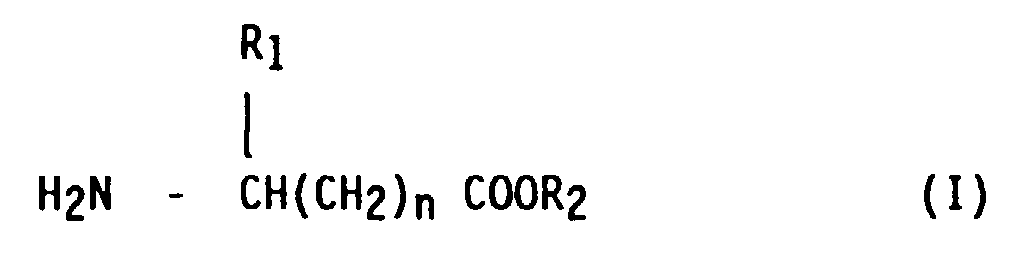
- dans une première étape, le dérivé lié au polymère chiral est déprotoné par une base forte dans un solvant de préférence aprotique, de préférence polaire, tel que par exemple le tétrahydrofuranne ;
- dans une deuxième étape, on procède soit à l'alkylation soit à la protonation du dérivé déprotoné lié au polymère chiral, de façon à créer ou recréer un carbone asymétrique sur ledit dérivé, et,
- dans une troisième étape, on hydrolyse la base de Schiff pour obtenir un acide ami né de formule générale :

- où R1 et n sont tels que définis plus haut, et
- R3 représente un groupe alkyle ou aralkyle,
- R1 et R3 devant être différents.
Z-(CH2)n-
dans lequel n = 1 à 4

- dans des réactions d'aldolisation et de cétolisation avec R6 CHO (R6 = alkyle, aryle ou aralkyle) et avec des cétones aliphatiques ou arylaliphatiques,
- dans des réactions d'addition-1-4, avec des esters acryliques, l'acrylonitrile ou l'acroléine.
On abandonne 1 h, filtre, lave à l'acétone et à l'alcool. On met la résine en suspension dans l'éther et opère comme dans l'exemple 1. Rendement 90-95 % après tamisage. Charge identique à celle de l'exemple 1.
Claims (17)
- Polymère comportant :caractérisé par le fait que ledit motif chiral présente des sites susceptibles de former des liaisons hydrogènes avec un autre motif chiral et par le fait qu'au moins la moitié des motifs, exprimé en mole, sont des motifs chiraux.un motif chiral;un motif de fonctionnalisation ;un motif optionnel de réticulation ;
- Polymère selon la revendication 1 caractérisé par le fait qu'il est susceptibles d'être obtenu par copolymérisation radicalaire d'un monomère ou d'un oligomère ou d'un prépolymère chiral, d'un agent de fontionnalisation, et de préférence d'un agent de réticulation.
- Polymère selon l'une des revendications 1 et 2 caractérisé par le fait que ledit motif chiral représente, exprimé en mole, un pourcentage au moins égal à 2/3.
- Polymère selon l'une des revendications 1 à 3 pris séparément caractérisé par le fait qu'il est susceptible d'être obtenu par copolymérisation radicalaire d'un monomère chiral, d'un agent de réticulation et d'un agent de fonctionnalisation, caractérisé par le fait que :le monomère chiral est constitué par le N-acryloyl prolinol, soit sous la forme R, soit sous la forme S ;l'agent de réticulation est constitué par la bis-acryloyl-N, N' diméthyléthylènediamine ou par la bis-acryloyl piperazine ;l'agent de fonctionnalisation est constitué par la para-N-acryloyl-N-méthyl amino benzaldéhyde, et dans lequel un seul ou plusieurs des groupes acryloyles est éventuellement remplacé, soit dans la malle chirale, soit dans l'agent de fonctionnalisation, soit dans l'agent de réticulation, par un groupe méthacryloyle.
- Procédé de synthèse asymétrique, caractérisé par le fait qu'il consiste à greffer un composé prochiral sur un support polymérique constitué au moins par une séquence d'un polymère comportant :et à réaliser la réaction à une température supérieure à 0°C.un motif chiralun motif de fonctionnalisationun motif optionnel de réticulation
- Procédé de synthèse asymétrique selon la revendication 5 caractérisé par le fait que ledit motif chiral représente , exprimé en mole, au moins 2/3.
- Procédé de synthèse asymétrique selon la revendication 5, caractérisé par le fait que lorsque le motif chiral ne présente pas des sites susceptibles de faire des liaisons d'hydrogène intramoléculaires avec un autre motif chiral, ledit motif chiral représente, exprimé en mole, un pourcentage au moins égal à 70 %, avantageusement à 3/4.
- Procédé de synthèse asymétrique selon les revendications 5 à 7, caractérisé par le fait que la synthèse asymétrique est effectuée à une température égale à l'ambiante et/ou une température obtenue par chauffage modéré.
- Procédé de synthèse asymétrique selon les revendications 5 à 8, caractérisé par le fait que la synthèse asymétrique est effectuée à température de reflux du tétrahydrofuranne, à la fin de la première étape, pendant une durée de 15 mn à 4 h.
- Procédé selon les revendications 5 à 9, caractérisé par le fait que ledit composé prochiral greffé sur un support polymérique est un compose optiquement actif et par le fait que la synthèse asymétrique est une inversion, ou le composé ainsi formé est soumis à un réactif connu pour inverser une configuration.
- Procéde selon les revendications 5 à 9, caractérisé par le fait que ledit composé prochiral greffé sur un support polymérique est un composé au moins partiellement racémique et par le fait que la synthèse asymétrique est une déracémisation ou le composé ainsi formé est soumis à un réactif connu pour racémiser une configuration.
- Procédé de synthèse asymétrique selon les revendications 5 à 11, caractérisé par le fait qu'il s'agit d'une synthèse asymétrique d'acides aminés et par le fait que consiste à partir d'un dérivé prochiral de formule générale :dans lequel n est égal à 0 ou 1,
 R1 représente un atome d'hydrogène, un groupe alkyle ou aralkyle, etR2 représente un groupe alkyle en C1 à C5 linéaire ou ramifié ou un groupe aryle, lequel dérivé est réversiblement ancré par formation d'une base de Schiff sur ledit polymère chiral et en ce que :dans une première étape, le dérivé lié au polymère chiral est déprotoné à température ambiante par une base forte dans un solvant aprotique de préférence le tétrahydrofuranne ;dans une deuxième étape, on procède, soit à l'alkylation, soit à la protonation du dérivé déprotoné lié au polymère chiral, de façon à créer un carbone asymétrique sur ledit dérivé et,dans une troisième étape, on hydrolyse la base de Schiff pour obtenir un acide aminé de formule générale :
 où R1 et n sont tels que définis plus haut,R3 représente un groupe alkyle ou aralkyle,R1 et R3 devant être différents.
 - Procédé de synthèse asymétrique sur support, d'acides aminés, selon la revendication 12, caractérisé par le fait que l'on procède à la protonation du dérivé déprotoné lié au polymère chiral, par addition d'eau, d'un alcool ou d'un acide minéral ou organique.
- Procédé de synthèse asymétrique sur support, d'acides aminés, selon la revendication 12, caractérisé par le fait que l'on procède à l'alkylation du dérivé déprotoné lié au polymère chiral, par un halogénure de formule générale R3 X, où X représente Cl, Br, ou I, et R3 représente un groupe alkyle ou aralkyle.
- Procédé de synthèse asymétrique sur support, d'acides aminés, selon la revendication 12, caractérisé par le fait que l'on procède à l'alkylation du dérivé déprotoné lié au polymère chiral, par des réactions d'addition-1-4, avec des esters acryliques, l'acrylonitrile ou l'acroléine..
- Procédé de synthèse asymétrique sur support, selon la revendication 14, caractérisé par le fait que R3 dans R3-X est un groupe fonctionnalisé du type :
Z-(CH2)n-
dans lequel :n = 1 à 4;Z = I, CN, CO2R4 (R4 = alkyle), OR5 (R5 = CH3 tosyle, tétrahydropyranyle), Y-NH (Y = benzyloxycarbonyle, t-butyloxycarbonyle), R4S,
- Procédé de synthèse asymétrique sur support, d'acides aminés, selon la revendication 12, caractérisé par le fait que l'on procède à l'alkylation du dérivé déprotoné lié au polymère chiral,par aldolisation ou cétolisation avec respectivement un aldéhyde de formule R6 CHO (R6 = alkyle, aryle ou aralkyle) et avec une cétone aliphatique ou arylaliphatique.
Applications Claiming Priority (2)
| Application Number | Priority Date | Filing Date | Title |
|---|---|---|---|
| FR8908679 | 1989-06-29 | ||
| FR8908679A FR2649098A1 (fr) | 1989-06-29 | 1989-06-29 | Polymeres chiraux pour la synthese d'aminoacides enantiomeriquement purs |
Publications (2)
| Publication Number | Publication Date |
|---|---|
| EP0406124A1 EP0406124A1 (fr) | 1991-01-02 |
| EP0406124B1 true EP0406124B1 (fr) | 1999-11-24 |
Family
ID=9383253
Family Applications (1)
| Application Number | Title | Priority Date | Filing Date |
|---|---|---|---|
| EP90401899A Expired - Lifetime EP0406124B1 (fr) | 1989-06-29 | 1990-06-29 | Polymères chiraux pour la synthèse d'aminoacides énantiomériquement purs |
Country Status (8)
| Country | Link |
|---|---|
| EP (1) | EP0406124B1 (fr) |
| AT (1) | ATE186920T1 (fr) |
| AU (1) | AU5967990A (fr) |
| DE (1) | DE69033361T2 (fr) |
| ES (1) | ES2138580T3 (fr) |
| FR (1) | FR2649098A1 (fr) |
| IE (1) | IE902395A1 (fr) |
| WO (1) | WO1991000303A1 (fr) |
Families Citing this family (4)
| Publication number | Priority date | Publication date | Assignee | Title |
|---|---|---|---|---|
| FR2671089A1 (fr) * | 1990-12-27 | 1992-07-03 | Rhone Poulenc Sante | Polymeres chiraux, leur preparation et leur emploi pour la preparation d'acides aryl-2 propioniques optiquement actifs. |
| US5391634A (en) * | 1993-05-26 | 1995-02-21 | The Dow Chemical Company | Optically-active, amphiphilic, water-soluble free-radical addition copolymers and their use in the resolution of racemic mixtures |
| WO2002046157A2 (fr) | 2000-12-04 | 2002-06-13 | Sepracor, Inc. | Procedes de synthese stereoselective de piperidines substituees |
| FR2875498B1 (fr) * | 2004-09-22 | 2006-12-01 | Centre Nat Rech Scient Cnrse | Procede pour l'inversion partielle ou totale de la configuration d'une amine |
Family Cites Families (2)
| Publication number | Priority date | Publication date | Assignee | Title |
|---|---|---|---|---|
| DE3143726C2 (de) * | 1981-11-04 | 1987-02-05 | Degussa Ag, 6000 Frankfurt | Optisch aktive Prolin-Derivate, Verfahren zu ihrer Herstellung und ihre Verwendung |
| JPH07116064B2 (ja) * | 1987-07-21 | 1995-12-13 | 三菱化学株式会社 | 分離剤 |
-
1989
- 1989-06-29 FR FR8908679A patent/FR2649098A1/fr active Pending
-
1990
- 1990-06-29 ES ES90401899T patent/ES2138580T3/es not_active Expired - Lifetime
- 1990-06-29 WO PCT/FR1990/000491 patent/WO1991000303A1/fr not_active Ceased
- 1990-06-29 IE IE239590A patent/IE902395A1/en unknown
- 1990-06-29 AU AU59679/90A patent/AU5967990A/en not_active Abandoned
- 1990-06-29 DE DE69033361T patent/DE69033361T2/de not_active Expired - Fee Related
- 1990-06-29 AT AT90401899T patent/ATE186920T1/de not_active IP Right Cessation
- 1990-06-29 EP EP90401899A patent/EP0406124B1/fr not_active Expired - Lifetime
Also Published As
| Publication number | Publication date |
|---|---|
| ES2138580T3 (es) | 2000-01-16 |
| IE902395A1 (en) | 1991-06-19 |
| ATE186920T1 (de) | 1999-12-15 |
| IE902395L (en) | 1990-12-29 |
| EP0406124A1 (fr) | 1991-01-02 |
| DE69033361T2 (de) | 2000-06-29 |
| DE69033361D1 (de) | 1999-12-30 |
| AU5967990A (en) | 1991-01-17 |
| FR2649098A1 (fr) | 1991-01-04 |
| WO1991000303A1 (fr) | 1991-01-10 |
Similar Documents
| Publication | Publication Date | Title |
|---|---|---|
| FR2482112A1 (fr) | Nouveaux copolymeres hydrophiles a base de n-(tris (hydroxymethyl) methyl) acrylamide, procedes pour leur preparation, gels aqueux desdits copolymeres et leur utilisation comme echangeurs d'ions | |
| EP2157106A1 (fr) | Matériau polymère contenant des chaines portant des fonctions imidazolidone | |
| FR2933695A1 (fr) | Procede de synthese de l'acide amino-9-nonanoique ou de ses esters a partir d'acides gras naturels insatures. | |
| BE897694A (fr) | Composition d'initiateur de photopolymerisation de grande sensibilite | |
| FR2534579A1 (fr) | Procede pour la resolution optique de l'acide a-2-hydroxy-3(4-methoxyphenyl)-3-(2-aminophenylthio) propionique dl | |
| EP2935378B1 (fr) | Nouveau procédé de préparation de polymères thermo-épaississants | |
| EP0334715B1 (fr) | Procédé de fabrication de résine vinylaromatique choc directement à partir de butadiène | |
| EP0406124A1 (fr) | Polymères chiraux pour la synthèse d'aminoacides énantiomériquement purs | |
| EP3177667B1 (fr) | Polymere dote de proprietes d'adherence | |
| CA1067911A (fr) | Procede de preparation de monomeres acryliques destines a la fabrication de floculants cationiques | |
| CN1119317C (zh) | 一种使旋光性1-苯基乙胺衍生物消旋的方法 | |
| JPH1095759A (ja) | 面性キラル又は軸性キラル末端基を有する樹枝状窒素含有有機化合物、その製造法及び使用法 | |
| US6538105B1 (en) | Catalysts for the enantioselective epoxidation of C═C double bonds | |
| US5280093A (en) | Chiral polymers for the synthesis of pure enantiomers of amino acids | |
| EP1140794B1 (fr) | Nouveau procede de preparation d'aminoacides chiraux | |
| EP0510168B1 (fr) | Procede de dedoublement d'hydantoines chirales | |
| EP0301932B1 (fr) | Matériau polymère insoluble à sites réactifs condensés, notamment du type groupe anhydride ou ester actif, procédé de préparation de ce matériau polymère et application de ce matériau | |
| EP2861640A1 (fr) | Nouveau copolymère en peigne et procédé pour sa préparation | |
| CH405716A (fr) | Procédé pour la préparation de poly(aminostyrène) | |
| FR2663926A1 (fr) | Nouveaux cycles acrylates a fonction alcool, aldehyde et/ou ether, leur procede de fabrication et leur application a l'obtention de nouveaux polymeres et copolymeres. | |
| FR2459254A1 (fr) | Azomethines polymeres | |
| BE1005988A3 (fr) | Procede de chloromethylation de composes organiques aromatiques. | |
| WO2008125787A1 (fr) | Procede de preparation d'un catalyseur et son utilisation dans un procede en continu de transesterification d'esters (meth)acryliques | |
| FR2671089A1 (fr) | Polymeres chiraux, leur preparation et leur emploi pour la preparation d'acides aryl-2 propioniques optiquement actifs. | |
| RU2301262C1 (ru) | Способ получения оптически активного полианилина |
Legal Events
| Date | Code | Title | Description |
|---|---|---|---|
| PUAI | Public reference made under article 153(3) epc to a published international application that has entered the european phase |
Free format text: ORIGINAL CODE: 0009012 |
|
| AK | Designated contracting states |
Kind code of ref document: A1 Designated state(s): AT BE CH DE DK ES FR GB GR IT LI LU NL SE |
|
| 17P | Request for examination filed |
Effective date: 19910319 |
|
| 17Q | First examination report despatched |
Effective date: 19920918 |
|
| RAP1 | Party data changed (applicant data changed or rights of an application transferred) |
Owner name: RHODIA CHIMIE |
|
| GRAG | Despatch of communication of intention to grant |
Free format text: ORIGINAL CODE: EPIDOS AGRA |
|
| GRAG | Despatch of communication of intention to grant |
Free format text: ORIGINAL CODE: EPIDOS AGRA |
|
| GRAH | Despatch of communication of intention to grant a patent |
Free format text: ORIGINAL CODE: EPIDOS IGRA |
|
| GRAH | Despatch of communication of intention to grant a patent |
Free format text: ORIGINAL CODE: EPIDOS IGRA |
|
| GRAA | (expected) grant |
Free format text: ORIGINAL CODE: 0009210 |
|
| AK | Designated contracting states |
Kind code of ref document: B1 Designated state(s): AT BE CH DE DK ES FR GB GR IT LI LU NL SE |
|
| ITF | It: translation for a ep patent filed | ||
| PG25 | Lapsed in a contracting state [announced via postgrant information from national office to epo] |
Ref country code: GR Free format text: LAPSE BECAUSE OF NON-PAYMENT OF DUE FEES Effective date: 19991124 Ref country code: SE Free format text: THE PATENT HAS BEEN ANNULLED BY A DECISION OF A NATIONAL AUTHORITY Effective date: 19991124 |
|
| REF | Corresponds to: |
Ref document number: 186920 Country of ref document: AT Date of ref document: 19991215 Kind code of ref document: T |
|
| REG | Reference to a national code |
Ref country code: CH Ref legal event code: EP |
|
| REF | Corresponds to: |
Ref document number: 69033361 Country of ref document: DE Date of ref document: 19991230 |
|
| REG | Reference to a national code |
Ref country code: CH Ref legal event code: NV Representative=s name: KIRKER & CIE SA |
|
| REG | Reference to a national code |
Ref country code: ES Ref legal event code: FG2A Ref document number: 2138580 Country of ref document: ES Kind code of ref document: T3 |
|
| PG25 | Lapsed in a contracting state [announced via postgrant information from national office to epo] |
Ref country code: DK Free format text: LAPSE BECAUSE OF FAILURE TO SUBMIT A TRANSLATION OF THE DESCRIPTION OR TO PAY THE FEE WITHIN THE PRESCRIBED TIME-LIMIT Effective date: 20000224 |
|
| GBT | Gb: translation of ep patent filed (gb section 77(6)(a)/1977) |
Effective date: 20000216 |
|
| PG25 | Lapsed in a contracting state [announced via postgrant information from national office to epo] |
Ref country code: LU Free format text: LAPSE BECAUSE OF NON-PAYMENT OF DUE FEES Effective date: 20000629 |
|
| PLBE | No opposition filed within time limit |
Free format text: ORIGINAL CODE: 0009261 |
|
| STAA | Information on the status of an ep patent application or granted ep patent |
Free format text: STATUS: NO OPPOSITION FILED WITHIN TIME LIMIT |
|
| 26N | No opposition filed | ||
| REG | Reference to a national code |
Ref country code: GB Ref legal event code: IF02 |
|
| PGFP | Annual fee paid to national office [announced via postgrant information from national office to epo] |
Ref country code: NL Payment date: 20060604 Year of fee payment: 17 |
|
| PGFP | Annual fee paid to national office [announced via postgrant information from national office to epo] |
Ref country code: FR Payment date: 20060608 Year of fee payment: 17 |
|
| PGFP | Annual fee paid to national office [announced via postgrant information from national office to epo] |
Ref country code: AT Payment date: 20060613 Year of fee payment: 17 |
|
| PGFP | Annual fee paid to national office [announced via postgrant information from national office to epo] |
Ref country code: DE Payment date: 20060622 Year of fee payment: 17 |
|
| PGFP | Annual fee paid to national office [announced via postgrant information from national office to epo] |
Ref country code: ES Payment date: 20060623 Year of fee payment: 17 |
|
| PGFP | Annual fee paid to national office [announced via postgrant information from national office to epo] |
Ref country code: GB Payment date: 20060628 Year of fee payment: 17 Ref country code: CH Payment date: 20060628 Year of fee payment: 17 |
|
| PGFP | Annual fee paid to national office [announced via postgrant information from national office to epo] |
Ref country code: IT Payment date: 20060630 Year of fee payment: 17 |
|
| PGFP | Annual fee paid to national office [announced via postgrant information from national office to epo] |
Ref country code: BE Payment date: 20060816 Year of fee payment: 17 |
|
| BERE | Be: lapsed |
Owner name: *RHODIA CHIMIE Effective date: 20070630 |
|
| REG | Reference to a national code |
Ref country code: CH Ref legal event code: PL |
|
| GBPC | Gb: european patent ceased through non-payment of renewal fee |
Effective date: 20070629 |
|
| PG25 | Lapsed in a contracting state [announced via postgrant information from national office to epo] |
Ref country code: AT Free format text: LAPSE BECAUSE OF NON-PAYMENT OF DUE FEES Effective date: 20070629 |
|
| NLV4 | Nl: lapsed or anulled due to non-payment of the annual fee |
Effective date: 20080101 |
|
| PG25 | Lapsed in a contracting state [announced via postgrant information from national office to epo] |
Ref country code: BE Free format text: LAPSE BECAUSE OF NON-PAYMENT OF DUE FEES Effective date: 20070630 |
|
| REG | Reference to a national code |
Ref country code: FR Ref legal event code: ST Effective date: 20080229 |
|
| PG25 | Lapsed in a contracting state [announced via postgrant information from national office to epo] |
Ref country code: CH Free format text: LAPSE BECAUSE OF NON-PAYMENT OF DUE FEES Effective date: 20070630 Ref country code: DE Free format text: LAPSE BECAUSE OF NON-PAYMENT OF DUE FEES Effective date: 20080101 Ref country code: NL Free format text: LAPSE BECAUSE OF NON-PAYMENT OF DUE FEES Effective date: 20080101 Ref country code: LI Free format text: LAPSE BECAUSE OF NON-PAYMENT OF DUE FEES Effective date: 20070630 |
|
| PG25 | Lapsed in a contracting state [announced via postgrant information from national office to epo] |
Ref country code: GB Free format text: LAPSE BECAUSE OF NON-PAYMENT OF DUE FEES Effective date: 20070629 |
|
| REG | Reference to a national code |
Ref country code: ES Ref legal event code: FD2A Effective date: 20070630 |
|
| PG25 | Lapsed in a contracting state [announced via postgrant information from national office to epo] |
Ref country code: FR Free format text: LAPSE BECAUSE OF NON-PAYMENT OF DUE FEES Effective date: 20070702 |
|
| PG25 | Lapsed in a contracting state [announced via postgrant information from national office to epo] |
Ref country code: ES Free format text: LAPSE BECAUSE OF NON-PAYMENT OF DUE FEES Effective date: 20070630 |
|
| PG25 | Lapsed in a contracting state [announced via postgrant information from national office to epo] |
Ref country code: IT Free format text: LAPSE BECAUSE OF NON-PAYMENT OF DUE FEES Effective date: 20070629 |