EP0403274A1 - Semi-custom integrated circuit device - Google Patents
Semi-custom integrated circuit device Download PDFInfo
- Publication number
- EP0403274A1 EP0403274A1 EP90306479A EP90306479A EP0403274A1 EP 0403274 A1 EP0403274 A1 EP 0403274A1 EP 90306479 A EP90306479 A EP 90306479A EP 90306479 A EP90306479 A EP 90306479A EP 0403274 A1 EP0403274 A1 EP 0403274A1
- Authority
- EP
- European Patent Office
- Prior art keywords
- unit
- transistor
- resistor
- capacitor
- type region
- Prior art date
- Legal status (The legal status is an assumption and is not a legal conclusion. Google has not performed a legal analysis and makes no representation as to the accuracy of the status listed.)
- Granted
Links
Images




Classifications
-
- H—ELECTRICITY
- H10—SEMICONDUCTOR DEVICES; ELECTRIC SOLID-STATE DEVICES NOT OTHERWISE PROVIDED FOR
- H10D—INORGANIC ELECTRIC SEMICONDUCTOR DEVICES
- H10D84/00—Integrated devices formed in or on semiconductor substrates that comprise only semiconducting layers, e.g. on Si wafers or on GaAs-on-Si wafers
- H10D84/90—Masterslice integrated circuits
- H10D84/903—Masterslice integrated circuits comprising field effect technology
- H10D84/907—CMOS gate arrays
-
- H—ELECTRICITY
- H10—SEMICONDUCTOR DEVICES; ELECTRIC SOLID-STATE DEVICES NOT OTHERWISE PROVIDED FOR
- H10D—INORGANIC ELECTRIC SEMICONDUCTOR DEVICES
- H10D84/00—Integrated devices formed in or on semiconductor substrates that comprise only semiconducting layers, e.g. on Si wafers or on GaAs-on-Si wafers
- H10D84/90—Masterslice integrated circuits
Definitions
- the present invention relates to a semi-custom integrated circuit apparatus capable of discretionally forming a gate array of a digital circuit (logic circuit), a gate array of an analog circuit, or a gate array on which a digital circuit and an analog circuit are mixed.
- a gate array on which a logic circuit is provided forms the main current. Furthermore, in a recently developed device, a gate array on which an analog circuit is provided has both a digital circuit and an analog circuit formed on the gate array.
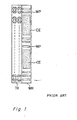
- Figure 1 represents a plan view of a main part of a cell array in a semi-custom IC disclosed in this Japanese Patent Disclosure.
- TR represents a transistor region, WR a wiring region, WP a wiring poly-silicon film and CE a capacitor poly-silicon film.
- respective cells In a semi-custom integrated circuit, respective cells must have a rectangular shape to enable the arrangement and wiring to be designed by a computer. Respective regions with a bulk form are fixed. Only the wiring is changed to enable the device to be provided with different functions.
- the prior art invention disclosed in the above patent disclosure is limited to the idea in which a digital circuit and an analog circuit are merely mixed. Therefore, in this prior art, the arrangement of the resistor and capacitor is not regular. Thus, it requires an unnecessarily large space, thereby drastically decreasing the number of cells with an analog function which can be provided in the cell. In particular, this prior art does not clearly specify the wiring and thus does not solve the wiring problem. Thus, as can be seen from the above, the prior art has serious problems which may make it impossible to realize a gate array on which a digital circuit and analog circuit can be mixedly mounted.
- An object of the present invention is to provide a semi-custom integrated circuit device capable of mounting a digital circuit and an analog circuit either independently or in a mixed manner. This is achieved by forming a basic cell with a combination of a transistor unit, a resistor unit and a capacitor unit.
- a feature of the present invention resides in a semi-custom integrated circuit comprising a basic cell array comprising a plurality of basic cells aligned in a first direction, each of the basic cells comprising a transistor unit, a capacitor unit and a resistor unit arranged in a second direction perpendicular to the first direction, the transistor unit being positioned between the capacitor unit and the resistor unit, the transistor unit having a terminal portion for connection of wiring, the capacitor unit having a terminal portion for connection of wiring, the resistor unit having a terminal portion for connection of wiring, and the terminal portions of the transistor unit, capacitor unit and resistor unit being aligned along a line.
- a plurality of said cell arrays are arranged in a second direction crossing a wiring region.
- an unused region on the capacitor unit or transistor unit is used for the arrangement of an interconnection wiring between said basic cells.
- the transistor unit comprises a source region and a drain region arranged in the first direction, a gate electrode provided between the source region and drain region and extending in the second direction, and the gate electrode having terminal portions in the terminal region.
- the resistor unit comprises a polysilicon layer formed on an insulating film covering a semiconductor substrate and extending in the second direction and having a terminal portion
- the capacitor unit comprising a first electrode formed on the insulating film for covering the semiconductor substrate, an insulating film for covering a first electrode and a second electrode formed on the insulating film, the first and second electrodes having respective terminal portions.
- the transistor unit comprises a p-channel MIS- transistor pair and an n-channel MIS-transistor pair arranged in the second direction
- the p-channel MIS transistor pair comprises a first p-type region a second p-type region, and a third p-type region, which are arranged in the first direction, a first gate electrode arranged between the first p-type region and the second p-type region and extended in the second direction and the second gate region arranged between the second p-type region and the third p-type region and extended in the second direction
- the n-channel MIS transistor pair comprises a first n-type region a second n-type region, a third n-type region, which are arranged in the first direction, a third gate electrode arranged between the first n-type region and the second n-type region and extended in the second direction, and a fourth gate electrode arranged in the second n-type region and the third n-type region and extended in the second direction
- the resistor
- the first and third gate electrodes are formed of an integrated electrode and the second and fourth electrodes are formed of an integrated electrode.
- the transistor unit comprises first and second p-channel MIS transistor pairs and first and second n-channel MIS transistor pairs arranged in the second direction, the first and second p-channel MIS transistor pairs each comprise a first p-type region, a second p-type region and a third p-type region arranged in the first direction, a first gate electrode arranged between the first p-type region and the second p-type region and extended in the second direction, and a second gate electrode arranged between the second p-type region and the third p-type region and extended in the second direction, the first and second n-channel MIS transistor pair each having a first n-type region, a second n-type region and a third n-type region arranged in the first direction, a third gate region arranged between the first n-type region and the second n-type region and extended in the second direction, and a fourth gate electrode arranged between the second n-type region and the third n-type region and extended in the second direction
- the first and second p-channel MIS transistor pair or said first and second n-channel MIS transistor pair are arranged adjacent to each other.
- a plurality of the transistor units forms a digital circuit through an interconnection and a plurality of resistor units and capacitor units forms an analog circuit through an internal connection.
- Figures 2A and 2B respectively, show a plan view of a main part of a basic cell for explaining the principle of the present invention and equivalent circuit thereof.
- 1 is a transistor unit, 1p a p-channel transistor portion, 1n an n-channel transistor portion, 2 a resistor unit, 3 a capacitor unit, ST the width of the transistor unit 1, SR the width of the resistor unit 2, and SC the width of the capacitor unit 3.
- transistor unit 1 As described above, in the present invention, transistor unit 1, resistor unit 2, and capacitor unit 3 are combined to form a single basic cell and the basic cell is arranged as an array.
- the basic cell shown in Figure 2A provides resistor unit 2 on the left side of transistor unit 1 and capacitor unit 3 on the right side thereof.
- the structure of the basic cell can be modified in various ways and the arrangement of the basic cell can be selected appropriately as necessary.
- the number of transistors may be one or more than one.
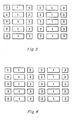
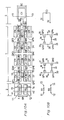
- Figure 3 represents an array in which the basic cell shown in Figure 2A is sequentially arranged.
- Figure 4 represents an array of a basic cell in which the positions of the capacitor unit 3 and resistor unit 2 are exchanged with those of the resistor unit 2 and capacitor unit 3 of the basic cell shown in Figure 3, such array of the basic cell being provided in one column.
- the array of the basic cell shown in Figure 3 is provided in the adjacent column.
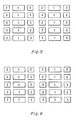
- Figure 5 represents an array in which the basic cell shown in Figure 3 and the basic cell shown in Figure 4 are provided in turn.
- Figure 6 shows an array in which a basic cell having resistor units 2 provided on both sides of the transistor unit 1 and a basic cell having capacitor units 3 provided on both sides of the transistor unit 1 are arranged in turn and the basic cell array on the left side is shifted from the basic cell array on the right side by one basic cell.
- Figure 7 represents an array in which the basic cell array on the left side becomes the same basic cell array on the right side in the array relationship shown in Figure 6.
- the width ST of the transistor unit 1 is equal to the width ST of resistor unit 2 and the width SC of capacitor unit 3, but the widths ST, SR and SC can be properly selected within a scope facilitating a computer aided design.
- Figures 8 and 9 are an explanatory main part plan views relating to an array for explaining a case in which the width SR of resistor unit 2 and the width SC of capacitor unit 3 are not equal to the width ST of transistor unit 1.
- the width SR of the resistor unit 2 and the width SC of the capacitor unit 3 are a positive integer times the width ST the of transistor unit 1.
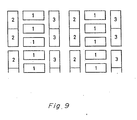
- Figure 9 represents an array in which the width SR of resistor unit 2 and the width SC of capacitor unit 3 are a positive integer times half the width ST of the transistor unit 1.
- the basic cell forms the transistor unit 1 in the transistor area TR and forms the resistor unit 2 and capacitor unit 3 so that they are buried in the wiring region WR.
- the gate array is of a channelless type (i.e. a sea of gate: SOG), the basic cell is provided over the entire area.
- a resistor unit for example, the resistor unit 2 or capacitor unit (for example, the capacitor unit 3) is provided on both sides of a transistor unit (for example, the transistor unit 1).
- the vertical width of these units is either the same as the vertical width (for example, the width ST) of the transistor unit, a positive integer times the vertical width of the transistor unit or positive integer times half the vertical width of the transistor unit.
- This assembly forms a basic cell.
- a transistor unit may be provided in the transistor region and the resistor or capacitor units may be provided in the wiring region provided beside the transistor region.
- FIGS 10A and 10B 11 to 32 indicate terminals, R1 and R2 resistors, QP1 and QP2 p-channel and QN2 n-channel transistors, QP3 and QP4 q-channel transistors, QN3 and QN4 n-channel transistors, C1 a capacitor, CP a contact pattern for connection to a p-type substrate and CN a contact pattern for connection to an n-type substrate.
- Respective transistors in Figures 10A and 10B are represented by their gates and symbols are given to their gates.
- An impurity diffused region R1 of the resistor unit 2 is to form a resistor R1.
- the regions 11 and 13 are to for terminals 11 and 13 of the resistor R1.
- Regions 16 and 21 are to form gate terminals 16 and 21 of the transistors QP1 and QP2.
- Regions 15 and 20 are to form source terminals 15 and 20.
- Region 18 is to form drain electrode 18.
- Regions 31 and 32 are to form terminal 31 and 32 of capacitor C1.
- the regions for terminals 11,13, 16 and 24 are aligned with each other.
- the regions for terminals 12,14, 21, 29 and 32 are alinged with each other. Therefore terminals of the resistor unit 2, transistor unit 1 and capacitor unit 3 are aligned with each other in a horizontal direction, for example, analog a line of a grid (not shown).
- Contact patterns CN and CP are also aligned in a horizontal direction. Some of the terminals or contact patterns may be aligned in a vertical direction. Therefore, the embodiment shown in Figure 10A facilitates computer aided design and wiring.
- Figure 11 is a sectional view of a main part along the line Y1-Y1 shown in Figure 10A and the same reference numbers as in Figures 2 and 10A represent the same parts as in Figures 2 to 10A.
- 41 indicates an n type semiconductor substrate
- 42 a field insulating film comprising a silicon dioxide (Sio2)
- 43A and 43B are p-type resistor regions
- 44 an insulating film formed simultaneously with a gate insulating film.
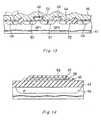
- Figure 12 is a sectional view of the main part along the line x-x shown in Figure 10A and the same references as used in Figure 2 to 11 represent the same parts or the same meanings.
- Figure 13 is a sectional view of the main part along the line Y2-Y2 shown in Figure 10A.
- the same reference numbers as used Figures 2 to 12 represent the same parts or the same meanings.
- 48 indicates a polisilicon gate electrode of transistor QP1, 49 a polisilicon gate electrode of transistor QP2, 50 a p-type source region of transistor QP1 and QP2, 51 a p-type drain region of transistors Q1, 52 a p-type drain region of transistor AP2, and 53 a between-layer insulating film comprising Sio2.
- Figure 14 is a sectional view of the main part along the line Y-3 shown in Figure 10A.
- the same reference numbers as in Figures 2 to 13 represent the same parts or the same meanings.
- 54 indicates a p-type region, 55 a capacitor electrode of polysilicon, 56 a capacitor dielectric film comprising Sio2, 57 a capacitor electrode of a polysilicon and 58 an insulating film.
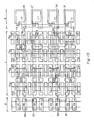
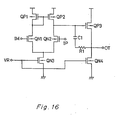
- Figures 15 and 16 represent a plan view of the main part for explaining the pattern layout of an operational amplifier formed by and the equivalent circuit diagram the basic cell of the present invention.
- the reference numbers as used in Figures 1 to 13 represent the same parts or the same meanings.
- V DD represents a positive power source level
- Vss a ground side power source level
- IM a -difference input IP a +difference input
- VR a bias input VR a bias input
- OT an output.
- the wire represented by a solid line is made of metal wire and it is in the first layer Al.
- the wire represented by a dashed line is also made of metal and is in the second layer Al.
- the x mark indicates the contact portion between the first-layer metal wire and the bulk, and the O mark designates the contact point between the first-layer metal wire and the second-layer metal wire.
- Transistor unit 1 resistor unit 2 and capacitor unit 3 can be wired by computer-aided automatic design.
- Figure 17 is an explanatory plan view of the main part representing the whole bulk for explaining a gate array embodying the present invention.
- the same reference numbers used in Figures 2 to 16 represent the same portions or the same meanings.
- BR represents an input and output buffer and BP an input and output bonding pad.
- resistor unit 2 and capacitor unit 3 in the basic cell need not be used. Further more, if the gate array is used only for an analog circuit, the whole basic cell can be used. If they are selectively embodied, a gate array in which a logic circuit and an analog circuit are mixed can be realized. When the gate array is formed only by the logic circuit, it does not cause any problem even if a metal wire passes over resistor unit 2 or capacitor unit 3.
- the basic cell of the present invention can also form A/D or D/A converter, analog switch, and comparator, for example.
- the basic cell of the present invention may be used for a full-custom integrated circuit device and a regular standard integrated circuit device.
- a resistor unit or a capacitor unit are provided on both sides of the transistor unit to form a basic array.
- the vertical width of these units is either the same as that of the transistor unit, a positive integer times the vertical width of the transistor unit, or a positive integer times half the vertical width of the transistor unit.
- the transistor unit may be provided on the transistor region and the resistor unit or capacitor unit may be provided on the region formed beside the transistor region.
- the digital circuit and the analog circuit can be independently or mixedly mounted, thereby providing semiconductor integration.
- the wiring required to complete an integrated circuit device to be provided to a user can be dealt with by automatic computer aided design using the conventional technology.
Landscapes
- Design And Manufacture Of Integrated Circuits (AREA)
- Semiconductor Integrated Circuits (AREA)
Abstract
Description
- The present invention relates to a semi-custom integrated circuit apparatus capable of discretionally forming a gate array of a digital circuit (logic circuit), a gate array of an analog circuit, or a gate array on which a digital circuit and an analog circuit are mixed.
- In the present art, a gate array on which a logic circuit is provided forms the main current. Furthermore, in a recently developed device, a gate array on which an analog circuit is provided has both a digital circuit and an analog circuit formed on the gate array.
- Generally, it is necessary in an analog circuit to provide a resistor or a capacitor in addition to a transistor.
- The number of prior-art devices having the gate array in which a digital circuit and an analog circuit are mixed is very small. However, an example of this type of device is the invention disclosed in Japanese Patent Disclosure sho 59-1083228, which has a capacitor formed in a wire layer of the cell array.
- Figure 1 represents a plan view of a main part of a cell array in a semi-custom IC disclosed in this Japanese Patent Disclosure.
- In Figure 1, TR represents a transistor region, WR a wiring region, WP a wiring poly-silicon film and CE a capacitor poly-silicon film.
- One electrode of the capacitor is formed of the capacitor poly-silicon film CE of the other electrode of the capacitor is formed of an impurity diffusion region with a bulk form. A resistor can be formed by deriving two electrodes from the impurity diffusion region.
- In a semi-custom integrated circuit, respective cells must have a rectangular shape to enable the arrangement and wiring to be designed by a computer. Respective regions with a bulk form are fixed. Only the wiring is changed to enable the device to be provided with different functions.
- As described above, where a digital circuit is mixed with an analog circuit, the above condition which includes provision of a resistor and capacitor, which are essential for the construction of an analog circuit, should be maintained.
- For this purpose, it is important to provide a layout which includes a resistor and a capacitor. Needless to say, the prior art invention disclosed in the above patent disclosure is limited to the idea in which a digital circuit and an analog circuit are merely mixed. Therefore, in this prior art, the arrangement of the resistor and capacitor is not regular. Thus, it requires an unnecessarily large space, thereby drastically decreasing the number of cells with an analog function which can be provided in the cell. In particular, this prior art does not clearly specify the wiring and thus does not solve the wiring problem. Thus, as can be seen from the above, the prior art has serious problems which may make it impossible to realize a gate array on which a digital circuit and analog circuit can be mixedly mounted.
- An object of the present invention is to provide a semi-custom integrated circuit device capable of mounting a digital circuit and an analog circuit either independently or in a mixed manner. This is achieved by forming a basic cell with a combination of a transistor unit, a resistor unit and a capacitor unit.
- A feature of the present invention resides in a semi-custom integrated circuit comprising a basic cell array comprising a plurality of basic cells aligned in a first direction, each of the basic cells comprising a transistor unit, a capacitor unit and a resistor unit arranged in a second direction perpendicular to the first direction, the transistor unit being positioned between the capacitor unit and the resistor unit, the transistor unit having a terminal portion for connection of wiring, the capacitor unit having a terminal portion for connection of wiring, the resistor unit having a terminal portion for connection of wiring, and the terminal portions of the transistor unit, capacitor unit and resistor unit being aligned along a line.
- In the semi-custom integrated circuit a plurality of said cell arrays are arranged in a second direction crossing a wiring region.
- In the semi-custom integrated circuit an unused region on the capacitor unit or transistor unit is used for the arrangement of an interconnection wiring between said basic cells.
- In the semi-custom integrated circuit the transistor unit comprises a source region and a drain region arranged in the first direction, a gate electrode provided between the source region and drain region and extending in the second direction, and the gate electrode having terminal portions in the terminal region.
- In the semi-custom integrated circuit the resistor unit comprises a polysilicon layer formed on an insulating film covering a semiconductor substrate and extending in the second direction and having a terminal portion, the capacitor unit comprising a first electrode formed on the insulating film for covering the semiconductor substrate, an insulating film for covering a first electrode and a second electrode formed on the insulating film, the first and second electrodes having respective terminal portions.
- In the semi-custom integrated circuit the transistor unit comprises a p-channel MIS- transistor pair and an n-channel MIS-transistor pair arranged in the second direction, the p-channel MIS transistor pair comprises a first p-type region a second p-type region, and a third p-type region, which are arranged in the first direction, a first gate electrode arranged between the first p-type region and the second p-type region and extended in the second direction and the second gate region arranged between the second p-type region and the third p-type region and extended in the second direction, the n-channel MIS transistor pair comprises a first n-type region a second n-type region, a third n-type region, which are arranged in the first direction, a third gate electrode arranged between the first n-type region and the second n-type region and extended in the second direction, and a fourth gate electrode arranged in the second n-type region and the third n-type region and extended in the second direction, the resistor unit comprises a first resistor element and a second resistor element arranged in the first direction and extended in said second direction, the capacitor unit has a first capacitor electrode and a second capacitor electrode, terminal portions of the first and the third electrodes, the first p-type region, the first n-type region, the first resistor element, and the first capacitor electrode being aligned along a line, terminal portions of the second, and fourth gate electrode, the third p-type region, the third n-type region, the second resistor element, and the second capacitor electrode are aligned with each other, and the terminal portions of the second p-type region and the second n-type region being aligned along a line.
- In the semi-custom integrated circuit the first and third gate electrodes are formed of an integrated electrode and the second and fourth electrodes are formed of an integrated electrode.
- In the semi-custom integrated circuit the transistor unit comprises first and second p-channel MIS transistor pairs and first and second n-channel MIS transistor pairs arranged in the second direction, the first and second p-channel MIS transistor pairs each comprise a first p-type region, a second p-type region and a third p-type region arranged in the first direction, a first gate electrode arranged between the first p-type region and the second p-type region and extended in the second direction, and a second gate electrode arranged between the second p-type region and the third p-type region and extended in the second direction, the first and second n-channel MIS transistor pair each having a first n-type region, a second n-type region and a third n-type region arranged in the first direction, a third gate region arranged between the first n-type region and the second n-type region and extended in the second direction, and a fourth gate electrode arranged between the second n-type region and the third n-type region and extended in the second direction, the resistor unit having a first resistor element and a second resistor element arranged in the first direction and extended in the second direction, the capacitor unit comprising a first capacitor electrode and a second capacitor electrode, terminal portions of the first and third gate electrode, the first p-type region, and the first n-type region, the first resistor element and the first capacitor electrode of the first and second p-channel MIS transistor pair, and the first and second n-channel MIS transistor pair and the first resistor element and the first capacitor electrode being aligned along a straight line, terminal portions of the second and fourth gate electrodes, the third p-type region, and the third n-type region, the second resistor element and the second capacitor electrode of the first and second p-channel MIS transistor pair and the first and second n-channel MIS transistor pair and the second resistor element and the second capacitor electrode are aligned along a straight line, and terminal portions of the second p-type region and the second n-type regions of the first and second p-channel MIS transistor pair and the said first and second n-channel MIS transistor pair are aligned along a line.
- In the semi-custom integrated circuit, the first and second p-channel MIS transistor pair or said first and second n-channel MIS transistor pair are arranged adjacent to each other.
- In the semi-custom integrated circuit a plurality of the transistor units forms a digital circuit through an interconnection and a plurality of resistor units and capacitor units forms an analog circuit through an internal connection.
-
- Figure 1 shows a plan view of the main part of a cell array in a semi-custom IC disclosed in the prior art.
- Figures 2A and 2B, respectively show a plan view of the main part of a basic cell for explaining the principle of the present invention and an equivalent circuit thereof,
- Figure 3 shows a plan view of the main part of an array for explaining one embodiment of an arrangement of a resistor unit and a capacitor unit and that of a basic cell,
- Figure 4 shows a plan view of the main part of an array for explaining another embodiment of an arrangement of a resistor unit and a capacitor unit and that of a basic cell,
- Figure 5 shows a plan view of the main part of an array for explaining a further embodiment of an arrangement of a resistor unit and a capacitor unit and that of a basic cell,
- Figure 6 shows a plan view of the main part of an array for explaining a still further embodiment of the arrangement of a resistor unit and a capacitor unit and that of a basic cell,
- Figure 7 shows a plan view of the main part of an array for explaining other embodiment of an arrangement of a resistor unit and a capacitor unit and that of a basic cell,
- Figure 8 shows a plan view of the main part of an array for explaining an embodiment in which the width of a transistor unit is different from that of the resistor unit or the capacitor unit,
- Figure 9 shows a plan view of the main part of an array for explaining another embodiment in which the width of the transistor unit is different from that of the resistor unit or capacitor unit,
- Figures 10A and 10B, respectively, show a plan view of the main part of the basic cell for explaining the embodiment of the present invention and an equivalent circuit thereof,
- Figure 11 is a sectional view of the main part of the embodiment along the line Y1-Y1 shown in Figure 10A,
- Figure 12 shows a sectional side view of the main part of the embodiment along the line X-X shown in Figure 10A,
- Figure 13 is a sectional view of the main part of the embodiment along the line Y2-Y2 shown in Figure 10A,
- Figure 14 shows a sectional view of the main part of the embodiment along the line Y3-Y3 shown in Figure 10A,
- Figures 15 shows a plan view of the main part of the embodiment for explaining a pattern layout of an operational amplifier to which the present invention is applied,
- Figure 16 shows an equivalent circuit of the operational amplifier shown in Figure 15 as the pattern layout and,
- Figure 17 shows a plan view of the main part of the whole bulk for explaining the gate array according to the present invention.
- Figures 2A and 2B, respectively, show a plan view of a main part of a basic cell for explaining the principle of the present invention and equivalent circuit thereof.
- In the drawing, 1 is a transistor unit, 1p a p-channel transistor portion, 1n an n-channel transistor portion, 2 a resistor unit, 3 a capacitor unit, ST the width of the
transistor unit 1, SR the width of theresistor unit 2, and SC the width of thecapacitor unit 3. - As described above, in the present invention,
transistor unit 1,resistor unit 2, andcapacitor unit 3 are combined to form a single basic cell and the basic cell is arranged as an array. - The basic cell shown in Figure 2A provides
resistor unit 2 on the left side oftransistor unit 1 andcapacitor unit 3 on the right side thereof. The structure of the basic cell can be modified in various ways and the arrangement of the basic cell can be selected appropriately as necessary. The number of transistors may be one or more than one. - Figures 3 to 7 represent explanatory plan views of the main part of an array for explaining the arrangement of the
resistor 2 and thecapacitor unit 3 and an array of the basic cell. The same reference numbers as used in Figure 2A represent the same portions or the same meanings. - Figure 3 represents an array in which the basic cell shown in Figure 2A is sequentially arranged.
- Figure 4 represents an array of a basic cell in which the positions of the
capacitor unit 3 andresistor unit 2 are exchanged with those of theresistor unit 2 andcapacitor unit 3 of the basic cell shown in Figure 3, such array of the basic cell being provided in one column. The array of the basic cell shown in Figure 3 is provided in the adjacent column. - Figure 5 represents an array in which the basic cell shown in Figure 3 and the basic cell shown in Figure 4 are provided in turn.
- Figure 6 shows an array in which a basic cell having
resistor units 2 provided on both sides of thetransistor unit 1 and a basic cell havingcapacitor units 3 provided on both sides of thetransistor unit 1 are arranged in turn and the basic cell array on the left side is shifted from the basic cell array on the right side by one basic cell. - Figure 7 represents an array in which the basic cell array on the left side becomes the same basic cell array on the right side in the array relationship shown in Figure 6.
- In the basic cell shown in Figures 2 and 7, the width ST of the
transistor unit 1 is equal to the width ST ofresistor unit 2 and the width SC ofcapacitor unit 3, but the widths ST, SR and SC can be properly selected within a scope facilitating a computer aided design. - Figures 8 and 9 are an explanatory main part plan views relating to an array for explaining a case in which the width SR of
resistor unit 2 and the width SC ofcapacitor unit 3 are not equal to the width ST oftransistor unit 1. The reference numbers shown in Figures 8 and 9, which are the same as those shown in Figures 3 to 7, represent the same part or the same meaning. - In Figure 8, the width SR of the
resistor unit 2 and the width SC of thecapacitor unit 3 are a positive integer times the width ST the oftransistor unit 1. - Figure 9 represents an array in which the width SR of
resistor unit 2 and the width SC ofcapacitor unit 3 are a positive integer times half the width ST of thetransistor unit 1. - Where the gate array is of a channel type, the basic cell forms the
transistor unit 1 in the transistor area TR and forms theresistor unit 2 andcapacitor unit 3 so that they are buried in the wiring region WR. If the gate array is of a channelless type (i.e. a sea of gate: SOG), the basic cell is provided over the entire area. - As is clear from the above description, in the semi-custom integrated circuit device according to the present invention as viewed in the plan direction, a resistor unit (for example, the resistor unit 2) or capacitor unit (for example, the capacitor unit 3) is provided on both sides of a transistor unit (for example, the transistor unit 1). The vertical width of these units is either the same as the vertical width (for example, the width ST) of the transistor unit, a positive integer times the vertical width of the transistor unit or positive integer times half the vertical width of the transistor unit. This assembly forms a basic cell. In addition, a transistor unit may be provided in the transistor region and the resistor or capacitor units may be provided in the wiring region provided beside the transistor region.
- By this means, a semi-custom integrated circuit apparatus on which a digital circuit and an analog circuit can be independently or mixedly mounted is realized and the wire for completing an integrated circuit device which can be provided to a user can be dealt with by using the conventional technology.
- Figures 10A and 10B, respectively, represent a plan view and an equivalent circuit view of a main part of a basic cell for explaining an embodiment of the present invention and the same references used in Figures 2 to 9 represent the same parts or meanings.
- The present embodiment is basically the same as the basic cell explained by referring to Figure 2. Needless to say, the symbols in Figure 9A correspond to the symbols shown in Figure 9B.
- In Figures 10A and 10B, 11 to 32 indicate terminals, R1 and R2 resistors, QP1 and QP2 p-channel and QN2 n-channel transistors, QP3 and QP4 q-channel transistors, QN3 and QN4 n-channel transistors, C1 a capacitor, CP a contact pattern for connection to a p-type substrate and CN a contact pattern for connection to an n-type substrate. Respective transistors in Figures 10A and 10B are represented by their gates and symbols are given to their gates.
- An impurity diffused region R1 of the
resistor unit 2 is to form a resistor R1. Theregions terminals Regions gate terminals Regions source terminals Region 18 is to formdrain electrode 18.Regions - The regions for
terminals terminals resistor unit 2,transistor unit 1 andcapacitor unit 3 are aligned with each other in a horizontal direction, for example, analog a line of a grid (not shown). Contact patterns CN and CP are also aligned in a horizontal direction. Some of the terminals or contact patterns may be aligned in a vertical direction. Therefore, the embodiment shown in Figure 10A facilitates computer aided design and wiring. - Figure 11 is a sectional view of a main part along the line Y1-Y1 shown in Figure 10A and the same reference numbers as in Figures 2 and 10A represent the same parts as in Figures 2 to 10A.
- In Figure 11, 41 indicates an n type semiconductor substrate, 42 a field insulating film comprising a silicon dioxide (Sio₂), 43A and 43B are p-type resistor regions and 44 an insulating film formed simultaneously with a gate insulating film.
- Figure 12 is a sectional view of the main part along the line x-x shown in Figure 10A and the same references as used in Figure 2 to 11 represent the same parts or the same meanings.
- In Figure 12, 45 indicates a p⁺-type electrode contact region, 46 a phosphosilicate glass(PSG) film and 47 an electrode.
- Figure 13 is a sectional view of the main part along the line Y2-Y2 shown in Figure 10A. The same reference numbers as used Figures 2 to 12 represent the same parts or the same meanings.
- In Figure 13, 48 indicates a polisilicon gate electrode of transistor QP1, 49 a polisilicon gate electrode of transistor QP2, 50 a p-type source region of transistor QP1 and QP2, 51 a p-type drain region of transistors Q1, 52 a p-type drain region of transistor AP2, and 53 a between-layer insulating film comprising Sio₂.
- Figure 14 is a sectional view of the main part along the line Y-3 shown in Figure 10A. The same reference numbers as in Figures 2 to 13 represent the same parts or the same meanings.
- In Figure 14, 54 indicates a p-type region, 55 a capacitor electrode of polysilicon, 56 a capacitor dielectric film comprising Sio₂, 57 a capacitor electrode of a polysilicon and 58 an insulating film.
- As described above, when a capacitor is formed of a 2-layer configuration comprising polysilicon films, the accuracy of the capacitance is higher than that of a capacitor formed by bulk polysilicon and a single-layer polysilicon film. Where a high-precision capacitor or resistor is obtained, it becomes possible to form a D/A converter of the R-string type or an A/D converter of the sequential comparison type by using the cell of the present invention. Therefore, an integrated circuit unit device can be completed within a short period in the same manner as an ordinary gate array.
- Figures 15 and 16 represent a plan view of the main part for explaining the pattern layout of an operational amplifier formed by and the equivalent circuit diagram the basic cell of the present invention. The reference numbers as used in Figures 1 to 13 represent the same parts or the same meanings.
- In Figures 14 and 15, VDD represents a positive power source level, Vss a ground side power source level, IM a -difference input, IP a +difference input, VR a bias input and OT an output. The wire represented by a solid line is made of metal wire and it is in the first layer Aℓ. The wire represented by a dashed line is also made of metal and is in the second layer Aℓ. The x mark indicates the contact portion between the first-layer metal wire and the bulk, and the O mark designates the contact point between the first-layer metal wire and the second-layer metal wire.
- As is clear from the drawings, the basic cell in this embodiment is the same as that, used for the explanation in Figures 2 to 4.
Transistor unit 1,resistor unit 2 andcapacitor unit 3 can be wired by computer-aided automatic design. - Figure 17 is an explanatory plan view of the main part representing the whole bulk for explaining a gate array embodying the present invention. The same reference numbers used in Figures 2 to 16 represent the same portions or the same meanings.
- In Figure 17, BR represents an input and output buffer and BP an input and output bonding pad.
- In Figure 17, when the gate array is used only for a logic circuit,
resistor unit 2 andcapacitor unit 3 in the basic cell need not be used. Further more, if the gate array is used only for an analog circuit, the whole basic cell can be used. If they are selectively embodied, a gate array in which a logic circuit and an analog circuit are mixed can be realized. When the gate array is formed only by the logic circuit, it does not cause any problem even if a metal wire passes overresistor unit 2 orcapacitor unit 3. - The basic cell of the present invention can also form A/D or D/A converter, analog switch, and comparator, for example.
- The basic cell of the present invention may be used for a full-custom integrated circuit device and a regular standard integrated circuit device.
- In the semi-custom integrated circuit device according to the present invention, as a viewed from the plan direction, a resistor unit or a capacitor unit are provided on both sides of the transistor unit to form a basic array. The vertical width of these units is either the same as that of the transistor unit, a positive integer times the vertical width of the transistor unit, or a positive integer times half the vertical width of the transistor unit. In addition, the transistor unit may be provided on the transistor region and the resistor unit or capacitor unit may be provided on the region formed beside the transistor region.
- With this configuration, the digital circuit and the analog circuit can be independently or mixedly mounted, thereby providing semiconductor integration. The wiring required to complete an integrated circuit device to be provided to a user, can be dealt with by automatic computer aided design using the conventional technology.
Claims (30)
a basic cell array comprising a plurality of basic cells aligned in a first direction, said basic cells comprising a transistor unit, a capacitor unit and a resistor unit arranged in a second direction perpendicular to said first direction,
said transistor unit being positioned between said capacitor unit and said resistor unit,
said transistor unit having a terminal portion for connection of wiring,
said capacitor unit having a terminal portion for connection of wiring,
said resistor unit having a terminal portion for connection of wiring, and
the terminal portions of said transistor unit, capacitor unit and resistor unit being aligned along a line.
a plurality of said cell arrays are arranged in a second direction crossing a wiring region.
said transistor unit comprises:
a source region and a drain region arranged in said first direction,
a gate electrode provided between said source region and drain region and extending in said second direction, and
said gate electrode having terminal portions in said terminal region.
said resistor unit comprises a polysilicon layer formed on an insulating film covering a semiconductor substrate and extending in said second direction and having a terminal portion,
said capacitor unit comprising a first electrode formed on the insulating film for covering said semiconductor substrate, an insulating film for covering a first electrode and a second electrode formed on said insulating film, said first and second electrodes having respective terminal portions.
said transistor unit comprises a p-channel MIS-transistor pair and an n-channel MIS-transistor pair arranged in said second direction,
said p-channel MIS transistor pair comprises a first p-type region a second p-type region, and a third p-type region, which are arranged in said first direction, a first gate electrode arranged between said first p-type region and said second p-type region and extended in said second direction and said second gate region arranged between said second p-type region and said third p-type region and extended in said second direction,
said n-channel MIS transistor pair comprises a first n-type region a second n-type region, a third n-type region, which are arranged in said first direction, a third gate electrode arranged between said first n-type region and said second n-type region and extended in said second direction, and a fourth gate electrode arranged in said second n-type region and said third n-type region and extended in said second direction,
said resistor unit comprises a first resistor element and a second resistor element arranged in said first direction and extended in said second direction,
said capacitor unit has a first capacitor electrode and a second capacitor electrode,
terminal portions of the first and the third electrodes, said first p-type region, said first n-type region, said first resistor element, and said first capacitor electrode are aligned along a line,
terminal portions of the second, and fourth gate electrode, said third p-type region, said third n-type region, said second resistor element, and said second capacitor electrode are aligned with each other, and the terminal portions of said second p-type region and said second n-type region are aligned along a line.
said first and third gate electrodes are formed of an integrated electrode and said second and fourth electrodes are formed of an integrated electrode.
said transistor unit comprises first and second p-channel MIS transistor pairs and first and second n-channel MIS transistor pairs arranged in said second direction,
said first and second p-channel MIS transistor pairs each comprise a first p-type region, a second p- type region and a third p-type region arranged in said first direction, a first gate electrode arranged between said first p-type region and said second p-type region and extended in said second direction, and a second gate electrode arranged between said second p-type region and said third p-type region and extended in said second direction,
said first and second n-channel MIS transistor pair each has a first n-type region, a second n-type region and a third n-type region arranged in said first direction, a third gate region arranged between said first n-type region and said second n-type region and extended in said second direction, and a fourth gate electrode arranged between said second n-type region and said third n-type region and extended in said second direction,
said resistor unit has a first resistor element and a second resistor element arranged in said first direction and extended in said second direction,
said capacitor unit comprises a first capacitor electrode and a second capacitor electrode,
terminal portions of said first and third gate electrode, said first p-type region, and said first n-type region, said first resistor element and said first capacitor electrode of said first and second p- channel MIS transistor pair, and said first and second n-channel MIS transistor pair and said first resistor element and said first capacitor electrode are aligned along a straight line,
terminal portions of said second and fourth gate electrodes, said third p-type region, and said third n-type region, said second resistor element and said second capacitor electrode of said first and second p-channel MIS transistor pair and said first and second n-channel MIS transistor pair and said second resistor element and said second capacitor electrode are aligned along a straight line, and terminal portions of said second p-type region and said second n-type regions of said first and second p-channel MIS transistor pair and said first and second n-channel MIS transistor pair are aligned along a line.
said first and second p-channel MIS transistor pair or said first and second n-channel MIS transistor pair are arranged adjacent to each other.
a plurality of said transistor units forms a digital circuit through an interconnection and
a plurality of resistor units and capacitor units forms an analog circuit through an internal connection.
said basic cell comprising:
a transistor unit with a vertical width, and
a resistor unit and capacitor unit respectively provided on respective sides of said transistor unit, said resistor and capacitor units having the same vertical width as the said vertical width of the transistor unit.
Wherein a plurality of said basic cell is arranged in one column so that said resistor, transistor, and capacitor units are respectively aligned in a vertical direction and a plurality of said basic cell arranged in the adjacent column is, in a horizontal direction, aligned with said basic cell arranged in one column,
a transistor unit with a vertical width,
a resistor unit provided on the left side of the transistor unit, and
a capacitor unit provided on the right side of the transistor unit, and
said resistor and capacitor units having the same vertical width as the said vertical width of the transistor unit, and
said second basic cell comprising,
a transistor unit provided on the right side of the transistor unit, and
a capacitor unit provided on the left side of the transistor unit,
said resistor and capacitor units having the same vertical width as the said vertical width of the transistor unit.
wherein a plurality of said first basic cell is arranged in one column so that they are aligned with each other and a plurality of said second basic cell is arranged in the adjacent column so that they are aligned with each other.
wherein a plurality of said first and second basic cells are arranged in turn in one column so that they are aligned with each other.
a transistor unit with a vertical width, and
a resistor unit provided on both sides of the transistor unit,
said resistor unit having the same vertical width as the said vertical width of the transistor unit, and
said second basic cell comprising,
a transistor unit with a vertical width, and
a capacitor unit provided on both sides of the transistor unit,
said capacitor unit having the same vertical width as the said vertical width of the transistor unit.
wherein a plurality of said first and second basic cells are arranged in turn in one column and in the adjacent column so that they are aligned with each other and an alternative order of said first and second basic cells in one column is shifted from that in the adjacent column by one basic cell.
wherein a plurality of said first and second basic cells are arranged in one column so that they are aligned with each other and said first basic cell in one column corresponds to said first basic cell in the adjacent column and said second basic cell in one column corresponds to said second basic cell in the adjacent column.
an array of said basic cells is to form an operation amplifier.
said basic cell comprising:
a transistor unit with a vertical width, and
a resistor unit and capacitor unit respectively provided on respective sides of said transistor unit, said resistor and capacitor units having a vertical width integer times the said vertical width of the transistor unit.
said basic cell comprising:
a transistor unit with a vertical width, and
a resistor unit and capacitor unit respectively provided on respective sides of said transistor unit, said resistor and capacitor units having a vertical width integer times half the said vertical width of the transistor unit.
a transistor unit,
a resistor unit, provided on a side of said transistor unit, and
a capacitor provided on a side of said transistor unit wherein said transistor, resistor and capacitor units are aligned in a horizontal direction.
wherein said transistor resistor and capacitor units have their terminals aligned in a horizontal direction and at least one of said transistor , resistor and capacitor units have their terminals aligned in a vertical direction.
a transistor unit,
a resistor unit, provided on a side of said transistor unit, and
a capacitor provided on a side of said transistor unit wherein said transistor, resistor and capacitor units are aligned in a horizontal direction.
Applications Claiming Priority (2)
| Application Number | Priority Date | Filing Date | Title |
|---|---|---|---|
| JP1149473A JP3030778B2 (en) | 1989-06-14 | 1989-06-14 | Semi-custom integrated circuit device |
| JP149473/89 | 1989-06-14 |
Publications (2)
| Publication Number | Publication Date |
|---|---|
| EP0403274A1 true EP0403274A1 (en) | 1990-12-19 |
| EP0403274B1 EP0403274B1 (en) | 1994-10-12 |
Family
ID=15475914
Family Applications (1)
| Application Number | Title | Priority Date | Filing Date |
|---|---|---|---|
| EP90306479A Expired - Lifetime EP0403274B1 (en) | 1989-06-14 | 1990-06-14 | Semi-custom integrated circuit device |
Country Status (4)
| Country | Link |
|---|---|
| EP (1) | EP0403274B1 (en) |
| JP (1) | JP3030778B2 (en) |
| KR (1) | KR930006985B1 (en) |
| DE (1) | DE69013235T2 (en) |
Families Citing this family (2)
| Publication number | Priority date | Publication date | Assignee | Title |
|---|---|---|---|---|
| KR101259751B1 (en) * | 2008-09-08 | 2013-04-30 | 삼성전자주식회사 | Layout method of semiconductor integrated circuit including capacitors having the same width as the length of active resistors |
| JP6045923B2 (en) * | 2013-01-25 | 2016-12-14 | レンゴー株式会社 | Partition material |
Citations (1)
| Publication number | Priority date | Publication date | Assignee | Title |
|---|---|---|---|---|
| EP0189183A1 (en) * | 1985-01-25 | 1986-07-30 | Hitachi, Ltd. | Semiconducteur integrated circuit device |
Family Cites Families (5)
| Publication number | Priority date | Publication date | Assignee | Title |
|---|---|---|---|---|
| JPS6390844U (en) * | 1986-12-04 | 1988-06-13 | ||
| JPS63142656A (en) * | 1986-12-05 | 1988-06-15 | Fuji Xerox Co Ltd | Semi-custom semiconductor integrated circuit |
| JPS647536A (en) * | 1987-06-29 | 1989-01-11 | Nec Corp | Semi-custom semiconductor integrated circuit |
| JPH01123432A (en) * | 1987-11-09 | 1989-05-16 | Nec Corp | Semiconductor integrated circuit device |
| JPH01248535A (en) * | 1988-03-29 | 1989-10-04 | Nec Corp | Semi-custom integrated circuit |
-
1989
- 1989-06-14 JP JP1149473A patent/JP3030778B2/en not_active Expired - Fee Related
-
1990
- 1990-06-14 KR KR9008726A patent/KR930006985B1/en not_active Expired - Fee Related
- 1990-06-14 DE DE69013235T patent/DE69013235T2/en not_active Expired - Fee Related
- 1990-06-14 EP EP90306479A patent/EP0403274B1/en not_active Expired - Lifetime
Patent Citations (1)
| Publication number | Priority date | Publication date | Assignee | Title |
|---|---|---|---|---|
| EP0189183A1 (en) * | 1985-01-25 | 1986-07-30 | Hitachi, Ltd. | Semiconducteur integrated circuit device |
Non-Patent Citations (3)
| Title |
|---|
| PATENT ABSTRACTS OF JAPAN, vol. 10, no. 99 (E-396)[2156], 16th April 1986; & JP-A-60 240 139 (SUMITOMO DENKI KOGYO K.K.) 29-11-1985 * |
| PATENT ABSTRACTS OF JAPAN, vol. 9, no. 136 (E-320)[1859], 12th June 1985; & JP-A-60 18 932 (SUWA SEIKOSHA K.K.) 31-01-1985 * |
| PATENT ABSTRACTS OF JAPAN, vol. 9, no. 201 (E-336)[1924] 17th August 1985; & JP-A-60 66 449 (SUWA SEIKOSHA K.K.) 16-04-1985 * |
Also Published As
| Publication number | Publication date |
|---|---|
| JPH0316173A (en) | 1991-01-24 |
| EP0403274B1 (en) | 1994-10-12 |
| KR930006985B1 (en) | 1993-07-24 |
| DE69013235D1 (en) | 1994-11-17 |
| JP3030778B2 (en) | 2000-04-10 |
| DE69013235T2 (en) | 1995-02-23 |
Similar Documents
| Publication | Publication Date | Title |
|---|---|---|
| EP0058504B1 (en) | Method of constructing a delay circuit in a master slice ic | |
| JP3154411B2 (en) | Two metal layer integrated circuit gate array laid out by CAD | |
| KR920004179B1 (en) | Semiconductor integrated circuit | |
| US5663589A (en) | Current regulating semiconductor integrated circuit device and fabrication method of the same | |
| EP0080361B1 (en) | Complementary metal-oxide semiconductor integrated circuit device of master slice type | |
| US5087955A (en) | Input-output circuit of reduced device area for semicustom semiconductor integrated circuit | |
| US5300796A (en) | Semiconductor device having an internal cell array region and a peripheral region surrounding the internal cell array for providing input/output basic cells | |
| US4525809A (en) | Integrated circuit | |
| US4750027A (en) | Master slice semiconductor device | |
| US4771327A (en) | Master-slice integrated circuit having an improved arrangement of transistor elements for simplified wirings | |
| JPS6065547A (en) | Semiconductor device | |
| US4524377A (en) | Integrated circuit | |
| US5281835A (en) | Semi-custom integrated circuit device | |
| US5952698A (en) | Layout pattern for improved MOS device matching | |
| EP0403274B1 (en) | Semi-custom integrated circuit device | |
| US4951111A (en) | Integrated circuit device | |
| EP0650196A2 (en) | Semiconductor integrated circuit device and method of producing the same using master slice approach | |
| JP2997179B2 (en) | Power MOS transistor | |
| JPS586157A (en) | Cmos master slice lsi | |
| JP2000223575A (en) | Semiconductor device design method, semiconductor device, and semiconductor device manufacturing method | |
| US6081004A (en) | BiCMOS compacted logic array | |
| EP0136888B1 (en) | Large scale integration circuitry | |
| EP1009031B1 (en) | Semiconductor integrated circuit device and method of producing the same | |
| EP0730303A2 (en) | Microelectronic integrated circuit including hexagonal CMOS "NAND" gate device | |
| HK28196A (en) | I/O cells in semiconductor integrated circuits |
Legal Events
| Date | Code | Title | Description |
|---|---|---|---|
| PUAI | Public reference made under article 153(3) epc to a published international application that has entered the european phase |
Free format text: ORIGINAL CODE: 0009012 |
|
| AK | Designated contracting states |
Kind code of ref document: A1 Designated state(s): DE FR GB |
|
| 17P | Request for examination filed |
Effective date: 19910507 |
|
| 17Q | First examination report despatched |
Effective date: 19930115 |
|
| GRAA | (expected) grant |
Free format text: ORIGINAL CODE: 0009210 |
|
| AK | Designated contracting states |
Kind code of ref document: B1 Designated state(s): DE FR GB |
|
| REF | Corresponds to: |
Ref document number: 69013235 Country of ref document: DE Date of ref document: 19941117 |
|
| ET | Fr: translation filed | ||
| PLBE | No opposition filed within time limit |
Free format text: ORIGINAL CODE: 0009261 |
|
| STAA | Information on the status of an ep patent application or granted ep patent |
Free format text: STATUS: NO OPPOSITION FILED WITHIN TIME LIMIT |
|
| 26N | No opposition filed | ||
| REG | Reference to a national code |
Ref country code: GB Ref legal event code: IF02 |
|
| PGFP | Annual fee paid to national office [announced via postgrant information from national office to epo] |
Ref country code: GB Payment date: 20050608 Year of fee payment: 16 Ref country code: FR Payment date: 20050608 Year of fee payment: 16 |
|
| PGFP | Annual fee paid to national office [announced via postgrant information from national office to epo] |
Ref country code: DE Payment date: 20050609 Year of fee payment: 16 |
|
| PG25 | Lapsed in a contracting state [announced via postgrant information from national office to epo] |
Ref country code: GB Free format text: LAPSE BECAUSE OF NON-PAYMENT OF DUE FEES Effective date: 20060614 |
|
| PG25 | Lapsed in a contracting state [announced via postgrant information from national office to epo] |
Ref country code: DE Free format text: LAPSE BECAUSE OF NON-PAYMENT OF DUE FEES Effective date: 20070103 |
|
| GBPC | Gb: european patent ceased through non-payment of renewal fee |
Effective date: 20060614 |
|
| REG | Reference to a national code |
Ref country code: FR Ref legal event code: ST Effective date: 20070228 |
|
| PG25 | Lapsed in a contracting state [announced via postgrant information from national office to epo] |
Ref country code: FR Free format text: LAPSE BECAUSE OF NON-PAYMENT OF DUE FEES Effective date: 20060630 |