EP0402508B2 - Einrichtung zum Detektieren einer Folge von anormalen Ereignissen in einem elektrischen Signal, insbesondere dem Depolarisationssignal eines Herzens - Google Patents
Einrichtung zum Detektieren einer Folge von anormalen Ereignissen in einem elektrischen Signal, insbesondere dem Depolarisationssignal eines Herzens Download PDFInfo
- Publication number
- EP0402508B2 EP0402508B2 EP89110885A EP89110885A EP0402508B2 EP 0402508 B2 EP0402508 B2 EP 0402508B2 EP 89110885 A EP89110885 A EP 89110885A EP 89110885 A EP89110885 A EP 89110885A EP 0402508 B2 EP0402508 B2 EP 0402508B2
- Authority
- EP
- European Patent Office
- Prior art keywords
- signal
- heart
- events
- event
- characteristic quantity
- Prior art date
- Legal status (The legal status is an assumption and is not a legal conclusion. Google has not performed a legal analysis and makes no representation as to the accuracy of the status listed.)
- Expired - Lifetime
Links
- 230000002159 abnormal effect Effects 0.000 title claims description 45
- 230000028161 membrane depolarization Effects 0.000 claims description 45
- 206010061592 cardiac fibrillation Diseases 0.000 claims description 41
- 230000002600 fibrillogenic effect Effects 0.000 claims description 39
- 230000004064 dysfunction Effects 0.000 claims description 5
- 230000001747 exhibiting effect Effects 0.000 claims 4
- 210000000056 organ Anatomy 0.000 claims 1
- 238000001514 detection method Methods 0.000 description 33
- 239000008186 active pharmaceutical agent Substances 0.000 description 12
- 230000033764 rhythmic process Effects 0.000 description 7
- 206010003119 arrhythmia Diseases 0.000 description 6
- 230000006793 arrhythmia Effects 0.000 description 5
- 230000008859 change Effects 0.000 description 5
- 230000007257 malfunction Effects 0.000 description 5
- 230000000694 effects Effects 0.000 description 3
- 230000008901 benefit Effects 0.000 description 2
- 230000000747 cardiac effect Effects 0.000 description 2
- 238000010586 diagram Methods 0.000 description 2
- 230000010354 integration Effects 0.000 description 2
- 238000000034 method Methods 0.000 description 2
- 230000000630 rising effect Effects 0.000 description 2
- 238000012935 Averaging Methods 0.000 description 1
- 230000015572 biosynthetic process Effects 0.000 description 1
- 239000003990 capacitor Substances 0.000 description 1
- 230000003750 conditioning effect Effects 0.000 description 1
- 239000013078 crystal Substances 0.000 description 1
- 230000006870 function Effects 0.000 description 1
- 230000003993 interaction Effects 0.000 description 1
- 230000010355 oscillation Effects 0.000 description 1
- 238000001556 precipitation Methods 0.000 description 1
- 230000008569 process Effects 0.000 description 1
- 238000009751 slip forming Methods 0.000 description 1
- 230000001225 therapeutic effect Effects 0.000 description 1
Images


Classifications
-
- A—HUMAN NECESSITIES
- A61—MEDICAL OR VETERINARY SCIENCE; HYGIENE
- A61B—DIAGNOSIS; SURGERY; IDENTIFICATION
- A61B5/00—Measuring for diagnostic purposes; Identification of persons
- A61B5/24—Detecting, measuring or recording bioelectric or biomagnetic signals of the body or parts thereof
- A61B5/316—Modalities, i.e. specific diagnostic methods
- A61B5/318—Heart-related electrical modalities, e.g. electrocardiography [ECG]
- A61B5/346—Analysis of electrocardiograms
- A61B5/349—Detecting specific parameters of the electrocardiograph cycle
- A61B5/361—Detecting fibrillation
-
- A—HUMAN NECESSITIES
- A61—MEDICAL OR VETERINARY SCIENCE; HYGIENE
- A61N—ELECTROTHERAPY; MAGNETOTHERAPY; RADIATION THERAPY; ULTRASOUND THERAPY
- A61N1/00—Electrotherapy; Circuits therefor
- A61N1/18—Applying electric currents by contact electrodes
- A61N1/32—Applying electric currents by contact electrodes alternating or intermittent currents
- A61N1/38—Applying electric currents by contact electrodes alternating or intermittent currents for producing shock effects
- A61N1/39—Heart defibrillators
- A61N1/3956—Implantable devices for applying electric shocks to the heart, e.g. for cardioversion
-
- A—HUMAN NECESSITIES
- A61—MEDICAL OR VETERINARY SCIENCE; HYGIENE
- A61B—DIAGNOSIS; SURGERY; IDENTIFICATION
- A61B5/00—Measuring for diagnostic purposes; Identification of persons
- A61B5/72—Signal processing specially adapted for physiological signals or for diagnostic purposes
- A61B5/7235—Details of waveform analysis
- A61B5/7239—Details of waveform analysis using differentiation including higher order derivatives
-
- A—HUMAN NECESSITIES
- A61—MEDICAL OR VETERINARY SCIENCE; HYGIENE
- A61N—ELECTROTHERAPY; MAGNETOTHERAPY; RADIATION THERAPY; ULTRASOUND THERAPY
- A61N1/00—Electrotherapy; Circuits therefor
- A61N1/18—Applying electric currents by contact electrodes
- A61N1/32—Applying electric currents by contact electrodes alternating or intermittent currents
- A61N1/38—Applying electric currents by contact electrodes alternating or intermittent currents for producing shock effects
- A61N1/39—Heart defibrillators
- A61N1/3987—Heart defibrillators characterised by the timing or triggering of the shock
Definitions
- Device for detecting a Sequence of abnormal events in one electrode physiological signal, in particular the depolarization signal of a heart.
- the invention relates to a Means for detecting a sequence of abnormal ones Events under a variety of normal Events in an electrophysiological signal.
- the embodiments of the invention relate to also a device for detection a sequence of indications of fibrillation Events under a variety of normal Events in the depolarization signal a malfunctioning heart, a Device for detecting the fibrillation of a a malfunctioning heart and a device for automatic defibrillation a malfunctioning heart.
- Detecting a sequence of abnormal ones Events under a variety of normal events in an electrophysiological signal plays e.g. in the detection of arrhythmias based on the depolarization signal of a malfunction having a heart.
- the Depolarization signal of a malfunction showing heart contains in addition to normal Waveforms indicative of cardiac activity Arrhythmia, e.g. Cardiac fibrillation (fibrillation), Waveforms from those in the case of waveforms present in normal cardiac activity differ. If you take a normal one or waveforms corresponding to abnormal heartbeat as a normal or abnormal event in the depolarization signal of the heart an arrhythmia is a sequence of abnormal events under a variety of normal events represents.
- the invention is based on the object a device for detection a sequence of abnormal events in one electrophysiological signal, especially the Depolarization signal of a heart to train so that the detection of a sequence of abnormal Events in the signal under all circumstances, especially with gradual changes the manifestation of events, with high Reliability is guaranteed.
- the device according to the invention is therefore one for the maximum values signal parameters typical of each event to be detected, it can e.g. to the Amplitude, the slope of the signal, its Frequency, etc. act, one of them statistical Distribution determined the relevant parameter. This is with a setpoint of the parameter compared to be able to decide whether the at events taking into account the formation of the parameter a sequence of abnormal events contain or even components of a sequence of abnormal events.
- the detection of one The sequence of abnormal events is based on an objective criterion because the setpoint the characteristic in no way from the course of the signal depends.
- the signal with respect to that signal parameter, its maximum values for each event be measured with a defined threshold is compared, the signal at both Occurrence of normal as well as abnormal Event.
- the threshold value can thus be avoided that glitches or the like wrongly regarded as an event and in determining the the statistical distribution of the measured maximum values corresponding parameter is taken into account become.
- the invention is called the statistical Distribution of the measured maximum values accordingly
- the standard deviation is determined. The standard deviation allows itself then when the measured maximum values of the events scatter within certain limits, one exact decision as to whether an episode is abnormal Events or not.
- the standard deviation is therefore based on a so-called detection masters, which, if this is desirable, also as a fraction or percentage of the threshold value can be expressed can, determined. This is particularly clear because the relations of the maximum values to the threshold value are immediately recognizable.
- the task is by the device according to claim 1 solved.
- the advantages of this facility result from the previous description.
- the facility owns also a simple structure, because means for measuring the maximum value and mean for Determine one of the statistical distribution of the measured Maximum values corresponding characteristic only with regard to a single signal parameter must be present, whereby according to one preferred embodiment of the invention Means for determining one of the statistical distribution corresponding to the measured maximum values Determine the standard deviations.
- Means for determining one of the statistical distribution corresponding to the measured maximum values Determine the standard deviations.
- Means for detecting a sequence of events indicative of fibrillation under a variety of normal events in the depolarization signal of a malfunction having a heart is in the claim 4 specified.
- That time period is therefore the signal parameter used for which the amplitude of the Signals starting from a point in time which the steepness of the depolarization signal defined steepness reached, at least the product from defined steepness and elapsed time equivalent.
- the threshold value thus forms a minimum period of time, which both the depolarization signal when a normal as well as one occurs exceeds an indicative event of fibrillation.
- the total time is the maximum value measured for which the amplitude of the depolarization signal during the respective event at least the product of defined steepness and elapsed time corresponds to being statistical
- the parameter ultimately becomes the standard deviation of the total time periods or of the total time periods corresponding sizes (detection margin) determined.
- the depolarization signal of the heart in the case of normal Heartbeats (sinus rhythm) for every event has approximately the same total amount of time for which the amplitude of the depolarization signal during of the respective event at least the product from defined steepness and elapsed time equivalent.
- the standard deviation is correspondingly low the one for the last one that occurred and a defined number of consecutive immediately before this occurred event measured total time corresponding statistical Characteristic variable.
- the heart no longer follows the sinus rhythm, which e.g. in the case of fibrillation the case is that fluctuate for the individual Total time measured by events, what its precipitation in an enlargement the standard deviation of the total time periods place.
- a device for detecting fibrillation one with a malfunction Heart is specified in claim 5.
- a device for automatic defibrillation a malfunctioning heart has additional means according to claim 6 for the application of defibrillation impulses to the heart on that with the means to produce of a signal are connected and if present of a signal the heart with at least one Apply defibrillation pulse. Because the means a signal to generate a signal as mentioned only deliver if two conditions are met are, the danger is that the heart is using defibrillation pulses is applied without a Fibrillation is present, extremely low.
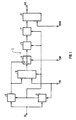
- FIG. 1 one is designated overall by 1 Device for detecting a sequence of abnormal ones Events under a variety of normal Events are shown in an electrical signal IS.
- the input signal IS arrives to a detector circuit (2) that the signal IS regarding a signal parameter (e.g. amplitude and / or slope) with a defined threshold compares.
- a signal parameter e.g. amplitude and / or slope
- the detector circuit (2) can also be designed in this way be that there is a fixed threshold is. Whenever an event occurs, the the defined with regard to the signal parameter Exceeds the threshold value, the detector circuit gives (2) a detection signal DS.
- the signal IS also comes to a Peak value meter (3) based on the same signal parameter how the detector circuit (2) responds.
- the detection signal DS By the detection signal DS, the one Control input of the peak value meter (3) fed is activated in such a way that it when an event occurs (detection signal DS) the maximum value of said signal parameter measures. If the switch (4) the in FIG 1 occupies the position shown, arrives by means of of the peak value meter (3) for each event occurred measured maximum value a memory (5) which is designed such that he the measured for the most recent event Maximum value and that for a defined number from successive immediately before this measured maximum events stores. Doing so each time you save the maximum value of the most recent event the maximum value of the "oldest" event deleted.
- the operations described are by the when an event of the detector circuit (2) each emitted detection signal DS controlled, the memory (5) is fed.
- the changeover switch (4) it is concerned preferably an electronic switch, by applying a changeover signal SW in its other switch position is the Memory (5) with the output of a subtracting circuit (6) connected by the detection signal DS controls the difference for each event between the associated maximum value and the Threshold value of the signal parameter forms.
- the subtracting circuit (6) the output signal of the peak value meter (3) the signal TV corresponding to the threshold value is supplied.
- One of the calculated statistical parameters the corresponding signal is sent to a comparator (8) fed this with a setpoint of statistical Characteristic signal DVA compares that fed to its other input is.
- the setpoint or the corresponding one Signal DVA is selected such that when the electrical signal IS essentially exclusively contains normal events, no output signal AS of the comparator (8) is present. However, if the signal IS is a sequence of abnormal Events or only abnormal events contains, this causes a deviation of the statistical characteristic of the target value, which the Comparator (8) based on the corresponding signals detects and by emitting an output signal AS indicates.
- the device described (1) is so able to follow sequences of abnormal events under a variety of normal events to be detected in an electrical signal IS.
- the comparator (8) be constructed so that it generates an output signal AS if that of the determined corresponding statistical parameter Signal exceeds a corresponding setpoint, falls below or a window-like setpoint range leaves.
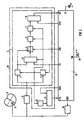
- FIG. 2 shows a device for automatic defibrillation one with a malfunction Heart (9) shown.
- Such devices that are similar like pacemakers in the body of one Can be implanted if miniaturized accordingly and in a suitable Housings are used to one called cardiac fibrillation or fibrillation State of a heart to end by the heart with electric shocks, so-called defibrillation pulses, apply. So that Device can work automatically, it must first be able to prevent the occurrence of fibrillation safe to detect. This is what the device does 2 a designated overall with (10) Fibrillation detector circuit, which the depolarization signal of the heart (9) is supplied.
- the depolarization signal is inserted into a ventricle of the heart (9) implanted electrode (11) removed and goes through a signal conditioning circuit (12) in which it is reinforced and if necessary is filtered before going to the fibrillation detector circuit (10) arrives.
- the fibrillation detector circuit (10) contains a device (1) acc. FIG 1, which is used here in the Depolarization signal of the heart (9) a consequence abnormal, suggestive of fibrillation To detect events. Relevant details will be explained later. However, it is on already pointed out here that the Memory 5 has a capacity sufficient around the maximum values or corresponding to them Data for the least 20, or typically 50 last save events that occurred and that the arithmetic circuit (7) as a parameter.
- the standard deviation determined using the comparator 8 with a corresponding setpoint or this corresponding signal DVA is compared.
- a measuring circuit (13) which by the Device (1) originating detection signals DS are supplied and the the time intervals between successive detector signals DS, i.e. one size corresponding to the heart rate measures.
- the output signal of the measuring circuit (13) arrives at a comparator (14) and is included here a signal DVS corresponding to a setpoint compared to which a certain heart rate may be exceeded if exceeded there is fibrillation.
- the comparator (14) delivers an output signal FS, just like the output signal AS of the comparator (8) one with the fibrillation detector circuit (10) related control logic (15) is supplied.
- the comparator (8) provides an output signal AS, which means that a sequence of abnormal, events suggestive of fibrillation in the depolarization signal of the heart (9) is detected the comparator (14) a signal FS that says the heart rate is in an area for a Fibrillation is typical, actuates the control logic (15) by means of a signal DEF over a corresponding designated output a generator device (16) such that this one or more Delivers defibrillation pulses to the heart (9) over the same electrode (11), which is also used for detection of the depolarization signal is used become. It goes without saying that to act upon of the heart (9) with defibrillation pulses too there may be a separate electrode.
- the fibrillation detector circuit is named (10) the signals TV, DVA, DVS and SW, the meaning of which has already been explained was supplied by the control logic (15).
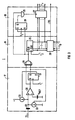
- FIG 3 which as part of the device (1) in the fibrillation detector circuit (10) of the device acc. FIG 2 Is used, performs the functions of the detector circuit (2) and the peak value meter (3) out.
- the circuit is gem. 3 as a digital circuit executed what in terms of interaction with the control logic (15) is an advantage is.
- a circuit corresponding to the circuit shown in FIG. 3 However, switching can also be done without realize another as an analog circuit, if this is desirable.
- the circuit acc. FIG 3 comprises a delta modulator (17), a counter unit (18) and a register unit (19).
- the delta modulator (17) has a comparator (20), a D flip-flop (21), current sources (22) and an integration capacitor (23).
- the inverting input of the comparator (20) is connected to a reference voltage V REF .
- the D flip-flop (21) is clocked at a frequency f 1 of 16 kHz, for example.
- the counter unit (18) has an EXCLUSIVE-OR gate (24), a counter (25) clocked at a frequency f 2 of, for example, 8 kHz and a comparator (26).
- the comparator (26) compares the output value T of the counter (25) with a target value TV, which corresponds to a specific time period t D.
- the register unit (19) contains a register (27) which is clocked via an RS flip-flop (28) and an AND gate (29), the RS flip-flop (28) in turn having a frequency f 1 is clocked.
- the register (27) serves to store the maximum output value of the counter (25), which the counter in each case reaches after the generation of a detection signal DS.
- the output of the comparator (20) remains in its state as long as the amplitude of the depolarization signal IS exceeds (+ I / C) t or ( -I / C) t exceeds or falls below, where t is the time that has passed since. below the slope + I / C or -I / C has elapsed.
- the D flip-flop (21) does not change its state either, so that the counter (25) is not reset by the EXCLUSIVE-OR gate (24).
- the output value T of the counter (25) which is a measure of the time t, begins to increase. If the output value T of the counter (25) reaches a value T D which corresponds to a minimum time period t D , the comparator (26) gives the output value of the counter (25) with the value T D which corresponds to the signal TB according to FIG and Fig. 2 corresponds, compares, to a detection signal DS indicating that an event has been detected. The counter (25) then continues to count until it is reset to zero by the EXCLUSIVE-OR gate (24).
- the AND gate (18) namely gives a clock pulse to the register (27) when, after the detection of an event, the RS flip-flop (28), the output of which is connected to one input of the AND gate (29) , and then a pulse from the EXCLUSIVE-OR gate (24) arrives at the other input of the AND gate (29).
- the circuit according to. 3 shows the signal parameter, with respect to which the depolarization signal IS is compared to a threshold value and with respect to which the maximum value is measured, is the length of time for which the amplitude of the depolarization signal IS exceeds or falls below a value that results from the product of a defined one Slope + I / C or -I / C and that time period t that has elapsed since the slope at which the slope of the depolarization signal IS reaches the defined slope + I / C or -I / C.
- a waveform In order for a waveform to be detected as an event in the depolarization signal IS, it must therefore exceed or fall below a certain slope + I / C or -I / C, reach a certain minimum time period t D and a certain minimum amplitude (+ I / C) t or (-I / C) t.
- FIG 4 shows the depolarization signal of a heart working in the sinus rhythm, that is to say in the normal rhythm, as is shown in the device at the output of the signal processing circuit (12).
- FIG 2 is present.
- the section of the depolarization signal shown contains 3 events, which are designated by I to III.
- the device 1 continuously checks, following the clock of the frequency f 1 , whether the depolarization signal has a slope which exceeds or exceeds the value + I / C. falls below the value -I / C. As long as this is not the case, the counter (25) is continuously reset.
- event I has a slope for the first time at time t 0 , which falls below the value -I / C.
- the counter (25) measures the time period t T until the point in time at which the amplitude of the depolarization signal exceeds the value (-I / C) t.
- the course of the straight line (-I / C) t is entered in FIG. 4, this straight line affecting the depolarization signal at time t 0 and intersecting after the total time period t T has elapsed. Since in the event of event I the total time period t T exceeds a minimum time period t D , for example 6 ms, the device (1) generates a detection signal DS after the minimum time t D has elapsed. Data corresponding to the total time period t T are transferred to the memory (5).
- the corresponding depolarization signal is shown in FIG. 5.
- the total time periods t T determined for the individual events fluctuate considerably.
- FIG. 5 which shows the depolarization signal of a heart operating according to the sinus rhythm
- FIG. 5 shows the rising edges of the events so steep that detection is possible. This means that two detection signals DS are sometimes generated for events IV to XI, since the minimum time period t D is exceeded both in the case of the falling and the rising edge of an event.
- control logic (15) As shown in FIG 2 using the connection TM the control logic (15) and connected to it Transmitting / receiving coil (30) can be seen the control logic (15) is designed such that the Device acc. 2 with a not shown Communicate external device bidirectionally telemetrically can. Accordingly, there is the possibility the data stored in the control logic (15) check for signals DVA, DVS, TV and change if necessary. The same possibility also exists regarding the adjustability of the Power sources (22) and another, additional possible detection criterion, namely the polarity change I / C, + I / C or -I / C for the slope.
- the frequencies f 1 , f 2 are derived in a generally known and therefore not shown manner from the oscillation frequency of a crystal (31) connected to the control logic (15) via the connection C1.
Landscapes
- Health & Medical Sciences (AREA)
- Cardiology (AREA)
- Life Sciences & Earth Sciences (AREA)
- Animal Behavior & Ethology (AREA)
- Veterinary Medicine (AREA)
- Public Health (AREA)
- Engineering & Computer Science (AREA)
- Biomedical Technology (AREA)
- Heart & Thoracic Surgery (AREA)
- General Health & Medical Sciences (AREA)
- Pathology (AREA)
- Surgery (AREA)
- Molecular Biology (AREA)
- Medical Informatics (AREA)
- Biophysics (AREA)
- Physics & Mathematics (AREA)
- Nuclear Medicine, Radiotherapy & Molecular Imaging (AREA)
- Radiology & Medical Imaging (AREA)
- Measurement And Recording Of Electrical Phenomena And Electrical Characteristics Of The Living Body (AREA)
- Electrotherapy Devices (AREA)
- Measuring Pulse, Heart Rate, Blood Pressure Or Blood Flow (AREA)
Description
- FIG 1
- in Form eines Blockschaltbildes eine erfindungsgemässe Einrichtung zur Detektion einer Folge von anormalen Ereignissen unter einer Vielzahl von normalen Ereignissen in einem elektrischen Signal
- FIG 2
- eine Einrichtung zur selbsttätigen Defibrillation eines eine Funktionsstörung aufweisenden Herzens, welche eine Einrichtung gem. FIG 1 enthält, als Blockschaltbild.
- FIG 3
- in detaillierter Darstellung einen Teil der Schaltung der Einrichtung gem. FIG 2,
- FIG 4
- das eine Anzahl von aufeinanderfolgenden normalen Ereignissen enthaltende Depolarisationssignal eines Herzens, und
- FIG 5
- das eine Folge von anormalen, auf eine Fibrillation hindeutenden Ereignissen enthaltende Depolarisationssignal eines eine Funktionsstörung aufweisenden Herzens.
Claims (7)
- Einrichtung zum Detektieren einer Folge von anormalen funktionsstörungsbedingten Ereignissen unter einer Vielzahl von normalen Ereignissen in einem elektrophysiologischen Signal (IS) eines eine Funktionsstörung aufweisenden Organs, welche Einrichtung aufweist:a) Mittel (2;17,18,19) zum Vergleichen des Signals (IS) hinsichtlich eines Signalparameters (t;T) mit einem definierten Schwellwert (tD;TD), den das Signal (IS) sowohl beim Auftreten eines normalen als auch eines anormalen Ereignisses überschreitet,b) Mittel (3;17,18,19) zur Messung des Maximalwertes (tT;TT) des Signalparameters (t;T) des jeweiligen Ereignisses, gekennzeichnet durchc) Mittel (5,7) zum Ermitteln einer der statistischen Verteilung der für das jeweils zuletzt aufgetretene Ereignis und eine definierte Anzahl von aufeinanderfolgend unmittelbar vor diesem aufgetretenen Ereignissen gemessenen Maximalwerten (tT;TT) entsprechenden Kenngröße (S), undd) Mittel (8) zum Vergleichen der ermittelten Kenngröße (S) mit einem definierten Sollwert (DVA), welche bei einer Abweichung zwischen ermittelter Kenngröße (S) und Sollwert (DVA) ein Signal (AS) erzeugen.
- Einrichtung nach Anspruch 1, dadurch gekennzeichnet, daß die Mittel (5,7) zum Ermitteln einer der statistischen Verteilung der gemessenen Maximalwerte (tT;TT) entsprechenden Kenngröße (S) die Standardabweichung ermitteln.
- Einrichtung nach Anspruch 1 oder 2, dadurch gekennzeichnet, daß Mittel (4,6)zur Bestimmung der Differenz zwischen dem jeweils für ein Ereignis gemessenen Maximalwert (tT;TT) und dem Schwellwert (tD;TD) des Signalparameters (t;T) vorgesehen sind, wobei den Mitteln (7) zum Ermitteln einer der statistischen Verteilung der gemessenen Maximalwerte (tT;TT) entsprechenden Kenngröße bezüglich der einzelnen Ereignisse jeweils die Differenz zur Ermittlung der Größe (S) zugeführt ist.
- Einrichtung nach Anspruch 1, wobei das Signal das Depolarisationssignal (IS) eines eine Funktionsstörung aufweisenden Herzens (9) ist und wobei die Folge von anormalen Ereignissen auf eine Fibrillation hindeutet, und welche Einrichtung aufweist:a) Mittel (11,12) zum Erfassen des Depolarisationssignals(IS) des Herzens (9),b) Mittel (2,17,18,19) zum Vergleichen des Depolarisationssignals (IS) hinsichtlich derjenigen, als Signalparameter zu verstehenden Zeitdauer (t;T), für die seine Amplitude jeweils beginnend von einem Zeitpunkt (t0), zu dem die Steilheit des Depolarisationssignals (IS) eine definierte Steilheit (+ I/C,-IC) erreicht, mindestens dem Produkt aus definierter Steilheit (+ I/C,-I/C) und verstrichener Zeit entspricht (t;T), mit einer als Schwellwert zu verstehenden Mindestzeitdauer (tD;TD), die das Depolarisationssignal (IS) sowohl beim Auftreten eines normalen als auch eines auf eine Fibrillation hindeutenden Ereignisses überschreitet,c) Mittel (3;17,18,19) zum Messen der, als Maximalwert zu verstehenden, Gesamtzeitdauer (tT:TT) für die die Amplitude des Depolarisationssignals (IS) während des jeweiligen Ereignisses mindestens dem Produkt aus definierter Steilheit (+ I/C,-I/C) und verstrichener Zeit (t;T) entspricht,d) Mittel (5.7) zum Ermitteln einer der als statistische Verteilung zu verstehenden Standardabweichung, der für das jeweils zuletzt aufgetretene Ereignis und eine definierte Anzahl von aufeinanderfolgend unmittelbar vor diesem aufgetretenen Ereignissen gemessenen Gesamtzeitdauern (tT;TT) entsprechenden statistischen Kenngröße (S), unde) Mittel (8) zum Vergleichen der ermittelten statistischen Kenngröße (S) mit einem Sollwert (DVA) der Kenngröße (S), welche beim Überschreiten des Sollwertes (DVA) ein Signal (AS) erzeugen.
- Einrichtung zum Detektieren der Fibrillation eines eine Funktionsstörung aufweisenden Herzens, welche aufweist:a) eine Einrichtung nach Anspruch 4, zum Detektieren einer Folge von auf eine Defibrillation hindeutenden Ereignissen in dem Depolarisationssignal (IS) des Herzens (9),b) Mittel (13,14) zum Messen der Herzschlagfrequenz des Herzens (9) und Vergleichen der gemessenen Herzschlagfrequenz mit einem definierten Grenzwert (DVS), undc) Mittel zum Erzeugen eines Signales (DEF), wenn sowohl die der Standardabweichung entsprechende Kenngröße (S) den Sollwert (DVA) als auch die Herzschlagfrequenz den Grenzwert (DVS) überschreiten.
- Einrichtung zur selbsttätigen Defibrillation eines eine Funktionsstörung aufweisenden Herzens, welche aufweist:a) eine Einrichtung nach Anspruch 5 zum Detektieren der Defibrillation des Herzens (9),b) Mittel (16,11) zur Beaufschlagung des Herzens (9) mit Defibrillationsimpulsen, die mit den Mitteln (15) zum Erzeugen eines Signals (DEF) verbunden sind und bei Vorliegen eines Signales (DEF) das Herz (9) mit wenigstens einem Defibrillationsimpuls beaufschlagen.
- Einrichtung nach einem der Ansprüche 4 bis 6, dadurch gekennzeichnet, daß Mittel (4,6) zur Bestimmung der Differenz zwischen der jeweils für ein Ereignis gemessenen Gesamtzeitdauer (tT;TT) und der Mindestzeitdauer (tD;TD) vorgesehen sind, wobei den Mitteln (7) zum Ermitteln einer der statistischen Verteilung der gemessenen Maximalwerte (tT;TT) entsprechenden Kenngröße (S) bezüglich der einzelnen Ereignisse jeweils die Differenzen zur Ermittlung der Kenngröße (S) zugeführt sind.
Priority Applications (4)
| Application Number | Priority Date | Filing Date | Title |
|---|---|---|---|
| DE58909118T DE58909118D1 (de) | 1989-06-15 | 1989-06-15 | Verfahren und Einrichtung zum Detektieren einer Folge von anormalen Ereignissen in einem elektrischen Signal, insbesondere dem Depolarisationssignal eines Herzens. |
| EP89110885A EP0402508B2 (de) | 1989-06-15 | 1989-06-15 | Einrichtung zum Detektieren einer Folge von anormalen Ereignissen in einem elektrischen Signal, insbesondere dem Depolarisationssignal eines Herzens |
| JP2154996A JPH0355027A (ja) | 1989-06-15 | 1990-06-13 | 異常事象の検出方法および装置 |
| US07/538,107 US5058599A (en) | 1989-06-15 | 1990-06-14 | Method and apparatus for detecting a sequence of abnormal events in an electrical signal, particularly in the depolarization signal of a heart |
Applications Claiming Priority (1)
| Application Number | Priority Date | Filing Date | Title |
|---|---|---|---|
| EP89110885A EP0402508B2 (de) | 1989-06-15 | 1989-06-15 | Einrichtung zum Detektieren einer Folge von anormalen Ereignissen in einem elektrischen Signal, insbesondere dem Depolarisationssignal eines Herzens |
Publications (3)
| Publication Number | Publication Date |
|---|---|
| EP0402508A1 EP0402508A1 (de) | 1990-12-19 |
| EP0402508B1 EP0402508B1 (de) | 1995-03-15 |
| EP0402508B2 true EP0402508B2 (de) | 2002-10-23 |
Family
ID=8201502
Family Applications (1)
| Application Number | Title | Priority Date | Filing Date |
|---|---|---|---|
| EP89110885A Expired - Lifetime EP0402508B2 (de) | 1989-06-15 | 1989-06-15 | Einrichtung zum Detektieren einer Folge von anormalen Ereignissen in einem elektrischen Signal, insbesondere dem Depolarisationssignal eines Herzens |
Country Status (4)
| Country | Link |
|---|---|
| US (1) | US5058599A (de) |
| EP (1) | EP0402508B2 (de) |
| JP (1) | JPH0355027A (de) |
| DE (1) | DE58909118D1 (de) |
Families Citing this family (45)
| Publication number | Priority date | Publication date | Assignee | Title |
|---|---|---|---|---|
| US5280792A (en) * | 1991-09-20 | 1994-01-25 | The University Of Sydney | Method and system for automatically classifying intracardiac electrograms |
| US5301677A (en) * | 1992-02-06 | 1994-04-12 | Cardiac Pacemakers, Inc. | Arrhythmia detector using delta modulated turning point morphology of the ECG wave |
| IT1259358B (it) * | 1992-03-26 | 1996-03-12 | Sorin Biomedica Spa | Dispositivo impiantabile per la rilevazione ed il controllo del tono simpatico-vagale |
| EP0583490B1 (de) * | 1992-07-31 | 1998-04-22 | Pacesetter AB | Verfahren zur Verarbeitung eines elektrischen, insbesondere von einem Herzen abgeleiteten Signals |
| US5566096A (en) * | 1992-11-13 | 1996-10-15 | Quinton Electrophysiology Corporation | Integrated electrical signal switching and amplifying system |
| US5400795A (en) * | 1993-10-22 | 1995-03-28 | Telectronics Pacing Systems, Inc. | Method of classifying heart rhythms by analyzing several morphology defining metrics derived for a patient's QRS complex |
| US5640967A (en) * | 1994-03-29 | 1997-06-24 | Quinton Electrophysiology Corporation | Monitoring system and method for use during an electrophysiology study |
| SE9401578D0 (sv) | 1994-05-06 | 1994-05-06 | Siemens Elema Ab | Medicinsk anordning |
| DE4427845A1 (de) * | 1994-07-30 | 1996-02-01 | Biotronik Mess & Therapieg | Verfahren zur Aufnahme von für Herzaktionen charakteristischen Signalen und Vorrichtung zu dessen Durchführung |
| US5545186A (en) | 1995-03-30 | 1996-08-13 | Medtronic, Inc. | Prioritized rule based method and apparatus for diagnosis and treatment of arrhythmias |
| WO1997043002A1 (en) * | 1996-05-14 | 1997-11-20 | Medtronic, Inc. | Prioritized rule based method and apparatus for diagnosis and treatment of arrhythmias |
| US5817132A (en) * | 1997-05-09 | 1998-10-06 | Cedars-Sinai Medical Center | Defibrillation apparatus and method |
| US6024740A (en) | 1997-07-08 | 2000-02-15 | The Regents Of The University Of California | Circumferential ablation device assembly |
| US5971983A (en) | 1997-05-09 | 1999-10-26 | The Regents Of The University Of California | Tissue ablation device and method of use |
| US6012457A (en) | 1997-07-08 | 2000-01-11 | The Regents Of The University Of California | Device and method for forming a circumferential conduction block in a pulmonary vein |
| US5868680A (en) * | 1997-09-23 | 1999-02-09 | The Regents Of The University Of California | Quantitative characterization of fibrillatory spatiotemporal organization |
| SE9704311D0 (sv) * | 1997-11-24 | 1997-11-24 | Pacesetter Ab | A cardiac event detecting system for a heart stimulator |
| US6453192B1 (en) * | 2000-03-13 | 2002-09-17 | Cardiac Pacemakers, Inc. | Detection of ventricular ectopic beats using ventricular electrogram |
| US6567691B1 (en) | 2000-03-22 | 2003-05-20 | Medtronic, Inc. | Method and apparatus diagnosis and treatment of arrhythias |
| DE60102836T2 (de) | 2000-11-28 | 2005-04-21 | Medtronic Inc | Vorrichtung zur erkennung einer vorhoffibrillation mittels herzkammerdetektion |
| US6684105B2 (en) * | 2001-08-31 | 2004-01-27 | Biocontrol Medical, Ltd. | Treatment of disorders by unidirectional nerve stimulation |
| US7885709B2 (en) | 2001-08-31 | 2011-02-08 | Bio Control Medical (B.C.M.) Ltd. | Nerve stimulation for treating disorders |
| US7974693B2 (en) * | 2001-08-31 | 2011-07-05 | Bio Control Medical (B.C.M.) Ltd. | Techniques for applying, configuring, and coordinating nerve fiber stimulation |
| US8386056B2 (en) | 2001-08-31 | 2013-02-26 | Bio Control Medical (B.C.M.) Ltd. | Parasympathetic stimulation for treating atrial arrhythmia and heart failure |
| US7778711B2 (en) | 2001-08-31 | 2010-08-17 | Bio Control Medical (B.C.M.) Ltd. | Reduction of heart rate variability by parasympathetic stimulation |
| US8571653B2 (en) | 2001-08-31 | 2013-10-29 | Bio Control Medical (B.C.M.) Ltd. | Nerve stimulation techniques |
| US6932804B2 (en) | 2003-01-21 | 2005-08-23 | The Regents Of The University Of California | System and method for forming a non-ablative cardiac conduction block |
| US7321793B2 (en) | 2003-06-13 | 2008-01-22 | Biocontrol Medical Ltd. | Vagal stimulation for atrial fibrillation therapy |
| US8036745B2 (en) * | 2004-06-10 | 2011-10-11 | Bio Control Medical (B.C.M.) Ltd. | Parasympathetic pacing therapy during and following a medical procedure, clinical trauma or pathology |
| US8204591B2 (en) | 2002-05-23 | 2012-06-19 | Bio Control Medical (B.C.M.) Ltd. | Techniques for prevention of atrial fibrillation |
| US7076298B2 (en) * | 2002-06-14 | 2006-07-11 | Medtronic, Inc. | Method and apparatus for prevention of arrhythmia clusters using overdrive pacing |
| US7317950B2 (en) | 2002-11-16 | 2008-01-08 | The Regents Of The University Of California | Cardiac stimulation system with delivery of conductive agent |
| EP1648560A4 (de) | 2003-06-13 | 2015-10-28 | Biocontrol Medical Ltd | Vagale stimulation für die anti-embolie-therapie |
| US8229545B2 (en) | 2005-09-15 | 2012-07-24 | St. Jude Medical, Atrial Fibrillation Division, Inc. | System and method for mapping complex fractionated electrogram information |
| US8038625B2 (en) * | 2005-09-15 | 2011-10-18 | St. Jude Medical, Atrial Fibrillation Division, Inc. | System and method for three-dimensional mapping of electrophysiology information |
| US20070129065A1 (en) * | 2005-12-05 | 2007-06-07 | Justin Divis | System and method for providing advertising using a communication network for mobile phones |
| EP1993053A1 (de) * | 2007-03-20 | 2008-11-19 | British Telecommunications Public Limited Company | Erkennung von abnormalen Ereignissen |
| US9370660B2 (en) | 2013-03-29 | 2016-06-21 | Rainbow Medical Ltd. | Independently-controlled bidirectional nerve stimulation |
| US10105540B2 (en) | 2015-11-09 | 2018-10-23 | Bluewind Medical Ltd. | Optimization of application of current |
| TWI563973B (zh) * | 2015-12-02 | 2017-01-01 | 麗東生技股份有限公司 | 生物訊號檢測方法及電子裝置 |
| EP3612081B1 (de) | 2017-04-18 | 2025-07-30 | Boston Scientific Scimed Inc. | Annotationshistogramm für elektrophysiologische signale |
| WO2018195040A1 (en) | 2017-04-18 | 2018-10-25 | Boston Scientific Scimed Inc. | Electroanatomical mapping tools facilitated by activation waveforms |
| US10709349B2 (en) | 2017-04-18 | 2020-07-14 | Boston Scientific Scimed Inc. | Annotation waveform |
| RU200046U1 (ru) * | 2020-05-19 | 2020-10-02 | Общество с ограниченной ответственностью Управляющая компания "Алтайский завод прецизионных изделий" | Центробежный суппорт |
| EP4221572A1 (de) | 2020-09-30 | 2023-08-09 | Boston Scientific Scimed Inc. | Interaktive 2d-streukurve von egm-eigenschaftsmetriken |
Family Cites Families (11)
| Publication number | Priority date | Publication date | Assignee | Title |
|---|---|---|---|---|
| US3612041A (en) * | 1969-07-25 | 1971-10-12 | Us Army | Apparatus for detecting ventricular fibrillation |
| US3703900A (en) * | 1969-12-02 | 1972-11-28 | Cardiac Resuscitator Corp | Cardiac resuscitator |
| US3861387A (en) * | 1972-09-11 | 1975-01-21 | Cardiodynamics | Cardiac arrhythmia detector |
| US3978856A (en) * | 1975-03-20 | 1976-09-07 | Michel Walter A | Heart beat waveform monitoring apparatus |
| US4202340A (en) * | 1975-09-30 | 1980-05-13 | Mieczyslaw Mirowski | Method and apparatus for monitoring heart activity, detecting abnormalities, and cardioverting a malfunctioning heart |
| GB1538522A (en) * | 1975-09-30 | 1979-01-17 | Mirowski M | Apparatus for detecting the state of a heart and for cardioverting a malfunctioning heart |
| US4184493A (en) * | 1975-09-30 | 1980-01-22 | Mieczyslaw Mirowski | Circuit for monitoring a heart and for effecting cardioversion of a needy heart |
| US4342318A (en) * | 1980-08-25 | 1982-08-03 | Medtronic, Inc. | Physiological waveform processor |
| US4393877A (en) * | 1981-05-15 | 1983-07-19 | Mieczyslaw Mirowski | Heart rate detector |
| US4523595A (en) * | 1981-11-25 | 1985-06-18 | Zibell J Scott | Method and apparatus for automatic detection and treatment of ventricular fibrillation |
| US4905708A (en) * | 1985-10-31 | 1990-03-06 | Davies David W | Apparatus for recognizing cardiac rhythms |
-
1989
- 1989-06-15 DE DE58909118T patent/DE58909118D1/de not_active Expired - Fee Related
- 1989-06-15 EP EP89110885A patent/EP0402508B2/de not_active Expired - Lifetime
-
1990
- 1990-06-13 JP JP2154996A patent/JPH0355027A/ja active Pending
- 1990-06-14 US US07/538,107 patent/US5058599A/en not_active Expired - Lifetime
Also Published As
| Publication number | Publication date |
|---|---|
| EP0402508A1 (de) | 1990-12-19 |
| DE58909118D1 (de) | 1995-04-20 |
| JPH0355027A (ja) | 1991-03-08 |
| EP0402508B1 (de) | 1995-03-15 |
| US5058599A (en) | 1991-10-22 |
Similar Documents
| Publication | Publication Date | Title |
|---|---|---|
| EP0402508B1 (de) | Verfahren und Einrichtung zum Detektieren einer Folge von anormalen Ereignissen in einem elektrischen Signal, insbesondere dem Depolarisationssignal eines Herzens | |
| DE3037927C2 (de) | Vorrichtung zur Überwachung der respirativen Aktivität eines Patienten mit Einrichtungen zur Unterdrückung von Störsignalen | |
| EP0212370B1 (de) | Verfahren und Gerät zur Atmungsüberwachung | |
| DE2447052C2 (de) | Gerät zur Erkennung der R-Zacke in einem Herzaktionssignal | |
| DE69226345T2 (de) | Erfassung der Bewegung zwischen einer Elektrode und einem Patienten und schnelle Wiederherstellung der Grenzen | |
| DE3249490C2 (de) | Vorrichtung zum Erfassen der Herzaktion | |
| EP0453589B1 (de) | Anordnung zur Gewebestimulation | |
| EP0464252B1 (de) | Anordnung zur Gewebestimulation | |
| DE2217235C3 (de) | Vorrichtung zur Überwachung der Herztätigkeit eines Patienten durch Ermittlung und Vergleich von Formkriterien des Herzaktionssignals | |
| WO1991016102A1 (de) | Anordnung zur gewebestimulation | |
| DE2253967C3 (de) | Verfahren zur Erfassung von Arrhythmien im Verlauf von Herzaktionsspannungen und Vorrichtung zur Durchführung des Verfahrens | |
| DE3131042A1 (de) | Anordnung und verfahren zum erfassen von herzrhythmusstoerungen | |
| DE2747730A1 (de) | Herzschrittmacher | |
| DE2661005C2 (de) | ||
| EP1108390B1 (de) | Vorrichtung zur Erkennung der Kreislaufwirkungen von Extrasystolen | |
| DE2825626C2 (de) | ||
| EP0490985B1 (de) | Medizinisches gerät zur stimulation von gewebekontraktionen | |
| DE2328468A1 (de) | Schaltungsanordnung zum erzeugen einer dem foetalen herzschlag entsprechenden impulsfolge | |
| DE2062752B2 (de) | Vorrichtung zum Anzeigen von vorzeitigen Herzkammerkontraktionen, die von mehreren reizbaren Stellen ausgelöst werden | |
| DE2628629C3 (de) | Bedarfsherzschrittmacher mit Störerkennungsschaltung | |
| EP0005170A2 (de) | Schaltanordnung zum Erkennen von Arrhythmien | |
| DE2362063B2 (de) | Schaltungsanordnung zum Erfassen von physiologischen elektrischen Meßsignalen | |
| DE19844598A1 (de) | Inplantierbarer Kardioverter, insbesondere Defibrillator | |
| EP1074274B1 (de) | Vorrichtung zur Erkennung von Fusionsereignissen bei Elektrostimulation des Herzens | |
| DE2246100A1 (de) | Geraet zum erfassen bzw. verarbeiten von messignalen |
Legal Events
| Date | Code | Title | Description |
|---|---|---|---|
| PUAI | Public reference made under article 153(3) epc to a published international application that has entered the european phase |
Free format text: ORIGINAL CODE: 0009012 |
|
| AK | Designated contracting states |
Kind code of ref document: A1 Designated state(s): DE FR GB IT NL SE |
|
| 17P | Request for examination filed |
Effective date: 19901205 |
|
| 17Q | First examination report despatched |
Effective date: 19930224 |
|
| RAP1 | Party data changed (applicant data changed or rights of an application transferred) |
Owner name: PACESETTER AB |
|
| GRAA | (expected) grant |
Free format text: ORIGINAL CODE: 0009210 |
|
| AK | Designated contracting states |
Kind code of ref document: B1 Designated state(s): DE FR GB IT NL SE |
|
| REF | Corresponds to: |
Ref document number: 58909118 Country of ref document: DE Date of ref document: 19950420 |
|
| ET | Fr: translation filed | ||
| ITF | It: translation for a ep patent filed | ||
| PG25 | Lapsed in a contracting state [announced via postgrant information from national office to epo] |
Ref country code: SE Effective date: 19950615 |
|
| GBT | Gb: translation of ep patent filed (gb section 77(6)(a)/1977) |
Effective date: 19950605 |
|
| PLBQ | Unpublished change to opponent data |
Free format text: ORIGINAL CODE: EPIDOS OPPO |
|
| PLBI | Opposition filed |
Free format text: ORIGINAL CODE: 0009260 |
|
| PLBF | Reply of patent proprietor to notice(s) of opposition |
Free format text: ORIGINAL CODE: EPIDOS OBSO |
|
| 26 | Opposition filed |
Opponent name: BIOTRONIK MESS- UND THERAPIEGERAETE GMBH & CO INGE Effective date: 19951213 |
|
| NLR1 | Nl: opposition has been filed with the epo |
Opponent name: BIOTRONIK MESS- UND THERAPIEGERAETE GMBH & CO INGE |
|
| PLBF | Reply of patent proprietor to notice(s) of opposition |
Free format text: ORIGINAL CODE: EPIDOS OBSO |
|
| RAP2 | Party data changed (patent owner data changed or rights of a patent transferred) |
Owner name: PACESETTER AB |
|
| NLT2 | Nl: modifications (of names), taken from the european patent patent bulletin |
Owner name: PACESETTER AB |
|
| PGFP | Annual fee paid to national office [announced via postgrant information from national office to epo] |
Ref country code: GB Payment date: 19980515 Year of fee payment: 10 |
|
| PLBO | Opposition rejected |
Free format text: ORIGINAL CODE: EPIDOS REJO |
|
| APAC | Appeal dossier modified |
Free format text: ORIGINAL CODE: EPIDOS NOAPO |
|
| APAE | Appeal reference modified |
Free format text: ORIGINAL CODE: EPIDOS REFNO |
|
| APAC | Appeal dossier modified |
Free format text: ORIGINAL CODE: EPIDOS NOAPO |
|
| PG25 | Lapsed in a contracting state [announced via postgrant information from national office to epo] |
Ref country code: GB Free format text: LAPSE BECAUSE OF NON-PAYMENT OF DUE FEES Effective date: 19990615 |
|
| PGFP | Annual fee paid to national office [announced via postgrant information from national office to epo] |
Ref country code: NL Payment date: 19990621 Year of fee payment: 11 |
|
| GBPC | Gb: european patent ceased through non-payment of renewal fee |
Effective date: 19990615 |
|
| PG25 | Lapsed in a contracting state [announced via postgrant information from national office to epo] |
Ref country code: NL Free format text: LAPSE BECAUSE OF NON-PAYMENT OF DUE FEES Effective date: 20010101 |
|
| RAP2 | Party data changed (patent owner data changed or rights of a patent transferred) |
Owner name: ST. JUDE MEDICAL AB |
|
| NLV4 | Nl: lapsed or anulled due to non-payment of the annual fee |
Effective date: 20010101 |
|
| APAC | Appeal dossier modified |
Free format text: ORIGINAL CODE: EPIDOS NOAPO |
|
| PLAW | Interlocutory decision in opposition |
Free format text: ORIGINAL CODE: EPIDOS IDOP |
|
| RTI2 | Title (correction) |
Free format text: MEANS FOR DETECTING A SERIES OF ABNORMAL EVENTS IN AN ELECTRICAL SIGNAL, ESPECIALLY THE DEPOLARISATION SIGNAL OF A HEART |
|
| PUAH | Patent maintained in amended form |
Free format text: ORIGINAL CODE: 0009272 |
|
| STAA | Information on the status of an ep patent application or granted ep patent |
Free format text: STATUS: PATENT MAINTAINED AS AMENDED |
|
| 27A | Patent maintained in amended form |
Effective date: 20021023 |
|
| AK | Designated contracting states |
Kind code of ref document: B2 Designated state(s): DE FR GB IT NL SE |
|
| ET3 | Fr: translation filed ** decision concerning opposition | ||
| APAH | Appeal reference modified |
Free format text: ORIGINAL CODE: EPIDOSCREFNO |
|
| PGFP | Annual fee paid to national office [announced via postgrant information from national office to epo] |
Ref country code: DE Payment date: 20070622 Year of fee payment: 19 |
|
| PGFP | Annual fee paid to national office [announced via postgrant information from national office to epo] |
Ref country code: IT Payment date: 20070616 Year of fee payment: 19 |
|
| PG25 | Lapsed in a contracting state [announced via postgrant information from national office to epo] |
Ref country code: DE Free format text: LAPSE BECAUSE OF NON-PAYMENT OF DUE FEES Effective date: 20090101 |
|
| PG25 | Lapsed in a contracting state [announced via postgrant information from national office to epo] |
Ref country code: IT Free format text: LAPSE BECAUSE OF NON-PAYMENT OF DUE FEES Effective date: 20080615 |
|
| PGFP | Annual fee paid to national office [announced via postgrant information from national office to epo] |
Ref country code: FR Payment date: 20080430 Year of fee payment: 20 |