EP0402162A2 - Traitement d'image avec opérateurs d'amélioration du bruit pour la réduction de moiré et/ou la génération des pointes aléatoires - Google Patents
Traitement d'image avec opérateurs d'amélioration du bruit pour la réduction de moiré et/ou la génération des pointes aléatoires Download PDFInfo
- Publication number
- EP0402162A2 EP0402162A2 EP90306251A EP90306251A EP0402162A2 EP 0402162 A2 EP0402162 A2 EP 0402162A2 EP 90306251 A EP90306251 A EP 90306251A EP 90306251 A EP90306251 A EP 90306251A EP 0402162 A2 EP0402162 A2 EP 0402162A2
- Authority
- EP
- European Patent Office
- Prior art keywords
- image data
- image
- noise
- function
- filter
- Prior art date
- Legal status (The legal status is an assumption and is not a legal conclusion. Google has not performed a legal analysis and makes no representation as to the accuracy of the status listed.)
- Granted
Links
- 238000012545 processing Methods 0.000 title claims abstract description 37
- 230000002708 enhancing effect Effects 0.000 title claims description 6
- 230000000694 effects Effects 0.000 claims abstract description 25
- 230000006870 function Effects 0.000 claims description 57
- 238000000034 method Methods 0.000 claims description 35
- 230000000737 periodic effect Effects 0.000 claims description 13
- 238000003672 processing method Methods 0.000 claims 1
- 238000001914 filtration Methods 0.000 abstract description 10
- 238000010009 beating Methods 0.000 abstract description 3
- 230000008569 process Effects 0.000 description 13
- 238000005070 sampling Methods 0.000 description 9
- 238000012216 screening Methods 0.000 description 9
- 239000000872 buffer Substances 0.000 description 6
- 230000000873 masking effect Effects 0.000 description 6
- 230000000007 visual effect Effects 0.000 description 5
- 230000000875 corresponding effect Effects 0.000 description 3
- 238000012986 modification Methods 0.000 description 3
- 230000004048 modification Effects 0.000 description 3
- 230000008901 benefit Effects 0.000 description 2
- 238000006243 chemical reaction Methods 0.000 description 2
- 230000002596 correlated effect Effects 0.000 description 2
- 238000009795 derivation Methods 0.000 description 2
- 238000010586 diagram Methods 0.000 description 2
- 238000003384 imaging method Methods 0.000 description 2
- 238000003860 storage Methods 0.000 description 2
- 230000003321 amplification Effects 0.000 description 1
- 238000005311 autocorrelation function Methods 0.000 description 1
- 230000005540 biological transmission Effects 0.000 description 1
- 230000001276 controlling effect Effects 0.000 description 1
- 238000012937 correction Methods 0.000 description 1
- 230000007547 defect Effects 0.000 description 1
- 230000001419 dependent effect Effects 0.000 description 1
- 238000001514 detection method Methods 0.000 description 1
- 238000009792 diffusion process Methods 0.000 description 1
- 238000012432 intermediate storage Methods 0.000 description 1
- 239000011159 matrix material Substances 0.000 description 1
- 238000003199 nucleic acid amplification method Methods 0.000 description 1
- 238000010422 painting Methods 0.000 description 1
- 230000004044 response Effects 0.000 description 1
- 230000035945 sensitivity Effects 0.000 description 1
- 230000001360 synchronised effect Effects 0.000 description 1
- 238000012546 transfer Methods 0.000 description 1
Images

Classifications
-
- H—ELECTRICITY
- H04—ELECTRIC COMMUNICATION TECHNIQUE
- H04N—PICTORIAL COMMUNICATION, e.g. TELEVISION
- H04N1/00—Scanning, transmission or reproduction of documents or the like, e.g. facsimile transmission; Details thereof
- H04N1/40—Picture signal circuits
- H04N1/40075—Descreening, i.e. converting a halftone signal into a corresponding continuous-tone signal; Rescreening, i.e. combined descreening and halftoning
-
- H—ELECTRICITY
- H04—ELECTRIC COMMUNICATION TECHNIQUE
- H04N—PICTORIAL COMMUNICATION, e.g. TELEVISION
- H04N1/00—Scanning, transmission or reproduction of documents or the like, e.g. facsimile transmission; Details thereof
- H04N1/40—Picture signal circuits
- H04N1/405—Halftoning, i.e. converting the picture signal of a continuous-tone original into a corresponding signal showing only two levels
-
- H—ELECTRICITY
- H04—ELECTRIC COMMUNICATION TECHNIQUE
- H04N—PICTORIAL COMMUNICATION, e.g. TELEVISION
- H04N1/00—Scanning, transmission or reproduction of documents or the like, e.g. facsimile transmission; Details thereof
- H04N1/40—Picture signal circuits
- H04N1/409—Edge or detail enhancement; Noise or error suppression
Definitions
- the present invention relates generally to the use of digital filtering and thresholding techniques in electronic image reproduction, and more particularly, to image filtering methods to obtain special effects.
- the 8 bit data of varying intensity is directed through a threshold device to determine whether the data for a selected location should be assigned a spot or a blank.
- the data value for any given pixel location is compared to a threshold value to determine whether a spot should be printed for that location, or if the location should be left blank.
- a single threshold value may be applied to all the data derived by the scanner. Tonal range, contrast and other qualities of the output image may be varied by controlling the threshold conversion applied to the image.
- Filters work by changing the grey value of each pixel in the electronic image based on various mathematical relationships to one or more pixels in the immediate surrounding area. Filters vary in their function by the relationship employed, by the size of the area covered by the filter and the number of pixels used, and/or coefficient values associated with each pixel. Filters work by emphasizing edges or particular frequencies of interest. Just as there are screens that create special effects in images, there are also filters that create their own type of special effects. Differential filters detect edges in an image, resulting in the output image being an 'outlined' version of the original. There are many differential filters useful for edge gradient detection, including one class known as Laplacian operators. Such filters are discussed in Gonzalez & Wintz, Digital Image Processing, Addison-Wesley Publishing Co. Reading, MAp.58 and p.212.
- Moiré is the result of two or more periodic patterns beating or interacting with each other. Patterns here are defined as halftone screens or sampling (i.e., digitizing). Sampling moiré is unavoidable. It varies with sampling frequency of the image input device and the input image frequency. It is an artifact of sampling a periodic input. It is common practice to apply screens in making images of pictorial documents, such as photographs or art work, to create the appearance of intermediate levels of grey.
- An alternative to this technique uses hardware or software to apply noise (e.g., with random number generator applying random numbers to a screening operation) to the scanned image, as shown for example in US-A 4,700,235 to Gall, US-A 4,449,150 to Kato, US-A 4,578,714 to Sugiura et al., JP-A 56-143766 to Yokomizo and JP-A 56-141667 to Yokomizo.
- the artificially produced noise breaks up, or masks the structure of the moiré patterns eliminating some of the high frequency structure that comprises the moiré.
- the disadvantage of this method is that it can be intolerably slow for software applications and expensive in hardware.
- US-A 4,782,399 to Sato uses filtering of a digital image to eliminate moiré effects by processing the image along two channels, a high resolution channel and a low resolution channel, and selecting the channel that produces the best result for particular image data types
- US-A 4,821,109 to Roe describes the use of a probability function which introduces a random element in the choice of elemental areas at the edge of a halftone dot
- US-A 4,819,066 to Miyagi pertains to continuous tone image data processing that attempts to approximate continuous tone images by reproducing the exact density of the original image.
- US-A 4,691,343 to Tenenbaum shows a facsimile arrangement which uses an audio carrier signal superimposed on the image information signal to eliminate noise.
- US-A 4,739,413 to Meyer teaches defining pixel density by a value having amplitude and phase.
- US-A 4,811,108 to Numakura et al. teaches conversion of a continuous tone image to a halftone image by processing the data so that the density of a control point in the continuous tone image and the density of a corresponding control point in the halftone image are correlated.
- US-A 4,811,115 to Lin et al. teaches the use of an approximate auto correlation function to detect the frequency of halftone image data to select the method of handling the data.
- US-A 4,817,180 to Cho et al. teaches the filtering in one or two dimensions for detail emphasis.
- the invention is intended to provide an improved method and apparatus for producing special effects in digital image processing.
- a method of processing digital image data to alter the appearance thereof including: supplying image data, said image data including inherent random noise, and having an original periodic function, said image data having superimposed thereon an additional periodic function, said original and additional periodic functions having frequencies creating a moiré pattern in said image data; characterised by applying a filter function to the image data supplied, said filter function having the characteristics of enhancing high frequency and noise of said image data, whereby enhancement of said random noise masks the moiré pattern in said image data.
- a filter function is applied to the image data that greatly enhances high frequency image data, including noise inherent in the image.
- noise which may be the granularity of the image, serves to mask the beating pattern of moiré, when present.
- One function which accomplishes adequate high frequency noise enhancement is a modified Laplacian function.
- the image is thresholded to place it in an appropriate form for printing.
- the special effect of a random screen image or mezzo tint is obtained when a continuous tone image is processed with a modified Laplacian filter function, and subsequently thresholded.
- the result allows the image data to be processed in a manner allowing the effect of a random screen without the use of a screen, preparatory to printing.
- the invention provides a method and apparatus for image processing for producing with a filter operator, for selected enhancements to an image, the effect of random noise by the application of selected functions alone or in combination with other thresholding or image processing techniques.
- the modified Laplacian operator referred to in conjunction with the described invention is a filter function characterized by a n x m operator, where n and m are greater than or equal to 3, with a uniform, or nearly uniform field of negative coefficients about a single positive coefficient, and the sum of all the coefficients of the operator is greater than 0.
- n and m are greater than or equal to 3
- the single positive coefficient need not necessarily be centrally located in the field.
- the Laplacian filter which greatly amplifies high frequencies, may be used to minimize moiré. It enhances high frequency noise, which masks the moiré. Lower frequencies characterized by moiré are not enhanced as greatly. The amount of masking is dependent upon system and input image noise. The noise impairs the periodic pattern of moiré, visually masking that defect. Intermediate grey levels are maintained by modification to the filter which tends to preserve some of the D.C. characteristics of the system. The video is then thresholded to give a more random appearance to the reproduced dot pattern.
- this process may replace both a low pass filter and subsequent screening process normally applied to high frequency halftone originals to prevent moiré. It also replaces the use of a random noise generator in conjunction with screening software or hardware for masking moiré.
- the inventive image processing apparatus and method described here takes advantage of the idea that the photograph or other continuous tone images themselves can be the source of an infinite random number generator, and the magnitude of the random number is correlated with density.
- the appearance emulates the effect of a random halftone process and extends to any document where the inherent noise (or granularity) in the process is proportional to the darkness (or density) at each point.
- the method uses thresholding and not halftoning, the implementation of the method is simpler.
- the random screening effect emulated by the modified Laplacian function as applied to a continuous tone image, in combination with a standard thresholding process is, in itself, useful for a variety of purposes. Because of the random dot pattern, obtained from the amplification of random noise in the image, subsequent reproduction of the image with a periodic sampling process will not be susceptible to moiré. A pleasing artistic or visual effect may be obtained. The darkness of the image is adjustable by merely altering the threshold level and/or the DC of the noise enhancing operator. This arrangement constitutes another method of converting a grey image into a format suitable for printing in a binary printer. A cost advantage may be available if an image processing arrangement provided with a programmable filter does not require a random screening function.
- Digital image information in the form of image data picture elements, (hereinafter, pixels), digital voltage representations of image intensity at discrete locations in an image, is provided from a suitable source.
- the image data pixels may be obtained through line by line scanning of an image bearing original by one or more photosensitive imaging devices, such as a multiple element array of charge coupled devices, commonly referred to as CCD's.
- CCD's charge coupled devices
- Line by line scanning of an image bearing original for the derivation of image information is well known and does not form a part of the present invention.
- image information may be computer generated, or provided from an electronically stored original.
- the present invention finds particular utility with an image scanning device, and will be described with reference thereto, the invention may also find relevant use in a loop back mode, or with a processing system which may or may not include a scanner.
- the term "screen” or “screening function” will refer to a process of applying thresholds to data, whether those thresholds are distributed over a range of values over an area, as commonly understood to constitute a screen process, whether the screen applies a single threshold, commonly understood as a threshold process, or whether a mathematical or statistical process is used to apply a threshold or screen to data as in error diffusion methods.
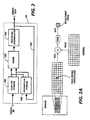
- Figure 1 shows an image processing arrangement such as that exemplified by the Xerox 7650 Pro Imager, in an application which may be used in association with the present invention.
- image information or image data may be initially derived from an imaging device, typically comprising a scanning array of photosensitive elements, which generate analog signals in accordance with exposure to light imagewise reflected from an original document.
- image information is produced from a scanning device, it might be produced along several channels, where each channel represents a portion of the scanning array from which image information is derived. Providing plural channels will allow parallel and faster processing of the image information.
- fast scan direction refers to the direction across the image, typically, although not necessarily, parallel to the array of photosensitive elements while the “slow scan direction” refers to the direction perpendicular to the fast scan direction, and parallel to relative movement between an image and the array.
- Each channel directs image information from the image sensor 10 to an analog to digital converter 12, functionally adjacent to the scanning array, to be converted from the analog signal initially derived from the image sensor to a digital grey level signal, typically an 8 bit data byte, into digital shading circuit 14.
- digital shading circuit 14 data is normalized against a predetermined calibration to account for discrepancies in the sensitivity of each photosensitive element. The data is also deskewed to account for the order in which data is derived from each photosensitive element in the scanning array, and correction algorithms account for bad photosensitive element locations in the array by various interpolation and bad pixel discarding routines.
- Bus control 16 controls the entry of data to the image processing portion of the device from either the scanning electronics or from an outside source.
- Line buffers 18 operate in a ping pong buffer arrangement to convert the data flow from synchronous operation at the scanner electronics to asynchronous operation at the image processing section.
- Data stored in a first buffer is read out of the first buffer while a second buffer is filled, with reading and storage occurring independently, in accordance with operating requirements.
- Partial page buffer 20 is a FIFO memory device that stores data over a portion of a page at a time, and depending upon its status as full or empty, the speed of the scanning operation is controlled.
- the data line is illustrated as a single line, the 8 bit data byte may transmitted from device to device along 8 parallel data transmission lines, or serially.
- Each of several processing function circuits including filter 22, one dimensional scaling circuit 24, cropping and windowing circuit 26, and thresholding and screening circuits 28, are enabled by controller 34 for operation on image data. Any of the processing functions may be accomplished by a hardwired arrangement, or by a microprocessor operating in accordance with an appropriate instruction set. Controller 34 may be a microprocessor driven device, responsive to operator commands through a user interface 36, which may be a computer connected via output interface 30, with software appropriate to drive the image processing device, and selection of functions, to cause controller logic to enable image processing function circuits 22, 24, 26, and 28. Pixel clock and pixel line synch signals are directed through controller 34 for control of the various image processing operations at appropriate points in the stream of data.
- Device memory in this case illustrated as screen and filter library 38, is accessible through user interface 36 to control the operation of the various functions in accordance with predetermined routines.
- the memory may be accessible to the user interface 36 for the addition or access of information.
- the described arrangement is but one possible scanning and image processing arrangement, where many arrangements are known and useful in relation to the present invention
- programmable filter 22 is a digital filter typically including scan line storage device 100, adder 102, multiplier/accumulator 104, and a feed back loop 106 from the output of multiplier/accumulator 104 through intermediate storage device 108 to the input of adder 102, provides the following one dimensional filter function definable in each of the fast and slow scan directions, for a filter having a field of N: where x(n) is the input to the filter; y(n) is the output of the filter; h(m) is the sample response of the filter.
- coefficients determined to identify the desired filter function are multiplied by a factor of 128 in the slow scan direction and 32 in the fast scan direction, and the whole number result is used to load the kernel, so that digital values are used by the multiplier.
- a twelve value data file is loaded with the first eight values of the data file representing the coefficients along the fast scan axis, the ninth being the multiplier for center pixel adjust, and the last three values representing the coefficients for the slow scan axis.
- the center point for the fast scan axis corresponds to the first data point, and the slow scan axis center is the twelfth data point.
- the convolution kernel must be represented in the software in a separable filter format.
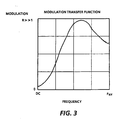
- the modified Laplacian function shown given over a range of frequency values from DC to the Nyquist frequency (F NY ), which is one half sampling resolution, may be applied to an image to obtain certain unusual effects.
- the magnitude of the maximum value R and the frequency at which it occurs is, selected based on interacting effects of the visual process, the sampling frequency, the noise generated from a specific image, and visual appeal.
- the modified Laplacian function shown tends to greatly amplify high frequency elements of the image, including noise inherent at such high frequency values.
- the maximum value of the function is selected based on the interacting effects of the visual process including the sampling frequency, the noise generated for a specific image and visual appeal.
- the modified Laplacian function of Figure 3 provides a masking of the beat patterns, breaking up the characteristic moiré pattern, while maintaining intermediate grey levels.
- the function shown greatly enhances the noise (granularity) of the image to provide masking.
- the addition of random noise generated from a source exterior to the image is unnecessary, as is the usual low pass filtering used for moiré removal which tends to give the appearance of reduced sharpness.
- the function is applied in both fast and slow scan directions in accordance with fast scan and slow scan coefficients.
- the Laplacian operator referred to with respect to Figure 3 is a filter function characterized by a m x n operator, where n and m are greater than or equal to 3, with a uniform, or nearly uniform field of negative coefficients about a single positive coefficient, and the sum of all the coefficients of the operator is greater than 0.
- n and m are greater than or equal to 3
- the sum of all the coefficients of the operator is greater than 0.
- nearly uniform it is understood that some variation among the negative coefficients may be acceptable, and still obtain the effect of the invention.
- the single positive coefficient need not necessarily be centrally located in the field.
- Tables 1 and 2 below respectively show a generic m x n filter coefficient operator and an example m x n filter coefficient operator in accordance with the invention.
- TABLE 1 A 1,1 A 1,2 ... A 1,j ... A 1,m A 2,1 A 2,2 ... A 2,j ... A 2,m ... ... ... ... ... ... A i,1 A i,2 ... B i,j ... A i,m ... ... ... ... ... A n,1 A n,2 ... A n,j ... A n,m
- noise may be predominant at differing frequencies. Accordingly, the function may be shifted along the frequency domain to accommodate those differing frequency values.
- a straight threshold value is applied to the filtered image. Further screening is not required.
- a photographic or continuous tone image is filtered as described, and subsequently a threshold value is applied to the image, a random screen effect or mezzo tint is created.
- This effect gives the appearance of a randomly screened image, without requiring the use of a random number generated screen.
- the image is placed in condition for printing at a binary printer.
- the level at which the image is thresholded serves to darken or lighten the image.
- the modified Laplacian filter itself may be viewed as the combination of two simple filters, a negative low pass filter and a signal amplifying filter.
- the low pass filter tends to blur subtle shades of contrast together, while the second emphasizes maxima and minima.
- the combination of the two serves to create a filter that enhances high frequency features, such as edges and random noise, while suppressing low frequencies.
- the thresholding application enhances the effect by eliminating differences between shades of contrast, or low frequencies.
- an image processed in accordance with the invention may be derived from another source, and stored on a memory device for use as in a loop back mode or software operation. Additionally, nothing in principle bars the use of a hardwired filter, or selection of hardwired filters from being used in accordance with the invention.
Landscapes
- Engineering & Computer Science (AREA)
- Multimedia (AREA)
- Signal Processing (AREA)
- Image Processing (AREA)
- Facsimile Image Signal Circuits (AREA)
- Picture Signal Circuits (AREA)
- Processing Of Color Television Signals (AREA)
Applications Claiming Priority (2)
| Application Number | Priority Date | Filing Date | Title |
|---|---|---|---|
| US364396 | 1982-04-02 | ||
| US07/364,396 US5225915A (en) | 1989-06-09 | 1989-06-09 | Image processing with noise enhancing operators for moire reduction and/or random dot generation |
Publications (3)
| Publication Number | Publication Date |
|---|---|
| EP0402162A2 true EP0402162A2 (fr) | 1990-12-12 |
| EP0402162A3 EP0402162A3 (fr) | 1993-01-20 |
| EP0402162B1 EP0402162B1 (fr) | 1996-11-20 |
Family
ID=23434351
Family Applications (1)
| Application Number | Title | Priority Date | Filing Date |
|---|---|---|---|
| EP90306251A Expired - Lifetime EP0402162B1 (fr) | 1989-06-09 | 1990-06-08 | Traitement d'image avec opérateurs d'amélioration du bruit pour la réduction de moiré et/ou la génération des pointes aléatoires |
Country Status (4)
| Country | Link |
|---|---|
| US (1) | US5225915A (fr) |
| EP (1) | EP0402162B1 (fr) |
| JP (1) | JP3238392B2 (fr) |
| DE (1) | DE69029169T2 (fr) |
Families Citing this family (21)
| Publication number | Priority date | Publication date | Assignee | Title |
|---|---|---|---|---|
| JP2894117B2 (ja) * | 1992-10-20 | 1999-05-24 | 富士ゼロックス株式会社 | 画像信号処理方法及びその装置 |
| US5511781A (en) * | 1993-02-17 | 1996-04-30 | United Games, Inc. | Stop play award wagering system |
| US5394252A (en) * | 1994-03-02 | 1995-02-28 | Xerox Corporation | Hybrid quantization method for color document reproduction |
| US5579457A (en) * | 1994-07-29 | 1996-11-26 | The Harlequin Group Ltd. | Image display apparatus and method using irregularly placed curving structures |
| DE69519032T2 (de) * | 1994-07-29 | 2001-05-17 | Harlequin Ltd., Barrington | Bildwiedergabe unter benutzung von gleichmässig verteilten intensitätsgruppen |
| US5426519A (en) * | 1994-08-25 | 1995-06-20 | Xerox Corporation | Method and apparatus for implementing accurate angle screens |
| US5602653A (en) * | 1994-11-08 | 1997-02-11 | Xerox Corporation | Pixel pair grid halftoning for a hyperacuity printer |
| US5565994A (en) * | 1994-12-06 | 1996-10-15 | Xerox Corporation | Multiple separation error diffusion, with cross separation correlation control for color images |
| US5764810A (en) * | 1995-12-20 | 1998-06-09 | R.R. Donnelley & Sons Company, Inc. | Screenless conversion of continuous tone images with alterable dot spacing patterns |
| US5765029A (en) * | 1996-05-08 | 1998-06-09 | Xerox Corporation | Method and system for fuzzy image classification |
| US5778156A (en) * | 1996-05-08 | 1998-07-07 | Xerox Corporation | Method and system for implementing fuzzy image processing of image data |
| US5740334A (en) * | 1996-07-01 | 1998-04-14 | Xerox Corporation | Quantization method for color document reproduction in a color printing system |
| US5835639A (en) * | 1996-12-18 | 1998-11-10 | Eastman Kodak Company | Method for detecting rotation and magnification in images |
| JP2001136402A (ja) * | 1999-11-10 | 2001-05-18 | Minolta Co Ltd | 色変換装置 |
| US7373015B2 (en) * | 1999-12-15 | 2008-05-13 | Sharp Kabushiki Kaisha | Image processing device and method |
| US6850651B2 (en) | 2001-07-02 | 2005-02-01 | Corel Corporation | Moiré correction in images |
| US6950211B2 (en) * | 2001-07-05 | 2005-09-27 | Corel Corporation | Fine moire correction in images |
| US20030206662A1 (en) * | 2002-05-03 | 2003-11-06 | Avinash Gopal B. | Method and apparatus for improving perceived digital image quality |
| US7545997B2 (en) * | 2004-09-10 | 2009-06-09 | Xerox Corporation | Simulated high resolution using binary sub-sampling |
| JP4238900B2 (ja) * | 2006-08-31 | 2009-03-18 | ソニー株式会社 | 固体撮像装置、撮像装置 |
| US20110191129A1 (en) * | 2010-02-04 | 2011-08-04 | Netzer Moriya | Random Number Generator Generating Random Numbers According to an Arbitrary Probability Density Function |
Family Cites Families (21)
| Publication number | Priority date | Publication date | Assignee | Title |
|---|---|---|---|---|
| US4049958A (en) * | 1975-03-03 | 1977-09-20 | Texas Instruments Incorporated | Programable filter using chirp-Z transform |
| JPS56141667A (en) * | 1980-04-08 | 1981-11-05 | Canon Inc | Video signal processing equipment |
| JPS56143766A (en) * | 1980-04-10 | 1981-11-09 | Canon Inc | Processor for video signal |
| US4350996A (en) * | 1980-04-14 | 1982-09-21 | Scitex Corporation Ltd. | Screened image reproduction |
| US4449150A (en) * | 1981-01-19 | 1984-05-15 | Ricoh Company, Ltd. | Method of processing medium tone picture |
| JPS57160264A (en) * | 1981-03-30 | 1982-10-02 | Canon Inc | Recorder of half tone picture |
| IL70213A (en) * | 1983-11-13 | 1988-02-29 | Paul Fenster | Digital fluorographic image enhancement system |
| ATE29815T1 (de) * | 1983-11-14 | 1987-10-15 | Hell Rudolf Dr Ing Gmbh | Verfahren und einrichtung zur herstellung gerasterter druckformen. |
| JPS6110360A (ja) * | 1984-06-26 | 1986-01-17 | Canon Inc | 画像処理装置 |
| US4817180A (en) * | 1984-11-10 | 1989-03-28 | Dainippon Screen Mfg. Co., Ltd. | Image signal filtering |
| US4739413A (en) * | 1985-06-14 | 1988-04-19 | Luma Telecom, Inc. | Video-optimized modulator-demodulator with adjacent modulating amplitudes matched to adjacent pixel gray values |
| JP2647366B2 (ja) * | 1985-08-29 | 1997-08-27 | キヤノン株式会社 | 画像処理装置 |
| US4691343A (en) * | 1986-05-27 | 1987-09-01 | Tenenbaum David M | Noise elimination system for pictures and the like |
| GB8628238D0 (en) * | 1986-11-26 | 1986-12-31 | Crosfield Electronics Ltd | Generating half-tone representations |
| US4748514A (en) * | 1986-12-22 | 1988-05-31 | Xerox Corporation | Variable rate scanning control |
| US4876610A (en) * | 1986-12-25 | 1989-10-24 | Canon Kabushiki Kaisha | Image processing apparatus with binarization-error dispersal |
| JPH0691612B2 (ja) * | 1987-03-11 | 1994-11-14 | 株式会社ヤマトヤ商会 | 画像の階調変換方法 |
| US4926251A (en) * | 1987-04-07 | 1990-05-15 | Kabushiki Kaisha Toshiba | Color image processing apparatus with image corrector |
| US4755813A (en) * | 1987-06-15 | 1988-07-05 | Xerox Corporation | Screening circuit for screening image pixels |
| US4818543A (en) * | 1987-10-15 | 1989-04-04 | University Of Georgia Research Foundation, Inc. | Control of food intake in poultry by dietary addition |
| US4811115A (en) * | 1987-10-16 | 1989-03-07 | Xerox Corporation | Image processing apparatus using approximate auto correlation function to detect the frequency of half-tone image data |
-
1989
- 1989-06-09 US US07/364,396 patent/US5225915A/en not_active Expired - Lifetime
-
1990
- 1990-06-04 JP JP14605990A patent/JP3238392B2/ja not_active Expired - Fee Related
- 1990-06-08 DE DE69029169T patent/DE69029169T2/de not_active Expired - Fee Related
- 1990-06-08 EP EP90306251A patent/EP0402162B1/fr not_active Expired - Lifetime
Also Published As
| Publication number | Publication date |
|---|---|
| DE69029169T2 (de) | 1997-03-20 |
| JP3238392B2 (ja) | 2001-12-10 |
| EP0402162A3 (fr) | 1993-01-20 |
| US5225915A (en) | 1993-07-06 |
| EP0402162B1 (fr) | 1996-11-20 |
| JPH0322180A (ja) | 1991-01-30 |
| DE69029169D1 (de) | 1997-01-02 |
Similar Documents
| Publication | Publication Date | Title |
|---|---|---|
| EP0402162B1 (fr) | Traitement d'image avec opérateurs d'amélioration du bruit pour la réduction de moiré et/ou la génération des pointes aléatoires | |
| US5513016A (en) | Method and apparatus for processing image signal | |
| US6101285A (en) | Filter for producing continuous tone images from halftone digital images data | |
| CA2097508C (fr) | Methode et appareil pour obtenir une image en similigravure a partir d'une image a echelle de gris a l'aide d'un masque a bruit bleu | |
| JP3359390B2 (ja) | 空間フィルタ装置 | |
| JP2001136388A (ja) | 適応的誤差拡散方法 | |
| EP0817465B1 (fr) | Procédé de diffusion d'erreurs avec amélioration symétrique | |
| EP0500174B1 (fr) | Méthode de traitement d'image et système de balayage/d'impression de mise en oeuvre de la méthode | |
| EP0366427B1 (fr) | Traitement d'images | |
| US7262879B2 (en) | Method for screening of halftone images | |
| JPH05176156A (ja) | 画像処理装置の枠消し方式 | |
| US5134503A (en) | Image processing apparatus | |
| JPH05161025A (ja) | カラー画像処理装置のパターン発生方式 | |
| US6842268B1 (en) | Printing of digital color images with locally adjusted half-toning | |
| JP2533652B2 (ja) | 画像輪郭処理方法 | |
| JP3093217B2 (ja) | 画像処理装置及び画像処理方法 | |
| JPH01133470A (ja) | デジタル画像処理方法 | |
| JP2951972B2 (ja) | 画像処理装置 | |
| JP3222570B2 (ja) | 像域識別装置 | |
| KR920008327B1 (ko) | 화상신호 전처리장치 | |
| JP3445847B2 (ja) | 画像処理装置 | |
| JP2941852B2 (ja) | 画像処理方法 | |
| JP2941853B2 (ja) | 画像処理方法 | |
| JP2659274B2 (ja) | 画像信号処理方法 | |
| JPH04313959A (ja) | 画像信号処理方法および装置 |
Legal Events
| Date | Code | Title | Description |
|---|---|---|---|
| PUAI | Public reference made under article 153(3) epc to a published international application that has entered the european phase |
Free format text: ORIGINAL CODE: 0009012 |
|
| AK | Designated contracting states |
Kind code of ref document: A2 Designated state(s): DE FR GB |
|
| PUAL | Search report despatched |
Free format text: ORIGINAL CODE: 0009013 |
|
| AK | Designated contracting states |
Kind code of ref document: A3 Designated state(s): DE FR GB |
|
| 17P | Request for examination filed |
Effective date: 19930705 |
|
| 17Q | First examination report despatched |
Effective date: 19950324 |
|
| GRAG | Despatch of communication of intention to grant |
Free format text: ORIGINAL CODE: EPIDOS AGRA |
|
| GRAH | Despatch of communication of intention to grant a patent |
Free format text: ORIGINAL CODE: EPIDOS IGRA |
|
| GRAH | Despatch of communication of intention to grant a patent |
Free format text: ORIGINAL CODE: EPIDOS IGRA |
|
| GRAA | (expected) grant |
Free format text: ORIGINAL CODE: 0009210 |
|
| AK | Designated contracting states |
Kind code of ref document: B1 Designated state(s): DE FR GB |
|
| REF | Corresponds to: |
Ref document number: 69029169 Country of ref document: DE Date of ref document: 19970102 |
|
| ET | Fr: translation filed | ||
| PLBE | No opposition filed within time limit |
Free format text: ORIGINAL CODE: 0009261 |
|
| STAA | Information on the status of an ep patent application or granted ep patent |
Free format text: STATUS: NO OPPOSITION FILED WITHIN TIME LIMIT |
|
| 26N | No opposition filed | ||
| REG | Reference to a national code |
Ref country code: GB Ref legal event code: IF02 |
|
| REG | Reference to a national code |
Ref country code: GB Ref legal event code: 746 Effective date: 20050404 |
|
| PGFP | Annual fee paid to national office [announced via postgrant information from national office to epo] |
Ref country code: FR Payment date: 20050608 Year of fee payment: 16 |
|
| PGFP | Annual fee paid to national office [announced via postgrant information from national office to epo] |
Ref country code: DE Payment date: 20060601 Year of fee payment: 17 |
|
| PGFP | Annual fee paid to national office [announced via postgrant information from national office to epo] |
Ref country code: GB Payment date: 20060607 Year of fee payment: 17 |
|
| REG | Reference to a national code |
Ref country code: FR Ref legal event code: ST Effective date: 20070228 |
|
| GBPC | Gb: european patent ceased through non-payment of renewal fee |
Effective date: 20070608 |
|
| PG25 | Lapsed in a contracting state [announced via postgrant information from national office to epo] |
Ref country code: FR Free format text: LAPSE BECAUSE OF NON-PAYMENT OF DUE FEES Effective date: 20060630 Ref country code: DE Free format text: LAPSE BECAUSE OF NON-PAYMENT OF DUE FEES Effective date: 20080101 |
|
| PG25 | Lapsed in a contracting state [announced via postgrant information from national office to epo] |
Ref country code: GB Free format text: LAPSE BECAUSE OF NON-PAYMENT OF DUE FEES Effective date: 20070608 |