EP0400460B1 - Moisture-absorbent compositions - Google Patents
Moisture-absorbent compositions Download PDFInfo
- Publication number
- EP0400460B1 EP0400460B1 EP90109700A EP90109700A EP0400460B1 EP 0400460 B1 EP0400460 B1 EP 0400460B1 EP 90109700 A EP90109700 A EP 90109700A EP 90109700 A EP90109700 A EP 90109700A EP 0400460 B1 EP0400460 B1 EP 0400460B1
- Authority
- EP
- European Patent Office
- Prior art keywords
- moisture
- weight
- parts
- absorbent
- moisture absorption
- Prior art date
- Legal status (The legal status is an assumption and is not a legal conclusion. Google has not performed a legal analysis and makes no representation as to the accuracy of the status listed.)
- Expired - Lifetime
Links
Images




Classifications
-
- B—PERFORMING OPERATIONS; TRANSPORTING
- B01—PHYSICAL OR CHEMICAL PROCESSES OR APPARATUS IN GENERAL
- B01J—CHEMICAL OR PHYSICAL PROCESSES, e.g. CATALYSIS OR COLLOID CHEMISTRY; THEIR RELEVANT APPARATUS
- B01J20/00—Solid sorbent compositions or filter aid compositions; Sorbents for chromatography; Processes for preparing, regenerating or reactivating thereof
- B01J20/28—Solid sorbent compositions or filter aid compositions; Sorbents for chromatography; Processes for preparing, regenerating or reactivating thereof characterised by their form or physical properties
- B01J20/28014—Solid sorbent compositions or filter aid compositions; Sorbents for chromatography; Processes for preparing, regenerating or reactivating thereof characterised by their form or physical properties characterised by their form
- B01J20/28026—Particles within, immobilised, dispersed, entrapped in or on a matrix, e.g. a resin
-
- B—PERFORMING OPERATIONS; TRANSPORTING
- B01—PHYSICAL OR CHEMICAL PROCESSES OR APPARATUS IN GENERAL
- B01D—SEPARATION
- B01D53/00—Separation of gases or vapours; Recovering vapours of volatile solvents from gases; Chemical or biological purification of waste gases, e.g. engine exhaust gases, smoke, fumes, flue gases, aerosols
- B01D53/26—Drying gases or vapours
- B01D53/28—Selection of materials for use as drying agents
-
- B—PERFORMING OPERATIONS; TRANSPORTING
- B01—PHYSICAL OR CHEMICAL PROCESSES OR APPARATUS IN GENERAL
- B01J—CHEMICAL OR PHYSICAL PROCESSES, e.g. CATALYSIS OR COLLOID CHEMISTRY; THEIR RELEVANT APPARATUS
- B01J20/00—Solid sorbent compositions or filter aid compositions; Sorbents for chromatography; Processes for preparing, regenerating or reactivating thereof
- B01J20/02—Solid sorbent compositions or filter aid compositions; Sorbents for chromatography; Processes for preparing, regenerating or reactivating thereof comprising inorganic material
- B01J20/04—Solid sorbent compositions or filter aid compositions; Sorbents for chromatography; Processes for preparing, regenerating or reactivating thereof comprising inorganic material comprising compounds of alkali metals, alkaline earth metals or magnesium
- B01J20/041—Oxides or hydroxides
-
- B—PERFORMING OPERATIONS; TRANSPORTING
- B01—PHYSICAL OR CHEMICAL PROCESSES OR APPARATUS IN GENERAL
- B01J—CHEMICAL OR PHYSICAL PROCESSES, e.g. CATALYSIS OR COLLOID CHEMISTRY; THEIR RELEVANT APPARATUS
- B01J20/00—Solid sorbent compositions or filter aid compositions; Sorbents for chromatography; Processes for preparing, regenerating or reactivating thereof
- B01J20/02—Solid sorbent compositions or filter aid compositions; Sorbents for chromatography; Processes for preparing, regenerating or reactivating thereof comprising inorganic material
- B01J20/04—Solid sorbent compositions or filter aid compositions; Sorbents for chromatography; Processes for preparing, regenerating or reactivating thereof comprising inorganic material comprising compounds of alkali metals, alkaline earth metals or magnesium
- B01J20/045—Solid sorbent compositions or filter aid compositions; Sorbents for chromatography; Processes for preparing, regenerating or reactivating thereof comprising inorganic material comprising compounds of alkali metals, alkaline earth metals or magnesium containing sulfur, e.g. sulfates, thiosulfates, gypsum
-
- B—PERFORMING OPERATIONS; TRANSPORTING
- B01—PHYSICAL OR CHEMICAL PROCESSES OR APPARATUS IN GENERAL
- B01J—CHEMICAL OR PHYSICAL PROCESSES, e.g. CATALYSIS OR COLLOID CHEMISTRY; THEIR RELEVANT APPARATUS
- B01J20/00—Solid sorbent compositions or filter aid compositions; Sorbents for chromatography; Processes for preparing, regenerating or reactivating thereof
- B01J20/02—Solid sorbent compositions or filter aid compositions; Sorbents for chromatography; Processes for preparing, regenerating or reactivating thereof comprising inorganic material
- B01J20/06—Solid sorbent compositions or filter aid compositions; Sorbents for chromatography; Processes for preparing, regenerating or reactivating thereof comprising inorganic material comprising oxides or hydroxides of metals not provided for in group B01J20/04
- B01J20/08—Solid sorbent compositions or filter aid compositions; Sorbents for chromatography; Processes for preparing, regenerating or reactivating thereof comprising inorganic material comprising oxides or hydroxides of metals not provided for in group B01J20/04 comprising aluminium oxide or hydroxide; comprising bauxite
-
- B—PERFORMING OPERATIONS; TRANSPORTING
- B01—PHYSICAL OR CHEMICAL PROCESSES OR APPARATUS IN GENERAL
- B01J—CHEMICAL OR PHYSICAL PROCESSES, e.g. CATALYSIS OR COLLOID CHEMISTRY; THEIR RELEVANT APPARATUS
- B01J20/00—Solid sorbent compositions or filter aid compositions; Sorbents for chromatography; Processes for preparing, regenerating or reactivating thereof
- B01J20/02—Solid sorbent compositions or filter aid compositions; Sorbents for chromatography; Processes for preparing, regenerating or reactivating thereof comprising inorganic material
- B01J20/10—Solid sorbent compositions or filter aid compositions; Sorbents for chromatography; Processes for preparing, regenerating or reactivating thereof comprising inorganic material comprising silica or silicate
- B01J20/103—Solid sorbent compositions or filter aid compositions; Sorbents for chromatography; Processes for preparing, regenerating or reactivating thereof comprising inorganic material comprising silica or silicate comprising silica
-
- B—PERFORMING OPERATIONS; TRANSPORTING
- B01—PHYSICAL OR CHEMICAL PROCESSES OR APPARATUS IN GENERAL
- B01J—CHEMICAL OR PHYSICAL PROCESSES, e.g. CATALYSIS OR COLLOID CHEMISTRY; THEIR RELEVANT APPARATUS
- B01J20/00—Solid sorbent compositions or filter aid compositions; Sorbents for chromatography; Processes for preparing, regenerating or reactivating thereof
- B01J20/02—Solid sorbent compositions or filter aid compositions; Sorbents for chromatography; Processes for preparing, regenerating or reactivating thereof comprising inorganic material
- B01J20/10—Solid sorbent compositions or filter aid compositions; Sorbents for chromatography; Processes for preparing, regenerating or reactivating thereof comprising inorganic material comprising silica or silicate
- B01J20/16—Alumino-silicates
- B01J20/18—Synthetic zeolitic molecular sieves
-
- B—PERFORMING OPERATIONS; TRANSPORTING
- B01—PHYSICAL OR CHEMICAL PROCESSES OR APPARATUS IN GENERAL
- B01J—CHEMICAL OR PHYSICAL PROCESSES, e.g. CATALYSIS OR COLLOID CHEMISTRY; THEIR RELEVANT APPARATUS
- B01J20/00—Solid sorbent compositions or filter aid compositions; Sorbents for chromatography; Processes for preparing, regenerating or reactivating thereof
- B01J20/28—Solid sorbent compositions or filter aid compositions; Sorbents for chromatography; Processes for preparing, regenerating or reactivating thereof characterised by their form or physical properties
- B01J20/28014—Solid sorbent compositions or filter aid compositions; Sorbents for chromatography; Processes for preparing, regenerating or reactivating thereof characterised by their form or physical properties characterised by their form
-
- B—PERFORMING OPERATIONS; TRANSPORTING
- B01—PHYSICAL OR CHEMICAL PROCESSES OR APPARATUS IN GENERAL
- B01J—CHEMICAL OR PHYSICAL PROCESSES, e.g. CATALYSIS OR COLLOID CHEMISTRY; THEIR RELEVANT APPARATUS
- B01J20/00—Solid sorbent compositions or filter aid compositions; Sorbents for chromatography; Processes for preparing, regenerating or reactivating thereof
- B01J20/28—Solid sorbent compositions or filter aid compositions; Sorbents for chromatography; Processes for preparing, regenerating or reactivating thereof characterised by their form or physical properties
- B01J20/28014—Solid sorbent compositions or filter aid compositions; Sorbents for chromatography; Processes for preparing, regenerating or reactivating thereof characterised by their form or physical properties characterised by their form
- B01J20/28033—Membrane, sheet, cloth, pad, lamellar or mat
Definitions
- the present invention relates generally to moisture-absorbent compositions, and more particularly but not exclusively to those having an indicator function of showing colors changing in accordance with the rate of moisture absorption.
- these items are contained in water-vaporproof metallic cans or glass bottles, or wrapped with films having a low water vapor permeability and made of polyethylene, extended polypropylene, polyvinylidene chloride and aluminum foil.
- desiccants such as silica gel, calcium chloride, quick lime, or zeolite are sealed in such containers or packages. When used, these desiccants are put, in the form of particles or powder, in paper bags, cloth bags, or containers. As a result, the inherent excellent properties of the desiccants are not fully exhibited.
- the desiccant may adhere, or may be kneaded in, the item in the container. Furthermore, the use of a deliquescent desiccant may lead to a liquefaction phenomenon. In addition, it is difficult to examine the moisture absorption effect of the desiccant with the naked eye, and the gradual change of moisture absorption effect cannot be understood.
- the object of the present invention is to provide moisture-absorbent compositions, which have high moisture absorption effect and excellent water-retention for a long period of time, and are free from such drawbacks as fly loss or leakage due to deliquescence.
- Preferred embodiments of the compositions according to the present invention have an indicator function, using a substance having a color variable in accordance with the rate of moisture absorption.
- the moisture-absorbent composition according to the present invention contains 100 parts by weight of thermoplastic resin and 5 to 400 parts by weight of magnesium sulfate (represented by MgSO4 ⁇ nH2O (0 ⁇ n ⁇ 3) and, optionally, aluminum oxide, calcium oxide, silicon oxide, zeolite, cobalt chloride, and barium oxide.
- thermoplastic resin is kneaded with a moisture-absorbent substance and, when necessary, a moisture-reactive color-varying substance.
- the resultant moisture-absorbent composition may be formed in a desired shape, for example, a film, a sheet, a plate, a bag, a pellet or a container. This formed item may serve as a package, and changes its color according to the moisture absorption rate.
- thermoplastic resin employed in the present invention A publicly known material may be used for the thermoplastic resin employed in the present invention.
- examples of such material are: polyethylene (PE), polypropylene (PP), polycarbonate, polyamide (PA), etylene-vinyl acetate copolymer (EVA), ethylenemethacrylate copolymer, polyvinyl chloride, polystyrene, polyester, polyacrylic ester or polyvinylidene chloride (PVDC).
- PE polyethylene
- PP polypropylene
- PA polyamide
- EVA etylene-vinyl acetate copolymer
- PVDC polyvinylidene chloride
- the moisture-absorbent substance combined with the thermoplastic resin, contains magnesium sulfate (represented by MgSO4 ⁇ nH2O (0 ⁇ n ⁇ 3) and, optionally, aluminum oxide, calcium oxide, silicon oxide, natural and synthetic zeolite, cobalt chloride, and barium oxide.
- magnesium sulfate having excellent dispersion properties in the resin is most desirable.
- the moisture-absorbent substances of various particle sizes are available. But the particle size of the moisture-absorbent substance needs to be determined according to the mold item to be produced. For instance, when a film having 50 »m is manufactured, it is necessary to use the substance having the particle size less than 50 »m. If the particle size is greater than 50 » the surface of the film becomes uneven due to the exposure the moisture absorbent on the surface of the film, and items to be wrapped in the film may be damaged. Further, the particles may be mixed in the items to be wrapped.
- the amount of the moisture-absorbent substance is 5 to 40 parts by weight, in relation to 100 parts by weight of thermoplastic resin.
- the amount of absorbed moisture is proportional to the content of anhydride magnesium sulfate, employed as moisture-absorbent substance, in the moisture-absorbent composition of the invention.
- the molecular weight of the anhydride magnesium sulfate is just half the molecular weight of the (saturated) hepta-hydrate of magnesium sulfate.
- the moisture-absorbent substance in the resin absorbs the same amount of water as the moisture-absorbent substance.
- the amount of the moisture-absorbent substance is 5 to 40 parts by weight, in relation to 100 parts by weight of thermoplastic resin, the dispersion properties of the moisture-absorbent substance in the resin are excellent. In addition, excellent moisture-absorption properties, water retention properties, and moldability are attained.
- an indicator function is realized by adding 0.5 to 5 parts by weight of anhydride cobalt chloride.
- the anhydride cobalt chloride is dissolved in a solvent, thus preparing an "indicator solution".
- the solvent is, for example, a mixture of methanol and glycerin. If the amount of added anhydride cobalt chloride is less than 0.5 part by weight, the change in color is not clearly observed. If the amount of added anhydride cobalt chloride is more than 5 parts by weight, the color becomes too deep to be clearly observed.
- the solvent of anhydride cobalt chloride is prepared only of glycerin, the water content of the solvent is too high and the volatility of the solvent is too low. Thus, large part of the indicator solution reacts with the moisture-absorbent substance and also large part of glycerin remains.
- the glycerin is mixed with methanol having low water content and high volatility. Inversely, if the amount of methanol is too large, the indicator solution volatilizes too quickly. Thus, it is desirable that the ratio of glycerin to methanol be set to 1 : 2.
- Cobalt chloride is in itself a moisture-absorbent substance. Cobalt chloride can be mixed in resin without losing its moisture absorption property, when the moisture-absorbent composition is formed. However, when the indicator function is to be provided, the amount of anhydride cobalt chloride needs to be limited to 0.5 to 5 parts by weight, as stated above.
- a foaming agent may be mixed, in addition to the thermoplastic resin, moisture-absorbent substance, and indicator solution.
- the foaming agent publicly known materials can be used: for example, azo-isobutyl-nitrile, azodicarbonamide and 4, 4'-oxybenzene-sulfonylhydrazide.
- the amount of the foaming agent is preferably 0.2 to 10 parts by weight in relation to 100 parts by weight of thermoplastic resin.
- the moisture-absorbent composition, obtained by adding the foaming agent thereto is light in weight and has high moisture absorption properties both in its outer and inner parts.
- such publicly known additives as a plasticizer, a stabilizer, a lubricator, and a coloring agent, can be mixed in the composition, as far as the object of the present invention can be achieved.
- the moisture-absorbent composition of the present invention can be prepared by any suitable method. According to a most typical method, the aforementioned thermoplastic resin, moisture-absorbent and, when necessary, indicator solution, as well as other additives, are mixed in a mixer at a temperature of 100 to 350°C for 1 to 40 minutes. The mixture is molded by a molding machine.
- the moisture-absorbent composition of the present invention can be combined with at least one of laminating materials, as listed below, having various functions, and consequently molded items suitable for various purposes can be obtained.
- the laminating material may be resins, such as thermoplastic resin, paper, fibers, metals, various coating materials, various adhesives, or various moisture-absorbent molded items containing a moisture absorbent composition according to the invention.
- the type, size (thickness), and number of the laminations are variable, within the scope of the subject matter of the present invention.
- the laminating material is used, for example, in the form of a laminated film, a laminated sheet, or a laminated plate.
- LDPE low-density polyethylene
- MDPE low-density polyethylene
- HDPE high-density polyethylene
- LDPE/HDPE high-density polyethylene
- PA/adhesive PE/LDPE PA/adhesive PE/ionomer
- PA/adhesive PE/EVA PA/adhesive PE/HDPE
- PA/adhesive PE/LLDPE linear-chain low-density polyethylene
- the moisture-absorbent compositions of the present invention have per se lasting moisture
- the composition having the indicator function allows visual observation of a gradual change in moisture absorption rate.
- the color of the composition differs from the standard color (shown in literatures), possibly to the color of resin itself.
- the color of the composition is substantially identical to the standard color.
- Two methods are available for providing a molded item containing a moisture absorbent composition according to the invention with the indicator function.
- the entire body of the moisture-absorbent molded item changes its color according to humidity.
- a moisture-absorbent composition having the indicator function is employed as part of the moisture-absorbent molded item (a bag or a container), so that the humidity of the inside of the molded item can be seen from the outside.
- a non-moisture-absorbent bag (or container) of a moisture-absorbent composition having the indicator function so that the humidity of the inside of the bag can be seen from the outside.
- the cushion insert changes its color according to the amount of moisture absorbed over several months.
- the user of the cushion insert can immediately understand the time of replacing the cushion insert.
- this cushion insert is economical.
- ethylene-vinyl acetate copolymer (average molecular weight: 31000), 50 parts by weight of an anhydride magnesium sulfate having an average particle size of 10 »m, and 1 part by weight of stearic acid functioning as a lubricator were employed to prepare a sheet in the same manner as in Example 1.
- EVA ethylene-vinyl acetate copolymer
- an anhydride magnesium sulfate having an average particle size of 10 »m 100 parts by weight of ethylene-vinyl acetate copolymer (EVA) (average molecular weight: 31000)
- an anhydride magnesium sulfate having an average particle size of 10 »m 50 parts by weight of anhydride magnesium sulfate having an average particle size of 10 »m
- stearic acid functioning as a lubricator 100 parts by weight of ethylene-vinyl acetate copolymer (EVA) (average molecular weight: 31000), 50 parts by weight of an anhydride magnesium
- Vegetables such as leek and broccoli, along with carbonic acid gas, were sealed in the bag.
- the bag was left for a week at a temperature of 20°C. No waterdrop formed in the bag. It was found that this bag was effective in keeping freshness of vegetables and had excellent moistureproof properties.
- ethylene-methyl methacrylate (average molecular weight: 35000), 10 parts by weight of tri-hydrated magnesium sulfate having an average particle size of 6 »m, and 1 part by weight of stearic acid functioning as a lubricator were employed to prepare a pellet in the same manner as in Example 1.
- the pellet was subjected to extrusion in an extruder, and a film 0.1 mm thick was obtained. Using the film as a sample, a moisture absorption test was performed.
- Fig. 2 shows the transmissivity of this film, as compared with that of a blank.
- the film of the present invention has high light (ultraviolet) absorption properties.
- the use of this film as a packaging material is effective.
- the moisture-absorbent composition of the present invention is therefore applicable to vinyl houses, or containers for cosmetics which are easily decomposed by ultraviolet. Conventionally, undesirable effects of ultraviolet have been prevented by the use of a deep color in containers, etc. According to the present invention, users can see the inside of containers, for example.
- Example 1 100 parts by weight of polystyrene (average molecular weight: 30000), 5 parts by weight of mono-hydrated magnesium sulfate having an average particle size of 3.5 »m, and 0.5 part by weight of azo-isobutyl-nitrile functioning as a foaming agent were kneaded in the same manner as in Example 1. The mixture was subjected to injection molding. Thus, a foamed item was obtained. Using this as a sample, a moisture absorption test was performed.
- Example 5 25 parts by weight of zeolite (average particle Size: 8 »m) were substituted for the anhydride magnesium sulfate. Then, in like manner, a film was prepared, and using this as a comparison sample, a moisture absorption test was performed.
- zeolite average particle Size: 8 »m
- the samples prepared in Examples 1 to 6 were left in constant temperature baths having a temperature of 25°C and having, respectively, humidities of 90 %, 50 % and 20 %.
- the moisture absorption rates were measured after the lapse of one day, two days, four days, six days, 10 days, 15 days, and 20 days.
- the moisture absorption rates are expressed in percentage terms and represent the increase in weight of the samples (in comparison to their initial weights).
- Table 1 shows the test results obtained when the humidity was 90 %;
- Table 2 shows the test results obtained when the humidity was 50 %; and
- Table 3 shows the test results when the humidity was 20 %.
- Fig. 4 is a graph showing the relationship between the moisture absorption rates in Examples 5 and 6, in relation to the number of days, when the humidity was 90 %.
- Table 1 (Humidity: 90 %) Number of Days Examples 1 2 3 4 5 6 1 26.5 5.2 0.4 0.7 8.9 2.4 2 42.9 9.8 0.8 1.5 12.8 2.4 4 60.4 10.4 1.4 2.6 19.5 2.4 6 65.1 13.5 1.8 3.0 24.2 2.4 10 65.3 16.3 2.3 3.8 26.0 2.4 15 65.4 19.4 3.4 4.3 26.4 2.4 20 65.4 23.0 3.8 5.1 26.4 2.4 (Humidity: %) Table 2 (Humidity: 50 %) Number of Days Examples 1 2 3 4 5 6 1 14.31 2.18 0.38 0.41 4.93 1.44 2 21.49 3.40 0.40 0.78 7.16 1.61 4 30.60 5.02 0.75 1.45 12.64 1.70 6 33.10 6.60 0.92 1.72 13.48 1.70 10 33.05 9.63 1.21 2.75 14.00 1.73 15 33.12 9.74 1.
- the plates were used as comparison samples.
- the moisture absorption rates of the samples were measured, while they were left for one to sixty days in constant temperature baths having a temperature of 25°C and humidities of 50 % and 20 %, respectively.
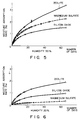
- Fig. 5 is a graph showing the moisture absorption rates of the three samples when the humidity was 50 %.
- Fig. 6 is a graph showing the moisture absorption rates of the three samples when the humidity was 20 %.
- LDPE low-density polyethylene
- anhydrous magnesium sulfate having an average particle size of 4.59 »m
- a bag made of the three-layer film by means of heat sealing, absorbed moisture in the bag effectively. In the state where the bag was sealed, the contents of the bag were preserved for a long time.
- a bag made of the three-layer film by means of heat sealing, absorbed moisture in the bag effectively. In the state where the bag was sealed, the contents of the bag were preserved for a long time.
- the bags formed of the three-layer films have high moisture absorption properties.
- a moisture-absorbent substance, HDPE and LDPE, prepared by the same process as in Example 8 were melted with use of three extrusion molders. Then, these were fed to a single die, whereby a three-layer film having the same structure as the film in Example 8. In addition, an aluminum foil was adhered to the outer layer of HDPE. As a result, a four-layer film (Al 7 »m/HDPE 50 »m/moisture-absorbent substance 50 »m/LDPE 10 »m) was prepared.
- 100 parts by weight of resin can be kneaded with 400 parts by weight of moisture-absorbent substance, and excellent moisture absorption properties are exhibited.
- the pellets were injection-molded by an injection-molder (PS40E5ASE, manufactured by NISSEI-JUSHI-KOGYO Kabushiki-Kaisha) to form a plate (85 ⁇ 54 ⁇ 1.5 mm).
- PS40E5ASE manufactured by NISSEI-JUSHI-KOGYO Kabushiki-Kaisha
- LDPE low-density polyethylene
- anhydride magnesium sulfate having an average particle size of 4.59 »m
- 12.56 parts by weight of indicator solution anhydride cobalt chloride 3.00 parts by weight; methyl alcohol 3.68 part by weight; glycerin 2.92 part by weight
- the pellets were injection-molded by an injection-molder (manufactured by TOSHIBA KIKAI Kabushiki-Kaisha) to form an inner lid(89 mm ⁇ , 1.5 mm thick) of a sealed container.
- EMA ethylene-methylacrylate copolymer
- indicator solution anhydride cobalt chloride 1.50 parts by weight; methyl alcohol 1.84 part by weight; glycerin 1.46 part by weight
- LDPE low-density polyethylene
- anhydride magnesium sulfate having an average particle size of 5.13 »m
- zeolite having an average particle size of 74 »m (aluminosilicate)
- the moisture-absorbent composition of the present invention is easily processed and molded in a desired shape. Even if the composition is subjected to various types of molding, good moisture absorption properties are maintained, and the change of color corresponding to humidity can be visually observed.
- the moisture-absorbent compositions can be widely used as moisture-absorbent agents or in moisture-absorbent packaging materials for protecting the quality of foods, medicines, cosmetics, luxuries, precision instruments, or mechanical parts.
Landscapes
- Chemical & Material Sciences (AREA)
- Analytical Chemistry (AREA)
- Chemical Kinetics & Catalysis (AREA)
- Organic Chemistry (AREA)
- Inorganic Chemistry (AREA)
- Dispersion Chemistry (AREA)
- Engineering & Computer Science (AREA)
- General Chemical & Material Sciences (AREA)
- Oil, Petroleum & Natural Gas (AREA)
- Compositions Of Macromolecular Compounds (AREA)
- Laminated Bodies (AREA)
Description
- The present invention relates generally to moisture-absorbent compositions, and more particularly but not exclusively to those having an indicator function of showing colors changing in accordance with the rate of moisture absorption.
- Oxidation, corrosion and liquefaction, due to moisture absorption results in degradation in quality of foods, medicines, electronic parts, precision instruments and daily necessaries. To prevent such oxidation or corrosion, these items are contained in water-vaporproof metallic cans or glass bottles, or wrapped with films having a low water vapor permeability and made of polyethylene, extended polypropylene, polyvinylidene chloride and aluminum foil. In addition, desiccants such as silica gel, calcium chloride, quick lime, or zeolite are sealed in such containers or packages. When used, these desiccants are put, in the form of particles or powder, in paper bags, cloth bags, or containers. As a result, the inherent excellent properties of the desiccants are not fully exhibited. If the container of the desiccant is damaged or broken, the desiccant may adhere, or may be kneaded in, the item in the container. Furthermore, the use of a deliquescent desiccant may lead to a liquefaction phenomenon. In addition, it is difficult to examine the moisture absorption effect of the desiccant with the naked eye, and the gradual change of moisture absorption effect cannot be understood.
- Published Unexamined Japanese Patent Application No. 61-227818 proposes a technique of preventing a leak of liquid due to moisture absorption liquefaction, wherein micro-porous thermoplastic resin sheet is employed as a packaging material for desiccants. There is also proposed a technique wherein non-woven cloth and composite desiccants are alternately laminated. These techniques, however, have problems such as high costs, trouble in using the desiccant or careless swallow of the desiccant.
- The object of the present invention is to provide moisture-absorbent compositions, which have high moisture absorption effect and excellent water-retention for a long period of time, and are free from such drawbacks as fly loss or leakage due to deliquescence. Preferred embodiments of the compositions according to the present invention have an indicator function, using a substance having a color variable in accordance with the rate of moisture absorption.
- The moisture-absorbent composition and according to this invention has the following advantages:
- 1) The composition has high moisture-absorbent properties and water retention, and is free from corrosion, fly loss, leakage due to deliquescence, or waterdrops. Therefore, the composition and a molded item containing the present composition are excellent in safely and stability.
- 2) At the time of use, it is not necessary to wrap a molded item containing the present composition, unlike the case of a conventional moisture-absorbent element. If the molded item containing the present composition is manufactured as a bag or a container, the bag or container itself serves conveniently as an moisture-absorbent substance.
- 3) The amount of moisture absorbed in the molded item containing the present composition is immediately understood by the change in color. The time at which the molded item should be replaced can be understood at a glance.
- 4) The moisture absorption effects last for a long time.
- 5) When the composition is molded to a cushion insert, the insert can absorb moisture for a long time, and the time at which the insert should be changed can be seen at a glance.
- 6) The manufacture and processing is easy, resulting in high productivity. The moisture absorption effects do not reduce owing to the processing or molding.
- 7) When the composition is molded to a film, the film may be laminated, foamed, or colored. The heat sealing properties of the film are excellent. The film may be laminated with a layer having a low vapor permeability. The film absorbs ultraviolet excellently (see Fig. 1).
- 8) The composition may be used as a dehydrating agent to be used in an organic solvent.
- 9) The composition has light-shield properties, electrification-prevention properties, and deodorant properties.
- This invention can be more fully understood from the following detailed description when taken in conjunction with the accompanying drawings, in which:
- Fig. 1 is a graph showing the relationship between the amount of absorbed moisture and the content of magnesium sulfate;
- Fig. 2 is a graph showing the light transmissivity of a film in Example 3;
- Fig. 3 is a graph showing the measured particle sizes of magnesium sulfate employed in Example 4;
- Fig. 4 is a graph showing the relationship between the moisture absorption rate and the number of days in a moisture absorption test (humidity: 90 %) in Examples 5 and comparison example 6;
- Fig. 5 is a graph showing the moisture absorption rate and the number of days in a moisture absorption test (humidity: 50 %) in comparison Example 7;
- Fig. 6 is a graph showing the moisture absorption rate and the number of days in a moisture absorption test (humidity: 20 %) of a pellet in Example 7;
- Fig. 7 is a graph showing the moisture absorption rate and the number of days in a moisture absorption test in Examples 8 and 9;
- Fig. 8 is a graph showing the moisture absorption rate and the number of days in a moisture absorption test of a pellet in Example 11;
- Fig. 9 is a graph showing the relationship between the moisture absorption rate and the hue in a plate used in Example 12;
- Fig. 10 is a graph showing the relationship between the moisture absorption rate and the hue in an inner lid of a sealed container in Example 13;
- Fig. 11 is a graph showing the relationship between the moisture absorption rate and the hue in an extruded sheet serving as a cushion insert in a shoe employed in Example 14; and
- Fig. 12 is a graph showing the relationship between the moisture absorption rate and the number of days in a moisture absorption test for a plate in Example 15.
- In order to solve the problems, as stated above, the moisture-absorbent composition according to the present invention contains 100 parts by weight of thermoplastic resin and 5 to 400 parts by weight of magnesium sulfate (represented by MgSO₄ · nH₂O (0 ≦n≦ 3) and, optionally, aluminum oxide, calcium oxide, silicon oxide, zeolite, cobalt chloride, and barium oxide.
- The main feature of the present invention resides in that thermoplastic resin is kneaded with a moisture-absorbent substance and, when necessary, a moisture-reactive color-varying substance. The resultant moisture-absorbent composition may be formed in a desired shape, for example, a film, a sheet, a plate, a bag, a pellet or a container. This formed item may serve as a package, and changes its color according to the moisture absorption rate.
- A publicly known material may be used for the thermoplastic resin employed in the present invention. Examples of such material are: polyethylene (PE), polypropylene (PP), polycarbonate, polyamide (PA), etylene-vinyl acetate copolymer (EVA), ethylenemethacrylate copolymer, polyvinyl chloride, polystyrene, polyester, polyacrylic ester or polyvinylidene chloride (PVDC). One or two of these may be used.
- The moisture-absorbent substance, combined with the thermoplastic resin, contains magnesium sulfate (represented by MgSO₄ · nH₂O (0 ≦n≦ 3) and, optionally, aluminum oxide, calcium oxide, silicon oxide, natural and synthetic zeolite, cobalt chloride, and barium oxide. In particular, magnesium sulfate having excellent dispersion properties in the resin is most desirable.
- The moisture-absorbent substances of various particle sizes are available. But the particle size of the moisture-absorbent substance needs to be determined according to the mold item to be produced. For instance, when a film having 50 »m is manufactured, it is necessary to use the substance having the particle size less than 50 »m. If the particle size is greater than 50 », the surface of the film becomes uneven due to the exposure the moisture absorbent on the surface of the film, and items to be wrapped in the film may be damaged. Further, the particles may be mixed in the items to be wrapped.
- If necessary, particles of different sizes may be mixed. In this case, the amount of the moisture-absorbent substance is 5 to 40 parts by weight, in relation to 100 parts by weight of thermoplastic resin. As shown in Fig. 1, the amount of absorbed moisture is proportional to the content of anhydride magnesium sulfate, employed as moisture-absorbent substance, in the moisture-absorbent composition of the invention. The molecular weight of the anhydride magnesium sulfate is just half the molecular weight of the (saturated) hepta-hydrate of magnesium sulfate. Namely, the moisture-absorbent substance in the resin absorbs the same amount of water as the moisture-absorbent substance. In this invention, it is advantageous to mix the moisture-absorbent substance, the amount of which is equal to that of water to be absorbed, in the resin. In this case, the resin having a desired absorption ability can be obtained.
- When the amount of the moisture-absorbent substance is 5 to 40 parts by weight, in relation to 100 parts by weight of thermoplastic resin, the dispersion properties of the moisture-absorbent substance in the resin are excellent. In addition, excellent moisture-absorption properties, water retention properties, and moldability are attained.
- Further, an indicator function is realized by adding 0.5 to 5 parts by weight of anhydride cobalt chloride. The anhydride cobalt chloride is dissolved in a solvent, thus preparing an "indicator solution". The solvent is, for example, a mixture of methanol and glycerin. If the amount of added anhydride cobalt chloride is less than 0.5 part by weight, the change in color is not clearly observed. If the amount of added anhydride cobalt chloride is more than 5 parts by weight, the color becomes too deep to be clearly observed.
- If the solvent of anhydride cobalt chloride is prepared only of glycerin, the water content of the solvent is too high and the volatility of the solvent is too low. Thus, large part of the indicator solution reacts with the moisture-absorbent substance and also large part of glycerin remains. To solve these problems, the glycerin is mixed with methanol having low water content and high volatility. Inversely, if the amount of methanol is too large, the indicator solution volatilizes too quickly. Thus, it is desirable that the ratio of glycerin to methanol be set to 1 : 2.
- Cobalt chloride is in itself a moisture-absorbent substance. Cobalt chloride can be mixed in resin without losing its moisture absorption property, when the moisture-absorbent composition is formed. However, when the indicator function is to be provided, the amount of anhydride cobalt chloride needs to be limited to 0.5 to 5 parts by weight, as stated above.
- In the moisture-absorbent composition of the present invention, a foaming agent may be mixed, in addition to the thermoplastic resin, moisture-absorbent substance, and indicator solution. As the foaming agent, publicly known materials can be used: for example, azo-isobutyl-nitrile, azodicarbonamide and 4, 4'-oxybenzene-sulfonylhydrazide. The amount of the foaming agent is preferably 0.2 to 10 parts by weight in relation to 100 parts by weight of thermoplastic resin. The moisture-absorbent composition, obtained by adding the foaming agent thereto, is light in weight and has high moisture absorption properties both in its outer and inner parts. Also, such publicly known additives, as a plasticizer, a stabilizer, a lubricator, and a coloring agent, can be mixed in the composition, as far as the object of the present invention can be achieved.
- The moisture-absorbent composition of the present invention can be prepared by any suitable method. According to a most typical method, the aforementioned thermoplastic resin, moisture-absorbent and, when necessary, indicator solution, as well as other additives, are mixed in a mixer at a temperature of 100 to 350°C for 1 to 40 minutes. The mixture is molded by a molding machine.
- The moisture-absorbent composition of the present invention can be combined with at least one of laminating materials, as listed below, having various functions, and consequently molded items suitable for various purposes can be obtained.
- The laminating material may be resins, such as thermoplastic resin, paper, fibers, metals, various coating materials, various adhesives, or various moisture-absorbent molded items containing a moisture absorbent composition according to the invention.
- The type, size (thickness), and number of the laminations are variable, within the scope of the subject matter of the present invention.
- The laminating material is used, for example, in the form of a laminated film, a laminated sheet, or a laminated plate.
- What follows are examples of the lamination structure (of course, the use of the compositions according to the invention is not limited to them):
LDPE (low-density polyethylene)/MDPE (middle-density polyethylene)
HDPE (high-density polyethylene)/LDPE/HDPE
HDPE/ionomer
PA/ionomer
PP/EVA/PP
PP/EVA/LDPE
PA/adhesive PE/LDPE
PA/adhesive PE/ionomer
PA/adhesive PE/EVA
PA/adhesive PE/HDPE
PA/adhesive PE/LLDPE (linear-chain low-density polyethylene)
PA/adhesive LLDPE/LLDPE
PA/adhesive PP/PP
LDPE/PA/EVA
EVA/PVDC/EVA
EVA/PVDC/ionomer
LDPE/adhesive PE/PA
The moisture-absorbent compositions of the present invention have per se lasting moisture absorption effects. Even after the moisture-absorbent substance is mixed with the resin, the resultant mixture does not lose the moisture-absorbent effects, by virtue of the coordinate bond between the mixture and moisture. In addition, the composition having the indicator function allows visual observation of a gradual change in moisture absorption rate. - The table, stated below, shows changes in color due to moisture absorption rates:
Standard Color Mixed with Resin Other than Polyamide Mixed with Polyamide Anhydride of Cobalt Chloride Pale Blue Pale Blue Nile Blue Hydrate (1) of Cobalt Chloride Royal Purple Royal Purple Pale Royal Purple Hydrate (2) of Cobalt Chloride Light Purplish Red Pale Royal Purple Grayish Blue Hydrate (4) of of Cobalt Chloride Pink Pink Grayish Pink Hydrate (6) of Cobalt Chloride Rose Color Rose Color Light Pink - When cobalt chloride is mixed in polyamide resin, the color of the composition differs from the standard color (shown in literatures), possibly to the color of resin itself. When cobalt chloride is mixed in resins other than polyamide the color of the composition is substantially identical to the standard color.
- Two methods are available for providing a molded item containing a moisture absorbent composition according to the invention with the indicator function. According to one method, the entire body of the moisture-absorbent molded item changes its color according to humidity. According to the other method, a moisture-absorbent composition having the indicator function is employed as part of the moisture-absorbent molded item (a bag or a container), so that the humidity of the inside of the molded item can be seen from the outside. Of course, it is possible to make a part of a non-moisture-absorbent bag (or container) of a moisture-absorbent composition having the indicator function, so that the humidity of the inside of the bag can be seen from the outside.
- In the case where the moisture-absorbent composition is used as material of a cushion insert of a shoe, the cushion insert changes its color according to the amount of moisture absorbed over several months. Thus, the user of the cushion insert can immediately understand the time of replacing the cushion insert. In addition, since the moisture-absorbent effects last for a long lime, this cushion insert is economical.
- Examples of the present invention will now be described with reference to Figs. 1 to 10.
- 100 parts by weight of polyethylene (concentration: 0.92 g/cm³), 190 parts by weight of an anhydride magnesium sulfate having an average particle size of 30 »m, and 1 part by weight of stearic acid functioning as a lubricator were mixed and heated at a temperature of 130°C for 15 minutes by means of an experimental mixing roll. Thus, a
sheet 2 mm thick was prepared and the sheet was punched to pellets each having the diameter of 10 mm. Using this pellet as a sample, a moisture absorption test was performed. When the humidity was 90 %, the moisture absorption rate was high, i.e. 65 %. When the humidity was 50 %, the moisture absorption rate lowered to 33 %. When the humidity was 20 %, the moisture absorption rate further lowered to 3 %. Since the humidity was substantially proportional to the humidity absorption rate, it was understood that the produced pellet had excellent humidity control properties and could therefore be used to control humidity. - 100 parts by weight of ethylene-vinyl acetate copolymer (EVA) (average molecular weight: 31000), 50 parts by weight of an anhydride magnesium sulfate having an average particle size of 10 »m, and 1 part by weight of stearic acid functioning as a lubricator were employed to prepare a sheet in the same manner as in Example 1. Using a press roll, the sheet was laminated with polyethylene (average molecular weight: 28000) and aluminum foil, thus forming a sheet 0.1 mm thick. Then, the sheet was subjected to heat seal treatment, and a package bag was manufactured. Using this bag as a sample, a moisture absorption test was performed.
- Vegetables, such as leek and broccoli, along with carbonic acid gas, were sealed in the bag. The bag was left for a week at a temperature of 20°C. No waterdrop formed in the bag. It was found that this bag was effective in keeping freshness of vegetables and had excellent moistureproof properties.
- 100 parts by weight of ethylene-methyl methacrylate (average molecular weight: 35000), 10 parts by weight of tri-hydrated magnesium sulfate having an average particle size of 6 »m, and 1 part by weight of stearic acid functioning as a lubricator were employed to prepare a pellet in the same manner as in Example 1. The pellet was subjected to extrusion in an extruder, and a film 0.1 mm thick was obtained. Using the film as a sample, a moisture absorption test was performed.
- Light having a wavelength of 250 to 500 nm is radiated on the film. Fig. 2 shows the transmissivity of this film, as compared with that of a blank.
- As is obvious from Fig. 2, the film of the present invention has high light (ultraviolet) absorption properties. In order to prevent undesirable effects due to ultraviolet, the use of this film as a packaging material is effective.
- It was found, by the joint research between the U. S. Department of Agriculture and the Wiseman Research Center of Israel, that ultraviolet effectively destroys protein relating to photosynthesis. The moisture-absorbent composition of the present invention is therefore applicable to vinyl houses, or containers for cosmetics which are easily decomposed by ultraviolet. Conventionally, undesirable effects of ultraviolet have been prevented by the use of a deep color in containers, etc. According to the present invention, users can see the inside of containers, for example.
- 100 parts by weight of polystyrene (average molecular weight: 30000), 5 parts by weight of mono-hydrated magnesium sulfate having an average particle size of 3.5 »m, and 0.5 part by weight of azo-isobutyl-nitrile functioning as a foaming agent were kneaded in the same manner as in Example 1. The mixture was subjected to injection molding. Thus, a foamed item was obtained. Using this as a sample, a moisture absorption test was performed.
- 100 parts by weight of polyvinyl chloride (in the form of paste; average molecular weight: 1650), 25 parts by weight of anhydride magnesium sulfate having an average particle size of 10 »m, 80 parts by weight of dioctyl phthalate functioning as a plasticizer, and 2 parts by weight of stearic acid zinc were employed to prepare a film 0.1 mm thick in the same manner as in Example 3. Using this as a sample, a moisture absorption test was performed.
- In Example 5, 25 parts by weight of zeolite (average particle Size: 8 »m) were substituted for the anhydride magnesium sulfate. Then, in like manner, a film was prepared, and using this as a comparison sample, a moisture absorption test was performed.
- The samples prepared in Examples 1 to 6 were left in constant temperature baths having a temperature of 25°C and having, respectively, humidities of 90 %, 50 % and 20 %. The moisture absorption rates were measured after the lapse of one day, two days, four days, six days, 10 days, 15 days, and 20 days.
- The moisture absorption rates are expressed in percentage terms and represent the increase in weight of the samples (in comparison to their initial weights). Table 1 shows the test results obtained when the humidity was 90 %; Table 2 shows the test results obtained when the humidity was 50 %; and Table 3 shows the test results when the humidity was 20 %.
- Fig. 4 is a graph showing the relationship between the moisture absorption rates in Examples 5 and 6, in relation to the number of days, when the humidity was 90 %.
Table 1 (Humidity: 90 %) Number of Days Examples 1 2 3 4 5 6 1 26.5 5.2 0.4 0.7 8.9 2.4 2 42.9 9.8 0.8 1.5 12.8 2.4 4 60.4 10.4 1.4 2.6 19.5 2.4 6 65.1 13.5 1.8 3.0 24.2 2.4 10 65.3 16.3 2.3 3.8 26.0 2.4 15 65.4 19.4 3.4 4.3 26.4 2.4 20 65.4 23.0 3.8 5.1 26.4 2.4 (Humidity: %) Table 2 (Humidity: 50 %) Number of Days Examples 1 2 3 4 5 6 1 14.31 2.18 0.38 0.41 4.93 1.44 2 21.49 3.40 0.40 0.78 7.16 1.61 4 30.60 5.02 0.75 1.45 12.64 1.70 6 33.10 6.60 0.92 1.72 13.48 1.70 10 33.05 9.63 1.21 2.75 14.00 1.73 15 33.12 9.74 1.83 2.81 14.32 1.75 20 33.60 9.78 2.01 2.80 14.32 1.75 (Humidity: %) Table 3 (Humidity: 20 %) Number of Days Examples 1 2 3 4 5 6 1 1.62 0.34 - - 0.46 1.20 2 2.57 0.49 - - 0.55 1.20 4 2.76 0.61 - 0.10 0.84 1.22 6 2.77 0.70 0.10 - 0.95 1.21 10 2.84 0.75 0.14 0.19 1.03 1.21 15 2.92 0.80 0.13 0.20 1.03 1.23 20 3.06 0.78 0.17 0.20 1.06 1.23 (Humidity: %) - As seen from the tables, when the humidity is high, the moisture absorption rate of magnesium sulfate (Examples 1 to 5) is remarkably high than that of zeolite (Example 6). As is obvious from Table 3, when the humidity is 20 %, the moisture absorption rate of zeolite is higher than that of magnesium sulfate. The moisture absorption rate of magnesium sulfate rises in accordance with the increase in number of days, whereas that of zeolite reaches a substantially saturated point at the initial stage. In the above-described cases, the resin, in which the moisture-absorbent substance is kneaded, is soft. The cases of using hard resin will now be discussed in the following examples.
- First, 100 parts by weight of polyethylene (LDPE: density = 0.92 g/cm³ ) were mixed with 50 parts by weight of anhydrous magnesium sulfate having an average particle size of 4.59 »m. Secondly, 100 parts by weight of polyethylene (LDPE: density = 0.92 g/cm³) were mixed with 50 parts by weight of zeolite having an average particle size of 8 »m. Thirdly, 100 parts by weight of polyethylene (LDPE: density = 0.92 g/cm³) were mixed with 50 parts by weight of silicon oxide. Using an extruder, each mixture was heated for 15 minutes at a temperature of 130°C, and three types of pellet-like moisture-absorbent substances were obtained. The moisture-absorbent substances were molded to three plates.
- The plates were used as comparison samples. The moisture absorption rates of the samples were measured, while they were left for one to sixty days in constant temperature baths having a temperature of 25°C and humidities of 50 % and 20 %, respectively.
- Fig. 5 is a graph showing the moisture absorption rates of the three samples when the humidity was 50 %. Fig. 6 is a graph showing the moisture absorption rates of the three samples when the humidity was 20 %.
- It is seen that, when the humidity is 50 %, the moisture absorption rate of zeolite is highest, that of magnesium sulfate follows, and that of silicon oxide is lowest. When the humidity is 20 %, the moisture absorption rate of zeolite is highest, that of silicon oxide follows, and that of magnesium sulfate is lowest. It is understood, therefore, that when the humidity is 50 % the moisture absorption rate of zeolite mixed in hard resin is higher than that of magnesium sulfate mixed in hard resin. Depending on the types of the resin mixed with the moisture absorption substance and the humidity, it is necessary to select optimum resin and moisture-absorption substance.
- 100 parts by weight of low-density polyethylene (LDPE: density = 0.92 g/cm³) and 50 parts by weight of anhydrous magnesium sulfate having an average particle size of 4.59 »m were kneaded and heated at a temperature of 130°C for 15 minutes by means of a kneading/extruding molder. Thus, pellet-like moisture-absorbent substances were obtained. Then, using an inflation molder, a three-layer film (HDPE: 50 »m/moisture-absorbent substance: 50 »m/LDPE: 10 »m) having an outer layer of high-density polyethylene (HDPE: density = 0.95 g/cm³, the same hereinafter) and an inner layer of LDPE.
- With the three-layer film (50 × 50 mm) used as a sample, a moisture absorption test was conducted under the conditions of the temperature of 25°C and the humidity of 75%. The results of the test are shown in Fig. 7.
- A bag, made of the three-layer film by means of heat sealing, absorbed moisture in the bag effectively. In the state where the bag was sealed, the contents of the bag were preserved for a long time.
- 100 parts by weight of high-polymeric polyamide (
nylon 6, molecular weight = 16000) and 50 parts by weight of anhydrous magnesium sulfate having an average particle size of 4.59 »m were employed, to a three-layer film (HDPE: 50 »m/moisture-absorbent substance: 50 »m/LDPE: 10 »m) according to the same process as in Example 8. Using the three-layer film as a sample, a moisture absorption test was conducted. The results of the test are shown in Fig. 7. - A bag, made of the three-layer film by means of heat sealing, absorbed moisture in the bag effectively. In the state where the bag was sealed, the contents of the bag were preserved for a long time.
- As is clear from Examples 8 and 9, the bags formed of the three-layer films have high moisture absorption properties.
- A moisture-absorbent substance, HDPE and LDPE, prepared by the same process as in Example 8 were melted with use of three extrusion molders. Then, these were fed to a single die, whereby a three-layer film having the same structure as the film in Example 8. In addition, an aluminum foil was adhered to the outer layer of HDPE. As a result, a four-layer film (
Aℓ 7 »m/HDPE 50 »m/moisture-absorbent substance 50 »m/LDPE 10 »m) was prepared. - Two sheets of the four-layer film were superposed on each other and were thermally sealed at their four sides. Thus, a sealed member of 57 × 88 mm was obtained. The sealed member was left for 24 hours at a temperature of 25°C and with a humidity of 90 %. The moisture permeability of the sealed member from its outer layer was measured. It was found that the moisture permeability was 0.28 g/cm².
- 100 parts by weight of high-polymeric polyamide (
nylon 6, molecular weight = 16000) and 400 parts by weight of anhydride magnesium sulfate having an average particle size of 5.13 »m were kneaded in a kneading/extruding molder under the conditions: the cylinder temperature was 225 to 250°C at 650 mmHg, and the rotation speed of the screw was 60 rpm. Then, the kneaded mass was strand-cut to pellets. - Using the pellets as a sample, the moisture absorption rate was tested under the conditions wherein the temperature was 25°C and the humidity was 75%. The results of the test are shown in Fig. 8.
- According to this invention, 100 parts by weight of resin can be kneaded with 400 parts by weight of moisture-absorbent substance, and excellent moisture absorption properties are exhibited.
- 100 parts by weight of high-polymeric polyamide (
nylon 6, molecular weight = 16000), 50 parts by weight of anhydride magnesium sulfate having an average particle size of 4.59 »m, and 3.14 parts by weight of indicator solution (anhydride cobalt chloride 1.50 parts by weight; methyl alcohol 0.92 part by weight; glycerin 0.73 part by weight) were kneaded in a kneading/extruding molder (PCM 45, two-shaft extrusion molder, manufactured by IKEGAI-TEKKO Kabushiki-Kaisha) under the conditions: the temperature of resin was 163°C, and the rotation speed of the screw was 130 rpm. Then, the kneaded mass was strand-cut to pellets. - The pellets were injection-molded by an injection-molder (PS40E5ASE, manufactured by NISSEI-JUSHI-KOGYO Kabushiki-Kaisha) to form a plate (85 × 54 × 1.5 mm). Using the plate as a sample, the relationship between the moisture absorption rate and the hue was examined under the conditions: the temperature = 25°C, and the humidity = 75%. The results are shown in Fig. 9.
- 100 parts by weight of low-density polyethylene (LDPE: density = 0.921 g/cm³), 50 parts by weight of anhydride magnesium sulfate having an average particle size of 4.59 »m, and 12.56 parts by weight of indicator solution (anhydride cobalt chloride 3.00 parts by weight; methyl alcohol 3.68 part by weight; glycerin 2.92 part by weight) were kneaded in a kneading/extruding molder and then hot-cut to pellets. The pellets were injection-molded by an injection-molder (manufactured by TOSHIBA KIKAI Kabushiki-Kaisha) to form an inner lid(89 mmφ, 1.5 mm thick) of a sealed container.
- Using the inner lid as a sample, the relationship between the moisture absorption rate and the hue was examined under the conditions: the temperature = 25°C, and the humidity = 75%. The results are shown in Fig. 10.
- 100 parts by weight of ethylene-methylacrylate copolymer (EMA: density = 0.942 g/cm³), 50 parts by weight of anhydride magnesium sulfate having an average particle size of 4.59 »m, and 4.80 parts by weight of indicator solution (anhydride cobalt chloride 1.50 parts by weight; methyl alcohol 1.84 part by weight; glycerin 1.46 part by weight) were kneaded in a kneading/extruding molder and then hot-cut to pellets. The pellets were extruded by the same kneading/extruding molder by means of a T-die method, thereby forming a cushion insert for a shoe.
- Using the cushion insert as a sample, the relationship between the moisture absorption rate and the hue was examined under the conditions: the temperature = 25°C, and the humidity = 75%. The results are shown in Fig. 11.
- 100 parts by weight of low-density polyethylene (LDPE: density = 0.92 g/cm³), 25 parts by weight of anhydride magnesium sulfate having an average particle size of 5.13 »m, and 25 parts by weight of zeolite having an average particle size of 74 »m (aluminosilicate) were kneaded in a kneading/extruding molder and then hot-cut to pellets. The pellets were injection-molded to form a plate (85 × 54 × 1.5 mm).
- Using the plate as a sample, the moisture absorption rate was tested under the conditions: the temperature = 25°C, and the humidity = 75%, 50%, and 20%. The results are shown in Fig. 12.
- From the results, it is clear that even if two or more moisture-absorbent substances are mixed in resin, excellent moisture absorption properties are exhibited at each humidity.
- As is shown in the above-described examples, the moisture-absorbent composition of the present invention is easily processed and molded in a desired shape. Even if the composition is subjected to various types of molding, good moisture absorption properties are maintained, and the change of color corresponding to humidity can be visually observed.
- As has been described above, the moisture-absorbent compositions can be widely used as moisture-absorbent agents or in moisture-absorbent packaging materials for protecting the quality of foods, medicines, cosmetics, luxuries, precision instruments, or mechanical parts.
Claims (5)
- A moisture-absorbent composition containing 100 parts by weight of a thermoplastic resin and 5 to 400 parts by weight of magnesium sulfate represented by MgSO₄·nH₂O (0 ≦ n ≦ 3).
- A moisture-absorbent composition according to claim 1, further comprising at least one member selected from the group consisting of aluminum oxide, calcium oxide, silicon oxide, zeolite, barium oxide and cobalt chloride, the total amount of said magnesium sulfate and said at least one member being 5 to 400 parts by weight.
- A moisture-absorbent composition as claimed in claim 2 which contains 0.5 to 5 parts by weight of anhydrous cobalt chloride.
- The moisture-absorbent composition according to claim 1, further containing 0.5 to 5 parts by weight of anhydrous cobalt chloride.
- The moisture-absorbent composition according to any of claims 1 to 4, which further contains a foaming agent.
Applications Claiming Priority (8)
| Application Number | Priority Date | Filing Date | Title |
|---|---|---|---|
| JP130431/89 | 1989-05-23 | ||
| JP13043189 | 1989-05-23 | ||
| JP1254326A JPH0753222B2 (en) | 1989-05-23 | 1989-09-28 | Desiccant composition |
| JP254326/89 | 1989-09-28 | ||
| JP259429/89 | 1989-10-03 | ||
| JP1259429A JPH0796092B2 (en) | 1989-05-23 | 1989-10-03 | Desiccant molding |
| JP77052/89 | 1990-03-28 | ||
| JP7705290A JPH03277659A (en) | 1990-03-28 | 1990-03-28 | Moisture-absorbing composition having function of indicator and molded article thereof |
Publications (2)
| Publication Number | Publication Date |
|---|---|
| EP0400460A1 EP0400460A1 (en) | 1990-12-05 |
| EP0400460B1 true EP0400460B1 (en) | 1995-04-05 |
Family
ID=27465998
Family Applications (1)
| Application Number | Title | Priority Date | Filing Date |
|---|---|---|---|
| EP90109700A Expired - Lifetime EP0400460B1 (en) | 1989-05-23 | 1990-05-22 | Moisture-absorbent compositions |
Country Status (3)
| Country | Link |
|---|---|
| US (1) | US5078909A (en) |
| EP (1) | EP0400460B1 (en) |
| DE (1) | DE69018312T2 (en) |
Cited By (6)
| Publication number | Priority date | Publication date | Assignee | Title |
|---|---|---|---|---|
| WO2007128049A1 (en) * | 2006-05-03 | 2007-11-15 | Ashton Walter Bishop | Footwear with colour indicating means to indicate a variety of conditions |
| EP2093162A1 (en) | 2008-02-20 | 2009-08-26 | Airsec S.A.S. | Moisture absorbing polymeric formulations with enhanced absorption properties |
| EP2096135A1 (en) | 2008-02-27 | 2009-09-02 | Airsec | Foamable polymer preparations and compositions comprising a foamed polymer and having high and rapid water absorption |
| EP2420530A1 (en) | 2010-08-20 | 2012-02-22 | Süd-Chemie AG | Foamable polymer preparations and compositions having improved sorption properties |
| AU2007237367B2 (en) * | 2006-12-07 | 2012-07-05 | Multisorb Technologies, Inc. | Resin bonded sorbent |
| WO2026018049A1 (en) | 2024-07-15 | 2026-01-22 | Bpacks Lab D.O.O. Beograd | Biodegradable moisture absorbing composite and methods for producing same |
Families Citing this family (83)
| Publication number | Priority date | Publication date | Assignee | Title |
|---|---|---|---|---|
| US5304419A (en) * | 1990-07-06 | 1994-04-19 | Alpha Fry Ltd | Moisture and particle getter for enclosures |
| CA2108163A1 (en) * | 1991-04-25 | 1992-10-26 | Arthur Zenker Moss | Moisture indicating molding resins |
| US5332538A (en) * | 1992-11-02 | 1994-07-26 | General Electric Company | Method for making a spacer element for a multi-pane sealed window |
| FR2698289B1 (en) * | 1992-11-20 | 1995-01-27 | Airsec Ind Sa | Desiccants based on polymers. |
| IT1275365B (en) * | 1994-07-22 | 1997-08-05 | P I L S R L | ABSORBENT PRODUCT IN SHEET USED IN THE PACKAGING OF FOODS THAT RELEASE LIQUIDS AND GASES |
| US5849816A (en) * | 1994-08-01 | 1998-12-15 | Leonard Pearlstein | Method of making high performance superabsorbent material |
| US5549590A (en) * | 1994-08-01 | 1996-08-27 | Leonard Pearlstein | High performance absorbent particles and methods of preparation |
| US6174952B1 (en) | 1995-04-19 | 2001-01-16 | Capitol Specialty Plastics, Inc. | Monolithic polymer composition having a water absorption material |
| US6080350A (en) * | 1995-04-19 | 2000-06-27 | Capitol Specialty Plastics, Inc. | Dessicant entrained polymer |
| US6214255B1 (en) | 1995-04-19 | 2001-04-10 | Capitol Specialty Plastics, Inc. | Desiccant entrained polymer |
| USRE40941E1 (en) | 1995-04-19 | 2009-10-20 | Csp Technologies, Inc. | Monolithic polymer composition having a releasing material |
| US5911937A (en) * | 1995-04-19 | 1999-06-15 | Capitol Specialty Plastics, Inc. | Desiccant entrained polymer |
| US6221446B1 (en) | 1995-04-19 | 2001-04-24 | Capitol Specialty Plastics, Inc | Modified polymers having controlled transmission rates |
| US6486231B1 (en) | 1995-04-19 | 2002-11-26 | Csp Technologies, Inc. | Co-continuous interconnecting channel morphology composition |
| US6316520B1 (en) | 1995-04-19 | 2001-11-13 | Capitol Specialty Plastics, Inc. | Monolithic polymer composition having a releasing material |
| US6460271B2 (en) | 1995-04-19 | 2002-10-08 | Csp Technologies, Inc. | Insert having interconnecting channel morphology for aldehyde absorption |
| US6130263A (en) * | 1995-04-19 | 2000-10-10 | Capitol Specialty Plastics, Inc. | Desiccant entrained polymer |
| US6124006A (en) * | 1995-04-19 | 2000-09-26 | Capitol Specialty Plastics, Inc. | Modified polymers having controlled transmission rates |
| US6177183B1 (en) | 1995-04-19 | 2001-01-23 | Capitol Specialty Plastics, Inc. | Monolithic composition having an activation material |
| US6194079B1 (en) | 1995-04-19 | 2001-02-27 | Capitol Specialty Plastics, Inc. | Monolithic polymer composition having an absorbing material |
| JPH11508186A (en) * | 1995-06-23 | 1999-07-21 | ミネソタ マイニング アンド マニュファクチャリング カンパニー | Sorption goods |
| US5962333A (en) * | 1996-01-25 | 1999-10-05 | Multisorb Technologies, Inc. | Medical diagnostic test strip with desiccant |
| US6103141A (en) * | 1997-01-23 | 2000-08-15 | Multisorb Technologies, Inc. | Desiccant deposit |
| US6465532B1 (en) | 1997-03-05 | 2002-10-15 | Csp Tecnologies, Inc. | Co-continuous interconnecting channel morphology polymer having controlled gas transmission rate through the polymer |
| US5950323A (en) * | 1997-08-21 | 1999-09-14 | Wroth; Elizabeth | Desiccant accessory for shoes and the like |
| US5918379A (en) * | 1997-10-03 | 1999-07-06 | La La La La Ltd. | Device for drying wet interior surfaces of hollow containers |
| JP4246813B2 (en) * | 1998-05-18 | 2009-04-02 | 日産自動車株式会社 | Non-asbestos disc brake pads for automobiles |
| JP2002516917A (en) * | 1998-06-04 | 2002-06-11 | キャピトル スペシャルティ プラスティクス,インコーポレイティド | Desiccant blended with thermoplastic material |
| GB2341798B (en) * | 1998-09-25 | 2001-03-14 | Brian Whittle Associates Ltd | Nutritional and pharmaceutical compositions comprising desiccants |
| US6843936B1 (en) * | 1998-10-22 | 2005-01-18 | Texas Instruments Incorporated | Getter for enhanced micromechanical device performance |
| US6235219B1 (en) * | 1999-08-02 | 2001-05-22 | Thomas Beckenhauer | Compositions useful as desiccants and methods relating thereto |
| AUPQ219399A0 (en) * | 1999-08-13 | 1999-09-02 | Currumbin Sand & Gravel Pty Ltd | Improvements to hydrated aluminosilicates |
| WO2001046038A1 (en) * | 1999-11-22 | 2001-06-28 | Capitol Specialty Plastics, Inc. | Heat molded insert consisting of an ethylene-vinyl acetate/desiccant blend |
| US6696002B1 (en) | 2000-03-29 | 2004-02-24 | Capitol Security Plastics, Inc. | Co-continuous interconnecting channel morphology polymer having modified surface properties |
| TW571601B (en) | 2000-05-17 | 2004-01-11 | Dynic Corp | Hygroscopic molded material |
| US6827218B1 (en) | 2000-08-28 | 2004-12-07 | Sud-Chemie Inc. | Packaging container for electronic components |
| US7201959B2 (en) * | 2002-04-25 | 2007-04-10 | Sud-Chemie Inc. | Absorbent polymeric composition |
| US7389877B2 (en) | 2000-08-28 | 2008-06-24 | Sud-Chemie Inc. | Apparatus for packaging electronic components including a reel entrained with desiccating material |
| US7335422B2 (en) * | 2002-04-25 | 2008-02-26 | Sud-Chemie Inc. | Absorbent polymeric material |
| US6816812B2 (en) * | 2000-12-18 | 2004-11-09 | American Air Liquide, Inc. | Methods and apparatus for estimating moisture absorption by hygroscopic materials |
| US6887924B2 (en) | 2001-05-11 | 2005-05-03 | Multisorb Technologies, Inc. | Pressed adsorbent and method of fabrication thereof |
| EP1453743B1 (en) | 2001-11-17 | 2008-07-23 | Aventis Pharma Limited | Pharmaceutical product and method with an adsorbent |
| US7314895B2 (en) * | 2001-12-19 | 2008-01-01 | Csp Technologies, Inc. | Thermoplastic composition comprising a CO2 releasing material |
| US20070029400A1 (en) * | 2002-04-25 | 2007-02-08 | Sud-Chemie Inc. | Scented pharmaceutical or neutraceutical vessel |
| US20080017528A1 (en) * | 2002-04-25 | 2008-01-24 | Sud-Chemie Inc. | Scented container with moisture control capacity |
| US20040131805A1 (en) * | 2002-06-20 | 2004-07-08 | Merical Rick L. | Films having a desiccant material incorporated therein and methods of use and manufacture |
| US7871558B2 (en) | 2002-06-20 | 2011-01-18 | Alcan Global Pharmaceutical Packaging, Inc. | Containers intended for moisture-sensitive products |
| US8110260B2 (en) | 2007-02-02 | 2012-02-07 | Rick Merical | Containers intended for moisture-sensitive products |
| US8003179B2 (en) | 2002-06-20 | 2011-08-23 | Alcan Packaging Flexible France | Films having a desiccant material incorporated therein and methods of use and manufacture |
| WO2004006628A1 (en) * | 2002-07-08 | 2004-01-15 | Dynic Corporation | Hygroscopic molding |
| FR2847833B1 (en) * | 2002-12-02 | 2005-08-26 | Henkel France | HUMIDITY ABSORBER MATERIAL |
| TW200507924A (en) * | 2003-02-17 | 2005-03-01 | Getters Spa | Composition and devices for gas sorption and process for their manufacturing |
| AU2003294063A1 (en) * | 2003-11-24 | 2005-07-14 | Airsec | Polymeric adsorbing structure |
| AU2004318179B2 (en) | 2004-03-05 | 2009-07-23 | Egomedical Swiss Ag | Analyte test system for determining the concentration of an analyte in a physiological fluid |
| ES2334671T3 (en) | 2004-08-13 | 2010-03-15 | Egomedical Technologies Ag | ANALYTES TEST SYSTEM TO DETERMINE THE CONCENTRATION OF AN ANALYTE IN A PHYSIOLOGICAL OR AQUOUS FLUID. |
| US9339789B2 (en) | 2004-10-12 | 2016-05-17 | Multisorb Technologies, Inc. | Thermoset desiccant product and method for making same |
| US7501011B2 (en) | 2004-11-09 | 2009-03-10 | Multisorb Technologies, Inc. | Humidity control device |
| CN101151095A (en) * | 2004-12-30 | 2008-03-26 | 格雷斯股份有限两合公司 | Flexible Absorbent Objects |
| AU2011244846B2 (en) * | 2005-01-21 | 2015-03-19 | Multisorb Technologies, Inc. | Resin bonded sorbent |
| US8097221B2 (en) | 2005-01-21 | 2012-01-17 | Multisorb Technologies, Inc. | Lamp assembly |
| US7595278B2 (en) | 2005-01-21 | 2009-09-29 | Multisorb Technologies, Inc. | Resin bonded sorbent |
| US8853124B2 (en) * | 2005-01-21 | 2014-10-07 | Multisorb Technologies, Inc. | Resin bonded sorbent |
| ITMI20052496A1 (en) * | 2005-12-27 | 2007-06-28 | Getters Spa | COMPOSITE SYSTEMS GAS ABSORBERS AND METHODS FOR THEIR PRODUCTION |
| FR2896235B1 (en) * | 2006-01-18 | 2010-04-23 | Airsec | DEHYDRATING CONTAINER COMPRISING A HUMIDITY STATUS INDICATOR |
| JP3979542B1 (en) * | 2006-08-30 | 2007-09-19 | 佐々木化学薬品株式会社 | Desiccant composition, desiccant molded product, equilibrium humidity control method thereof, and control method of equilibrium humidity maintenance time |
| EP2095943B1 (en) * | 2006-12-21 | 2015-10-07 | Nippon Kasei Chemical Company Limited | Humidity-regulating sheet |
| WO2008092470A1 (en) * | 2007-01-29 | 2008-08-07 | Egomedical Swiss Ag | Resealeable container for storing moisture sensitive test elements |
| EP2129460A4 (en) | 2007-03-29 | 2011-07-06 | Multisorb Tech Inc | ADSORBTIVE COMPOSITE SEAL LAYER SELECTING METHOD FOR PACKAGING APPLICATIONS |
| WO2008135569A1 (en) * | 2007-05-07 | 2008-11-13 | Airsec | Release agent for scented additives |
| CN103157400B (en) | 2007-06-21 | 2014-12-24 | 简·探针公司 | Instrument and method for exposing container to multiple areas |
| JP2011520716A (en) | 2008-05-15 | 2011-07-21 | シーエスピー テクノロジーズ,インコーポレイティド | Bottle with non-rounded seal |
| ITMI20081374A1 (en) * | 2008-07-25 | 2010-01-26 | Getters Spa | COMPOSITE ABSORBER OF H2O FOR SEALED MEDICAL DEVICES |
| US8057586B2 (en) * | 2008-07-28 | 2011-11-15 | Multisorb Technologies, Inc. | Humidity control for product in a refrigerator |
| CH700645A2 (en) | 2009-03-20 | 2010-09-30 | Alcan Tech & Man Ltd | Coversheet as press-through foil for a blister pack. |
| US20110151158A1 (en) * | 2009-05-26 | 2011-06-23 | Stall Alan D | Method of making a food casing |
| US20120070592A1 (en) * | 2009-05-26 | 2012-03-22 | Stall Alan D | Permeable Polymeric Films and Methods of Making Same |
| WO2011052433A1 (en) | 2009-10-26 | 2011-05-05 | 日本クラウンコルク株式会社 | Moisture-absorbing resin composition and molded products thereof |
| US8506675B2 (en) * | 2010-03-26 | 2013-08-13 | Joseph Ellsworth | Composite desiccant and air-to-water system and method |
| US11137153B1 (en) * | 2013-11-15 | 2021-10-05 | JEA Holdings, LLC | Humidity and/or hydrogen control products, and production |
| WO2015193534A1 (en) * | 2014-06-18 | 2015-12-23 | Upm-Kymmene Corporation | A method to provide composite comprising a desiccating process agent and composites thereof |
| EP3186316A1 (en) * | 2014-08-01 | 2017-07-05 | Itene, Instituto Tecnológico Del Embalaje Transporte Y Logistica | Package for mushrooms, fresh fruits and vegetables |
| JP5858311B1 (en) * | 2015-01-23 | 2016-02-10 | 富田製薬株式会社 | Hygroscopic inorganic filler-containing polyolefin composition and molded body using the same |
| EP3369017A4 (en) * | 2015-10-28 | 2019-06-12 | Sikorsky Aircraft Corporation | Protective cover and gear assembly |
Family Cites Families (12)
| Publication number | Priority date | Publication date | Assignee | Title |
|---|---|---|---|---|
| DE1203458B (en) * | 1963-02-21 | 1965-10-21 | Walker Mfg Co | Process for the production of a sorbent material using a foamable mixture of plastic and silica gel |
| US3833406A (en) * | 1972-08-07 | 1974-09-03 | Owens Illinois Inc | Closed container with desiccant coating on inside surface thereof |
| US3832254A (en) * | 1972-12-14 | 1974-08-27 | Ppg Industries Inc | Method of making a multiple glazed unit having a thermoplastic,spacer-dehydrator element |
| CA1022633A (en) * | 1974-05-04 | 1977-12-13 | Shuji Yamamoto | Dual coated power cable with calcium oxide filler |
| EP0003903B1 (en) * | 1978-02-24 | 1982-12-22 | Teijin Limited | Oxygen scavenger composition, heat-generating composition and structure, and their use as an oxygen scavenger or generator of heat |
| US4380501A (en) * | 1981-05-11 | 1983-04-19 | Olin Corporation | Gas scavenger agents for containers of solid chloroisocyanurates |
| US4665050A (en) * | 1984-08-13 | 1987-05-12 | Pall Corporation | Self-supporting structures containing immobilized inorganic sorbent particles and method for forming same |
| JPH0629367B2 (en) * | 1985-12-02 | 1994-04-20 | ポリプラスチックス株式会社 | Conductive resin composition |
| JPS62135168A (en) * | 1985-12-03 | 1987-06-18 | 科研製薬株式会社 | Dehumidifying packaging material |
| AU600459B2 (en) * | 1985-12-25 | 1990-08-16 | Mitsubishi Rayon Company Limited | Method for producing rubber modified thermoplastic resins |
| US4792484A (en) * | 1986-05-15 | 1988-12-20 | Kuraray Co., Ltd. | Composition, process for producing the same and multi-layer structure |
| KR960015106B1 (en) * | 1986-11-25 | 1996-10-28 | 가부시기가이샤 히다찌세이사꾸쇼 | Surface package type semiconductor package |
-
1990
- 1990-05-22 DE DE69018312T patent/DE69018312T2/en not_active Expired - Lifetime
- 1990-05-22 EP EP90109700A patent/EP0400460B1/en not_active Expired - Lifetime
- 1990-05-22 US US07/526,817 patent/US5078909A/en not_active Expired - Lifetime
Cited By (7)
| Publication number | Priority date | Publication date | Assignee | Title |
|---|---|---|---|---|
| WO2007128049A1 (en) * | 2006-05-03 | 2007-11-15 | Ashton Walter Bishop | Footwear with colour indicating means to indicate a variety of conditions |
| AU2007237367B2 (en) * | 2006-12-07 | 2012-07-05 | Multisorb Technologies, Inc. | Resin bonded sorbent |
| EP2093162A1 (en) | 2008-02-20 | 2009-08-26 | Airsec S.A.S. | Moisture absorbing polymeric formulations with enhanced absorption properties |
| EP2096135A1 (en) | 2008-02-27 | 2009-09-02 | Airsec | Foamable polymer preparations and compositions comprising a foamed polymer and having high and rapid water absorption |
| EP2420530A1 (en) | 2010-08-20 | 2012-02-22 | Süd-Chemie AG | Foamable polymer preparations and compositions having improved sorption properties |
| WO2012022543A1 (en) | 2010-08-20 | 2012-02-23 | Süd-Chemie AG | Foamable polymer preparations and compositions having improved sorption properties |
| WO2026018049A1 (en) | 2024-07-15 | 2026-01-22 | Bpacks Lab D.O.O. Beograd | Biodegradable moisture absorbing composite and methods for producing same |
Also Published As
| Publication number | Publication date |
|---|---|
| DE69018312T2 (en) | 1995-12-14 |
| US5078909A (en) | 1992-01-07 |
| EP0400460A1 (en) | 1990-12-05 |
| DE69018312D1 (en) | 1995-05-11 |
Similar Documents
| Publication | Publication Date | Title |
|---|---|---|
| US5078909A (en) | Moisture-absorbent compositions and molded items | |
| EP0688666B1 (en) | Multi-layer structural body | |
| US5889093A (en) | Oxygen-absorbing resin composition and packing material, multi-layered packing material, package and packing method using the same | |
| US7201959B2 (en) | Absorbent polymeric composition | |
| CN109562609A (en) | Oxygen-barrier property plastic material | |
| AU5357094A (en) | Polymer compositions containing oxygen scavenging compounds | |
| JP5828207B2 (en) | Oxygen-absorbing film, oxygen-absorbing laminate, oxygen-absorbing packaging material comprising oxygen-absorbing laminate, and oxygen-absorbing resin composition | |
| JPH03109917A (en) | Formed desiccant | |
| EP3603965A1 (en) | Oxygen absorptive film, packaging laminated body and packaging body using oxygen absorptive film, and method for processing contents using packaging body | |
| JP3362756B2 (en) | Oxygen-absorbing resin composition and oxygen-absorbing laminate | |
| JPH0539379A (en) | Humidity controlling composition and humidity controlling molded article | |
| JPS626508B2 (en) | ||
| JP2005007837A (en) | Moisture absorbent-containing pellet, its production method, and method for manufacturing hygroscopic molded article | |
| JP3949956B2 (en) | Desiccant-kneaded resin composition, resin molded product and molding method thereof | |
| JP2005272009A (en) | Multi-layer package | |
| JP3781062B2 (en) | Lid packing | |
| JP4370630B2 (en) | Oxygen absorbing container lid | |
| JP3545089B2 (en) | Method for producing oxygen-absorbing container and oxygen-absorbing container obtained by this method | |
| JPH0571628B2 (en) | ||
| JP6225345B2 (en) | Oxygen-absorbing film, oxygen-absorbing laminate, oxygen-absorbing packaging material comprising oxygen-absorbing laminate, and oxygen-absorbing resin composition | |
| JP3460801B2 (en) | Deoxidizing multilayer or method for food heating | |
| EP3891215B1 (en) | Polyolefin compositions with improved oxygen scavenging capability | |
| JPS63194946A (en) | Multilayer resin molded form | |
| CN209888303U (en) | High oxygen resistant film | |
| JPH0195044A (en) | Oxygen absorbing composite film or sheet |
Legal Events
| Date | Code | Title | Description |
|---|---|---|---|
| PUAI | Public reference made under article 153(3) epc to a published international application that has entered the european phase |
Free format text: ORIGINAL CODE: 0009012 |
|
| 17P | Request for examination filed |
Effective date: 19900522 |
|
| AK | Designated contracting states |
Kind code of ref document: A1 Designated state(s): DE FR GB IT |
|
| 17Q | First examination report despatched |
Effective date: 19920728 |
|
| GRAA | (expected) grant |
Free format text: ORIGINAL CODE: 0009210 |
|
| AK | Designated contracting states |
Kind code of ref document: B1 Designated state(s): DE FR GB IT |
|
| ET | Fr: translation filed | ||
| ITF | It: translation for a ep patent filed | ||
| REF | Corresponds to: |
Ref document number: 69018312 Country of ref document: DE Date of ref document: 19950511 |
|
| PLBE | No opposition filed within time limit |
Free format text: ORIGINAL CODE: 0009261 |
|
| STAA | Information on the status of an ep patent application or granted ep patent |
Free format text: STATUS: NO OPPOSITION FILED WITHIN TIME LIMIT |
|
| 26N | No opposition filed | ||
| REG | Reference to a national code |
Ref country code: GB Ref legal event code: IF02 |
|
| PGFP | Annual fee paid to national office [announced via postgrant information from national office to epo] |
Ref country code: IT Payment date: 20090530 Year of fee payment: 20 Ref country code: FR Payment date: 20090416 Year of fee payment: 20 |
|
| PGFP | Annual fee paid to national office [announced via postgrant information from national office to epo] |
Ref country code: GB Payment date: 20090520 Year of fee payment: 20 Ref country code: DE Payment date: 20090722 Year of fee payment: 20 |
|
| PG25 | Lapsed in a contracting state [announced via postgrant information from national office to epo] |
Ref country code: GB Free format text: LAPSE BECAUSE OF EXPIRATION OF PROTECTION Effective date: 20100521 |
|
| PG25 | Lapsed in a contracting state [announced via postgrant information from national office to epo] |
Ref country code: DE Free format text: LAPSE BECAUSE OF EXPIRATION OF PROTECTION Effective date: 20100522 |