EP0399749B1 - Mit Farbstoff dispergierte Paste und diese Paste enthaltende Anstrichfarbe - Google Patents
Mit Farbstoff dispergierte Paste und diese Paste enthaltende Anstrichfarbe Download PDFInfo
- Publication number
- EP0399749B1 EP0399749B1 EP19900305465 EP90305465A EP0399749B1 EP 0399749 B1 EP0399749 B1 EP 0399749B1 EP 19900305465 EP19900305465 EP 19900305465 EP 90305465 A EP90305465 A EP 90305465A EP 0399749 B1 EP0399749 B1 EP 0399749B1
- Authority
- EP
- European Patent Office
- Prior art keywords
- colorant
- water
- inorganic
- inorganic colorant
- paint
- Prior art date
- Legal status (The legal status is an assumption and is not a legal conclusion. Google has not performed a legal analysis and makes no representation as to the accuracy of the status listed.)
- Expired - Lifetime
Links
Images
Classifications
-
- C—CHEMISTRY; METALLURGY
- C09—DYES; PAINTS; POLISHES; NATURAL RESINS; ADHESIVES; COMPOSITIONS NOT OTHERWISE PROVIDED FOR; APPLICATIONS OF MATERIALS NOT OTHERWISE PROVIDED FOR
- C09C—TREATMENT OF INORGANIC MATERIALS, OTHER THAN FIBROUS FILLERS, TO ENHANCE THEIR PIGMENTING OR FILLING PROPERTIES ; PREPARATION OF CARBON BLACK ; PREPARATION OF INORGANIC MATERIALS WHICH ARE NO SINGLE CHEMICAL COMPOUNDS AND WHICH ARE MAINLY USED AS PIGMENTS OR FILLERS
- C09C1/00—Treatment of specific inorganic materials other than fibrous fillers; Preparation of carbon black
- C09C1/28—Compounds of silicon
- C09C1/30—Silicic acid
- C09C1/3063—Treatment with low-molecular organic compounds
-
- C—CHEMISTRY; METALLURGY
- C09—DYES; PAINTS; POLISHES; NATURAL RESINS; ADHESIVES; COMPOSITIONS NOT OTHERWISE PROVIDED FOR; APPLICATIONS OF MATERIALS NOT OTHERWISE PROVIDED FOR
- C09C—TREATMENT OF INORGANIC MATERIALS, OTHER THAN FIBROUS FILLERS, TO ENHANCE THEIR PIGMENTING OR FILLING PROPERTIES ; PREPARATION OF CARBON BLACK ; PREPARATION OF INORGANIC MATERIALS WHICH ARE NO SINGLE CHEMICAL COMPOUNDS AND WHICH ARE MAINLY USED AS PIGMENTS OR FILLERS
- C09C1/00—Treatment of specific inorganic materials other than fibrous fillers; Preparation of carbon black
- C09C1/36—Compounds of titanium
- C09C1/3607—Titanium dioxide
- C09C1/3669—Treatment with low-molecular organic compounds
-
- C—CHEMISTRY; METALLURGY
- C09—DYES; PAINTS; POLISHES; NATURAL RESINS; ADHESIVES; COMPOSITIONS NOT OTHERWISE PROVIDED FOR; APPLICATIONS OF MATERIALS NOT OTHERWISE PROVIDED FOR
- C09C—TREATMENT OF INORGANIC MATERIALS, OTHER THAN FIBROUS FILLERS, TO ENHANCE THEIR PIGMENTING OR FILLING PROPERTIES ; PREPARATION OF CARBON BLACK ; PREPARATION OF INORGANIC MATERIALS WHICH ARE NO SINGLE CHEMICAL COMPOUNDS AND WHICH ARE MAINLY USED AS PIGMENTS OR FILLERS
- C09C1/00—Treatment of specific inorganic materials other than fibrous fillers; Preparation of carbon black
- C09C1/62—Metallic pigments or fillers
-
- C—CHEMISTRY; METALLURGY
- C09—DYES; PAINTS; POLISHES; NATURAL RESINS; ADHESIVES; COMPOSITIONS NOT OTHERWISE PROVIDED FOR; APPLICATIONS OF MATERIALS NOT OTHERWISE PROVIDED FOR
- C09C—TREATMENT OF INORGANIC MATERIALS, OTHER THAN FIBROUS FILLERS, TO ENHANCE THEIR PIGMENTING OR FILLING PROPERTIES ; PREPARATION OF CARBON BLACK ; PREPARATION OF INORGANIC MATERIALS WHICH ARE NO SINGLE CHEMICAL COMPOUNDS AND WHICH ARE MAINLY USED AS PIGMENTS OR FILLERS
- C09C1/00—Treatment of specific inorganic materials other than fibrous fillers; Preparation of carbon black
- C09C1/62—Metallic pigments or fillers
- C09C1/64—Aluminium
-
- C—CHEMISTRY; METALLURGY
- C09—DYES; PAINTS; POLISHES; NATURAL RESINS; ADHESIVES; COMPOSITIONS NOT OTHERWISE PROVIDED FOR; APPLICATIONS OF MATERIALS NOT OTHERWISE PROVIDED FOR
- C09C—TREATMENT OF INORGANIC MATERIALS, OTHER THAN FIBROUS FILLERS, TO ENHANCE THEIR PIGMENTING OR FILLING PROPERTIES ; PREPARATION OF CARBON BLACK ; PREPARATION OF INORGANIC MATERIALS WHICH ARE NO SINGLE CHEMICAL COMPOUNDS AND WHICH ARE MAINLY USED AS PIGMENTS OR FILLERS
- C09C3/00—Treatment in general of inorganic materials, other than fibrous fillers, to enhance their pigmenting or filling properties
- C09C3/04—Physical treatment, e.g. grinding or treatment with ultrasonic vibrations
- C09C3/048—Treatment with a plasma
-
- C—CHEMISTRY; METALLURGY
- C09—DYES; PAINTS; POLISHES; NATURAL RESINS; ADHESIVES; COMPOSITIONS NOT OTHERWISE PROVIDED FOR; APPLICATIONS OF MATERIALS NOT OTHERWISE PROVIDED FOR
- C09C—TREATMENT OF INORGANIC MATERIALS, OTHER THAN FIBROUS FILLERS, TO ENHANCE THEIR PIGMENTING OR FILLING PROPERTIES ; PREPARATION OF CARBON BLACK ; PREPARATION OF INORGANIC MATERIALS WHICH ARE NO SINGLE CHEMICAL COMPOUNDS AND WHICH ARE MAINLY USED AS PIGMENTS OR FILLERS
- C09C3/00—Treatment in general of inorganic materials, other than fibrous fillers, to enhance their pigmenting or filling properties
- C09C3/08—Treatment with low-molecular-weight non-polymer organic compounds
-
- C—CHEMISTRY; METALLURGY
- C01—INORGANIC CHEMISTRY
- C01P—INDEXING SCHEME RELATING TO STRUCTURAL AND PHYSICAL ASPECTS OF SOLID INORGANIC COMPOUNDS
- C01P2004/00—Particle morphology
- C01P2004/80—Particles consisting of a mixture of two or more inorganic phases
-
- C—CHEMISTRY; METALLURGY
- C01—INORGANIC CHEMISTRY
- C01P—INDEXING SCHEME RELATING TO STRUCTURAL AND PHYSICAL ASPECTS OF SOLID INORGANIC COMPOUNDS
- C01P2006/00—Physical properties of inorganic compounds
- C01P2006/12—Surface area
-
- C—CHEMISTRY; METALLURGY
- C01—INORGANIC CHEMISTRY
- C01P—INDEXING SCHEME RELATING TO STRUCTURAL AND PHYSICAL ASPECTS OF SOLID INORGANIC COMPOUNDS
- C01P2006/00—Physical properties of inorganic compounds
- C01P2006/22—Rheological behaviour as dispersion, e.g. viscosity, sedimentation stability
-
- C—CHEMISTRY; METALLURGY
- C01—INORGANIC CHEMISTRY
- C01P—INDEXING SCHEME RELATING TO STRUCTURAL AND PHYSICAL ASPECTS OF SOLID INORGANIC COMPOUNDS
- C01P2006/00—Physical properties of inorganic compounds
- C01P2006/60—Optical properties, e.g. expressed in CIELAB-values
Definitions
- the present invention relates to inorganic colorant-dispersed pastes, and paints containing the same; in more detail, it relates to pastes in which the colorants are dispersed beforehand in the production of paints etc., and paints being produced from the inorganic colorants and the paste in which the colorants are dispersed.
- oil paints which contains an organic, solvent, a water paint wherein water is used instead of the organic solvent, and a powder paint in which the solvent is not used. Since oil paint involves use of an organic solvent which is harmful and volatile, a problem of pollution occurence such as air pollution and health injury for coating workers is present, so water paint and powder paint are under development.
- powdered colorants are ground in a vehicle of a dispersion medium, which comprises suitable resins, solvents and so on, to produce a so-called paste in which colorants are uniformly dispersed, and then resins, solvents, and various kinds of additives are further added to the paste, if necessary.
- a dispersion medium which comprises suitable resins, solvents and so on
- the colorants which have been used as the raw materials for paints etc. there are organic and inorganic colorants. While the organic colorants are superior in color clearness, the inorganic colorants show high stability and are superior in heat-resistance, hiding power, and weather-resistance, so that the inorganic colorants are more often used for an use in which durability is necessary.
- a paste which contains a colorant in high concentration is at first prepared by using various types of dispersing tools, and this paste is diluted with a solution of a resin, which is defined depending upon their respective use, to get a paint.
- a resin which is defined depending upon their respective use
- paints and paint films have to posses some kinds of performance such as gloss, hiding power, stabilities against settling, flooding, and floating and so on.
- some kinds of performance such as gloss, hiding power, stabilities against settling, flooding, and floating and so on.
- fine dispersion of the colorant is necessary. Dispersibility of the colorant in the paint is better as an affinity between the colorant and the vehicle becomes better, and the affinity between the colorant and vehicle is affected with surface properties of the colorant.
- DE-A-3321905 discloses an inorganic powder with improved dispersibility, single particles of the powder being coated with a thin film of organic polymer by plasma polymerisation.
- the inorganic powder may be a magnetic powder.
- the vehicle in which the colorant is dispersed is usually composed of resins as the forementioned.
- the resin molecule has an acidic functional group such as a carboxyl group and a sulphonic group or a basic functional group such as a primary, secondary, or tertially amino group and an imino group
- the resin molecule adsorbs the colorant by an acid-base interaction improving the dispersion stability, when a basic functional group or an acidic functional group is suitably introduced into the colorant.
- adsorption of the resin to the colorant is attained by that the free energy on the interface between the colorant and the resin is arranged to be smaller than the free energy on the interface between the colorant and the solvent, but since the molecule skeleton of the fluorine resin and epoxy resin is of low polarity, when attention is paid to the polarity of the colorant surface, the organic colorant and carbon black have low polarity on their surfaces, so tha the free energy on the interface between the colorant and the resin is small and the resin adsorption proceeds easily.
- inorganic colorants are composed of metal oxides such as TiO2, ZnO, SiO2, Al2O3, Fe2O, FeO, and Fe2O3 and of metals such as Al, Cu, and Zn.
- metal oxides such as TiO2, ZnO, SiO2, Al2O3, Fe2O, FeO, and Fe2O3
- metals such as Al, Cu, and Zn.
- a number of hydroxy groups are formed by chemical or physical adsorption of water existing in the air. Because of this, the surface of inorganic colorants has high polarity and, for example, when the polarity is indicated by the heat of immersion, the organic colorants such as phthalocyanine blue and quinacridone red and carbon black show about 0.1 J/m2 or less, whereas the inorganic colorants show 0.25 J/m2 or more.
- the inorganic colorant surface has high polarity, so that the free energy on the interface between the colorant and the resin is large, relatively unstable interface is resulted, and the resin adsorption does not proceed. Therefore, in order to increase the SP type of affinity between an inorganic colorant having such an inherently polar surface as above, and a resin which has relatively lower polarity, the polarlity of the surface of the inorganic colorant must be lowered. That is, in order to carry out dispersion stability with the resin adsorption of an inorganic colorant, it is indeed necessary to lower the surface polarity of the inorganic colorant.
- the colorant surface has to be hydrophobic ( low polarity ) and thus, it is necessary to decrease polarity of the inorganic colorant surface.
- the method ( 1 ) has difficulty in selection of the treating conditions and a defect of high cost in treatment.
- the method ( 2 ) has a case that the treatment is not possible in dependence upon chemical properties of surfaces of colorants.
- the use of an aliphatic alcohol is limited to the case where the surfaces of colorants are neutral or weakly acidic.
- a treated layer is removed from the surface of the colorants by hydrolysis and, therefore, a water paint can not be applied.
- the method ( 3 ) needs to use such a high temperature as 700 ⁇ 800 °C for reaction and, therefore, there is a defect that a hue changes due to the high temperature, and as for the method ( 4 ), applicable colorants and vehicles cannot be freely chosen because a special silicone compound is used.
- the subject of the present invention is to provide an excellent performance of paints by using a titanium dioxide inorganic colorant whose dispersibility in the dispersing medium is enhanced; the range of vehicle and paint systems to which said colorant can be applied is wide; especially suitable for water paint in which a neutral or a non-polar resin is used. Also, the subject of the present invention is to provide a paste and paint, where said inorganic colorant is used. In the invention to solve said subject, low-temperature plasma polymerization of an organic compound is applied for forming a non-polar group on a surface of the inorganic colorant.
- an aqueous dispersed paste wherein an inorganic colorant is dispersed in an aqueous solution in which a water-soluble resin is dissolved in water, characterised in that the inorganic colorant is titanium dioxide which has on its surface a non-polar group formed by a low-temperature plasma polymerisation reaction of an organic compound and has decreased polarity so that the surface of the inorganic colorant does not become non-polar.
- the present invention also provides an aqueous paint comprising the paste as defined in the previous paragraph, having more water and at least one of said water-soluble resin and an additional water-soluble resin.
- the present invention also provides an aqueous paint wherein an inorganic colorant is dispersed in an aqueous solution in which a water-soluble resin is dissolved in water, characterised in that the inorganic colorant is titanium dioxide which has on its surface a non-polar group formed by a low-temperature plasma polymerisation reaction of an organic compound and has decreased polarity so that the surface of the inorganic colorant does not become non-polar.
- the plasma polymer is formed on an inorganic colorant surface by bringing the inorganic colorant in contact with a plasma atmosphere of the above organic compound and, as a result, the inorganic colorant is wholly or partly covered with coating film of said plasma polymer and the polarity of the inorganic colorant surface lowers.
- the heat of immersion against water decreases with treating titanium dioxide by styrene plasma, from 0.28 J/m2 to 0.19 J/m2 and, with treating it by octafluorocyclobutane (perfluorocyclobutane), to 0.13 J/m2 (T Kobayashi, H Kageyama, and S Ikeda; ACS Symposium on Plasma Polymerization and Plasma Interaction with Polymeric Materials, Proceedings, 1990 ).
- the inorganic colorant in the present invention is titanium dioxide.
- the surface of this inorganic colorant has inherent polarity.
- the organic compound in the present invention can be for example an aromatic hydrocarbon such as benzene, toluene, xylene, and styrene etc., a cycloaliphatic compound such as cyclohexane, cyclobutane, and THF ( tetrahydrofuran ) etc., a compound which contains an element other than hydrogen and carbon in said compounds, for example, a fluorine-containing compound such as octafluorocyclobutane, and an organic compound which is capable of forming a non-polar group on a surface of the inorganic colorant by plasma polymerization.
- an aromatic hydrocarbon such as benzene, toluene, xylene, and styrene etc.
- a cycloaliphatic compound such as cyclohexane, cyclobutane, and THF ( tetrahydrofuran ) etc.
- a non-polar group on a surface of the inorganic colorant As a method to form a non-polar group on a surface of the inorganic colorant, plasma polymerization of said organic compound is applied.
- the non-polar group is formed on a surface of the inorganic colorant.
- the surface of the inorganic colorant is treated so as to increase the non-polar group than the surface before treatment and to decrease the polarity.
- the low temperature plasma treatment is carried out using an apparatus and a method which are usually applied for various kinds of materials, but it is preferred to select an organic compound whose vapor pressure is 0.1 torr or more at room temperature. In addition, it is preferred to carry out under a condition of that the pressure of plasma atmosphere of an organic compound is 0.1 ⁇ 10 torr, and it is more preferable to carry out in a range of 0.5 ⁇ 3 torr. It is preferred to carry out under a condition whereby the electric energy being imposed during the plasma treatment is 1 mWh/m2 or more per an unit surface area of the inorganic colorant being subjected to treatment.
- the inorganic colorant produced as above is dispersed in a suitable vehicle by a usual means and is used to prepare a paste for producing a paint and to produce a paint.
- a material for a dispersing medium for dispersing the inorganic colorant relating to the present invention for example, as a vehicle for paint and so on, it is preferred to use various kinds of water-soluble materials such as a water-soluble acrylic resin etc. and various kinds of non-polar materials such as a fluorine resin etc.
- the colorant-dispersed paste may be obtained by dispersing the treated inorganic colorant into a vehicle.
- the vehicle comprises a resin and water and, if necessary, an additive such as one which is known for use in paint.
- a resin for this vehicle a water-soluble resin is used.
- the method and apparatus for dispersing the inorganic colorant in the vehicle can be similar to those used in producing conventional paint.
- the paints of this invention contain the treated inorganic colorant and the paste in which the colorant is dispersed.
- the paint is usually produced by further adding one or more of a plasticizer, a drying agent, a curing agent, a dispersing agent, and an emulsifier etc. into a paste in which colorants are dispersed.
- a plasticizer e.g., ethylene glycol dimethacrylate copolymer
- a drying agent e.g., ethylene glycol dimethacrylate copolymer
- the inorganic colorant may directly be added without using the paste in which the colorant is dispersed.
- a paint being produced using an inorganic colorant relating to the present invention as described above, a water paint which uses a water-soluble resin and a neutral or non-polar resin paint are preferred.
- the inorganic colorant of the present invention which has inherent polarity on a surface, if a non-polar group is formed on the surface with low temperature plasma polymerization of an organic compound, polarity of the surface of the inorganic colorant lowers.
- the inorganic colorant surface lowers in polarity, the affinity of the surface for the non-polar vehicle of paints etc. is enhanced, and the dispersibity of the inorganic colorants is improved.
- the resin is adsorbed on the colorant surface through so-called hydrophobic interaction between hydrophobic groups of the resin and non-polar groups of the colorant, and dispersibility and dispersion stability of the inorganic colorant is improved because the adsorbed resin prevents flocculation of dispersed colorants and keeps the colorant in a separated state.
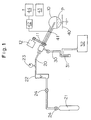
- Fig. 1 shows an outline structure of a plasma-treatment apparatus for producing an inorganic colorant.
- the treatment vessel of a flask shape 10 has a volume of 500 ml and is connected at a neck part with a driving motor 12 via a belt for driving 11, and is designed so as to accomodate a material P such as an inorganic powdered colorant etc. and to carry out the plasma treatment with rotating and stirring.
- the treatment vessel 10 is connected with a gas-supplying pipe 20, with which a gas cylinder 21 as resources for an organic compound is set at the other end of the pipe 20. On the way of the pipe 20, a gas flow meter 22 and a pressure gauge 23 or a valve 24 are set.
- a vacuum-suction pipe 30 is also connected, which is connected with a vacuum pump 32 via a trap 31 and thus, a gas in the treatment vessel 10 is degased with suction.
- a pair of electrodes 40 and 41 are disposed, one electrode 40 is grounded and the other electrode 41 is connected with a high frequency electric source 44 via a impedance matching circuit 42.
- a high-frequency generator 43 is set as well as connected wlth a commercial electric source.
- the low temperature plasma treatment for an inorganic colorant is carried out.
- Each of the inorganic colorant A ⁇ E as mentioned above and an inorganic colorant not yet treated were dispersed, by using a water-soluble acrylic resin (which was an acrylic resin having an acid value 60 and a number-averaged molecular weight 6000, solubilized by neutralizing the resin with dimethylethanolamine ) as a vehicle, with a 200 ml desk top type of SG mill, according to the formulation which is shown in the under-presented Table 1, whereby the aqueous colorants-dispersed paste a ⁇ e and x were obtained.
- a water-soluble acrylic resin which was an acrylic resin having an acid value 60 and a number-averaged molecular weight 6000, solubilized by neutralizing the resin with dimethylethanolamine
- the colorants-dispersed paste a ⁇ e and x were applied on a glass plate by using a doctor blade and, after drying, specular gloss at 60 ° was evaluated.
- specular gloss at 60 ° was evaluated.
- viscosimeter of a corn-plate type E type made by Tokyo Keiki Co., Ltd.
- shear rate in a range of 1.92 ⁇ 384 sec ⁇ 1 viscosity determination was carried out and the yield value was obtained from the Casson's equation.
- the paste a ⁇ d in which colorants were dispersed, relating to the examples of the present invention, when compared with the paste x in which a colorant not yet treated was dispersed, all have higher gloss and smaller yield value, which means better flow properties, and an effect of this invention was evidenced.
- the treating effect in the dispersed paste e was poor, for which the inorganic colorant E being short in treating time was used. From these facts, it is preferred that imposing electric energy is 1 mWh/m2 or more.
- the paint b' in the example of this invention shows higher gloss and, even after the storage, a decrease in gloss is not observed, so that superiority in storage stability is proved. Also, as a result of the rubbing test for the mixed paint, it was proved that the paint, for which the inorganic colorant relating to the example of this invention was used, was obviously small in the color difference and superior in the stability against flooding.
- the surface of the titanium dioxide colorant can be transformed so that its polarity can be much reduced by that a nonpolar group obtainable from low temperature plasma polymerization of an organic compound is formed, and in a case of that a nonpolar material is used as a dispersion medium of a colorant such as a vehicle for coating and so on, an affinity of a dispersion medium for a colorant material becomes higher and a dispersibility is elevated. Also, since stabilization due to a hydrophobic interaction is more easily attained, the dispersibility for a water-soluble material is elevated.
- various kinds of performance being affected with the dispersibility are elevated.
- various kinds of performance such as gloss, storage stability, and stability against flooding and floating are elevated.
Landscapes
- Chemical & Material Sciences (AREA)
- Organic Chemistry (AREA)
- Physics & Mathematics (AREA)
- Engineering & Computer Science (AREA)
- Plasma & Fusion (AREA)
- Pigments, Carbon Blacks, Or Wood Stains (AREA)
- Paints Or Removers (AREA)
Claims (3)
- Wässrige dispergierte Paste, bei welcher ein anorganischer Farbstoff in einer wässrigen Lösung, in welcher ein wasserlösliches Harz gelöst ist, dispergiert ist, dadurch gekennzeichnet, daß der anorganische Farbstoff Titandioxid ist, welches an seiner Oberfläche eine nichtpolare Gruppe hat, die durch eine Plasmapolymerisationsreaktion bei niedriger Temperatur einer organischen Verbindung unter einer Bedingung geformt wurde, daß die elektrische Energie, die während der Plasmapolymerisationsreaktion angelegt wird, 1 mWh/m² oder mehr je Einheitsoberflächenbereich des anorganischen Farbstoffes beträgt, wobei die Oberfläche des anorganischen Farbstoffes nach der Plasmapolymerisationsreaktion nicht nichtpolar wird.
- Wässrige Farbe, welche die Paste nach Anspruch 1 umfaßt, sowie mehr Wasser und wenigstens eines von dem wasserlöslichen Harz und dem zusätzlichen wasserlöslichen Harz enthält.
- Wässrige Farbe, bei welcher ein anorganischer Farbstoff in einer wässrigen Lösung, in welcher ein wasserlösliches Harz in Wasser gelöst ist, dispergiert ist, dadurch gekennzeichnet, daß der anorganische Farbstoff Titandioxid ist, welches an seiner Oberfläche eine nichtpolare Gruppe hat, die durch eine Plasmapolymerisationsreaktion bei niedriger Temperatur einer organischen Verbindung unter einer Bedingunge geformt ist, daß die elektrische Energie, die während der Plasmapolymerisationsreaktion angelegt wird, 1 mWh/m² oder mehr je Einheitsoberflächenbereich des anorganischen Farbstoffes beträgt, wobei die Oberfläche des anorganischen Farbstoffes nach der Plasmapolymerisationsreaktion nicht nichtpolar wird.
Applications Claiming Priority (2)
| Application Number | Priority Date | Filing Date | Title |
|---|---|---|---|
| JP1128240A JPH02305863A (ja) | 1989-05-22 | 1989-05-22 | 無機着色材,着色材分散ペーストト,および,塗料 |
| JP128240/89 | 1989-05-22 |
Publications (2)
| Publication Number | Publication Date |
|---|---|
| EP0399749A1 EP0399749A1 (de) | 1990-11-28 |
| EP0399749B1 true EP0399749B1 (de) | 1995-08-23 |
Family
ID=14979962
Family Applications (1)
| Application Number | Title | Priority Date | Filing Date |
|---|---|---|---|
| EP19900305465 Expired - Lifetime EP0399749B1 (de) | 1989-05-22 | 1990-05-21 | Mit Farbstoff dispergierte Paste und diese Paste enthaltende Anstrichfarbe |
Country Status (3)
| Country | Link |
|---|---|
| EP (1) | EP0399749B1 (de) |
| JP (1) | JPH02305863A (de) |
| DE (1) | DE69021774T2 (de) |
Families Citing this family (2)
| Publication number | Priority date | Publication date | Assignee | Title |
|---|---|---|---|---|
| JPH06329948A (ja) * | 1993-05-21 | 1994-11-29 | Nara Kikai Seisakusho:Kk | 粉体の表面改質方法 |
| DE102011075470A1 (de) | 2011-05-06 | 2012-11-08 | Tesa Se | Klebeband, bevorzugt Selbstklebeband, bestehend aus mindestens zwei direkt aufeinander laminierten Schichten A und B, wobei mindestens eine oder beide Schichten A oder B eine Klebmasse ist |
Family Cites Families (2)
| Publication number | Priority date | Publication date | Assignee | Title |
|---|---|---|---|---|
| JPS6011067B2 (ja) * | 1982-06-11 | 1985-03-22 | 学校法人近畿大学 | 分散ベ−ス組成物 |
| JPS58223437A (ja) * | 1982-06-18 | 1983-12-26 | Tdk Corp | 分散性を改良した無機粉末 |
-
1989
- 1989-05-22 JP JP1128240A patent/JPH02305863A/ja active Pending
-
1990
- 1990-05-21 EP EP19900305465 patent/EP0399749B1/de not_active Expired - Lifetime
- 1990-05-21 DE DE1990621774 patent/DE69021774T2/de not_active Expired - Fee Related
Also Published As
| Publication number | Publication date |
|---|---|
| DE69021774D1 (de) | 1995-09-28 |
| DE69021774T2 (de) | 1996-04-11 |
| JPH02305863A (ja) | 1990-12-19 |
| EP0399749A1 (de) | 1990-11-28 |
Similar Documents
| Publication | Publication Date | Title |
|---|---|---|
| EP0327199B1 (de) | Dispersionen aus Verbundpartikeln | |
| CA1037208A (en) | Black colouring agent | |
| US6083315A (en) | Agglomerated pigment, process for producing the same, aqueous pigment dispersion, and water-based ink composition | |
| EP1655349A1 (de) | Schuppenförmiges pigment, es enthaltenderlack bzw. pulverlack sowie zur verwendung darin vorgesehenesoberflächenbehandlungsmittel für schuppenförmiges pigment | |
| US5216068A (en) | Process for producing an agglomerated molding powder composed of polytetrafluoroethylene and hydrophobic fillers | |
| US3642446A (en) | Process and apparatus for the manufacture of carbon blacks having improved dispersion and platewear characteristics | |
| EP1072655B1 (de) | Wässrige Russdispersionen | |
| EP0810270A2 (de) | Gefärbte Aluminiumpigmente und Verfahren zu deren Herstellung | |
| EP0399749A1 (de) | Mit Farbstoff dispergierte Paste und diese Paste enthaltende Anstrichfarbe | |
| EP0350861A2 (de) | Wässrige Überzugszusammensetzung | |
| US5296523A (en) | Inorganic colorant, colorant-dispersed paste, and paint containing the same | |
| CA1207274A (en) | Pigment-containing base composition | |
| EP1001880B1 (de) | Verfahren zur herstellung von zerreibbaren produkten aus polytetrafluorethylen | |
| CA2124490C (en) | Processes for the preparation of developer compositions | |
| Tianyong et al. | Properties of copper phthalocyanine blue (CI Pigment Blue 15: 3) treated with poly (ethylene glycol) s | |
| EP3505574B1 (de) | Amphiphile copolymere als oberflächenmodifizierungsmittel zur herstellung von verbesserten calciumcarbonatpulvern | |
| JPH09328629A (ja) | アルミニウム顔料とその製造方法およびそれを含む樹脂組成物 | |
| US2282303A (en) | Pigment treatment | |
| KR0149852B1 (ko) | 디부틸틴 옥사이드를 함유하는 촉매 페이스트의 제조방법 및 그의 용도 | |
| JPH09165413A (ja) | 遷移金属組成物 | |
| EP0708131A1 (de) | Rieselfähige Polytetrafluorethylen-Formpulver | |
| JPH0724746B2 (ja) | 顔料分散剤 | |
| CN117304731A (zh) | 一种水性涂料用润湿剂 | |
| SU1130387A1 (ru) | Способ приготовлени суспензий | |
| EP0612821A1 (de) | Dispergiermittel für Russ |
Legal Events
| Date | Code | Title | Description |
|---|---|---|---|
| PUAI | Public reference made under article 153(3) epc to a published international application that has entered the european phase |
Free format text: ORIGINAL CODE: 0009012 |
|
| AK | Designated contracting states |
Kind code of ref document: A1 Designated state(s): DE GB |
|
| 17P | Request for examination filed |
Effective date: 19910214 |
|
| 17Q | First examination report despatched |
Effective date: 19920824 |
|
| GRAA | (expected) grant |
Free format text: ORIGINAL CODE: 0009210 |
|
| AK | Designated contracting states |
Kind code of ref document: B1 Designated state(s): DE GB |
|
| REF | Corresponds to: |
Ref document number: 69021774 Country of ref document: DE Date of ref document: 19950928 |
|
| PLBE | No opposition filed within time limit |
Free format text: ORIGINAL CODE: 0009261 |
|
| STAA | Information on the status of an ep patent application or granted ep patent |
Free format text: STATUS: NO OPPOSITION FILED WITHIN TIME LIMIT |
|
| 26N | No opposition filed | ||
| PGFP | Annual fee paid to national office [announced via postgrant information from national office to epo] |
Ref country code: GB Payment date: 19980512 Year of fee payment: 9 |
|
| PGFP | Annual fee paid to national office [announced via postgrant information from national office to epo] |
Ref country code: DE Payment date: 19980529 Year of fee payment: 9 |
|
| PG25 | Lapsed in a contracting state [announced via postgrant information from national office to epo] |
Ref country code: GB Free format text: LAPSE BECAUSE OF NON-PAYMENT OF DUE FEES Effective date: 19990521 |
|
| GBPC | Gb: european patent ceased through non-payment of renewal fee |
Effective date: 19990521 |
|
| PG25 | Lapsed in a contracting state [announced via postgrant information from national office to epo] |
Ref country code: DE Free format text: LAPSE BECAUSE OF NON-PAYMENT OF DUE FEES Effective date: 20000301 |