EP0388685B1 - Verfahren zum Verbinden von Oxidkeramik und Metall sowie hierdurch hergestelltes Werkzeug - Google Patents
Verfahren zum Verbinden von Oxidkeramik und Metall sowie hierdurch hergestelltes Werkzeug Download PDFInfo
- Publication number
- EP0388685B1 EP0388685B1 EP90104088A EP90104088A EP0388685B1 EP 0388685 B1 EP0388685 B1 EP 0388685B1 EP 90104088 A EP90104088 A EP 90104088A EP 90104088 A EP90104088 A EP 90104088A EP 0388685 B1 EP0388685 B1 EP 0388685B1
- Authority
- EP
- European Patent Office
- Prior art keywords
- layers
- nickel
- layer
- titanium
- metallic
- Prior art date
- Legal status (The legal status is an assumption and is not a legal conclusion. Google has not performed a legal analysis and makes no representation as to the accuracy of the status listed.)
- Expired - Lifetime
Links
Images

Classifications
-
- C—CHEMISTRY; METALLURGY
- C04—CEMENTS; CONCRETE; ARTIFICIAL STONE; CERAMICS; REFRACTORIES
- C04B—LIME, MAGNESIA; SLAG; CEMENTS; COMPOSITIONS THEREOF, e.g. MORTARS, CONCRETE OR LIKE BUILDING MATERIALS; ARTIFICIAL STONE; CERAMICS; REFRACTORIES; TREATMENT OF NATURAL STONE
- C04B37/00—Joining burned ceramic articles with other burned ceramic articles or other articles by heating
- C04B37/02—Joining burned ceramic articles with other burned ceramic articles or other articles by heating with metallic articles
- C04B37/023—Joining burned ceramic articles with other burned ceramic articles or other articles by heating with metallic articles characterised by the interlayer used
- C04B37/025—Joining burned ceramic articles with other burned ceramic articles or other articles by heating with metallic articles characterised by the interlayer used consisting of glass or ceramic material
-
- B—PERFORMING OPERATIONS; TRANSPORTING
- B23—MACHINE TOOLS; METAL-WORKING NOT OTHERWISE PROVIDED FOR
- B23K—SOLDERING OR UNSOLDERING; WELDING; CLADDING OR PLATING BY SOLDERING OR WELDING; CUTTING BY APPLYING HEAT LOCALLY, e.g. FLAME CUTTING; WORKING BY LASER BEAM
- B23K35/00—Rods, electrodes, materials, or media, for use in soldering, welding, or cutting
- B23K35/22—Rods, electrodes, materials, or media, for use in soldering, welding, or cutting characterised by the composition or nature of the material
- B23K35/24—Selection of soldering or welding materials proper
- B23K35/32—Selection of soldering or welding materials proper with the principal constituent melting at more than 1550°C
- B23K35/325—Ti as the principal constituent
-
- C—CHEMISTRY; METALLURGY
- C04—CEMENTS; CONCRETE; ARTIFICIAL STONE; CERAMICS; REFRACTORIES
- C04B—LIME, MAGNESIA; SLAG; CEMENTS; COMPOSITIONS THEREOF, e.g. MORTARS, CONCRETE OR LIKE BUILDING MATERIALS; ARTIFICIAL STONE; CERAMICS; REFRACTORIES; TREATMENT OF NATURAL STONE
- C04B37/00—Joining burned ceramic articles with other burned ceramic articles or other articles by heating
- C04B37/02—Joining burned ceramic articles with other burned ceramic articles or other articles by heating with metallic articles
- C04B37/023—Joining burned ceramic articles with other burned ceramic articles or other articles by heating with metallic articles characterised by the interlayer used
- C04B37/026—Joining burned ceramic articles with other burned ceramic articles or other articles by heating with metallic articles characterised by the interlayer used consisting of metals or metal salts
-
- C—CHEMISTRY; METALLURGY
- C04—CEMENTS; CONCRETE; ARTIFICIAL STONE; CERAMICS; REFRACTORIES
- C04B—LIME, MAGNESIA; SLAG; CEMENTS; COMPOSITIONS THEREOF, e.g. MORTARS, CONCRETE OR LIKE BUILDING MATERIALS; ARTIFICIAL STONE; CERAMICS; REFRACTORIES; TREATMENT OF NATURAL STONE
- C04B2235/00—Aspects relating to ceramic starting mixtures or sintered ceramic products
- C04B2235/65—Aspects relating to heat treatments of ceramic bodies such as green ceramics or pre-sintered ceramics, e.g. burning, sintering or melting processes
- C04B2235/656—Aspects relating to heat treatments of ceramic bodies such as green ceramics or pre-sintered ceramics, e.g. burning, sintering or melting processes characterised by specific heating conditions during heat treatment
- C04B2235/6562—Heating rate
-
- C—CHEMISTRY; METALLURGY
- C04—CEMENTS; CONCRETE; ARTIFICIAL STONE; CERAMICS; REFRACTORIES
- C04B—LIME, MAGNESIA; SLAG; CEMENTS; COMPOSITIONS THEREOF, e.g. MORTARS, CONCRETE OR LIKE BUILDING MATERIALS; ARTIFICIAL STONE; CERAMICS; REFRACTORIES; TREATMENT OF NATURAL STONE
- C04B2237/00—Aspects relating to ceramic laminates or to joining of ceramic articles with other articles by heating
- C04B2237/02—Aspects relating to interlayers, e.g. used to join ceramic articles with other articles by heating
- C04B2237/04—Ceramic interlayers
- C04B2237/08—Non-oxidic interlayers
- C04B2237/086—Carbon interlayers
-
- C—CHEMISTRY; METALLURGY
- C04—CEMENTS; CONCRETE; ARTIFICIAL STONE; CERAMICS; REFRACTORIES
- C04B—LIME, MAGNESIA; SLAG; CEMENTS; COMPOSITIONS THEREOF, e.g. MORTARS, CONCRETE OR LIKE BUILDING MATERIALS; ARTIFICIAL STONE; CERAMICS; REFRACTORIES; TREATMENT OF NATURAL STONE
- C04B2237/00—Aspects relating to ceramic laminates or to joining of ceramic articles with other articles by heating
- C04B2237/02—Aspects relating to interlayers, e.g. used to join ceramic articles with other articles by heating
- C04B2237/12—Metallic interlayers
- C04B2237/122—Metallic interlayers based on refractory metals
-
- C—CHEMISTRY; METALLURGY
- C04—CEMENTS; CONCRETE; ARTIFICIAL STONE; CERAMICS; REFRACTORIES
- C04B—LIME, MAGNESIA; SLAG; CEMENTS; COMPOSITIONS THEREOF, e.g. MORTARS, CONCRETE OR LIKE BUILDING MATERIALS; ARTIFICIAL STONE; CERAMICS; REFRACTORIES; TREATMENT OF NATURAL STONE
- C04B2237/00—Aspects relating to ceramic laminates or to joining of ceramic articles with other articles by heating
- C04B2237/02—Aspects relating to interlayers, e.g. used to join ceramic articles with other articles by heating
- C04B2237/12—Metallic interlayers
- C04B2237/123—Metallic interlayers based on iron group metals, e.g. steel
-
- C—CHEMISTRY; METALLURGY
- C04—CEMENTS; CONCRETE; ARTIFICIAL STONE; CERAMICS; REFRACTORIES
- C04B—LIME, MAGNESIA; SLAG; CEMENTS; COMPOSITIONS THEREOF, e.g. MORTARS, CONCRETE OR LIKE BUILDING MATERIALS; ARTIFICIAL STONE; CERAMICS; REFRACTORIES; TREATMENT OF NATURAL STONE
- C04B2237/00—Aspects relating to ceramic laminates or to joining of ceramic articles with other articles by heating
- C04B2237/30—Composition of layers of ceramic laminates or of ceramic or metallic articles to be joined by heating, e.g. Si substrates
- C04B2237/32—Ceramic
- C04B2237/34—Oxidic
- C04B2237/343—Alumina or aluminates
-
- C—CHEMISTRY; METALLURGY
- C04—CEMENTS; CONCRETE; ARTIFICIAL STONE; CERAMICS; REFRACTORIES
- C04B—LIME, MAGNESIA; SLAG; CEMENTS; COMPOSITIONS THEREOF, e.g. MORTARS, CONCRETE OR LIKE BUILDING MATERIALS; ARTIFICIAL STONE; CERAMICS; REFRACTORIES; TREATMENT OF NATURAL STONE
- C04B2237/00—Aspects relating to ceramic laminates or to joining of ceramic articles with other articles by heating
- C04B2237/30—Composition of layers of ceramic laminates or of ceramic or metallic articles to be joined by heating, e.g. Si substrates
- C04B2237/32—Ceramic
- C04B2237/34—Oxidic
- C04B2237/345—Refractory metal oxides
- C04B2237/348—Zirconia, hafnia, zirconates or hafnates
-
- C—CHEMISTRY; METALLURGY
- C04—CEMENTS; CONCRETE; ARTIFICIAL STONE; CERAMICS; REFRACTORIES
- C04B—LIME, MAGNESIA; SLAG; CEMENTS; COMPOSITIONS THEREOF, e.g. MORTARS, CONCRETE OR LIKE BUILDING MATERIALS; ARTIFICIAL STONE; CERAMICS; REFRACTORIES; TREATMENT OF NATURAL STONE
- C04B2237/00—Aspects relating to ceramic laminates or to joining of ceramic articles with other articles by heating
- C04B2237/30—Composition of layers of ceramic laminates or of ceramic or metallic articles to be joined by heating, e.g. Si substrates
- C04B2237/40—Metallic
- C04B2237/403—Refractory metals
-
- C—CHEMISTRY; METALLURGY
- C04—CEMENTS; CONCRETE; ARTIFICIAL STONE; CERAMICS; REFRACTORIES
- C04B—LIME, MAGNESIA; SLAG; CEMENTS; COMPOSITIONS THEREOF, e.g. MORTARS, CONCRETE OR LIKE BUILDING MATERIALS; ARTIFICIAL STONE; CERAMICS; REFRACTORIES; TREATMENT OF NATURAL STONE
- C04B2237/00—Aspects relating to ceramic laminates or to joining of ceramic articles with other articles by heating
- C04B2237/30—Composition of layers of ceramic laminates or of ceramic or metallic articles to be joined by heating, e.g. Si substrates
- C04B2237/40—Metallic
- C04B2237/405—Iron metal group, e.g. Co or Ni
- C04B2237/406—Iron, e.g. steel
-
- C—CHEMISTRY; METALLURGY
- C04—CEMENTS; CONCRETE; ARTIFICIAL STONE; CERAMICS; REFRACTORIES
- C04B—LIME, MAGNESIA; SLAG; CEMENTS; COMPOSITIONS THEREOF, e.g. MORTARS, CONCRETE OR LIKE BUILDING MATERIALS; ARTIFICIAL STONE; CERAMICS; REFRACTORIES; TREATMENT OF NATURAL STONE
- C04B2237/00—Aspects relating to ceramic laminates or to joining of ceramic articles with other articles by heating
- C04B2237/50—Processing aspects relating to ceramic laminates or to the joining of ceramic articles with other articles by heating
- C04B2237/72—Forming laminates or joined articles comprising at least two interlayers directly next to each other
Definitions
- the invention relates to a method for connecting a component made of oxide ceramic to a metallic component, and a tool consisting of a component made of a metal of subgroup 6, in which the two components are connected by an intermediate layer.
- Oxide-ceramic materials are distinguished from metals by their hardness, wear resistance and temperature resistance as well as by their higher resistance to erosion and corrosion. In many cases, however, their use in mechanical engineering and process engineering is hampered by the disadvantageous properties such as brittleness, low flexural strength and resistance to temperature changes. That is why there has been a great deal of effort recently to combine the properties of ceramics and metal in order to better utilize the advantages of both materials. This led to the development of composite materials and ceramic coatings on metals as well as connections between ceramic and metallic components. A well-known example of the connection technology is the use of ceramic cutting inserts on a metallic tool holder.
- the ceramic is coated with a wetting metallization layer must become.
- the elements titanium, zirconium, aluminum, lithium and especially their alloys are suitable as the wetting layer.
- a compensation layer is proposed which is introduced between the first (metallization) layer and the third (solder) layer in order to compensate for differences in the thermal expansion coefficients of metal and ceramic.
- a compensation layer is proposed which is introduced between the first (metallization) layer and the third (solder) layer in order to compensate for differences in the thermal expansion coefficients of metal and ceramic.
- An electrically conductive metallization layer is produced on the ceramic layer by vapor deposition of a thin niobium or tungsten film, which is covered by a niobium layer deposited from a fluoride melt at 740 ° C. High-temperature resistant metals such as tungsten, molybdenum or niobium are soldered onto this layer.
- the metallization of the ceramic can be dispensed with if active solders made of titanium and zirconium or their alloys with copper or silver are used.
- the invention has for its object to provide a method for producing a tool in which the favorable properties of metal and ceramic are combined.
- the ceramic is to be effectively supported by a hard metal, the connection point of ceramic and hard metal being able to compensate for the different temperature expansion.
- the tool should be able to be produced by a simple method with a single method step. In particular, the method should not be used high pressures and thus a high pressure press.
- the connection should be resistant to temperature changes and should not tend to form brittle phases.
- the object is achieved by a method with the features listed in the characterizing part of the first claim and by a tool with the features listed in the characterizing part of the seventh claim.
- the invention proposes a simple method for joining metals of subgroup 6, in particular tungsten, with oxide ceramics, in particular aluminum oxide.
- oxide ceramics in particular aluminum oxide.
- Zirconium oxide with additions of oxides, carbides, borides and nitrides can also be used as the oxide ceramic
- the layer thickness of the first and third layers should be approximately up to 100 ⁇ m.
- foils of an amorphous Ni / Ti alloy are used for the first and third layers.
- the thickness of the films for the first and third layers should not exceed 30 ⁇ m. Thinner layers prove to be advantageous.
- a lower limit for the film layer thickness is the surface roughness of the components, in particular the oxide ceramic.
- niobium layer For the thickness of the niobium layer, a value of 50 ⁇ m plus the film thickness of the first layer can be assumed as the basis for assessment. However, good results are also achieved with somewhat thicker films, approximately up to 100 ⁇ m.
- the structure of the foils should be amorphous; for example, they become more suitable from amorphous powders according to the process described in published patent application DE 35 18 706 Composition pressed and sintered. It is advantageous here that the foils can be cut to the desired size with scissors.
- An amorphous nickel / titanium alloy containing 35 to 60 atom% of nickel is used as the material for the first and third intermediate layers.
- 1 shows the melting diagram of the nickel / titanium system.
- the respective melting point of the alloy can be seen from this melting diagram.
- the formation of brittle phases, which form in particular with a nickel content of about 25 to 30%, is largely ruled out; on the other hand, the melting point is significantly reduced compared to the known TiNi3 solder.
- the range which corresponds to the flank of the melting point curve between about 35 and 45 atom% of nickel is particularly preferred.
- An alloy which contains 40 atom% of nickel and 60 atom% of titanium is very suitable.
- niobium or niobium base alloys in foil form are suitable as compensation material to compensate for the different expansion coefficients of ceramic and the metal of subgroup 6, provided that the plastic properties of niobium are not significantly impaired by alloy additives.
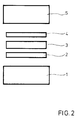
- a Ni / Ti foil 2 of a suitable size is placed on a component made of oxide ceramic 1.
- a foil made of niobium or a niobium base alloy 3 is placed on this foil, which is covered by a further Ni / Ti foil 4.
- the size and arrangement of the foils corresponds to the desired connecting area of the ceramic and the metallic component 5.
- the metallic component 5 is placed on the last-mentioned film.
- a weight that exerts a pressure of at least 0.2 MPa on the connection point is placed on the metallic component, provided the weight of the metallic component is not sufficient.
- the pressure can also be applied by a simple pressing device. A high pressure press device is unnecessary.
- the components and foils can be arranged in a graphite induction furnace which, with a suitable geometry, also prevents the arrangement from shifting.
- the arrangement is then heated under a protective gas atmosphere at least to the melting temperature of the Ni / Ti alloy, preferably to about 1255 ° to 1300 ° C.
- the heating time is about 30 seconds.
- the connected components are slowly cooled and removed from the heater.
- Two pieces of foil measuring 2 x 8 mm2 were produced from 40% Ni, the rest of titanium in accordance with DE-OS 35 18 706. The thickness of the foils was 30 ⁇ m. A section with 2 x 8 mm2 was cut out of a niobium foil with a thickness of 100 ⁇ m.
- the tungsten component was connected to the ceramic component in a soldering device.
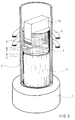
- Fig. 3 shows the structure of this soldering device.
- a quartz tube 2 is attached to a steel base plate 1.
- the lower part of the quartz tube is filled with a cylinder 3 made of Al2O3, which serves as thermal insulation.
- the tungsten component 5, the amorphous Ni / Ti foil 6, the niobium foil 7, a further Ni / Ti foil 8 and the ceramic component 9 are inserted into this fitting slot and by means of a suitable stamp 10, which presses of 0.2 MPa, weighed down.
- the graphite matrix 4 holds the parts to be soldered in position and guides the press ram 10.
- the die 4 itself is surrounded by a graphite susceptor (not shown in the figure), in which the required heating power is generated by means of a high-frequency coil 11.
- a resistance heater could also be used as the heater.
- the quartz glass tube 2 contained an argon atmosphere during the soldering process.
- the soldering temperature in the range of 1255 to 1300 ° C is started with a heating rate of 100 ° C / min. It has proven itself to hold for 10 minutes at about 1000 ° C provide good temperature compensation. A service life of at least 5 seconds must be observed at the soldering temperature. Standing times of up to 3 minutes deliver good results.
- the minimum contact pressure is 0.2 MPa. However, a pressure in the range from 0.35 to 0.7 MPa is preferred. These pressures are generated by applying a weight at the beginning of the soldering process. If a press is used, it is sufficient to apply the pressure only above 1000 ° C.
- the mixture is cooled to 1000 ° C. in about 2 minutes. This ends the alloying processes in the soldering zone as defined as possible. With a holding time of a few minutes at 1000 ° C, however, another possibility for voltage equalization is created.
- the temperature is then lowered at a rate of 50 ° C./min and the sample obtained is removed from the die.
- the temperature is monitored using a built-in thermocouple.
- Niobium has thus reached the tungsten-cobalt alloy through the liquid solder phase. This is followed by a two-phase zone (Zone 3), in which grains with approx. 70 at% niobium are embedded in a phase with less than 50 at% niobium, which also contains 40 at% Ni-Ti.
- a fourth zone was created by solder penetrating the niobium along the grain boundaries.
- the attack remains limited, however, so that eventually a residue of pure niobium (Zone 5) is available.
- Zone 5 pure niobium
- the composition corresponds approximately to that of zone 3. However, about 10 at.% Aluminum are still dissolved in it.
- Zones 1 and 2 have a hardness close to that of the pure tungsten / cobalt alloy.
- Zone 3 with a Vickers hardness of 5592 MPa [570 kp / mm2] can be described as hard, but not yet as a brittle phase.
- Zone 4 with 2747 MPa [280 kp / mm2] comes close to the hardness of pure niobium with 1128 MPa [115 kp / mm2].
- a hardness of approx. 7848 MPa [800 kp / mm2] was measured in the zone adjacent to the aluminum oxide. In all hardness measurements, the measurement of the diagonals of the pyramid impression gave no indication of internal stresses in the contact area with the brittle oxide ceramic.
- the lower limit of the soldering temperature was 1255 ° C with a contact pressure of 0.2 MPa.
- the minimum pressure of 0.2 MPa is required to push gas bubbles that were trapped when the solder melted out of the solder area. At the same time, the pressure causes an even contact and thus a more uniform and faster reaction of the solder with the ceramic, which is slower than the alloy formation with the niobium.
- the working temperature can be reduced even further by using higher pressures.
- solder is pressed out of the seam area by a higher contact pressure and the possibility of brittle phase formation is reduced. In this context, it is advantageous if even thinner foils of the solder are used.
Landscapes
- Chemical & Material Sciences (AREA)
- Engineering & Computer Science (AREA)
- Ceramic Engineering (AREA)
- Materials Engineering (AREA)
- Structural Engineering (AREA)
- Organic Chemistry (AREA)
- Mechanical Engineering (AREA)
- Ceramic Products (AREA)
Priority Applications (1)
| Application Number | Priority Date | Filing Date | Title |
|---|---|---|---|
| AT90104088T ATE89538T1 (de) | 1989-03-20 | 1990-03-02 | Verfahren zum verbinden von oxidkeramik und metall sowie hierdurch hergestelltes werkzeug. |
Applications Claiming Priority (2)
| Application Number | Priority Date | Filing Date | Title |
|---|---|---|---|
| DE3909088A DE3909088C1 (enExample) | 1989-03-20 | 1989-03-20 | |
| DE3909088 | 1989-03-20 |
Publications (2)
| Publication Number | Publication Date |
|---|---|
| EP0388685A1 EP0388685A1 (de) | 1990-09-26 |
| EP0388685B1 true EP0388685B1 (de) | 1993-05-19 |
Family
ID=6376760
Family Applications (1)
| Application Number | Title | Priority Date | Filing Date |
|---|---|---|---|
| EP90104088A Expired - Lifetime EP0388685B1 (de) | 1989-03-20 | 1990-03-02 | Verfahren zum Verbinden von Oxidkeramik und Metall sowie hierdurch hergestelltes Werkzeug |
Country Status (3)
| Country | Link |
|---|---|
| EP (1) | EP0388685B1 (enExample) |
| AT (1) | ATE89538T1 (enExample) |
| DE (1) | DE3909088C1 (enExample) |
Cited By (1)
| Publication number | Priority date | Publication date | Assignee | Title |
|---|---|---|---|---|
| DE102019121936A1 (de) * | 2019-08-14 | 2021-02-18 | Technische Universitaet Dresden | Hochtemperaturaktivlote |
Families Citing this family (3)
| Publication number | Priority date | Publication date | Assignee | Title |
|---|---|---|---|---|
| EP0852978A4 (en) * | 1995-09-27 | 2000-03-01 | Ishizuka Research Inst Ltd | SUPERABRASIVE GRAINED COMPOSITE MATERIALS |
| RU2184644C2 (ru) * | 1997-07-16 | 2002-07-10 | Дзе Исизука Рисерч Инститьют, Лтд. | Алмазосодержащий слоистый композит и способ его получения |
| US7896222B2 (en) | 2004-10-01 | 2011-03-01 | Regents Of The University Of Michigan | Manufacture of shape memory alloy cellular materials and structures by transient-liquid reactive joining |
Family Cites Families (2)
| Publication number | Priority date | Publication date | Assignee | Title |
|---|---|---|---|---|
| DE3014645C2 (de) * | 1980-04-16 | 1982-12-02 | MTU Motoren- und Turbinen-Union München GmbH, 8000 München | Metall-Keramik-Bauteil und Verfahren zu seiner Herstellung |
| DE3518706A1 (de) * | 1985-05-24 | 1986-11-27 | Kernforschungszentrum Karlsruhe Gmbh, 7500 Karlsruhe | Verfahren zur herstellung von formkoerpern mit verbesserten, isotropen eigenschaften |
-
1989
- 1989-03-20 DE DE3909088A patent/DE3909088C1/de not_active Expired - Lifetime
-
1990
- 1990-03-02 EP EP90104088A patent/EP0388685B1/de not_active Expired - Lifetime
- 1990-03-02 AT AT90104088T patent/ATE89538T1/de not_active IP Right Cessation
Cited By (2)
| Publication number | Priority date | Publication date | Assignee | Title |
|---|---|---|---|---|
| DE102019121936A1 (de) * | 2019-08-14 | 2021-02-18 | Technische Universitaet Dresden | Hochtemperaturaktivlote |
| DE102019121936B4 (de) | 2019-08-14 | 2025-09-04 | Technische Universitaet Dresden | Hochtemperaturaktivlote |
Also Published As
| Publication number | Publication date |
|---|---|
| EP0388685A1 (de) | 1990-09-26 |
| DE3909088C1 (enExample) | 1990-08-30 |
| ATE89538T1 (de) | 1993-06-15 |
Similar Documents
| Publication | Publication Date | Title |
|---|---|---|
| DE68908433T2 (de) | Herstellung von aufgelöteten thermisch stabilen polykristallinen Diamant-Presswerkstücken. | |
| DE69217123T2 (de) | Verfahren zur Herstellung von Schleifkörpern mit chemisch-gebundener haftender Beschichtung | |
| DE3688999T2 (de) | Sinterhartmetallkörper für Werkzeuge. | |
| EP0174984B1 (en) | Liquid phase bonded amorphous materials and process for preparation thereof | |
| DE3780136T2 (de) | Gesinterter verbundpresskoerper mit grosser haerte. | |
| EP1250467B1 (de) | Lotlegierung | |
| DE69707283T2 (de) | Verfahren zur zusammenfügung von werkstoffteilen auf basis von siliciumcarbid mit hilfe einer dicken verbindungsschicht durch feuerfeste hartlötung und so erhaltener verbund | |
| DE69014161T2 (de) | Werkzeug unter Verwendung von Gold als Bindemittel und Verfahren zu dessen Herstellung. | |
| DE69904364T2 (de) | Hartlötzusammensetzung und verfahren zum hartlöten von materialien auf aluminiumoxyd-basis mit dieser zusammensetzung | |
| EP1233935B1 (de) | Verfahren zur festlegung eines aus metall-matrix-composite-(mmc) material gebildeten körpers auf einem keramischen körper | |
| WO2004080913A1 (de) | Verfahren zur herstellung eines verbundwerkstoffes | |
| DE69802051T2 (de) | Legierungen zum Verbinden auf Sinterkarbid, und damit hergestellte Verbundwerkstoffe | |
| EP1751320A1 (de) | Verschleissteil aus einem diamanthaltigen verbundwerkstoff | |
| EP0209672B1 (de) | Verfahren zum Verbinden von Siliciumcarbid-Formteilen | |
| DE3608559A1 (de) | Verfahren zum verbinden von formteilen aus sic mit keramik oder metall und zur oberflaechenbehandlung von sisic sowie eine zum verbinden brauchbare legierung | |
| US4630767A (en) | Method of brazing using a ductile low temperature brazing alloy | |
| EP1678733B1 (de) | Verfahren zur herstellung eines verbundkörpers durch hochtemperaturlöten einer nichtmetallischen komponente mit einer metallischen oder nichtmetallischen komponente | |
| DE3909088C1 (enExample) | ||
| DE3933215C1 (enExample) | ||
| He et al. | The effect of Mo particles addition in Ag-Cu-Ti filler alloy on Ti (C, N)-based cermet/45 steel-brazed joints | |
| Su et al. | Al2O3/SUS304 brazing via AgCuTi-W composite as active filler | |
| CA1229507A (en) | Nickel based brazing filler metals | |
| DE102004020404A1 (de) | Trägerplatte für Sputtertargets | |
| DE68920726T2 (de) | Verfahren zur bildung einer keramischen schicht auf einem metallkörper. | |
| EP3577249A1 (de) | Verfahren zum beschichten von soliden diamantwerkstoffen |
Legal Events
| Date | Code | Title | Description |
|---|---|---|---|
| PUAI | Public reference made under article 153(3) epc to a published international application that has entered the european phase |
Free format text: ORIGINAL CODE: 0009012 |
|
| AK | Designated contracting states |
Kind code of ref document: A1 Designated state(s): AT BE CH FR GB IT LI NL SE |
|
| 17P | Request for examination filed |
Effective date: 19901029 |
|
| 17Q | First examination report despatched |
Effective date: 19920928 |
|
| GRAA | (expected) grant |
Free format text: ORIGINAL CODE: 0009210 |
|
| AK | Designated contracting states |
Kind code of ref document: B1 Designated state(s): AT BE CH FR GB IT LI NL SE |
|
| PG25 | Lapsed in a contracting state [announced via postgrant information from national office to epo] |
Ref country code: IT Free format text: LAPSE BECAUSE OF FAILURE TO SUBMIT A TRANSLATION OF THE DESCRIPTION OR TO PAY THE FEE WITHIN THE PRE;WARNING: LAPSES OF ITALIAN PATENTS WITH EFFECTIVE DATE BEFORE 2007 MAY HAVE OCCURRED AT ANY TIME BEFORE 2007. THE CORRECT EFFECTIVE DATE MAY BE DIFFERENT FROM THE ONE RECORDED.SCRIBED TIME-LIMIT Effective date: 19930519 Ref country code: GB Effective date: 19930519 Ref country code: NL Effective date: 19930519 Ref country code: SE Effective date: 19930519 |
|
| REF | Corresponds to: |
Ref document number: 89538 Country of ref document: AT Date of ref document: 19930615 Kind code of ref document: T |
|
| ET | Fr: translation filed | ||
| NLV1 | Nl: lapsed or annulled due to failure to fulfill the requirements of art. 29p and 29m of the patents act | ||
| GBV | Gb: ep patent (uk) treated as always having been void in accordance with gb section 77(7)/1977 [no translation filed] |
Effective date: 19930519 |
|
| PGFP | Annual fee paid to national office [announced via postgrant information from national office to epo] |
Ref country code: CH Payment date: 19940127 Year of fee payment: 5 |
|
| PLBE | No opposition filed within time limit |
Free format text: ORIGINAL CODE: 0009261 |
|
| STAA | Information on the status of an ep patent application or granted ep patent |
Free format text: STATUS: NO OPPOSITION FILED WITHIN TIME LIMIT |
|
| PGFP | Annual fee paid to national office [announced via postgrant information from national office to epo] |
Ref country code: AT Payment date: 19940329 Year of fee payment: 5 |
|
| PGFP | Annual fee paid to national office [announced via postgrant information from national office to epo] |
Ref country code: FR Payment date: 19940330 Year of fee payment: 5 |
|
| PGFP | Annual fee paid to national office [announced via postgrant information from national office to epo] |
Ref country code: BE Payment date: 19940401 Year of fee payment: 5 |
|
| 26N | No opposition filed | ||
| PG25 | Lapsed in a contracting state [announced via postgrant information from national office to epo] |
Ref country code: AT Effective date: 19950302 |
|
| PG25 | Lapsed in a contracting state [announced via postgrant information from national office to epo] |
Ref country code: CH Effective date: 19950331 Ref country code: BE Effective date: 19950331 Ref country code: LI Effective date: 19950331 |
|
| BERE | Be: lapsed |
Owner name: KERNFORSCHUNGSZENTRUM KARLSRUHE G.M.B.H. Effective date: 19950331 |
|
| PG25 | Lapsed in a contracting state [announced via postgrant information from national office to epo] |
Ref country code: FR Free format text: LAPSE BECAUSE OF NON-PAYMENT OF DUE FEES Effective date: 19951130 |
|
| REG | Reference to a national code |
Ref country code: CH Ref legal event code: PL |
|
| REG | Reference to a national code |
Ref country code: FR Ref legal event code: ST |