EP0387357B1 - Indolenine derivatives - Google Patents
Indolenine derivatives Download PDFInfo
- Publication number
- EP0387357B1 EP0387357B1 EP89910180A EP89910180A EP0387357B1 EP 0387357 B1 EP0387357 B1 EP 0387357B1 EP 89910180 A EP89910180 A EP 89910180A EP 89910180 A EP89910180 A EP 89910180A EP 0387357 B1 EP0387357 B1 EP 0387357B1
- Authority
- EP
- European Patent Office
- Prior art keywords
- compound
- formula
- methylene
- λmax
- reference example
- Prior art date
- Legal status (The legal status is an assumption and is not a legal conclusion. Google has not performed a legal analysis and makes no representation as to the accuracy of the status listed.)
- Expired - Lifetime
Links
- RKJUIXBNRJVNHR-UHFFFAOYSA-N indolenine group Chemical group N1=CCC2=CC=CC=C12 RKJUIXBNRJVNHR-UHFFFAOYSA-N 0.000 title claims abstract description 6
- 150000001875 compounds Chemical class 0.000 claims abstract description 77
- 125000001570 methylene group Chemical group [H]C([H])([*:1])[*:2] 0.000 claims abstract description 34
- 125000004430 oxygen atom Chemical group O* 0.000 claims abstract description 6
- 125000004435 hydrogen atom Chemical group [H]* 0.000 claims abstract description 3
- 125000004209 (C1-C8) alkyl group Chemical group 0.000 claims description 4
- 125000000217 alkyl group Chemical group 0.000 abstract description 6
- 239000000975 dye Substances 0.000 abstract description 6
- 239000000543 intermediate Substances 0.000 abstract description 3
- 230000003287 optical effect Effects 0.000 abstract description 2
- 239000004065 semiconductor Substances 0.000 abstract description 2
- 230000002194 synthesizing effect Effects 0.000 abstract description 2
- ANRHNWWPFJCPAZ-UHFFFAOYSA-M thionine Chemical class [Cl-].C1=CC(N)=CC2=[S+]C3=CC(N)=CC=C3N=C21 ANRHNWWPFJCPAZ-UHFFFAOYSA-M 0.000 abstract 1
- OKKJLVBELUTLKV-UHFFFAOYSA-N Methanol Chemical compound OC OKKJLVBELUTLKV-UHFFFAOYSA-N 0.000 description 24
- -1 alkali metal salts Chemical class 0.000 description 24
- 229910052760 oxygen Inorganic materials 0.000 description 15
- 238000010521 absorption reaction Methods 0.000 description 14
- YXFVVABEGXRONW-UHFFFAOYSA-N Toluene Chemical compound CC1=CC=CC=C1 YXFVVABEGXRONW-UHFFFAOYSA-N 0.000 description 12
- SWXVUIWOUIDPGS-UHFFFAOYSA-N diacetone alcohol Chemical compound CC(=O)CC(C)(C)O SWXVUIWOUIDPGS-UHFFFAOYSA-N 0.000 description 12
- 238000000034 method Methods 0.000 description 11
- 125000002496 methyl group Chemical group [H]C([H])([H])* 0.000 description 11
- KFZMGEQAYNKOFK-UHFFFAOYSA-N Isopropanol Chemical compound CC(C)O KFZMGEQAYNKOFK-UHFFFAOYSA-N 0.000 description 9
- 238000002844 melting Methods 0.000 description 9
- 230000008018 melting Effects 0.000 description 9
- 239000000203 mixture Substances 0.000 description 9
- 238000006243 chemical reaction Methods 0.000 description 8
- LFQSCWFLJHTTHZ-UHFFFAOYSA-N Ethanol Chemical compound CCO LFQSCWFLJHTTHZ-UHFFFAOYSA-N 0.000 description 7
- VLTRZXGMWDSKGL-UHFFFAOYSA-N perchloric acid Chemical group OCl(=O)(=O)=O VLTRZXGMWDSKGL-UHFFFAOYSA-N 0.000 description 7
- WFDIJRYMOXRFFG-UHFFFAOYSA-N Acetic anhydride Chemical compound CC(=O)OC(C)=O WFDIJRYMOXRFFG-UHFFFAOYSA-N 0.000 description 6
- UHOVQNZJYSORNB-UHFFFAOYSA-N Benzene Chemical compound C1=CC=CC=C1 UHOVQNZJYSORNB-UHFFFAOYSA-N 0.000 description 6
- YMWUJEATGCHHMB-UHFFFAOYSA-N Dichloromethane Chemical compound ClCCl YMWUJEATGCHHMB-UHFFFAOYSA-N 0.000 description 6
- JUJWROOIHBZHMG-UHFFFAOYSA-N Pyridine Chemical compound C1=CC=NC=C1 JUJWROOIHBZHMG-UHFFFAOYSA-N 0.000 description 6
- HEMHJVSKTPXQMS-UHFFFAOYSA-M Sodium hydroxide Chemical compound [OH-].[Na+] HEMHJVSKTPXQMS-UHFFFAOYSA-M 0.000 description 6
- 239000002253 acid Substances 0.000 description 6
- MVPPADPHJFYWMZ-UHFFFAOYSA-N chlorobenzene Chemical compound ClC1=CC=CC=C1 MVPPADPHJFYWMZ-UHFFFAOYSA-N 0.000 description 6
- 125000004108 n-butyl group Chemical group [H]C([H])([H])C([H])([H])C([H])([H])C([H])([H])* 0.000 description 6
- SCVFZCLFOSHCOH-UHFFFAOYSA-M potassium acetate Chemical class [K+].CC([O-])=O SCVFZCLFOSHCOH-UHFFFAOYSA-M 0.000 description 6
- 239000002904 solvent Substances 0.000 description 6
- 125000001814 trioxo-lambda(7)-chloranyloxy group Chemical group *OCl(=O)(=O)=O 0.000 description 6
- DKGAVHZHDRPRBM-UHFFFAOYSA-N Tert-Butanol Chemical compound CC(C)(C)O DKGAVHZHDRPRBM-UHFFFAOYSA-N 0.000 description 5
- XLYOFNOQVPJJNP-UHFFFAOYSA-N water Substances O XLYOFNOQVPJJNP-UHFFFAOYSA-N 0.000 description 5
- QGKMIGUHVLGJBR-UHFFFAOYSA-M (4z)-1-(3-methylbutyl)-4-[[1-(3-methylbutyl)quinolin-1-ium-4-yl]methylidene]quinoline;iodide Chemical class [I-].C12=CC=CC=C2N(CCC(C)C)C=CC1=CC1=CC=[N+](CCC(C)C)C2=CC=CC=C12 QGKMIGUHVLGJBR-UHFFFAOYSA-M 0.000 description 4
- QPFMBZIOSGYJDE-UHFFFAOYSA-N 1,1,2,2-tetrachloroethane Chemical compound ClC(Cl)C(Cl)Cl QPFMBZIOSGYJDE-UHFFFAOYSA-N 0.000 description 4
- LRHPLDYGYMQRHN-UHFFFAOYSA-N N-Butanol Chemical compound CCCCO LRHPLDYGYMQRHN-UHFFFAOYSA-N 0.000 description 4
- 238000009835 boiling Methods 0.000 description 4
- NNBZCPXTIHJBJL-UHFFFAOYSA-N decalin Chemical compound C1CCCC2CCCCC21 NNBZCPXTIHJBJL-UHFFFAOYSA-N 0.000 description 4
- DIOQZVSQGTUSAI-UHFFFAOYSA-N decane Chemical compound CCCCCCCCCC DIOQZVSQGTUSAI-UHFFFAOYSA-N 0.000 description 4
- 238000000921 elemental analysis Methods 0.000 description 4
- ZXEKIIBDNHEJCQ-UHFFFAOYSA-N isobutanol Chemical compound CC(C)CO ZXEKIIBDNHEJCQ-UHFFFAOYSA-N 0.000 description 4
- TVMXDCGIABBOFY-UHFFFAOYSA-N octane Chemical compound CCCCCCCC TVMXDCGIABBOFY-UHFFFAOYSA-N 0.000 description 4
- BDERNNFJNOPAEC-UHFFFAOYSA-N propan-1-ol Chemical compound CCCO BDERNNFJNOPAEC-UHFFFAOYSA-N 0.000 description 4
- 125000006274 (C1-C3)alkoxy group Chemical group 0.000 description 3
- 125000004200 2-methoxyethyl group Chemical group [H]C([H])([H])OC([H])([H])C([H])([H])* 0.000 description 3
- XHCWDDGZFBAXRT-UHFFFAOYSA-N 3-bromo-3-methylbutan-2-one Chemical compound CC(=O)C(C)(C)Br XHCWDDGZFBAXRT-UHFFFAOYSA-N 0.000 description 3
- QTBSBXVTEAMEQO-UHFFFAOYSA-N Acetic acid Chemical compound CC(O)=O QTBSBXVTEAMEQO-UHFFFAOYSA-N 0.000 description 3
- VEXZGXHMUGYJMC-UHFFFAOYSA-N Hydrochloric acid Chemical compound Cl VEXZGXHMUGYJMC-UHFFFAOYSA-N 0.000 description 3
- KWYUFKZDYYNOTN-UHFFFAOYSA-M Potassium hydroxide Chemical compound [OH-].[K+] KWYUFKZDYYNOTN-UHFFFAOYSA-M 0.000 description 3
- ZMANZCXQSJIPKH-UHFFFAOYSA-N Triethylamine Chemical compound CCN(CC)CC ZMANZCXQSJIPKH-UHFFFAOYSA-N 0.000 description 3
- 239000002168 alkylating agent Substances 0.000 description 3
- 229940100198 alkylating agent Drugs 0.000 description 3
- 235000014113 dietary fatty acids Nutrition 0.000 description 3
- 239000000194 fatty acid Substances 0.000 description 3
- 229930195729 fatty acid Natural products 0.000 description 3
- 239000000463 material Substances 0.000 description 3
- 150000007524 organic acids Chemical class 0.000 description 3
- 235000011056 potassium acetate Nutrition 0.000 description 3
- UMJSCPRVCHMLSP-UHFFFAOYSA-N pyridine Natural products COC1=CC=CN=C1 UMJSCPRVCHMLSP-UHFFFAOYSA-N 0.000 description 3
- 239000011541 reaction mixture Substances 0.000 description 3
- CXWXQJXEFPUFDZ-UHFFFAOYSA-N tetralin Chemical compound C1=CC=C2CCCCC2=C1 CXWXQJXEFPUFDZ-UHFFFAOYSA-N 0.000 description 3
- UOCLXMDMGBRAIB-UHFFFAOYSA-N 1,1,1-trichloroethane Chemical compound CC(Cl)(Cl)Cl UOCLXMDMGBRAIB-UHFFFAOYSA-N 0.000 description 2
- OCJBOOLMMGQPQU-UHFFFAOYSA-N 1,4-dichlorobenzene Chemical compound ClC1=CC=C(Cl)C=C1 OCJBOOLMMGQPQU-UHFFFAOYSA-N 0.000 description 2
- 125000000954 2-hydroxyethyl group Chemical group [H]C([*])([H])C([H])([H])O[H] 0.000 description 2
- YEJRWHAVMIAJKC-UHFFFAOYSA-N 4-Butyrolactone Chemical compound O=C1CCCO1 YEJRWHAVMIAJKC-UHFFFAOYSA-N 0.000 description 2
- HSZXWLQWOHESIF-UHFFFAOYSA-N 5-butyl-7,7-dimethyl-6-methylidene-[1,3]dioxolo[4,5-f]indole Chemical compound C1=C2N(CCCC)C(=C)C(C)(C)C2=CC2=C1OCO2 HSZXWLQWOHESIF-UHFFFAOYSA-N 0.000 description 2
- VTYYLEPIZMXCLO-UHFFFAOYSA-L Calcium carbonate Chemical compound [Ca+2].[O-]C([O-])=O VTYYLEPIZMXCLO-UHFFFAOYSA-L 0.000 description 2
- XDTMQSROBMDMFD-UHFFFAOYSA-N Cyclohexane Chemical compound C1CCCCC1 XDTMQSROBMDMFD-UHFFFAOYSA-N 0.000 description 2
- CTQNGGLPUBDAKN-UHFFFAOYSA-N O-Xylene Chemical compound CC1=CC=CC=C1C CTQNGGLPUBDAKN-UHFFFAOYSA-N 0.000 description 2
- CDBYLPFSWZWCQE-UHFFFAOYSA-L Sodium Carbonate Chemical compound [Na+].[Na+].[O-]C([O-])=O CDBYLPFSWZWCQE-UHFFFAOYSA-L 0.000 description 2
- VMHLLURERBWHNL-UHFFFAOYSA-M Sodium acetate Chemical class [Na+].CC([O-])=O VMHLLURERBWHNL-UHFFFAOYSA-M 0.000 description 2
- QAOWNCQODCNURD-UHFFFAOYSA-N Sulfuric acid Chemical compound OS(O)(=O)=O QAOWNCQODCNURD-UHFFFAOYSA-N 0.000 description 2
- 235000011054 acetic acid Nutrition 0.000 description 2
- 230000002378 acidificating effect Effects 0.000 description 2
- 239000003513 alkali Substances 0.000 description 2
- 229910052783 alkali metal Inorganic materials 0.000 description 2
- 125000005228 aryl sulfonate group Chemical group 0.000 description 2
- VSGNNIFQASZAOI-UHFFFAOYSA-L calcium acetate Chemical class [Ca+2].CC([O-])=O.CC([O-])=O VSGNNIFQASZAOI-UHFFFAOYSA-L 0.000 description 2
- 239000001639 calcium acetate Chemical class 0.000 description 2
- 235000011092 calcium acetate Nutrition 0.000 description 2
- 229960005147 calcium acetate Drugs 0.000 description 2
- 125000002915 carbonyl group Chemical group [*:2]C([*:1])=O 0.000 description 2
- 238000004440 column chromatography Methods 0.000 description 2
- 238000006482 condensation reaction Methods 0.000 description 2
- 239000013078 crystal Substances 0.000 description 2
- 229940117389 dichlorobenzene Drugs 0.000 description 2
- XBDQKXXYIPTUBI-UHFFFAOYSA-N dimethylselenoniopropionate Natural products CCC(O)=O XBDQKXXYIPTUBI-UHFFFAOYSA-N 0.000 description 2
- 125000001495 ethyl group Chemical group [H]C([H])([H])C([H])([H])* 0.000 description 2
- 238000001914 filtration Methods 0.000 description 2
- 125000005843 halogen group Chemical group 0.000 description 2
- 239000003960 organic solvent Substances 0.000 description 2
- VLTRZXGMWDSKGL-UHFFFAOYSA-M perchlorate Inorganic materials [O-]Cl(=O)(=O)=O VLTRZXGMWDSKGL-UHFFFAOYSA-M 0.000 description 2
- BWHMMNNQKKPAPP-UHFFFAOYSA-L potassium carbonate Chemical compound [K+].[K+].[O-]C([O-])=O BWHMMNNQKKPAPP-UHFFFAOYSA-L 0.000 description 2
- 238000002360 preparation method Methods 0.000 description 2
- 238000000746 purification Methods 0.000 description 2
- 239000002516 radical scavenger Substances 0.000 description 2
- 238000001953 recrystallisation Methods 0.000 description 2
- 238000010992 reflux Methods 0.000 description 2
- 238000000926 separation method Methods 0.000 description 2
- 239000001632 sodium acetate Chemical class 0.000 description 2
- 235000017281 sodium acetate Nutrition 0.000 description 2
- 125000001424 substituent group Chemical group 0.000 description 2
- 238000005292 vacuum distillation Methods 0.000 description 2
- PXXNTAGJWPJAGM-UHFFFAOYSA-N vertaline Natural products C1C2C=3C=C(OC)C(OC)=CC=3OC(C=C3)=CC=C3CCC(=O)OC1CC1N2CCCC1 PXXNTAGJWPJAGM-UHFFFAOYSA-N 0.000 description 2
- 239000008096 xylene Substances 0.000 description 2
- SCYULBFZEHDVBN-UHFFFAOYSA-N 1,1-Dichloroethane Chemical compound CC(Cl)Cl SCYULBFZEHDVBN-UHFFFAOYSA-N 0.000 description 1
- FSSPGSAQUIYDCN-UHFFFAOYSA-N 1,3-Propane sultone Chemical compound O=S1(=O)CCCO1 FSSPGSAQUIYDCN-UHFFFAOYSA-N 0.000 description 1
- XGNXYCFREOZBOL-UHFFFAOYSA-N 1,3-benzodioxol-5-amine Chemical compound NC1=CC=C2OCOC2=C1 XGNXYCFREOZBOL-UHFFFAOYSA-N 0.000 description 1
- MPPPKRYCTPRNTB-UHFFFAOYSA-N 1-bromobutane Chemical compound CCCCBr MPPPKRYCTPRNTB-UHFFFAOYSA-N 0.000 description 1
- CYNYIHKIEHGYOZ-UHFFFAOYSA-N 1-bromopropane Chemical compound CCCBr CYNYIHKIEHGYOZ-UHFFFAOYSA-N 0.000 description 1
- VFWCMGCRMGJXDK-UHFFFAOYSA-N 1-chlorobutane Chemical compound CCCCCl VFWCMGCRMGJXDK-UHFFFAOYSA-N 0.000 description 1
- LEWZOBYWGWKNCK-UHFFFAOYSA-N 2,3-dihydro-1h-inden-5-amine Chemical compound NC1=CC=C2CCCC2=C1 LEWZOBYWGWKNCK-UHFFFAOYSA-N 0.000 description 1
- LBLYYCQCTBFVLH-UHFFFAOYSA-M 2-methylbenzenesulfonate Chemical compound CC1=CC=CC=C1S([O-])(=O)=O LBLYYCQCTBFVLH-UHFFFAOYSA-M 0.000 description 1
- 239000004593 Epoxy Chemical class 0.000 description 1
- IAYPIBMASNFSPL-UHFFFAOYSA-N Ethylene oxide Chemical compound C1CO1 IAYPIBMASNFSPL-UHFFFAOYSA-N 0.000 description 1
- UFWIBTONFRDIAS-UHFFFAOYSA-N Naphthalene Chemical compound C1=CC=CC2=CC=CC=C21 UFWIBTONFRDIAS-UHFFFAOYSA-N 0.000 description 1
- GOOHAUXETOMSMM-UHFFFAOYSA-N Propylene oxide Chemical compound CC1CO1 GOOHAUXETOMSMM-UHFFFAOYSA-N 0.000 description 1
- 150000001243 acetic acids Chemical class 0.000 description 1
- 150000007513 acids Chemical class 0.000 description 1
- 150000001298 alcohols Chemical class 0.000 description 1
- 150000001338 aliphatic hydrocarbons Chemical class 0.000 description 1
- 125000003545 alkoxy group Chemical group 0.000 description 1
- 150000004996 alkyl benzenes Chemical class 0.000 description 1
- 125000005526 alkyl sulfate group Chemical group 0.000 description 1
- 150000008052 alkyl sulfonates Chemical group 0.000 description 1
- 125000002490 anilino group Chemical class [H]N(*)C1=C([H])C([H])=C([H])C([H])=C1[H] 0.000 description 1
- 150000004945 aromatic hydrocarbons Chemical class 0.000 description 1
- RDHPKYGYEGBMSE-UHFFFAOYSA-N bromoethane Chemical compound CCBr RDHPKYGYEGBMSE-UHFFFAOYSA-N 0.000 description 1
- YHASWHZGWUONAO-UHFFFAOYSA-N butanoyl butanoate Chemical compound CCCC(=O)OC(=O)CCC YHASWHZGWUONAO-UHFFFAOYSA-N 0.000 description 1
- QYJXDIUNDMRLAO-UHFFFAOYSA-N butyl 4-methylbenzenesulfonate Chemical compound CCCCOS(=O)(=O)C1=CC=C(C)C=C1 QYJXDIUNDMRLAO-UHFFFAOYSA-N 0.000 description 1
- BZWQNMUGNDAMBX-UHFFFAOYSA-N butyl butane-1-sulfonate Chemical compound CCCCOS(=O)(=O)CCCC BZWQNMUGNDAMBX-UHFFFAOYSA-N 0.000 description 1
- XOXVXYRAFRSTIM-UHFFFAOYSA-N butyl phenylmethanesulfonate Chemical compound CCCCOS(=O)(=O)CC1=CC=CC=C1 XOXVXYRAFRSTIM-UHFFFAOYSA-N 0.000 description 1
- 229910000019 calcium carbonate Inorganic materials 0.000 description 1
- 150000004653 carbonic acids Chemical class 0.000 description 1
- 125000003178 carboxy group Chemical group [H]OC(*)=O 0.000 description 1
- 239000003795 chemical substances by application Substances 0.000 description 1
- 238000003745 diagnosis Methods 0.000 description 1
- 150000008050 dialkyl sulfates Chemical class 0.000 description 1
- DENRZWYUOJLTMF-UHFFFAOYSA-N diethyl sulfate Chemical compound CCOS(=O)(=O)OCC DENRZWYUOJLTMF-UHFFFAOYSA-N 0.000 description 1
- 229940008406 diethyl sulfate Drugs 0.000 description 1
- VAYGXNSJCAHWJZ-UHFFFAOYSA-N dimethyl sulfate Chemical compound COS(=O)(=O)OC VAYGXNSJCAHWJZ-UHFFFAOYSA-N 0.000 description 1
- 125000006222 dimethylaminomethyl group Chemical group [H]C([H])([H])N(C([H])([H])[H])C([H])([H])* 0.000 description 1
- 125000005745 ethoxymethyl group Chemical group [H]C([H])([H])C([H])([H])OC([H])([H])* 0.000 description 1
- ANNNGOUEZBONHD-UHFFFAOYSA-N ethyl phenylmethanesulfonate Chemical compound CCOS(=O)(=O)CC1=CC=CC=C1 ANNNGOUEZBONHD-UHFFFAOYSA-N 0.000 description 1
- 238000000605 extraction Methods 0.000 description 1
- 150000008282 halocarbons Chemical class 0.000 description 1
- 229930195733 hydrocarbon Natural products 0.000 description 1
- 150000002430 hydrocarbons Chemical class 0.000 description 1
- 125000002887 hydroxy group Chemical group [H]O* 0.000 description 1
- HVTICUPFWKNHNG-UHFFFAOYSA-N iodoethane Chemical compound CCI HVTICUPFWKNHNG-UHFFFAOYSA-N 0.000 description 1
- 229940035429 isobutyl alcohol Drugs 0.000 description 1
- 125000000959 isobutyl group Chemical group [H]C([H])([H])C([H])(C([H])([H])[H])C([H])([H])* 0.000 description 1
- 125000001449 isopropyl group Chemical group [H]C([H])([H])C([H])(*)C([H])([H])[H] 0.000 description 1
- 210000004185 liver Anatomy 0.000 description 1
- 238000004519 manufacturing process Methods 0.000 description 1
- 125000004184 methoxymethyl group Chemical group [H]C([H])([H])OC([H])([H])* 0.000 description 1
- VUQUOGPMUUJORT-UHFFFAOYSA-N methyl 4-methylbenzenesulfonate Chemical compound COS(=O)(=O)C1=CC=C(C)C=C1 VUQUOGPMUUJORT-UHFFFAOYSA-N 0.000 description 1
- 125000006533 methyl amino methyl group Chemical group [H]N(C([H])([H])[H])C([H])([H])* 0.000 description 1
- 150000007522 mineralic acids Chemical class 0.000 description 1
- 125000003136 n-heptyl group Chemical group [H]C([H])([H])C([H])([H])C([H])([H])C([H])([H])C([H])([H])C([H])([H])C([H])([H])* 0.000 description 1
- 125000001280 n-hexyl group Chemical group C(CCCCC)* 0.000 description 1
- SNMVRZFUUCLYTO-UHFFFAOYSA-N n-propyl chloride Chemical compound CCCCl SNMVRZFUUCLYTO-UHFFFAOYSA-N 0.000 description 1
- 125000004123 n-propyl group Chemical group [H]C([H])([H])C([H])([H])C([H])([H])* 0.000 description 1
- PVWOIHVRPOBWPI-UHFFFAOYSA-N n-propyl iodide Chemical compound CCCI PVWOIHVRPOBWPI-UHFFFAOYSA-N 0.000 description 1
- 238000001579 optical reflectometry Methods 0.000 description 1
- 229960004109 potassium acetate Drugs 0.000 description 1
- 229910000027 potassium carbonate Inorganic materials 0.000 description 1
- BWILYWWHXDGKQA-UHFFFAOYSA-M potassium propanoate Chemical compound [K+].CCC([O-])=O BWILYWWHXDGKQA-UHFFFAOYSA-M 0.000 description 1
- 239000004331 potassium propionate Substances 0.000 description 1
- 235000010332 potassium propionate Nutrition 0.000 description 1
- 125000002924 primary amino group Chemical group [H]N([H])* 0.000 description 1
- VPMPNXOWJXJXOQ-UHFFFAOYSA-N propan-2-yl phenylmethanesulfonate Chemical compound CC(C)OS(=O)(=O)CC1=CC=CC=C1 VPMPNXOWJXJXOQ-UHFFFAOYSA-N 0.000 description 1
- 235000019260 propionic acid Nutrition 0.000 description 1
- WYVAMUWZEOHJOQ-UHFFFAOYSA-N propionic anhydride Chemical compound CCC(=O)OC(=O)CC WYVAMUWZEOHJOQ-UHFFFAOYSA-N 0.000 description 1
- DTOFWENHXCPOJZ-UHFFFAOYSA-N propyl phenylmethanesulfonate Chemical compound CCCOS(=O)(=O)CC1=CC=CC=C1 DTOFWENHXCPOJZ-UHFFFAOYSA-N 0.000 description 1
- IUVKMZGDUIUOCP-BTNSXGMBSA-N quinbolone Chemical compound O([C@H]1CC[C@H]2[C@H]3[C@@H]([C@]4(C=CC(=O)C=C4CC3)C)CC[C@@]21C)C1=CCCC1 IUVKMZGDUIUOCP-BTNSXGMBSA-N 0.000 description 1
- 150000003839 salts Chemical class 0.000 description 1
- 230000001235 sensitizing effect Effects 0.000 description 1
- 229960004249 sodium acetate Drugs 0.000 description 1
- 229910000029 sodium carbonate Inorganic materials 0.000 description 1
- JXKPEJDQGNYQSM-UHFFFAOYSA-M sodium propionate Chemical compound [Na+].CCC([O-])=O JXKPEJDQGNYQSM-UHFFFAOYSA-M 0.000 description 1
- 239000004324 sodium propionate Substances 0.000 description 1
- 235000010334 sodium propionate Nutrition 0.000 description 1
- 229960003212 sodium propionate Drugs 0.000 description 1
- 125000000542 sulfonic acid group Chemical group 0.000 description 1
- 125000000999 tert-butyl group Chemical group [H]C([H])([H])C(*)(C([H])([H])[H])C([H])([H])[H] 0.000 description 1
- 150000003512 tertiary amines Chemical class 0.000 description 1
- IMFACGCPASFAPR-UHFFFAOYSA-N tributylamine Chemical compound CCCCN(CCCC)CCCC IMFACGCPASFAPR-UHFFFAOYSA-N 0.000 description 1
- YFTHZRPMJXBUME-UHFFFAOYSA-N tripropylamine Chemical compound CCCN(CCC)CCC YFTHZRPMJXBUME-UHFFFAOYSA-N 0.000 description 1
Classifications
-
- C—CHEMISTRY; METALLURGY
- C07—ORGANIC CHEMISTRY
- C07D—HETEROCYCLIC COMPOUNDS
- C07D491/00—Heterocyclic compounds containing in the condensed ring system both one or more rings having oxygen atoms as the only ring hetero atoms and one or more rings having nitrogen atoms as the only ring hetero atoms, not provided for by groups C07D451/00 - C07D459/00, C07D463/00, C07D477/00 or C07D489/00
- C07D491/02—Heterocyclic compounds containing in the condensed ring system both one or more rings having oxygen atoms as the only ring hetero atoms and one or more rings having nitrogen atoms as the only ring hetero atoms, not provided for by groups C07D451/00 - C07D459/00, C07D463/00, C07D477/00 or C07D489/00 in which the condensed system contains two hetero rings
- C07D491/04—Ortho-condensed systems
-
- C—CHEMISTRY; METALLURGY
- C07—ORGANIC CHEMISTRY
- C07D—HETEROCYCLIC COMPOUNDS
- C07D209/00—Heterocyclic compounds containing five-membered rings, condensed with other rings, with one nitrogen atom as the only ring hetero atom
- C07D209/56—Ring systems containing three or more rings
- C07D209/58—[b]- or [c]-condensed
- C07D209/70—[b]- or [c]-condensed containing carbocyclic rings other than six-membered
Definitions
- the present invention relates to novel indolenine derivatives.
- the indolenine derivative of the present invention is a compound undisclosed in literature and is represented by the formula (1) wherein R1 is a hydrogen atom or a C1-C8 alkyl group, X and Y are the same or different and each represent a methylene group or an oxygen atom.
- the compounds of the present invention represented by the formula (1) are useful as an intermediate for synthesizing the cyanine compounds represented by the formula (8) which appear hereinafter.
- the compounds of the present invention can be prepared by various processes, and can be easily prepared, for example, by the following preferable process.
- the conventional aniline derivative of the formula (2) is reacted with the conventional 3-bromo-3-methyl-2-butanone of the formula (3) in the presence of an acid scavenger.
- Useful acid scavengers are, for example, pyridine, triethylamine, tri-n-propylamine, tri-n-butylamine and like tertiary amines; sodium carbonate, potassium carbonate, calcium carbonate and like alkali metal salts of carbonic acids; sodium acetate, potassium acetate, calcium acetate and like alkali metal salts of acetic acids.
- the acid scavenger is used in an amount of usually about 0.3 to about 5 moles, preferably about 0.5 to about 1.5 moles, per mole of the compound of the formula (2).
- the proportions of the compounds of the formulas (2) and (3) are usually about 0.3 to about 5 moles, preferably about 0.5 to about 1.5 moles, of the latter per mole of the former.
- the reaction is conducted usually at a temperature in the range of from ambient temperature to about 200°C, preferably about 50 to about 150°C and is completed usually in several hours to about 25 hours, preferably about 5 to about 15 hours.
- the compound of the present invention thus obtained can be readily isolated from the reaction mixture and purified by commonly employed separation and purification means such as recrystallization or column chromatography.
- the compound of the present invention can be made into the cyanine compound of the formula (8) by the following process:
- R1, X and Y are as defined above
- Z1 is an acidic residue other than perchlorate residue and tetrafluoroborate residue
- Z2 is a perchlorate residue or a tetrafluoroborate residue
- R2 is an optionally substituted lower alkyl group.
- the compound represented by the formula (4a) can be prepared by causing an alkylating agent to act on the indolenine derivative of the formula (1).
- alkylating agent examples include methyl toluenesulfonate, ethyl toluenesulfonate, n-propyl toluenesulfonate, isopropyl toluenesulfonate, n-butyl toluenesulfonate and like alkyl toluenesulfonates, ethyl bromide, n-propyl bromide, n-butyl bromide, ethyl iodide, n-propyl iodide, n-propyl chloride, n-butyl chloride and like halogenated alkyls, dimethyl sulfate, diethyl sulfate and like dialkyl sulfates, a mixture of acids and
- the amount of the alkylating agent to be used is usually about 0.3 to about 5 moles, preferably about 0.5 to about 2 moles, per mole of the compound of the formula (1).
- the reaction is carried out in the presence or the absence of a solvent.
- a solvent Illustrative of useful solvents are toluene, xylene and like alkylbenzenes; n-octane, n-decane, cyclohexane, decalin and like aliphatic hydrocarbons; benzene, naphthalin, tetralin and like aromatic hydrocarbons; trichloroethane, tetrachloroethane, chlorobenzene, dichlorobenzene and like halogenated hydrocarbons.
- the reaction is effected usually at a temperature in the range of from room temperature to about 200°C, preferably about 50 to about 150°C, and is completed in usually about 2 to about 30 hours, preferably about 5 to about 25
- the compound of the formula (5) can be prepared by treating the compound of the formula (4a) with alkali in a suitable solvent such as water.
- a suitable solvent such as water.
- Useful alkalis can be any of those heretofore used, such as sodium hydroxide or potassium hydroxide.
- the alkali is used in an amount of about 1 to about 20 moles, preferably about 1 to about 5 moles, per mole of the compound of the formula (4a).
- the amount of the solvent to be used is usually about 2 to about 100 moles, preferably about 2 to about 20 moles, per mole of the compound of the formula (4a).
- the reaction is performed usually at 0 to about 150°C, preferably 0 to about 100°C, and is completed usually in tens of minutes to about 10 hours, preferable about 1 to about 5 hours.
- the compound of the formula (4b) can be produced by reacting the compound of the formula (5) with the compound of the formula (6) in an appropriate solvent such as methanol, ethanol, n-propyl alcohol, isopropyl alcohol, n-butanol, isobutyl alcohol, tert-butyl alcohol and like alcohols; benzene, toluene, xylene, n-octane, n-decane, cyclohexane, decalin, trichloroethane, tetrachloroethane, chlorobenzene, dichlorobenzene and like hydrocarbons.
- an appropriate solvent such as methanol, ethanol, n-propyl alcohol, isopropyl alcohol, n-butanol, isobutyl alcohol, tert-butyl alcohol and like alcohols; benzene, toluene, xylene, n-octane, n-decan
- the proportions of the compounds of the formulas (5) and (6) are about 0.3 to about 10 moles, preferably about 0.5 to about 3 moles, of the latter per mole of the former.
- the reaction is conducted at 0 to about 70°C and is usually completed in about 10 minutes to about 3 hours.
- the cyanine compounds represented by the formula wherein R1, R2, X and Y are as defined above, Z is an acidic residue, and n is 2 or 3, can be prepared by subjecting to condensation reaction the indolenium salt (the compounds of the formulas (4a) and (4b)) obtained above and a known compound represented by the formula wherein n is as defined above.
- Examples of the lower alkyl group are methyl, ethyl, n-propyl, isopropyl, n-butyl, isobutyl, tert-butyl, n-hexyl, n-heptyl, n-octyl and like C1-C8 alkyl groups.
- substituents for the lower alkyl group are C1-C8 alkoxy, hydroxyl, sulfonic acid group, carboxy, (C1-C8 alkyl)amino, phenylsulfonyl amino, p-methylphenylsulfonyl amino, acetoxy, (C1-C3 alkoxy)carbonyl and (C1-C3 alkoxy)(C1-C3 alkoxy)carbonyl.
- lower alkyl group having such substituents are methoxymethyl, ethoxymethyl, 2-methoxyethyl, 2-ethoxyethyl, 2-(n-butoxy)ethyl, n-butoxymethyl, 2-hydroxyethyl, a group -(CH2) m -SO3Na (wherein m is an integer of 1 to 8), methylaminomethyl, dimethylaminomethyl, 2-(p-methylphenylsulfonylamino)ethyl, acetoxymethyl, methoxycarbonylmethyl, methoxymethoxymethyl or 2-ethoxyethoxyethyl.
- Examples of the group Z are halogen atom, alkyl sulfonate residue, arylsulfonate residue, perchlorate residue, tetrafluoroborate residue and arylcarboxylic acid residue.
- Z is a halogen atom
- examples of Z ⁇ are Cl ⁇ , Br ⁇ , I ⁇ and F ⁇ .
- examples of Z ⁇ are CH3SO4 ⁇ , C2H5SO4 ⁇ , n-C3H7SO4 ⁇ and n-C4H9SO4 ⁇ .
- examples of Z ⁇ are and
- examples or Z ⁇ include ClO4 ⁇ .
- examples of Z ⁇ include BF4 ⁇ .
- Z ⁇ is an example of Z ⁇ is
- the foregoing condensation reaction is conducted in an anhydrous organic solvent in the presence of a fatty acid salt.
- fatty acid salts are, for example, sodium acetate, potassium acetate, calcium acetate, sodium propionate or potassium propionate.
- the fatty acid salt is used usually in an amount or about 0.5 to about 3 moles, preferably about 1 to about 2 moles, per mole or the compound of the formula (4a) or (4b).
- Examples of the anhydrous organic acid are acetic anhydride, propionic anhydride, butyric anhydride or ⁇ -butyrolactone.
- Such anhydrous organic acid is used usually in an amount of about 10 to about 100 moles, preferably about 20 to about 50 moles, per mole of the compound of the formula (4a) or (4b).
- the proportions or the compound of the formula (4a) or (4b) and the compound of the formula (7) are about 0.2 to about 1.5 moles, preferably about 0.4 to about 0.7 mole, of the latter per mole of the former.
- the reaction smoothly proceeds at a temperature of about 50 to about 150°C, preferably about 70 to about 140°C, and is usually completed in about 10 to about 60 minutes.
- the compound prepared by any of the foregoing processes can be isolated from the reaction mixture and purified with ease by usual separation and purification means such as recrystallization or column chromatography.
- the cyanine compounds of the formula (8) obtained above are useful for the following applications. More specifically, the cyanine compounds of the formula (8) has a good solubility in an organic solvent such as methanol, ethanol, n-propyl alcohol, isopropyl alcohol, n-butanol, isobutanol, tert-butanol, diacetone alcohol or like alcohol, dichloromethane, dichloroethane or like aliphatic halogenated hydrocarbons.
- the compounds of the invention have an maximum absorption at 670 to 830 nm and have a high molar absorptivity coefficient.
- the compounds When used as an optical disc recording medium adapted for semiconductor laser recording, the compounds exhibit an outstanding optical reflectivity on exposure to the laser beam for reproduction, hence especially valuable for use.
- the compounds of the formula (8) which are capable of achieving a marked absorption as compared with usual dyes are suitable for use as a dye for filters, or as a photosensitive material or a sensitizing dye for photosensitive materials in copying and printing.
- the compounds are usable as an agent for medical diagnosis for examining the function of livers, as a dye for Langmuir-Blodgett film, etc.
- the compounds of the invention are useful as intermediates for production of functional dyes such as photochromic materials.
- Boiling point 139 to 145°C/ 667 to 800 Pa (5 to 6 mmHg) Elemental analysis C H N Found (%) 77.9 8.1 6.4 Calcd. (%) 78.10 7.96 6.51
- the wavelength at maximum absorption ( ⁇ max) of the obtained compound was 694 nm (methanol).
- the obtained compound had a wavelength of 793 nm (methanol) at maximum absorption ( ⁇ max).
- the compound thus obtained had a wavelength at maximum absorption ( ⁇ max) and molar absorptivity coefficient ( ⁇ ) as shown below.
- ⁇ max 672 nm (diacetone alcohol)
- ⁇ 2.20 X 105 cm ⁇ 1
Landscapes
- Chemical & Material Sciences (AREA)
- Organic Chemistry (AREA)
- Indole Compounds (AREA)
- Nitrogen And Oxygen Or Sulfur-Condensed Heterocyclic Ring Systems (AREA)
- Plural Heterocyclic Compounds (AREA)
- Nitrogen Condensed Heterocyclic Rings (AREA)
Abstract
Description
- The present invention relates to novel indolenine derivatives.
- The indolenine derivative of the present invention is a compound undisclosed in literature and is represented by the formula (1)

wherein R¹ is a hydrogen atom or a C₁-C₈ alkyl group, X and Y are the same or different and each represent a methylene group or an oxygen atom. - The compounds of the present invention represented by the formula (1) are useful as an intermediate for synthesizing the cyanine compounds represented by the formula (8) which appear hereinafter.
- The compounds of the present invention can be prepared by various processes, and can be easily prepared, for example, by the following preferable process.

The conventional aniline derivative of the formula (2) is reacted with the conventional 3-bromo-3-methyl-2-butanone of the formula (3) in the presence of an acid scavenger. Useful acid scavengers are, for example, pyridine, triethylamine, tri-n-propylamine, tri-n-butylamine and like tertiary amines; sodium carbonate, potassium carbonate, calcium carbonate and like alkali metal salts of carbonic acids; sodium acetate, potassium acetate, calcium acetate and like alkali metal salts of acetic acids. The acid scavenger is used in an amount of usually about 0.3 to about 5 moles, preferably about 0.5 to about 1.5 moles, per mole of the compound of the formula (2). The proportions of the compounds of the formulas (2) and (3) are usually about 0.3 to about 5 moles, preferably about 0.5 to about 1.5 moles, of the latter per mole of the former. The reaction is conducted usually at a temperature in the range of from ambient temperature to about 200°C, preferably about 50 to about 150°C and is completed usually in several hours to about 25 hours, preferably about 5 to about 15 hours. - The compound of the present invention thus obtained can be readily isolated from the reaction mixture and purified by commonly employed separation and purification means such as recrystallization or column chromatography.
- The compound of the present invention can be made into the cyanine compound of the formula (8) by the following process:

In the above formulas, R¹, X and Y are as defined above, Z₁ is an acidic residue other than perchlorate residue and tetrafluoroborate residue, Z₂ is a perchlorate residue or a tetrafluoroborate residue, and R² is an optionally substituted lower alkyl group. - The compound represented by the formula (4a) can be prepared by causing an alkylating agent to act on the indolenine derivative of the formula (1). Examples of the alkylating agent are methyl toluenesulfonate, ethyl toluenesulfonate, n-propyl toluenesulfonate, isopropyl toluenesulfonate, n-butyl toluenesulfonate and like alkyl toluenesulfonates, ethyl bromide, n-propyl bromide, n-butyl bromide, ethyl iodide, n-propyl iodide, n-propyl chloride, n-butyl chloride and like halogenated alkyls, dimethyl sulfate, diethyl sulfate and like dialkyl sulfates, a mixture of acids and epoxy compounds (for example, a mixture of hydrochloric acid, sulfuric acid or like inorganic acid, acetic acid, propionic acid or like organic acid and ethylene oxide or propylene oxide), methyl sultone, ethyl sultone, propyl sultone, butyl sultone and like alkyl sultones. The amount of the alkylating agent to be used is usually about 0.3 to about 5 moles, preferably about 0.5 to about 2 moles, per mole of the compound of the formula (1). The reaction is carried out in the presence or the absence of a solvent. Illustrative of useful solvents are toluene, xylene and like alkylbenzenes; n-octane, n-decane, cyclohexane, decalin and like aliphatic hydrocarbons; benzene, naphthalin, tetralin and like aromatic hydrocarbons; trichloroethane, tetrachloroethane, chlorobenzene, dichlorobenzene and like halogenated hydrocarbons. The reaction is effected usually at a temperature in the range of from room temperature to about 200°C, preferably about 50 to about 150°C, and is completed in usually about 2 to about 30 hours, preferably about 5 to about 25 hours.
- The compound of the formula (5) can be prepared by treating the compound of the formula (4a) with alkali in a suitable solvent such as water. Useful alkalis can be any of those heretofore used, such as sodium hydroxide or potassium hydroxide. The alkali is used in an amount of about 1 to about 20 moles, preferably about 1 to about 5 moles, per mole of the compound of the formula (4a). The amount of the solvent to be used is usually about 2 to about 100 moles, preferably about 2 to about 20 moles, per mole of the compound of the formula (4a). The reaction is performed usually at 0 to about 150°C, preferably 0 to about 100°C, and is completed usually in tens of minutes to about 10 hours, preferable about 1 to about 5 hours.
- The compound of the formula (4b) can be produced by reacting the compound of the formula (5) with the compound of the formula (6) in an appropriate solvent such as methanol, ethanol, n-propyl alcohol, isopropyl alcohol, n-butanol, isobutyl alcohol, tert-butyl alcohol and like alcohols; benzene, toluene, xylene, n-octane, n-decane, cyclohexane, decalin, trichloroethane, tetrachloroethane, chlorobenzene, dichlorobenzene and like hydrocarbons. The proportions of the compounds of the formulas (5) and (6) are about 0.3 to about 10 moles, preferably about 0.5 to about 3 moles, of the latter per mole of the former. The reaction is conducted at 0 to about 70°C and is usually completed in about 10 minutes to about 3 hours.
- The cyanine compounds represented by the formula

wherein R¹, R², X and Y are as defined above, Z is an acidic residue, and n is 2 or 3, can be prepared by subjecting to condensation reaction the indolenium salt (the compounds of the formulas (4a) and (4b)) obtained above and a known compound represented by the formula
wherein n is as defined above. - Shown below are specific examples of the groups represented by R¹, R² and Z in the formula (8).
- Examples of the lower alkyl group are methyl, ethyl, n-propyl, isopropyl, n-butyl, isobutyl, tert-butyl, n-hexyl, n-heptyl, n-octyl and like C₁-C₈ alkyl groups.
- Examples of the substituents for the lower alkyl group are C₁-C₈ alkoxy, hydroxyl, sulfonic acid group, carboxy, (C₁-C₈ alkyl)amino, phenylsulfonyl amino, p-methylphenylsulfonyl amino, acetoxy, (C₁-C₃ alkoxy)carbonyl and (C₁-C₃ alkoxy)(C₁-C₃ alkoxy)carbonyl.
- Specific examples of the lower alkyl group having such substituents are methoxymethyl, ethoxymethyl, 2-methoxyethyl, 2-ethoxyethyl, 2-(n-butoxy)ethyl, n-butoxymethyl, 2-hydroxyethyl, a group -(CH₂)m-SO₃Na (wherein m is an integer of 1 to 8), methylaminomethyl, dimethylaminomethyl, 2-(p-methylphenylsulfonylamino)ethyl, acetoxymethyl, methoxycarbonylmethyl, methoxymethoxymethyl or 2-ethoxyethoxyethyl.
- Examples of the group Z are halogen atom, alkyl sulfonate residue, arylsulfonate residue, perchlorate residue, tetrafluoroborate residue and arylcarboxylic acid residue. When Z is a halogen atom, examples of Z⁻ are Cl⁻, Br⁻, I⁻ and F⁻. When Z is an alkyl sulfate residue, examples of Z⁻ are CH₃SO₄⁻, C₂H₅SO₄⁻, n-C₃H₇SO₄⁻ and n-C₄H₉SO₄⁻. When Z is an arylsulfonate residue, examples of Z⁻ are

and
When Z is a perchlorate residue, examples or Z⁻ include ClO₄⁻. When Z is a tetrafluoroborate residue, examples of Z⁻ include BF₄⁻. When Z is an arylcarboxylic acid residue, an example of Z⁻ is
- The foregoing condensation reaction is conducted in an anhydrous organic solvent in the presence of a fatty acid salt. Useful fatty acid salts are, for example, sodium acetate, potassium acetate, calcium acetate, sodium propionate or potassium propionate. The fatty acid salt is used usually in an amount or about 0.5 to about 3 moles, preferably about 1 to about 2 moles, per mole or the compound of the formula (4a) or (4b). Examples of the anhydrous organic acid are acetic anhydride, propionic anhydride, butyric anhydride or γ-butyrolactone. Such anhydrous organic acid is used usually in an amount of about 10 to about 100 moles, preferably about 20 to about 50 moles, per mole of the compound of the formula (4a) or (4b). The proportions or the compound of the formula (4a) or (4b) and the compound of the formula (7) are about 0.2 to about 1.5 moles, preferably about 0.4 to about 0.7 mole, of the latter per mole of the former. The reaction smoothly proceeds at a temperature of about 50 to about 150°C, preferably about 70 to about 140°C, and is usually completed in about 10 to about 60 minutes.
- The compound prepared by any of the foregoing processes can be isolated from the reaction mixture and purified with ease by usual separation and purification means such as recrystallization or column chromatography.
- The cyanine compounds of the formula (8) obtained above are useful for the following applications. More specifically, the cyanine compounds of the formula (8) has a good solubility in an organic solvent such as methanol, ethanol, n-propyl alcohol, isopropyl alcohol, n-butanol, isobutanol, tert-butanol, diacetone alcohol or like alcohol, dichloromethane, dichloroethane or like aliphatic halogenated hydrocarbons. The compounds of the invention have an maximum absorption at 670 to 830 nm and have a high molar absorptivity coefficient. When used as an optical disc recording medium adapted for semiconductor laser recording, the compounds exhibit an outstanding optical reflectivity on exposure to the laser beam for reproduction, hence especially valuable for use. Further, the compounds of the formula (8) which are capable of achieving a marked absorption as compared with usual dyes are suitable for use as a dye for filters, or as a photosensitive material or a sensitizing dye for photosensitive materials in copying and printing. Moreover, the compounds are usable as an agent for medical diagnosis for examining the function of livers, as a dye for Langmuir-Blodgett film, etc.
- In addition, the compounds of the invention are useful as intermediates for production of functional dyes such as photochromic materials.
- Given below are Examples illustrating the preparation of the compounds of the present invention and Reference Examples illustrating the preparation of the compounds of the formula (8).
- A mixture of 20.57 g of 3,4-methylenedioxyaniline, 24.76 g of 3-bromo-3-methyl-2-butanone and 75 ml of pyridine was reacted at a temperature of 50 to 55°C for 5 hours and further reacted with refluxing for 10 hours. After completion of the reaction, the reaction mixture was added to 100 ml of water and the solution was extracted with 50 ml of dichloromethane. After removal of the solvent, the residue was subjected to vacuum distillation, giving 11.64 g of 2,3,3-trimethyl-5,6-methylenedioxyindolenine.
Boiling point: 134 to 136°C/ 533 to 667 Pa (4 to 5 mmHg)Elemental analysis C H N Found (%) 70.6 6.5 6.7 Calcd. (%) 70.92 6.45 6.89 - A mixture of 20.00 g of 5-aminoindane, 27.23 g of 3-bromo-3-methyl-2-butanone and 60 ml of pyridine was treated in the same manner as in Example 1, giving 17.60 g of the compound of the formula (1) (wherein R¹=H, X=methylene, Y=methylene).
Boiling point: 122 to 130°C/ 400 to 533 Pa (3 to 4 mmHg)Elemental analysis C H N Found (%) 84.3 8.7 6.9 Calcd. (%) 84.37 8.60 7.03 - The same procedure as in Example 1 was repeated using 19.76 g of the compound of the formula (2) (wherein R¹=methyl, X=O, Y=methylene), giving 11.72 g of the compound of the formula (1) (wherein R¹=methyl, X=O, Y=methylene).
Boiling point: 139 to 145°C/ 667 to 800 Pa (5 to 6 mmHg)Elemental analysis C H N Found (%) 77.9 8.1 6.4 Calcd. (%) 78.10 7.96 6.51 -
- A 11.65 g quantity of the compound of the formula (1) (wherein R¹=methyl, X=methylene, Y=O) was prepared in the same manner as in Example 1 using 19.76 g of the compound of the formula (2) (wherein R¹=methyl, X=methylene, Y=O).
Boiling point: 130 to 135°C/ 400 to 533 Pa (3 to 4 mmHg)Elemental analysis C H N Found (%) 77.8 8.1 6.3 Calcd. (%) 78.10 7.96 6.51 - A mixture of 10.16 g of 2,3,3-trimethyl-5,6-methylenedioxyindolenine obtained above in Example 1, 13.67 g of n-butyl p-toluenesulfonate and 40 ml of chlorobenzene was reacted with refluxing for 20 hours. After completion of the reaction, 1-(n-butyl)-2,3,3-trimethyl-5,6-methylenedioxyindolenium·toluenesulfonate was extracted with 60 ml of water.
- To the extract was added 20 g of 20% NaOH and the mixture was reacted at 70°C for 3 hours, followed by extraction with 30 ml of toluene. After the toluene was distilled off, the residue was subjected to vacuum distillation, giving 5.25 g of 1-(n-butyl)-3,3-dimethyl-2-methylene-5,6-methylenedioxyindoline.
Boling point: 162 to 164°C/ 667 to 800 Pa (5 to 6 mmHg)
A 3.24 g quantity of 70% HClO₄ was added to a mixture of 5.00 g of 1-(n-butyl)-3,3-dimethyl-2-methylene-5,6-methylenedioxyindoline obtained above and 100 ml of isopropyl alcohol at a temperature of up to 20°C. The mixture obtained was stirred at room temperature for 1 hour and cooled to not higher than 5°C. The precipitated crystals were separated by filtration, washed and dried, giving 6.94 g of 1-(n-butyl)-2,3,3-trimethyl-5,6-methylenedioxyindolenium·perchlorate.
Melting point: 147.0 to 150.0°C
To 20 ml of acetic anhydride were added 1.45 g of 1-(n-butyl)-2,3,3-trimethyl-5,6-methylenedioxyindolenium·perchlorate, 0.52 g of β-anilino-acrolein-anile hydrochloride and 0.68 g of potassium acetate. The resulting mixture was refluxed for 10 minutes and poured into 100 ml of water. The precipitated crystals were separated by filtration, washed with water and recrystallized from methanol, giving 1.05 g of the compound of the formula (8) (wherein R¹=H, R²=n-butyl, X=O, Y=O, Z⁻=ClO₄⁻, n=2). Given below are the melting point, wavelength at maximum absorption (λmax) and molar absorptivity coefficient (ε) of the obtained compound.
Melting point: 242.0 to 243.0°C
λmax: 696 nm (methanol)
ε : 1.76 X 10⁵ cm⁻¹·M⁻¹ -
- A 5.20 g quantity of the compound of the formula (8) (wherein R¹=H, R²=ethyl, X=O, Y=O, Z⁻=I⁻, n=2) was prepared in the same manner as in Reference Example 1 using 10.15 g of the compound of the formula (1) (wherein R¹=H, X=O, Y=O).
- The wavelength at maximum absorption (λmax) of the obtained compound was 694 nm (methanol).
- The same procedure as in Reference Example 1 was repeated using 15.00 g of the compound of the formula (1) (wherein R¹=H, X=O, Y=O), giving 6.00 g of the compound of the formula (8) (wherein R¹=H, R²=2-methoxyethyl, X=O, Y=O, Z⁻=ClO₄⁻, n=3).
- The obtained compound had a wavelength of 793 nm (methanol) at maximum absorption (λmax).
- A 2.09 g quantity of the compound of the formula (8) (wherein R¹=methyl, R²=n-butyl, X=O, Y=methylene, Z⁻=ClO₄⁻, n=2) was prepared in the same manner as in Reference Example 1 using 6.45 g of the compound of the formula (1) (wherein R¹=methyl, X=O, Y=methylene). Given below are the melting point, wavelength at maximum absorption (λmax) and molar absorptivity coefficient (ε) of the thus obtained compound.
Melting point: 227 to 228°C
λmax: 695 nm (diacetone alcohol)
ε : 1.94 X 10⁵ cm⁻¹ - The same procedure as in Reference Example 1 was repeated using 6.45 g of the compound of the formula (1) (wherein R¹=methyl, X=methylene, Y=O), giving 2.76 g of the compound of the formula (8) (wherein R¹=methyl, R²=n-butyl, X=methylene, Y=O, Z⁻=ClO₄⁻, n=2). The compound had a melting point, wavelength at maximum absorption (λmax) and molar absorptivity coefficient (ε) as shown below:
Melting point: 215 to 217°C
λmax: 688 nm (diacetone alcohol)
ε : 1.90 X 10⁵ cm⁻¹ - A 2.20 g quantity of the compound of the formula (8) (wherein R¹=H, R²=n-butyl, X=methylene, Y=methylene, Z⁻=ClO₄⁻, n=2) was obtained by conducting the same procedure as in Reference Example 1 using 4.00 g of the compound of the formula (1) (wherein R¹=H, X=methylene, Y=methylene). Given below are the melting point, wavelength at maximum absorption (λmax) and molar absorptivity coefficient (ε) of the obtained compound.
Melting point: 163 to 165°C
λmax: 670 nm (diacetone alcohol)
ε : 2.24 X 10⁵ cm⁻¹ - The compound of the formula (8) (wherein R¹=H, R²=2-ethoxyethyl, X=methylene, Y=methylene, Z⁻=ClO₄⁻, n=2) was prepared in the same manner as in Reference Example 1 using the compound of the formula (1) (wherein R¹=H, X=methylene, Y=methylene). The compound thus obtained had a wavelength at maximum absorption (λmax) and molar absorptivity coefficient (ε) as shown below.
λmax: 672 nm (diacetone alcohol)
ε : 2.20 X 10⁵ cm⁻¹ - The same procedure as in Reference Example 1 was repeated using the compound of the formula (1) (wherein R¹=H, X=methylene, Y=methylene), giving the compound of the formula (8) (wherein R¹=H, R²=2-acetoxyethyl, X=methylene, Y=methylene, Z⁻=BF₄⁻, n=3). The wavelength at maximum absorption (λmax) and molar absorptivity coefficient (ε) of the obtained compound were as follows.
λmax: 768 nm
ε : 2.28 x 10⁵ cm⁻¹ - The compound of the formula (8) (wherein R¹=H, R²=2-methoxyethyl, X=methylene, Y=methylene, Z⁻=I⁻, n=3) was obtained in the same manner as in Reference Example 1 using the compound of the formula (1) (wherein R¹=H, X=methylene, Y=methylene). Given below are the wavelength at maximum absorption (λmax) and molar absorptivity coefficient (ε) of the obtained compound.
λmax: 768 nm
ε : 2.30 X 10⁵ cm⁻¹ - The same procedure as in Reference Example 1 was repeated using the compound of the formula (1) (wherein R¹=H, X=O, Y=O), giving the compound of the formula (8) (wherein R¹=H, R²=2-hydroxyethyl, X=O, Y=O, Z⁻=

n=2). The obtained compound had a wavelength at maximum absorption (λmax) and molar absorptivity coefficient (ε) as given below.
λmax: 695 nm (diacetone alcohol)
ε : 1.70 X 10⁵ cm⁻¹ - The compound of the formula (8) (wherein R¹=H, R²=-C₂H₄SO₃Na, X=O, Y=O, Z⁻=Cl⁻, n=3) was obtained in the same manner as in Reference Example 1 using the compound of the formula (1) (wherein R¹=H, X=O, Y=O). Given below are the wavelength at maximum absorption (λmax) and molar absorptivity coefficient (ε) of the obtained compound.
λmax: 790 nm (methanol)
ε : 1.60 X 10⁵ cm⁻¹ -
- The same procedure as in Reference Example 1 was repeated using the compound of the formula (1) (wherein R¹=methyl, X=O, Y=methylene), giving the compound of the formula (8) (wherein R¹=methyl, R²=n-butyl, X=O, Y=methylene, Z⁻=C₂H₅SO₄⁻, n=3). The compound had a wavelength at maximum absorption (λmax) and molar absorptivity coefficient (ε) as shown below.
λmax: 795 nm (methanol)
ε : 1.93 X 10⁵ cm⁻¹
Claims (5)
- An indolenine derivative represented by the formula
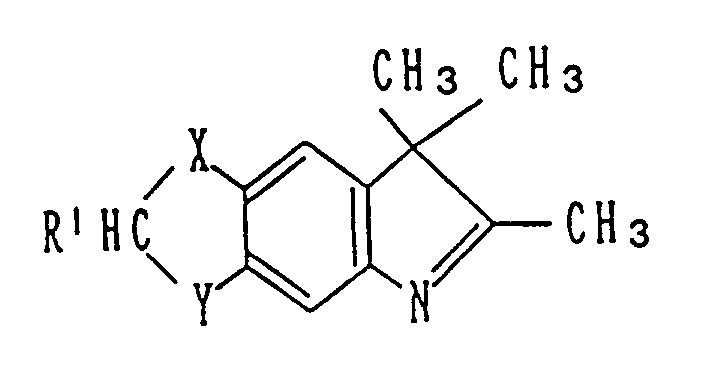
- A compound according to claim 1 wherein X and Y are both a methylene group.
- A compound according to claim 1 wherein X and Y are both an oxygen atom.
- A compound according to claim 1 wherein X is a methylene group and Y is an oxygen atom.
- A compound according to claim 1 wherein X is an oxygen atom and Y is a methylene group.
Applications Claiming Priority (3)
| Application Number | Priority Date | Filing Date | Title |
|---|---|---|---|
| JP233275/88 | 1988-09-16 | ||
| JP23327588 | 1988-09-16 | ||
| PCT/JP1989/000944 WO1990002735A1 (en) | 1988-09-16 | 1989-09-14 | Indolenine derivatives |
Publications (3)
| Publication Number | Publication Date |
|---|---|
| EP0387357A1 EP0387357A1 (en) | 1990-09-19 |
| EP0387357A4 EP0387357A4 (en) | 1991-11-13 |
| EP0387357B1 true EP0387357B1 (en) | 1995-04-05 |
Family
ID=16952537
Family Applications (1)
| Application Number | Title | Priority Date | Filing Date |
|---|---|---|---|
| EP89910180A Expired - Lifetime EP0387357B1 (en) | 1988-09-16 | 1989-09-14 | Indolenine derivatives |
Country Status (4)
| Country | Link |
|---|---|
| US (1) | US5055589A (en) |
| EP (1) | EP0387357B1 (en) |
| DE (1) | DE68922094T2 (en) |
| WO (1) | WO1990002735A1 (en) |
Families Citing this family (1)
| Publication number | Priority date | Publication date | Assignee | Title |
|---|---|---|---|---|
| DE69910333T2 (en) * | 1998-11-30 | 2004-06-03 | Yamamoto Chemicals, Inc., Yao | Polymethine compounds, their manufacturing processes and their use |
Family Cites Families (2)
| Publication number | Priority date | Publication date | Assignee | Title |
|---|---|---|---|---|
| FR1520821A (en) * | 1966-03-11 | 1968-04-12 | Eastman Kodak Co | New photographic emulsions containing a dye of the carbocyanin type |
| US4062870A (en) * | 1974-05-31 | 1977-12-13 | Beecham Group Limited | Chroman derivatives |
-
1989
- 1989-09-14 EP EP89910180A patent/EP0387357B1/en not_active Expired - Lifetime
- 1989-09-14 DE DE68922094T patent/DE68922094T2/en not_active Expired - Fee Related
- 1989-09-14 WO PCT/JP1989/000944 patent/WO1990002735A1/en not_active Ceased
- 1989-09-14 US US07/490,591 patent/US5055589A/en not_active Expired - Fee Related
Also Published As
| Publication number | Publication date |
|---|---|
| EP0387357A4 (en) | 1991-11-13 |
| US5055589A (en) | 1991-10-08 |
| DE68922094D1 (en) | 1995-05-11 |
| WO1990002735A1 (en) | 1990-03-22 |
| EP0387357A1 (en) | 1990-09-19 |
| DE68922094T2 (en) | 1995-10-26 |
Similar Documents
| Publication | Publication Date | Title |
|---|---|---|
| US20100274023A1 (en) | Novel intermediate compounds for the preparation of meso-substituted cyanine, merocyanine and oxonole dyes | |
| Keil et al. | Synthesis and characterization of 1, 3-bis-(2-dialkylamino-5-thienyl)-substituted squaraines—a novel class of intensively coloured panchromatic dyes | |
| US7709660B2 (en) | Polymethine ether compounds | |
| US5055589A (en) | Indolenine derivative | |
| CN115260786B (en) | Preparation method of infrared dye | |
| EP0387360B1 (en) | Cyanine compounds | |
| US5008401A (en) | Cyanine compounds | |
| JPH10195319A (en) | Method for producing polymethine cyanine compound | |
| JP2849757B2 (en) | Indolenine derivative | |
| JP2001002661A (en) | Nitrile compound and method for producing the same | |
| JPH075551B2 (en) | Squarylium compound | |
| GB2208514A (en) | New cyanine dyes for optical recording | |
| JP2843855B2 (en) | Cyanine compounds | |
| FR2611365A1 (en) | PROCESS FOR THE PREPARATION OF ASYMMETRIC STILBENE DERIVATIVES CONTAINING TRIAZINYL GROUPS | |
| USRE35044E (en) | Cyanine compounds | |
| EP1686157A1 (en) | Nonsolvate-form crystal of polymethine compound and process for producing the same | |
| CA1215052A (en) | 1-(HALOALKYL)-1,2,3,4-TETRAHYDRO-.beta.-CARBOLINES, THEIR PREPARATION AND THEIR USE | |
| JPH05339233A (en) | Squarylium compound | |
| JP4790631B2 (en) | Non-solvated crystal of polymethine compound, production method and use thereof | |
| JPH01131277A (en) | Cyanine compounds | |
| EP0738707B1 (en) | Dianilinoglutacondialdehyde compound and process for the preparation thereof | |
| JPH0791477B2 (en) | Method for producing benzoindolenine cyanine dye | |
| JPH0148267B2 (en) | ||
| KR840001356B1 (en) | Process for preparing 2-hydroxy-3-substituted propyl aryl ethers | |
| JPH03148258A (en) | Fulgimide derivative |
Legal Events
| Date | Code | Title | Description |
|---|---|---|---|
| PUAI | Public reference made under article 153(3) epc to a published international application that has entered the european phase |
Free format text: ORIGINAL CODE: 0009012 |
|
| AK | Designated contracting states |
Kind code of ref document: A1 Designated state(s): DE FR GB NL |
|
| 17P | Request for examination filed |
Effective date: 19900911 |
|
| A4 | Supplementary search report drawn up and despatched |
Effective date: 19910925 |
|
| AK | Designated contracting states |
Kind code of ref document: A4 Designated state(s): DE FR GB NL |
|
| 17Q | First examination report despatched |
Effective date: 19930811 |
|
| GRAA | (expected) grant |
Free format text: ORIGINAL CODE: 0009210 |
|
| AK | Designated contracting states |
Kind code of ref document: B1 Designated state(s): DE FR GB NL |
|
| REF | Corresponds to: |
Ref document number: 68922094 Country of ref document: DE Date of ref document: 19950511 |
|
| ET | Fr: translation filed | ||
| PLBE | No opposition filed within time limit |
Free format text: ORIGINAL CODE: 0009261 |
|
| STAA | Information on the status of an ep patent application or granted ep patent |
Free format text: STATUS: NO OPPOSITION FILED WITHIN TIME LIMIT |
|
| 26N | No opposition filed | ||
| PGFP | Annual fee paid to national office [announced via postgrant information from national office to epo] |
Ref country code: GB Payment date: 19970826 Year of fee payment: 9 Ref country code: FR Payment date: 19970826 Year of fee payment: 9 |
|
| PGFP | Annual fee paid to national office [announced via postgrant information from national office to epo] |
Ref country code: NL Payment date: 19970930 Year of fee payment: 9 |
|
| PGFP | Annual fee paid to national office [announced via postgrant information from national office to epo] |
Ref country code: DE Payment date: 19971128 Year of fee payment: 9 |
|
| PG25 | Lapsed in a contracting state [announced via postgrant information from national office to epo] |
Ref country code: GB Free format text: LAPSE BECAUSE OF NON-PAYMENT OF DUE FEES Effective date: 19980914 |
|
| PG25 | Lapsed in a contracting state [announced via postgrant information from national office to epo] |
Ref country code: NL Free format text: LAPSE BECAUSE OF NON-PAYMENT OF DUE FEES Effective date: 19990401 |
|
| GBPC | Gb: european patent ceased through non-payment of renewal fee |
Effective date: 19980914 |
|
| PG25 | Lapsed in a contracting state [announced via postgrant information from national office to epo] |
Ref country code: FR Free format text: LAPSE BECAUSE OF NON-PAYMENT OF DUE FEES Effective date: 19990531 |
|
| NLV4 | Nl: lapsed or anulled due to non-payment of the annual fee |
Effective date: 19990401 |
|
| PG25 | Lapsed in a contracting state [announced via postgrant information from national office to epo] |
Ref country code: DE Free format text: LAPSE BECAUSE OF NON-PAYMENT OF DUE FEES Effective date: 19990701 |
|
| REG | Reference to a national code |
Ref country code: FR Ref legal event code: ST |