EP0385447A2 - Herstellungsverfahren für ein Halbleiter-Bauelement und musterbildende Beschichtungslösung dafür - Google Patents
Herstellungsverfahren für ein Halbleiter-Bauelement und musterbildende Beschichtungslösung dafür Download PDFInfo
- Publication number
- EP0385447A2 EP0385447A2 EP90103923A EP90103923A EP0385447A2 EP 0385447 A2 EP0385447 A2 EP 0385447A2 EP 90103923 A EP90103923 A EP 90103923A EP 90103923 A EP90103923 A EP 90103923A EP 0385447 A2 EP0385447 A2 EP 0385447A2
- Authority
- EP
- European Patent Office
- Prior art keywords
- resist
- coating solution
- pattern
- substrate
- layer
- Prior art date
- Legal status (The legal status is an assumption and is not a legal conclusion. Google has not performed a legal analysis and makes no representation as to the accuracy of the status listed.)
- Granted
Links
Images


Classifications
-
- G—PHYSICS
- G03—PHOTOGRAPHY; CINEMATOGRAPHY; ANALOGOUS TECHNIQUES USING WAVES OTHER THAN OPTICAL WAVES; ELECTROGRAPHY; HOLOGRAPHY
- G03F—PHOTOMECHANICAL PRODUCTION OF TEXTURED OR PATTERNED SURFACES, e.g. FOR PRINTING, FOR PROCESSING OF SEMICONDUCTOR DEVICES; MATERIALS THEREFOR; ORIGINALS THEREFOR; APPARATUS SPECIALLY ADAPTED THEREFOR
- G03F7/00—Photomechanical, e.g. photolithographic, production of textured or patterned surfaces, e.g. printing surfaces; Materials therefor, e.g. comprising photoresists; Apparatus specially adapted therefor
- G03F7/004—Photosensitive materials
- G03F7/039—Macromolecular compounds which are photodegradable, e.g. positive electron resists
-
- G—PHYSICS
- G03—PHOTOGRAPHY; CINEMATOGRAPHY; ANALOGOUS TECHNIQUES USING WAVES OTHER THAN OPTICAL WAVES; ELECTROGRAPHY; HOLOGRAPHY
- G03F—PHOTOMECHANICAL PRODUCTION OF TEXTURED OR PATTERNED SURFACES, e.g. FOR PRINTING, FOR PROCESSING OF SEMICONDUCTOR DEVICES; MATERIALS THEREFOR; ORIGINALS THEREFOR; APPARATUS SPECIALLY ADAPTED THEREFOR
- G03F7/00—Photomechanical, e.g. photolithographic, production of textured or patterned surfaces, e.g. printing surfaces; Materials therefor, e.g. comprising photoresists; Apparatus specially adapted therefor
- G03F7/004—Photosensitive materials
- G03F7/0048—Photosensitive materials characterised by the solvents or agents facilitating spreading, e.g. tensio-active agents
-
- H—ELECTRICITY
- H10—SEMICONDUCTOR DEVICES; ELECTRIC SOLID-STATE DEVICES NOT OTHERWISE PROVIDED FOR
- H10P—GENERIC PROCESSES OR APPARATUS FOR THE MANUFACTURE OR TREATMENT OF DEVICES COVERED BY CLASS H10
- H10P14/00—Formation of materials, e.g. in the shape of layers or pillars
- H10P14/60—Formation of materials, e.g. in the shape of layers or pillars of insulating materials
- H10P14/68—Organic materials, e.g. photoresists
- H10P14/683—Organic materials, e.g. photoresists carbon-based polymeric organic materials, e.g. polyimides, poly cyclobutene or PVC
-
- H—ELECTRICITY
- H10—SEMICONDUCTOR DEVICES; ELECTRIC SOLID-STATE DEVICES NOT OTHERWISE PROVIDED FOR
- H10P—GENERIC PROCESSES OR APPARATUS FOR THE MANUFACTURE OR TREATMENT OF DEVICES COVERED BY CLASS H10
- H10P50/00—Etching of wafers, substrates or parts of devices
- H10P50/73—Etching of wafers, substrates or parts of devices using masks for insulating materials
Definitions
- the present invention relates to a process for the preparation of a semiconductor device, and a pattern-forming coating solution. More particularly, the present invention relates to a process for the preparation of a semiconductor device in which a formation of cracks during electron beam (EB) lithography can be prevented, and a pattern-forming coating solution used for carrying out this process.
- EB electron beam
- a lithographic technique using short waves such as electron beams and X-rays can be mentioned as one means satisfying this requirement, and the resist material used for this lithographic technique is a factors having an influence on the precision.
- the resist material must have not only a high sensitivity and resolution but also a good resistance to plasma etching, because the high resolution lithography will require dry etching techniques such as plasma etching.
- a positive resist material having a high resolution and a high dry etching resistance which comprises a novel ⁇ -methylstyrene/methyl ⁇ -chloroacrylate copolymer represented by the following formula (Japanese Unexamined Patent Publication No. 63-137227): wherein l is a number of at least 3 and m is a number smaller than 7, with the proviso that the sum of l and m is 10 and Mw is at least 20,000.
- the resist composed of this novel copolymer is a positive resist of high resolutuion and high contrast.
- this resist has a very high sensitivity and an excellent resistance to dry etching, in combination.
- this resist material is coated by using a coating solvent such as monochlorobenzene, as shown in Figs. 1A through 1E and Figs. 2A and 2B, a formation of cracks (Fig. 2A) and penetration of developer on etch species between the resist and the substrate (Fig. 2B) often occur after development or etching.
- a coating solvent such as monochlorobenzene
- An insulating film 2 (for example, PSG) is formed on a semiconductor substrate 1 (Fig. 1A), and a resist material composed of the above-mentioned ⁇ -methylstyrene/methyl ⁇ -chloroacrylate copolymer is coated on the insulating film to form a resist layer 3 (Fig. 1B). Then, after pre-baking, an E.B. exposure is carried out (Fig. 1C), and after the exposure, the development is carried out with xylene (Fig. 1D). By using the resist pattern formed by the development, etching (isotropic etching or anisotropic etching) is carried out to obtain a desired pattern (Fig. 1E).
- etching isotropic etching or anisotropic etching
- a "crack A” is observed in the resist layer, and furthermore, a "penetration B” of developer or etch species occurs between the insulating layer 2 and the resist 3.
- a primary object of the present invention is to provide a process for the preparation of a semiconductor device, in which the occurrence of "cracking" or “penetration” after development or etching is prevented when an ⁇ -methyl-styrene/methyl ⁇ -chloroacryate copolymer is coated from a predetermined solvent such as bromobenzene or benzonitrile on a layer to be etched (film to be processed).
- a predetermined solvent such as bromobenzene or benzonitrile
- Another object of the present invention is to provide a pattern-forming coating solution which does not cause "cracking" or “penetration at the litographic step in the process for the preparation of a semiconductor device.
- the term “cracking” is meant a formation of tears or cracks from a part of the resist pattern (window) formed as the etching mask
- penetration is meant the phenomenon in which the developer is allowed to penetrate the interface between the resist and the substrate after the development because of an insufficient adhesion between the resist and the substrate, and the resist is peeled from the substrate, or the phenomenon in which the etching agent is allowed to penetrate the interface between the resist and the substrate at the isotropic etching because of an insufficient adhesion between the resist and the substrate after the etching, and the etching quantity in the lateral direction is much larger than the etching quantity in the longitudinal direction.
- the present invention is based on this finding.
- a process for the preparation of a semiconductor device which comrpises the steps of (a) forming a resist layer by coating a coating solution of a positive resist material composed of an ⁇ -methylstyrene/methyl ⁇ -chloroacrylate copolymer in at least one solvent selected from the group consisting of bromobenzene, bezonitrile, o-dichlorobenzene, ethyl benzoate and nitrogenzene on a substrate or on an a layer to be etched and formed on a substrate, (b) subjecting the resist layer formed at step (a) to electron beam (E.B.) exposure, (c) developing the exposed resist layer, and (d) etching the substrate or the layer to be etched, by using the resist pattern layer obtained by the development as a mask.
- a positive resist material composed of an ⁇ -methylstyrene/methyl ⁇ -chloroacrylate copolymer in at least one solvent selected from the group consisting of bromobenzene,
- a pattern-forming coating solution for use in carrying out the above-mentioned process for the preparation of a semiconductor device, which comprises a positive resist material composed of an ⁇ -methylstyrene/methyl ⁇ -chloroacrylate copolymer which is dissolved in at least one solvent selected from the group consisting of bromobenzene, benzonistrile, o-dichloro-benzene, ethyl benzoate and nitrobenzene.
- the gist of the present invention is that a specific positive resist material is dissolved in a specific solvent and the formed solution is used as a pattern-forming coating solution in the production of a semiconductor device.
- specific solvents that can be used in the present invention, o-dichlorobenzene and ethyl benzoate provide coating solutions which provide excellent effects (patterning exposure dose range film thickness dependency) over coating solutions formed by using other solvents.
- the layer to be etched includes all layers to be etched in the production of a semiconductor device, for example, an insulating film (PSG or the like).
- PSG insulating film
- the present invention can be applied when the insulating crystal substrate such as the silicone substrate, the compound semiconductor semiconductor substrate, and Al2O3 substrate and the like is etched.
- ⁇ -methylstyrene/methyl ⁇ -chloroacrylate was synthesized according to the following conditions. Polymerization initiator, azobisisobutyronitrile (AIBN) 0.12 mole% Solvent, 1, 4-dioxane 851.1 g Monomer, ⁇ -methylstyrene 2.8 moles Monomer, methyl ⁇ -chloroacrylate 1.2 moles Reaction temperature 80°C Reaction time (in nitrogen atmosphere) 25 hours
- the obtained copolymer was a copolymer of the above-mentioned formula (I), in which l was 5, m was 5 and the molecular weight was 30,000.
- Coating solutions were prepared by using the copolymer obtained in Example 1 as the positive type resist material and bromobenzene, benzonitrile, o-dichlorobenzene, nitro-benzene or ethyl benzoate as the solvent.
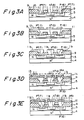
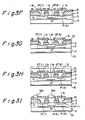
- the coating solutions were used at the passivation step for a formation of contact hole, as shown in Figs. 3D through 3F.
- an epitaxial layer 5 was formed on an N+ layer 4 as the collector, a P layer 6 was formed in the epitaxial layer 5, and a P+ layer 7 formed as the base region on both sides. Then an N+ layer 8 was formed as the emitter region, and thus the bulk-forming step was completed. Then a silicon oxide film 9 was formed on the bulk, a photoresist was coated on the silicon oxide film 9, and an electrode window opening operation for Al lines was carried out by a photolithographic technique (Fig. 3A).
- Al 11a was deposited to a thickness of 8000 ⁇ by the sputtering method (or the vacuum deposition method) (Fig. 3B), a base electrode 11b and a emitter electrode 11e were formed by using the photoresist 12 as a mask (Fig. 3C), and a PSG film 13 as the passivation film for the Al lines was deposited to a thickness of 10000 ⁇ by the CVD method.
- the above-mentioned coating solution was coated on the PSG film 13 as the passivation film to form a resist layer 14 having a thickness of 1.5 ⁇ m.
- Baking was carried out at 180°C for 20 minutes, and E.B. exposure (20 kV) was carried out (Fig. 3D).
- the development was carried out with xylene to form a contact hole pattern 13b (Fig. 3E).
- the etching (isotropic etching and anisotropic etching) was carried out by using the obtained pattern as a mask, and the resist layer was removed to form contact holes for Al lines of the second layer (Fig. 3F).
- Example 2 By using the casting solutions used in Example 2 and comparative coating solutions comprising a solvent other then the solvents of the present invention, the formation of contact hols and an etching treatment were carried out in the same manner as described in Example 2.
- the cracking and penetration between the substrate and the resist were evaluated by the following method.
- a pattern comprising isolated holes of 20 ⁇ m x 5 ⁇ m, 3.5 ⁇ m x 3.5 ⁇ m, 28 ⁇ m x 12 ⁇ m and 5 ⁇ m x 20 ⁇ m and integrated holes of 1 ⁇ m x 1 ⁇ m was formed in one chip, and when “cracking" or “penetration” defined hereinbefore was observed under an optical microscope, it was judged that cracking or penetration had occurred (x in Table 1). When cracking or penetration was not observed under the optical microscope, it was judged that cracking or penetration had not occurred (o in Table 1).
- Table 2 Coating Solvent Light Exposure Quantity ( ⁇ c/cm2) bromobenzene 53 to 58 benzonitrile 53 to 64 o-dichlorobenzene 50 to 64 ethyl benzoate 50 to 64 nitrobenzene 54 to 64
- each value indicates the patterning exposure dose in the applicable region (cracking or penetration did not occur) with respect to each coating solvent.
- o-dichlorobenzene and ethyl benzoate have a broader patterning exposure dose region (at least 50 ⁇ c/cm2) than other solvents. This means that the process margin is large and the throughout is improved.
- the film thickness dependency was determined.
- Table 3 indicates the applicable film thickness region of each coating solvent.
- o-dichlorobenzene and ethyl benzoate have a broader applicable film thickness region than other solvents. This means that, in these two coating solvents, the probability of cracking or penetration between the substrate and the resist is lower than in other coating solvents.
- the film thickness must be at least 0.5 ⁇ m and a film thickness of up to 1.7 ⁇ m can be adopted. If the film thickness exceeds 1.7 ⁇ m, use of the film becomes difficult because the resolution power of the resist is lowered when the thickness is too large.
- the concentration of the pattern-forming coating solution is 10 to 25% by weight (which corresponds to 300 to 900 parts by weight of the solvent per 100 parts by weight of the polymer). If the concentration is lower than 10% by weight, a desired uniform film thickness cannot be obtained. If the concentration is higher than 25% by weight, the viscosity is too high, the solution is not spread, and a uniform film cannot be obtained. Moreover, precipitation of the polymer sometimes occurs.
- a resist solution was prepared by dissolving the ⁇ -methylstyrene-methyl ⁇ -chloroacrylate copolymer having a molecular weight of 30,000, which was used in Examples 3 through 7, in a 2/1 mixed solvent of o-dichlorobenzene/ethyl benzoate.
- the solution was coated in a thickness of 1.5 ⁇ m on a PSG film, based at 180°C for 20 minutes, subjected to E.B. light exposure (20 kV), and developed with xylene to form a contact hole patter. After the formation of the contact hole pattern, etching was carried out.
- a coating solution is formed by using a specific solvent for a specific positive resist material, and a semiconductor device is prepared by conducting the resist-forming and etching steps by using this coating solution, whereby an effect of preventing both cracking and penetration after development and after etching a resist film having a thickness of 1.5 ⁇ m can be obtained. Therefore, the film thickness margin can be broadened and a good product yield can be obtained.
- Pattern-forming coating solutions prepared by using o-dichlorobenzene and ethyl benzoate selected from the specific solvents of the present invention have an excellent patterning sensitivity dependency, compared with the coating solutions formed by using other solvents, and the applicable film thickness region is broadened and the probability of cracking or penetration between the substrate and the resist is much lower than when other solvents are used.
Landscapes
- Physics & Mathematics (AREA)
- General Physics & Mathematics (AREA)
- Spectroscopy & Molecular Physics (AREA)
- Photosensitive Polymer And Photoresist Processing (AREA)
- Exposure Of Semiconductors, Excluding Electron Or Ion Beam Exposure (AREA)
Applications Claiming Priority (2)
| Application Number | Priority Date | Filing Date | Title |
|---|---|---|---|
| JP50157/89 | 1989-03-03 | ||
| JP5015789 | 1989-03-03 |
Publications (3)
| Publication Number | Publication Date |
|---|---|
| EP0385447A2 true EP0385447A2 (de) | 1990-09-05 |
| EP0385447A3 EP0385447A3 (de) | 1991-06-26 |
| EP0385447B1 EP0385447B1 (de) | 1994-12-28 |
Family
ID=12851357
Family Applications (1)
| Application Number | Title | Priority Date | Filing Date |
|---|---|---|---|
| EP90103923A Expired - Lifetime EP0385447B1 (de) | 1989-03-03 | 1990-02-28 | Herstellungsverfahren für ein Halbleiter-Bauelement und musterbildende Beschichtungslösung dafür |
Country Status (3)
| Country | Link |
|---|---|
| US (1) | US5087551A (de) |
| EP (1) | EP0385447B1 (de) |
| DE (1) | DE69015381T2 (de) |
Cited By (2)
| Publication number | Priority date | Publication date | Assignee | Title |
|---|---|---|---|---|
| EP0424182A3 (en) * | 1989-10-19 | 1991-12-11 | Fujitsu Limited | Process for formation of resist patterns |
| CN108779215A (zh) * | 2016-03-25 | 2018-11-09 | 日本瑞翁株式会社 | 共聚物的制造方法 |
Families Citing this family (1)
| Publication number | Priority date | Publication date | Assignee | Title |
|---|---|---|---|---|
| CN107207666A (zh) * | 2015-02-20 | 2017-09-26 | 日本瑞翁株式会社 | 聚合物及正型抗蚀剂组合物 |
Family Cites Families (2)
| Publication number | Priority date | Publication date | Assignee | Title |
|---|---|---|---|---|
| US4535054A (en) * | 1983-05-05 | 1985-08-13 | Hughes Aircraft Company | Wet process for developing styrene polymer resists for submicron lithography |
| JPH083636B2 (ja) * | 1986-11-29 | 1996-01-17 | 富士通株式会社 | 電子線ポジレジスト |
-
1990
- 1990-02-28 EP EP90103923A patent/EP0385447B1/de not_active Expired - Lifetime
- 1990-02-28 DE DE69015381T patent/DE69015381T2/de not_active Expired - Fee Related
- 1990-03-02 US US07/487,089 patent/US5087551A/en not_active Expired - Lifetime
Cited By (4)
| Publication number | Priority date | Publication date | Assignee | Title |
|---|---|---|---|---|
| EP0424182A3 (en) * | 1989-10-19 | 1991-12-11 | Fujitsu Limited | Process for formation of resist patterns |
| US5403699A (en) * | 1989-10-19 | 1995-04-04 | Fujitsu Limited | Process for formation of resist patterns |
| CN108779215A (zh) * | 2016-03-25 | 2018-11-09 | 日本瑞翁株式会社 | 共聚物的制造方法 |
| CN108779215B (zh) * | 2016-03-25 | 2020-06-02 | 日本瑞翁株式会社 | 共聚物的制造方法 |
Also Published As
| Publication number | Publication date |
|---|---|
| EP0385447B1 (de) | 1994-12-28 |
| EP0385447A3 (de) | 1991-06-26 |
| DE69015381T2 (de) | 1995-05-04 |
| US5087551A (en) | 1992-02-11 |
| DE69015381D1 (de) | 1995-02-09 |
Similar Documents
| Publication | Publication Date | Title |
|---|---|---|
| EP2089770B1 (de) | Verfahren zur erzeugung von fotolithografischen strukturen mit entwicklergetrimmter hartmaske | |
| EP0256031B1 (de) | Entwickelverfahren für polymethacryl-anhydrid-photolacke | |
| KR102346806B1 (ko) | 포토레지스트 패턴 트리밍 조성물 및 방법 | |
| US6132644A (en) | Energy sensitive electrically conductive admixtures | |
| US6753129B2 (en) | Method and apparatus for modification of chemically amplified photoresist by electron beam exposure | |
| US4156745A (en) | Electron sensitive resist and a method preparing the same | |
| US3971860A (en) | Method for making device for high resolution electron beam fabrication | |
| KR20050115866A (ko) | 수용성 수지 조성물, 패턴 형성방법 및 내식막 패턴의검사방법 | |
| EP0309682A2 (de) | Härtungsbeständige Photolackbeschichtung | |
| US6406818B1 (en) | Method of manufacturing photomasks by plasma etching with resist stripped | |
| EP0492256B1 (de) | Photolithographische Strukturerzeugung | |
| KR100293975B1 (ko) | 건식 에칭 방법 및 건식 에칭 방법을 이용한 반도체 장치의 제조방법 | |
| EP0424182A2 (de) | Verfahren zur Herstellung von Photolackmustern | |
| EP0617329B1 (de) | Verfahren zur Herstellung einer Mikrostruktur und einer Röntgenstrahlmaske | |
| US20100062363A1 (en) | Composition for upper surface antireflection film, and method for pattern formation using the same | |
| US6774365B2 (en) | SEM inspection and analysis of patterned photoresist features | |
| EP0385447A2 (de) | Herstellungsverfahren für ein Halbleiter-Bauelement und musterbildende Beschichtungslösung dafür | |
| KR100418739B1 (ko) | 조절된피에이치를갖는전기전도성중합체를포함하는조성물,상기전기전도성중합체의층을포함하는레지스트구조물,이구조물의제조방법 | |
| EP0236914B1 (de) | Herstellung von elektronischen Bauelementen durch ein lithographisches Verfahren | |
| JP2550201B2 (ja) | 半導体装置の製造方法及びそれに用いるパターン形成用塗布溶液 | |
| US5114827A (en) | Photoresists resistant to oxygen plasmas | |
| EP0030604A2 (de) | Verfahren zum Härten von Photoresistbildern | |
| JPS6248211B2 (de) | ||
| JPH06110214A (ja) | レジストパターンの形成方法 | |
| US6642152B1 (en) | Method for ultra thin resist linewidth reduction using implantation |
Legal Events
| Date | Code | Title | Description |
|---|---|---|---|
| PUAI | Public reference made under article 153(3) epc to a published international application that has entered the european phase |
Free format text: ORIGINAL CODE: 0009012 |
|
| AK | Designated contracting states |
Kind code of ref document: A2 Designated state(s): DE FR GB |
|
| PUAL | Search report despatched |
Free format text: ORIGINAL CODE: 0009013 |
|
| AK | Designated contracting states |
Kind code of ref document: A3 Designated state(s): DE FR GB |
|
| 17P | Request for examination filed |
Effective date: 19910727 |
|
| 17Q | First examination report despatched |
Effective date: 19940207 |
|
| RBV | Designated contracting states (corrected) |
Designated state(s): DE GB |
|
| GRAA | (expected) grant |
Free format text: ORIGINAL CODE: 0009210 |
|
| AK | Designated contracting states |
Kind code of ref document: B1 Designated state(s): DE GB |
|
| REF | Corresponds to: |
Ref document number: 69015381 Country of ref document: DE Date of ref document: 19950209 |
|
| PLBE | No opposition filed within time limit |
Free format text: ORIGINAL CODE: 0009261 |
|
| STAA | Information on the status of an ep patent application or granted ep patent |
Free format text: STATUS: NO OPPOSITION FILED WITHIN TIME LIMIT |
|
| 26N | No opposition filed | ||
| REG | Reference to a national code |
Ref country code: GB Ref legal event code: IF02 |
|
| PGFP | Annual fee paid to national office [announced via postgrant information from national office to epo] |
Ref country code: GB Payment date: 20050223 Year of fee payment: 16 |
|
| PGFP | Annual fee paid to national office [announced via postgrant information from national office to epo] |
Ref country code: DE Payment date: 20050224 Year of fee payment: 16 |
|
| PG25 | Lapsed in a contracting state [announced via postgrant information from national office to epo] |
Ref country code: GB Free format text: LAPSE BECAUSE OF NON-PAYMENT OF DUE FEES Effective date: 20060228 |
|
| PG25 | Lapsed in a contracting state [announced via postgrant information from national office to epo] |
Ref country code: DE Free format text: LAPSE BECAUSE OF NON-PAYMENT OF DUE FEES Effective date: 20060901 |
|
| GBPC | Gb: european patent ceased through non-payment of renewal fee |
Effective date: 20060228 |