EP0366309A2 - Farbbildquantisierungssystem - Google Patents
Farbbildquantisierungssystem Download PDFInfo
- Publication number
- EP0366309A2 EP0366309A2 EP89310452A EP89310452A EP0366309A2 EP 0366309 A2 EP0366309 A2 EP 0366309A2 EP 89310452 A EP89310452 A EP 89310452A EP 89310452 A EP89310452 A EP 89310452A EP 0366309 A2 EP0366309 A2 EP 0366309A2
- Authority
- EP
- European Patent Office
- Prior art keywords
- color
- space
- spaces
- division
- list
- Prior art date
- Legal status (The legal status is an assumption and is not a legal conclusion. Google has not performed a legal analysis and makes no representation as to the accuracy of the status listed.)
- Granted
Links
Images










Classifications
-
- H—ELECTRICITY
- H04—ELECTRIC COMMUNICATION TECHNIQUE
- H04N—PICTORIAL COMMUNICATION, e.g. TELEVISION
- H04N1/00—Scanning, transmission or reproduction of documents or the like, e.g. facsimile transmission; Details thereof
- H04N1/46—Colour picture communication systems
- H04N1/64—Systems for the transmission or the storage of the colour picture signal; Details therefor, e.g. coding or decoding means therefor
- H04N1/644—Systems for the transmission or the storage of the colour picture signal; Details therefor, e.g. coding or decoding means therefor using a reduced set of representative colours, e.g. each representing a particular range in a colour space
Definitions
- color displays often employ a color lookup table (LUT) (see Figure 12).
- LUT color lookup table
- a frame buffer can store all the intensities of red, green and blue components of image data
- a color LUT becomes unnecessary; the data read from the frame buffer is used directly for video signals for the color display.
- each of the red, the green and the blue components is represented by 8 bits, and thus 24 bits are required for one pel of the image data.
- the frame buffer requires enormous amounts of storage, and becomes expensive.
- a colour LUT can be utilised, in which the contents of the frame buffer are used as color indexes to address the LUT.
- the contents of the LUT representing red, green and blue components of color are read and utilized as video signals for the color display. Therefore, it is sufficient for the pel data in the frame buffer to just accommodate the number of entries of the color LUT. For example, in a case where the number of entries of the color LUT or the number of colors simultaneously displayed on the color display is 256, the pel data of the frame buffer can be represented by 8 bits (1 byte).
- color LUT-type displays that can simultaneously display 8, 16, 32 or 256 colors.
- a color image may have a greater number of color than the number of colors available for display (for example, a color image, where the intensity of each of the red, green and blue component is represented by 8 bits, has 16.7 million colors), it is important to be able to select the optimum number of simultaneously displayed colors, to cause as little deterioration of image quality as possible, and to map the original colors of the color image to those selected colors simultaneously displayable.
- Such a technique is called color image quantization.
- color quantization can be broadly divided into uniform sampling and adaptive sampling.
- Uniform sampling performs quantization by uniformly dividing a color space, and giving a representative color to each divided space; reloading of a LUT is not necessary once the representative color for each divided space has been loaded.
- a disadvantage of this technique is that image quality is significantly degraded for an input image whose colors are not uniformly distributed in a color-space, but are locally clustered.
- color-space means various spaces such as RGB space (Red, Green, Blue space), HLS space (Hue, Lightness, Saturation space), CYMB space (Cyan, Yellow, Magenta, Black space) and L*u*v space).
- L*u*v space means a color-space which is arranged so that color difference sensed by a human corresponds to a distance in the space, and is also called a uniform color-space.
- Adaptive sampling is a technique where the contents of a lookup table change according to an input image to perform the optimum quantization.
- Various adaptive sampling methods have been proposed, but all perform quantization by the following four steps. (Here we assume that an input image is defined in an RGB space).
- Step 2 and subsequent steps determine the image quality, but the key steps for the quantization itself are Steps 2 and 3; the quality of the quantization depends on Step 2 where "k" representative colors are selected, and Step 3 where colors "close” to remaining colors are selected from the "k” representative colors, and assigned.
- Step 4 error diffusion utilising errors of the quantization of dithering (a random noise method) are also used in many cases.
- Step 2 A known technique for performing Step 2 is listed in the following.
- P. Heckbert "Color Image Quantization for Frame Buffer Display,” ACM SIGGRAPH, July, 1982 discloses the popularity algorithm and the median cut algorithm.
- the former is a method that sorts a histogram in descending order of frequency, and selects "k" colors from the top as the representative colors. This method is simple, but has a noticeable disadvantage that the image quality significantly deteriorates if many colors are distributed with equal frequency.
- the latter is a method that calculates maximum and minimum values in each direction of R, G, and B components, and splits the space with their median value recursively. Extra time is necessary to find the maximum and the minimum values in each direction of R, G, and B components, and, if the median values are given in real numbers, a major amount of processing time is required because of real number calculation. If they are given in integers, there is the disadvantage that errors may be caused whether they are truncated or rounded.
- U. S. Patent No. 4,654,720 discloses the population equalization algorithm. It is a method that selects "k" representative colors while finding neighbourhood spaces which render the frequency of the "k” colors as equal as possible in the color-space. This method provides excellent image quality, but a lot of time is necessary to merge the neighbourhood spaces depending on the input image, and an enormous amount of storage is required.
- US 4, 710, 806 discloses a fixed are and chromaticity based algorithm. It is a method in which a fixed area is provided in a color lookup table in advance, entries whose values appear in the fixed area are removed from the histogram before a histogram is generated based on the ratio between R, G, and B (chromaticity), and representative colors are found according to peak values appearing therein. Colors in a region with constant chromaticity and varying lightness are mainly selected by utilizing the characteristic of the human eye that is sensitive to the lightness.
- Existence or nonexistence of the fixed area depends on an input image, so that it may be an advantage or a disadvantage.
- a major drawback is that this technique requires a lot of processing time because real number calculation is involved in a series of processes such as generation of the histogram for brightness and detection of the peaks (particularly, calculation of angles such as arc cosine).
- Step 3 involves finding neighbourhood representative color for those remaining colors with more than one entry in the histogram.
- the technique described in US 4, 654, 720 processes them through merge while incrementing the distance as 1-st neighbourhood, 2-nd neighbourhood, and so on.
- Other approaches find representative neighbourhood colours by introducing some measures of distance (for example, Euclidean distance in the RGB space). The distance calculation involved in finding the neighbourhood is a time-consuming process.
- the present invention provides a means for processing both Steps 2 and 3 utilising an adaptive sampling method at a high speed.
- the processing time and the storage required for quantization are proportional to the number of colors simultaneously displayable on the color display, and are not affected by the number of colors and the distribution of colors specific to the original image. Due to the decrease in storage required the invention can be implemented on a personal computer.
- a color image quantization system is presented in which selection of representative color data to be loaded into a look up table are determined by division of an original color space to generate child-color spaces, which in turn are repeatedly divided until at least k child-color spaces have been generated, where k equals the number of addresses to the LUT, the order in which the color spaces are divided being dependent upon the frequency of original image pels whose color lies within each color space.
- the order of color-space division is determined by the value of a space-occupying number for a color-space, the number being obtained by calculating the number of pels of the original image with colors that lie within the color-space and multiplying the calculation by a weighting-factor corresponding to the level of the division, the level being related to the number of times the original color-space has been divided to yield the color-space.
- the weighting-factor becomes larger as the division level becomes higher, and the color-spaces are divided in descending order of space-occupying number.
- a method and apparatus for color image quantization which selects "k" display colors from 2 ⁇ ni colors obtained by assigning n i bits to represent the intensity level of each of "a" kinds of basic color (1 ⁇ i ⁇ a); and quantizies an original color image comprising a number of pels for which any one of the said 2 ⁇ ni colors may be assigned so that it may be displayed with the said "k" display colors:
- a kind of basic color are typically those basic colors such as red, green and blue.
- the scope of the invention is not limited to an image consisting of only these color components.
- a component such as ground surface temperature may be included as a basic component.
- an image to be quantized could be called a multi-dimensional multi-value image.
- color image is used for convenience.
- the invention can apply to a multi-dimensional multi-value image, it is described as an apparatus for simple color image quantization by exemplifying a color-space consisting of red, green and blue components.
- Figure 1 shows a schematic of apparatus for color image quantization.
- the apparatus broadly consists of four units; a histogram generator, a representative color selector, a neighbourhood representative color mapping device, and an index image generator. It is assumed that each of the red, green and blue components of an original image to be displayed is "n" bits, and that a display utilising a color LUT selects and displays "k" colors (hereinafter called “representative colors”) from a color-space consisting of "m” bits for each of the red, green, and blue components.
- the apparatus performs quantization of a color image and the following describes the processing sequence in conjunction with each of the above units.
- the histogram generator receives an original image to be displayed, finds the frequency of colors used in the image, and outputs a histogram.
- the original image being received is represented by "n" bits for each of the red (R), the green (G), and the blue (B) components, and the histogram output has "m” bits for each of R, G, and B (n ⁇ m).
- Figure 2 shows an example of a histogram
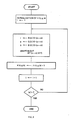
- Figure 3 illustrates the processing sequence of the histogram generator.
- N indicates the number of pels in the original image
- R(i), G(i) and B(i) indicate the i-th pel data of the original image ("n" bits for each of R, G and B), respectively
- r, g, and b indicate data consisting of only significant "m” bits taken from data of R(i), G(i) and B(i), respectively
- H (r, g, b) indicates the frequency of use (count value) for elements (r, g, b) in a color-space represented by "m" bits for each of the red, the green, and the blue components.
- Step 2 the representative color selector recursively divides into eight the color-space represented by "m" bits for each of the red, the green, and the blue components, and finally obtains "k" divided color-spaces from which the representative colors are selected.
- the color-space is recursively divided into eight so that the number of pels (frequency of use) assigned in each divided color-space may become as nearly equal as possible.
- a divided color-space management list and a division priority management list are introduced to implement the above.
- the embodiment herein treats a three-dimensional space having red, green, and blue components, the space is divided into eight, and the divided color-space management list has an eight-branch (oct-tree) structure.
- the list will be a four-branch (quad-tree) structure if the space is two-dimensional, or a 16-branch structure if it is four-dimensional.
- FIG 4 shows the relation between the color-space and eight divided spaces.
- each of the red, the green, and the blue components has a value in a range from the lower limit of 0 to the upper limit of 2 m - 1.
- the entire color-space is divided into eight.
- the eight divided spaces are number from (1) to (8) according to the numbering practice as shown in Figure 4. They are called child color-spaces (child-octants) to the original color-space.
- the original space is called a parent color-space (parent-octant) to those child color-spaces (1) to (8).
- Each child color-space is further subject to division into eight. As division is repeated, the difference between the lower and the upper limits becomes smaller.
- Each element (node) in the divided color-space management list (node) has the following information for controlling each child color-space:
- the level in the tree structure (1) has a value of up to "m" at the deepest level. At the level “m,” the upper limit coincides with the lower limit. This means that the space cannot be divided any more at the level "m.”
- the space-occupying number (3) can be found by multiplying the frequency of use in the histogram found in Step 1 by a weighing-factor determined according to the depth of the tree structure (level) (1).
- the color index of a color LUT (4) and the representative color (5) are set in Step 2 or 3.
- the pointers (6) and (7) are pointers connecting the parent color-space and the child color-space according to the numbering rules shown in Figure 4 when the parent color-space is divided into eight child color-spaces, and back pointers enabling easy reference from a child color space generated through division to the parent color space.
- all the pointers of (7) are empty (NULL).
- NULL empty
- the color space is not assigned for a memory for its control, and is treated as an empty (NULL) space. Therefore, some of the pointers to the child color-spaces may be empty (NULL).
- the division priority management list is used to determine which space should be divided into eight next, while a color-space is recursively divided into eight.
- Figure 7 shows a division priority management list.
- Each element of the list is rearranged in descending order of the space-occupying number whenever a color-space is divided into eight.
- each element (node) of the list has the following three pointers:
- Figure 8 shows the process in which a color-space is divided two-dimensionally for easy understanding.
- the numerals in the divided color-space of Figure 8 indicate examples of the space-occupying number.
- a color-space is divided into four, and provides four child-color spaces.
- the above-mentioned divided color-space management list as well as the division priority management list are generated, so that the elements are arranged in descending order of the space-occupying number (proc-1 in Figures 8 and 9).
- a child-space (A) at the top of the division priority management list pointed by the division priority controlling pointer (CPTR), or having the largest space-occupying number is selected as the object of division, and divided into four.
- the divided color-space management list is updated in the same manner as above, and the division priority management list is rearranged and updated for its elements in the descending order of the space-occupying number (proc-2 in Figures 8 and 9). Such a process of division into four is recursively repeated until the number of divided color-spaces reaches "k" (the number of representative colors).
- the division of a color-space may be stopped at the moment when the number of color-spaces registered in the division priority management list reaches "k," and Steps 3 and 4 are started.
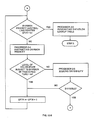
- a child color-space to be divided is selected in the following manner. First, assuming that a child color-space at the top of the division priority management list pointed by CPTR (P in Figure 10) is divided into four, if the largest value of the space-occupying numbers for these four child color-spaces is larger than than that of the space-occupying number for a child color-space (R) at the end of the current division priority management list, the color-space (P) at the top of the division priority management list is divided into four. Otherwise, CPTR moves to the second child color-space (Q), which is then selected as the object of the division and divided into four. The same process is repeated, and the process of Step 2 is completed when CPTR points to the k-th child color-space R.
- the representative color selector determines representative colors from colors contained in "k" child color-spaces in the final division priority management list generated in Step 2, and sets color indexes of the representative colors to corresponding "k" child color-spaces in the divided color-space management list. It also generates a color lookup table (LUT) that is a correlation table of the representative colors and the color indexes (see Figure 11A). The color indexes are also set in the corresponding entries in the histogram.
- LUT color lookup table
- Step 3 Mapping to neighborhood representative color
- the neighbourhood representative color mapping device determines representative colors closest to those of the original image, and sets indexes of the representative colors in the histogram generated in Step 1 (see Figure 11B).
- Step 3 consists of the following two major processes.
- the color index of the child color space having the largest space-occupying number among those with representative colors is recursively set as its color index.
- Neighbourhood representative colors for mapping are determined in the following manner for entries of the histogram generated in Step 1 whose use frequency is non-zero, and which are not selected as the representative colors.
- the index image generator replaces the color of each pel of the original image to an index of the representative color by referring to the histogram with indexes of the representative colors generated in Step 3 to generate an index image in which a pel sequence is represented by an index sequence.
- Figure 13 shows a more detailed process flow of the representative color selector. It has six processors. Input signals, output signals and processing procedure of each processor are described below.
- Processor 2-1 (processor for generating a divided child color-space)
- the processor 2-1 receives the divided color-space data to be divided and the histogram as input signals, and outputs child color-space data as output signals.
- the contents of the input and the output signals are provided as follows:
- the CPU of the processor 2-1 executes the following operation.
- Figure 14 shows the procedure of operation (i).
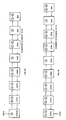
- Figure 15 shows a circuit used for the procedure of operation (ii).
- an input signal string is sequentially represented by a set of four elements, (i, j, k, SW), and an output signal string is represented by a set of two elements, (k, (i + j)/2) or ((i + j)/2, k).
- the processor 2-2 receives a divided color-space to be inserted as input signals, and generates a division priority management list inserted with the divided color-space as the output signals.
- VAL (i) is integer data values which are sorted in the descending order.
- the space-occupying number is given by the following equation: Space-governing number ⁇ (Total number of frequency of use of color contained in the divided color-space) x (Weighing-factor corresponding to the level of the divided color-space)
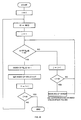
- Figure 17 shows the processing procedure of the processor 2-2.
- the processor 2-3 receives the current division priority management list as input signals, and generates a division priority management list, the entry at the end of which is deleted, as the output signals.
- the processor 2-4 receives the division priority controlling pointer CPTR and the division priority management list as the input signals, and generates divided color-spaces (octants) as the output signals.
- Processor 2-5 (processor for judging divisibility)
- the processor 2-5 receives a divided color-space, which is a candidate of division, a division priority management list and a histogram as the input signals, and generates judgment value whether or not it can be divided as the output signals.
- Figure 18 shows the processing procedure.
- the processor 2-5 includes the processor 2-1.
- Processor 2-6 (processor for generating a color LUT)
- the processor 2-6 receives the division priority management list, the divided color-space management list and the histogram as the input signals, and generates a color lookup table and an updated divided color-space management list as the output signals.
- N e is the number of non-zero entries in the histogram H (r, g, b).
- the processor 2-6 has the following two major processes.
- the processing flow of Figure 20 determines an average value obtained from color data of colors contained in a representative color-space weighed by the frequency of use of that color, as a representative color.
- a color with the highest frequency in the representative color-space may be selected as the representative color, but the process as shown in Figure 20 is preferable when taking image quality into consideration.
- a color index is set to a corresponding entry in the histogram.
- Figure 21 shows the processing flow of the neighbourhood representative color mapping device.
- the device has two processors. The following shows input signals, output signals, and processing flows of each processor.
- Processor 3-1 (processor for providing color index to parent color-space)
- the processor 3-1 receives the divided color-space management list as the input signals, sets a color index of a child color-space with the largest space-occupying number to the parent color-space in the list, and generates an updated divided color-space management list as the output signals.
- This processor can be very simply described by using recursive processing. Only an initial value and the root divided color-space of the divided color-space management list are given as the input signals. Then, the process is performed in the flow as shown in Figure 22. However, it is assumed that large integers are set in the divided color-space management list for the divided color-spaces other than those having the index values (value of 1 to K) set by the processor 2-6. Because a child color-space with the largest space-occupying number appears at the top of the division priority management list, it corresponds to the space with the smallest index value.
- Processor 3-2 (processor for generating color index portion of a histogram)
- the processor 3-2 receives a histogram with a color index having non-zero entries of N e ( Figure 11B), a color lookup table having "k" color indexes, and the divided color-space management list as the input signals, and generates an updated histogram with color indices.
- I (r, g, b) (histogram with color index (color index portion): integer data)
- Figure 23 shows the processing flow of the processor 3-2. As shown in the figure, the process for providing the color index of the neighbourhood representative color is performed by traversing the divided color-space management list provided with the color index as described above.
- a histogram (4 bits for each of R, G, and B) is created from the original image ( Figure 24).
- a single circle represents each divided color-space, the upper part of which indicates the frequency of use of the contained color, while the lower part indicates the color index in the color LUT.
- the divided color-space management list actually contains the space-occupying number, the total number of frequency of use of colors contained in each space is indicated in the figure for convenience.
- a double circle represents a divided color-space remaining in the division priority management list obtained in Step 2 which a color index was assigned to in advance.
- An index image is created by using applicable color index values, which are determined by referring to the color indexed histogram based on the values of r, g, and b (4 bit values that were made the entries of the histogram in Step 1) of the original image while scanning it.
- the division priority management list is updated, its elements are rearranged in descending order of space-occupying number, so that the division priority controlling pointer (CPTR) points to an element as close to the top of the list as possible, or the one with as large a space-occupying number as possible.
- the division priority management list is not necessarily sorted. Of course, in that case, the process for determining the element pointed by the CPTR is more complicated.
- the entries of the histogram store data of corresponding color indexes.
- the color-space subject to the division is not limited to three dimensions.
- an equal number of bits are assigned to each basic component, it is possible that a color-space to be subject to division in which the number of bits assigned to a basic component differs from that for another component.
- the number of divisions for each time other than 2 may be set for the basic component in its axial direction.
- the number of divisions for each time may be intentionally set to a number other than 8.
- This invention provides a high-speed method and an apparatus for color image quantization utilizing an adaptive sampling technique in which the processing time is substantially determined by the number of simultaneously displayed colors to be selected, but is not affected by the number of colors or the color distribution in the original image.
- Factors contributing to the improvement in the speed of color image quantization are that all calculations necessary for selecting the representative colors can be performed by integer operation, and that there is no need for calculation of the distance mapping to neighbouring representative colors.
- All that is required as data are a histogram, a divided color-space management list, and a division priority management list, so that the required storage capacity may be small. Accordingly the invention can be implemented on a personal computer.
- the divisibility of a color-space can be determined by introducing a weighing-factor which depends on the division level, so that, in a case where the original image does not have coloring that is not uniformly distributed in color-space, but has a number of local peaks, it is possible to avoid dropping of the colors representing a color group that are of low density in the color-space, but are widely distributed (they are often colors for accent). Therefore, it is possible to prevent degrading of the quantized image.
Landscapes
- Engineering & Computer Science (AREA)
- Multimedia (AREA)
- Signal Processing (AREA)
- Image Processing (AREA)
- Facsimile Image Signal Circuits (AREA)
- Controls And Circuits For Display Device (AREA)
- Image Analysis (AREA)
- Processing Of Color Television Signals (AREA)
Applications Claiming Priority (2)
| Application Number | Priority Date | Filing Date | Title |
|---|---|---|---|
| JP269514/88 | 1988-10-27 | ||
| JP63269514A JPH087553B2 (ja) | 1988-10-27 | 1988-10-27 | 色画像量子化方法及び装置 |
Publications (3)
| Publication Number | Publication Date |
|---|---|
| EP0366309A2 true EP0366309A2 (de) | 1990-05-02 |
| EP0366309A3 EP0366309A3 (de) | 1991-08-28 |
| EP0366309B1 EP0366309B1 (de) | 1995-06-07 |
Family
ID=17473466
Family Applications (1)
| Application Number | Title | Priority Date | Filing Date |
|---|---|---|---|
| EP89310452A Expired - Lifetime EP0366309B1 (de) | 1988-10-27 | 1989-10-12 | Farbbildquantisierungssystem |
Country Status (4)
| Country | Link |
|---|---|
| US (1) | US5049986A (de) |
| EP (1) | EP0366309B1 (de) |
| JP (1) | JPH087553B2 (de) |
| DE (1) | DE68922959D1 (de) |
Cited By (12)
| Publication number | Priority date | Publication date | Assignee | Title |
|---|---|---|---|---|
| US5331439A (en) * | 1992-03-10 | 1994-07-19 | Scitex Corporation Ltd. | Apparatus and method for color transformation |
| EP0580302A3 (en) * | 1992-07-22 | 1994-09-14 | Ibm | Method and apparatus for generating a color palette |
| EP0923037A1 (de) * | 1997-12-12 | 1999-06-16 | Hewlett-Packard Company | Vereinfachte Hardwareimplementation für radiale und Tetraeder-Interpolation |
| US5966474A (en) * | 1997-12-12 | 1999-10-12 | Hewlett-Packard Company | Non-symmetric radial and non-symmetric pruned radial interpolation |
| US6031642A (en) * | 1997-12-12 | 2000-02-29 | Hewlett-Packard Company | Tetrahedral and pruned tetrahedral interpolation |
| US6040925A (en) * | 1997-12-12 | 2000-03-21 | Hewlett-Packard Company | Radial and pruned radial interpolation |
| US6040926A (en) * | 1997-12-12 | 2000-03-21 | Hewlett-Packard Company | Common non-symmetric pruned radial and non-symmetric pruned tetrahedral interpolation hardware implementation |
| US6049400A (en) * | 1997-12-12 | 2000-04-11 | Hewlett-Packard Company | Non-symmetric tetrahedral and non-symmetric pruned tetrahedral interpolation |
| WO2004040520A1 (en) * | 2002-11-01 | 2004-05-13 | Cae Inc. | Method and apparatus for providing calligraphic light point display |
| EP1518220A4 (de) * | 2002-05-13 | 2008-03-12 | Genesis Microchip Inc | Vorrichtung und verfahren zur farbabbildung mit mehrfachauflösung für anzeigebausteine |
| EP1514237A4 (de) * | 2001-03-20 | 2008-04-23 | Konan Technology Inc | Verfahren zum abstrahieren des histogramms der hsv-farbe |
| EP2046064A4 (de) * | 2006-10-05 | 2009-10-21 | Panasonic Corp | Leuchtdisplay-einrichtung |
Families Citing this family (48)
| Publication number | Priority date | Publication date | Assignee | Title |
|---|---|---|---|---|
| US5222154A (en) * | 1991-06-12 | 1993-06-22 | Hewlett-Packard Company | System and method for spot color extraction |
| US5365252A (en) * | 1991-09-23 | 1994-11-15 | Ricoh Company, Ltd. | Color quantization apparatus and method for frame buffer display |
| US5684897A (en) * | 1992-02-19 | 1997-11-04 | Ezel Inc. | Method for quantizing color image data by minimizing least squares error of binary coding |
| US5509111A (en) * | 1992-04-27 | 1996-04-16 | International Business Machines Corporation | Color image region management system and color image region management method and color image region retrieval method |
| US5418895A (en) * | 1992-11-25 | 1995-05-23 | Eastman Kodak Company | Method for displaying a high quality digital color image on a limited color display |
| JP3268512B2 (ja) * | 1993-03-03 | 2002-03-25 | セイコーエプソン株式会社 | 画像処理装置および画像処理方法 |
| US5615320A (en) * | 1994-04-25 | 1997-03-25 | Canon Information Systems, Inc. | Computer-aided color selection and colorizing system using objective-based coloring criteria |
| US5508718A (en) * | 1994-04-25 | 1996-04-16 | Canon Information Systems, Inc. | Objective-based color selection system |
| JPH08163129A (ja) * | 1994-12-09 | 1996-06-21 | Nippon Telegr & Teleph Corp <Ntt> | 同報機能実現方法 |
| US5734744A (en) * | 1995-06-07 | 1998-03-31 | Pixar | Method and apparatus for compression and decompression of color data |
| US5982990A (en) * | 1995-07-20 | 1999-11-09 | Hewlett-Packard Company | Method and apparatus for converting color space |
| US7728845B2 (en) | 1996-02-26 | 2010-06-01 | Rah Color Technologies Llc | Color calibration of color image rendering devices |
| US6043909A (en) | 1996-02-26 | 2000-03-28 | Imagicolor Corporation | System for distributing and controlling color reproduction at multiple sites |
| US6081276A (en) * | 1996-11-14 | 2000-06-27 | International Business Machines Corporation | Method and apparatus for creating a color name dictionary and for querying an image by color name |
| AU9119098A (en) | 1997-08-25 | 1999-03-16 | Richard A. Holub | A system for distributing and controlling color reproduction at multiple sites |
| US6518981B2 (en) * | 1997-11-12 | 2003-02-11 | Canon Kabushiki Kaisha | Generating and using a color palette |
| US6445834B1 (en) | 1998-10-19 | 2002-09-03 | Sony Corporation | Modular image query system |
| US6256409B1 (en) | 1998-10-19 | 2001-07-03 | Sony Corporation | Method for determining a correlation between images using multi-element image descriptors |
| US6236406B1 (en) * | 1998-10-21 | 2001-05-22 | Sony Corporation | Three-dimensional color space display |
| US6262710B1 (en) * | 1999-05-25 | 2001-07-17 | Intel Corporation | Performing color conversion in extended color polymer displays |
| KR100364753B1 (ko) * | 1999-11-19 | 2002-12-16 | 엘지전자 주식회사 | 칼라 히스토그램의 빈값 양자화 방법 |
| US6618500B1 (en) * | 1999-12-07 | 2003-09-09 | Sony Corporation | Color conversion matrix based on minimal surface theory |
| KR100422697B1 (ko) * | 1999-12-27 | 2004-03-12 | 엘지전자 주식회사 | 색공간 양자화 묘사자 |
| US7102648B1 (en) | 2000-04-11 | 2006-09-05 | Rah Color Technologies Llc | Methods and apparatus for calibrating a color display |
| US6522780B1 (en) | 2000-12-15 | 2003-02-18 | America Online, Inc. | Indexing of images and/or text |
| US6522782B2 (en) | 2000-12-15 | 2003-02-18 | America Online, Inc. | Image and text searching techniques |
| US6556710B2 (en) | 2000-12-15 | 2003-04-29 | America Online, Inc. | Image searching techniques |
| US6671402B1 (en) | 2000-12-15 | 2003-12-30 | America Online, Inc. | Representing an image with weighted joint histogram |
| US6522779B2 (en) | 2000-12-15 | 2003-02-18 | America Online, Inc. | Representing an image with a posterized joint histogram |
| US7079684B2 (en) * | 2001-12-05 | 2006-07-18 | Oridus, Inc. | Method and apparatus for color quantization of images employing a dynamic color map |
| US7636468B2 (en) * | 2003-11-10 | 2009-12-22 | Microsoft Corporation | System for customer and automatic color management using policy controls |
| JP5032911B2 (ja) * | 2007-07-31 | 2012-09-26 | キヤノン株式会社 | 画像処理装置及び画像処理方法 |
| US9076068B2 (en) * | 2010-10-04 | 2015-07-07 | Datacolor Holding Ag | Method and apparatus for evaluating color in an image |
| JP2012213134A (ja) * | 2011-03-24 | 2012-11-01 | Sony Corp | 画像処理装置および方法 |
| HRP20240953T1 (hr) | 2013-04-08 | 2024-10-25 | Dolby International Ab | Metoda kodiranja i metoda dekodiranja lut i odgovarajući uređaji |
| KR102275639B1 (ko) | 2013-10-14 | 2021-07-08 | 마이크로소프트 테크놀로지 라이센싱, 엘엘씨 | 비디오 및 영상 코딩 및 디코딩에 대한 기본 색상 인덱스 맵 모드의 특징 |
| CN105659602B (zh) | 2013-10-14 | 2019-10-08 | 微软技术许可有限责任公司 | 用于视频和图像编码的帧内块复制预测模式的编码器侧选项 |
| KR102257269B1 (ko) | 2013-10-14 | 2021-05-26 | 마이크로소프트 테크놀로지 라이센싱, 엘엘씨 | 비디오 및 이미지 코딩 및 디코딩을 위한 인트라 블록 카피 예측 모드의 피쳐 |
| EP3090553B1 (de) | 2014-01-03 | 2022-07-06 | Microsoft Technology Licensing, LLC | Blockvektorvorhersage in der video- und bildcodierung/-decodierung |
| US10390034B2 (en) | 2014-01-03 | 2019-08-20 | Microsoft Technology Licensing, Llc | Innovations in block vector prediction and estimation of reconstructed sample values within an overlap area |
| US11284103B2 (en) | 2014-01-17 | 2022-03-22 | Microsoft Technology Licensing, Llc | Intra block copy prediction with asymmetric partitions and encoder-side search patterns, search ranges and approaches to partitioning |
| US9699468B2 (en) * | 2014-02-10 | 2017-07-04 | Microsoft Technology Licensing, Llc | Adaptive screen and video coding scheme |
| US10542274B2 (en) | 2014-02-21 | 2020-01-21 | Microsoft Technology Licensing, Llc | Dictionary encoding and decoding of screen content |
| US10785486B2 (en) | 2014-06-19 | 2020-09-22 | Microsoft Technology Licensing, Llc | Unified intra block copy and inter prediction modes |
| CN105874795B (zh) | 2014-09-30 | 2019-11-29 | 微软技术许可有限责任公司 | 在波前并行处理被启用时对图片内预测模式的规则 |
| CN106664405B (zh) | 2015-06-09 | 2020-06-09 | 微软技术许可有限责任公司 | 用调色板模式对经逸出编码的像素的稳健编码/解码 |
| US10986349B2 (en) | 2017-12-29 | 2021-04-20 | Microsoft Technology Licensing, Llc | Constraints on locations of reference blocks for intra block copy prediction |
| CN113613007B (zh) * | 2021-07-19 | 2024-03-05 | 青岛信芯微电子科技股份有限公司 | 一种三维色彩查找表的生成方法及显示设备 |
Family Cites Families (6)
| Publication number | Priority date | Publication date | Assignee | Title |
|---|---|---|---|---|
| US4694404A (en) * | 1984-01-12 | 1987-09-15 | Key Bank N.A. | High-speed image generation of complex solid objects using octree encoding |
| JPS60230693A (ja) * | 1984-04-27 | 1985-11-16 | インタ−ナショナル ビジネス マシ−ンズ コ−ポレ−ション | カラ−画像表示システム |
| US4689669A (en) * | 1984-11-27 | 1987-08-25 | Sony Corporation | Color graphics data processing apparatus |
| JPS61131990A (ja) * | 1984-11-30 | 1986-06-19 | Sony Corp | ビデオテツクス画像作成装置 |
| US4887151A (en) * | 1986-06-30 | 1989-12-12 | Canon Kabushiki Kaisha | Encoding apparatus for color image data with block-by-block individual quantizing or individual encoding of luminosity, structure, and color information |
| US4907075A (en) * | 1987-07-28 | 1990-03-06 | International Business Machines Corporation | Method for selecting colors |
-
1988
- 1988-10-27 JP JP63269514A patent/JPH087553B2/ja not_active Expired - Lifetime
-
1989
- 1989-10-12 EP EP89310452A patent/EP0366309B1/de not_active Expired - Lifetime
- 1989-10-12 DE DE68922959T patent/DE68922959D1/de not_active Expired - Lifetime
- 1989-10-26 US US07/427,680 patent/US5049986A/en not_active Expired - Fee Related
Cited By (15)
| Publication number | Priority date | Publication date | Assignee | Title |
|---|---|---|---|---|
| US5331439A (en) * | 1992-03-10 | 1994-07-19 | Scitex Corporation Ltd. | Apparatus and method for color transformation |
| US5412491A (en) * | 1992-03-10 | 1995-05-02 | Scitex Corporation Ltd. | Apparatus and method for color transformation |
| EP0580302A3 (en) * | 1992-07-22 | 1994-09-14 | Ibm | Method and apparatus for generating a color palette |
| US5434957A (en) * | 1992-07-22 | 1995-07-18 | International Business Machines Corporation | Method and apparatus for generating a color palette |
| US6028683A (en) * | 1997-12-12 | 2000-02-22 | Hewlett-Packard Company | Common pruned radial and pruned tetrahedral interpolation hardware implementation |
| US5966474A (en) * | 1997-12-12 | 1999-10-12 | Hewlett-Packard Company | Non-symmetric radial and non-symmetric pruned radial interpolation |
| EP0923037A1 (de) * | 1997-12-12 | 1999-06-16 | Hewlett-Packard Company | Vereinfachte Hardwareimplementation für radiale und Tetraeder-Interpolation |
| US6031642A (en) * | 1997-12-12 | 2000-02-29 | Hewlett-Packard Company | Tetrahedral and pruned tetrahedral interpolation |
| US6040925A (en) * | 1997-12-12 | 2000-03-21 | Hewlett-Packard Company | Radial and pruned radial interpolation |
| US6040926A (en) * | 1997-12-12 | 2000-03-21 | Hewlett-Packard Company | Common non-symmetric pruned radial and non-symmetric pruned tetrahedral interpolation hardware implementation |
| US6049400A (en) * | 1997-12-12 | 2000-04-11 | Hewlett-Packard Company | Non-symmetric tetrahedral and non-symmetric pruned tetrahedral interpolation |
| EP1514237A4 (de) * | 2001-03-20 | 2008-04-23 | Konan Technology Inc | Verfahren zum abstrahieren des histogramms der hsv-farbe |
| EP1518220A4 (de) * | 2002-05-13 | 2008-03-12 | Genesis Microchip Inc | Vorrichtung und verfahren zur farbabbildung mit mehrfachauflösung für anzeigebausteine |
| WO2004040520A1 (en) * | 2002-11-01 | 2004-05-13 | Cae Inc. | Method and apparatus for providing calligraphic light point display |
| EP2046064A4 (de) * | 2006-10-05 | 2009-10-21 | Panasonic Corp | Leuchtdisplay-einrichtung |
Also Published As
| Publication number | Publication date |
|---|---|
| DE68922959D1 (de) | 1995-07-13 |
| JPH02116893A (ja) | 1990-05-01 |
| EP0366309B1 (de) | 1995-06-07 |
| JPH087553B2 (ja) | 1996-01-29 |
| EP0366309A3 (de) | 1991-08-28 |
| US5049986A (en) | 1991-09-17 |
Similar Documents
| Publication | Publication Date | Title |
|---|---|---|
| US5049986A (en) | Method and apparatus for color image quantization | |
| US5142272A (en) | Method and apparatus for processing display color signal | |
| US4710806A (en) | Digital display system with color lookup table | |
| EP1014699B1 (de) | Verfahren zur Selektion von Farbblockpunkten für die Blockkodierung | |
| US6011540A (en) | Method and apparatus for generating small, optimized color look-up tables | |
| EP0159691B1 (de) | Farbbildanzeigesystem | |
| US6518981B2 (en) | Generating and using a color palette | |
| US7012617B2 (en) | Method for representing a digital color image using a set of palette colors based on detected important colors | |
| US6766051B2 (en) | Adaptive tree-base lookup for non-separably divided color tables | |
| US5130701A (en) | Digital color representation | |
| US6882445B1 (en) | Color gamut compression apparatus and method | |
| US7139426B2 (en) | Histogram data collector for applying progressively adjusted histogram equalization to an oscilloscope image | |
| WO1988000377A1 (en) | Resolution conversion of bitmap images using error term averaging | |
| US6707938B2 (en) | Principal axis look-up for color correction | |
| EP0544510B1 (de) | Rasterpufferspeicher mit aufgeteiltem Pegel | |
| US6836563B2 (en) | Computer-readable medium and program for quantizing a data set, method and apparatus for quantizing a data set | |
| Burger et al. | Color images | |
| US5467110A (en) | Population attribute compression | |
| JPH05241550A (ja) | 色画像変換方法 | |
| JPH10276337A (ja) | カラー画像処理装置 | |
| US6002795A (en) | Method and apparatus for transforming a source image to an output image | |
| JP4235306B2 (ja) | 低複雑性、低メモリ消費の逆ディザ方法 | |
| US6295137B1 (en) | Method of color correction using multi-level halftoning | |
| JP3452212B2 (ja) | 減色処理を行なうカラー画像処理装置 | |
| JP4197900B2 (ja) | パレット色の組を用いてディジタルカラー画像を表現する方法 |
Legal Events
| Date | Code | Title | Description |
|---|---|---|---|
| PUAI | Public reference made under article 153(3) epc to a published international application that has entered the european phase |
Free format text: ORIGINAL CODE: 0009012 |
|
| AK | Designated contracting states |
Kind code of ref document: A2 Designated state(s): DE FR GB |
|
| 17P | Request for examination filed |
Effective date: 19900820 |
|
| PUAL | Search report despatched |
Free format text: ORIGINAL CODE: 0009013 |
|
| AK | Designated contracting states |
Kind code of ref document: A3 Designated state(s): DE FR GB |
|
| 17Q | First examination report despatched |
Effective date: 19930722 |
|
| GRAA | (expected) grant |
Free format text: ORIGINAL CODE: 0009210 |
|
| AK | Designated contracting states |
Kind code of ref document: B1 Designated state(s): DE FR GB |
|
| PG25 | Lapsed in a contracting state [announced via postgrant information from national office to epo] |
Ref country code: FR Effective date: 19950607 |
|
| REF | Corresponds to: |
Ref document number: 68922959 Country of ref document: DE Date of ref document: 19950713 |
|
| PG25 | Lapsed in a contracting state [announced via postgrant information from national office to epo] |
Ref country code: DE Effective date: 19950908 |
|
| PGFP | Annual fee paid to national office [announced via postgrant information from national office to epo] |
Ref country code: GB Payment date: 19950926 Year of fee payment: 7 |
|
| EN | Fr: translation not filed | ||
| PLBE | No opposition filed within time limit |
Free format text: ORIGINAL CODE: 0009261 |
|
| STAA | Information on the status of an ep patent application or granted ep patent |
Free format text: STATUS: NO OPPOSITION FILED WITHIN TIME LIMIT |
|
| 26N | No opposition filed | ||
| PG25 | Lapsed in a contracting state [announced via postgrant information from national office to epo] |
Ref country code: GB Effective date: 19961012 |
|
| GBPC | Gb: european patent ceased through non-payment of renewal fee |
Effective date: 19961012 |