EP0366262A2 - Gasnachweissystem - Google Patents
Gasnachweissystem Download PDFInfo
- Publication number
- EP0366262A2 EP0366262A2 EP89309623A EP89309623A EP0366262A2 EP 0366262 A2 EP0366262 A2 EP 0366262A2 EP 89309623 A EP89309623 A EP 89309623A EP 89309623 A EP89309623 A EP 89309623A EP 0366262 A2 EP0366262 A2 EP 0366262A2
- Authority
- EP
- European Patent Office
- Prior art keywords
- electrolyte
- elongated element
- electrodes
- fluid component
- along
- Prior art date
- Legal status (The legal status is an assumption and is not a legal conclusion. Google has not performed a legal analysis and makes no representation as to the accuracy of the status listed.)
- Ceased
Links
Images

Classifications
-
- G—PHYSICS
- G01—MEASURING; TESTING
- G01N—INVESTIGATING OR ANALYSING MATERIALS BY DETERMINING THEIR CHEMICAL OR PHYSICAL PROPERTIES
- G01N27/00—Investigating or analysing materials by the use of electric, electrochemical, or magnetic means
- G01N27/26—Investigating or analysing materials by the use of electric, electrochemical, or magnetic means by investigating electrochemical variables; by using electrolysis or electrophoresis
- G01N27/416—Systems
- G01N27/4162—Systems investigating the composition of gases, by the influence exerted on ionic conductivity in a liquid
-
- G—PHYSICS
- G01—MEASURING; TESTING
- G01N—INVESTIGATING OR ANALYSING MATERIALS BY DETERMINING THEIR CHEMICAL OR PHYSICAL PROPERTIES
- G01N33/00—Investigating or analysing materials by specific methods not covered by groups G01N1/00 - G01N31/00
- G01N33/0004—Gaseous mixtures, e.g. polluted air
- G01N33/0009—General constructional details of gas analysers, e.g. portable test equipment
- G01N33/0027—General constructional details of gas analysers, e.g. portable test equipment concerning the detector
- G01N33/0036—General constructional details of gas analysers, e.g. portable test equipment concerning the detector specially adapted to detect a particular component
- G01N33/0052—Gaseous halogens
Definitions
- This invention relates to an electrochemical system for the detection of a fluid component. eg the detection of chlorine gas in a gas stream or the environment.
- a known device is disclosed in our prior British Patent No. 1552620.
- a drawback with known devices is that they are effectively "point" sensors in that they are capable only of detecting gas such as chlorine if present or released in closed proximity to the device and the wind or gas flow is directed towards the sensor.
- this drawback could be overcome by using a large array of sensing devices in sufficiently close proximity to one another as to minimise the risk of a gas release going undetected.
- a vessel containing a toxic gas could be encircled by a vast array of point sensor devices so as to detect any gas release occurring as a result of the vessel being breached.
- the feasibility of such an arrangement would be questionable in terms of capital cost and complexity.
- an electrochemical system for the detection of a fluid component comprising two or more electrodes in contact with an electrolyte which combines with the fluid component to be detected to cause a change in an electrical parameter detectable by means of the electrodes, characterised in that the electrolyte is distributed by capillary action along an elongated element which is arranged so as to extend predominantly horizontally.
- an electrochemical system for the detection of a fluid component comprising two or more electrodes in contact with an electrolyte which combines with the fluid component to be detected to cause a change in an electrical parameter detectable by means of the electrodes characterised in that the electrolyte is distributed along an elongated element which contacts the contents of a reservoir of said electrolyte, means is provided for supporting the elongated element with its longitudinal axis generally horizontal, and the elongated element is arranged either alone or in combination with at least one of the electrodes to distribute the electrolyte lengthwise thereof by capillary action.
- means for maintaining electrolyte tending to drain away from the elongated element along its active length in contact therewith; such means may for example comprise a channel or trough in which the elongated element is received.
- the assembly of the elongated element and the electrodes may extend along and be supported by the base of the channel or trough. Any excess electrolyte tending to drain from or drip from the elongated element and electrode assembly simply collects at the base of the channel or trough and is therefore available for capillary feed back to the elongated element and electrode assembly.
- active length is used herein to refer to that part of the elongated element which carries the electrolyte, is exposed for reaction of the electrolyte with the fluid component to be detected and is provided with the electrodes.
- the channel in which the elongated element is received may be open at one side or it may have a closed periphery, ie a tubular configuration. In the latter event, the channel is composed of a material which is permeable to gas flow but retains liquid if the liquid is not subject to any significant pressure tending to force it through the wall or walls of the channel.
- the elongated element has a structure per se or is composed of a material providing a wicking action and is arranged to dip into the electrolyte-containing reservoir.
- the system may include two or more electrolyte-containing reservoirs and the elongate element may contact the reservoirs at spaced positions along its length.
- the elongated element functions as a wick, it preferably comprises strands or fibres woven together to form a cord, cable or string-like structure.
- the elongated element will be of a substantial longitudinal extent, preferably at least one order of magnitude, and more preferably at least 50 times, greater than its diameter (or major cross-sectional dimension).
- the electrodes may extend generally parallel with the elongated element or one or more of the electrodes may be wound around the elongated element conveniently in helical fashion in which event the pitch of the coil is preferably substantially larger than the major cross-sectional dimension of the elongated element.
- the elongated element is woven from strands or fibres
- one or more of the electrodes may be interwoven with the strands or fibres or otherwise incorporated in the body of the elongated element so that the electrodes contact the electrolyte distributed along the elongated element.
- the capillary action may be provided by gaps present in the vicinity of the positions of contact between the electrodes and the outer periphery of the elongated element. Such gaps will exist for example when the electrodes are of round section and the elongated element is of round section.
- the electrodes are arranged to extend in generally helical fashion around the elongated element so that, at intervals along the length of the elongated element, they (and hence the gaps along which capillary flow occurs) are immersed in the electrolyte occupying the channel or trough.
- the electrolyte may be chemically reactive with said fluid component and preferably comprises an aqueous solution of a hygroscopic substance or substances or, more preferably, a deliquescent substance or substances as disclosed in our prior Patent No. 1552620.
- the electrolyte may incorporate a humectant.
- the elongated element may be arranged so that it has a generally linear or curvilinear configuration and serves as a "line" sensor or it may be configured in a two dimensional or even three dimensional arrangement by, for example, mounting it in a zig-zag, meandering or like configuration in one or more planes.
- the elongated element may be arranged to extend as a loop around the perimeter of a zone which is to be monitored.
- the elongated member may have both ends immersed in a common reservoir containing the electrolyte and the remainder of the elongated member together with the electrodes may extend for instance around the periphery of a vessel containing a toxic gas so that, in the event of a breach in the integrity of the vessel at any point around its periphery or a valve or flange associated with the vessel, any gas released is detected by the sensor.
- a system for the detection of a fluid component comprising two or more electrodes in contact with an electrolyte which combines with the fluid component to be detected to cause a change in an electrical parameter detectable via the electrodes, characterised in that the electrolyte is distributed along an elongated element and incorporates a viscosity-enhancing agent which renders the electrolyte substantially immobile.
- the viscosity-enhancing agent may take any suitable form which is chemically compatible with the electrolyte and imparts sufficient viscosity thereto to render it substantially immobile particularly in terms of resisting flow induced by gravity and more particularly in terms of resisting loss of electrolyte by dripping of the electrolyte from non-vertical runs of the elongated element.
- the viscosity-enhancing agent may for example comprise a gelling agent such as a hydrogel or agar.
- the elongated element preferably has an open pore structure and conveniently comprises strands or fibres woven together so that the elongated element has a cord, cable or string-like structure.
- the arrangement may be such that gaps between the electrodes and the elongated element act as reservoirs holding the electrolyte, in which case the element may comprise a rod, tube or the like.
- the electrolyte may be coated on to the external surface of the elongated element or the latter may be impregnated with the electrolyte.
- the elongated element is arranged so as to extend predominantly horizontally and support means are provided for supporting it at spaced intervals along its length.
- the support means may for example comprise vertically disposed posts to which the elongated element is attachable by means of suitable connectors.
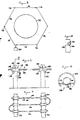
- the detecting system of the invention comprises an elongated element 10 which extends along a generally horizontally disposed tube 12 and is arranged in the vicinity of a zone 13 which is to be monitored for the release of a gas such as chlorine.
- the zone 13 may for example accommodate a storage vessel containing the gas and the elongated element may be located adjacent the vessel, for instance in close proximity to a part of the vessel, such as a valve or flange, from which gas could leak in the event of a breech in the integrity of the vessel.
- the element 10 has an electrolyte in liquid form distributed along its length and is provided with a pair of electrode wires 14, 16 (of for example platinum or platinised niobium or platinised titanium) extending in spaced relation to one another and generally co-extensive with the element 10.
- electrode wires 14, 16 of for example platinum or platinised niobium or platinised titanium
- the tube 12 is adapted to allow ingress of air into its interior so that the element 10 is exposed to an air flow which, in the event of a breach in the vessel integrity, will contain the gas to be detected.
- Such ingress of gas may be implemented in a number of ways; for example, the tube may be slotted or provided with perforations in its wall or it may be composed at least in part of a material having inherent porosity such that the tube wall is permeable to gas but only permits egress of liquid if the latter is under significant pressure.
- Porous plastics materials such as porous polyfluoroethylene or porous polyethylene are commercially available and the tube may be composed, at least in part, of such material.
- the electrolyte is selected according to the gas to be detected and, as previously mentioned, typically comprises an aqueous solution of a deliquescent salt. Distribution of the electrolyte along the element 10 is effected by capillary action.
- the necessary capillary action is, in preferred embodiments of the invention, provided by fabricating the element 10 in the form of a wick, eg it may comprise a cable, cord or string produced from fibres or strands. At least one end (both in the illustrated embodiment of Figure 1) of the wicking element 10 dips into a reservoir 18 containing the electrolyte.
- the element 10 is disposed horizontally, the tendency for the aqueous electrolyte to drip is not a problem because the wicking element 10 runs along the lowermost section or base of the tube 12 (see Figure 3) and any excess electrolyte 32 (see Figure 3) can therefore collect at the base region of the tube 12 and is available for re-absorption into the element 10 by capillary action. If desired, as shown in Figure 1, the element 10 may contact intermediate reservoirs 20 of electrolyte at strategic positions along its length.
- the element 10 may be continuous over the whole of its length in which case contact with the electrolyte in the intermediate reservoirs 20 can be effected by introducing a looped portion 22 in the element 10 (as shown diagrammatically in Figure 4) and immersing the looped portion(s) in the reservoir(s) 20.
- the element 10 may comprise separate sections extending between successive reservoirs 18,20.
- the electrode wires 14,16 are coupled to an instrumentation console 24 and are preferably wound around the element 10 in a multi-start fashion with a slow spiral and without contacting each other.
- at least one of the electrode wires 14,16 may be incorporated into the body of the element; for instance by interweaving the wire(s) 14/16 with the strands or fibres from which the element 10 is woven.
- the console 24 serves to impress a low voltage (ie. below the decomposition potential of water) across the electrodes 14,16 and a change in the composition of the electrolyte resulting from localised reaction thereof with the fluid component to be detected (if present) causes a measurable electric current to flow between the electrode wires which is sensed by the instrumentation 24.
- the latter in response to sensing of such a current, may for example cause actuation of visible and/or audible alarms either if any of the fluid component is detected or if the fluid component detected reaches or exceeds a predetermined level of concentration, and/or the instrumentation 24 may record and/or display the presence of the fluid component or changes in its concentration level over a period of time.
- an element 10 which, per se, has wicking characteristics
- distribution of the electrolyte along the element 10 by capillary action may be produced by virtue of the small generally helically extending gaps 26 immediately adjacent the zones of substantially line contact between the electrode wires 14,16 and the peripheral surface of the element 10.
- the element 10 may have a smooth surface and may be of solid or tubular section.
- the wires 14,16 by virtue of their helical configuration repeatedly pass across the base region of the tube 12 thus allowing electrolyte present in the base region to be collected and fed by capillary action around and along the length of the element 10.
- a cover 28 may be provided to provide protection against the weather, particularly rain.
- the lengths of tube 12 may comprise commercially-available tubing and commercially-available couplings and fittings such as are used in plastic plumbing systems may be employed to produce joints and junctions between the tube lengths.
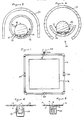
- the channel along which the element 10 runs is in the form of a trough 36 mounted within a cover 38 by suitable means such as discs 40 (see Figure 7) having a central aperture 42 through which the assembly of the trough 36 and element 10 extend and a radial projection 44 for reception in the opening 46 (which may be of a continuous or discontinuous nature lengthwise of the cover) at the underside of the cover 38.
- the opening(s) 46 serves as an inlet for air/gas flow into the cover for interaction with the element 10.
- a system for detection of release of a gas, such as chlorine or other toxic gas, into the surrounding atmosphere in the event of a breach in the integrity of a vessel 110 containing the gas.
- the system comprises a fence-like arrangement erected around the perimeter of the vessel and comprises a series of support posts 112 which support a continuous line sensor 114 extending generally horizontally from one post to the next to form a loop encircling the vessel 110.
- the line sensor 114 comprises a cord or string 116 woven from fibres or strands of an electrically insulating material, e.g.
- the cord or string is provided with electrode wires 118,120 of for example platinum (or platinised titanium or platinised niobium which are substantially co-extensive with the cord 116 and extend from an instrumentation console 122 around the loop and back to the console 122.
- the wires 118,120 are wound around the cord 116 in a multi-start fashion with a slow spiral and without contacting each other.
- at least one wire may be interwoven with the strands or fibres from which the cable is woven or otherwise incorporated into the body of the cable and in such a way that the wires are non-contacting.
- the electrolyte may be selected so as to be chemically reactive with the fluid component to be detected - for example where chlorine is to be detected the electrolyte may comprise an aqueous solution of a deliquescent salt such as calcium bromide or the salt may be combined with a humectant such as glycerol to keep an otherwise dry salt damp.
- the electrolyte will additionally incorporate a viscosity-enhancing agent which will be selected so as to be chemically compatible with the electro-chemically active constituent of the electrolyte without adversely affecting to any significant extent the electrochemical interaction of the electrolyte with the fluid component to be detected.
- the active constituent of the electrolyte should be deliquescent or hygroscopic or be combined with a humectant so as to reduce susceptibility to rapid drying out as a result of evaporation of the solvent in the course of exposure to gas streams.
- the viscosity-enhancing agent may also be a humectant for the purpose of maintaining the salt damp.
- the system may be used for a wide variety of fluid components including chlorine dioxide, ozone, oxides of nitrogen; lithium-bromide for example is suitable for the detection of NO x .
- a low voltage potential (below the decomposition potential of water) is impressed across the electrodes by means of the instrumentation 122 and a change in the composition of the electrolyte resulting from localised reaction thereof with the fluid component to be detected (if present) causes a measurable electric current to flow between the electrodes which can be sensed by the instrumentation 122.
- the latter in response to sensing of such a current, may for example cause actuation of visible and/or audible alarms either if any of the fluid component in question is detected or if the fluid component detected reaches or exceeds a predetermined level of concentration, and/or the instrumentation may record and/or display the presence of the fluid component or changes in the concentration level of the fluid component over a period of time.
- the particular mounting arrangement employed in this embodiment takes the form of bobbins 124 having a central bore through which the line sensor 114 passes, the bobbins 124 being designed for reception in openings 126 in the support posts 112.
- the bobbins 124 are restrained against axial movement relative to the support posts by flanges 128 and the bobbins 124 are releasably retained in the openings 126 by resiliently-deflectable fingers 130.
- the system essentially acts as a line sensor, ie in one dimension.
- the system may provide sensing in two dimensions and it will be seen that the system may readily take the form of a two-dimensional fence-like arrangement which may be arranged to encircle a zone to be monitored for possible release of the fluid component to be detected.
- the cable and electrode assembly is shown with a two dimensional configuration in the vertical plane; however it will be appreciated that a three dimensional configuration is also possible.
- the line sensor is described as being continuous, the loop may, if desired, comprise a number of separate line sensors constituting respective sections of the loop.
- the exposed lengths of electrolyte-bearing cable 116 may be protected by means of a shield or cover 132 which can for example be supported by the bobbin flanges 128 in spaced relation with the cable 116.
- the cover 132 has an opening or openings 134 at its underside to permit circulation of air or the gas stream around the cable/electrode assembly.
- the cover 132 can be made of a rigid non-corrodable material such as a suitable plastics material and may be provided with spaced support arms 136 along its length to afford additional support for the cable/electrode assembly to prevent the latter from sagging over the span between successive posts 112.
- the cover 132 may if desired be made of a gas permeable material, such as a porous polyethylene, which though porous will not allow ingress of water if not under pressure - in this event, the porosity of the material may be adequate to allow ingress of gas without the need for openings such as 134 in the cover, ie the cover may be tubular with an uninterrupted peripheral wall.
- a gas permeable material such as a porous polyethylene, which though porous will not allow ingress of water if not under pressure - in this event, the porosity of the material may be adequate to allow ingress of gas without the need for openings such as 134 in the cover, ie the cover may be tubular with an uninterrupted peripheral wall.
Landscapes
- Chemical & Material Sciences (AREA)
- Life Sciences & Earth Sciences (AREA)
- Health & Medical Sciences (AREA)
- Immunology (AREA)
- Engineering & Computer Science (AREA)
- Pathology (AREA)
- Physics & Mathematics (AREA)
- Analytical Chemistry (AREA)
- Biochemistry (AREA)
- General Health & Medical Sciences (AREA)
- General Physics & Mathematics (AREA)
- Electrochemistry (AREA)
- Chemical Kinetics & Catalysis (AREA)
- Molecular Biology (AREA)
- Combustion & Propulsion (AREA)
- Food Science & Technology (AREA)
- Medicinal Chemistry (AREA)
- Investigating Or Analyzing Materials By The Use Of Fluid Adsorption Or Reactions (AREA)
- Measuring Oxygen Concentration In Cells (AREA)
- Investigating Or Analyzing Materials By The Use Of Electric Means (AREA)
Applications Claiming Priority (4)
| Application Number | Priority Date | Filing Date | Title |
|---|---|---|---|
| GB8824896 | 1988-10-24 | ||
| GB8824895 | 1988-10-24 | ||
| GB888824895A GB8824895D0 (en) | 1988-10-24 | 1988-10-24 | Electrochemical system |
| GB888824896A GB8824896D0 (en) | 1988-10-24 | 1988-10-24 | Detection system |
Publications (2)
| Publication Number | Publication Date |
|---|---|
| EP0366262A2 true EP0366262A2 (de) | 1990-05-02 |
| EP0366262A3 EP0366262A3 (de) | 1990-09-12 |
Family
ID=26294548
Family Applications (1)
| Application Number | Title | Priority Date | Filing Date |
|---|---|---|---|
| EP19890309623 Ceased EP0366262A3 (de) | 1988-10-24 | 1989-09-21 | Gasnachweissystem |
Country Status (3)
| Country | Link |
|---|---|
| US (1) | US5007996A (de) |
| EP (1) | EP0366262A3 (de) |
| JP (1) | JPH02269950A (de) |
Cited By (1)
| Publication number | Priority date | Publication date | Assignee | Title |
|---|---|---|---|---|
| US6304327B1 (en) | 1999-03-02 | 2001-10-16 | Vulcan Chemicals | Method and apparatus for photometric analysis of chlorine dioxide solutions |
Families Citing this family (1)
| Publication number | Priority date | Publication date | Assignee | Title |
|---|---|---|---|---|
| DE102016206445B4 (de) * | 2016-04-15 | 2023-11-16 | Deutsches Zentrum für Luft- und Raumfahrt e.V. | Coulometrischer Feuchtesensor mit gelförmigem Elektrolyt und Herstellungsverfahren für einen Coulometrischen Feuchtesensor mit gelförmigem Elektrolyt |
Family Cites Families (13)
| Publication number | Priority date | Publication date | Assignee | Title |
|---|---|---|---|---|
| NL91995C (de) * | 1952-01-16 | |||
| DE1133922B (de) * | 1959-05-28 | 1963-01-24 | Beckman Instruments, Inc., Fullerton, CaI. (V. St. A.) | Meßzelle für Meßanordnungen zur elektrolytischen Bestimmung des Gehaltes eines bestimmten Gases in einer Gasströmung |
| US3223608A (en) * | 1961-05-05 | 1965-12-14 | Paul A Hersch | Electrochemical gas analyzer |
| US3258415A (en) * | 1964-05-11 | 1966-06-28 | Union Carbide Corp | Oxygen analyzer and oxygen-depolarized cell therefor |
| US3493484A (en) * | 1965-09-01 | 1970-02-03 | Rodney Berg | Gas detecting apparatus |
| US3461055A (en) * | 1966-10-06 | 1969-08-12 | Perkin Elmer Corp | Reference electrode and method of making same |
| US3526577A (en) * | 1966-12-13 | 1970-09-01 | Yellow Springs Instr | Method and apparatus for gas measurement |
| US3833495A (en) * | 1970-09-28 | 1974-09-03 | Gen Electric | Reference electrode half cell |
| US3988233A (en) * | 1973-01-05 | 1976-10-26 | Bbc Brown Boveri & Company Limited | Apparatus for measuring dissolved gases in a fluid medium |
| US4207162A (en) * | 1979-03-07 | 1980-06-10 | Cambridge Instrument Company, Inc. | Chemical detector utilizing an electrolytic gel |
| US4329214A (en) * | 1980-07-21 | 1982-05-11 | Becton, Dickinson And Company | Gas detection unit |
| US4514278A (en) * | 1983-01-14 | 1985-04-30 | The United States Of America As Represented By The Administrator Of The National Aeronautics And Space Administration | Trace water sensor |
| US4626330A (en) * | 1984-01-25 | 1986-12-02 | Dixie Electrical Manufacturing Company | Torsionally installed anode and earth anchor/penetrator |
-
1989
- 1989-09-21 EP EP19890309623 patent/EP0366262A3/de not_active Ceased
- 1989-10-16 US US07/422,120 patent/US5007996A/en not_active Expired - Fee Related
- 1989-10-19 JP JP1270518A patent/JPH02269950A/ja active Pending
Cited By (1)
| Publication number | Priority date | Publication date | Assignee | Title |
|---|---|---|---|---|
| US6304327B1 (en) | 1999-03-02 | 2001-10-16 | Vulcan Chemicals | Method and apparatus for photometric analysis of chlorine dioxide solutions |
Also Published As
| Publication number | Publication date |
|---|---|
| EP0366262A3 (de) | 1990-09-12 |
| JPH02269950A (ja) | 1990-11-05 |
| US5007996A (en) | 1991-04-16 |
Similar Documents
| Publication | Publication Date | Title |
|---|---|---|
| US20030094033A1 (en) | Liquid leak detector | |
| US10168293B2 (en) | Fluids leakage sensor | |
| JP3007106B2 (ja) | センサアッセンブリ | |
| EP0306183B1 (de) | Ölleckfühler | |
| JPS63255652A (ja) | 検出装置 | |
| JP4669533B2 (ja) | 漏水検知装置および漏水検知システム | |
| DK421087D0 (da) | Indikatoranordning til paavisning af carbondioxid | |
| DE1932175B2 (de) | Elektrischer messfuehler zur bestimmung der jeweiligen augen blicklichen fuellhoehe von schuettfaehigem gut | |
| US5007996A (en) | Detection system | |
| US5898374A (en) | Sump alarm with radon detection | |
| US4870855A (en) | Gas sensor protection devices and assemblies | |
| CA1110699A (en) | Electrochemical device | |
| EP0616207A2 (de) | Detektor für brennbare Gase insbesondere Methan | |
| GB2073430A (en) | Gas detection device | |
| SE438736B (sv) | Referenselektrod for detektering av lost syre i en reducerande atmosfer med hog temperatur, over 205?59c samt metanordning omfattande denna elektrod | |
| US20030194351A1 (en) | Sodium chloride solution humidified sensor | |
| US3502436A (en) | Leak visual warning and detection device | |
| EP0591294B1 (de) | Gas- und/oder flüssigkeitsführende rohrleitung | |
| DE69224478T2 (de) | Sensor zum Einbau in Brunnen zur Ueberwachung des Grundwassers vor Verunreinigungen durch Kohlenwasserstoffe | |
| EP0313790A2 (de) | Insbesondere auf Flüssigkeiten reagierende Lecküberwachungs- und Prüfeinrichtung | |
| GB2373057A (en) | Liquid leak detector and system | |
| DE2713792A1 (de) | Gasleckageanzeiger | |
| HO et al. | Permeation characteristics of organic vapors in silicone rubber tubing | |
| EP3387407B1 (de) | Elektrisches kabel zur detektion des vorhandenseins von flüssigkeiten | |
| EP1446646A1 (de) | Ein mehrschicht-detektor für flüssigkeitsleck |
Legal Events
| Date | Code | Title | Description |
|---|---|---|---|
| PUAI | Public reference made under article 153(3) epc to a published international application that has entered the european phase |
Free format text: ORIGINAL CODE: 0009012 |
|
| AK | Designated contracting states |
Kind code of ref document: A2 Designated state(s): AT BE CH DE ES FR GB GR IT LI LU NL SE |
|
| PUAL | Search report despatched |
Free format text: ORIGINAL CODE: 0009013 |
|
| AK | Designated contracting states |
Kind code of ref document: A3 Designated state(s): AT BE CH DE ES FR GB GR IT LI LU NL SE |
|
| 17P | Request for examination filed |
Effective date: 19910212 |
|
| 17Q | First examination report despatched |
Effective date: 19921210 |
|
| STAA | Information on the status of an ep patent application or granted ep patent |
Free format text: STATUS: THE APPLICATION HAS BEEN REFUSED |
|
| 18R | Application refused |
Effective date: 19941031 |