EP0366155B1 - Unité arithmétique à fonction logarithmique comprenant des moyens pour le traitement séparé de pseudo-division et pseudo-multiplication - Google Patents
Unité arithmétique à fonction logarithmique comprenant des moyens pour le traitement séparé de pseudo-division et pseudo-multiplication Download PDFInfo
- Publication number
- EP0366155B1 EP0366155B1 EP89120128A EP89120128A EP0366155B1 EP 0366155 B1 EP0366155 B1 EP 0366155B1 EP 89120128 A EP89120128 A EP 89120128A EP 89120128 A EP89120128 A EP 89120128A EP 0366155 B1 EP0366155 B1 EP 0366155B1
- Authority
- EP
- European Patent Office
- Prior art keywords
- value
- adder
- subtracter
- register
- held
- Prior art date
- Legal status (The legal status is an assumption and is not a legal conclusion. Google has not performed a legal analysis and makes no representation as to the accuracy of the status listed.)
- Expired - Lifetime
Links
Images
Classifications
-
- G—PHYSICS
- G06—COMPUTING OR CALCULATING; COUNTING
- G06F—ELECTRIC DIGITAL DATA PROCESSING
- G06F1/00—Details not covered by groups G06F3/00 - G06F13/00 and G06F21/00
- G06F1/02—Digital function generators
- G06F1/03—Digital function generators working, at least partly, by table look-up
- G06F1/0307—Logarithmic or exponential functions
-
- G—PHYSICS
- G06—COMPUTING OR CALCULATING; COUNTING
- G06F—ELECTRIC DIGITAL DATA PROCESSING
- G06F7/00—Methods or arrangements for processing data by operating upon the order or content of the data handled
- G06F7/38—Methods or arrangements for performing computations using exclusively denominational number representation, e.g. using binary, ternary, decimal representation
- G06F7/48—Methods or arrangements for performing computations using exclusively denominational number representation, e.g. using binary, ternary, decimal representation using non-contact-making devices, e.g. tube, solid state device; using unspecified devices
- G06F7/544—Methods or arrangements for performing computations using exclusively denominational number representation, e.g. using binary, ternary, decimal representation using non-contact-making devices, e.g. tube, solid state device; using unspecified devices for evaluating functions by calculation
- G06F7/556—Logarithmic or exponential functions
-
- G—PHYSICS
- G06—COMPUTING OR CALCULATING; COUNTING
- G06F—ELECTRIC DIGITAL DATA PROCESSING
- G06F7/00—Methods or arrangements for processing data by operating upon the order or content of the data handled
- G06F7/38—Methods or arrangements for performing computations using exclusively denominational number representation, e.g. using binary, ternary, decimal representation
- G06F7/48—Methods or arrangements for performing computations using exclusively denominational number representation, e.g. using binary, ternary, decimal representation using non-contact-making devices, e.g. tube, solid state device; using unspecified devices
- G06F7/483—Computations with numbers represented by a non-linear combination of denominational numbers, e.g. rational numbers, logarithmic number system or floating-point numbers
- G06F7/4833—Logarithmic number system
Definitions
- the present invention relates to a scientific computing machine and, in particular, to a logarithmic function arithmetic unit for use in the machine.
- STL Simential Table Lookup
- a known logarithmic function arithmetic unit using the STL method comprises a single barrel shifter and a single adder/subtractor and effects loop processes of the STL method under the microprogram control.
- the arithmetic result is not of high precision since, for example, the number of significant digits is reduced.
- the present invention is defined in claim 1.
- the STL method will be described below for computing a logarithmic function log e (1 + x) with a precision of n digits in the binary system.
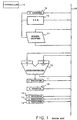
- a known logarithmic function arithmetic unit shown therein uses the STL algorithm as described above.
- the arithmetic unit comprises w, x, y, and z registers 11, 12, 13 and 14 for holding w, x k , y k and z k , respectively, an adder/subtracter 15 for effecting addition/subtraction of two inputs A and B, a read-only memory (ROM) 16 for generating r k , a barrel shifter 17 for shifting an input value by desired digits rightwardly, k counter 18 for providing k to read-only memory 16 and a digit number to be shifted at the barrel shifter 17, and a loop number control counter or n counter 19 for controlling the STL loop number.
- Those registers 11-14, adder/subtracter 15, read-only memory 16, barrel shifter 17, and counters 18 and 19 are connected through a data bus 20.
- the unit comprises a micro controller 10 for controlling those blocks 11-19.
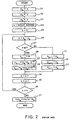
- the arithmetic unit executes the STL loop of Process III as follows.
- Equation (9) is obtained.
- Equation (4) since r k of Equation (4) is reduced by increase of k, significant digits are reduced so that rounding errors are accumulated at the least significant bit.
- Equations of (7), (8), (9), (11), (12) and (13) are computed with use of fixed-point numbers, conversion must be made between the fixed-point system and the floating-point system when x and log e (1 + x) are represented by use of the floating-point system. In conversion of x of a small number from the floating-point system to the fixed-point system, the significant digits are considerably reduced. Therefore, the known unit is low in the precision.
- the present invention attempts to use a modified STL method so as to separately perform the pseudo division and the pseudo multiplication by use of hardware such as a single barrel shifter, two adder/subtracters, a stack of a first-in last-out type and a divider without use of the microprogram control.
- Equation (1) ⁇ ⁇ 2 n . Therefore, in order to achieve 2n-digit precision in the binary system according to the modified STL method, the pseudo multiplication is executed by use of approximation log e (1 + ⁇ ) ⁇ ⁇ which is accepted according to the Taylor expansion. Accordingly, the total step number of the pseudo division and the pseudo multiplication is about n which is equal to the step number in the conventional STL method.
- y k is shifted to a lower digit at one step of the pseudo division in order to improve the precision.
- x k is shifted to a higher digit in the pseudo multiplication.
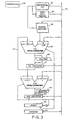
- the arithmetic unit shown therein comprises a first and a second register 41 and 42 for holding two variables Y k and 2X k , a read-only memory 43 for generating a constant ⁇ k given by Equation (24), a barrel shifter 44 for shifting a value of a variable supplied from the second register 42, an exponential circuit 45 for executing Process II and for controlling a digit number to be shifted at the barrel shifter 44 and an address of the read-only memory 43, a first adder/subtracter 46 for effecting addition/subtraction of two inputs A and B so as to execute Equations (17) and (18), a second adder/subtracter 47 for effecting addition/subtraction of two inputs C and D so as to execute Equation (15), a first shifter 48 for shifting an output value from the first adder/subtracter 46 to produce a half value, a second shifter 49 for shifting an output value from the second adder/subtractor 47 to produce a twice value, a stack of
- a sign indication digit of the value in the second register 42 is pushed out and supplied to the stack 50.
- Y k is supplied from the first register 41 to the first adder/subtractor 46 as input A through the data bus 53 and is also supplied to the barrel shifter 44 through the data bus 52.
- the barrel shifter 44 shifts Y k by the digit number indicated by the exponential circuit 45 to produce 2 -k ⁇ Y k which is supplied to the first adder/subtracter 46 as input B.
- Equation (17) is obtained.
- Equation (25) is obtained.
- Each of Operations 4 and 7 is executed by one clock. Therefore, the entire processing time is 2(m - i) clocks which is equal to or smaller than n clocks.
Landscapes
- Engineering & Computer Science (AREA)
- Physics & Mathematics (AREA)
- General Physics & Mathematics (AREA)
- Theoretical Computer Science (AREA)
- General Engineering & Computer Science (AREA)
- Computational Mathematics (AREA)
- Mathematical Analysis (AREA)
- Pure & Applied Mathematics (AREA)
- Computing Systems (AREA)
- Mathematical Optimization (AREA)
- Complex Calculations (AREA)
Claims (3)
- Unité arithmétique à fonction logarithmique pour calculer une fonction de loge (1 + x/y) en utilisant l'algorithme des processus de pseudo-division et de pseudo-multiplication, qui comprend :des moyens (45) réagissant aux nombres d'entrée x et y tels que 0 ≤ x < y < +∞, pour calculer des partie mantisses X et Y telles que 1 ≤ X < 2, 1 ≤ Y < 2 et des parties exponentielles i et j, i et j étant des nombres entiers, de x et y respectivement, de façon à satisfaire les équations x=2-i.X et y=2-j.Y, lesdits moyens de calcul produisant des constantes de k=0, 1, ..., i, i+1, i+2, ..., m-1 et m, m étant un nombre entier supérieur à i+1 ;des moyens (43) de production de coefficients, couplés auxdits moyens de calcul (45) pour produire un coefficient de Γk=2klog(1+2-k) pour k=m-1 à k=0 ;des premiers moyens de registre (41) pour maintenir une première valeur maintenue, lesdits premiers moyens de registre (41) étant couplés auxdits moyens de calcul (45), et pour maintenir initialement Yk=Yi=Y comme étant ladite première valeur maintenue ;des deuxièmes moyens de registre (42) pour maintenir une deuxième valeur maintenue, lesdits deuxièmes moyens de registre (42) étant couplés auxdits moyens de calcul (45), et pour maintenir initialement 2Xk=2Xi=2X comme étant ladite deuxième valeur maintenue ;des moyens (44) de bloc fonctionnel de décalage circulaire, couplés auxdits moyens de calcul (45) et auxdits premiers moyens de registre (41), pour décaler ladite première valeur maintenue de k chiffres, afin de produire une valeur décalée 2-k.Yk ;des premiers moyens d'addition/soustraction (46) ayant des premiers moyens d'entrée primaire (A) couplés auxdits premiers moyens de registre (41) et des premiers moyens d'entrée secondaire (B), lesdits premiers moyens d'entrée primaire (A) recevant ladite première valeur maintenue en tant que première valeur d'entrée primaire, lesdits premiers moyens d'entrée secondaire (B) recevant une première valeur d'entrée secondaire, lesdits premiers moyens d'addition/soustraction (46) additionnant lesdites premières valeurs d'entrée primaire et secondaire afin de produire une première somme ;des deuxièmes moyens d'addition/soustraction (47) ayant des deuxièmes moyens d'entrée primaire (C) et des deuxièmes moyens d'entrée secondaire (D) couplés auxdits deuxièmes moyens de registre, lesdits deuxièmes moyens d'entrée primaire (C) recevant une deuxième valeur d'entrée primaire, lesdits deuxièmes moyens d'entrée secondaire (D) recevant ladite deuxième valeur maintenue en tant que deuxième valeur d'entrée secondaire, lesdits deuxièmes moyens d'addition/soustraction (47) additionnant ou soustrayant ladite deuxième valeur d'entrée primaire à ou de ladite deuxième valeur d'entrée secondaire afin de produire une deuxième somme ;des moyens de commande (54) commandant lesdits premiers et deuxièmes moyens d'addition/soustraction (46, 47) et lesdits moyens (44) de bloc fonctionnel de décalage circulaire, pour produire les opérations suivantes pour k=i, i+1, i+2, ..., m-1, m ;lesdits deuxièmes moyens d'addition/soustraction (47) recevant ladite première valeur maintenue comme étant ladite deuxième valeur d'entrée primaire et soustrayant ladite deuxième valeur d'entrée primaire de ladite deuxième valeur d'entrée secondaire afin de produire W=2Xk-Yk comme étant ladite deuxième somme ;lesdits deuxièmes moyens de registre (42) maintenant W=2Xk-Yk comme étant ladite deuxième valeur maintenue ;des moyens de pile premier entré dernier sorti (50) couplés auxdits deuxièmes moyens de registre (42) pour empiler une valeur d'indication de signe, ladite valeur d'indication de signe étant égale à "1" quand ladite deuxième valeur maintenue est positive ou nulle, ladite valeur d'indication de signe étant égale à "0" quand ladite deuxième valeur maintenue est négative ;lesdits moyens de commande (54) commandant lesdits premiers moyens d'addition/soustraction (46) pour réaliser les opérations suivantes pour k = m, m-1, m-2, ..., i+1 ;lesdits premiers moyens d'addition/soustraction (46) recevant ladite valeur décalée 2-k.Yk comme étant ladite première valeur d'entrée secondaire quand ladite deuxième valeur maintenue est positive ou nulle, lesdits premiers moyens d'addition/soustraction (46) produisant Yk+1=Yk+ 2-k.Yk comme étant ladite première somme, ladite première somme étant transmise auxdits premiers moyens de registre (41), lesdits premiers moyens de registre (41) maintenant éventuellement Ym comme étant ladite première valeur maintenue ; etlesdits deuxièmes moyens d'addition/soustraction (47) étant fixés à "0" comme étant ladite deuxième valeur d'entrée primaire quand ladite deuxième valeur maintenue est négative, lesdits deuxièmes moyens d'addition/soustraction (47) produisant Xk+1=2Xk comme étant ladite deuxième somme ;des moyens de multiplication par deux (49) couplés auxdits deuxièmes moyens d'addition/soustraction (47) pour produire une valeur égale à deux fois celle de ladite deuxième somme, ladite valeur double étant transmise auxdits deuxièmes moyens de registre (42), de sorte que lesdits deuxièmes moyens de registre (42) maintiennent éventuellement 2Xm comme étant ladite deuxième valeur maintenue ;des moyens de division (51) couplés auxdits premiers et deuxièmes moyens de registre (41, 42) pour diviser, sous la commande desdits moyens de commande (54), une moitié de ladite deuxième valeur maintenue 2Xm par ladite première valeur maintenue Ym afin de produire un résultat divisé de Xm=Xm/Ym, ledit résultat divisé Xm étant transmis en tant que Xk auxdits moyens de registre (41) comme étant ladite première valeur maintenue ;lesdits premiers moyens d'addition/soustraction (46) recevant sous la commande desdits moyens de commande (54), ledit coefficient Γk comme étant ladite première valeur d'entrée secondaire quand ladite valeur d'indication de signe "1" est dépilée desdits moyens de pile premier rentré dernier sorti (50), lesdits premiers moyens d'addition/soustraction (46) produisant Xk+Γk comme étant ladite première somme, lesdits premiers moyens d'addition/soustraction (46) étant fixés à "0" comme étant ladite première valeur d'entrée secondaire quand ladite valeur d'indication de signe "0" est dépilée desdits moyens de pile premier entré dernier sorti (50), lesdits premiers moyens d'addition/soustraction (46) produisant Xk comme étant ladite première somme ; etdes moyens de décalage (48) couplés auxdits premiers moyens d'addition/soustraction (46) pour décaler ladite première somme, sous la commande desdits moyens de commande (54), afin de produire Xk+1=(Xk+Γk)/2 selon une autre possibilité Xk+1=Xk/2 en tant que valeur décalée, ladite valeur décalée étant transmise auxdits premiers moyens de registre (41) et étant maintenue comme étant ladite première valeur maintenue, ladite première valeur maintenue représentant finalement une mantisse Xi dudit loge (1+x/y).
- Unité arithmétique à fonction logarithmique selon la revendication 1, dans laquelle i est maintenu à la valeur 0, de sorte que l'arithmétique est exécutée grâce à l'utilisation d'un système en virgule fixe.
- Unité arithmétique à fonction logarithmique selon la revendication 1, dans laquelle lesdits moyens de production de coefficient (43) comprennent une mémoire morte.
Applications Claiming Priority (2)
| Application Number | Priority Date | Filing Date | Title |
|---|---|---|---|
| JP271013/88 | 1988-10-28 | ||
| JP63271013A JP2822399B2 (ja) | 1988-10-28 | 1988-10-28 | 対数関数演算装置 |
Publications (3)
| Publication Number | Publication Date |
|---|---|
| EP0366155A2 EP0366155A2 (fr) | 1990-05-02 |
| EP0366155A3 EP0366155A3 (fr) | 1991-11-13 |
| EP0366155B1 true EP0366155B1 (fr) | 1996-05-29 |
Family
ID=17494194
Family Applications (1)
| Application Number | Title | Priority Date | Filing Date |
|---|---|---|---|
| EP89120128A Expired - Lifetime EP0366155B1 (fr) | 1988-10-28 | 1989-10-30 | Unité arithmétique à fonction logarithmique comprenant des moyens pour le traitement séparé de pseudo-division et pseudo-multiplication |
Country Status (4)
| Country | Link |
|---|---|
| US (1) | US5041999A (fr) |
| EP (1) | EP0366155B1 (fr) |
| JP (1) | JP2822399B2 (fr) |
| DE (1) | DE68926563T2 (fr) |
Families Citing this family (11)
| Publication number | Priority date | Publication date | Assignee | Title |
|---|---|---|---|---|
| EP0554035B1 (fr) * | 1992-01-27 | 2001-10-17 | Mitsubishi Denki Kabushiki Kaisha | Caméra vidéo couleur à l'état solide |
| US6788342B1 (en) | 1992-01-27 | 2004-09-07 | Mitsubishi Denki Kabushiki Kaisha | Color video camera for generating a luminance signal with unattenuated harmonics |
| US6055553A (en) * | 1997-02-25 | 2000-04-25 | Kantabutra; Vitit | Apparatus for computing exponential and trigonometric functions |
| US6567832B1 (en) * | 1999-03-15 | 2003-05-20 | Matsushita Electric Industrial Co., Ltd. | Device, method, and storage medium for exponentiation and elliptic curve exponentiation |
| US6976043B2 (en) * | 2001-07-30 | 2005-12-13 | Ati Technologies Inc. | Technique for approximating functions based on lagrange polynomials |
| US7509363B2 (en) * | 2001-07-30 | 2009-03-24 | Ati Technologies Ulc | Method and system for approximating sine and cosine functions |
| US7606850B2 (en) * | 2005-03-30 | 2009-10-20 | Lockheed Martin Corporation | Method and apparatus for providing a base-2 logarithm approximation to a binary number |
| JP4895544B2 (ja) * | 2005-07-15 | 2012-03-14 | 株式会社Shoei | フルフェイス型ヘルメット |
| US8510360B2 (en) * | 2010-06-04 | 2013-08-13 | International Business Machines Corporation | Calculating large precision common logarithms |
| US10838718B2 (en) * | 2017-09-28 | 2020-11-17 | Fujitsu Limited | Processing device, arithmetic unit, and control method of processing device |
| WO2020090025A1 (fr) * | 2018-10-31 | 2020-05-07 | 富士通株式会社 | Unité de traitement arithmétique et procédé de commande d'unité de traitement arithmétique |
Family Cites Families (2)
| Publication number | Priority date | Publication date | Assignee | Title |
|---|---|---|---|---|
| US4089060A (en) * | 1976-10-15 | 1978-05-09 | Mitchell Donald K | Digital logarithmic apparatus |
| JPS6051733B2 (ja) * | 1977-11-19 | 1985-11-15 | 日本電気株式会社 | 指数関数演算装置 |
-
1988
- 1988-10-28 JP JP63271013A patent/JP2822399B2/ja not_active Expired - Fee Related
-
1989
- 1989-10-30 DE DE68926563T patent/DE68926563T2/de not_active Expired - Fee Related
- 1989-10-30 EP EP89120128A patent/EP0366155B1/fr not_active Expired - Lifetime
- 1989-10-30 US US07/428,301 patent/US5041999A/en not_active Expired - Lifetime
Also Published As
| Publication number | Publication date |
|---|---|
| JPH02118725A (ja) | 1990-05-07 |
| DE68926563T2 (de) | 1997-01-23 |
| EP0366155A3 (fr) | 1991-11-13 |
| JP2822399B2 (ja) | 1998-11-11 |
| DE68926563D1 (de) | 1996-07-04 |
| EP0366155A2 (fr) | 1990-05-02 |
| US5041999A (en) | 1991-08-20 |
Similar Documents
| Publication | Publication Date | Title |
|---|---|---|
| EP0421092B1 (fr) | Procédé et appareil pour l'exécution de fonctions arithmétiques en utilisant l'approximation polynomiale et un multiplieur à format rectangulaire | |
| US5046038A (en) | Method and apparatus for performing division using a rectangular aspect ratio multiplier | |
| US5065352A (en) | Divide apparatus employing multiplier with overlapped partial quotients | |
| US4707798A (en) | Method and apparatus for division using interpolation approximation | |
| EP0158530A2 (fr) | Diviseur non-restituant | |
| EP0381161A2 (fr) | Procédé et système de multiplication modulaire | |
| EP0356153B1 (fr) | Procédé et appareil de division en base 2**n à sélection chevauchée de bits de quotient, et arrondissement et correction simultanés de quotient | |
| US5659495A (en) | Numeric processor including a multiply-add circuit for computing a succession of product sums using redundant values without conversion to nonredundant format | |
| EP0472139A2 (fr) | Processeur à virgule flottante | |
| US5132925A (en) | Radix-16 divider using overlapped quotient bit selection and concurrent quotient rounding and correction | |
| US5258944A (en) | High performance mantissa divider | |
| JPH0235348B2 (fr) | ||
| EP0366155B1 (fr) | Unité arithmétique à fonction logarithmique comprenant des moyens pour le traitement séparé de pseudo-division et pseudo-multiplication | |
| EP0297588B1 (fr) | Processeur arithmétique utilisant une pseudo-division pour des fonctions trigonométriques | |
| US5144576A (en) | Signed digit multiplier | |
| US5007009A (en) | Non-recovery parallel divider circuit | |
| US4594680A (en) | Apparatus for performing quadratic convergence division in a large data processing system | |
| US5181184A (en) | Apparatus for multiplying real-time 2's complement code in a digital signal processing system and a method for the same | |
| EP0398568A2 (fr) | Circuit multiplicateur | |
| US4949295A (en) | Transformation of divisor and dividend in digital division | |
| US5278782A (en) | Square root operation device | |
| JP2508784B2 (ja) | 指数関数演算装置 | |
| US5825681A (en) | Divider/multiplier circuit having high precision mode | |
| US6598065B1 (en) | Method for achieving correctly rounded quotients in algorithms based on fused multiply-accumulate without requiring the intermediate calculation of a correctly rounded reciprocal | |
| US4716538A (en) | Multiply/divide circuit for encoder PCM samples |
Legal Events
| Date | Code | Title | Description |
|---|---|---|---|
| PUAI | Public reference made under article 153(3) epc to a published international application that has entered the european phase |
Free format text: ORIGINAL CODE: 0009012 |
|
| 17P | Request for examination filed |
Effective date: 19891117 |
|
| AK | Designated contracting states |
Kind code of ref document: A2 Designated state(s): DE FR GB |
|
| PUAL | Search report despatched |
Free format text: ORIGINAL CODE: 0009013 |
|
| AK | Designated contracting states |
Kind code of ref document: A3 Designated state(s): DE FR GB |
|
| 17Q | First examination report despatched |
Effective date: 19940830 |
|
| GRAH | Despatch of communication of intention to grant a patent |
Free format text: ORIGINAL CODE: EPIDOS IGRA |
|
| GRAH | Despatch of communication of intention to grant a patent |
Free format text: ORIGINAL CODE: EPIDOS IGRA |
|
| GRAA | (expected) grant |
Free format text: ORIGINAL CODE: 0009210 |
|
| AK | Designated contracting states |
Kind code of ref document: B1 Designated state(s): DE FR GB |
|
| REF | Corresponds to: |
Ref document number: 68926563 Country of ref document: DE Date of ref document: 19960704 |
|
| ET | Fr: translation filed | ||
| PLBE | No opposition filed within time limit |
Free format text: ORIGINAL CODE: 0009261 |
|
| STAA | Information on the status of an ep patent application or granted ep patent |
Free format text: STATUS: NO OPPOSITION FILED WITHIN TIME LIMIT |
|
| 26N | No opposition filed | ||
| REG | Reference to a national code |
Ref country code: GB Ref legal event code: IF02 |
|
| REG | Reference to a national code |
Ref country code: GB Ref legal event code: 732E |
|
| REG | Reference to a national code |
Ref country code: FR Ref legal event code: TP |
|
| PGFP | Annual fee paid to national office [announced via postgrant information from national office to epo] |
Ref country code: FR Payment date: 20041008 Year of fee payment: 16 |
|
| PGFP | Annual fee paid to national office [announced via postgrant information from national office to epo] |
Ref country code: GB Payment date: 20041027 Year of fee payment: 16 |
|
| PGFP | Annual fee paid to national office [announced via postgrant information from national office to epo] |
Ref country code: DE Payment date: 20041028 Year of fee payment: 16 |
|
| PG25 | Lapsed in a contracting state [announced via postgrant information from national office to epo] |
Ref country code: GB Free format text: LAPSE BECAUSE OF NON-PAYMENT OF DUE FEES Effective date: 20051030 |
|
| PG25 | Lapsed in a contracting state [announced via postgrant information from national office to epo] |
Ref country code: DE Free format text: LAPSE BECAUSE OF NON-PAYMENT OF DUE FEES Effective date: 20060503 |
|
| GBPC | Gb: european patent ceased through non-payment of renewal fee |
Effective date: 20051030 |
|
| PG25 | Lapsed in a contracting state [announced via postgrant information from national office to epo] |
Ref country code: FR Free format text: LAPSE BECAUSE OF NON-PAYMENT OF DUE FEES Effective date: 20060630 |
|
| REG | Reference to a national code |
Ref country code: FR Ref legal event code: ST Effective date: 20060630 |