EP0366014A2 - Dreidimensionales Bilderzeugungsgerät - Google Patents
Dreidimensionales Bilderzeugungsgerät Download PDFInfo
- Publication number
- EP0366014A2 EP0366014A2 EP89119496A EP89119496A EP0366014A2 EP 0366014 A2 EP0366014 A2 EP 0366014A2 EP 89119496 A EP89119496 A EP 89119496A EP 89119496 A EP89119496 A EP 89119496A EP 0366014 A2 EP0366014 A2 EP 0366014A2
- Authority
- EP
- European Patent Office
- Prior art keywords
- space
- dimensional
- image
- dimensional image
- random signal
- Prior art date
- Legal status (The legal status is an assumption and is not a legal conclusion. Google has not performed a legal analysis and makes no representation as to the accuracy of the status listed.)
- Withdrawn
Links
Images



Classifications
-
- G—PHYSICS
- G06—COMPUTING OR CALCULATING; COUNTING
- G06T—IMAGE DATA PROCESSING OR GENERATION, IN GENERAL
- G06T15/00—Three-dimensional [3D] image rendering
-
- G—PHYSICS
- G06—COMPUTING OR CALCULATING; COUNTING
- G06T—IMAGE DATA PROCESSING OR GENERATION, IN GENERAL
- G06T13/00—Animation
- G06T13/20—Three-dimensional [3D] animation
- G06T13/60—Three-dimensional [3D] animation of natural phenomena, e.g. rain, snow, water or plants
Definitions
- This invention relates to a three-dimensional image generator for generating images of natural objects such as waves on the surface of the sea or a forest blown by the wind, more particularly to a three-dimensional image generator capable of generating dynamic images in real time.
- One prior-art technique employs pairs of fractal or extended fractal waves representative of stochastic processes propagating in different directions. The waves in each pair are multiplied together and the products added to generate realistic images of three-dimensional natural scenes.
- fractal images are computationally intensive, time-consuming process, however. A minute and a half is required to produce a single, static image by the method above. Fractal techniques are therefore unsuitable for creating dynamic images (moving pictures), and are incapable of generating dynamic images in real time.
- Another object is to generate static three-dimensional images of natural objects at high speed.
- a further object is to combine images of different natural objects in real time.
- a three-dimensional image generator comprises a random signal generator for generating a random signal, a space filter for receiving the random signal and performing a two- dimensional filtering operation to generate a three-dimensional image, space rotation means for rotating the three-dimensional image according to a viewing position, and image output means for displaying the image.
- the space filter For a dynamic three-dimensional image, the space filter performs repeated filtering operations, using overlapping intervals of the random signal, to generate successive three-dimensional images.
- the three-dimensional image generator may comprise a plurality of space filters, the outputs of which are combined by a filter output combiner.
- a three-dimensional image generator may comprise a plurality of partial image generators, each having a random signal generator and one or more space filters as described above. Such a three-dimensional image generator also has space synthesis means for receiving the three-dimensional images generated by the partial image generators and combining them to create a synthesized three-dimensional image, space rotation means for rotating the synthesized three-dimensional image according to a viewing position, and image output means for displaying the image.
- a first three-dimensional image generator will be described with reference to Figs. 1 to 6.
- a second three-dimensional image generator will be described with reference to Fig. 7.
- Fig. 1 is a block diagram of the first three-dimensional image generator, which comprises four partial image generators 11, 12, 13, and 14, a space synthesis means 17, a space rotation means 18, and an output means 19.
- the partial image generators 11 to 14 generate images of waves traveling in different directions.
- the space synthesis means 17 combines these into a single three-dimensional image representing the surface of the sea.
- the space rotation means 18 rotates the three-dimensional image according to a desired viewing position.
- the output means 19 receives this space-rotated image and displays it for view.
- the partial image generators 11 to 14 comprise clock pulse generators 21 to 24, random signal generators 31 to 34, space filters 41 to 44, reorientation means 51 to 54, and amplitude adjustment means 61 to 64, respectively. within each partial image generator, these are connected in series in the above order.
- the outputs of the amplitude adjustment means 61 to 64 are furnished to the space synthesis means 17.
- Each of the clock pulse generators 21 to 24 generates a clock pulse signal.
- the clock pulse signals are furnished to respective random signal generators 31 to 34.
- the random signal generators 31 to 34 convert the input clock pulses to pulse signals in which the occurrence of logic "1" and logic "0" is randomized.
- the random signal generators 31 to 34 can be structured so that at each clock cycle there is a 50% probability of generating a "1" pulse and a 50% probability of generating a "0" pulse.
- Well-known M-series techniques can be used to generate such random pulses. For example, the M series of seven, having a repetition cycle of 127, can be applied.
- the random pulse signals are furnished to the space filters 41 to 44.
- the space filters 41 to 44 treat the random pulse signals as if they represented power spectra of mathematical functions of two variables (x and y). A filtering operation is performed that transforms each power spectrum to a function representing height over the x-y plane, thus representing a three-dimensional image. Four such three-dimensional images are obtained, one from each of the space filters 41 to 44.
- the surface defined by the function in each three dimensional image has irregular height variations that mimic, for example, waves on the surface of the sea. Since the three-dimensional images given by the four functions are combined to create the final image, they will be referred to as partial images.
- a space filter To generate its first image, a space filter requires a number of clock pulses equal to, for example, the number of dots in the image. After generating an initial image, however, a space filter can generate successive images at the rate of one image per clock cycle, as will be described later. Successive partial images from the same space filter differ only slightly, the difference being such that the waves appear to travel in, for example, the negative x-direction, changing in shape as they travel.
- the partial three-dimensional images obtained from the space filters 41 to 44 are furnished to the reorientation means 51 to 54.
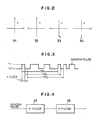
- the reorientation means 51 to 54 rotate the coordinates of the input partial images in steps of 90 o as shown in Fig. 2.
- the waves travel east, for example, while in the partial image output from the reorientation means 51 they travel north, in the partial image output from the reorientation means 53 they travel west, and in the partial image output from the reorientation means 54 they travel south.
- the reoriented partial images output from the reorientation means 51 to 54 are furnished to respective amplitude adjustment means 61 to 64.
- the amplitude adjustment means 61 to 64 perform a mathematical amplification operation, adjusting the amplitudes of the images according to specified gain parameters. That is, they adjust the height of the waves in the images.
- the four reoriented, adjusted partial images output from the partial image generators 11 to 14 are furnished to the space synthesis means 7, which combines them by adding the values of the functions at each point (x, y). If the amplitude adjustment means 61 to 64 have equal gains, the four directions of travel in the partial images cancel each other, and the combined three-dimensional image shows the surface of the sea rising and falling in a stationary manner. If the gains of the amplitude adjustment means 61 to 64 are unequal, however, the combined image shows waves traveling principally in the direction of the partial image having the largest gain. By suitable adjustment of the four gains, the waves can be made to travel in any desired direction.
- the synthesized three-dimensional image output from the space synthesis means 7 is furnished to the space rotation means 8.
- the space rotation means 8 performs a well-known transformation to present the synthesized, three-dimensional image as it would be seen from a certain viewing position. For example, it can rotate the image to represent the surface of the sea as seen by a person standing on the shore, or by a person flying in an airplane.
- the space filters 41 to 44, reorientation means 51 to 54, amplitude adjustment means 61 to 64, image synthesis means 17, and space rotation means 18 can be built using standard arithmetic and logic circuits; their structures will be apparent to one skilled in the art. Alternatively, they can be implemented as programs running on a general-purpose computer.
- the image output means 9 is, for example, a CRT display or printer that outputs the final three-dimensional image.
- Fig. 3 shows an example of a random signal generated by, for example, the random signal generator 31.
- the signal has a random value of "1" or "0.”
- the space filter 41 uses a certain interval of this random signal, such as the interval TPA in the drawing.
- the random values in respective clock cycles in this interval are assigned to points with integer coordinates in an n-m plane. For example, the first random value is assigned to the point (1, 1), the second random value is assigned to the point (1, 2), and so on, the values from the interval TPA filling a rectangular area in the n-m plane.
- the x-y plane over which the image will be generated will be referred to as the space domain.
- the n-m plane represents the corresponding frequency domain: n represents frequency in the x-direction; m represents frequency in the y-direction.
- the random values assigned to the n-m plane represent the power spectrum of a highly disordered function in the space domain: for example, a function depicting a sea with an unnaturally chaotic surface.
- the space filter 41 can be mathematically described as comprising an x-direction filter 45 and a y-direction filter 46.
- the x-direction filter 45 performs a filtering operation on rows of values with identical m-coordinates in the n-m plane.
- the y-direction filter 46 then performs a filtering operation on columns of values with identical n-coordinates. These filtering operations reduce the disorder by attenuating certain frequency components in the power spectrum.
- an inverse fourier transformation (not explicitly shown in the drawing) is performed to transform the filtered result to the space domain, obtaining a function on the x-y plane as the output of the space filter.
- the operations of filtering in the x- and y-directions and the final inverse Fourier transformation can be combined into a single two-dimensional filtering operation.
- the quantities ⁇ x and ⁇ y are scale factors representing the width of divisions between grid lines on which points are displayed in the x-y plane.
- the quantity l0 is a correlation length parameter, which corresponds to the length until a qualitatively identical waveform next appears.
- ⁇ 2 is a variance parameter, which indicates the degree of density variations in the waves.
- the other space filters 42 to 44 operate in the same way. Special-purpose hardware is available for performing these filtering operations, and can be used to carry out the filtering process at high speed.
- the overall filtering operation is summarized in Fig. 5.
- the random values are assigned to the n-m plane, then convolved with P(n ⁇ x, m ⁇ y) to obtain a function on the x-y plane, representing a partial three-dimensional image.
- the space filter 41 shifts the interval of the random signal by one clock cycle and repeats the same operation. That is, it takes the random values in the overlapping interval TPB in Fig. 3, assigns these values to the n-m plane, and convolves them with P(n ⁇ x, m ⁇ y) to obtain a new function on the x-y plane.
- the interval TPC in Fig. 3 is used for the next partial image after that. One complete image is thus obtained for each clock cycle.
- each successive partial three-dimensional image can be obtained from the preceding one by relatively simple operations. Even using standard computing equipment, new partial images can be obtained at a rate of, for example, sixty images per second, which is more than adequate for real-time, dynamic image display.
- the nature of the image obtained depends on the filter parameters of the space filters 41 to 44 and the gain parameters of the amplitude adjustment means 61 to 64. These parameters can be assigned arbitrarily, or can be selected on the basis of an analysis of the type of natural scene to be represented.
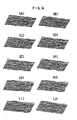
- Fig. 6 shows a series of images generated by this three-dimensional image generator.
- the first image is at (A) and the last at (J).
- the filter parameters are adjusted to simulate ocean waves.
- the gain parameters are adjusted so that the waves appear to travel mainly in the positive y-direction (up in the drawing). As the waves travel, they can be seen undergo subtle changes in shape.
- a second three-dimensional image generator will be described with reference to Fig. 7.
- the second three-dimensional image generator is identical to the first one shown in Fig. 1 except that each partial image generator has a plurality of space filters instead of just one.
- Fig. 7 illustrates one partial image generator 10 in the second three-dimensional image generator, comprising a clock pulse generator 20, a random signal generator 30, a plurality of space filters 401, 402, ..., reorientation means 50, and amplitude adjustment means 60.
- These elements are identical to the corresponding elements in Fig. 1, each of the space filters 401, 402, ... having the structure described in Figs. 4 and 5.
- the random signal generated by the random signal generator 30 is supplied separately to the space filters 401, 402, ....
- the three-dimensional images output by the space filters 401, 402, ... are supplied to a filter output combiner 70, which combines these images additively to generate a single combined, partial three-dimensional image.
- This combined partial image is then reoriented by the reorientation means 50 and adjusted in amplitude by the amplitude adjustment means 60 to produce a reoriented, adjusted partial image.
- the second three-dimensional image generator comprises four partial image generators of the structure shown in Fig. 7. Their partial image outputs are combined by a space synthesis means and rotated in space in the same way as in Fig. 1 to generate the final image.
- the filter parameters of the space filters 401, 402, ... can be set independently to generate waves differing in their amplitude, frequency, and phase relationships, but all traveling in the same direction. Superimposition of these waves yields dynamic images that appear even more natural than the images produced by the first three-dimensional image generator.
- the number of partial image generators need not be four as in Fig. 1; it can be any number equal to or greater than one. If there is only one partial image generator, the reorientation means and space synthesis means are unnecessary, and the amplitude adjustment means can also be omitted.
- partial image generators instead of using the partial image generators to generate images with waves moving in different directions, it is also possible to use them to generate different components of a total image.
- one partial image generator (or set of partial image generators) could generate an image of the sea, another could generate an image of clouds, and another could generate an image of mountains.
- the clock pulses for different partial image generators need not run at the same rate, but can be adjusted according to the type of object. For example, the clock pulses for the sea image could run faster than the clock pulses for the cloud image.
- the clock pulses for the mountain image could be stopped, once the initial images has been generated, so that the mountains do not move. Stopping the clock of a partial image generator provides a particularly convenient way to combine dynamic and static images.
- the space filters need not be Butterworth filters; other types of filters such as Gaussian filters, ARMA (auto-regression moving average) filters, or AR (auto-regression) filters can be used instead.
- the type of filter can be selected according to the intended natural object.
- the space filtering operation does not have to be performed directly on the random signals; it can be preceded by a fast fourier transform.
- the random signals represent a chaotic surface in the space domain.
- the fourier transform converts this surface to a power spectrum in the frequency domain.
- the filtering operation alters the power spectrum and converts it back to the space domain.
- the reorientation means in one of the partial image generators can be omitted, leaving its partial image unrotated.
- the other partial images can then be rotated with respect to the unrotated partial image.
- a random analog signal can be generated.
- the space filtering and other operations can also be carried out by analog means.
- Three-dimensional static images can be obtained by performing the space filtering just once, instead of repeatedly.
Landscapes
- Engineering & Computer Science (AREA)
- Physics & Mathematics (AREA)
- General Physics & Mathematics (AREA)
- Theoretical Computer Science (AREA)
- Computer Graphics (AREA)
- Processing Or Creating Images (AREA)
- Image Generation (AREA)
- Image Processing (AREA)
Applications Claiming Priority (2)
| Application Number | Priority Date | Filing Date | Title |
|---|---|---|---|
| JP63267233A JP2575197B2 (ja) | 1988-10-25 | 1988-10-25 | 3次元画像形成装置 |
| JP267233/88 | 1988-10-25 |
Publications (2)
| Publication Number | Publication Date |
|---|---|
| EP0366014A2 true EP0366014A2 (de) | 1990-05-02 |
| EP0366014A3 EP0366014A3 (de) | 1991-12-18 |
Family
ID=17441987
Family Applications (1)
| Application Number | Title | Priority Date | Filing Date |
|---|---|---|---|
| EP19890119496 Withdrawn EP0366014A3 (de) | 1988-10-25 | 1989-10-20 | Dreidimensionales Bilderzeugungsgerät |
Country Status (4)
| Country | Link |
|---|---|
| US (1) | US5239623A (de) |
| EP (1) | EP0366014A3 (de) |
| JP (1) | JP2575197B2 (de) |
| CA (1) | CA2001238A1 (de) |
Cited By (1)
| Publication number | Priority date | Publication date | Assignee | Title |
|---|---|---|---|---|
| EP0579451A1 (de) * | 1992-07-14 | 1994-01-19 | Sumitomo Electric Industries, Ltd. | Verfahren und Gerät zum Erzeugen beweglicher Bilder mit einer Serie vom Fahrzeughahrersitz zu beobachtenden Strassenbildern |
Families Citing this family (24)
| Publication number | Priority date | Publication date | Assignee | Title |
|---|---|---|---|---|
| IL106410A (en) * | 1992-08-06 | 1996-09-12 | Hughes Training Inc | A computerized interactive device for recording a witness interrogation |
| JPH06216882A (ja) * | 1993-01-19 | 1994-08-05 | Matsushita Electric Ind Co Ltd | 誤り訂正送信装置及び受信装置 |
| US5877777A (en) * | 1997-04-07 | 1999-03-02 | Colwell; Tyler G. | Fluid dynamics animation system and method |
| US6266063B1 (en) | 1997-10-20 | 2001-07-24 | Baron Services, Inc. | Real-time three-dimensional weather display method and weathercast system |
| US6683609B1 (en) | 1997-10-20 | 2004-01-27 | Baron Services, Inc. | Real-time three-dimensional weather data processing method and system |
| US6163756A (en) * | 1998-10-20 | 2000-12-19 | Baron Services, Inc. | System and method for detecting and displaying wind shear |
| US6670908B2 (en) | 2001-07-31 | 2003-12-30 | Baron Services, Inc. | Automated system and method for processing meteorological data |
| US6985148B2 (en) * | 2001-12-13 | 2006-01-10 | Microsoft Corporation | Interactive water effects using texture coordinate shifting |
| US7602141B2 (en) * | 2004-10-15 | 2009-10-13 | Lifesize Communications, Inc. | Battery operated speakerphone and charging stand |
| US20060232550A1 (en) * | 2005-04-15 | 2006-10-19 | Buckner Nathan C | Integrated mouse in remote control |
| JP4761825B2 (ja) * | 2005-05-02 | 2011-08-31 | 富士通株式会社 | 海面画像生成装置 |
| US20060248210A1 (en) * | 2005-05-02 | 2006-11-02 | Lifesize Communications, Inc. | Controlling video display mode in a video conferencing system |
| US8120638B2 (en) * | 2006-01-24 | 2012-02-21 | Lifesize Communications, Inc. | Speech to text conversion in a videoconference |
| US8125508B2 (en) * | 2006-01-24 | 2012-02-28 | Lifesize Communications, Inc. | Sharing participant information in a videoconference |
| US20070171275A1 (en) * | 2006-01-24 | 2007-07-26 | Kenoyer Michael L | Three Dimensional Videoconferencing |
| US20070274607A1 (en) * | 2006-04-12 | 2007-11-29 | Jincheng Huang | Method of Creating a Reflection Effect in an Image |
| US8633962B2 (en) * | 2007-06-22 | 2014-01-21 | Lifesize Communications, Inc. | Video decoder which processes multiple video streams |
| US8139100B2 (en) | 2007-07-13 | 2012-03-20 | Lifesize Communications, Inc. | Virtual multiway scaler compensation |
| US20100110160A1 (en) * | 2008-10-30 | 2010-05-06 | Brandt Matthew K | Videoconferencing Community with Live Images |
| US8456510B2 (en) * | 2009-03-04 | 2013-06-04 | Lifesize Communications, Inc. | Virtual distributed multipoint control unit |
| US8643695B2 (en) * | 2009-03-04 | 2014-02-04 | Lifesize Communications, Inc. | Videoconferencing endpoint extension |
| US8350891B2 (en) * | 2009-11-16 | 2013-01-08 | Lifesize Communications, Inc. | Determining a videoconference layout based on numbers of participants |
| US20150116321A1 (en) * | 2013-10-29 | 2015-04-30 | Travis Christopher Fortner | Camouflage and Similar Patterns Method and Technique of Creating Such Patterns |
| KR101705949B1 (ko) * | 2014-12-15 | 2017-02-10 | 김웅 | 싱크대와 가스버너가 구비된 접이식 테이블 |
Family Cites Families (2)
| Publication number | Priority date | Publication date | Assignee | Title |
|---|---|---|---|---|
| US4694407A (en) * | 1985-06-11 | 1987-09-15 | Rca Corporation | Fractal generation, as for video graphic displays |
| GB8620433D0 (en) * | 1986-08-22 | 1987-01-14 | Gec Avionics | Displays |
-
1988
- 1988-10-25 JP JP63267233A patent/JP2575197B2/ja not_active Expired - Lifetime
-
1989
- 1989-10-20 EP EP19890119496 patent/EP0366014A3/de not_active Withdrawn
- 1989-10-20 US US07/424,703 patent/US5239623A/en not_active Expired - Lifetime
- 1989-10-23 CA CA002001238A patent/CA2001238A1/en not_active Abandoned
Cited By (2)
| Publication number | Priority date | Publication date | Assignee | Title |
|---|---|---|---|---|
| EP0579451A1 (de) * | 1992-07-14 | 1994-01-19 | Sumitomo Electric Industries, Ltd. | Verfahren und Gerät zum Erzeugen beweglicher Bilder mit einer Serie vom Fahrzeughahrersitz zu beobachtenden Strassenbildern |
| US5613055A (en) * | 1992-07-14 | 1997-03-18 | Sumitomo Electric Industries, Ltd. | Method of and apparatus for producing an animation having a series of road drawings to be watched from a driver's seat of a vehicle |
Also Published As
| Publication number | Publication date |
|---|---|
| EP0366014A3 (de) | 1991-12-18 |
| CA2001238A1 (en) | 1990-04-25 |
| US5239623A (en) | 1993-08-24 |
| JPH02114391A (ja) | 1990-04-26 |
| JP2575197B2 (ja) | 1997-01-22 |
Similar Documents
| Publication | Publication Date | Title |
|---|---|---|
| US5239623A (en) | Three-dimensional image generator | |
| KR900000956B1 (ko) | 비데오 그래픽 디스플레이용 프랙탈 발생 방지 및 장치 | |
| US6229549B1 (en) | High-speed three-dimensional texture mapping systems and methods | |
| US4343037A (en) | Visual display systems of the computer generated image type | |
| US5325480A (en) | Texture method for producing fluid effects in a real-time simulation | |
| JPS6295666A (ja) | 画像発生装置 | |
| US4263726A (en) | Visual display apparatus | |
| GB2051525A (en) | C.G.I.-Surface textures | |
| CN115061348A (zh) | 基于物点的三维动态全息显示方法及装置 | |
| Rau et al. | Special relativity in virtual reality | |
| JP3653361B2 (ja) | 計算機ホログラム作成方法並びに作成装置 | |
| Koh et al. | Fast generation and surface structuring methods for terrain and other natural phenomena | |
| EP0473152B1 (de) | Topographisches Datenaufbausystem | |
| Ragragui et al. | Revolution mapping with bump mapping support | |
| CN116485972A (zh) | 模型的渲染方法、装置和电子设备 | |
| Grimsdale et al. | Zone management processor: a module for generating surfaces in raster-scan colour displays | |
| JPH1097611A (ja) | 映像生成方法及び装置 | |
| EP0463766A2 (de) | Fraktale Bilderzeugung | |
| JP2567108B2 (ja) | 画像処理における画像合成方式 | |
| US5131056A (en) | Electronic airbrushing | |
| JP2507471B2 (ja) | 表面モデル構成装置 | |
| JP3684171B2 (ja) | 柄替えシミュレーションシステム | |
| JPH0368080A (ja) | 動画像生成装置 | |
| SU714389A1 (ru) | Устройство дл отображени информации | |
| Christianson | History of visual systems in the Systems Engineering Simulator |
Legal Events
| Date | Code | Title | Description |
|---|---|---|---|
| PUAI | Public reference made under article 153(3) epc to a published international application that has entered the european phase |
Free format text: ORIGINAL CODE: 0009012 |
|
| AK | Designated contracting states |
Kind code of ref document: A2 Designated state(s): DE FR GB |
|
| PUAL | Search report despatched |
Free format text: ORIGINAL CODE: 0009013 |
|
| AK | Designated contracting states |
Kind code of ref document: A3 Designated state(s): DE FR GB |
|
| 17P | Request for examination filed |
Effective date: 19920205 |
|
| 17Q | First examination report despatched |
Effective date: 19940607 |
|
| STAA | Information on the status of an ep patent application or granted ep patent |
Free format text: STATUS: THE APPLICATION IS DEEMED TO BE WITHDRAWN |
|
| 18D | Application deemed to be withdrawn |
Effective date: 19941018 |