EP0356878B1 - Verfahren zur Aufarbeitung von Hydrolyserückständen aus der Organochlorsilansynthese - Google Patents
Verfahren zur Aufarbeitung von Hydrolyserückständen aus der Organochlorsilansynthese Download PDFInfo
- Publication number
- EP0356878B1 EP0356878B1 EP89115443A EP89115443A EP0356878B1 EP 0356878 B1 EP0356878 B1 EP 0356878B1 EP 89115443 A EP89115443 A EP 89115443A EP 89115443 A EP89115443 A EP 89115443A EP 0356878 B1 EP0356878 B1 EP 0356878B1
- Authority
- EP
- European Patent Office
- Prior art keywords
- hydrolysis
- solid
- oxidation
- reprocessing
- methyl
- Prior art date
- Legal status (The legal status is an assumption and is not a legal conclusion. Google has not performed a legal analysis and makes no representation as to the accuracy of the status listed.)
- Expired - Lifetime
Links
Images
Classifications
-
- C—CHEMISTRY; METALLURGY
- C07—ORGANIC CHEMISTRY
- C07F—ACYCLIC, CARBOCYCLIC OR HETEROCYCLIC COMPOUNDS CONTAINING ELEMENTS OTHER THAN CARBON, HYDROGEN, HALOGEN, OXYGEN, NITROGEN, SULFUR, SELENIUM OR TELLURIUM
- C07F7/00—Compounds containing elements of Groups 4 or 14 of the Periodic Table
- C07F7/02—Silicon compounds
- C07F7/08—Compounds having one or more C—Si linkages
- C07F7/12—Organo silicon halides
- C07F7/16—Preparation thereof from silicon and halogenated hydrocarbons direct synthesis
Definitions
- the present invention relates to a process for working up hydrolysis residues which are obtained in the hydrolysis of solids-containing polysilane sludges from organochlorosilane synthesis by the direct process.
- the invention relates to the processing of hydrolysis residues from the methylchlorosilane synthesis.
- Organochlorosilanes and in particular the methylchlorosilanes serve as starting materials for the production of silicones which are used in a wide range, for. B. as rubbers, joint sealants, oils, building protection agents, etc.
- Particularly desirable in the production of methylchlorosilanes is dimethyldichlorosilane, which is obtained in high yield when the direct reaction of silicon with methyl chloride is catalyzed by copper or copper compounds.
- the process is fundamentally described in US Pat. No. 2,380,995.
- the production of methylchlorosilanes by this process is operated worldwide on an industrial scale, with the reaction usually being carried out in continuously operated fluidized bed reactors.
- the contents of the kettle can be expanded into a stirred vessel, which is preferably under normal pressure, and the parts which can still be distilled can be expelled from the mixture by heating.
- the contents of this kettle are then usually subjected to hydrolysis.
- the hydrolysis itself can, as described in DE-PS 2 362 494, be carried out in a downpipe.
- the disadvantage is that due to the short contact times, the hydrolysis is often incomplete and large amounts of water are used.
- EP 0 089 783 shows that the problem of gluing can also be overcome by maintaining a minimum chlorine content, but this is a technically difficult task to solve.
- hydrochloric acid suspension is formed in which the more or less solid hydrolyzate is considered worthless and must be deposited.
- the hydrolyzates are not without problems, because they usually contain 2 - 10% predominantly metallic copper, which can be partially eluted from the deposited hydrolyzate and can therefore pose a danger to the groundwater.
- most of the hydrolysates obtained are sensitive to oxidation, and in some cases they even tend to self-ignite, which prevents proper landfilling.
- EP 0 210 418 now describes a process in which the hydrolysis in water or a highly dilute hydrochloric acid is carried out in a stirrer tank with a high-speed disc stirrer, this tank not being equipped with baffles, so that a trombone can form, into which the material to be hydrolyzed is introduced.
- the preferred temperature is between 60 and 90 ° C. This gives a suspension with finely divided solid hydrolyzates in which more than 90% of the solid particles have a diameter of ⁇ 5 mm.
- suspensions obtained in this way are then oxidized with gases containing oxygen, which according to the invention cited above is preferably carried out with technically pure oxygen under a pressure which is higher than atmospheric pressure.
- the solid and the copper-containing liquid are separated from one another.
- the present invention now relates to a process for working up high-boiling and solids-containing residues obtained in organochlorosilane synthesis, which are hydrolyzed and subsequently oxidized, characterized in that an inorganic precipitate is present in the solution during the hydrolysis and / or the oxidation for the hydrophilic adjustment of the solid surface in the solution is generated from water glass solution or silica sol.
- a surface-active substance according to the invention is not linked to the combinations of hydrolysis and oxidation, but can also be used in hydrolysis without subsequent oxidation.
- the better wetting causes a less pronounced tendency of the hydrolyzate to stick and thus leads to less contamination of the product-carrying system parts.
- the preferred type of hydrolysis is that the surface-active substance is added to the water or the highly dilute hydrochloric acid, which is added to the agitator tank with a high-speed disc stirrer for the purpose of hydrolysing the high-boiling and solid-containing residue from the organochlorosilane synthesis, and the surface is thus rendered hydrophilic .
- the preferred type of oxidation is that the substance which has a hydrophilic influence on the surface is added to the suspension to be oxidized when the oxidation container is filled. It is also possible to add part of the surface-active substance during the hydrolysis and a further part during the oxidation.
- the surprising advantage in carrying out the work-up process according to the present invention is that better wetting of the high-boiling and solids-containing residue to be hydrolyzed and, associated therewith, more effective hydrolysis is achieved and that in the oxidation, which according to the invention is preferably obtained by gassing the hydrolysis Suspension with technically pure oxygen is carried out under elevated pressure compared to atmospheric pressure at temperatures of 80 ⁇ 10 ° C, flotation and foaming effects are avoided, which can negatively influence the reaction.
- the substances which influence the surface properties of the hydrolyzate in the sense of the present invention are purely inorganic in nature and form a precipitate in the mineral acid medium, which is adsorbed on the hydrolyzate surface and thus ensures the hydrophilic character.
- alkaline silicate solutions such as e.g. B. water glass solution or silica sols.
- hydrochloric acid SiO2 precipitates due to the hydrochloric acid which is either already present or is formed during hydrolysis.
- the fine-particle precipitate is adsorbed on the hydrolyzate surface and, due to its hydrophilic character, ensures that the hydrolyzate surface is hydrophilized.
- the required amount of the surface-active or hydrophilic character imparting substance depends on the amount of the solid present in the suspension and its fineness.
- suspensions of 20-30% by weight of solid hydrolyzate are determined during the hydrolysis as a moist filter cake.
- the inorganic substances used according to the invention have the advantage that the organic waste water pollution is not further increased by their use.
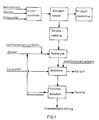
- Figure 1 shows the usual process route: gaseous reaction products, unreacted methyl chloride and fine particles enter the sludge vessel from the "direct synthesis reactors".
- the non-volatile components are collected here.
- the volatile components leave the vessel to enter the product distillation.
- the non-volatile content is expanded by means of a clock valve and introduced into a thickener in order to obtain volatile compounds at atmospheric pressure.
- the hydrolysis is carried out in a reaction vessel equipped with a stirrer with water or dilute HCl.
- surface-active substances can now be added to the water required for the hydrolysis via the water supply line or, if desired, only in the next step, namely when filling the oxidation reactor in which the gassing with the gas containing the elemental oxygen takes place, optionally at both points Subsets are abandoned.
- the solid is separated from the aqueous liquid by means of a suitable filtering device, this is fed to a suitable waste water treatment plant, and the solid is washed and then deposited.
- the wash water can optionally be used again for the hydrolysis.
- the example shows the change in the foaming and wetting behavior of a hydrolysis suspension caused by the addition of silica sol.
- the experiments were carried out in a gassing apparatus with three baffles and a gassing stirrer.
- the anionic BAYER silica sols 100/30%, 200/30% and 300/30% were used. (Manufacturer Bayer AG, Leverkusen). Amount added: 3ml Foam height during fumigation Sedimentation behavior of the solid after fumigation has ended Silica sol 100/30% 3 cm Foam breaks down immediately, solid completely wetted Silica sol 200/30% 3 cm Foam breaks down immediately, solid completely wetted, approx. 50% sediment Silica sol 300/30% 3 cm Foam breaks down immediately, solid matter sediments Comparison test without addition 35 cm Foam remains stable approx. 20% solids float
Landscapes
- Chemical & Material Sciences (AREA)
- Organic Chemistry (AREA)
- Silicon Compounds (AREA)
- Organic Low-Molecular-Weight Compounds And Preparation Thereof (AREA)
- Processing Of Solid Wastes (AREA)
Description
- Die vorliegende Erfindung betrifft ein Verfahren zur Aufarbeitung von Hydrolyserückständen, die bei der Hydrolyse von feststoffhaltigen Polysilanschlämmen aus der Organochlorsilansynthese nach dem Direktverfahren anfallen. Insbesondere bezieht sich die Erfindung auf die Aufarbeitung von Hydrolyserückständen aus der Methylchlorsilansynthese.
- Organochlorsilane und insbesondere die Methylchlorsilane dienen als Ausgangsmaterialien für die Herstellung von Siliconen, die in weiten Bereichen Anwendung finden, so z. B. als Kautschuke, Fugendichtmassen, Öle, Bautenschutzmittel usw. Besonders erwünscht bei der Herstellung der Methylchlorsilane ist das Dimethyldichlorsilan, welches in hoher Ausbeute erhalten wird, wenn die Direktreaktion von Silicium mit Methylchlorid durch Kupfer bzw. Kupferverbindungen katalysiert wird. Das Verfahren ist grundlegend in der US-PS 2 380 995 beschrieben. Die Herstellung von Methylchlorsilanen nach diesem Verfahren wird weltweit im industriellen Maßstab betrieben, wobei man die Reaktion üblicherweise in kontinuierlich betriebenen Fließbettreaktoren durchführt.
- Bei der Durchführung des Direktverfahrens in Fließbettreaktoren werden zusammen mit dem Reaktionsprodukt, der Rohsilanmischung und nicht umgesetztem Methylchlorid ständig auch die Feinstanteile von Silicium, Katalysator und unumgesetzter Kontaktmasse ausgetragen.
- Diese Staubanteile werden häufig zusammen mit den höchstsiedenden Reaktionsprodukten (Kp₇₆₀ > 160°C) in einem sogenannten Schlammkessel mit nachgeschaltetem Waschturm gesammelt. Die Temperatur des unter dem üblichen Überdruck von 1,5 - 10 bar stehenden Kessels wird im allgemeinen so eingestellt, daß das Gemisch aus Feststoff und kondensierten Anteilen genügend dünnflüssig gehalten wird, um den Austrag aus diesem Kessel zu ermöglichen.
- Gemäß der deutschen Patentschrift 2 362 494 kann der Kesselinhalt in einen bevorzugt unter Normaldruck stehenden Rührbehalter entspannt und die noch destillierbaren Anteile aus dem Gemisch durch Erhitzen ausgetrieben werden. Der Inhalt dieses Kessels wird dann in der Regel einer Hydrolyse zugeführt.
- Die Hydrolyse selbst kann, wie in DE-PS 2 362 494 beschrieben, in einem Fallrohr durchgeführt werden. Der Nachteil ist, daß durch die kurzen Kontaktzeiten die Hydrolyse oft nur unvollständig verläuft und große Mengen an Wasser gebraucht werden.
- Die DE-OS 3 005 743 beschreibt ein Hydrolyseverfahren, bei dem die unangenehme Eigenschaft des Klebens der Hydrolysate durch Zusatz von Mineralöl verhindert wird. Da aber die Hydrolysate als wertlos betrachtet und deponiert werden, ist die zusätzliche organische Belastung nachteilig.
- Aus der EP 0 089 783 geht hervor, daß das Problem des Klebens auch durch die Einhaltung eines Mindestchlorgehaltes bewältigt werden kann, was aber eine technisch schwer zu lösende Aufgabe ist.
- Bei all den erwähnten Verfahren entsteht eine salzsaure Suspension, bei der das mehr oder weniger feste Hydrolysat als wertlos gilt und deponiert werden muß. Die Hydrolysate sind allerdings nicht problemlos, denn sie erhalten meist 2 - 10 % überwiegend metallisches Kupfer, welches aus dem deponierten Hydrolysat teilweise eluiert werden kann und somit eine Gefahr für das Grundwasser darstellen kann. Darüber hinaus sind die meisten erhaltenen Hydrolysate oxidationsempfindlich, ja sie neigen in manchen Fällen sogar zur Selbstentzündung, was einer ordnungsgemäßen Deponierung entgegensteht.
- Die EP 0 210 418 beschreibt nun ein Verfahren, bei dem die Hydrolyse in Wasser oder einer stark verdünnten Salzsäure, in einem Rührwerksbehälter mit einem schnell laufenden Scheibenrührer ausgeführt wird, wobei dieser Behälter nicht mit Strombrechern ausgerüstet ist, so daß sich eine Trombe ausbilden kann, in die das zu hydrolysierende Material eingetragen wird. Die bevorzugte Temperatur liegt dabei zwischen 60 und 90°C. Man erhält so eine Suspension mit feinteiligen festen Hydrolysaten, in denen mehr als 90 % der Feststoffteilchen Durchmesser < 5 mm aufweisen.
- Die so erhaltenen Suspensionen werden anschließend mit Sauerstoff enthaltenden Gasen oxidiert, was gemäß der oben zitierten Erfindung bevorzugt mit technisch reinem Sauerstoff unter gegenüber Atmosphärendruck erhöhtem Druck erfolgt.
- Nach beendeter Oxidation werden Feststoff und kupferhaltige Flüssigkeit voneinander getrennt.
- Mit dem in der EP 0 210 418 beschriebenen Verfahren erhält man dann einen deponiefähigen, stichfesten, nicht gasenden, keine eluierbaren Schwermetalle enthaltenden und im Sinne der Erfindung thermisch inerten Feststoff, der ordnungsgemäß deponiert werden kann.
- Gegenstand der vorliegenden Erfindung ist nun ein Verfahren zur Aufarbeitung von bei der Organochlorsilansynthese anfallenden hochsiedenden und feststoffhaltigen Rückständen, die hydrolysiert und anschließend oxidiert werden, dadurch gekennzeichnet, daß bei der Hydrolyse und/oder der Oxidation zur hydrophilen Einstellung der Feststoffoberfläche in der Lösung ein anorganischer Niederschlag aus Wasserglaslösung oder Kieselsol erzeugt wird.
- Der erfindungsgemäße Zusatz eines oberflächenaktiven Stoffes ist nicht an die Kombinationen Hydrolyse und Oxidation gebunden, sondern kann auch bei der Hydrolyse ohne anschließende Oxidation zur Anwendung kommen. In der Regel bewirkt die bessere Benetzung eine weniger ausgeprägte Neigung des Hydrolysates zum Kleben und führt so zu einer geringeren Verschmutzung der produktführenden Anlagenteile.
- Die bevorzugte Art der Hydrolyse besteht darin, daß man die oberflächenaktive Substanz dem Wasser oder der stark verdünnten Salzsäure, die dem Rührwerksbehälter mit einem schnellaufenden Scheibenrührer zum Zwecke der Hydrolyse des hochsiedenden und feststoffhaltigen Rückstandes aus der Organochlorsilansynthese zugeführt wird, zusetzt und so die Oberfläche hydrophil einstellt.
- Die bevorzugte Art der Oxidation besteht darin, daß man den die Oberfläche hydrophil beeinflussenden Stoff beim Füllen des Oxidationsbehälters der zu oxidierenden Suspension zusetzt. Auch ist es möglich, einen Teil der oberflächenaktiven Substanz bei der Hydrolyse und einen weiteren Teil bei der Oxidation zuzusetzen.
- Der überraschende Vorteil bei der Durchführung des Aufarbeitungsverfahrens gemäß der vorliegenden Erfindung besteht darin, daß man eine bessere Benetzung des zu hydrolysierenden hochsiedenden und feststoffhaltigen Rückstandes und damit verbunden eine effektivere Hydrolyse erreicht und daß bei der Oxidation, die erfindungsgemäß bevorzugt durch Begasen der bei der Hydrolyse erhaltenen Suspension mit technisch reinem Sauerstoff unter gegenüber Atmosphäredruck erhöhtem Druck bei Temperaturen von 80 ± 10°C erfolgt, Flotations- und Schaumbildungseffekte vermieden werden, die die Reaktionsführung negativ beeinflussen können.
- Die Stoffe, die die Oberflächeneigenschaften des Hydrolysates im Sinne der vorliegenden Erfindung beeinflussen sind rein anorganischer Natur und bilden im mineralsauren Medium einen Niederschlag, der an der Hydrolysatoberfläche adsorbiert wird und so für den hydrophilen Charakter sorgt.
- Geeignet sind entweder alkalische Silikatlösungen wie z. B. Wasserglaslösung oder aber Kieselsole. Beim Zusatz der genannten Stoffe zur Hydrolysatsuspension oder aber zum Hydrolysewasser fällt aufgrund der entweder schon gegenwärtigen oder bei der Hydrolyse entstehenden Salzsäure SiO₂ aus. Der feinteilige Niederschlag wird an der Hydrolysatoberfläche adsorbiert und sorgt aufgrund seines hydrophilen Charakters für die Hydrophilierung der Hydrolysatoberfläche.
- Die benötigte Menge der oberflächenaktiven bzw. hydrophilen Charakter verleihenden Substanz ist abhängig von der Menge des in der Suspension vorhandenen Feststoffs und dessen Feinheit.
- In den meisten Fällen werden bei der Hydrolyse Suspensionen von 20 - 30 Gew.-% festen Hydrolysates, bestimmt als feuchter Filterkuchen, angestrebt. Für solche Suspensionen muß man erfahrungsgemäß zwischen 100 und 5.000 ppm, berechnet als Gewichtsteile der Wirksubstanz auf die Gesamtmenge der Suspension, einsetzen. Bevorzugt werden Zusätze zwischen 200 und 3.000 ppm Wirksubstanz bezogen auf die gesamte Suspension.
- Die erfindungsgemäß eingesetzten anorganischen Stoffe haben den Vorteil, daß die organische Abwasserbelastung durch ihren Einsatz nicht weiter erhöht wird.
- Das bevorzugte Vorgehen gemäß der vorliegenden Erfindung wird anhand der beigefügten Abbildung und der folgenden Beispiele näher erläutert, wobei die Beispiele illustrativen und nicht einschränkenden Charakter haben.
- In der Abbildung Fig. 1 ist der übliche Verfahrensweg dargestellt: Aus den "Direktsynthesereaktoren" treten gasförmige Reaktionsprodukte, unumgesetztes Methylchlorid und Feinanteile in das Schlammgefäß ein. Hier werden die nichtflüchtigen Bestandteile aufgefangen. Die flüchtigen Bestandteile verlassen das Gefäß, um in die Produktdestillation zu gelangen. Mittels eines Taktventils wird der nichtflüchtige Inhalt entspannt und in einen Eindicker eingeleitet, um bei Atmosphäredruck flüchtige Verbindungen zu gewinnen.
- Die Hydrolyse wird in einem mit einem Rührer ausgerüsteten Reaktionsgefäß mit Wasser oder verdünnter HCl durchgeführt.
- Oberflächenaktive Stoffe können nun erfindungsgemäß dem für die Hydrolyse benötigten Wasser über die Wasserzuleitung zugesetzt werden oder, falls erwünscht, erst im nächsten Schritt, nämlich beim Befüllen des Oxidationsreaktors, in dem die Begasung mit dem den elementaren Sauerstoff enthaltenden Gas stattfindet, gegebenenfalls können an beiden Stellen Teilmengen aufgegeben werden. Nach der Oxidation wird mittels einer geeigneten Filtriereinrichtung der Feststoff von der wäßrigen Flüssigkeit getrennt, diese einer geeigneten Abwasserbehandlungsanlage zugeführt und der Feststoff gewaschen und anschließend deponiert. Das Waschwasser kann gegebenenfalls wieder zur Hydrolyse eingesetzt werden.
- Das Beispiel zeigt die Veränderung im Schäumungs- und Benetzungsverhalten einer Hydrolysesuspension hervorgerufen durch den Zusatz von Kieselsol. Die Experimente wurden in einer Begasungsapparatur mit drei Strömungsbrechern und einem Begasungsrührer durchgeführt.
- Begasungsbedingungen:
Begasungsrührer ⌀ = 4,6 cm
Rührgeschwindigkeit: 1585 ± 30 UpM
Gefäßdurchmesser : 15 cm
Gefäßhöhe : 60 cm
Füllhöhe : ca. 17,5 cm
Die Suspension (3 kg) hatte eine Konzentration von 20 Gew.-% an feuchtem Feststoff. - Verwendet wurden die anionischen BAYER-Kieselsole 100/30 %, 200/30 % und 300/30 %. (Hersteller Bayer AG, Leverkusen).
Zugesetzte Menge: 3ml Schaumhöhe bei Begasung Absetzverhalten des Feststoffes nach Beendigung der Begasung Kieselsol 100/30 % 3 cm Schaum bricht sofort zusammen, Feststoff vollständig benetzt Kieselsol 200/30 % 3 cm Schaum bricht sofort zusammen, Feststoff vollständig benetzt, ca. 50 % sedimentieren Kieselsol 300/30 % 3 cm Schaum bricht sofort zusammen, Feststtoff sedimentiert Vergleichsversuch ohne Zusatz 35 cm Schaum bleibt stabil ca. 20 % Feststoff schwimmen auf
Claims (2)
- Verfahren zur Aufarbeitung von bei der Organochlorsilansynthese anfallenden hochsiedenden und feststoffhaltigen Rückständen, die hydrolysiert und gegebenenfalls anschließend mit sauerstoffhaltigen Gasen oxidiert werden, dadurch gekennzeichnet, daß bei der Hydrolyse und/oder der Oxidation zur hydrophilen Einstellung der Feststoffoberfläche in der Lösung ein anorganischer Niederschlag aus Wasserglaslösung oder Kieselsol erzeugt wird.
- Verfahren nach Anspruch 1, dadurch gekennzeichnet, daß Wasserglaslösung oder Kieselsol in Mengen von 100 ppm bis 5.000 ppm (berechnet als SiO₂), bezogen auf die Hydrolysesuspension, eingesetzt werden.
Applications Claiming Priority (2)
| Application Number | Priority Date | Filing Date | Title |
|---|---|---|---|
| DE3829581A DE3829581A1 (de) | 1988-09-01 | 1988-09-01 | Verfahren zur aufarbeitung von hydrolyserueckstaenden aus der organochlorsilansynthese |
| DE3829581 | 1988-09-01 |
Publications (3)
| Publication Number | Publication Date |
|---|---|
| EP0356878A2 EP0356878A2 (de) | 1990-03-07 |
| EP0356878A3 EP0356878A3 (en) | 1990-05-02 |
| EP0356878B1 true EP0356878B1 (de) | 1993-09-15 |
Family
ID=6361994
Family Applications (1)
| Application Number | Title | Priority Date | Filing Date |
|---|---|---|---|
| EP89115443A Expired - Lifetime EP0356878B1 (de) | 1988-09-01 | 1989-08-22 | Verfahren zur Aufarbeitung von Hydrolyserückständen aus der Organochlorsilansynthese |
Country Status (6)
| Country | Link |
|---|---|
| US (1) | US4961861A (de) |
| EP (1) | EP0356878B1 (de) |
| JP (1) | JP2768990B2 (de) |
| BR (1) | BR8904401A (de) |
| DE (2) | DE3829581A1 (de) |
| ES (1) | ES2043987T3 (de) |
Families Citing this family (5)
| Publication number | Priority date | Publication date | Assignee | Title |
|---|---|---|---|---|
| DE3829582A1 (de) * | 1988-09-01 | 1990-03-08 | Bayer Ag | Verfahren zur aufarbeitung von hydrolyserueckstaenden aus der organochlorsilansynthese |
| US5321149A (en) * | 1992-12-09 | 1994-06-14 | General Electric Company | Process for stabilizing spent silicon contact mass |
| US5945497A (en) * | 1997-12-22 | 1999-08-31 | Dow Corning Corporation | Method for hydrolyzing organochlorosilanes |
| US6075109A (en) * | 1998-12-17 | 2000-06-13 | Dow Corning Corporation | Method of forming a granular siloxane gel having reduced chloride content |
| DE102010061814A1 (de) * | 2010-11-23 | 2012-05-24 | Wacker Chemie Ag | Verfahren zum Aufarbeiten von flüssigen Rückständen der Direktsynthese von Organochlorsilanen |
Family Cites Families (10)
| Publication number | Priority date | Publication date | Assignee | Title |
|---|---|---|---|---|
| US2380995A (en) * | 1941-09-26 | 1945-08-07 | Gen Electric | Preparation of organosilicon halides |
| GB1173022A (en) * | 1965-11-10 | 1969-12-03 | Dow Corning | Aqueous Emulsions |
| FR2079698A5 (en) * | 1970-02-10 | 1971-11-12 | Robert Dominique | Dewatering of minerals - using fatty anionic or nonionic agents and alkyl sulphosuccinic wetting agent |
| US4422880A (en) * | 1975-03-12 | 1983-12-27 | J. M. Huber Corporation | Precipitated siliceous products |
| EP0005011B1 (de) * | 1978-04-15 | 1981-07-15 | Simon-Carves Limited | Verfahren zur Beseitigung von Metallverunreinigungen aus Abwasserschlamm |
| US4221691A (en) * | 1979-02-16 | 1980-09-09 | Dow Corning Corporation | Method of hydrolyzing chlorosilanes |
| DE3005754A1 (de) * | 1980-02-15 | 1981-08-20 | William Wallisellen Honegger | Vorrichtung zur halterung von gegenstaenden |
| US4408030A (en) * | 1982-03-22 | 1983-10-04 | Dow Corning Corporation | Waste chlorosilane treatment |
| DE3523543A1 (de) * | 1985-07-02 | 1987-01-15 | Bayer Ag | Verfahren zur aufarbeitung von hydrolyserueckstaenden aus der methylchlorsilansynthese |
| DE3829582A1 (de) * | 1988-09-01 | 1990-03-08 | Bayer Ag | Verfahren zur aufarbeitung von hydrolyserueckstaenden aus der organochlorsilansynthese |
-
1988
- 1988-09-01 DE DE3829581A patent/DE3829581A1/de not_active Withdrawn
-
1989
- 1989-08-16 US US07/394,606 patent/US4961861A/en not_active Expired - Fee Related
- 1989-08-22 DE DE89115443T patent/DE58905610D1/de not_active Expired - Lifetime
- 1989-08-22 ES ES89115443T patent/ES2043987T3/es not_active Expired - Lifetime
- 1989-08-22 EP EP89115443A patent/EP0356878B1/de not_active Expired - Lifetime
- 1989-08-31 BR BR898904401A patent/BR8904401A/pt not_active Application Discontinuation
- 1989-08-31 JP JP1223323A patent/JP2768990B2/ja not_active Expired - Lifetime
Also Published As
| Publication number | Publication date |
|---|---|
| JP2768990B2 (ja) | 1998-06-25 |
| EP0356878A2 (de) | 1990-03-07 |
| EP0356878A3 (en) | 1990-05-02 |
| ES2043987T3 (es) | 1994-01-01 |
| BR8904401A (pt) | 1990-04-17 |
| DE3829581A1 (de) | 1990-03-15 |
| JPH02101084A (ja) | 1990-04-12 |
| DE58905610D1 (de) | 1993-10-21 |
| US4961861A (en) | 1990-10-09 |
Similar Documents
| Publication | Publication Date | Title |
|---|---|---|
| EP0032376B1 (de) | Verfahren zur kontinuierlichen Herstellung von SiOC-Gruppen aufweisenden Silanen oder SiOC-Gruppen aufweisenden Polysiloxanen | |
| EP0210418B1 (de) | Verfahren zur Aufarbeitung von Hydrolyserückständen aus der Methylchlorsilansynthese | |
| EP0474265B1 (de) | Verfahren zur Herstellung von Dichlorsilan | |
| DE3311650A1 (de) | Verfahren zur herstellung von hoch reinem silan sowie hoch reinem polykristallinem und einkristallinem silicium fuer solarzellen und halbleiter | |
| DE10116007A1 (de) | Vorrichtung und Verfahren zur Herstellung von im Wesentlichen halogenfreien Trialkoxysilanen | |
| EP0356881B1 (de) | Verfahren zur Aufarbeitung von Hydrolyserückständen aus der Organochlorsilansynthese | |
| DE69634895T2 (de) | Kieselsäuregel, synthetisches quarzglaspulver, geformtes quarzglas und verfahren zu deren herstellung | |
| DE3709630A1 (de) | Verfahren zur beseitigung verunreinigter chlorsilane | |
| DE2240014C3 (de) | Verfahren zur Hydrophobierung von hochdispersen Oxiden | |
| DE3005743A1 (de) | Verfahren zum hydrolysieren von chlorsilanen | |
| EP0355592B1 (de) | Verfahren zur Entfernung von Silanverbindungen aus silanhaltigen Abgasen | |
| DE69124638T2 (de) | Verfahren zur Reinigung von Alkoxysilanen | |
| EP0356878A2 (de) | Verfahren zur Aufarbeitung von Hydrolyserückständen aus der Organochlorsilansynthese | |
| DE69104875T2 (de) | Verminderung des Chloridgehaltes in Polysiloxanen. | |
| DE69801606T2 (de) | Verfahren und Vorrichtung zur Rückgewinnung von Germanium aus Abgasen chemischer Aufdampfprozesse | |
| DE69222224T2 (de) | Verfahren zur Herstellung von Alkoxysilanen | |
| DE19624097A1 (de) | Verfahren zum Passivieren von feinteiligem Material des Organochlorsilan-Reaktors und Wiedergewinnen von Chlorsilan daraus | |
| EP0054650B1 (de) | Verfahren zum Reinigen von Chlorsilanen | |
| DE3525802A1 (de) | Verfahren zur herstellung von modifizierten faellungskieselsaeuren | |
| DE3637273C1 (de) | Verfahren zur Herstellung von SiH-Gruppen enthaltenden Organopolysiloxanen | |
| DE3523541A1 (de) | Verfahren zur aufarbeitung von bei der organochlorsilan-herstellung anfallenden hydrolysierten rueckstaenden | |
| EP0033109A1 (de) | Verfahren zur hydrothermalen Herstellung von Natriumsilikatlösungen in einem statischen Reaktionsbehälter | |
| DE69807766T2 (de) | Verfahren zur Behandlung von Silan-enthaltendem Gas | |
| DE69314914T2 (de) | Verfahren zur Stabilisierung von verbrauchten Silizium-Kontaktmassen | |
| DE1593083A1 (de) | Verfahren zur Herstellung von Methylchlorsilanen |
Legal Events
| Date | Code | Title | Description |
|---|---|---|---|
| PUAI | Public reference made under article 153(3) epc to a published international application that has entered the european phase |
Free format text: ORIGINAL CODE: 0009012 |
|
| 17P | Request for examination filed |
Effective date: 19890824 |
|
| AK | Designated contracting states |
Kind code of ref document: A2 Designated state(s): DE ES FR GB |
|
| PUAL | Search report despatched |
Free format text: ORIGINAL CODE: 0009013 |
|
| AK | Designated contracting states |
Kind code of ref document: A3 Designated state(s): DE ES FR GB |
|
| 17Q | First examination report despatched |
Effective date: 19920424 |
|
| GRAA | (expected) grant |
Free format text: ORIGINAL CODE: 0009210 |
|
| AK | Designated contracting states |
Kind code of ref document: B1 Designated state(s): DE ES FR GB |
|
| REF | Corresponds to: |
Ref document number: 58905610 Country of ref document: DE Date of ref document: 19931021 |
|
| ET | Fr: translation filed | ||
| REG | Reference to a national code |
Ref country code: ES Ref legal event code: FG2A Ref document number: 2043987 Country of ref document: ES Kind code of ref document: T3 |
|
| GBT | Gb: translation of ep patent filed (gb section 77(6)(a)/1977) |
Effective date: 19931207 |
|
| PLBE | No opposition filed within time limit |
Free format text: ORIGINAL CODE: 0009261 |
|
| STAA | Information on the status of an ep patent application or granted ep patent |
Free format text: STATUS: NO OPPOSITION FILED WITHIN TIME LIMIT |
|
| PGFP | Annual fee paid to national office [announced via postgrant information from national office to epo] |
Ref country code: ES Payment date: 19940803 Year of fee payment: 6 |
|
| 26N | No opposition filed | ||
| PG25 | Lapsed in a contracting state [announced via postgrant information from national office to epo] |
Ref country code: ES Free format text: LAPSE BECAUSE OF THE APPLICANT RENOUNCES Effective date: 19950823 |
|
| REG | Reference to a national code |
Ref country code: FR Ref legal event code: TP |
|
| REG | Reference to a national code |
Ref country code: ES Ref legal event code: FD2A Effective date: 19991007 |
|
| REG | Reference to a national code |
Ref country code: GB Ref legal event code: 732E |
|
| REG | Reference to a national code |
Ref country code: GB Ref legal event code: IF02 |
|
| PGFP | Annual fee paid to national office [announced via postgrant information from national office to epo] |
Ref country code: DE Payment date: 20080901 Year of fee payment: 20 |
|
| PGFP | Annual fee paid to national office [announced via postgrant information from national office to epo] |
Ref country code: FR Payment date: 20080818 Year of fee payment: 20 |
|
| PGFP | Annual fee paid to national office [announced via postgrant information from national office to epo] |
Ref country code: GB Payment date: 20080827 Year of fee payment: 20 |
|
| REG | Reference to a national code |
Ref country code: GB Ref legal event code: PE20 Expiry date: 20090821 |
|
| PG25 | Lapsed in a contracting state [announced via postgrant information from national office to epo] |
Ref country code: GB Free format text: LAPSE BECAUSE OF EXPIRATION OF PROTECTION Effective date: 20090821 |