EP0356781B1 - Verfahren zur Verarbeitung von organischem Material - Google Patents
Verfahren zur Verarbeitung von organischem Material Download PDFInfo
- Publication number
- EP0356781B1 EP0356781B1 EP89114806A EP89114806A EP0356781B1 EP 0356781 B1 EP0356781 B1 EP 0356781B1 EP 89114806 A EP89114806 A EP 89114806A EP 89114806 A EP89114806 A EP 89114806A EP 0356781 B1 EP0356781 B1 EP 0356781B1
- Authority
- EP
- European Patent Office
- Prior art keywords
- sludge
- ammonia
- admixture
- passageway
- process according
- Prior art date
- Legal status (The legal status is an assumption and is not a legal conclusion. Google has not performed a legal analysis and makes no representation as to the accuracy of the status listed.)
- Expired - Lifetime
Links
- 238000000034 method Methods 0.000 title claims abstract description 47
- 230000008569 process Effects 0.000 title claims abstract description 43
- 239000011368 organic material Substances 0.000 title abstract description 17
- QGZKDVFQNNGYKY-UHFFFAOYSA-N Ammonia Chemical compound N QGZKDVFQNNGYKY-UHFFFAOYSA-N 0.000 claims abstract description 110
- 229910021529 ammonia Inorganic materials 0.000 claims abstract description 55
- NBIIXXVUZAFLBC-UHFFFAOYSA-N Phosphoric acid Chemical compound OP(O)(O)=O NBIIXXVUZAFLBC-UHFFFAOYSA-N 0.000 claims abstract description 20
- 239000000463 material Substances 0.000 claims abstract description 13
- 229910000147 aluminium phosphate Inorganic materials 0.000 claims abstract description 10
- 239000010802 sludge Substances 0.000 claims description 64
- 239000002253 acid Substances 0.000 claims description 25
- 239000010801 sewage sludge Substances 0.000 claims description 23
- 150000007522 mineralic acids Chemical class 0.000 claims description 13
- 230000001954 sterilising effect Effects 0.000 claims description 11
- 239000010865 sewage Substances 0.000 claims description 8
- 230000000249 desinfective effect Effects 0.000 claims description 6
- GRYLNZFGIOXLOG-UHFFFAOYSA-N Nitric acid Chemical compound O[N+]([O-])=O GRYLNZFGIOXLOG-UHFFFAOYSA-N 0.000 claims description 3
- 229910017604 nitric acid Inorganic materials 0.000 claims description 3
- 239000000203 mixture Substances 0.000 claims description 2
- 239000002910 solid waste Substances 0.000 claims description 2
- 239000007788 liquid Substances 0.000 abstract description 4
- 239000000126 substance Substances 0.000 abstract description 3
- 239000002002 slurry Substances 0.000 description 29
- 230000035899 viability Effects 0.000 description 14
- 235000013601 eggs Nutrition 0.000 description 11
- 239000003337 fertilizer Substances 0.000 description 11
- IJGRMHOSHXDMSA-UHFFFAOYSA-N Atomic nitrogen Chemical compound N#N IJGRMHOSHXDMSA-UHFFFAOYSA-N 0.000 description 8
- 229910052698 phosphorus Inorganic materials 0.000 description 8
- 239000007787 solid Substances 0.000 description 7
- 238000004659 sterilization and disinfection Methods 0.000 description 7
- 230000008719 thickening Effects 0.000 description 6
- 241000244186 Ascaris Species 0.000 description 5
- XEEYBQQBJWHFJM-UHFFFAOYSA-N Iron Chemical compound [Fe] XEEYBQQBJWHFJM-UHFFFAOYSA-N 0.000 description 5
- 238000006243 chemical reaction Methods 0.000 description 5
- 238000010438 heat treatment Methods 0.000 description 5
- 229910052757 nitrogen Inorganic materials 0.000 description 5
- WSFSSNUMVMOOMR-UHFFFAOYSA-N Formaldehyde Chemical compound O=C WSFSSNUMVMOOMR-UHFFFAOYSA-N 0.000 description 4
- 238000013019 agitation Methods 0.000 description 4
- 238000001035 drying Methods 0.000 description 4
- 239000007789 gas Substances 0.000 description 4
- 238000002347 injection Methods 0.000 description 4
- 239000007924 injection Substances 0.000 description 4
- 239000000243 solution Substances 0.000 description 4
- XLYOFNOQVPJJNP-UHFFFAOYSA-N water Substances O XLYOFNOQVPJJNP-UHFFFAOYSA-N 0.000 description 4
- 230000001580 bacterial effect Effects 0.000 description 3
- 239000010949 copper Substances 0.000 description 3
- 230000000694 effects Effects 0.000 description 3
- 238000001704 evaporation Methods 0.000 description 3
- 238000011534 incubation Methods 0.000 description 3
- 235000015097 nutrients Nutrition 0.000 description 3
- 238000009928 pasteurization Methods 0.000 description 3
- 238000012360 testing method Methods 0.000 description 3
- 231100000701 toxic element Toxicity 0.000 description 3
- 239000011701 zinc Substances 0.000 description 3
- VHUUQVKOLVNVRT-UHFFFAOYSA-N Ammonium hydroxide Chemical compound [NH4+].[OH-] VHUUQVKOLVNVRT-UHFFFAOYSA-N 0.000 description 2
- RYGMFSIKBFXOCR-UHFFFAOYSA-N Copper Chemical compound [Cu] RYGMFSIKBFXOCR-UHFFFAOYSA-N 0.000 description 2
- 108010034145 Helminth Proteins Proteins 0.000 description 2
- MHAJPDPJQMAIIY-UHFFFAOYSA-N Hydrogen peroxide Chemical compound OO MHAJPDPJQMAIIY-UHFFFAOYSA-N 0.000 description 2
- 229910002651 NO3 Inorganic materials 0.000 description 2
- NHNBFGGVMKEFGY-UHFFFAOYSA-N Nitrate Chemical compound [O-][N+]([O-])=O NHNBFGGVMKEFGY-UHFFFAOYSA-N 0.000 description 2
- OAICVXFJPJFONN-UHFFFAOYSA-N Phosphorus Chemical compound [P] OAICVXFJPJFONN-UHFFFAOYSA-N 0.000 description 2
- NINIDFKCEFEMDL-UHFFFAOYSA-N Sulfur Chemical compound [S] NINIDFKCEFEMDL-UHFFFAOYSA-N 0.000 description 2
- 239000005864 Sulphur Substances 0.000 description 2
- HCHKCACWOHOZIP-UHFFFAOYSA-N Zinc Chemical compound [Zn] HCHKCACWOHOZIP-UHFFFAOYSA-N 0.000 description 2
- 239000000654 additive Substances 0.000 description 2
- 230000000996 additive effect Effects 0.000 description 2
- 235000011114 ammonium hydroxide Nutrition 0.000 description 2
- 239000011575 calcium Substances 0.000 description 2
- 229910052791 calcium Inorganic materials 0.000 description 2
- 238000004891 communication Methods 0.000 description 2
- 229910052802 copper Inorganic materials 0.000 description 2
- 244000000013 helminth Species 0.000 description 2
- 229910052742 iron Inorganic materials 0.000 description 2
- 230000007653 larval development Effects 0.000 description 2
- 239000011777 magnesium Substances 0.000 description 2
- 229910052749 magnesium Inorganic materials 0.000 description 2
- 239000011572 manganese Substances 0.000 description 2
- 239000011574 phosphorus Substances 0.000 description 2
- 229910052700 potassium Inorganic materials 0.000 description 2
- 230000035484 reaction time Effects 0.000 description 2
- 239000011734 sodium Substances 0.000 description 2
- 229910052708 sodium Inorganic materials 0.000 description 2
- 229910052725 zinc Inorganic materials 0.000 description 2
- QJZYHAIUNVAGQP-UHFFFAOYSA-N 3-nitrobicyclo[2.2.1]hept-5-ene-2,3-dicarboxylic acid Chemical compound C1C2C=CC1C(C(=O)O)C2(C(O)=O)[N+]([O-])=O QJZYHAIUNVAGQP-UHFFFAOYSA-N 0.000 description 1
- 241000244185 Ascaris lumbricoides Species 0.000 description 1
- OYPRJOBELJOOCE-UHFFFAOYSA-N Calcium Chemical compound [Ca] OYPRJOBELJOOCE-UHFFFAOYSA-N 0.000 description 1
- VEXZGXHMUGYJMC-UHFFFAOYSA-M Chloride anion Chemical compound [Cl-] VEXZGXHMUGYJMC-UHFFFAOYSA-M 0.000 description 1
- DGAQECJNVWCQMB-PUAWFVPOSA-M Ilexoside XXIX Chemical compound C[C@@H]1CC[C@@]2(CC[C@@]3(C(=CC[C@H]4[C@]3(CC[C@@H]5[C@@]4(CC[C@@H](C5(C)C)OS(=O)(=O)[O-])C)C)[C@@H]2[C@]1(C)O)C)C(=O)O[C@H]6[C@@H]([C@H]([C@@H]([C@H](O6)CO)O)O)O.[Na+] DGAQECJNVWCQMB-PUAWFVPOSA-M 0.000 description 1
- FYYHWMGAXLPEAU-UHFFFAOYSA-N Magnesium Chemical compound [Mg] FYYHWMGAXLPEAU-UHFFFAOYSA-N 0.000 description 1
- PWHULOQIROXLJO-UHFFFAOYSA-N Manganese Chemical compound [Mn] PWHULOQIROXLJO-UHFFFAOYSA-N 0.000 description 1
- ZOKXTWBITQBERF-UHFFFAOYSA-N Molybdenum Chemical compound [Mo] ZOKXTWBITQBERF-UHFFFAOYSA-N 0.000 description 1
- CBENFWSGALASAD-UHFFFAOYSA-N Ozone Chemical compound [O-][O+]=O CBENFWSGALASAD-UHFFFAOYSA-N 0.000 description 1
- 229910019142 PO4 Inorganic materials 0.000 description 1
- ZLMJMSJWJFRBEC-UHFFFAOYSA-N Potassium Chemical compound [K] ZLMJMSJWJFRBEC-UHFFFAOYSA-N 0.000 description 1
- KWYUFKZDYYNOTN-UHFFFAOYSA-M Potassium hydroxide Chemical compound [OH-].[K+] KWYUFKZDYYNOTN-UHFFFAOYSA-M 0.000 description 1
- 241000700605 Viruses Species 0.000 description 1
- 230000002745 absorbent Effects 0.000 description 1
- 239000002250 absorbent Substances 0.000 description 1
- 238000010306 acid treatment Methods 0.000 description 1
- 239000004411 aluminium Substances 0.000 description 1
- 229910052782 aluminium Inorganic materials 0.000 description 1
- XAGFODPZIPBFFR-UHFFFAOYSA-N aluminium Chemical compound [Al] XAGFODPZIPBFFR-UHFFFAOYSA-N 0.000 description 1
- 238000010923 batch production Methods 0.000 description 1
- 230000015572 biosynthetic process Effects 0.000 description 1
- 229910052796 boron Inorganic materials 0.000 description 1
- 229910052799 carbon Inorganic materials 0.000 description 1
- 239000001913 cellulose Substances 0.000 description 1
- 229920002678 cellulose Polymers 0.000 description 1
- 238000005119 centrifugation Methods 0.000 description 1
- 239000000470 constituent Substances 0.000 description 1
- 238000010924 continuous production Methods 0.000 description 1
- 238000011161 development Methods 0.000 description 1
- 230000018109 developmental process Effects 0.000 description 1
- 238000010586 diagram Methods 0.000 description 1
- 238000010790 dilution Methods 0.000 description 1
- 239000012895 dilution Substances 0.000 description 1
- RTZKZFJDLAIYFH-UHFFFAOYSA-N ether Substances CCOCC RTZKZFJDLAIYFH-UHFFFAOYSA-N 0.000 description 1
- 230000008020 evaporation Effects 0.000 description 1
- 238000002474 experimental method Methods 0.000 description 1
- 230000004720 fertilization Effects 0.000 description 1
- 239000012467 final product Substances 0.000 description 1
- 230000003311 flocculating effect Effects 0.000 description 1
- 238000005188 flotation Methods 0.000 description 1
- 239000000499 gel Substances 0.000 description 1
- 229910001385 heavy metal Inorganic materials 0.000 description 1
- 244000052637 human pathogen Species 0.000 description 1
- 239000004021 humic acid Substances 0.000 description 1
- 239000003864 humus Substances 0.000 description 1
- 230000000968 intestinal effect Effects 0.000 description 1
- 244000000053 intestinal parasite Species 0.000 description 1
- 238000011005 laboratory method Methods 0.000 description 1
- 229920005610 lignin Polymers 0.000 description 1
- 229910052748 manganese Inorganic materials 0.000 description 1
- 238000000386 microscopy Methods 0.000 description 1
- 229910052750 molybdenum Inorganic materials 0.000 description 1
- 239000011733 molybdenum Substances 0.000 description 1
- 238000012544 monitoring process Methods 0.000 description 1
- 230000003472 neutralizing effect Effects 0.000 description 1
- 244000045947 parasite Species 0.000 description 1
- 230000007170 pathology Effects 0.000 description 1
- 239000010452 phosphate Substances 0.000 description 1
- NBIIXXVUZAFLBC-UHFFFAOYSA-K phosphate Chemical compound [O-]P([O-])([O-])=O NBIIXXVUZAFLBC-UHFFFAOYSA-K 0.000 description 1
- 229940072033 potash Drugs 0.000 description 1
- 239000011591 potassium Substances 0.000 description 1
- BWHMMNNQKKPAPP-UHFFFAOYSA-L potassium carbonate Substances [K+].[K+].[O-]C([O-])=O BWHMMNNQKKPAPP-UHFFFAOYSA-L 0.000 description 1
- 235000015320 potassium carbonate Nutrition 0.000 description 1
- 238000012545 processing Methods 0.000 description 1
- 239000000047 product Substances 0.000 description 1
- 230000002035 prolonged effect Effects 0.000 description 1
- 239000002994 raw material Substances 0.000 description 1
- 239000000376 reactant Substances 0.000 description 1
- 238000011160 research Methods 0.000 description 1
- 239000003206 sterilizing agent Substances 0.000 description 1
- 230000000638 stimulation Effects 0.000 description 1
- 229910052717 sulfur Inorganic materials 0.000 description 1
- 239000010455 vermiculite Substances 0.000 description 1
- 229910052902 vermiculite Inorganic materials 0.000 description 1
- 235000019354 vermiculite Nutrition 0.000 description 1
- NWONKYPBYAMBJT-UHFFFAOYSA-L zinc sulfate Chemical compound [Zn+2].[O-]S([O-])(=O)=O NWONKYPBYAMBJT-UHFFFAOYSA-L 0.000 description 1
- 235000009529 zinc sulphate Nutrition 0.000 description 1
- 239000011686 zinc sulphate Substances 0.000 description 1
Images

Classifications
-
- C—CHEMISTRY; METALLURGY
- C02—TREATMENT OF WATER, WASTE WATER, SEWAGE, OR SLUDGE
- C02F—TREATMENT OF WATER, WASTE WATER, SEWAGE, OR SLUDGE
- C02F11/00—Treatment of sludge; Devices therefor
-
- C—CHEMISTRY; METALLURGY
- C05—FERTILISERS; MANUFACTURE THEREOF
- C05F—ORGANIC FERTILISERS NOT COVERED BY SUBCLASSES C05B, C05C, e.g. FERTILISERS FROM WASTE OR REFUSE
- C05F7/00—Fertilisers from waste water, sewage sludge, sea slime, ooze or similar masses
-
- Y—GENERAL TAGGING OF NEW TECHNOLOGICAL DEVELOPMENTS; GENERAL TAGGING OF CROSS-SECTIONAL TECHNOLOGIES SPANNING OVER SEVERAL SECTIONS OF THE IPC; TECHNICAL SUBJECTS COVERED BY FORMER USPC CROSS-REFERENCE ART COLLECTIONS [XRACs] AND DIGESTS
- Y02—TECHNOLOGIES OR APPLICATIONS FOR MITIGATION OR ADAPTATION AGAINST CLIMATE CHANGE
- Y02A—TECHNOLOGIES FOR ADAPTATION TO CLIMATE CHANGE
- Y02A40/00—Adaptation technologies in agriculture, forestry, livestock or agroalimentary production
- Y02A40/10—Adaptation technologies in agriculture, forestry, livestock or agroalimentary production in agriculture
- Y02A40/20—Fertilizers of biological origin, e.g. guano or fertilizers made from animal corpses
Definitions
- THIS INVENTION relates to a process for sterilizing and disinfecting sewage sludge.
- WO 8102888 teaches flocculating activated or humus sludge, which has been thickened to a solids content of at least 2%, by treatment with a base to raise the pH of the thickened sludge to more than 8, and then with an acid to lower the pH to 1 to 4. Sufficient base is used so that the sludge gels.
- US 4743287 which teaches a method of forming a humic acid fertilizer.
- the method includes analyzing an organic material to determine the proportion of major inorganic elements such as nitrogen, phosphate, potash and sulphur therein, mixing trace amounts of the major elements with the organic material, adding water thereto, and then treating this mixture sequentially either with an acid followed by a base such as ammonia, or a base followed by an acid. It deals in detail with the combination of treating the material first with the acid and then with the base, but deals in substantially less detail with the combination where the material is treated first with the base and then with the acid. Moreover, it teaches that the combination of the base treatment followed by acid treatment is utilized only when the raw material has a high lignin and cellulose content. Neither of these patents teach a process for sterilizing and disinfecting sewage sludge, in accordance with the present invention.
- major inorganic elements such as nitrogen, phosphate, potash and sulphur therein
- a process for sterilizing and disinfecting sewage sludge which comprises in sequential order admixing raw, activated or digested sewage sludge containing from about 2% to 50% by mass of solid waste material, with ammonia and; admixing an inorganic acid with the sewage sludge-ammonia admixture, which is characterized in that
- the slurry thus comprises 2% to 50% by mass organic solids in water.
- the slurry may comprise 10%-30% by mass, typically about 15% by mass solids, based on the total slurry mass, in water.
- the sterilized disinfected sludge may also be enriched, depending on the degree of treatment, the manner in which the temperature is raised, etc.
- the end material can thus be suitable for use as a fertilizer.
- the process may include passing the sewage sludge along a passageway, eg along a pipe reactor, with the raising of the pH being effected in a first zone of the passageway and the addition of the acid to a second zone of the passageway.
- the zones may be spaced a sufficient distance apart so that the ammonia can react with the sludge for at least 5 minutes before the acid addition takes place.
- the passageway may be of generally elongate form. In another embodiment of the invention, it may be of convoluted form.
- anhydrous ammonia gas is thus used. It is further believed that the ammonia also functions by forming NH4OH as an intermediate, with the NH4OH molecules reacting, it is believed, with the organic material.
- the ammonia may be injected into the sludge.
- the ammonia injection is preferably effected in such a manner that intimate admixture thereof with the sludge takes place. For example, this may be effected by injecting the ammonia through a nozzle, with the sludge flow along the passageway being turbulent.
- the method may include agitating the sludge as the ammonia is injected, to effect the intimate admixture.
- a pipe reactor is particularly suitable since it is easy to pressurize to effect efficient contact of the ammonia with the sludge, and is relatively inexpensive to construct and operate.
- the amount of ammonia added may be in the region of from 0,2% to 20% (by mass) ammonia, based on the total mass of sludge. It is thus important that all the sludge be treated with the ammonia since at least part of the sterilization achieved with the process is due to the ammoniation of the organic material in the sludge.
- the sludge may be allowed to react with the ammonia for between 5 and 20 minutes, eg for about 10 minutes, before the acid addition is effected.
- the acid may be an inorganic acid.
- the inorganic acid may be phosphoric acid and/or nitric acid, the use of which also results in nutrients, ie phosphorus or nitrogen, being added to the sludge.
- the acid introduction which may also be by way of injection, is also preferably effected in such a manner that intimate admixture thereof with the sludge takes place. It may also be effected by injecting the acid through a nozzle and/or by agitating the sludge while the addition takes place.
- the acid may be in the form of a dilute solution, eg a 21% (by mass) P solution.
- Sufficient acid is thus injected to neutralize the ammonia, and to provide the resultant slurry temperature of at least 65°C.
- the slurry temperature can hence be raised, if necessary, by introducing more ammonia, so that more acid is then required to react exothermically with the ammonia to neutralize it, resulting in a higher slurry temperature, but the slurry temperature should preferably not exceed 130°C, at a pressure of 1-3 bar(g), since this will give rise to gas or vapour formation.
- the mass ratio of ammonia to acid solution (21% P) may be in the range 15:100 to 25:100, typically about 20:100.
- ammonia/acid ratio can be varied as desired, depending on the intended end use of the treated sludge, eg whether a pasteurized and/or enriched final product is also required, as well as what degree of treatment thereof is required, eg degree of enrichment.
- the process may also include drying, eg evaporating, the sludge and/or adding at least one further additive, eg a nitrate, depending on the intended end use of the treated sludge.
- the process can be continuous. In another embodiment of the invention, it can be a batch process.
- reference numeral 10 generally indicates a continuous process for sterilizing and disinfecting sewage sludge, in accordance with the invention.
- the process 10 includes an initial thickening stage 12, into which leads a flow line 14.
- the thickening stage can comprise conventional thickening means, eg mechanical thickening means such as centrifugation equipment, or settling means.
- the thickening stage 12 is only required if the incoming sludge indeed requires thickening and can thus be omitted, if desired.
- raw sewage sludge can have a solids concentration of 0,01-5%, typically 3-5%, by mass, and it is then thickened in the stage 12 to have a solids content of about 15% by mass.
- the thickened slurry passes along a flow line 16 fitted with a pump 18 into a pipe reactor 20 or 60 at substantially ambient temperature, or at the temperature at which it emerges from the stage 12, ie the stream is not heated up prior to entering the pipe reactor.
- the pipe reactor can be of generally elongate or convoluted form, and operates at a pressure of about 1-3 bar(g).
- the pipe reactor is sized such that sludge flow along it is turbulent.
- the pipe reactor dimensions will thus be selected by simple trial and experiment, to achieve a desired degree of treatment for a particular sludge flow rate. It is believed that the velocity through the reactor should not exceed 1 m/s to maintain the turbulent flow necessary for good mixing and good heat exchange as described in more detail hereinafter with reference to the reactor 60. For similar reasons it is preferred that the diameter of the pipe constituting the pipe reactor should not exceed 15 cm.
- the pipe reactor 20 defines a flow passageway 24 along which the sewage sludge 26 flows in the direction of arrow 28.
- gaseous ammonia is injected into the sludge or slurry 26 through a nozzle 34 fitted to a conduit 32 connected to a supply or source of ammonia under pressure (not shown).
- the ammonia is not heated up prior to being injected into the slurry, save for the heat required to gasify liquid ammonia when it is supplied in liquid form. This can be achieved by passing an air stream over a coil through which the ammonia passes.
- the nozzle 34 is such that intimate admixing of the ammonia with the slurry takes place.
- additional agitation eg a mechanical agitation device (not shown) may be provided in the pipe reactor in proximity to the zone 30.
- Sufficient ammonia is added in the zone 30 to raise the pH of the slurry intermediate formed in the zone 30 to at least 10, typically about 11,6.
- Some exothermic reactions between the ammonia and the constituents of the slurry also takes place so that some degree of heating of the slurry also normally takes place in the zone 30.
- the slurry can be heated by utilizing the heat of reaction as hereinafter described with reference to the reactor 60. However, no extraneous heating takes place in the zone 30 and the degree of heating is usually such that the slurry temperature is raised by between 5 and 60°C, eg about 40°C.
- Another zone 40 is located sufficiently downstream of the zone 30 such that the ammonia can react with the organic material for about 10 minutes before entering the zone 40.
- the ammonia is usually allowed to react with the organic material in the zone between the zones 30, 40 without addition of any further reactants.
- an additive such as a sterilizing agent, eg hydrogen peroxide or ozone, can be added between the zones 30, 40.
- phosphoric acid is injected into the slurry intermediate through a nozzle 38 fitted to a conduit 36 connected to a source or supply of phosphoric acid.
- the phosphoric acid can be in concentrated or dilute form, eg a dilute phosphoric acid solution containing about 21% P (by mass).
- the nozzle 38 is such that intimate admixing of the phosphoric acid with the slurry takes place. Agitation by means of a mechanical agitation device (not shown) may be effected in proximity to the zone 40 if desired.
- Sufficient acid is added in the zone 40 to neutralize the ammonia in the slurry, so that the pH of the treated slurry leaving the zone 40 is about 7.
- An exothermic reaction between the ammonia and the acid takes place in the zone 40, resulting in heating of the sludge. No extraneous heating of the sludge is necessary.
- the slurry should be heated to a temperature of at least 65-70°C. Hence, if the temperature is too low, additional ammonia can be introduced into the zone 30, so that more acid then has to be added in the zone 40, leading to an increase in the treated slurry temperature.
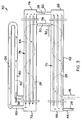
- the pipe reactor 60 includes two parallel lengths of pipe or conduit 62, 64.
- the one end of the pipe 62 is closed off with a header or end cap 66, while its other end is closed off with a header or end cap 68.
- a tube bundle 70 extends through the pipe 62 so that the inside of the header 66 is in communication with the inside of the header 68 by means of the interior of the tubes of the tube bundle.
- the flow line 44 leads from the header 66, while the flow line 16 leads into the pipe 62 near its end to which the header 66 is fitted.
- the one end of the pipe 64 is closed off with a header or end cap 72, while its other end is closed off with a header or end cap 74.
- a tube bundle 76 extends through the pipe 64 so that the inside of the header 72 is in communication with the inside of the header 74 through the tubes of the tube bundle.
- a conduit 78 interconnects one pair of ends of the pipes 62, 64 with the ammonia injection conduit 32 leading into the conduit 78.
- a conduit 80 leads from the other end of the pipe 64, with the acid injection conduit 36 leading into the conduit 80.
- the conduit 80 leads into the header 72.
- a conduit 82 interconnects the headers 74, 68.
- sewage sludge enters the one end of the pipe 62 via the flow line 16, typically at a temperature of about 15°C.
- the sludge is heated up in the pipe 62, by counter current heat exchange with material passing along the tubes of the tube bundle 70.
- Heated sludge typically having a temperature of about 20°C, enters the conduit 78.
- the conduit 78 in which ammonia is injected into the sludge, hence constitutes the zone 30.
- the sludge enters the pipe 64, it typically has a temperature of 50-60°C, the rise in temperature being due to exothermic reactions of the ammonia with organic material in the sludge.
- the sludge is heated further as it passes along the pipe 64, by counter current heat exchange with material passing along the tubes of the tube bundle 76.
- This sludge has a high pH of about 11,6.
- the conduit 80 hence constitutes the zone 40.
- the temperature of the sludge increases to 65-70°C in the conduit 80, while its pH is lowered to about 7.
- the neutralized sludge passes through the tube bundle 76, into the header 74, through the conduit 82, into the header 68, through the tube bundle 70, into the header 66, and then into the flow line 44. It hence serves to heat up the sewage sludge passing through the reactor, while it is cooled down, typically to about 40°C. Hence, the heat generated by the exothermic reactions which take place is used to heat up the incoming sludge.
- the process 10 can be controlled by monitoring the temperature of the slurry leaving the zone 40. However, instead, the process 10 can be controlled in any other suitable fashion. Instead of the phosphoric acid, nitric acid can be used.
- the Applicant believes that the acid, by neutralizing the ammonia, serves to prevent the nitrogen provided by the ammonia from evaporating.
- the ammonia provides, primarily, sterilization, pasteurization and disinfection, as well as a degree of enrichment.
- the resultant treated slurry will be sterilized, pasteurized, disinfected, and enriched, with the desired degree of such sterilization, pasteurization, disinfection and enrichment typically being controlled by varying the temperature of the slurry merging from the zone 40, as hereinbefore described.
- the treated slurry will be suitable for use as a fertilizer, and can hence, if desired, be dried, eg by evaporation (not shown).
- the treated slurry can also be used as such as a liquid fertilizer and can hence pass directly to a storage vessel 42 along a flow line 44.
- a further nutrient eg a nitrate
- a further nutrient eg a nitrate
- the sludge can be admixed with an absorbent substance, such as vermiculite, in a drying stage 46 (indicated in broken line in Figure 1) resulting in drying of the material, before passing to storage 48 along a flow line 50.
- the degree of sterilization obtainable with the process 10 was also determined. This was done by taking samples of both treated and untreated sewage sludge and testing them in respect of eggs of the intestinal nematode Ascaris lumbricoides which are extremely durable and resistant. If these ova are hence present in sewage sludge and are killed by the treatment process, it follows that other human pathogens which are less resistant and which may also be present, such as parasites, viruses and bacterial, will have been inactivated. Ascaris can hence be used as an 'indicator' organism.
- Ascaris eggs were isolated using the Helminth Filter (South African Medical Journal, 1972, 46:1344-1346), and modified formal-ether and zinc sulphate concentration methods (Journal of Clinical Pathology, 1970, 23:545-546; Laboratory Methods in 'Colour Atlas of Intestinal Parasites', pp 9-21, published in 1971 by Charles C Thomas, Illinois, USA; Water Research, 1974, 8:851-853).
- eggs from sludge samples treated in accordance with the process 10 ie so called activated sludge pasteurization-treated eggs ('ASP eggs') and control eggs from untreated samples of the same sludges ('untreated eggs') were incubated in 1% formalin (to inhibit bacterial multiplication) at 30°C for 18 days or more.
- the ova were then examined to see if larval development had taken place inside them, and if so, whether or not the lava were viable.
- Ascaris egg was viable it was examined to establish whether not a mobile larva was present inside it. This involved prolonged examination using light microscopy, with the application of stimulation if necessary.
Landscapes
- Engineering & Computer Science (AREA)
- Environmental & Geological Engineering (AREA)
- Chemical & Material Sciences (AREA)
- Organic Chemistry (AREA)
- Water Supply & Treatment (AREA)
- Hydrology & Water Resources (AREA)
- Life Sciences & Earth Sciences (AREA)
- Treatment Of Sludge (AREA)
- Fertilizers (AREA)
- Organic Low-Molecular-Weight Compounds And Preparation Thereof (AREA)
- Treatments Of Macromolecular Shaped Articles (AREA)
- Processing Of Solid Wastes (AREA)
- Removal Of Specific Substances (AREA)
Claims (9)
- Ein Verfahren (10) für die Sterilisation und Desinfektion von Klärschlämmen, das nacheinander folgende Schritte umfaßt:
Vermischung mit Ammoniak (32) von rohem aktivierten oder ausgefaultem Klärschlamm, der etwa 2% bis 50 Masse-% festes Abfallmaterial enthält; und
Zugabe einer anorganischen Säure (36) zu der Mischung aus Klärschlamm und Ammoniak,
dadurch gekennzeichnet, daß(a) das Ammoniak in Form von wasserfreiem Ammoniakgas vorliegt;(b) eine ausreichende Menge des wasserfreien Ammoniakgases dafür verwendet wird, um den pH-Wert des Klärschlammes auf etwa 11,6 und die Temperatur des Klärschlammes auf einen Wert zwischen 30° und 60° C anzuheben;(c) eine ausreichende Menge der anorganischen Säure dafür verwendet wird, um die Mischung aus Klärschlamm und Ammoniak auf einen pH-Wert von etwa 7 zu neutralisieren;(d) eine ausreichende Menge der anorganischen Säure dafür verwendet wird, um die Temperatur der Mischung auf mindestens 65° C anzuheben; und(e) die Menge der eingesetzten Säure geringer ist als stöchiometrisch erforderlich, um mit dem beigemischten Ammoniakgas zu reagieren,
so daß ein weitgehend sterilisierter und desinfizierter Schlamm erhalten wird. - Verfahren nach Anspruch 1,
dadurch gekennzeichnet, daß man die Mischung aus Klärschlamm und Ammoniak für eine Dauer von mindestens 5 Minuten bei einem Druck von 1 bis 3 bar(g) reagieren läßt, bevor die anorganische Säure zugegeben wird, wobei diese anorganische Säure eine Phosphorsäure, eine Salpetersäure oder eine Mischung dieser Säuren ist. - Verfahren nach einem der Ansprüche 1 oder 2,
dadurch gekennzeichnet, daß die Menge des eingesetzten wasserfreien Ammoniakgases ausreichend ist, um die Temperatur der Mischung aus Klärschlamm und Ammoniak auf einen Wert zwischen 50° und 60° C anzuheben. - Verfahren nach einem der Ansprüche 1 bis 3,
dadurch gekennzeichnet, daß(a) der Klärschlamm durch einen Kanal (24) geleitet wird;(b) das wasserfreie Ammoniakgas in einer ersten Zone (30) des Kanals in den Klärschlamm eingeleitet und damit vermischt wird;(c) die Vermischung der anorganischen Säure mit der Mischung aus Klärschlamm und Ammoniak in einer zweiten Zone (40) des Kanals unterhalb der ersten Zone durchgeführt wird; und daß(d) eine ausreichende Menge der anorganischen Säure dafür verwendet wird, um die Temperatur der Mischung aus Klärschlamm und Ammoniak auf einen Wert zwischen 70° und 130° C anzuheben. - Verfahren nach Anspruch 4,
dadurch gekennzeichnet, daß der neutralisierte Klärschlamm auf etwa 40° C abgekühlt wird, bevor er aus dem Kanal abgelassen wird. - Verfahren nach einem der Ansprüche 4 oder 5,
dadurch gekennzeichnet, daß der Kanal eine Abmessung hat, die es erlaubt, den Klärschlamm in Form einer turbulenter Strömung durch den Kanal zu leiten. - Verfahren nach einem der Ansprüche 4 bis 6,
dadurch gekennzeichnet, daß der Kanal ein schraubenförmiger Röhrenreaktor (60) ist. - Verfahren nach einem der Ansprüche 1 bis 3,
dadurch gekennzeichnet, daß die Vermischung des Ammoniakgases mit dem Klärschlamm durch Einblasen des Gases in den Klärschlamm erfolgt, während dieser gerührt wird, um eine innige Vermischung des Ammoniakgases mit dem Klärschlamm herzustellen. - Verfahren nach einem der Ansprüche 1 bis 3,
dadurch gekennzeichnet, daß die Vermischung des Ammoniakgases mit dem Klärschlamm durch Einblasen des Gases in den Klärschlamm durchgeführt wird, während sich der Klärschlamm in einem turbulenten Strömungszustand befindet, um so eine innige Vermischung des Ammoniakgases mit dem Klärschlamm herzustellen.
Priority Applications (1)
| Application Number | Priority Date | Filing Date | Title |
|---|---|---|---|
| AT89114806T ATE98622T1 (de) | 1988-08-11 | 1989-08-10 | Verfahren zur verarbeitung von organischem material. |
Applications Claiming Priority (2)
| Application Number | Priority Date | Filing Date | Title |
|---|---|---|---|
| ZA885934 | 1988-08-11 | ||
| ZA885934 | 1988-08-11 |
Publications (2)
| Publication Number | Publication Date |
|---|---|
| EP0356781A1 EP0356781A1 (de) | 1990-03-07 |
| EP0356781B1 true EP0356781B1 (de) | 1993-12-15 |
Family
ID=25579369
Family Applications (1)
| Application Number | Title | Priority Date | Filing Date |
|---|---|---|---|
| EP89114806A Expired - Lifetime EP0356781B1 (de) | 1988-08-11 | 1989-08-10 | Verfahren zur Verarbeitung von organischem Material |
Country Status (12)
| Country | Link |
|---|---|
| EP (1) | EP0356781B1 (de) |
| JP (1) | JPH0288484A (de) |
| KR (1) | KR970006501B1 (de) |
| AT (1) | ATE98622T1 (de) |
| AU (1) | AU634165B2 (de) |
| BR (1) | BR8904041A (de) |
| CA (1) | CA1337457C (de) |
| DE (1) | DE68911426T2 (de) |
| ES (1) | ES2048794T3 (de) |
| GB (1) | GB8829024D0 (de) |
| IL (1) | IL91294A (de) |
| PT (1) | PT91437B (de) |
Cited By (2)
| Publication number | Priority date | Publication date | Assignee | Title |
|---|---|---|---|---|
| US8557013B2 (en) | 2009-12-30 | 2013-10-15 | Vitag Holdings, Llc | Bioorganically-augmented high value fertilizer |
| US8992654B2 (en) | 2011-03-28 | 2015-03-31 | Vitag Corporation | High value organic-enhanced inorganic fertilizers |
Families Citing this family (15)
| Publication number | Priority date | Publication date | Assignee | Title |
|---|---|---|---|---|
| NO178296C (no) * | 1992-01-15 | 1996-03-20 | Cambi As | Produkter inneholdende vannlöslige forbindelser av nitrogen og fosfor som er rasktvirkende gjödsel, fremgangsmåte ved fremstilling av dette, samt anvendelse derav |
| JPH0818893B2 (ja) * | 1992-03-05 | 1996-02-28 | 正治 東田 | 有機質肥料の製造装置 |
| JP2659895B2 (ja) * | 1992-04-01 | 1997-09-30 | 日本碍子株式会社 | 有機性汚泥の処理方法 |
| DE4331546C2 (de) * | 1993-09-16 | 1999-12-23 | Walhalla Kalk Entwicklungs Und | Nährstoffangereicherte Klärschlämme sowie ihre Herstellung und Verwendung |
| FR2740448B1 (fr) * | 1995-10-25 | 1998-01-09 | Kaltenbach Thuring Sa | Procede et installation de fabrication d'engrais a partir de sous-produits organiques |
| NO302813B1 (no) * | 1996-02-13 | 1998-04-27 | Biopartner As | Fremgangsmåte og anordning for behandling av væskeholdige materialer basert på organiske avfallsprodukter |
| AU2004243314A1 (en) * | 2003-05-27 | 2004-12-09 | Environmental Technologies Capital Partners, Llc | Organic recycling with metal addition |
| US7785386B2 (en) * | 2005-07-14 | 2010-08-31 | Capensis Investments 497 (Proprietary) Limited | Treatment of organic matter sludges |
| EP1945596B8 (de) * | 2005-09-15 | 2015-11-04 | Anuvia Plant Nutrients Holdings LLC | Alkalisches verfahren für die umwandlung von organische substanzen enthaltendem schlamm in dünger |
| US9695092B2 (en) | 2006-02-23 | 2017-07-04 | Anuvia Plant Nutrients Corporation | Process for treating sludge and manufacturing bioorganically-augmented high nitrogen-containing inorganic fertilizer |
| CA2678548C (en) * | 2007-02-16 | 2013-04-23 | Vitag Corporation | Process for treating sludge and manufacturing bioorganically-augmented high nitrogen-containing inorganic fertilizer |
| EP3302782A4 (de) | 2015-06-05 | 2019-01-09 | Anuvia Plant Nutrients Holdings, LLC | Düngemittel mit hochwertiger kohlenstoffhaltiger substanz und verfahren zur herstellung |
| DE102018108450A1 (de) * | 2018-04-10 | 2019-10-10 | Hochschule Osnabrück | Verfahren und Vorrichtung zur Behandlung einer biologischen Suspension |
| WO2020037242A1 (en) | 2018-08-16 | 2020-02-20 | Anuvia Plant Nutrients Holdings, Llc | Reactive inorganic coatings for agricultural fertilizers |
| WO2020102420A1 (en) | 2018-11-14 | 2020-05-22 | Anuvia Plant Nutrients Holdings, Llc | Delivery of bioactive molecules in coatings or surface layers of organically enhanced inorganic fertilizers |
Family Cites Families (4)
| Publication number | Priority date | Publication date | Assignee | Title |
|---|---|---|---|---|
| US3775132A (en) * | 1971-01-08 | 1973-11-27 | Key Minerals Corp | Precipitation of metal proteinates from brines by base-acid-base hydrolysis |
| JPS5349855A (en) * | 1976-10-18 | 1978-05-06 | Hitachi Ltd | Method of anaerobic digestion of organic waste matter |
| WO1981002888A1 (en) * | 1980-04-03 | 1981-10-15 | Oxfam | Treatment of activated or humus sludge |
| US4743287A (en) * | 1984-09-24 | 1988-05-10 | Robinson Elmo C | Fertilizer and method |
-
1988
- 1988-12-13 GB GB888829024A patent/GB8829024D0/en active Pending
-
1989
- 1989-08-09 AU AU39448/89A patent/AU634165B2/en not_active Ceased
- 1989-08-10 AT AT89114806T patent/ATE98622T1/de not_active IP Right Cessation
- 1989-08-10 BR BR898904041A patent/BR8904041A/pt unknown
- 1989-08-10 DE DE68911426T patent/DE68911426T2/de not_active Expired - Fee Related
- 1989-08-10 ES ES89114806T patent/ES2048794T3/es not_active Expired - Lifetime
- 1989-08-10 EP EP89114806A patent/EP0356781B1/de not_active Expired - Lifetime
- 1989-08-11 CA CA000608142A patent/CA1337457C/en not_active Expired - Fee Related
- 1989-08-11 PT PT91437A patent/PT91437B/pt not_active IP Right Cessation
- 1989-08-11 KR KR1019890011484A patent/KR970006501B1/ko not_active Expired - Fee Related
- 1989-08-11 JP JP1207049A patent/JPH0288484A/ja active Pending
- 1989-08-11 IL IL9129489A patent/IL91294A/en not_active IP Right Cessation
Cited By (5)
| Publication number | Priority date | Publication date | Assignee | Title |
|---|---|---|---|---|
| US8557013B2 (en) | 2009-12-30 | 2013-10-15 | Vitag Holdings, Llc | Bioorganically-augmented high value fertilizer |
| US8920733B2 (en) | 2009-12-30 | 2014-12-30 | Vitag Corporation | Bioorganically-augmented high value fertilizer |
| US9328030B2 (en) | 2009-12-30 | 2016-05-03 | Anuvia Plant Nutrients Corporation | Bioorganically-augmented high value fertilizer |
| US9586869B1 (en) | 2009-12-30 | 2017-03-07 | Anuvia Plant Nutrients Corporation | Bioorganically-augmented high value fertilizer |
| US8992654B2 (en) | 2011-03-28 | 2015-03-31 | Vitag Corporation | High value organic-enhanced inorganic fertilizers |
Also Published As
| Publication number | Publication date |
|---|---|
| ATE98622T1 (de) | 1994-01-15 |
| EP0356781A1 (de) | 1990-03-07 |
| PT91437B (pt) | 1995-05-31 |
| JPH0288484A (ja) | 1990-03-28 |
| DE68911426T2 (de) | 1994-06-16 |
| ES2048794T3 (es) | 1994-04-01 |
| GB8829024D0 (en) | 1989-01-25 |
| AU634165B2 (en) | 1993-02-18 |
| IL91294A (en) | 1995-03-30 |
| BR8904041A (pt) | 1990-03-20 |
| KR900003072A (ko) | 1990-03-23 |
| DE68911426D1 (de) | 1994-01-27 |
| AU3944889A (en) | 1990-02-15 |
| KR970006501B1 (ko) | 1997-04-28 |
| CA1337457C (en) | 1995-10-31 |
| PT91437A (pt) | 1990-03-08 |
Similar Documents
| Publication | Publication Date | Title |
|---|---|---|
| EP0356781B1 (de) | Verfahren zur Verarbeitung von organischem Material | |
| EP0302298B1 (de) | Entseuchung von Klärschlamm | |
| EP2654940B1 (de) | Verfahren zur herstellung einer wässrigen stabilen chlordioxidlösung | |
| US3966450A (en) | Animal waste odor treatment | |
| DE102014207842B3 (de) | Kombinierte Rückgewinnung von Phosphor, Kalium und Stickstoff aus wässrigen Reststoffen | |
| JPS63302999A (ja) | 汚水汚泥の処理方法 | |
| DE69604914T2 (de) | Düngemittel und verfahren zu ihrer herstellung | |
| CA2527410A1 (en) | Liquid fertilizer incorporating biosolids and high concentrations of ammonium | |
| DE3603739A1 (de) | Verfahren zur verarbeitung von jauche aus exkrementen von nutzvieh | |
| DE69302618T2 (de) | Vorrichtung und Anlage zur Schlammbehandlung mit kombinierter chemischer und biologischer Oxidation | |
| US5575928A (en) | Process and product produced thereby for disinfection and agricultural reuse of organic sludges | |
| WO2019166471A1 (de) | Verfahren und vorrichtung zur gewinnung von düngemitteln aus organischen abfällen | |
| US5178776A (en) | Method of converting biological waste for agricultural use | |
| RU2827611C1 (ru) | Способ переработки органических отходов | |
| US7927039B2 (en) | Method for improving vermiculite's intake of ammonium ions, absorption material, its uses and method of removing ammonium from environment | |
| ES2332630B2 (es) | Tratamiento de lodos de materia organica. | |
| PL242990B1 (pl) | Sposób unieszkodliwiania borowiny pozabiegowej | |
| KR800000873B1 (ko) | 오물 슬러쥐의 처리방법 | |
| Barbeau et al. | Advances in Biosolids Disinfection/Stabilization Utilizing Sulfuric Acid | |
| PL153755B1 (pl) | Sposób usuwania związków organicznych i azotanu anionowego z roztworów wodnych | |
| HU193252B (en) | Process for degerminating dung water contaminating environment and producing complex liquide organic fertilizer from them | |
| KR810001816B1 (ko) | 분뇨를 주재로한 비료 제조방법 | |
| DD142802A3 (de) | Verfahren zur herstellung einer naehrstoffreichen bodenverbessernden organischen substanz | |
| IT201900012378A1 (it) | Metodo a idrolisi termica per il trattamento di biomasse e procedimento di depurazione di acque reflue che utilizza il metodo di trattamento | |
| JPS6261902A (ja) | ホルムアルデヒドガス発生法 |
Legal Events
| Date | Code | Title | Description |
|---|---|---|---|
| PUAI | Public reference made under article 153(3) epc to a published international application that has entered the european phase |
Free format text: ORIGINAL CODE: 0009012 |
|
| AK | Designated contracting states |
Kind code of ref document: A1 Designated state(s): AT BE CH DE ES FR GB GR IT LI LU NL SE |
|
| 17P | Request for examination filed |
Effective date: 19900907 |
|
| 17Q | First examination report despatched |
Effective date: 19910820 |
|
| GRAA | (expected) grant |
Free format text: ORIGINAL CODE: 0009210 |
|
| AK | Designated contracting states |
Kind code of ref document: B1 Designated state(s): AT BE DE ES FR GB GR IT LU NL SE |
|
| RBV | Designated contracting states (corrected) |
Designated state(s): AT BE DE ES FR GB GR IT LU NL SE |
|
| REF | Corresponds to: |
Ref document number: 98622 Country of ref document: AT Date of ref document: 19940115 Kind code of ref document: T |
|
| REF | Corresponds to: |
Ref document number: 68911426 Country of ref document: DE Date of ref document: 19940127 |
|
| ITF | It: translation for a ep patent filed | ||
| REG | Reference to a national code |
Ref country code: ES Ref legal event code: FG2A Ref document number: 2048794 Country of ref document: ES Kind code of ref document: T3 |
|
| ET | Fr: translation filed | ||
| REG | Reference to a national code |
Ref country code: GR Ref legal event code: FG4A Free format text: 3011050 |
|
| PLBE | No opposition filed within time limit |
Free format text: ORIGINAL CODE: 0009261 |
|
| STAA | Information on the status of an ep patent application or granted ep patent |
Free format text: STATUS: NO OPPOSITION FILED WITHIN TIME LIMIT |
|
| 26N | No opposition filed | ||
| EAL | Se: european patent in force in sweden |
Ref document number: 89114806.6 |
|
| PGFP | Annual fee paid to national office [announced via postgrant information from national office to epo] |
Ref country code: AT Payment date: 20010206 Year of fee payment: 12 |
|
| PGFP | Annual fee paid to national office [announced via postgrant information from national office to epo] |
Ref country code: SE Payment date: 20010212 Year of fee payment: 12 Ref country code: ES Payment date: 20010212 Year of fee payment: 12 |
|
| PGFP | Annual fee paid to national office [announced via postgrant information from national office to epo] |
Ref country code: BE Payment date: 20010213 Year of fee payment: 12 |
|
| PGFP | Annual fee paid to national office [announced via postgrant information from national office to epo] |
Ref country code: GR Payment date: 20010220 Year of fee payment: 12 |
|
| PGFP | Annual fee paid to national office [announced via postgrant information from national office to epo] |
Ref country code: LU Payment date: 20010223 Year of fee payment: 12 |
|
| PGFP | Annual fee paid to national office [announced via postgrant information from national office to epo] |
Ref country code: NL Payment date: 20010228 Year of fee payment: 12 |
|
| PG25 | Lapsed in a contracting state [announced via postgrant information from national office to epo] |
Ref country code: LU Free format text: LAPSE BECAUSE OF NON-PAYMENT OF DUE FEES Effective date: 20010810 Ref country code: AT Free format text: LAPSE BECAUSE OF NON-PAYMENT OF DUE FEES Effective date: 20010810 |
|
| PG25 | Lapsed in a contracting state [announced via postgrant information from national office to epo] |
Ref country code: SE Free format text: LAPSE BECAUSE OF NON-PAYMENT OF DUE FEES Effective date: 20010811 Ref country code: ES Free format text: LAPSE BECAUSE OF NON-PAYMENT OF DUE FEES Effective date: 20010811 |
|
| PG25 | Lapsed in a contracting state [announced via postgrant information from national office to epo] |
Ref country code: BE Free format text: LAPSE BECAUSE OF NON-PAYMENT OF DUE FEES Effective date: 20010831 |
|
| REG | Reference to a national code |
Ref country code: GB Ref legal event code: IF02 |
|
| PG25 | Lapsed in a contracting state [announced via postgrant information from national office to epo] |
Ref country code: GR Free format text: LAPSE BECAUSE OF NON-PAYMENT OF DUE FEES Effective date: 20020209 |
|
| BERE | Be: lapsed |
Owner name: TOM HOLDINGS LTD Effective date: 20010831 |
|
| PG25 | Lapsed in a contracting state [announced via postgrant information from national office to epo] |
Ref country code: NL Free format text: LAPSE BECAUSE OF NON-PAYMENT OF DUE FEES Effective date: 20020301 |
|
| EUG | Se: european patent has lapsed |
Ref document number: 89114806.6 |
|
| NLV4 | Nl: lapsed or anulled due to non-payment of the annual fee |
Effective date: 20020301 |
|
| PGFP | Annual fee paid to national office [announced via postgrant information from national office to epo] |
Ref country code: GB Payment date: 20021106 Year of fee payment: 14 |
|
| PGFP | Annual fee paid to national office [announced via postgrant information from national office to epo] |
Ref country code: FR Payment date: 20021108 Year of fee payment: 14 |
|
| PGFP | Annual fee paid to national office [announced via postgrant information from national office to epo] |
Ref country code: DE Payment date: 20021111 Year of fee payment: 14 |
|
| PG25 | Lapsed in a contracting state [announced via postgrant information from national office to epo] |
Ref country code: GB Free format text: LAPSE BECAUSE OF NON-PAYMENT OF DUE FEES Effective date: 20030810 |
|
| PG25 | Lapsed in a contracting state [announced via postgrant information from national office to epo] |
Ref country code: DE Free format text: LAPSE BECAUSE OF NON-PAYMENT OF DUE FEES Effective date: 20040302 |
|
| REG | Reference to a national code |
Ref country code: ES Ref legal event code: FD2A Effective date: 20020911 |
|
| GBPC | Gb: european patent ceased through non-payment of renewal fee |
Effective date: 20030810 |
|
| PG25 | Lapsed in a contracting state [announced via postgrant information from national office to epo] |
Ref country code: FR Free format text: LAPSE BECAUSE OF NON-PAYMENT OF DUE FEES Effective date: 20040430 |
|
| REG | Reference to a national code |
Ref country code: FR Ref legal event code: ST |
|
| PG25 | Lapsed in a contracting state [announced via postgrant information from national office to epo] |
Ref country code: IT Free format text: LAPSE BECAUSE OF NON-PAYMENT OF DUE FEES;WARNING: LAPSES OF ITALIAN PATENTS WITH EFFECTIVE DATE BEFORE 2007 MAY HAVE OCCURRED AT ANY TIME BEFORE 2007. THE CORRECT EFFECTIVE DATE MAY BE DIFFERENT FROM THE ONE RECORDED. Effective date: 20050810 |