EP0354676B1 - Verfahren zur Herstellung einer Sicherung - Google Patents
Verfahren zur Herstellung einer Sicherung Download PDFInfo
- Publication number
- EP0354676B1 EP0354676B1 EP89307369A EP89307369A EP0354676B1 EP 0354676 B1 EP0354676 B1 EP 0354676B1 EP 89307369 A EP89307369 A EP 89307369A EP 89307369 A EP89307369 A EP 89307369A EP 0354676 B1 EP0354676 B1 EP 0354676B1
- Authority
- EP
- European Patent Office
- Prior art keywords
- conductors
- fuse
- housing
- metal
- strip
- Prior art date
- Legal status (The legal status is an assumption and is not a legal conclusion. Google has not performed a legal analysis and makes no representation as to the accuracy of the status listed.)
- Expired - Lifetime
Links
- 238000000034 method Methods 0.000 title claims description 16
- 238000004519 manufacturing process Methods 0.000 title description 17
- 239000004020 conductor Substances 0.000 claims description 62
- 239000002184 metal Substances 0.000 claims description 60
- 229910052751 metal Inorganic materials 0.000 claims description 60
- FGUUSXIOTUKUDN-IBGZPJMESA-N C1(=CC=CC=C1)N1C2=C(NC([C@H](C1)NC=1OC(=NN=1)C1=CC=CC=C1)=O)C=CC=C2 Chemical compound C1(=CC=CC=C1)N1C2=C(NC([C@H](C1)NC=1OC(=NN=1)C1=CC=CC=C1)=O)C=CC=C2 FGUUSXIOTUKUDN-IBGZPJMESA-N 0.000 claims 1
- 229910000679 solder Inorganic materials 0.000 description 5
- 230000006641 stabilisation Effects 0.000 description 5
- 238000011105 stabilization Methods 0.000 description 5
- 230000000712 assembly Effects 0.000 description 4
- 238000000429 assembly Methods 0.000 description 4
- 238000003780 insertion Methods 0.000 description 4
- 230000037431 insertion Effects 0.000 description 4
- 239000000463 material Substances 0.000 description 3
- 230000014759 maintenance of location Effects 0.000 description 2
- 230000013011 mating Effects 0.000 description 2
- 238000005476 soldering Methods 0.000 description 2
- HCHKCACWOHOZIP-UHFFFAOYSA-N Zinc Chemical compound [Zn] HCHKCACWOHOZIP-UHFFFAOYSA-N 0.000 description 1
- 230000009286 beneficial effect Effects 0.000 description 1
- 239000003989 dielectric material Substances 0.000 description 1
- 230000003252 repetitive effect Effects 0.000 description 1
- 229910052725 zinc Inorganic materials 0.000 description 1
- 239000011701 zinc Substances 0.000 description 1
Images


Classifications
-
- H—ELECTRICITY
- H01—ELECTRIC ELEMENTS
- H01H—ELECTRIC SWITCHES; RELAYS; SELECTORS; EMERGENCY PROTECTIVE DEVICES
- H01H85/00—Protective devices in which the current flows through a part of fusible material and this current is interrupted by displacement of the fusible material when this current becomes excessive
- H01H85/02—Details
- H01H85/04—Fuses, i.e. expendable parts of the protective device, e.g. cartridges
- H01H85/041—Fuses, i.e. expendable parts of the protective device, e.g. cartridges characterised by the type
- H01H85/0411—Miniature fuses
- H01H85/0415—Miniature fuses cartridge type
- H01H85/0417—Miniature fuses cartridge type with parallel side contacts
-
- H—ELECTRICITY
- H01—ELECTRIC ELEMENTS
- H01H—ELECTRIC SWITCHES; RELAYS; SELECTORS; EMERGENCY PROTECTIVE DEVICES
- H01H69/00—Apparatus or processes for the manufacture of emergency protective devices
- H01H69/02—Manufacture of fuses
Definitions
- the invention relates to a method of producing electrical fuses of the type comprising spaced-apart conductors having blade portions which extend from an insulating housing.
- a fuse metal link extends between the conductors, the fuse metal link being of identical thickness to the stock metal used to manufacture the fuses.
- Stabilization members are also provided to prevent the rotation and overinsertion of the fuse terminal in the housing.
- fuses available in the market are produced by stamping and forming a single piece of flat sheet metal. This produces a fuse having the fuse metal link integral with the conductors.
- Another type of fuse currently available has the conductors stamped and formed from strips of flat sheet metal and a conductive wire is positioned to span the gap between the conductors, providing the electrical path required between the conductors.
- fuse metal links which are directly soldered to the conductors, are provided to electrically connect the conductors.
- stamped and formed fuses with integral fuse metal links are costly to manufacture.
- an expensive metal such as zinc
- the fuse metal link is coined to the thickness required. Consequently, this process wastes a good amount of material, thereby increasing the cost of manufacture.
- the coining operation of the fuse metal link is also difficult to precisely control. Therefore, the dimensions of the fuse metal link may vary outside of tolerance limits, causing the amperage at which the fuse metal link will melt or fail to be inconsistent. This is an unacceptable result.
- soldering conductive wires or a separate fuse metal link to the conductors also creates problems. It is extremely difficult, if not impossible, to accurately control soldering technology. Therefore, the solder joint will be inconsistent. This is an unacceptable result because the solder joint is a critical electrical connection between the conductors and the wire of the link. The inaccurate control of the solder joint may not be able to handle the rated current of the fuse. This causes the solder joint to fail before the required electrical load is encountered on the fuse metal link. Consequently, inaccurate control of the solder joint causes essentially identical fuses to have different electrical characteristics. This type of inconsistency cannot be tolerated.
- a common problem associated with the various fuses discussed relates to the handling of the fuses during the manufacture process. As only a fuse metal link or wire is to extend across the legs of the fuse, the stability of the legs is difficult to control during the manufacture process.
- the present invention concerns the production of an electrical fuse assembly which comprises a fuse terminal and an insulated housing.
- the fuse terminal described herein has a pair of parallel spaced-apart conductors, each of the conductors having a mounting portion and a flat blade portion.
- the mounting portions are mounted in the insulating housing, and the blade portions extend from one end of the insulating housing.
- a fuse metal link has ends connected to the mounting portions.
- Support means are provided on the conductors of the fuse terminal.
- the support means are provided proximate the mounting means and extend in a direction which is essentially parallel to the axis of the fuse metal link.
- Support means cooperation surfaces are provided in cavities of the housing. The surfaces are dimensioned to receive the support means thereon. This configuration allows the support means of the fuse terminal to engage the cooperation surface of the housing, thereby providing a positive alignment feature, which insures that the fuse terminal will be in proper position with respect to the housing of the fuse assembly.
- the blade portions of the electrical fuse assembly are made from metal stock which is folded over upon itself to give the blade portions an increased thickness, thereby providing the blade portions with the mechanical strength required for operation.
- Retention means are provided on the mounting portions of the fuse terminal and extend into openings provided in the housing of the fuse assembly.
- the retention means provided on the mounting means are formed after the fuse terminal has been inserted into the housing, thereby insuring that the fuse terminal can be inserted into the housing under minimal insertion force conditions.
- An electrical fuse assembly of the same general type is disclosed in DE-A-2 946 093.
- the present invention consists in a method of producing an electrical fuse assembly, as defined in claim 1.
- FR-A-2 422 250 discloses a method of producing electrical fuse assemblies, in which a strip of metal stock is progressively stamped to provide a strip of fuse terminals arranged in end to end relationship. In a repetitive operation the leading fuse terminal of the strip is severed therefrom and is inserted into an insulating housing to provide an electrical fuse assembly.
- a fuse terminal 2 of fuse assembly 3 comprises a pair of spaced-apart conductors 4, 6 having coplanar blade portions 8 which extend from a bottom wall 10 of a molded dielectric housing 12. Upper ends 13 of conductors 4, 6 are exposed through top wall 14 of the housing 12 for probing purposes.
- Housing 12 can be molded from any dielectric material having the heat resistant characteristics required to withstand the heat generated by the flow of electrical current across a fuse metal link 16.
- Housing 12 has oppositely facing sidewalls 18, oppositely facing endwalls 20, top wall 14, and bottom wall 10.
- a conductor receiving cavity 22 is positioned between sidewalls 18 and endwalls 20. The cavity 22 extends from the top wall 14 of the housing 12 to the bottom wall 10.
- a ridge 24 is provided on the outside surfaces of walls 18 proximate top wall 14. Ridge 24 allows for easy handling of housing 12 by either manual or automatic means. Consequently, fuse assembly 3 can be easily inserted into or removed from a mating connector (not shown).
- Fuse terminal 2 is stamped and formed from material having the structural and conductive characteristics required. As is best shown in Figures 1 and 2, fuse terminal 2 is comprised of conductors 4, 6 and fuse metal link 16. Conductors 4, 6 are mirror images of each other and spaced from each other in essentially parallel alignment. Fuse metal link 16 spans the distance between conductor 4, 6 to provide both a mechanical and electrical connection between the conductors.
- Conductors 4, 6 are comprised of blade portions 8, mounting portions 28, fuse metal link interconnection portions 30, and stabilization members 42.
- blade portions 8 are made of sheet metal stock which is folded over to give the blade portions a thickness which is essentially double the thickness of the fuse metal link 16.
- Blade portions 8 are of generally rectangular configuration having a first major surface 32 and a second major surface 34. Free ends 36 of blade portions 8 are tapered inward to provide a lead-in surface which is beneficial as blade portions 8 are inserted into a respective mating connector (not shown). It should be noted that the thickness of blade portions 8 provides the mechanical strength required by portions 8 to be mated and unmated without a mechanical failure of conductors 4, 6.
- Mounting portions 28 extend from ends of blade portions 8 which are opposite free ends 36. As is shown in Figures 1 and 2, the first major surfaces 32 and the second major surfaces 34 of blade portions 8 are continued to mounting portions 28, thereby insuring that the width of mounting portions 28 is identical to the width of blade portions 8. Lances 40 are provided on the mounting portions 28. As shown in Figures 1a and 3, lances 40 are formed to extend beyond first major surface 32. When conductors 4, 6 are positioned in housing 12, mounting portions 28 are positioned in cavity 22 of housing 12, such that the first major surface 32 and the second major surface 34 are positioned proximate respective sidewalls 18 of the housing 12.
- Lances 40 of mounting portions 28 cooperate with the inside surfaces of the sidewalls 18 in order to provide a means to secure the conductors 4, 6 to the housing 12. As removal of the conductors 4, 6 from the housing 12 is attempted, the lances 40 dig into the inside surfaces of walls 18, thereby preventing the removal of fuse terminal 2 from housing 12.
- lances 40 are formed in mounting portions 28 of conductors 4, 6 after fuse terminal 2 has been fully inserted into housing 12. Consequently, fuse terminal 2 can be inserted into cavity 22 of housing 12 with minimal resistance, as lances 40 so not frictionally engage the sidewalls of the cavity during insertion. As is best shown in Figure 4, the forming of lances 40 is accommodated by openings 41 provided in housing 12. Openings 41 allow for the appropriate tooling to engage mounting portions 28 when conductors 4, 6 are fully inserted. The tooling forms lances 40 into the configuration shown in Figure 1.
- Overinsertion and stabilization members 42 are provided adjacent mounting portions 28.
- members 42 are formed from a bar 44 which extends from conductor 4 to conductor 6. The bar is provided to maintain the conductors 4, 6 in position with respect to each other as the fuse terminals 2 are manufactured.
- a portion 46 of bar 44 is removed, to allow the members 42 to cooperate with surfaces 48 provided in the cavity 22 of housing 12. The removal of portion 46 also provides a break across which the electrical current can not flow.
- Stabilization members 42 cooperate with surfaces 48 of housing 12 to prevent the rotation of fuse terminal 2 in housing 12 and to prevent the overinsertion of terminal 2 into housing 12.
- members 42 engage with surfaces 48.
- the sides of mounting portions 28 are provided in close proximity to the surfaces of cavity 22. This configuration prevents the rotation of terminal 2 in housing 12.
- the engagement of members 42 with surfaces 48 also provides a positive stop means for terminal 2 as the terminal in inserted into the housing. As terminal 2 is inserted into housing 12, members 42 will engage surfaces 48 of housing 12 to prevent further insertion of terminal 2 into housing 12. This positive stop means insures that the terminal will be properly positioned in the housing when insertion is complete.
- Fuse metal link interconnection portions 30 extend from mounting portions 28 in the opposite direction as blade portions 8. Portions 30 have a thickness which is less than the thickness of blade portions 8, as the portions 30 are not folded over.
- Fuse metal link 16 which is integral with the fuse metal link interconnection portions 30 of conductors 4, 6, electrically connects conductors 4, 6 of terminal 2.
- Each fuse metal link 16 has interconnection portions 56 and a bridging portion 58.
- Interconnection portions 56 are provided at either end of fuse metal link 16, and cooperate with the portions 30 of conductors 4, 6.
- Bridging portion 58 extends between interconnection portions 56. The dimensions of bridging portion 58 will vary according to the amount of current which is to travel across the fuse metal link 16. The greater the width w of bridging portion 58 of fuse metal link 16, the more amperage which can be carried across the link before it fails.
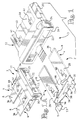
- Figures 5 and 6 show the method of manufacture of the above described fuse assembly.
- Figure 5 represents the progression by which flat metal strip stock is stamped and formed into the fuse terminal required for the fuse assembly.
- the progression shown in not intended to show every step which is taken to form the fuse terminals, but rather the figure is intended to be a diagrammatic representation of the manufacturing process.
- metal strip 102 is of sufficient width to allow for two strips of the fuse terminals to be manufactured at one time.
- the metal stock is stamped and formed as shown in steps A through G.
- the conductors 4, 6 of the fuse terminals 2 are formed by folding over the stock metal. This method of manufacture insures that the conductors will be of adequate thickness.
- the folding of conductors 4, 6 also eliminates the need to coin the fuse metal link 16, as the fuse metal link has the same thickness as the stock metal. As coining is difficult to precisely control, the use of a method which eliminates the need for coining provides for much more reliable fuses.
- two carrier strips 104 are provided which maintain the fuse terminals in a spaced relationship.
- a securing strip 106 is also provided to maintain the terminals in proper relationship. As shown at F and G of Figure 5, securing strip 106 extends between the carrier strips 104, to maintain the fuse terminals of each strip in a fixed position relative to each other.
- step H the majority of securing strip 106 is removed, thereby allowing each strip of the fuse terminals to move independently of each other.
- bar 44 is an important feature of the strip of terminals once securing strip 106 has been removed. With securing strip 106 removed from the terminals, bar 44 acts to maintain conductors 4, 6 in essentially parallel relationship. If bar 44 where not provided, fuse metal link 16 would be the only structural connection between conductors 4, 6 during steps H through K. This would be an unacceptable result, as the fuse metal link could not be able to withstand the forces associated therewith. Consequently, bar 44 prevents the failure of fuse metal link 16.
- housings 12 are provided on a carrier strip 108 to facilitate the automated production of the fuse assembly.
- carrier strip 108 has two rows of housings 12 extending therefrom. The rows of carrier strips are essentially mirror images of each other.
- a row of stamped and formed fuse terminals is provided on either side of carrier strip 108 in alignment with respective housings 12, as is illustrated in step L of Figure 6.
- the terminals are inserted into the housings, as is shown in steps L through N.
- step M once the terminal is partially inserted into the housing, a portion 46 of bar 44 is removed. As conductors 4, 6 are supported by housing 12, the structural support provided by bar 44 is not needed. The removal of portion 46 also prevents the flow of an electrical current across bar 44, thereby insuring that fuse metal link 16 will be the only portion across which an electrical current can flow between conductors 4, 6.
- the removal of portion 46 also provides fuse terminal 2 with stabilization members 42 required, as was previously discussed.
- fuse terminals 2 With fuse terminals 2 fully inserted into fuse assembly 3, the two rows of fuse assemblies are separated. Each row of fuse assemblies 3 is then placed on a real.
- the fuse assembly is relatively inexpensive to manufacture. This is due to the fact that no material is wasted, i.e. there is no need to coin the fuse metal link to the correct size.
- the terminals are manufactured from sheet metal stock which has the thickness required for the fuse metal link. In order to provide the structural advantages required by the conductors, the metal is folded over to provide the appropriate thickness. This provides for a much more accurate and stable fuse terminal because the manufacturing tolerances are easily controlled. (Coining of the fuse metal link results in inconsistent terminals due to the tolerances associated with coining.)
- bar 44 to provide the spacing required between the conductors during the manufacture of the fuse assemblies.
- the use of the bar prevents the structural failure of the fuse metal link during the manufacture of the fuse assembly.
Landscapes
- Engineering & Computer Science (AREA)
- Manufacturing & Machinery (AREA)
- Fuses (AREA)
Claims (4)
- Verfahren zum Herstellen einer elektrischen Sicherung (3), das folgende Schritte aufweist:a Stanzen von Öffnungen in einen Streifen Blech (102), der die verlangten elektrischen Eigenschaften hat;b Verformen des Metallstreifens (102), um Zuleitungen (4, 6) herzustellen, so daß die Zuleitungen (4,6) die verlangte strukturelle Festigkeit haben;c Entfernen eines Stützstreifens (106) zwischen den Zuleitungen (4, 6), so daß Positionierstreben (44) bereitgestellt werden, um die Zuleitungen (4, 6) strukturell miteinander zu verbinden, wobei die Positionierstreben (44) die Abstands- und Positioniervorrichtungen darstellen, um die Zuleitungen (4,6) in der richtigen Lage zueinander zu halten; undd Entfernen eines Teils (46) der Positionierstrebe (44), so daß die Positionierstrebe (44) keinen elektrischen oder strukturellen Kontakt zwischen den Zuleitungen (4, 6) bildet, wodurch eine Anschlagvorrichtung benachbart zu der Positionierstrebe (44) bereitgestellt wird;e Teilweises Einführen der Zuleitungen (4, 6) in ein Gehäuse (12) der Sicherung (3), bevor der Teil (46) der Positionierstrebe (44) entfernt wird, wodurch die Zuleitungen (4, 6) mit der notwendigen strukturellen Unterstützung versehen werden; undf Vollständiges Einführen der Zuleitungen (4, 6) in das Gehäuse (12) der Sicherung (3), nachdem der Teil (46) der Positionierstrebe (44) entfernt wurde.
- Verfahren zum Herstellen einer elektrischen Sicherung (3) nach Anspruch 1, in dem die Zuleitungen (4, 6) durch Umbiegen des Metalls gebildet werden, um einen Abschnitt des Metalls herzustellen, der im wesentlichen die doppelte Dicke des Metallstreifens (102) hat.
- Verfahren zum Herstellen einer elektrischen Sicherung (3) nach Anspruch 1 oder 2, in dem ein Metallstreifen verwendet wird, der eine Breite hat, die ungefähr der doppelten Länge einer Zuleitung (4, 6) entspricht, wodurch die Herstellung der Zuleitungen (4, 6) in zwei gleichzeitigen Reihen ermöglicht wird.
- Verfahren zum Herstellen einer elektrischen Sicherung nach Anspruch 1, 2 oder 3, wobei in Schritt b die Zuleitungen (4, 6) in zwei gegenüberliegenden Reihen hergestellt werden, die Schritte c und d in bezug auf die Zuleitungen (4, 6) beider Reihen ausgeführt werden, und wobei in Schritt e zwei gegenüberliegende Reihen von Gehäusen (12) bereitgestellt werden, wobei jedes Gehäuse (12) mit einem jeweiligen Paar der Zuleitungen (4, 6) ausgerichtet ist, jedes Paar Zuleitungen (4, 6) teilweise in ein jeweiliges Gehäuse (12) eingeführt wird, und Schritt f dann in bezug auf jedes Paar Zuleitungen (4, 6) und das jeweilige Gehäuse (12) ausgeführt wird.
Applications Claiming Priority (4)
| Application Number | Priority Date | Filing Date | Title |
|---|---|---|---|
| GB8818904 | 1988-08-09 | ||
| GB8818905 | 1988-08-09 | ||
| GB888818905A GB8818905D0 (en) | 1988-08-09 | 1988-08-09 | Fuse assembly |
| GB888818904A GB8818904D0 (en) | 1988-08-09 | 1988-08-09 | Method of manufacturing fuse assembly |
Publications (2)
| Publication Number | Publication Date |
|---|---|
| EP0354676A1 EP0354676A1 (de) | 1990-02-14 |
| EP0354676B1 true EP0354676B1 (de) | 1993-11-24 |
Family
ID=26294257
Family Applications (1)
| Application Number | Title | Priority Date | Filing Date |
|---|---|---|---|
| EP89307369A Expired - Lifetime EP0354676B1 (de) | 1988-08-09 | 1989-07-20 | Verfahren zur Herstellung einer Sicherung |
Country Status (5)
| Country | Link |
|---|---|
| US (1) | US4998086A (de) |
| EP (1) | EP0354676B1 (de) |
| JP (1) | JP2615214B2 (de) |
| CA (1) | CA1320523C (de) |
| DE (1) | DE68910900T2 (de) |
Families Citing this family (31)
| Publication number | Priority date | Publication date | Assignee | Title |
|---|---|---|---|---|
| AR246379A1 (es) * | 1991-10-09 | 1994-07-29 | Amp Inc | Fusible electrico de cuchilla. |
| US5307562A (en) * | 1992-11-06 | 1994-05-03 | The Whitaker Corporation | Method for making contact |
| DE9411394U1 (de) * | 1994-07-14 | 1994-09-22 | Wilhelm Pudenz GmbH, 27243 Dünsen | Sicherungseinsatz und Sicherungshalter hierfür |
| JPH08125352A (ja) * | 1994-10-12 | 1996-05-17 | Whitaker Corp:The | ハウジング組立体及びそれを使用する電気装置 |
| US6642834B1 (en) * | 1999-03-04 | 2003-11-04 | Littelfuse, Inc. | High voltage automotive use |
| JP3815709B2 (ja) * | 2000-03-31 | 2006-08-30 | 矢崎総業株式会社 | ヒューズ |
| JP2001291464A (ja) * | 2000-04-06 | 2001-10-19 | Yazaki Corp | ヒューズ |
| JP4104817B2 (ja) * | 2000-11-22 | 2008-06-18 | 太平洋精工株式会社 | ブレード形ヒューズ |
| US6878004B2 (en) * | 2002-03-04 | 2005-04-12 | Littelfuse, Inc. | Multi-element fuse array |
| WO2005053993A2 (en) * | 2003-11-26 | 2005-06-16 | Littelfuse, Inc. | Vehicle electrical protection device and system employing same |
| DE10358444A1 (de) * | 2003-12-13 | 2005-07-07 | Wilhelm Pudenz Gmbh | Einstückiger Sicherungseinsatz, Verfahren zur Herstellung des einstückigen Sicherungseinsatzes und Vorrichtung zur Durchführung des Verfahrens |
| DE20319350U1 (de) | 2003-12-13 | 2004-03-04 | Wilhelm Pudenz Gmbh | Sicherungseinsatz mit flachem Isolierkörper |
| WO2005088665A2 (en) | 2004-03-05 | 2005-09-22 | Littelfuse, Inc. | Low profile automotive fuse |
| JP2005353465A (ja) * | 2004-06-11 | 2005-12-22 | Sumitomo Wiring Syst Ltd | 電気接続箱のヒュージブルリンク装着構造 |
| WO2006032060A2 (en) * | 2004-09-15 | 2006-03-23 | Littelfuse, Inc. | High voltage/high current fuse |
| US20070236322A1 (en) * | 2006-04-10 | 2007-10-11 | Jerry Edwards | Fuse having connectable terminals |
| USD559203S1 (en) | 2006-11-14 | 2008-01-08 | Littelfuse, Inc. | Indicator for a fuse |
| US7983024B2 (en) | 2007-04-24 | 2011-07-19 | Littelfuse, Inc. | Fuse card system for automotive circuit protection |
| DE102008025917A1 (de) * | 2007-06-04 | 2009-01-08 | Littelfuse, Inc., Des Plaines | Hochspannungssicherung |
| US7808362B2 (en) * | 2007-08-13 | 2010-10-05 | Littlefuse, Inc. | Moderately hazardous environment fuse |
| US8674803B2 (en) * | 2007-08-13 | 2014-03-18 | Littelfuse, Inc. | Moderately hazardous environment fuse |
| USD575746S1 (en) | 2008-01-14 | 2008-08-26 | Littelfuse, Inc. | Blade fuse and fuse element therefore |
| US8077007B2 (en) * | 2008-01-14 | 2011-12-13 | Littlelfuse, Inc. | Blade fuse |
| USD575745S1 (en) | 2008-01-14 | 2008-08-26 | Littelfuse, Inc. | Blade fuse and fuse element therefore |
| JP5207533B2 (ja) * | 2008-09-05 | 2013-06-12 | 矢崎総業株式会社 | 複合型ヒュージブルリンク、ヒューズボックス及びその製造方法 |
| USD671504S1 (en) * | 2011-04-07 | 2012-11-27 | Pacific Engineering Corp. | Fuse |
| USD671080S1 (en) * | 2011-04-07 | 2012-11-20 | Pacific Engineering Corp. | Fuse |
| US9989579B2 (en) * | 2016-06-20 | 2018-06-05 | Eaton Intelligent Power Limited | Monitoring systems and methods for detecting thermal-mechanical strain fatigue in an electrical fuse |
| US11289298B2 (en) | 2018-05-31 | 2022-03-29 | Eaton Intelligent Power Limited | Monitoring systems and methods for estimating thermal-mechanical fatigue in an electrical fuse |
| US11143718B2 (en) | 2018-05-31 | 2021-10-12 | Eaton Intelligent Power Limited | Monitoring systems and methods for estimating thermal-mechanical fatigue in an electrical fuse |
| CN119626852B (zh) * | 2025-02-12 | 2025-06-10 | 温州万华塑胶有限公司 | 一种塑壳断路器基座铜件装配机及其装配工艺 |
Family Cites Families (11)
| Publication number | Priority date | Publication date | Assignee | Title |
|---|---|---|---|---|
| US3909767A (en) * | 1974-01-14 | 1975-09-30 | Littelfuse Inc | Miniature plug-in fuse |
| DE2511459A1 (de) * | 1975-03-15 | 1976-09-23 | Rau Swf Autozubehoer | Anordnung zur absicherung der elektrischen anlage eines motorgetriebenen fahrzeuges |
| US4224592A (en) * | 1978-04-03 | 1980-09-23 | Mcgraw-Edison Company | Miniature plug-in fuse assembly and method of manufacture |
| DE2940607A1 (de) * | 1979-10-06 | 1981-04-16 | Wilhelm Pudenz KG, 2831 Dünsen | Stecksicherung |
| DE2946093A1 (de) * | 1979-11-15 | 1981-05-27 | Wilhelm Pudenz KG, 2831 Dünsen | Stromfuehrendes teil einer stecksicherung |
| US4344060A (en) * | 1980-09-19 | 1982-08-10 | Littelfuse, Inc. | Enclosed plug-in fuse assembly |
| FR2491255B1 (fr) * | 1980-09-30 | 1985-07-05 | Dav Ind | Fusible |
| CH656979A5 (en) * | 1981-12-02 | 1986-07-31 | Pudenz Kg Wilhelm | Plug-in fuse and a method for its production |
| JPS58106732A (ja) * | 1981-12-18 | 1983-06-25 | ヴイルヘルム・プ−デンツ・コマンデイ−トゲゼルシヤフト | 差込み式ヒユ−ズ |
| US4394638A (en) * | 1982-07-21 | 1983-07-19 | Essex Group, Inc. | Miniature plug-in fuse assembly and method of making a fuse element therefor |
| US4672352A (en) * | 1986-04-23 | 1987-06-09 | Kabushiki Kaisha T An T | Fuse assembly |
-
1989
- 1989-06-20 US US07/368,737 patent/US4998086A/en not_active Expired - Fee Related
- 1989-07-20 DE DE68910900T patent/DE68910900T2/de not_active Expired - Fee Related
- 1989-07-20 EP EP89307369A patent/EP0354676B1/de not_active Expired - Lifetime
- 1989-07-21 CA CA000606388A patent/CA1320523C/en not_active Expired - Fee Related
- 1989-08-09 JP JP1206583A patent/JP2615214B2/ja not_active Expired - Lifetime
Also Published As
| Publication number | Publication date |
|---|---|
| DE68910900T2 (de) | 1994-06-01 |
| US4998086A (en) | 1991-03-05 |
| EP0354676A1 (de) | 1990-02-14 |
| JP2615214B2 (ja) | 1997-05-28 |
| CA1320523C (en) | 1993-07-20 |
| DE68910900D1 (de) | 1994-01-05 |
| JPH0287437A (ja) | 1990-03-28 |
Similar Documents
| Publication | Publication Date | Title |
|---|---|---|
| EP0354676B1 (de) | Verfahren zur Herstellung einer Sicherung | |
| EP0337659B1 (de) | Lötstift-Rückhaltevorrichtung | |
| US4255009A (en) | Two row electrical connector | |
| US5274918A (en) | Method for producing contact shorting bar insert for modular jack assembly | |
| EP0236490B1 (de) | Elektrischer steckgitterreihenverbinder | |
| EP0438120B1 (de) | Abzweigverbindergehäuse und Sammelschiene für eine Abzweigverbindung | |
| US4349804A (en) | Fuse assembly for a miniature plug-in fuse | |
| EP0503578B1 (de) | Elektrischer Steckverbinder mit Überbrückungen | |
| EP0653809B1 (de) | Elektrischer Verbinder und Anschlusselement dafür zur Verbindung mit ein Messerkontakt | |
| EP0472006A1 (de) | Elektrischer Steckverbinder mit Mitteln zum Sicherstellen einer zuverlässigen elektrischen Verbindung | |
| US5100342A (en) | High density flat cable connector | |
| JPH0154824B2 (de) | ||
| US5061196A (en) | Selective shorting of plug pins/socket contacts in an electrical connector | |
| EP0014037B1 (de) | Elektrischer Stecker für Flachkabel | |
| US4527857A (en) | Terminal for connecting a wire to a blade type terminal | |
| EP0795930B1 (de) | Elektrische Aufnahmebuchse für Stift mit hoher Kontaktkraft | |
| EP0185471A2 (de) | Isolierung wegschiebendes Endstück | |
| EP0191539B1 (de) | Elektrisches Anschlussendstück für Steckverbinder | |
| EP0041966A1 (de) | Verfahren zur herstellung elektrischer steckschmelzsicherungen und nach diesem verfahren hergestellte schmelzsicherung | |
| EP0390449B1 (de) | Elektrischer Verbinder | |
| CA2054656A1 (en) | Wall plate jack and contact therefor | |
| CA1091319A (en) | Method of producing multiple contact assemblies and contacts therefor | |
| EP0324119A2 (de) | Drucksteckverbinder | |
| EP0355432B1 (de) | Kontaktanordnung | |
| EP0762559A2 (de) | Elektrische Verbinderklemme mit gerundetem Lotanschlussstück |
Legal Events
| Date | Code | Title | Description |
|---|---|---|---|
| PUAI | Public reference made under article 153(3) epc to a published international application that has entered the european phase |
Free format text: ORIGINAL CODE: 0009012 |
|
| AK | Designated contracting states |
Kind code of ref document: A1 Designated state(s): DE FR GB IT |
|
| 17P | Request for examination filed |
Effective date: 19900627 |
|
| 17Q | First examination report despatched |
Effective date: 19920730 |
|
| RAP1 | Party data changed (applicant data changed or rights of an application transferred) |
Owner name: THE WHITAKER CORPORATION |
|
| GRAA | (expected) grant |
Free format text: ORIGINAL CODE: 0009210 |
|
| AK | Designated contracting states |
Kind code of ref document: B1 Designated state(s): DE FR GB IT |
|
| REF | Corresponds to: |
Ref document number: 68910900 Country of ref document: DE Date of ref document: 19940105 |
|
| ET | Fr: translation filed | ||
| ITF | It: translation for a ep patent filed | ||
| PLBE | No opposition filed within time limit |
Free format text: ORIGINAL CODE: 0009261 |
|
| STAA | Information on the status of an ep patent application or granted ep patent |
Free format text: STATUS: NO OPPOSITION FILED WITHIN TIME LIMIT |
|
| 26N | No opposition filed | ||
| PGFP | Annual fee paid to national office [announced via postgrant information from national office to epo] |
Ref country code: GB Payment date: 19980623 Year of fee payment: 10 |
|
| PGFP | Annual fee paid to national office [announced via postgrant information from national office to epo] |
Ref country code: FR Payment date: 19980707 Year of fee payment: 10 |
|
| PG25 | Lapsed in a contracting state [announced via postgrant information from national office to epo] |
Ref country code: GB Free format text: LAPSE BECAUSE OF NON-PAYMENT OF DUE FEES Effective date: 19990720 |
|
| PG25 | Lapsed in a contracting state [announced via postgrant information from national office to epo] |
Ref country code: FR Free format text: THE PATENT HAS BEEN ANNULLED BY A DECISION OF A NATIONAL AUTHORITY Effective date: 19990731 |
|
| GBPC | Gb: european patent ceased through non-payment of renewal fee |
Effective date: 19990720 |
|
| REG | Reference to a national code |
Ref country code: FR Ref legal event code: ST |
|
| PGFP | Annual fee paid to national office [announced via postgrant information from national office to epo] |
Ref country code: DE Payment date: 20020731 Year of fee payment: 14 |
|
| PG25 | Lapsed in a contracting state [announced via postgrant information from national office to epo] |
Ref country code: DE Free format text: LAPSE BECAUSE OF NON-PAYMENT OF DUE FEES Effective date: 20040203 |
|
| PG25 | Lapsed in a contracting state [announced via postgrant information from national office to epo] |
Ref country code: IT Free format text: LAPSE BECAUSE OF NON-PAYMENT OF DUE FEES;WARNING: LAPSES OF ITALIAN PATENTS WITH EFFECTIVE DATE BEFORE 2007 MAY HAVE OCCURRED AT ANY TIME BEFORE 2007. THE CORRECT EFFECTIVE DATE MAY BE DIFFERENT FROM THE ONE RECORDED. Effective date: 20050720 |