EP0353938B1 - Process for producing neuraminidase - Google Patents
Process for producing neuraminidase Download PDFInfo
- Publication number
- EP0353938B1 EP0353938B1 EP89307598A EP89307598A EP0353938B1 EP 0353938 B1 EP0353938 B1 EP 0353938B1 EP 89307598 A EP89307598 A EP 89307598A EP 89307598 A EP89307598 A EP 89307598A EP 0353938 B1 EP0353938 B1 EP 0353938B1
- Authority
- EP
- European Patent Office
- Prior art keywords
- neuraminidase
- mixture
- streptomyces
- added
- manufactured
- Prior art date
- Legal status (The legal status is an assumption and is not a legal conclusion. Google has not performed a legal analysis and makes no representation as to the accuracy of the status listed.)
- Expired - Lifetime
Links
Images
Classifications
-
- C—CHEMISTRY; METALLURGY
- C12—BIOCHEMISTRY; BEER; SPIRITS; WINE; VINEGAR; MICROBIOLOGY; ENZYMOLOGY; MUTATION OR GENETIC ENGINEERING
- C12N—MICROORGANISMS OR ENZYMES; COMPOSITIONS THEREOF; PROPAGATING, PRESERVING, OR MAINTAINING MICROORGANISMS; MUTATION OR GENETIC ENGINEERING; CULTURE MEDIA
- C12N9/00—Enzymes; Proenzymes; Compositions thereof; Processes for preparing, activating, inhibiting, separating or purifying enzymes
- C12N9/14—Hydrolases (3)
- C12N9/24—Hydrolases (3) acting on glycosyl compounds (3.2)
- C12N9/2402—Hydrolases (3) acting on glycosyl compounds (3.2) hydrolysing O- and S- glycosyl compounds (3.2.1)
-
- C—CHEMISTRY; METALLURGY
- C12—BIOCHEMISTRY; BEER; SPIRITS; WINE; VINEGAR; MICROBIOLOGY; ENZYMOLOGY; MUTATION OR GENETIC ENGINEERING
- C12Y—ENZYMES
- C12Y302/00—Hydrolases acting on glycosyl compounds, i.e. glycosylases (3.2)
- C12Y302/01—Glycosidases, i.e. enzymes hydrolysing O- and S-glycosyl compounds (3.2.1)
- C12Y302/01018—Exo-alpha-sialidase (3.2.1.18), i.e. trans-sialidase
-
- A—HUMAN NECESSITIES
- A61—MEDICAL OR VETERINARY SCIENCE; HYGIENE
- A61K—PREPARATIONS FOR MEDICAL, DENTAL OR TOILETRY PURPOSES
- A61K38/00—Medicinal preparations containing peptides
Definitions
- Neuraminidase (EC 3.2.1.18) is a hydrolase capable of releasing sialic acid residues, whose substrate is a ketoside having sialic acid residues in the ⁇ -configuration located at the ends of, for example, glycoproteins and glycolipids. (Acyl derivatives of neuraminic acid are collectively called sialic acid).
- Neuraminidase is used for quantitative determination of sialic acid-containing substances in the living body such as sera, and is utilized for clinical diagnosis of various diseases such as inflammatory diseases, diffuse collagen diseases and cancer.
- neuraminidase is widely distributed in microorganisms such as viruses, bacteria and actinomycetes, and in various tissues, for example from fowls and mammals.
- neuraminidase For production of neuraminidase using microorganisms, various processes are known wherein a microorganism capable of producing neuraminidase is cultured in a medium supplemented with a neuraminidase inducer such as colominic acid, a leach and extract of various animal tissues, and neuraminidase formed is recovered therefrom [Metabolism, 16 (5), 761 (1979); Biochim. Biophys. Acta, 350 , 425-431 (1974); J. Biochem., 82 , 1425-1433 (1977); J. Bacteriol., 119 (2), 394-400 (1974); Canadian J. Microbiology, 18 , 1007 (1972); Japanese Published Examined Patent Application No. 11991/1975; and Japanese Published Unexamined Patent Application No. 34181/1985 (USP No. 4710470, EP 133694-A)].
- a neuraminidase inducer such as colominic acid,
- the present inventors have made various investigations on processes for producing neuraminidase at low cost on an industrial scale. As a result, it has been found that by cloning a DNA fragment which is derived from a microorganism belonging to the genus Micromonospora and harboring a gene encoding neuraminidase and introducing a recombinant DNA containing said DNA fragment into a Streptomyces host, the neuraminidase productivity of the host is high and neuraminidase can be produced without supplementing with any neuraminidase inducer.
- the invention provides an isolated vector capable of autonomously replicating in a microorganism belonging to the genus Streptomyces , containing a DNA fragment which is derived from a microorganism belonging to the genus Micromonospora and which encodes neuraminidase.
- the invention also provides a process for producing neuraminidase, which comprises culturing in a medium a microorganism belonging to the genus Streptomyces harbouring a vector of the invention, accumulating neuraminidase in the culture and recovering neuraminidase from the culture.
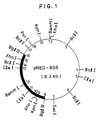
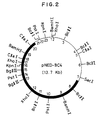
- Figs. 1 and 2 illustrate the restriction enzyme maps of plasmids pNED-BG6 and pNED-BC4, respectively.
- bold portions show regions containing a gene encoding neuraminidase, and numerals indicate the following values (kb).
- chromosomal DNA of a microorganism belonging to the genus Micromonospora which is capable of producing neuraminidase may be used.
- Specific examples of strains are as follows.
- any vector is usable so long as it is able to autonomously replicate in strains belonging to the genus Streptomyces .
- Preferred examples include pIJ41 [Gene, 20 , 51-62 (1982)] and pIJ702 [J. Gen. Microbiol., 129 , 2703-2714 (1983)].
- Vectors containing a DNA fragment carrying thereon genetic information that participates in the synthesis of neuraminidase can be obtained in a mixture of various vectors by cleaving a donor DNA and a parent vector with appropriate restriction enzymes, for example, Bgl II or Bcl I, and ligating them utilizing their cleavage terminals. Microorganisms incapable of producing neuraminidase are transformed with the thus obtained vectors. By examining the neuraminidase productivity of the thus obtained transformants, a transformant which has acquired neuraminidase productivity is selected. A vector containing a DNA fragment carrying thereon genetic information that participates in the synthesis of neuraminidase can be obtained by extracting it from the thus obtained transformant.
- appropriate restriction enzymes for example, Bgl II or Bcl I
- any microorganisms is usable so long as it belongs to the genus Streptomyces and can acquire neuraminidase productivity by harboring a vector according to the invention. Specifically, the following strains can be used.
- a strain capable of producing neuraminidase can be obtained by transforming one of the host microorganisms described above with a vector containing a DNA fragment carrying thereon genetic information that participates in the synthesis of neuraminidase in accordance with the method of K.F. Chater et al. [Current Topics in Microbiology and Immunology, 96 , 69-95 (1982)].
- microorganisms which can be used in the invention include Streptomyces lividans NED-BG6 harboring recombinant DNA pNED-BG6 obtained by inserting into pIJ702 a Micromonospora viridifaciens -derived DNA fragment carrying thereon genetic information that participates in the synthesis of neuraminidase, and Streptomyces lividans NED-BC4 harboring recombinant DNA pNED-BC4 obtained in a similar manner.
- the strains were deposited with the Fermentation Research Institute, Agency of Industrial Science and Technology of Japan under the Budapest Treaty on February 27, 1988 and March 17, 1989 under accession Nos. FERM BP-1768 and FERM BP-2340, respectively.
- transformants having neuraminidase productivity which are obtained in the invention are cultured in a manner conventionally employed for the cultivation of ordinary actinomycetes without supplementing any neuraminidase inducer to produce and accumulate neuraminidase in the culture.
- any natural medium or synthetic medium may be used so long as it contains suitable carbon sources, nitrogen sources, inorganic substances and other nutrients.
- various carbohydrates such as glucose, fructose, sucrose, maltose, mannose, starch, starch hydrolysate and molasses
- various sugar alcohols such as glycerol, sorbitol and mannitol
- various organic acids such as acetic acid, lactic acid, pyruvic acid, fumaric acid and citric acid
- various alcohols such as ethanol
- various glycols such as ethylene glycol and propylene glycol
- various amino acids a leaching solution of bovine heart or bovine brain and bovine blood powders.
- ammonia or various inorganic and organic ammonium salts such as ammonium chloride, ammonium carbonate, ammonium phosphate, ammonium nitrate and ammonium acetate; nitrates such as sodium nitrate and potassium nitrate; urea, amino acids and other nitrogen compounds, as well as nitrogen-containing organic compounds, such as peptone, NZ-amine, meat extract, corn steep liquor, casein hydrolysate, chrysalis hydrolysate, fish meal or its digestion products and defatted soybean or digestion products thereof.
- ammonia or various inorganic and organic ammonium salts such as ammonium chloride, ammonium carbonate, ammonium phosphate, ammonium nitrate and ammonium acetate
- nitrates such as sodium nitrate and potassium nitrate
- urea amino acids and other nitrogen compounds
- nitrogen-containing organic compounds such as peptone, NZ-amine, meat extract, corn steep liquor, casein hydroly
- inorganic substances there can be used, for example, potassium dihydrogenphosphate, dipotassium hydrogenphosphate, potassium chloride, magnesium sulfate, manganese sulfate, ferrous sulfate, sodium chloride or calcium carbonate.
- the cultivation is typically carried out at a pH of 6.0 to 7.5 and a temperature of 25 to 35°C for 4 to 6 days under aerobic conditions while agitating.
- Neuraminidase can be recovered from the culture as follows.
- the culture After completion of the cultivation, the culture is filtered or centrifuged and the cells are removed to obtain the filtrate or supernatant.
- the filtrate or supernatant is treated in a conventional manner generally used for the purification of an enzyme, for example, salting out, precipitation with organic solvents, dialysis, ion exchange column chromatography, gel filtration and freeze drying to recover purified neuraminidase.
- the filtrate of a culture is subjected to salting out with 50% saturated ammonium sulfate solution.
- the precipitates formed are dissolved in a buffer.
- the dialysate is adsorbed on a column packed with an anionic exchange resin, such as DEAE-Sephadex or DEAE-cellulose.
- the adsorbed enzyme is eluted with a density gradient of sodium chloride or ammonium sulfate.
- the eluted enzyme is further purified by gel filtration with Sephadex G-75 or Biogel P-100.
- Streptomyces lividans NED-BG6 (FERM BP-1768) harboring pNED-BG6 obtained in Example 1 and Streptomyces lividans NED-BC4 (FERM BP-2340) harboring pNED-BC4 obtained in Example 1 were inoculated in 4 ml each of YEME medium [a medium containing 3.0 g of yeast extract (manufactured by Difco Inc.), 5.0 g of bactopeptone (manufactured by Difco Inc.) and 10.0 g of glucose in 1 liter of deionized water, adjusted to a pH of 7.2 and autoclaved at 120°C for 20 minutes] containing 1 ⁇ g of thiopeptin, followed by shaking culture at 30°C for 2 days.
- YEME medium a medium containing 3.0 g of yeast extract (manufactured by Difco Inc.), 5.0 g of bactopeptone (manufactured by Dif
- the thus obtained seed culture 0.5 ml, was inoculated in 10 ml of SK No. 2 medium containing 2.5 ⁇ g of thiopeptin, followed by shaking culture at 30°C for 5 days. During the culturing, 0.2 ml each of the culture broth was subjected to sampling every day.
- Each of the cultivation sample was centrifuged at 14,000 rpm at 4°C for 5 minutes to collect the supernatant.
- the supernatant was diluted with deionized water to 40-fold, and its neuraminidase activity was determined.
- neuraminidase activity was made in accordance with the quantitative assay for N-acetylhexosamine described in "Protein, Nucleic Acid, Enzyme", separate volume “Experimental Method of Glycosides", page 22 (1968) published by Kyoritsu Publishing Co., Ltd.
- borate solution prepared by dissolving 4.95 g of boric acid in 50 ml of deionized water and adjusting its pH to 9.1, followed by the addition of deionized water to make 100 ml
- the reaction mixture was dipped in water to cool.
- Micromonospora viridifaciens the original strain, showed 1.2 units/ml at the highest.
- the whole amount was gently adsorbed on a column (having an inner diameter of 4.2 cm and a height of 37.5 cm) packed with 500 ml of DEAE-Sepharose CL-6B (manufactured by Pharmacia Fine Chemicals Inc.), and 1 liter of phosphate buffer was passed through the column to remove the non-adsorbed portion.
- a column having an inner diameter of 4.2 cm and a height of 37.5 cm
- DEAE-Sepharose CL-6B manufactured by Pharmacia Fine Chemicals Inc.
- DNA nucleotide sequence of the neuraminidase gene derived from Micromonospora viridifaciens was determined as follows. Since it was expected that the gene was present in the common part (8, 9, 10, 11, 12 and 13 positions in Fig. 1 and 15, 16, 17, 18, 19 and 20 positions in Fig. 2) of insert DNAs in recombinant plasmids pNED-BG6 and pNED-BC4 produced in Example 1, the common region and the upstream and downstream regions thereof were analyzed.
- a DNA fragment of 2.5 kb digested with Bgl II (Fig. 1, 8 to 16 positions), derived from pNED-BG6, and a DNA fragment of 0.5 kb digested with Bgl II (Fig. 2, 13 to 15 positions), derived from pNED-BC4, were cloned, respectively, using E . coli cloning vector pUC118 [Methods in Enzymology, 153 , 3-11 (1987)]. Since nucleotide sequence is determined using viral single-stranded DNA and primer extension goes only toward one direction to inserted DNA, each DNA fragment was inserted in two directions, so as to make it possible to determine the nucleotide sequence of the inserted DNA fragment from both ends.
- the inserted DNA fragment was excised by using restriction enzymes Pst I and Xba I (both manufactured by Boehringer GmbH), and various deletion mutants were prepared using Kilo-Deletion Kit (manufactured by Takara Shuzo Co., Ltd.). From the deletion mutants obtained, various DNA fragments were recovered with helper phage M13K07 as single stranded DNA, and their base sequence was determined in accordance with the dideoxy method [Proc. Natl. Acad. Sci. USA., 74 , 5463-5467 (1977)].
Landscapes
- Chemical & Material Sciences (AREA)
- Life Sciences & Earth Sciences (AREA)
- Organic Chemistry (AREA)
- Health & Medical Sciences (AREA)
- Zoology (AREA)
- Engineering & Computer Science (AREA)
- Bioinformatics & Cheminformatics (AREA)
- Genetics & Genomics (AREA)
- Wood Science & Technology (AREA)
- General Health & Medical Sciences (AREA)
- General Engineering & Computer Science (AREA)
- Biochemistry (AREA)
- Molecular Biology (AREA)
- Microbiology (AREA)
- Biotechnology (AREA)
- Biomedical Technology (AREA)
- Medicinal Chemistry (AREA)
- Enzymes And Modification Thereof (AREA)
- Micro-Organisms Or Cultivation Processes Thereof (AREA)
Applications Claiming Priority (4)
| Application Number | Priority Date | Filing Date | Title |
|---|---|---|---|
| JP18644188 | 1988-07-26 | ||
| JP186441/88 | 1988-07-26 | ||
| JP1081199A JP2886547B2 (ja) | 1988-07-26 | 1989-03-31 | ノイラミニダーゼの製造法 |
| JP81199/89 | 1989-03-31 |
Publications (2)
| Publication Number | Publication Date |
|---|---|
| EP0353938A1 EP0353938A1 (en) | 1990-02-07 |
| EP0353938B1 true EP0353938B1 (en) | 1994-12-21 |
Family
ID=26422236
Family Applications (1)
| Application Number | Title | Priority Date | Filing Date |
|---|---|---|---|
| EP89307598A Expired - Lifetime EP0353938B1 (en) | 1988-07-26 | 1989-07-26 | Process for producing neuraminidase |
Country Status (4)
| Country | Link |
|---|---|
| US (1) | US5268290A (enExample) |
| EP (1) | EP0353938B1 (enExample) |
| JP (1) | JP2886547B2 (enExample) |
| DE (1) | DE68920087T2 (enExample) |
Families Citing this family (9)
| Publication number | Priority date | Publication date | Assignee | Title |
|---|---|---|---|---|
| KR20050057136A (ko) * | 2002-09-04 | 2005-06-16 | 가부시키가이샤 디나벡크 겐큐쇼 | 시알산 결합활성을 갖는 막단백질을 엔벨로프에 포함하는바이러스 벡터를 그람 양성균 유래 뉴라미니다아제를 사용하여 제조하는 방법 |
| US20090227032A1 (en) | 2005-12-13 | 2009-09-10 | Kyoto University | Nuclear reprogramming factor and induced pluripotent stem cells |
| BRPI0619794B8 (pt) | 2005-12-13 | 2022-06-14 | Univ Kyoto | Uso de um fator de reprogramação, agente para a preparação de uma célula-tronco pluripotente induzida a partir de uma célula somática e métodos para preparar uma célula- tronco pluripotente induzida método e para preparar uma célula somática e uso de células-tronco pluripotentes induzidas |
| US8278104B2 (en) * | 2005-12-13 | 2012-10-02 | Kyoto University | Induced pluripotent stem cells produced with Oct3/4, Klf4 and Sox2 |
| US8129187B2 (en) * | 2005-12-13 | 2012-03-06 | Kyoto University | Somatic cell reprogramming by retroviral vectors encoding Oct3/4. Klf4, c-Myc and Sox2 |
| JP2008307007A (ja) | 2007-06-15 | 2008-12-25 | Bayer Schering Pharma Ag | 出生後のヒト組織由来未分化幹細胞から誘導したヒト多能性幹細胞 |
| US9213999B2 (en) | 2007-06-15 | 2015-12-15 | Kyoto University | Providing iPSCs to a customer |
| KR101661940B1 (ko) * | 2008-05-02 | 2016-10-04 | 고쿠리츠 다이가쿠 호진 교토 다이가쿠 | 핵 초기화 방법 |
| IL295259A (en) | 2020-02-03 | 2022-10-01 | Premas Biotech Private Ltd | Recombinant expression platform, constructs and methods for expression of proteins that are difficult to express (dte-ps) |
Family Cites Families (3)
| Publication number | Priority date | Publication date | Assignee | Title |
|---|---|---|---|---|
| JPS5011991A (enExample) * | 1973-06-01 | 1975-02-06 | ||
| JPS6034181A (ja) * | 1983-08-04 | 1985-02-21 | Kyowa Hakko Kogyo Co Ltd | ノイラミニダ−ゼの製造法 |
| US5024948A (en) * | 1985-10-17 | 1991-06-18 | American Cyanamid Company | Genetic system for micromonospora |
-
1989
- 1989-03-31 JP JP1081199A patent/JP2886547B2/ja not_active Expired - Fee Related
- 1989-07-25 US US07/384,709 patent/US5268290A/en not_active Expired - Lifetime
- 1989-07-26 EP EP89307598A patent/EP0353938B1/en not_active Expired - Lifetime
- 1989-07-26 DE DE68920087T patent/DE68920087T2/de not_active Expired - Fee Related
Also Published As
| Publication number | Publication date |
|---|---|
| DE68920087D1 (de) | 1995-02-02 |
| US5268290A (en) | 1993-12-07 |
| DE68920087T2 (de) | 1995-07-20 |
| JP2886547B2 (ja) | 1999-04-26 |
| EP0353938A1 (en) | 1990-02-07 |
| JPH02131577A (ja) | 1990-05-21 |
Similar Documents
| Publication | Publication Date | Title |
|---|---|---|
| Sawers et al. | Expression and operon structure of the sel genes of Escherichia coli and identification of a third selenium-containing formate dehydrogenase isoenzyme | |
| CN100491524C (zh) | 生产葡糖胺的方法和原料 | |
| Grogan | Evidence that β-galactosidase of Sulfolobus solfataricus is only one of several activities of a thermostable β-d-glycosidase | |
| EP0832970B1 (en) | Process for producing nucleoside-5'-phosphate ester | |
| Hove-Jensen et al. | Escherichia coli rpiA gene encoding ribose phosphate isomerase A | |
| CA1170202A (en) | Process for cloning the gene coding for a thermostable alpha-amylase into escherichia coli and bacillus subtilis | |
| US5268290A (en) | Process for producing neuraminidase | |
| JP2729628B2 (ja) | 巨大菌からのグルコース・デヒドロゲナーゼの調製方法 | |
| EP0739983B1 (en) | Gene encoding lacto-n-biosidase | |
| EP0537553B1 (en) | Farnesyl pyrophosphate synthetase and DNA sequence encoding the same | |
| JPS62155081A (ja) | 新規微生物およびそれを用いる醗酵法によるビオチンの製造法 | |
| EP0420894B1 (en) | Large scale method for purification of high purity heparinase | |
| WO1985005632A1 (en) | Chimeric plasmids that replicate in bacteria and yeast and microorganisms transformed therewith | |
| JPH0630583B2 (ja) | Dνaおよびその用途 | |
| EP0374771B1 (en) | Production method for PvuI restriction endonuclease | |
| US4518698A (en) | Plasmid and production thereof | |
| US4478937A (en) | Plasmid and production thereof | |
| EP0240105A1 (en) | A gene coding for biotin synthetase and utilization thereof | |
| EP0548095B1 (en) | Pharmaceutical compositions containing superoxide dismutase from bacillus stearothermophilus and bacillus caldotenax | |
| EP0162725B1 (en) | Chimeric plasmid vector | |
| Murray et al. | Characterization of a rifampin-resistant, conditional asporogenous mutant of Bacillus subtilis | |
| RU2314346C2 (ru) | Плазмиды для хромосомной рекомбинации escherichia coli | |
| JPS59159778A (ja) | 耐熱性のロイシン脱水素酵素の製造法 | |
| JP3472841B2 (ja) | プロモーター活性を有する遺伝子断片及び藍藻による異種タンパク質の大量製造法 | |
| JPH01132384A (ja) | プラスミド及びそれで形質転換されたエシェリチア・コリ |
Legal Events
| Date | Code | Title | Description |
|---|---|---|---|
| PUAI | Public reference made under article 153(3) epc to a published international application that has entered the european phase |
Free format text: ORIGINAL CODE: 0009012 |
|
| AK | Designated contracting states |
Kind code of ref document: A1 Designated state(s): DE FR GB |
|
| 17P | Request for examination filed |
Effective date: 19900226 |
|
| 17Q | First examination report despatched |
Effective date: 19930114 |
|
| GRAA | (expected) grant |
Free format text: ORIGINAL CODE: 0009210 |
|
| AK | Designated contracting states |
Kind code of ref document: B1 Designated state(s): DE FR GB |
|
| REF | Corresponds to: |
Ref document number: 68920087 Country of ref document: DE Date of ref document: 19950202 |
|
| ET | Fr: translation filed | ||
| PLBE | No opposition filed within time limit |
Free format text: ORIGINAL CODE: 0009261 |
|
| STAA | Information on the status of an ep patent application or granted ep patent |
Free format text: STATUS: NO OPPOSITION FILED WITHIN TIME LIMIT |
|
| 26N | No opposition filed | ||
| REG | Reference to a national code |
Ref country code: GB Ref legal event code: IF02 |
|
| PGFP | Annual fee paid to national office [announced via postgrant information from national office to epo] |
Ref country code: FR Payment date: 20050708 Year of fee payment: 17 |
|
| PGFP | Annual fee paid to national office [announced via postgrant information from national office to epo] |
Ref country code: GB Payment date: 20050720 Year of fee payment: 17 |
|
| PGFP | Annual fee paid to national office [announced via postgrant information from national office to epo] |
Ref country code: DE Payment date: 20050721 Year of fee payment: 17 |
|
| PG25 | Lapsed in a contracting state [announced via postgrant information from national office to epo] |
Ref country code: GB Free format text: LAPSE BECAUSE OF NON-PAYMENT OF DUE FEES Effective date: 20060726 |
|
| PG25 | Lapsed in a contracting state [announced via postgrant information from national office to epo] |
Ref country code: DE Free format text: LAPSE BECAUSE OF NON-PAYMENT OF DUE FEES Effective date: 20070201 |
|
| GBPC | Gb: european patent ceased through non-payment of renewal fee |
Effective date: 20060726 |
|
| REG | Reference to a national code |
Ref country code: FR Ref legal event code: ST Effective date: 20070330 |
|
| PG25 | Lapsed in a contracting state [announced via postgrant information from national office to epo] |
Ref country code: FR Free format text: LAPSE BECAUSE OF NON-PAYMENT OF DUE FEES Effective date: 20060731 |