EP0349330B1 - Photographisches Material und Verfahren (B) - Google Patents
Photographisches Material und Verfahren (B) Download PDFInfo
- Publication number
- EP0349330B1 EP0349330B1 EP89306644A EP89306644A EP0349330B1 EP 0349330 B1 EP0349330 B1 EP 0349330B1 EP 89306644 A EP89306644 A EP 89306644A EP 89306644 A EP89306644 A EP 89306644A EP 0349330 B1 EP0349330 B1 EP 0349330B1
- Authority
- EP
- European Patent Office
- Prior art keywords
- pug
- group
- photographic
- coupler
- link
- Prior art date
- Legal status (The legal status is an assumption and is not a legal conclusion. Google has not performed a legal analysis and makes no representation as to the accuracy of the status listed.)
- Expired - Lifetime
Links
- 239000000463 material Substances 0.000 title claims abstract description 53
- 238000000034 method Methods 0.000 title claims abstract description 13
- 230000008569 process Effects 0.000 title claims abstract description 10
- 150000001875 compounds Chemical class 0.000 claims abstract description 64
- -1 silver halide Chemical class 0.000 claims abstract description 48
- 229910052709 silver Inorganic materials 0.000 claims abstract description 36
- 239000004332 silver Substances 0.000 claims abstract description 36
- 230000000269 nucleophilic effect Effects 0.000 claims abstract description 14
- 238000006073 displacement reaction Methods 0.000 claims abstract description 9
- 239000003795 chemical substances by application Substances 0.000 claims description 49
- 238000006243 chemical reaction Methods 0.000 claims description 32
- 238000011161 development Methods 0.000 claims description 31
- 239000003112 inhibitor Substances 0.000 claims description 31
- 125000000217 alkyl group Chemical group 0.000 claims description 26
- 239000000839 emulsion Substances 0.000 claims description 25
- 238000012545 processing Methods 0.000 claims description 15
- 229910052739 hydrogen Inorganic materials 0.000 claims description 14
- 239000001257 hydrogen Substances 0.000 claims description 14
- 125000003118 aryl group Chemical group 0.000 claims description 11
- 125000000753 cycloalkyl group Chemical group 0.000 claims description 9
- 125000000623 heterocyclic group Chemical group 0.000 claims description 9
- UFHFLCQGNIYNRP-UHFFFAOYSA-N Hydrogen Chemical compound [H][H] UFHFLCQGNIYNRP-UHFFFAOYSA-N 0.000 claims description 8
- 125000006575 electron-withdrawing group Chemical group 0.000 claims description 4
- 125000006574 non-aromatic ring group Chemical group 0.000 claims description 2
- 230000007062 hydrolysis Effects 0.000 abstract description 9
- 238000006460 hydrolysis reaction Methods 0.000 abstract description 9
- 238000005859 coupling reaction Methods 0.000 abstract description 8
- 230000008878 coupling Effects 0.000 abstract description 6
- 238000010168 coupling process Methods 0.000 abstract description 6
- 239000000975 dye Substances 0.000 description 48
- XEKOWRVHYACXOJ-UHFFFAOYSA-N Ethyl acetate Chemical compound CCOC(C)=O XEKOWRVHYACXOJ-UHFFFAOYSA-N 0.000 description 42
- 239000010410 layer Substances 0.000 description 40
- VLKZOEOYAKHREP-UHFFFAOYSA-N n-Hexane Chemical compound CCCCCC VLKZOEOYAKHREP-UHFFFAOYSA-N 0.000 description 30
- 125000004432 carbon atom Chemical group C* 0.000 description 22
- YGYAWVDWMABLBF-UHFFFAOYSA-N Phosgene Chemical compound ClC(Cl)=O YGYAWVDWMABLBF-UHFFFAOYSA-N 0.000 description 17
- YMWUJEATGCHHMB-UHFFFAOYSA-N Dichloromethane Chemical compound ClCCl YMWUJEATGCHHMB-UHFFFAOYSA-N 0.000 description 12
- 239000000047 product Substances 0.000 description 11
- VYPSYNLAJGMNEJ-UHFFFAOYSA-N Silicium dioxide Chemical compound O=[Si]=O VYPSYNLAJGMNEJ-UHFFFAOYSA-N 0.000 description 9
- CSNNHWWHGAXBCP-UHFFFAOYSA-L Magnesium sulfate Chemical compound [Mg+2].[O-][S+2]([O-])([O-])[O-] CSNNHWWHGAXBCP-UHFFFAOYSA-L 0.000 description 8
- 230000000694 effects Effects 0.000 description 8
- 239000002243 precursor Substances 0.000 description 8
- 239000000741 silica gel Substances 0.000 description 8
- 229910002027 silica gel Inorganic materials 0.000 description 8
- 239000002904 solvent Substances 0.000 description 8
- 239000007844 bleaching agent Substances 0.000 description 7
- 125000001495 ethyl group Chemical group [H]C([H])([H])C([H])([H])* 0.000 description 7
- 125000001997 phenyl group Chemical group [H]C1=C([H])C([H])=C(*)C([H])=C1[H] 0.000 description 7
- QTBSBXVTEAMEQO-UHFFFAOYSA-N Acetic acid Chemical compound CC(O)=O QTBSBXVTEAMEQO-UHFFFAOYSA-N 0.000 description 6
- WEVYAHXRMPXWCK-UHFFFAOYSA-N Acetonitrile Chemical compound CC#N WEVYAHXRMPXWCK-UHFFFAOYSA-N 0.000 description 6
- 108010010803 Gelatin Proteins 0.000 description 6
- OKKJLVBELUTLKV-UHFFFAOYSA-N Methanol Chemical compound OC OKKJLVBELUTLKV-UHFFFAOYSA-N 0.000 description 6
- YXFVVABEGXRONW-UHFFFAOYSA-N Toluene Chemical compound CC1=CC=CC=C1 YXFVVABEGXRONW-UHFFFAOYSA-N 0.000 description 6
- 125000003545 alkoxy group Chemical group 0.000 description 6
- 238000004458 analytical method Methods 0.000 description 6
- 125000000484 butyl group Chemical group [H]C([*])([H])C([H])([H])C([H])([H])C([H])([H])[H] 0.000 description 6
- 239000008273 gelatin Substances 0.000 description 6
- 229920000159 gelatin Polymers 0.000 description 6
- 235000019322 gelatine Nutrition 0.000 description 6
- 235000011852 gelatine desserts Nutrition 0.000 description 6
- 229910052736 halogen Inorganic materials 0.000 description 6
- 150000002367 halogens Chemical class 0.000 description 6
- 239000000203 mixture Substances 0.000 description 6
- 238000011160 research Methods 0.000 description 6
- 238000004809 thin layer chromatography Methods 0.000 description 6
- XLYOFNOQVPJJNP-UHFFFAOYSA-N water Chemical compound O XLYOFNOQVPJJNP-UHFFFAOYSA-N 0.000 description 6
- 125000004429 atom Chemical group 0.000 description 5
- 125000003354 benzotriazolyl group Chemical class N1N=NC2=C1C=CC=C2* 0.000 description 5
- 125000003178 carboxy group Chemical group [H]OC(*)=O 0.000 description 5
- 150000002431 hydrogen Chemical group 0.000 description 5
- 125000002496 methyl group Chemical group [H]C([H])([H])* 0.000 description 5
- JAAIPIWKKXCNOC-UHFFFAOYSA-N 1h-tetrazol-1-ium-5-thiolate Chemical class SC1=NN=NN1 JAAIPIWKKXCNOC-UHFFFAOYSA-N 0.000 description 4
- RTZKZFJDLAIYFH-UHFFFAOYSA-N Diethyl ether Chemical compound CCOCC RTZKZFJDLAIYFH-UHFFFAOYSA-N 0.000 description 4
- JGFZNNIVVJXRND-UHFFFAOYSA-N N,N-Diisopropylethylamine (DIPEA) Chemical compound CCN(C(C)C)C(C)C JGFZNNIVVJXRND-UHFFFAOYSA-N 0.000 description 4
- JUJWROOIHBZHMG-UHFFFAOYSA-N Pyridine Chemical compound C1=CC=NC=C1 JUJWROOIHBZHMG-UHFFFAOYSA-N 0.000 description 4
- BQCADISMDOOEFD-UHFFFAOYSA-N Silver Chemical compound [Ag] BQCADISMDOOEFD-UHFFFAOYSA-N 0.000 description 4
- HUMNYLRZRPPJDN-UHFFFAOYSA-N benzaldehyde Chemical compound O=CC1=CC=CC=C1 HUMNYLRZRPPJDN-UHFFFAOYSA-N 0.000 description 4
- 230000015572 biosynthetic process Effects 0.000 description 4
- DOIRQSBPFJWKBE-UHFFFAOYSA-N dibutyl phthalate Chemical compound CCCCOC(=O)C1=CC=CC=C1C(=O)OCCCC DOIRQSBPFJWKBE-UHFFFAOYSA-N 0.000 description 4
- 229910052943 magnesium sulfate Inorganic materials 0.000 description 4
- 235000019341 magnesium sulphate Nutrition 0.000 description 4
- 230000002829 reductive effect Effects 0.000 description 4
- 239000007858 starting material Substances 0.000 description 4
- 238000003786 synthesis reaction Methods 0.000 description 4
- RLIHXKPTGKETCC-QMMMGPOBSA-N (2s)-2-(benzylazaniumyl)propanoate Chemical compound OC(=O)[C@H](C)NCC1=CC=CC=C1 RLIHXKPTGKETCC-QMMMGPOBSA-N 0.000 description 3
- YEJHUOTUSORYPX-VIFPVBQESA-N (2s)-2-[benzyl(methyl)amino]propanoic acid Chemical compound OC(=O)[C@H](C)N(C)CC1=CC=CC=C1 YEJHUOTUSORYPX-VIFPVBQESA-N 0.000 description 3
- 0 **=CC(CC1)CC1C1CC1 Chemical compound **=CC(CC1)CC1C1CC1 0.000 description 3
- GGZHVNZHFYCSEV-UHFFFAOYSA-N 1-Phenyl-5-mercaptotetrazole Chemical compound SC1=NN=NN1C1=CC=CC=C1 GGZHVNZHFYCSEV-UHFFFAOYSA-N 0.000 description 3
- CSCPPACGZOOCGX-UHFFFAOYSA-N Acetone Chemical compound CC(C)=O CSCPPACGZOOCGX-UHFFFAOYSA-N 0.000 description 3
- 241001479434 Agfa Species 0.000 description 3
- WSFSSNUMVMOOMR-UHFFFAOYSA-N Formaldehyde Chemical compound O=C WSFSSNUMVMOOMR-UHFFFAOYSA-N 0.000 description 3
- KWYUFKZDYYNOTN-UHFFFAOYSA-M Potassium hydroxide Chemical compound [OH-].[K+] KWYUFKZDYYNOTN-UHFFFAOYSA-M 0.000 description 3
- 229920004890 Triton X-100 Polymers 0.000 description 3
- 239000013504 Triton X-100 Substances 0.000 description 3
- 238000004061 bleaching Methods 0.000 description 3
- 125000002915 carbonyl group Chemical group [*:2]C([*:1])=O 0.000 description 3
- 239000003054 catalyst Substances 0.000 description 3
- 125000001309 chloro group Chemical group Cl* 0.000 description 3
- 238000003776 cleavage reaction Methods 0.000 description 3
- 125000002887 hydroxy group Chemical group [H]O* 0.000 description 3
- 230000007246 mechanism Effects 0.000 description 3
- 229910052751 metal Inorganic materials 0.000 description 3
- 239000002184 metal Substances 0.000 description 3
- 239000000123 paper Substances 0.000 description 3
- 239000002516 radical scavenger Substances 0.000 description 3
- 230000000717 retained effect Effects 0.000 description 3
- 230000007017 scission Effects 0.000 description 3
- ZUNKMNLKJXRCDM-UHFFFAOYSA-N silver bromoiodide Chemical compound [Ag].IBr ZUNKMNLKJXRCDM-UHFFFAOYSA-N 0.000 description 3
- 239000012279 sodium borohydride Substances 0.000 description 3
- 229910000033 sodium borohydride Inorganic materials 0.000 description 3
- 239000001043 yellow dye Substances 0.000 description 3
- IMNFDUFMRHMDMM-UHFFFAOYSA-N N-Heptane Chemical compound CCCCCCC IMNFDUFMRHMDMM-UHFFFAOYSA-N 0.000 description 2
- CDBYLPFSWZWCQE-UHFFFAOYSA-L Sodium Carbonate Chemical compound [Na+].[Na+].[O-]C([O-])=O CDBYLPFSWZWCQE-UHFFFAOYSA-L 0.000 description 2
- UIIMBOGNXHQVGW-UHFFFAOYSA-M Sodium bicarbonate Chemical compound [Na+].OC([O-])=O UIIMBOGNXHQVGW-UHFFFAOYSA-M 0.000 description 2
- 238000010521 absorption reaction Methods 0.000 description 2
- 230000009471 action Effects 0.000 description 2
- 125000004414 alkyl thio group Chemical group 0.000 description 2
- 150000001450 anions Chemical class 0.000 description 2
- 230000008901 benefit Effects 0.000 description 2
- 125000001246 bromo group Chemical group Br* 0.000 description 2
- 125000004106 butoxy group Chemical group [*]OC([H])([H])C([H])([H])C(C([H])([H])[H])([H])[H] 0.000 description 2
- 239000007795 chemical reaction product Substances 0.000 description 2
- 239000003153 chemical reaction reagent Substances 0.000 description 2
- 238000000576 coating method Methods 0.000 description 2
- 125000004122 cyclic group Chemical group 0.000 description 2
- 238000000354 decomposition reaction Methods 0.000 description 2
- 238000009792 diffusion process Methods 0.000 description 2
- 125000001153 fluoro group Chemical group F* 0.000 description 2
- 238000004128 high performance liquid chromatography Methods 0.000 description 2
- 125000004435 hydrogen atom Chemical group [H]* 0.000 description 2
- 230000006872 improvement Effects 0.000 description 2
- 239000011229 interlayer Substances 0.000 description 2
- 238000005259 measurement Methods 0.000 description 2
- BDAGIHXWWSANSR-UHFFFAOYSA-N methanoic acid Natural products OC=O BDAGIHXWWSANSR-UHFFFAOYSA-N 0.000 description 2
- 125000000325 methylidene group Chemical group [H]C([H])=* 0.000 description 2
- PSHKMPUSSFXUIA-UHFFFAOYSA-N n,n-dimethylpyridin-2-amine Chemical compound CN(C)C1=CC=CC=N1 PSHKMPUSSFXUIA-UHFFFAOYSA-N 0.000 description 2
- AJDUTMFFZHIJEM-UHFFFAOYSA-N n-(9,10-dioxoanthracen-1-yl)-4-[4-[[4-[4-[(9,10-dioxoanthracen-1-yl)carbamoyl]phenyl]phenyl]diazenyl]phenyl]benzamide Chemical compound O=C1C2=CC=CC=C2C(=O)C2=C1C=CC=C2NC(=O)C(C=C1)=CC=C1C(C=C1)=CC=C1N=NC(C=C1)=CC=C1C(C=C1)=CC=C1C(=O)NC1=CC=CC2=C1C(=O)C1=CC=CC=C1C2=O AJDUTMFFZHIJEM-UHFFFAOYSA-N 0.000 description 2
- 230000007935 neutral effect Effects 0.000 description 2
- 150000002894 organic compounds Chemical class 0.000 description 2
- QNGNSVIICDLXHT-UHFFFAOYSA-N para-ethylbenzaldehyde Natural products CCC1=CC=C(C=O)C=C1 QNGNSVIICDLXHT-UHFFFAOYSA-N 0.000 description 2
- BWHMMNNQKKPAPP-UHFFFAOYSA-L potassium carbonate Chemical compound [K+].[K+].[O-]C([O-])=O BWHMMNNQKKPAPP-UHFFFAOYSA-L 0.000 description 2
- UMJSCPRVCHMLSP-UHFFFAOYSA-N pyridine Natural products COC1=CC=CN=C1 UMJSCPRVCHMLSP-UHFFFAOYSA-N 0.000 description 2
- 230000005855 radiation Effects 0.000 description 2
- HEMHJVSKTPXQMS-UHFFFAOYSA-M sodium hydroxide Inorganic materials [OH-].[Na+] HEMHJVSKTPXQMS-UHFFFAOYSA-M 0.000 description 2
- 239000000126 substance Substances 0.000 description 2
- 125000000547 substituted alkyl group Chemical group 0.000 description 2
- 239000004711 α-olefin Substances 0.000 description 2
- GVEYRUKUJCHJSR-UHFFFAOYSA-N (4-azaniumyl-3-methylphenyl)-ethyl-(2-hydroxyethyl)azanium;sulfate Chemical compound OS(O)(=O)=O.OCCN(CC)C1=CC=C(N)C(C)=C1 GVEYRUKUJCHJSR-UHFFFAOYSA-N 0.000 description 1
- ILKZXYARHQNMEF-UHFFFAOYSA-N (4-azaniumyl-3-methylphenyl)-ethyl-(2-methoxyethyl)azanium;4-methylbenzenesulfonate Chemical compound CC1=CC=C(S(O)(=O)=O)C=C1.CC1=CC=C(S(O)(=O)=O)C=C1.COCCN(CC)C1=CC=C(N)C(C)=C1 ILKZXYARHQNMEF-UHFFFAOYSA-N 0.000 description 1
- WLDRFJDGKMTPPV-UHFFFAOYSA-N 1,2-dimethylhydrazine dihydrochloride Chemical compound Cl.Cl.CNNC WLDRFJDGKMTPPV-UHFFFAOYSA-N 0.000 description 1
- YXIWHUQXZSMYRE-UHFFFAOYSA-N 1,3-benzothiazole-2-thiol Chemical class C1=CC=C2SC(S)=NC2=C1 YXIWHUQXZSMYRE-UHFFFAOYSA-N 0.000 description 1
- ADFXKUOMJKEIND-UHFFFAOYSA-N 1,3-dicyclohexylurea Chemical compound C1CCCCC1NC(=O)NC1CCCCC1 ADFXKUOMJKEIND-UHFFFAOYSA-N 0.000 description 1
- YHMYGUUIMTVXNW-UHFFFAOYSA-N 1,3-dihydrobenzimidazole-2-thione Chemical class C1=CC=C2NC(S)=NC2=C1 YHMYGUUIMTVXNW-UHFFFAOYSA-N 0.000 description 1
- 150000005207 1,3-dihydroxybenzenes Chemical class 0.000 description 1
- 150000005208 1,4-dihydroxybenzenes Chemical class 0.000 description 1
- 125000006219 1-ethylpentyl group Chemical group [H]C([H])([H])C([H])([H])C([H])([H])C([H])([H])C([H])(*)C([H])([H])C([H])([H])[H] 0.000 description 1
- BAXOFTOLAUCFNW-UHFFFAOYSA-N 1H-indazole Chemical class C1=CC=C2C=NNC2=C1 BAXOFTOLAUCFNW-UHFFFAOYSA-N 0.000 description 1
- OQNCPSHYLBEOGZ-UHFFFAOYSA-N 2,3-didodecylbenzene-1,4-diol Chemical compound CCCCCCCCCCCCC1=C(O)C=CC(O)=C1CCCCCCCCCCCC OQNCPSHYLBEOGZ-UHFFFAOYSA-N 0.000 description 1
- CDAWCLOXVUBKRW-UHFFFAOYSA-N 2-aminophenol Chemical class NC1=CC=CC=C1O CDAWCLOXVUBKRW-UHFFFAOYSA-N 0.000 description 1
- FLFWJIBUZQARMD-UHFFFAOYSA-N 2-mercapto-1,3-benzoxazole Chemical class C1=CC=C2OC(S)=NC2=C1 FLFWJIBUZQARMD-UHFFFAOYSA-N 0.000 description 1
- UDAIGHZFMLGNDQ-UHFFFAOYSA-N 2-nitroquinoline Chemical compound C1=CC=CC2=NC([N+](=O)[O-])=CC=C21 UDAIGHZFMLGNDQ-UHFFFAOYSA-N 0.000 description 1
- CWLKGDAVCFYWJK-UHFFFAOYSA-N 3-aminophenol Chemical class NC1=CC=CC(O)=C1 CWLKGDAVCFYWJK-UHFFFAOYSA-N 0.000 description 1
- XRZDIHADHZSFBB-UHFFFAOYSA-N 3-oxo-n,3-diphenylpropanamide Chemical class C=1C=CC=CC=1NC(=O)CC(=O)C1=CC=CC=C1 XRZDIHADHZSFBB-UHFFFAOYSA-N 0.000 description 1
- BWGRDBSNKQABCB-UHFFFAOYSA-N 4,4-difluoro-N-[3-[3-(3-methyl-5-propan-2-yl-1,2,4-triazol-4-yl)-8-azabicyclo[3.2.1]octan-8-yl]-1-thiophen-2-ylpropyl]cyclohexane-1-carboxamide Chemical compound CC(C)C1=NN=C(C)N1C1CC2CCC(C1)N2CCC(NC(=O)C1CCC(F)(F)CC1)C1=CC=CS1 BWGRDBSNKQABCB-UHFFFAOYSA-N 0.000 description 1
- OSWFIVFLDKOXQC-UHFFFAOYSA-N 4-(3-methoxyphenyl)aniline Chemical compound COC1=CC=CC(C=2C=CC(N)=CC=2)=C1 OSWFIVFLDKOXQC-UHFFFAOYSA-N 0.000 description 1
- XTBFKMDOQMQYPP-UHFFFAOYSA-N 4-n,4-n-diethylbenzene-1,4-diamine;hydron;chloride Chemical compound Cl.CCN(CC)C1=CC=C(N)C=C1 XTBFKMDOQMQYPP-UHFFFAOYSA-N 0.000 description 1
- GONFBOIJNUKKST-UHFFFAOYSA-N 5-ethylsulfanyl-2h-tetrazole Chemical compound CCSC=1N=NNN=1 GONFBOIJNUKKST-UHFFFAOYSA-N 0.000 description 1
- RGCKGOZRHPZPFP-UHFFFAOYSA-N Alizarin Natural products C1=CC=C2C(=O)C3=C(O)C(O)=CC=C3C(=O)C2=C1 RGCKGOZRHPZPFP-UHFFFAOYSA-N 0.000 description 1
- ZSSDZVXLTYKFCD-UHFFFAOYSA-N C1C2(C3)C1CCC3C2 Chemical compound C1C2(C3)C1CCC3C2 ZSSDZVXLTYKFCD-UHFFFAOYSA-N 0.000 description 1
- GAWIXWVDTYZWAW-UHFFFAOYSA-N C[CH]O Chemical group C[CH]O GAWIXWVDTYZWAW-UHFFFAOYSA-N 0.000 description 1
- 241001408630 Chloroclystis Species 0.000 description 1
- 229940126062 Compound A Drugs 0.000 description 1
- QNAYBMKLOCPYGJ-UHFFFAOYSA-N D-alpha-Ala Natural products CC([NH3+])C([O-])=O QNAYBMKLOCPYGJ-UHFFFAOYSA-N 0.000 description 1
- 229940090898 Desensitizer Drugs 0.000 description 1
- 102000004190 Enzymes Human genes 0.000 description 1
- 108090000790 Enzymes Proteins 0.000 description 1
- 241000273402 Eupithecia tantillaria Species 0.000 description 1
- NLDMNSXOCDLTTB-UHFFFAOYSA-N Heterophylliin A Natural products O1C2COC(=O)C3=CC(O)=C(O)C(O)=C3C3=C(O)C(O)=C(O)C=C3C(=O)OC2C(OC(=O)C=2C=C(O)C(O)=C(O)C=2)C(O)C1OC(=O)C1=CC(O)=C(O)C(O)=C1 NLDMNSXOCDLTTB-UHFFFAOYSA-N 0.000 description 1
- QNAYBMKLOCPYGJ-UWTATZPHSA-N L-Alanine Natural products C[C@@H](N)C(O)=O QNAYBMKLOCPYGJ-UWTATZPHSA-N 0.000 description 1
- QNAYBMKLOCPYGJ-REOHCLBHSA-N L-alanine Chemical compound C[C@H](N)C(O)=O QNAYBMKLOCPYGJ-REOHCLBHSA-N 0.000 description 1
- CWNSVVHTTQBGQB-UHFFFAOYSA-N N,N-Diethyldodecanamide Chemical compound CCCCCCCCCCCC(=O)N(CC)CC CWNSVVHTTQBGQB-UHFFFAOYSA-N 0.000 description 1
- LFZAGIJXANFPFN-UHFFFAOYSA-N N-[3-[4-(3-methyl-5-propan-2-yl-1,2,4-triazol-4-yl)piperidin-1-yl]-1-thiophen-2-ylpropyl]acetamide Chemical compound C(C)(C)C1=NN=C(N1C1CCN(CC1)CCC(C=1SC=CC=1)NC(C)=O)C LFZAGIJXANFPFN-UHFFFAOYSA-N 0.000 description 1
- 239000000020 Nitrocellulose Substances 0.000 description 1
- 239000004698 Polyethylene Substances 0.000 description 1
- 239000004743 Polypropylene Substances 0.000 description 1
- 229910021607 Silver chloride Inorganic materials 0.000 description 1
- FJWGYAHXMCUOOM-QHOUIDNNSA-N [(2s,3r,4s,5r,6r)-2-[(2r,3r,4s,5r,6s)-4,5-dinitrooxy-2-(nitrooxymethyl)-6-[(2r,3r,4s,5r,6s)-4,5,6-trinitrooxy-2-(nitrooxymethyl)oxan-3-yl]oxyoxan-3-yl]oxy-3,5-dinitrooxy-6-(nitrooxymethyl)oxan-4-yl] nitrate Chemical compound O([C@@H]1O[C@@H]([C@H]([C@H](O[N+]([O-])=O)[C@H]1O[N+]([O-])=O)O[C@H]1[C@@H]([C@@H](O[N+]([O-])=O)[C@H](O[N+]([O-])=O)[C@@H](CO[N+]([O-])=O)O1)O[N+]([O-])=O)CO[N+](=O)[O-])[C@@H]1[C@@H](CO[N+]([O-])=O)O[C@@H](O[N+]([O-])=O)[C@H](O[N+]([O-])=O)[C@H]1O[N+]([O-])=O FJWGYAHXMCUOOM-QHOUIDNNSA-N 0.000 description 1
- MPLZNPZPPXERDA-UHFFFAOYSA-N [4-(diethylamino)-2-methylphenyl]azanium;chloride Chemical compound [Cl-].CC[NH+](CC)C1=CC=C(N)C(C)=C1 MPLZNPZPPXERDA-UHFFFAOYSA-N 0.000 description 1
- SJOOOZPMQAWAOP-UHFFFAOYSA-N [Ag].BrCl Chemical compound [Ag].BrCl SJOOOZPMQAWAOP-UHFFFAOYSA-N 0.000 description 1
- HOLVRJRSWZOAJU-UHFFFAOYSA-N [Ag].ICl Chemical compound [Ag].ICl HOLVRJRSWZOAJU-UHFFFAOYSA-N 0.000 description 1
- 238000002835 absorbance Methods 0.000 description 1
- 238000000862 absorption spectrum Methods 0.000 description 1
- 125000002777 acetyl group Chemical group [H]C([H])([H])C(*)=O 0.000 description 1
- 239000002253 acid Substances 0.000 description 1
- 230000002411 adverse Effects 0.000 description 1
- 229960003767 alanine Drugs 0.000 description 1
- HFVAFDPGUJEFBQ-UHFFFAOYSA-M alizarin red S Chemical compound [Na+].O=C1C2=CC=CC=C2C(=O)C2=C1C=C(S([O-])(=O)=O)C(O)=C2O HFVAFDPGUJEFBQ-UHFFFAOYSA-M 0.000 description 1
- 125000003342 alkenyl group Chemical group 0.000 description 1
- 125000004448 alkyl carbonyl group Chemical group 0.000 description 1
- 229940024606 amino acid Drugs 0.000 description 1
- 150000001413 amino acids Chemical class 0.000 description 1
- 229940051880 analgesics and antipyretics pyrazolones Drugs 0.000 description 1
- PYKYMHQGRFAEBM-UHFFFAOYSA-N anthraquinone Natural products CCC(=O)c1c(O)c2C(=O)C3C(C=CC=C3O)C(=O)c2cc1CC(=O)OC PYKYMHQGRFAEBM-UHFFFAOYSA-N 0.000 description 1
- 150000004056 anthraquinones Chemical class 0.000 description 1
- 239000008346 aqueous phase Substances 0.000 description 1
- 125000005110 aryl thio group Chemical group 0.000 description 1
- 125000004104 aryloxy group Chemical group 0.000 description 1
- QVQLCTNNEUAWMS-UHFFFAOYSA-N barium oxide Chemical compound [Ba]=O QVQLCTNNEUAWMS-UHFFFAOYSA-N 0.000 description 1
- 230000004888 barrier function Effects 0.000 description 1
- 229910001864 baryta Inorganic materials 0.000 description 1
- 125000001797 benzyl group Chemical group [H]C1=C([H])C([H])=C(C([H])=C1[H])C([H])([H])* 0.000 description 1
- 230000000903 blocking effect Effects 0.000 description 1
- 238000010504 bond cleavage reaction Methods 0.000 description 1
- 229910052799 carbon Inorganic materials 0.000 description 1
- 230000003197 catalytic effect Effects 0.000 description 1
- 229920002678 cellulose Polymers 0.000 description 1
- 229920002301 cellulose acetate Polymers 0.000 description 1
- 230000008859 change Effects 0.000 description 1
- 239000003638 chemical reducing agent Substances 0.000 description 1
- 238000010549 co-Evaporation Methods 0.000 description 1
- 239000011248 coating agent Substances 0.000 description 1
- 239000000084 colloidal system Substances 0.000 description 1
- 230000000052 comparative effect Effects 0.000 description 1
- 239000008139 complexing agent Substances 0.000 description 1
- 229940125782 compound 2 Drugs 0.000 description 1
- 238000007796 conventional method Methods 0.000 description 1
- 229920001577 copolymer Polymers 0.000 description 1
- 239000013078 crystal Substances 0.000 description 1
- 230000002950 deficient Effects 0.000 description 1
- 238000004090 dissolution Methods 0.000 description 1
- 238000001035 drying Methods 0.000 description 1
- 239000012259 ether extract Substances 0.000 description 1
- 125000001301 ethoxy group Chemical group [H]C([H])([H])C([H])([H])O* 0.000 description 1
- 125000004705 ethylthio group Chemical group C(C)S* 0.000 description 1
- 239000000284 extract Substances 0.000 description 1
- YAGKRVSRTSUGEY-UHFFFAOYSA-N ferricyanide Chemical compound [Fe+3].N#[C-].N#[C-].N#[C-].N#[C-].N#[C-].N#[C-] YAGKRVSRTSUGEY-UHFFFAOYSA-N 0.000 description 1
- 239000010408 film Substances 0.000 description 1
- 239000007888 film coating Substances 0.000 description 1
- 238000009501 film coating Methods 0.000 description 1
- 239000000706 filtrate Substances 0.000 description 1
- 238000005187 foaming Methods 0.000 description 1
- 235000019253 formic acid Nutrition 0.000 description 1
- 239000011521 glass Substances 0.000 description 1
- 125000005843 halogen group Chemical group 0.000 description 1
- 125000005842 heteroatom Chemical group 0.000 description 1
- 150000002391 heterocyclic compounds Chemical class 0.000 description 1
- OAKJQQAXSVQMHS-UHFFFAOYSA-N hydrazine Substances NN OAKJQQAXSVQMHS-UHFFFAOYSA-N 0.000 description 1
- XMBWDFGMSWQBCA-UHFFFAOYSA-N hydrogen iodide Chemical compound I XMBWDFGMSWQBCA-UHFFFAOYSA-N 0.000 description 1
- 238000007327 hydrogenolysis reaction Methods 0.000 description 1
- 230000003301 hydrolyzing effect Effects 0.000 description 1
- 125000002768 hydroxyalkyl group Chemical group 0.000 description 1
- 125000004029 hydroxymethyl group Chemical group [H]OC([H])([H])* 0.000 description 1
- RSAZYXZUJROYKR-UHFFFAOYSA-N indophenol Chemical compound C1=CC(O)=CC=C1N=C1C=CC(=O)C=C1 RSAZYXZUJROYKR-UHFFFAOYSA-N 0.000 description 1
- 230000002401 inhibitory effect Effects 0.000 description 1
- 125000005647 linker group Chemical group 0.000 description 1
- 230000000873 masking effect Effects 0.000 description 1
- 125000000956 methoxy group Chemical group [H]C([H])([H])O* 0.000 description 1
- 125000001160 methoxycarbonyl group Chemical group [H]C([H])([H])OC(*)=O 0.000 description 1
- SNVLJLYUUXKWOJ-UHFFFAOYSA-N methylidenecarbene Chemical group C=[C] SNVLJLYUUXKWOJ-UHFFFAOYSA-N 0.000 description 1
- 230000004048 modification Effects 0.000 description 1
- 238000012986 modification Methods 0.000 description 1
- QRBFSNYYMHZRGU-UHFFFAOYSA-N n-[2-(4-amino-n-ethyl-3-methylanilino)ethyl]methanesulfonamide;sulfuric acid;hydrate Chemical compound O.OS(O)(=O)=O.CS(=O)(=O)NCCN(CC)C1=CC=C(N)C(C)=C1 QRBFSNYYMHZRGU-UHFFFAOYSA-N 0.000 description 1
- PCILLCXFKWDRMK-UHFFFAOYSA-N naphthalene-1,4-diol Chemical compound C1=CC=C2C(O)=CC=C(O)C2=C1 PCILLCXFKWDRMK-UHFFFAOYSA-N 0.000 description 1
- 150000004780 naphthols Chemical class 0.000 description 1
- 125000000449 nitro group Chemical group [O-][N+](*)=O 0.000 description 1
- 229920001220 nitrocellulos Polymers 0.000 description 1
- 125000000962 organic group Chemical group 0.000 description 1
- 239000012044 organic layer Substances 0.000 description 1
- 150000004866 oxadiazoles Chemical class 0.000 description 1
- 238000005691 oxidative coupling reaction Methods 0.000 description 1
- 150000004989 p-phenylenediamines Chemical class 0.000 description 1
- 230000000737 periodic effect Effects 0.000 description 1
- 150000002989 phenols Chemical class 0.000 description 1
- 150000004986 phenylenediamines Chemical class 0.000 description 1
- 239000008363 phosphate buffer Substances 0.000 description 1
- 239000001007 phthalocyanine dye Substances 0.000 description 1
- 229920006289 polycarbonate film Polymers 0.000 description 1
- 229920000573 polyethylene Polymers 0.000 description 1
- 229920000139 polyethylene terephthalate Polymers 0.000 description 1
- 239000005020 polyethylene terephthalate Substances 0.000 description 1
- 239000004848 polyfunctional curative Substances 0.000 description 1
- 229920000642 polymer Polymers 0.000 description 1
- 229920000098 polyolefin Polymers 0.000 description 1
- 229920001155 polypropylene Polymers 0.000 description 1
- 229910000027 potassium carbonate Inorganic materials 0.000 description 1
- 239000000843 powder Substances 0.000 description 1
- 238000007781 pre-processing Methods 0.000 description 1
- 125000002924 primary amino group Chemical group [H]N([H])* 0.000 description 1
- 230000001681 protective effect Effects 0.000 description 1
- JEXVQSWXXUJEMA-UHFFFAOYSA-N pyrazol-3-one Chemical class O=C1C=CN=N1 JEXVQSWXXUJEMA-UHFFFAOYSA-N 0.000 description 1
- NDGRWYRVNANFNB-UHFFFAOYSA-N pyrazolidin-3-one Chemical class O=C1CCNN1 NDGRWYRVNANFNB-UHFFFAOYSA-N 0.000 description 1
- MCSKRVKAXABJLX-UHFFFAOYSA-N pyrazolo[3,4-d]triazole Chemical class N1=NN=C2N=NC=C21 MCSKRVKAXABJLX-UHFFFAOYSA-N 0.000 description 1
- 239000010453 quartz Substances 0.000 description 1
- 230000035484 reaction time Effects 0.000 description 1
- 239000012260 resinous material Substances 0.000 description 1
- ADZWSOLPGZMUMY-UHFFFAOYSA-M silver bromide Chemical compound [Ag]Br ADZWSOLPGZMUMY-UHFFFAOYSA-M 0.000 description 1
- HKZLPVFGJNLROG-UHFFFAOYSA-M silver monochloride Chemical compound [Cl-].[Ag+] HKZLPVFGJNLROG-UHFFFAOYSA-M 0.000 description 1
- 229910000030 sodium bicarbonate Inorganic materials 0.000 description 1
- 235000017557 sodium bicarbonate Nutrition 0.000 description 1
- 229910000029 sodium carbonate Inorganic materials 0.000 description 1
- 230000003381 solubilizing effect Effects 0.000 description 1
- 241000894007 species Species 0.000 description 1
- 230000003595 spectral effect Effects 0.000 description 1
- 238000001228 spectrum Methods 0.000 description 1
- 239000003381 stabilizer Substances 0.000 description 1
- 239000012258 stirred mixture Substances 0.000 description 1
- 238000003756 stirring Methods 0.000 description 1
- 125000004964 sulfoalkyl group Chemical group 0.000 description 1
- 239000000725 suspension Substances 0.000 description 1
- 238000012360 testing method Methods 0.000 description 1
- 125000003831 tetrazolyl group Chemical group 0.000 description 1
- 238000012546 transfer Methods 0.000 description 1
- 230000001052 transient effect Effects 0.000 description 1
- 239000006097 ultraviolet radiation absorber Substances 0.000 description 1
- 238000005406 washing Methods 0.000 description 1
Classifications
-
- C—CHEMISTRY; METALLURGY
- C07—ORGANIC CHEMISTRY
- C07D—HETEROCYCLIC COMPOUNDS
- C07D257/00—Heterocyclic compounds containing rings having four nitrogen atoms as the only ring hetero atoms
- C07D257/02—Heterocyclic compounds containing rings having four nitrogen atoms as the only ring hetero atoms not condensed with other rings
- C07D257/04—Five-membered rings
-
- C—CHEMISTRY; METALLURGY
- C07—ORGANIC CHEMISTRY
- C07D—HETEROCYCLIC COMPOUNDS
- C07D249/00—Heterocyclic compounds containing five-membered rings having three nitrogen atoms as the only ring hetero atoms
- C07D249/16—Heterocyclic compounds containing five-membered rings having three nitrogen atoms as the only ring hetero atoms condensed with carbocyclic rings or ring systems
- C07D249/18—Benzotriazoles
-
- G—PHYSICS
- G03—PHOTOGRAPHY; CINEMATOGRAPHY; ANALOGOUS TECHNIQUES USING WAVES OTHER THAN OPTICAL WAVES; ELECTROGRAPHY; HOLOGRAPHY
- G03C—PHOTOSENSITIVE MATERIALS FOR PHOTOGRAPHIC PURPOSES; PHOTOGRAPHIC PROCESSES, e.g. CINE, X-RAY, COLOUR, STEREO-PHOTOGRAPHIC PROCESSES; AUXILIARY PROCESSES IN PHOTOGRAPHY
- G03C7/00—Multicolour photographic processes or agents therefor; Regeneration of such processing agents; Photosensitive materials for multicolour processes
- G03C7/30—Colour processes using colour-coupling substances; Materials therefor; Preparing or processing such materials
- G03C7/305—Substances liberating photographically active agents, e.g. development-inhibiting releasing couplers
- G03C7/30576—Substances liberating photographically active agents, e.g. development-inhibiting releasing couplers characterised by the linking group between the releasing and the released groups, e.g. time-groups
-
- Y—GENERAL TAGGING OF NEW TECHNOLOGICAL DEVELOPMENTS; GENERAL TAGGING OF CROSS-SECTIONAL TECHNOLOGIES SPANNING OVER SEVERAL SECTIONS OF THE IPC; TECHNICAL SUBJECTS COVERED BY FORMER USPC CROSS-REFERENCE ART COLLECTIONS [XRACs] AND DIGESTS
- Y10—TECHNICAL SUBJECTS COVERED BY FORMER USPC
- Y10S—TECHNICAL SUBJECTS COVERED BY FORMER USPC CROSS-REFERENCE ART COLLECTIONS [XRACs] AND DIGESTS
- Y10S430/00—Radiation imagery chemistry: process, composition, or product thereof
- Y10S430/156—Precursor compound
-
- Y—GENERAL TAGGING OF NEW TECHNOLOGICAL DEVELOPMENTS; GENERAL TAGGING OF CROSS-SECTIONAL TECHNOLOGIES SPANNING OVER SEVERAL SECTIONS OF THE IPC; TECHNICAL SUBJECTS COVERED BY FORMER USPC CROSS-REFERENCE ART COLLECTIONS [XRACs] AND DIGESTS
- Y10—TECHNICAL SUBJECTS COVERED BY FORMER USPC
- Y10S—TECHNICAL SUBJECTS COVERED BY FORMER USPC CROSS-REFERENCE ART COLLECTIONS [XRACs] AND DIGESTS
- Y10S430/00—Radiation imagery chemistry: process, composition, or product thereof
- Y10S430/156—Precursor compound
- Y10S430/158—Development inhibitor releaser, DIR
-
- Y—GENERAL TAGGING OF NEW TECHNOLOGICAL DEVELOPMENTS; GENERAL TAGGING OF CROSS-SECTIONAL TECHNOLOGIES SPANNING OVER SEVERAL SECTIONS OF THE IPC; TECHNICAL SUBJECTS COVERED BY FORMER USPC CROSS-REFERENCE ART COLLECTIONS [XRACs] AND DIGESTS
- Y10—TECHNICAL SUBJECTS COVERED BY FORMER USPC
- Y10S—TECHNICAL SUBJECTS COVERED BY FORMER USPC CROSS-REFERENCE ART COLLECTIONS [XRACs] AND DIGESTS
- Y10S430/00—Radiation imagery chemistry: process, composition, or product thereof
- Y10S430/156—Precursor compound
- Y10S430/16—Blocked developers
Definitions
- This invention relates to new photographic compounds that release photographically useful groups by means of intramolecular nucleophilic displacement during photographic processing and to photographic materials and processes using such compounds.
- a photographically useful group (PUG) from a compound, such as a coupler, in a photographic material and process.
- PAG photographically useful group
- U.S. Patent 4,248,962 describes compounds that release photographically useful groups by means of an intramolecular nucleophilic displacement reaction in photographic materials.
- couplers capable of releasing a photographically useful group in a photographic material upon processing provide a degree of control over the timing and rate of release as well as the rate of diffusion and distance of diffusion of the photographically useful group in the photographic material.
- such needs have existed with the added parameter that such a compound must not require significantly modifying the photographically useful groups or the carrier compounds, such as the couplers, in a way that would adversely affect the ultimate end use for which each is intended.
- the present invention provides a photographic material comprising a support bearing at least one photographic silver halide emulsion layer having in or adjacent the emulsion layer at least one compound (A) of the formula CAR-LINK-PUG where CAR is a carrier moiety, preferably a coupler, capable of releasing LINK-PUG during photographic processing upon reaction with oxidized developing agent; LINK-PUG is in turn capable of releasing a photographically useful group (PUG) by an intramolecular nucleophilic displacement reaction; and LINK-PUG is represented by the formula: wherein Q is N or CR z ; R q is alkyl, cycloalkyl, heterocyclyl or aryl, or R q together with R1, R2 or R z can represent the atoms necessary to complete a non-aromatic ring; R z , R1 and R2 are independently alkyl, cycloalkyl, heterocyclyl, aryl or hydrogen; R3 is alkyl, cycloalky
- a preferred compound (A) is a dye-forming coupler of the form COUP-LINK-PUG in which COUP is a coupler moiety and LINK-PUG is a coupling-off group.
- a process of forming an image having the described advantages comprises developing an exposed photographic material by means of a color developing agent in the presence of described compound (A), particularly a coupler as described.
- the compound (A), preferably a coupler, contains a coupling-off group -LINK-PUG that enables increased resistance to hydrolysis during storage. It also enables increased acutance of an image formed upon processing a photographic silver halide material containing the compound (A) when PUG is a development inhibitor moiety.
- Illustrative preferred -LINK-PUG groups are represented by the formulas: and wherein R4 is as defined for R3, or an electron density controlling group, that is an electron withdrawing group or an electron donating group as known in the organic compound synthesis art. These improvements for compounds of the invention are demonstrated by the data in the photographic examples when compared to couplers of the type described in U.S. Patent 4,248,962.
- reaction of compound (A), preferably a development inhibitor releasing (DIR) coupler, with oxidized color developing agent cleaves the bond between the coupling-off group and the carrier portion of the compound (A), preferably the coupler moiety (COUP). Then the bond between the photographically useful group and the remainder of the coupling-off group is cleaved. Bond cleavage between the PUG and the remainder of the coupling-off group preferably does not involve the action of oxidized color developing agent. The cleavage of the bond between the PUG and the remainder of the coupling-off group is enabled by an intramolecular nucleophilic displacement reaction.
- DIR development inhibitor releasing
- Tailoring the structure of the LINK moiety to the requirements of a given PUG allows control over timing and rate of release of the PUG.
- the sequential cleavage of the bond between the coupling-off group and the carrier portion of the compound A and the bond between the PUG and the remainder of the coupling-off group is a characteristic feature of the compounds as described.
- Couplers represented by the formula: wherein R4 is an electron density controlling group and PUG is a photographically useful group.
- Examples of useful electron withdrawing groups as described for R4 include:
- Examples of useful electron donating groups as described for R4 include:
- PUG is a development inhibitor
- useful release times are generally achieved using electron withdrawing groups in R4 if PUG is a mercaptotetrazole derivative.
- Coupler and “coupler compound” refer to the entire compound, including the coupler moiety and the coupling-off group including the PUG.
- the term “coupler moiety” refers to that portion of the compound other than the coupling-off group.
- the coupler moiety can be any moiety that will react with oxidized color developing agent to cleave the bond between the carboxy portion of the coupling-off group and the coupler moiety.
- the coupler moiety herein includes coupler moieties employed in conventional color-forming couplers that yield colorless products on reaction with oxidized color developing agents as well as coupler moieties that yield colored products on reaction with oxidized color developing agents. Both types of coupler moieties are well known to those skilled in the photographic art.
- the coupler moiety can be ballasted or unballasted. It can be monomeric, or it can be part of a dimeric, oligomeric or polymeric coupler, in which case more than one group containing PUG can be contained in the coupler, or it can form part of a bis compound in which the PUG forms part of a link between two coupler moieties.
- the reaction product of the coupler moiety and the oxidized color developing agent can be: (1) colored and nondiffusible, in which case it will remain in the location in which it is formed, (2) colored and diffusible, in which case it may be removed during processing from the location where it is formed or allowed to migrate to a different location, or (3) colorless and diffusible or non-diffusible in which case it will not contribute to image density.
- the coupling-off group is joined to the coupler moiety at the coupling position of the coupler moiety.
- the coupling-off group is released from the coupling position by oxidative coupling reactions known in the photographic art.
- intramolecular nucleophilic displacement reaction means a reaction in which a nucleophilic center of a compound reacts directly, or indirectly through an intervening molecule, at another site on the compound, that is an electrophilic center, to effect displacement of a group or atom attached to the electrophilic center.
- Such compounds have a nucleophilic group and electrophilic group spacially related by the configuration of the molecule to promote reactive proximity.
- the electrophilic group and the nucleophilic group are located in the coupling-off group as described so that a cyclic organic ring, or a transient cyclic organic ring can be easily formed by an intramolecular reaction involving the nucleophilic center and the electrophilic center.
- a nucleophilic group is understood to be a grouping of atoms one of which is electron rich. This atom is referred to as the nucleophilic center.
- An electrophilic group is understood to be a grouping of atoms one of which is electron deficient. This is referred to as the electrophilic center.
- the PUG can be any group that is typically made available in a photographic material in an imagewise fashion.
- the PUG can be a photographic reagent or a photographic dye.
- a photographic reagent herein is a moiety that upon release further reacts with components in the photographic element, such as a development inhibitor, a development accelerator, a bleach inhibitor, a bleach accelerator, a coupler (for example, a competing coupler, a dye-forming coupler, or a development inhibitor releasing coupler (DIR coupler), a dye precursor, a dye, a developing agent (for example, a competing developing agent, a dye-forming developing agent, or a silver halide developing agent), a silver complexing agent, a fixing agent, an image toner, a stabilizer, a hardener, a tanning agent, a fogging agent, an ultraviolet radiation absorber, an antifoggant, a nucleator, a chemical or spectral sensitizer or a desensitizer.
- a development inhibitor for
- the PUG can be present in the coupling-off group as a preformed species or it can be present in a blocked form or as a precursor.
- the PUG can be for example a preformed development inhibitor or the development inhibiting function can be blocked by being the point of attachment to the carbonyl group bonded to PUG in the coupling-off group.
- Other examples are a preformed dye, a dye that is blocked to shift its absorption, and a leuco dye.
- Preferred compound (A) is a photographic coupler containing a coupler moiety and a PUG containing a hetero atom from Group VA or VIA of the Periodic Table having a negative valence of 2 or 3 bonded to the carbonyl group of the coupling-off group.
- Y represents, in the case of a dye forming coupler that is useful with couplers according to the invention, a hydrogen atom or a coupling-off group as described. In the case of couplers according to the invention, Y represents as defined above.
- couplers are resorcinols or m-aminophenols which form black or neutral products on reaction with oxidized color developing agent and have the Y group para to a hydroxy group.
- R9 is alkyl of 3 to 20 carbon atoms, phenyl or phenyl substituted with hydroxy, halo, amino, alkyl of 1 to 20 carbon atoms or alkoxy of 1 to 20 carbon atoms
- each R10 is independently hydrogen, alkyl of 1 to 20 carbon atoms, alkenyl of 1 to 20 carbon atoms, or aryl of 6 to 20 carbon atoms
- Rg is one or more halogen, alkyl of 1 to 20 carbon atoms, alkoxy of 1 to 20 carbon atoms or other monovalent organic groups.
- the Y and particularly the PUG are selected and prepared to adjust to the activity of the adjoining carrier moiety, particularly a coupler moiety and the other groups of the coupler in order to optimize release of the PUG for its intended purpose.
- PUG groups of differing structural types are useful which enable timing groups having a range of activities.
- Various properties, such as pKa, are also usefully considered in optimizing the selection of optimum groups for a particular purpose.
- An example of such a selection could involve, for instance, a benzotriazole moiety as a PUG.
- Such a benzotriazole moiety can be released too quickly from a timing group which involves an intramolecular nucleophilic displacement mechanism; however, the benzotriazole moiety can be modified from to in order to modify the rate at which the benzotriazole moiety is cleaved from the Y.
- Another illustration of modifying the PUG involves changing, for example, a mercaptotetrazole moiety from to at elevated pH, such as above about pH 10, wherein the -CH2O- portion of the group hydrolyzes rapidly leaving the remainder of the PUG free for its intended purpose.
- the photographic couplers of this invention can be incorporated in photographic materials and/or in photographic processing solutions, such as developer solutions, so that upon development of an exposed photographic material they will be in reactive association with oxidized color developing agent.
- Coupler compounds incorporated in photographic processing solutions should be of such molecular size and configuration that they will diffuse through photographic layers with the processing solution.
- the coupler compounds should be nondiffusible, that is they should be of such molecular size and configuration that they will not significantly diffuse or wander from the layer in which they are coated.
- Photographic materials of this invention can be processed by conventional techniques in which color forming couplers and color developing agents are incorporated in separate processing solutions or compositions or in the material.
- Photographic materials in which the compounds of this invention are incorporated can be a simple material comprising a support and a single silver halide emulsion layer or they can be multilayer, multicolor materials.
- the compounds of this invention can be incorporated in at least one of the silver halide emulsion layers and/or in at least one other layer, such as an adjacent layer, where they will come into reactive association with oxidized color developing agent which has developed silver halide in the emulsion layer.
- the silver halide emulsion layer can contain or have associated with it, other photographic coupler compounds, such as dye-forming couplers, colored masking couplers, and/or competing couplers. These other photographic couplers can form dyes of the same or different color and hue as the photographic couplers of this invention.
- the silver halide emulsion layers and other layers of the photographic material can contain addenda conventionally contained in such layers.
- a typical multilayer, multicolor photographic material can comprise a support having thereon a red-sensitive silver halide emulsion unit having associated therewith a cyan dye image-providing material, a green-sensitive silver halide emulsion unit having associated therewith a magenta dye image-providing material and a blue-sensitive silver halide emulsion unit having associated therewith a yellow dye image-providing material, at least one of the silver halide emulsion units having associated therewith a photographic coupler of the invention.
- Each silver halide emulsion unit can be composed of one or more layers and the various units and layers can be arranged in different locations with respect to one another.
- the couplers of this invention can be incorporated in or associated with one or more layers or units of the photographic material.
- a layer or unit affected by PUG can be controlled by incorporating in appropriate locations in the material a scavenger layer which will confine the action of PUG to the desired layer or unit.
- At least one of the layers of the photographic material can be, for example, a mordant layer or a barrier layer.
- the light sensitive silver halide emulsions can include coarse, regular or fine grain silver halide crystals or mixtures thereof and can be comprised of such silver halides as silver chloride, silver bromide, silver bromoiodide, silver chlorobromide, silver chloroiodide, silver chlorobromoiodide and mixtures thereof.
- the emulsions can be negative-working or direct-positive emulsions. They can form latent images predominantly on the surface of the silver halide grains or predominantly on the interior of the silver halide grains. They can be chemically and spectrally sensitized.
- the emulsions typically will be gelatin emulsions although other hydrophilic colloids are useful.
- Tabular grain light sensitive silver halides are particularly useful such as described in Research Disclosure , January 1983, Item No. 22534 and U.S. Patent 4,434,226.
- the support can be any support used with photographic materials. Typical supports include cellulose nitrate film, cellulose acetate film, polyvinylacetal film, polyethylene terephthalate film, polycarbonate film and related films or resinous materials as well as glass, paper, metal and the like. Typically, a flexible support is employed, such as a polymeric film or paper support. Paper supports can be acetylated or coated with baryta and/or an ⁇ -olefin polymer, particularly a polymer of an ⁇ -olefin containing 2 to 10 carbon atoms such as polyethylene, polypropylene, ethylene-butene copolymers and the like.
- the compound (A), particularly photographic couplers as described, can be used in photographic materials in the same way as photographic couplers which release PUGs have previously been used in photographic materials. However, because of the improved ability to control the release of the PUG, the couplers permit enhanced effects or more selective effects. In addition, the couplers can be employed in applications where conventional couplers have previously been employed and a separate component was employed to provide a PUG.
- the couplers can be incorporated in a photographic material for different purposes and in different locations.
- the coupler can be employed in a photographic material like couplers which release development inhibitors have been used in the photographic art.
- Couplers of this invention which release a development inhibitor can be contained in, or in reactive association with, one or more of the silver halide emulsion units in a color photographic material. If the silver halide emulsion unit is composed of more than one layer, one or more of such layers can contain the coupler of this invention. The layers can contain other photographic couplers conventionally used in the art.
- the coupling reaction using couplers of this invention can form dyes of the same color as the color forming coupler(s) in the layer or unit, it can form a dye of a different color, or it can result in a colorless or neutral reaction product.
- the range of operation between layers of the development inhibitor released from the coupler of this invention can be controlled by the use of scavenger layers, such as a layer of fine grain silver halide emulsion. Scavenger layers can be in various locations in a photographic material containing couplers of this invention. They can be located between layers, between the layers and the support, or over all of the layers.
- Couplers of this invention which release development inhibitors can enhance the effects heretofore obtained with DIR couplers since they can release a development inhibitor at a distance from the point at which oxidized color developing agent reacted with the coupler, in which case they can provide, for example, enhanced interlayer interimage effects.
- Photographic couplers as described which release bleach inhibitors or bleach accelerators can be employed in the ways described in the photographic art to inhibit the bleaching of silver or accelerated bleaching in areas of a photographic material.
- Photographic couplers as described which release a dye or dye precursor can be used in processes where the dye is allowed to diffuse to an integral or separate receiving layer to form a desired image.
- the dye can be retained in the location where it is released to augment the density of the dye formed from the coupler from which it is released or to modify or correct the hue of that dye or another dye.
- the dye can be completely removed from the photographic material and the dye which was not released from the coupler can be retained in the material as a color correcting mask.
- Couplers as described can be employed to release another coupler and the PUG. If the released coupler is a dye-forming coupler it can react with oxidized developing agent in the same or an adjacent layer to form a dye of the same or a different color or hue as that obtained from the primary coupler. If the released coupler is a competing coupler it can react with oxidized color developing agent in the same or an adjacent layer to reduce dye density.
- Photographic couplers as described in which the PUG is a developing agent can be used to release a developing agent which will compete with the color forming developing agent, and thus reduce dye density.
- the couplers can provide, in an imagewise manner, a developing agent which because of such considerations as activity would not desirably be introduced into the photographic material in a uniform fashion.
- the release mechanisms can be initiated by any means that initiates cleavage of the coupling-off group from the carrier moiety.
- the release mechanism can, for example, be initiated by reaction of the carrier compound with radiation, enzymes, moisture, acid or base, and/or oxidized reducing agent.
- the photographic materials can be coated on a variety of supports as described in Research Disclosure Section XVII and the reference described therein.
- Photographic materials can be exposed to actinic radiation, typically in the visible region of the spectrum, to form a latent image as described in Research Disclosure Section XVIII and then processed to form a visible dye image as described in Research Disclosure Section XIX.
- Processing to form a visible dye image includes the step of contacting the element with a color developing agent to reduce developable silver halide and oxidize the color developing agent. Oxidized color developing agent in turn reacts with the coupler to yield a dye.
- Preferred color developing agents useful in the invention are p-phenylene diamines.
- the processing step described above gives a negative image.
- this step can be preceded by development with a non-chromogenic developing agent to develop exposed silver halide, but not form a dye, and then uniformly fogging the element to render unexposed silver halide developable.
- a direct positive emulsion can be employed to obtain a positive image.
- Couplers as described can be prepared by reactions and methods known in the organic compound synthesis art.
- the couplers as described are prepared in Scheme A by first attaching the LINK group to the coupling position of the coupler moiety (COUP) without the PUG being present. Then the product is reacted with an appropriate derivative of the PUG to form the desired coupler.
- PUG may be attached first to the LINK group as in Scheme B, and then the LINK-PUG group attached to COUP.
- the following description illustrates these syntheses in which
- a nitrogen-blocking group B is first attached to amino acid S-1 by treatment with S-2 and the resulting S-3 is allowed to react with the hydroxyl-coupler compound to produce S-4.
- the blocking group B (typically COOCH2Ph or CH2Ph) is then removed by hydrogenolysis to give the COUP-LINK moiety S-5.
- S-5 can also be made directly from S-1 by reaction with the hydroxyl coupler compound, but yields and purity may suffer.
- Treatment of S-5 with phosgene converts it to the corresponding carbonyl chloride, which can further react with a given PUG to provide the desired COUP-LINK-PUG compound S-7.
- reaction of a PUG carbonyl chloride with S-5 can give S-7 directly.
- a given PUG group can be attached to a hydrazine compound S-8 reaction with S-9.
- the resultant S-10 is then treated with phosgene to give the carbonyl chloride derivative S-11, which can further react with the hydroxyl-coupler compound to give the desired COUP-LINK-PUG compound S-12.
- PMT herein means phenylmercaptotetrazole.
- N-benzylalanine (1) (67 g, 0.374 mole) was taken up in formic acid (41 mL. 88%) and formaldehyde (37 mL, 38%) added.
- the resulting solution was heated on a steam bath for 1 1/2 hours. After this period the clear solution was cooled and as much of the solvent as possible removed under reduced pressure. Removal of the water was aided by co-evaporation with methanol. To the residual oil was added methanol (200 mL) and the solution diluted with ether yielding the product as a fine white powder, 63.7 g (88%).
- the N-benzyl-N-methylalanate (3) (2.0 g, 3.0 mmol) was taken up in acetic acid (50 mL), to which was added the catalyst, 10%-Pd-on-C (300 mg), and the solution hydrogenated for 2 hours at 45 psi. After this period a thin layer chromatography analysis (silica gel, 15% ethyl acetate in hexane, and also ethyl acetate alone) showed no starting material.
- the catalyst was filtered off and the acetic acid solution poured into water (200 mL) and extracted with methylene chloride (3x 50 mL). The organic extracts were washed with sodium bicarbonate (1x 50 mL) and dried (MgSO4). The solvent was removed to give an oil which crystallized from hexane. Yield 1.4 g (82%).
- N-methylalanate (9.7 g, 16.82 mmol) was taken up in dry THF (100 mL) to which was added the phosgene (100 mL of a 12% solution in toluene).
- the base, N-N-diethylaniline (DEA), (2.7 mL, 16.82 mmol) was then added and the reaction stirred at room temperature for about 20 minutes. At the end of this period, the solvent was removed under vacuum to give an oil which was used as such in the next step.
- DEA N-N-diethylaniline
- a thin layer chromatography analysis (silica gel, 30% ethyl acetate in hexane) showed no starting material but just one new major spot which was more polar than the starting material.
- the pyridine was removed under reduced pressure, the oil taken up in ethyl acetate (100 mL) washed with 2N-HCl (2x 100 mL), dried (MgSO4) and then the solvent removed under vacuum to yield an oil. This oil was taken up in 30% ethyl acetate in hexane eluting with the same solvent and the first major band collected. Yield 9.0 g (66%).
- the hydrazide (1.2 g, 4.54 mmol) was taken up in methylene chloride (20 mL) and the base, N,N-diisopropylethylamine (0.8 mL, 4.54 mmol), was added followed by the phosgene (19 mL of a 12% solution of phosgene in toluene, 22.70 mmol). The reaction was stirred for about 30 minutes at room temperature, after which a thin layer chromatography analysis (silica gel, ethyl acetate) showed no starting material. The solvent was removed under reduced pressure and the crude carbonyl chloride (2) used as such in the next step.
- the half-life for release of the development inhibitor PUG from each DIR compound was determined in solution as a means for predicting the relative release rates when incorporated in film coatings. All reactions were carried out at a measured pH of 10.0 +/- 0.2 in aqueous 3% Triton X-100 (Triton X-100 is a trademark), ionic strength 0.375. Concentrations were chosen so that dye formation from COUP and LINK-PUG liberation would be complete in a fraction of a second. The rate of the coupling reaction and the limitations of hand pipetting imposed a one second lower limit on the range of half-lives which could be determined by this method.
- coupler stock 1.0 mL of 2 mMolar solution in aqueous 12% Triton X-100
- pH 10 phosphate buffer 1.0 mL, ionic strength 1.5
- aqueous CD-2 developer compound 1.0 mL of 2 mMolar solution.
- aqueous ferricyanide 1.0 mL of 4 mMolar solution
- aqueous ECl 1.0 mL of 1.0 mMolar solution
- Photographic materials were prepared by coating the following layers on a cellulose ester film support (amounts of each component are indicated in mg/m2):
- Strips of each element were exposed to green light through a graduated density steptablet, or through a 35% modulation fringe chart for sharpness measurements, and then developed 3.25 minutes at 38°C. in the following color developer, stopped, washed, bleached, fixed, washed and dried.
Landscapes
- Chemical & Material Sciences (AREA)
- Organic Chemistry (AREA)
- Physics & Mathematics (AREA)
- General Physics & Mathematics (AREA)
- Silver Salt Photography Or Processing Solution Therefor (AREA)
- Plural Heterocyclic Compounds (AREA)
Claims (8)
- Photographisches Silberhalogenidmaterial mit einem Träger, auf dem sich mindestens eine photographische Silberhalogenidemulsionsschicht befindet, wobei in dieser Schicht oder benachbart zu der Emulsionsschicht mindestens eine Verbindung (A) vorliegt, die durch die Formel CAR-LINK-PUG darstellbar ist, worin CAR ein Trägerrest ist, der dazu befähigt ist, den Rest LINK-PUG während der photographischen Entwicklung nach Reaktion mit oxidierter Entwicklerverbindung freizusetzen; worin LINK-PUG dazu befähigt ist, eine photographisch geeignete Gruppe (PUG) durch eine intramolekulare, nukleophile Verdrängungsreaktion freizusetzen; und worin LINK-PUG durch die folgende Formel dargestellt wird:
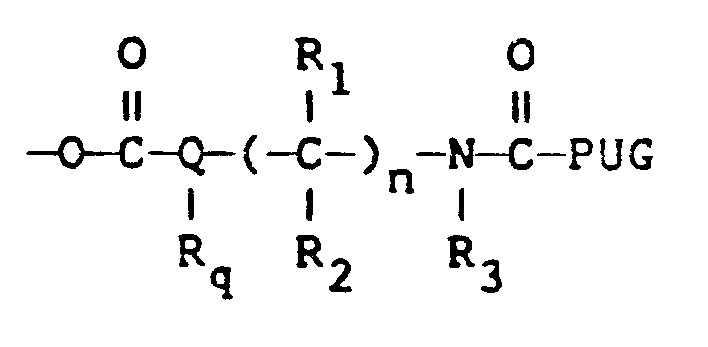
Q gleich N oder CRz;
Rq gleich Alkyl, Cycloalkyl, Heterocyclyl oder Aryl, oder Rq steht gemeinsam mit R₁, R₂ oder Rz für die Atome, die zur Vervollständigung eines nicht-aromatischen Ringes erforderlich sind;
Rz, R₁ und R₂ unabhängig voneinander Alkyl, Cycloalkyl, Heterocyclyl, Aryl oder Wasserstoff;
R₃ gleich Alkyl, Cycloalkyl, Heterocyclyl oder Aryl;
PUG eine photographisch geeignete Gruppe, bei der es sich um einen Entwicklungsinhibitorrest handelt; und
n gleich 0 oder 1. - Photographisches Material nach Anspruch 1, in dem die Gruppe LINK-PUG der folgenden Formel entspricht:

- Photographisches Material nach Anspruch 1, in dem die Gruppe LINK-PUG der folgenden Formel entspricht:

- Photographisches Material nach Anspruch 1, in dem die Gruppe LINK-PUG der folgenden Formel entspricht:

- Photographisches Material nach Anspruch 1, in dem die Verbindung (A) ein Kuppler ist, der durch die folgende Formel dargestellt wird:

COUP einen Kupplerrest;
R₅ eine Elektronen spendende Gruppe oder eine Elektronen abziehende Gruppe; und
Q einen freisetzbaren Entwicklungsinhibitorrest. - Photographisches Material nach Anspruch 1, in dem die Verbindung (A) der folgenden Formel entspricht:

- Verfahren zur Herstellung eines photographischen Bildes in einem exponierten photographischen Material nach einem der Ansprüche 1 - 6, das die Entwicklung des exponierten photographischen Silberhalogenides mit einer Silberhalogenid-Farbentwicklerverbindung umfaßt.
- Photographische Verbindung (A), dargestellt durch die Formel CAR-LINK-PUG, wie in einem der Ansprüche 1 - 6 definiert.
Applications Claiming Priority (2)
| Application Number | Priority Date | Filing Date | Title |
|---|---|---|---|
| US214090 | 1988-06-30 | ||
| US07/214,090 US4857440A (en) | 1988-06-30 | 1988-06-30 | Photographic material and process (B) |
Publications (3)
| Publication Number | Publication Date |
|---|---|
| EP0349330A2 EP0349330A2 (de) | 1990-01-03 |
| EP0349330A3 EP0349330A3 (de) | 1991-03-27 |
| EP0349330B1 true EP0349330B1 (de) | 1995-03-29 |
Family
ID=22797744
Family Applications (1)
| Application Number | Title | Priority Date | Filing Date |
|---|---|---|---|
| EP89306644A Expired - Lifetime EP0349330B1 (de) | 1988-06-30 | 1989-06-30 | Photographisches Material und Verfahren (B) |
Country Status (5)
| Country | Link |
|---|---|
| US (1) | US4857440A (de) |
| EP (1) | EP0349330B1 (de) |
| JP (1) | JPH02256047A (de) |
| AT (1) | ATE120564T1 (de) |
| DE (1) | DE68921935T2 (de) |
Families Citing this family (19)
| Publication number | Priority date | Publication date | Assignee | Title |
|---|---|---|---|---|
| JPH07113758B2 (ja) * | 1988-03-28 | 1995-12-06 | 富士写真フイルム株式会社 | ハロゲン化銀写真感光材料 |
| JPH02235055A (ja) * | 1989-03-08 | 1990-09-18 | Fuji Photo Film Co Ltd | ハロゲン化銀カラー写真感光材料 |
| JP2694373B2 (ja) * | 1989-04-21 | 1997-12-24 | 富士写真フイルム株式会社 | ハロゲン化銀写真感光材料 |
| US5019492A (en) * | 1989-04-26 | 1991-05-28 | Eastman Kodak Company | Photographic element and process comprising a blocked photographically useful compound |
| US5021322A (en) * | 1990-02-22 | 1991-06-04 | Eastman Kodak Company | Photographic element comprising a development inhibitor releasing compound having a linking group between the carrier and the inhibitor |
| US5026628A (en) * | 1990-02-22 | 1991-06-25 | Eastman Kodak Company | Photographic material and process comprising a compound capable of forming a wash-out dye |
| US5151343A (en) * | 1990-02-22 | 1992-09-29 | Eastman Kodak Company | Photographic material and process comprising wash-out naphtholic coupler |
| US5234800A (en) * | 1990-02-22 | 1993-08-10 | Eastman Kodak Company | Photographic material and process comprising wash-out naphtholic coupler |
| JP2687189B2 (ja) * | 1991-05-22 | 1997-12-08 | 富士写真フイルム株式会社 | ハロゲン化銀カラー写真感光材料 |
| JP2709226B2 (ja) * | 1991-06-06 | 1998-02-04 | 富士写真フイルム株式会社 | ハロゲン化銀カラー写真感光材料 |
| US5352570A (en) * | 1991-06-28 | 1994-10-04 | Eastman Kodak Company | Method and photographic material and process comprising a benzotriazole compound |
| US5399465A (en) * | 1993-01-15 | 1995-03-21 | Eastman Kodak Company | Method of processing reversal elements comprising selected development inhibitors and absorber dyes |
| JPH07281369A (ja) * | 1994-04-06 | 1995-10-27 | Fuji Photo Film Co Ltd | ハロゲン化銀カラー写真感光材料 |
| GB9612907D0 (en) * | 1996-06-20 | 1996-08-21 | Kodak Ltd | Photographic couplers which release useful groups anchiomerically and their synthesis |
| US6472135B1 (en) * | 2000-06-13 | 2002-10-29 | Eastman Kodak Company | Silver halide element with improved high temperature storage and raw stock keeping |
| US6472133B1 (en) * | 2000-06-13 | 2002-10-29 | Eastman Kodak Company | Silver halide element with improved high temperature storage |
| US6472134B1 (en) * | 2000-06-13 | 2002-10-29 | Eastman Kodak Company | Silver halide element with improved high temperature storage and sensitivity |
| US6780573B1 (en) * | 2003-05-30 | 2004-08-24 | Eastman Kodak Company | Color photographic element containing coupler moiety with improved amino acid timing group |
| US7108964B2 (en) | 2004-09-09 | 2006-09-19 | Eastman Kodak Company | Compound containing an anthranilic acid blocking group |
Family Cites Families (6)
| Publication number | Priority date | Publication date | Assignee | Title |
|---|---|---|---|---|
| US3311476A (en) * | 1962-12-26 | 1967-03-28 | Eastman Kodak Co | Two-equivalent couplers for color photography |
| US4248962A (en) * | 1977-12-23 | 1981-02-03 | Eastman Kodak Company | Photographic emulsions, elements and processes utilizing release compounds |
| JPS56114946A (en) * | 1980-02-15 | 1981-09-09 | Konishiroku Photo Ind Co Ltd | Silver halide photographic sensitive material |
| JPS60218645A (ja) * | 1984-04-13 | 1985-11-01 | Fuji Photo Film Co Ltd | ハロゲン化銀写真感光材料 |
| JPS61156126A (ja) * | 1984-12-28 | 1986-07-15 | Konishiroku Photo Ind Co Ltd | ハロゲン化銀カラ−写真感光材料 |
| CA1324609C (en) * | 1986-07-30 | 1993-11-23 | Eastman Kodak Company | Photographic element and process |
-
1988
- 1988-06-30 US US07/214,090 patent/US4857440A/en not_active Expired - Lifetime
-
1989
- 1989-06-29 JP JP1165541A patent/JPH02256047A/ja active Pending
- 1989-06-30 AT AT89306644T patent/ATE120564T1/de not_active IP Right Cessation
- 1989-06-30 EP EP89306644A patent/EP0349330B1/de not_active Expired - Lifetime
- 1989-06-30 DE DE68921935T patent/DE68921935T2/de not_active Expired - Fee Related
Also Published As
| Publication number | Publication date |
|---|---|
| DE68921935T2 (de) | 1995-12-14 |
| DE68921935D1 (de) | 1995-05-04 |
| EP0349330A2 (de) | 1990-01-03 |
| JPH02256047A (ja) | 1990-10-16 |
| US4857440A (en) | 1989-08-15 |
| ATE120564T1 (de) | 1995-04-15 |
| EP0349330A3 (de) | 1991-03-27 |
Similar Documents
| Publication | Publication Date | Title |
|---|---|---|
| US4248962A (en) | Photographic emulsions, elements and processes utilizing release compounds | |
| EP0255085B2 (de) | Photographisches Element und Verfahren | |
| EP0444501B1 (de) | Photographisches Material und Verfahren, eine Verbindung umfassend, die eine auswaschbare Farbe zu bilden vermag | |
| US4857440A (en) | Photographic material and process (B) | |
| US5151343A (en) | Photographic material and process comprising wash-out naphtholic coupler | |
| EP0443530B1 (de) | Photographisches Material und Verfahren, das einen auswaschbaren Naphtholkuppler umfasst | |
| EP0348139B1 (de) | Photographische Materialien und Verfahren | |
| EP0349332B1 (de) | Photographisches Material und Verfahren | |
| EP0347850B1 (de) | Photographisches Material, das eine Kombination von abspaltbaren Verbindungen enthält | |
| US5234800A (en) | Photographic material and process comprising wash-out naphtholic coupler | |
| EP0576088B1 (de) | Photographisches Material und Verfahren, einen Kuppler umfassend, das eine auswaschbare Farbe zu bilden vermag | |
| US5021322A (en) | Photographic element comprising a development inhibitor releasing compound having a linking group between the carrier and the inhibitor | |
| EP0348134B1 (de) | Photographische Materialien, die abspaltbare Verbindungen enthalten | |
| EP0577182B1 (de) | Photographisches Material und Verfahren, einen Kuppler umfassend, das einen auswaschbaren Farbstoff zu bilden vermag | |
| US5334490A (en) | Magenta development inhibitor releasing coupler | |
| US5264583A (en) | Photographic coupler and method of making the same | |
| US5250398A (en) | Photographic silver halide material and process comprising water-solubilized naphtholic coupler | |
| US5306607A (en) | Photographic material and process comprising a pyrazolotriazole moiety | |
| US5362880A (en) | Method of preparing a magenta development inhibitor releasing coupler | |
| US5264582A (en) | Method of forming a photographic coupler capable of forming a wash-out dye | |
| EP0576087A1 (de) | Photographisches Material und Verfahren, einen Kuppler umfassend, das eine auswaschbare Farbe zu bilden vermag | |
| EP0576089A2 (de) | Photographisches Material und Verfahren, einen Kuppler umfassend, der einen auswaschbaren Farbstoff zu bilden vermag |
Legal Events
| Date | Code | Title | Description |
|---|---|---|---|
| PUAI | Public reference made under article 153(3) epc to a published international application that has entered the european phase |
Free format text: ORIGINAL CODE: 0009012 |
|
| AK | Designated contracting states |
Kind code of ref document: A2 Designated state(s): AT BE CH DE ES FR GB GR IT LI LU NL SE |
|
| PUAL | Search report despatched |
Free format text: ORIGINAL CODE: 0009013 |
|
| AK | Designated contracting states |
Kind code of ref document: A3 Designated state(s): AT BE CH DE ES FR GB GR IT LI LU NL SE |
|
| 17P | Request for examination filed |
Effective date: 19910916 |
|
| 17Q | First examination report despatched |
Effective date: 19940211 |
|
| GRAA | (expected) grant |
Free format text: ORIGINAL CODE: 0009210 |
|
| AK | Designated contracting states |
Kind code of ref document: B1 Designated state(s): AT BE CH DE ES FR GB GR IT LI LU NL SE |
|
| PG25 | Lapsed in a contracting state [announced via postgrant information from national office to epo] |
Ref country code: IT Free format text: LAPSE BECAUSE OF FAILURE TO SUBMIT A TRANSLATION OF THE DESCRIPTION OR TO PAY THE FEE WITHIN THE PRESCRIBED TIME-LIMIT;WARNING: LAPSES OF ITALIAN PATENTS WITH EFFECTIVE DATE BEFORE 2007 MAY HAVE OCCURRED AT ANY TIME BEFORE 2007. THE CORRECT EFFECTIVE DATE MAY BE DIFFERENT FROM THE ONE RECORDED. Effective date: 19950329 Ref country code: NL Free format text: LAPSE BECAUSE OF NON-PAYMENT OF DUE FEES Effective date: 19950329 Ref country code: CH Effective date: 19950329 Ref country code: AT Effective date: 19950329 Ref country code: LI Effective date: 19950329 Ref country code: BE Effective date: 19950329 Ref country code: ES Free format text: THE PATENT HAS BEEN ANNULLED BY A DECISION OF A NATIONAL AUTHORITY Effective date: 19950329 Ref country code: GR Free format text: LAPSE BECAUSE OF FAILURE TO SUBMIT A TRANSLATION OF THE DESCRIPTION OR TO PAY THE FEE WITHIN THE PRESCRIBED TIME-LIMIT Effective date: 19950329 |
|
| REF | Corresponds to: |
Ref document number: 120564 Country of ref document: AT Date of ref document: 19950415 Kind code of ref document: T |
|
| REF | Corresponds to: |
Ref document number: 68921935 Country of ref document: DE Date of ref document: 19950504 |
|
| ET | Fr: translation filed | ||
| PG25 | Lapsed in a contracting state [announced via postgrant information from national office to epo] |
Ref country code: SE Effective date: 19950629 |
|
| PG25 | Lapsed in a contracting state [announced via postgrant information from national office to epo] |
Ref country code: LU Free format text: LAPSE BECAUSE OF NON-PAYMENT OF DUE FEES Effective date: 19950630 |
|
| REG | Reference to a national code |
Ref country code: CH Ref legal event code: PL |
|
| NLV1 | Nl: lapsed or annulled due to failure to fulfill the requirements of art. 29p and 29m of the patents act | ||
| PLBE | No opposition filed within time limit |
Free format text: ORIGINAL CODE: 0009261 |
|
| STAA | Information on the status of an ep patent application or granted ep patent |
Free format text: STATUS: NO OPPOSITION FILED WITHIN TIME LIMIT |
|
| 26N | No opposition filed | ||
| PGFP | Annual fee paid to national office [announced via postgrant information from national office to epo] |
Ref country code: GB Payment date: 19990504 Year of fee payment: 11 |
|
| PGFP | Annual fee paid to national office [announced via postgrant information from national office to epo] |
Ref country code: FR Payment date: 19990602 Year of fee payment: 11 |
|
| PGFP | Annual fee paid to national office [announced via postgrant information from national office to epo] |
Ref country code: DE Payment date: 19990624 Year of fee payment: 11 |
|
| PG25 | Lapsed in a contracting state [announced via postgrant information from national office to epo] |
Ref country code: GB Free format text: LAPSE BECAUSE OF NON-PAYMENT OF DUE FEES Effective date: 20000630 |
|
| GBPC | Gb: european patent ceased through non-payment of renewal fee |
Effective date: 20000630 |
|
| PG25 | Lapsed in a contracting state [announced via postgrant information from national office to epo] |
Ref country code: FR Free format text: LAPSE BECAUSE OF NON-PAYMENT OF DUE FEES Effective date: 20010228 |
|
| REG | Reference to a national code |
Ref country code: FR Ref legal event code: ST |
|
| PG25 | Lapsed in a contracting state [announced via postgrant information from national office to epo] |
Ref country code: DE Free format text: LAPSE BECAUSE OF NON-PAYMENT OF DUE FEES Effective date: 20010403 |