EP0348764A2 - Alkane triol monoesters and process for their preparation - Google Patents
Alkane triol monoesters and process for their preparation Download PDFInfo
- Publication number
- EP0348764A2 EP0348764A2 EP89111037A EP89111037A EP0348764A2 EP 0348764 A2 EP0348764 A2 EP 0348764A2 EP 89111037 A EP89111037 A EP 89111037A EP 89111037 A EP89111037 A EP 89111037A EP 0348764 A2 EP0348764 A2 EP 0348764A2
- Authority
- EP
- European Patent Office
- Prior art keywords
- radical
- general formula
- monoesters
- alkanetriol
- dialkyl
- Prior art date
- Legal status (The legal status is an assumption and is not a legal conclusion. Google has not performed a legal analysis and makes no representation as to the accuracy of the status listed.)
- Granted
Links
Classifications
-
- C—CHEMISTRY; METALLURGY
- C07—ORGANIC CHEMISTRY
- C07C—ACYCLIC OR CARBOCYCLIC COMPOUNDS
- C07C67/00—Preparation of carboxylic acid esters
- C07C67/28—Preparation of carboxylic acid esters by modifying the hydroxylic moiety of the ester, such modification not being an introduction of an ester group
- C07C67/293—Preparation of carboxylic acid esters by modifying the hydroxylic moiety of the ester, such modification not being an introduction of an ester group by isomerisation; by change of size of the carbon skeleton
-
- C—CHEMISTRY; METALLURGY
- C07—ORGANIC CHEMISTRY
- C07C—ACYCLIC OR CARBOCYCLIC COMPOUNDS
- C07C69/00—Esters of carboxylic acids; Esters of carbonic or haloformic acids
- C07C69/02—Esters of acyclic saturated monocarboxylic acids having the carboxyl group bound to an acyclic carbon atom or to hydrogen
- C07C69/12—Acetic acid esters
- C07C69/18—Acetic acid esters of trihydroxylic compounds
Definitions
- This invention relates to alkanetriol monoesters and a process for their preparation by reacting ⁇ , ⁇ -diols with esters of alkenols in the presence of radical formers.
- the invention further relates to the new alkanetriol monoesters of the general formula in which x and y are integers from 0 to 6,
- R1 is a hydrogen atom, an alkyl radical having 1 to 12 C atoms, a cycloalkyl radical, an aralkyl radical or an aryl radical and the radicals R2, R3, R4 and R5 each have a hydrogen atom or an alkyl radical with 1 to 4 carbon atoms.
- x is an integer from 0 to 6
- y is an integer from 0 to 6, preferably 0 to 4
- R 1 is a hydrogen atom, an alkyl radical having 1 to 12, preferably 1 to 6, carbon atoms, a cycloalkyl radical such as a cyclopentyl or cyclohexyl radical, an aralkyl radical such as a benzyl radical or an aryl radical such as the phenyl radical.
- the radicals R2 to R5 can be alkyl radicals having 1 to 4 carbon atoms, such as methyl, ethyl, propyl or butyl; they preferably represent hydrogen atoms.
- the new alkanetriol monoesters of the formula I are versatile intermediate products which can be used e.g. saponify or transesterify to the appropriate triplets.
- reaction for the preparation of the alkanetriol monoesters can be represented, for example, in the case of the reaction of 1,4-butanediol with allyl acetate and di-tert-butyl peroxide as free radical generator by the following equation:
- ⁇ , ⁇ -diols of the formula II are ethylene glycol, 1,4-butanediol, 1,3-propanediol, 1,5-pentanediol, 1,6-hexanediol, 1,7-heptanediol and 1,8-octanediol.
- Alkenol esters of formula III are e.g. Vinyl acetate, allyl acetate, 1-butenyl-4-ol acetate, allyl propionate, vinyl propionate, 1-pentenyl-5-ol formate and 1-hexenyl-6-ol acetate.
- the reaction according to the invention is carried out at higher temperatures. For example, temperatures from 100 to 200 ° C, in particular 140 to 170 ° C are selected. Generally one works at normal pressure; however, it may also be advisable to carry out the reaction at elevated pressure, e.g. up to 20 bar.
- the diols of the formula II In order to suppress the polymerization of the alkenol esters III, it is advantageous to use the diols of the formula II in excess. So you choose e.g. a molar ratio of compound II to III from 3: 1 to 40: 1, preferably from 5: 1 to 15: 1.
- the yield of the desired compounds of the formula I can often be increased by working under inert gas. This prevents side reactions caused by atmospheric oxygen.
- radical formers e.g. Suitable oxygen and all peroxides and azo compounds, which are usually also used in the polymerization of olefinic monomers.
- examples include azo compounds, such as azoisobutyronitrile, hydroperoxides, such as tert-butyl hydroperoxide and cyclohexyl hydroperoxide, diacyl peroxides, such as dibenzoyl peroxide, peroxy acids and corresponding esters, such as m-chloroperbenzoic acid, perbenzoic acid, tert.-butyl perbenzoate and dialkyl peroxyl peroxide, and dialkyl peroxyl peroxide, and dialkyl peroxyl peroxide, and dialkyl peroxyl peroxide, and dialkyl peroxyl peroxide, and dialkyl peroxyl peroxide, and dialkyl peroxyl peroxide, and dialkyl peroxyl peroxide, and dialkyl peroxyl peroxide, and dial
- solvents which is inert to the radical formers, but also to the compounds of the formulas I to III, is used.
- Solvents of this type are e.g. aromatic hydrocarbons such as chlorobenzenes.
- reaction times are generally 1 to 4 hours. It is advisable to use suitable analysis methods to determine whether the reaction time and reaction temperature are sufficient to completely break down the radical generator. If such degradation has not occurred, the radical generator is subsequently destroyed by suitable measures, for example by adding a reducing agent.
- the alkanetriol monoesters can usually be worked up by distillation.
- the excess ⁇ , ⁇ -diol is first distilled off.
- the residue obtained in this way can be worked up either by distillation or crystallization to give pure alkanetriol monoester.
- Example 1 was repeated, but using allyl alcohol instead of allyl acetate. Only traces of 1.4.7-heptanetriol were found by gas chromatography.
- Example 10 was repeated, but using 1-buten-4-ol instead of 1-buten-4-ol acetate. Only small amounts of 1.4.8-octantriol were determined by gas chromatography.
Landscapes
- Chemical & Material Sciences (AREA)
- Organic Chemistry (AREA)
- Organic Low-Molecular-Weight Compounds And Preparation Thereof (AREA)
- Low-Molecular Organic Synthesis Reactions Using Catalysts (AREA)
Abstract
Alkantriolmonoester der allgemeinen Formel

CH₂=CH-(-CH₂)

in Gegenwart von Radikalbildnern. Alkanetriol monoesters of the general formula
CH₂ = CH - (- CH₂)
in the presence of radical formers.
Description
Diese Erfindung betrifft Alkantriolmonoester und ein Verfahren zu ihrer Herstellung durch Umsetzung von α,ω-Diolen mit Estern von Alkenolen in Gegenwart von Radikalbildnern.This invention relates to alkanetriol monoesters and a process for their preparation by reacting α, ω-diols with esters of alkenols in the presence of radical formers.
Es ist bekannt, daß sich primäre und sekundäre Alkanole in Gegenwart von Radikalbildnern, wie tert.-Butylhydroperoxid oder Di-tert.-butylperoxid, mit 1-Alkenen zu höheren Alkoholen (J. Amer. Chem. Soc. 76, 450 (1953)) und mit Acrylsäureestern zu 5-Alkylbutyrolactonen (Izv. Akad. SSSR, 1964, 894) umsetzen lassen. über eine Umsetzung von Diolen mit Olefinen in Gegenwart von Radikalbildnern ist lediglich bekannt, daß man aus α,ω-Diolen, wie 1,4-Butandiol, in Gegenwart von Di-tert.-butylperoxid mit Acrylsäureestern (5-(ω-Hydroxyalkyl)butyrolactone erhält (DE-OS 28 18 126). Eine Umsetzung von α,ω-Diolen mit 1-Alkenylacetaten wurde dagegen bisher nicht beschrieben.It is known that primary and secondary alkanols combine with 1-alkenes to give higher alcohols in the presence of radical formers, such as tert-butyl hydroperoxide or di-tert-butyl peroxide (J. Amer. Chem. Soc. 76, 450 (1953)) ) and reacted with acrylic acid esters to 5-alkylbutyrolactones (Izv. Akad. SSSR, 1964, 894). All that is known about the reaction of diols with olefins in the presence of radical formers is that α, ω-diols, such as 1,4-butanediol, in the presence of di-tert-butyl peroxide with acrylic acid esters (5- (ω-hydroxyalkyl) butyrolactone is obtained (DE-OS 28 18 126), however, a reaction of α, ω-diols with 1-alkenylacetates has not previously been described.
Es wurde nun gefunden, daß man Alkantriolmonoester der Formel

CH₂=CH-(-CH₂)

in der y und R¹ die obengenannte Bedeutung haben, in Gegenwart von Radikalbildnern bei höheren Temperaturen umsetzt.It has now been found that alkanetriol monoesters of the formula
CH₂ = CH - (- CH₂)
in which y and R¹ have the meaning given above, in the presence of radical formers at higher temperatures.
Wie die negativen Ergebnisse der Vergleichsbeispiele 11 und 12 zeigen, in denen anstelle von Allylacetat und Butenylacetat Allylalkohol und 1-Buten-4-ol verwendet wurden, war der erfolgreiche Verlauf der erfindungsgemäßen Reaktion nicht vorauszusehen.As the negative results of Comparative Examples 11 and 12 show, in which allyl alcohol and 1-buten-4-ol were used instead of allyl acetate and butenyl acetate, the successful course of the reaction according to the invention could not be foreseen.
Die Erfindung betrifft weiterhin die neuen Alkantriolmonoester der allgemeinen Formel

In den neuen Alkantriolmonoestern der Formel I bedeuten x eine ganze Zahl von 0 bis 6, y eine ganze Zahl von 0 bis 6, vorzugsweise 0 bis 4, R¹ ein Wasserstoffatom, einen Alkylrest mit 1 bis 12, vorzugsweise 1 bis 6 C-Atomen, einen Cycloalkylrest, wie einen Cyclopentyl- oder Cyclohexylrest, einen Aralkylrest, wie einen Benzylrest oder einen Arylrest, wie den Phenylrest. Die Reste R² bis R⁵ können Alkylreste mit 1 bis 4 C-Atomen, wie Methyl, Ethyl, Propyl oder Butyl sein; bevorzugt stehen sie für Wasserstoffatome.In the new alkanetriol monoesters of the formula I, x is an integer from 0 to 6, y is an integer from 0 to 6, preferably 0 to 4, R 1 is a hydrogen atom, an alkyl radical having 1 to 12, preferably 1 to 6, carbon atoms, a cycloalkyl radical such as a cyclopentyl or cyclohexyl radical, an aralkyl radical such as a benzyl radical or an aryl radical such as the phenyl radical. The radicals R² to R⁵ can be alkyl radicals having 1 to 4 carbon atoms, such as methyl, ethyl, propyl or butyl; they preferably represent hydrogen atoms.
Die neuen Alkantriolmonoester der Formel I sind vielseitig abwandelbare Zwischenprodukte, die sich z.B. zu den entsprechenden Triolen verseifen oder umestern lassen.The new alkanetriol monoesters of the formula I are versatile intermediate products which can be used e.g. saponify or transesterify to the appropriate triplets.
Die Reaktion zur Herstellung der Alkantriolmonoester läßt sich z.B. für den Fall der Umsetzung von 1,4-Butandiol mit Allylacetat und Di-tert.-butylperoxid als Radikalbildner durch die folgende Formelgleichung wiedergeben:

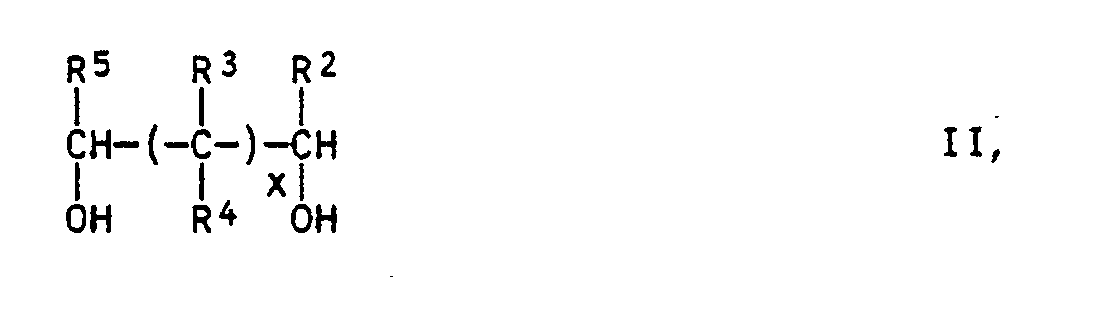
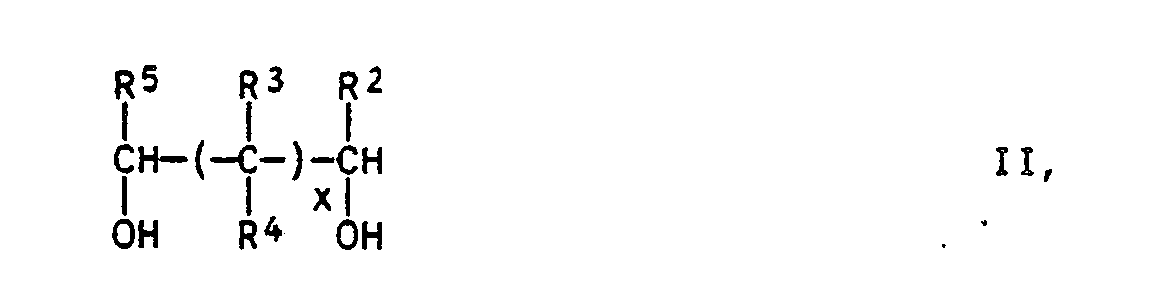
Als α,ω-Diole der Formel II seien z.B. Ethylenglykol, 1,4-Butandiol, 1,3-Propandiol, 1,5-Pentandiol, 1,6-Hexandiol, 1,7-Heptandiol und 1,8-Octandiol genannt.Examples of α, ω-diols of the formula II are ethylene glycol, 1,4-butanediol, 1,3-propanediol, 1,5-pentanediol, 1,6-hexanediol, 1,7-heptanediol and 1,8-octanediol.
Alkenolester der Formel III sind z.B. Vinylacetat, Allylacetat, 1-Butenyl-4-ol-acetat, Allylpropionat, Vinylpropionat, 1-Pentenyl-5-ol-formiat und 1-Hexenyl-6-ol-acetat.Alkenol esters of formula III are e.g. Vinyl acetate, allyl acetate, 1-butenyl-4-ol acetate, allyl propionate, vinyl propionate, 1-pentenyl-5-ol formate and 1-hexenyl-6-ol acetate.
Die erfindungsgemäße Umsetzung wird bei höheren Temperaturen durchgeführt. Beispielsweise wählt man Temperaturen von 100 bis 200°C, insbesondere 140 bis 170°C. Im allgemeinen arbeitet man bei Normaldruck; es kann aber auch empfehlenswert sein, die Umsetzung bei erhöhtem Druck, z.B. bis zu 20 bar, durchzuführen.The reaction according to the invention is carried out at higher temperatures. For example, temperatures from 100 to 200 ° C, in particular 140 to 170 ° C are selected. Generally one works at normal pressure; however, it may also be advisable to carry out the reaction at elevated pressure, e.g. up to 20 bar.
Um die Polymerisation der Alkenolester III zurückzudrängen, ist es vorteilhaft, die Diole der Formel II im Überschuß einzusetzen. So wählt man z.B. ein Molverhältnis der Verbindung II zu III von 3:1 bis 40:1, vorzugsweise von 5:1 bis 15:1. Durch Arbeiten unter Inertgas läßt sich die Ausbeute an den erwünschten Verbindungen der Formel I oftmals steigern. Hierdurch werden durch den Luftsauerstoff bewirkte Nebenreaktionen unterbunden.In order to suppress the polymerization of the alkenol esters III, it is advantageous to use the diols of the formula II in excess. So you choose e.g. a molar ratio of compound II to III from 3: 1 to 40: 1, preferably from 5: 1 to 15: 1. The yield of the desired compounds of the formula I can often be increased by working under inert gas. This prevents side reactions caused by atmospheric oxygen.
Als Radikalbildner sind z.B. Sauerstoff und alle Peroxide und Azoverbindungen geeignet, die üblicherweise auch bei der Polymerisation von olefinischen Monomeren verwendet werden. Beispiele hierfür sind Azoverbindungen, wie Azoisobutyronitril, Hydroperoxide, wie tert.-Butylhydroperoxid und Cyclohexylhydroperoxid, Diacylperoxide, wie Dibenzoylperoxid, Peroxysäuren und entsprechende Ester, wie m-Chlorperbenzoesäure, Perbenzoesäure, tert.-Butylperbenzoat und Dialkylperoxide, wie Dicyclohexylperoxid, tert.-Butylcyclohexylperoxid und insbesondere Di-tert.-butylperoxid. Im allgemeinen verwendet man 0,05 bis 0,3 Mol, insbesondere 0,1 bis 0,2 Mol des Radikalbildners, bezogen auf den jeweiligen Alkenolester.As radical formers e.g. Suitable oxygen and all peroxides and azo compounds, which are usually also used in the polymerization of olefinic monomers. Examples include azo compounds, such as azoisobutyronitrile, hydroperoxides, such as tert-butyl hydroperoxide and cyclohexyl hydroperoxide, diacyl peroxides, such as dibenzoyl peroxide, peroxy acids and corresponding esters, such as m-chloroperbenzoic acid, perbenzoic acid, tert.-butyl perbenzoate and dialkyl peroxyl peroxide, and dialkyl peroxyl peroxide, and dialkyl peroxyl peroxide, and dialkyl peroxyl peroxide, and dialkyl peroxyl peroxide, and dialkyl peroxyl peroxide, and dialkyl peroxyl peroxide, and dialkyl peroxyl peroxide, and dialkyl peroxyl peroxide, and dialkyl peroxyl peroxide, and dialkyl peroxyl peroxide, and dialkyl peroxide, and dialkyl peroxyl peroxide, and dialkyl peroxyl peroxide, and dialkyl peroxyl peroxide, and dialkyl peroxyl peroxide, and dialkyl peroxyl peroxide, and dialkyl peroxide, and dialkyl peroxy, and dialkyl peroxyl, and dialkyl peroxyl, and peroxide especially di-tert-butyl peroxide. In general, 0.05 to 0.3 mol, in particular 0.1 to 0.2 mol, of the radical generator, based on the respective alkenol ester, is used.
In den meisten Fällen ist es nicht notwendig, ein Lösungsmittel zuzusetzen, da das im Überschuß eingesetzte Diol gleichzeitig als Lösungsmittel dient. Falls ein zusätzliches Lösungsmittel erforderlich ist, so verwendet man ein gegenüber den Radikalbildnern, aber auch gegenüber den Verbindungen der Formeln I bis III inertes Lösungsmittel. Lösungsmittel dieser Art sind z.B. aromatische Kohlenwasserstoffe, wie Chlorbenzole.In most cases, it is not necessary to add a solvent, since the excess diol also serves as a solvent. If an additional solvent is required, a solvent which is inert to the radical formers, but also to the compounds of the formulas I to III, is used. Solvents of this type are e.g. aromatic hydrocarbons such as chlorobenzenes.
Die Reaktionszeiten liegen im allgemeinen bei 1 bis 4 Stunden. Es empfiehlt sich, durch geeignete Analysenmethoden festzustellen, ob Reaktionszeit und Reaktionstemperatur ausreichen, um den Radikalbildner vollständig abzubauen. Sollte ein solcher Abbau nicht eingetreten sein, so wird der Radikalbildner durch geeignete Maßnahmen, z.B. durch Zugabe von Reduktionsmittel, nachträglich zerstört.The reaction times are generally 1 to 4 hours. It is advisable to use suitable analysis methods to determine whether the reaction time and reaction temperature are sufficient to completely break down the radical generator. If such degradation has not occurred, the radical generator is subsequently destroyed by suitable measures, for example by adding a reducing agent.
Die Aufarbeitung der Alkantriolmonoester kann meist durch Destillation erfolgen. Hierzu wird zunächst das überschüssige α,ω-Diol abdestilliert. Der so erhaltene Rückstand kann entweder durch Destillation oder Kristallisation zu reinem Alkantriolmonoester aufgearbeitet werden.The alkanetriol monoesters can usually be worked up by distillation. For this purpose, the excess α, ω-diol is first distilled off. The residue obtained in this way can be worked up either by distillation or crystallization to give pure alkanetriol monoester.
In einem mit Rührer, 2 Tropftrichtern und Innenthermometer ausgerüsteten 2-1-Vierhalskolben wurden 810 g 1,4-Butandiol (9 mol) unter Stickstoff auf 160°C erhitzt. Bei 160±2°C wurden innerhalb von 75 Minuten gleichzeitig 90 g frisch destilliertes Allylacetat (0,9 mol) und 26 g Di-tert.-butylperoxid (0,18 mol) zugegeben. Nach beendeter Zugabe wurde das Reaktionsgemisch noch eine Stunde bei 160°C nachgerührt.In a 2-1 four-necked flask equipped with a stirrer, 2 dropping funnels and internal thermometer, 810 g of 1,4-butanediol (9 mol) were heated to 160 ° C. under nitrogen. At 160 ± 2 ° C., 90 g of freshly distilled allyl acetate (0.9 mol) and 26 g of di-tert-butyl peroxide (0.18 mol) were simultaneously added over the course of 75 minutes. After the addition had ended, the reaction mixture was stirred at 160 ° C. for a further hour.
Nach dem Abkühlen wurden 720 g unumgesetztes 1,4-Butandiol (8 mol) über eine Claisenbrücke abdestilliert. Durch fraktionierende Destillation des Rückstands wurden 87 g 1,4-Dihydroxy-7-acetoxyheptan vom Siedepunkt 140 bis 148°C/0, 1 mbar (51 %, bezogen auf eingesetztes Allylacetat) erhalten.After cooling, 720 g of unreacted 1,4-butanediol (8 mol) were distilled off over a Claisen bridge. Fractional distillation of the residue gave 87 g of 1,4-dihydroxy-7-acetoxyheptane with a boiling point of 140 to 148 ° C./0.1 mbar (51%, based on the allyl acetate used).
Bei den in Beispiel 1 angegebenen Temperaturen und Molverhältnissen wurden die aus der Tabelle ersichtlichen Reaktionspartner II, III und Di-tert.-butylperoxid entsprechend umgesetzt. Die angegebenen Ausbeuten der Alkantriolmonoester wurden nach Destillation bestimmt; sie beziehen sich auf den eingesetzten Alkenolester der Formel III

Beispiel 10 wurde wiederholt, wobei jedoch anstelle von 1-Buten-4-ol-acetat 1-Buten-4-ol verwendet wurde. Es wurden nur geringe Mengen an 1.4.8-Octantriol gaschromatographisch ermittelt.Example 10 was repeated, but using 1-buten-4-ol instead of 1-buten-4-ol acetate. Only small amounts of 1.4.8-octantriol were determined by gas chromatography.
Claims (5)


CH₂=CH-(-CH₂)


in der y und R¹ die obengenannte Bedeutung haben, in Gegenwart von Radikalbildnern bei höheren Temperaturen umsetzt.2. Process for the preparation of alkanetriol monoesters of the general formula
CH₂ = CH - (- CH₂)
in which y and R¹ have the meaning given above, in the presence of radical formers at higher temperatures.
Applications Claiming Priority (2)
| Application Number | Priority Date | Filing Date | Title |
|---|---|---|---|
| DE3821479A DE3821479A1 (en) | 1988-06-25 | 1988-06-25 | ALKANTRIOL MONOESTER AND A METHOD FOR THE PRODUCTION THEREOF |
| DE3821479 | 1988-06-25 |
Publications (3)
| Publication Number | Publication Date |
|---|---|
| EP0348764A2 true EP0348764A2 (en) | 1990-01-03 |
| EP0348764A3 EP0348764A3 (en) | 1991-06-26 |
| EP0348764B1 EP0348764B1 (en) | 1994-06-01 |
Family
ID=6357236
Family Applications (1)
| Application Number | Title | Priority Date | Filing Date |
|---|---|---|---|
| EP89111037A Expired - Lifetime EP0348764B1 (en) | 1988-06-25 | 1989-06-19 | Alkane triol monoesters and process for their preparation |
Country Status (2)
| Country | Link |
|---|---|
| EP (1) | EP0348764B1 (en) |
| DE (2) | DE3821479A1 (en) |
Family Cites Families (1)
| Publication number | Priority date | Publication date | Assignee | Title |
|---|---|---|---|---|
| US4337271A (en) * | 1981-01-28 | 1982-06-29 | The United States Of America As Represented By The Secretary Of Agriculture | Erythro-9,10-Dihydroxyoctadecan-1-ol acetate a boll weevil anti-feedant |
-
1988
- 1988-06-25 DE DE3821479A patent/DE3821479A1/en not_active Withdrawn
-
1989
- 1989-06-19 EP EP89111037A patent/EP0348764B1/en not_active Expired - Lifetime
- 1989-06-19 DE DE58907742T patent/DE58907742D1/en not_active Expired - Lifetime
Also Published As
| Publication number | Publication date |
|---|---|
| DE58907742D1 (en) | 1994-07-07 |
| EP0348764A3 (en) | 1991-06-26 |
| EP0348764B1 (en) | 1994-06-01 |
| DE3821479A1 (en) | 1989-12-28 |
Similar Documents
| Publication | Publication Date | Title |
|---|---|---|
| EP0008096A2 (en) | Process for the synthesis of 2-(perfluoroalkyl)-ethanols | |
| EP0695284B1 (en) | Continuous production process of tertiary alcohols by radical addition of secondary alcohols to alkenes | |
| DE1160439B (en) | Process for the preparation of acrylic acid esters of N-oxyalkyl or N-oxyalkoxyalkyl lactams | |
| EP0348764B1 (en) | Alkane triol monoesters and process for their preparation | |
| DE1144262B (en) | Process for the preparation of AEthane-1, 2-diol and propane-1, 2-diol monoacrylate and monomethacrylate | |
| DE2509967C2 (en) | 3,6-dimethyl-hept-2-en-1-ol and 3,6-dimethyl-heptenyl and heptadienyl esters | |
| EP0398154A1 (en) | Process for the production of telomer-alcohols | |
| EP0765861B1 (en) | Process for the preparation of alkyl esters of (meth)acrylic acid | |
| DE69836724T2 (en) | ETHER COMPOUNDS AND METHOD FOR THE PRODUCTION THEREOF | |
| EP0113015A1 (en) | Use of 1,4-dihydroxynaphthalene for the polymerisation of ethylenically unsaturated compounds | |
| DE1178854B (en) | Process for the production of carboxylic acid esters, ethers or acetals of 2, 5-dimethylhexane-2, 5-dihydroperoxide | |
| DE10342902B4 (en) | Process for the preparation of α-1 alkenyloxypolyalkylene glycols | |
| DE4026712A1 (en) | METHOD FOR PRODUCING TERTIARY FLUORINE ALCOHOLS | |
| DE1933536A1 (en) | Process for the preparation of allyl esters | |
| DE2601520A1 (en) | PROCESS FOR THE PREPARATION OF 2-HYDROXYALKYLPHOSPHINES | |
| DE3736990A1 (en) | 1,7,9,15-TETRAOXA-4,12-DIAZA-8-SILASPIRO- (7.7) -PENTADECANE, METHOD FOR THE PRODUCTION AND THEIR USE | |
| DE1270806B (en) | Use of mixed esters as plasticizers in chlorine-containing vinyl polymers | |
| DE4342448C1 (en) | Process for the preparation of acrylic and methacrylic acid esters of partially fluorinated alcohols | |
| DE19706384C1 (en) | Process for the preparation of diethyl ethanephosphonate | |
| DE1116671B (en) | Process for the preparation of monomeric, C-alkyl-substituted N-vinyloxazolidonen- (2) | |
| DE2845160A1 (en) | PEROXY-DICARBONIC ACID-DI (POLYOL) -ESTER | |
| DE2526718A1 (en) | PROCESS FOR PREPARING COPOLYMERIZABLE MIXTURES | |
| DE1078127B (en) | Process for the production of peroxides | |
| EP0022462A1 (en) | 2-Alkoxyethyl-cycloalkyl-ethers, compositions containing these, and their utilization for the preparation of odorant compositions | |
| DE19853862A1 (en) | Process for the preparation of substituted cycloketones |
Legal Events
| Date | Code | Title | Description |
|---|---|---|---|
| PUAI | Public reference made under article 153(3) epc to a published international application that has entered the european phase |
Free format text: ORIGINAL CODE: 0009012 |
|
| AK | Designated contracting states |
Kind code of ref document: A2 Designated state(s): BE CH DE FR GB IT LI |
|
| 17P | Request for examination filed |
Effective date: 19901227 |
|
| PUAL | Search report despatched |
Free format text: ORIGINAL CODE: 0009013 |
|
| AK | Designated contracting states |
Kind code of ref document: A3 Designated state(s): BE CH DE FR GB IT LI |
|
| 17Q | First examination report despatched |
Effective date: 19930205 |
|
| GRAA | (expected) grant |
Free format text: ORIGINAL CODE: 0009210 |
|
| PGFP | Annual fee paid to national office [announced via postgrant information from national office to epo] |
Ref country code: CH Payment date: 19940524 Year of fee payment: 6 |
|
| PGFP | Annual fee paid to national office [announced via postgrant information from national office to epo] |
Ref country code: FR Payment date: 19940525 Year of fee payment: 6 |
|
| AK | Designated contracting states |
Kind code of ref document: B1 Designated state(s): BE CH DE FR GB IT LI |
|
| PGFP | Annual fee paid to national office [announced via postgrant information from national office to epo] |
Ref country code: BE Payment date: 19940610 Year of fee payment: 6 |
|
| PGFP | Annual fee paid to national office [announced via postgrant information from national office to epo] |
Ref country code: GB Payment date: 19940616 Year of fee payment: 6 |
|
| PGFP | Annual fee paid to national office [announced via postgrant information from national office to epo] |
Ref country code: DE Payment date: 19940624 Year of fee payment: 6 |
|
| REF | Corresponds to: |
Ref document number: 58907742 Country of ref document: DE Date of ref document: 19940707 |
|
| ITF | It: translation for a ep patent filed | ||
| GBT | Gb: translation of ep patent filed (gb section 77(6)(a)/1977) |
Effective date: 19940629 |
|
| ET | Fr: translation filed | ||
| PLBE | No opposition filed within time limit |
Free format text: ORIGINAL CODE: 0009261 |
|
| STAA | Information on the status of an ep patent application or granted ep patent |
Free format text: STATUS: NO OPPOSITION FILED WITHIN TIME LIMIT |
|
| 26N | No opposition filed | ||
| PG25 | Lapsed in a contracting state [announced via postgrant information from national office to epo] |
Ref country code: GB Effective date: 19950619 |
|
| PG25 | Lapsed in a contracting state [announced via postgrant information from national office to epo] |
Ref country code: DE Effective date: 19950623 |
|
| PG25 | Lapsed in a contracting state [announced via postgrant information from national office to epo] |
Ref country code: LI Effective date: 19950630 Ref country code: CH Effective date: 19950630 Ref country code: BE Effective date: 19950630 |
|
| BERE | Be: lapsed |
Owner name: BASF A.G. Effective date: 19950630 |
|
| GBPC | Gb: european patent ceased through non-payment of renewal fee |
Effective date: 19950619 |
|
| PG25 | Lapsed in a contracting state [announced via postgrant information from national office to epo] |
Ref country code: FR Effective date: 19960229 |
|
| REG | Reference to a national code |
Ref country code: CH Ref legal event code: PL |
|
| REG | Reference to a national code |
Ref country code: FR Ref legal event code: ST |
|
| PG25 | Lapsed in a contracting state [announced via postgrant information from national office to epo] |
Ref country code: IT Free format text: LAPSE BECAUSE OF NON-PAYMENT OF DUE FEES;WARNING: LAPSES OF ITALIAN PATENTS WITH EFFECTIVE DATE BEFORE 2007 MAY HAVE OCCURRED AT ANY TIME BEFORE 2007. THE CORRECT EFFECTIVE DATE MAY BE DIFFERENT FROM THE ONE RECORDED. Effective date: 20050619 |