EP0343826B1 - Biosensoren - Google Patents
Biosensoren Download PDFInfo
- Publication number
- EP0343826B1 EP0343826B1 EP89304914A EP89304914A EP0343826B1 EP 0343826 B1 EP0343826 B1 EP 0343826B1 EP 89304914 A EP89304914 A EP 89304914A EP 89304914 A EP89304914 A EP 89304914A EP 0343826 B1 EP0343826 B1 EP 0343826B1
- Authority
- EP
- European Patent Office
- Prior art keywords
- layer
- sensitive
- sample
- film
- sensor
- Prior art date
- Legal status (The legal status is an assumption and is not a legal conclusion. Google has not performed a legal analysis and makes no representation as to the accuracy of the status listed.)
- Expired - Lifetime
Links
- 239000000463 material Substances 0.000 claims abstract description 44
- 238000012360 testing method Methods 0.000 claims abstract description 36
- 229910052751 metal Inorganic materials 0.000 claims abstract description 35
- 239000002184 metal Substances 0.000 claims abstract description 35
- 239000012528 membrane Substances 0.000 claims abstract description 27
- 238000002198 surface plasmon resonance spectroscopy Methods 0.000 claims abstract description 23
- 238000006243 chemical reaction Methods 0.000 claims abstract description 13
- 239000012780 transparent material Substances 0.000 claims abstract description 11
- 230000001419 dependent effect Effects 0.000 claims abstract 2
- 230000002745 absorbent Effects 0.000 claims description 15
- 239000002250 absorbent Substances 0.000 claims description 15
- 230000003287 optical effect Effects 0.000 claims description 8
- 239000012530 fluid Substances 0.000 claims description 7
- 239000011148 porous material Substances 0.000 claims description 6
- 230000008878 coupling Effects 0.000 claims description 5
- 238000010168 coupling process Methods 0.000 claims description 5
- 238000005859 coupling reaction Methods 0.000 claims description 5
- 230000005670 electromagnetic radiation Effects 0.000 claims description 5
- 238000013098 chemical test method Methods 0.000 claims description 2
- 229910052709 silver Inorganic materials 0.000 abstract description 9
- 239000004332 silver Substances 0.000 abstract description 9
- 229920003023 plastic Polymers 0.000 abstract description 3
- 239000004033 plastic Substances 0.000 abstract description 2
- 239000010410 layer Substances 0.000 description 94
- 239000000523 sample Substances 0.000 description 62
- 239000010408 film Substances 0.000 description 60
- 239000000427 antigen Substances 0.000 description 11
- 102000036639 antigens Human genes 0.000 description 11
- 108091007433 antigens Proteins 0.000 description 11
- 238000000034 method Methods 0.000 description 8
- 230000033001 locomotion Effects 0.000 description 7
- 230000008859 change Effects 0.000 description 6
- 230000000694 effects Effects 0.000 description 6
- 239000011521 glass Substances 0.000 description 6
- 239000010409 thin film Substances 0.000 description 6
- 239000011248 coating agent Substances 0.000 description 5
- 238000000576 coating method Methods 0.000 description 5
- 239000012491 analyte Substances 0.000 description 4
- 230000027455 binding Effects 0.000 description 4
- 238000001704 evaporation Methods 0.000 description 4
- PCHJSUWPFVWCPO-UHFFFAOYSA-N gold Chemical compound [Au] PCHJSUWPFVWCPO-UHFFFAOYSA-N 0.000 description 4
- 229910052737 gold Inorganic materials 0.000 description 4
- 239000010931 gold Substances 0.000 description 4
- 230000035945 sensitivity Effects 0.000 description 4
- 230000009471 action Effects 0.000 description 3
- 230000008901 benefit Effects 0.000 description 3
- 230000005540 biological transmission Effects 0.000 description 3
- 238000010586 diagram Methods 0.000 description 3
- 150000002500 ions Chemical class 0.000 description 3
- 230000005855 radiation Effects 0.000 description 3
- 239000000758 substrate Substances 0.000 description 3
- 239000004411 aluminium Substances 0.000 description 2
- 229910052782 aluminium Inorganic materials 0.000 description 2
- XAGFODPZIPBFFR-UHFFFAOYSA-N aluminium Chemical compound [Al] XAGFODPZIPBFFR-UHFFFAOYSA-N 0.000 description 2
- 238000013459 approach Methods 0.000 description 2
- 238000010276 construction Methods 0.000 description 2
- 238000001514 detection method Methods 0.000 description 2
- 239000007788 liquid Substances 0.000 description 2
- 238000003754 machining Methods 0.000 description 2
- 230000007246 mechanism Effects 0.000 description 2
- 230000010355 oscillation Effects 0.000 description 2
- 238000000926 separation method Methods 0.000 description 2
- 239000007787 solid Substances 0.000 description 2
- 230000001360 synchronised effect Effects 0.000 description 2
- 239000003298 DNA probe Substances 0.000 description 1
- 102000004190 Enzymes Human genes 0.000 description 1
- 108090000790 Enzymes Proteins 0.000 description 1
- 102000003886 Glycoproteins Human genes 0.000 description 1
- 108090000288 Glycoproteins Proteins 0.000 description 1
- 102000004856 Lectins Human genes 0.000 description 1
- 108090001090 Lectins Proteins 0.000 description 1
- 108020004518 RNA Probes Proteins 0.000 description 1
- 239000003391 RNA probe Substances 0.000 description 1
- PNEYBMLMFCGWSK-UHFFFAOYSA-N aluminium oxide Inorganic materials [O-2].[O-2].[O-2].[Al+3].[Al+3] PNEYBMLMFCGWSK-UHFFFAOYSA-N 0.000 description 1
- 229910021417 amorphous silicon Inorganic materials 0.000 description 1
- 238000004458 analytical method Methods 0.000 description 1
- 238000003556 assay Methods 0.000 description 1
- 230000015572 biosynthetic process Effects 0.000 description 1
- 239000007853 buffer solution Substances 0.000 description 1
- 238000004140 cleaning Methods 0.000 description 1
- 238000012864 cross contamination Methods 0.000 description 1
- 229910003460 diamond Inorganic materials 0.000 description 1
- 239000010432 diamond Substances 0.000 description 1
- 239000006185 dispersion Substances 0.000 description 1
- 230000005684 electric field Effects 0.000 description 1
- 238000007772 electroless plating Methods 0.000 description 1
- 238000009713 electroplating Methods 0.000 description 1
- 230000005686 electrostatic field Effects 0.000 description 1
- 230000008020 evaporation Effects 0.000 description 1
- 239000003574 free electron Substances 0.000 description 1
- 239000007789 gas Substances 0.000 description 1
- 150000004676 glycans Chemical class 0.000 description 1
- CPBQJMYROZQQJC-UHFFFAOYSA-N helium neon Chemical compound [He].[Ne] CPBQJMYROZQQJC-UHFFFAOYSA-N 0.000 description 1
- 230000002209 hydrophobic effect Effects 0.000 description 1
- 238000007654 immersion Methods 0.000 description 1
- 238000003018 immunoassay Methods 0.000 description 1
- 230000003993 interaction Effects 0.000 description 1
- 238000010849 ion bombardment Methods 0.000 description 1
- 239000002523 lectin Substances 0.000 description 1
- 238000005259 measurement Methods 0.000 description 1
- 229910001960 metal nitrate Inorganic materials 0.000 description 1
- 238000012544 monitoring process Methods 0.000 description 1
- 230000007935 neutral effect Effects 0.000 description 1
- 230000009871 nonspecific binding Effects 0.000 description 1
- 239000011368 organic material Substances 0.000 description 1
- 230000003534 oscillatory effect Effects 0.000 description 1
- 239000002245 particle Substances 0.000 description 1
- 102000040430 polynucleotide Human genes 0.000 description 1
- 108091033319 polynucleotide Proteins 0.000 description 1
- 239000002157 polynucleotide Substances 0.000 description 1
- 229920001282 polysaccharide Polymers 0.000 description 1
- 239000005017 polysaccharide Substances 0.000 description 1
- 230000008569 process Effects 0.000 description 1
- 102000004169 proteins and genes Human genes 0.000 description 1
- 108090000623 proteins and genes Proteins 0.000 description 1
- 238000009877 rendering Methods 0.000 description 1
- 230000004044 response Effects 0.000 description 1
- 150000003839 salts Chemical class 0.000 description 1
- 239000002356 single layer Substances 0.000 description 1
- 239000000243 solution Substances 0.000 description 1
Images

Classifications
-
- G—PHYSICS
- G01—MEASURING; TESTING
- G01N—INVESTIGATING OR ANALYSING MATERIALS BY DETERMINING THEIR CHEMICAL OR PHYSICAL PROPERTIES
- G01N33/00—Investigating or analysing materials by specific methods not covered by groups G01N1/00 - G01N31/00
- G01N33/48—Biological material, e.g. blood, urine; Haemocytometers
- G01N33/50—Chemical analysis of biological material, e.g. blood, urine; Testing involving biospecific ligand binding methods; Immunological testing
- G01N33/53—Immunoassay; Biospecific binding assay; Materials therefor
- G01N33/543—Immunoassay; Biospecific binding assay; Materials therefor with an insoluble carrier for immobilising immunochemicals
- G01N33/54366—Apparatus specially adapted for solid-phase testing
- G01N33/54373—Apparatus specially adapted for solid-phase testing involving physiochemical end-point determination, e.g. wave-guides, FETS, gratings
-
- G—PHYSICS
- G01—MEASURING; TESTING
- G01N—INVESTIGATING OR ANALYSING MATERIALS BY DETERMINING THEIR CHEMICAL OR PHYSICAL PROPERTIES
- G01N21/00—Investigating or analysing materials by the use of optical means, i.e. using sub-millimetre waves, infrared, visible or ultraviolet light
- G01N21/17—Systems in which incident light is modified in accordance with the properties of the material investigated
- G01N21/55—Specular reflectivity
- G01N21/552—Attenuated total reflection
- G01N21/553—Attenuated total reflection and using surface plasmons
-
- G—PHYSICS
- G01—MEASURING; TESTING
- G01N—INVESTIGATING OR ANALYSING MATERIALS BY DETERMINING THEIR CHEMICAL OR PHYSICAL PROPERTIES
- G01N21/00—Investigating or analysing materials by the use of optical means, i.e. using sub-millimetre waves, infrared, visible or ultraviolet light
- G01N21/75—Systems in which material is subjected to a chemical reaction, the progress or the result of the reaction being investigated
Definitions
- This invention relates to sensors for use in biological, biochemical and chemical testing and in particular to immunosensors used to monitor the interaction of antibodies with their corresponding antigens.
- the properties of the surface change when a solution containing a corresponding antigen is brought into contact with the surface to thus allow the antigen to bind with the antibody.
- the change in the optical properties of the surface can be monitored with suitable apparatus.
- SPR surface plasmon resonance
- Surface plasmon resonance is the oscillation of the plasma of free electrons which exists at a metal boundary. These oscillations are affected by the refractive index of the material adjacent the metal surface and it is this that forms the basis of the sensor mechanism.
- Surface plasmon resonance may be achieved by using the evanescent wave which is generated when a light beam is totally internally reflected at the boundary of a medium, e.g. glass, which has a high dielectric constant.
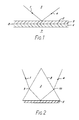
- FIG. 1 of the accompanying drawings Illustrated in Figure 1 of the accompanying drawings is a diagram of the equipment described in this paper.
- a beam 1 of light is applied from a laser source (not shown) onto an internal surface 2 of a glass body 3.
- a detector (not shown) monitors the internally reflected beam 4.
- Applied to the external surface 2 of glass body 3 is a thin film 5 of metal, for example gold or silver, and applied to the film 5 is a further thin film 6 of organic material containing antibodies.
- a sample 7 containing antigen is brought into contact with the antibody film 6 to thus cause a reaction between the antigen and the antibody. If binding occurs the refractive index of the layer 6 will change owing to the increased size of the antibody molecules and this change can be detected and measured using the surface plasmon resonance technique, as will now be explained.
- Surface plasmon resonance can be experimentally observed, in the arrangement of Figure 1, by varying the angle of the incident beam 1 and monitoring the intensity of the internally reflected beam 4. At a certain angle of incidence the parallel component of the light momentum will match with the dispersion for surface plasmons at the opposite surface 8 of the metal film. Provided that the thickness of metal film 5 is chosen correctly there will be an electromagnetic coupling between the glass/metal interface at surface 2 and the metal/antibody interface at surface 8 which results in surface plasmon resonance and thus an attenuation in the reflected beam 4 at that particular angle of incidence. Thus, as the angle of incidence of beam 1 is varied, surface plasmon resonance is observed as a sharp dip in the intensity of the internally reflected beam 4 at a particular angle of incidence.
- the angle of incidence at which resonance occurs is affected by the refractive index of the material against the metal film 5 - i.e. the antibody layer 6 - and the angle of incidence corresponding to resonance is thus a direct measure of the state of the reaction between the antibody and the antigen.
- Increased sensitivity can be obtained by choosing an angle of incidence halfway down the reflectance dip curve, where the response is substantially linear, at the beginning of the antibody/antigen reaction, and then maintaining that angle of incidence fixed and observing changes in the intensity of the reflected beam 4 with time.
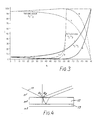
- FIG. 1 A diagram showing this arrangement is given in Figure 2 which is simply an experimental set up intended to demonstrate surface plasmon resonance.
- the prism is shown under reference 8 and has applied to its undersurface a thin film 5 of metal.
- Light 1 from a laser source (not shown) is incident on the prism where it is refracted at point 9 before entering the prism.
- the internally reflected beam 4 is likewise refracted (at point 10) upon exiting from the prism.
- the present invention utilises an alternative method of obtaining surface plasmon resonance in which a membrane is used in order to achieve the necessary internal reflection.
- the membrane takes the form of a laminate which comprises, in its most basic form, a first film made of transparent material and used, in effect, to replace the prism of Figure 2 in order to obtain the internal reflection needed for surface plasmon resonance, a second film of metal, such as silver, and a third film of sensitive material such as an antibody layer, the layers being arranged in the manner of Figure 1 - i.e. first film - second film - third film.
- the great advantage of using such an arrangement is that the membrane can be produced very cheaply and is thus readily available without great expense.
- the membrane can be supplied in the form of a continuous film, possibly sprocket fed like a cinematograph film, so that new areas of membrane can be brought into play in sequence one after another. Such a film could be packaged in cassette form.
- Figure 4 there is shown a diagrammatic representation of the reflection and refraction of an input light wave 11 travelling in a medium having a refractive index n1 in a thin block 12 of transparent material having a refractive index n2.
- a layer 13 of material such as silver.
- the refractive index of the medium behind the silver is n3.
- the graph of Figure 3 shows the percentage of transmission or reflection at the interfaces n1/n2 and n2/n3 for both S- polarised light and for P-polarised light as the angle 0, of incidence is varied.
- a wide section solid beam is focussed to a point on the interface in such a way that the incoming beam spans a range of angles about resonance. This type of arrangement is described in more detail in our European patent application 0305109.
- a relatively narrow beam is scanned about a range of angles close to the angle of incidence corresponding to resonance. This scanning may be achieved using a mirror in conjunction with a concave reflector.
- the mirror is caused to oscillate backwards and forwards at, say, 50Hz and takes the light output from the light source to move the beam backwards and forwards in sympathy in a scanning motion.
- the scanning beam is applied to the concave reflector which reflects the beam to a fixed spot on the n2/n3 interface whatever the angle of scanning.
- the mirror is caused to rotate continuously at, say, 50 r.p.s. to produce a 360° output sweep of the light beam. All but a small arc of interest is masked off to thereby produce, after reflection, an undirectional scanning motion across the angles of incidence spanning resonance.
- the sample feeding arrangements are provided within the membrane by incorporating a further layer in the laminate structure making up the membrane.
- This further layer is applied to the aforesaid third film - the sensitive layer - so that, in operation, a sample fluid can be brought into contact with the sensitive layer to effect a reaction between the sample and the sensitive layer.
- said further layer may be of porous material, which is used by placing the sample on its side remote from the sensitive layer, and allowing the sample to pass through the porous layer and into the sensitive area in a reasonably controlled manner.
- a particularly suitable form of porous material is that marketed by Anotec Separations Limited. This comprises a non-flexible honeycomb filter fabricated from alumina.
- the filters have a plurality of 200nm diameter apertures passing from one face to the other in a honeycomb-like structure. In some versions, one side of the 200nm diameter apertures are terminated on one side by 20nm apertures.
- This type offilter has the inherent advantage of providing a filter to prevent cells and other large particles within the sample from reaching the active area.
- said further layer takes the form of a structural layer, pre-formed to provide controlled feeding of the sample, or a plurality of samples simultaneously, past the active area.
- the further layer comprises a film of material having passage means extending from its face remote from the sensitive layer to the opposite face.
- an absorbent material which will be operable to draw the sample past the active area, at least for the short period of the test.
- the arrangement is such that said passage means leads from the face remote from the sensitive area, past the sensitive area, to the absorbent material.
- the film making up said further layer is made from hydrophyllic material.
- the passage means could comprise a single aperture passing through from one face of said further layer to the other. If an absorbent material is included, the aperture may open, at its end adjacent the sensitive layer, into another aperture leading to the absorbent material.
- the aperture and the further aperture if fitted are of a size such that the sample travels along them by capillary action.
- absorbent material may be provided as separate pieces of absorbent material for each test or, bearing in mind that the absorbent material is on the downstream side of the active areas, could be formed as a single piece of absorbent material common to a plurality of active areas.
- the passage means may take the form of a slot-like aperture passing from one face to the other of said further layer.
- the edges of the slot where they open onto the face which is remote from the sensitive layer are preferably chamfered to define an elongate trough-like well into which sample can be placed for the test.
- the sample passes down the slot to the opposite face of the further layer where it reacts with the various sensitive areas which are positioned to lie at the bottom of the slot.
- the size of the slot is such that the sample passes through it by capillary action.
- Absorbent material may be used, as before to draw the sample past the active areas.
- the layer applied to the metal film is described herein as an antibody layer for use in immunoassays, it will be seen that any sensitive layer whose refractive index changes upon an event occurring can be used thus to provide a sensitive detector having a wide variety of applications in the fields of biology, biochemistry and chemistry.
- the material comprising the sensitive layer may be specific to a particular entity within the sample or may be non-specific (i.e. may interact with several species of entity within the sample).
- recognition molecules such as the aforementioned antibodies which will specifically bind an analyte of interest within the sample, DNA/RNA probes which will bind with their complements in the sample liquid, or lectins, glycoproteins or enzyme substrates, all of which are capable of recognising and binding with the other partner in a bimolecular recognition pair.
- non-specific materials include hydrophobic materials, for example in the form of a monolayer of phospholipid-type molecules to capture amphipathic molecules, or hydrophilic materials which would capture polysaccharides.
- hydrophobic materials for example in the form of a monolayer of phospholipid-type molecules to capture amphipathic molecules, or hydrophilic materials which would capture polysaccharides.
- the surface of the metal film itself can form an effective non-specific binding material. Silver or gold surfaces will bind proteins or polynucleotides such as DNA or RNA without the need for any further coating and, in this case, a separate sensitive layer is effectively dispensed with altogether, and the surface of the metal film used directly for the capture of entities within the sample to be tested.
- the metal film material is commonly silver or gold, usually applied by evaporation.
- the film needs to be as uniform as possible in order to cater for minute movement in the point of incidence of the incoming beam. It is assumed that a structural metal film will give the best resonance and there are various ways in which the transparent film can be pretreated to improve the performance of the metal film and in particular to control the natural tendency of such films to form discontinuous islands:-
- Coating performance can also be improved by:-
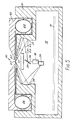
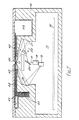
- the apparatus comprises a housing 14 having a hollow interior 15 in which is positioned a printed circuit board 16 on which is mounted the electronic circuitry associated with the apparatus.
- An aperture is formed in the top part of the housing, which aperture is covered by a support plate 17 of transparent material.
- a radiation source 18 produces a collimated input beam 19 of electromagnetic radiation.
- the frequency of the radiation must be such as to result in the generation of surface plasmon waves and in practice will be within or near the visible region.
- Suitable sources include a helium neon laseroran infra red diode laser, but an ordinary light source, with suitable filters and collimators, could be used.
- the light beam 19 is applied to a mirror 20 which in turn directs the light onto a concave reflecting surface 21 and thence to the transparent support plate 17.
- the mirror 20 is driven by motor means (not shown), to rotate in an oscillatory manner between the limit positions shown by the solid and dotted lines. The result of this is that the light beam applied to the reflecting surface 21 scans backwards and forwards between the positions represented by the beams 22 (solid line) and 23 (dotted line).
- a membrane in the form of a continuous film 24 which is moveable from left to right in Figure 5 from a supply reel 25 to a take-up reel 26.
- the membrane takes the form of a layer of flexible transparent material to which is applied a metal film layerfor example of silver and a final layer of sensitive material, such as an antibody layer.
- the arrangement is such that the layers are in the order - transparent support plate 17 - flexible transparent layer - metal film layer - sensitive layer.
- the sensitive layer is on the top when seen in Figure 5.
- the sample feeding arrangements dictate a more sophisticated construction of film, an example of which is given in Figure 6, to which reference will shortly be made.
- the flexible transparent layer lies directly against the transparent plate, possibly with an optical coupling fluid in between.
- the refractive index of the plate 17 is the same as that of the flexible transparent layer so that the two effectively act as a single transparent block, as far as light is concerned.
- Light incidentfrom reflecting surface 21 behaves in the block in a similar manner to that described above with reference to Figures 3 and 4.
- the metal film layer causes the light to be internally reflected at a point 27 lying on the interface between the flexible transparent layer and the metal film layer of the film 24.
- the internally reflected light passes out of the block, and is reflected off a further concave reflecting surface 28 to be incident on the sensitive surface of a light detector 29.
- the reflective surface 21 has a shape which is such as to bring light incident thereon from a range of angles to a single point 27, despite the refraction which inevitably occurs when the light enters the transparent plate 17.
- Computer analysis of the ray paths can derive a suitable shape for surface 21 to ensure that point 27 is stationary as the scanning between limit positions 22, 23 occurs.
- reflective surface 28 has a shape which is such as to bring light incident thereon from a range of angles to a single point at the sensitive area of detector 29.
- the reflective surfaces 21, 28 are formed by machining of the material, for example aluminium, of the housing 14. If the housing is not fabricated from a suitable material, the reflective surfaces 21, 28 can, of course, be formed as separate elements attached to the housing. Diamond machining of aluminium results in a highly reflective surface whose shape can be tailored, under computer control, to give whatever optical characteristics are required of it.
- the sensitive layer is one whose refractive index changes as it reacts with a sample, in the manner described above. This changes the angle of incidence at which surface plasmon resonance occurs, and thus the reaction of a sample with the sensitive layer can be monitored by observing the dip as the test proceeds. In order to carry out a test, it is simply necessary to place a sample to be tested on top of the sensitive layer in the area of the point 27 at which the light is incident, and observe the changes in the dip characteristics.
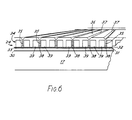
- FIG. 6 A particular method of feeding the sample to the active layer is shown in Figure 6 to which reference will now be made.
- the film 24 which is shown in Figure 6 is able to carry out multiple analyte testing on a single sample and, for this purpose, the point 27 at which light is incident on the interface between the flexible transparent layer and the metal film layer, which point was hitherto assumed to be stationary, must in fact be moveable in a direction transverse to the plane of Figure 5. This is achieved by means of a more sophisticated mirror system than that shown at 20 in Figure 5, and is described in greater detail on our aforementioned copending application.
- the film 24 is shown lying against the transparent plate 17 with an optional layer 30 of optical coupling gel or fluid in between.
- the film 24 comprises a layer 31 of flexible transparent material, such as transparent plastics material to which is applied a thin film layer 32 of metal such as silver or gold.
- a layer 33 of sensitive material such as an antibody layer.
- the layer 33 may be continuous, or may be applied in discrete areas where the reactions occur, as will become clear hereinafter.
- the final layer, shown under reference 34 is a preformed layer of, preferably hydrophyllic, plastics material which is used for feeding the sample to the sensitive layer 33 so as to react therewith.
- the layer 34 has a plurality of slots 35 extending transversely across the layer.
- the slots open into the top surface 36 of layer 34, and their edges are chamfered at 37 to define elongate troughs into which sample to be tested may be placed.
- the slots do not extend right through the layer 34, but terminate in a plurality of transverse passages 38 formed in that surface of layer 34 which faces the sensitive layer 33.
- Each transverse passage defines a chamber which becomes, during a test, the active area where the reaction between the sample and the sensitive layer 34 takes place.
- Each slot 35 terminates in a plurality of separate passages 38 which thus define a plurality of spaced active areas in which separate tests on a common sample can be carried out.
- Each slot 35 is associated with a pair of absorbent areas 39, formed as respective channels opening into the undersurface of layer 34 and containing an absorbent material.
- the passages 38 are such as to lead into the absorbent areas 39 so as to draw the sample continuously across the active area during a test.
- the film 24 is advanced until one slot 35 lies in registry with the point 27.
- a sample to be tested, and containing an antigen capable of binding with the antibody molecules in layer 33 is placed in the well 37 and passes through slot 35 by capillary action. Emerging from slot 35, the liquid sample commences to flow rapidly outwards in opposite directions along passageway 38 towards the absorbent material 39, passing as it does so, the layer 33.
- the sample adjacent the layer 33 is thus being constantly replenished during the course of the test, which ensures maximum sensitivity.
- any antigen within the sample capable of binding with the antibody in layer 33 will do so, thus altering the refractive index of layer 33 as the reaction proceeds.
- This change in refractive index is continuously monitored during the test by directing at the point 27 the light beam from source 18. Provided that conditions are correct - in particular the angle of incidence at the point 27 is correct - the application of the light beam will result in the generation of a plasmon wave, thus extracting energy from the input beam and causing an attenuation in the intensity of the output beam at a particular angle of incidence.
- the mirror 20 is oscillated backwards and forwards as the test proceeds so as to cause the beam to scan between the limit positions 22, 23, as explained above.
- the circuitry controlling the mirror motor outputs a strobe signal to enable the detector 29 to identify the instantaneous angle at which the light is incident at the point 27, so that an accurate picture of the reflectance dip can be obtained.
- the mirror 20 is also moved in such a way as to cause the point 27 to itself move backwards and forwards across the film 24 so as to pass one by one over the various active areas beneath the slot 35.
- the movement of point 27 may be continuous, but preferably the arrangement is such that the point 27 hovers over each active area for a short time before passing on to the next so as to enable the dip to be scanned over each active area.
- Suitable strobe signals output from the mirror motor drive circuitry are synchronised with the output from detector 29 so that the output from detector 29 can be identified with a particular active area along the slot 35.
- the initial reflective dip which is chosen for setting up the limit beams 22, 23 may be taken from the dip which results when some neutral or buffer solution is passed through the cell but before any reaction thereof has taken place.
- the refractive index does not start to change immediately due to the antibody/antigen reaction.
- This centre angle may be chosen to be the actual angle of dip, or it may be an angle half way down the reflectance dip.
- the film 24 may be advanced by an amount equal to the distance between adjacent slots 35, thereby to bring the next slot into line with the point 27, and thus enable a further test to be carried out. This process can be repeated until the film 24 runs out.
- the film 24 housed in a disposable cassette 40 ( Figure 5) which incorporates an opening 41 via which sample may be placed in the wells of the exposed film.
- the continuous film 24 of the embodiment of Figure 5 is replaced by a disposable element based on a rigid porous material made by Anotec Separations Limited.
- This material is briefly described above. Because of the brittle nature of the porous material, it is not possible to implement the apparatus in the form of a continuous film. Instead small disposable cards, a few centimetres long, are fed into the machine one by one. Each of these cards comprises a sandwich of a sensitive layer, such as an antibody layer, a metal film layer and the porous layer, this latter being made of any porous material such as the Anotec material. In the operative position one card is positioned on top of the transparent support plate 17 with the porous layer uppermost, and the sensitive layer against the plate 17.
- the sensitive layer is so thin, typically 50-100nm thick, that it is effectively transparent to the incident light.
- the cards, shown under reference 42 are fed from a stack 43, across the transparent support plate 17, to a bin 44.
- a pusher mechanism 45 acts to push the cards 42 along one by one, and an opening 46 in the top cover 47 of the housing 14 permits the placement of sample on the top surface of the card. Only sample with a relatively high concentration of analyte can be used with this technique because there is no continuous flow of sample past the active area to improve sensitivity.
- the Anotec material is a honeycomb-like structure, with both its major surface being covered with holes, the layers of metal and antibody will likewise be perforated. As a result, sample applied during a test, and passing through the filter to the surface of the transparent plate 17 will act as a coupling fluid, thus rendering further addition of such fluid unnecessary.
- an additional structured, e.g. porous, layer is incorporated in the cards of the previous embodiment.
- the order of layers is: rigid porous (e.g. Anotec) layer - sensitive layer - metal film layer - structural layer.
- This latter layer can be structured to draw sample fluid through the Anotec filter, thus keeping up a continuous flow during the test, and improving sensitivity.
- Absorbing pads can be placed at the edges of the cards in order to receive used sample directed by said structural layer.
- Figure 8 shows an arrangement similarto that of Figure 5, but in which the output reflecting surface 28 and the small light detector 29 are replaced by a large area light detector 47 such as an amorphous silicon device.
- the detector may be positioned in any convenient position and has a radiation sensitive area which is large enough to encompass the full movement of the output beam.
- the output from the detector is synchronised with the scanning of mirror 20 so that the circuitry is able to identify what the detector is looking at at any one instance of time. For this reason, it is not necessary to provide the detector47 with any x - y positional detection since the information in the beam is on a time basis, rather than a positional basis.
Landscapes
- Health & Medical Sciences (AREA)
- Life Sciences & Earth Sciences (AREA)
- Immunology (AREA)
- Chemical & Material Sciences (AREA)
- Engineering & Computer Science (AREA)
- Physics & Mathematics (AREA)
- Pathology (AREA)
- Biochemistry (AREA)
- General Health & Medical Sciences (AREA)
- General Physics & Mathematics (AREA)
- Analytical Chemistry (AREA)
- Hematology (AREA)
- Urology & Nephrology (AREA)
- Biomedical Technology (AREA)
- Molecular Biology (AREA)
- Plasma & Fusion (AREA)
- Cell Biology (AREA)
- Microbiology (AREA)
- Biotechnology (AREA)
- Chemical Kinetics & Catalysis (AREA)
- Food Science & Technology (AREA)
- Medicinal Chemistry (AREA)
- Investigating Or Analysing Materials By Optical Means (AREA)
- Investigating Or Analysing Biological Materials (AREA)
- Measurement And Recording Of Electrical Phenomena And Electrical Characteristics Of The Living Body (AREA)
- Measuring Pulse, Heart Rate, Blood Pressure Or Blood Flow (AREA)
Claims (13)
Priority Applications (1)
| Application Number | Priority Date | Filing Date | Title |
|---|---|---|---|
| AT89304914T ATE83321T1 (de) | 1988-05-20 | 1989-05-16 | Biosensoren. |
Applications Claiming Priority (2)
| Application Number | Priority Date | Filing Date | Title |
|---|---|---|---|
| GB888811919A GB8811919D0 (en) | 1988-05-20 | 1988-05-20 | Biological sensors |
| GB8811919 | 1988-05-20 |
Publications (2)
| Publication Number | Publication Date |
|---|---|
| EP0343826A1 EP0343826A1 (de) | 1989-11-29 |
| EP0343826B1 true EP0343826B1 (de) | 1992-12-09 |
Family
ID=10637206
Family Applications (1)
| Application Number | Title | Priority Date | Filing Date |
|---|---|---|---|
| EP89304914A Expired - Lifetime EP0343826B1 (de) | 1988-05-20 | 1989-05-16 | Biosensoren |
Country Status (6)
| Country | Link |
|---|---|
| US (1) | US5023053A (de) |
| EP (1) | EP0343826B1 (de) |
| JP (1) | JP2731591B2 (de) |
| AT (1) | ATE83321T1 (de) |
| DE (1) | DE68903785T2 (de) |
| GB (1) | GB8811919D0 (de) |
Families Citing this family (95)
| Publication number | Priority date | Publication date | Assignee | Title |
|---|---|---|---|---|
| US6060237A (en) * | 1985-02-26 | 2000-05-09 | Biostar, Inc. | Devices and methods for optical detection of nucleic acid hybridization |
| US4935346A (en) | 1986-08-13 | 1990-06-19 | Lifescan, Inc. | Minimum procedure system for the determination of analytes |
| GB2247749A (en) * | 1990-09-05 | 1992-03-11 | Marconi Gec Ltd | Sensor utilising surface plasmon resonance |
| GB9019999D0 (en) * | 1990-09-13 | 1990-10-24 | Amersham Int Plc | Biological sensors |
| US5583643A (en) * | 1991-04-12 | 1996-12-10 | British Technology Group Ltd. | Methods of and apparatus for measurement using acousto-optic devices |
| GB9200564D0 (en) * | 1992-01-11 | 1992-03-11 | Fisons Plc | Analytical device with variable angle of incidence |
| US5351127A (en) * | 1992-06-17 | 1994-09-27 | Hewlett-Packard Company | Surface plasmon resonance measuring instruments |
| US5327225A (en) * | 1993-01-28 | 1994-07-05 | The Center For Innovative Technology | Surface plasmon resonance sensor |
| US5395587A (en) * | 1993-07-06 | 1995-03-07 | Smithkline Beecham Corporation | Surface plasmon resonance detector having collector for eluted ligate |
| GB9320305D0 (en) * | 1993-10-01 | 1993-11-17 | Kodak Ltd | Production of carriers for surface plasmin resonance |
| US5955153A (en) * | 1993-10-01 | 1999-09-21 | Johnson & Johnson Clinical Diagnostics, Inc. | Production of carriers for surface plasmon resonance |
| GB9320310D0 (en) * | 1993-10-01 | 1993-11-17 | Kodak Ltd | Production of carriers for surface plasmon resonance |
| CA2128296A1 (en) * | 1993-12-22 | 1995-06-23 | Peter John Degen | Polyvinylidene fluoride membrane |
| AT403746B (de) * | 1994-04-12 | 1998-05-25 | Avl Verbrennungskraft Messtech | Optochemischer sensor sowie verfahren zu seiner herstellung |
| US5981203A (en) * | 1994-04-26 | 1999-11-09 | The Regents Of The University Of Michigan | Unitary sandwich enzyme immunoassay cassette, device and method of use |
| US5606633A (en) * | 1995-06-26 | 1997-02-25 | American Research Corporation Of Virginia | Chemical detector employing surface plasmon resonance excited using an optical waveguide configured as an asymmetric waveguide coupler |
| US5917607A (en) * | 1996-04-25 | 1999-06-29 | Fuji Photo Film Co., Ltd. | Surface plasmon sensor for multiple channel analysis |
| US5852229A (en) * | 1996-05-29 | 1998-12-22 | Kimberly-Clark Worldwide, Inc. | Piezoelectric resonator chemical sensing device |
| US6020047A (en) * | 1996-09-04 | 2000-02-01 | Kimberly-Clark Worldwide, Inc. | Polymer films having a printed self-assembling monolayer |
| US7153651B1 (en) * | 1996-10-31 | 2006-12-26 | Inverness Medical - Biostar, Inc. | Flow-through optical assay devices providing laminar flow of fluid samples, and methods of construction thereof |
| GB9623820D0 (en) * | 1996-11-16 | 1997-01-08 | Secr Defence | Surface plasma resonance sensor |
| US5846843A (en) * | 1996-11-18 | 1998-12-08 | The University Of Toledo | Sensor using long range surface plasmon resonance with diffraction double-grating |
| US5922550A (en) * | 1996-12-18 | 1999-07-13 | Kimberly-Clark Worldwide, Inc. | Biosensing devices which produce diffraction images |
| US6048623A (en) * | 1996-12-18 | 2000-04-11 | Kimberly-Clark Worldwide, Inc. | Method of contact printing on gold coated films |
| US6180288B1 (en) | 1997-03-21 | 2001-01-30 | Kimberly-Clark Worldwide, Inc. | Gel sensors and method of use thereof |
| WO1999001737A2 (en) * | 1997-06-10 | 1999-01-14 | Calspan Corporation | Detection of chemical agent materials using a sorbent polymer and fluorescent probe |
| WO1998059234A1 (en) | 1997-06-24 | 1998-12-30 | The University Of Wyoming | Method and apparatus for detection of a controlled substance |
| US6060256A (en) * | 1997-12-16 | 2000-05-09 | Kimberly-Clark Worldwide, Inc. | Optical diffraction biosensor |
| KR20010040559A (ko) | 1998-02-02 | 2001-05-15 | 시그나츄어 바이오사이언스 인코포레이티드 | 분자 결합 이벤트의 검출용 방법 및 장치 |
| US6338968B1 (en) | 1998-02-02 | 2002-01-15 | Signature Bioscience, Inc. | Method and apparatus for detecting molecular binding events |
| US6395480B1 (en) | 1999-02-01 | 2002-05-28 | Signature Bioscience, Inc. | Computer program and database structure for detecting molecular binding events |
| DE19805809C2 (de) * | 1998-02-12 | 2000-02-17 | Biotul Bio Instr Gmbh | Bestimmung der Oberflächenplasmonen-Resonanz mit Hilfe von örtlich oder zeitlich modifizierten Schichten |
| US6373577B1 (en) | 1998-05-20 | 2002-04-16 | Graffinity Pharmaceutical Design Gmbh | Surface plasmon resonance sensor for the simultaneous measurement of a plurality of samples in fluid form |
| US6573107B1 (en) | 1998-08-05 | 2003-06-03 | The University Of Wyoming | Immunochemical detection of an explosive substance in the gas phase through surface plasmon resonance spectroscopy |
| US6300638B1 (en) | 1998-11-12 | 2001-10-09 | Calspan Srl Corporation | Modular probe for total internal reflection fluorescence spectroscopy |
| WO2000031515A1 (de) * | 1998-11-20 | 2000-06-02 | Graffinity Pharmaceutical Design Gmbh | Messanordnung zum parallelen auslesen von spr-sensoren |
| US6221579B1 (en) * | 1998-12-11 | 2001-04-24 | Kimberly-Clark Worldwide, Inc. | Patterned binding of functionalized microspheres for optical diffraction-based biosensors |
| US6579673B2 (en) | 1998-12-17 | 2003-06-17 | Kimberly-Clark Worldwide, Inc. | Patterned deposition of antibody binding protein for optical diffraction-based biosensors |
| US6770488B1 (en) | 1999-03-19 | 2004-08-03 | The University Of Wyoming | Practical method and apparatus for analyte detection with colloidal particles |
| US6480282B1 (en) | 1999-05-06 | 2002-11-12 | University Of Washington | Capillary surface plasmon resonance sensors and multisensors |
| US7167615B1 (en) | 1999-11-05 | 2007-01-23 | Board Of Regents, The University Of Texas System | Resonant waveguide-grating filters and sensors and methods for making and using same |
| US6458326B1 (en) | 1999-11-24 | 2002-10-01 | Home Diagnostics, Inc. | Protective test strip platform |
| US6399295B1 (en) | 1999-12-17 | 2002-06-04 | Kimberly-Clark Worldwide, Inc. | Use of wicking agent to eliminate wash steps for optical diffraction-based biosensors |
| US6728429B1 (en) | 2000-02-16 | 2004-04-27 | Biotell, Inc. | Optical detection |
| DE10012793C2 (de) * | 2000-03-13 | 2002-01-24 | Fraunhofer Ges Forschung | Sensorelement zur optischen Detektion von chemischen oder biochemischen Analyten |
| US6525330B2 (en) | 2001-02-28 | 2003-02-25 | Home Diagnostics, Inc. | Method of strip insertion detection |
| US6562625B2 (en) | 2001-02-28 | 2003-05-13 | Home Diagnostics, Inc. | Distinguishing test types through spectral analysis |
| US6541266B2 (en) | 2001-02-28 | 2003-04-01 | Home Diagnostics, Inc. | Method for determining concentration of an analyte in a test strip |
| SE0100889D0 (sv) * | 2001-03-14 | 2001-03-14 | Biacore Ab | Method and apparatus for attenuated total reflection spectrosopy |
| US7102752B2 (en) | 2001-12-11 | 2006-09-05 | Kimberly-Clark Worldwide, Inc. | Systems to view and analyze the results from diffraction-based diagnostics |
| US7098041B2 (en) | 2001-12-11 | 2006-08-29 | Kimberly-Clark Worldwide, Inc. | Methods to view and analyze the results from diffraction-based diagnostics |
| DE10163657B4 (de) * | 2001-12-21 | 2008-05-08 | Gedig, Erk, Dr. | Vorrichtung und Verfahren zur Untersuchung dünner Schichten |
| US20030119203A1 (en) | 2001-12-24 | 2003-06-26 | Kimberly-Clark Worldwide, Inc. | Lateral flow assay devices and methods for conducting assays |
| US8367013B2 (en) | 2001-12-24 | 2013-02-05 | Kimberly-Clark Worldwide, Inc. | Reading device, method, and system for conducting lateral flow assays |
| US7223534B2 (en) * | 2002-05-03 | 2007-05-29 | Kimberly-Clark Worldwide, Inc. | Diffraction-based diagnostic devices |
| US7485453B2 (en) * | 2002-05-03 | 2009-02-03 | Kimberly-Clark Worldwide, Inc. | Diffraction-based diagnostic devices |
| US7118855B2 (en) * | 2002-05-03 | 2006-10-10 | Kimberly-Clark Worldwide, Inc. | Diffraction-based diagnostic devices |
| US7214530B2 (en) * | 2002-05-03 | 2007-05-08 | Kimberly-Clark Worldwide, Inc. | Biomolecule diagnostic devices and method for producing biomolecule diagnostic devices |
| US7771922B2 (en) * | 2002-05-03 | 2010-08-10 | Kimberly-Clark Worldwide, Inc. | Biomolecule diagnostic device |
| US7223368B2 (en) * | 2002-05-03 | 2007-05-29 | Kimberly-Clark Worldwide, Inc. | Diffraction-based diagnostic devices |
| US7091049B2 (en) * | 2002-06-26 | 2006-08-15 | Kimberly-Clark Worldwide, Inc. | Enhanced diffraction-based biosensor devices |
| US7285424B2 (en) | 2002-08-27 | 2007-10-23 | Kimberly-Clark Worldwide, Inc. | Membrane-based assay devices |
| US7432105B2 (en) | 2002-08-27 | 2008-10-07 | Kimberly-Clark Worldwide, Inc. | Self-calibration system for a magnetic binding assay |
| US7314763B2 (en) * | 2002-08-27 | 2008-01-01 | Kimberly-Clark Worldwide, Inc. | Fluidics-based assay devices |
| US7169550B2 (en) * | 2002-09-26 | 2007-01-30 | Kimberly-Clark Worldwide, Inc. | Diffraction-based diagnostic devices |
| US7781172B2 (en) | 2003-11-21 | 2010-08-24 | Kimberly-Clark Worldwide, Inc. | Method for extending the dynamic detection range of assay devices |
| US20040121334A1 (en) * | 2002-12-19 | 2004-06-24 | Kimberly-Clark Worldwide, Inc. | Self-calibrated flow-through assay devices |
| US7247500B2 (en) | 2002-12-19 | 2007-07-24 | Kimberly-Clark Worldwide, Inc. | Reduction of the hook effect in membrane-based assay devices |
| US20040197819A1 (en) | 2003-04-03 | 2004-10-07 | Kimberly-Clark Worldwide, Inc. | Assay devices that utilize hollow particles |
| US7851209B2 (en) * | 2003-04-03 | 2010-12-14 | Kimberly-Clark Worldwide, Inc. | Reduction of the hook effect in assay devices |
| US7943395B2 (en) | 2003-11-21 | 2011-05-17 | Kimberly-Clark Worldwide, Inc. | Extension of the dynamic detection range of assay devices |
| US7713748B2 (en) | 2003-11-21 | 2010-05-11 | Kimberly-Clark Worldwide, Inc. | Method of reducing the sensitivity of assay devices |
| US20050112703A1 (en) | 2003-11-21 | 2005-05-26 | Kimberly-Clark Worldwide, Inc. | Membrane-based lateral flow assay devices that utilize phosphorescent detection |
| US20050112587A1 (en) * | 2003-11-25 | 2005-05-26 | Sherrill James V. | Analyzing biological probes |
| US7943089B2 (en) | 2003-12-19 | 2011-05-17 | Kimberly-Clark Worldwide, Inc. | Laminated assay devices |
| US7521226B2 (en) | 2004-06-30 | 2009-04-21 | Kimberly-Clark Worldwide, Inc. | One-step enzymatic and amine detection technique |
| US7749445B2 (en) * | 2005-05-02 | 2010-07-06 | Bioscale, Inc. | Method and apparatus for analyzing bioprocess fluids |
| US7611908B2 (en) * | 2005-05-02 | 2009-11-03 | Bioscale, Inc. | Method and apparatus for therapeutic drug monitoring using an acoustic device |
| US7300631B2 (en) * | 2005-05-02 | 2007-11-27 | Bioscale, Inc. | Method and apparatus for detection of analyte using a flexural plate wave device and magnetic particles |
| US7648844B2 (en) * | 2005-05-02 | 2010-01-19 | Bioscale, Inc. | Method and apparatus for detection of analyte using an acoustic device |
| JP2006313091A (ja) * | 2005-05-06 | 2006-11-16 | Fuji Photo Film Co Ltd | 結合物質回収方法及び装置 |
| JP2007010578A (ja) * | 2005-07-01 | 2007-01-18 | Sony Corp | 表面プラズモン共鳴素子および表面プラズモン共鳴測定装置 |
| WO2007021907A2 (en) * | 2005-08-12 | 2007-02-22 | Bioscale, Inc. | Resonant sensor systems and methods with reduced gas interference |
| EP2028475B1 (de) * | 2006-06-12 | 2013-08-14 | Nippon Telegraph And Telephone Corporation | Chip zur optischen analyse |
| JP4949397B2 (ja) | 2006-06-26 | 2012-06-06 | 日本電信電話株式会社 | Spr測定用センサー素子 |
| US20080118402A1 (en) * | 2006-11-21 | 2008-05-22 | David Brancazio | Method and apparatus for analyte processing |
| US8202491B2 (en) | 2006-11-21 | 2012-06-19 | Bioscale, Inc. | Apparatus for analyte processing |
| WO2009033056A1 (en) * | 2007-09-06 | 2009-03-12 | Bioscale, Inc. | Reusable detection surfaces and methods of using same |
| US7736891B2 (en) * | 2007-09-11 | 2010-06-15 | University Of Washington | Microfluidic assay system with dispersion monitoring |
| WO2009090985A1 (ja) | 2008-01-16 | 2009-07-23 | Nippon Telegraph And Telephone Corporation | 流速測定装置、抗原濃度測定装置、フローセル、流速測定方法、抗原濃度測定方法 |
| US8094316B1 (en) * | 2008-05-12 | 2012-01-10 | Institute Of Photonics And Electronics As Cr, V.V.I. | Surface plasmon resonance coupler and disperser sensor |
| US20090323073A1 (en) * | 2008-06-30 | 2009-12-31 | Reichert, Inc. | Analytical Instrument Having Internal Reference Channel |
| JP5672709B2 (ja) | 2010-02-04 | 2015-02-18 | セイコーエプソン株式会社 | 生体情報検出器、生体情報測定装置および生体情報検出器における反射部の設計方法 |
| EP2631669B1 (de) * | 2012-02-24 | 2017-11-08 | Sick AG | Optische Einrichtung |
| CN108303397A (zh) * | 2017-12-25 | 2018-07-20 | 苏州大学 | 一种高性能折射率灵敏度传感器件及其测试方法 |
Family Cites Families (9)
| Publication number | Priority date | Publication date | Assignee | Title |
|---|---|---|---|---|
| US3526480A (en) * | 1966-12-15 | 1970-09-01 | Xerox Corp | Automated chemical analyzer |
| GB1451449A (en) * | 1972-10-09 | 1976-10-06 | Bagshawe K D | Chemical and biological analysis |
| US4327073A (en) * | 1980-04-07 | 1982-04-27 | Huang Henry V | Automated method for quantitative analysis of biological fluids |
| FR2565350B1 (fr) * | 1984-06-05 | 1986-10-10 | Paris Nord Universite | Moyens propres a permettre le support, le traitement, le stockage et l'analyse automatiques en continu d'echantillons biologiques |
| GB8509491D0 (en) * | 1985-04-12 | 1985-05-15 | Plessey Co Plc | Optic waveguide biosensors |
| GB8509492D0 (en) * | 1985-04-12 | 1985-05-15 | Plessey Co Plc | Optical assay |
| GB8620193D0 (en) * | 1986-08-19 | 1986-10-01 | Emi Plc Thorn | Chemical sensor |
| GB2197065A (en) * | 1986-11-03 | 1988-05-11 | Stc Plc | Optical sensor device |
| NL8700851A (nl) * | 1987-04-10 | 1988-11-01 | Tno | Werkwijze en inrichting voor het detecteren van zeer lage concentraties van een in een meetmedium aanwezige chemische component onder toepassing van oppervlakte-plasmonresonantie en elektrochemisch gestimuleerde adsorptie. |
-
1988
- 1988-05-20 GB GB888811919A patent/GB8811919D0/en active Pending
-
1989
- 1989-05-16 AT AT89304914T patent/ATE83321T1/de not_active IP Right Cessation
- 1989-05-16 EP EP89304914A patent/EP0343826B1/de not_active Expired - Lifetime
- 1989-05-16 DE DE8989304914T patent/DE68903785T2/de not_active Expired - Fee Related
- 1989-05-19 JP JP1126521A patent/JP2731591B2/ja not_active Expired - Lifetime
- 1989-05-22 US US07/355,187 patent/US5023053A/en not_active Expired - Fee Related
Also Published As
| Publication number | Publication date |
|---|---|
| JP2731591B2 (ja) | 1998-03-25 |
| DE68903785D1 (de) | 1993-01-21 |
| GB8811919D0 (en) | 1988-06-22 |
| JPH0259646A (ja) | 1990-02-28 |
| ATE83321T1 (de) | 1992-12-15 |
| US5023053A (en) | 1991-06-11 |
| DE68903785T2 (de) | 1993-04-08 |
| EP0343826A1 (de) | 1989-11-29 |
Similar Documents
| Publication | Publication Date | Title |
|---|---|---|
| US5023053A (en) | Biological sensors | |
| EP0341927B1 (de) | Biosensoren | |
| EP0305109B1 (de) | Biologische Sensoren | |
| US5055265A (en) | Biological sensors | |
| EP0326291B1 (de) | Biologische Nachweisvorrichtung | |
| US6870627B2 (en) | System for directed molecular interaction in surface plasmon resonance analysis | |
| EP1581800B1 (de) | Oberflächenplasmonenresonanzsensor | |
| EP0257955A2 (de) | Chemischer Fühler | |
| WO1992005426A1 (en) | Biological sensors | |
| US7586615B2 (en) | Measuring unit | |
| JP2002372490A (ja) | 全反射減衰を利用したセンサーおよび測定チップアセンブリ | |
| US20020180975A1 (en) | Measuring apparatus | |
| JP2003329580A (ja) | 測定装置および測定チップ | |
| JP4030796B2 (ja) | 測定チップ | |
| JP2003042944A (ja) | 表面プラズモン共鳴センサ装置 | |
| JP2003042945A (ja) | 表面プラズモン共鳴センサ装置 | |
| JP2003098074A (ja) | 全反射減衰を利用した測定方法および測定装置 | |
| JP2003279477A (ja) | 測定装置および測定チップ | |
| JP2006053093A (ja) | バイオセンサー |
Legal Events
| Date | Code | Title | Description |
|---|---|---|---|
| PUAI | Public reference made under article 153(3) epc to a published international application that has entered the european phase |
Free format text: ORIGINAL CODE: 0009012 |
|
| AK | Designated contracting states |
Kind code of ref document: A1 Designated state(s): AT BE CH DE FR GB IT LI LU NL SE |
|
| 17P | Request for examination filed |
Effective date: 19900215 |
|
| 17Q | First examination report despatched |
Effective date: 19910429 |
|
| GRAA | (expected) grant |
Free format text: ORIGINAL CODE: 0009210 |
|
| ITF | It: translation for a ep patent filed | ||
| AK | Designated contracting states |
Kind code of ref document: B1 Designated state(s): AT BE CH DE FR GB IT LI LU NL SE |
|
| PG25 | Lapsed in a contracting state [announced via postgrant information from national office to epo] |
Ref country code: AT Effective date: 19921209 |
|
| REF | Corresponds to: |
Ref document number: 83321 Country of ref document: AT Date of ref document: 19921215 Kind code of ref document: T |
|
| REF | Corresponds to: |
Ref document number: 68903785 Country of ref document: DE Date of ref document: 19930121 |
|
| ET | Fr: translation filed | ||
| PG25 | Lapsed in a contracting state [announced via postgrant information from national office to epo] |
Ref country code: LU Free format text: LAPSE BECAUSE OF NON-PAYMENT OF DUE FEES Effective date: 19930531 |
|
| PLBE | No opposition filed within time limit |
Free format text: ORIGINAL CODE: 0009261 |
|
| STAA | Information on the status of an ep patent application or granted ep patent |
Free format text: STATUS: NO OPPOSITION FILED WITHIN TIME LIMIT |
|
| 26N | No opposition filed | ||
| EAL | Se: european patent in force in sweden |
Ref document number: 89304914.8 |
|
| PGFP | Annual fee paid to national office [announced via postgrant information from national office to epo] |
Ref country code: GB Payment date: 19980507 Year of fee payment: 10 |
|
| PGFP | Annual fee paid to national office [announced via postgrant information from national office to epo] |
Ref country code: FR Payment date: 19980511 Year of fee payment: 10 |
|
| PGFP | Annual fee paid to national office [announced via postgrant information from national office to epo] |
Ref country code: SE Payment date: 19980515 Year of fee payment: 10 |
|
| PGFP | Annual fee paid to national office [announced via postgrant information from national office to epo] |
Ref country code: DE Payment date: 19980522 Year of fee payment: 10 |
|
| PGFP | Annual fee paid to national office [announced via postgrant information from national office to epo] |
Ref country code: CH Payment date: 19980527 Year of fee payment: 10 |
|
| PGFP | Annual fee paid to national office [announced via postgrant information from national office to epo] |
Ref country code: NL Payment date: 19980531 Year of fee payment: 10 |
|
| PGFP | Annual fee paid to national office [announced via postgrant information from national office to epo] |
Ref country code: BE Payment date: 19980714 Year of fee payment: 10 |
|
| PG25 | Lapsed in a contracting state [announced via postgrant information from national office to epo] |
Ref country code: GB Free format text: LAPSE BECAUSE OF NON-PAYMENT OF DUE FEES Effective date: 19990516 |
|
| PG25 | Lapsed in a contracting state [announced via postgrant information from national office to epo] |
Ref country code: SE Free format text: LAPSE BECAUSE OF NON-PAYMENT OF DUE FEES Effective date: 19990517 |
|
| PG25 | Lapsed in a contracting state [announced via postgrant information from national office to epo] |
Ref country code: LI Free format text: LAPSE BECAUSE OF NON-PAYMENT OF DUE FEES Effective date: 19990531 Ref country code: CH Free format text: LAPSE BECAUSE OF NON-PAYMENT OF DUE FEES Effective date: 19990531 Ref country code: BE Free format text: LAPSE BECAUSE OF NON-PAYMENT OF DUE FEES Effective date: 19990531 |
|
| REG | Reference to a national code |
Ref country code: GB Ref legal event code: 732E |
|
| BERE | Be: lapsed |
Owner name: AMERSHAM INTERNATIONAL P.L.C. Effective date: 19990531 |
|
| PG25 | Lapsed in a contracting state [announced via postgrant information from national office to epo] |
Ref country code: NL Free format text: LAPSE BECAUSE OF NON-PAYMENT OF DUE FEES Effective date: 19991201 |
|
| REG | Reference to a national code |
Ref country code: CH Ref legal event code: PL |
|
| GBPC | Gb: european patent ceased through non-payment of renewal fee |
Effective date: 19990516 |
|
| EUG | Se: european patent has lapsed |
Ref document number: 89304914.8 |
|
| PG25 | Lapsed in a contracting state [announced via postgrant information from national office to epo] |
Ref country code: FR Free format text: LAPSE BECAUSE OF NON-PAYMENT OF DUE FEES Effective date: 20000131 |
|
| NLV4 | Nl: lapsed or anulled due to non-payment of the annual fee |
Effective date: 19991201 |
|
| PG25 | Lapsed in a contracting state [announced via postgrant information from national office to epo] |
Ref country code: DE Free format text: LAPSE BECAUSE OF NON-PAYMENT OF DUE FEES Effective date: 20000301 |
|
| REG | Reference to a national code |
Ref country code: FR Ref legal event code: ST |
|
| REG | Reference to a national code |
Ref country code: FR Ref legal event code: TP |
|
| PG25 | Lapsed in a contracting state [announced via postgrant information from national office to epo] |
Ref country code: IT Free format text: LAPSE BECAUSE OF NON-PAYMENT OF DUE FEES;WARNING: LAPSES OF ITALIAN PATENTS WITH EFFECTIVE DATE BEFORE 2007 MAY HAVE OCCURRED AT ANY TIME BEFORE 2007. THE CORRECT EFFECTIVE DATE MAY BE DIFFERENT FROM THE ONE RECORDED. Effective date: 20050516 |