EP0343476A2 - Ethylenic unsaturated urea derivatives and process for their preparation - Google Patents
Ethylenic unsaturated urea derivatives and process for their preparation Download PDFInfo
- Publication number
- EP0343476A2 EP0343476A2 EP89108699A EP89108699A EP0343476A2 EP 0343476 A2 EP0343476 A2 EP 0343476A2 EP 89108699 A EP89108699 A EP 89108699A EP 89108699 A EP89108699 A EP 89108699A EP 0343476 A2 EP0343476 A2 EP 0343476A2
- Authority
- EP
- European Patent Office
- Prior art keywords
- formula
- optionally substituted
- ethylenically unsaturated
- urea derivatives
- amines
- Prior art date
- Legal status (The legal status is an assumption and is not a legal conclusion. Google has not performed a legal analysis and makes no representation as to the accuracy of the status listed.)
- Granted
Links
Classifications
-
- C—CHEMISTRY; METALLURGY
- C07—ORGANIC CHEMISTRY
- C07D—HETEROCYCLIC COMPOUNDS
- C07D295/00—Heterocyclic compounds containing polymethylene-imine rings with at least five ring members, 3-azabicyclo [3.2.2] nonane, piperazine, morpholine or thiomorpholine rings, having only hydrogen atoms directly attached to the ring carbon atoms
- C07D295/16—Heterocyclic compounds containing polymethylene-imine rings with at least five ring members, 3-azabicyclo [3.2.2] nonane, piperazine, morpholine or thiomorpholine rings, having only hydrogen atoms directly attached to the ring carbon atoms acylated on ring nitrogen atoms
- C07D295/20—Heterocyclic compounds containing polymethylene-imine rings with at least five ring members, 3-azabicyclo [3.2.2] nonane, piperazine, morpholine or thiomorpholine rings, having only hydrogen atoms directly attached to the ring carbon atoms acylated on ring nitrogen atoms by radicals derived from carbonic acid, or sulfur or nitrogen analogues thereof
- C07D295/215—Radicals derived from nitrogen analogues of carbonic acid
-
- C—CHEMISTRY; METALLURGY
- C07—ORGANIC CHEMISTRY
- C07C—ACYCLIC OR CARBOCYCLIC COMPOUNDS
- C07C275/00—Derivatives of urea, i.e. compounds containing any of the groups, the nitrogen atoms not being part of nitro or nitroso groups
- C07C275/04—Derivatives of urea, i.e. compounds containing any of the groups, the nitrogen atoms not being part of nitro or nitroso groups having nitrogen atoms of urea groups bound to acyclic carbon atoms
- C07C275/06—Derivatives of urea, i.e. compounds containing any of the groups, the nitrogen atoms not being part of nitro or nitroso groups having nitrogen atoms of urea groups bound to acyclic carbon atoms of an acyclic and saturated carbon skeleton
- C07C275/10—Derivatives of urea, i.e. compounds containing any of the groups, the nitrogen atoms not being part of nitro or nitroso groups having nitrogen atoms of urea groups bound to acyclic carbon atoms of an acyclic and saturated carbon skeleton being further substituted by singly-bound oxygen atoms
-
- C—CHEMISTRY; METALLURGY
- C07—ORGANIC CHEMISTRY
- C07C—ACYCLIC OR CARBOCYCLIC COMPOUNDS
- C07C275/00—Derivatives of urea, i.e. compounds containing any of the groups, the nitrogen atoms not being part of nitro or nitroso groups
- C07C275/28—Derivatives of urea, i.e. compounds containing any of the groups, the nitrogen atoms not being part of nitro or nitroso groups having nitrogen atoms of urea groups bound to carbon atoms of six-membered aromatic rings of a carbon skeleton
-
- C—CHEMISTRY; METALLURGY
- C07—ORGANIC CHEMISTRY
- C07D—HETEROCYCLIC COMPOUNDS
- C07D211/00—Heterocyclic compounds containing hydrogenated pyridine rings, not condensed with other rings
- C07D211/04—Heterocyclic compounds containing hydrogenated pyridine rings, not condensed with other rings with only hydrogen or carbon atoms directly attached to the ring nitrogen atom
- C07D211/06—Heterocyclic compounds containing hydrogenated pyridine rings, not condensed with other rings with only hydrogen or carbon atoms directly attached to the ring nitrogen atom having no double bonds between ring members or between ring members and non-ring members
- C07D211/36—Heterocyclic compounds containing hydrogenated pyridine rings, not condensed with other rings with only hydrogen or carbon atoms directly attached to the ring nitrogen atom having no double bonds between ring members or between ring members and non-ring members with hetero atoms or with carbon atoms having three bonds to hetero atoms with at the most one bond to halogen, e.g. ester or nitrile radicals, directly attached to ring carbon atoms
- C07D211/56—Nitrogen atoms
- C07D211/58—Nitrogen atoms attached in position 4
-
- C—CHEMISTRY; METALLURGY
- C07—ORGANIC CHEMISTRY
- C07C—ACYCLIC OR CARBOCYCLIC COMPOUNDS
- C07C2601/00—Systems containing only non-condensed rings
- C07C2601/12—Systems containing only non-condensed rings with a six-membered ring
- C07C2601/14—The ring being saturated
Definitions
- the invention relates to ethylenically unsaturated urea derivatives, in particular urea derivatives with (meth) acrylic ester or (meth) acrylamide groups, some of which have interesting solubilities in water and / or organic solvents and, among other things. polymerize radically or have copolymerized, as well as processes for their preparation.
- EP-PS 3870 already discloses ethylenically unsaturated urea derivatives with (meth) allyl groups and their use as comonomers in emulsion polymerization. When used as monomers, however, they have the disadvantages known in allyl polymerization.
- the process is preferably carried out according to the invention in such a way that the reactions according to a) and / or b) in bulk or preferably in inert organic solvents or in copolymerizable ethylenically unsaturated monomers (reactive diluents) which are inert under the reaction conditions in the absence of Water, preferably at temperatures between 0 ° C and room temperature, or at a higher temperature, preferably up to 60 C, is carried out.
- the inert organic solvents used are the inert solvents usually used in organic syntheses with isocyanates in an anhydrous medium, provided that they include can meet the requirements for dissolving action and boiling range.
- Preferred inert solvents are e.g. Toluene, tetrahydrofuran (THF), ethyl acetate and hexane.
- reactive diluents which are copolymerizable monomers which are inert under the synthesis conditions of the urea group formation according to the invention, but which can later be copolymerized with the unsaturated urea derivatives of the formula I according to the invention under suitable polymerization conditions.
- Preferred inert reactive diluents are accordingly e.g. (Meth) acrylic acid esters, styrene and vinyl esters, the use of which is preferably carried out below the saturation concentration of the reactants.
- a catalyst is also used in the isocyanate addition according to the invention, i.a. in order to keep the reaction temperature as low as possible, which can be particularly advantageous when using reactive diluents.
- Preferred catalysts are organic tin compounds which are preferably used in solution in an inert organic solvent. The use of dibutyltin dilaurate is particularly preferred.
- Preferred isocyanates of the formula II are those in which, in formula II, R 1 and R 2 for H or CH 3 , preferably H, R 3 for H or CHa, preferably CH 3 , Y for 0 and n for 2 to 4, preferably 2.
- Ammonia (Ci-C 4 ) -mono- or -dialkylamines, heterocyclic compounds with 5- to 7-membered rings such as pyrrole, pyrrolidine, piperidine or morpholine are preferably used as amine components of the formula III.
- Particularly preferred compounds of the formula V are those in which at least one R 7 radical, in particular four R 7 radicals, preferably four R 7 radicals in the 2- and 6-position of the heterocycle, are CH 3 .
- the customary known alkyl, aryl, aralkyl and cycloalkyl monoisocyanates can be used as isocyanates of the formula VI. Z are particularly preferred.
- the compounds of the formula prepared according to the invention are obtained directly in crystalline form and, if appropriate after suctioning off any solvents used, can generally be used as intermediates without further purification and drying.
- compounds of the formula I are also obtained in liquid-viscous form and can also be used directly as intermediates.
- the resulting crude reaction products in the synthesis process according to the invention can also by conventional methods such. B. elution, recrystallization, reprecipitation and / or distilling off volatile constituents, if appropriate under reduced pressure, cleaned and the compounds of formula I are obtained in chemically pure form.
- reaction product After a reaction time of about 2.5 hours, the reaction product is suctioned off from the liquid portion, washed three times with 100 ml of n-hexane and dried under vacuum.
- the yield of crystalline reaction product of the above formula I is 83.1 g (48.3% of theory), its melting point is 74-77 ° C.
- the product is readily soluble in water and readily soluble in some organic solvents, such as . B. toluene, acrylic ester, styrene.
- the IR and the 1 H-NMR spectrum are consistent with the structure of the urea compound of the above formula I.
- Example 1 The apparatus described in Example 1 is used with the modification that the gas inlet tube has been replaced by a dropping funnel.
- 36.6 g (0.5 mol) of n-butylamine and 1 drop of dibutyltin dilaurate (Sn catalyst), dissolved in 100 ml of toluene, are placed in the four-necked flask and 77.5 g (0.5 mol) are stirred at room temperature.
- Isocyanatoethyl methacrylate dripped into the template at a temperature between room temperature and 30 ° C.
- the desired reaction product of the above formula I precipitates in solid form in the reaction mixture during the dropping.
- the yield of the desired compound of the above formula I is 85.8 g (85.7% of theory); Melting point: 62-65 ° C.
- the product is soluble in various organic solvents as well as in styrene and / or acrylic esters and is not very soluble in water.
- the IR and the 1 H-NMR spectrum are consistent with the structure of the urea compound according to formula I mentioned above.
- Example 2 The apparatus described in Example 2 is used and the procedure is as described in Example 2, but the procedure is as follows. Instead of n-butylamine, 92.5 g (0.5 mol) of tert-butylaminoethyl methacrylate in toluene are introduced with the Sn catalyst and 49.6 g (0.5 mol) of butyl isocyanate are metered in instead of isocyanatoethyl methacrylate.
- the yield of liquid, highly viscous, yellowish-colored reaction product of the above formula I is 136.2 g (95.9% of theory). The product is readily miscible with various organic solvents and only slightly miscible with water.
- the IR and the 1 H-NMR spectrum are consistent with the structure of the urea compound according to the formula I mentioned above.
- Example 2 The apparatus described in Example 2 is used and the procedure is as described in Example 2, but the procedure is as follows. Instead of n-butylamine, 48.9 g (0.2 mol) of 4-methacrylamido-2,2,6,6-tetramethylpiperidine (MATMP) in toluene are initially introduced with the Sn catalyst, and 19.8 g (0, 2 mol) of n-butyl isocyanate were metered in at 40.degree. The yield of solid reaction product of the above formula I is 36 g (52.4% of theory); Melting point: 128 ° C. The product shows low solubility in both water and organic solvents. The IR and the 1 H-NMR spectrum are consistent with the structure of the urea compound according to formula I mentioned above.
- MATMP 4-methacrylamido-2,2,6,6-tetramethylpiperidine
- Example 2 The apparatus described in Example 2 is used and the procedure is as described in Example 2, but the procedure is as follows. Instead of n-butylamine, 122.2 g (0.5 mol) of MATMP (cf. Example 5) are placed in toluene with the Sn catalyst and, instead of isocyanatoethyl methacrylate, 62.5 g (0.5 mol) of cyclohexyl isocyanate are metered in at 50.degree. The yield of solid reaction product of the above formula I is 103.5 g (56% of theory); Melting point: 129 ° C. The product shows little solubility in both water and organic solvents. The IR and the 1 H-NMR spectrum are consistent with the structure of the urea compound according to formula I mentioned above.
- Example 2 The apparatus described in Example 2 is used and the procedure is as described in Example 2, but the procedure is as follows. Instead of n-butylamine, 92.5 g (0.5 mol) of tert-butylaminoethyl methacrylate in toluene are introduced with the Sn catalyst and 59.6 g (0.5 mol) of phenyl isocyanate are metered in at 50 ° C. instead of isocyanatoethyl methacrylate.
- the yield of solid reaction product of the above formula I is 150.6 g (99% of theory); Melting point: 63 ° C. The product is easily soluble in various organic solvents and slightly soluble in water.
- the IR and the 1 H-NMR spectrum are consistent with the structure of the urea compound according to formula I mentioned above.
- Example 2 The apparatus described in Example 2 is used and the procedure is as described in Example 2, but the procedure is as follows. Instead of n-butylamine, 77.5 g (0.5 mol) of isocyanatoethyl methacrylate in toluene are introduced with the Sn catalyst and 43.6 g (0.5 mol) of morpholine are metered in at 30 ° C. instead of isocyanatoethyl methacrylate.
- the yield of solid reaction product of the above formula I is 116.9 g (96.5% of theory); Melting point: 132 ° C. The product shows little solubility in both water and organic solvents.
- the IR and the 1 H-NMR spectrum are consistent with the structure of the urea compound according to the above formula.
- Example 2 The apparatus described in Example 2 is used and the procedure is as described in Example 2, but the procedure is as follows. Instead of n-butylamine, 77.5 g (0.5 mol) of isocyanatoethyl methacrylate in toluene are introduced with the Sn catalyst and 42.6 g (0.5 mol) of piperidine are metered in at 30 ° C. instead of isocyanatoethyl methacrylate.
- the yield of solid reaction product of the above formula I is 107.0 g (89.1% of theory); Melting point: 88 ° C.
- the product is readily soluble in various organic solvents and not very soluble in water.
- the IR and the 1 H-NMR spectrum are consistent with the structure of the urea compound according to formula I mentioned above.
Landscapes
- Chemical & Material Sciences (AREA)
- Organic Chemistry (AREA)
- Organic Low-Molecular-Weight Compounds And Preparation Thereof (AREA)
- Addition Polymer Or Copolymer, Post-Treatments, Or Chemical Modifications (AREA)
- Hydrogenated Pyridines (AREA)
- Polymerisation Methods In General (AREA)
Abstract
Harnstoffderivate mit α,β-ethylenisch ungesättigten Carboxy- oder Carbamidresten, hergestellt durch Umsetzung von ethylenisch ungesättigten Isocyanaten mit Ammoniak oder Aminen oder durch Umsetzung von ethylenisch ungesättigten Aminen mit Isocyanaten in Abwesenheit von Wasser, gegebenenfalls in Substanz, wobei man zur besseren Reaktionsführung die Umsetzungen vorteilhaft in inerten organischen Lösungsmitteln oder auch in sogenannten Reaktivverdünnern, das sind unter den Umsetzungsbedingungen sich inert verhaltende copolymerisationsfähige ethylenisch ungesättigte monomere Verbindungen, wie z.B. Vinylester, (Meth- )Acrylester, Vinylaromaten, durchführen kann.Urea derivatives with α, β-ethylenically unsaturated carboxy or carbamide radicals, prepared by reacting ethylenically unsaturated isocyanates with ammonia or amines or by reacting ethylenically unsaturated amines with isocyanates in the absence of water, if appropriate in bulk, the reactions being advantageous for better reaction management in inert organic solvents or also in so-called reactive diluents, these are copolymerizable ethylenically unsaturated monomeric compounds which are inert under the reaction conditions, such as, for example Vinyl esters, (meth) acrylic esters, vinyl aromatics, can perform.
Die erfindungsgemäß hergestellten Harnstoffderivate sind in ihrer monomeren Form gering bis mäßig bzw. teilweise gut löslich in Wasser und/oder in organischen Lösungsmitteln. Sie sind über ihre α,β-ethylenisch ungesättigten Carboxy-bzw. Carbamidgruppen polymerisationsfähig bzw. copolymerisationsfähig und können durch radikalisch initiierte Polymerisation bzw. Copolymerisation vielseitig zur Herstellung von Polymerisaten bzw. Copolymerisaten verwendet werden.In their monomeric form, the urea derivatives produced according to the invention are slightly to moderately or partially readily soluble in water and / or in organic solvents. They are about their α, β-ethylenically unsaturated carboxy or. Carbamide groups are polymerizable or copolymerizable and can be used in a variety of ways for the preparation of polymers or copolymers by means of free-radical initiated polymerization or copolymerization.
Description
Die Erfindung betrifft ethylenisch ungesättigte Harnstoffderivate, insbesondere Harnstoffderivate mit (Meth)Acrylester- oder (Meth)Acrylamidgruppen, die teilweise interessante Löslichkeiten in Wasser und/oder organischen Lösungsmitteln aufweisen und sich u.a. radikalisch polymerisieren bzw. copolymerisieren lassen, sowie Verfahren zu ihrer Herstellung.The invention relates to ethylenically unsaturated urea derivatives, in particular urea derivatives with (meth) acrylic ester or (meth) acrylamide groups, some of which have interesting solubilities in water and / or organic solvents and, among other things. polymerize radically or have copolymerized, as well as processes for their preparation.
Aus der EP-PS 3870 sind bereits ethylenisch ungesättigte Harnstoffderivate mit (Meth)Allylgruppen und deren Verwendung als Comonomere bei der Emulsionspolymerisation bekannt. Bei ihrer Verwendung als Monomere zeigen sie jedoch die bei der Allylpolymerisation bekannten Nachteile.EP-PS 3870 already discloses ethylenically unsaturated urea derivatives with (meth) allyl groups and their use as comonomers in emulsion polymerization. When used as monomers, however, they have the disadvantages known in allyl polymerization.
Aus der EP-OS 197 635 sind ethylenisch ungesättigte Harnstoffverbindungen mit (Meth)-Acrylesterresten bekannt, deren Harnstoffgruppe an dem der (Meth)Acrylestergruppe benachbarten N-Atom durch H und am anderen N-Atom durch einen größeren organischen Rest mit mindestens 5 C-Atomen substituiert ist. Diese Harnstoffverbindungen zeigen weder in Wasser noch in den meisten organischen Lösungsmitteln nennenswerte Löslichkeiten. Sie können durch Copolymerisation mit a,ß-ethylenisch ungesättigten Carbonsäuren und weiteren Comonomeren zur Herstellung von niedrig-viskosen Verdickerdispersionen verwendet werden, die sich durch Einstellung ihres pH-Wertes auf etwa 9 in hochviskose wäßrige Lösungen überführen lassen. Diese Produkte sollen eine bessere Verseifungsbeständigkeit und bessere Elektrolytbeständigkeiten, vergleichsweise zu anderen üblichen Verdickern, besitzen und zur Verbesserung der rheologischen Eigenschaften von wäßrigen Systemen verwendet werden können. Über andere Verwendung dieser Produkte ist nichts ausgeführt.From EP-OS 197 635 ethylenically unsaturated urea compounds with (meth) acrylic ester residues are known, the urea group of which is adjacent to the (meth) acrylic ester group by H and the other N atom by a larger organic radical with at least 5 C- Atoms is substituted. These urea compounds show no significant solubility in water or in most organic solvents. By copolymerization with α, β-ethylenically unsaturated carboxylic acids and other comonomers, they can be used to prepare low-viscosity thickener dispersions which can be converted into highly viscous aqueous solutions by adjusting their pH to about 9. These products are said to have better saponification resistance and better electrolyte resistance compared to other conventional thickeners and can be used to improve the rheological properties of aqueous systems. Nothing is said about any other use of these products.
Es wurden nun überraschenderweise Harnstoffderivate mit α,β-ethylenisch ungesättigten Carboxy- oder Carbamidresten gefunden, die geringe oder mäßige bis gute Löslichkeiten in Wasser und/oder in organischen Lösungsmitteln aufweisen, die polymerisationsfähig und copolymerisationsfähig sind und sich vorteilhaft und vielseitig, beispielsweise zur Herstellung von Polymerisaten oder Copolymerisaten, verwenden lassen.Surprisingly, it has now been found urea derivatives with α, β-ethylenically unsaturated carboxy or carbamide radicals which have low or moderate to good solubilities in water and / or in organic solvents, which are polymerizable and copolymerizable and which are advantageous and versatile, for example for the preparation of Have polymers or copolymers used.
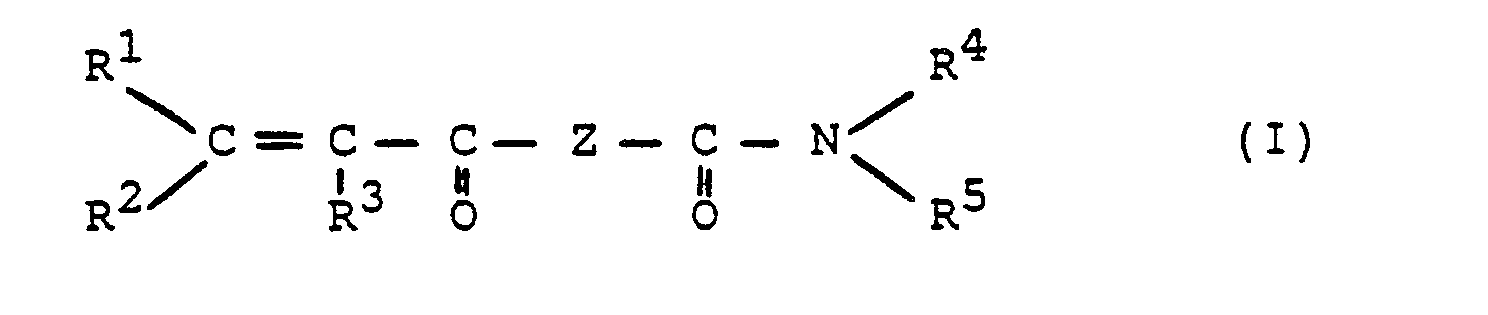
Gegenstand der Erfindung sind daher ethylenisch ungesättigte Harnstoffderivate der Formel I,

- RI, R2, R3, die gleich oder verschieden sein können, = H oder CHs,

- oder

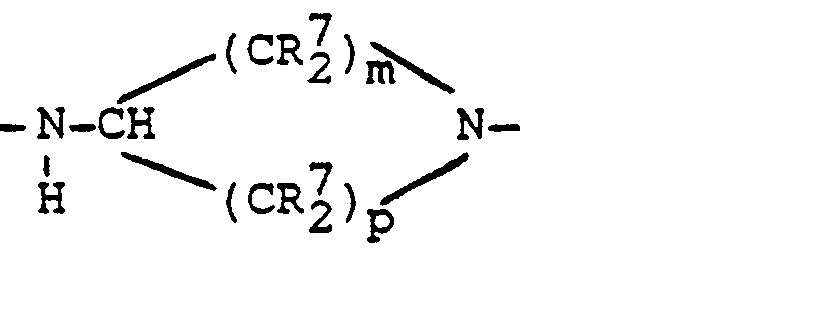
- Y = Sauerstoff oder NH, n = 2 bis 4, vorzugsweise 2,
- R6 = gegebenenfalls substituiertes (C1-C4)-Alkyl,
- R7 = H oder CH3 und m, p = jeweils mindestens die Zahl 1, vorzugsweise m + p = 3 bis 5,
- R4R5, die gleich oder verschieden sein können, = H, gegebenenfalls substituiertes (C1-Cso)-Alkyl, vorzugsweise (C1-C18)-Alkyl, gegebenenfalls substituiertes - (CkH2k)-OH mit k = 1 bis 8, vorzugsweise 2 bis 4, gegebenenfalls substituiertes (C6-C10)-Aryl, gegebenenfalls substituiertes (C7-Cso)-Aralkyl, gegebenenfalls substituiertes (Cs-C8)-Cycloalkyl, einen gegebenenfalls substituierten 5 bis 7-gliedrigen Heterocyclus oder einen aus R4 und R5 gemeinsam mit dem N-Atom gebildeten und gegebenenfalls substituierten Heterocyclus.
- Vorzugsweise steht R4 für H, wenn Z den Rest

- und
- R5 einen gegebenenfalls substituierten 5 bis 7-gliedrigen Heterocyclus, einen gegebenenfalls substituierten (C5-C8)-Cycloalkylrest oder einen gegebenenfalls substituierten Arylrest, oder wenn Z den Rest

- und R5 = H oder (C1-C4)-Alkyl bedeutet.
- R I , R 2 , R 3 , which may be the same or different, = H or CHs,
- or
- Y = oxygen or NH, n = 2 to 4, preferably 2,
- R 6 = optionally substituted (C 1 -C 4 ) alkyl,
- R 7 = H or CH 3 and m, p = in each case at least the number 1, preferably m + p = 3 to 5,
- R 4 R 5 , which may be the same or different, = H, optionally substituted (C 1 -Cso) alkyl, preferably (C 1 -C 18 ) alkyl, optionally substituted - (C k H 2k ) -OH with k = 1 to 8, preferably 2 to 4, optionally substituted (C 6 -C 10 ) aryl, optionally substituted (C 7 -Cso) aralkyl, optionally substituted (C s -C 8 ) cycloalkyl, an optionally substituted 5 to 7-membered heterocycle or a heterocycle formed from R 4 and R 5 together with the N atom and optionally substituted.
- R 4 is preferably H if Z is the remainder
- and
- R 5 is an optionally substituted 5 to 7-membered heterocycle, an optionally substituted (C 5 -C 8 ) cycloalkyl radical or an optionally substituted aryl radical, or if Z represents the radical
- and R 5 = H or (C 1 -C 4 ) alkyl.
Bevorzugte Harnstoffderivate sind ferner solche, bei denen in Formel I R1, R2 = H und R3 = CHs, oder R1,R2 = H, R3 = CH3 und Z =

Gegenstand der Erfindung ist ferner ein Verfahren zur Herstellung von ethylenisch ungesättigten Harnstoffderivaten der Formel I,

- a) Isocyanate der Formel II,


- b) Amine der Formeln IV oder V,
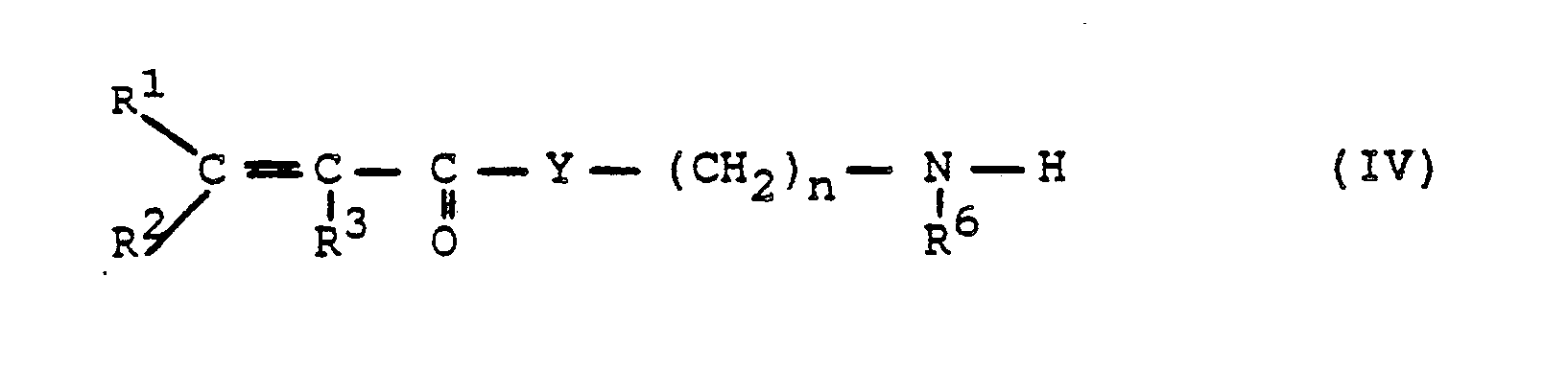


- a) isocyanates of the formula II,
- b) amines of the formulas IV or V,
Die Durchführung des Verfahrens erfolgt erfindungsgemäß bevorzugt in der Weise, daß man die Umsetzungen nach a) und/oder b) in Substanz oder vorzugsweise in inerten organischen Lösungsmitteln bzw. in unter den Umsetzungsbedingungen sich inert verhaltenden copolymerisationsfähigen ethylenisch ungesättigten Monomeren (Reaktivverdünner) in Abwesenheit von Wasser, vorzugsweise bei Temperaturen zwischen 0°C und Raumtemperatur, oder bei einer höheren Temperatur, vorzugsweise bis zu 60 C, durchführt.The process is preferably carried out according to the invention in such a way that the reactions according to a) and / or b) in bulk or preferably in inert organic solvents or in copolymerizable ethylenically unsaturated monomers (reactive diluents) which are inert under the reaction conditions in the absence of Water, preferably at temperatures between 0 ° C and room temperature, or at a higher temperature, preferably up to 60 C, is carried out.
Als inerte organische Lösungsmittel kommen die bei organischen Synthesen mit Isocyanaten in wasserfreiem Medium üblicherweise verwendeten inerten Lösungsmittel zur Anwendung, sofern sie u.a. die Erfordernisse hinsichtlich Lösewirkung und Siedebereich erfüllen können.The inert organic solvents used are the inert solvents usually used in organic syntheses with isocyanates in an anhydrous medium, provided that they include can meet the requirements for dissolving action and boiling range.
Bevorzugte inerte Lösungsmittel sind z.B. Toluol, Tetrahydrofuran (THF), Ethylacetat und Hexan.Preferred inert solvents are e.g. Toluene, tetrahydrofuran (THF), ethyl acetate and hexane.
Bevorzugt sind ferner auch sogenannte Reaktivverdünner, das sind copolymerisationsfähige Monomere, die sich unter den Synthesebedingungen der erfindungsgemäßen Harnstoffgruppenbildung inert verhalten, sich aber später unter geeigneten Polymerisationsbedingungen mit den erfindungsgemäßen ungesättigten Harnstoffderivaten der Formel I copolymerisieren lassen. Bevorzugte inerte Reaktivverdünner sind demzufolge z.B. (Meth)Acrylsäureester, Styrol und Vinylester, wobei man bei deren Verwendung vorzugsweise unterhalb der Sättigungskonzentration der Reaktanten arbeitet.Also preferred are so-called reactive diluents, which are copolymerizable monomers which are inert under the synthesis conditions of the urea group formation according to the invention, but which can later be copolymerized with the unsaturated urea derivatives of the formula I according to the invention under suitable polymerization conditions. Preferred inert reactive diluents are accordingly e.g. (Meth) acrylic acid esters, styrene and vinyl esters, the use of which is preferably carried out below the saturation concentration of the reactants.
Gegebenenfalls wird bei der erfindungsgemäßen Isocyanataddition ein Katalysator mitverwendet, u.a. um die Reaktionstemperatur möglichst niedrig halten zu können, was insbesondere bei der Verwendung von Reaktivverdünnern vorteilhaft sein kann. Bevorzugte Katalysatoren sind organische Zinnverbindungen, die vorzugsweise in einem inerten organischen Lösungsmittel gelöst eingesetzt werden. Besonders bevorzugt ist die Verwendung von Dibutylzinndilaurat.If necessary, a catalyst is also used in the isocyanate addition according to the invention, i.a. in order to keep the reaction temperature as low as possible, which can be particularly advantageous when using reactive diluents. Preferred catalysts are organic tin compounds which are preferably used in solution in an inert organic solvent. The use of dibutyltin dilaurate is particularly preferred.
Als Isocyanate der Formel II werden bevorzugt solche verwendet, bei denen in Formel II R1 und R2 für H oder CH3, vorzugsweise H, R3 für H oder CHa, vorzugsweise CH3, Y für 0 und n für 2 bis 4, vorzugsweise 2, steht.Preferred isocyanates of the formula II are those in which, in formula II, R 1 and R 2 for H or CH 3 , preferably H, R 3 for H or CHa, preferably CH 3 , Y for 0 and n for 2 to 4, preferably 2.
Als Aminkomponenten der Formel III werden bevorzugt Ammoniak, (Ci-C4)-Mono- oder -Dialkylamine, heterocyclische Verbindungen mit 5- bis 7-gliedrigen Ringen wie Pyrrol, Pyrrolidin, Piperidin oder Morpholin verwendet.Ammonia, (Ci-C 4 ) -mono- or -dialkylamines, heterocyclic compounds with 5- to 7-membered rings such as pyrrole, pyrrolidine, piperidine or morpholine are preferably used as amine components of the formula III.
Als Amine der Formel IV werden bevorzugt solche verwendet, bei denen in Formel IV R1, R2, R3 = H oder CH3, vorzugsweise R1, R2 = H und R3 = CHa, Y = 0, n = 2 bis 4, vorzugsweise 2, R6 = H oder (Ci-C4)-Alkyl, vorzugsweise (C1-C4)-Alkyl, insbesondere Butyl, besonders bevorzugt tert.-Butyl, bedeutet.Preferred amines of the formula IV are those in which in formula IV R 1 , R 2 , R 3 = H or CH 3 , preferably R 1 , R 2 = H and R 3 = CHa, Y = 0, n = 2 to 4, preferably 2, R 6 = H or (C 1 -C 4 ) -alkyl, preferably (C 1 -C 4 ) -alkyl, in particular butyl, particularly preferably tert-butyl.
Als Amine der Formel V werden bevorzugt solche verwendet, bei denen in Formel V R1, R2, R3 die Bedeutung wie in Formel IV haben, R7 = H oder CH3 und m + p = 3 bis 5, vorzugsweise m = 2 und p = 2 entsprechend einem Piperidinrest, bedeuten. Besonders bevorzugte Verbindungen der Formel V sind solche, bei denen mindestens ein Rest R7, insbesondere vier Reste R7, vorzugsweise vier Reste R7 in 2-und 6-Position des Heterocyclus, CH3 bedeuten.Preferred amines of the formula V are those in which VR 1 , R 2 , R 3 in formula VR have the meaning as in formula IV, R 7 = H or CH 3 and m + p = 3 to 5, preferably m = 2 and p = 2, corresponding to a piperidine residue. Particularly preferred compounds of the formula V are those in which at least one R 7 radical, in particular four R 7 radicals, preferably four R 7 radicals in the 2- and 6-position of the heterocycle, are CH 3 .
Als Isocyanate der Formel VI können insbesondere die üblichen bekannten Alkyl-, Aryl-, Aralkyl- und Cycloalkylmonoisocyanate verwendet werden. Besonders bevorzugt sind z. B. Methylisocyanat, Ethylisocyanat, Butylisocyanat, Nonylisocyanat, Oktadecylisocyanat, Phenylisocyanat, 3-Chlorphenylisocyanat, 3-Toluylisocyanat und Cyclohexylisocyanat.In particular, the customary known alkyl, aryl, aralkyl and cycloalkyl monoisocyanates can be used as isocyanates of the formula VI. Z are particularly preferred. B. methyl isocyanate, ethyl isocyanate, butyl isocyanate, nonyl isocyanate, octadecyl isocyanate, phenyl isocyanate, 3-chlorophenyl isocyanate, 3-toluyl isocyanate and cyclohexyl isocyanate.
Die erfindungsgemäß hergestellten Verbindungen der Formel werden in den meisten Fällen unmittelbar in kristalliner Form erhalten und können, gegebenenfalls nach Absaugen von mitverwendeten Lösungsmitteln, im allgemeinen ohne weitere Reinigung und Trocknung als Zwischenprodukte weiter verwendet werden. In manchen Fällen fallen Verbindungen der Formel I auch in flüssig-viskoser Form an und können als Zwischenprodukte ebenfalls direkt weiter verwendet werden. Selbstverständlich können die bei dem erfindungsgemäßen Syntheseverfahren anfallenden rohen Reaktionsprodukte auch nach üblichen Methoden, wie z. B. Eluieren, Umkristallisieren, Umfällen und/oder Abdestillieren flüchtiger Bestandteile gegebenenfalls unter vermindertem Druck, gereinigt und die Verbindungen der Formel I in chemisch reiner Form gewonnen werden.In most cases, the compounds of the formula prepared according to the invention are obtained directly in crystalline form and, if appropriate after suctioning off any solvents used, can generally be used as intermediates without further purification and drying. In some cases, compounds of the formula I are also obtained in liquid-viscous form and can also be used directly as intermediates. Of course, the resulting crude reaction products in the synthesis process according to the invention can also by conventional methods such. B. elution, recrystallization, reprecipitation and / or distilling off volatile constituents, if appropriate under reduced pressure, cleaned and the compounds of formula I are obtained in chemically pure form.
Es hat sich bei Löslichkeitsversuchen u.a. gezeigt, daß die Löslichkeiten von Verbindungen der Formel I mit R', R2 = H, R3 = CH3, Z = -O-(CH2)2- N -, H R4 = H und R5 = H oder (C1-C4)-Alkyl, eine starke Abhängigkeit von der Art des Restes R5 zeigen. So ist bei Verbindungen mit R5 = H oder CH3 die Löslichkeit in Wasser überraschend hoch (> 10 Gew.-%) und die Verbindung mit R5 = CHs ist außerdem auch in inerten organischen Lösungsmitteln und in inerten Reaktivverdünnern gut löslich. Mit steigender Größe des Restes R5 von (C2)-Alkyl bis zu (C4)-Alkyl geht die Löslichkeit der Verbindungen sowohl in Wasser als auch in inerten organischen Lösungsmitteln stark zurück.It has been shown in solubility tests, inter alia, that the solubilities of compounds of the formula I with R ', R 2 = H, R 3 = CH 3 , Z = -O- (CH 2 ) 2 - N -, HR 4 = H and R 5 = H or (C 1 -C 4 ) alkyl, show a strong dependence on the nature of the radical R 5 . In the case of compounds with R 5 = H or CH 3, the solubility in water is surprisingly high (> 10% by weight) and the compound with R 5 = CHs is also readily soluble in inert organic solvents and in inert reactive diluents. As the size of the R 5 radical increases from (C 2 ) -alkyl to (C 4 ) -alkyl, the solubility of the compounds decreases sharply both in water and in inert organic solvents.
Dieses stark variable Löslichkeitsverhalten eröffnet den Harnstoffderivaten der Formel 1 interessante Verwendungsmöglichkeiten, insbesondere als Comonomere bei Polymerisationen. Es wurde diesbezüglich überraschenderweise gefunden, daß vorzugsweise durch radikalisch initiierte Emulsions- oder Suspensionspolymerisation hergestellte Dispersionspolymerisate auf der Basis von ethylenisch ungesättigen Monomeren, die mindestens 1 Gew.-% Monomereinheiten aus Harnstoffderivaten der Formel I der vorliegenden Erfindung enthalten, unerwartet vorteilhafte Eigenschaften besitzen. Diese Polymerisate bzw. Copolymerisate, ihre Verwendbarkeit, insbesondere in Form ihrer wäßrigen Dispersionen, sowie ihre Herstellung unter Verwendung monomerer Harnstoffderivate der Formel I der vorliegenden Erfindung als Ausgangsprodukte sind Gegenstand der am gleichen Tag eingereichten Patentanmeldung HOE 88/F 124 (Az. P 38 17 469.3), auf die hiermit Bezug genommen wird.This highly variable solubility behavior opens up interesting uses for the urea derivatives of Formula 1, in particular as comonomers in polymerizations. In this regard, it has surprisingly been found that dispersion polymers preferably prepared by free-radically initiated emulsion or suspension polymerization and based on ethylenically unsaturated monomers which contain at least 1% by weight of monomer units from urea derivatives of the formula I of the present invention have unexpectedly advantageous properties. These polymers or copolymers, their usability, in particular in the form of their aqueous dispersions, and their preparation using monomeric urea derivatives of the formula I of the present invention as starting products are the subject of the patent application HOE 88 / F 124 filed on the same day (file number P 38 17 469.3), to which reference is hereby made.
Die Erfindung wird durch die nachstehenden Beispiele näher erläutert.The invention is illustrated by the examples below.
Herstellung der Formel I-Verbindung

In einem Vierhalskolben mit Rührer, Thermometer, Gaseinleitungsrohr und Rückflußkühler mit CaCl2-Endrohr werden 1,2 I trockenes n-Hexan, 155,1 g (1 Mol) Isocyanatoethylmethacrylat und 0,1 ml Dibutylzinndilaurat vorgelegt. Anschließend wird bei einer Temperatur zwischen 0 und 5°C mindestens 1 Mol NH3 als trockenes Ammoniakgas unter Rühren unmittelbar unter die Flüssigkeitsoberfläche in die Reaktionsmischung eingeleitet. Nach einiger Reaktionszeit trübt sich das Reaktionsgemisch und die gewünschte ethylenisch ungesättigte Harnstoffverbindung der obengenannten Formel I beginnt auszukristallisieren. Nach einer Reaktionszeit von ca. 2,5 Stunden wird das Reaktionsprodukt vom flüssigen Anteil abgesaugt, dreimal mit 100 ml n-Hexan gewaschen und unter Vakuum getrocknet. Die Ausbeute an kristallinem Reaktionsprodukt der obengenannten Formel I beträgt 83,1 g (48,3 % der Theorie), sein Schmelzpunkt liegt bei 74-77° C. Das Produkt ist leicht löslich in Wasser und gut löslich in einigen organischen Lösungsmitteln, wie z. B. Toluol, Acrylester, Styrol. Das IR- und das 1H-NMR-Spektrum stehen mit der Struktur der Harnstoffverbindung der obengenannten Formel I im Einklang.1.2 l of dry n-hexane, 155.1 g (1 mol) of isocyanatoethyl methacrylate and 0.1 ml of dibutyltin dilaurate are placed in a four-necked flask equipped with a stirrer, thermometer, gas inlet tube and reflux condenser with a CaCl 2 end tube. Subsequently, at a temperature between 0 and 5 ° C., at least 1 mol of NH 3 as dry ammonia gas is introduced into the reaction mixture with stirring directly below the liquid surface. After some reaction time, the reaction mixture becomes cloudy and the desired ethylenically unsaturated urea compound of the above formula I begins to crystallize out. After a reaction time of about 2.5 hours, the reaction product is suctioned off from the liquid portion, washed three times with 100 ml of n-hexane and dried under vacuum. The yield of crystalline reaction product of the above formula I is 83.1 g (48.3% of theory), its melting point is 74-77 ° C. The product is readily soluble in water and readily soluble in some organic solvents, such as . B. toluene, acrylic ester, styrene. The IR and the 1 H-NMR spectrum are consistent with the structure of the urea compound of the above formula I.
Herstellung der Formel I-Verbindung

Es wird die in Beispiel 1 beschriebene Apparatur mit der Abänderung verwendet, daß das Gaseinleitungsrohr durch einen Tropftrichter ersetzt wurde. Es werden in dem Vierhalskolben 36,6 g (0,5 Mol) n-Butylamin und 1 Tropfen Dibutylzinndilaurat (Sn-Katalysator), gelöst in 100 ml Toluol, vorgelegt und bei Raumtemperatur unter Rühren 77,5 g (0,5 Mol) Isocyanatoethylmethacrylat bei einer Temperatur zwischen Raumtemperatur und 30 °C in die Vorlage getropft. Das gewünschte Reaktionsprodukt der obengenannten Formel I fällt während des Zutropfens in dem Reaktionsgemisch in fester Form aus. Nach beendeter Reaktion läßt man ca. 1 Stunde nachreagieren, saugt anschließend das feste Umsetzungsprodukt vom flüssigen Anteil ab, wäscht das feste Produkt zweimal mit jeweils 30 ml Diethylether und trocknet es unter Vakuum. Die Ausbeute an der gewünschten Verbindung der obengenannten Formel I beträgt 85,8 g (85,7 % d. Theorie); Schmelzpunkt: 62-65°C. Das Produkt ist löslich in verschiedenen organischen Lösungsmitteln sowie in Styrol und/oder Acrylestern und ist wenig löslich in Wasser. Das IR- und das 1H-NMR-Spektrum stehen mit der Struktur der Harnstoffverbindung gemäß der obengenannten Formel I im Einklang.The apparatus described in Example 1 is used with the modification that the gas inlet tube has been replaced by a dropping funnel. 36.6 g (0.5 mol) of n-butylamine and 1 drop of dibutyltin dilaurate (Sn catalyst), dissolved in 100 ml of toluene, are placed in the four-necked flask and 77.5 g (0.5 mol) are stirred at room temperature. Isocyanatoethyl methacrylate dripped into the template at a temperature between room temperature and 30 ° C. The desired reaction product of the above formula I precipitates in solid form in the reaction mixture during the dropping. After the reaction has ended, the mixture is left to react for about 1 hour, then the solid reaction product is suctioned off from the liquid portion, the solid product is washed twice with 30 ml of diethyl ether each time and dried under vacuum. The yield of the desired compound of the above formula I is 85.8 g (85.7% of theory); Melting point: 62-65 ° C. The product is soluble in various organic solvents as well as in styrene and / or acrylic esters and is not very soluble in water. The IR and the 1 H-NMR spectrum are consistent with the structure of the urea compound according to formula I mentioned above.

Es wird wie in Beispiel 1 beschrieben verfahren, jedoch mit der Abänderung, daß anstelle von Ammoniakgas mindestens 1 Mol trockenes, gasförmiges Methylamin in die Reaktionsmischung eingeleitet wird. Die Ausbeute an festem Reaktionsprodukt der obengenannten Formel I beträgt 159,4 g (85,6 % der Theorie); Schmelzpunkt: 62 - 67°C. Das Produkt ist leicht löslich in Wasser und in verschiedenen organischen Lösungsmitteln. Das IR- und das 1H-NMR-Spektrum stehen mit der Struktur der Harnstoffverbindung gemäß der obengenannten Formel I im Einklang.The procedure is as described in Example 1, but with the modification that instead of ammonia gas, at least 1 mol of dry, gaseous methylamine is introduced into the reaction mixture. The yield of solid reaction product of the above formula I is 159.4 g (85.6% of theory); Melting point: 62 - 67 ° C. The product is easily soluble in water and in various organic solvents. The IR and the 1 H-NMR spectrum are consistent with the structure of the urea compound according to formula I mentioned above.

Es wird die in Beispiel 2 beschriebene Apparatur verwendet und es wird wie in Beispiel 2 beschrieben, jedoch mit folgender Abänderung verfahren. Es werden statt n-Butylamin 92,5 g (0,5 Mol) tert.-Butylaminoethylmethacrylat in Toluol mit dem Sn-Katalysator vorgelegt und statt Isocyanatoethylmethacrylat 49,6 g (0,5 Mol) Butylisocyanat zudosiert. Die Ausbeute an flüssigem, hochviskosem, gelblich gefärbtem Reaktionsprodukt der obengenannten Formel I beträgt 136,2 g (95,9 % der Theorie). Das Produkt ist mit verschiedenen organischen Lösungsmitteln gut mischbar und mit Wasser nur geringfügig mischbar. Das IR-und das 1H-NMR-Spektrum stehen mit der Struktur der Harnstoffverbindung gemäß der obengenannten Formel I im Einklang.The apparatus described in Example 2 is used and the procedure is as described in Example 2, but the procedure is as follows. Instead of n-butylamine, 92.5 g (0.5 mol) of tert-butylaminoethyl methacrylate in toluene are introduced with the Sn catalyst and 49.6 g (0.5 mol) of butyl isocyanate are metered in instead of isocyanatoethyl methacrylate. The yield of liquid, highly viscous, yellowish-colored reaction product of the above formula I is 136.2 g (95.9% of theory). The product is readily miscible with various organic solvents and only slightly miscible with water. The IR and the 1 H-NMR spectrum are consistent with the structure of the urea compound according to the formula I mentioned above.

Es wird die in Beispiel 2 beschriebene Apparatur verwendet und es wird wie in Beispiel 2 beschrieben, jedoch mit folgender Abänderung verfahren. Es werden statt n-Butylamin 48,9 g (0,2 Mol) 4-Methacrylamido-2,2,6,6-tetramethylpiperidin (MATMP) in Toluol mit dem Sn-Katalysator vorgelegt und statt Isocyanatoethylmethacrylat 19,8 g (0,2 Mol) n-Butylisocyanat bei 40 °C zudosiert. Die Ausbeute an festem Reaktionsprodukt der obengenannten Formel I beträgt 36 g (52,4 % der Theorie); Schmelzpunkt: 128°C. Das Produkt zeigt zur geringe Löslichkeit sowohl in Wasser als auch in organischen Lösungsmitteln. Das IR- und das 1H-NMR-Spektrum stehen mit der Struktur der Harnstoffverbindung gemäß der obengenannten Formel I im Einklang.The apparatus described in Example 2 is used and the procedure is as described in Example 2, but the procedure is as follows. Instead of n-butylamine, 48.9 g (0.2 mol) of 4-methacrylamido-2,2,6,6-tetramethylpiperidine (MATMP) in toluene are initially introduced with the Sn catalyst, and 19.8 g (0, 2 mol) of n-butyl isocyanate were metered in at 40.degree. The yield of solid reaction product of the above formula I is 36 g (52.4% of theory); Melting point: 128 ° C. The product shows low solubility in both water and organic solvents. The IR and the 1 H-NMR spectrum are consistent with the structure of the urea compound according to formula I mentioned above.

Es wird die in Beispiel 2 beschriebene Apparatur verwendet und es wird wie in Beispiel 2 beschrieben, jedoch mit folgender Abänderung verfahren. Es werden statt n-Butylamin 122,2 g (0,5 Mol) MATMP (vgl. Beispiel 5) in Toluol mit dem Sn-Katalysator vorgelegt und statt Isocyanatoethylmethacrylat 62,5 g (0,5 Mol) Cyclohexylisocyanat bei 50 C zudosiert. Die Ausbeute an festem Reaktionsprodukt der obengenannten Formel I beträgt 103,5 g (56 % der Theorie); Schmelzpunkt: 129°C. Das Produkt zeigt nur geringe Löslichkeit sowohl in Wasser als auch in organischen Lösungsmittel. Das IR- und das 1H-NMR-Spektrum stehen mit der Struktur der Harnstoffverbindung gemäß der obengenannten Formel I im Einklang.The apparatus described in Example 2 is used and the procedure is as described in Example 2, but the procedure is as follows. Instead of n-butylamine, 122.2 g (0.5 mol) of MATMP (cf. Example 5) are placed in toluene with the Sn catalyst and, instead of isocyanatoethyl methacrylate, 62.5 g (0.5 mol) of cyclohexyl isocyanate are metered in at 50.degree. The yield of solid reaction product of the above formula I is 103.5 g (56% of theory); Melting point: 129 ° C. The product shows little solubility in both water and organic solvents. The IR and the 1 H-NMR spectrum are consistent with the structure of the urea compound according to formula I mentioned above.

Es wird die in Beispiel 2 beschriebene Apparatur verwendet und es wird wie in Beispiel 2 beschrieben, jedoch mit folgender Abänderung verfahren. Es werden statt n-Butylamin 92,5 g (0,5 Mol) tert.-Butylaminoethylmethacrylat in Toluol mit dem Sn-Katalysator vorgelegt und statt Isocyanatoethylmethacrylat 59,6 g (0,5 Mol) Phenylisocyanat bei 50°C zudosiert. Die Ausbeute an festem Reaktionsprodukt der obengenannten Formel I beträgt 150,6 g (99 % der Theorie); Schmelzpunkt: 63° C. Das Produkt ist leicht löslich in verschiedenen organischen Lösungsmitteln und wenig löslich in Wasser. Das IR- und das 1H-NMR-Spektrum stehen mit der Struktur der Harnstoffverbindung gemäß der obengenannten Formel I im Einklang..The apparatus described in Example 2 is used and the procedure is as described in Example 2, but the procedure is as follows. Instead of n-butylamine, 92.5 g (0.5 mol) of tert-butylaminoethyl methacrylate in toluene are introduced with the Sn catalyst and 59.6 g (0.5 mol) of phenyl isocyanate are metered in at 50 ° C. instead of isocyanatoethyl methacrylate. The yield of solid reaction product of the above formula I is 150.6 g (99% of theory); Melting point: 63 ° C. The product is easily soluble in various organic solvents and slightly soluble in water. The IR and the 1 H-NMR spectrum are consistent with the structure of the urea compound according to formula I mentioned above.

Es wird die in Beispiel 2 beschriebene Apparatur verwendet und es wird wie in Beispiel 2 beschrieben, jedoch mit folgender Abänderung verfahren. Es werden statt n-Butylamin 77,5 g (0,5 Mol) Isocyanatoethylmethacrylat in Toluol mit dem Sn-Katalysator vorgelegt und statt Isocyanatoethylmethacrylat 43,6 g (0,5 Mol) Morpholin bei 30 °C zudosiert. Die Ausbeute an festem Reaktionsprodukt der obengenannten Formel I beträgt 116,9 g (96,5 % der Theorie); Schmelzpunkt: 132°C. Das Produkt zeigt nur geringe Löslichkeit sowohl in Wasser als auch in organischen Lösungsmitteln. Das IR- und das 1H-NMR-Spektrum stehen mit der Struktur der Harnstoffverbindung gemäß der obengenannten Formel im Einklang.The apparatus described in Example 2 is used and the procedure is as described in Example 2, but the procedure is as follows. Instead of n-butylamine, 77.5 g (0.5 mol) of isocyanatoethyl methacrylate in toluene are introduced with the Sn catalyst and 43.6 g (0.5 mol) of morpholine are metered in at 30 ° C. instead of isocyanatoethyl methacrylate. The yield of solid reaction product of the above formula I is 116.9 g (96.5% of theory); Melting point: 132 ° C. The product shows little solubility in both water and organic solvents. The IR and the 1 H-NMR spectrum are consistent with the structure of the urea compound according to the above formula.
Herstellung der Formel I-Verbindung

Es wird die in Beispiel 2 beschriebene Apparatur verwendet und es wird wie in Beispiel 2 beschrieben, jedoch mit folgender Abänderung verfahren. Es werden statt n-Butylamin 77,5 g (0,5 Mol) Isocyanatoethylmethacrylat in Toluol mit dem Sn-Katalysator vorgelegt und statt Isocyanatoethylmethacrylat 42,6 g (0,5 Mol) Piperidin bei 30°C zudosiert. Die Ausbeute an festem Reaktionsprodukt der obengenannten Formel I beträgt 107,0 g (89,1 % der Theorie); Schmelzpunkt: 88 °C. Das Produkt ist gut löslich in verschiedenen organischen Lösungsmitteln und wenig löslich in Wasser. Das IR- und das 1H-NMR-Spektrum stehen mit der Struktur der Harnstoffverbindung gemäß der obengenannten Formel I im Einklang.The apparatus described in Example 2 is used and the procedure is as described in Example 2, but the procedure is as follows. Instead of n-butylamine, 77.5 g (0.5 mol) of isocyanatoethyl methacrylate in toluene are introduced with the Sn catalyst and 42.6 g (0.5 mol) of piperidine are metered in at 30 ° C. instead of isocyanatoethyl methacrylate. The yield of solid reaction product of the above formula I is 107.0 g (89.1% of theory); Melting point: 88 ° C. The product is readily soluble in various organic solvents and not very soluble in water. The IR and the 1 H-NMR spectrum are consistent with the structure of the urea compound according to formula I mentioned above.
Claims (5)






Applications Claiming Priority (2)
| Application Number | Priority Date | Filing Date | Title |
|---|---|---|---|
| DE3817468 | 1988-05-21 | ||
| DE3817468A DE3817468A1 (en) | 1988-05-21 | 1988-05-21 | ETHYLENICALLY UNSATURATED UREA DERIVATIVES AND METHOD FOR THEIR PRODUCTION |
Publications (3)
| Publication Number | Publication Date |
|---|---|
| EP0343476A2 true EP0343476A2 (en) | 1989-11-29 |
| EP0343476A3 EP0343476A3 (en) | 1991-07-03 |
| EP0343476B1 EP0343476B1 (en) | 1994-12-14 |
Family
ID=6354934
Family Applications (1)
| Application Number | Title | Priority Date | Filing Date |
|---|---|---|---|
| EP89108699A Expired - Lifetime EP0343476B1 (en) | 1988-05-21 | 1989-05-16 | Ethylenic unsaturated urea derivatives and process for their preparation |
Country Status (7)
| Country | Link |
|---|---|
| US (1) | US5079356A (en) |
| EP (1) | EP0343476B1 (en) |
| JP (1) | JPH0217166A (en) |
| AT (1) | ATE115557T1 (en) |
| AU (1) | AU625191B2 (en) |
| DE (2) | DE3817468A1 (en) |
| ES (1) | ES2067496T3 (en) |
Cited By (4)
| Publication number | Priority date | Publication date | Assignee | Title |
|---|---|---|---|---|
| WO1995016668A1 (en) * | 1993-12-17 | 1995-06-22 | Bausch & Lomb Incorporated | Urea and urethane monomers for contact lens materials |
| DE102007039501A1 (en) | 2007-08-21 | 2009-02-26 | Evonik Röhm Gmbh | New polymerisable isocyanate and polymers containing this isocyanate |
| EP2354845A1 (en) * | 2010-02-02 | 2011-08-10 | Bayer MaterialScience AG | (Meth)acrylate writing monomers |
| WO2024134480A1 (en) * | 2022-12-21 | 2024-06-27 | 3M Innovative Properties Company | Heterocyclic acrylic acid derivatives as monomers for the synthesis of polymers for use in ion exchange articles |
Families Citing this family (3)
| Publication number | Priority date | Publication date | Assignee | Title |
|---|---|---|---|---|
| DE3817469A1 (en) * | 1988-05-21 | 1989-11-30 | Hoechst Ag | DISPERSION POLYMERISES CONTAINING UREA GROUPS BASED ON ETHYLENICALLY UNSATURATED MONOMERERS, PROCESS FOR THEIR PREPARATION AND THEIR USE |
| FR2809736A1 (en) * | 2000-05-31 | 2001-12-07 | Corning Sa | PREPARATION OF A STABLE COMPOSITION OF RADOLICALLY COPOLYMERISABLE MONOMERS COMPRISING AT LEAST ONE FUNCTION MONOMER (S) UREA |
| JP6194620B2 (en) * | 2013-04-19 | 2017-09-13 | 株式会社リコー | Active energy ray curable ink for ink jet recording |
Family Cites Families (9)
| Publication number | Priority date | Publication date | Assignee | Title |
|---|---|---|---|---|
| NL200174A (en) * | 1952-04-16 | |||
| DE2437639C2 (en) * | 1974-08-05 | 1984-04-05 | Basf Ag, 6700 Ludwigshafen | Polymers containing N-dialkylurea groups |
| US4584143A (en) * | 1984-10-01 | 1986-04-22 | Ciba Geigy Corporation | Fluoroalkyl-carbamyl group containing acrylates and methacrylates |
| DE3501722A1 (en) * | 1985-01-19 | 1986-07-24 | Agfa-Gevaert Ag, 5090 Leverkusen | LIGHT SENSITIVE, STABILIZED PHOTOGRAPHIC RECORDING MATERIAL |
| FR2580636B1 (en) * | 1985-04-23 | 1987-05-15 | Charbonnages Ste Chimique | NEW ACRYLIC DERIVATIVES OF UREA |
| DE3545607A1 (en) * | 1985-12-21 | 1987-07-02 | Agfa Gevaert Ag | COLOR PHOTOGRAPHIC RECORDING MATERIAL |
| CA1293579C (en) * | 1986-01-17 | 1991-12-24 | Akio Kashihara | Crosslinked polymer microparticles and coating composition containing the same |
| EP0243890A3 (en) * | 1986-04-30 | 1988-08-03 | EASTMAN KODAK COMPANY (a New Jersey corporation) | Novel diol monomers and polymers thereof |
| DE3712365A1 (en) * | 1987-04-11 | 1988-10-27 | Hoechst Ag | NEW 2-ACYLPYRROLIDINE DERIVATIVES, METHOD FOR THE PRODUCTION THEREOF, CONTAINERS AND THE USE THEREOF |
-
1988
- 1988-05-21 DE DE3817468A patent/DE3817468A1/en not_active Withdrawn
-
1989
- 1989-05-16 AT AT89108699T patent/ATE115557T1/en not_active IP Right Cessation
- 1989-05-16 DE DE58908758T patent/DE58908758D1/en not_active Expired - Fee Related
- 1989-05-16 EP EP89108699A patent/EP0343476B1/en not_active Expired - Lifetime
- 1989-05-16 ES ES89108699T patent/ES2067496T3/en not_active Expired - Lifetime
- 1989-05-19 AU AU34952/89A patent/AU625191B2/en not_active Ceased
- 1989-05-19 JP JP1124585A patent/JPH0217166A/en active Pending
-
1990
- 1990-07-02 US US07/547,793 patent/US5079356A/en not_active Expired - Fee Related
Cited By (5)
| Publication number | Priority date | Publication date | Assignee | Title |
|---|---|---|---|---|
| WO1995016668A1 (en) * | 1993-12-17 | 1995-06-22 | Bausch & Lomb Incorporated | Urea and urethane monomers for contact lens materials |
| US5451651A (en) * | 1993-12-17 | 1995-09-19 | Bausch & Lomb Incorporated | Urea and urethane monomers for contact lens materials |
| DE102007039501A1 (en) | 2007-08-21 | 2009-02-26 | Evonik Röhm Gmbh | New polymerisable isocyanate and polymers containing this isocyanate |
| EP2354845A1 (en) * | 2010-02-02 | 2011-08-10 | Bayer MaterialScience AG | (Meth)acrylate writing monomers |
| WO2024134480A1 (en) * | 2022-12-21 | 2024-06-27 | 3M Innovative Properties Company | Heterocyclic acrylic acid derivatives as monomers for the synthesis of polymers for use in ion exchange articles |
Also Published As
| Publication number | Publication date |
|---|---|
| US5079356A (en) | 1992-01-07 |
| EP0343476A3 (en) | 1991-07-03 |
| DE58908758D1 (en) | 1995-01-26 |
| ES2067496T3 (en) | 1995-04-01 |
| JPH0217166A (en) | 1990-01-22 |
| DE3817468A1 (en) | 1989-11-30 |
| EP0343476B1 (en) | 1994-12-14 |
| ATE115557T1 (en) | 1994-12-15 |
| AU3495289A (en) | 1989-11-23 |
| AU625191B2 (en) | 1992-07-02 |
Similar Documents
| Publication | Publication Date | Title |
|---|---|---|
| EP0621293A1 (en) | Comb polymers | |
| DE2040983B2 (en) | Acrylic acid derivatives of 2,2,6,6-tetramethylpiperidine and process for their preparation | |
| EP0444508B1 (en) | Ethylenically unsaturated fluorine-containing urethan derivatives and process for their preparation | |
| EP0522376A1 (en) | Process for the manufacture of polyalkylmethacrylate-macromonomers | |
| EP0343476B1 (en) | Ethylenic unsaturated urea derivatives and process for their preparation | |
| DE69132656T2 (en) | ORGANIC POLYMER CONNECTION AND THEIR PRODUCTION | |
| EP1400508B1 (en) | Dithiocarbamic acid ester | |
| DE2027443B2 (en) | Process for the purification of hydroxyalkyl acrylates or hydroxyalkyl methacrylates | |
| EP0424750A2 (en) | Ethylenically unsaturated surface active urethane derivatives and process for their preparation | |
| EP0453638A1 (en) | Process for the preparation of terminated heterocyclic substituted acrylic- and methacrylicacidalkyl esters | |
| EP1834941A2 (en) | Polymerisation inhibitor for stabilizing olefinically unsaturated monomers | |
| EP0168749A1 (en) | Polymerisable compounds with an ionic structure | |
| DE68914916T2 (en) | Azo amide compounds. | |
| WO1999042501A2 (en) | Method for the production of polymers from n-vinyl compounds | |
| DE2914701A1 (en) | THIOCARBAMYLHYDROXYLAMINE COMPOUNDS AND THEIR USE AS POLYMERIZATION INITIATORS | |
| EP0166296B1 (en) | Process for the preparation of optically active 1,4-dihydropyridines | |
| DE3917942C2 (en) | Nitrobenzoyl-3-cyclopropylaminoacrylates, process for their preparation and use | |
| EP0681567B1 (en) | Diacyl peroxide esters | |
| EP0714886B1 (en) | Copolymerisable oxime ether | |
| DE3700196C2 (en) | Polymerization of acrylic derivatives using organophosphorus catalysts | |
| DE4244864C2 (en) | Furan-terminated telechel(s) for copolymerisation, crosslinking, etc. | |
| DE3832466C2 (en) | ||
| DE1940053C3 (en) | Aminimide homo- and copolymers and process for their preparation | |
| DE3137840A1 (en) | Zirconium methacrylate, process for the preparation thereof, and the use thereof as crosslinking agent | |
| DE1960716B2 (en) | Process for the preparation of acrylic and methacrylic acid carbalkoxyalkyl esters |
Legal Events
| Date | Code | Title | Description |
|---|---|---|---|
| PUAI | Public reference made under article 153(3) epc to a published international application that has entered the european phase |
Free format text: ORIGINAL CODE: 0009012 |
|
| AK | Designated contracting states |
Kind code of ref document: A2 Designated state(s): AT BE CH DE ES FR GB GR IT LI NL SE |
|
| 17P | Request for examination filed |
Effective date: 19901210 |
|
| PUAL | Search report despatched |
Free format text: ORIGINAL CODE: 0009013 |
|
| AK | Designated contracting states |
Kind code of ref document: A3 Designated state(s): AT BE CH DE ES FR GB GR IT LI NL SE |
|
| 17Q | First examination report despatched |
Effective date: 19930119 |
|
| GRAA | (expected) grant |
Free format text: ORIGINAL CODE: 0009210 |
|
| AK | Designated contracting states |
Kind code of ref document: B1 Designated state(s): AT BE CH DE ES FR GB GR IT LI NL SE |
|
| REF | Corresponds to: |
Ref document number: 115557 Country of ref document: AT Date of ref document: 19941215 Kind code of ref document: T |
|
| REF | Corresponds to: |
Ref document number: 58908758 Country of ref document: DE Date of ref document: 19950126 |
|
| EAL | Se: european patent in force in sweden |
Ref document number: 89108699.3 |
|
| ITF | It: translation for a ep patent filed | ||
| REG | Reference to a national code |
Ref country code: GR Ref legal event code: FG4A Free format text: 3014406 |
|
| ET | Fr: translation filed | ||
| REG | Reference to a national code |
Ref country code: ES Ref legal event code: FG2A Ref document number: 2067496 Country of ref document: ES Kind code of ref document: T3 |
|
| GBT | Gb: translation of ep patent filed (gb section 77(6)(a)/1977) |
Effective date: 19950315 |
|
| PLBE | No opposition filed within time limit |
Free format text: ORIGINAL CODE: 0009261 |
|
| STAA | Information on the status of an ep patent application or granted ep patent |
Free format text: STATUS: NO OPPOSITION FILED WITHIN TIME LIMIT |
|
| 26N | No opposition filed | ||
| PGFP | Annual fee paid to national office [announced via postgrant information from national office to epo] |
Ref country code: FR Payment date: 19970410 Year of fee payment: 9 |
|
| PGFP | Annual fee paid to national office [announced via postgrant information from national office to epo] |
Ref country code: CH Payment date: 19970414 Year of fee payment: 9 |
|
| PGFP | Annual fee paid to national office [announced via postgrant information from national office to epo] |
Ref country code: SE Payment date: 19970424 Year of fee payment: 9 Ref country code: NL Payment date: 19970424 Year of fee payment: 9 Ref country code: GB Payment date: 19970424 Year of fee payment: 9 |
|
| PGFP | Annual fee paid to national office [announced via postgrant information from national office to epo] |
Ref country code: AT Payment date: 19970507 Year of fee payment: 9 |
|
| PGFP | Annual fee paid to national office [announced via postgrant information from national office to epo] |
Ref country code: BE Payment date: 19970512 Year of fee payment: 9 |
|
| PGFP | Annual fee paid to national office [announced via postgrant information from national office to epo] |
Ref country code: ES Payment date: 19970523 Year of fee payment: 9 |
|
| PGFP | Annual fee paid to national office [announced via postgrant information from national office to epo] |
Ref country code: GR Payment date: 19970530 Year of fee payment: 9 |
|
| PGFP | Annual fee paid to national office [announced via postgrant information from national office to epo] |
Ref country code: DE Payment date: 19970724 Year of fee payment: 9 |
|
| PG25 | Lapsed in a contracting state [announced via postgrant information from national office to epo] |
Ref country code: GB Free format text: LAPSE BECAUSE OF NON-PAYMENT OF DUE FEES Effective date: 19980516 Ref country code: AT Free format text: LAPSE BECAUSE OF NON-PAYMENT OF DUE FEES Effective date: 19980516 |
|
| PG25 | Lapsed in a contracting state [announced via postgrant information from national office to epo] |
Ref country code: SE Free format text: LAPSE BECAUSE OF NON-PAYMENT OF DUE FEES Effective date: 19980517 |
|
| PG25 | Lapsed in a contracting state [announced via postgrant information from national office to epo] |
Ref country code: ES Free format text: LAPSE BECAUSE OF NON-PAYMENT OF DUE FEES Effective date: 19980518 |
|
| PG25 | Lapsed in a contracting state [announced via postgrant information from national office to epo] |
Ref country code: LI Free format text: LAPSE BECAUSE OF NON-PAYMENT OF DUE FEES Effective date: 19980531 Ref country code: GR Free format text: LAPSE BECAUSE OF NON-PAYMENT OF DUE FEES Effective date: 19980531 Ref country code: FR Free format text: LAPSE BECAUSE OF NON-PAYMENT OF DUE FEES Effective date: 19980531 Ref country code: CH Free format text: LAPSE BECAUSE OF NON-PAYMENT OF DUE FEES Effective date: 19980531 Ref country code: BE Free format text: LAPSE BECAUSE OF NON-PAYMENT OF DUE FEES Effective date: 19980531 |
|
| BERE | Be: lapsed |
Owner name: HOECHST A.G. Effective date: 19980531 |
|
| PG25 | Lapsed in a contracting state [announced via postgrant information from national office to epo] |
Ref country code: NL Free format text: LAPSE BECAUSE OF NON-PAYMENT OF DUE FEES Effective date: 19981201 |
|
| GBPC | Gb: european patent ceased through non-payment of renewal fee |
Effective date: 19980516 |
|
| REG | Reference to a national code |
Ref country code: CH Ref legal event code: PL |
|
| EUG | Se: european patent has lapsed |
Ref document number: 89108699.3 |
|
| NLV4 | Nl: lapsed or anulled due to non-payment of the annual fee |
Effective date: 19981201 |
|
| PG25 | Lapsed in a contracting state [announced via postgrant information from national office to epo] |
Ref country code: DE Free format text: LAPSE BECAUSE OF NON-PAYMENT OF DUE FEES Effective date: 19990302 |
|
| REG | Reference to a national code |
Ref country code: FR Ref legal event code: ST |
|
| REG | Reference to a national code |
Ref country code: ES Ref legal event code: FD2A Effective date: 20000503 |
|
| PG25 | Lapsed in a contracting state [announced via postgrant information from national office to epo] |
Ref country code: IT Free format text: LAPSE BECAUSE OF NON-PAYMENT OF DUE FEES;WARNING: LAPSES OF ITALIAN PATENTS WITH EFFECTIVE DATE BEFORE 2007 MAY HAVE OCCURRED AT ANY TIME BEFORE 2007. THE CORRECT EFFECTIVE DATE MAY BE DIFFERENT FROM THE ONE RECORDED. Effective date: 20050516 |