EP0343068B1 - SRAM mit schneller Löschung von auswählbaren Eingängen/Ausgängen - Google Patents
SRAM mit schneller Löschung von auswählbaren Eingängen/Ausgängen Download PDFInfo
- Publication number
- EP0343068B1 EP0343068B1 EP89401362A EP89401362A EP0343068B1 EP 0343068 B1 EP0343068 B1 EP 0343068B1 EP 89401362 A EP89401362 A EP 89401362A EP 89401362 A EP89401362 A EP 89401362A EP 0343068 B1 EP0343068 B1 EP 0343068B1
- Authority
- EP
- European Patent Office
- Prior art keywords
- memory cells
- columns
- memory
- flash clear
- flash
- Prior art date
- Legal status (The legal status is an assumption and is not a legal conclusion. Google has not performed a legal analysis and makes no representation as to the accuracy of the status listed.)
- Expired - Lifetime
Links
Images

Classifications
-
- G—PHYSICS
- G11—INFORMATION STORAGE
- G11C—STATIC STORES
- G11C7/00—Arrangements for writing information into, or reading information out from, a digital store
-
- G—PHYSICS
- G06—COMPUTING OR CALCULATING; COUNTING
- G06F—ELECTRIC DIGITAL DATA PROCESSING
- G06F12/00—Accessing, addressing or allocating within memory systems or architectures
- G06F12/02—Addressing or allocation; Relocation
- G06F12/08—Addressing or allocation; Relocation in hierarchically structured memory systems, e.g. virtual memory systems
- G06F12/0802—Addressing of a memory level in which the access to the desired data or data block requires associative addressing means, e.g. caches
- G06F12/0891—Addressing of a memory level in which the access to the desired data or data block requires associative addressing means, e.g. caches using clearing, invalidating or resetting means
-
- G—PHYSICS
- G11—INFORMATION STORAGE
- G11C—STATIC STORES
- G11C11/00—Digital stores characterised by the use of particular electric or magnetic storage elements; Storage elements therefor
- G11C11/21—Digital stores characterised by the use of particular electric or magnetic storage elements; Storage elements therefor using electric elements
- G11C11/34—Digital stores characterised by the use of particular electric or magnetic storage elements; Storage elements therefor using electric elements using semiconductor devices
- G11C11/40—Digital stores characterised by the use of particular electric or magnetic storage elements; Storage elements therefor using electric elements using semiconductor devices using transistors
- G11C11/41—Digital stores characterised by the use of particular electric or magnetic storage elements; Storage elements therefor using electric elements using semiconductor devices using transistors forming static cells with positive feedback, i.e. cells not needing refreshing or charge regeneration, e.g. bistable multivibrator or Schmitt trigger
- G11C11/413—Auxiliary circuits, e.g. for addressing, decoding, driving, writing, sensing, timing or power reduction
-
- G—PHYSICS
- G11—INFORMATION STORAGE
- G11C—STATIC STORES
- G11C7/00—Arrangements for writing information into, or reading information out from, a digital store
- G11C7/10—Input/output [I/O] data interface arrangements, e.g. I/O data control circuits, I/O data buffers
- G11C7/1048—Data bus control circuits, e.g. precharging, presetting, equalising
-
- G—PHYSICS
- G11—INFORMATION STORAGE
- G11C—STATIC STORES
- G11C7/00—Arrangements for writing information into, or reading information out from, a digital store
- G11C7/12—Bit line control circuits, e.g. drivers, boosters, pull-up circuits, pull-down circuits, precharging circuits, equalising circuits, for bit lines
-
- G—PHYSICS
- G11—INFORMATION STORAGE
- G11C—STATIC STORES
- G11C7/00—Arrangements for writing information into, or reading information out from, a digital store
- G11C7/20—Memory cell initialisation circuits, e.g. when powering up or down, memory clear, latent image memory
-
- Y—GENERAL TAGGING OF NEW TECHNOLOGICAL DEVELOPMENTS; GENERAL TAGGING OF CROSS-SECTIONAL TECHNOLOGIES SPANNING OVER SEVERAL SECTIONS OF THE IPC; TECHNICAL SUBJECTS COVERED BY FORMER USPC CROSS-REFERENCE ART COLLECTIONS [XRACs] AND DIGESTS
- Y02—TECHNOLOGIES OR APPLICATIONS FOR MITIGATION OR ADAPTATION AGAINST CLIMATE CHANGE
- Y02D—CLIMATE CHANGE MITIGATION TECHNOLOGIES IN INFORMATION AND COMMUNICATION TECHNOLOGIES [ICT], I.E. INFORMATION AND COMMUNICATION TECHNOLOGIES AIMING AT THE REDUCTION OF THEIR OWN ENERGY USE
- Y02D10/00—Energy efficient computing, e.g. low power processors, power management or thermal management
Definitions
- the present invention pertains in general to memories, and more particularly, to a multiple I/O SRAM having the capability of clearing selected memory cells.
- the cache memory market is growing at a rapid pace with the advent of the high-performance 32-bit microprocessors.
- the cache memory is a small but fast memory block typically inserted between the CPU and the primary memory.
- the CPU fetches data and instructions from the cache when it is determined that the desired data and instructions reside in the cache. Since the cache memory is about ten times faster than the primary memory, the CPU-memory speed gap is considerably reduced when accessing the cache.
- the primary memory and the cache memory are usually divided into equal-size pages.
- Required pages from the primary memory are first transferred into the cache and execution of the program begins with the CPU fetching data and instructions from the cache. If the address of the instruction to be executed or the data to be fetched is not in the cache memory (i.e., a miss), an appropriate page from the primary memory is transferred into the cache memory. If the address is in the cache memory (i.e., a hit), the execution of instructions from the cache continues.
- One method for writing data into a primary memory location using a cache scheme requires a tag to be associated with each cache page. The tag indicates whether a page is altered or not due to a memory Write operation. If not altered, the page is discarded and another required page is brought into the cache.
- the cache memory compares each address generated by the microprocessor with the tag to determine if there is a hit, it is important that the integrity of this tag be maintained such that an invalid hit does not occur.
- An invalid hit can occur, for example, upon power up of the system since a random sequence of bits is initially stored in the tag.
- One bit in each of the tags is designated as a valid bit.
- the I/O associated with this valid bit is typically tied to a positive voltage representing the logic high voltage which, when written to the valid bit, provides an indication of a valid tag.
- the entire memory is flash cleared such that all zeroes are stored in each of the tag bits until a tag is stored in the address cache, at which time the logic "1" is written in the valid bit for the tag written to.
- the presence of a hit can be determined.
- SRAM static random access memories
- the entire memory was cleared upon power up of the system by storing a zero in each of the memory locations by various methods.
- One method required sequentially addressing all of the memory locations and forcing a zero therein.
- Another system forces all of the memory locations to zero.
- drivers must be present which can drive all of the memory locations to a "0" logic state.
- some type of interconnection is required for each of the memory cells which increases the amount of space occupied by the memory array. Typically, each column of memory cells will require a separate run of conductive material to interface with each of the memory cells for the clear function.
- EP-0259967 describes a semiconductor memory device having a main memory and a cache memory.
- a validity unit of the device is provided for storing validity bits for indicating a valid/invalid state of address data in each address of the memory unit, and an initialize circuit is arranged to simultaneously invalidate the valid bits.
- EP-0257938 describes a digital memory having a column activation means for applying either a reset signal or a preset signal to the columns of a memory matrix to individually reset or preset a particular column.
- EP-0189700 describes a static RAM having a flash clear function.
- the RAM has a flip-flop cell and employs a circuit for simultaneously clearing all cells to a logic zero.
- a flash clear signal is applied to a flash clear line, which can be shared by adjacent cells bordering the line.
- None of these documents provide a memory layout in which particular bits of a data word can be selectively cleared.
- a memory with selectively clearable memory cells comprising: an array of memory cells arranged in rows and columns including memory cells operable to store a first or a second logic state therein and having a flash clear input for forcing the logic state stored therein to said first logic state in response to receiving a flash clear signal, the flash clear inputs for said memory cells in a given one of said columns being commonly connected together; row address decode means for receiving and decoding a row address and accessing an associated one of said rows of memory cells in said array; input/output means for interfacing with the accessed ones of said memory cells for inputting data thereto for a write operation and outputting data therefrom for a read operation, wherein memory cells in pairs of adjacent columns have their commonly connected flash clear inputs connected to flash clear means including a first common conductive run disposed adjacent the columns in each pair, said first common conductive run being arranged to receive a flash clear signal for connection to the commonly connected flash clear inputs of the associated ones of said memory cells for clearing thereof in response to said
- a method for selectively clearing memory cells in a multiple input/output memory comprising: disposing memory cells in an array in rows and columns; connecting memory cells in pairs of adjacent columns to a first common conductive run disposed adjacent the columns in each pair; connecting a flash clear signal to first common conductive run of pairs of adjacent columns to be flash cleared, characterised in that said columns of memory cells are configured such that a given column address is associated with a group of said columns of memory cells, each of said columns of memory cells in each group associated with a separate data bit in a bit sequence and wherein each pair of adjacent columns includes columns associated with the same data bit of separate column addresses, wherein said flash clear signal is connected to the memory cells in selected pairs such that memory cells in columns of the selected pairs containing the same data bit of different bit sequences are forced to a first logic state.
- the present invention as described herein comprises a multiple I/O memory with selectably clearable cells.
- the memory includes an array of memory cells arranged in rows and columns with each of the rows accessible with a separate row address and each of the columns arranged in predetermined I/O groups and each column associated with a predetermined I/O.
- the memory cells are operable to force the logic state stored therein to a first logic state in the presence of a clear signal .
- An externally generated clear signal is selectively input to columns of memory cells associated with a selected I/O. Therefore, only the columns of memory cells associated with a selected I/O are forced to the first logic state in the presence of the clear signal.
- Some of the memory cells embodied in a monolithic integrated circuit are grouped together in pairs such that each pair consists of two columns of memory cells each associated with the same I/O and each associated with an adjacent column address.
- Each of the memory cells has a clear input which is connected to a common first conductive run which is disposed adjacent and parallel to each of the columns of memory cells in the pair.
- the first conductive runs for the columns of memory cells associated with the selected I/O are connected to a second conductive run disposed adjacent to the array proximate to each of the columns of memory cells.
- the second conductive run is interfaced with the externally generated clear signal.
- a driver is provided for driving the distributed capacitance of the first and second conductive runs.
- Memory cells associated with columns that are not associated with the selected I/O are connected to a source reference voltage instead of to the clear signal; accordingly, the FLASH CLEAR function is not provided for those memory cells.
- each of the memory cells is comprised of a static memory cell.
- the memory cell includes two cross-coupled MOS N-channel transistors having the drains thereof connected to first and second sense nodes, respectively.
- the source of one of the cross-coupled transistors is connected to a source reference voltage and the source of the second cross-coupled transistor is connected to the clear input.
- the first and second sense nodes are respectively connected to the drain supply through a pull up device.
- the memory is comprised of a static cell array 10 which is comprised of a plurality of static memory cells (not shown) arranged in rows and columns.
- a row of memory cells is selected by activating one of a plurality of Word Lines 12, which are connected to a Word Line bus 14.
- the Word Line bus 14 is connected to the output of a row decode circuit 16 that is operable to decode a row address which is buffered by a row address buffer 18.
- the row decode circuit 16 has a mutually exclusive output and selects one of the Word Lines 12 for activation thereof.
- the memory cells in the row associated with the activated Word Line are then accessed and the contents thereof output on bit lines.
- Each of the bit lines in the cell array 10 are connected to a column decode circuit 20 which has the output thereof connected to a data Input/Output (I/O) circuit 22 through a bus 24 which is comprised of a plurality of I/O data lines.
- the column decode circuit 20 receives a column address from a column address buffer 26.
- the column decode circuit 20 is operable to select multiple columns of memory cells for each column address received. Data written to or read from the accessed columns represent an N-bit word. Therefore, the cell array 10 is a "by-N" array.
- the cell array 10 has a FLASH CLEAR input associated with a control line 28 which is connected to the output of a driver circuit 30.
- the driver circuit 30 has the input thereof connected to a FLASH CLEAR control signal.
- the cell array 10 is operable to preset all memory cells of selected columns of the memory cell array to logic 0's when the FLASH CLEAR signal is input to the driver 30, the selected columns being associated with a common I/O line.
- the ability to selectively clear any I/O line in the cell array 10 results in lower drive requirements for the driver 30 and a lower associated noise level due to the lower drive current, as will be described in more detail hereinbelow.
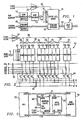
- FIG. 2 there is illustrated a partial block diagram of cell array 10 utilizing the flash clearing scheme of the present invention.
- columns of memory cells in an integrated circuit are arranged to accommodate various layout considerations, column decoder schemes, etc., such that the columns are not necessarily topologically located in a sequential order relative to their associated I/O line; that is, columns associated with a given column address are not necessarily physically adjacent to each other.
- columns that are associated with a particular one of the data bits DB0 ⁇ -DBN are physically grouped together, each of the data bits DB0 ⁇ -DBN being associated with a separate I/O line.
- this allows selective clearing of all memory cells associated with a selected data bit.
- all of the bit DB0 ⁇ are designated as the selected memory cells to be flash cleared.
- columns associated with the memory cells to be flash cleared for the selected data bit are physically disposed adjacent to each other in pairs. Each pair represents two adjacent column addresses, for example, Column 0 ⁇ and Column 1. This allows one control line to feed a pair of adjacent columns associated with the memory cells to be cleared.
- the column address COL 0 ⁇ will access memory cells for data bits DB0 ⁇ -DBN associated with Column 0 ⁇ .
- the column address COL 1 will access memory cells for data bits DB0 ⁇ -DBN associated with Column 1.
- the column of memory cells for the DB0 ⁇ data bits associated with the column address COL 0 ⁇ ,and the column of memory cells for the DB0 ⁇ data bits associated with the column address COL 1 are physically disposed adjacent each other with a single control line operative to clear the associated memory cells in response to the FLASH CLEAR signal.
- the column decoder 20 outputs a plurality of column address lines 32 labelled COL 0 ⁇ -COL N.
- Each of the column address lines 32 is associated with one of N+1 columns and each column address is associated with memory cells for data bits DB0 ⁇ -DBN. Therefore, when a row of memory cells is accessed, the presence of the respective column address results in the data bits DB0 ⁇ -DBN for the accessed row being output on the data bus 24.
- the columns of memory cells are arranged in pairs 34 with each pair 34 representing two adjacent column addresses for a given one of data bits DB0 ⁇ -DBN.
- the pairs 34 are organized in banks 36 with each bank representing all of the columns of memory cells for two adjacent column addresses.
- the first pair 34 corresponds to the bits DB0 ⁇ for adjacent column addresses COL 0 ⁇ and COL 1.
- the next adjacent pair 34 corresponds to the data bits DB1 for adjacent column addresses COL 0 ⁇ and COL 1, with the last pair 34 in the first of the banks 36 corresponding to the data bits DBN for adjacent column addresses COL 0 ⁇ and COL 1.
- the next adjacent bank 36 corresponds to all of the data bits DB0 ⁇ -DBN for adjacent column addresses COL 2 and COL 3, with the last bank 36 representing all of the data bits DB0 ⁇ -DBN for adjacent column addresses COL (N-1) and COL N.
- Each of the pairs 34 associated with the memory cells for data bits DB0 ⁇ in each of the banks 36 has a control line 38 connected to the FLASH CLEAR control line 28.
- the line 38 provides an interconnection to the FLASH CLEAR signal through driver 30, which clears all of the memory cells for bits DB0 ⁇ for each bank and for each column address.
- any of the pairs 34 can be connected to the line 28 for the purposes of flash clearing the memory cells associated with that particular data bit. This allows the selection of all of the columns associated with a selected one of data bits DB0 ⁇ -DBN to be cleared. Further, for an alternative embodiment, this also allows for selection of a particular column address and memory cells for associated data bits DB0 ⁇ -DBN to be cleared.
- the first bank 36 associated with the column addresses COL 0 ⁇ and COL 1 could be selected such that only the memory cells for the first data bit DB0 ⁇ associated with these two column addresses would be cleared.
- this is merely a mask change which requires a jumper to be made from the control line 28, which runs adjacent to the array, to the appropriate terminal in pair 34.
- Each of the I/O lines in bus 24 is interconnected to the output of an associated column through one of a plurality of transfer gates 40.
- Each of the transfer gates comprises an N-channel transistor having a source-to-drain path connected between the respective I/O line and the column output; the gate terminal of each transfer gate is connected to the associated one of the column address lines 32.
- FIG. 3 there is illustrated a detailed schematic diagram of a portion of the cell array 10 illustrating the interconnections of memory cells 42.
- the memory cells 42 are arranged in rows and columns such that each memory cell 42 has a specific column and row address location.
- the wordlines associated with row addresses are not shown.
- the pair 34 in the set associated with the I/O 0 ⁇ line and in the bank 36 associated with the column addresses COL 2 and COL 3 are illustrated.
- the column of memory cells 42 associated with both the column address COL 1 and the I/O N line, and the column of memory cells 42 associated with both the column address COL 2 and the I/O 1 line are illustrated.
- Each of the memory cells 42 has associated therewith a Bit Line output and a Bit Line-bar output. It should be noted that in any given pair 34, the Bit Line-bar outputs of the associated memory cells 42 are physically located adjacent to one another, whereas the Bit Line outputs are disposed on the opposite sides of the memory cells 42, for reasons that will be described hereinbelow.
- Each of the memory cells 42 is coupled to two V SS input lines, a V SS input line 44 on the Bit Line-bar side of the memory cell 42 and a V SS input line 46 on the Bit Line side of the memory cell 42.
- V SS input lines 44 for the memory cells 42 in the pair 34 that are associated with the I/O 0 ⁇ line are connected to line 28, which has a signal CLKVSS applied thereto.
- the remaining memory cells 42 associated with the I/O 1-I/O N lines have the ground reference voltage applied to the V SS input line 44.
- Each of the V SS input line 46 of all of the memory cells 42 are connected to the ground reference voltage.
- the CLKVSS signal is utilized to clear the memory cells to which it is coupled.
- any of the pairs 34 of columns of memory cells 42 could alternately have the V SS inputs 44 thereof selectively connected to the CLKVSS signal to allow FLASH CLEARing of the memory cells in those columns.
- Each of the Bit Line outputs of the memory cells 42 is connected to one of a plurality of Bit Lines 48 and each of the Bit Line-bar outputs is connected to one of a plurality of Bit Line-bar lines 50.
- the Bit Line 48 for each of the columns of memory cells is connected to an associated multiplexer 52 and each of the Bit Line-bar lines 50 is connected to an associated multiplexer 54.
- the multiplexers 52 and 54 each comprise pass gates similar to the pass gates 40 in Figure 2.
- Each of the I/O lines in bus 24 has an inverted and a non-inverted form. The inverted form thereof is connected to the output of multiplexer 54 and the non-inverted form is connected to the output of multiplexer 52.
- the control line 28 is a conductive run having a distributed capacitance associated therewith and is driven by the driver 30 which comprises a distributed driver.
- a plurality of CMOS driver circuits are provided, the driver circuits each being represented by a P-channel transistor 49 and an N-channel transistor 51 connected in a complementary configuration between the positive supply V CC and a reference V SS or ground.
- the drain of the N-channel transistor 51 is connected to the line 28.
- the CMOS transistor drivers are comprised of transistors 49 and 51 and are distributed along the line 28. In such a manner, a low source impedance can be provided to the line 28.
- the gates of the P-channel transistors 49 are connected to a control line 53 and the gates of the N-channel transistors 51 are connected to a control line 55 representing the inverted and non-inverted form of the FLASH CLEAR signal and are designated as PLCR and NCLR, respectively. Therefore, the transistors 49 and 51 provide the drive necessary to supply the CLKVSS-signal whereby the voltage of the line 44 connected to the CLKVSS signal can readily be pulled from V SS to V CC . It can be seen that a significantly decreased amount of drive is required to drive only the V SS input lines 44 associated with the I/O 0 ⁇ lines as compared to the amount of drive which would be required to drive all of the cells in the memory array 10.
- the memory cell 42 comprises a pair of cross-coupled N-channel transistors 56 and 58.
- Transistor 56 has the source thereof connected to the V SS input line 46, the drain thereof connected to a sense node 60 and the gate thereof connected to a sense node 62.
- Transistor 58 has the source thereof connected to the V SS input line 44, the drain thereof connected to the sense node 62 and the gate thereof connected to sense node 60.
- the V SS input line 44 is connected to the CLKVSS line
- the V SS input line 46 as described above, is connected to V SS , representing a cell that can be flash cleared.
- the associated V SS input line 44 is connected to V SS rather than to CLKVSS.
- the source of transistor 58 therefore comprises the FLASH CLEAR input of the memory cell 42.
- the sense node 60 is connected to a positive supply V CC through a pull-up transistor 64 and the sense node 62 is connected to the positive supply V CC through a pull-up transistor 66.
- Node 62 is connected to the Bit-Line-bar 50 through the source-to-drain path of an N-channel access transistor 68, the gate of which is connected to the Word Line 12 for the accessed row.
- node 60 is connected to the Bit Line 48 through the source-to-drain path of an N-channel transistor 70, the gate of transistor 70 being connected to Word Line 12.
- the operation of the memory cell 42 with the V SS input line 44 connected to V SS is identical to a conventional SRAM cell. It should be noted that for the illustrated cell the clear input is on the right side of the cell whereas in the mirrored layout, the cell is mirrored about the center with the clear input on the left side of the cell.
- the memory cell 42 is flash cleared by raising the line 44 from the voltage V SS to the voltage V CC , which operation occurs when the voltages on both line 53 and line 55 go low, thus turning on transistors 49 and turning off transistors 51.
- the non-inverted node 60 is disposed at a low voltage representing a logic "0" and the inverted node 62 is disposed at a high voltage representing a logic "1".
- node 62 When a logic "1" is stored in the memory cell 42, node 62 is disposed at a low voltage at or near V SS ; in this condition transistor 58 is turned on and transistor 56 is turned off. To clear this logic state and force node 62 to a high voltage, the voltage on the source of transistor 58 is pulled to a high voltage such that transistor 58 acts as a source follower and pulls the voltage on node 62 high. This in effect turns on transistor 56, pulling node 60 low, which results in transistor 58 being turned off, such that when the voltage on line 44 is pulled back low, transistor 58 is off and node 62 is high. This provides a clearing operation that does not require any interaction by the row decoder to write logic "0" information from the Bit Lines into the memory cell for the clear operation and, additionally, only minimal power is required.
- a central processing unit (CPU) 72 provides an address output connected to an address bus 74 and a data I/O connected to a data bus 76.
- the address bus 74 is connected to the address input of a main memory 78, the data input thereof being connected to the data bus 76.
- the address bus 74 is also input to a data cache 80 with the data input of the data cache 80 connected to the data bus 76.
- An address cache 82 is also provided which has an address input and a data input, the data input representing the tag information.
- the address input of the address cache 82 is connected to the three least significant bits of the address through the bus 84.
- the tag input is connected to the three most significant bits of the address bus 74 through a bus 86.
- the address cache 82 has one of the data bits thereof connected to a positive voltage through a pull-up resistor (not shown).
- the FLASH CLEAR signal is also input to the address cache 82.
- the address cache 82 is operable to receive the three least significant bits of the address output by the CPU and to output the addressed location and compare it with the information on the bus 86. If a true comparison is made, a match signal is generated and output on a line 88 to the Output Enable input of the data cache 80.
- the tag information is stored during a Write operation, which will not be described. When a match is present, this is termed a "hit", which results in the data stored in the data cache 80 being output on the data bus 76.
- the access time to the data cache as compared to the access time to the main memory 78 is approximately ten times faster, resulting in increased speed.
- the FLASH CLEAR input allows the valid bit in the address cache 82 to be cleared without requiring the rest of the memory locations in the address cache 82 to be cleared. As described above, the clearing of selected I/Os removes the requirement for clearing all of the memory locations, thus resulting in lower drive requirements, improved noise levels during clear, etc.
- a static random access memory having multiple I/Os with the capability of clearing a selected I/O.
- the memory is configured such that all columns of memory cells associated with the given I/O can be selectively connected to a clear signal. Further, columns of memory cells for a selected I/O and for two adjacent column addresses are physically disposed adjacent to each other such that they can share a common conductive run disposed parallel to each of the columns and connected to the clear signal. In such a manner, pairs of memory cells associated with the same I/O can be cleared, thus reducing layout constraints.
Landscapes
- Engineering & Computer Science (AREA)
- Theoretical Computer Science (AREA)
- Physics & Mathematics (AREA)
- General Engineering & Computer Science (AREA)
- General Physics & Mathematics (AREA)
- Microelectronics & Electronic Packaging (AREA)
- Computer Hardware Design (AREA)
- Static Random-Access Memory (AREA)
- Read Only Memory (AREA)
- Dram (AREA)
Claims (15)
- Speicher mit selektiv löschbaren bzw. freigebbaren Speicherzellen,
mit einer Anordnung (10) von Speicherzellen (42), die in Zeilen und Spalten (COL) angeordnet sind, die Speicherzellen (42) enthalten, die betreibbar sind, um einen ersten oder einen zweiten logischen Zustand darin zu speichern, und die einen Schnellöscheingang (28) haben, um deren gespeicherten logischen Zustand in Abhängigkeit zu dem Empfang eines Schnellöschsignals in den ersten logischen Zustand zu bringen bzw. zu forcieren, wobei die Schnellöscheingänge für die Speicherzellen an einer der gegebenen Spalten gemeinsam miteinander angeschlossen sind;
mit Zeilenadressendekodermitteln (16, 18), um eine Zeilenadresse zu empfangen und zu dekodieren, und auf eine zugehörige der Speicherzellenzeilen in der Anordnung zuzugreifen;
mit Eingabe-/Ausgabemitteln (22), um einen Anschluß zu denjenigen der Speicherzellen herzustellen, auf die zugegriffen wird, um Daten für eine Schreiboperation einzugeben und um Daten für eine Leseoperation auszugeben, wobei die Speicherzellen in Paaren (34) benachbarter Spalten (COL0; COL1; COL2, COL3) mit ihren gemeinsam angeschlossenen Schnellösch- bzw. -freigabeeingängen an Schnellösch- bzw. -freigabemitteln angeschlosen sind, die eine erste gemeinsame leitende Bahn (38) enthalten, die an die Spalten in jedem Paar angrenzend angeordnet ist, wobei die erste gemeinsame leitfähige Bahn angeordnet ist, um ein Schnellösch- bzw. -freigabesignal zum Anschließen an die gemeinsam angeschlossenen Schnellöscheingänge der zugehörigen der Speicherzellen zu empfangen, um diese in Abhängigkeit zu dem Löschsignal zu löschen,
dadurch gekennzeichnet, daß die Speicherzellenspalten so angeordnet bzw. konfiguriert sind, daß eine gegebene Spaltenadresse einer Gruppe der Speicherzellenspalten zugeordnet ist, wobei Spaltenadressendekodermittel betreibbar sind, um die Gruppe der Speicherzellenspalten auszuwählen, die einer empfangenen Spaltenadresse zugeordnet ist, wobei jede der Speicherzellenspalten in jeder Gruppe (COL0 ... COLN) einem gesonderten Datenbit (DB0 ... DBN) in einer Bitsequenz zugeordnet ist, und jedes Paar (34) angrenzender Spalten Spalten enthält, die demselben Datenbit (DB0) von gesonderten Spaltenadressen (COL0, COL1; COL2, COL3) zugeordnet sind, wobei das Schnellöschmittel (28, 30, 38) betreibbar ist, um das Schnellöschsignal an die gemeinsam angeschlossenen Schnellöscheingänge der Speicherzellen in ausgewählten Paaren so anzuschließen, daß die Speicherzellen in den Spalten der ausgewählten Paare, die dasselbe Datenbit (DB0) verschiedener Bitsequenzen enthalten, in den ersten logischen Zustand gebracht werden. - Speicher nach Anspruch 1, in dem die Speicherzellen statische Speicherzellen (42) aufweisen.
- Speicher nach einem der Ansprüche 1 oder 2, bei dem das Schnellöschmittel weiterin folgendes aufweist:
eine zweite leitfähige Bahn (28), die angrenzend an die Anordnung (10) und in der Nähe von jeder der Speicherzellenspalten angeordnet ist, wobei die zweite leitfähige Bahn an diejenige der ersten leitfähigen Bahnen (38) angeschlossen ist, die den ausgewählten Paaren der Zellenspalten zugeordnet sind; und
eine Treibereinrichtung (30), um das Schnellöschsignal zu empfangen und um die zweite leitfähige Bahn (28) und die daran angeschlossenen ersten leitfähigen Bahnen (38) mit dem Löschsignal anzutreiben bzw. anzusteuern, um das Schnelllöschsignal sämtlichen der Speicherzellen zuzuführen, deren Schnellöscheingänge über die zugehörigen bzw. zugeordneten ersten leitenden Bahnen an die zweite leitfähige Bahn angeschlossen sind. - Speicher nach Anspruch 3, in der die Treibereinrichtung mehrere Treiberschaltungen (49, 51) aufweist, die entlang der zweiten leitenden Bahn verteilt sind, in der die Treiberschaltungen gleichzeitig mit einem Schnellöschsignal die zweite leitfähige Bahn antreiben bzw. ansteuern.
- Speicheranordnung nach Anspruch 4, in der die Treiberschaltungen in einer Dimension der Anordnung in gleichmäßigen Abständen entlang der zweiten leitfähigen Bahn beabstandet angeordnet sind und zu sämtlichen Spalten der Anordnung, einschließlich jener, die nicht an die gemeinsamen leitenden Bahnen angeschlossen sind, ausgerichtet sind.
- Speicher nach einem der Ansprüche 3, 4 oder 5, der Mittel zum wahlweisen Anschließen derjenigen der ersten leitfähigen Bahnen (38) an die zweite leitende Bahn (28) aufweist, die den ausgewählten Paaren zugeordnet sind.
- Speicher nach Anspruch 6, in den die zweite leitfähige Bahn benachbart zu der Anordnung und senkrecht zu den ersten leitfähigen Bahnen angeordnet ist und die Verbindungsmittel eine leitfähige Verbindung zwischen denjenigen der ersten leitfähigen Bahnen aufweisen, die den ausgewählten Paaren der Spalten und der zweiten leitfähigen Bahn zugeordnet sind.
- Speicher nach einem der vorhergehenden Ansprüche, in dem
das Schnellöschsignal (CLKVss) einen ersten Zustand mit einem ersten Spannungspegel (Vcc) und einen zweiten Zustand mit einem zweiten Spannungspegel (Vss) hat, und jede der Speicherzellen (42) betreibbar ist, um den darin gespeicherten logischen Zustand in den ersten logischen Zustand zu bringen, wenn der erste Spannungspegel an deren Schnellöscheingang angelegt wird, und wobei der logische Zustand der Speicherzellen nicht geändert wird, wenn der zweite Spannungspegel an deren Schnellöscheingang angelegt wird; und
das Schnellöschmittel (49, 51) betreibbar ist, um den ersten Spannungspegel (Vcc) an die Schnellöscheingänge der Speicherzellen der ausgewählten Paare (34) der Spalten und den zweiten Spannungspegel (Vss) an die Schnellöscheingänge der Speicherzellen der nicht ausgewählten Paare der Spalten anzulegen, wenn das besagte Schnellöschsignal anliegt. - Speicher nach Anspruch 8, in dem die Mittel zum Anlegen des ersten Spannungspegels an die zweite leitfähige Bahn einen Treiber (49) aufweist, dessen Eingang mit dem Schnellöscheingang verbunden ist, und dessen Ausgang beitreibbar ist, um die zweite leitfähige Bahn anzusteuern.
- Speicher nach einem der vorhergehenden Ansprüche, in dem die ersten und zweiten leitfähigen Bahnen eine verteilte Kapazität haben, die damit verbunden ist.
- Speicher nach einem der vorhergehenden Ansprüche, bei dem jede der Speicherzellen aufweist:
einen ersten Abtast- bzw. Abfrageknotenpunkt (60);
einen zweiten Abtast- bzw. Abfrageknotenpunkt (62);
einen ersten Transistor (56), der einen Durchgang von der Source zu dem Drain aufweist, der zwischen einem ersten Abtast- bzw. Abfrageknotenpunkt (60) und einem Knotenpunkt, der einen zweiten Spannungspegel (Vss) zur Verfügung stellt, angeschlossen ist und dessen Gate mit dem zweiten Abtast- bzw. Abfrageknotenpunkt (62) verbunden ist;
einen zweiten Transistor (58), der einen Durchgang von dessen Source zu dessen Drain zwischen dem zweiten Abtast- bzw. Abfrageknotenpunkt (62) und dem Schnellöscheingang angeschlossen ist, und dessen Gate an den ersten Abtast- bzw. Abfrageknotenpunkt (60) angeschlossen ist;
ein erste Hochsetz- bzw. Pull-up-Einrichtung (64), die zwischen dem ersten Abtast- bzw. Abfrageknotenpunkt (60) und einer Stromversorgung (Vcc) angeschlossen ist, um den ersten Abtast- bzw. Abfrageknotenpunkt auf die Spannung der Stromversorgung hochzusetzen, wenn der erste Transistor nichtleitend ist;
eine zweite Hochsetz- bzw. Pull-up-Einrichtung (66), die zwischen dem zweiten Abtast- bzw. Abfrageknotenpunkt (62) und der Stromversorgung (Vcc) angeschlossen ist, um den zweiten Abtast- bzw. Abfrageknotenpunkt auf die Spannung der Stromversorgung hochzusetzen, wenn der erste Transistor nichtleitend ist;
ein Zugrifftransistor (68), dessen Durchgang von der Source zu dem Drain zwischen dem ersten Abtast- bzw. Abfrageknotenpunkt und dem Spaltenadressdekodierungsmittel (20) angeschlossen ist und dessen Gate mit den Zeilenadressendekodierungsmitteln (16, 18) verbunden ist; und
der erste Abtast- bzw. Abfrageknotenpunkt, der auf einen Spannungspegel gebracht bzw. gezwungen wird, der einem ersten logischen Zustand entspricht, wenn der Schnellöscheingang auf einen ersten Spannungspegel (Vcc) angehoben wird. - Speicher nach einem der vorhergehenden Ansprüche 1 bis 11, in dem Speicherzellen in den verbleibenden, nichtgewählten Paaren von Spalten den Wert nicht ändern, wenn das Schnellöschsignal erzeugt wird.
- Speicher nach einem der Ansprüche 1 bis 12, in dem sämtliche Paare, die dasselbe Datenbit verschiedener Spaltenadressen enthalten, ausgewählt werden.
- Speicher nach irgendeinem der Ansprüche 1 bis 12, in dem Paare, die dasselbe Datenbit nur von ausgewählten Spaltenadressen enthalten, gewählt werden.
- Verfahren zum selektiven Löschen von Speicherzellen in einem Mehrfach-Eingabe-Ausgabe-Speicher, der folgendes aufweist:
Speicherzellen (42) werden in einer Anordnung in Zeilen und Spalten angeordnet;
Speicherzellen werden in Paaren (34) von benachbarten Spalten (COL0, COL1; COL2, COL3) an eine erste gemeinsame leitfähige Bahn (38) angeschlossen, die an die Spalten in jedem Paar angrenzend angeordnet ist;
ein Schnellöschsignal wird an die ersten gemeinsamen leitfähigen Bahnen von Paaren benachbarter bzw. angrenzender Spalten angeschlossen, um schnell gelöscht zu werden,
dadurch gekennzeichnet, daß die Speicherzellenspalten so angeordnet bzw. konfiguriert sind, daß einer gegebenen Spaltenadresse eine Gruppe der Speicherzellenspalten zueordnet wird, wobei jeder der Speicherzellenspalten in jeder Gruppe (COL0 ... COLN) ein gesondertes Datenbit (DB0 ... DBN) in einer Bitsequenz zugeordnet wird, und in dem jedes Paar benachbarter Spalten Spalten enthält, die demselben Datenbit gesonderter Spaltenadressen zugeordnet werden, in dem das Schnellöschsignal mit den Speicherzellen in ausgewählten Paaren so verbunden bzw. angeschlossen wird, daß Speicherzellen in den Spalten der ausgewählten Paare, die dasselbe Datenbit verschiedener Bitsequenzen enthalten, in einen ersten logischen Zustand gebracht bzw. gezwungen werden.
Priority Applications (1)
| Application Number | Priority Date | Filing Date | Title |
|---|---|---|---|
| EP93203384A EP0594266B1 (de) | 1988-05-18 | 1989-05-17 | SRAM mit Flash-Rücksetzung für auswählbare E/A-Leitungen |
Applications Claiming Priority (2)
| Application Number | Priority Date | Filing Date | Title |
|---|---|---|---|
| US19569688A | 1988-05-18 | 1988-05-18 | |
| US195696 | 1988-05-18 |
Related Child Applications (1)
| Application Number | Title | Priority Date | Filing Date |
|---|---|---|---|
| EP93203384.8 Division-Into | 1993-12-03 |
Publications (3)
| Publication Number | Publication Date |
|---|---|
| EP0343068A2 EP0343068A2 (de) | 1989-11-23 |
| EP0343068A3 EP0343068A3 (en) | 1990-02-28 |
| EP0343068B1 true EP0343068B1 (de) | 1994-07-20 |
Family
ID=22722403
Family Applications (2)
| Application Number | Title | Priority Date | Filing Date |
|---|---|---|---|
| EP93203384A Expired - Lifetime EP0594266B1 (de) | 1988-05-18 | 1989-05-17 | SRAM mit Flash-Rücksetzung für auswählbare E/A-Leitungen |
| EP89401362A Expired - Lifetime EP0343068B1 (de) | 1988-05-18 | 1989-05-17 | SRAM mit schneller Löschung von auswählbaren Eingängen/Ausgängen |
Family Applications Before (1)
| Application Number | Title | Priority Date | Filing Date |
|---|---|---|---|
| EP93203384A Expired - Lifetime EP0594266B1 (de) | 1988-05-18 | 1989-05-17 | SRAM mit Flash-Rücksetzung für auswählbare E/A-Leitungen |
Country Status (4)
| Country | Link |
|---|---|
| EP (2) | EP0594266B1 (de) |
| JP (1) | JP2754492B2 (de) |
| KR (1) | KR900019012A (de) |
| DE (2) | DE68928270T2 (de) |
Families Citing this family (2)
| Publication number | Priority date | Publication date | Assignee | Title |
|---|---|---|---|---|
| DE19758514A1 (de) * | 1997-08-19 | 1999-04-08 | Sican Braunschweig Gmbh | Statischer CMOS-RAM-Speicher |
| US6772277B2 (en) * | 2001-04-30 | 2004-08-03 | Hewlett-Packard Development Company, L.P. | Method of writing to a memory array using clear enable and column clear signals |
Citations (2)
| Publication number | Priority date | Publication date | Assignee | Title |
|---|---|---|---|---|
| EP0257938A2 (de) * | 1986-08-28 | 1988-03-02 | Advanced Micro Devices, Inc. | Digitaler Speicher mit Reset-/Preset-Möglichkeiten |
| EP0259967A2 (de) * | 1986-08-01 | 1988-03-16 | Fujitsu Limited | Verzeichnisspeicher |
Family Cites Families (5)
| Publication number | Priority date | Publication date | Assignee | Title |
|---|---|---|---|---|
| US4099069A (en) * | 1976-10-08 | 1978-07-04 | Westinghouse Electric Corp. | Circuit producing a common clear signal for erasing selected arrays in a mnos memory system |
| US4567578A (en) * | 1982-09-08 | 1986-01-28 | Harris Corporation | Cache memory flush scheme |
| US4587629A (en) * | 1983-12-30 | 1986-05-06 | International Business Machines Corporation | Random address memory with fast clear |
| EP0189700A3 (de) * | 1984-12-28 | 1988-04-27 | Thomson Components-Mostek Corporation | Statischer Speicher mit schnellem Nullsetzen |
| JPH0640439B2 (ja) * | 1986-02-17 | 1994-05-25 | 日本電気株式会社 | 半導体記憶装置 |
-
1989
- 1989-05-17 DE DE68928270T patent/DE68928270T2/de not_active Expired - Fee Related
- 1989-05-17 EP EP93203384A patent/EP0594266B1/de not_active Expired - Lifetime
- 1989-05-17 DE DE68916858T patent/DE68916858T2/de not_active Expired - Fee Related
- 1989-05-17 EP EP89401362A patent/EP0343068B1/de not_active Expired - Lifetime
- 1989-05-18 KR KR1019890006638A patent/KR900019012A/ko not_active Abandoned
- 1989-05-18 JP JP1125458A patent/JP2754492B2/ja not_active Expired - Fee Related
Patent Citations (2)
| Publication number | Priority date | Publication date | Assignee | Title |
|---|---|---|---|---|
| EP0259967A2 (de) * | 1986-08-01 | 1988-03-16 | Fujitsu Limited | Verzeichnisspeicher |
| EP0257938A2 (de) * | 1986-08-28 | 1988-03-02 | Advanced Micro Devices, Inc. | Digitaler Speicher mit Reset-/Preset-Möglichkeiten |
Also Published As
| Publication number | Publication date |
|---|---|
| DE68928270D1 (de) | 1997-09-25 |
| EP0343068A2 (de) | 1989-11-23 |
| DE68916858T2 (de) | 1995-02-16 |
| EP0594266A3 (en) | 1994-09-07 |
| DE68928270T2 (de) | 1998-01-15 |
| DE68916858D1 (de) | 1994-08-25 |
| JP2754492B2 (ja) | 1998-05-20 |
| JPH0229816A (ja) | 1990-01-31 |
| EP0343068A3 (en) | 1990-02-28 |
| EP0594266A2 (de) | 1994-04-27 |
| KR900019012A (ko) | 1990-12-22 |
| EP0594266B1 (de) | 1997-08-20 |
Similar Documents
| Publication | Publication Date | Title |
|---|---|---|
| US5267210A (en) | SRAM with flash clear for selectable I/OS | |
| US6173379B1 (en) | Memory device for a microprocessor register file having a power management scheme and method for copying information between memory sub-cells in a single clock cycle | |
| EP0318952B1 (de) | Halbleiterspeichervorrichtung mit einer gleichzeitigen Löschfunktion für einen Teil der Speicherdaten | |
| US5253203A (en) | Subarray architecture with partial address translation | |
| US6421290B2 (en) | Output circuit for alternating multiple bit line per column memory architecture | |
| US5657291A (en) | Multiport register file memory cell configuration for read operation | |
| JPH03286495A (ja) | 半導体記憶装置 | |
| US4789967A (en) | Random access memory device with block reset | |
| EP0936625A2 (de) | Assoziativspeicher (CAM) | |
| US5311467A (en) | Selective bulk write operation | |
| EP0675500B1 (de) | Verbesserte Speicheranordnung und Herstellungsverfahren | |
| JPH05266654A (ja) | マルチポートメモリ装置 | |
| US4890263A (en) | RAM with capability for rapid clearing of data from memory by simultaneously selecting all row lines | |
| EP1405315A2 (de) | Verfahren uns system zur unterteilung eines registerdatenspeicher in verschiedene bänke | |
| EP0570977B1 (de) | Halbleiterspeicheranordnung | |
| HK1003851B (en) | A memory apparatus and method for use in a data processing system | |
| HK1003851A1 (en) | A memory apparatus and method for use in a data processing system | |
| EP0573046B1 (de) | Halbleiterspeicheranordnung mit zwischen Speicherzellenmatrizen geteiltem Einzeldatenleitungspaar | |
| US5621695A (en) | SRAM with simplified architecture for use with pipelined data | |
| EP0434852B1 (de) | Hochintegrierter Halbleiterspeicher mit Mehrfachzugang | |
| EP0381940B1 (de) | Registerbankschaltung | |
| EP0594266B1 (de) | SRAM mit Flash-Rücksetzung für auswählbare E/A-Leitungen | |
| JP3240897B2 (ja) | 半導体記憶装置 | |
| US5463751A (en) | Memory device having address translator and comparator for comparing memory cell array outputs | |
| JPH07114794A (ja) | 半導体記憶装置 |
Legal Events
| Date | Code | Title | Description |
|---|---|---|---|
| PUAI | Public reference made under article 153(3) epc to a published international application that has entered the european phase |
Free format text: ORIGINAL CODE: 0009012 |
|
| AK | Designated contracting states |
Kind code of ref document: A2 Designated state(s): DE FR GB IT |
|
| PUAL | Search report despatched |
Free format text: ORIGINAL CODE: 0009013 |
|
| RAP1 | Party data changed (applicant data changed or rights of an application transferred) |
Owner name: SGS-THOMSON MICROELECTRONICS, INC. |
|
| AK | Designated contracting states |
Kind code of ref document: A3 Designated state(s): DE FR GB IT |
|
| RHK1 | Main classification (correction) |
Ipc: G11C 7/00 |
|
| 17P | Request for examination filed |
Effective date: 19900320 |
|
| 17Q | First examination report despatched |
Effective date: 19921028 |
|
| GRAA | (expected) grant |
Free format text: ORIGINAL CODE: 0009210 |
|
| AK | Designated contracting states |
Kind code of ref document: B1 Designated state(s): DE FR GB IT |
|
| REF | Corresponds to: |
Ref document number: 68916858 Country of ref document: DE Date of ref document: 19940825 |
|
| ITF | It: translation for a ep patent filed | ||
| ET | Fr: translation filed | ||
| PLBE | No opposition filed within time limit |
Free format text: ORIGINAL CODE: 0009261 |
|
| STAA | Information on the status of an ep patent application or granted ep patent |
Free format text: STATUS: NO OPPOSITION FILED WITHIN TIME LIMIT |
|
| 26N | No opposition filed | ||
| PGFP | Annual fee paid to national office [announced via postgrant information from national office to epo] |
Ref country code: DE Payment date: 19980522 Year of fee payment: 10 |
|
| PG25 | Lapsed in a contracting state [announced via postgrant information from national office to epo] |
Ref country code: DE Free format text: LAPSE BECAUSE OF NON-PAYMENT OF DUE FEES Effective date: 20000301 |
|
| REG | Reference to a national code |
Ref country code: GB Ref legal event code: IF02 |
|
| PGFP | Annual fee paid to national office [announced via postgrant information from national office to epo] |
Ref country code: FR Payment date: 20020508 Year of fee payment: 14 |
|
| PGFP | Annual fee paid to national office [announced via postgrant information from national office to epo] |
Ref country code: GB Payment date: 20020515 Year of fee payment: 14 |
|
| PG25 | Lapsed in a contracting state [announced via postgrant information from national office to epo] |
Ref country code: GB Free format text: LAPSE BECAUSE OF NON-PAYMENT OF DUE FEES Effective date: 20030517 |
|
| GBPC | Gb: european patent ceased through non-payment of renewal fee |
Effective date: 20030517 |
|
| PG25 | Lapsed in a contracting state [announced via postgrant information from national office to epo] |
Ref country code: FR Free format text: LAPSE BECAUSE OF NON-PAYMENT OF DUE FEES Effective date: 20040130 |
|
| REG | Reference to a national code |
Ref country code: FR Ref legal event code: ST |
|
| PG25 | Lapsed in a contracting state [announced via postgrant information from national office to epo] |
Ref country code: IT Free format text: LAPSE BECAUSE OF NON-PAYMENT OF DUE FEES Effective date: 20050517 |