EP0342845B1 - Création d'images en demi-teintes - Google Patents
Création d'images en demi-teintes Download PDFInfo
- Publication number
- EP0342845B1 EP0342845B1 EP89304680A EP89304680A EP0342845B1 EP 0342845 B1 EP0342845 B1 EP 0342845B1 EP 89304680 A EP89304680 A EP 89304680A EP 89304680 A EP89304680 A EP 89304680A EP 0342845 B1 EP0342845 B1 EP 0342845B1
- Authority
- EP
- European Patent Office
- Prior art keywords
- resolution
- data
- image
- digital data
- control signal
- Prior art date
- Legal status (The legal status is an assumption and is not a legal conclusion. Google has not performed a legal analysis and makes no representation as to the accuracy of the status listed.)
- Expired - Lifetime
Links
Images

Classifications
-
- H—ELECTRICITY
- H04—ELECTRIC COMMUNICATION TECHNIQUE
- H04N—PICTORIAL COMMUNICATION, e.g. TELEVISION
- H04N1/00—Scanning, transmission or reproduction of documents or the like, e.g. facsimile transmission; Details thereof
- H04N1/40—Picture signal circuits
- H04N1/40068—Modification of image resolution, i.e. determining the values of picture elements at new relative positions
-
- G—PHYSICS
- G06—COMPUTING OR CALCULATING; COUNTING
- G06T—IMAGE DATA PROCESSING OR GENERATION, IN GENERAL
- G06T3/00—Geometric image transformations in the plane of the image
- G06T3/40—Scaling of whole images or parts thereof, e.g. expanding or contracting
- G06T3/4007—Scaling of whole images or parts thereof, e.g. expanding or contracting based on interpolation, e.g. bilinear interpolation
-
- H—ELECTRICITY
- H04—ELECTRIC COMMUNICATION TECHNIQUE
- H04N—PICTORIAL COMMUNICATION, e.g. TELEVISION
- H04N1/00—Scanning, transmission or reproduction of documents or the like, e.g. facsimile transmission; Details thereof
- H04N1/40—Picture signal circuits
- H04N1/405—Halftoning, i.e. converting the picture signal of a continuous-tone original into a corresponding signal showing only two levels
- H04N1/4055—Halftoning, i.e. converting the picture signal of a continuous-tone original into a corresponding signal showing only two levels producing a clustered dots or a size modulated halftone pattern
Definitions
- the invention relates to methods and apparatus for generating a half-tone version of an image.
- a bilevel image that is one that is either black or white with no intermediate shades of grey.
- the exposure is often done by exposing the film in elemental areas or textels.
- the image to be outputted is digitised in elemental areas or pixels.
- the textel size it is usual practice for the textel size to be considerably smaller than the pixel size or the repeat in the dot pattern. For example images digitised at a resolution of 12 pixels/mm are commonly output with a halftone screen pitch of 6 dots/mm and a resolution of 72 textels/mm.
- the textel frequency is six times the pixel frequency.
- the halftones may be generated as follows.
- the pixel data is replicated to achieve the textel resolution.
- the replicated pixel data is then added to a regular screen function - if the sum is greater than a threshold then the corresponding textel value is set to 1 (dark), otherwise it is set to 0 (light).
- the textel data is then used to expose the film.
- EP-A-0247830 A possible solution described in our co-pending European patent application EP-A-0247830 involves scanning the original image in a series of overlapped scan lines. In this way, the number of input pixels is increased, typically doubled which will automatically lead to an increase in spatial resolution. However, one problem with this process is that there is a significant increase in scanning time required.
- US-A-4258393 describes a picture element processing method in which a picture element is divided into four smaller picture elements whose densities are determined from the algebraic mean value of the densities of the picture element and surrounding picture elements. This approach leads to a general smoothing of the picture element values but is restricted in its use of an algebraic sum to obtain the values and the requirement that each value should be obtained in this manner. Where high resolution output is required, the process would be unduly slow.
- a method of generating a half-tone version of an image represented by a first set of digital data defining the colour content of abutting pixels of the image at a first resolution, in which a record medium is selectively exposed to an exposing beam which is scanned across the record medium and whose intensity is controlled by a control signal representing image pixels at a second, finer resolution, the control signal being generated by comparing a second set of digital data, derived from the first set of digital data and representing the colour content of the image at the second resolution, with half-tone information defining an array of half-tone dot elements at the second resolution, each element being associated with a respective threshold value, whereby each data value of the second set of data is compared with a respective threshold value chosen in accordance with the position of the exposing beam within the half-tone dot currently being exposed and the control signal (CS) value varying in accordance with whether or not the data value exceeds the threshold is characterised in that the second set of digital data is obtained from the first set
- control signal generator obtains the second set of digital data from the first set of digital data by interpolating a third set of digital data defining image pixels at a third resolution finer than the first resolution but no finer than the second resolution, and thereafter replicating the third set of image data to obtain the second set.
- a method of generating a half-tone version of an image represented by a first set of digital data defining the colour content of abutting pixels of the image at a first resolution, in which a record medium is selectively exposed to an exposing beam which is scanned across the record medium and whose intensity is controlled by a control signal representing image pixels at a second, finer resolution, the control signal being generated by comparing a second set of digital data, derived from the first set of digital data and representing the colour content of the image at the second resolution, with half-tone information defining an array of half-tone dot elements at the second resolution, each element being associated with a respective threshold value, whereby each data value of the second set of data is compared with a respective threshold value chosen in accordance with the position of the exposing beam within the half-tone dot currently being exposed and the control signal (CS) value varying in accordance with whether or not the data value exceeds the threshold is characterised in that the control signal generator obtains the second set of digital data defining the colour content of abutting pixels
- PV interpolated value
- each half-tone dot is defined at a second, textel resolution much higher than the original first, pixel resolution.
- the method and apparatus can be used to apply a variety of functions, for example an unsharp masking algorithm, or a function to improve the reproduction accuracy of an output scanner.
- the exposing beam may have any conventional form for example an ink jet or radiation beam.
- the invention is applicable to the modulation of a single radiation beam but may also be used where the radiation beam comprises a plurality of subsidiary beams each of which is modulated by the same control signal in a single pass across the record medium.
- each subsidiary radiation beam may be individually further modulated, if desired, to achieve additional accuracy as described, for example, in EP-A-0151353.
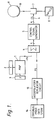
- the apparatus shown in Figure 1 comprises a half-tone dot generator including a store 1 defining half-tone dot information.
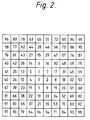
- a simple example of the half-tone dot information where the dot lattice axes are aligned with the scan direction is shown in Figure 2.
- This map shows the 10 x 10 textel dot unit cell value ranging from 0 to 99 dot %. In a real device the unit cell is approximately 12 units square skewed at some angle to the scan direction, with values ranged to be in the same units as the source data.
- the map is addressed by X and Y address generators 2, 3 which track the position of the exposing laser beams, to be described below, on a record medium.
- the store 1 is connected to an adder circuit 4 such that the inverse of the addressed value from the store 1 (-PV) is applied to the adder 4.
- a picture signal PS
- the generation of this picture signal PS will be explained in more detail below.
- the picture signal defines colour density values for each pixel of a colour component corresponding to the separation being generated.
- the output signal from the adder circuit 4 is fed to a control signal generator 5 which generates a control signal which is fed to a laser beam modulator 7 which controls the intensity of a laser beam from a laser 8, while the beam impinges on a record medium 10 mounted on a rotatable cylinder 11. Relative movement is caused, in a conventional manner, between the beam and the cylinder 11 such that the radiation beam scans along a series of abutting scan lines across the record medium 10.
- Each control signal usually constitutes a binary value of one or zero such that if the control signal (CS) is binary zero then modulator 7 reduces the intensity of the outgoing laser beam whereas if the control signal CS has a value one then the full intensity beam will pass to the record medium 10.
- the laser beam may have an intermediate value, particularly at the edge of a half-tone dot.
- the laser beam may be split up into many beams e.g. six, each of which is modulated in the same manner as a single beam.
- each beam on the record medium 10 is continuously monitored in a conventional manner and the location of impingement of each beam is represented by respective X and Y values which are used to address the map 1.
- the apparatus is used to generate a half-tone reproduction of an original image which will have been generated in a conventional manner so as to be represented by a series of digital data values corresponding to pixels of that original image at a first resolution.
- Figure 3 illustrates a small portion of the original image in terms of pixel positions, the original pixels being labelled "X". These pixel values may be fed directly to an interpolator/replicator circuit 13 or may be stored in a data store 14 (as shown in Figure 1).
- the interpolator/replicator circuit 13 is omitted and the store 14 is addressed directly so as to pass each pixel value in turn to the adder circuit 4.
- the pixel values will represent colour density percentages for the colour component concerned although other representations of colour density could also be used.
- the same representation should be used to represent the original pixels and the data values in this store 1.
- each pixel may be represented by a value ranging between zero and one hundred. In other words a percentage value.
- the store 1 need only contain the 100 values of a 10 x 10 unit cell. More commonly the screen is at some angle to the scan direction so as to give a repeat in the scan direction after passing through several unit cells. Store 1 would then contain the new giant unit cell containing many dot unit cells. In some cases it is possible to reduce the amount of data in store where the data in one row or column is repeated in another.
- store 1 For each element, store 1 is accessed to provide a digital value which is compared with the picture signal PS to determine whether the laser beam concerned should expose or not expose the corresponding part of the record medium depending on whether or not PS is greater than the digital value.
- the third resolution is three times the first resolution in each direction, other multiples are possible up to the finest, second resolution.
- the same algorithm is then used in the other dimension to generate sub-pixel 29. This type of interpolation can inherently cause an unsharp mask to be applied. Following this, the sub-pixels are replicated up to the second resolution.
- the invention is primarily for use in generating a number of colour separations corresponding to a coloured image, it is also suitable for generating reproductions of monochrome images.
Landscapes
- Engineering & Computer Science (AREA)
- Multimedia (AREA)
- Signal Processing (AREA)
- Physics & Mathematics (AREA)
- General Physics & Mathematics (AREA)
- Theoretical Computer Science (AREA)
- Facsimile Image Signal Circuits (AREA)
- Editing Of Facsimile Originals (AREA)
- Image Processing (AREA)
- Facsimile Scanning Arrangements (AREA)
Claims (6)
- Méthode de création d'une version d'image en demi-teinte, représentée par un premier jeu de données alphanumériques définissant la teneur en couleur des pixels attenants de l'image en une première résolution, un moyen d'enregistrement étant exposé de manière sélective à un faisceau d'exposition qui balaye le moyen d'en et dont l'intensité est réglée par un signal régulateur représentant les pixels d'image d'une deuxième résolution plus fine, le signal régulateur étant créé en comparant un deuxième jeu de données alphanumériques, relevant du premier jeu de données alphanumériques et représentant la teneur en couleur de l'image de deuxième résolution, avec des renseignements de demi-teinte définissant un ensemble d'éléments à points en demi-teinte en deuxième résolution, chaque élément étant associé avec une valeur respective de seuil, selon quoi chaque valeur de donnée du deuxième jeu de données est comparée avec une valeur respective de seuil sélectionnée selon la position du faisceau d'exposition dans le point en demi-teinte actuellement exposé et la valeur du signal de commande (CS) étant variable sans égard au dépassement ou le contraire du seuil de valeur de donnée, caractérisé en ce que le deuxième jeu de données alphanumériques est obtenu à partir du premier jeu en interpolant un troisième jeu de données alphanumériques définissant les pixels d'image selon une troisième résolution plus fine que la première résolution mais plus grossière que la deuxième résolution, et répétant par la suite le troisième jeu de données d'image pour obtenir le deuxième jeu.
- Méthode selon la revendication 1 dont le troisième jeu de données est interpolé partiellement au minimum à partir du premier jeu de données par une méthode dont une valeur interpolée (PV) est interpolée à partir de valeurs sélectionnées à partir du premier jeu de données alphanumériques P₁-P₄ correspondant aux quatre pixels avoisinants selon la formule:

dont A-D sont des coefficients de pondération et
- Méthode selon la revendication 1 ou la revendication 2, dont chaque point en demi-teinte comporte un ensemble carré d'éléments de points à la deuxième résolution.
- Méthode selon l'une quelconque des revendications précédentes, dont l'interpolation est telle à améliorer les caractéristiques de l'image reproduite par l'application d'un algorithme de masquage flou.
- Appareil de création d'une version d'image en demi-teinte, représentée par un premier jeu de données alphanumériques définissant la teneur en couleur des pixels attenants de l'image en une première résolution, l'appareil comportant un moyen d'enregistrement (8) pour la création d'un faisceau d'exposition; un support de moyen d'enregistrement (11) dont le moyen d'enregistrement et le support sont relativement amovibles de façon telle qu'une image est enregistrée sur un moyen d'enregistrement (10) monté sur le support en passant le faisceau sur le moyen d'enregistrement en une série de lignes attenantes de balayage; et un dispositif créateur de signal de commande (5) pour la création d'un signal de commande (CS) représentant les pixels d'image suivant une deuxième résolution plus fine en réglant l'intensité du faisceau d'exposition qui est apporté au moyen d'enregistrement (8) de façon telle qu'un moyen d'enregistrement (10) sur le support (11) est exposé de manière sélective à la deuxième résolution plus fine, le dispositif créateur de signal de commande (5) étant adapté pour assurer le signal de commande en comparant un deuxième jeu de données alphanumériques relevant du premier jeu de données alphanumériques et représentant la teneur en couleur de l'image de deuxième résolution, avec des renseignements de demi-teinte définissant un ensemble d'éléments à points en demi-teinte en deuxième résolution, chaque élément étant associé avec une valeur respective de seuil, selon quoi chaque valeur de donnée du deuxième jeu de données est comparée avec une valeur respective de seuil choisie selon la position du faisceau d'exposition dans le point en demi-teinte actuellement exposé et la valeur du signal de commande (CS) étant variable sans égard au dépassement ou le contraire du seuil de valeur de données, caractérisé en ce que le dispositif créateur du signal de commande obtient le deuxième jeu de données alphanumériques est obtenu à partir du premier jeu de données alphanumériques en interpolant un troisième jeu de données alphanumériques définissant les pixels d'image selon une troisième résolution plus fine que la première résolution mais plus grossière que la deuxième résolution, et répétant par la suite le troisième jeu de données d'image pour obtenir le deuxième jeu.
- Appareil selon la revendication 5, dont le dispositif créateur de signal de commande assure l'interpolation au minimum du troisième jeu de données à partir du premier jeu de données suivant une méthode par laquelle une valeur interpolée (PV) est interpolée à partir de valeurs sélectionnées à partir du premier jeu de données alphanumériques P₁-P₄ correspondant aux quatre pixels avoisinants selon la formule:

dont A-D sont des coefficients de pondération et
Applications Claiming Priority (2)
| Application Number | Priority Date | Filing Date | Title |
|---|---|---|---|
| GB8811568 | 1988-05-16 | ||
| GB888811568A GB8811568D0 (en) | 1988-05-16 | 1988-05-16 | Producing half-tone images |
Publications (2)
| Publication Number | Publication Date |
|---|---|
| EP0342845A1 EP0342845A1 (fr) | 1989-11-23 |
| EP0342845B1 true EP0342845B1 (fr) | 1993-12-22 |
Family
ID=10636978
Family Applications (1)
| Application Number | Title | Priority Date | Filing Date |
|---|---|---|---|
| EP89304680A Expired - Lifetime EP0342845B1 (fr) | 1988-05-16 | 1989-05-09 | Création d'images en demi-teintes |
Country Status (5)
| Country | Link |
|---|---|
| US (1) | US4989096A (fr) |
| EP (1) | EP0342845B1 (fr) |
| JP (1) | JPH0271669A (fr) |
| DE (1) | DE68911588T2 (fr) |
| GB (1) | GB8811568D0 (fr) |
Families Citing this family (13)
| Publication number | Priority date | Publication date | Assignee | Title |
|---|---|---|---|---|
| US5229868A (en) * | 1989-08-25 | 1993-07-20 | Matsushita Electric Industrial Co., Ltd. | Method and apparatus for converting a line density of a bi-level image signal |
| DE69027723T2 (de) * | 1989-09-07 | 1997-01-09 | Canon Kk | Bilddarstellungsgerät |
| JP3096910B2 (ja) * | 1989-12-19 | 2000-10-10 | 株式会社リコー | 画像記録装置 |
| US5204760A (en) * | 1990-08-27 | 1993-04-20 | Kabushiki Kaisha Toshiba | System and method for converting continuous half tone image into pseudo half tone image |
| ES2103829T3 (es) * | 1990-11-21 | 1997-10-01 | Polaroid Corp | Un procedimiento de impresion. |
| US5341228A (en) * | 1990-12-04 | 1994-08-23 | Research Corporation Technologies | Method and apparatus for halftone rendering of a gray scale image using a blue noise mask |
| WO1992012495A1 (fr) * | 1990-12-31 | 1992-07-23 | E.I. Du Pont De Nemours And Company | Procede de redimensionnement d'images, de conception d'un filtre prevu a cet effet et de mise en correspondance par mappage de l'image de sortie avec l'image d'entree |
| US5239625A (en) * | 1991-03-05 | 1993-08-24 | Rampage Systems, Inc. | Apparatus and method to merge images rasterized at different resolutions |
| US5515182A (en) * | 1992-08-31 | 1996-05-07 | Howtek, Inc. | Rotary scanner |
| IL105343A (en) * | 1993-04-08 | 1997-02-18 | Scitex Corp Ltd | Apparatus and technique for generating a screen reproduction of an image |
| FR2743241B1 (fr) * | 1995-12-28 | 1998-02-13 | Sagem | Procede de modification de la resolution d'une image numerisee |
| US5914725A (en) * | 1996-03-07 | 1999-06-22 | Powertv, Inc. | Interpolation of pixel values and alpha values in a computer graphics display device |
| CN113689334B (zh) * | 2021-08-24 | 2024-12-03 | 深圳市先地图像科技有限公司 | 一种激光成像设备以及激光成像控制方法 |
Family Cites Families (11)
| Publication number | Priority date | Publication date | Assignee | Title |
|---|---|---|---|---|
| US4068266A (en) * | 1976-06-03 | 1978-01-10 | Xerox Corporation | Statistical resolution conversion technique |
| JPS54126415A (en) * | 1978-03-24 | 1979-10-01 | Ricoh Co Ltd | High-density picture element forecasting-restoring method |
| JPS5563173A (en) * | 1978-11-06 | 1980-05-13 | Ricoh Co Ltd | Picture signal processing system |
| US4280144A (en) * | 1979-12-03 | 1981-07-21 | International Business Machines Corporation | Coarse scan/fine print algorithm |
| US4419690A (en) * | 1980-09-01 | 1983-12-06 | Crosfield Electronics Limited | Method and apparatus for producing a half-tone reproduction |
| EP0070677B1 (fr) * | 1981-07-14 | 1991-01-09 | Dai Nippon Printing Co., Ltd. | Dispositif d'impression vidéo |
| JPS6191772A (ja) * | 1984-10-11 | 1986-05-09 | Canon Inc | 画像処理装置 |
| US4736254A (en) * | 1984-11-22 | 1988-04-05 | Matsushita Electric Industrial Co., Ltd. | Method and apparatus for generating pseudo-halftone dots by comparing gray scale values of an original with dither threshold values stored in cells of a matrix array divided into imaginary matrices of elemental areas each containing one cell |
| US4644409A (en) * | 1985-02-26 | 1987-02-17 | Advanced Micro Devices, Inc. | Document resolution-adaption method and apparatus |
| US4841375A (en) * | 1986-05-29 | 1989-06-20 | Kabushiki Kaisha Toshiba | Image-resolution conversion apparatus for converting a pixel-density of image data |
| GB8628238D0 (en) * | 1986-11-26 | 1986-12-31 | Crosfield Electronics Ltd | Generating half-tone representations |
-
1988
- 1988-05-16 GB GB888811568A patent/GB8811568D0/en active Pending
-
1989
- 1989-05-09 DE DE89304680T patent/DE68911588T2/de not_active Expired - Fee Related
- 1989-05-09 EP EP89304680A patent/EP0342845B1/fr not_active Expired - Lifetime
- 1989-05-15 JP JP1118826A patent/JPH0271669A/ja active Pending
- 1989-05-16 US US07/352,521 patent/US4989096A/en not_active Expired - Fee Related
Non-Patent Citations (1)
| Title |
|---|
| "A survey of Techniques for the Display of Continuous Tone Pictures on Bilevel Displays". Computer Graphics and Image Processing 5, 13-40 (1976) by JARVIS, JUDICE AND NINKE. Academic Press 1976 * |
Also Published As
| Publication number | Publication date |
|---|---|
| US4989096A (en) | 1991-01-29 |
| GB8811568D0 (en) | 1988-06-22 |
| DE68911588T2 (de) | 1994-04-14 |
| DE68911588D1 (de) | 1994-02-03 |
| EP0342845A1 (fr) | 1989-11-23 |
| JPH0271669A (ja) | 1990-03-12 |
Similar Documents
| Publication | Publication Date | Title |
|---|---|---|
| US4339774A (en) | Apparatus and method for generating a dispersed dot half tone picture from a continuous tone picture | |
| US5583660A (en) | Non-perpendicular, equal frequency non-conventional screen patterns for electronic halftone generation | |
| US5323245A (en) | Perpendicular, unequal frequency non-conventional screen patterns for electronic halftone generation | |
| EP0814431B1 (fr) | Positionnement de caractères avec anticrénelage et précision inférieure au pixel utilisant des techniques de masquage des niveaux de gris | |
| CA1114747A (fr) | Representation electronique en demi-teintes a cellules approximativement parallelogrammatiques | |
| EP0201674B1 (fr) | Procédé pour reproduire des images numériques à teintes multiples à l'aide d'une imprimante à deux teintes et à dimension de point fixe | |
| EP0749232A1 (fr) | Procédé et appareil pour rendre en demi-teinte une image d'échelle de gris à l'aide d'un masque de bruit bleu | |
| EP0481602B1 (fr) | Une fonction générale de noyau pour la génération électronique de demi-teintes | |
| US4413286A (en) | Method and apparatus involving digital screen generation | |
| EP0342845B1 (fr) | Création d'images en demi-teintes | |
| US5515456A (en) | Process for providing digital halftone image with random error diffusion, color correction and enlargement | |
| JPH04213964A (ja) | 調節可能な粗さを可能とするスクリーン画像に対してデジタルハーフトーン化を行う写真画像再生装置 | |
| US5140431A (en) | Digital electronic system for halftone printing | |
| US5805724A (en) | Method and system for hybrid error diffusion processing of image information using dynamic screens based on brightness/darkness settings | |
| EP0642258B1 (fr) | Procédé pour obtenir une image tramée par modulation en fréquence | |
| EP0235631B1 (fr) | Procédé pour faire un écran de demi-teintes | |
| JPH06105129A (ja) | 分離可能フィルターを使用する電子ハイファイスクリーンレス変換装置及び方法 | |
| US5264926A (en) | Perpendicular, equal frequency non-conventional screen patterns for electronic halftone generation | |
| US6344870B1 (en) | Methods of providing lower resolution format data into higher resolution format | |
| US6097502A (en) | Multilevel screening for color laser printer | |
| US5258832A (en) | Non-perpendicular, unequal frequency non-conventional screen patterns for electronic halftone generation | |
| US6411745B1 (en) | Method and apparatus to reduce cross-interference in reproduction of scanned halftone images | |
| EP0696131B1 (fr) | Procédé et système pour le traitement d'information d'images utilisant le tramage et la diffusion d'erreurs | |
| EP0361538A1 (fr) | Procédé et système pour l'amélioration des bords dans la reproduction d'images numériques à plusieurs niveaux de gris d'une imprimante à points de dimensions fixes | |
| EP0451995B1 (fr) | Procédé et appareil pour la formation d'images en demi-teintes |
Legal Events
| Date | Code | Title | Description |
|---|---|---|---|
| PUAI | Public reference made under article 153(3) epc to a published international application that has entered the european phase |
Free format text: ORIGINAL CODE: 0009012 |
|
| AK | Designated contracting states |
Kind code of ref document: A1 Designated state(s): DE GB |
|
| 17P | Request for examination filed |
Effective date: 19900315 |
|
| RAP1 | Party data changed (applicant data changed or rights of an application transferred) |
Owner name: CROSFIELD ELECTRONICS LIMITED |
|
| 17Q | First examination report despatched |
Effective date: 19920319 |
|
| RAP1 | Party data changed (applicant data changed or rights of an application transferred) |
Owner name: CROSFIELD ELECTRONICS LIMITED |
|
| GRAA | (expected) grant |
Free format text: ORIGINAL CODE: 0009210 |
|
| AK | Designated contracting states |
Kind code of ref document: B1 Designated state(s): DE GB |
|
| REF | Corresponds to: |
Ref document number: 68911588 Country of ref document: DE Date of ref document: 19940203 |
|
| PLBE | No opposition filed within time limit |
Free format text: ORIGINAL CODE: 0009261 |
|
| STAA | Information on the status of an ep patent application or granted ep patent |
Free format text: STATUS: NO OPPOSITION FILED WITHIN TIME LIMIT |
|
| 26N | No opposition filed | ||
| PGFP | Annual fee paid to national office [announced via postgrant information from national office to epo] |
Ref country code: GB Payment date: 19980430 Year of fee payment: 10 |
|
| PGFP | Annual fee paid to national office [announced via postgrant information from national office to epo] |
Ref country code: DE Payment date: 19980515 Year of fee payment: 10 |
|
| REG | Reference to a national code |
Ref country code: GB Ref legal event code: 732E |
|
| PG25 | Lapsed in a contracting state [announced via postgrant information from national office to epo] |
Ref country code: GB Free format text: LAPSE BECAUSE OF NON-PAYMENT OF DUE FEES Effective date: 19990509 |
|
| GBPC | Gb: european patent ceased through non-payment of renewal fee |
Effective date: 19990509 |
|
| PG25 | Lapsed in a contracting state [announced via postgrant information from national office to epo] |
Ref country code: DE Free format text: LAPSE BECAUSE OF NON-PAYMENT OF DUE FEES Effective date: 20000301 |