EP0340736A1 - Method of controlling the baking of foods - Google Patents
Method of controlling the baking of foods Download PDFInfo
- Publication number
- EP0340736A1 EP0340736A1 EP89107950A EP89107950A EP0340736A1 EP 0340736 A1 EP0340736 A1 EP 0340736A1 EP 89107950 A EP89107950 A EP 89107950A EP 89107950 A EP89107950 A EP 89107950A EP 0340736 A1 EP0340736 A1 EP 0340736A1
- Authority
- EP
- European Patent Office
- Prior art keywords
- heat
- baking
- food
- amount
- temperature
- Prior art date
- Legal status (The legal status is an assumption and is not a legal conclusion. Google has not performed a legal analysis and makes no representation as to the accuracy of the status listed.)
- Withdrawn
Links
- 235000013305 food Nutrition 0.000 title claims abstract description 75
- 238000000034 method Methods 0.000 title claims abstract description 15
- 230000005855 radiation Effects 0.000 claims description 35
- 239000000463 material Substances 0.000 claims description 26
- 230000007613 environmental effect Effects 0.000 claims description 17
- 238000005259 measurement Methods 0.000 claims description 2
- 238000010438 heat treatment Methods 0.000 abstract description 27
- 230000001276 controlling effect Effects 0.000 description 19
- 238000012546 transfer Methods 0.000 description 11
- 238000012360 testing method Methods 0.000 description 10
- 235000015895 biscuits Nutrition 0.000 description 8
- 238000007796 conventional method Methods 0.000 description 6
- 229910000831 Steel Inorganic materials 0.000 description 5
- 239000010959 steel Substances 0.000 description 5
- 238000002474 experimental method Methods 0.000 description 4
- 239000003973 paint Substances 0.000 description 4
- 230000000630 rising effect Effects 0.000 description 4
- 239000000126 substance Substances 0.000 description 4
- 230000000694 effects Effects 0.000 description 3
- 230000008961 swelling Effects 0.000 description 3
- XLYOFNOQVPJJNP-UHFFFAOYSA-N water Substances O XLYOFNOQVPJJNP-UHFFFAOYSA-N 0.000 description 3
- 238000010521 absorption reaction Methods 0.000 description 2
- 238000009795 derivation Methods 0.000 description 2
- 230000000977 initiatory effect Effects 0.000 description 2
- 230000004044 response Effects 0.000 description 2
- RYGMFSIKBFXOCR-UHFFFAOYSA-N Copper Chemical compound [Cu] RYGMFSIKBFXOCR-UHFFFAOYSA-N 0.000 description 1
- 235000010627 Phaseolus vulgaris Nutrition 0.000 description 1
- 244000046052 Phaseolus vulgaris Species 0.000 description 1
- 235000008429 bread Nutrition 0.000 description 1
- 235000012970 cakes Nutrition 0.000 description 1
- 235000009508 confectionery Nutrition 0.000 description 1
- 235000014510 cooky Nutrition 0.000 description 1
- 239000002826 coolant Substances 0.000 description 1
- 229910052802 copper Inorganic materials 0.000 description 1
- 239000010949 copper Substances 0.000 description 1
- 230000003247 decreasing effect Effects 0.000 description 1
- 238000001035 drying Methods 0.000 description 1
- RYZCLUQMCYZBJQ-UHFFFAOYSA-H lead(2+);dicarbonate;dihydroxide Chemical compound [OH-].[OH-].[Pb+2].[Pb+2].[Pb+2].[O-]C([O-])=O.[O-]C([O-])=O RYZCLUQMCYZBJQ-UHFFFAOYSA-H 0.000 description 1
- 239000002994 raw material Substances 0.000 description 1
- 230000001603 reducing effect Effects 0.000 description 1
- 238000002310 reflectometry Methods 0.000 description 1
- 230000006903 response to temperature Effects 0.000 description 1
- 235000011888 snacks Nutrition 0.000 description 1
- CDBYLPFSWZWCQE-UHFFFAOYSA-L sodium carbonate Substances [Na+].[Na+].[O-]C([O-])=O CDBYLPFSWZWCQE-UHFFFAOYSA-L 0.000 description 1
- 238000005476 soldering Methods 0.000 description 1
- 238000001179 sorption measurement Methods 0.000 description 1
- 229910001220 stainless steel Inorganic materials 0.000 description 1
- 239000010935 stainless steel Substances 0.000 description 1
- 230000008685 targeting Effects 0.000 description 1
Images
Classifications
-
- G—PHYSICS
- G05—CONTROLLING; REGULATING
- G05D—SYSTEMS FOR CONTROLLING OR REGULATING NON-ELECTRIC VARIABLES
- G05D23/00—Control of temperature
- G05D23/19—Control of temperature characterised by the use of electric means
- G05D23/27—Control of temperature characterised by the use of electric means with sensing element responsive to radiation
-
- A—HUMAN NECESSITIES
- A21—BAKING; EDIBLE DOUGHS
- A21B—BAKERS' OVENS; MACHINES OR EQUIPMENT FOR BAKING
- A21B1/00—Bakers' ovens
- A21B1/40—Bakers' ovens characterised by the means for regulating the temperature
-
- F—MECHANICAL ENGINEERING; LIGHTING; HEATING; WEAPONS; BLASTING
- F24—HEATING; RANGES; VENTILATING
- F24C—DOMESTIC STOVES OR RANGES ; DETAILS OF DOMESTIC STOVES OR RANGES, OF GENERAL APPLICATION
- F24C7/00—Stoves or ranges heated by electric energy
- F24C7/08—Arrangement or mounting of control or safety devices
Definitions
- the present invention relates to a method of controlling the baking for foods, for instance a viscuit, cookie, sponge cake, bread, snack confectionery, beans and the like.
- the baking of foods has been controlled under basic factors of baking temperature and baking period of time. Namely, an expert sets a certain standard baking temperature and baking period of time through his careful experiments, wherein states of baking on the food are checked by taking browning, water content, taste and others into consideration. Then, a worker operates the baking apparatus based on said controlling factors of the standard baking temperature and baking period of time, which may be trimmed bv manual control to provide final baked products having quality same with or near to that of a standard product.
- the inventors have carefully studied and investigated in various view points, as to cause of such phenomenone to find that even if an environmental or surrounding temperature and staying period of time of the food in the baking apparatus are set in same values, a heat transfer rate of conduction heat transmitted to the food to be heated and/or intensity of heat to be radiated thereto from a heat source or inner wall of the baking apparatus are different, due to a difference in structure of the type of selected baking apparatus and a delicate or slight change in its operating condition, to give remarkable influence on baking degree of the food.
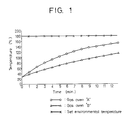
- the test piece was painted in black to absorbe major part of the radiation heat, in addition to the conduction heat, so that it can be said that temperature rising speed of the test piece shows a total heating ability of the oven, as sum of the conduction heat and radiation heat to be generated by the oven. Judging the results shown in Fig. 1, by taking the fact into consideration, the temperature rising speed of the test piece in oven “A” is remarkably high, in comparison with that in oven “B” and thus the former oven is more excellent than the latter in its total heating ability.
- h Apparent heat transfer rate (kcal /m2 ⁇ hr ⁇ °C
- ⁇ Suface area of the substance to be heated (m2)
- T Environmental temperature (°C)
- T′ Temperature of the substance to be heated (°C).
- a baking degree of foods depends on how much thermal energy has been absorbed by the food, rather than how long the food has been kept under what environmental temperature.
- the amount of heat transmitted to the food is determined by the both of the environmental temperature and heat transfer rate, as shown in said equation, which means that the baking temperature and baking period of time, as having been employed as basic controlling factors for baking have a poor correcpondency with the amount of heat transmitted to the food to make the appropriate control of baking for foods difficult.
- An object of the invention is to provide a method of controlling the baking for foods, which always attains an appropriate baking independently of a type of baking apparatus to be employed.
- the object can be attained by a method of controlling the baking for foods, wherein an amount of heat as absorbed by a portion in a baking apparatus and in the vicinity of the food therein is measured to control at least one of factors of temperature for heating the food and air flow rate in the baking apparatus, based on the measured amount of heat.
- the amount of heat absorbed by the food may be determined by setting a thermocouple in a sample piece of the food per se or in a test piece having heat absorption characteristic close to that of the food, putting the thermocouple incorporating food or test piece in the baking apparatus, and measuring the temperature which rises in the food or test piece.
- such a measuring system has disadvantages of that the measurement shall be limited in a short time period of until the temperature of sample (the food or test piece) reaches the environmental one in the baking apparatus, which means the system can be applied for a control of batch type baking apparatus, but can not be applied for a continuously operating type baking apparatus.
- the heat flow sensor is attached on tip end outer surface of a thermal resistant hollow cylinder, an inner space of which can be cooled, the cylinder is set in a baking apparatus and is kept at a fixed temperature by a coolant circulating the inner space thereof through the heat sink, so as to determine an amount of heat passing through the heat flow sensor.
- thermal energy radiated from the heat source is absorbed by a heat receiving surface of the sensor and the heat thus received is transferred to the heat sink via the sensor.
- an electromotive force proportional to the passed thermal energy will appear across output terminals of the sensor. If all of the radiation thermal energy of the heat source is converted by the receiving surface of sensor into a thermal energy and transmitted to the heat sink, the sensor will indicate an exact value (kcal/m2 ⁇ hr) equal to the thermal energy radiated from the heat source and received by the sensor.
- the sensor output is calibrated with reference to the thermal radiation energy density (kcal /m2 ⁇ hr) in the sensor surface, thereby permitting reduction of the measuring deviation simply by selecting a particular graduation in the scale of an associated meter.
- such a sensor is connected to an HFM MC-L type indicator a graduation selecting dial is adjusted with reference to a particular constant which is allotted to the sensor, and the sensor is set with its surface towards an object, so that thermal radiation energy density of the object can be displayed in the indicator by the unit of kcal/m2 ⁇ hr.
- Pieces of food in the baking apparatus will be subjected to the conduction heating from the surrounding air and the radiation heating from the heat source and the inner wall of the baking apparatus.
- the conduction-to-radiation heat ratio depends on type of oven to be selected. As for a baking apparatus using burning gas as its heat source to supply the flow of heated air, the conduction heating is predominant. As for a baking apparatus using an electric resistance type heater or an infrared heater as heat source to effect direct heating, the radiation heating is predominant. In any event, the pieces of food will be exposed to the both of conduction and radiation heating, when a conventional baking apparatus is employed.
- All the conduction heat will be transmitted to the pieces of food, independent from kind of food, but absorption of the radiation heat will depend on the radiation rate of the food surface. For example, if a piece of certain food has a radiation rate of 0.5, only one half of the radiation heat will be absorbed by the food.
- the amount of the heat transmitted to the food and absorbed therein in the oven is given as the sum of the conduction heat and the radiation heat, but the amount of the radiation heat should, however, be corrected by taking the radiation rate of the particular food into consideration.
- the controlling factor is specified as "at least one of temperature for heating the food in the baking apparatus and air flow rate in the baking apparatus". This is based on the inventor's finding: the flow rate is a significant controlling factor.
- the conventional method uses only "temperature and time” as controlling factors and is not appropriate for controlling the baking of foods. As the flow rate of air flowing over but near an outer surface of object to be baked increases, the amount of heat transmitted to the object will increase. This implies that the air flow rate is a useful controlling factor for baking.
- conventional baking apparatus equipped with air circulator and ventilator the air flow control is performed with a manual adjust ment, and no automatic control is provided. The automatic control, however, cannot be effected without providing appropriate means to determine how the heat of conduction varies with air flow rate. For this purpose, thermometers are useless.
- the air flow rate in the baking apparatus can be automatically controlled in response to the heat absorbed by the object.
- the air flow rate can be controlled by varying continuously the opening of the control valve of the duct through which the air is circulated, or by varying continuously the rotation speed of the blower to circulate the air.
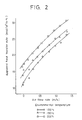
- Fig. 2 shows a relation between heat transfer rate and air flow rate by setting environmental temperature in different levels.
- the apparent heat transfer rate changes rapidly and in a wide range, independent of environmental temperature, and the range, within which the apparent heat transfer rate changes is broad.
- the increase of air flow rate from 0.5 m/sec to 1 m/sec will cause the change in the apparent heat transfer rate by about twice. Accordingly, the control by the air makes possible a desired control for baking, even if a sudden change in thermal load shall occur, for instance, at the initiation stage of baking.
- a biscuit oven was used. It had a 30 meter long steel conveyer belt to supply pieces of biscuit raw material continuously and was composed of a first zone extending one third of the whole oven length from its entrance; a second zone extending another one third distance; and a third zone extending the remaining one third distance to its exit.
- Each zone has gas burners each positioned on the upper and lower sides of the conveyer belt.
- a temperature control device was provided with for each zone to control each nozzle opening of the burners for performing independent temperature control in each zone.
- Each zone had also an air circulating blower and duct positioned above the upper side and under the lower side of the conveyer belt, thereby permitting independent control of the air flow rate by changing the rotation speed of the blower.
- the air flow rate could be changed within the range from 0 to 2 m/sec.
- a heat flow meter was prepared by attaching to a stainless steel hollow cylinder (90 cm length, 30 mm diameter) a heat sink to circulating water in the cylinder to cool a top end thereof, and fixing by soldering on the heat sink an E500 type heat flow sensor (manufactured by Kyoto Densi Kogyo Kabushiki Kaisha of Japan).
- the heat flow meter was arranged above the upper surface of the belt conveyer at the center of each zone in the vicinity of the biscuit material to be baked.
- the surface of each heat flow meter was painted with a heat-resistant black paint.
- Two heat flow meters were arranged below the lower surface of the conveyer belt in the opposing relation with the one above the upper surface of the conveyer belt. These two flow meters were parallel to each other, and their one end appeared outside of the oven wall. One of the flow meters was painted with heat- resistant black paint, whereas the other meter was painted with heat-resistant silver white paint.
- the radiation rate of the black-printed heat flow meter was 0.9, whereas the radiation rate of the white-printed one was 0. 1.
- the radiation rate of the biscuit material was 0.87 to 0.93.
- the radiation rate of the steel conveyer belt was 0.4.
- a browning measuring device such as VS- 10 manufactured and sold by GORING KARR Limited (Britain) was used. It was provided at the outlet of the baking apparatus. The browning meter projected a beam of light to a baked biscuit to continuously determine its browning in terms of an amount of light reflected from the biscuit.
- the baking apparatus was equipped with a feedback system using a signal from the browning meter for controlling the baking apparatus.
- the first zone it was preferable that heat be gradually applied to the raw food material and that the air be supplied at a relatively low flow rate, so as to inhibit surface drying of the raw food material
- An experimental result showed that appropriate heating was 2000 kcal /m2 ⁇ hr
- the temperature above conveyer in the first zone was set at 170 to 180°C, and the rotation speed of the blower was adjusted to supply the flow of air, so that the heat flow meter's reading was 2000 kcal/m2 ⁇ hr
- the flow rate of air was determined to be about 0.5 m/sec.
- the food material was heated by both of the conduction heat and the radiation heat.
- the conduction heat shall be transmitted to the food material and the heat flow meter at the same rate, but the radiation heat is transmitted thereto, in proportion to the radiation rate inherent thereto.
- the food material and the black-painted heat flow meter had substantially same radiation rate, and therefore, an amount "q" of the heat absorbed by the black-painted heat flow meter was substantially equal to "q" of the heat absorbed by the food material.
- the temperature under the conveyer was set at 170 to 180 °C which is same with one above the conveyer.
- the amount of the heat absorbed by the black-painted heat flow meter was 2000 kcal /m2 ⁇ hr, whereas an amount of the heat absorbed by the silver-white-painted heat flow meter was 1600 kcal/m2 ⁇ hr. Further, the radiation rate of the black-painted and silver-white-painted heat flow meter were 0.9 and 0. 1 respectively, as stated before.
- the conduction heat (C) and radiation heat (R) can be determined as 1550 and 500 kcal /m2 ⁇ hr, respectively.
- an amount of heat absorbed by the food material from its lower surface i.e. the heat transmitted through the steel conveyer become the amount of conduction heat (1550kcal/m2 ⁇ hr) plus 40% (the radiation rate of the steel conveyer : 0.4) of the radiation heat (500kcal /m2 ⁇ hr), so that it was totalized as 1750kcal/m2 ⁇ hr which value is less than the amount absorbed by the food material from its upper surface, by 250kcal/m2 ⁇ hr.
- the oven has to work in its maximum range.
- an amount of heat of 4000 kcal/m2 ⁇ hr or more is required.
- the environmental temperature was set at 210 to 220°C. Then the rotation speed of the blower was increased to make the air flow rate of about 1.6 m/sec for permitting the heat flow meters to indicate the amount of heat of 4000 kcal/m2 ⁇ hr.
- the environmental temperature was set at 210 to 220°C. Then, the flow rate of air was controlled in the same way as in the first zone to effect the substantially same heating with the upper surface, as above. An air rate required therefor was of about 1.8 m/sec.
- the temperature and the flow rate of air were controlled based on a degree of browning of the food material surface rather than an amount of the heat absorbed by the heat flow meters.
- the browning measuring device described before was used to determine the browning of the food material, and the signal representing any deviation from the desired browning was feedback to the blower in the third zone, thereby reducing the rotation speed of the blower in case of over browning, and increasing the rotation speed of the blower in case of insufficient browning.
- a linear control was employed, wherein a width of blower control range becomes maximum, when ⁇ 20% deviation will occur in browning of the food material with respect to a standard or desired browning.
- a heating temperature and flow rate of air were balance-controlled to cause the desired browning on the food material surface by operating the blower, based on its medium rotation speed just between the maximum and minimum speeds.
- the control of thermal supplying amount which utilizes the change in air flow rate can rapidly change a heating state for permitting to attain even and desired browning.
- a control depending exclusively on heating temperature is not suitable for adjusting the browning, since a response to temperature control for a heat source is slow in ovens with a high thermal capacity.
- the pre-setting of the blower rotation speed at its medium level will permit to expand a range for allowing a derivation which may be occurred in the preceding step.
- Browning control experiments were carried out to compare the baking control according to the invention with a conventional baking control, with use of baking apparatus as in Example.
- the browning control as far as the conventional method is concerned, was effected based on temperature control in the third zone and without use the air flow control, as controlling factor. Specifically, the air flow rate was set at the fixed value of 1 m/sec.
- the temperature control in the third zone was carried out in response to the signal from the browning measuring device at the outlet of the oven to control the heating temperature of the third zone. Then, the proportional control was adopted, causing 10% temperature change for ⁇ 20% browning derivation with respect to the standard browning.
- the oven used in Example has so large in its thermal capacity that it had to be pre-heated before starting the baking operation.
- the environmental temperature in the oven has reached a set valve, after lapsed 30 minutes.
- a baked food was found to be unsatisfactory because of too light browning and insufficient swelling. Satisfactory products resulted after 1 hour from the initiation of the pre-heating.
- the oven was set to a targeting heat amount condition by controlling air flow rate in the oven, at the time of that temperature in the oven has reached a level near the setting value, to initiate the operation for baking the food material, so that desired good products can be obtained, even if the temperature in both of the first and second zones were lower by 5°C than those of the setting values.
- the required pre-heating period of time was shortened to 25 minutes, from 1 hr as in the conventional method.
- Table 3 shows summaries on baking conditions and results for this Reference Example 2.
- Table 2 Conventional method Method of the invention 1st zone Set temperature: 175 C, Set temperature: 175 C, Set flow rate : 0.5m/sec Set heat amount: 2000 kcal/m2 ⁇ hr 2nd zone Set temperature: 215 C Set temperature: 215 C, Set heat amount: 4000 kcal/m2 ⁇ hr 3rd zone Heat source temperature control, Automatic control based on browning, with an aid of control in air flow rate Automatic control based on browning, Set flow rate: 1.0 m/sec Pre-heating 30 minutes: inadequate browning & inadequate swelling, Pre-heating: 25 minutes (good products) 50 minutes: inadequate swelling, 60 minutes: good products
Landscapes
- Engineering & Computer Science (AREA)
- Mechanical Engineering (AREA)
- Life Sciences & Earth Sciences (AREA)
- Physics & Mathematics (AREA)
- General Physics & Mathematics (AREA)
- Automation & Control Theory (AREA)
- Chemical & Material Sciences (AREA)
- Food Science & Technology (AREA)
- General Engineering & Computer Science (AREA)
- Combustion & Propulsion (AREA)
- Confectionery (AREA)
- Bakery Products And Manufacturing Methods Therefor (AREA)
- General Preparation And Processing Of Foods (AREA)
- Apparatuses For Bulk Treatment Of Fruits And Vegetables And Apparatuses For Preparing Feeds (AREA)
- Control Of Temperature (AREA)
- Baking, Grill, Roasting (AREA)
Applications Claiming Priority (2)
| Application Number | Priority Date | Filing Date | Title |
|---|---|---|---|
| JP63107674A JPH07108195B2 (ja) | 1988-05-02 | 1988-05-02 | 食品の焼成制御方法 |
| JP107674/88 | 1988-05-02 |
Publications (1)
| Publication Number | Publication Date |
|---|---|
| EP0340736A1 true EP0340736A1 (en) | 1989-11-08 |
Family
ID=14465117
Family Applications (1)
| Application Number | Title | Priority Date | Filing Date |
|---|---|---|---|
| EP89107950A Withdrawn EP0340736A1 (en) | 1988-05-02 | 1989-05-02 | Method of controlling the baking of foods |
Country Status (3)
| Country | Link |
|---|---|
| US (1) | US4963375A (enExample) |
| EP (1) | EP0340736A1 (enExample) |
| JP (1) | JPH07108195B2 (enExample) |
Cited By (4)
| Publication number | Priority date | Publication date | Assignee | Title |
|---|---|---|---|---|
| EP0517496A1 (en) * | 1991-06-03 | 1992-12-09 | Patentsmith II, Inc. | Heat transfer rate target module |
| EP0628275A1 (de) * | 1993-06-09 | 1994-12-14 | Hans Heerig | Vorrichtung und Verfahren zur Wärmebehandlung von Nahrungsmitteln |
| WO1997034491A1 (en) * | 1996-03-15 | 1997-09-25 | Aktiebolaget Electrolux | An oven for the preparation of food |
| CN107908144A (zh) * | 2017-11-24 | 2018-04-13 | 北京小米移动软件有限公司 | 一种控制抽烟机的方法、装置及存储介质 |
Families Citing this family (16)
| Publication number | Priority date | Publication date | Assignee | Title |
|---|---|---|---|---|
| JP2759116B2 (ja) * | 1989-12-25 | 1998-05-28 | 東京エレクトロン株式会社 | 熱処理方法および熱処理装置 |
| JP2731278B2 (ja) * | 1990-03-15 | 1998-03-25 | 株式会社東芝 | 炉内温度制御装置 |
| US5340598A (en) * | 1993-10-15 | 1994-08-23 | Nabisco, Inc. | Method for producing spherical shaped baked goods |
| US5947005A (en) * | 1996-09-09 | 1999-09-07 | Salton-Maxim Housewares, Inc. | Bread making machine and method with automated dispenser and pause function |
| JP2000121508A (ja) * | 1998-10-15 | 2000-04-28 | Tlv Co Ltd | 電源を内蔵するモニタリング・システム |
| US20070006865A1 (en) | 2003-02-21 | 2007-01-11 | Wiker John H | Self-cleaning oven |
| US9585400B2 (en) | 2004-03-23 | 2017-03-07 | The Middleby Corporation | Conveyor oven apparatus and method |
| US8087407B2 (en) | 2004-03-23 | 2012-01-03 | Middleby Corporation | Conveyor oven apparatus and method |
| JP4680175B2 (ja) * | 2005-12-27 | 2011-05-11 | 山崎製パン株式会社 | 焼成菓子の焼成方法 |
| US8839714B2 (en) | 2009-08-28 | 2014-09-23 | The Middleby Corporation | Apparatus and method for controlling a conveyor oven |
| ES2661073T3 (es) | 2011-07-15 | 2018-03-27 | Gea Food Solutions Bakel B.V. | Un dispositivo de tratamiento térmico que comprende una antena de radiometría de microondas |
| US10344985B2 (en) * | 2013-03-16 | 2019-07-09 | Lawrence E Anderson | Oven time and temperature device and method of computing oven cookng time |
| US20190331342A1 (en) * | 2013-03-16 | 2019-10-31 | Lawrence Anderson | Method and Device for Cooking |
| US10624353B1 (en) * | 2015-03-12 | 2020-04-21 | John Langley | Pizza oven |
| DE102015225581A1 (de) * | 2015-12-17 | 2017-06-22 | Convotherm Elektrogeräte GmbH | Verfahren zum Betreiben eines gewerblichen Gargeräts |
| US11224228B1 (en) | 2020-06-18 | 2022-01-18 | John Langley | Three sensor oven |
Citations (3)
| Publication number | Priority date | Publication date | Assignee | Title |
|---|---|---|---|---|
| FR2155397A5 (en) * | 1971-09-27 | 1973-05-18 | Westinghouse Electric Corp | Billet heating - in computer controlled through furnace |
| GB2111399A (en) * | 1981-11-20 | 1983-07-06 | Kallinger Walter | A method of temperature control of building materials |
| US4675826A (en) * | 1984-08-06 | 1987-06-23 | Granco-Clark, Inc. | Temperature control system |
Family Cites Families (8)
| Publication number | Priority date | Publication date | Assignee | Title |
|---|---|---|---|---|
| JPS537450B2 (enExample) * | 1972-12-20 | 1978-03-17 | ||
| JPS49122518A (enExample) * | 1973-03-29 | 1974-11-22 | ||
| US4230731A (en) * | 1978-05-25 | 1980-10-28 | Robertshaw Controls Company | Microwave cooking method and control means |
| JPS56141994U (enExample) * | 1980-03-27 | 1981-10-27 | ||
| JPS56138619A (en) * | 1980-03-31 | 1981-10-29 | Sanyo Electric Co Ltd | Electronically controlled cooker |
| US4397875A (en) * | 1980-09-08 | 1983-08-09 | Umc Industries, Inc. | Method of heating food |
| JPS62154593A (ja) * | 1985-12-27 | 1987-07-09 | 株式会社東芝 | 調理器 |
| JPH0755192B2 (ja) * | 1986-05-12 | 1995-06-14 | 株式会社東芝 | 被煮炊物の量検出方法 |
-
1988
- 1988-05-02 JP JP63107674A patent/JPH07108195B2/ja not_active Expired - Lifetime
-
1989
- 1989-04-28 US US07/344,726 patent/US4963375A/en not_active Expired - Fee Related
- 1989-05-02 EP EP89107950A patent/EP0340736A1/en not_active Withdrawn
Patent Citations (3)
| Publication number | Priority date | Publication date | Assignee | Title |
|---|---|---|---|---|
| FR2155397A5 (en) * | 1971-09-27 | 1973-05-18 | Westinghouse Electric Corp | Billet heating - in computer controlled through furnace |
| GB2111399A (en) * | 1981-11-20 | 1983-07-06 | Kallinger Walter | A method of temperature control of building materials |
| US4675826A (en) * | 1984-08-06 | 1987-06-23 | Granco-Clark, Inc. | Temperature control system |
Non-Patent Citations (1)
| Title |
|---|
| PATENT ABSTRACTS OF JAPAN, vol. 11, no. 25, (M-556)[2472], 23rd January 1987; & JP-A-61 197 919 (KIMIKO IKEGAMI) 02-09-1986 * |
Cited By (5)
| Publication number | Priority date | Publication date | Assignee | Title |
|---|---|---|---|---|
| EP0517496A1 (en) * | 1991-06-03 | 1992-12-09 | Patentsmith II, Inc. | Heat transfer rate target module |
| EP0628275A1 (de) * | 1993-06-09 | 1994-12-14 | Hans Heerig | Vorrichtung und Verfahren zur Wärmebehandlung von Nahrungsmitteln |
| WO1997034491A1 (en) * | 1996-03-15 | 1997-09-25 | Aktiebolaget Electrolux | An oven for the preparation of food |
| CN107908144A (zh) * | 2017-11-24 | 2018-04-13 | 北京小米移动软件有限公司 | 一种控制抽烟机的方法、装置及存储介质 |
| CN107908144B (zh) * | 2017-11-24 | 2020-09-18 | 北京小米移动软件有限公司 | 一种控制抽烟机的方法、装置及存储介质 |
Also Published As
| Publication number | Publication date |
|---|---|
| JPH01281042A (ja) | 1989-11-13 |
| US4963375A (en) | 1990-10-16 |
| JPH07108195B2 (ja) | 1995-11-22 |
Similar Documents
| Publication | Publication Date | Title |
|---|---|---|
| US4963375A (en) | Method of controlling the baking of foods | |
| EP0455169B1 (en) | Heating cooker | |
| Chua et al. | Convective drying of banana, guava and potato pieces: effect of cyclical variations of air temperature on drying kinetics and color change | |
| US5938961A (en) | Electronic controller for heating apparatus | |
| CA1264071A (en) | Cooking apparatus capable of detecting temperature of food to be cooked | |
| EP0450499B1 (en) | Heat cooking apparatus | |
| CA1300692C (en) | Microwave oven with automatic defrosting means | |
| CA1190604A (en) | Combined microwave oven and grill oven with automated cooking performance | |
| US4757184A (en) | Rack loaded, radiant heated, cantilevered deck oven and method | |
| US4818547A (en) | Method for cooking food material of varying volume | |
| JPH0375542A (ja) | 促進耐光試験方法 | |
| US4181744A (en) | Method of browning foods in a microwave oven | |
| HK43794A (en) | Cooking apparatus providing accurate control of cooking process and capability for specifying hardness degree of cooked food | |
| DE3682802D1 (de) | Kochherd mit einer vorrichtung zum automatischen regeln des ankochheizvorganges einer kochvorrichtung. | |
| US4058254A (en) | Temperature-monitoring and control system | |
| CA1094648A (en) | Method of cooking juiced foods in a microwave oven | |
| US5333953A (en) | Method and apparatus for calculating thermal sensitivity | |
| AU1065588A (en) | An apparatus for cooking by electric heating | |
| US5302793A (en) | Microwave ovens with air inlet and air outlet temperature sensors | |
| FR2697407A1 (fr) | Dispositif de régulation pour four à feu de bois destiné à la cuisson de tartes flambées et pizzas. | |
| JPH0458912A (ja) | 電気調理器 | |
| JPH06276912A (ja) | 自動制御装置付オーブン | |
| SU661523A1 (ru) | Термостат | |
| JPS63254324A (ja) | 加熱調理器 | |
| JP2523749B2 (ja) | 加熱装置 |
Legal Events
| Date | Code | Title | Description |
|---|---|---|---|
| PUAI | Public reference made under article 153(3) epc to a published international application that has entered the european phase |
Free format text: ORIGINAL CODE: 0009012 |
|
| AK | Designated contracting states |
Kind code of ref document: A1 Designated state(s): DE FR GB IT |
|
| 17P | Request for examination filed |
Effective date: 19900316 |
|
| 17Q | First examination report despatched |
Effective date: 19910716 |
|
| RAP1 | Party data changed (applicant data changed or rights of an application transferred) |
Owner name: MEIJI SEIKA KAISHA LTD. Owner name: TOSHIBA CORPORATION |
|
| STAA | Information on the status of an ep patent application or granted ep patent |
Free format text: STATUS: THE APPLICATION IS DEEMED TO BE WITHDRAWN |
|
| 18D | Application deemed to be withdrawn |
Effective date: 19941201 |