EP0339237B1 - Phenol substituted gem-diphosphonate derivatives, process for their preparation and pharmaceutical compositions containing them - Google Patents
Phenol substituted gem-diphosphonate derivatives, process for their preparation and pharmaceutical compositions containing them Download PDFInfo
- Publication number
- EP0339237B1 EP0339237B1 EP89104656A EP89104656A EP0339237B1 EP 0339237 B1 EP0339237 B1 EP 0339237B1 EP 89104656 A EP89104656 A EP 89104656A EP 89104656 A EP89104656 A EP 89104656A EP 0339237 B1 EP0339237 B1 EP 0339237B1
- Authority
- EP
- European Patent Office
- Prior art keywords
- diphosphonate
- formula
- ditertiobutyl
- hydroxyphenyl
- compounds
- Prior art date
- Legal status (The legal status is an assumption and is not a legal conclusion. Google has not performed a legal analysis and makes no representation as to the accuracy of the status listed.)
- Expired - Lifetime
Links
- 0 C*(CCC(C)(C1)*2CCC3)CCC(C)(C4)*3C2C14O Chemical compound C*(CCC(C)(C1)*2CCC3)CCC(C)(C4)*3C2C14O 0.000 description 13
Classifications
-
- C—CHEMISTRY; METALLURGY
- C07—ORGANIC CHEMISTRY
- C07F—ACYCLIC, CARBOCYCLIC OR HETEROCYCLIC COMPOUNDS CONTAINING ELEMENTS OTHER THAN CARBON, HYDROGEN, HALOGEN, OXYGEN, NITROGEN, SULFUR, SELENIUM OR TELLURIUM
- C07F9/00—Compounds containing elements of Groups 5 or 15 of the Periodic Table
- C07F9/02—Phosphorus compounds
- C07F9/28—Phosphorus compounds with one or more P—C bonds
- C07F9/30—Phosphinic acids [R2P(=O)(OH)]; Thiophosphinic acids ; [R2P(=X1)(X2H) (X1, X2 are each independently O, S or Se)]
-
- C—CHEMISTRY; METALLURGY
- C07—ORGANIC CHEMISTRY
- C07F—ACYCLIC, CARBOCYCLIC OR HETEROCYCLIC COMPOUNDS CONTAINING ELEMENTS OTHER THAN CARBON, HYDROGEN, HALOGEN, OXYGEN, NITROGEN, SULFUR, SELENIUM OR TELLURIUM
- C07F9/00—Compounds containing elements of Groups 5 or 15 of the Periodic Table
- C07F9/02—Phosphorus compounds
- C07F9/28—Phosphorus compounds with one or more P—C bonds
- C07F9/38—Phosphonic acids [RP(=O)(OH)2]; Thiophosphonic acids ; [RP(=X1)(X2H)2(X1, X2 are each independently O, S or Se)]
- C07F9/3804—Phosphonic acids [RP(=O)(OH)2]; Thiophosphonic acids ; [RP(=X1)(X2H)2(X1, X2 are each independently O, S or Se)] not used, see subgroups
- C07F9/3839—Polyphosphonic acids
- C07F9/386—Polyphosphonic acids containing hydroxy substituents in the hydrocarbon radicals
-
- A—HUMAN NECESSITIES
- A61—MEDICAL OR VETERINARY SCIENCE; HYGIENE
- A61P—SPECIFIC THERAPEUTIC ACTIVITY OF CHEMICAL COMPOUNDS OR MEDICINAL PREPARATIONS
- A61P3/00—Drugs for disorders of the metabolism
- A61P3/06—Antihyperlipidemics
-
- C—CHEMISTRY; METALLURGY
- C07—ORGANIC CHEMISTRY
- C07F—ACYCLIC, CARBOCYCLIC OR HETEROCYCLIC COMPOUNDS CONTAINING ELEMENTS OTHER THAN CARBON, HYDROGEN, HALOGEN, OXYGEN, NITROGEN, SULFUR, SELENIUM OR TELLURIUM
- C07F9/00—Compounds containing elements of Groups 5 or 15 of the Periodic Table
- C07F9/02—Phosphorus compounds
- C07F9/28—Phosphorus compounds with one or more P—C bonds
- C07F9/38—Phosphonic acids [RP(=O)(OH)2]; Thiophosphonic acids ; [RP(=X1)(X2H)2(X1, X2 are each independently O, S or Se)]
- C07F9/3804—Phosphonic acids [RP(=O)(OH)2]; Thiophosphonic acids ; [RP(=X1)(X2H)2(X1, X2 are each independently O, S or Se)] not used, see subgroups
- C07F9/3839—Polyphosphonic acids
- C07F9/3865—Polyphosphonic acids containing sulfur substituents
-
- C—CHEMISTRY; METALLURGY
- C07—ORGANIC CHEMISTRY
- C07F—ACYCLIC, CARBOCYCLIC OR HETEROCYCLIC COMPOUNDS CONTAINING ELEMENTS OTHER THAN CARBON, HYDROGEN, HALOGEN, OXYGEN, NITROGEN, SULFUR, SELENIUM OR TELLURIUM
- C07F9/00—Compounds containing elements of Groups 5 or 15 of the Periodic Table
- C07F9/02—Phosphorus compounds
- C07F9/28—Phosphorus compounds with one or more P—C bonds
- C07F9/38—Phosphonic acids [RP(=O)(OH)2]; Thiophosphonic acids ; [RP(=X1)(X2H)2(X1, X2 are each independently O, S or Se)]
- C07F9/40—Esters thereof
- C07F9/4003—Esters thereof the acid moiety containing a substituent or a structure which is considered as characteristic
- C07F9/4025—Esters of poly(thio)phosphonic acids
- C07F9/404—Esters of poly(thio)phosphonic acids containing hydroxy substituents in the hydrocarbon radicals
-
- C—CHEMISTRY; METALLURGY
- C07—ORGANIC CHEMISTRY
- C07F—ACYCLIC, CARBOCYCLIC OR HETEROCYCLIC COMPOUNDS CONTAINING ELEMENTS OTHER THAN CARBON, HYDROGEN, HALOGEN, OXYGEN, NITROGEN, SULFUR, SELENIUM OR TELLURIUM
- C07F9/00—Compounds containing elements of Groups 5 or 15 of the Periodic Table
- C07F9/02—Phosphorus compounds
- C07F9/28—Phosphorus compounds with one or more P—C bonds
- C07F9/38—Phosphonic acids [RP(=O)(OH)2]; Thiophosphonic acids ; [RP(=X1)(X2H)2(X1, X2 are each independently O, S or Se)]
- C07F9/40—Esters thereof
- C07F9/4003—Esters thereof the acid moiety containing a substituent or a structure which is considered as characteristic
- C07F9/4025—Esters of poly(thio)phosphonic acids
- C07F9/4043—Esters of poly(thio)phosphonic acids containing sulfur substituents
-
- C—CHEMISTRY; METALLURGY
- C07—ORGANIC CHEMISTRY
- C07F—ACYCLIC, CARBOCYCLIC OR HETEROCYCLIC COMPOUNDS CONTAINING ELEMENTS OTHER THAN CARBON, HYDROGEN, HALOGEN, OXYGEN, NITROGEN, SULFUR, SELENIUM OR TELLURIUM
- C07F9/00—Compounds containing elements of Groups 5 or 15 of the Periodic Table
- C07F9/02—Phosphorus compounds
- C07F9/28—Phosphorus compounds with one or more P—C bonds
- C07F9/38—Phosphonic acids [RP(=O)(OH)2]; Thiophosphonic acids ; [RP(=X1)(X2H)2(X1, X2 are each independently O, S or Se)]
- C07F9/44—Amides thereof
- C07F9/4403—Amides thereof the acid moiety containing a substituent or a structure which is considered as characteristic
- C07F9/4423—Amides of poly (thio)phosphonic acids
-
- C—CHEMISTRY; METALLURGY
- C07—ORGANIC CHEMISTRY
- C07F—ACYCLIC, CARBOCYCLIC OR HETEROCYCLIC COMPOUNDS CONTAINING ELEMENTS OTHER THAN CARBON, HYDROGEN, HALOGEN, OXYGEN, NITROGEN, SULFUR, SELENIUM OR TELLURIUM
- C07F9/00—Compounds containing elements of Groups 5 or 15 of the Periodic Table
- C07F9/02—Phosphorus compounds
- C07F9/547—Heterocyclic compounds, e.g. containing phosphorus as a ring hetero atom
- C07F9/655—Heterocyclic compounds, e.g. containing phosphorus as a ring hetero atom having oxygen atoms, with or without sulfur, selenium, or tellurium atoms, as the only ring hetero atoms
- C07F9/65515—Heterocyclic compounds, e.g. containing phosphorus as a ring hetero atom having oxygen atoms, with or without sulfur, selenium, or tellurium atoms, as the only ring hetero atoms the oxygen atom being part of a five-membered ring
- C07F9/65517—Heterocyclic compounds, e.g. containing phosphorus as a ring hetero atom having oxygen atoms, with or without sulfur, selenium, or tellurium atoms, as the only ring hetero atoms the oxygen atom being part of a five-membered ring condensed with carbocyclic rings or carbocyclic ring systems
-
- C—CHEMISTRY; METALLURGY
- C07—ORGANIC CHEMISTRY
- C07F—ACYCLIC, CARBOCYCLIC OR HETEROCYCLIC COMPOUNDS CONTAINING ELEMENTS OTHER THAN CARBON, HYDROGEN, HALOGEN, OXYGEN, NITROGEN, SULFUR, SELENIUM OR TELLURIUM
- C07F9/00—Compounds containing elements of Groups 5 or 15 of the Periodic Table
- C07F9/02—Phosphorus compounds
- C07F9/547—Heterocyclic compounds, e.g. containing phosphorus as a ring hetero atom
- C07F9/6564—Heterocyclic compounds, e.g. containing phosphorus as a ring hetero atom having phosphorus atoms, with or without nitrogen, oxygen, sulfur, selenium or tellurium atoms, as ring hetero atoms
- C07F9/6571—Heterocyclic compounds, e.g. containing phosphorus as a ring hetero atom having phosphorus atoms, with or without nitrogen, oxygen, sulfur, selenium or tellurium atoms, as ring hetero atoms having phosphorus and oxygen atoms as the only ring hetero atoms
- C07F9/657163—Heterocyclic compounds, e.g. containing phosphorus as a ring hetero atom having phosphorus atoms, with or without nitrogen, oxygen, sulfur, selenium or tellurium atoms, as ring hetero atoms having phosphorus and oxygen atoms as the only ring hetero atoms the ring phosphorus atom being bound to at least one carbon atom
- C07F9/657181—Heterocyclic compounds, e.g. containing phosphorus as a ring hetero atom having phosphorus atoms, with or without nitrogen, oxygen, sulfur, selenium or tellurium atoms, as ring hetero atoms having phosphorus and oxygen atoms as the only ring hetero atoms the ring phosphorus atom being bound to at least one carbon atom the ring phosphorus atom and, at least, one ring oxygen atom being part of a (thio)phosphonic acid derivative
Definitions
- This invention relates to a novel class of compounds, phenol substituted gem-diphosphonate derivatives as well as the process for preparing such compounds. It further relates to pharmaceutical compositions containing the above-mentioned compounds especially for the treatment of hyperlipidemia.
- the phenol substituted gem-diphosphonates were tested and discovered to be potent hypolipidemic and lipid altering agents, in addition some were found to possess hypotensive activity. These gem-diphosphonates are therefore potentially useful agents for the treatment of dyslipemias and associated cardiovascular diseases.
- the present invention relates to compounds of formula (I): where:
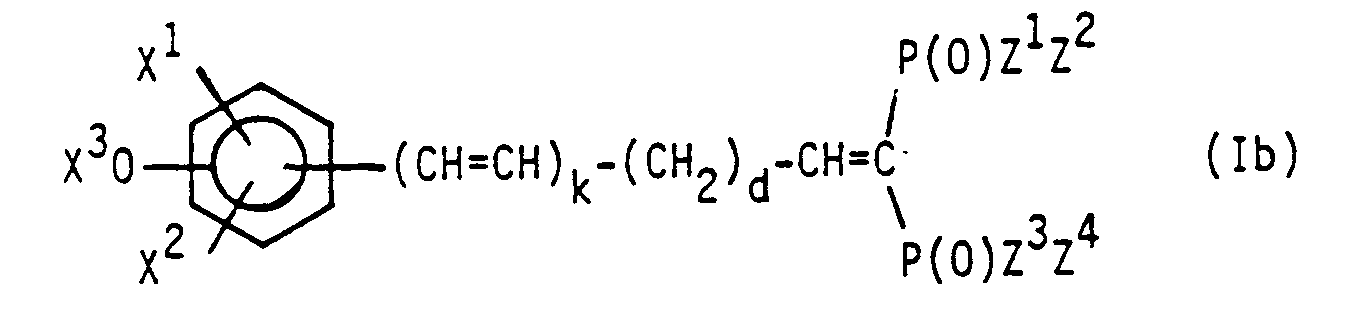
- the compounds of formula (I) include the phenol substituted alkylidenediphosphonates (Ia) and the phenol substituted alkenylidenediphosphonates (Ib) where X 1 , X 2 , X 3 , A, B, k, d, Z 1 , Z 2 , Z 3 , Z 4 are as described above.
- Compounds of structure (Ia) include, for example, those in which:
- Compounds of structure (Ib) include, for example, those in which
- the present invention also relates to a process for preparing gem-diphosphonates of formula (Ia) and (Ib).
- the experimental procedure for preparing (Ia) consists in reacting the diphosphonate compound III with a base such as sodium hydride, sodium metal, sodium alkoxide, n-butyl lithium or lithium diisopropylamide.
- the starting product II is then reacted with the anion of compound III thus formed in situ to give the substituted diphosphonate (la).
- the reaction takes place in solvents such as hexane, heptane, benzene, toluene, tetrahydrofuran, dioxane, dimethoxyethane, methyl tertiobutyl ether or N, N-dimethylformamide.
- solvents can be utilized pure or as a mixture, depending on the solvent polarity desired.
- the temperature range of the reaction is between -78 °C and the boiling point of the solvent or solvent mixture.
- the reaction time varies between several hours and several days.
- A is a sulfur atom
- the appropriate starting compound II is the bis (substituted phenol) disulfide and the preferred base is n-butyl lithium.
- the procedure for preparing (Ib) consists in condensing the appropriate aldehyde IV with the diphosphonate compound V using titanium tetrachloride and a tertiary amine such as methyl morpholine or pyridine as catalysts.
- the reaction is carried out in an ether solvent such as tetrahydrofuran, dioxane or dimethoxyethane.
- the polarity of the reaction medium can be conveniently modified by adding a non-polar solvent such as tetrachloromethane.
- the temperature of the reaction varies between -15°C and 40 °C, preferably between 0 ° C and 30 ° C.
- a complex hydride reagent such as sodium borohydride or lithium borohydride in a polar solvent which can be methanol, ethanol at a temperature between -15 and room temperature.
- complex hydride reagent such as sodium borohydride or lithium borohydride in methanol or ethanol as solvent at a temperature between room and reflux temperature.
- Another convenient reduction method is the catalytic hydrogenation using palladium or platinum adsorbed on active charcoal as catalyst.
- Suitable solvents include methanol, ethanol, dimethoxyethane, dioxane, tetrahydrofuran and acetic acid. The reduction is performed at room temperature and at a pressure between 1 and 4 atm.
- Compounds (I) obtained through one of the procedures described in page 8 can be derivatized into other products with different ester groups.
- the latter compounds are alkylated by using trialkyl orthoformates to form the corresponding tetraalkyl esters.
- An alternative method consists in reacting the tetraethyl ester derivative with bromotrimethylsilane/phosphorus pentachloride to form the diphosphonyl tetrachloride.
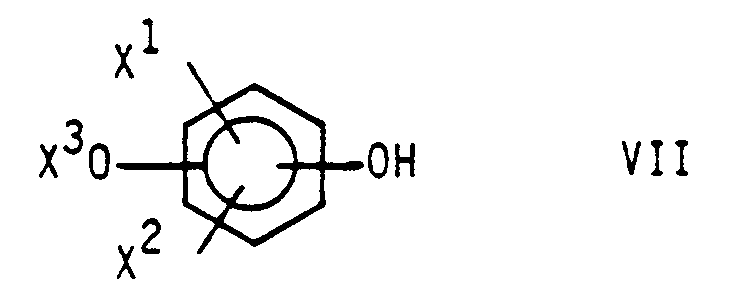
- (Ia) can also be prepared by reacting bromoalkylidenediphosphonate VIII with respectively the thiohydroquinone VI or hydroquinone derivative VII in presence of a base. or
- A is S-(CH 2 ) n where n ⁇ 3
- one additional method for preparing (Ia) involves reacting VI with an alkenylidenediphosphonate IX in presence of a radical initiating agent such as benzoyl peroxide or hydrogen peroxide.
- the sulfide group is converted to the higher oxidation states, namely the sulfone groups, by using an oxidative agent which may be a peracid such as m-chloroperbenzoic acid or a peroxide salt such as potassium permanganate or potassium hydrogen persulfate.
- an oxidative agent which may be a peracid such as m-chloroperbenzoic acid or a peroxide salt such as potassium permanganate or potassium hydrogen persulfate.
- Compounds (I) where X 3 is different from H can be prepared by using the corresponding starting compound II where X 3 #H.
- One alternative method involves derivatizing the phenolic -OH group in compounds (I) by standard synthetic procedures: alkylation, by reacting the phenoxide anion with alkylating reagents such as alkyl halide or dialkyl sulfate, esterification by using acylating reagents such as acid anhydrides or acyl halides to form the corresponding esters or by using isocyanates to form the corresponding carbamates.
- alkylating reagents such as alkyl halide or dialkyl sulfate
- esterification by using acylating reagents such as acid anhydrides or acyl halides to form the corresponding esters or by using isocyanates to form the corresponding carbamates.
- the starting compounds V which are not commercially available are prepared by one of the two following methods.
- the structures of compounds of formula (I) are determined by elemental analysis, infrared (IR), mass (MS) and nuclear magnetic resonance (NMR) spectroscopies. The purity of the compounds is verified by thin layer chromatography (silica gel, CH 2 CI 2 /MeOH or CHCI 3 /MeOH eluent mixtures), gas liquid chromatography (Methyl silicone column) or high performance liquid chromatography (Octadecylsilane C 18 reversed phase column).
- n- normal, i- is iso-, sec is secondary-, t is tertio-.
- s is singlet
- d is doublet
- t is triplet
- m multiplet.
- the temperatures are measured in degree Celsius and the melting points are uncorrected.
- the boiling points refer to values obtained by short path distillation carried out in a ball tube type distillation apparatus (Kugelrohr).
- Tetraethyl methylenediphosphonate (21.2 g, 73.5 mmol) was added at room temperature to a 80% dispersion of sodium hydride in mineral oil (2.2 g, 73.5 mmol) suspended in 70 ml dry benzene.
- sodium tetraethyl methylenediphosphonate was then added a 30 ml toluene solution of 20 g (66.8 mmol) of 3,5-ditertiobutyl-4-hydroxybenzylbromide prepared according to H. Gross, H. Seibt and I. Keitel, Journal für prakt. Chemie 317 (6), p. 890-896 (1975). The resulting mixture was refluxed for 16 hours.
- Tetraethyl methylenediphosphonate (21 g, 72 mmol) was added followed by pyridine (22.9 g, 290 mmol). The mixture was stirred for 3 h at room temperature and concentrated under vacuum. The residue was partitioned between Et 2 0 and H 2 0. The ether phase was washed with NaHCO 3 solution to pH 7, dried and evaporated to dryness. An amount of 18.5 g (40 mmol, 77% yield) was obtained of the title compound, pure by GLC.
- the reduction of compound 33 can also be carried out by catalytic hydrogenation.
- the compound prepared by these reduction procedures has physical and spectroscopic data identical to those of the product described in example 3.
- trimethylbromosilane (5 ml, 38.6 mmol) was added dropwise to 10 ml of a carbon tetrachloride solution of tetraethyl 2-(3,5-ditertiobutyl-4-hydroxyphenyl)-ethylidene-1,1-diphosphonate (1.95 g, 3.86 mmol).
- the mixture was stirred at room temperature for 30 h.
- the excess of BrSiMe 3 was removed by distillation and the residue was treated with 20 ml H 2 0 for 2 h. Evaporation of the aqueous solution gave 1.43 g (3.6 mol, 94%) of the diphosphonic acid.
- Tetraethyl 2-(3,5-ditertiobutyl-4-hydroxyphenyl)ethylidene-1,1-diphosphonate 500 mg, 1 mmol was added to a suspension of 80% NaH (40 mg, 1.3 mmol) in 20 ml dry THF. Methyl iodide (1.3 ml, 6 mmol) was added and the reaction mixture was refluxed for 16 h. After Et 2 0/H 2 0 extraction, the organic phase was dried and evaporated. Column chromatography (Si0 2 , 95/5 CHCl 3 /MeOH) gave 440 mg (0.84 mmol, 84%) of the title compound.
- Diethyl bis(dimethylamino)phosphinyl methylphosphonate was prepared by reacting diethyl methylphosphonate and bis(dimethylamino) phosphorochloridate using lithium diisopropylamide in THF, according to P. Savignac et al, Tetrahedron Letters 26 (37), p. 4435-4438 (1985).
- Dibutyl diethyl 2-(3,5-ditertiobutyl-4-hydroxyphenyl)-ethenylidene-1,1-diphosphonate was synthesized by reacting TiCI 4 (4.94 g, 26 mmol), 3,5-ditertiobutyl-4-hydroxybenzaldehyde (3 g, 13 mmol), dibutyl diethyl methylenediphosphonate (4.4 g, 13 mmol) and N-methylmorpholine (5.25 g, 52 mmol) in 20 ml THF at room temperature. Column chromatography (95/5 CHCl 3 /MeOH) afforded 2.6 g (4.6 mmol, 36%) of the title compound.
- Tetraethyl propylidene-1,1-diphosphonate was prepared in 65% yield by reacting tetraethyl methylenediphosphonate with ethyl iodide in presence of NaH in tetrahydrofuran.
- Tetraethyl propylidene-1,1-diphosphonate (1.5 g, 4.75 mmol) was added to a suspension of 80% NaH (0.143 g, 4.75 mmol) in dry THF (10 ml) and the mixture was stirred until the NaH disappeared.
- 3,5- ditertiobutyl-4-hydroxybenzylbromide (1,42 g, 4,75 mmol) in 5 ml THF was added and the mixture was refluxed for 4 h. After work up, column chromatography (Si0 2 , 95/5 CHCl 3 /MeOH) gave 0.9 g (1.7 mmol, 36%) of the title compound.
- mp 107-110° C
- Tetraethyl 7-bromoheptylidene-1,1-diphosphonate was prepared by reaction of sodium tetraethyl methylenediphosphonate with 1,6-dibromohexane.
- Titanium tetrachloride (3.14g, 0.017 mol) was dropped, under nitrogen, to 40 ml of anhydrous THF cooled in an ice bath. It was successively added 2.15g (0.008 mol) of 3,5-ditertiobutyl-4-hydroxy-cinnamaldehyde, 2.39g (0.008 mol) of tetraethyl methylenediphosphonate and 3.25 g (0.033 mol) of methylmorpholine. The resulting mixture was kept in the ice bath for a further 1 hour then allowed to return to room temperature overnight. 50 ml of water was added and the resulting mixture was extracted with 3 x 50 ml of ethyl ether.
- Diethyl (2-oxo-1,3,2-dioxaphosphorin-2-yl)methylphosphonate was prepared by the Arbuzov reaction of triethyl phosphite and 2-chloromethyl-2-oxo-1,3,2-dioxaphosphorinan. (IR: 1260 and 1030 cm -1 ).
- the gem-diphosphonate derivatives were discovered to display a spectrum of pharmacological activities, the most marked being hypolipidemia (hypocholesterolemia and/or hypotriglyceridemia). Some of the diphosphonic acid derivatives demonstrated anti-inflammatory activity and some diphosphonate esters were hypotensive. Diuretic and positive inotropic activity were also observed.
- the gem-diphosphonates possess antioxidant and radical scavenging activities associated with the dialkyl hydroxyphenyl moieties present in their structures.
- Free radical scavengers are known to be efficacious in preventing the pathological changes in a number of diseases induced by oxidative stress.
- the gem-diphosphonates are thus potentially useful for the treatment of diseases such as:
- the new diphosphonates described in this patent application were administered orally to mice.
- This rodent species has plasma lipid levels relatively close to man (generally greater than 150mg/dl).
- the plasma cholesterol and triglyceride levels are in the range of 100mg/dl, whereas for rat the comparative values are close to 50mg/dl.
- mice have recently investigated the use of mice and found this species to be a relevant model for testing new agents in comparison to drugs known to be efficacious in human hyperlipidemia (Effects of Fenofibrate, Gemfibrozil and Nicotinic Acid on Plasma Lipoprotein Levels in Normal and Hyperlipidemic Mice, a Proposed Model for Drug Screening. Olivier, P. et al. Atherosclerosis 70, p.107-114, 1988).
- mice of the OF1 strain weighing 25 to 35 g were divided into 5 groups of 6 animals each.
- Four groups received the compounds to be tested, or the reference drugs, the fifth group served as control.
- Compounds were dissolved in diethyl ether, the solution was added to the pelleted food and the ether was evaporated.
- Plasma cholesterol and plasma triglycerides were measured by enzymatic methods (Ames kit No. 6376 and No. 6630). The mean cholesterol or triglyceride value of each group receiving tested compounds or reference drugs was expressed as percent of the mean value observed for the contemporary control.
- Table 3 showed that a number of diphosphonate derivatives (Compounds 3, 4, 5, 6, 7, 18, 21, 22, 23, 24, 33, 34, 37, 47 and 48) were markedly hypocholesterolemic, Compounds 33 and 34 being the most potent (-40% and -41 %).
- Clofibrate, gemfibrozil and fenofibrate which are three Registered Trademarks of drugs used clinically for the treatment of hyperlipidemia, were found to be less hypocholesterolemic than many of the diphosphonates tested.
- Fenofibrate was the most potent (-15%) of the references drugs tested. Similar hypocholesterolemic activity was measured in mice receiving the fibrate derivatives as published in the reference cited above (Olivier, P. et al.).
- the effect of four selected diphosphonates was investigated on the inflammatory response to kappa carrageenan in the rat paw oedema model.
- Eight male rats were employed per group.
- Oedema was induced in the right hind paw of each animal by a single injection into the plantar aponeurosis of 0.1 ml of a 1 % w/v of kappa carrageenan solution dissolved in 0.9% NaCI.
- the test compounds (100 mg/kg) and reference drug (indomethacin 30 mg/kg) were administered by gavage 1 hour prior to induction of oedema by carrageanan injection.
- the volume of the right paw was measured for each animal at 0, 1, 2.5 and 4 hours after carrageenan injection (only 4 hour values are reported).
- the spontaneously hypertensive rat is a well established animal model of human arterial hypertension.
- the gem-diphosphonates of formula (I) were found to induce a marked hypotension when administered to SHRs.
- Compounds 4, 6, 7 and 18 decreased blood pressure by 30 to 50% and are as potent as the reference drugs tested similarly and which are used for the treatment of angina pectoris and hypertension.
- the gem-diphosphonates of formula (I) are thus potentially useful in the treatment of cardiovascular diseases via a smooth muscle relaxant activity.
- the primary indications of these compounds would be the treatment of angina pectoris, congestive heart failure and hypertension.
- the gem-diphosphonates of formula (I) can thus be used for the treatment of hyperlipidemia and/or hypertension and can be administered preferably in the form of capsules, tablets and granules.
- the active principle should be mixed with a pharmaceutical carrier.
- the term "pharmaceutical carrier” denotes a solid or liquid filler diluent or encapsulating substance.
- substances which can serve as pharmaceutical carriers are sugars, starches, cellulose and its derivatives, powdered tragacanth, malt, gelatin, talc, stearic acid, magnesium stearate, calcium sulfate, vegetable oils, polyols and polyethylene glycol, agar, alginic acid, pyrogen-free water, isotonic saline and phosphate buffer solutions, as well as other non-toxic compatible substances used in pharmaceutical formulations.
- Wetting agents and lubricants such as sodium lauryl sulfate, as well as coloring agents, flavoring agents and preservatives, can also be present.
- the pharmaceutical carrier employed in conjunction with the phosphonates is used at a concentration sufficient to provide a practical size to dosage relationship.
- the pharmaceutical carrier comprises from about 0.1% to 99% by weight of the total composition.
- Capsules and tablets are prepared by conventional methods using gem-diphosphonates in their liquid or cristalline form as described in the following examples:
- composition containing a pharmaceutically acceptable gem-diphosphonate can be administered as a solution, suspension, emulsion or by intradermal, intramuscular, intravenous or intraperitoneal injection.
- Rectal administration of gem-diphosphonates can be performed by incorporating the active principle into conventional jelly bases to produce suppositories.
Landscapes
- Chemical & Material Sciences (AREA)
- Organic Chemistry (AREA)
- Health & Medical Sciences (AREA)
- General Health & Medical Sciences (AREA)
- Life Sciences & Earth Sciences (AREA)
- Molecular Biology (AREA)
- Biochemistry (AREA)
- Obesity (AREA)
- Animal Behavior & Ethology (AREA)
- Medicinal Chemistry (AREA)
- Nuclear Medicine, Radiotherapy & Molecular Imaging (AREA)
- Chemical Kinetics & Catalysis (AREA)
- Pharmacology & Pharmacy (AREA)
- Hematology (AREA)
- General Chemical & Material Sciences (AREA)
- Diabetes (AREA)
- Public Health (AREA)
- Veterinary Medicine (AREA)
- Bioinformatics & Cheminformatics (AREA)
- Engineering & Computer Science (AREA)
- Pharmaceuticals Containing Other Organic And Inorganic Compounds (AREA)
Description
- This invention relates to a novel class of compounds, phenol substituted gem-diphosphonate derivatives as well as the process for preparing such compounds. It further relates to pharmaceutical compositions containing the above-mentioned compounds especially for the treatment of hyperlipidemia.
- Many epidemiologic studies have shown that people with high levels of serum cholesterol are at high risk of developing coronary artery diseases. The convincing and definitive evidence that lowering serum cholesterol with the aid of hypocholesterolemic drugs reduces the risk of coronary heart diseases was provided by the Lipid Research Clinics Coronary Primary Prevention Trial reports (The Lipid Research Clinics Coronary Primary Prevention Trial results. I. Reduction in incidence of coronary heart disease. Journal of the American Medical Association 251, p.351-364, 1984. The Lipid Research Clinics Coronary Primary Prevention Trial results. II. The relationship of reduction in incidence of coronary heart disease to cholesterol lowering. Journal of the American Medical Association 251, p. 365-374, 1984).
- In addition, the most recent report from the Helsinki study showed that gemfibrozil treatment, which was associated with the modification of the serum lipoprotein levels and decreased plasma triglycerides, reduces the incidence of coronary heart disease in men with dyslipemia (The New England Journal of Medicine 317 (20), p. 1237-1245, 1987).
- The phenol substituted gem-diphosphonates were tested and discovered to be potent hypolipidemic and lipid altering agents, in addition some were found to possess hypotensive activity. These gem-diphosphonates are therefore potentially useful agents for the treatment of dyslipemias and associated cardiovascular diseases.
- H. Gross and coworkers have described the synthesis of (3,5-ditertiobutyl-4-hydroxyphenyl)methylidene diphosphonic acid and its Me, Et and Pr esters in Journal f. prakt. Chemie 317(6), P. 890-896 (1975); ibid. 318(3), p. 403-408 (1976) and ibid. 320(2), p. 344-350 (1978). No potential application of these compounds was provided in the description.
- W. Lehnert reported in Tetrahedron 30, p. 301-305 (1974) a method for the preparation of simple phenylethenylidene-diphosphonate and-carboxyphosphonate esters, without any information on their potential application.
- The US Patent No. 4,696,920 (1987) of Symphar S.A. reports the preparation of tetraethyl and tetrabutyl 2-(3,5-ditertiobutyl-4-hydroxy)benzyl-1,3-propylidenediphosphonate and their possible use in the treatment of cardiovascular diseases induced by or associated with the dysfunction of the slow calcium channels.
- The UK patent 2 043 072 (1979) of Symphar S.A. discloses the synthesis of unsubstituted phenyl- and phenoxy-alkylidene-1,1-diphosphonic acids and Me and Et esters and their application as antiatherosclerotic agents.
- The present invention relates to compounds of formula (I):

- - Z 1, Z2, Z3 and Z4 identical or different are
- - OR where R is H, a straight, branched or cyclic alkyl group comprising from 1 to 8 carbon atoms,
- - OM where M is an alkaline or alkaline earth metal ion or an ammonium group NR4 where R has the same meaning as defined above,
- - NR2 where R has the same meaning as defined above,
- - Z',Z2 and Z3, Z4 may form an alkylidenedioxy ring comprising 2 to 8 carbon atoms.
- - X1, X2 identical or different, are H, a halogen atom, a straight, branched or cyclic alkyl or alkoxy group from 1 to 8 carbon atoms,
- - X3 is H, an alkyl group R1 from 1 to 4 carbon atoms, an acyl group C(O)R1, a carbamyl group C(O)-NHR' where R1 is described as above; X30 and one of the two other substituents X1 or X2 may form an alkylidenedioxy ring comprising from 1 to 4 carbon atoms,
- - A is -CH=CH-CH2-, -(CH2)n-, -O(CH2)n-, -S-, S02, -S(CH2)n-, -S02(CH2)n-, where n is an integer from 1 to 7, -(CH = CH)k-(CH2)d-CH = where k is zero or 1 and d is an integer from zero to 4,
- - B is H, an alkyl group from 1 to 4 carbon atoms,
- - t is zero or 1, with the proviso that t is zero only when A is (CH = CH)k-(CH2)d-CH = where k and d are as described above.
- The compounds of formula (I) include the phenol substituted alkylidenediphosphonates (Ia) and the phenol substituted alkenylidenediphosphonates (Ib)


- Compounds of structure (Ia) include, for example, those in which:
- - X1, X2 identical or different are alkyl groups from 1 to 8 carbon atoms,
- - X3 is hydrogen,
- - A is CH=CH-CH2, (CH2)n, S, S02, S-(CH2)n, S02-(CH2)n, where n is 1-7,
- - B is hydrogen or a C1-C4 alkyl group,
- - Z1, Z2, Z3, Z4 identical or different are OH, alkoxy groups of 1 to 8 carbon atoms or one or both of the pairs Z1, Z2 and Z3, Z4 are an alkylidenedioxy group of 2 to 8 carbon atoms.
- Compounds of structure (Ib) include, for example, those in which
- - X1, X2 identical or different are alkyl groups from 1 to 8 carbon atoms,
- - X3 is hydrogen,
- - k is zero or 1 and d is zero to 4,
- - Z1, Z2, Z3, Z4 identical or different are OH, alkoxy groups of 1 to 8 carbon atoms or one or both of the pairs Z1, Z2 and Z3, Z4 are an alkylidenedioxy group of 2 to 8 carbon atoms.
- The present invention also relates to a process for preparing gem-diphosphonates of formula (Ia) and (Ib).
- The experimental procedure for preparing (Ia) consists in reacting the diphosphonate compound III with a base such as sodium hydride, sodium metal, sodium alkoxide, n-butyl lithium or lithium diisopropylamide. The starting product II is then reacted with the anion of compound III thus formed in situ to give the substituted diphosphonate (la). The reaction takes place in solvents such as hexane, heptane, benzene, toluene, tetrahydrofuran, dioxane, dimethoxyethane, methyl tertiobutyl ether or N, N-dimethylformamide. The solvents can be utilized pure or as a mixture, depending on the solvent polarity desired. The temperature range of the reaction is between -78 °C and the boiling point of the solvent or solvent mixture. The reaction time varies between several hours and several days. In the case where A is a sulfur atom, the appropriate starting compound II is the bis (substituted phenol) disulfide and the preferred base is n-butyl lithium.
- The procedure for preparing (Ib) consists in condensing the appropriate aldehyde IV with the diphosphonate compound V using titanium tetrachloride and a tertiary amine such as methyl morpholine or pyridine as catalysts. The reaction is carried out in an ether solvent such as tetrahydrofuran, dioxane or dimethoxyethane. The polarity of the reaction medium can be conveniently modified by adding a non-polar solvent such as tetrachloromethane. The temperature of the reaction varies between -15°C and 40 °C, preferably between 0 ° C and 30 ° C.
- The obtained alkenylidene-diphosphonates (Ib) can be hydrogenated to the corresponding alkylidenediphosphonates (Ia) where B = H. In the particular case where structure (Ib) contains two double bonds, i.e. when k = 1, the reduction conditions can be made to form either of the following two compounds (Ia): the partially saturated compound where A = (CH = CH)k-(CH2)d-CH2, B = H, or the completely saturated compound where A=(CH2-CH2)k-(CH2)d-CH2, B=H.
- The partially saturated compound (Ia) where A = (CH = CH)k-(CH2)d-CH2, B = H, can be made predominantly when (Ib), where k = 1, is reduced with a complex hydride reagent such as sodium borohydride or lithium borohydride in a polar solvent which can be methanol, ethanol at a temperature between -15 and room temperature.
- The completely saturated compound (Ia) where A=(CH2CH2)k-(CH2)d-CH2, B=H, can be obtained from (Ib), where k = 1, by reduction with an excess of complex hydride reagent such as sodium borohydride or lithium borohydride in methanol or ethanol as solvent at a temperature between room and reflux temperature. Another convenient reduction method is the catalytic hydrogenation using palladium or platinum adsorbed on active charcoal as catalyst. Suitable solvents include methanol, ethanol, dimethoxyethane, dioxane, tetrahydrofuran and acetic acid. The reduction is performed at room temperature and at a pressure between 1 and 4 atm.
- Compounds (I) obtained through one of the procedures described in page 8 can be derivatized into other products with different ester groups. One such method involves the hydrolysis of the tetraethyl ester compounds (I), Z1-Z4 = OEt, with hydrochloric acid or bromotrimethylsilane/water to yield the corresponding diphosphonic acids (I), Z1-Z4 = OH. The latter compounds are alkylated by using trialkyl orthoformates to form the corresponding tetraalkyl esters. An alternative method consists in reacting the tetraethyl ester derivative with bromotrimethylsilane/phosphorus pentachloride to form the diphosphonyl tetrachloride. The esterification of this intermediate with various alcohols or diols yields new derivatives (I) where the pairs of substituents Z1, Z2 and Z3, Z4 may be individual alkoxy groups or may form alkylidenedioxy groups. The esterification reaction is carried out in a polar ether solvent such as dioxane at a temperature between 20 ° C and 100°C
- The above described synthetic procedures are described on pages 8 and 9.


- The starting compounds V which are not commercially available are prepared by one of the two following methods.
- - Arbuzov reaction between an alkyl phosphite and a halogenomethylphosphonate

- - Transesterification of the methylenediphosphonate ethyl ester

- The structures of compounds of formula (I) are determined by elemental analysis, infrared (IR), mass (MS) and nuclear magnetic resonance (NMR) spectroscopies. The purity of the compounds is verified by thin layer chromatography (silica gel, CH2CI2/MeOH or CHCI3/MeOH eluent mixtures), gas liquid chromatography (Methyl silicone column) or high performance liquid chromatography (Octadecylsilane C18 reversed phase column).
- The abbreviations used in this patent application are as follows: In tables 1 and 2, n- is normal, i- is iso-, sec is secondary-, t is tertio-. In the NMR spectra, s is singlet, d is doublet, t is triplet, m is multiplet. The temperatures are measured in degree Celsius and the melting points are uncorrected. The boiling points refer to values obtained by short path distillation carried out in a ball tube type distillation apparatus (Kugelrohr).
- The present invention will be further described by the examples 1 to 23 which are typical of the synthetic procedures used.
-

- A solution of 3,5-ditertiobutyl-4-hydroxybenzyl bromide (2.48 g, 8.3 mmol) in 30 ml dioxane was added to a solution of 12.5 mmol of sodium tetrabutyl methylenediphosphonate prepared by reacting an equimolar amount of NaH and tetrabutyl methylenediphosphonate in 30 ml tetrahydrofuran. The reaction mixture was refluxed for 16 h then was partitioned between H20 and CHCl3. The dried organic phase (MgS04) was evaporated and the residue was purified by column chromatography (Si02, CHCl3 then 95/5 CHCl3/MeOH) to afford 2.9 g (4.6 mmol, 56%) of tetrabutyl 2-(3,5-ditertiobutyl-4-hydroxyphenyl)-ethylidene-1,1- diphosphonate.
- IR (film): 2980 cm-1: aliphatic C-H
- 1440: t-C4H9
- 1240: P = O
- 1020-970: P-O-C
- NMR (CDCI3):
- 8 = 7.05 (s, 2H): aromatic H
- 5.08 (s, 1 H) OH
- 4.1-3.95 (m, 8
H ): P-O-CH2-C3H7 - 3.18 (t x d, J = 7 and 1
6 Hz, 2H): Ph-CH2- - 2.66 (t x t, J = 7 and 24 Hz, 1 H): Ph-CH2-CH
- 1.60 (sextet, J = 7 Hz, 8H): P-O-CH2CH2-C2H5
- 1.44 (s, 18H): t-C4H9
- 1.38 (multiplet, J = 7 Hz, 8H): P-O-C2H4-CH2-CH3
- 0.90 (2 x t, J = 7 Hz, 12H): P-O-C3H6-CH3-
- 8 = 7.05 (s, 2H): aromatic H
-

- To a solution of tetraethyl methylenediphosphonate (2.43 g, 8.43 mmol) in 15 ml dry tetrahydrofuran were added 5.3 ml (8.43 mmol) of 1.6 M n-butyllithium in hexane at -78° under nitrogen. To the above solution were then added 15 ml of a tetrahydrofuran solution of 4.0 g (8.43 mmol) of bis(3,5-ditertiobutyl-4-hydroxyphenyl)disulfide, prepared according to T. Fujisawa et al., Synthesis 1972, p. 624-625. The mixture was maintained at -78 °C for 1 h and then stirred at 25°C for 3 days. Hydrol
ysis was performed with 20 ml saturated NH4CI solution and the mixture was extracted with 3 x 40 ml diethyl ether. The organic phase was dried over MgS04, evaporated and the residue was purified by column chromatography (Si02, 95/5 CH2CI2/MeOH). It was obtained 2.2g (4.2 mmol) of a yellow oil which slowly crystallized; yield = 49%. mp = 78-80°C
- IR (film): 3600 + 3450 cm-1: OH
- 1430: t-C4H9
- 1250: P = 0
- 1040: P-O-C
- NMR (CDCl3):
- δ = 7.5 (s, 2H):aromatic H
- 5.4 (s, 1 H): OH
- 4.35-4.2 (m,
8H ): P-O-CH2CH3 - 3.55 (t, J = 21 Hz, 1H): -CH-PO3Et2
- 1.45 (s, 18H): t-C4H9
- 1.35 (t, J - 7Hz, 12H): P-O-CH2-CH3
- δ = 7.5 (s, 2H):aromatic H
- MS: 524 (M+)
-

- Tetraethyl methylenediphosphonate (21.2 g, 73.5 mmol) was added at room temperature to a 80% dispersion of sodium hydride in mineral oil (2.2 g, 73.5 mmol) suspended in 70 ml dry benzene. To this solution of sodium tetraethyl methylenediphosphonate was then added a 30 ml toluene solution of 20 g (66.8 mmol) of 3,5-ditertiobutyl-4-hydroxybenzylbromide prepared according to H. Gross, H. Seibt and I. Keitel, Journal für prakt. Chemie 317 (6), p. 890-896 (1975). The resulting mixture was refluxed for 16 hours. The cooled toluene phase was extracted with H20, dried over MgS04 and evaporated to dryness. The residue was purified by column chromatography (Si02, pure CHCl3 followed by a 95/5 CHCl3/MeOH solution) to give 21.3 g (63% yield) of tetraethyl 2-(3,5-ditertiobutyl-4-hydroxyphenyl)-ethylidene-1,1- diphosphonate.
- mp = 62-63 °C

- IR (KBr): 3400 cm-1: O-H
- 2850: aliphatic C-H
- 1440: t-butyl
- 1240: P=O
- 1040: P-O-C
- NMR (CDCl3):
- δ = 7.1 (s, 2H): aromatic H
- 5.1 (s, 1 H): OH
- 4.15 - 4.05 (m, 8H): P-O-CH2CH3
- 3.18 (t x d, J = 6 and 17Hz,2H): Ph-CH2
- 2.65 (t x t, J = 6 and 24Hz, 1 H): Ph-CH2-CH
- 1.45 (s, 18H): tC4H9
- 1.26 (two overlapping t, J = 7Hz, 12H): P-O-CH2-CH3
- δ = 7.1 (s, 2H): aromatic H
-

- To a solution of sodium tetraethyl methylenediphosphonate (22 mmol) in 15 ml dry dimethoxyethane were added 4.1 g (20 mmol) of 6-chloropiperonyl chloride. After 16 h at reflux the reaction mixture was partitioned between Et20 (3 x 20 ml) and H20 (20 ml) and the organic phase was dried over MgS04. Short path distillation (Kugelrohr) gave 3.1 g (8.5 mmol, 43%) of the title compound.
- bp = 200 C/0.05 mmHg
- IR (film) 2950 cm-1: aliphatic C-H
- 1240: P=O
- 1030: P-O-C + OCH20

- NMR (CDCl3):
- δ = 6.76 (s, 1 H): aromatic H
- 6.70 (s, 1 H): aromatic H
- 5.84 (s, 2H): O-CH2-O
- 4.10-3.96 (m,8H):
- 3.10-3.20 (m, 2H): Ph-CH2
- 2.80 (t x t, J = 7 and 2
4 Hz, 1 H): Ph-CH2CH - 1.12 (two overlapping t, J = 7 Hz, 12H): P-O-CH2CH3
- δ = 6.76 (s, 1 H): aromatic H
-

- Under nitrogen, 300 ml of dry tetrahydrofuran were placed in a 500 ml reactor and were cooled to 0°. Titanium tetrachloride (27.5 g, 145 mmol) was added dropwise followed by 10 g (52 mmol) of 3-tertiobutyl-4-hydroxy-5-methylbenzaldehyde synthesized according to G.A. Nikiforov et al, lzv. Akad. Nauk SSSR, Otd. Khim. Nauk 1962, p. 1836-8; Chem. Abst. 58, 7856f (1963). Tetraethyl methylenediphosphonate (21 g, 72 mmol) was added followed by pyridine (22.9 g, 290 mmol). The mixture was stirred for 3 h at room temperature and concentrated under vacuum. The residue was partitioned between Et20 and H20. The ether phase was washed with NaHCO3 solution to pH 7, dried and evaporated to dryness. An amount of 18.5 g (40 mmol, 77% yield) was obtained of the title compound, pure by GLC.
- IR (film): 3400 cm-1: OH
- 2950: aliphatic C-H
- 1240: P=O
- 1060: P-O-C
- NMR (CDCl3):
- δ = 8.2 (d x d, J = 30 and 50Hz, 1 H): Ph-CH = CP2
- 7.7-7.6 (m, 2H): aromatic H
- 4.25-4.05 (m, 8H): P-O-CH2CH3
- 2.25 (s, 3H): CH3
- 1.4 (s, 9H): t-C4H9
- 1.35 and 1.2 (2 x t, 12H): P-O-CH2-CH3
- δ = 8.2 (d x d, J = 30 and 50Hz, 1 H): Ph-CH = CP2
-

- An amount of 700 ml dry tetrahydrofuran was placed in a 1 I reactor under nitrogen atmosphere. Titanium tetrachloride (96.5 g, 0.51 mol) was added to the THF solution cooled to 0°, followed by 40.0 g (0.17 mol) 3,5-ditertiobutyl-4-hydroxybenzaldehyde. Tetraethyl methylenediphosphonate (69.1 g, 0.24 mol) was added dropwise, followed by methylmorpholine (97.6 g, 0.97 mol) and the resulting mixture was stirred at room temperature for 4 h. The reaction mixture was then partitioned between H20 and diethyl ether. The ether phase was washed until neutral pH, dried and evaporated. The residue was recrystallized in acetone and the mother liquor purified by column chromatography (Si02, pure CHCl3 followed by 95/5 CHCl3/MeOH). The combined fractions gave 53 g (0.11 mol, 62% yield) of tetraethyl 2-(3,5-ditertiobutyl-4-hydroxyphenyl)-ethenylidene-1,1-diphosphonate.
- mp = 120-121 °C

- IR (KBr) : 3200 cm-1: OH
- 2850: aliphatic C-H
- 1570: C = C
- 1440: t-butyl
- 1240: P = O
- 1060: P-O-C
- NMR (CDCl3):
- δ = 8.25 (d x d, J = 30 and 48 Hz, 1 H): Ph-CH = C-P2
- 7.7 (m, 2H): aromatic H
- 5.65 (s, 1 H): OH
- 4.2 - 4.0 (2 x m, 8H): P-O-CH2-CH3
- 1.5 and 1.45 (2 x s, 18H): t-
C 4H9 - 1.4 and 1.2 (2 x t, 12H): P-O-CH2CH3
- δ = 8.25 (d x d, J = 30 and 48 Hz, 1 H): Ph-CH = C-P2
-

- Under nitrogen, TiCI4 (11 ml, 100 mmol) was added dropwise to a 200 ml solution of dry THF cooled to 0°C. Sequentially were added piperonal (7.5 g, 50 mmol) dissolved in 30 ml THF, tetraethyl methylenediphosphonate (14.4 g, 50 mmol) and N-methylmorpholine (20.2 g, 200 mmol). The mixture was stirred at room temperature for 90 min, H20 (50 ml) was added and the resulting mixture was extracted by Et20 (3 x 100 ml). The residue of the organic phase was purified by column chromatography (Si02, 95/5 CHCl3/MeOH) to give 13.7 g (32.6 mmol, 66%) of the title compound.
- IR (film): 2980, 1560 (C = C), 1250 (P = O), 1030 (P-O-C)

- NMR (CDCl3):
- δ = 8.26-8.04 (dxd, J = 48 and 30 Hz, 1 H): Ph-CH = C
- 7.52 (S, 1 H): aromatic H
- 7.28 (d, 1 H): aromatic H
- 6.80 (d, 1 H): aromatic H
- 5.98 (S, 2H): O-CH2-O
- 4.15 and 4.05 (two m, 8H): P-O-CH2CH3
- 1.30 and 1.16 (two t, 12H): P-O-CH2CH3
- δ = 8.26-8.04 (dxd, J = 48 and 30 Hz, 1 H): Ph-CH = C
-

- An amount of 11.4 g (24.6 mmol) of tetraethyl 2-(3-tertiobutyl-4-hydroxy-5-methylphenyl)-ethenylidene-1,1- diphosphonate was added to a solution of 4.65 g (123 mmol) NaBH4 in EtOH and the mixture was refluxed for 90 min. The ethanol solution was evaporated and the residue was partitioned between 2.5N HCI and Et20. Evaporation of the dried organic phase gave an oil which was purified by short-path distillation. 9.9 g (87% yield) of tetraethyl 2-(3-tertiobutyl-4-hydroxy-5-methylphenyl)-ethylidene-1,1-diphosphonate were obtained.
- bp = 190°C (0.05 mmHg)

- IR (film): 3400 cm-1: OH
- 2850: aliphatic C-H
- 1240: P=O
- 1060: P-O-C
- NMR (CDCl3):
- 8 = 7.0-6.9 (m, 2H): aromatic H
- 4.2-4.05 (m, 8H): P-O-CH2-CH3
- 3.14 (d x t, J = 6 and 18 Hz, 2H): Ph-CH2
- 2.6 (t x t, J = 6 and 24 Hz, 1 H): Ph-CH2-CH
- 2.2 (s, 3H): CH3
- 1.4 (s, 9H): t-
C 4H9 - 1.25 (2 x t, 12H)
: P-O-CH2-CH3
- 8 = 7.0-6.9 (m, 2H): aromatic H
-

- A 80 ml ethanol solution of tetraethyl 2-(3,5-ditertiobutyl-4-hydroxyphenyl)-ethenylidene-1,1-diphosphonate (25.3 g, 50 mmol) (compound 33) was added under nitrogen to a suspension of lithium borohydride (3.3 g, 150 mmol) in 250 ml ethanol and the mixture was refluxed for 1 h. The solvent was evaporated and the residue was taken up in diethyl ether. The ether phase was washed with a 10% HCI solution, H20 until pH 6 and then dried over MgS04. Evaporation of the ether solution gave 24 g (47 mmol, 95% yield) of tetraethyl 2-(3,5-ditertiobutyl-4-hydroxyphenyl)-ethylidene-1,1-diphosphonate.
- The reduction of compound 33 can also be carried out by catalytic hydrogenation.
- A mixture of compound 33 (1 g, 2 mmol) and 20 mg of 10% Palladium on active charcoal (10% Pd/C) in 50 ml acetic acid was hydrogenated at room temperature and 1.5 atm pressure for 16 h. Filtration of the catalyst and evaporation of the solvent gave 1.0 g (2 mmol, 100%) of the title compound.
- Platinum on active charcoal (10% Pt/C) can also be used with equally good results. A mixture of compound 33 (1 g, 2 mmol) and 20 mg 10% Pt/C in 50 ml CH3COOH was hydrogenated at room temperature and 1.2 atm for 16 h and gave after work up 1 g of compound 4 (2 mmol, 100%).
- The compound prepared by these reduction procedures has physical and spectroscopic data identical to those of the product described in example 3.
-
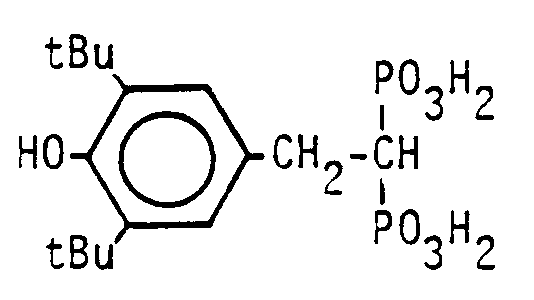
- Under anhydrous conditions, trimethylbromosilane (5 ml, 38.6 mmol) was added dropwise to 10 ml of a carbon tetrachloride solution of tetraethyl 2-(3,5-ditertiobutyl-4-hydroxyphenyl)-ethylidene-1,1-diphosphonate (1.95 g, 3.86 mmol). The mixture was stirred at room temperature for 30 h. The excess of BrSiMe3 was removed by distillation and the residue was treated with 20 ml H20 for 2 h. Evaporation of the aqueous solution gave 1.43 g (3.6 mol, 94%) of the diphosphonic acid.
- mp = 177-178°C
- IR (KBr): 3600 cm-1: OH
- 3000-2500: P-O-H
- 1430: t-C4H9
- 1200: P=O
- A mixture of compound 4 (2.5 g, 50 mmol) in 10 ml 37% HCI was heated to 115 for 16 h. The evaporation to dryness of HCI provided 1.9g (4.8 mmol, 96%) of 2-(3,5-ditertiobutyl-4-hydroxyphenyl)-ethylidene-1,1-diphosphonic acid.
-

- A mixture of 3.5 g (8.9 mmol) 2-(3,5-ditertiobutyl-4-hydroxyphenyl)-ethylidene-1,1-diphosphonic acid and 10 g (94 mmol) trimethylorthoformate was refluxed for one hour. The methyl formate and methanol formed were distilled off. Fresh trimethyl orthoformate (10 g, 94 mmol) was added and the mixture was refluxed for one hour. Removal of excess reagent and short path distillation (200°C, 0.05 mmHg) gave 2.5 g (65%) of tetramethyl 2-(3,5-ditertiobutyl-4-hydroxyphenyl)-ethylidene-1,1-diphosphonate.
- mp = 77-78 °C
- IR(KBr): 3400 cm-1: O-H
- 2850: aliphatic C-H
- 1430: t-butyl
- 1245: P=O
- 1185: P-O-Me
- 1030: P-O-C.
- NMR (CDCl3):
- δ = 7.25 and 7.05 (m, 2H): aromatic H
- 5.0 (s, 1 H): OH
- 3.7 - 3.65 (two d, J = 11 Hz, 12H): P-O-CH3
- 3.1 (t x d, J = 6 and 17 Hz, 2H): Ph-CH2
- 2.6 (t x t, J = 6 and 24 Hz, 1 H): Ph-CH2-CH
- 1.35 (s, 18H) : t-C4H9
- δ = 7.25 and 7.05 (m, 2H): aromatic H
-

- Tetraethyl 2-(3,5-ditertiobutyl-4-hydroxyphenyl)ethylidene-1,1-diphosphonate (500 mg, 1 mmol) was added to a suspension of 80% NaH (40 mg, 1.3 mmol) in 20 ml dry THF. Methyl iodide (1.3 ml, 6 mmol) was added and the reaction mixture was refluxed for 16 h. After Et20/H20 extraction, the organic phase was dried and evaporated. Column chromatography (Si02, 95/5 CHCl3/MeOH) gave 440 mg (0.84 mmol, 84%) of the title compound.
- IR: 2980 cm-1: aliphatic C-H
- 1240: P=O
- 1030: P-O-C
- MS: 534 (M+), 397 (100%, M-PO3Et2)+, 233
-

- A mixture of tetraethyl 2-(3,5-ditertiobutyl-4-hydroxyphenyl)-ethenylidene-1,1-diphosphonate (3 g, 6 mmol) and a catalytic amount (50 mg) H2 S04 in 3 g of acetic anhydride was warmed to 80 °C for 3 h. The reaction mixture was poured on ice and extracted in Et20. The organic phase was washed with H20 and dried over MgS04 and evaporated to dryness. The residue was purified by column chromatography (Si02, 95/5 CHCl3/MeOH) to give 2.32 g (4.2 mmol, 71 % yield) of the title compound.
- IR: 2840 cm1: aliphatic C-H
- 1760: C=O
- 1560: C=C
- 1240: P=O
- 1030: P-O-C
-

- A mixture of 1.0 g (3.04 mmol) of tetraetnyl 3-butenylidene-1,1-diphosphonate prepared by reaction of tetraethyl methylene diphosphonate and allyl bromide, 0.8 g (3.36 mmol) of 3,5-ditertiobutyl-4-hydrox- yphenylmercaptan and 0.022 g (0.09 mmol) of dibenzoylperoxide was refluxed in benzene overnight. After evaporation of the solvent, the crude product was column chromatographied and 0.44 g (25% yield) of tetraethyl 4-(3,5-ditertiobutyl-4-hydroxyphenylthio)-butylidene-1,1-diphosphonate was isolated.
- IR (film): 3400 cm-1: O-H
- 2850: aliphatic C-H
- 1430: t-butyl
- 1240: P=O
- 1020: P-O-C
- MS: 566 (M+), 429 (M-PO3Et2)+
-

- Diethyl bis(dimethylamino)phosphinyl methylphosphonate was prepared by reacting diethyl methylphosphonate and bis(dimethylamino) phosphorochloridate using lithium diisopropylamide in THF, according to P. Savignac et al, Tetrahedron Letters 26 (37), p. 4435-4438 (1985).
- Diethyl bis(dimethylamino)phosphinyl methylphosphonate (1.4 g, 5 mmol) was added at room temperature to a suspension of 80% NaH (0.15 g, 5 mmol) in 20 ml dry tetrahydrofuran. A solution of 3,5- ditertiobutyl-4-hydroxybenzylbromide (1.5 g, 5 mmol) in 20 ml dioxane was added and the mixture was refluxed overnight. After evaporation of the solvents, the residue was partitioned between H20 and CHCl3. The residue of the organic phase was purified by column chromatography (Si02, 95/5 CHCl3/MeOH) to give 490 mg (20% yield) of the title compound.
- IR (film): 3400 cm-1: OH
- 2860: aliphatic C-H
- 1440: t-C4 H9
- 1240 + 1220: P = O
- 1030: P-O-C
- MS: (m/e)+ : 504 (M 369 (100%, M -PO(NMe2)2); 135 (PO(NMe2)2)
- NMR (CDCl3)
- δ = 7.08 (s, 2H): aromatic H
- 5.08 (s, 1 H): OH
- 4.1-3.9 (m, 4H): P-O-CH2CH3
- 3.25-3.1 (large m, 2H): Ph-CH2-CH
- 2.9-2.7 (large m, 1 H): Ph-CH2-CH
- 2.5 and 2.55 (two d, J=9 9 Hz, 12H): N-CH3
- 1.38 (s, 18H): t-C4H9
- 1.15 (two t, J = 7Hz, 6H): P-O-CH2CH3
-

- A solution of 800 mg (1.26 mmol) of 49.5% KHSOs (Potassium hydrogen persulfate, "oxone") in 0.8 ml H20 was added to a solution of 400 mg of tetraethyl 3,5-ditertiobutyl-4-hydroxyphenylthio-methylene diphosphonate (compound 5) (0.84 mmol) in 5 ml CH30H while stirring in an ice bath. The resulting slurry is stirred overnight and the mixture is concentrated to remove MeOH. The residue is partitioned between H20 and CH2CI2. The organic phase is washed with H20 until neutral pH, concentrated and the residue is purified by column chromatography (CHCl3/MeOH). An amount of 200 mg (0.36 mmol, 29%) of tetraethyl 3,5-ditertiobutyl-4-hydroxyphenylsulfonyl-methylenediphosphonate was obtained.
- mp = 118-120°C
- MS: (m/e): 556 (M+ 492 ((M-S02)+ , 100%). 355 (M-PO3Et2)
- A mixture of compound 5 (400 mg, 0.76 mmol) and 85% m-chloroperbenzoic acid (0.5 g, 2.5 mmol) in 5 ml CH2CI2 was stirred at room temperature for 16 h. The organic solution was extracted with saturated NaHSO3, saturated NaHCO3 and dried over MgS04. Column chromatography purification (CHCl3/MeOH) gave 160 mg of compound 16 (0.28 mmol, 38%).
-

- Dibutyl diethyl methylenediphosphonate was prepared in 43% yield by reacting sodium dibutyl phosphite with diethyl chloromethylphosphonate, bp = 140 (0.05 mmHg), (Kugelrohr).
- Dibutyl diethyl 2-(3,5-ditertiobutyl-4-hydroxyphenyl)-ethenylidene-1,1-diphosphonate was synthesized by reacting TiCI4 (4.94 g, 26 mmol), 3,5-ditertiobutyl-4-hydroxybenzaldehyde (3 g, 13 mmol), dibutyl diethyl methylenediphosphonate (4.4 g, 13 mmol) and N-methylmorpholine (5.25 g, 52 mmol) in 20 ml THF at room temperature. Column chromatography (95/5 CHCl3/MeOH) afforded 2.6 g (4.6 mmol, 36%) of the title compound.
- IR (film): 2980 cm-1: aliphatic C-H
- 1560: C = C
- 1430: t-C4 H9
- 1240: P = O
- 1020-970: P-O-C
- MS: (m/e): 560 (M 423 (M-PO3Et2)+ , 367 (M-PO3Bu2)+ , 311
-

- Tetraethyl propylidene-1,1-diphosphonate was prepared in 65% yield by reacting tetraethyl methylenediphosphonate with ethyl iodide in presence of NaH in tetrahydrofuran.
- Tetraethyl propylidene-1,1-diphosphonate (1.5 g, 4.75 mmol) was added to a suspension of 80% NaH (0.143 g, 4.75 mmol) in dry THF (10 ml) and the mixture was stirred until the NaH disappeared. 3,5- ditertiobutyl-4-hydroxybenzylbromide (1,42 g, 4,75 mmol) in 5 ml THF was added and the mixture was refluxed for 4 h. After work up, column chromatography (Si02, 95/5 CHCl3/MeOH) gave 0.9 g (1.7 mmol, 36%) of the title compound. mp = 107-110° C
- IR (film): 3400 cm-1: OH
- 2850: aliphatic C-H
- 1440: t-butyl
- 1240: P = O
- 1040: P-O-C
- NMR (CDCl3)
- δ = 7.15 (m, 2H): aromatic H
- 5.1 (s, 1 H): OH
- 4.2 - 4.04 (m, 8H): O-CH2-CH3
- 3.2 (two d, J = 12 and 16 Hz, 2H): Ph-CH2-CP2
- 2.1 - 1.9 (m, 2H): -C(P2)-CH2-CH3
- 1.45 (s, 18H): tC4H9
- 1.3 - 1.15 (several t, J=7Hz, 15H): -C(P2)-CH2-CH3 + O-CH2CH3
-

- Tetraethyl 7-bromoheptylidene-1,1-diphosphonate was prepared by reaction of sodium tetraethyl methylenediphosphonate with 1,6-dibromohexane.
- A 20 ml tetrahydrofuran solution containing 4.2 mmol of the sodium salt of 3,5-ditertiobutyl-4-hydroxyphenyl mercaptan was added to 20 ml of a tetrahydrofuran solution containing tetraethyl 7-bromoheptylidene-1,1-diphosphonate (1,89 g, 4.2 mmol). The reaction mixture was stirred at room temperature overnight. After hydrolysis and extraction into Et20, the crude compound was purified by column chromatography (Si02, 95/5 CHCl3/MeOH) to yield 1.6 g (2.63 mmol, 62%) of the title compound.
- IR (film): 3400 cm-1: OH
- 2940: aliphatic C-H
- 1430: t-C4 H9
- 1250: P = O
- 1030 + 980: P-O-C
- MS: (m/e): 608 (M+) 371, 288 (100%),152
-

- Treatment of tetraethyl 2-(3,5-ditertiobutyl-4-hydroxyphenyl)ethylidene-1,1-diphosphonate with BrSiMe3 gave the corresponding tetrakis (trimethylsilyl) diphosphonate. This latter compound was reacted with PCl5 in CCl4 according to the reaction conditions described by T. Morita et al, Chemistry Letters p. 435-438 (1980) to afford 2-(3,5-ditertiobutyl-4-hydroxyphenyl)ethylidene-1,1 diphosphonyl tetrachloride.
- To a solution of Et3 N (7.86g, 78 mmol) in 80 ml dioxane held at 55 were added simultaneously the above described diphosphonyl tetrachloride (9.0g, 19 mmol) in 40ml dioxane and 1,3-propanediol (2.90g, 38 mmol) in 40 ml dioxane. The reaction mixture was refluxed for 3 h after the end of the addition. The precipitate of Et3N.HCI was removed by filtration and the filtrate was purified by column chromatography (Si02, CHCl3/MeOH 95/5). An amount of 1.35g (2.9 mmol, 15% yield) of the title compound was obtained. mp = 175-176 ° C
- IR (KBr) = 3400, 1430, 1260 (P = O), 1040 (P-O-C)
- MS (m/e) = 474 (M+ 353 (100%, M-PO3(C3H6)2)+
- NMR (CDCl3)
- δ = 7.25 and 7.1 (m, 2H): aromatic H
- 5.1 (s, 1 H):OH
- 4.45, 4.3 and 4.1 (3m, 8H): P-O-(CH2)-
- 3.26 (dxt, J = 6 and 17Hz, 2H):Ph-CH2-
- 2.80 (txt, J = 7 and 23 Hz, 1 H): Ph-CH2-CH
- 2.1 and 1.9 (2m, 4H): P-O-CH2-CH2-CH2
- 1.4 (s, 18H): t-C4 H9
-

- Titanium tetrachloride (3.14g, 0.017 mol) was dropped, under nitrogen, to 40 ml of anhydrous THF cooled in an ice bath. It was successively added 2.15g (0.008 mol) of 3,5-ditertiobutyl-4-hydroxy-cinnamaldehyde, 2.39g (0.008 mol) of tetraethyl methylenediphosphonate and 3.25 g (0.033 mol) of methylmorpholine. The resulting mixture was kept in the ice bath for a further 1 hour then allowed to return to room temperature overnight. 50 ml of water was added and the resulting mixture was extracted with 3 x 50 ml of ethyl ether. The combined organic phase was washed with 3 x 50 ml of brine, dried over magnesium sulfate and evaporated. The residue was purified by column chromatography (Si02, 95/5 CHCl3/MeOH) to give 3.6 g (0.0068 mol, 82%) of the crude title compound. The latter was recrystallized from acetone yielding 2.1 g (0.0040 mol, 48%) of pure product. Melting point was 141-143 C giving a deep red solution.
- IR(KBr): 3360 cm-1: OH
- 1600, 1550 and 1530: C = C
- 1420 and 1430: tC4 H9
- 1200: P = O
- 1020: P-O-C
- MS: m/e: 530 (M+) 515 (M-Me), 393 (M-PO3Et2)
- NMR (CDCl3)
- δ = 8.05 - 7.7 (several m, 2H): C = CH-CH = C
- 7.4 (s, 2H): aromatic H
- 7.04 (d, J = 15 Hz, 1 H): Ph-CH = C
- 5.6 (s, 1 H): OH
- 4.2 (m, 8H): P-O-CH2CH3
- 1.45 (s, 18H): t-C4 H9
- 1.35 (t, J = 7Hz, 12H): P-O-CH2CH3
-

- Diethyl (2-oxo-1,3,2-dioxaphosphorin-2-yl)methylphosphonate was prepared by the Arbuzov reaction of triethyl phosphite and 2-chloromethyl-2-oxo-1,3,2-dioxaphosphorinan. (IR: 1260 and 1030 cm-1).
- The general reaction conditions described in example 6 were employed using diethyl (2-oxo-1,3,2-dioxaphosphorin-2-yl) methylphosphonate as the phosphonate reagent. After work up, purification by column chromatography gave the title compound as an oil in 63% yield.
- IR (Film): 3450cm-1, 1570 (C=C), 1420, 1260, 1030 (P-O-C)
- MS: 488 (M+) 367 (M-PO3Et2) , 351 (M-PO3(CH2)3) , 57 (t-Bu)
- NMR (CDCl3)
- = 8.2 (d x d, J = 30 and 48 Hz, 1 H): Ph-CH = CP2
- 7.75 (m, 2H): aromatic H
- 5.65 (m, 1 H): OH
- 4.3 - 4.0 (several m, 8H): P-O-CH2-CH3 and P-O-CH2-(CH2)2
- 2.1 - 1.6 (several m, 2H): P-O-CH2-CH2-CH2
- 1.4 (s, 18H): t-C4H9
- 1.4 (t, J=7Hz): P-O-CH2-CH3
-

- 0.5g (0.94 mmol) of tetraethyl 4-(3,5-ditertiobutyl-4-hydroxyphenyl)-1,3-butadienylidene-1,1-diphosphonate (compound 43), 0.23g of 10% palladium on active charcoal in 25ml of glacial acetic acid were submitted to 3 atm. hydrogen gas in a Parr hydrogenation apparatus until no more absorption was observed. The catalyst was filtered. The filtrate was diluted with an equal volume of water and extracted with chloroform. The chloroform phase was washed successively with 10% NaOH, water and dried over MgS04. Evaporation of the solvent gave 0.4g of the title compound (98% purity by GC).
- IR (film)= 3400 cm-1: O-H
- 2940: aliphatic C-H
- 1440: t-butyl
- 1250: P = O
- 1020: P-O-C
- NMR (CDCl3):
- δ = 6.96 (s, 2H) : aromatic H
- 5.03 (s, 1 H) : OH
- 4.24-4.10 (m, 8H): P-O-CH2-CH3
- 2.52 (t, J=7 Hz, 2H): Ph-CH2-
- 2.28 (txt, J = 6 and 24Hz, 1H): Ph-CH2-CH2-CH2-CHP2
- 2.04-1.78 (2xm, 4H): Ph-CH2-CH2-CH2-CHP2
- 1.40 (s, 18H): tC4 H9
- 1.28 (two overlapping t, J=7Hz, 12H): P-0-CH2 CH3
- δ = 6.96 (s, 2H) : aromatic H
- MS: 534 (M )
- This compound was chromatophically and spectroscopically identical to the material isolated from the reaction of 3-(3,5-ditertiobutyl-4-hydroxyphenyl)-propyl bromide (mp = 52-54 ° C) with the sodium salt of tetraethyl methylenediphosphonate in benzene.


- During routine screening the gem-diphosphonate derivatives were discovered to display a spectrum of pharmacological activities, the most marked being hypolipidemia (hypocholesterolemia and/or hypotriglyceridemia). Some of the diphosphonic acid derivatives demonstrated anti-inflammatory activity and some diphosphonate esters were hypotensive. Diuretic and positive inotropic activity were also observed.
- In addition it might be expected that the gem-diphosphonates possess antioxidant and radical scavenging activities associated with the dialkyl hydroxyphenyl moieties present in their structures. Free radical scavengers are known to be efficacious in preventing the pathological changes in a number of diseases induced by oxidative stress. The gem-diphosphonates are thus potentially useful for the treatment of diseases such as:
- - tissue ischemia such as heart and brain ischemia,
- - muscular dystrophy,
- - chronic obstructive pulmonary disease,
- - viral infections,
- - senile caractogenesis and
- - vitamin E deficiencies.
- With the goal of finding new drugs which might be hypolipidemic, the new diphosphonates described in this patent application were administered orally to mice. This rodent species has plasma lipid levels relatively close to man (generally greater than 150mg/dl). For example, in mice receiving a normal diet the plasma cholesterol and triglyceride levels are in the range of 100mg/dl, whereas for rat the comparative values are close to 50mg/dl. Other scientists have recently investigated the use of mice and found this species to be a relevant model for testing new agents in comparison to drugs known to be efficacious in human hyperlipidemia (Effects of Fenofibrate, Gemfibrozil and Nicotinic Acid on Plasma Lipoprotein Levels in Normal and Hyperlipidemic Mice, a Proposed Model for Drug Screening. Olivier, P. et al. Atherosclerosis 70, p.107-114, 1988).
- In every screening experiment, 30 mice of the OF1 strain weighing 25 to 35 g were divided into 5 groups of 6 animals each. Four groups received the compounds to be tested, or the reference drugs, the fifth group served as control. Compounds were dissolved in diethyl ether, the solution was added to the pelleted food and the ether was evaporated.
- All compounds were tested at the final concentration of 0.1% in animal chow, equivalent to a daily intake of about 180 mg/kg. This diet was fed for 10 days, then after an overnight fasting the animals were sacrified by decapitation under ether anesthesia. Blood samples were collected in EDTA containing tubes.
- Plasma cholesterol and plasma triglycerides were measured by enzymatic methods (Ames kit No. 6376 and No. 6630). The mean cholesterol or triglyceride value of each group receiving tested compounds or reference drugs was expressed as percent of the mean value observed for the contemporary control.
- Table 3 showed that a number of diphosphonate derivatives (Compounds 3, 4, 5, 6, 7, 18, 21, 22, 23, 24, 33, 34, 37, 47 and 48) were markedly hypocholesterolemic, Compounds 33 and 34 being the most potent (-40% and -41 %). Clofibrate, gemfibrozil and fenofibrate, which are three Registered Trademarks of drugs used clinically for the treatment of hyperlipidemia, were found to be less hypocholesterolemic than many of the diphosphonates tested. Fenofibrate was the most potent (-15%) of the references drugs tested. Similar hypocholesterolemic activity was measured in mice receiving the fibrate derivatives as published in the reference cited above (Olivier, P. et al.).
- A significant hypotriglyceridemia was observed with Compounds 3, 5, 6, 7, 21, 22, 23, 24, 30, 31, 33, 37, 47 and 48. It should be noted that Compounds 3, 19, 24, 30, 37 and 47 decreased plasma triglycerides by more than 44%, values not reached by the reference drugs tested similarly. Gemfibrozil was the most potent hypotriglyceridemic reference drug (-35%), which is in accordance with values published in the literature.
- The exact mechanism by which these diphosphonates lower plasma lipids in various in vivo models is not known. However, investigations using in vitro preparations have demonstrated that these compounds inhibit and interfere with some key enzymes involved in cholesterol synthesis and metabolism, specifically acyl-CoA: cholesterol acyltransferase (ACAT), lipases, etc., and thus indicate the possible sites of action.
- The effect of four selected diphosphonates was investigated on the inflammatory response to kappa carrageenan in the rat paw oedema model. Eight male rats were employed per group. Oedema was induced in the right hind paw of each animal by a single injection into the plantar aponeurosis of 0.1 ml of a 1 % w/v of kappa carrageenan solution dissolved in 0.9% NaCI. The test compounds (100 mg/kg) and reference drug (indomethacin 30 mg/kg) were administered by gavage 1 hour prior to induction of oedema by carrageanan injection.
- The volume of the right paw was measured for each animal at 0, 1, 2.5 and 4 hours after carrageenan injection (only 4 hour values are reported).
- Table 4 showed that indomethacin prevented completely the increase in paw volume as expected. Compounds 8 and 36 showed significant inhibitory activities whereas their ethyl ester counterparts demonstrated only minimal activity.
- These results indicate that the diphosphonic acids such as Compound 8 are anti-inflammatory in this animal model.
- The spontaneously hypertensive rat (SHR) is a well established animal model of human arterial hypertension. The gem-diphosphonates of formula (I) were found to induce a marked hypotension when administered to SHRs.
- In screening experiments various gem-diphosphonates were dissolved in Tween-80 (Reg. TM) and administered orally to SH rats. Blood pressure was monitored hourly using a tailcuff method. Hypotension measured two hours post dose are given in Table 5.
- Compounds 4, 6, 7 and 18 decreased blood pressure by 30 to 50% and are as potent as the reference drugs tested similarly and which are used for the treatment of angina pectoris and hypertension.
- The gem-diphosphonates of formula (I) are thus potentially useful in the treatment of cardiovascular diseases via a smooth muscle relaxant activity. The primary indications of these compounds would be the treatment of angina pectoris, congestive heart failure and hypertension.


- The gem-diphosphonates of formula (I) can thus be used for the treatment of hyperlipidemia and/or hypertension and can be administered preferably in the form of capsules, tablets and granules. For this purpose the active principle should be mixed with a pharmaceutical carrier.
- As used herein, the term "pharmaceutical carrier" denotes a solid or liquid filler diluent or encapsulating substance. Some examples of the substances which can serve as pharmaceutical carriers are sugars, starches, cellulose and its derivatives, powdered tragacanth, malt, gelatin, talc, stearic acid, magnesium stearate, calcium sulfate, vegetable oils, polyols and polyethylene glycol, agar, alginic acid, pyrogen-free water, isotonic saline and phosphate buffer solutions, as well as other non-toxic compatible substances used in pharmaceutical formulations. Wetting agents and lubricants such as sodium lauryl sulfate, as well as coloring agents, flavoring agents and preservatives, can also be present.
- The pharmaceutical carrier employed in conjunction with the phosphonates is used at a concentration sufficient to provide a practical size to dosage relationship. Preferably the pharmaceutical carrier comprises from about 0.1% to 99% by weight of the total composition. Capsules and tablets are prepared by conventional methods using gem-diphosphonates in their liquid or cristalline form as described in the following examples:


- For the treatment of specific disease states, composition containing a pharmaceutically acceptable gem-diphosphonate can be administered as a solution, suspension, emulsion or by intradermal, intramuscular, intravenous or intraperitoneal injection. Rectal administration of gem-diphosphonates can be performed by incorporating the active principle into conventional jelly bases to produce suppositories.
Compound 8 can also be obtained by hydrolysis with hydrochloric acid.
Claims (19)






Priority Applications (1)
| Application Number | Priority Date | Filing Date | Title |
|---|---|---|---|
| AT89104656T ATE84040T1 (en) | 1988-03-31 | 1989-03-16 | PHENOL-SUBSTITUTED GEM-DIPHOSPHONATE DERIVATIVES, PROCESS FOR THEIR MANUFACTURE AND PHARMACEUTICALS CONTAINING THEM. |
Applications Claiming Priority (2)
| Application Number | Priority Date | Filing Date | Title |
|---|---|---|---|
| CH1239/88 | 1988-03-31 | ||
| CH1239/88A CH675422A5 (en) | 1988-03-31 | 1988-03-31 |
Publications (3)
| Publication Number | Publication Date |
|---|---|
| EP0339237A2 EP0339237A2 (en) | 1989-11-02 |
| EP0339237A3 EP0339237A3 (en) | 1991-01-09 |
| EP0339237B1 true EP0339237B1 (en) | 1992-12-30 |
Family
ID=4205733
Family Applications (1)
| Application Number | Title | Priority Date | Filing Date |
|---|---|---|---|
| EP89104656A Expired - Lifetime EP0339237B1 (en) | 1988-03-31 | 1989-03-16 | Phenol substituted gem-diphosphonate derivatives, process for their preparation and pharmaceutical compositions containing them |
Country Status (25)
| Country | Link |
|---|---|
| US (2) | US5043330A (en) |
| EP (1) | EP0339237B1 (en) |
| JP (1) | JPH0822865B2 (en) |
| KR (1) | KR0147830B1 (en) |
| CN (2) | CN1086820A (en) |
| AR (1) | AR247569A1 (en) |
| AT (1) | ATE84040T1 (en) |
| AU (1) | AU612475B2 (en) |
| CA (1) | CA1338495C (en) |
| CH (1) | CH675422A5 (en) |
| DE (2) | DE339237T1 (en) |
| DK (1) | DK173936B1 (en) |
| ES (1) | ES2011210T3 (en) |
| FI (1) | FI92933C (en) |
| GR (2) | GR900300002T1 (en) |
| HU (1) | HU203556B (en) |
| IE (1) | IE62692B1 (en) |
| IL (1) | IL89649A (en) |
| MY (1) | MY103850A (en) |
| NO (1) | NO891317L (en) |
| NZ (1) | NZ228516A (en) |
| PH (1) | PH27603A (en) |
| PT (1) | PT90175B (en) |
| ZA (1) | ZA892126B (en) |
| ZW (1) | ZW3789A1 (en) |
Families Citing this family (38)
| Publication number | Priority date | Publication date | Assignee | Title |
|---|---|---|---|---|
| JPH0377894A (en) * | 1989-08-18 | 1991-04-03 | Toray Ind Inc | Methylene diphosphonic acid compound |
| CA2067974A1 (en) * | 1991-05-13 | 1992-11-14 | Scott A. Biller | Method for lowering cholesterol employing a phosphonomethylphosphinate squalene synthetase inhibitor |
| US5157027A (en) * | 1991-05-13 | 1992-10-20 | E. R. Squibb & Sons, Inc. | Bisphosphonate squalene synthetase inhibitors and method |
| JPH05163150A (en) * | 1991-05-13 | 1993-06-29 | E R Squibb & Sons Inc | Suppressant/remedy against atherromatous arteriosclerosis |
| EP0594857B1 (en) * | 1991-09-05 | 1998-04-29 | Toray Industries, Inc. | Methanediphosphonic acid derivative, production thereof and medicinal use thereof |
| JPH06172372A (en) * | 1991-11-06 | 1994-06-21 | Takeda Chem Ind Ltd | Squalene synthetase inhibitor and its use |
| EP0541037A3 (en) * | 1991-11-06 | 1997-02-26 | Takeda Chemical Industries Ltd | Squalene synthetase inhibitory composition and use thereof |
| FR2683529B1 (en) * | 1991-11-12 | 1994-02-04 | Bretagne Occidentale Universite | PHARMACEUTICAL COMPOUNDS GEM-DIPHOSPHONATES ANALOGUE OF CIS-PLATINUM. |
| CH683996A5 (en) * | 1992-03-05 | 1994-06-30 | Symphar Sa | aminophosphonates substituted derivatives, process for their preparation and pharmaceutical compositions containing them. |
| DE69330114T2 (en) * | 1992-07-10 | 2001-08-02 | Toray Industries, Inc. | METHANDIPHOSPHONATE DERIVATIVE, THEIR PRODUCTION AND THE USE THEREOF AS A MEDICINAL PRODUCT |
| US5332728A (en) * | 1992-11-23 | 1994-07-26 | Bristol-Myers Squibb Company | Method for treating a fungal infection |
| US5434288A (en) * | 1992-12-01 | 1995-07-18 | Monsanto Company | PLA2 inhibitors |
| ZA941088B (en) * | 1993-02-19 | 1995-09-27 | Symphar Sa | Substituted ketophosphonates the processes for their preparation and pharmaceutical compositions containing them |
| WO1994019359A1 (en) * | 1993-02-25 | 1994-09-01 | Toray Industries, Inc. | Process for producing methanediphosphonate compound |
| US5419845A (en) * | 1994-03-15 | 1995-05-30 | Basf Corporation | Perfluorinated gemdiphosphonates as corrosion inhibitors for antifreeze coolants and other functional fluids |
| EP0725070B1 (en) * | 1994-08-24 | 2003-03-26 | Toray Industries, Inc. | Process for producing methanediphosphonic acid compound |
| CH690163A5 (en) * | 1995-07-28 | 2000-05-31 | Symphar Sa | Derivatives substituted gem-diphosphonates useful as anti-cancer. |
| GB9603637D0 (en) * | 1996-02-21 | 1996-04-17 | Smithkline Beecham Plc | Process |
| WO1997043437A2 (en) * | 1996-05-15 | 1997-11-20 | The University Of Sheffield | Isopentenyl pyrophosphate isomerase (ipi) and/or prenyl transferase inhibitors |
| US6670398B2 (en) * | 1997-05-14 | 2003-12-30 | Atherogenics, Inc. | Compounds and methods for treating transplant rejection |
| ATE356113T1 (en) | 1997-05-14 | 2007-03-15 | Atherogenics Inc | PROBUCOLSUMRIC ACID ESTERS TO INHIBIT THE EXPRESSION OF VCAM-1 |
| IL125336A0 (en) * | 1998-07-14 | 1999-03-12 | Yissum Res Dev Co | Compositions for inhibition and treatment of restinosis |
| US6984400B2 (en) | 1998-07-14 | 2006-01-10 | Yissum Research Development Company Of The Hebrew University Of Jerusalem | Method of treating restenosis using bisphosphonate nanoparticles |
| US7008645B2 (en) | 1998-07-14 | 2006-03-07 | Yissum Research Development Company Of The Hebrew University Of Jerusalem | Method of inhibiting restenosis using bisphosphonates |
| AUPQ872800A0 (en) * | 2000-07-12 | 2000-08-03 | Heart Research Institute, The | Compositions and methods for treating cardiovascular disorders |
| GB0019272D0 (en) * | 2000-08-04 | 2000-09-27 | Symphar Sa | Pharmaceutical compounds |
| US20030064967A1 (en) * | 2001-04-11 | 2003-04-03 | Jayraz Luchoomun | Methods to increase plasma HDL cholesterol levels and improve HDL functionality with probucol monoesters |
| EP1435970A4 (en) * | 2001-10-18 | 2005-05-04 | Ilex Products Inc | METHOD OF TREATING SKIN WITH DIPHOSPHONATE DERIVATIVES |
| EP1485106A2 (en) * | 2002-02-19 | 2004-12-15 | Ilex Products, Inc. | Phosphonate-phosphate and diphosphonate apolipoprotein e modulators |
| US20060205692A1 (en) * | 2002-05-11 | 2006-09-14 | Montes Imber F | 1,1-and 1,2-Bisphosphonates as apoliprotein e modulators |
| WO2004064781A2 (en) * | 2003-01-14 | 2004-08-05 | Adam Heller | Anti-inflammatory substituted phenols and elastomeric compositions for oral delivery of drugs |
| US10517883B2 (en) | 2003-06-27 | 2019-12-31 | Zuli Holdings Ltd. | Method of treating acute myocardial infarction |
| US7687482B2 (en) * | 2006-03-17 | 2010-03-30 | The Board Of Trustees Of The University Of Illinois | Bisphosphonate compounds and methods |
| EP2139320A4 (en) * | 2007-03-26 | 2010-09-08 | Salutria Pharmaceuticals Llc | Methods and compositions of derivatives of probucol for the treatment of diabetes |
| WO2008118946A1 (en) * | 2007-03-27 | 2008-10-02 | Atherogenics, Inc. | Methods and compositions using certain phenolic derivatives for the treatment of diabetes |
| US9993427B2 (en) | 2013-03-14 | 2018-06-12 | Biorest Ltd. | Liposome formulation and manufacture |
| EP3209671B8 (en) * | 2014-10-21 | 2019-07-31 | Council of Scientific and Industrial Research | Alkylidene phosphonate esters as p-glycoprotein inducers |
| WO2018236221A2 (en) * | 2017-06-03 | 2018-12-27 | Can Holding B.V. | DISSOLUTION OF NEURODEGENERATIVE PEPTIDE DEPOSITION |
Family Cites Families (7)
| Publication number | Priority date | Publication date | Assignee | Title |
|---|---|---|---|---|
| CA777769A (en) * | 1963-03-18 | 1968-02-06 | H. Roy Clarence | Substituted methylene diphosphonic acid compounds and detergent compositions |
| DE1302557B (en) * | 1963-04-09 | 1971-08-26 | ||
| GB2043072B (en) * | 1979-02-13 | 1983-11-23 | Symphar Sa | Diphosphonate compounds |
| US4416877A (en) * | 1979-02-13 | 1983-11-22 | Symphar S.A. | Anti-atherosclerotic pharmaceutical compositions containing diphosphonate compounds |
| FR2531088B1 (en) * | 1982-07-29 | 1987-08-28 | Sanofi Sa | ANTI-INFLAMMATORY PRODUCTS DERIVED FROM METHYLENEDIPHOSPHONIC ACID AND THEIR PREPARATION METHOD |
| CH664158A5 (en) * | 1984-07-18 | 1988-02-15 | Symphar Sa | DERIVATIVES PROPYLIDENEDIPHOSPHONATES-1,3 SUBSTITUTED IN POSITION 2, THEIR PREPARATION METHOD AND PHARMACEUTICAL COMPOSITIONS CONTAINING THEM. |
| US6259935B1 (en) * | 1997-06-24 | 2001-07-10 | Matsushita Electrical Industrial Co., Ltd. | Electro-mechanical-acoustic transducing device |
-
1988
- 1988-03-31 CH CH1239/88A patent/CH675422A5/fr not_active IP Right Cessation
-
1989
- 1989-03-13 IE IE80289A patent/IE62692B1/en not_active IP Right Cessation
- 1989-03-14 US US07/323,334 patent/US5043330A/en not_active Expired - Lifetime
- 1989-03-15 ZW ZW37/89A patent/ZW3789A1/en unknown
- 1989-03-16 DE DE198989104656T patent/DE339237T1/en active Pending
- 1989-03-16 ES ES89104656T patent/ES2011210T3/en not_active Expired - Lifetime
- 1989-03-16 EP EP89104656A patent/EP0339237B1/en not_active Expired - Lifetime
- 1989-03-16 DE DE8989104656T patent/DE68904104T2/en not_active Expired - Fee Related
- 1989-03-16 MY MYPI89000332A patent/MY103850A/en unknown
- 1989-03-16 AT AT89104656T patent/ATE84040T1/en not_active IP Right Cessation
- 1989-03-17 IL IL8964989A patent/IL89649A/en not_active IP Right Cessation
- 1989-03-21 ZA ZA892126A patent/ZA892126B/en unknown
- 1989-03-22 CA CA000594468A patent/CA1338495C/en not_active Expired - Fee Related
- 1989-03-28 DK DK198901481A patent/DK173936B1/en not_active IP Right Cessation
- 1989-03-29 AR AR89313527A patent/AR247569A1/en active
- 1989-03-29 NZ NZ228516A patent/NZ228516A/en unknown
- 1989-03-29 NO NO89891317A patent/NO891317L/en unknown
- 1989-03-30 FI FI891538A patent/FI92933C/en not_active IP Right Cessation
- 1989-03-30 AU AU32243/89A patent/AU612475B2/en not_active Ceased
- 1989-03-30 CN CN93116289A patent/CN1086820A/en active Pending
- 1989-03-30 CN CN89101830A patent/CN1024555C/en not_active Expired - Fee Related
- 1989-03-30 HU HU891595A patent/HU203556B/en not_active IP Right Cessation
- 1989-03-30 KR KR1019890004076A patent/KR0147830B1/en not_active Expired - Fee Related
- 1989-03-30 PT PT90175A patent/PT90175B/en not_active IP Right Cessation
- 1989-03-31 JP JP1083855A patent/JPH0822865B2/en not_active Expired - Fee Related
- 1989-03-31 PH PH38417A patent/PH27603A/en unknown
-
1991
- 1991-06-07 GR GR90300002T patent/GR900300002T1/en unknown
- 1991-07-31 US US07/738,430 patent/US5128331A/en not_active Expired - Lifetime
-
1993
- 1993-03-23 GR GR930400629T patent/GR3007442T3/el unknown
Also Published As
Similar Documents
| Publication | Publication Date | Title |
|---|---|---|
| US5043330A (en) | Phenol substituted gem-diphosphonate derivatives, process for their preparation and pharmaceutical compositions containing them | |
| US4904646A (en) | Phosphorus-containing HMG-COA reductase inhibitors | |
| US5017716A (en) | Phosphorous-containing HMG-CoA reductase inhibitors, new intermediates and method | |
| PT87539B (en) | PROCESS FOR THE PREPARATION OF HMG-COA REDUCTASE INHIBITORS CONTAINING PHOSPHORUS AND NEW INTERMEDIARIES | |
| EP0559079B1 (en) | Substituted aminophosphonate derivatives, process for their preparation and pharmaceutical compositions containing them | |
| CA1284320C (en) | 2-substituted-1,3-propylidenediphosphonate derivatives, and the process for their preparation | |
| CA2674902C (en) | Improved process for the preparation of oxidized phospholipids | |
| US5374628A (en) | Aryl and heteroaryl(phosphinylmethyl)phosphonate squalene synthetase inhibitors and method | |
| US5347029A (en) | Dialkyl (dialkoxyphosphinyl)methyl phosphates as anti-inflammatory agents | |
| IE63715B1 (en) | Phosphorus-containing hmg-coa reductase inhibitors | |
| EP0409181A2 (en) | Phosphorus-containing squalene synthetase inhibitors and method for their preparation | |
| US5025003A (en) | Isoprenoid phosphinylformic acid squalene synthetase inhibitors | |
| HU211204A9 (en) | Novel methylenebisphosphonic acid derivatives | |
| AU6205294A (en) | Substituted phosphonates, the processes for their preparation and pharmaceutical compositions containing them | |
| US5212164A (en) | Phosphorus-containing squalene synthetase inhibitors | |
| US5273969A (en) | Phosphorus-containing squalene synthetase inhibitors and method | |
| US5434288A (en) | PLA2 inhibitors | |
| Garcia et al. | Synthesis of new ether glycerophospholipids structurally related to modulator | |
| US5107011A (en) | Isoprenoid phosphinylformic acid squalene synthetase inhibitors and method | |
| US5166386A (en) | Process of making isoprenoid phosphinylformic acid squalene synthetase inhibitors | |
| SU996421A1 (en) | Process for producing dichloroanhydrides of unsaturated phosphonous acids | |
| GB2235924A (en) | Phosphorus-containing 3-hydroxy-butanoic acid intermediates |
Legal Events
| Date | Code | Title | Description |
|---|---|---|---|
| PUAI | Public reference made under article 153(3) epc to a published international application that has entered the european phase |
Free format text: ORIGINAL CODE: 0009012 |
|
| AK | Designated contracting states |
Kind code of ref document: A2 Designated state(s): AT BE CH DE ES FR GB GR IT LI LU NL SE |
|
| ITCL | It: translation for ep claims filed |
Representative=s name: ING. ENRICO LORENZONI |
|
| TCAT | At: translation of patent claims filed | ||
| TCNL | Nl: translation of patent claims filed | ||
| DET | De: translation of patent claims | ||
| PUAL | Search report despatched |
Free format text: ORIGINAL CODE: 0009013 |
|
| AK | Designated contracting states |
Kind code of ref document: A3 Designated state(s): AT BE CH DE ES FR GB GR IT LI LU NL SE |
|
| 17P | Request for examination filed |
Effective date: 19910330 |
|
| 17Q | First examination report despatched |
Effective date: 19911030 |
|
| RAP3 | Party data changed (applicant data changed or rights of an application transferred) |
Owner name: SYMPHAR S.A. |
|
| GRAA | (expected) grant |
Free format text: ORIGINAL CODE: 0009210 |
|
| AK | Designated contracting states |
Kind code of ref document: B1 Designated state(s): AT BE CH DE ES FR GB GR IT LI LU NL SE |
|
| REF | Corresponds to: |
Ref document number: 84040 Country of ref document: AT Date of ref document: 19930115 Kind code of ref document: T |
|
| REF | Corresponds to: |
Ref document number: 68904104 Country of ref document: DE Date of ref document: 19930211 |
|
| ET | Fr: translation filed | ||
| ITF | It: translation for a ep patent filed | ||
| REG | Reference to a national code |
Ref country code: GR Ref legal event code: FG4A Free format text: 3007442 |
|
| PLBE | No opposition filed within time limit |
Free format text: ORIGINAL CODE: 0009261 |
|
| STAA | Information on the status of an ep patent application or granted ep patent |
Free format text: STATUS: NO OPPOSITION FILED WITHIN TIME LIMIT |
|
| 26N | No opposition filed | ||
| REG | Reference to a national code |
Ref country code: ES Ref legal event code: FG2A Ref document number: 2011210 Country of ref document: ES Kind code of ref document: T3 |
|
| EPTA | Lu: last paid annual fee | ||
| EAL | Se: european patent in force in sweden |
Ref document number: 89104656.7 |
|
| REG | Reference to a national code |
Ref country code: GB Ref legal event code: IF02 |
|
| PGFP | Annual fee paid to national office [announced via postgrant information from national office to epo] |
Ref country code: GR Payment date: 20020228 Year of fee payment: 14 |
|
| PGFP | Annual fee paid to national office [announced via postgrant information from national office to epo] |
Ref country code: LU Payment date: 20020304 Year of fee payment: 14 |
|
| REG | Reference to a national code |
Ref country code: CH Ref legal event code: PFA Free format text: SYMPHAR S.A. TRANSFER- ILEX ONCOLOGY RESEARCH SA |
|
| NLT1 | Nl: modifications of names registered in virtue of documents presented to the patent office pursuant to art. 16 a, paragraph 1 |
Owner name: ILEX ONCOLOGY RESEARCH S.A. |
|
| PG25 | Lapsed in a contracting state [announced via postgrant information from national office to epo] |
Ref country code: LU Free format text: LAPSE BECAUSE OF NON-PAYMENT OF DUE FEES Effective date: 20030316 |
|
| PG25 | Lapsed in a contracting state [announced via postgrant information from national office to epo] |
Ref country code: GR Free format text: LAPSE BECAUSE OF NON-PAYMENT OF DUE FEES Effective date: 20031002 |
|
| PGFP | Annual fee paid to national office [announced via postgrant information from national office to epo] |
Ref country code: AT Payment date: 20050330 Year of fee payment: 17 Ref country code: SE Payment date: 20050330 Year of fee payment: 17 |
|
| PGFP | Annual fee paid to national office [announced via postgrant information from national office to epo] |
Ref country code: CH Payment date: 20050331 Year of fee payment: 17 |
|
| PGFP | Annual fee paid to national office [announced via postgrant information from national office to epo] |
Ref country code: NL Payment date: 20060305 Year of fee payment: 18 |
|
| PGFP | Annual fee paid to national office [announced via postgrant information from national office to epo] |
Ref country code: FR Payment date: 20060308 Year of fee payment: 18 |
|
| PGFP | Annual fee paid to national office [announced via postgrant information from national office to epo] |
Ref country code: DE Payment date: 20060309 Year of fee payment: 18 |
|
| PGFP | Annual fee paid to national office [announced via postgrant information from national office to epo] |
Ref country code: GB Payment date: 20060315 Year of fee payment: 18 |
|
| PG25 | Lapsed in a contracting state [announced via postgrant information from national office to epo] |
Ref country code: AT Free format text: LAPSE BECAUSE OF NON-PAYMENT OF DUE FEES Effective date: 20060316 |
|
| PG25 | Lapsed in a contracting state [announced via postgrant information from national office to epo] |
Ref country code: SE Free format text: LAPSE BECAUSE OF NON-PAYMENT OF DUE FEES Effective date: 20060317 |
|
| PG25 | Lapsed in a contracting state [announced via postgrant information from national office to epo] |
Ref country code: CH Free format text: LAPSE BECAUSE OF NON-PAYMENT OF DUE FEES Effective date: 20060331 Ref country code: LI Free format text: LAPSE BECAUSE OF NON-PAYMENT OF DUE FEES Effective date: 20060331 |
|
| PGFP | Annual fee paid to national office [announced via postgrant information from national office to epo] |
Ref country code: IT Payment date: 20060331 Year of fee payment: 18 |
|
| PGFP | Annual fee paid to national office [announced via postgrant information from national office to epo] |
Ref country code: ES Payment date: 20060425 Year of fee payment: 18 |
|
| PGFP | Annual fee paid to national office [announced via postgrant information from national office to epo] |
Ref country code: BE Payment date: 20060515 Year of fee payment: 18 |
|
| REG | Reference to a national code |
Ref country code: CH Ref legal event code: PL |
|
| EUG | Se: european patent has lapsed | ||
| GBPC | Gb: european patent ceased through non-payment of renewal fee |
Effective date: 20070316 |
|
| NLV4 | Nl: lapsed or anulled due to non-payment of the annual fee |
Effective date: 20071001 |
|
| BERE | Be: lapsed |
Owner name: S.A. *SYMPHAR Effective date: 20070331 |
|
| PG25 | Lapsed in a contracting state [announced via postgrant information from national office to epo] |
Ref country code: BE Free format text: LAPSE BECAUSE OF NON-PAYMENT OF DUE FEES Effective date: 20070331 |
|
| REG | Reference to a national code |
Ref country code: FR Ref legal event code: ST Effective date: 20071130 |
|
| PG25 | Lapsed in a contracting state [announced via postgrant information from national office to epo] |
Ref country code: DE Free format text: LAPSE BECAUSE OF NON-PAYMENT OF DUE FEES Effective date: 20071002 Ref country code: NL Free format text: LAPSE BECAUSE OF NON-PAYMENT OF DUE FEES Effective date: 20071001 |
|
| PG25 | Lapsed in a contracting state [announced via postgrant information from national office to epo] |
Ref country code: GB Free format text: LAPSE BECAUSE OF NON-PAYMENT OF DUE FEES Effective date: 20070316 |
|
| REG | Reference to a national code |
Ref country code: ES Ref legal event code: FD2A Effective date: 20070317 |
|
| PG25 | Lapsed in a contracting state [announced via postgrant information from national office to epo] |
Ref country code: FR Free format text: LAPSE BECAUSE OF NON-PAYMENT OF DUE FEES Effective date: 20070402 Ref country code: ES Free format text: LAPSE BECAUSE OF NON-PAYMENT OF DUE FEES Effective date: 20070317 |
|
| PG25 | Lapsed in a contracting state [announced via postgrant information from national office to epo] |
Ref country code: IT Free format text: LAPSE BECAUSE OF NON-PAYMENT OF DUE FEES Effective date: 20070316 |