EP0559079B1 - Substituted aminophosphonate derivatives, process for their preparation and pharmaceutical compositions containing them - Google Patents
Substituted aminophosphonate derivatives, process for their preparation and pharmaceutical compositions containing them Download PDFInfo
- Publication number
- EP0559079B1 EP0559079B1 EP93102934A EP93102934A EP0559079B1 EP 0559079 B1 EP0559079 B1 EP 0559079B1 EP 93102934 A EP93102934 A EP 93102934A EP 93102934 A EP93102934 A EP 93102934A EP 0559079 B1 EP0559079 B1 EP 0559079B1
- Authority
- EP
- European Patent Office
- Prior art keywords
- tert
- butyl
- hydroxyphenyl
- aminomethylphosphonate
- diethyl
- Prior art date
- Legal status (The legal status is an assumption and is not a legal conclusion. Google has not performed a legal analysis and makes no representation as to the accuracy of the status listed.)
- Expired - Lifetime
Links
- 0 CCc1c(*)c(I)cc(*(C)(*=C)N*=C)c1 Chemical compound CCc1c(*)c(I)cc(*(C)(*=C)N*=C)c1 0.000 description 5
- YXFVVABEGXRONW-UHFFFAOYSA-N Cc1ccccc1 Chemical compound Cc1ccccc1 YXFVVABEGXRONW-UHFFFAOYSA-N 0.000 description 2
- FPEZWBDYYHUOBX-UHFFFAOYSA-N CC(c1ccccc1)[IH]I Chemical compound CC(c1ccccc1)[IH]I FPEZWBDYYHUOBX-UHFFFAOYSA-N 0.000 description 1
Classifications
-
- C—CHEMISTRY; METALLURGY
- C07—ORGANIC CHEMISTRY
- C07F—ACYCLIC, CARBOCYCLIC OR HETEROCYCLIC COMPOUNDS CONTAINING ELEMENTS OTHER THAN CARBON, HYDROGEN, HALOGEN, OXYGEN, NITROGEN, SULFUR, SELENIUM OR TELLURIUM
- C07F9/00—Compounds containing elements of Groups 5 or 15 of the Periodic Table
- C07F9/02—Phosphorus compounds
- C07F9/547—Heterocyclic compounds, e.g. containing phosphorus as a ring hetero atom
- C07F9/6558—Heterocyclic compounds, e.g. containing phosphorus as a ring hetero atom containing at least two different or differently substituted hetero rings neither condensed among themselves nor condensed with a common carbocyclic ring or ring system
-
- A—HUMAN NECESSITIES
- A61—MEDICAL OR VETERINARY SCIENCE; HYGIENE
- A61K—PREPARATIONS FOR MEDICAL, DENTAL OR TOILETRY PURPOSES
- A61K31/00—Medicinal preparations containing organic active ingredients
- A61K31/66—Phosphorus compounds
- A61K31/661—Phosphorus acids or esters thereof not having P—C bonds, e.g. fosfosal, dichlorvos, malathion or mevinphos
-
- A—HUMAN NECESSITIES
- A61—MEDICAL OR VETERINARY SCIENCE; HYGIENE
- A61P—SPECIFIC THERAPEUTIC ACTIVITY OF CHEMICAL COMPOUNDS OR MEDICINAL PREPARATIONS
- A61P9/00—Drugs for disorders of the cardiovascular system
- A61P9/10—Drugs for disorders of the cardiovascular system for treating ischaemic or atherosclerotic diseases, e.g. antianginal drugs, coronary vasodilators, drugs for myocardial infarction, retinopathy, cerebrovascula insufficiency, renal arteriosclerosis
-
- C—CHEMISTRY; METALLURGY
- C07—ORGANIC CHEMISTRY
- C07F—ACYCLIC, CARBOCYCLIC OR HETEROCYCLIC COMPOUNDS CONTAINING ELEMENTS OTHER THAN CARBON, HYDROGEN, HALOGEN, OXYGEN, NITROGEN, SULFUR, SELENIUM OR TELLURIUM
- C07F9/00—Compounds containing elements of Groups 5 or 15 of the Periodic Table
- C07F9/02—Phosphorus compounds
- C07F9/28—Phosphorus compounds with one or more P—C bonds
- C07F9/38—Phosphonic acids [RP(=O)(OH)2]; Thiophosphonic acids ; [RP(=X1)(X2H)2(X1, X2 are each independently O, S or Se)]
- C07F9/3804—Phosphonic acids [RP(=O)(OH)2]; Thiophosphonic acids ; [RP(=X1)(X2H)2(X1, X2 are each independently O, S or Se)] not used, see subgroups
- C07F9/3882—Arylalkanephosphonic acids
-
- C—CHEMISTRY; METALLURGY
- C07—ORGANIC CHEMISTRY
- C07F—ACYCLIC, CARBOCYCLIC OR HETEROCYCLIC COMPOUNDS CONTAINING ELEMENTS OTHER THAN CARBON, HYDROGEN, HALOGEN, OXYGEN, NITROGEN, SULFUR, SELENIUM OR TELLURIUM
- C07F9/00—Compounds containing elements of Groups 5 or 15 of the Periodic Table
- C07F9/02—Phosphorus compounds
- C07F9/28—Phosphorus compounds with one or more P—C bonds
- C07F9/38—Phosphonic acids [RP(=O)(OH)2]; Thiophosphonic acids ; [RP(=X1)(X2H)2(X1, X2 are each independently O, S or Se)]
- C07F9/40—Esters thereof
- C07F9/4003—Esters thereof the acid moiety containing a substituent or a structure which is considered as characteristic
- C07F9/4056—Esters of arylalkanephosphonic acids
-
- C—CHEMISTRY; METALLURGY
- C07—ORGANIC CHEMISTRY
- C07F—ACYCLIC, CARBOCYCLIC OR HETEROCYCLIC COMPOUNDS CONTAINING ELEMENTS OTHER THAN CARBON, HYDROGEN, HALOGEN, OXYGEN, NITROGEN, SULFUR, SELENIUM OR TELLURIUM
- C07F9/00—Compounds containing elements of Groups 5 or 15 of the Periodic Table
- C07F9/02—Phosphorus compounds
- C07F9/547—Heterocyclic compounds, e.g. containing phosphorus as a ring hetero atom
- C07F9/553—Heterocyclic compounds, e.g. containing phosphorus as a ring hetero atom having one nitrogen atom as the only ring hetero atom
- C07F9/5537—Heterocyclic compounds, e.g. containing phosphorus as a ring hetero atom having one nitrogen atom as the only ring hetero atom the heteroring containing the structure -C(=O)-N-C(=O)- (both carbon atoms belong to the heteroring)
-
- C—CHEMISTRY; METALLURGY
- C07—ORGANIC CHEMISTRY
- C07F—ACYCLIC, CARBOCYCLIC OR HETEROCYCLIC COMPOUNDS CONTAINING ELEMENTS OTHER THAN CARBON, HYDROGEN, HALOGEN, OXYGEN, NITROGEN, SULFUR, SELENIUM OR TELLURIUM
- C07F9/00—Compounds containing elements of Groups 5 or 15 of the Periodic Table
- C07F9/02—Phosphorus compounds
- C07F9/547—Heterocyclic compounds, e.g. containing phosphorus as a ring hetero atom
- C07F9/553—Heterocyclic compounds, e.g. containing phosphorus as a ring hetero atom having one nitrogen atom as the only ring hetero atom
- C07F9/572—Five-membered rings
-
- C—CHEMISTRY; METALLURGY
- C07—ORGANIC CHEMISTRY
- C07F—ACYCLIC, CARBOCYCLIC OR HETEROCYCLIC COMPOUNDS CONTAINING ELEMENTS OTHER THAN CARBON, HYDROGEN, HALOGEN, OXYGEN, NITROGEN, SULFUR, SELENIUM OR TELLURIUM
- C07F9/00—Compounds containing elements of Groups 5 or 15 of the Periodic Table
- C07F9/02—Phosphorus compounds
- C07F9/547—Heterocyclic compounds, e.g. containing phosphorus as a ring hetero atom
- C07F9/553—Heterocyclic compounds, e.g. containing phosphorus as a ring hetero atom having one nitrogen atom as the only ring hetero atom
- C07F9/576—Six-membered rings
- C07F9/58—Pyridine rings
-
- C—CHEMISTRY; METALLURGY
- C07—ORGANIC CHEMISTRY
- C07F—ACYCLIC, CARBOCYCLIC OR HETEROCYCLIC COMPOUNDS CONTAINING ELEMENTS OTHER THAN CARBON, HYDROGEN, HALOGEN, OXYGEN, NITROGEN, SULFUR, SELENIUM OR TELLURIUM
- C07F9/00—Compounds containing elements of Groups 5 or 15 of the Periodic Table
- C07F9/02—Phosphorus compounds
- C07F9/547—Heterocyclic compounds, e.g. containing phosphorus as a ring hetero atom
- C07F9/553—Heterocyclic compounds, e.g. containing phosphorus as a ring hetero atom having one nitrogen atom as the only ring hetero atom
- C07F9/576—Six-membered rings
- C07F9/59—Hydrogenated pyridine rings
-
- C—CHEMISTRY; METALLURGY
- C07—ORGANIC CHEMISTRY
- C07F—ACYCLIC, CARBOCYCLIC OR HETEROCYCLIC COMPOUNDS CONTAINING ELEMENTS OTHER THAN CARBON, HYDROGEN, HALOGEN, OXYGEN, NITROGEN, SULFUR, SELENIUM OR TELLURIUM
- C07F9/00—Compounds containing elements of Groups 5 or 15 of the Periodic Table
- C07F9/02—Phosphorus compounds
- C07F9/547—Heterocyclic compounds, e.g. containing phosphorus as a ring hetero atom
- C07F9/6536—Heterocyclic compounds, e.g. containing phosphorus as a ring hetero atom having nitrogen and sulfur atoms with or without oxygen atoms, as the only ring hetero atoms
- C07F9/6539—Five-membered rings
- C07F9/6541—Five-membered rings condensed with carbocyclic rings or carbocyclic ring systems
-
- C—CHEMISTRY; METALLURGY
- C07—ORGANIC CHEMISTRY
- C07F—ACYCLIC, CARBOCYCLIC OR HETEROCYCLIC COMPOUNDS CONTAINING ELEMENTS OTHER THAN CARBON, HYDROGEN, HALOGEN, OXYGEN, NITROGEN, SULFUR, SELENIUM OR TELLURIUM
- C07F9/00—Compounds containing elements of Groups 5 or 15 of the Periodic Table
- C07F9/02—Phosphorus compounds
- C07F9/547—Heterocyclic compounds, e.g. containing phosphorus as a ring hetero atom
- C07F9/655—Heterocyclic compounds, e.g. containing phosphorus as a ring hetero atom having oxygen atoms, with or without sulfur, selenium, or tellurium atoms, as the only ring hetero atoms
- C07F9/65515—Heterocyclic compounds, e.g. containing phosphorus as a ring hetero atom having oxygen atoms, with or without sulfur, selenium, or tellurium atoms, as the only ring hetero atoms the oxygen atom being part of a five-membered ring
- C07F9/65517—Heterocyclic compounds, e.g. containing phosphorus as a ring hetero atom having oxygen atoms, with or without sulfur, selenium, or tellurium atoms, as the only ring hetero atoms the oxygen atom being part of a five-membered ring condensed with carbocyclic rings or carbocyclic ring systems
Definitions
- This invention relates to a novel class of compounds, aminophosphonates substituted at alpha position by phenol groups as well as the processes for their preparation.
- the invention further relates to the pharmaceutical compositions containing the above mentioned compounds, especially for the treatment of hyperlipidemia and hypercholesterolemia which are at the origin of the arteriosclerotic process.
- Plasma cholesterol in particular cholesterol transported by low density lipoproteins (LDL), is a key factor in the pathology of cardiovascular diseases (T. Gordon et al, The Framingham Study, Am. J. Med. 62 , 707, 1977). It has been shown recently that the use of hypocholesterolemic drugs could decrease the incidence of cardiovascular diseases (R.Z. Levy et al, Results of the NHLBP Type II Coronary Intervention Study, Circulation 69 , 325, 1984; M.H. Frick et al, The Helsinki Heart Study, N. Engl. J. Med., 317 , 1237-1245, 1987).
- the hypocholesterolemic and antioxidant drug Probucol prevents the deposition of cholesterol in the arteries of hereditary atherosclerotic rabbits (T. E. Carew et al, Proc. Natl. Acad. Sci. USA 84 , 7725-7729, 1987; T. Kita et al, Proc. Natl. Acad. Sci. USA 84 , 5928-5931, 1987) and induces the regression of xanthomas in patients suffering from familial hypercholesterolemia (A. Yamamoto et al, Am. J. Cardiol. 57 , 29-35, 1986). These results are proof that it is possible to decrease or to prevent the deposition of arterial or peripheric tissue cholesterol by using potent hypocholesterolemic and antioxidant drugs, these two properties being synergistic.
- aminophosphonic acids which are analogs of amino acids, possess a large spectrum of biological and pharmacological properties and are enzyme inhibitors, antimicrobial agents, herbicidal agents, anticancer agents, antiosteoclastic agents (K. Issleib, Phospha-Pharmaka, Nachr. Chem. Tech. Lab. 35 (10), 1037-1042, 1977).
- the present inventors have found useful to incorporate to the aminophosphonate function a phenol substituent derived from the BHT compound (2,6-di-tert-butyl-4-methyl phenol).
- aminophosphonates are potent hypocholesterolemic compounds and furthermore, have remarkable antioxidant properties. Therefore, these aminophosphonates are potentially drugs of choice for treating cardiovascular and metabolic diseases induced by or associated with lipid (cholesterol) metabolism perturbation or with a decrease of defense mechanisms due to "oxidative stress”.
- the first object of the present invention thus consists in the aminophosphonate derivatives alpha-substituted by phenol groups per se, which are defined as in claim 1, i.e. excluding those already disclosed.
- the compounds of formula (I) include those in which:
- This invention also relates to the processes for the preparation of the novel compounds of formula (I), as defined in claim 1.
- aminophosphonates of formula (I) are prepared by nucleophilic addition of a phosphite on the imine (IV) obtained by condensation of the aldehyde (II) with the primary amine (III).
- the appropriate aldehyde and amine are reacted with or without a catalyst in a solvent such as ether, tetrahydrofuran, benzene, toluene or ethanol.
- the catalyst can be a molecular sieve, an acid such as glacial acetic acid, p-toluenesulfonic acid, thionyl chloride, titanium tetrachloride, boron trifluoride etherate, or a base such as potassium carbonate.
- reaction is carried out at temperatures between 0° and the boiling point of the solvent used. Reaction times vary between one hour to one day.
- condensation can be brought about by azeotropic distillation with benzene or toluene as solvent in a Dean-Stark apparatus.
- imine derivatives (IV) can be isolated, purified, characterized and possibly tested for their biological properties. In general, however, they are used directly in the next reaction step.
- the nucleophilic addition of a phosphite on the carbon atom of an imine can be carried out by reacting the relevant reactants imine (IV) and dialkyl phosphite (V) or its derivative trimethylsilyl-dialkyl phosphite (Me 3 SiO)P(OR 1 )OR 2 ) (VI) with or without using as catalyst an amine, such as diethyl amine or triethyl amine.
- the addition can be carried out by using the salt of dialkyl phosphite formed in situ by reacting dialkyl phosphite with a base such as sodium hydride, sodium methoxide or ethoxide.
- reaction is carried out with or without a solvent such as petroleum ether, benzene, toluene, diethyl ether, tetrahydrofuran, 1,2-dimethoxyethane at a temperature between 30° and 140°C. Reaction times vary between 2 h and overnight.
- a solvent such as petroleum ether, benzene, toluene, diethyl ether, tetrahydrofuran, 1,2-dimethoxyethane
- the corresponding aminophosphonate (I) is prepared by reacting aldehyde (II) with equimolar amounts of the secondary amine (III) and dialkyl phosphite (V) dissolved in a hydrocarbon solvent such as petroleum ether, benzene, toluene, xylene at a temperature between room temperature and the boiling point of the selected solvent.
- a hydrocarbon solvent such as petroleum ether, benzene, toluene, xylene
- the aminophosphonates of formula (I) where A and Z are both hydrogen atoms are easily prepared by catalytic hydrogenation of the corresponding amino phosphonate of formula (I) where Z is hydrogen and A an alpha substituted benzyl group such as 1-phenyl ethyl, 1-phenyl cyclopentyl or a benzyloxycarbonyl group.
- the catalyst can be palladium on charcoal or palladium (II) hydroxide on charcoal, the solvent can be ethanol or glacial acetic acid.
- the aminophosphonic acids of formula (I) can be obtained by nucleophilic addition of phosphorous acid (V) on the appropriate imine (IV). The reaction is carried out with or without a solvent (benzene, toluene) at a temperature between 80° and 140°C.
- the aminophosphonic acids of formula (I) can also be prepared by hydrolysis of their corresponding esters according to established literature methods by using reagents such as hydrochloric acid, hydrobromic acid, bromotrimethyl silane or iodotrimethyl silane.
- the reaction is carried out in a solvent such as petroleum ether, benzene, toluene, ether, tetrahydrofuran, with a tertiary base such as triethylamine.
- the aminophosphonic acids (I) can form salts with inorganic or organic bases.
- These inorganic salts can be ammonium salts, salts of alkali or alkalino-earth metals such as lithium, sodium, potassium, magnesium or calcium.
- the organic salts can be salts of amines such as alkylamines, e.g. triethylamine, dicyclohexylamine, alkanolamines, e.g. diethanol-amine, benzylamines, e.g. dibenzylamine, heterocyclic amines, e.g. morpholine etc... These salts are integral part of the invention.
- aminophosphonate esters (I) can form salts of inorganic acids such as HCl, H 2 SO 4 or with organic acids such as oxalic acid, maleic acid, etc...
- organic acids such as oxalic acid, maleic acid, etc.
- hydrochloride salt of aminophosphonate (I) is provided (example 2). All these salts are integral part of this invention.
- n normal, i is iso, s is secondary and t is tertiary.
- s is singlet, d doublet, t triplet and m multiplet. The temperatures were recorded in Celsius degrees and the melting points are not corrected.
- 1-Phenyl-cyclopentylamine was prepared according to Organic Syntheses, Coll Vol VI, p. 910, John Wiley & Sons, 1988. A mixture of 5.0g (21.37 mmol) 3,5-di-tert-butyl-4-hydroxybenzaldehyde and 3.5g (21.5 mmol) 1-phenyl-cyclopentylamine dissolved in 30ml THF to which 2g of 3 ⁇ molecular sieve was added, was stirred overnight. The molecular sieve was filtered and the THF was evaporated. Diethyl phosphite (3.0g, 21.50 mmol) was added to the residue and the mixture was heated to 140° for 5 h.
- Acetic anhydride (17.5g, 0.172 mol) was added to a solution of 80g (0.164 mol) diethyl ⁇ -(3,5-di-tert-butyl-4-hydroxyphenyl)-N-(3-phenylpropyl)-aminomethylphosphonate and 17.35g (0.172 mol) triethylamine in 450ml toluene.
- the title compound can also be obtained by using acetyl chloride as acylating agent.
- aminophosphonates of formula (I) are potent hypocholesterolemic compounds. Their antioxidant activity has also been clearly demonstrated in vitro. The antioxidant activity of aminophosphonates may be the basis for their use as inhibitors of platelet aggregation or hypoglycemic agents.
- Plasma cholesterol was measured by an enzymatic test (DIAMED, Morat, Switzerland). The mean values of each group receiving the test or reference compounds were expressed as percent of mean value of the contemporary control.
- the liver of a Wistar rat anesthetized with ether was collected and homogenized in 4 volumes of phosphate buffer (+4°C, pH 7.4) by means of a Potter. After centrifugation at 2000 rpm for 10 min the supernatant obtained was kept at +4°C. Lipid peroxidation was carried out in presence of FeSO 4 according to the method described by A.T. Quitaniha et al, Ann. N. Y. Acad. Sci., 393 , 32-47, 1982.
- the mixture contained 1.7ml phosphate buffer, 0.2ml homogenate and 0.1ml of a 2mM FeSO 4 solution.
- the test compounds were added in a volume of 6 ⁇ l of ethanol or DMSO. Oxydation was carried out at 37°C for 2 h and was stopped by the addition of 20 ⁇ l of 2% ethanolic solution of BHT. Generated peroxides were measured using thiobarbituric acid according to the method described by Yagi (in "Lipid Peroxides in Biology and Medicine", p. 223-242, 1982, Ed. K. Yagi, Academic Press Inc.) using 1,1,3,3-tetramethoxypropane as standard.
- the compounds were tested at the concentration of 25 ⁇ M.
- the dose inhibiting peroxidation by 50% (IC 50 ) was determined by sequential dilutions of the product between 10 -7 and 10 -5 M. In cases where IC 50 was not determined the only ⁇ 25 ⁇ M mention is specified. Compounds whose IC 50 are inferior to 25 ⁇ M are considered as having a significant antioxidant activity.
- compounds 3, 7, 9, 17, 19, 21, 22, 27, 29, 38, 42, 43, 60, 61, 62, 73 decrease plasma cholesterol by more than 30% and can be considered more active than known hypocholesterolemic agents.
- Clofibrate, Gemfibrozil and Fenofibrate which are drugs used clinically for treatment of hyperlipidemia, have respectively the following plasma cholesterol values of +4%, -7%, -26% as compared to control.
- the antioxidant product BHT, 2,6-di-tert-butyl-4-methylphenol has no hypocholesterolemic activity in this model.
- hypocholesterolemic activity the aminophosphonates studied were found inactive on the enzyme HMGCoA reductase at 10 ⁇ M concentration. These results were confirmed by the absence of effect of these compounds on the incorporation of 14 C acetate in cholesterol synthesized by Hep G2 cells and CaCo-2 at doses up to 10 ⁇ M. In these two tests the positive control Lovastatin (hypocholesterolemic drug with HMGCoA reductase inhibitory activity) inhibits the enzyme and the 14 C acetate incorporation by more than 98%. The mechanism of hypocholesterolemia of this class is different and potentially unique.
- the hypocholesterolemic drugs from the fibrate family did not display any measurable antioxidant activity in this test.
- aminophosphonates of formula (I) can thus be used for the treatment of hyperlipidemia and can be administered preferably in the form of capsules, tablets and granules.
- the active principle should be mixed with a pharmaceutical carrier.
- the term "pharmaceutical carrier” denotes a solid or liquid filler, diluent or encapsulating substance.
- substances which can serve as pharmaceutical carriers are sugars, starches, cellulose and its derivatives, ethyl cellulose, cellulose acetate, powdered tragacanth, malt, gelatin, talc, stearic acid, magnesium stearate, calcium sulphate, vegetable oils, polyols and polyethylene glycol, agar, alginic acid, pyrogen-free water, isotonic saline and phosphate buffer solutions, as well as other non-toxic compatible substances used in pharmaceutical formulations.
- Wetting agents and lubricants such as sodium lauryl sulphate, as well as colouring agents, flavouring agents and preservatives, can also be present.
- Capsules and tablets are prepared by conventional methods using aminophosphonates in their liquid or crystalline form as described in the following examples:
- Example of a Capsule Formulation Ingredients mg/Capsule Compound 73 300 Gelatin 100 Polyethylene glycol 1000 600 Potassium sorbate 0.5
- Example of a Tablet Formulation Ingredients mg/Tablet Compound 22 500 Hydroxypropyl methyl cellulose 500 Magnesium stearate 3
- compositions containing a pharmaceutically acceptable aminophosphonate can be administered as a solution, suspension, emulsion or by intradermal, intramuscular, intravenous or intraperitoneal injection.
- Rectal administration of aminophosphonates can be performed by incorporating the active principle into conventional jelly bases to produce suppositories.
Landscapes
- Chemical & Material Sciences (AREA)
- Organic Chemistry (AREA)
- Health & Medical Sciences (AREA)
- Life Sciences & Earth Sciences (AREA)
- General Health & Medical Sciences (AREA)
- Biochemistry (AREA)
- Molecular Biology (AREA)
- Animal Behavior & Ethology (AREA)
- Bioinformatics & Cheminformatics (AREA)
- Pharmacology & Pharmacy (AREA)
- Medicinal Chemistry (AREA)
- Public Health (AREA)
- Veterinary Medicine (AREA)
- Engineering & Computer Science (AREA)
- Epidemiology (AREA)
- Urology & Nephrology (AREA)
- Vascular Medicine (AREA)
- Cardiology (AREA)
- Heart & Thoracic Surgery (AREA)
- Chemical Kinetics & Catalysis (AREA)
- General Chemical & Material Sciences (AREA)
- Nuclear Medicine, Radiotherapy & Molecular Imaging (AREA)
- Pharmaceuticals Containing Other Organic And Inorganic Compounds (AREA)
Abstract
Description
- This invention relates to a novel class of compounds, aminophosphonates substituted at alpha position by phenol groups as well as the processes for their preparation. The invention further relates to the pharmaceutical compositions containing the above mentioned compounds, especially for the treatment of hyperlipidemia and hypercholesterolemia which are at the origin of the arteriosclerotic process.
- Plasma cholesterol, in particular cholesterol transported by low density lipoproteins (LDL),is a key factor in the pathology of cardiovascular diseases (T. Gordon et al, The Framingham Study, Am. J. Med. 62, 707, 1977). It has been shown recently that the use of hypocholesterolemic drugs could decrease the incidence of cardiovascular diseases (R.Z. Levy et al, Results of the NHLBP Type II Coronary Intervention Study, Circulation 69, 325, 1984; M.H. Frick et al, The Helsinki Heart Study, N. Engl. J. Med., 317, 1237-1245, 1987).
- The studies of D.H. Blankenhorn et al (J. Am. Med. Ass. 257, 3233-3240, 1987; J. Am. Med. Ass. 259, 2698, 1988) have clearly demonstrated that it was possible to prevent the progression or furthermore, to facilitate the regression of the already formed atherosclerotic coronary plaques by a therapeutic approach. The studies of Steinberg's group (Atherosclerosis Reviews Vol. 18, 1-23, 1988) have shown that the oxidation of low density lipoproteins is at the origin of the formation of foam cells which contribute to deposition of cholesterol in the arteries (atherosclerotic plaques) or in tendons and skin (xanthomas).
- The hypocholesterolemic and antioxidant drug Probucol prevents the deposition of cholesterol in the arteries of hereditary atherosclerotic rabbits (T. E. Carew et al, Proc. Natl. Acad. Sci. USA 84, 7725-7729, 1987; T. Kita et al, Proc. Natl. Acad. Sci. USA 84, 5928-5931, 1987) and induces the regression of xanthomas in patients suffering from familial hypercholesterolemia (A. Yamamoto et al, Am. J. Cardiol. 57, 29-35, 1986). These results are proof that it is possible to decrease or to prevent the deposition of arterial or peripheric tissue cholesterol by using potent hypocholesterolemic and antioxidant drugs, these two properties being synergistic.
- On the other hand, a survey of the literature has shown that known aminophosphonic acids, which are analogs of amino acids, possess a large spectrum of biological and pharmacological properties and are enzyme inhibitors, antimicrobial agents, herbicidal agents, anticancer agents, antiosteoclastic agents (K. Issleib, Phospha-Pharmaka, Nachr. Chem. Tech. Lab. 35 (10), 1037-1042, 1977). The present inventors have found useful to incorporate to the aminophosphonate function a phenol substituent derived from the BHT compound (2,6-di-tert-butyl-4-methyl phenol).
- The experiments performed by the present inventors have shown that some aminophosphonates, in particular those substituted at the alpha position by phenol groups, are potent hypocholesterolemic compounds and furthermore, have remarkable antioxidant properties. Therefore, these aminophosphonates are potentially drugs of choice for treating cardiovascular and metabolic diseases induced by or associated with lipid (cholesterol) metabolism perturbation or with a decrease of defense mechanisms due to "oxidative stress".
- Some alpha-substituted by phenol groups of these aminophosphonate derivatives have already been disclosed as such, for example in GB-A-1098199, FR-A-2372171, J. für Prakt. Chemie , vol. 317(6), 1975, p. 890-91, vol. 318 (3), 1976, p. 403 and vol. 311, 1969, p. 399-400, "Phosphorus, Sulfur and Silicon and the related documents ", vol. 57 (1-2), 1991, p. 61, Synthetic Communications, vol. 18(12), 1988, p. 1442, and J. Gen. Chem. of the USSR, vol. 56(9)I, p. 1764.
- The first object of the present invention thus consists in the aminophosphonate derivatives alpha-substituted by phenol groups per se, which are defined as in claim 1, i.e. excluding those already disclosed.
- However, none of the above prior art documents discloses the hypercholesterolemic and antioxydant activities of the following compounds of formula (I) in general, which are forming a second object of this invention, as defined in claim 3 :

- X1, X2, identical or different, are H, a straight or branched alkyl or alkoxy group having from 1 to 8 carbon atoms, a hydroxy group or a nitro group,
- X3 is H, an alkyl group from 1 to 4 carbon atoms, X3O and one of the two other substituents X1 or X2 may form an alkylidene dioxy ring having from 1 to 4 carbon atoms,
- R1, R2, identical or different, are H, a straight or branched alkyl group having from 1 to 6 carbon atoms,
- B is CH2, CH2-CH2 or CH=CH,
- n is zero or 1,
- Z is H, a straight or branched alkyl group having from 1 to 8 carbon atoms, an acyl group R3-CO where R3 is an alkyl group from 1 to 4 carbon atoms, a perfluoroalkyl group from 1 to 4 carbon atoms.
- A is H, CH2-CH=CH2, a straight, branched or cyclic alkyl group having from 1 to 8 carbon atoms, or is selected from the following groups:


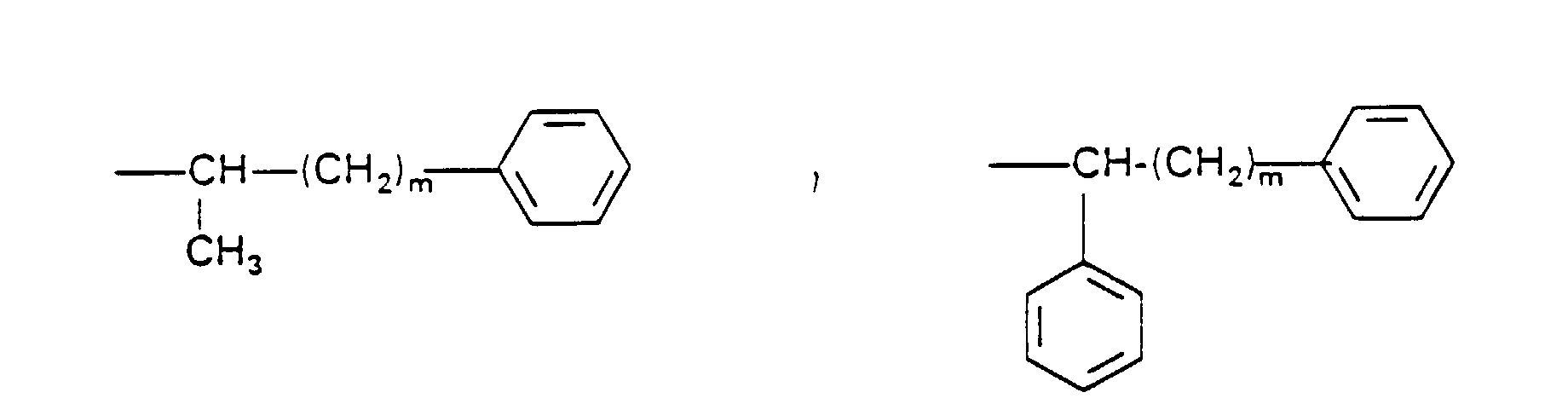


- According to the specific examples of the invention, the compounds of formula (I) include those in which:
- X3 is H or an alkyl group having from 1 to 4 carbon atoms, preferably X3 is H,
- X1 and X2, identical or different, are a straight or branched alkyl group having from 1 to 6 carbon atoms, preferably X1 and X2 are both t-butyl,
- R1 and R2 are each H or a straight or branched alkyl group from 1 to 4 carbon atoms, preferably Ethyl,
- B is CH2,
- n is zero or 1, preferably n is zero,
- Z is H, a straight or branched alkyl group from 1 to 4 carbon atoms, an acyl group R3-CO- where R3 is a C1-4 alkyl group, and,
- A is H or is selected from the following groups:


- This invention also relates to the processes for the preparation of the novel compounds of formula (I), as defined in claim 1.
- Following procedure a), aminophosphonates of formula (I) are prepared by nucleophilic addition of a phosphite on the imine (IV) obtained by condensation of the aldehyde (II) with the primary amine (III). The appropriate aldehyde and amine are reacted with or without a catalyst in a solvent such as ether, tetrahydrofuran, benzene, toluene or ethanol. The catalyst can be a molecular sieve, an acid such as glacial acetic acid, p-toluenesulfonic acid, thionyl chloride, titanium tetrachloride, boron trifluoride etherate, or a base such as potassium carbonate. The reaction is carried out at temperatures between 0° and the boiling point of the solvent used. Reaction times vary between one hour to one day. For the less reactive aldehydeamine series, condensation can be brought about by azeotropic distillation with benzene or toluene as solvent in a Dean-Stark apparatus.
- Some imine derivatives (IV) can be isolated, purified, characterized and possibly tested for their biological properties. In general, however, they are used directly in the next reaction step.
- The nucleophilic addition of a phosphite on the carbon atom of an imine can be carried out by reacting the relevant reactants imine (IV) and dialkyl phosphite (V) or its derivative trimethylsilyl-dialkyl phosphite (Me3SiO)P(OR1)OR2) (VI) with or without using as catalyst an amine, such as diethyl amine or triethyl amine. In addition, the addition can be carried out by using the salt of dialkyl phosphite formed in situ by reacting dialkyl phosphite with a base such as sodium hydride, sodium methoxide or ethoxide. The reaction is carried out with or without a solvent such as petroleum ether, benzene, toluene, diethyl ether, tetrahydrofuran, 1,2-dimethoxyethane at a temperature between 30° and 140°C. Reaction times vary between 2 h and overnight.
- In the case of secondary amines, the corresponding aminophosphonate (I) is prepared by reacting aldehyde (II) with equimolar amounts of the secondary amine (III) and dialkyl phosphite (V) dissolved in a hydrocarbon solvent such as petroleum ether, benzene, toluene, xylene at a temperature between room temperature and the boiling point of the selected solvent. The reaction can last between 15 min and several days.
- According to procedure b), the aminophosphonates of formula (I) where A and Z are both hydrogen atoms, are easily prepared by catalytic hydrogenation of the corresponding amino phosphonate of formula (I) where Z is hydrogen and A an alpha substituted benzyl group such as 1-phenyl ethyl, 1-phenyl cyclopentyl or a benzyloxycarbonyl group. The catalyst can be palladium on charcoal or palladium (II) hydroxide on charcoal, the solvent can be ethanol or glacial acetic acid.
- The aminophosphonic acids of formula (I) can be obtained by nucleophilic addition of phosphorous acid (V) on the appropriate imine (IV). The reaction is carried out with or without a solvent (benzene, toluene) at a temperature between 80° and 140°C. The aminophosphonic acids of formula (I) can also be prepared by hydrolysis of their corresponding esters according to established literature methods by using reagents such as hydrochloric acid, hydrobromic acid, bromotrimethyl silane or iodotrimethyl silane.
- According to procedure c), the N-acylated aminophosphonates of formula (I) where Z = R3-CO are obtained by acylation of the corresponding aminophosphonates (I) where Z=H, the acylating agent can be R3-CO-Cl or (R3CO)2O (VII). The reaction is carried out in a solvent such as petroleum ether, benzene, toluene, ether, tetrahydrofuran, with a tertiary base such as triethylamine.
- When R1, R2 are hydrogen, the aminophosphonic acids (I) can form salts with inorganic or organic bases. These inorganic salts can be ammonium salts, salts of alkali or alkalino-earth metals such as lithium, sodium, potassium, magnesium or calcium. The organic salts can be salts of amines such as alkylamines, e.g. triethylamine, dicyclohexylamine, alkanolamines, e.g. diethanol-amine, benzylamines, e.g. dibenzylamine, heterocyclic amines, e.g. morpholine etc... These salts are integral part of the invention.
- Through their amino function, the aminophosphonate esters (I) can form salts of inorganic acids such as HCl, H2SO4 or with organic acids such as oxalic acid, maleic acid, etc... An example of hydrochloride salt of aminophosphonate (I) is provided (example 2). All these salts are integral part of this invention.
- Compounds of structure (I) have at least one asymmetrical center which is the carbon atom in position alpha to the phosphonate group. The compounds (I) therefore exist under the two enantiomeric forms. The racemic mixtures (50% of each enantiomer) and the pure enantiomers are comprised in the scope of this application.
- The structures of compounds of formula (I) are established by their elemental analysis, their infrared (IR), mass (MS) and nuclear magnetic resonance (NMR) spectra. The purity of the compounds is checked by thin layer, gas liquid or high performance liquid chromatographies.
- The abbreviations used in this application are the following: in the tables, n is normal, i is iso, s is secondary and t is tertiary. In the description of the NMR spectra, respectively s is singlet, d doublet, t triplet and m multiplet. The temperatures were recorded in Celsius degrees and the melting points are not corrected.
- This invention is illustrated by the examples 1-23 which are representative of the compounds in the application and of the processes of synthesis employed.

-

- A solution containing 312.7g (1.35 mol) of 3,5-di-tert-butyl-4-hydroxybenzaldehyde in 2400ml THF was added to a solution of 189.4 g (1.40mol) of 3-phenylpropyl-amine in 200 ml THF. The resulting mixture was stirred at room temperature for 24h. The solution was then dried with MgSO4 and evaporated to dryness to yield 480g of a light brown solid which was recrystallized in petroleum ether. 400g of a yellow solid were obtained; mp= 86-87°C; yield = 86%. IR (KBr): 1610 cm-1: CH=N.
- To the previously obtained imine (350g, 0.997mol) dissolved in 220ml toluene by slight warming was added dropwise diethyl phosphite (172g, 1.25mol). The resulting mixture was refluxed for 7h then toluene was removed under vacuum. The viscous mass was triturated in hot petroleum ether and after cooling, was filtered and dried. Recrystallization in t-butyl methyl ether gave 340g of a white solid, yield= 66%, mp= 99-100°C.
Elemental analysis C28H44NO4P % Calc. C 68.68 H 9.06 N 2.86 % Found C 68.45 H 9.36 N 2.74 - IR (KBr):
- 3340 cm-1: OH, 3240 (broad): NH, 1440: tert-Bu, 1190: P=O, 1120: P-OEt, 1030: P-O-C.
- MS:
- m/e = 488: M+-1, 351: 488- PO3Et2
- NMR (CDCl3): δ=
- 7.22 (m, 5H) : phenyl H
7.20 (d, j P-H =2.2Hz, 2H): aromatic H, 3,5-di-t-butyl-4-hydroxy phenyl
5.20 (s, 1H) : OH
4.08, 3.95 and 3.80 (3m, 4H): P-O-CH 2-CH3
3.94 (d, J P-H = 19 Hz, 1H): CH-PO3Et2
2.65 (m, 4H): NH-CH 2-CH2-CH2-Ph
1.80 (m, 3H): NH-CH2-CH 2-CH2-Ph
1.45 (s,18H): tert-Bu
1.30 and 1.12 (2t, J=7Hz, 6H): P-O-CH2-CH 3 -
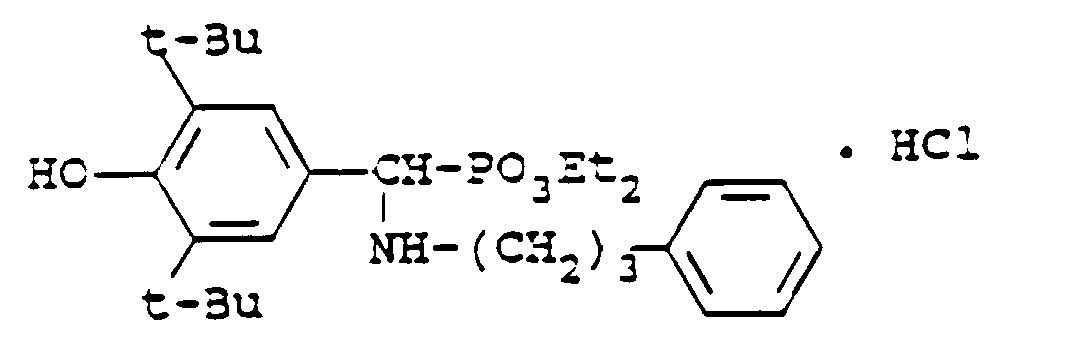
- A solution of diethyl α-(3,5-di-tert-butyl-4-hydroxyphenyl)-N-(3-phenylpropyl) aminomethylphosphonate (3.0g, 6.13 mmol) in 50 ml ether was cooled to -10°C and was saturated with gazeous hydrogen chloride. The closed flask was left in the freezer overnight. Evaporation of the solvent gave 3.3g of a solid which was recrystallized in ethanol/water.
mp= 132-134°C with volume contraction - IR (KBr):
- 3620 cm-1: OH, 2700 (broad) + 1600 + 1330: NH2, 1230: P=O, 1160: P-O-Et, 1040: P-O-C.
-

- A mixture of 80.2g (342 mmol) 3,5-di-tert-butyl-4-hydroxybenzaldehyde and 56.0g (360 mmol) 2-(4-chlorophenyl)ethylamine dissolved in 750ml THF was stirred at room temperature for 24h. The solution was dried with MgSO4, filtered and evaporated. The solid residue was recrystallized in ligroin to yield 101g; 79% yield.
mp= 116-119°C.
IR (KBr): 1610 cm-1: CH=N - The above imine (9.0g, 24.1 mmol) was dissolved in 57ml toluene. Diethyl phosphite (4.2g, 30.2 mmol) was added dropwise and the mixture was refluxed for 5 h. The solvent was evaporated to yield 14.0g of solid residue. Recrystallization in 30ml ligroin, then 30ml t-butyl methyl ether gave 9.0g (74% yield) of a solid, mp= 119.5-121°C.
Elemental analysis C27H41ClNO4P % Calc. C 63.58 H 8.10 N 2.75 P 6.07 % Found C 63.77 H 8.30 N 2.80 P 6.21 - IR(KBr):
- 3480 cm-1: OH, 3400 (broad): NH, 1440: tert-Bu, 1230: P=O, 1100: Ph-Cl, 1030: P-O-C.
- NMR (CDCl3): δ =
- 7.23 and 7.10 (2d, J=8Hz, 4H): aromatic H, 4-chlorophenyl
7.11 (d, J P-H=2Hz, 2H): aromatic H, 3,5-di-tert-butyl-4-hydroxyphenyl
5.20 (s, 1H): OH
4.00, 3.91 and 3.78 (3m, 4H): P-O-CH 2CH3
3.94 (d, JP-H= 19 Hz. 1H): CH-PO3Et2
2.80 (m, 2H): NH-CH 2-CH2-Ph-Cl
2.75 (m, 2H): NH-CH2-CH 2Ph-Cl
1.90 (broad): NH-
1.44 (s, 18H): tert-Bu
1.25 and 1.10 (2t, J= 7Hz, 6H): P-O-CH2-CH 3 - MS:
- m/e = 372: M+-PO3Et2
-

- A mixture of 5.0g (21.4 mmol) of 3,5-di-t-butyl-4-hydroxy benzaldehyde, 2.34g (21.6 mmol) of 3-picolylamine and 6.0g (42.8 mmol) anhydrous potassium carbonate in 50 ml benzene was refluxed for one day. The potassium carbonate was filtered and the solvent was evaporated. The residue was heated at 140°C with 3.0g (21.6 mmol) of diethylphosphite for 3h. An amount of 6.6g of compound was isolated by column chromatography (95/5 CHCl3/MeOH), which gave 5.9g (60%) after recrystallization in petroleum ether; mp = 100-101°C.
- IR (film):
- 3650 cm-1:OH, 3300 (large): NH, 1430: tert-Bu, 1230: P=O, 1030: P-O-C.
- NMR (CDCl3): δ =
- 8.50, 7.65 and 7.25 (3m, 4H): aromatic H, 3-picolyl
7.20 (d, J P-H =2Hz, 2H): aromatic H, 3,5-di-t-butyl-4-hydroxyphenyl
5.25 (s, 1H): OH
4.08, 3.94 and 3.80 (3m, 4H): P-O-CH 2CH3
3.91 (d, J P-H = 19 Hz, 1H): CH-PO3Et2
3.81 and 3.61 (2d, J=13Hz, 2H): NH-CH 2-Py
2.20 (broad): NH-, 1.45 (s, 18H): tert-Bu
1.30 and 1.10 (2t, J=7Hz, 6H): P-O-CH2CH 3 - MS:
- m/e= 462: M+, 324: M+-HPO3Et2 (base peak)
-
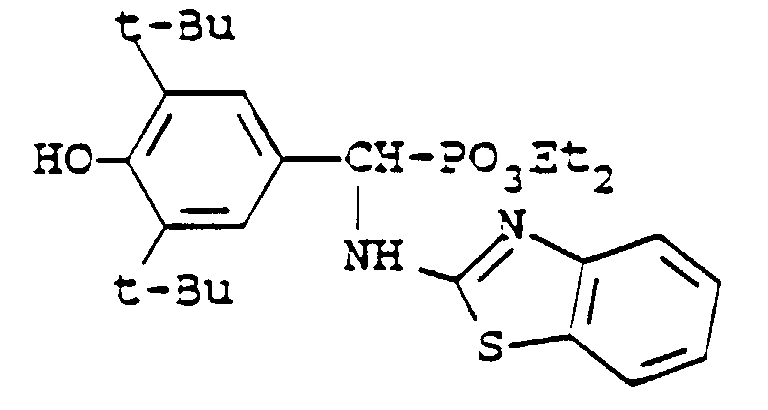
- A solution of 5.0g (21.4 mmol) 3,5-di-tert-butyl-4-hydroxybenzaldehyde and 3.2g (21.6 mmol) 2-aminobenzothiazole dissolved in 60 ml toluene contained in a flask connected to a Dean-Stark apparatus was heated to reflux overnight. Toluene was evaporated under vacuum then the residue was heated with 3.0g (21.6 mmol) diethyl phosphite at 140°C for 3 h. The title compound was purified by column chromatography with a mixture of 95/5 CHCl3/MeOH. Trituration in petroleum ether gave 6.5g (60% yield) of a solid; mp= 198-199°C.
- IR (KBr):
- 3620 cm-1: OH, 3260: NH, 1540: C=N, benzothiazole, 1450: tert-Bu, 1240: P=O, 1030: P-O-C.
- NMR(CDCl3) δ =
- 7.56, 7.29 and 7.09 (3m, 4H): aromatic H, benzothiazolyl
7.33 (d, J P-H= 2Hz, 2H): aromatic H, 3,5-di-t-butyl-4-hydroxyphenyl
6.55 (broad): NH-
5.32 (d, J P-H=21.5 Hz, 1H): CH-PO3Et2
5.25 (s, 1H): OH
4.17, 3.98 and 3.75 (3m, 4H): P-O-CH 2-CH3
1.45 (s, 18H): tert-Bu
1.28 and 1.08 (2t, J= 7Hz, 6H): P-O-CH2-CH 3 - MS:
- m/e = 504 : M+, 367: M+-PO3Et2 (base peak)
-

- 3,5-Di-tert-butyl-4-hydroxybenzaldehyde (5.0g, 21.4 mmol) was added at room temperature to a solution of N-methyl-3-picolylamine (2.6g, 21.6 mmol) and diethyl phosphite (3.0g, 21.6 mmol) in 20ml toluene. The reaction mixture was stirred at room temperature for 2h then refluxed for 15 min. After the evaporation of toluene, the residue was column chromatographed using 95/5 CHCl3/MeOH as eluent. An amount of 4.4g of title compound was isolated, yield = 43%.
- IR (film):
- 3640 cm-1: OH, 1480: C=N, pyridine, 1430: tert-Bu, 1240: P=O, 1040: P-O-C.
- NMR (CDCl3): δ =
- 8.52, 7.77 and 7.27 (3m, 4H): aromatic H, 3-picolyl
7.25 (d, J P-H =2Hz, 2H): aromatic H, 3,5-di-t-butyl-4-hydroxyphenyl
5.29 (s, 1H): OH
4.20, 3.90 and 3.70 (3m, 4H): P-O-CH 2-CH3
3.90 (d, J P-H = 23.5Hz, 1H): CH-PO3Et2
3.90 and 3.37 (2d, J=13.5Hz, 2H): N(CH3)-CH 2-Py
2.42 (s, 3H): N(CH 3)-CH2-Py
1.45 (s, 18H): tert-Bu
1.37 and 0.99 (2t, J=7Hz, 6H): P-O-CH2-CH 3 - MS:
- m/e = 477 : M+ + 1, 339 : M+-PO3Et2
-

- The process described in example 4 was used. The title compound was isolated by column chromatography using 98/2 CHCl3/MeOH as eluent. Yield: 54%, mp= 95-110°C.
- IR (film):
- 3620 cm-1: OH, 3300 (broad): NH, 1430: tert-Bu, 1230: P=O, 1150: P-O-Et, 1020: P-O-C.
- NMR (CDCl3): mixture of diastereoisomers δ =
- 7.27 (m, 5H): H phenyl
7.09 (d, J P-H = 2Hz, 2H): aromatic H, 3,5-di-t-butyl-4 hydroxyphenyl
5.16 (s, 1H): OH
4.14, 3.90 and 3.80 (3m, 4H): P-O-CH 2-CH3
4.00 (d, J P-H =19Hz, 1H): CH-PO3Et2
3.70 (q, J=6Hz, 1H):
1.42 (s, 18H): tert-Bu
1.35 (d, J=6Hz, 3H):
- MS:
- m/e= 338: M +-PO3Et2
-

- The process described in example 1 was used. The title compound was purified by column chromatography using 98/2 CHCl3/MeOH as eluent. Yield = 77%, mp= 122.5-123.5°C.
- IR (film):
- 3640 cm-1: OH, 3340: NH, 1440: tert-Bu, 1250: P=O, 1030: P-O-C.
- NMR (CDCl3): δ=
- 7.19 (d, J P-H = 2Hz, 2H): aromatic H, 3,5-di-tert-butyl-4-hydroxyphenyl
6.80 (d, J= 1.5Hz, 1H), 6.75 (d, J=8Hz, 1H)
and 6.69 (dxd, J=1.5, J=8Hz, 1H): aromatic H, piperonyl
5.95 (s, 2H): methylenedioxy
5.20 (s, 1H): OH
4.80, 3.95 and 3.83 (3m, 4H): P-O-CH 2-CH3
3.91 (d, J H-P = 19Hz, 1H): CH-PO3Et2
3.73 and 3.50 (2d, J= 13Hz, 2H): NH-CH 2-Ar
2.04 (large): NH-
1.46 (s, 18H): tert-Bu
1.30 and 1.12: (2t, J=7Hz, 6H): P-O-CH2-CH 3 - MS:
- m/e= 505: M+, 368: M+-PO3Et2.
-

- The starting compound 3,5-di-sec-butyl-4-hydroxybenzaldehyde was prepared by formylation of 2,6-di-sec-butylphenol, mp = 65-68°C, IR (KBr): 2740 cm-1: (CHO), 1650: C=O.
- The process described in example 1 was used to prepare the title compound which was purified by column chromatography (95/5 CHCl3/MeOH). Yield 68%.
- IR (film):
- 3300 cm-1: OH, 1460: CH2 and CH3, 1200: P=O, 1160: P-O-Et, 1030: P-O-C.
- NMR (CDCl3): δ=
- 7.20 (m, 5H): phenyl H
6.97 (d. 2H): aromatic H, 3,5-di-sec-butyl-4-hydroxyphenyl
4.90 (s, 1H): OH
3.95 and 3.73 (2m, 4H): P-O-CH 2-CH3
3.97 (d, J P-H = 19Hz, 1H): CH-PO3Et2
2.88 (m, 2H), 1.60 (m, 4H), 1.22 (m, 6H) and
0.86 (m, 6H): sec-Bu
2.77 (m, 4H): NH-(CH 2)2-Ph
1.88 (large): NH-
1.23 and 1.09 (2t, J=7Hz, 6H): P-O-CH2-CH 3 - MS:
- m/e= 338 : M+-PO3Et2
-

- 1-Phenyl-cyclopentylamine was prepared according to Organic Syntheses, Coll Vol VI, p. 910, John Wiley & Sons, 1988. A mixture of 5.0g (21.37 mmol) 3,5-di-tert-butyl-4-hydroxybenzaldehyde and 3.5g (21.5 mmol) 1-phenyl-cyclopentylamine dissolved in 30ml THF to which 2g of 3 Å molecular sieve was added, was stirred overnight. The molecular sieve was filtered and the THF was evaporated. Diethyl phosphite (3.0g, 21.50 mmol) was added to the residue and the mixture was heated to 140° for 5 h. The title compound was isolated by column chromatography (95/5 CHCl3/MeOH) and recrystallized in petroleum ether: 3.9g were obtained, yield 35 %, mp= 114-115°C.
IR (KBr): 3620 cm-1: OH, 3300: NH, 1430: tert-Bu, 1200: P=O, 1030: P-O-C. - NMR (CDCl3): δ=
- 7.20 (m, 5H): H phenyl
6.92 (d, J P-H = 2Hz, 2H): aromatic H, 3,5-di-tert-butyl-4 hydroxyphenyl
5.05 (s, 1H): OH
3.97, 3.74 and 3.45 (3m, 4H): P-O-CH 2-CH3
3.60 (d, J P-H = 23Hz, 1H): CH-PO3Et2
1.85 (broad): NH-
1.50-2.10 (m, 8H): H, cyclopentylidene
1.37 (s, 18H): tert-Bu
1.24 and 0.94 (2t, J=7Hz, 6H): P-O-CH2-CH 3 - MS:
- m/e = 378 : M+ -PO3Et2
-

- The process described in example 1 was used. The title compound was purified by column chromatography (9/1 CHCl3/MeOH) and recrystallized in petroleum ether 40-60. Yield 81%, mp = 76-78°C.
- IR(film):
- 3640 cm-1: OH, 3300: NH, 1590, 1570, 1470: -2Py, 1430: tert-Bu, 1230: P=O, 1160: P-OEt, 1020: P-O-C.
- NMR (CDCl3): δ=
- 8.47, 7.53 and 7.09 (3m, 4H): aromatic H, 2-pyridyl
7.12 (d, J P-H = 2Hz, 2H): aromatic H, 3,5-di-t-butyl-4-hydroxyphenyl
5.15 (s, 1H): OH
3.94 (d, J P-H = 19Hz, 1H): CH-PO3Et2
3.86 (m, 4H): P-O-CH 2-CH3
2.92 (m, 4H): NH-(CH 2)2-Py
2.15 (broad): NH-
1.38 (s, 18H): tert-Bu
1.19 and 1.05 (2t, J=7Hz, 6H): P-O-CH2CH 3 - MS:
- m/e = 477: M+ + 1, 339 : M+ - PO3Et2
-
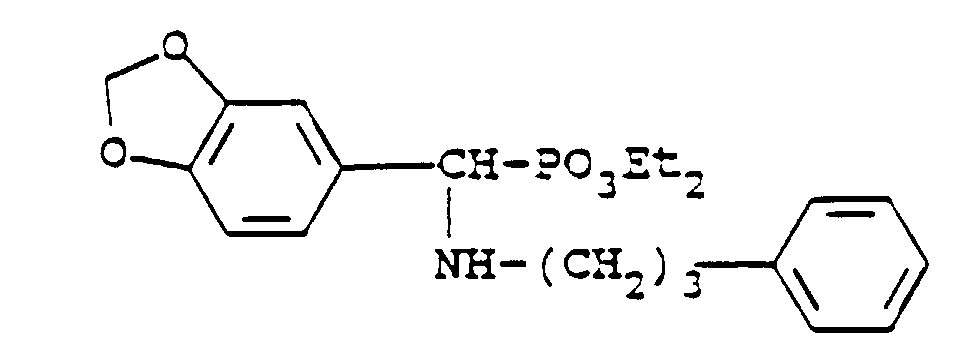
- The process described in example 10 was followed. The title compound was purified by column chromatography using 9/1 CHCl3/MeOH as eluent. Yield 68%.
IR (film): 3300 cm-1 : NH, 1240: P=O, 1020: P-O-C. - NMR (CDCl3): δ=
- 7.25 and 7.15 (2m, 5H): phenyl H
6.95, 6.83 and 6.77 (3m, 3H): aromatic H, 3,4-methylenedioxyphenyl
5.95 (s, 2H): methylenedioxy
4.11, 4.00 and 3.89 (3m, 4H): P-O-CH 2-CH3
3.92 (d, J P-H = 19.5 Hz, 1H): CH-PO3Et2
2.58 (m, 4H): NH-CH 2-CH2-CH 2Ph
1.75 (broad): NH-
1.77 (m, 2H): NH-CH2-CH 2-CH2Ph
1.30 and 1.19 (2t, J=7Hz, 6H): P-O-CH2CH 3 - MS:
- m/e = 404 M+-1
-

- A mixture of 5g (21.4 mmol) 3,5-di-tert-butyl-4-hydroxybenzaldehyde and 2.66g (21.6 mmol) 4-methoxyaniline in 30ml of THF was reacted overnight on 3 Angstrom molecular sieves. Molecular sieve was filtrated, THF was evaporated then 2.98g (21.6 mmol) diethyl phosphite was added. The reaction mixture was heated at 140°C for 6h then purified by column chromatography (98/2 CHCl3/MeOH). A white solid weighing 8.6g was obtained, yield 83%, mp= 108-109°C.
- IR (film) 3640 cm-1 :
- OH, 3400 (broad): NH, 1520: Phenyl, 1430: tert-Bu, 1240: P=O, 1030: P-O-C.
- NMR (CDCl3): δ =
- 7.20 (d. J P-H = 2Hz, 2H): aromatic H, 3,5-di-tert-butyl-hydroxyphenyl
6.65 (2d, J=9Hz, 4H): aromatic H, 4-methoxyphenyl
5.15 (s, 1H): OH
4.60 (d, J P-H = 23Hz, 1H): CH-PO3Et2
4.10, 3.90 and 3.60 (3m, 4H): P-O-CH 2-CH3
3.70 (s, 1H): -OCH 3
1.80 (broad): NH
1.40 (s, 18H): tert-Bu
1.25 and 1.05 (2t, J= 7Hz, 6H) P-O-CH2-CH 3 - MS:
- m/e 478: M+ + 1, 447: M+, 341: M+-PO3Et2+H.
-

- Acetic anhydride (17.5g, 0.172 mol) was added to a solution of 80g (0.164 mol) diethyl α-(3,5-di-tert-butyl-4-hydroxyphenyl)-N-(3-phenylpropyl)-aminomethylphosphonate and 17.35g (0.172 mol) triethylamine in 450ml toluene. The reaction mixture was heated to reflux for 6 h then was extracted with brine and finally dried over MgSO4. After evaporation to dryness, the residue was recrystallized in a mixture of acetone and tert-butyl methyl ether. 59g were obtained, yield 68%, mp = 135-136°C.
- The title compound can also be obtained by using acetyl chloride as acylating agent. Acetyl chloride (0.28g, 3.62 mmol) was added to a solution containing 1.77g (3.62 mmol) aminophosphonate and 0.36g (3.62 mmol) triethylamine. After heating at reflux temperature, work-up was carried out as described above. 2.2g was obtained, yield 70%, mp = 134-136°C.
Elemental analysis C30H46NO5P %Calc. C 67.80 H 8.61 N 2.64 %Found C 67.76 H 8.61 N 2.50 - IR (KBr):
- 1620 cm-1: C=O, 1425: tert-Bu, 1230: P=O, 1020: P-O-C.
- MS:
- m/e= 532 : M+ 1, 488 : M+ - CH3CO, 394 : M+ - PO3Et2
- RMN (CDCl3):
- mixture of two amide rotation isomers. The characteristics of the major isomer are reported here
- δ=
- 7.47 (s, 2H): aromatic H, 3,5-di-tert-butyl-4-hydroxyphenyl
7.15 and 6.94 (2m, 5H): phenyl H
6.28 (d, J P-H =22Hz, 1H): CH-PO3Et2
5.3 (s, 1H): OH
4.1 (m, 4H): P-O-CH 2-CH3
3.59 and 3.42 (2m, 2H): NH-CH 2-(CH2)2-Ph
2.32 (t, J=8Hz, 2H): NH-(CH2)2-CH 2-Ph
2.06 (s, 3H): CO-CH 3
1.42 (s, 18H): tert-Bu
1.32 and 1.14 (2t, J= 7Hz, 6H): P-O-CH2-CH 3
1.60 and 0.93 (2m, 2H): NH-CH2-CH 2-CH2-Ph -

- Trifluoroacetic anhydride (1.03g, 4.9 mmol) was added under nitrogen to a mixture of 2.0g (4.1 mmol) of diethyl α-(3,5-di-tert-butyl-4-hydroxyphenyl)-N-(3-phenyl propyl)-aminomethylphosphonate and 0.4g (4.1 mmol) of triethylamine in 20ml benzene. The mixture was heated to 40°C for 1 h, evaporated to dryness and the residue was recrystallized in petroleum ether. 2.3g of a white solid was obtained, yield 96%; mp = 74-79°C.
-

- The process described in example 1 was employed using 4-phenylbutylamine as amine. A white solid was obtained with a yield of 51%, after purification by column chromatography (98/2 CHCl3/MeOH), mp = 93-94°C.
IR (KBr) 3400 cm-1: NH, 1430: tert-Bu, 1220: P=O, 1030: P-O-C. - NMR (CDCl3) δ=
- 7.25 and 7.15 (2m, 5H): phenyl H
7.17 (d, J P-H = 2Hz, 1H): aromatic H, 3,5-di-t-butyl-4-hydroxyphenyl
5.2 (s, 1H): OH
4.06, 3.92 and 3.78 (3m, 4H): P-O-CH 2-CH3
3.90 (d. J P-H = 19Hz, 1H): CH-PO3Et2
2.56 (m, 4H): NH-CH 2-(CH2)2-CH 2-Ph
1.74 (broad): NH-
1.65 and 1.50 (2m, 4H): NH-CH2-(CH 2)2-CH2-Ph
1.42 (s, 18H): tert-Bu
1.26 and 1.12 (2t, J=7Hz, 6H): P-O-CH2-CH3 - MS:
- m/e = 366: M+-PO3Et2
-
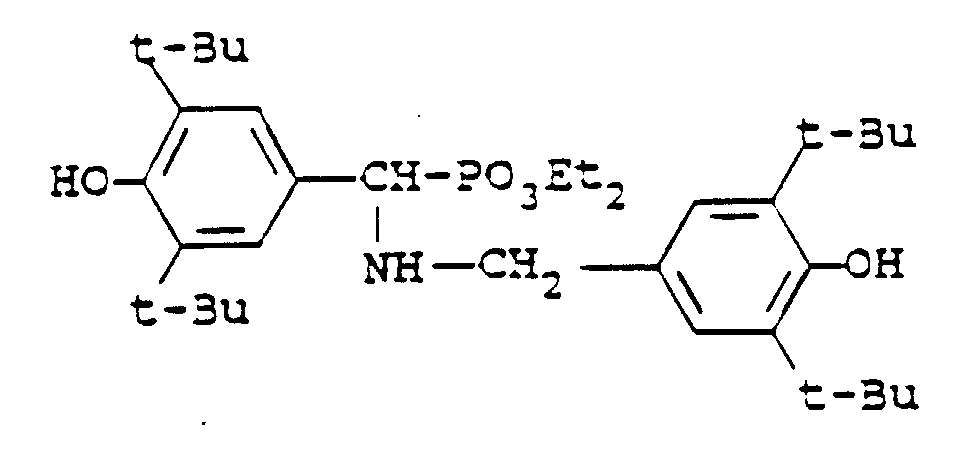
- A mixture of 0.97g (4.13 mmol) 3,5-di-tert-butyl-4-hydroxybenzaldehyde and 1.0g (4.25 mmol) 3,5-di-tert-butyl-4-hydroxybenzylamine (mp = 158-163°C, prepared according to E. Müller et al, Chem. Ber. 92, 2278-2293, 1959) in 20ml THF was stirred at room temperature overnight. It was dried over MgSO4 then evaporated. A solution of the obtained imine in 10ml toluene is reacted with 0.42g (4.16 mmol) triethylamine and 0.57g (4.25 mmol) diethyl phosphite at 100°C for 6h. After evaporation the residue was purified by two column chromatographies (SiO2, 95/5 then 98/2 CHCl3/MeOH). An amount of 0.4g (16%) of a white solid was obtained, mp = 120-123°C.
- IR (KBr) 3640 cm-1:
- OH, 3400 (broad): NH, 1440: tert-Bu, 1240: P=O. 1030: P-O-C.
- NMR (CDCl3): δ =
- 7.20 (d, J P-H =2Hz, 2H): aromatic H, -substituted 3,5-di-t-butyl-4-hydroxyphenyl
7.05 (s, 2H): aromatic H, 3,5-di-tert-butyl-4-hydroxy benzylamino
5.18 and 5.14 (2s, 2H) = OH of the two phenols
4.06, 3.94 and 3.80 (3m, 4H): P-O-CH 2-CH3
3.97 (d. J P-H = 19Hz, 1H): CH-PO3Et2
3.72 and 3.48 (2d, J= 12.5 Hz, 2H): NH-CH 2-Ph
1.44 and 1.42 (2s, 36H): 4 groups tert-Bu
1.27 and 1.12 (2t, J=7Hz, 6H): P-O-CH2CH 3 - MS:
- m/e = 452: M+-PO3 Et2
-

- 3,5-Di-tert-butyl-4-hydroxyphenylacetaldehyde was obtained by reduction of ethyl 3,5-di-tert-butyl-4-hydroxyphenylacetate with a double molar excess of diisobutyl aluminum hydride in hexane at -78°C, mp = 74-76° (MS = m/e: 248=M+, 219=Nl+-CHO).
- The above described aldehyde (4g, 15.3 mmol) was reacted with 3-phenylpropylamine (2.1g, 15.5 mmol) in 50 ml THF at room temperature for 18h. After drying and solvent evaporation, diethyl phosphite (2.2g, 15.5 mmol) was added and the mixture was heated at 140°C for 5 h. Purification by column chromatography (98/2 CHCl3/MeOH) gave 2.38g (31%) of a light yellow oil.
- IR (film) 3640 cm-1:
- OH, 3300 (broad): NH, 1440: tert-Bu, 1230: P=O, 1030 P-O-C
- NMR (CDCl3): δ =
- 7.20, 7.13 and 7.0 (3m, 5H): phenyl H
7.03 (s, 2H): aromatic H, 3,5-di-tert-butyl-4-hydroxyphenyl
5.20 (s,1H): OH
4.14 (m, 4H): P-O-CH 2-CH3
3.08 (m, 2H): NH-CH 2-(CH2)2-Ph
2.72 (m, 2H): Ph-CH 2-CH-PO3Et2
2.50 (dxt, J P-H = 12Hz, J=7.5Hz, 1H): CH-PO3Et2
2.42 (t, J= 7Hz, 2H): NH-(CH2)2-CH 2-Ph
1.58 (m, 2H): NH-CH2-CH 2-CH2-Ph
1.42 (s, 18H): tert-Bu
1.32 and 1.29 (2t, J=7Hz, 6H): P-O-CH2-CH 3 - MS:
- m/e = 504 : M+ + 1, 366 : M+ - PO3Et2
-

- A mixture containing 2g (9.7 mmol) 2,6-di-tert-butyl phenol, 0.4g NaOH dissolved in 4ml water, 13.7g (60.1 mmol) benzyl triethyl ammonium chloride and 12g (84.5 mmol) methyl iodide was heated at 45° for 18 h. After purification 0.67g 2,6-di-tert-butyl anisol was obtained. This compound (1.46g, 6.63 mmol) was formylated by reaction at 0°C with dichloromethyl methyl ether (1.15g, 10 mmol) in presence of tin tetrachloride (3.1g, 11.9 mmol) in 20ml CH2Cl2. After hydrolysis and extraction into ether. 1.15g of 3,5-di-tert-butyl-4-methoxybenzaldehyde were obtained (MS: m/e= 248: M+ ; 233 = M+-CH3).
- This aldehyde was reacted with 0.63g (4.68 mmol) 3-phenylpropylamine in 25ml THF, then 0.65g (4.68 mmol) diethylphosphite was added and the resulting mixture heated at 110°C for 4 h. Purification by column chromatography gave 0.9g (37% of a yellow oil).
IR (film) 3400 cm-1 (broad): NH, 1440: tert-Bu, 1220: P=O, 1020: P-O-C. - NMR (CDCl3): δ =
- 7.24 and 7.14 (2m, 5H) phenyl H
7.26 (d, J P-H = 2Hz, 2H): aromatic H, 3,5 di-tert-butyl-4-hydroxyphenyl
4.05, 3.93 and 3.79 (3m, 4H): P-O-CH 2-CH3
3.95 (d, J P-H = 19 Hz, 1H): CH-PO3ET2
3.66 (s, 3H): Ph-O-CH 3
2.66 and 2.59 (2m, 4H): NH-CH 2-CH2-CH 2-Ph
1.79 (m, 3H): NH and NH-CH2-CH 2-CH2-Ph
1.42 (s, 18H): tert-Bu
1.27 and 1.10 (2t, J= 7Hz, 6H): P-O-CH2-CH 3 - MS:
- m/e = 504 : M+ + 1, 366 : M+-PO3Et2
-

- 3,5-Di-tert-butyl-4-hydroxybenzaldehyde (10.0g, 43 mmol) was reacted at room temperature with allyl amine (2.45g, 43 mmol) in 20 ml THF overnight. The solution was dried over MgSO4 and evaporated to dryness.
- The reagent diethyl trimethylsilylphosphite was prepared by adding chloro trimethylsilane (5.1 g, 47 mmol) dissolved in 10ml CH2Cl2 into a solution cooled to 0°C containing HPO3Et2 (5.9g, 43 mmol), Et3N (4.7g, 47 mmol) in 40 ml CH2Cl2. The mixture was stirred at 0°C for 20 min, then the previously described imine dissolved in 70ml CH2Cl2 was added. The reaction mixture was left to reach room temperature and was stirred for 5 h. Hydrolysis was carried out with 100ml water and the aqueous phase was extracted with CH2Cl2. The pooled organic phases were dried over K2CO3. The crude compound (21.0g) was purified by column chromatography (98/2 CHCl3/MeOH), 16.0g were obtained, yield 90%; mp = 91-92°C.
- IR (film): 3640 cm-1:
- OH, 3300 (broad): NH, 1430: tert-Bu, 1230: P=O, 1020: P-O-C
- MS m/e = 411 :
- M+, 274: M+ - PO3Et2
- NMR (CDCl3): δ=
- 7.20 (s, 2H): aromatic H, 3,5-di-tert-butyl-4-hydroxyphenyl
5.85 (m, 1H): NH-CH2-CH=CH2
5.19 (s, 1H): OH
5.12 (m, 2H): NH-CH2-CH=CH 2
3.98 (d, J P-H = 18.5 Hz, 1H): CH-PO3Et2
3.93 (m, 4H): P-O-CH 2-CH3
3.18 (m, 2H): NH-CH 2-CH=CH2
1.88 (broad, 1H): NH-CH2-CH=CH2
1.43 (s, 18H): tert-Bu
1.28 and 1.12 (2t, J=7Hz, 6H); P-O-CH2-CH 3 -

- Diethyl α-(3,5-di-tert-butyl-4-hydroxyphenyl)-N-(3-phenylpropyl)-aminomethylphosphonate (compound 22, 3.0g, 6.1 mmol) was heated at reflux in 30ml 6N HCl for 24 h. The compound was extracted with chloroform, 2.5g were obtained. Yield = 94%, mp = 162-169°C.
- IR (KBr):
- 3640 cm-1: OH, 3400 (broad): NH, 2800 and 1600: PO-H, 1430: tert-Bu, 1200: P=O, 1000 and 940: P-OH
- The structure of the compound was confirmed by titration.
-

- Diethyl α-(3,5-di-tert-butyl-4-hydroxyphenyl)-N-(1-phenylethyl)-aminomethyl phosphonate, compound 29 (3.0g, 6.3 mmol) was hydrogenated in ethanol with 3.0g 10% Pd/C. The compound was purified by column chromatography (9/1 CHCl3/MeOH): 1.5g was obtained; yield = 62%, mp = 131-133°C.
- The title compound was also obtained by catalytic hydrogenation (10% Pd/C), EtOH) of diethyl α-(3,5-di-tert-butyl-4-hydroxyphenyl)-N-(1-phenylcyclopentyl) aminophosphonate (compound 45) or diethyl α-(3,5-di-tert-butyl-4-hydroxyphenyl)-N-benzyloxycarbonyl-amino methylphosphonate (compound 85).
IR (KBr) 3300 and 3360 cm-1: NH2, 1440: tert-Bu, 1170: P=O, 1030: P-O-C - NMR (CDCl3): δ=
- 7.24 (d, J P-H = 2Hz, 2H): aromatic H, 3,5 di-tert-butyl-4-hydroxyphenyl
5.21 (s, 1H): OH
4.17 (d, J P-H = 16Hz, 1H): CH-PO3Et2
3.94 (m, 4H): P-O-CH 2-CH3
1.77 (broad, 2H): NH2
1.44 (s, 18H): tert-Bu
1.28 and 1.15 (2xt, J=7Hz, 6H): P-O-CH2-CH 3 - MS:
- m/e = 234: M+-PO3Et2
-

- In a flask were mixed acetic acid (17.0g, 282 mmol) and thionyl chloride (10.0g, 83 mmol). Then were added sequentially benzyl carbamate (3.0g, 20 mmol), diethyl phosphite (2.8g, 20 mmol) and 3,5-di-tert-butyl-4-hydroxybenzaldehyde (5.0g, 21.3 mmol). The mixture was stirred at room temperature for 20 min then at 80°C for 2 h. The mixture was left to cool, then was dissolved in CHCl3 and was extracted successively with H2O, 20% NaOH and H2O. The crude compound was extracted hot with ethyl acetate and the pure crystals were filtered, 6.0g were obtained, yield 60%, mp = 196-197°C.
IR(KBr) 3520 Cm-1: OH, 3240: NH, 1690: C=O, 1530: amide II, 1430: tert-Bu, 1230: P=O, 1110: C-N, 1030: P-O-C. - NMR (CDCl3): δ=
- 7.33 (m, 5H): aromatic H, NHCOO-CH2-Ph
7.18 (s, 2H): aromatic H, 3,5-di-tert-butyl-4-hydroxyphenyl
5.74 (m, 1H): CH-PO3ET2
5.22 (broad): NH-COOBz
5.15 and 5.08 (2xd, J = 12,5 Hz, 2H): NH-COO-CH 2-Ph
3.89 (m, 4H): P-O-CH 2-CH3
1.42 (s, 18H): tert-Bu
1.27 and 1.06 (2xt, J = 7Hz, 6H): P-O-CH2-CH 3 - MS:
- m/e = 505: M+, 368: M+-PO3Et2
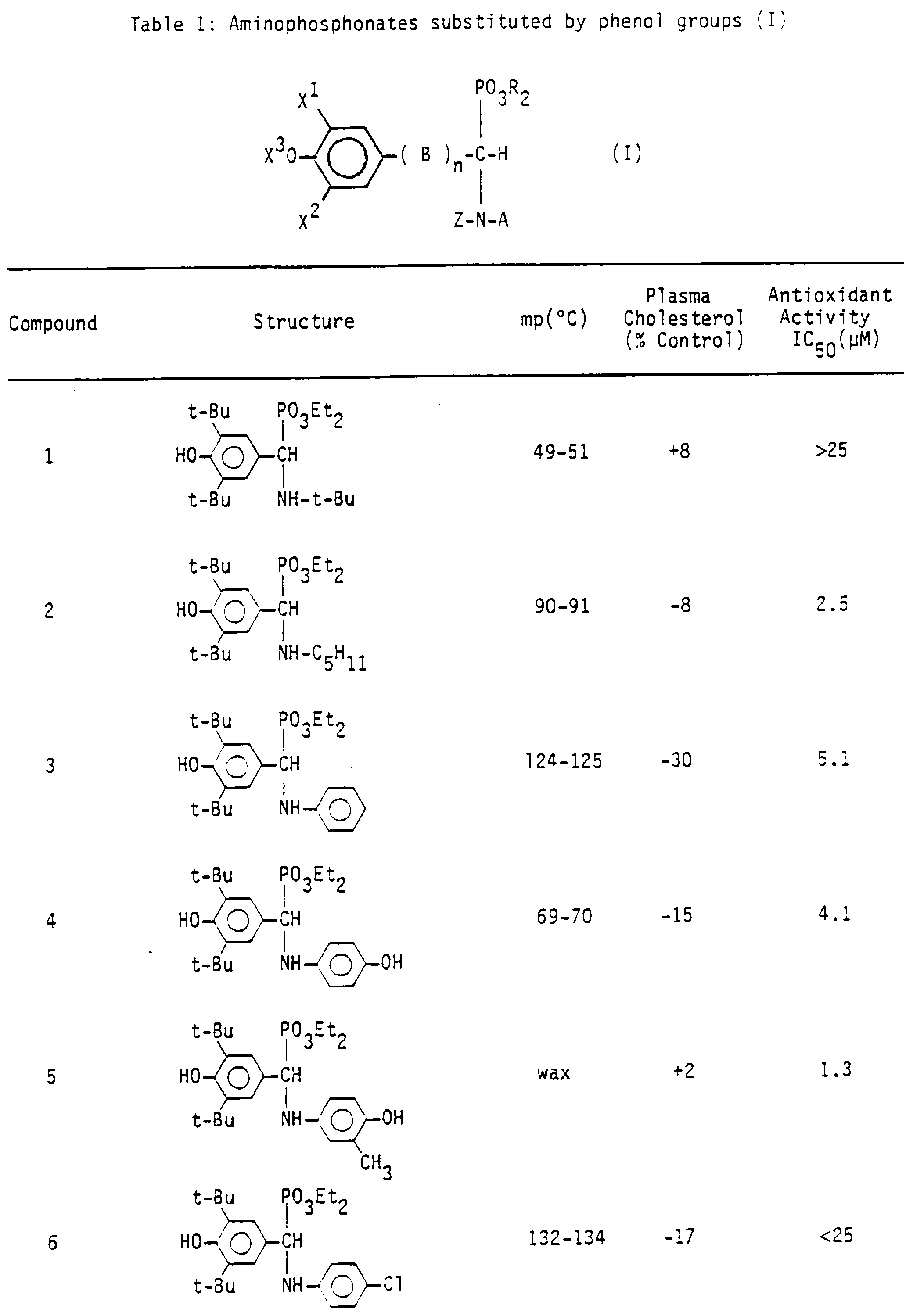
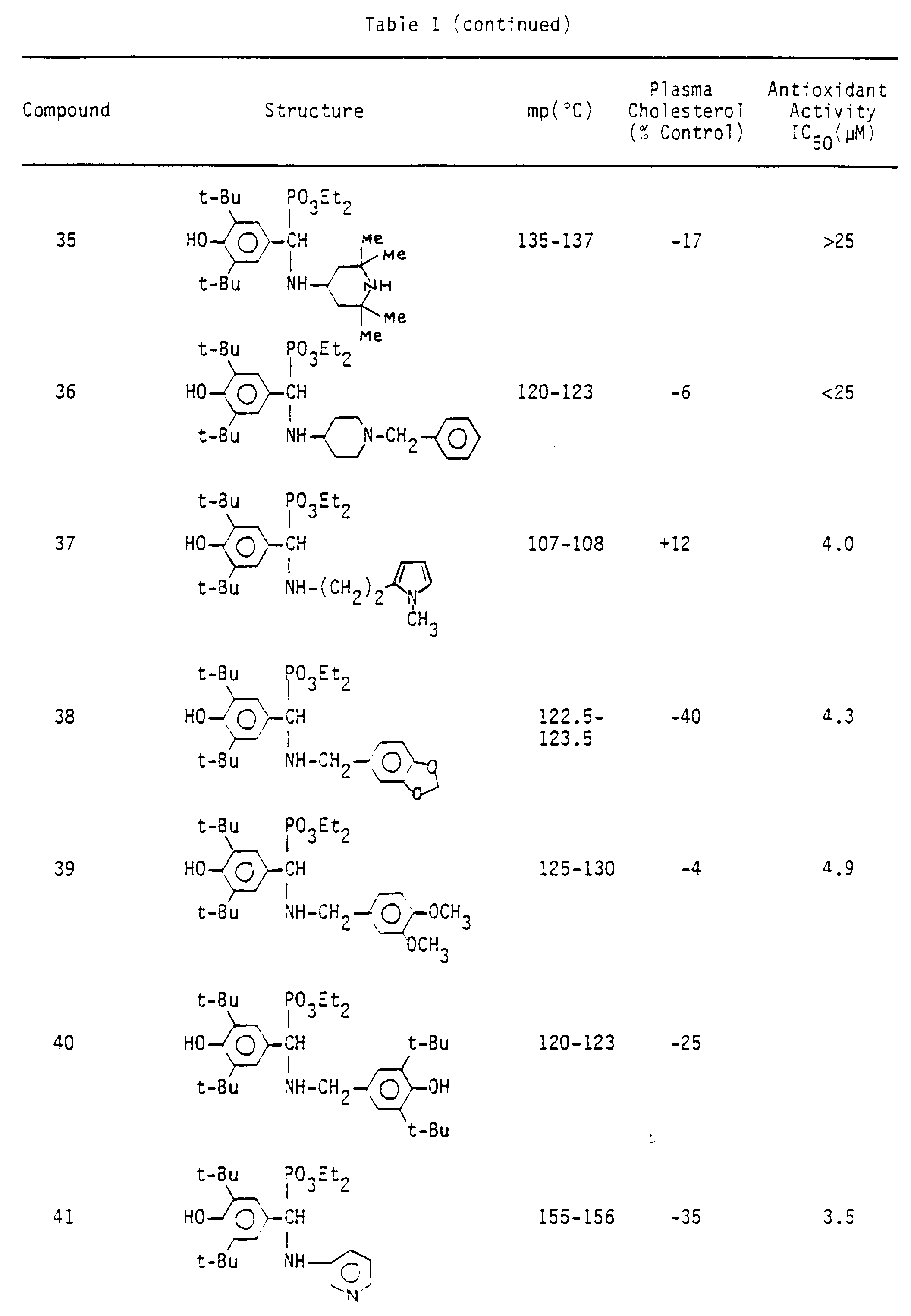
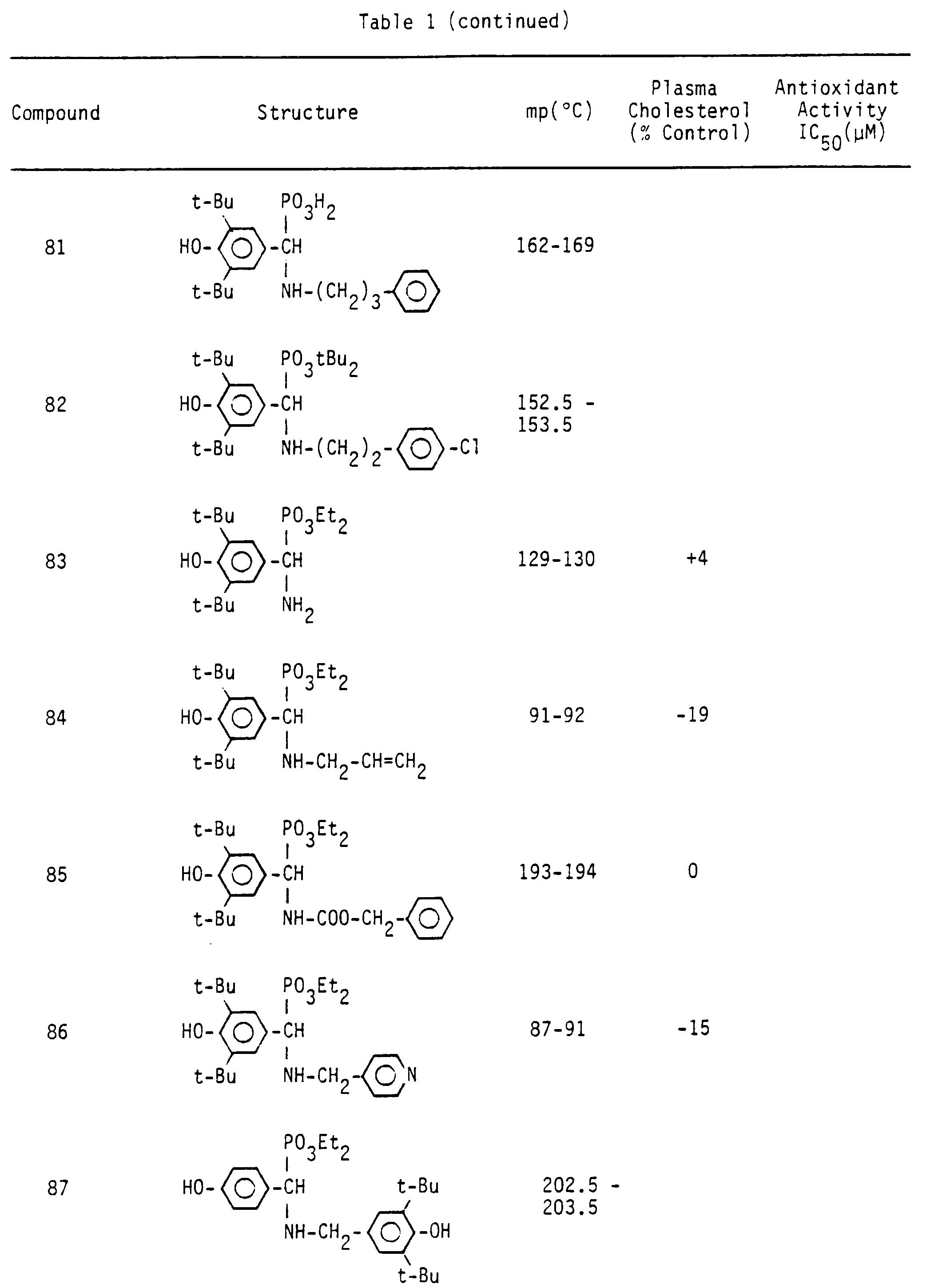
- Pharmacological studies performed in vivo have established that aminophosphonates of formula (I) are potent hypocholesterolemic compounds. Their antioxidant activity has also been clearly demonstrated in vitro. The antioxidant activity of aminophosphonates may be the basis for their use as inhibitors of platelet aggregation or hypoglycemic agents.
- Mouse fed a normal diet is a convenient model which was proposed by several authors (P. Olivier et al, Atherosclerosis 70, 107-114, 1988) for the screening for hypocholesterolemic drugs. OF1 strain mice (Iffa Credo) weighing between 25 and 35g were divided into 5 groups of 5 animals each, four groups received the test compounds and the fifth group served as control. The test compounds were dissolved in diethyl ether. The ether solution was added to food to obtain a final concentration of 0.1%. compound in food. Ether was then evaporated at room temperature. The animals were fed for 10 days, the daily food intake corresponds to ca. 180mg/kg. After an overnight fast, they were sacrificed by decapitation under ether anesthesia. Blood samples were collected using EDTA as anticoagulant.
- Plasma cholesterol was measured by an enzymatic test (DIAMED, Morat, Switzerland). The mean values of each group receiving the test or reference compounds were expressed as percent of mean value of the contemporary control.
- The liver of a Wistar rat anesthetized with ether was collected and homogenized in 4 volumes of phosphate buffer (+4°C, pH 7.4) by means of a Potter. After centrifugation at 2000 rpm for 10 min the supernatant obtained was kept at +4°C. Lipid peroxidation was carried out in presence of FeSO4 according to the method described by A.T. Quitaniha et al, Ann. N. Y. Acad. Sci., 393, 32-47, 1982.
- The mixture contained 1.7ml phosphate buffer, 0.2ml homogenate and 0.1ml of a 2mM FeSO4 solution. The test compounds were added in a volume of 6µl of ethanol or DMSO. Oxydation was carried out at 37°C for 2 h and was stopped by the addition of 20µl of 2% ethanolic solution of BHT. Generated peroxides were measured using thiobarbituric acid according to the method described by Yagi (in "Lipid Peroxides in Biology and Medicine", p. 223-242, 1982, Ed. K. Yagi, Academic Press Inc.) using 1,1,3,3-tetramethoxypropane as standard.
- In a first step, the compounds were tested at the concentration of 25µM. For most compounds which displayed an inhibition superior to 50% of the iron induced oxidation at a concentration of 25µM, the dose inhibiting peroxidation by 50% (IC50) was determined by sequential dilutions of the product between 10-7 and 10-5M. In cases where IC50 was not determined the only < 25 µM mention is specified. Compounds whose IC50 are inferior to 25 µM are considered as having a significant antioxidant activity.
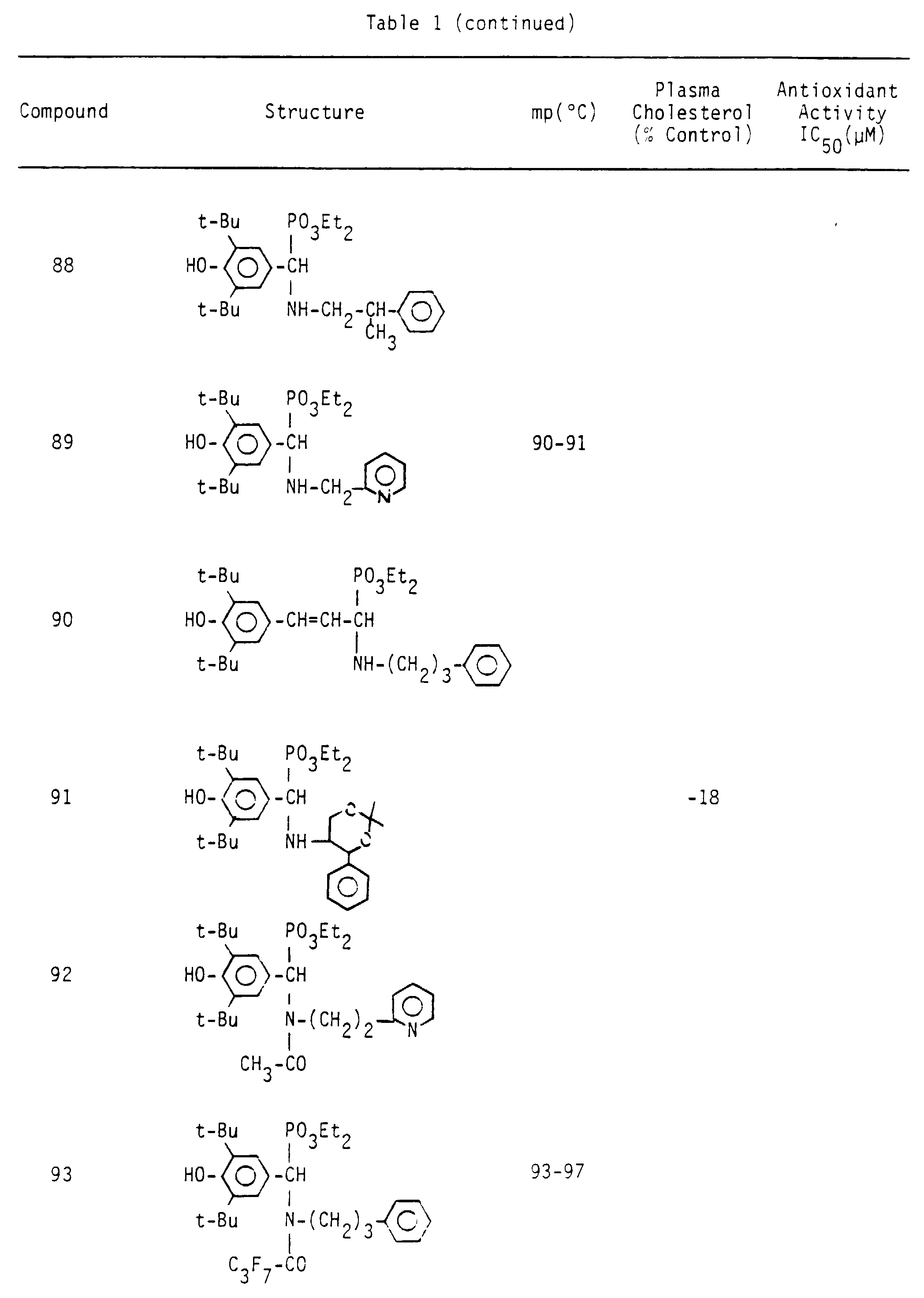
- The values listed on table 1 show that a great number of aminophosphonates of formula (I) are remarkable hypocholesterolemic agents in the mouse.
- In particular, compounds 3, 7, 9, 17, 19, 21, 22, 27, 29, 38, 42, 43, 60, 61, 62, 73 decrease plasma cholesterol by more than 30% and can be considered more active than known hypocholesterolemic agents. In the same experimental conditions, Clofibrate, Gemfibrozil and Fenofibrate, which are drugs used clinically for treatment of hyperlipidemia, have respectively the following plasma cholesterol values of +4%, -7%, -26% as compared to control. The antioxidant product BHT, 2,6-di-tert-butyl-4-methylphenol, has no hypocholesterolemic activity in this model.
- Regarding the mechanism of hypocholesterolemic activity, the aminophosphonates studied were found inactive on the enzyme HMGCoA reductase at 10µM concentration. These results were confirmed by the absence of effect of these compounds on the incorporation of 14C acetate in cholesterol synthesized by Hep G2 cells and CaCo-2 at doses up to 10µM. In these two tests the positive control Lovastatin (hypocholesterolemic drug with HMGCoA reductase inhibitory activity) inhibits the enzyme and the 14C acetate incorporation by more than 98%. The mechanism of hypocholesterolemia of this class is different and potentially unique.
- Furthermore the above-mentioned aminophosphonates display at the same time an in vitro antioxidant activity which is superior to that of the drug Probucol and which is comparable to BHT, an established antioxidant: IC50 (Probucol) > 25µM; IC50 (BHT)= 5µM. The hypocholesterolemic drugs from the fibrate family did not display any measurable antioxidant activity in this test.
- In conclusion the aminophosphonates tested display simultaneously a hypocholesterolemic and antioxidant activity which are remarkable.
- The aminophosphonates of formula (I) can thus be used for the treatment of hyperlipidemia and can be administered preferably in the form of capsules, tablets and granules. For this purpose the active principle should be mixed with a pharmaceutical carrier.
- As used herein, the term "pharmaceutical carrier" denotes a solid or liquid filler, diluent or encapsulating substance. Some examples of the substances which can serve as pharmaceutical carriers are sugars, starches, cellulose and its derivatives, ethyl cellulose, cellulose acetate, powdered tragacanth, malt, gelatin, talc, stearic acid, magnesium stearate, calcium sulphate, vegetable oils, polyols and polyethylene glycol, agar, alginic acid, pyrogen-free water, isotonic saline and phosphate buffer solutions, as well as other non-toxic compatible substances used in pharmaceutical formulations. Wetting agents and lubricants such as sodium lauryl sulphate, as well as colouring agents, flavouring agents and preservatives, can also be present.
- The pharmaceutical carrier employed in conjunction with the phosphonates is used at a concentration sufficient to provide a practical size to dosage relationship. Preferably the pharmaceutical carrier comprises from about 0.1% to 99% by weight of the total composition. Capsules and tablets are prepared by conventional methods using aminophosphonates in their liquid or crystalline form as described in the following examples:
Example of a Capsule Formulation Ingredients mg/Capsule Compound 73 300 Gelatin 100 Polyethylene glycol 1000 600 Potassium sorbate 0.5 Example of a Tablet Formulation Ingredients mg/Tablet Compound 22 500 Hydroxypropyl methyl cellulose 500 Magnesium stearate 3 - For the treatment of specific disease states, compositions containing a pharmaceutically acceptable aminophosphonate can be administered as a solution, suspension, emulsion or by intradermal, intramuscular, intravenous or intraperitoneal injection. Rectal administration of aminophosphonates can be performed by incorporating the active principle into conventional jelly bases to produce suppositories.




k is an integer from 2 to 4, m is an integer from 0 to 5, X4, X5, X6, identical or different, are H, a straight or branched alkyl or alkoxy group from 1 to 8 carbon atoms, a hydroxy, trifluoromethyl, nitro, amino, dimethylamino, diethylamino group, a halogen atom (F, Cl, Br, I), X4 and X5 may form an alkylidendioxy ring having from 1 to 4 carbon atoms, X7 is H or CH3, R is a straight or branched alkyl group having from 1 to 6 carbon atoms, an aryl or alkylaryl group from 6 to 9 carbon atoms.
| Elemental analysis C28N45ClNO4P | |||||
| % Calc. | C 63.92 | N 8.62 | Cl 6.74 | N 2.66 | P 5.89 |
| % Found | C 63.57 | H 8.46 | Cl 6.52 | N 2.56 | P 5.71 |
| Elemental analysis C25H39N2O4P | ||||
| %Calc | C 64.91 | H 8.50 | N 6.06 | P 6.70 |
| %Found | C 64.83 | H 8.70 | N 5.88 | P 6.45 |
| Elemental analysis C27H40NO6P | ||||
| %Calc. | C 64.14 | H 7.95 | N 2.77 | P 6.10 |
| %Found | C 64.41 | H 8.07 | N 2.73 | P 6.21 |
| Elemental analysis C27H42NO4P | ||||
| %Calc. | C 68.20 | H 8.90 | N 2.90 | P 6.50 |
| %Found | C 68.04 | H 9.15 | N 3.13 | P 6.36 |
| Elemental analysis C26H41N2O4P | ||||
| %Calc. | C 65.52 | H 8.67 | N 5.88 | P 6.50 |
| %Found | C 65.33 | H 8.52 | N 5.69 | P 6.62 |
| Elemental analysis C26H40NO5P | ||||
| %Calc. | C 65.40 | H 8.40 | N 2.90 | P 6.50 |
| %Found | C 65.34 | H 8.54 | N 2.97 | P 6.64 |
| Elemental analysis C29N46NO4P | ||||
| %Calc. | C 69.20 | H 9.20 | N 2.80 | P 6.10 |
| %Found | C 69.01 | H 9.45 | N 2.93 | P 6.27 |
| Elemental analysis: C24H36NO4P. | ||||
| %Calc. | C 66.49 | H 8.37 | N 3.23 | P 7.14 |
| %Found | C 66.69 | H 8.52 | N 2.95 | P 6.91 0.2% H2O |
Claims (15)
- Aminophosphonate derivatives alpha-substituted by phenol groups, of formula (I) :
 - X1, X2, identical or different, are H, a straight or branched alkyl or alkoxy group having from 1 to 8 carbon atoms, a hydroxy group or a nitro group,- X3 is H, an alkyl group from 1 to 4 carbon atoms,- R1, R2, identical or different, are H, a straight or branched alkyl group having from 1 to 6 carbon atoms,- B is CH2, CH2-CH2 or CH=CH,- n is zero or 1,- Z is H, a straight or branched alkyl group having from 1 to 8 carbon atoms, an acyl group R3-CO where R3 is an alkyl group from 1 to 4 carbon atoms, a perfluoroalkyl group from 1 to 4 carbon atoms,- A is selected from the following groups :where :


k is an integer from 2 to 4, m is an integer from 0 to 5, X4, X5, X6, identical or different, are H, a straight or branched alkyl or alkoxy group from 1 to 8 carbon atoms, a hydroxy, trifluoromethyl, nitro, amino, dimethylamino, diethylamino group, a halogen atom (F, Cl, Br, I), X4 and X5 may form an alkylidendioxy ring having from 1 to 4 carbon atoms, X7 is H or CH3, R is a straight or branched alkyl group having from 1 to 6 carbon atoms, an aryl or alkylaryl group from 6 to 9 carbon atoms;
with the provisos that :
when A is - where m is zero and X4 is Cl or Br and X5 and X6 are H, and where m is zero,1, or 2 and X4,X5 and X6 are H, then X1, X2 are not an alkyl group and X3 is not H, and- where m is zero, X4 is OH, X5 is H or Me and X6 is H, and when n is zero, and Z, R1 and R2 are H,
then X3 is not a methyl group and X1 and X2 are not both H. - Aminophosphonate derivatives according to claim 1 selected among the group comprising :- diethyl α-(3,5-di-tert-butyl-4-hydroxyphenyl)-N-(4-hydroxyphenyl)amino-methylphosphonate,- diethyl α-(3,5-di-tert-butyl-4-hydroxyphenyl)-N-(4-methoxyphenyl)amino-methylphosphonate,- diethyl α-(3,5-di-tert-butyl-4-hydroxyphenyl)-N-(3-methylphenyl)aminomethylphosphonate,- diethyl α-(3,5-di-tert-butyl-3-hydroxyphenyl)-N-(4-ethoxyphenyl)-aminomethylphosphonate,- diethyl α-(3,5-di-tert-butyl-4-hydroxyphenyl)-N-(2-phenylethyl)aminomethylphosphonate,- diethyl α-(3,5-di-tert-butyl-4-hydroxyphenyl)-N-[2-(4-hydroxyphenyl)ethyl]-aminomethylphosphonate,- dimethyl α-(3,5-di-tert-butyl-4-hydroxyphenyl)-N-[2-(4-chlorophenyl)ethyl]-aminomethylphosphonate,- diethyl α-(3,5-di-tert-butyl-4-hydroxyphenyl)-N-[2-(4-chlorophenyl)ethyl]-aminomethylphosphonate,- dipropyl α-(3,5-di-tert-butyl-4-hydroxyphenyl)-N-[2-(4-chlorophenyl)ethyl]-aminomethylphosphonate,- diisopropyl α-(3,5-di-tert-butyl-4-hydroxyphenyl)-N-[2-(4-chlorophenyl)-ethyl]-aminomethylphosphonate,- dimethyl α-(3,5-di-tert-butyl-4-hydroxyphenyl)-N-(3-phenylpropyl)-aminomethylphosphonate,- diethyl α-(3,5-di-tert-butyl-4-hydroxyphenyl)-N-(3-phenylpropyl)-aminomethylphosphonate,- diisopropyl α-(3,5-di-tert-butyl-4-hydroxyphenyl)-N-(3-phenylpropyl)-aminomethylphosphonate,- diethyl α-(3,5-di-tert-butyl-4-hydroxyphenyl)-N-(4-phenylbutyl)-aminomethylphosphonate,- diethyl α-(3,5-di-tert-butyl-4-hydroxyphenyl)-N-(1-phenylethyl)-aminomethylphosphonate,- diethyl α-(3,5-di-tert-butyl-4-hydroxyphenyl)-N-(3,5-di-tert-butyl-4-hydroxybenzyl)-aminomethylphosphonate,- diethyl α-(3,5-di-tert-butyl-4-hydroxyphenyl)-N-(3-picolyl)-aminomethylphosphonate,- diethyl α-(3,5-di-tert-butyl-4-hydroxyphenyl)-N-[2-(2-pyridyl)ethyl]-aminomethylphosphonate,- diethyl α-(3,5-di-tert-butyl-4-hydroxyphenyl)-N-(3-pyridyl)-aminomethylphosphonate,- diethyl α-(3,4-methylenedioxyphenyl)-N-(3-phenylpropyl)-aminomethylphosphonate,- diethyl α-(3,5-di-tert-butyl-4-hydroxyphenyl)-N-methyl-N-(3-picolyl)-aminomethylphosphonate,- dimethyl α-(3,5-di-tert-butyl-4-hydroxyphenyl)-N-acetyl-N-(3-phenylpropyl)aminomethylphosphonate,- diethyl α-(3,5-di-tert-butyl-4-hydroxyphenyl)-N-acetyl-N-(3-phenylpropyl)-aminomethylphosphonate,- dipropyl α-(3,5-di-tert-butyl-4-hydroxyphenyl)-N-acetyl-N-(3-phenylpropyl) aminomethylphosphonate,- diisopropyl α-(3,5-di-tert-butyl-4-hydroxyphenyl)-N-acetyl-N-(3-phenylpropyl)aminomethylphosphonate,- diethyl α-(3,5-di-tert-butyl-4-methoxyphenyl)-N-(3-phenylpropyl)aminomethylphosphonate,- diethyl α-(3,5-di-tert-butyl-4-hydroxybenzyl-N-(3-phenylpropyl)-aminomethylphosphonate,- diethyl α-(4-hydroxyphenyl)-N-[2-(4-chlorophenyl)ethyl]-aminomethylphosphonate,- α-(3,5-di-tert-butyl-4-hydroxyphenyl)-N-(3-phenylpropyl)-aminomethylphosphonic acid,- diethyl α-(3,5-di-tert-butyl-4-hydroxyphenyl)-N-(4-picolyl)-aminomethylphosphonate,- diethyl α-(4-hydroxyphenyl)-N-(3,5-di-tert-butyl-4-hydroxybenzyl)-aminomethylphosphonate,- diethyl α-(3,5-di-tert-butyl-4-hydroxyphenyl)-N-(2-phenylpropyl)-aminomethylphosphonate,- diethyl α-(3,5-di-tert-butyl-4-hydroxyphenyl)-N-acetyl-N-[2-(2-pyridyl)ethyl]-aminomethylphosphonate,- diethyl α-(3,5-di-tert-butyl-4-hydroxyphenyl)-N-heptafluorobutyryl-N-(3-phenylpropyl)-aminomethylphosphonate and- diethyl α-(3,5-di-tert-butyl-4-hydroxyphenyl)-N-(2-picolyl)-aminomethylphosphonate.
- Aminophosphonate derivatives alpha-substituted by phenol groups of formula (I) for use as hypocholesterolemic and antioxidant agents,
 - X1, X2, identical or different, are H, a straight or branched alkyl or alkoxy group having from 1 to 8 carbon atoms, a hydroxy group or a nitro group,- X3 is H, an alkyl group from 1 to 4 carbon atoms, X3O and one of the two other substituents X1 or X2 may form an alkylidene dioxy ring having from 1 to 4 carbon atoms,- R1, R2, identical or different, are H, a straight or branched alkyl group having from 1 to 6 carbon atoms,- B is CH2, CH2-CH2 or CH=CH,- n is zero or 1,- Z is H, a straight or branched alkyl group having from 1 to 8 carbon atoms, an acyl group R3-CO where R3 is an alkyl group from 1 to 4 carbon atoms, a perfluoroalkyl group from 1 to 4 carbon atoms.- A is H, CH2-CH=CH2, a straight, branched or cyclic alkyl group having from 1 to 8 carbon atoms, or is selected from the following groups:where:



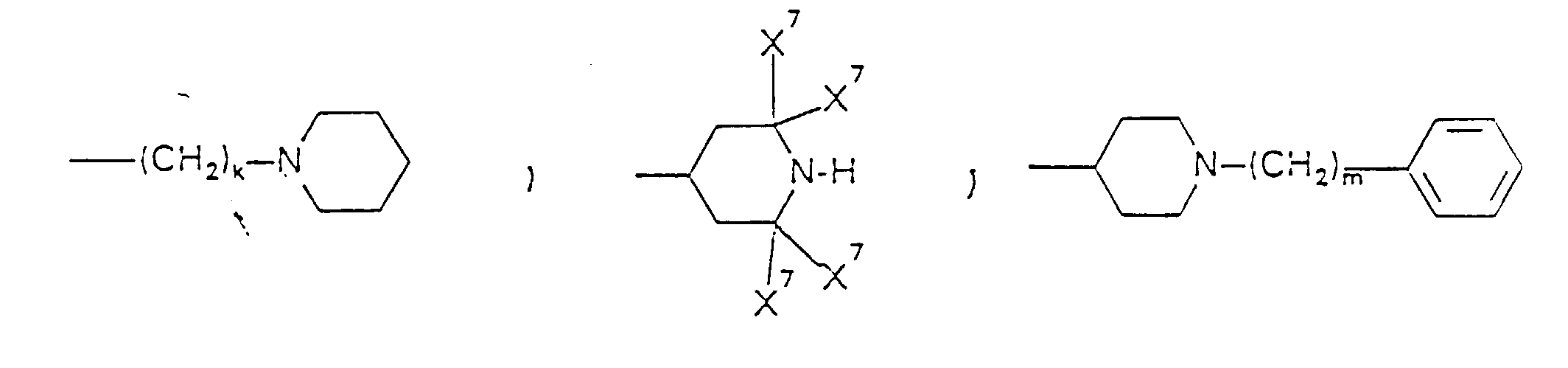
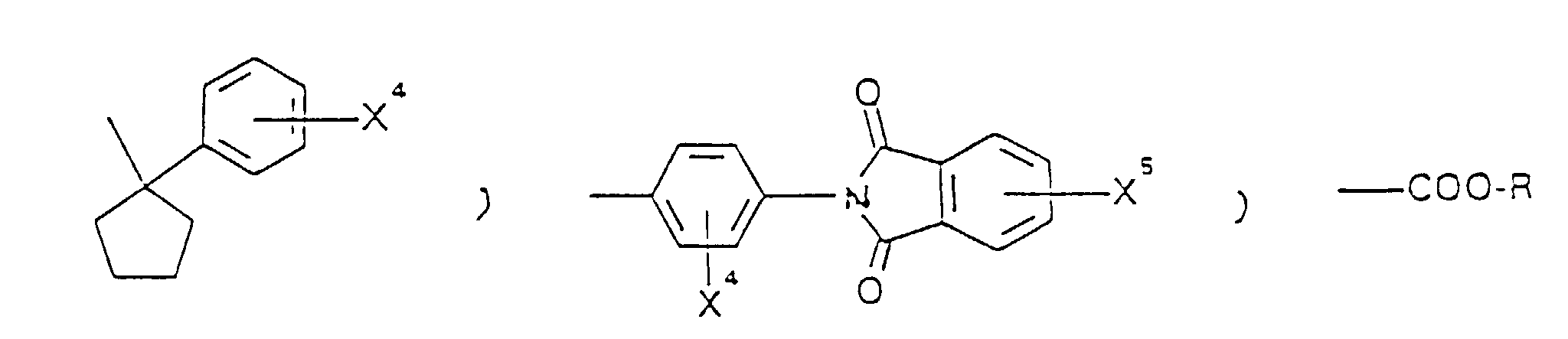
k is an integer from 2 to 4, m is an integer from 0 to 5, X4, X5, X6, identical or different, are H, a straight or branched alkyl or alkoxy group from 1 to 8 carbon atoms, a hydroxy, trifluoromethyl, nitro, amino, dimethylamino, diethyl amino group, a halogen atom (F, Cl, Br, I), X4 and X5 may form an alkylidendioxy ring having from 1 to 4 carbon atoms, X7 is H or CH3, R is a straight or branched alkyl group having from 1 to 6 carbon atoms, an aryl or alkylaryl group from 6 to 9 carbon atoms. - Compounds of formula (I) according to claim 3, where- X1 and X2, identical or different, are a linear or branched alkyl group from 1 to 6 carbon atoms,- X3 is H or an alkyl group from 1 to 4 carbon atoms,- R1 and R2 identical are H or a linear or branched alkyl group from 1 to 4 carbon atoms,- n is zero or 1, when n is 1 B is CH2,- Z is H, an acyl group R3-CO where R3 is an alkyl group from 1 to 4 carbon atoms and- A is H or is selected among the following groups


- Compounds of formule (I) according to claim 3 where:- X1 and X2 are each a tert-butyl group,- X3 is H,- R1 and R2 are each an ethyl group,- n is zero,- Z is H and- A is selected among the following groups:

- Aminophosphonate derivatives according to claim 3, selected among the group comprising:- diethyl α-(3,5-di-tert-butyl-4-hydroxyphenyl)-N-phenyl-aminomethylphosphonate,- diethyl α-(3,5-di-tert-butyl-4-hydroxyphenyl)-N-(4-hydroxyphenyl)aminomethylphosphonate,- diethyl α-(3,5-di-tert-butyl-4-hydroxyphenyl)-N-(4-chlorophenyl)aminomethylphosphonate,- diethyl α-(3,5-di-tert-butyl-4-hydroxyphenyl)-N-(4-methoxyphenyl) aminomethylphosphonate,- diethyl α-(3,5-di-tert-butyl-4-hydroxyphenyl)-N-(3-methylphenyl)aminomethylphosphonate,- diethyl α-(3,5-di-tert-butyl-4-hydroxyphenyl)-N-(4-ethoxyphenyl)-aminomethylphosphonate,- diethyl α-(3,5-di-tert-butyl-4-hydroxyphenyl)-N-(4-pentylphenyl)-aminomethylphosphonate,- diethyl α-(3,5-di-tert-butyl-4-hydroxyphenyl)-N-[4-(4-chlorophtalimido)-3-methylphenyl] aminomethylphosphonate,- diethyl α-(3,5-di-tert-butyl-4-hydroxyphenyl)-N-benzyl-aminomethylphosphonate,- diethyl α-(3,5-di-tert-butyl-4-hydroxyphenyl)-N-(2-phenylethyl)aminomethylphosphonate,- diethyl α-(3,5-di-tert-butyl-4-hydroxyphenyl)-N-[2-(4-hydroxyphenyl)ethyl]-aminomethylphosphonate,- dimethyl α-(3,5-di-tert-butyl-4-hydroxyphenyl)-N-[2-(4-chlorophenyl)ethyl]-aminomethylphosphonate,- diethyl α-(3,5-di-tert-butyl-4-hydroxyphenyl)-N-[2-(4-chlorophenyl)ethyl]-aminomethylphosphonate,- dipropyl α-(3,5-di-tert-butyl-4-hydroxyphenyl)-N-[2-(4-chlorophenyl)ethyl]-aminomethylphosphonate,- diisopropyl α-(3,5-di-tert-butyl-4-hydroxyphenyl)-N-[2-(4-chlorophenyl)ethyl]-aminomethylphosphonate,- dimethyl α-(3,5-di-tert-butyl-4-hydroxyphenyl)-N-(3-phenylpropyl)-aminomethylphosphonate,- diethyl α-(3,5-di-tert-butyl-4-hydroxyphenyl)-N-(3-phenylpropyl)-aminomethylphosphonate,- diisopropyl α-(3,5-di-tert-butyl-4-hydroxyphenyl)-N-(3-phenylpropyl)-aminomethylphosphonate,- diethyl α-(3,5-di-tert-butyl-4-hydroxyphenyl)-N-(4-phenylbutyl)-aminomethylphosphonate,- diethyl α-(3,5-di-tert-butyl-4-hydroxyphenyl)-N-(1-phenylethyl)-aminomethylphosphonate,- diethyl α-(3,5-di-tert-butyl-4-hydroxyphenyl)-N-(2,2,6,6-tetramethyl-4-piperidyl)-aminomethylphosphonate,- diethyl α-(3,5-di-tert-butyl-4-hydroxyphenyl)-N-piperonyl-aminomethylphosphonate,- diethyl α-(3,5-di-tert-butyl-4-hydroxyphenyl)-N-(3,5-di-tert-butyl-4-hydroxybenzyl)-aminomethylphosphonate,- diethyl α-(3,5-di-tert-butyl-4-hydroxyphenyl)-N-(3-picolyl)-aminomethylphosphonate,- diethyl α-(3,5-di-tert-butyl-4-hydroxyphenyl)-N-[2-(2-pyridyl)ethyl]-aminomethylphosphonate,- diethyl α-(3,5-di-tert-butyl-4-hydroxyphenyl)-N-(2-benzothiazolyl)-aminomethylphosphonate,- diethyl α-(3,5-di-tert-butyl-4-hydroxyphenyl)-N-(1-phenylcyclopentyl)-aminomethylphosphonate,- diethyl α-(3,5-di-tert-butyl-4-hydroxyphenyl)-N-(3-pyridyl)-aminomethylphosphonate,- diethyl α-(3,4-methylenedioxyphenyl)-N-(3-phenylpropyl)-aminomethylphosphonate,- diethyl α-(3,5-di-tert-butyl-4-hydroxyphenyl)-N-methyl-N-(3-picolyl)-aminomethylphosphonate,- dimethyl α-(3,5-di-tert-butyl-4-hydroxyphenyl)-N-acetyl-N-(3-phenylpropyl)aminomethylphosphonate,- diethyl α-(3,5-di-tert-butyl-4-hydroxyphenyl)-N-acetyl-N-(3-phenylpropyl)-aminomethylphosphonate,- dipropyl α-(3,5-di-tert-butyl-4-hydroxyphenyl)-N-acetyl-N-(3-phenylpropyl) aminomethylphosphonate,- diisopropyl α-(3,5-di-tert-butyl-4-hydroxyphenyl)-N-acetyl-N-(3-phenylpropyl)aminomethylphosphonate,- diethyl α-(3,5-di-tert-butyl-4-methoxyphenyl)-N-(3-phenylpropyl)aminomethylphosphonate,- diethyl α-(3,5-di-tert-butyl-4-hydroxybenzyl)-N-(3-phenylpropyl)-aminomethylphosphonate,- diethyl α-(3,5-di-sec-butyl-4-hydroxyphenyl)-N-(2-phenylethyl)-aminomethylphosphonate,- diethyl α-(3,5-di-isopropyl-4-hydroxyphenyl)-N-(2-phenylethyl)-aminomethylphosphonate,- diethyl α-(4-hydroxyphenyl)-N-[2-(4-chlorophenyl)ethyl]-aminomethylphosphonate,- α-(3,5-di-tert-butyl-4-hydroxyphenyl)-N-(3-phenylpropyl)-aminomethylphosphonic acid,- di-tert-butyl α-(3,5-di-tert-butyl-4-hydroxyphenyl)-N-[2-(4-chlorophenyl) ethyl]-aminomethylphosphonate,- diethyl α-(3,5-di-tert-butyl-4-hydroxyphenyl)-aminomethylphosphonate,- diethyl α-(3,5-di-tert-butyl-4-hydroxyphenyl)-N-allyl-aminomethylphosphonate,- diethyl α-(3,5-di-tert-butyl-4-hydroxyphenyl)-N-benzyloxycarbonyl-aminomethylphosphonate,- diethyl α-(3,5-di-tert-butyl-4-hydroxyphenyl)-N-(4-picolyl)-aminomethylphosphonate,- diethyl α-(4-hydroxyphenyl)-N-(3,5-di-tert-butyl-4-hydroxybenzyl)-aminomethylphosphonate,- diethyl α-(3,5-di-tert-butyl-4-hydroxyphenyl)-N-(2-phenylpropyl)-aminomethylphosphonate,- diethyl α-(3,5-di-tert-butyl-4-hydroxyphenyl)-N-(2,2-dimethyl-4-phenyl-1,3-dioxa-5-cyclohexyl)-aminomethylphosphonate,- diethyl α-(3,5-di-tert-butyl-4-hydroxyphenyl)-N-acetyl-N-[2-(2-pyridyl)ethyl]-aminomethylphosphonate,- diethyl α-(3,5-di-tert-butyl-4-hydroxyphenyl)-N-heptafluorobutyryl-N-(3-phenylpropyl)-aminomethylphosphonate and- diethyl α-(3,5-di-tert-butyl-4-hydroxyphenyl)-N-(2-picolyl)-aminomethylphosphonate.
- Process for preparing aminophosphonate of formule (I) according to claim 1, which consists in reacting an imine of formula (IV) with a dialkyl phosphite of formula (V)

- Process according to claim 7 where the reaction is catalyzed by an amine, for example diethylamine, or triethylamine.
- Process for preparing aminomethylphosphonate esters of formula (I) according to claim 1, which consists in reacting an imine of formula (IV) with a reagent trimethylsilyl-dialkylphosphite of formula (VI)

- Process according to claim 9 where the imine of formula IV is obtained by condensing the aldehyde of formula (II) and the primary amine III, where Z=H

- Process for preparing aminophosphonic acids of formula (I) where R1=R2=H according to claim 1 by hydrolysis of aminophosphonate esters of formules (I), where R1 and R2 are alkyl groups from 1 to 4 carbon atoms with concentrated hydrochloric acid at reflux or with bromotrimethylsilane followed by aqueous hydrolysis.
- Process for preparing N-acylated aminophosphonates of formula (I) according to claim 1 by acylation of the corresponding aminophosphonate (I) where at least one of the two groups A or Z is H, with an acylating reagent (VII) in presence of a tertiary amine in a solvent such as petroleum ether, benzene, toluene, ether, tetrahydrofuran.

- Process for preparing aminophosphonates of formula (I) according to claim 1 where A = Z = H by catalytic hydrogenation of the corresponding aminophosphonate of formula (I) where Z = H and A is an α-substituted benzyl group such as 1-phenylethyl, 1-phenylcyclopentyl or a benzyl oxycarbonyl group, using as catalyst palladium on charcoal or palladium (II) hydroxide on charcoal and ethanol or glacial acetic acid as solvent.
- Pharmaceutical composition comprising a therapeutically effective amount of at least one aminophosphonate of formula (I) according to claim 3, in combination with a pharmaceutically acceptable support.
- Pharmaceutical composition according to claim 14 for the treatment or arteriosclerosis by decreasing plasma cholesterol and blood peroxides.
Applications Claiming Priority (2)
| Application Number | Priority Date | Filing Date | Title |
|---|---|---|---|
| CH704/92A CH683996A5 (en) | 1992-03-05 | 1992-03-05 | aminophosphonates substituted derivatives, process for their preparation and pharmaceutical compositions containing them. |
| CH704/92 | 1992-03-05 |
Publications (2)
| Publication Number | Publication Date |
|---|---|
| EP0559079A1 EP0559079A1 (en) | 1993-09-08 |
| EP0559079B1 true EP0559079B1 (en) | 1997-08-13 |
Family
ID=4193232
Family Applications (1)
| Application Number | Title | Priority Date | Filing Date |
|---|---|---|---|
| EP93102934A Expired - Lifetime EP0559079B1 (en) | 1992-03-05 | 1993-02-25 | Substituted aminophosphonate derivatives, process for their preparation and pharmaceutical compositions containing them |
Country Status (17)
| Country | Link |
|---|---|
| US (1) | US5424303A (en) |
| EP (1) | EP0559079B1 (en) |
| JP (1) | JPH0649083A (en) |
| KR (1) | KR930019685A (en) |
| AT (1) | ATE156829T1 (en) |
| AU (1) | AU662957B2 (en) |
| CA (1) | CA2091031A1 (en) |
| CH (1) | CH683996A5 (en) |
| DE (1) | DE69312984T2 (en) |
| DK (1) | DK0559079T3 (en) |
| ES (1) | ES2108772T3 (en) |
| FI (1) | FI930974L (en) |
| GR (1) | GR3025268T3 (en) |
| NO (1) | NO303783B1 (en) |
| NZ (1) | NZ247056A (en) |
| SG (1) | SG43831A1 (en) |
| ZA (1) | ZA931473B (en) |
Families Citing this family (21)
| Publication number | Priority date | Publication date | Assignee | Title |
|---|---|---|---|---|
| DE4433244A1 (en) * | 1994-09-19 | 1996-03-28 | Hoechst Ag | Aminomethylphosphonic and aminomethylphosphinic acid derivatives and their use for the treatment of degenerative joint diseases |
| DE19502209A1 (en) * | 1995-01-25 | 1996-08-01 | Hoechst Ag | Phosphonoacetic acid derivatives and their use for the treatment of degenerative joint diseases |
| CH690264A5 (en) * | 1995-06-30 | 2000-06-30 | Symphar Sa | aminophosphonates substituted derivatives, their preparation process and their use for preparing pharmaceutical compositions. |
| GB9626536D0 (en) * | 1996-12-20 | 1997-02-05 | Symphar Sa | Novel compounds |
| GB9626615D0 (en) * | 1996-12-20 | 1997-02-05 | Symphar Sa | Novel compounds |
| GB9626616D0 (en) * | 1996-12-20 | 1997-02-05 | Symphar Sa | Novel compounds |
| JP3418322B2 (en) | 1997-08-28 | 2003-06-23 | 日本電信電話株式会社 | IC card with use status display function and IC card system |
| DE19748659A1 (en) * | 1997-11-04 | 1999-05-06 | Hoechst Ag | Aminophosphonium group-containing crosslinked copolymers for medical uses |
| DE69910045T2 (en) | 1998-09-09 | 2004-04-22 | Metabasis Therapeutics Inc., San Diego | NEW HETEROAROMATIC FRUCTOSE 1,6-BISPHOSPHATASE INHIBITORS |
| JP2003512426A (en) | 1999-10-27 | 2003-04-02 | テバ ファーマシューティカル インダストリーズ リミティド | Use of 1-aminoindan for the treatment of mania in bipolar mood disorder. |
| US7563774B2 (en) | 2000-06-29 | 2009-07-21 | Metabasis Therapeutics, Inc. | Combination of FBPase inhibitors and antidiabetic agents useful for the treatment of diabetes |
| CA2420851A1 (en) | 2000-09-27 | 2002-04-04 | Ilex Oncology Research S.A. | .alpha.-substituted .beta.-aminoethyl phosphonates |
| US20030114421A1 (en) * | 2000-09-27 | 2003-06-19 | Phan Hieu Trung | Alpha-substituted beta-aminoethyl phosphonate derivatives |
| GB0025849D0 (en) | 2000-10-23 | 2000-12-06 | Smithkline Beecham Plc | Novel compounds |
| EP2520290B1 (en) | 2003-12-23 | 2014-12-10 | Abraxis BioScience, LLC | Propofol analogs, process for their preparation, and methods of use |
| JP4824968B2 (en) * | 2005-08-18 | 2011-11-30 | 株式会社クレハ | Phosphonic acid derivatives and acid addition salts thereof, and agricultural and horticultural disease control agents using the same |
| JP2007318972A (en) | 2006-05-29 | 2007-12-06 | Jtekt Corp | Motor and electric power steering device |
| CN101003548B (en) * | 2006-12-12 | 2010-09-08 | 中国林业科学研究院林产化学工业研究所 | Rosin-based diterpene modified α-phosphoramidate, preparation method and antitumor application |
| EP2854539A4 (en) * | 2012-05-14 | 2016-03-09 | Univ Kansas | PHOSPHONATE DERIVATIVES FOR THE TREATMENT OF ALZHEIMER'S DISEASE |
| CN104987350B (en) * | 2015-01-29 | 2017-12-05 | 贵州大学 | One kind has chiral alpha aminophosphonate compound and preparation and the application of the heterocycle containing benzothiazole of antiviral activity |
| CN120736882B (en) * | 2025-09-03 | 2025-11-18 | 营口宏远耐火材料有限公司 | Low-carbon magnesia carbon brick and preparation method thereof |
Family Cites Families (4)
| Publication number | Priority date | Publication date | Assignee | Title |
|---|---|---|---|---|
| DE1200679B (en) * | 1964-04-25 | 1965-09-09 | Agfa Ag | Light-sensitive material with embedded developer substance |
| GB1298199A (en) * | 1969-02-13 | 1972-11-29 | Curwen & Newberry Ltd | Improvements in or relating to boilers or fluid heaters |
| US4144224A (en) * | 1976-11-26 | 1979-03-13 | Ciba-Geigy Corporation | Phosphonate stabilizers |
| CH675422A5 (en) * | 1988-03-31 | 1990-09-28 | Symphar Sa |
-
1992
- 1992-03-05 CH CH704/92A patent/CH683996A5/en not_active IP Right Cessation
-
1993
- 1993-02-25 SG SG1996001674A patent/SG43831A1/en unknown
- 1993-02-25 DE DE69312984T patent/DE69312984T2/en not_active Expired - Fee Related
- 1993-02-25 AT AT93102934T patent/ATE156829T1/en not_active IP Right Cessation
- 1993-02-25 ES ES93102934T patent/ES2108772T3/en not_active Expired - Lifetime
- 1993-02-25 DK DK93102934.2T patent/DK0559079T3/en not_active Application Discontinuation
- 1993-02-25 EP EP93102934A patent/EP0559079B1/en not_active Expired - Lifetime
- 1993-02-26 US US08/024,731 patent/US5424303A/en not_active Expired - Lifetime
- 1993-03-02 ZA ZA931473A patent/ZA931473B/en unknown
- 1993-03-03 NZ NZ247056A patent/NZ247056A/en unknown
- 1993-03-03 NO NO930768A patent/NO303783B1/en unknown
- 1993-03-04 CA CA002091031A patent/CA2091031A1/en not_active Abandoned
- 1993-03-04 AU AU33947/93A patent/AU662957B2/en not_active Ceased
- 1993-03-04 FI FI930974A patent/FI930974L/en unknown
- 1993-03-05 KR KR1019930003335A patent/KR930019685A/en not_active Abandoned
- 1993-03-05 JP JP5069078A patent/JPH0649083A/en active Pending
-
1997
- 1997-11-05 GR GR970402906T patent/GR3025268T3/en unknown
Also Published As
| Publication number | Publication date |
|---|---|
| FI930974A7 (en) | 1993-09-06 |
| FI930974A0 (en) | 1993-03-04 |
| ZA931473B (en) | 1993-09-23 |
| FI930974L (en) | 1993-09-06 |
| KR930019685A (en) | 1993-10-18 |
| NZ247056A (en) | 1995-08-28 |
| DE69312984T2 (en) | 1998-03-12 |
| CH683996A5 (en) | 1994-06-30 |
| SG43831A1 (en) | 1997-11-14 |
| CA2091031A1 (en) | 1993-09-06 |
| ES2108772T3 (en) | 1998-01-01 |
| NO930768D0 (en) | 1993-03-03 |
| AU662957B2 (en) | 1995-09-21 |
| DE69312984D1 (en) | 1997-09-18 |
| EP0559079A1 (en) | 1993-09-08 |
| GR3025268T3 (en) | 1998-02-27 |
| US5424303A (en) | 1995-06-13 |
| DK0559079T3 (en) | 1998-03-30 |
| JPH0649083A (en) | 1994-02-22 |
| NO303783B1 (en) | 1998-08-31 |
| NO930768L (en) | 1993-09-06 |
| ATE156829T1 (en) | 1997-08-15 |
| AU3394793A (en) | 1993-09-09 |
Similar Documents
| Publication | Publication Date | Title |
|---|---|---|
| EP0559079B1 (en) | Substituted aminophosphonate derivatives, process for their preparation and pharmaceutical compositions containing them | |
| AU705206B2 (en) | Compounds and pharmaceutical compositions containing them | |
| US5128331A (en) | Method for lowering plasma lipid levels or blood pressure | |
| JP3526575B2 (en) | Phosphonic acid derivatives | |
| AU653681B2 (en) | Phosphonic diester derivative | |
| EP0946572B1 (en) | Pharmaceutical aminophosphonic acid derivatives | |
| MXPA98000189A (en) | Compounds and pharmaceutical compositions that contains them | |
| WO1994009017A1 (en) | Pyrimidine bisphosphonate esters and (alkoxymethylphosphinyl)alkyl phosphonic acids as anti-inflammatories | |
| WO1998028311A1 (en) | Pharmaceutical aminophosphonic acid derivatives | |
| WO1998028312A1 (en) | Pharmaceutical aminophosphonic acid derivatives | |
| JPH05239075A (en) | Phosphorus-containing isoprenoid derivative | |
| US6468992B1 (en) | Phosphonic acid diester derivatives | |
| US4897503A (en) | 1,1,2-triaryl-1-alkene derivatives | |
| CA2426773A1 (en) | Beta-substituted beta-aminoethyl phosphonates | |
| WO2004026242A2 (en) | Substituted ketophosphonate inhibitors of tumor cell proliferation | |
| US20050124581A1 (en) | Alpha-substituted heteroarylalkyl phosphonate derivatives | |
| ZA200406781B (en) | Alpha-substituted arylalkyl phosphonate derivatives. |
Legal Events
| Date | Code | Title | Description |
|---|---|---|---|
| PUAI | Public reference made under article 153(3) epc to a published international application that has entered the european phase |
Free format text: ORIGINAL CODE: 0009012 |
|
| AK | Designated contracting states |
Kind code of ref document: A1 Designated state(s): AT BE CH DE DK ES FR GB GR IE IT LI LU NL PT SE |
|
| 17P | Request for examination filed |
Effective date: 19931206 |
|
| 17Q | First examination report despatched |
Effective date: 19960112 |
|
| GRAG | Despatch of communication of intention to grant |
Free format text: ORIGINAL CODE: EPIDOS AGRA |
|
| GRAH | Despatch of communication of intention to grant a patent |
Free format text: ORIGINAL CODE: EPIDOS IGRA |
|
| GRAH | Despatch of communication of intention to grant a patent |
Free format text: ORIGINAL CODE: EPIDOS IGRA |
|
| GRAA | (expected) grant |
Free format text: ORIGINAL CODE: 0009210 |
|
| AK | Designated contracting states |
Kind code of ref document: B1 Designated state(s): AT BE CH DE DK ES FR GB GR IE IT LI LU NL PT SE |
|
| REF | Corresponds to: |
Ref document number: 156829 Country of ref document: AT Date of ref document: 19970815 Kind code of ref document: T |
|
| REG | Reference to a national code |
Ref country code: CH Ref legal event code: EP |
|
| REF | Corresponds to: |
Ref document number: 69312984 Country of ref document: DE Date of ref document: 19970918 |
|
| ITF | It: translation for a ep patent filed | ||
| REG | Reference to a national code |
Ref country code: CH Ref legal event code: NV Representative=s name: MICHELI & CIE INGENIEURS-CONSEILS |
|
| ET | Fr: translation filed | ||
| REG | Reference to a national code |
Ref country code: PT Ref legal event code: SC4A Free format text: AVAILABILITY OF NATIONAL TRANSLATION Effective date: 19970922 |
|
| REG | Reference to a national code |
Ref country code: ES Ref legal event code: FG2A Ref document number: 2108772 Country of ref document: ES Kind code of ref document: T3 |
|
| REG | Reference to a national code |
Ref country code: GR Ref legal event code: FG4A Free format text: 3025268 |
|
| REG | Reference to a national code |
Ref country code: DK Ref legal event code: T3 |
|
| PLBE | No opposition filed within time limit |
Free format text: ORIGINAL CODE: 0009261 |
|
| STAA | Information on the status of an ep patent application or granted ep patent |
Free format text: STATUS: NO OPPOSITION FILED WITHIN TIME LIMIT |
|
| 26N | No opposition filed | ||
| REG | Reference to a national code |
Ref country code: GB Ref legal event code: IF02 |
|
| REG | Reference to a national code |
Ref country code: CH Ref legal event code: PFA Free format text: SYMPHAR S.A. TRANSFER- ILEX ONCOLOGY RESEARCH SA |
|
| NLT1 | Nl: modifications of names registered in virtue of documents presented to the patent office pursuant to art. 16 a, paragraph 1 |
Owner name: ILEX ONCOLOGY RESEARCH S.A. |
|
| PGFP | Annual fee paid to national office [announced via postgrant information from national office to epo] |
Ref country code: PT Payment date: 20030123 Year of fee payment: 11 |
|
| PGFP | Annual fee paid to national office [announced via postgrant information from national office to epo] |
Ref country code: IE Payment date: 20030129 Year of fee payment: 11 |
|
| PGFP | Annual fee paid to national office [announced via postgrant information from national office to epo] |
Ref country code: GR Payment date: 20030130 Year of fee payment: 11 Ref country code: GB Payment date: 20030130 Year of fee payment: 11 |
|
| PGFP | Annual fee paid to national office [announced via postgrant information from national office to epo] |
Ref country code: NL Payment date: 20030204 Year of fee payment: 11 Ref country code: SE Payment date: 20030204 Year of fee payment: 11 |
|
| PGFP | Annual fee paid to national office [announced via postgrant information from national office to epo] |
Ref country code: LU Payment date: 20030205 Year of fee payment: 11 Ref country code: AT Payment date: 20030205 Year of fee payment: 11 |
|
| PGFP | Annual fee paid to national office [announced via postgrant information from national office to epo] |
Ref country code: FR Payment date: 20030206 Year of fee payment: 11 Ref country code: DK Payment date: 20030206 Year of fee payment: 11 |
|
| PGFP | Annual fee paid to national office [announced via postgrant information from national office to epo] |
Ref country code: DE Payment date: 20030208 Year of fee payment: 11 |
|
| PGFP | Annual fee paid to national office [announced via postgrant information from national office to epo] |
Ref country code: ES Payment date: 20030217 Year of fee payment: 11 |
|
| PGFP | Annual fee paid to national office [announced via postgrant information from national office to epo] |
Ref country code: BE Payment date: 20030219 Year of fee payment: 11 |
|
| PGFP | Annual fee paid to national office [announced via postgrant information from national office to epo] |
Ref country code: CH Payment date: 20030508 Year of fee payment: 11 |
|
| PG25 | Lapsed in a contracting state [announced via postgrant information from national office to epo] |
Ref country code: LU Free format text: LAPSE BECAUSE OF NON-PAYMENT OF DUE FEES Effective date: 20040225 Ref country code: IE Free format text: LAPSE BECAUSE OF NON-PAYMENT OF DUE FEES Effective date: 20040225 Ref country code: GB Free format text: LAPSE BECAUSE OF NON-PAYMENT OF DUE FEES Effective date: 20040225 Ref country code: AT Free format text: LAPSE BECAUSE OF NON-PAYMENT OF DUE FEES Effective date: 20040225 |
|
| PG25 | Lapsed in a contracting state [announced via postgrant information from national office to epo] |
Ref country code: SE Free format text: LAPSE BECAUSE OF NON-PAYMENT OF DUE FEES Effective date: 20040226 Ref country code: ES Free format text: LAPSE BECAUSE OF NON-PAYMENT OF DUE FEES Effective date: 20040226 |
|
| PG25 | Lapsed in a contracting state [announced via postgrant information from national office to epo] |
Ref country code: BE Free format text: LAPSE BECAUSE OF NON-PAYMENT OF DUE FEES Effective date: 20040228 |
|
| PG25 | Lapsed in a contracting state [announced via postgrant information from national office to epo] |
Ref country code: LI Free format text: LAPSE BECAUSE OF NON-PAYMENT OF DUE FEES Effective date: 20040229 Ref country code: CH Free format text: LAPSE BECAUSE OF NON-PAYMENT OF DUE FEES Effective date: 20040229 |
|
| PG25 | Lapsed in a contracting state [announced via postgrant information from national office to epo] |
Ref country code: DK Free format text: LAPSE BECAUSE OF NON-PAYMENT OF DUE FEES Effective date: 20040301 |
|
| BERE | Be: lapsed |
Owner name: S.A. *SYMPHAR Effective date: 20040228 |
|
| PG25 | Lapsed in a contracting state [announced via postgrant information from national office to epo] |
Ref country code: PT Free format text: LAPSE BECAUSE OF NON-PAYMENT OF DUE FEES Effective date: 20040831 |
|
| PG25 | Lapsed in a contracting state [announced via postgrant information from national office to epo] |
Ref country code: NL Free format text: LAPSE BECAUSE OF NON-PAYMENT OF DUE FEES Effective date: 20040901 Ref country code: DE Free format text: LAPSE BECAUSE OF NON-PAYMENT OF DUE FEES Effective date: 20040901 |
|
| PG25 | Lapsed in a contracting state [announced via postgrant information from national office to epo] |
Ref country code: GR Free format text: LAPSE BECAUSE OF NON-PAYMENT OF DUE FEES Effective date: 20040903 |
|
| REG | Reference to a national code |
Ref country code: DK Ref legal event code: EBP |
|
| EUG | Se: european patent has lapsed | ||
| GBPC | Gb: european patent ceased through non-payment of renewal fee |
Effective date: 20040225 |
|
| REG | Reference to a national code |
Ref country code: CH Ref legal event code: PL |
|
| PG25 | Lapsed in a contracting state [announced via postgrant information from national office to epo] |
Ref country code: FR Free format text: LAPSE BECAUSE OF NON-PAYMENT OF DUE FEES Effective date: 20041029 |
|
| NLV4 | Nl: lapsed or anulled due to non-payment of the annual fee |
Effective date: 20040901 |
|
| REG | Reference to a national code |
Ref country code: IE Ref legal event code: MM4A |
|
| REG | Reference to a national code |
Ref country code: FR Ref legal event code: ST |
|
| PG25 | Lapsed in a contracting state [announced via postgrant information from national office to epo] |
Ref country code: IT Free format text: LAPSE BECAUSE OF NON-PAYMENT OF DUE FEES;WARNING: LAPSES OF ITALIAN PATENTS WITH EFFECTIVE DATE BEFORE 2007 MAY HAVE OCCURRED AT ANY TIME BEFORE 2007. THE CORRECT EFFECTIVE DATE MAY BE DIFFERENT FROM THE ONE RECORDED. Effective date: 20050225 |
|
| REG | Reference to a national code |
Ref country code: ES Ref legal event code: FD2A Effective date: 20040226 |