EP0337435B1 - Verfahren zur Herstellung deckender Diketopyrrolopyrrolpigmente - Google Patents
Verfahren zur Herstellung deckender Diketopyrrolopyrrolpigmente Download PDFInfo
- Publication number
- EP0337435B1 EP0337435B1 EP89106531A EP89106531A EP0337435B1 EP 0337435 B1 EP0337435 B1 EP 0337435B1 EP 89106531 A EP89106531 A EP 89106531A EP 89106531 A EP89106531 A EP 89106531A EP 0337435 B1 EP0337435 B1 EP 0337435B1
- Authority
- EP
- European Patent Office
- Prior art keywords
- pigment
- alcohol
- methanol
- process according
- pigments
- Prior art date
- Legal status (The legal status is an assumption and is not a legal conclusion. Google has not performed a legal analysis and makes no representation as to the accuracy of the status listed.)
- Expired - Lifetime
Links
- 239000000049 pigment Substances 0.000 title claims description 59
- 238000000034 method Methods 0.000 title claims description 23
- FYNROBRQIVCIQF-UHFFFAOYSA-N pyrrolo[3,2-b]pyrrole-5,6-dione Chemical compound C1=CN=C2C(=O)C(=O)N=C21 FYNROBRQIVCIQF-UHFFFAOYSA-N 0.000 title description 8
- 238000004519 manufacturing process Methods 0.000 title description 4
- OKKJLVBELUTLKV-UHFFFAOYSA-N Methanol Chemical compound OC OKKJLVBELUTLKV-UHFFFAOYSA-N 0.000 claims description 49
- LFQSCWFLJHTTHZ-UHFFFAOYSA-N Ethanol Chemical compound CCO LFQSCWFLJHTTHZ-UHFFFAOYSA-N 0.000 claims description 26
- HEMHJVSKTPXQMS-UHFFFAOYSA-M sodium hydroxide Inorganic materials [OH-].[Na+] HEMHJVSKTPXQMS-UHFFFAOYSA-M 0.000 claims description 19
- 239000002585 base Substances 0.000 claims description 13
- KWYUFKZDYYNOTN-UHFFFAOYSA-M Potassium hydroxide Chemical compound [OH-].[K+] KWYUFKZDYYNOTN-UHFFFAOYSA-M 0.000 claims description 11
- DNIAPMSPPWPWGF-UHFFFAOYSA-N Propylene glycol Chemical compound CC(O)CO DNIAPMSPPWPWGF-UHFFFAOYSA-N 0.000 claims description 9
- LYCAIKOWRPUZTN-UHFFFAOYSA-N Ethylene glycol Chemical compound OCCO LYCAIKOWRPUZTN-UHFFFAOYSA-N 0.000 claims description 6
- LRHPLDYGYMQRHN-UHFFFAOYSA-N N-Butanol Chemical compound CCCCO LRHPLDYGYMQRHN-UHFFFAOYSA-N 0.000 claims description 6
- 238000002360 preparation method Methods 0.000 claims description 5
- AMQJEAYHLZJPGS-UHFFFAOYSA-N N-Pentanol Chemical compound CCCCCO AMQJEAYHLZJPGS-UHFFFAOYSA-N 0.000 claims description 4
- 229910052739 hydrogen Inorganic materials 0.000 claims description 3
- 239000001257 hydrogen Substances 0.000 claims description 3
- 125000004435 hydrogen atom Chemical group [H]* 0.000 claims description 3
- 238000003801 milling Methods 0.000 claims description 3
- ZAMOUSCENKQFHK-UHFFFAOYSA-N Chlorine atom Chemical group [Cl] ZAMOUSCENKQFHK-UHFFFAOYSA-N 0.000 claims description 2
- DGAQECJNVWCQMB-PUAWFVPOSA-M Ilexoside XXIX Chemical group C[C@@H]1CC[C@@]2(CC[C@@]3(C(=CC[C@H]4[C@]3(CC[C@@H]5[C@@]4(CC[C@@H](C5(C)C)OS(=O)(=O)[O-])C)C)[C@@H]2[C@]1(C)O)C)C(=O)O[C@H]6[C@@H]([C@H]([C@@H]([C@H](O6)CO)O)O)O.[Na+] DGAQECJNVWCQMB-PUAWFVPOSA-M 0.000 claims description 2
- 150000008044 alkali metal hydroxides Chemical class 0.000 claims description 2
- 235000011114 ammonium hydroxide Nutrition 0.000 claims description 2
- 239000000460 chlorine Chemical group 0.000 claims description 2
- 229910052801 chlorine Inorganic materials 0.000 claims description 2
- 125000002496 methyl group Chemical group [H]C([H])([H])* 0.000 claims description 2
- QKWILNTYPDJSME-UHFFFAOYSA-N pyrrolo[3,4-c]pyrrole-3,6-dione Chemical class C1=NC(=O)C2=C1C(=O)N=C2 QKWILNTYPDJSME-UHFFFAOYSA-N 0.000 claims description 2
- 125000001453 quaternary ammonium group Chemical group 0.000 claims description 2
- 125000000999 tert-butyl group Chemical group [H]C([H])([H])C(*)(C([H])([H])[H])C([H])([H])[H] 0.000 claims description 2
- 239000011521 glass Substances 0.000 description 18
- 238000000227 grinding Methods 0.000 description 15
- 239000000203 mixture Substances 0.000 description 14
- VYPSYNLAJGMNEJ-UHFFFAOYSA-N Silicium dioxide Chemical compound O=[Si]=O VYPSYNLAJGMNEJ-UHFFFAOYSA-N 0.000 description 12
- XLYOFNOQVPJJNP-UHFFFAOYSA-N water Substances O XLYOFNOQVPJJNP-UHFFFAOYSA-N 0.000 description 12
- 239000000919 ceramic Substances 0.000 description 10
- MCMNRKCIXSYSNV-UHFFFAOYSA-N Zirconium dioxide Chemical compound O=[Zr]=O MCMNRKCIXSYSNV-UHFFFAOYSA-N 0.000 description 8
- 239000003795 chemical substances by application Substances 0.000 description 7
- 239000004922 lacquer Substances 0.000 description 7
- 239000003960 organic solvent Substances 0.000 description 7
- 239000008096 xylene Substances 0.000 description 7
- CTQNGGLPUBDAKN-UHFFFAOYSA-N O-Xylene Chemical compound CC1=CC=CC=C1C CTQNGGLPUBDAKN-UHFFFAOYSA-N 0.000 description 6
- 229910052782 aluminium Inorganic materials 0.000 description 6
- 239000008187 granular material Substances 0.000 description 6
- 229920003023 plastic Polymers 0.000 description 6
- 239000004033 plastic Substances 0.000 description 6
- 239000001054 red pigment Substances 0.000 description 6
- 239000000725 suspension Substances 0.000 description 6
- XAGFODPZIPBFFR-UHFFFAOYSA-N aluminium Chemical compound [Al] XAGFODPZIPBFFR-UHFFFAOYSA-N 0.000 description 5
- 239000002270 dispersing agent Substances 0.000 description 5
- 239000000976 ink Substances 0.000 description 5
- 239000003973 paint Substances 0.000 description 5
- 235000012239 silicon dioxide Nutrition 0.000 description 5
- 239000000243 solution Substances 0.000 description 5
- 239000002966 varnish Substances 0.000 description 5
- IGPFDBHTWKTPFD-UHFFFAOYSA-N 1,4-diphenylpyrrolo[3,4-c]pyrrole-3,6-dione Chemical compound C=1C=CC=CC=1C1=NC(=O)C2=C1C(=O)N=C2C1=CC=CC=C1 IGPFDBHTWKTPFD-UHFFFAOYSA-N 0.000 description 4
- RSWGJHLUYNHPMX-UHFFFAOYSA-N Abietic-Saeure Natural products C12CCC(C(C)C)=CC2=CCC2C1(C)CCCC2(C)C(O)=O RSWGJHLUYNHPMX-UHFFFAOYSA-N 0.000 description 4
- 229920000877 Melamine resin Polymers 0.000 description 4
- 229910052681 coesite Inorganic materials 0.000 description 4
- 229910052906 cristobalite Inorganic materials 0.000 description 4
- 239000012065 filter cake Substances 0.000 description 4
- 239000003921 oil Substances 0.000 description 4
- 239000004800 polyvinyl chloride Substances 0.000 description 4
- 229920000915 polyvinyl chloride Polymers 0.000 description 4
- 239000000047 product Substances 0.000 description 4
- 239000000377 silicon dioxide Substances 0.000 description 4
- 238000003756 stirring Methods 0.000 description 4
- 229910052682 stishovite Inorganic materials 0.000 description 4
- 229910052905 tridymite Inorganic materials 0.000 description 4
- 238000001291 vacuum drying Methods 0.000 description 4
- 238000001238 wet grinding Methods 0.000 description 4
- IGKHBMWUGKPAGT-UHFFFAOYSA-N 1,4-bis(4-methylphenyl)pyrrolo[3,4-c]pyrrole-3,6-dione Chemical compound C1=CC(C)=CC=C1C1=NC(=O)C2=C1C(=O)N=C2C1=CC=C(C)C=C1 IGKHBMWUGKPAGT-UHFFFAOYSA-N 0.000 description 3
- ZWEHNKRNPOVVGH-UHFFFAOYSA-N 2-Butanone Chemical compound CCC(C)=O ZWEHNKRNPOVVGH-UHFFFAOYSA-N 0.000 description 3
- DKPFZGUDAPQIHT-UHFFFAOYSA-N Butyl acetate Natural products CCCCOC(C)=O DKPFZGUDAPQIHT-UHFFFAOYSA-N 0.000 description 3
- WMFOQBRAJBCJND-UHFFFAOYSA-M Lithium hydroxide Chemical compound [Li+].[OH-] WMFOQBRAJBCJND-UHFFFAOYSA-M 0.000 description 3
- 239000004640 Melamine resin Substances 0.000 description 3
- ZMXDDKWLCZADIW-UHFFFAOYSA-N N,N-Dimethylformamide Chemical compound CN(C)C=O ZMXDDKWLCZADIW-UHFFFAOYSA-N 0.000 description 3
- KHPCPRHQVVSZAH-HUOMCSJISA-N Rosin Natural products O(C/C=C/c1ccccc1)[C@H]1[C@H](O)[C@@H](O)[C@@H](O)[C@@H](CO)O1 KHPCPRHQVVSZAH-HUOMCSJISA-N 0.000 description 3
- -1 aliphatic alcohols Chemical class 0.000 description 3
- NDKBVBUGCNGSJJ-UHFFFAOYSA-M benzyltrimethylammonium hydroxide Chemical compound [OH-].C[N+](C)(C)CC1=CC=CC=C1 NDKBVBUGCNGSJJ-UHFFFAOYSA-M 0.000 description 3
- 238000001035 drying Methods 0.000 description 3
- 239000000835 fiber Substances 0.000 description 3
- FUZZWVXGSFPDMH-UHFFFAOYSA-N hexanoic acid Chemical compound CCCCCC(O)=O FUZZWVXGSFPDMH-UHFFFAOYSA-N 0.000 description 3
- YKPJEYXZEBLYCI-UHFFFAOYSA-N pyrrolo[3,4-c]pyrrole Chemical compound C1=NC=C2C=NC=C21 YKPJEYXZEBLYCI-UHFFFAOYSA-N 0.000 description 3
- 229920005989 resin Polymers 0.000 description 3
- 239000011347 resin Substances 0.000 description 3
- 150000003839 salts Chemical class 0.000 description 3
- KHPCPRHQVVSZAH-UHFFFAOYSA-N trans-cinnamyl beta-D-glucopyranoside Natural products OC1C(O)C(O)C(CO)OC1OCC=CC1=CC=CC=C1 KHPCPRHQVVSZAH-UHFFFAOYSA-N 0.000 description 3
- 238000005406 washing Methods 0.000 description 3
- XNWFRZJHXBZDAG-UHFFFAOYSA-N 2-METHOXYETHANOL Chemical compound COCCO XNWFRZJHXBZDAG-UHFFFAOYSA-N 0.000 description 2
- NKHUXLDXYURVLX-UHFFFAOYSA-N 2h-pyrrolo[3,4-c]pyrrole-4,6-dione Chemical compound N1C=C2C(=O)NC(=O)C2=C1 NKHUXLDXYURVLX-UHFFFAOYSA-N 0.000 description 2
- VZCYOOQTPOCHFL-OWOJBTEDSA-N Fumaric acid Chemical compound OC(=O)\C=C\C(O)=O VZCYOOQTPOCHFL-OWOJBTEDSA-N 0.000 description 2
- 229920003264 Maprenal® Polymers 0.000 description 2
- JUJWROOIHBZHMG-UHFFFAOYSA-N Pyridine Chemical compound C1=CC=NC=C1 JUJWROOIHBZHMG-UHFFFAOYSA-N 0.000 description 2
- KAESVJOAVNADME-UHFFFAOYSA-N Pyrrole Chemical compound C=1C=CNC=1 KAESVJOAVNADME-UHFFFAOYSA-N 0.000 description 2
- GWEVSGVZZGPLCZ-UHFFFAOYSA-N Titan oxide Chemical compound O=[Ti]=O GWEVSGVZZGPLCZ-UHFFFAOYSA-N 0.000 description 2
- 229920000180 alkyd Polymers 0.000 description 2
- 239000007864 aqueous solution Substances 0.000 description 2
- 239000011324 bead Substances 0.000 description 2
- 125000004432 carbon atom Chemical group C* 0.000 description 2
- 239000001913 cellulose Substances 0.000 description 2
- 229920002678 cellulose Polymers 0.000 description 2
- MVPPADPHJFYWMZ-UHFFFAOYSA-N chlorobenzene Chemical compound ClC1=CC=CC=C1 MVPPADPHJFYWMZ-UHFFFAOYSA-N 0.000 description 2
- 239000003086 colorant Substances 0.000 description 2
- 238000004040 coloring Methods 0.000 description 2
- JHIVVAPYMSGYDF-UHFFFAOYSA-N cyclohexanone Chemical compound O=C1CCCCC1 JHIVVAPYMSGYDF-UHFFFAOYSA-N 0.000 description 2
- 239000006185 dispersion Substances 0.000 description 2
- UKMSUNONTOPOIO-UHFFFAOYSA-N docosanoic acid Chemical compound CCCCCCCCCCCCCCCCCCCCCC(O)=O UKMSUNONTOPOIO-UHFFFAOYSA-N 0.000 description 2
- 229920001971 elastomer Polymers 0.000 description 2
- 238000001914 filtration Methods 0.000 description 2
- 239000003292 glue Substances 0.000 description 2
- 238000010438 heat treatment Methods 0.000 description 2
- 238000004898 kneading Methods 0.000 description 2
- 239000007788 liquid Substances 0.000 description 2
- 229910052751 metal Inorganic materials 0.000 description 2
- 239000002184 metal Substances 0.000 description 2
- 230000005012 migration Effects 0.000 description 2
- 238000013508 migration Methods 0.000 description 2
- 230000007935 neutral effect Effects 0.000 description 2
- LQNUZADURLCDLV-UHFFFAOYSA-N nitrobenzene Chemical compound [O-][N+](=O)C1=CC=CC=C1 LQNUZADURLCDLV-UHFFFAOYSA-N 0.000 description 2
- GLDOVTGHNKAZLK-UHFFFAOYSA-N octadecan-1-ol Chemical compound CCCCCCCCCCCCCCCCCCO GLDOVTGHNKAZLK-UHFFFAOYSA-N 0.000 description 2
- 229920000728 polyester Polymers 0.000 description 2
- 239000000843 powder Substances 0.000 description 2
- 239000011814 protection agent Substances 0.000 description 2
- 238000005096 rolling process Methods 0.000 description 2
- 239000005060 rubber Substances 0.000 description 2
- 239000004576 sand Substances 0.000 description 2
- 229920001187 thermosetting polymer Polymers 0.000 description 2
- VZCYOOQTPOCHFL-UHFFFAOYSA-N trans-butenedioic acid Natural products OC(=O)C=CC(O)=O VZCYOOQTPOCHFL-UHFFFAOYSA-N 0.000 description 2
- 229910052726 zirconium Inorganic materials 0.000 description 2
- 150000000180 1,2-diols Chemical class 0.000 description 1
- AMEIJSBJFSDMLE-UHFFFAOYSA-N 1,4-bis(4-tert-butylphenyl)pyrrolo[3,4-c]pyrrole-3,6-dione Chemical compound C1=CC(C(C)(C)C)=CC=C1C1=NC(=O)C2=C1C(=O)N=C2C1=CC=C(C(C)(C)C)C=C1 AMEIJSBJFSDMLE-UHFFFAOYSA-N 0.000 description 1
- SVONRAPFKPVNKG-UHFFFAOYSA-N 2-ethoxyethyl acetate Chemical compound CCOCCOC(C)=O SVONRAPFKPVNKG-UHFFFAOYSA-N 0.000 description 1
- BTXXTMOWISPQSJ-UHFFFAOYSA-N 4,4,4-trifluorobutan-2-one Chemical compound CC(=O)CC(F)(F)F BTXXTMOWISPQSJ-UHFFFAOYSA-N 0.000 description 1
- BQACOLQNOUYJCE-FYZZASKESA-N Abietic acid Natural products CC(C)C1=CC2=CC[C@]3(C)[C@](C)(CCC[C@@]3(C)C(=O)O)[C@H]2CC1 BQACOLQNOUYJCE-FYZZASKESA-N 0.000 description 1
- 239000004923 Acrylic lacquer Substances 0.000 description 1
- 239000004925 Acrylic resin Substances 0.000 description 1
- 229920000178 Acrylic resin Polymers 0.000 description 1
- 235000021357 Behenic acid Nutrition 0.000 description 1
- MQIUGAXCHLFZKX-UHFFFAOYSA-N Di-n-octyl phthalate Natural products CCCCCCCCOC(=O)C1=CC=CC=C1C(=O)OCCCCCCCC MQIUGAXCHLFZKX-UHFFFAOYSA-N 0.000 description 1
- 229920000426 Microplastic Polymers 0.000 description 1
- BPQQTUXANYXVAA-UHFFFAOYSA-N Orthosilicate Chemical compound [O-][Si]([O-])([O-])[O-] BPQQTUXANYXVAA-UHFFFAOYSA-N 0.000 description 1
- 239000004698 Polyethylene Substances 0.000 description 1
- 239000004743 Polypropylene Substances 0.000 description 1
- 239000004793 Polystyrene Substances 0.000 description 1
- 239000004972 Polyurethane varnish Substances 0.000 description 1
- 235000021355 Stearic acid Nutrition 0.000 description 1
- QCWXUUIWCKQGHC-UHFFFAOYSA-N Zirconium Chemical compound [Zr] QCWXUUIWCKQGHC-UHFFFAOYSA-N 0.000 description 1
- SMEGJBVQLJJKKX-HOTMZDKISA-N [(2R,3S,4S,5R,6R)-5-acetyloxy-3,4,6-trihydroxyoxan-2-yl]methyl acetate Chemical compound CC(=O)OC[C@@H]1[C@H]([C@@H]([C@H]([C@@H](O1)O)OC(=O)C)O)O SMEGJBVQLJJKKX-HOTMZDKISA-N 0.000 description 1
- BGYHLZZASRKEJE-UHFFFAOYSA-N [3-[3-(3,5-ditert-butyl-4-hydroxyphenyl)propanoyloxy]-2,2-bis[3-(3,5-ditert-butyl-4-hydroxyphenyl)propanoyloxymethyl]propyl] 3-(3,5-ditert-butyl-4-hydroxyphenyl)propanoate Chemical compound CC(C)(C)C1=C(O)C(C(C)(C)C)=CC(CCC(=O)OCC(COC(=O)CCC=2C=C(C(O)=C(C=2)C(C)(C)C)C(C)(C)C)(COC(=O)CCC=2C=C(C(O)=C(C=2)C(C)(C)C)C(C)(C)C)COC(=O)CCC=2C=C(C(O)=C(C=2)C(C)(C)C)C(C)(C)C)=C1 BGYHLZZASRKEJE-UHFFFAOYSA-N 0.000 description 1
- UKLDJPRMSDWDSL-UHFFFAOYSA-L [dibutyl(dodecanoyloxy)stannyl] dodecanoate Chemical compound CCCCCCCCCCCC(=O)O[Sn](CCCC)(CCCC)OC(=O)CCCCCCCCCCC UKLDJPRMSDWDSL-UHFFFAOYSA-L 0.000 description 1
- 229940081735 acetylcellulose Drugs 0.000 description 1
- 239000002253 acid Substances 0.000 description 1
- 150000007513 acids Chemical class 0.000 description 1
- NIXOWILDQLNWCW-UHFFFAOYSA-N acrylic acid group Chemical group C(C=C)(=O)O NIXOWILDQLNWCW-UHFFFAOYSA-N 0.000 description 1
- 239000000654 additive Substances 0.000 description 1
- 150000001408 amides Chemical class 0.000 description 1
- 229920003180 amino resin Polymers 0.000 description 1
- 239000003963 antioxidant agent Substances 0.000 description 1
- 230000003078 antioxidant effect Effects 0.000 description 1
- 239000003849 aromatic solvent Substances 0.000 description 1
- 239000010425 asbestos Substances 0.000 description 1
- POJOORKDYOPQLS-UHFFFAOYSA-L barium(2+) 5-chloro-2-[(2-hydroxynaphthalen-1-yl)diazenyl]-4-methylbenzenesulfonate Chemical compound [Ba+2].C1=C(Cl)C(C)=CC(N=NC=2C3=CC=CC=C3C=CC=2O)=C1S([O-])(=O)=O.C1=C(Cl)C(C)=CC(N=NC=2C3=CC=CC=C3C=CC=2O)=C1S([O-])(=O)=O POJOORKDYOPQLS-UHFFFAOYSA-L 0.000 description 1
- 229940116224 behenate Drugs 0.000 description 1
- 229940116226 behenic acid Drugs 0.000 description 1
- 239000011230 binding agent Substances 0.000 description 1
- 230000015572 biosynthetic process Effects 0.000 description 1
- BJQHLKABXJIVAM-UHFFFAOYSA-N bis(2-ethylhexyl) phthalate Chemical compound CCCCC(CC)COC(=O)C1=CC=CC=C1C(=O)OCC(CC)CCCC BJQHLKABXJIVAM-UHFFFAOYSA-N 0.000 description 1
- 238000009835 boiling Methods 0.000 description 1
- 229920002301 cellulose acetate Polymers 0.000 description 1
- 239000007795 chemical reaction product Substances 0.000 description 1
- 238000000576 coating method Methods 0.000 description 1
- 210000003298 dental enamel Anatomy 0.000 description 1
- 239000012975 dibutyltin dilaurate Substances 0.000 description 1
- 235000014113 dietary fatty acids Nutrition 0.000 description 1
- 238000007865 diluting Methods 0.000 description 1
- 239000003085 diluting agent Substances 0.000 description 1
- 150000002009 diols Chemical group 0.000 description 1
- 150000002028 dodecanols Chemical class 0.000 description 1
- 238000007580 dry-mixing Methods 0.000 description 1
- 238000004043 dyeing Methods 0.000 description 1
- 230000000694 effects Effects 0.000 description 1
- 239000000194 fatty acid Substances 0.000 description 1
- 229930195729 fatty acid Natural products 0.000 description 1
- 150000004665 fatty acids Chemical class 0.000 description 1
- 239000002657 fibrous material Substances 0.000 description 1
- 239000010408 film Substances 0.000 description 1
- 239000011888 foil Substances 0.000 description 1
- 239000001530 fumaric acid Substances 0.000 description 1
- 239000003966 growth inhibitor Substances 0.000 description 1
- 238000001746 injection moulding Methods 0.000 description 1
- 150000007529 inorganic bases Chemical class 0.000 description 1
- 229910010272 inorganic material Inorganic materials 0.000 description 1
- 239000011147 inorganic material Substances 0.000 description 1
- 239000001023 inorganic pigment Substances 0.000 description 1
- 229920002521 macromolecule Polymers 0.000 description 1
- 239000011777 magnesium Substances 0.000 description 1
- 159000000003 magnesium salts Chemical class 0.000 description 1
- VZCYOOQTPOCHFL-UPHRSURJSA-N maleic acid Chemical compound OC(=O)\C=C/C(O)=O VZCYOOQTPOCHFL-UPHRSURJSA-N 0.000 description 1
- JDSHMPZPIAZGSV-UHFFFAOYSA-N melamine Chemical compound NC1=NC(N)=NC(N)=N1 JDSHMPZPIAZGSV-UHFFFAOYSA-N 0.000 description 1
- 238000002074 melt spinning Methods 0.000 description 1
- 238000002156 mixing Methods 0.000 description 1
- GOQYKNQRPGWPLP-UHFFFAOYSA-N n-heptadecyl alcohol Natural products CCCCCCCCCCCCCCCCCO GOQYKNQRPGWPLP-UHFFFAOYSA-N 0.000 description 1
- QIQXTHQIDYTFRH-UHFFFAOYSA-N octadecanoic acid Chemical compound CCCCCCCCCCCCCCCCCC(O)=O QIQXTHQIDYTFRH-UHFFFAOYSA-N 0.000 description 1
- OQCDKBAXFALNLD-UHFFFAOYSA-N octadecanoic acid Natural products CCCCCCCC(C)CCCCCCCCC(O)=O OQCDKBAXFALNLD-UHFFFAOYSA-N 0.000 description 1
- 150000007530 organic bases Chemical class 0.000 description 1
- 239000011368 organic material Substances 0.000 description 1
- 239000012860 organic pigment Substances 0.000 description 1
- 125000003854 p-chlorophenyl group Chemical group [H]C1=C([H])C(*)=C([H])C([H])=C1Cl 0.000 description 1
- 229920001568 phenolic resin Polymers 0.000 description 1
- 239000004014 plasticizer Substances 0.000 description 1
- 229920002239 polyacrylonitrile Polymers 0.000 description 1
- 229920001225 polyester resin Polymers 0.000 description 1
- 239000004645 polyester resin Substances 0.000 description 1
- 229920000573 polyethylene Polymers 0.000 description 1
- 229920001155 polypropylene Polymers 0.000 description 1
- 229920002223 polystyrene Polymers 0.000 description 1
- 229920002635 polyurethane Polymers 0.000 description 1
- 239000004814 polyurethane Substances 0.000 description 1
- 229910052573 porcelain Inorganic materials 0.000 description 1
- 239000003755 preservative agent Substances 0.000 description 1
- UMJSCPRVCHMLSP-UHFFFAOYSA-N pyridine Natural products COC1=CC=CN=C1 UMJSCPRVCHMLSP-UHFFFAOYSA-N 0.000 description 1
- 239000010453 quartz Substances 0.000 description 1
- 229910052895 riebeckite Inorganic materials 0.000 description 1
- 229920002545 silicone oil Polymers 0.000 description 1
- 239000002002 slurry Substances 0.000 description 1
- 239000000344 soap Substances 0.000 description 1
- 239000007787 solid Substances 0.000 description 1
- 239000002904 solvent Substances 0.000 description 1
- 238000009987 spinning Methods 0.000 description 1
- 239000008117 stearic acid Substances 0.000 description 1
- 239000000126 substance Substances 0.000 description 1
- 238000003786 synthesis reaction Methods 0.000 description 1
- 229920002994 synthetic fiber Polymers 0.000 description 1
- 239000004753 textile Substances 0.000 description 1
- 239000010409 thin film Substances 0.000 description 1
- 230000009974 thixotropic effect Effects 0.000 description 1
- 239000004408 titanium dioxide Substances 0.000 description 1
- 239000001993 wax Substances 0.000 description 1
- 238000009736 wetting Methods 0.000 description 1
- 239000000080 wetting agent Substances 0.000 description 1
- 239000002023 wood Substances 0.000 description 1
- 150000003738 xylenes Chemical class 0.000 description 1
Classifications
-
- C—CHEMISTRY; METALLURGY
- C07—ORGANIC CHEMISTRY
- C07D—HETEROCYCLIC COMPOUNDS
- C07D487/00—Heterocyclic compounds containing nitrogen atoms as the only ring hetero atoms in the condensed system, not provided for by groups C07D451/00 - C07D477/00
- C07D487/02—Heterocyclic compounds containing nitrogen atoms as the only ring hetero atoms in the condensed system, not provided for by groups C07D451/00 - C07D477/00 in which the condensed system contains two hetero rings
- C07D487/04—Ortho-condensed systems
-
- C—CHEMISTRY; METALLURGY
- C09—DYES; PAINTS; POLISHES; NATURAL RESINS; ADHESIVES; COMPOSITIONS NOT OTHERWISE PROVIDED FOR; APPLICATIONS OF MATERIALS NOT OTHERWISE PROVIDED FOR
- C09B—ORGANIC DYES OR CLOSELY-RELATED COMPOUNDS FOR PRODUCING DYES, e.g. PIGMENTS; MORDANTS; LAKES
- C09B67/00—Influencing the physical, e.g. the dyeing or printing properties of dyestuffs without chemical reactions, e.g. by treating with solvents grinding or grinding assistants, coating of pigments or dyes; Process features in the making of dyestuff preparations; Dyestuff preparations of a special physical nature, e.g. tablets, films
- C09B67/0001—Post-treatment of organic pigments or dyes
- C09B67/0014—Influencing the physical properties by treatment with a liquid, e.g. solvents
-
- C—CHEMISTRY; METALLURGY
- C09—DYES; PAINTS; POLISHES; NATURAL RESINS; ADHESIVES; COMPOSITIONS NOT OTHERWISE PROVIDED FOR; APPLICATIONS OF MATERIALS NOT OTHERWISE PROVIDED FOR
- C09B—ORGANIC DYES OR CLOSELY-RELATED COMPOUNDS FOR PRODUCING DYES, e.g. PIGMENTS; MORDANTS; LAKES
- C09B57/00—Other synthetic dyes of known constitution
-
- C—CHEMISTRY; METALLURGY
- C09—DYES; PAINTS; POLISHES; NATURAL RESINS; ADHESIVES; COMPOSITIONS NOT OTHERWISE PROVIDED FOR; APPLICATIONS OF MATERIALS NOT OTHERWISE PROVIDED FOR
- C09B—ORGANIC DYES OR CLOSELY-RELATED COMPOUNDS FOR PRODUCING DYES, e.g. PIGMENTS; MORDANTS; LAKES
- C09B57/00—Other synthetic dyes of known constitution
- C09B57/004—Diketopyrrolopyrrole dyes
-
- C—CHEMISTRY; METALLURGY
- C09—DYES; PAINTS; POLISHES; NATURAL RESINS; ADHESIVES; COMPOSITIONS NOT OTHERWISE PROVIDED FOR; APPLICATIONS OF MATERIALS NOT OTHERWISE PROVIDED FOR
- C09B—ORGANIC DYES OR CLOSELY-RELATED COMPOUNDS FOR PRODUCING DYES, e.g. PIGMENTS; MORDANTS; LAKES
- C09B67/00—Influencing the physical, e.g. the dyeing or printing properties of dyestuffs without chemical reactions, e.g. by treating with solvents grinding or grinding assistants, coating of pigments or dyes; Process features in the making of dyestuff preparations; Dyestuff preparations of a special physical nature, e.g. tablets, films
- C09B67/0001—Post-treatment of organic pigments or dyes
- C09B67/0022—Wet grinding of pigments
Definitions
- the present invention relates to a method for producing opaque diketopyrrolopyrrole pigments of high color strength, color purity and saturation by wet grinding in an alcohol / base system.
- EP-A 190 999 describes a process for the production of pigments of strong color, such as, for example, diketopyrrolopyrrole pigments, by protolysis of the pigment salt obtained by treating the crude pigment with a strong base or during the synthesis, which is characterized in that the pigment salt is dissolved in an organic solvent treated with water so that the organic solvent is simultaneously removed during protolysis.
- the pigments obtained in this way which have a finely crystalline form, are distinguished by their color strength and transparency.
- EP-A 181 290 states that aftertreatment in water or in an organic solvent (preferably above 80 ° C.) and subsequent comminution, such as wet grinding, for example, particularly transparent pigment forms are obtained from diketopyrrolopyrrole pigments.
- EP-A 101 666 discloses a process for the preparation of organic pigments with improved dispersibility by grinding in water and 1,2-diols with at least 6 carbon atoms, at preferred temperatures between 15 and 70 ° C.
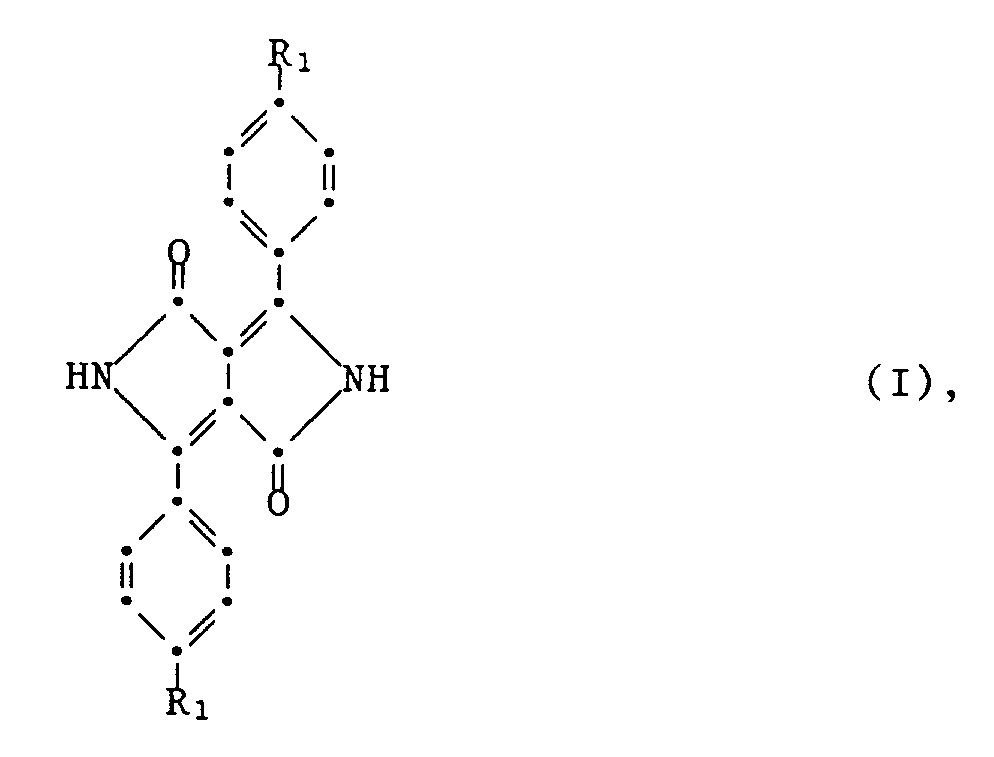
- the present invention accordingly relates to a process for the preparation of opacifying 1,4-diketopyrrolo [3,4-c] pyrroles of the formula wherein R1 is hydrogen, chlorine, methyl or tert-butyl, characterized in that the pigment in an alcohol from the group consisting of methanol, ethanol, butanol, pentanol, ethylene glycol and propylene glycol in the presence of a base from the group consisting of alkali metal hydroxides and quaternary ammonium hydroxides, at a temperature below 50 ° C, preferably between 10 and 40 ° C, is ground.
- Suitable bases are, for example, sodium hydroxide, potassium hydroxide, lithium hydroxide or benzyltrimethylammonium hydroxide. Sodium and potassium hydroxide are preferred.
- the alcohol is expediently present in a 5 to 25 times, preferably 10 to 16 times the amount, based on the weight of the pigment.
- a suitable concentration range of the base is from 2 to 50%, preferably from 20 to 40%, based on the weight of the pigment.
- Inorganic bases can be used as 15 to 70%, preferably 25 to 50% aqueous solutions, organic bases as 100% or at least as 50% aqueous solutions.
- the preferred concentration of the base varies depending on the alcohol used.
- any device which allows the pigment and the carrier to be subjected to intensive mechanical force effects in a liquid medium can be used as the apparatus for the grinding.
- Such apparatuses are known in large numbers. They are based, for example, on the principle of a large speed gradient generated in the liquid medium or a sudden change of direction, or in particular on the impact or mutual friction of grinding media, such as metal, glass or porcelain balls, plastic granules or grains of sand, caused by the rotation of the vessel, or even more effectively , are set in motion by vibration generators or stirring devices, such as in the glass bead mills.
- the grinding is carried out according to known methods, generally by charging the suitable grinding device with the crude diketopyrrolopyrrole, the alcohol and the base, and the suitable grinding aids, grinding the system at a temperature below 50 ° C., preferably between 10 and 40 ° C. and Isolate the diketopyrrolopyrrole pigment obtained.
- the grinding is preferably carried out in a ball mill by using sand, glass or ceramic balls with a preferred average diameter of 0.8 to 2.5 mm as grinding aids. Preference is given to grinding beads which are produced from a crystalline zirconium and an amorphous silica phase of the corresponding oxides (product from Quartz Products Corporation).
- dispersants, diluents or growth inhibitors can be added to the alcohol / base milling process, provided that these additives are not deactivated by the basic medium.
- a dispersant for example ®DISPERBYK 160, BYK Chemie
- a product is obtained which, when drawn off in a lithographic lacquer, has an improved gloss compared to shows a product without dispersant.
- the pigment is best isolated by removing the grinding aids from the grinding aids by filtering and washing the press cake with alcohol or by diluting and washing with alcohol and / or water and then distilling off the alcohol.
- the alcohol can thus be recovered and the pigment isolated by filtering the remaining non-combustible slurry and washing neutral with water.
- Suitable texture protection agents are, for example, fatty acids with at least 18 carbon atoms, such as stearic acid or behenic acid or their amides or metal salts, preferably magnesium salts, furthermore plasticizers, waxes, resin acids, such as abietic acid, rosin soap, alkylphenols or aliphatic alcohols, such as stearyl alcohol or vicinal diols, such as dodecanols -1,2-diol, also modified rosin / maleate resins or fumaric acid / rosin resins.
- Texture preservatives can advantageously be added in amounts of 0.1 to 30% by weight, preferably 2 to 15% by weight, based on the end product.
- a characteristic property of the pigments produced according to the invention is their high crystallinity.
- the pigments obtainable according to the invention can be used, for example, in the form of powder, dough, flush paste and preparation and are suitable, for example, for printing inks, glue inks, binder inks or varnishes of all kinds, such as physically and oxidatively drying varnishes, acid-, amine- and peroxide-curing varnishes or polyurethane varnishes .
- the pigments can also be used to dye synthetic, semi-synthetic or natural macromolecular substances such as polyvinyl chloride, polystyrene, polyethylene, polyesters, phenoplasts, aminoplasts and rubber.
- the red opaque pigments obtainable according to the invention can be used for coloring solid, elastic, paste-like, viscous, low-viscosity or thixotropic compositions and can be incorporated into them by methods known per se.
- Water-containing doughs can be obtained, for example, by stirring the pigment into water, optionally with the addition of a wetting or dispersing agent, or by stirring or kneading the pigment into a dispersing agent in the presence of water and, if appropriate, organic solvents or oils. These doughs can in turn be used, for example, for the production of flush pastes, printing inks, glue inks, plastic dispersions and spinning solutions.
- the pigment can also be brought in by stirring, rolling, kneading or grinding in water, organic solvents, non-drying oils, drying oils, lacquers, plastics or rubber. Finally, it is also possible to process the pigment into substance mixtures by dry mixing with organic or inorganic materials, granules, fiber materials, powders and other pigments.
- the pigments obtainable according to the invention are not only distinguished by the excellent hiding power, excellent color strength and purity of the color tone with very high saturation, but also by good general fastness properties, such as light and weather resistance, fastness to overcoating, migration and heat resistance, and excellent rheological properties.
- the pigments obtainable by the wet grinding process according to the invention are preferably suitable for coloring aqueous and / or solvent-containing paints, in particular automotive paints.
- Example 1 In a 500 ml wide-neck glass bottle with a screw cap, 14 g of raw 3,6-diphenyl-1,4-diketopyrrolo [3,4-c] pyrrole, 15 g of 30% aqueous sodium hydroxide solution and 180 ml of methanol are combined with 350 ml ceramic balls with a diameter of 1.6 to 2.5 mm and a composition of 69% ZrO2 and 31% SiO2, for 48 hours at 20-25 ° C, rotated on a roller bench so that the centrifugal forces are greater than that Gravitational forces are so that the balls remain on the wall of the glass bottle during the rotation (70-105 rpm).
- the ceramic balls are then separated off, the pigment suspension is filtered off, the filter cake is washed alkali-free with methanol and dried and powdered in a vacuum drying cabinet at 80 ° C. 13.6 g of red pigment are obtained, which are incorporated into plastics and paints, give opaque colors of high purity and saturation, and excellent light, heat and weather resistance.
- Example 3 If the procedure is analogous to that described in Example 2, but instead of 350 ml of ceramic balls, 350 ml of glass balls with an average diameter of 1 mm are used, a pigment with similarly good properties is obtained.
- Example 4 The procedure is analogous to that described in Example 1, but crude 3,6-di (4-chlorophenyl) -1 is used instead of 3,6-diphenyl-1,4-diketopyrrolo [3,4-c] pyrrole , 4-diketopyrrolo- [3,4-c] -pyrrole, a blue-tinged, opaque pigment is obtained, which gives colorations of high color strength and purity.
- Example 6 2.5 g of crude 3,6-di (4-methylphenyl) -1,4-diketopyrrolo [3,4-c] pyrrole, 2.5 g, are placed in a 100 ml wide-neck glass bottle with a screw cap 30% aqueous sodium hydroxide solution and 37 ml of methanol together with 68 ml ceramic balls with a diameter of 1.6-2.5 mm and a composition of 69,% ZrO2 and 31% SiO2, for 60 hours at 20-25 ° C on one The rotating bench is rotated so that the centrifugal forces are greater than the gravitational forces so that the balls remain on the wall of the glass bottle during rotation (70-105 rpm).
- the ceramic balls are then separated off, the pigment suspension is filtered off and the filter cake is washed alkali-free with methanol and dried and powdered in a vacuum drying cabinet at 80.degree. 2.4 g of red pigment are obtained, which, when incorporated into plastics and lacquers, give opaque scarlet colors with high opacity, purity and saturation, and excellent light, heat and weather resistance.
- Example 7 If the procedure is analogous to that described in Example 1, but instead of methanol, anhydrous ethanol is used, a red pigment with similarly good properties is obtained.
- Example 8 In a 2.85 l mill 2500 g ceramic balls with a diameter of 1.6-2.5 mm and consisting of about 69% ZrO2 and 31% SiO2, 50 g of raw 3,6-diphenyl-1 , 4-diketopyrrolo- [3,4-c] -pyrrole, 1000 ml of methanol and 75 g of 44% strength aqueous potassium hydroxide solution for 72 hours, a temperature of 20-27 ° C. and a speed of 65-70 rpm. turned.
- the ceramic balls are separated from the pigment suspension and washed with 800 ml of methanol.
- the pigment suspension is poured into a glass container equipped with a stirrer, thermometer and cooler. Steam is passed into the suspension and methanol along with something Water is distilled off until the temperature rises to 93 ° C. The mixture is stirred for 10 minutes and filtered off. The filter cake is washed neutral with water and dried in a vacuum drying cabinet at 80 ° C. 48.2 g of pigment are obtained, which, when powdered into lacquers and plastics, result in opaque red colorations of high saturation and purity.
- Example 9 In a 500 mL wide mouth glass bottle with screw cap closure, 2.5 g of crude 3,6-diphenyl-1,4-diketopyrrolo- [3,4-c] pyrrole, 13 ml ®Triton B (benzyltrimethylammonium hydroxide 35% in methanol) and 30 ml of methanol together with 68 ml of ceramic balls with a diameter of 1.6 to 2.5 mm and a composition of 69% ZrO2 and 31% SiO2, for 48 hours at 20-25 ° C, on a rolling bench like this rotated so that the centrifugal forces are greater than the gravitational forces so that the balls remain on the wall of the glass bottle during rotation (70-105 rpm).
- ®Triton B benzyltrimethylammonium hydroxide 35% in methanol
- Example 10 The procedure is analogous to that described in Example 7, but crude 3,6-diphenyl-1 is used instead of 3,6-di (4-methylphenyl) -1,4-diketopyrrolo- [3,4-c] -pyrrole , 4-diketopyrrolo- [3,4-c] pyrrole and 40 ml propylene glycol instead of 37 ml methanol, this gives a pigment with similarly good properties.
- Example 11 The procedure is analogous to that of Example 6, but using 3,6-di (4-tert-butylphenyl) -1,4-diketopyrrolo- [3,4-c] -pyrrole instead of 3,6-di ( 4-methylphenyl) -1,4-diketopyrrolo- [3,4-c] pyrrole gives a covering pigment which gives orange colorations of high color strength and purity with excellent light, weather and heat resistance.
- a thermosetting acrylic lacquer consisting of 41.3 g acrylic resin ®VIACRYL VC 373, 60% (VIANOVA Kunststoffharz AG), 16.3 g melamine resin
- Example 13 A mixture of 130 g steatite balls with a diameter of 8 mm, 47.5 g alkyd melamine stoving enamel, consisting of 60 g short oil alkyd resin ®BECKOSOL 27-320 (Reichhold Chemie AG) 60% in xylene, 36 g melamine resin ®SUPER-BECKAMIN 13-501 (Reichhold Chemie AG) 50% in xylene: butanol (2: 1 mixture), 2 g xylene and 2 g ethylene glycol monomethyl ether, and 2.5 g of the diketopyrrolo- [3,4-c] obtained according to Example 1 pyrrole pigments dispersed in a 200 ml glass bottle with "twist-off" closure for 120 hours on a trolley. After the steatite balls have been separated off, the full-tone mixture thus dispersed is sprayed onto aluminum sheets and then baked at 130 ° C. for 30 minutes. Very strong red colorations with high saturation and excellent resistance are obtained.
- Example 14 A mixture consisting of 1.0 g of the diketopyrrolo [3,4-c] pyrrole pigment obtained according to Example 4, 1.0 g of antioxidant (®IRGANOX 1010, CIBA-GEIGY AG) and 1000 g of polyethylene-HD granules (®VESTOLEN A 60-16, HUELS) is premixed for 15 minutes in a glass bottle on a roller bench. The mixture is then extruded in two passages on a single-screw extruder. The granules obtained in this way are injection-molded into sheets on an injection molding machine (Allround Aarburg 200) at 220 ° C. and pressed at 180 ° C. for 5 minutes. The press plates have strong red shades with excellent resistance.
- an injection molding machine Allround Aarburg 200
- Example 15 0.6 g each of the pyrrolo [3,4-c] pyrrole pigments obtained according to Examples 1 to 11 are mixed with 67 g polyvinyl chloride, 33 g dioctyl phthalate, 2 g dibutyltin dilaurate and 2 g titanium dioxide and on a roll mill for 15 Minutes at 160 ° C into a thin film.
- the red PVC films produced in this way are very colorful, resistant to migration and light.
- Example 16 1000 g of polypropylene granules (®DAPLEN PT-55, Chemie LINZ) and 20 g of a 50% pigment preparation consisting of 10 g of the pyrrolo- [3,4-c] pyrrole pigment obtained according to Example 4 and 10 g of Mg -Behenate, are mixed intensively in a mixing drum. The granules treated in this way are spun at 260 to 285 ° C. using the melt spinning process. Red-colored fibers with very good light and textile fastness properties are obtained.
- polypropylene granules (®DAPLEN PT-55, Chemie LINZ) and 20 g of a 50% pigment preparation consisting of 10 g of the pyrrolo- [3,4-c] pyrrole pigment obtained according to Example 4 and 10 g of Mg -Behenate, are mixed intensively in a mixing drum. The granules treated in this way are spun at 260 to 285 ° C. using the melt spinning process
- Example 17 In a solution consisting of 21.5 g of cellulose acetobutyrate (25% in butyl acetate), 1 g of zirconium octoate 6 (®NUODEX), 12 g of aromatic solvent SOLVESSO 150 (ESSO), 17.5 g of butyl acetate, 13 g of xylene 8 g of the diketopyrrolo [3,4-c] pyrrole pigment obtained according to Example 4 are well dispersed on a dispersing apparatus (®DISPERMAT, Hediger, Bassersdorf) by means of glass balls ( ⁇ 1 mm).
- a dispersing apparatus ®DISPERMAT, Hediger, Bassersdorf
- the dispersion is mixed with 24 g of polyester resin ®DYNAPOL H 700 (60%, DYNAMIT NOBEL) and 3 g of melamine resin ®MAPRENAL MF 650 (55%, HOECHST AG).
- the pigment varnish obtained in this way is sprayed onto aluminum sheets and then baked at 130 ° C. Strong red colorations with excellent gloss behavior are obtained.
- Example 18 If the procedure is analogous to that described in Example 17, but 0.15 g of DISPERBYK® 160 (BYK Chemie) is added to 12.5 g of the red pigment varnish, red colorations are obtained with even better rheological properties and excellent gloss behavior.
Landscapes
- Chemical & Material Sciences (AREA)
- Organic Chemistry (AREA)
- Chemical Kinetics & Catalysis (AREA)
- Nitrogen Condensed Heterocyclic Rings (AREA)
- Compositions Of Macromolecular Compounds (AREA)
- Paints Or Removers (AREA)
Description
- Die vorliegende Erfindung betrifft ein Verfahren zur Herstellung deckender Diketopyrrolopyrrolpigmente hoher Farbstärke, Farbtonreinheit und Sättigung durch Nassmahlung in einem Alkohol/Base-System.
- Aus EP-A 94 911 ist bekannt, dass eine deckendere Pigmentform erhalten werden kann, wenn man Diketopyrrolopyrrolpigmente in Wasser oder einem organischen Lösungsmittel heizt. Organische Lösungsmittel mit Siedepunkt über 80°C, wie z.B. Xylole, Chlorbenzol, Nitrobenzol, Pyridin, Cyclohexanon, Ethylenglykolmonomethylether oder Dimethylformamid sind bevorzugt. In EP-A 190 999 ist ein Verfahren zur Herstellung farbstarker Pigmente, wie z.B. Diketopyrrolopyrrolpigmente, durch Protolyse des durch Behandlung des Rohpigments mit einer starken Base oder bei der Synthese anfallenden Pigmentsalzes beschrieben, welches dadurch gekennzeichnet ist, dass man das Pigmentsalz in einem organischen Lösungsmittel so mit Wasser behandelt, dass das organische Lösungsmittel gleichzeitig während der Protolyse entfernt wird. Die so erhaltenen Pigmente, die eine feinkristalline Form aufweisen, zeichnen sich durch ihre Farbstärke und Transparenz aus. In EP-A 181 290 wird ausgeführt, dass durch Nachbehandlung in Wasser oder in einem organischen Lösungsmittel (vorzugsweise über 80°C) und nachträgliche Zerkleinerung, wie z.B. Nassmahlung, von Diketopyrrolopyrrolpigmenten besonders transparente Pigmentformen erhalten werden. Aus EP-A 101 666 ist ein Verfahren zur Herstellung von organischen Pigmenten mit verbesserter Dispergierbarkeit durch Mahlen in Wasser und 1,2-Diolen mit mindestens 6 C-Atomen, bei bevorzugten Temperaturen zwischen 15 und 70°C bekannt.
- Es ist nun gefunden worden, dass durch Nassmahlung bestimmter Diketopyrrolopyrrolpigmente in einem ausgewählten Alkohol/Base-System, ohne zu heizen, ganz überraschend eine deckende Pigmentform erhalten wird, welche sich durch ausserordentliche Farbstärke, hohe Reinheit des Farbtones mit unerwartet hoher Sättigung auszeichnet.
- Die vorliegende Erfindung betrifft demnach ein Verfahren zur Herstellung von deckenden 1,4-Diketopyrrolo-[3,4-c]-pyrrole der Formel

worin R₁ Wasserstoff, Chlor, Methyl oder tert.-Butyl ist, dadurch gekennzeichnet, dass das Pigment in einem Alkohol aus der Gruppe Methanol, Ethanol, Butanol, Pentanol, Ethylenglykol und Propylenglykol in Gegenwart einer Base aus der Gruppe der Alkalimetallhydroxide und quaternären Ammoniumhydroxide, bei einer Temperatur unter 50°C, bevorzugt zwischen 10 und 40°C, gemahlen wird. - Bevorzugt werden Methanol und Ethanol. Geeignete Basen sind z.B. Natriumhydroxid, Kaliumhydroxid, Lithiumhydroxid oder Benzyltrimethylammoniumhydroxid. Bevorzugt werden Natrium- und Kaliumhydroxid.
- Der Alkohol ist zweckmässig in einer 5- bis 25-fachen, bevorzugt 10- bis 16-fachen Menge, bezogen auf das Gewicht des Pigments, vorhanden. Ein zweckmässiger Konzentrationsbereich der Base ist von 2 bis 50 %, bevorzugt von 20 bis 40 %, bezogen auf das Gewicht des Pigments. Anorganische Basen können als 15 bis 70%ige, bevorzugt 25 bis 50%ige wässrige Lösungen, organische Basen als 100%ige oder wenigstens als 50%ige wässrige Lösungen eingesetzt werden. Die bevorzugte Konzentration der Base variiert allerdings je nach eingesetztem Alkohol.
- Als Apparatur für die Mahlung kann jede Vorrichtung verwendet werden, die es erlaubt, in einem flüssigen Medium das Pigment und den Trägerstoff intensiven mechanischen Kraftwirkungen zu unterwerfen. Derartige Apparaturen sind in grösserer Zahl bekannt. Sie beruhen beispielsweise auf dem Prinzip eines im flüssigen Medium erzeugten grossen Geschwindigkeitsgradienten oder einer plötzlichen Richtungsänderung, oder insbesondere auf Aufprallwirkung oder gegenseitiger Reibung von Mahlkörpern, wie Metall-, Glas- oder Porzellankugeln, Kunststoffgranulat oder Sandkörner, die durch Rotation des Gefässes, oder noch wirksamer, durch Schwingungserzeuger oder rührartige Vorrichtungen, wie beispielsweise bei den Glasperlmühlen, in Bewegung gesetzt werden.
- Die Mahlung wird nach bekannten Methoden durchgeführt, im allgemeinen durch Beschicken der geeigneten Mahlvorrichtung mit dem rohen Diketopyrrolopyrrol, dem Alkohol und der Base, sowie den geeigneten Mahlhilfsmitteln, Vermahlen des Systems bei einer Temperatur unter 50°C, bevorzugt zwischen 10 und 40°C und Isolieren des erhaltenen Diketopyrrolopyrrolpigments. Die Mahlung wird vorzugsweise in einer Kugelmühle durchgeführt, durch Verwendung von Sand-, Glas- oder Keramikkugeln mit einem bevorzugten durchschnittlichen Durchmesser von 0,8 bis 2,5 mm als Mahlhilfsmittel. Bevorzugt werden Mahlperlen, die aus einer kristallinen Zirkonium- und einer amorphen Kieselsäurephase der entsprechenden Oxide hergestellt werden (Produkt der Firma Quartz Products Corporation).
- Wenn erwünscht können für den Alkohol/Base-Mahlvorgang Dispergiermittel, Verdünnungsmittel oder wachstumshemmende Mittel zugesetzt werden, unter der Bedingung, dass diese Additive durch das basische Medium nicht desaktiviert werden. So kann beispielsweise durch Zusatz einer geringen Menge, z.B. 3-6 Gew.-%, bezogen auf das Pigment, eines Dispergiermittels (z.B. ®DISPERBYK 160, BYK Chemie), nach dem Mahlen, ein Produkt erhalten werden, das beim Ausziehen in einer lithographischen Lackfarbe einen verbesserten Glanz im Vergleich zu einem Produkt ohne Dispergiermittel zeigt.
- Das Pigment wird am besten dadurch isoliert, dass man die Pigmentaufschlämmung von den Mahlhilfsmitteln durch Filtrieren und Auswaschen des Presskuchens mit Alkohol oder durch Verdünmnung und Auswaschen mit Alkohol und/oder Wasser befreit und anschliessend den Alkohol abdestilliert. Der Alkohol kann somit zurückgewonnen werden und das Pigment durch Filtrieren der zurückgebliebenen nichtbrennbaren Aufschlämmung und Neutralwaschen mit Wasser isoliert werden.
- Es kann auch von Vorteil sein bestimmte Mengen eines Texturschutzmittels vorzugsweise zum isolierten Pigment nach der Mahlung zuzugeben. Geeignete Texturschutzmittel sind beispielsweise Fettsäuren mit mindestens 18 C-Atomen, wie Stearinsäure oder Behensaure oder deren Amide oder Metallsalze, bevorzugt Magnesiumsalze, ferner Weichmacher, Wachse, Harzsäuren, wie Abietinsäure, Kolophoniumseife, Alkylphenole oder aliphatische Alkohole, wie Stearylalkohol oder vicinale Diole, wie Dodecan-1,2-diol, ferner modifizierte Kolophonium/Maleat-Harze oder Fumarsäure/Kolophonium-Harze. Texturschutzmittel kann man zweckmässig in Mengen von 0,1 bis 30 Gew.%, bevorzugt 2 bis 15 Gew.-%, bezogen auf das Endprodukt, zugegeben.
- Eine charakteristische Eigenschaft der erfindungsgemäss hergestellten Pigmente ist ihre hohe Kristallinität.
- Die erfindungsgemäss erhältlichen Pigmente lassen sich beispielsweise in Form von Pulver, Teig, Flushpaste und Zubereitung anwenden und eignen sich z.B. für Druckfarben, Leimfarben, Binderfarben oder Lacke aller Art, wie physikalisch und oxydativ trocknende Lacke, saure-, amin- und peroxidhärtende Lacke oder Polyurethanlacke. Die Pigmente können auch zum Färben von synthetischen, halbsynthetischen oder natürlichen makromolekularen Stoffen verwendet werden, wie Polyvinylchlorid, Polystyrol, Polyethylen, Polyestern, Phenoplasten, Aminoplasten und Gummi. Weitere Anwendungsgebiete sind das Färben von natürlichen, regenerierten oder künstlichen Fasern, wie Glas-, Silikat-, Asbest-, Holz-, Cellulose-, Acetylcellulose-, Polyacrylnitril-, Polyester-, Polyurethan- und Polyvinylchloridfasern oder deren Gemischen, eventuell zusammen mit anderen organischen oder anorganischen Pigmenten. Man erhält mit den erfindungsgemäss erhaltenen Pigmenten Drucke, Lackierungen, Anstriche, Beläge, Beschichtungen, geformte Gebilde, wie Folien, Fäden, Platten, Blöcke, Granulate und Stäbe, mit brillanter roter Farbe von hervorragender Dauerhaftigkeit.
- Die erfindungsgemäss erhältlichen, roten deckenden Pigmente können zum Färben von festen, elastischen, pastenartigen, dickflüssigen, dünnflüssigen oder thixotropen Massen verwendet und in diese nach an sich bekannten Verfahren eingearbeitet werden. Wasserhaltige Teige können beispielsweise durch Einrühren des Pigments in Wasser, gegebenenfalls unter Zusatz eines Netz- oder Dispergiermittels oder durch Einrühren oder Einkneten des Pigments in ein Dispergiermittel in Gegenwart von Wasser und gegebenenfalls von organischen Lösungsmitteln oder Oelen erhalten werden. Diese Teige können beispielsweise wiederum zur Herstellung von Flushpasten, Druckfarben, Leimfarben, Kunststoffdispersionen und Spinnlösungen verwendet werden. Das Pigment kann aber auch durch Einrühren, Einwalzen, Einkneten oder Einmahlen in Wasser, organische Lösungsmittel, nicht trocknende Oele, trocknende Oele, Lacke, Kunststoffe oder Gummi gebracht werden. Schliesslich ist es auch möglich, das Pigment durch trockenes Mischen mit organischen oder anorganischen Massen, Granulaten, Faserstoffen, Pulvern und anderen Pigmenten zu Stoffmischungen zu verarbeiten.
- Die erfindungsgemäss erhältlichen Pigmente zeichnen sich nicht nur durch die ausgezeichnete Deckkraft, hervorragende Farbstärke und Reinheit des Farbtons mit sehr hoher Sättigung, sondern auch durch gute Allgemeinechtheiten, wie Licht- und Wetterbeständigkeit, Ueberlackierechtheit, Migrations- und Hitzebeständigkeit, sowie durch ausgezeichnete rheologische Eigenschaften aus.
- Die nach dem erfindungsgemässen Nassmahlverfahren erhältlichen Pigmente sind vorzugsweise für die Färbung von wässrigen und/oder Lösungsmittel enthaltenden Lacken, insbesondere Automobillacken, geeignet.
- Die folgenden Beispiele erläutern die Erfindung.
- Beispiel 1: In einer 500 ml fassenden Breithals-Glasflasche mit Schraubendeckelverschluss werden 14 g rohes 3,6-Diphenyl-1,4-diketopyrrolo[3,4-c]-pyrrol, 15 g 30%ige wässerige Natronlauge und 180 ml Methanol zusammen mit 350 ml Keramikkugeln mit einem Durchmesser von 1,6 bis 2,5 mm und einer Zusammensetzung von 69 % ZrO₂ und 31 % SiO₂, während 48 Stunden bei 20-25°C, auf einer Rollbank so gedreht, dass die Zentrifugalkräfte grösser als die Gravitationskräfte sind, damit die Kugeln während des Drehens an der Wand der Glasflasche bleiben (70-105 U/Min.).
- Danach werden die Keramikkugeln abgetrennt, die Pigmentsuspension abfiltriert, der Filterkuchen mit Methanol alkalifrei gewaschen und im Vakuumtrockenschrank bei 80°C getrocknet und gepulvert. Man erhält 13,6 g rotes Pigment, welches in Kunststoffe und Lacke eingearbeitet, deckende Ausfärbungen hoher Reinheit und Sättigung sowie ausgezeichneter Licht-, Hitze- und Wetterbeständigkeit ergibt.
- Beispiel 2: Verfährt man analog wie in Beispiel 1 beschrieben, schüttelt jedoch die Glasflasche auf einer Labor-Turbula-Maschine der Firma Willy A. Bachofen, Basel während 48 Stunden, so erhält man ein Pigment mit analog guten Eigenschaften.
- Beispiel 3: Verfährt man analog wie in Beispiel 2 beschrieben, verwendet jedoch anstelle von 350 ml Keramikkugeln 350 ml Glaskugeln mit einem durschschnittlichen Durchmesser von 1 mm, so erhält man ein Pigment mit analog guten Eigenschaften.
- Beispiel 4: Verfährt man analog wie in Beispiel 1 beschrieben, verwendet aber anstelle von 3,6-Diphenyl-1,4-diketopyrrolo-[3,4-c]-pyrrol rohes 3,6-Di(4-chlorphenyl)-1,4-diketopyrrolo-[3,4-c]-pyrrol, so erhält man ein blaustichigrotes, deckendes Pigment, welches Ausfärbungen hoher Farbstärke und Reinheit ergibt.
- Beispiel 5: Verfährt man analog wie in Beispiel 4 beschrieben, verwendet aber anstelle von 15 g 30%ige Natronlauge 7,0 g 50%ige wässerige Kalilauge, so erhält man ein rotes Pigment mit ebenso guten Eigenschaften.
- Beispiel 6: In einer 100 ml fassenden Breithals-Glasflasche mit Schraubendeckelverschluss werden 2,5 g rohes 3,6-Di(4-methylphenyl)-1,4-diketopyrrolo-[3,4-c]-pyrrol, 2,5 g 30%ige wässerige Natronlauge und 37 ml Methanol zusammen mit 68 ml Keramikkugeln mit einem Durchmesser von 1,6-2,5 mm und einer Zusammensetzung von 69, % ZrO₂ und 31 % SiO₂, während 60 Stunden bei 20-25°C auf einer Rollbank so gedreht, dass die Zentrifugalkräfte grösser als die Gravitationskräfte sind, damit die Kugeln während des Drehens an der Wand der Glasflasche bleiben (70-105 U/Min).
- Danach werden die Keramikkugeln abgetrennt, die Pigmentsuspension abfiltriert und der Filterkuchen mit Methanol alkalifrei gewaschen und im Vakuumtrockenschrank bei 80°C getrocknet und gepulvert. Man erhält 2,4 g rotes Pigment, welches in Kunststoffe und Lacke eingearbeitet deckende scharlachrote Ausfärbungen hoher Deckkraft, Reinheit und Sättigung sowie ausgezeichneter Licht-, Hitze- und Wetterbeständigkeiten ergibt.
- Beispiel 7: Verfährt man analog wie in Beispiel 1 beschrieben, verwendet aber anstelle von Methanol wasserfreien Ethanol so erhält man ein rotes Pigment mit analog guten Eigenschaften.
- Beispiel 8: In einer 2,85 l-Mühle werden 2500 g Keramikkugeln mit einem Durchmesser von 1,6-2,5 mm und bestehend aus ca. 69 % ZrO₂ und 31 % SiO₂, 50 g rohes 3,6-Diphenyl-1,4-diketopyrrolo-[3,4-c]-pyrrol, 1000 ml Methanol und 75 g 44%ige wässerige Kalilauge während 72 Stunden, einer Temperatur von 20-27°C und einer Geschwindigkeit von 65-70 U/Min. gedreht.
- Die Keramikkugeln werden von der Pigmentsuspension getrennt und mit 800 ml Methanol gewaschen. Die Pigmentsuspension wird in ein Glasbehälter, ausgerüstet mit Rührer, Thermometer und Kühler, umgegossen. Wasserdampf wird in die Suspension geleitet und Methanol zusammen mit etwas Wasser abdestilliert bis die Temperatur auf 93°C steigt. Man lässt 10 Minuten rühren und filtriert ab. Der Filterkuchen wird mit Wasser neutral gewaschen und im Vakuumtrockenschrank bei 80°C getrocknet. Man erhält 48,2 g Pigment, welches gepulvert in Lacke und Kunststoffe eingearbeitet deckende rote Ausfärbungen hoher Sättigung und Reinheit ergibt.
- Beispiel 9: In einer 500 ml fassenden Breithals-Glasflasche mit Schraubendeckelverschluss werden 2,5 g rohes 3,6-Diphenyl-1,4-diketopyrrolo-[3,4-c]-pyrrol, 13 ml ®TRITON B (Benzyltrimethylammoniumhydroxid 35 % in Methanol) und 30 ml Methanol zusammen mit 68 ml Keramikkugeln mit einem Durchmesser von 1,6 bis 2,5 mm und einer Zusammensetzung von 69 % ZrO₂ und 31 % SiO₂, während 48 Stunden bei 20-25°C, auf einer Rollbank so gedreht, dass die Zentrifugalkräfte grösser als die Gravitationskräfte sind, damit die Kugeln während des Drehens an der Wand der Glasflasche bleiben (70-105 U/Min.).
- Danach werden die Keramikkugeln abgetrennt, die Pigmentsuspension abfiltriert, der Filterkuchen mit Methanol alkalifrei gewaschen und im Vakuumtrockenschrank bei 80°C getrocknet und gepulvert. Man erhält 2,4 g rotes Pigment, welches in Kunststoffe und Lacke eingearbeitet deckende rote Ausfärbungen hoher Reinheit und Sättigung, sowie ausgezeichneter Licht-, Hitze- und Wetterbeständigkeit ergibt.
- Beispiel 10: Verfährt man analog wie in Beispiel 7 beschrieben, verwendet aber anstelle von 3,6-Di(4-methylphenyl)-1,4-diketopyrrolo-[3,4-c]-pyrrol rohes 3,6-Diphenyl-1,4-diketopyrrolo-[3,4-c]-pyrrol und 40 ml Propylenglykol anstelle von 37 ml Methanol, so erhält man ein Pigment mit analog guten Eigenschaften.
- Beispiel 11: Verfährt man analog wie in Beispiel 6, verwendet aber 3,6-Di(4-tert.-butylphenyl)-1,4-diketopyrrolo-[3,4-c]-pyrrol anstelle von 3,6-Di(4-methylphenyl)-1,4-diketopyrrolo-[3,4-c]-pyrrol, so erhält man ein deckendes Pigment, das orange Ausfärbungen hoher Farbstärke und Reinheit mit ausgezeichneter Licht-, Wetter- und Hitzebeständigkeit ergibt.
- Beispiel 12: Eine Mischung von
130,0 g Steatitkugeln (⌀ = 8 mm)
47,5 g eines thermohärtenden Acryllacks, bestehend aus
41,3 g Acrylharz ®VIACRYL VC 373, 60 % (VIANOVA Kunstharz AG),
16,3 g Melaminharz ®MAPRENAL TTX, 55 % (HOECHST AG),
32,8 g Xylol,
4,6 g Ethylglykolacetat,
2,0 g Butylacetat und
1,0 g ®Silikonöl A, 1 % in Xylol (BAYER AG), und
2,5 g des nach Beispiel 1 erhaltenen Pyrrolo-[3,4-c]-pyrrolpigments
wird in einer 200 ml Glasflasche mit "Twist-Off"-Verschluss während 72 Stunden auf dem Rollgestell dispergiert. Nach Abtrennen der Steatitkugeln werden
8,0 g der so dispergierten Volltonmischung,
0,6 g Aluminiumpaste ®ALCOA (60-65 % Al-Gehalt, Aluminium Corp. of America)
1,0 g Methylethylketon und
18,4 g des obigen thermohärtenden Acryllacks
gut vermischt, auf Aluminiumbleche gespritzt und anschliessend während 30 Minuten bei 130°C eingebrannt. - Man erhält sehr farbstarke deckende rote Metalleffektlackierungen mit ausgezeichneten Beständigkeiten.
- Verwendet man anstelle des Pigmentes gemäss Beispiel 1 ein Pigment gemäss den Beispielen 2 bis 12, so erhält man ebenso hochwertige Ausfärbungen.
- Beispiel 13: Eine Mischung von 130 g Steatitkugeln von 8 mm Durchmesser, 47,5 g Alkydmelamineinbrennlack, bestehend aus 60 g kurzöligem Alkydharz ®BECKOSOL 27-320 (Reichhold Chemie AG) 60%-ig in Xylol, 36 g Melaminharz ®SUPER-BECKAMIN 13-501 (Reichhold Chemie AG) 50%ig in Xylol:Butanol (2:1-Gemisch), 2 g Xylol und 2 g Ethylenglykolmonomethylether, und 2,5 g des nach Beispiel 1 erhaltenen Diketopyrrolo-[3,4-c]pyrrolpigments werden in einer 200 ml fassenden Glasflasche mit "Twist-Off"-Verschluss während 120 Stunden auf einem Rollgestell dispergiert. Nach Abtrennen der Steatitkugeln wird die so dispergierte Volltonmischung auf Aluminiumbleche gespritzt und anschliessend während 30 Minuten bei 130°C eingebrannt. Man erhält sehr farbstarke rote Ausfärbungen hoher Sättigung mit ausgezeichneten Beständigkeiten.
- Beispiel 14: Eine Mischung bestehend aus 1,0 g des nach Beispiel 4 erhaltenen Diketopyrrolo-[3,4-c]-pyrrolpigments, 1,0 g Antioxydans (®IRGANOX 1010, CIBA-GEIGY AG) und 1000 g Polyethylen-HD Granulat (®VESTOLEN A 60-16, HUELS) wird während 15 Minuten in einer Glasflasche auf einer Rollbank vorgemischt. Danach wird die Mischung in zwei Passagen auf einem Einwellenextruder extrudiert. Das so erhaltene Granulat wird auf der Spritzgussmaschine (Allround Aarburg 200) bei 220°C zu Platten verspritzt und 5 Minuten bei 180 °C nachgepresst. Die Pressplatten weisen farbstarke rote Nuancen mit ausgezeichneten Beständigkeiten auf.
- Beispiel 15: Je 0,6 g der gemäss Beispiele 1 bis 11 erhaltenen Pyrrolo-[3,4-c]-pyrrolpigmente werden mit 67 g Polyvinylchlorid, 33 g Dioctylphthalat, 2 g Dibutylzinndilaurat und 2 g Titandioxid vermischt und auf einem Walzenstuhl während 15 Minuten bei 160°C zu einer dünnen Folie verarbeitet. Die so erzeugten roten PVC-Folien sind sehr farbstark, migrations- und lichtbeständig.
- Beispiel 16: 1000 g Polypropylengranulat (®DAPLEN PT-55, Chemie LINZ) und 20 g eines 50%-igen Pigmentpräparates, bestehend aus 10 g des nach Beispiel 4 erhaltenen Pyrrolo-[3,4-c]-pyrrolpigments und 10 g Mg-Behenat, werden in einer Mischtrommel intensiv vermischt. Das so behandelte Granulat wird bei 260 bis 285°C nach dem Schmelzspinnverfahren versponnen. Man erhält rotgefärbte Fasern mit sehr guten Licht- und textilen Echtheiten.
- Beispiel 17: In eine Lösung bestehend aus 21,5 g Celluloseacetobutyrat (25%-ig in Butylacetat), 1 g Zirkoniumoctoat 6 (®NUODEX), 12 g aromatisches Lösungsmittel SOLVESSO 150 (ESSO), 17,5 g Butylacetat, 13 g Xylol werden 8 g des nach Beispiel 4 erhaltenen Diketopyrrolo-[3,4-c]-pyrrolpigments auf einem Dispergierapparat (®DISPERMAT, Hediger, Bassersdorf) mittels Glaskugeln (⌀ 1 mm) gut dispergiert.
- Nach Entfernen der Glaskugeln wird die Dispersion mit 24 g Polyesterharz ®DYNAPOL H 700 (60%-ig, DYNAMIT NOBEL) und 3 g Melaminharz ®MAPRENAL MF 650 (55%-ig, HOECHST AG) vermischt.
- Der auf diese Art erhaltene Pigmentlack wird auf Aluminiumbleche gespritzt und anschliessend bei 130°C eingebrannt. Man erhält farbstarke rote Ausfärbungen mit ausgezeichnetem Glanzverhalten.
- Beispiel 18: Verfährt man analog wie in Beispiel 17 beschrieben, mischt jedoch zu 12,5 g des roten Pigmentlacks noch 0,15 g DISPERBYK® 160 (BYK Chemie) zu, so erhält man rote Ausfärbungen mit noch besseren rheologischen Eigenschaften und ausgezeichnetem Glanzverhalten.
Claims (7)
- Verfahren zur Herstellung von deckenden 1,4-Diketopyrrolo-[3,4-c]-pyrrole der Formel
- Verfahren gemäss Anspruch 1, dadurch gekennzeichnet, dass der Alkohol Methanol oder Ethanol ist.
- Verfahren gemäss Anspruch 1, dadurch gekennzeichnet, dass die Base Natrium- oder Kaliumhydroxid ist.
- Verfahren gemäss Anspruch 1, dadurch gekennzeichnet, dass der Alkohol Methanol und die Base Natriumhydroxid sind.
- Verfahren gemäss Anspruch 1, dadurch gekennzeichnet, dass der Alkohol in einer 5- bis 25-fachen Menge, bezogen auf das Gewicht des Pigments, und die Base in einer Konzentration von 2 bis 50 %, bezogen auf das Gewicht des Pigments, vorhanden sind.
- Verfahren gemäss Anspruch 1, dadurch gekennzeichnet, dass die Mahlung bei einer Temperatur zwischen 10 und 40°C durchgeführt wird.
- Verfahren gemäss Anspruch 1, dadurch gekennzeichnet, dass in Formel I R₁ Wasserstoff bedeutet.
Applications Claiming Priority (2)
| Application Number | Priority Date | Filing Date | Title |
|---|---|---|---|
| US18186488A | 1988-04-15 | 1988-04-15 | |
| US181864 | 1988-04-15 |
Publications (3)
| Publication Number | Publication Date |
|---|---|
| EP0337435A2 EP0337435A2 (de) | 1989-10-18 |
| EP0337435A3 EP0337435A3 (de) | 1991-10-09 |
| EP0337435B1 true EP0337435B1 (de) | 1995-02-01 |
Family
ID=22666127
Family Applications (1)
| Application Number | Title | Priority Date | Filing Date |
|---|---|---|---|
| EP89106531A Expired - Lifetime EP0337435B1 (de) | 1988-04-15 | 1989-04-12 | Verfahren zur Herstellung deckender Diketopyrrolopyrrolpigmente |
Country Status (4)
| Country | Link |
|---|---|
| EP (1) | EP0337435B1 (de) |
| JP (1) | JP2632209B2 (de) |
| KR (1) | KR970009224B1 (de) |
| DE (1) | DE58908954D1 (de) |
Families Citing this family (6)
| Publication number | Priority date | Publication date | Assignee | Title |
|---|---|---|---|---|
| JP2504649B2 (ja) * | 1991-11-26 | 1996-06-05 | 東芝シリコーン株式会社 | 着色料及び着色シリコ―ンゴム組成物 |
| US5492564A (en) * | 1994-03-16 | 1996-02-20 | Ciba-Geigy Corporation | Diketopyrrolopyrrole pigment with high chroma |
| EP1101800B1 (de) * | 1999-11-17 | 2003-06-25 | Ciba SC Holding AG | Diketopyrrolopyrrol |
| JP2006206759A (ja) * | 2005-01-28 | 2006-08-10 | Dainippon Ink & Chem Inc | ジケトピロロピロール系顔料の製造方法 |
| DE102005050511A1 (de) * | 2005-10-21 | 2007-04-26 | Clariant Produkte (Deutschland) Gmbh | Verfahren zur Herstellung von feinteiligem C.I. Pigment Red 254 |
| EP2055748B1 (de) | 2006-07-20 | 2013-04-17 | DIC Corporation | Farbstarkes c.i. pigment rot 254 und herstellungsverfahren dafür |
Citations (1)
| Publication number | Priority date | Publication date | Assignee | Title |
|---|---|---|---|---|
| EP0101666A2 (de) * | 1982-08-20 | 1984-02-29 | Ciba-Geigy Ag | Mahlen von organischen Pigmenten |
Family Cites Families (5)
| Publication number | Priority date | Publication date | Assignee | Title |
|---|---|---|---|---|
| US4585878A (en) * | 1983-06-29 | 1986-04-29 | Ciba-Geigy Corporation | N-substituted 1,4-diketopyrrolo-[3,4-c]-pyrroles |
| EP0181290B1 (de) * | 1984-11-07 | 1991-09-18 | Ciba-Geigy Ag | Pigmentmischungen |
| US4801702A (en) * | 1985-11-06 | 1989-01-31 | Ciba-Geigy Corporation | Process for the preparation and conditioning or organic pigments |
| US4760144A (en) * | 1986-11-13 | 1988-07-26 | Ciba-Geigy Corporation | Process for preparation of yellow shade modification of gamma quinacridone |
| US4857646A (en) * | 1987-08-24 | 1989-08-15 | Ciba-Geigy Corporation | Modified beta-quinacridone pigment |
-
1989
- 1989-04-12 EP EP89106531A patent/EP0337435B1/de not_active Expired - Lifetime
- 1989-04-12 DE DE58908954T patent/DE58908954D1/de not_active Expired - Fee Related
- 1989-04-14 JP JP1095092A patent/JP2632209B2/ja not_active Expired - Fee Related
- 1989-04-14 KR KR89004970A patent/KR970009224B1/ko not_active Expired - Fee Related
Patent Citations (1)
| Publication number | Priority date | Publication date | Assignee | Title |
|---|---|---|---|---|
| EP0101666A2 (de) * | 1982-08-20 | 1984-02-29 | Ciba-Geigy Ag | Mahlen von organischen Pigmenten |
Also Published As
| Publication number | Publication date |
|---|---|
| JP2632209B2 (ja) | 1997-07-23 |
| EP0337435A2 (de) | 1989-10-18 |
| KR890016007A (ko) | 1989-11-27 |
| EP0337435A3 (de) | 1991-10-09 |
| JPH01306474A (ja) | 1989-12-11 |
| DE58908954D1 (de) | 1995-03-16 |
| KR970009224B1 (en) | 1997-06-09 |
Similar Documents
| Publication | Publication Date | Title |
|---|---|---|
| DE69213368T2 (de) | Verfahren zur Konditionierung organischer Pigmente | |
| EP0305328B1 (de) | Modifiziertes beta-Chinacridon-Pigment | |
| EP0296111B1 (de) | Mit Metalloxiden beschichtete organische Pigmente | |
| EP0864613B1 (de) | Pigmentzubereitungen und Verfahren zu ihrer Herstellung | |
| EP0348347A2 (de) | Verfahren zur Herstellung fester Lösungen von Chinacridonen | |
| EP0254681B1 (de) | Neue Stoffzusammensetzungen auf der Basis von Indanthronblau-Pigmenten | |
| EP0504923A1 (de) | Verfahren zur Herstellung von Pigmentzubereitungen auf Basis von C.I. Pigment Violet 23 | |
| EP0408499A2 (de) | Verfahren zur Konditionierung organischer Pigmente | |
| EP0574792A1 (de) | Verfahren zur Herstellung von Kupferphthalocyaninpigmentzubereitungen der alpha-Phase | |
| DE69220005T2 (de) | Feste Lösungen enthaltend zwei verschiedene Chinacridonverbindungen | |
| DE4403231A1 (de) | Verfahren zur Herstellung von Chinacridonpigmenten | |
| EP0042816B1 (de) | Verfahren zur Herstellung von Pigmentlegierungen | |
| DE69207489T2 (de) | Verfahren zur Herstellung von einem Beta-Chinacridonpigment | |
| EP0277914B1 (de) | Feste Lösungen von Pyrrolo-[3,4-c]-pyrrolen mit Chinacridonen | |
| EP0221853B1 (de) | Verfahren zur Herstellung und Konditionierung organischer Pigmente | |
| DE69222262T2 (de) | Neue feste Lösungen von Kupferphthalocyaninverbindungen | |
| US4992101A (en) | Process for the preparation of opaque diketopyrrolo-pyrrole pigments | |
| EP0655485A2 (de) | Verfahren zur Herstellung von linearen, unsubstituierten Chinacridonpigmenten der beta-Phasen | |
| EP0029007A1 (de) | Isoindolinpigmente, Verfahren zu deren Herstellung und Verwendung | |
| EP0267877A2 (de) | Verfahren zur Herstellung einer gelbstichigroten Modifikation von gamma-Chinacridon | |
| EP0348346B1 (de) | Verfahren zur Herstellung von opaken Chinacridonen | |
| DE4400329A1 (de) | Verwendung von Fettsäuretauriden zum Dispergieren polycyclischer Pigmente | |
| EP0366062B1 (de) | Mischkristallpigmente auf Basis halogenierter Perylentetracarbonsäurediimide | |
| EP0337435A2 (de) | Verfahren zur Herstellung deckender Diketopyrrolopyrrolpigmente | |
| EP1163294B1 (de) | Purpurfarbene pigmentzusammensetzung und deren verwendung |
Legal Events
| Date | Code | Title | Description |
|---|---|---|---|
| PUAI | Public reference made under article 153(3) epc to a published international application that has entered the european phase |
Free format text: ORIGINAL CODE: 0009012 |
|
| 17P | Request for examination filed |
Effective date: 19890412 |
|
| AK | Designated contracting states |
Kind code of ref document: A2 Designated state(s): CH DE FR GB LI |
|
| PUAL | Search report despatched |
Free format text: ORIGINAL CODE: 0009013 |
|
| AK | Designated contracting states |
Kind code of ref document: A3 Designated state(s): CH DE FR GB LI |
|
| 17Q | First examination report despatched |
Effective date: 19940112 |
|
| GRAA | (expected) grant |
Free format text: ORIGINAL CODE: 0009210 |
|
| AK | Designated contracting states |
Kind code of ref document: B1 Designated state(s): CH DE FR GB LI |
|
| REF | Corresponds to: |
Ref document number: 58908954 Country of ref document: DE Date of ref document: 19950316 |
|
| GBT | Gb: translation of ep patent filed (gb section 77(6)(a)/1977) |
Effective date: 19950314 |
|
| ET | Fr: translation filed | ||
| PLBE | No opposition filed within time limit |
Free format text: ORIGINAL CODE: 0009261 |
|
| STAA | Information on the status of an ep patent application or granted ep patent |
Free format text: STATUS: NO OPPOSITION FILED WITHIN TIME LIMIT |
|
| 26N | No opposition filed | ||
| REG | Reference to a national code |
Ref country code: CH Ref legal event code: PUE Owner name: CIBA-GEIGY AG TRANSFER- CIBA SC HOLDING AG |
|
| REG | Reference to a national code |
Ref country code: CH Ref legal event code: PFA Free format text: CIBA SC HOLDING AG TRANSFER- CIBA SPECIALTY CHEMICALS HOLDING INC. |
|
| REG | Reference to a national code |
Ref country code: GB Ref legal event code: 732E |
|
| REG | Reference to a national code |
Ref country code: FR Ref legal event code: TP |
|
| REG | Reference to a national code |
Ref country code: GB Ref legal event code: IF02 |
|
| PGFP | Annual fee paid to national office [announced via postgrant information from national office to epo] |
Ref country code: FR Payment date: 20020320 Year of fee payment: 14 |
|
| PGFP | Annual fee paid to national office [announced via postgrant information from national office to epo] |
Ref country code: CH Payment date: 20030318 Year of fee payment: 15 |
|
| PGFP | Annual fee paid to national office [announced via postgrant information from national office to epo] |
Ref country code: GB Payment date: 20030409 Year of fee payment: 15 |
|
| PG25 | Lapsed in a contracting state [announced via postgrant information from national office to epo] |
Ref country code: FR Free format text: LAPSE BECAUSE OF NON-PAYMENT OF DUE FEES Effective date: 20031231 |
|
| REG | Reference to a national code |
Ref country code: FR Ref legal event code: ST |
|
| PG25 | Lapsed in a contracting state [announced via postgrant information from national office to epo] |
Ref country code: GB Free format text: LAPSE BECAUSE OF NON-PAYMENT OF DUE FEES Effective date: 20040412 |
|
| PG25 | Lapsed in a contracting state [announced via postgrant information from national office to epo] |
Ref country code: LI Free format text: LAPSE BECAUSE OF NON-PAYMENT OF DUE FEES Effective date: 20040430 Ref country code: CH Free format text: LAPSE BECAUSE OF NON-PAYMENT OF DUE FEES Effective date: 20040430 |
|
| GBPC | Gb: european patent ceased through non-payment of renewal fee |
Effective date: 20040412 |
|
| REG | Reference to a national code |
Ref country code: CH Ref legal event code: PL |
|
| PGFP | Annual fee paid to national office [announced via postgrant information from national office to epo] |
Ref country code: DE Payment date: 20060323 Year of fee payment: 18 |
|
| PG25 | Lapsed in a contracting state [announced via postgrant information from national office to epo] |
Ref country code: DE Free format text: LAPSE BECAUSE OF NON-PAYMENT OF DUE FEES Effective date: 20071101 |