EP0336502A2 - Verfahren und Anordnung zum Codieren eines Sprachparameters, wie z.B. der Tonhöhe in Abhängigkeit von der Zeit - Google Patents
Verfahren und Anordnung zum Codieren eines Sprachparameters, wie z.B. der Tonhöhe in Abhängigkeit von der Zeit Download PDFInfo
- Publication number
- EP0336502A2 EP0336502A2 EP89200815A EP89200815A EP0336502A2 EP 0336502 A2 EP0336502 A2 EP 0336502A2 EP 89200815 A EP89200815 A EP 89200815A EP 89200815 A EP89200815 A EP 89200815A EP 0336502 A2 EP0336502 A2 EP 0336502A2
- Authority
- EP
- European Patent Office
- Prior art keywords
- signal
- instant
- information
- lines
- time
- Prior art date
- Legal status (The legal status is an assumption and is not a legal conclusion. Google has not performed a legal analysis and makes no representation as to the accuracy of the status listed.)
- Granted
Links
Images

Classifications
-
- G—PHYSICS
- G10—MUSICAL INSTRUMENTS; ACOUSTICS
- G10L—SPEECH ANALYSIS TECHNIQUES OR SPEECH SYNTHESIS; SPEECH RECOGNITION; SPEECH OR VOICE PROCESSING TECHNIQUES; SPEECH OR AUDIO CODING OR DECODING
- G10L25/00—Speech or voice analysis techniques not restricted to a single one of groups G10L15/00 - G10L21/00
Definitions
- the invention relates to a method of encoding a first signal, for example a speech parameter such as the pitch, as a function of time, to form a second signal, which second signal comprises a sequence of successive information blocks, an information block containing time information corresponding to a specific instant, and containing amplitude information associated with said instant, which amplitude information has beenderived from the first signal.
- the invention also relates to a device for carrying out the method.
- a signal for example a speech parameter such as the pitch in a speech signal
- the extrema in the signal i.e. the relative and absolute minima and maxima in the signal.
- the signal is encoded into a sequence of information blocks, each information block indicating the instant at which an extremum occurs in the signal and the associated value of the extremum at this instant.
- the encoded signal which ist constituted by the sequence of information blocks, can subsequently be transmitted via a transmission medium at a substantially lower bit rate than if the original signal were transmitted via the transmission medium. This is because the encoding provides a significant data reduction, enabling the signal to be transmitted via a transmission medium having a limited bandwidth.
- the original signal can be reconstructed by interpolation.
- the simplest interpolation is that in which the signal at instants situated between the instants of two successive information blocks is obtained by means of a straight line interconnecting two points defined by the information in two successive information blocks.
- Another possibility is to reconstruct the original signal in that the information in the information blocks which relates to the magnitude of the first signal is approximated to by a higher-order curve.
- the reconstructed signal for example the pitch as a function of time, can subequently be used to resynthesize a speech signal, for example by means of a speech chip.
- a speech chip for example the Applicant's speech chip PCF 8200, as described in the Elcoma publication no. 217, entitled "Speech Synthesis: the complete approach with the PCF 8200".
- a third signal is derived from the first signal, which third signal is a measure of the curvature of the first signal as a function of time, extrema in said third signal are determined, and the first signal is encoded in the form of a sequence of information blocks, of which an information block contains time information corresponding to the instant at which an extremum occurs in the third signal. Determining the extrema in the curvature of the signal and encoding a signal on the basis thereof in this way yields a better approximation to the first signal.
- An example of this is the encoding of a first signal which decreases continuously between a (relative) maximum and a (relative) minimum in conformity with two lines having different slopes and joining one another in a break-point situated between the instants at which the (relative) maximum and the (relative) minimum occur.
- the first-mentioned encoding method would yield two information blocks corresponding to the instants at which the (relative) maximum and the (relative) minimum occur and, for example, the associated values for the maximum and minimum. After decoding this would yield a reconstructed signal which varies between the maximum and the minimum in accordance with a straight line. The reconstructed signal no longer exhibits the break-point.
- the secondly mentioned known encoding method allows for this break-point.
- the break-point yields a maximum or a minimum in the curve representing the curvature, so that also for this break-point an information block is generated.
- This information block indicates the instant at which the break-point occurs and, for example, the value of the original signal at this instant. When the information blocks are decoded this break-point again occurs in the reconstructed signal.
- the method in accordance with the invention is characterized in that for deriving the third signal, each of a number of instants at which a sample of the first signal is available, two straight lines are determined which intersect one another at said instant, in that the lines are determined as approximations to lines through by a plurality of samples of the first signal for instants in a time interval within which said instant is situated, and in that for every instant the magnitude of the angle between the two intersecting lines at said instant is taken as the third signal.
- the invention is based on the recognition of the fact that owing to noise in the first signal the method of encoding the signal as procposed by Imai et al. does not function correctly. If in accordance with the invention every time two lines are determined, the influence of noise is reduced substantially, enabling a better coding to be achieved.
- the common value of the two lines at the intersection may be included in every information block. Reconstruction is now possible on the basis of said common value(s). Reconstruction is then achieved by interpolation between the points of intersection.
- This method may be characterized further in that the two lines to be determined for every instant are derived from the samples situated within the time interval by means of a least-squares method.
- the device for carrying out the method as defined above comprising an input terminal for receiving the first signal, for example a speech parameter such as the pitch, as a function of time, an encoding unit having an input coupled to the input terminal, and having an output, which encoding unit is constructed to encode the first signal to form a second signal comprising a sequence of successive information blocks, an information block containing time information corresponding to a specific instant, and containing amplitude information associated with said instant, which amplitude information has been derived from the first signal, and is constructed to supply the second signal at its output, which output is coupled to the output terminal of the device to supply the second signal, in which the encoding unit is adapted - to derive from the first signal a third signal which is a measure of the curvature of the first signal as a function of time, - to determine extrema in said third signal, and - to generate a sequence of information blocks, of which an information block contains time information corresponding to an instant at which an extremum occurs in the third signal, is characterized in that for de
- the amplitude information in an information block may correspond to the magnitude of the first signal at said instant.
- the amplitude information is an information block corresponds to the value at the intersection of the two lines which intersect one another at said instant.
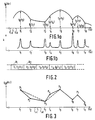
- Fig. 1 in Fig. 1a diagrammatically shows a first signal, in the present example the pitch f0 in a speech signal, as a function of time.
- the signal is represented as a continuous curve.
- the signal is available in the form of samples at equidistant descrete instants ... t i - 1 , t i , t i + 1 ... etc. (for example 20 ms each).
- Fig. 1b shows diagrammatically the third signal representing the curvature k of the first signal f0 of Fig. 1a as a function of time. If the signal f0 takes the form of samples at equidistant instants, the curvature will also be determined for said equidistant instants ...
- Fig. 1b does not show the actual curvature but a kind of absolute value of the curvature. This means that in the curve of Fig. 1b only the (relative) maxima have to be considered. If the actual curvature had been plotted, in which case for example a convex curvature would yield a positive value and a concave curvature a negative value, both the (relative) maxima and the (relative) minima in the curve would have to be allowed for in order to determine the extrema. From Fig. 1b it is apparent that in the curve k extrema appear for the instants t1, t2, ..., t8.
- the signal f0 in Fig. 1a is now encoded by generating a sequence of information blocks, see Fig. 2, in which an information block (such as the block B1 in Fig. 2) indicates the instant (t1) at which an extremum occurs in the curve k and the value of the pitch at this instant (f0(t1)).
- an information block such as the block B1 in Fig. 2 indicates the instant (t1) at which an extremum occurs in the curve k and the value of the pitch at this instant (f0(t1)).
- Fig. 4 shows diagrammatically a device for encoding the signal.
- the device comprises an input terminal 1 for receiving the first signal.
- the input terminal 1 is coupled to an input 2 of an encoding device 3.
- the encoding device 3 processes the signal as described with reference to Figs. 1 and 2 and produces the sequence of information blocks on its output 4, which is coupled to the output terminal 5, where this sequence of information blocks is available, for example for the purpose of transmission via a transmission medium.
- the encoding device 3 comprises a first unit 6, having an input 7 constituting the input 2 of the encoding device 3.
- the firt unit 6 is constructed to determine for every instant the curvature k of the signal f0 and to produce the curve k represetning this curvature on an output 8.
- This output 8 is coupled to an input 9 of an extreme-value detector 10.
- This extreme value detector 10 determines the extreme values in the curve k and supplies information about the instants (t1 to t8) at which said extreme values occur to an output 11.
- This output 11 is coupled to a first input 12 of a combination circuit 13.
- the extreme-value detector 10 in general detects absolute and relative extreme values, i.e.
- the input 2 of the encoding device 3 is coupled to a second input 14 of the combination circuit 13. For every instant applied via the input 12 the combination circuit 13 determines the value of the signal f0 associated with this instant and applied via the the input 14, and generates the sequence of information blocks (B1 to B8) as shown in Fig. 2 on an output 15. The output 15 is coupled to the output terminal 4 of the encoding device 3.
- the curvature k can be determined in various ways.
- a known method is to start from the second time derivative of the signal f0.
- Computing the second derivative in fact means subjecting the signal f0 to a strong high-pass filtration. This results in brief and rapid pitch variations being amplified because these have a high-frequency content. These variations belong to the domain of what is called micro-intonation, i.e. they are perceptually non-significant. Micro-intonation may be regarded as a form of noise in the signal, which disturbs the computation of the derivatives. For this reason the computation of the derivatives should be preceded by a substantial smoothing (of the pitch contour), which only leaves the more gradual perceptually relevant pitch variations in tact. However, this does not yet provide a satisfactory encoding accuracy.
- two straight lines L1 and L2 are determined for this instant.
- these two lines are represented as broken lines L1 and L2.
- the two lines should intersect at the instant t i .
- the lines L1 and L2 are determined as approximations to lines through the points f0(t i - n ) to f0(t i + m ). Both lines can be detemined by means of a least-squares method. This enables the influence of time samples for instants further away from t i to be reduced by means of a weighting function as illustrated in Fig. 5b. If desired, the amplitude for the pitch may be included in the weighting function.
- the values n and m may be equal to one another.
- M ⁇ w(t j )[L1(t j ) - f0(t j )]2 + j ⁇ i ⁇ w(t j ) [L2(t j ) - f0(t j )]2 + j>i W(t i ) [P i - f0(t i ]2 should be minimal.
- p i is the common value of the two lines at the intersection of the two lines at the instant t i .
- the angle ⁇ (i) between the two lines L1 and L2 is now a measure of the curvature of the pitch f0 at the instant t i .
- the above process is carried out, so that for all instants t i the value ⁇ (i) is obtained. Determining the instants for which the curvature is maximal now means that the minima and the maxima in the function ⁇ (i) must be determined.
- the invention is not limited to the embodiments described herein.
- the invention also applies to those embodiments which differ from the embodiments shown in respects which are not relevant to the invention.
- the method and the device may be used for encoding signals other than those representing the pitch.
- An example of this is the encoding of the curves for the formant frequencies as a function of time.
Landscapes
- Engineering & Computer Science (AREA)
- Computational Linguistics (AREA)
- Signal Processing (AREA)
- Health & Medical Sciences (AREA)
- Audiology, Speech & Language Pathology (AREA)
- Human Computer Interaction (AREA)
- Physics & Mathematics (AREA)
- Acoustics & Sound (AREA)
- Multimedia (AREA)
- Compression, Expansion, Code Conversion, And Decoders (AREA)
- Transmission Systems Not Characterized By The Medium Used For Transmission (AREA)
Applications Claiming Priority (2)
| Application Number | Priority Date | Filing Date | Title |
|---|---|---|---|
| NL8800854A NL8800854A (nl) | 1988-04-05 | 1988-04-05 | Werkwijze en inrichting voor het koderen van een signaal, bijvoorbeeld een spraakparameter, zoals de toonhoogte als funktie van de tijd. |
| NL8800854 | 1988-04-05 |
Publications (3)
| Publication Number | Publication Date |
|---|---|
| EP0336502A2 true EP0336502A2 (de) | 1989-10-11 |
| EP0336502A3 EP0336502A3 (de) | 1992-01-02 |
| EP0336502B1 EP0336502B1 (de) | 1996-12-18 |
Family
ID=19852060
Family Applications (1)
| Application Number | Title | Priority Date | Filing Date |
|---|---|---|---|
| EP89200815A Expired - Lifetime EP0336502B1 (de) | 1988-04-05 | 1989-03-30 | Verfahren und Anordnung zum Codieren eines Sprachparameters, wie z.B. der Tonhöhe in Abhängigkeit von der Zeit |
Country Status (5)
| Country | Link |
|---|---|
| US (1) | US4961228A (de) |
| EP (1) | EP0336502B1 (de) |
| JP (1) | JP3162058B2 (de) |
| DE (1) | DE68927556T2 (de) |
| NL (1) | NL8800854A (de) |
Families Citing this family (3)
| Publication number | Priority date | Publication date | Assignee | Title |
|---|---|---|---|---|
| JPH03192400A (ja) * | 1989-12-22 | 1991-08-22 | Gakken Co Ltd | 波形情報処理装置 |
| KR930009436B1 (ko) * | 1991-12-27 | 1993-10-04 | 삼성전자 주식회사 | 파형부호화/복호화 장치 및 방법 |
| JP4889718B2 (ja) * | 2008-12-26 | 2012-03-07 | 独立行政法人科学技術振興機構 | 信号処理装置、方法およびプログラム |
Family Cites Families (6)
| Publication number | Priority date | Publication date | Assignee | Title |
|---|---|---|---|---|
| US2959639A (en) * | 1956-03-05 | 1960-11-08 | Bell Telephone Labor Inc | Transmission at reduced bandwith |
| US3023277A (en) * | 1957-09-19 | 1962-02-27 | Bell Telephone Labor Inc | Reduction of sampling rate in pulse code transmission |
| US3278685A (en) * | 1962-12-31 | 1966-10-11 | Ibm | Wave analyzing system |
| US3598921A (en) * | 1969-04-04 | 1971-08-10 | Nasa | Method and apparatus for data compression by a decreasing slope threshold test |
| US3987289A (en) * | 1974-05-21 | 1976-10-19 | South African Inventions Development Corporation | Electrical signal processing |
| US4680797A (en) * | 1984-06-26 | 1987-07-14 | The United States Of America As Represented By The Secretary Of The Air Force | Secure digital speech communication |
-
1988
- 1988-04-05 NL NL8800854A patent/NL8800854A/nl not_active Application Discontinuation
-
1989
- 1989-03-14 US US07/323,469 patent/US4961228A/en not_active Expired - Lifetime
- 1989-03-30 DE DE68927556T patent/DE68927556T2/de not_active Expired - Fee Related
- 1989-03-30 EP EP89200815A patent/EP0336502B1/de not_active Expired - Lifetime
- 1989-04-03 JP JP08164889A patent/JP3162058B2/ja not_active Expired - Fee Related
Also Published As
| Publication number | Publication date |
|---|---|
| EP0336502B1 (de) | 1996-12-18 |
| JPH01306900A (ja) | 1989-12-11 |
| DE68927556D1 (de) | 1997-01-30 |
| EP0336502A3 (de) | 1992-01-02 |
| NL8800854A (nl) | 1989-11-01 |
| US4961228A (en) | 1990-10-02 |
| DE68927556T2 (de) | 1997-06-05 |
| JP3162058B2 (ja) | 2001-04-25 |
Similar Documents
| Publication | Publication Date | Title |
|---|---|---|
| US4058676A (en) | Speech analysis and synthesis system | |
| US4852179A (en) | Variable frame rate, fixed bit rate vocoding method | |
| US5495556A (en) | Speech synthesizing method and apparatus therefor | |
| EP0243562B1 (de) | Sprachkodierungsverfahren und Einrichtung zur Ausführung dieses Verfahrens | |
| US4301329A (en) | Speech analysis and synthesis apparatus | |
| US4742550A (en) | 4800 BPS interoperable relp system | |
| US4142066A (en) | Suppression of idle channel noise in delta modulation systems | |
| US5077798A (en) | Method and system for voice coding based on vector quantization | |
| CA2109412A1 (en) | Method and Apparatus for Estimating Signal Weighting Parameters in a Receiver | |
| US4918734A (en) | Speech coding system using variable threshold values for noise reduction | |
| US4382160A (en) | Methods and apparatus for encoding and constructing signals | |
| US4045616A (en) | Vocoder system | |
| US4969193A (en) | Method and apparatus for generating a signal transformation and the use thereof in signal processing | |
| EP0336502A2 (de) | Verfahren und Anordnung zum Codieren eines Sprachparameters, wie z.B. der Tonhöhe in Abhängigkeit von der Zeit | |
| US5231397A (en) | Extreme waveform coding | |
| US4459674A (en) | Voice input/output apparatus | |
| George et al. | A new speech coding model based on a least-squares sinusoidal representation | |
| US5202953A (en) | Multi-pulse type coding system with correlation calculation by backward-filtering operation for multi-pulse searching | |
| US7412384B2 (en) | Digital signal processing method, learning method, apparatuses for them, and program storage medium | |
| JPH0782360B2 (ja) | 音声分析合成方法 | |
| US4812987A (en) | Wave shaping circuit | |
| RU2071175C1 (ru) | Способ передачи цифровых сигналов и устройство для его осуществления | |
| Rheem et al. | A nonuniform sampling method of speech signal and its application to speech coding | |
| EP0333425A2 (de) | Sprachcodierung | |
| JPH05224698A (ja) | ピッチサイクル波形を平滑化する方法及び装置 |
Legal Events
| Date | Code | Title | Description |
|---|---|---|---|
| PUAI | Public reference made under article 153(3) epc to a published international application that has entered the european phase |
Free format text: ORIGINAL CODE: 0009012 |
|
| AK | Designated contracting states |
Kind code of ref document: A2 Designated state(s): DE FR GB |
|
| PUAL | Search report despatched |
Free format text: ORIGINAL CODE: 0009013 |
|
| AK | Designated contracting states |
Kind code of ref document: A3 Designated state(s): DE FR GB |
|
| 17P | Request for examination filed |
Effective date: 19920702 |
|
| 17Q | First examination report despatched |
Effective date: 19940711 |
|
| GRAG | Despatch of communication of intention to grant |
Free format text: ORIGINAL CODE: EPIDOS AGRA |
|
| GRAH | Despatch of communication of intention to grant a patent |
Free format text: ORIGINAL CODE: EPIDOS IGRA |
|
| GRAH | Despatch of communication of intention to grant a patent |
Free format text: ORIGINAL CODE: EPIDOS IGRA |
|
| GRAA | (expected) grant |
Free format text: ORIGINAL CODE: 0009210 |
|
| AK | Designated contracting states |
Kind code of ref document: B1 Designated state(s): DE FR GB |
|
| REF | Corresponds to: |
Ref document number: 68927556 Country of ref document: DE Date of ref document: 19970130 |
|
| ET | Fr: translation filed | ||
| PLBE | No opposition filed within time limit |
Free format text: ORIGINAL CODE: 0009261 |
|
| STAA | Information on the status of an ep patent application or granted ep patent |
Free format text: STATUS: NO OPPOSITION FILED WITHIN TIME LIMIT |
|
| 26N | No opposition filed | ||
| REG | Reference to a national code |
Ref country code: FR Ref legal event code: CD |
|
| PGFP | Annual fee paid to national office [announced via postgrant information from national office to epo] |
Ref country code: DE Payment date: 20010516 Year of fee payment: 13 |
|
| REG | Reference to a national code |
Ref country code: GB Ref legal event code: IF02 |
|
| PGFP | Annual fee paid to national office [announced via postgrant information from national office to epo] |
Ref country code: FR Payment date: 20020327 Year of fee payment: 14 |
|
| PGFP | Annual fee paid to national office [announced via postgrant information from national office to epo] |
Ref country code: GB Payment date: 20020328 Year of fee payment: 14 |
|
| PG25 | Lapsed in a contracting state [announced via postgrant information from national office to epo] |
Ref country code: DE Free format text: LAPSE BECAUSE OF NON-PAYMENT OF DUE FEES Effective date: 20021001 |
|
| PG25 | Lapsed in a contracting state [announced via postgrant information from national office to epo] |
Ref country code: GB Free format text: LAPSE BECAUSE OF NON-PAYMENT OF DUE FEES Effective date: 20030330 |
|
| GBPC | Gb: european patent ceased through non-payment of renewal fee |
Effective date: 20030330 |
|
| PG25 | Lapsed in a contracting state [announced via postgrant information from national office to epo] |
Ref country code: FR Free format text: LAPSE BECAUSE OF NON-PAYMENT OF DUE FEES Effective date: 20031127 |
|
| REG | Reference to a national code |
Ref country code: FR Ref legal event code: ST |